I. INTRODUCTION
Multiphase intermetallic alloysReference Chan, West, Dunstan, McLean, Martin and Morris1 are recently receiving increased attention because drawbacks, such as low ductility at ambient temperature and low flow strength at high temperature, that their constituent intermetallics universally haveReference Yamaguchi and Umakoshi2 are overcome e.g., by refining microstructure or reserving coherent interfaces and rigid orientation relationships between constituent phases. Among multiphase intermetallic alloys so far studied by the present authors' group,Reference Tomihisa, Kaneno and Takasugi3–Reference Fujita, Kaneno and Takasugi7 so-called dual two-phase intermetallic alloys based on pseudobinary Ni3Al (L12)–Ni3V (D022) alloy system have a unique microstructure.Reference Nunomura, Kaneno and Takasugi8–Reference Kawahara, Kaneno and Takasugi16 The dual two-phase intermetallic alloys are composed of primary Ni3Al precipitates and Ni solid solution (A1(face centered crystal)) at high temperature, and the prior A1 phase is decomposed into (Ni3Al + Ni3V) by a eutectoid reaction at low temperature, resulting in different microstructures from those of conventional γ/γ′-type superalloys. The dual two-phase microstructures are highly coherent among the constituent phases (structures) and therefore display high microstructural stability. In addition, the dual two-phase intermetallic alloys were found to show attractive high temperature tensile and creep strength that would be applicable to high temperature structural materials.Reference Takasugi and Kaneno17
Alloying method based on the addition of some transition metals has been attempted by the present authors' group to further improve mechanical properties of dual two-phase intermetallic alloys. It was consequently shown that Ti,Reference Shibuya, Kaneno, Yoshida and Takasugi10,Reference Shibuya, Kaneno, Yoshida, Shishido and Takasugi12 NbReference Soga, Kaneno and Takasugi14–Reference Kawahara, Kaneno and Takasugi16 and TaReference Moronaga, Kaneno, Ishii and Takasugi18 are useful solid solution strengtheners, dissolving into two constituent Ni3Al and Ni3V phases. Accordingly, these transition metals have been mostly added within their solid solubility limits to recently treated dual two-phase intermetallic alloys. On the other hand, to evaluate the effect of the addition of carbon (C) that has been an useful element in a number of steels and other alloys, dual two-phase intermetallic alloys containing Ti and/or Nb were charged with TiCReference Kitaura, Kaneno and Takasugi19 and NbCReference Kitaura, Kaneno and Takasugi20 carbide powders or with graphite carbon tips.Reference Osada, Moronaga, Kaneno and Takasugi21 It was found that C dissolving in the dual two-phase microstructure results in strengthening while dispersed carbides formed exceeding the solid solubility limit result in moderate strengthening without sacrificing the tensile ductility.Reference Kitaura, Kaneno and Takasugi19–Reference Osada, Moronaga, Kaneno and Takasugi21 Here, it has to be noted that the treated dual two-phase intermetallic alloys contain alloying transition metals Nb and/or Ti as well as constituent element V, either of which is well known as ‘carbide former’. Therefore, it is important to investigate how the dissolving behavior of C and the microstructure relating to the formed carbides as well as the mechanical properties are affected by the simultaneous addition of these alloying transition metals to the dual two-phase intermetallic alloys.
In this study, two kinds of alloy systems were evaluated: one is called as ternary alloy system and is composed of least elements Ni, Al, and V needed to create dual two-phase microstructure. The dual two-phase microstructure that the ternary alloy system displays is at the core of high-temperature mechanical properties. Therefore, the ternary alloy system was chosen to basically evaluate the effect of carbon or carbide addition on the dual two-phase microstructure and related mechanical properties. Other is called as multicomponent alloy system and is composed of Nb, Ti, Cr, and Co in addition to the three constituent elements. The multicomponent alloy system was developed to further improve the high-temperature mechanical and chemical properties through solid solution strengthening or improving oxidation resistance. The multicomponent alloy system is being applied to some high-temperature structural components in collaboration with industries.
The microstructures of the alloys prepared are investigated by a scanning electron microscope (SEM), an electron probe microscopic analyzer (EPMA), and x-ray diffraction (XRD). The mechanical properties such as hardness and tensile properties of the alloys prepared are evaluated by Vickers hardness and tensile tests. Results obtained from this study are also compared with the results obtained from the previous study on two quaternary alloy systems containing either Nb or Ti.Reference Osada, Moronaga, Kaneno and Takasugi21 Comparing the results obtained from total four alloy systems, the effects of no addition (i.e., constituent element V), single addition (of Nb or Ti), and multiple addition (of Nb and Ti) of carbide formers on the microstructures and mechanical properties are evaluated as a function of charged C content.
II. EXPERIMENTAL
Two kinds of alloy systems formulated by Ni75Al9V16 and Ni69Al9V9.5Nb3Ti1.5Co4Cr4 (at.%) were used as base alloy compositions and shown in Table I. Boron at 50–100 wt ppm levels was doped to suppress grain boundary fracture of the dual two-phase intermetallic alloys. For the multicomponent alloy system, Nb and Ti were added replacing V, Co was added replacing Ni, and Cr was added equally replacing Ni and V from the ternary alloy composition, according to thermodynamic calculation by which preferable substitution of alloying element either for Ni, Al, or V is predicted.Reference Ochiai, Oya and Suzuki22,Reference Sugimura, Kaneno and Takasugi23 These alloying elements were added within their solid solubility limits in the dual two-phase microstructure. It has been observed that Nb and Ti enhance flow strength by solid solution hardening in the two constituent phasesReference Shibuya, Kaneno, Yoshida and Takasugi10,Reference Shibuya, Kaneno, Yoshida, Shishido and Takasugi12,Reference Soga, Kaneno and Takasugi14–Reference Kawahara, Kaneno and Takasugi16 while Co and Cr enhance tensile ductility and oxidation resistance.Reference Hashimoto, Moronaga, Kaneno and Takasugi24 Graphite carbon (C) chips were charged in ranges of 0.1–4.0 at.% C and 0.9–9.3 at.% C to the ternary and the multicomponent alloy systems, respectively (Table I). The contents of C and B shown in Table I are extra numbers, i.e., the numbers excluded from the total 100 at.% summing other elements. The multicomponent alloys charged with high C contents were used to characterize chemistry and crystal structure of the carbides formed in the dual two-phase microstructure.
Nominal compositions of the alloys used in this study.

a C and B are extra numbers; the numbers are not included in the total 100 at.% summing other elements.
As starting raw materials of the alloys, 99.9 wt% Ni, 99.99 wt% Al, 99.9 wt% V, 99.9 wt% Nb, 99.9 wt% Ti, 99.9 wt% Co, 99.9 wt% Cr, 99.8 wt% boron (B), and 99.9 wt% C were used. Alloy buttons with a diameter of 30 or 50 mm were prepared by arc melting in argon gas atmosphere using tungsten electrode and copper hearth. Each alloy button was melted at least three times to ensure chemical homogeneity through an entire button cross section. The weight loss of the button ingots after arc melting was mostly less than 0.2%, therefore revealing that the designed alloy compositions were prepared. The alloys were homogenized at 1553 K for 3 h in a dynamic vacuum condition and then furnace cooled to room temperature (RT) at a cooling rate of approximately 10 K/min to obtain the dual two-phase microstructure. They were then sliced to sizes suitable for specimens used in following experiments. The sliced specimens were mechanically abraded on SiC paper and then electrolytically polished in a mixture solution of 15 vol% H2SO4 + 85 vol% CH3OH at approximately 260 K.
Microstructures of the prepared alloys were investigated by a field emission-type scanning electron microscope (FE-SEM: JSM-7001F operating at 15 kV; JEOL Ltd., Tokyo, Japan) and an EPMA (JXA-8530F equipped with wave dispersive spectroscopy operating at 15 kV; JEOL Ltd.). Also, XRD (RINT-2500 operating at 40 kV) was performed at a scanning speed of 1° or 5°/min in a diffraction angle range between 2θ = 20° and 100° to identify the constituent phases and second-phase dispersions, using Ni-filtrated Cu Kα radiation.
Vickers hardness tests were conducted in conditions of a holding time of 20 s and a load of 1 kg. Hardness was determined by collecting data points more than ten and averaging in each experimental condition. Tensile specimens with a gauge dimension of 2 × 1 × 10 mm3 were cut from the homogenized arc melted buttons using an electric discharge machine (EDM). Tensile axis of the tensile specimen was chosen perpendicular to solidification direction of the arc melted button. Tensile tests were conducted in temperature range between RT and 1173 K within a metal tube surrounded by an electric furnace. The metal tube of the electric furnace was evacuated to a vacuum degree of approximately 1.5 × 10⁻³ Pa before testing. The tensile specimens were deformed at an initial strain rate of 1.66 × 10⁻⁴ s−1 up to fracturing. Yield strength (YS) was defined at 0.2% plastic strain. Tensile elongation defined as plastic strain to fracture was calculated from a load-elongation curve drawn in the recorded chart.
III. RESULTS
A. Ternary alloy (Ni75Al9V16)
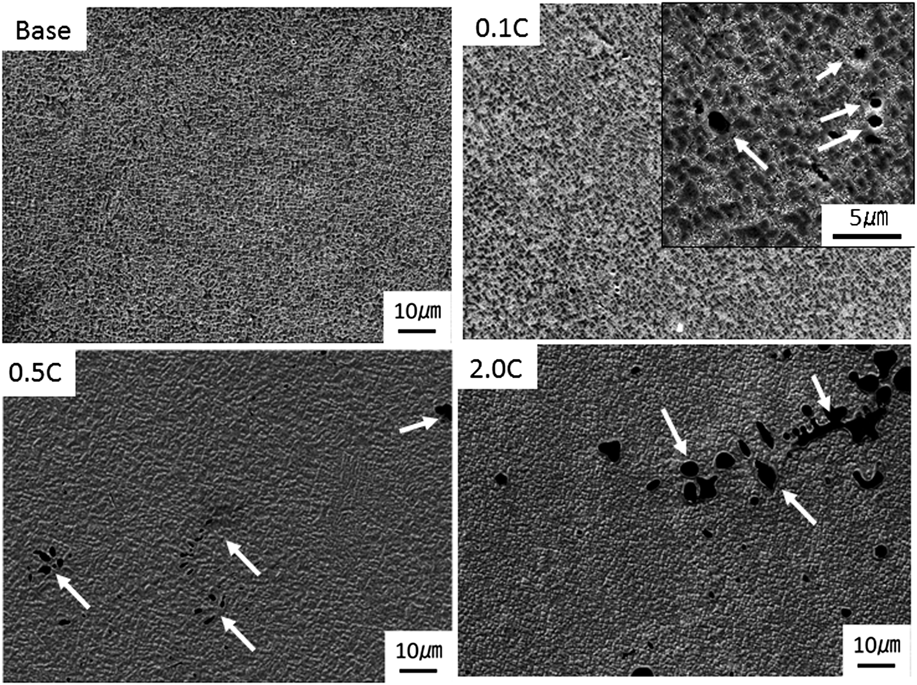
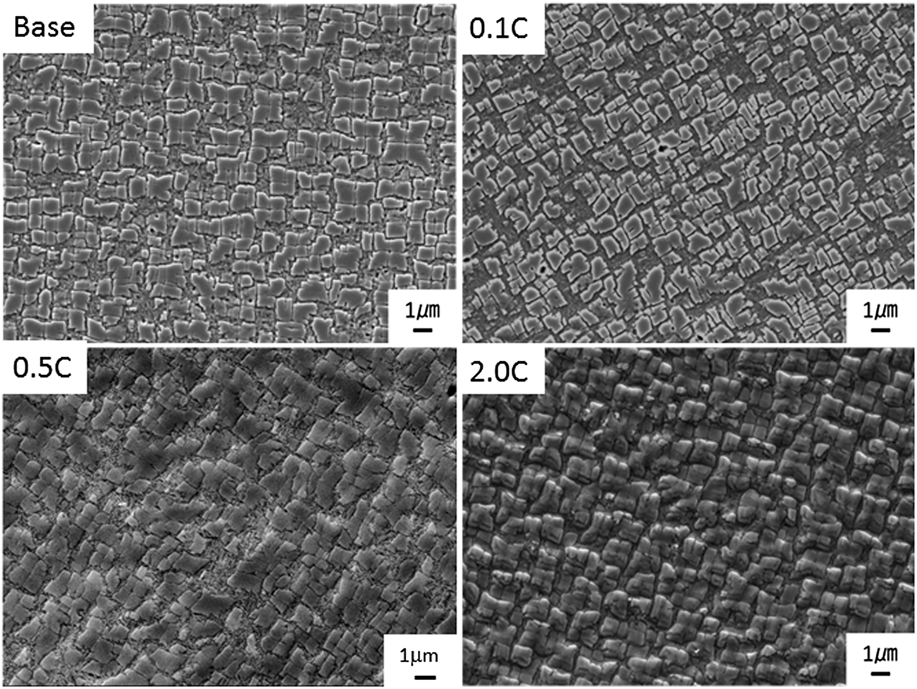
Figure 1 shows SEM-secondary electron images (SEIs) of the microstructures of the ternary alloys charged with C. Images were taken at a low magnification. The microstructures of all the ternary alloys were composed of grains with a size of several hundred μm. Grain interior of the base alloy (i.e., the alloy no charged with C) showed featureless microstructure. In the ternary alloys charged with C, third-phase dispersions presumed as carbides were observed, indicating that solid solubility limit of C in the present dual two-phase microstructure is small, less than 0.1 at.% C. Also, the volume fraction of the carbide dispersions increased with increasing charged C content. Figure 2 shows SEM-SEIs of the microstructures in the grain interiors (matrices) of the ternary alloys charged with C. Images were taken at a high magnification to characterize dual two-phase microstructures. The microstructures consisting of primary Ni3Al precipitates and channel region were clearly observed and insensitive to the charged C content. The size and morphology of the primary Ni3Al precipitates are not so different among all the ternary alloys observed.
SEM-SEIs of the microstructures of the ternary alloys charged with C. Pictures were taken at a low magnification to characterize carbide dispersions. Note that the carbides dispersed in matrices are marked by arrows.
SEM-SEIs of the microstructures of the ternary alloys charged with C. Pictures were taken at a high magnification to characterize dual two-phase microstructures.
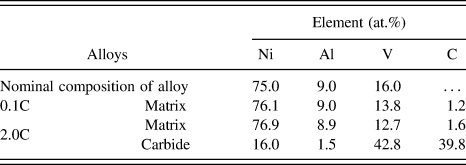
Alloy compositions in the matrices (i.e., grain interiors) and carbide dispersions of the ternary alloys charged with 0.1 and 2.0 at.% C were analyzed by EPMA and shown in Table II. The former area was analyzed with a relatively large probe diameter to obtain average composition over the grain interior while the latter area was analyzed with a probe diameter as small as possible. The carbide dispersions in the ternary alloy charged with 2.0 at.% C were composed of almost equal contents of V and C, therefore indicating VC carbides with NaCl structure ( $Fm\bar 3m$: a = 0.4165 nm). Also, V content in the matrix decreases with increasing charged C content, revealing that V in the dual two-phase microstructure is consumed by the charged C.
Chemical compositions (at.%) in the matrices (grain interiors) and carbides of the ternary alloys charged with 0.1 and 2.0 at.% C, respectively.
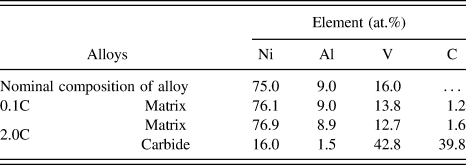
Figure 3 shows XRD patterns of the ternary alloys charged with C. In all the ternary alloys, the Ni3Al and Ni3V phases were identified although the majority of reflection peaks from the both phases are superimposed and therefore are not distinguished. However, the previous study using a transmission electron microscope (TEM) showed that dual two-phase microstructure is maintained in the ternary alloy with an almost same composition (Ni75Al8.5V16.5) as the present ternary alloy.Reference Kawahara, Moronaga, Kaneno, Kakitsuji and Takasugi25 In the ternary alloys charged with 2.0 and 4.0 at.% C, additional reflection peaks were identified as VC, whose chemical composition is identical to those of the carbides determined by the previous EPMA (Table II). In the ternary alloys charged with other low C contents, additional reflection peaks were not observed because the volume fractions of the formed carbides were small, as understood from the microstructures shown in Fig. 1. Also, it is likely that 111 reflection peaks from the Ni3Al and Ni3V phases had to be overlapped at 2θ = 43.42° with the most strongest 200 reflection peak from VC carbides.
XRD patterns of the ternary alloys charged with C.
Figure 4 shows the change of Vickers hardness by charged C content for the ternary alloys. The hardness gently made a peak at 0.1–0.5 at.% C and then steadily decreased with increasing charged C content. The C content where the hardness made a peak corresponds almost to the solid solubility limit of C in the dual two-phase microstructure, meaning that solid solution hardening due to C dissolving in the constituent phases certainly occurs.
Change of Vickers hardness by charged C content for the ternary alloys.
Figure 5 shows the changes of YS, tensile strength (UTS), and tensile elongation by charged C content at RT, 873 K, 1073 K, and 1173 K, respectively for the ternary alloys. The YS as well as the UTS tended to make a peak at around 0.1–0.5 at.% C contents, followed by a steady decrease, irrespective of test temperatures. This behavior is similar to that observed in the hardness shown in Fig. 4. Thus, the C content where the flow strength made a peak corresponds almost to the solid solubility limit of C in the dual two-phase microstructure. On the other hand, the tensile elongation increased in the range of 0.1–0.5 at.% C contents with increasing C content, and steadily increased with further increasing C content. Interestingly, not only the dissolving C but also the formed carbides are not harmful for the tensile ductility of the ternary alloys with dual two-phase microstructure; rather have the effect of enhancing the tensile ductility.
Changes of YS, UTS, and tensile elongation by charged C content at RT, 873, 1073, and 1173 K, respectively for the ternary alloys.
B. Multicomponent alloy (Ni69Al9V9.5Nb3Ti1.5Co4Cr4)
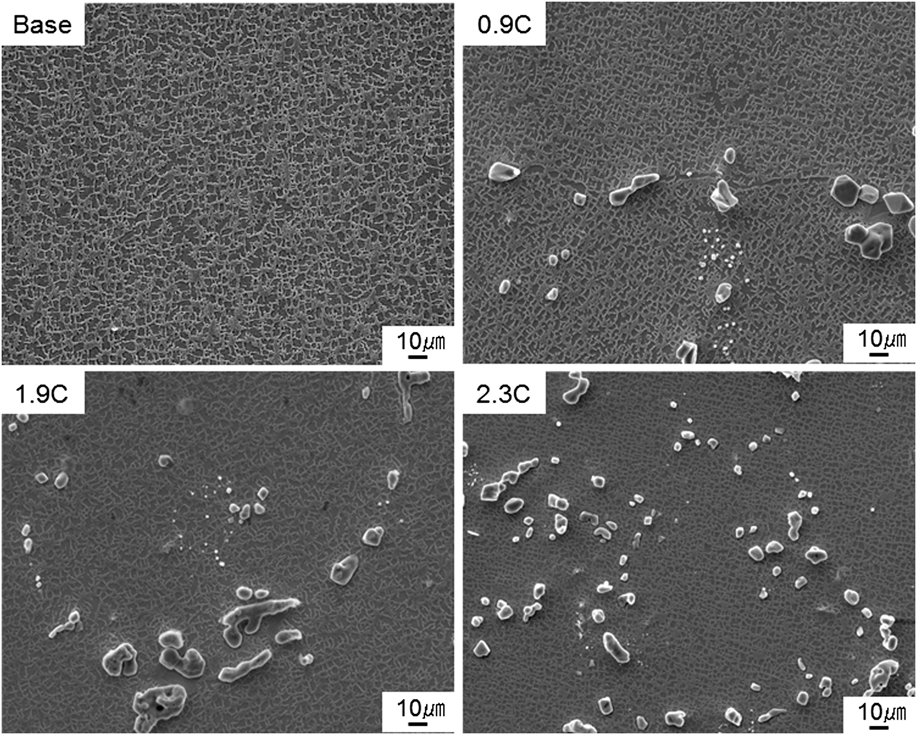
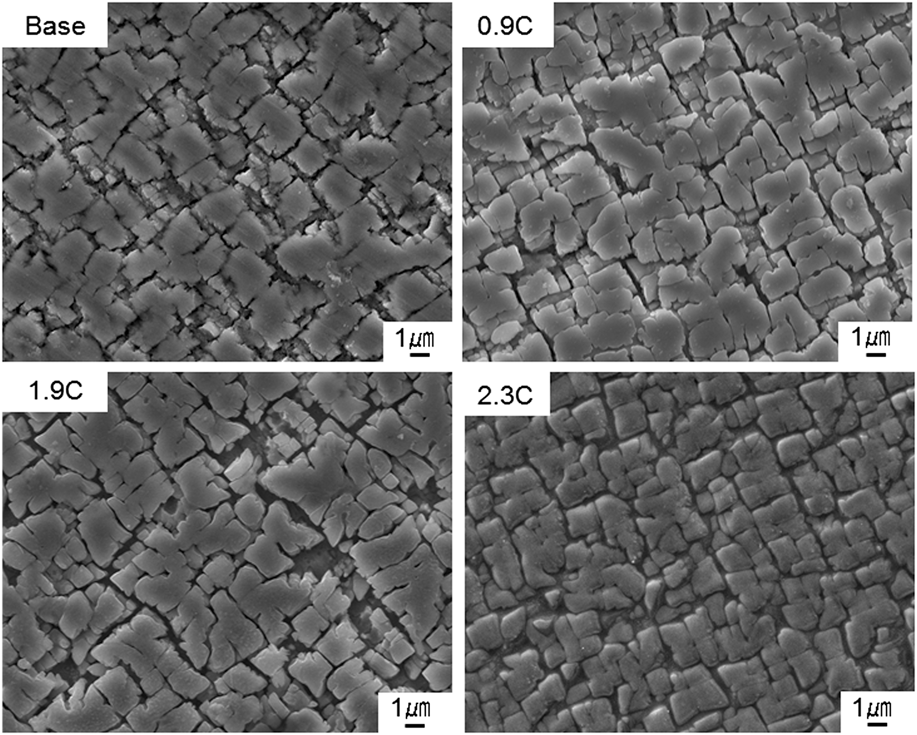
Figures 6 and 7 show SEM-SEIs of the microstructures of the multicomponent alloys charged with C. Images were taken at low (Fig. 6) and high (Fig. 7) magnifications. Third-phase dispersions presumed as carbides were observed in the alloy charged with either C content. Accordingly, solid solubility limit of C in the dual two-phase microstructure for the multicomponent alloy is assumed to be far below 0.9 at.% C. In the multicomponent alloys charged with high C contents, the carbides appear to coalesce and grow into large size. The dual two-phase microstructures composed of primary Ni3Al precipitates and channel region were formed in the grain interiors of all the alloys charged with C, and primarily insensitive to the charged C content.
SEM-SEIs of the microstructures of the multicomponent alloys charged with C. Pictures were taken at a low magnification to characterize carbide dispersions.
SEM-SEIs of the microstructures of the multicomponent alloys charged with C. Pictures were taken at a high magnification to characterize dual two-phase microstructure.
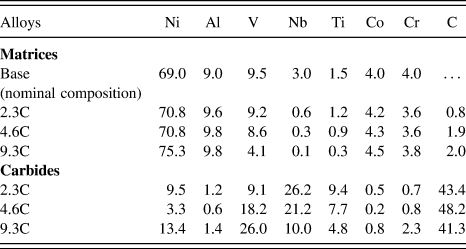
Figure 8 shows elemental mapping for the multicomponent alloy that was charged with a high C content (4.6 at.%) and had large-sized carbide dispersions. It is evident that the matrix is composed of alloying elements Co and Cr in addition to the constituent elements Ni, Al, and V. On the other hand, dispersed carbides were composed of carbide formers V, Nb, Ti, and C, as expected. V, Nb, and Ti were heterogeneously present within the carbides: Nb-rich and V-rich regions are mixed, revealing that NbC-based and VC-based carbides are coalesced. Alloy compositions of the matrices and coalesced carbides in the multicomponent alloys charged with various C contents were quantitatively analyzed by EPMA. The former area was analyzed with a relatively large probe diameter to collect an average alloy composition through the matrix. The latter area was analyzed, e.g., confining the position marked by yellow color dot shown in the SEI of Fig. 8. However, alloy compositions analyzed for the coalesced carbides have to be average values of the NbC-based and VC-based carbides. Table III summarizes alloy compositions of the matrices and carbides in the multicomponent alloys charged with various C contents. Also, Fig. 9 shows V, Nb, Ti, and Cr contents in the dispersed carbides and the matrices as a function of charged C content. As understood from Table III and Fig. 9, when the charged C contents are low (i.e., the volume fractions of the dispersed carbides are small), major transition elements combined with C are Nb, Ti, and V. On the other hand, when the charged C contents are high (i.e., the volume fractions of the dispersed carbides are large), those combined with C alternatively become V. The formed carbides were composed of an almost equi-atomic content of the sum of transition metals (V, Nb, Ti, and Cr) and C. Accompanied with the transition of the transition metals constituting the carbides with increasing charged C content, the content of transition metals in the matrix began to decline in the order, Nb → Ti → V with increasing C content, as shown in Fig. 9(b). Cr appears to be not so much involved into the carbides even with increasing charged C content.
SEM-SEI and elemental mappings of Ni, Al, V, Nb, Ti, Co, Cr, and C in the microstructure of the multi-component alloy charged with 4.6 at.% C. Quantitative analysis for alloy composition of the carbide dispersions was performed on the position marked by yellow color in the SEI and the analyzed values are shown in Table III.
Chemical compositions (at.%) in the matrices (grain interiors) and carbides of the multi-component alloys charged with various C contents.
Changes of V, Nb, Ti, Cr, and C contents in (a) the dispersed carbides and (b) the matrices by charged C content for the multicomponent alloys. As the alloy compositions in the matrix of the base alloy (i.e., no C charged alloy) in (b), the nominal compositions of the base alloy are plotted.
Figure 10 shows XRD patterns of the multicomponent alloys charged with C. The Ni3Al and Ni3V phases indicating the dual two-phase microstructure were identified for all the multicomponent alloys charged with C although the majority of reflection peaks from the both phases are not distinguished because of their superimposition. However, the previous study using TEM showed that dual two-phase microstructure is maintained in the multicomponent alloy with a similar composition (e.g., Ni71Al10V11Nb4Cr4) to the present ternary alloy.Reference Hashimoto, Moronaga, Kaneno and Takasugi24 The carbides were not identified for the multicomponent alloys charged with low C contents but identified for the multicomponent alloys charged with high C contents >1.9 at.% (i.e., high volume fractions of the dispersed carbides). It is noted from the figure that NbC-based carbides prevailed in the alloys with low charged C contents while VC-based carbides mixed with NbC-based carbides prevailed in the alloys with high C contents. Thus, the structural (XRD) result observed in the alloys charged with high C contents is consistent with the chemical (EPMA) result shown in Fig. 8 where the coalesced large carbides in the dual two-phase microstructure were constituted by V and Nb.
XRD patterns of the multicomponent alloys charged with C.
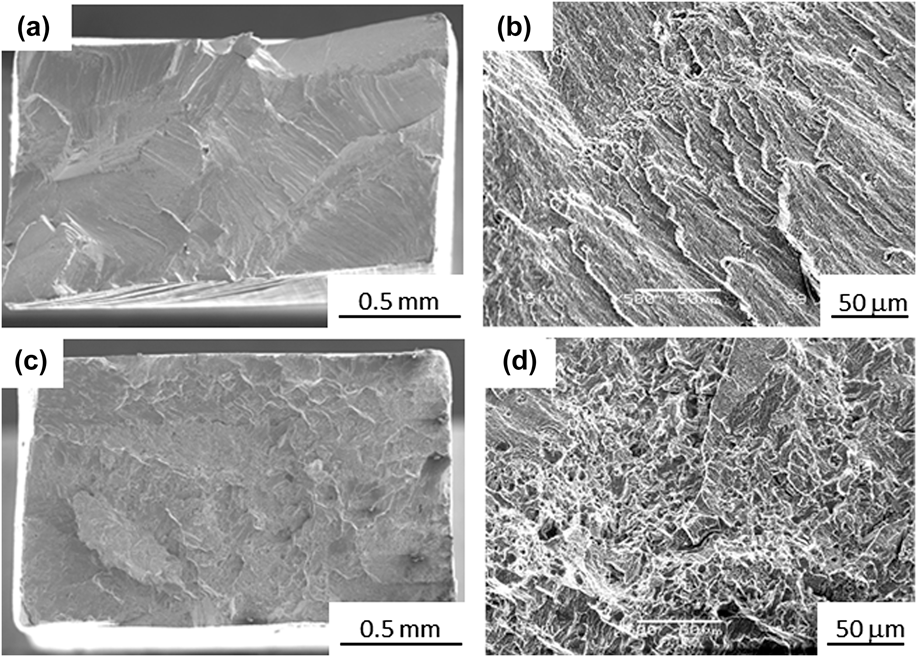
Figure 11 shows the changes of YS, UTS, and tensile elongation by charged C content for the multicomponent alloys deformed at RT and 1073 K, respectively. The YS as well as the UTS made a peak at C contents below 1 at.% C, followed by a steady decrease irrespective of test temperatures. This behavior is quite similar to the hardness behavior (Fig. 4) and the tensile behavior (Fig. 5) observed for the ternary alloys. The C content where the flow strength made a peak corresponds almost to the C content where the third-phase carbides began to be dispersed, exceeding the solid solubility limit of C in the multicomponent alloy. On the other hand, the tensile elongation steadily increased with increasing C content. Figure 11 again indicates that not only the dissolving C but also the carbides are not harmful, rather beneficial to the tensile ductility of the multicomponent alloy. In association with the tensile elongation behavior, Fig. 12 shows SEM fractography for the multicomponent alloys without and with 0.9 at.% C charging that were deformed at RT. The multicomponent alloy without C charging showed transgranular fracture accompanied with quasi cleavage-like pattern while that with C charging showed transgranular fracture accompanied with dimple pattern. Thus, the observed fractography is consistent with the tensile elongation behavior shown in Fig. 11. The decrease in the tensile elongation of the multicomponent alloy charged with a high content of 4.6 at.% C at 1073 K may be associated with too large carbide dispersions.
Changes of YS, UTS, and tensile elongation by charged C content for the multicomponent alloys deformed at RT and 1073 K, respectively.
SEM fractography for the multicomponent alloys charged (a and b) without and (c and d) with 0.9 at.% C that were deformed at RT. SEM images of both alloys were taken at (a and c) low and (b and d) high magnifications.
C. Comparison of ternary and multicomponent alloys with quaternary alloys (Ni75Al9V16Nb3 and Ni75Al9V16Ti3)
In the previous study by the present authors' group,Reference Osada, Moronaga, Kaneno and Takasugi21 the effect of C charging on the microstructure and tensile properties was investigated for two kinds of quaternary alloy systems formulated by Ni75Al9V13Nb3 and Ni75Al9V13Ti3 (at.%) (Table I). Nb or Ti was added to the ternary alloy evaluated in Sec. III. A. Both alloys are referred to as quaternary (Nb) and quaternary (Ti) alloys, respectively. It is meaningful to compare the present ternary and multicomponent alloys with the two quaternary alloys. Figures 13 and 14 summarize strength properties and tensile elongation as a function of charged C content for four alloy systems, respectively. Regarding the changes of YS and UTS by charged C content, almost similar behavior was investigated, irrespective of alloy systems or test temperatures. The YS as well as the UTS certainly increased in the low C content range below their solid solubility limits and then made a peak, followed by steady decrease with further increasing C content. The strengthening by the addition of Nb effectively occurs in the quaternary alloy (Nb), and is more substantial in the low C content range than in the high C content range irrespective of low or high test temperature. This result reveals that the solid solution strengthening due to Nb in the two constituent phases is effective in the low C content range but the dispersion strengthening due to Nb-based carbides appears to be ineffective in the high C content range, as described previously. The change of the tensile elongation by charged C content also showed similar behavior, irrespective of alloy systems or test temperatures (Fig. 14): the tensile elongation steadily increased over a wide range of charged C contents, revealing that the dissolving C as well as the formed carbides are beneficial for the tensile ductility of all the alloy systems evaluated.
Comparisons in YS and UTS at RT and 1073 K for the ternary, quaternary (Nb),Reference Osada, Moronaga, Kaneno and Takasugi21 quaternary (Ti),Reference Osada, Moronaga, Kaneno and Takasugi21 and multi-component alloys.
Comparison in tensile elongation at RT and 1073 K for the ternary, quaternary (Nb),Reference Osada, Moronaga, Kaneno and Takasugi21 quaternary (Ti),Reference Osada, Moronaga, Kaneno and Takasugi21 and multicomponent alloys.
IV. DISCUSSION
The maximum solid solubility limits of C in the A1 phase and the Ni3Al phase relating to the present dual two-phase intermetallic alloys have been reported to be 2.7 (Ref. Reference Singleton and Nash26) and 5.8 (Ref. Reference Huetter and Stadelmaier27) at.% C, respectively although that in the Ni3V phase is not available up to the present. On the other hand, the present study and the previous studiesReference Kitaura, Kaneno and Takasugi19–Reference Osada, Moronaga, Kaneno and Takasugi21 showed that the solid solubility limits of C in dual two-phase microstructures were very small, i.e., mostly less than 0.1 at.% C in all the alloy systems investigated. This is because V creating dual two-phase microstructure and at the same time constituting carbides is invariably contained in all the alloy systems investigated in this study. In the quaternary and multicomponent alloys, the carbide formers Nb, Ti, and/or Cr in addition to V were further contained. Thus, the formation of the carbides was inevitable in either alloy system evaluated in this study. In other words, carbides are always formed whenever certain amounts of carbon are charged to these dual two-phase intermetallic alloys.
It is likely that the carbides were not precipitated from solid phase but crystallized directly from liquid phase because their melting points are very high comparing with that (∼1650 K) of most dual two-phase intermetallic alloysReference Hong, Mishima and Suzuki28: the melting points of NbC, TiC, and VC are reported to be 3886 K, 3530 K, and 2921 K, respectively. Consequently, the carbides tended to coalesce and grow without having any crystal coherency with dual two-phase microstructure. Also, precipitation of fine carbides may be not expected in the dual two-phase intermetallic alloys even though transition metals such as Ti or Nb are not added. In the formed carbides, major transition metals combined with C changed from Ti and Nb to V with increasing charged C content: the formed carbides changed from (Nb, Ti, V)C at low C contents to VC at high C contents. Interestingly, this transition may be associated with the capability of the carbide formation, in other words, the magnitude of the heat of formation energy of the carbide; −183.8 kJ/mol (TiC) > −138.1 kJ/mol (NbC) > −100.9 kJ/mol (VC).Reference Gale and Totemeier29 Consequently, Ti and Nb first bind with low contents of C and have to be sooner or later depleted from the matrix. Subsequently, V binds with C by further charging of C. Solid solutioning among Ti, Nb, V, and Cr in the metal site X constituting carbides XC is possible according to the crystallographic feature so that TiC (a = 4.318 nm), NbC (a = 4.433 nm), and VC (a = 4.118 nm) have the same NaCl structure ( $Fm\bar 3m$) and similar lattice parameters.
It appears that the C dissolving in the constituent phases certainly enhances hardness or flow strength by solid solution hardening mechanism even though its solid solubility is small. Large lattice strain is expected by C charging since C occupies interstitial sites in Ni3Al (L12) and Ni3V (D022).Reference Masahashi, Takasugi and Izumi30,Reference Briant and Huang31 Also, it has to be noted that the dissolving C never reduces, rather, improves the tensile ductility though its responsible mechanisms are not yet clarified. As one of possible mechanisms responsible for this behavior, it has been suggested that the dissolving C enhances intergranular strength and thereby suppresses intergranular fracture.Reference Kitaura, Kaneno and Takasugi19–Reference Osada, Moronaga, Kaneno and Takasugi21 Indeed, SEM observation observed in the multicomponent alloy with the dispersed carbides (i.e., charged with 0.9 at.% C) (Fig. 12) indicates that intergranular fracture was suppressed.
For the mechanical properties at high C contents beyond the solid solubility limit, the hardness as well as the UTS were reduced while the tensile ductility was enhanced, irrespective of test temperatures or alloy systems. Here, it has to be noted that the decrease of the strength and the increase of the tensile ductility began at the same time as soon as the carbides were formed in the dual two-phase microstructures. It was shown that the formation of the carbides has the effect of depleting V, Ti, and Nb from the matrix: V is constituent element leading to core strengthening via maintaining eutectoid microstructure in the channel region while Ti and Nb are elements resulting in solid solution hardening in the constituent phases. The decrease of V content in the matrix may lead to the decrease of the volume fraction of the Ni3V phase acting as a strengthener in the eutectoid microstructure in the channel region. Otherwise, V constituting the Ni3V phase in the eutectoid microstructure is more removed from the matrix with increasing charged C content and thereby the relative content of Ni to V increases as actually shown in Table III, consequently destabilizing the eutectoid microstructure via destabilizing the Ni3V phase. Accordingly, the phase decomposition into the eutectoid microstructure from the prior A1 phase may be hindered by the formation of the carbides. Similar effect has been observed in the dual two-phase intermetallic alloys to which Re,Reference Moronaga, Kaneno, Semboshi and Takasugi32 Mo,Reference Edatsugi, Kaneno, Semboshi and Takasugi33 and WReference Edatsugi, Kaneno, Semboshi and Takasugi33 were added replacing V. In the dual two-phase microstructures, the channel region consisting of the eutectoid microstructure serves as hard material while the primary Ni3Al precipitates serve as soft material, in contrast to the γ/γ′-type conventional superalloys. The immature eutectoid microstructure in the channel region of the alloys in which V was removed via forming VC carbides had to result in the softening. Furthermore, apparent dispersion hardening is not expected since the formed carbides are too large and have no crystal coherency with the matrix. Thus, it is suggested that the softening due to the depletion of V, Ti, and Nb from the matrix prevailed over the dispersion hardening due to the carbides, consequently reducing hardness or strength and also enhancing tensile ductility of the dual two-phase intermetallic alloys. Also, proposing other additional mechanisms responsible for the enhanced tensile ductility, it is possible that particle stimulated plasticity (PSP)Reference Humphreys and Hatherly34,Reference Fleck, Ashby and Hutchinson35 by the dispersed carbides enhanced the tensile ductility. Actually, the result that numerous dimple patterns were observed in the multicomponent alloy with the dispersed carbides (i.e., charged with 0.9 at.% C) (Fig. 12) is consistent with the proposed mechanism. It is anticipated that plastic deformation is promoted in the region adjoining the carbides where V is depleted and thereby the eutectoid microstructure in the channel region is degenerated. As a relating observation, it is presented that the second-phase dispersions (Ni3Nb) in Ni3(Si, Ti) alloy induced plastic deformation and consequently increased the tensile elongation.Reference Fujita, Kaneno and Takasugi7 Certainly, much more studies are needed to specify the mechanisms responsible for the tensile behavior.
Last, briefly and comprehensively discussing the effect of alloy composition on the microstructure and mechanical properties relating to the dissolving carbon or the carbides, it appears that there are not so much distinctive differences among four alloy systems investigated or referred. This is because carbide former V is invariably contained in all alloy systems evaluated in this study and substantially dominated the solid solubility of carbon, the microstructure (relating to the dual two-phase microstructure or the carbides), and mechanical properties. In the alloys containing Nb that is a strong carbide former and at the same time prominent solid solution strengthener, the microstructure and mechanical properties were affected through introducing Nb containing carbides and also reducing Nb and C contents from the matrices (grain interiors). Consequently, considering the balance of the strength and tensile elongation, optimal contents of Nb and C and ratio of Nb to C contents may be suggested.
V. CONCLUSION
The effects of C charging on the microstructures and mechanical properties of ternary (Ni75Al9V16) and multicomponent (Ni69Al9V9.5Nb3Ti1.5Co4Cr4) alloys with dual two-phase Ni3Al and Ni3V microstructures were investigated by SEM, EPMA, XRD, Vickers hardness, and tensile tests, focusing on the effects of dissolving C and dispersed carbides. Also, the present results were comprehensively discussed, combining with the previously studied quaternary alloys containing Nb or Ti. The following results were obtained from the present study.
(1) Solid solubility limits of C in dual two-phase microstructures were small, mostly less than 0.1 at.% for all alloy systems evaluated in this study. This is because V that is required to create dual two-phase microstructure and at the same time is a carbide former is invariably contained in all alloy systems evaluated in this study.
(2) Major metals constituting the carbides changed from Ti and Nb to V with increasing charged C content, that is, the volume fraction of the carbides. This transition was correlated with the capability of the carbide formation, i.e., the degree of the heat of formation energy of the carbides.
(3) C dissolving in the two constituent phases contributed to strengthening or hardening through solid solution hardening mechanism and also to enhancing tensile ductility through suppressing intergranular fracture.
(4) The carbides little contributed to the strengthening because of large-sized dispersions with no crystal coherency with the matrices, rather, contributed to the softening or the improvement of tensile ductility through depleting solid solution strengthener V, Nb, Ti, and/or Cr from the matrices as well as through inducing carbide stimulated plasticity (PSP).
ACKNOWLEDGMENT
This work was supported in part by a Grant-in-Aid for Scientific Research (B) (No. 26289263) from the Japan Society for the Promotion of Science (JSPS).