1 Introduction
Metacognition has multiple facilitative functions in language learning in general and in developing listening comprehension in particular. One of the common functions among good listeners is a sense of agency from which they are in charge of their own listening. This sense of agency requires listeners to be responsible for and aware of their listening, to evaluate their own listening, and to use strategies to improve their listening comprehension. Metacognitive strategies support listeners to increase their comprehension, as it is a strong predictor of learning, describing almost 17% of variance in learning, in comparison with intelligence, which is described as 10% (Veenman, Van Hout-Wolters & Afflerbach, Reference Veenman, Van Hout-Wolters and Afflerbach2006).
Taking metacognition into action strategically in learning might cover up the high percentage of learning. Recent studies (Bozorgian, Reference Bozorgian2014; Cross, Reference Cross2011; Goh & Hu, Reference Goh and Hu2014; Vandergrift & Goh, Reference Vandergrift and Goh2012) have used metacognitive instruction to develop second and foreign language (L2/FL) listening comprehension. The aim of these studies centered on the process of listening comprehension, which is not sufficiently taken into consideration in the classroom. There is a wide choice of multimedia listening materials available, such as CDs, DVDs, and videos or the Internet, used in many L2/FL classrooms. However, to truly make multimedia the primary concern, some alterations must take place in the classroom approach and activities, although arranging multimedia as a pedagogically driven material seems to be a challenge to the syllabus developers and language professionals.
Dialogic interaction has recently been used as a tool in the classroom to develop listening comprehension (see Cross, Reference Cross2011). Dialogic interaction, which emanated from activity theory, investigates learners’ motives and beliefs, pair work, goals, and pattern of interaction to specify their development of metacognition of L2 listening. The interaction between pairs of learners is a useful tool in a listening lesson to elicit and measure listeners’ use of strategies (Fernández-Toro, Reference Fernández-Toro2005). However, this study has used the Metacognitive Awareness Listening Questionnaire (MALQ) and metacognitive instruction through dialogic interaction to examine Iranian advanced listeners’ metacognitive awareness and their multimedia listening development, which have been inadequately researched.
2 The concept of metacognition
The term “metacognition”, which emanated from Flavell (Reference Flavell1976), was simply defined as thinking about thinking, and cognition of cognition. A few years later, the term metacognition was deconstructed into three different but related kinds of knowledge: person knowledge (the cognitive knowledge an individual has about oneself and others), task knowledge (the knowledge source an individual finds for doing a task), and strategy knowledge (the knowledge of strategies an individual uses to accomplish the purpose of a task) (Flavell, Reference Flavell1979). Considering the different kinds of knowledge, teachers should realize person knowledge through individual differences; task knowledge through its purposes, demands, nature, and awareness; and strategy knowledge (e.g. Livingston, Reference Livingston1997) through cognition, metacognition, and condition of appropriate time and place, where strategies can be used. Thus, this knowledge realization assists teachers to develop quality teaching and learners to have quality learning outcomes in the English as a foreign language (EFL) classroom.
2.1 Metacognitive Awareness and Listening Questionnaire (MALQ)
Metacognitive awareness plays an important role in learning in general and L2/FL listening in particular. Metacognitive awareness was defined as “planning and consciously executing appropriate actions to achieve a particular goal” (Sheorey & Mokhtari, Reference Sheorey and Mokhtari2001: 432). MALQ was developed in the light of research and theory based on Flavell’s (Reference Flavell1979) notion of metacognition, which increased awareness of L2 listening comprehension (see Vandergrift, Goh, Mareschal & Tafaghodtari, Reference Vandergrift, Goh, Mareschal and Tafaghodtari2006).
Metacognitive awareness has been widely recognized to contribute to a child’s cognitive development, academic learning, and language development (Alexander, Reference Alexander2008; Wenden, Reference Wenden1991). This recognition of metacognitive awareness is a strong predictor of learning, accounting for approximately 17% of variance in learning, compared to 10%, which is accounted for by intelligence (Veenman et al., Reference Veenman, Van Hout-Wolters and Afflerbach2006). Metacognitive awareness has been used as a facilitating notion in improving L2/FL listening comprehension. Three studies (Bozorgian, Reference Bozorgian2014; Goh & Hu, Reference Goh and Hu2014; Vandergrift & Tafaghodtari, Reference Vandergrift and Tafaghodtari2010) have recently focused on the effect of metacognitive instruction on listeners’ comprehension and their metacognitive awareness.
Bozorgian (Reference Bozorgian2014) investigated the effect of metacognitive instruction on the listening comprehension and metacognitive awareness of a group of 30 male high-intermediate listeners who were learning EFL in Iran. The EFL listeners, speaking Persian as their first language, received a guided lesson plan in metacognition (planning, monitoring, and evaluation) through a pedagogical cycle approach over a semester (eight weeks). International English Language Testing System (IELTS) listening tests (practice) were used to track the listeners’ listening performance. Participants also completed the MALQ, which examined their use of metacognitive awareness when engaged in listening tasks. Results indicated that metacognitive instruction improved the listening comprehension after the listeners were taught metacognition, but the use of metacognitive awareness was not significantly reported.
Another study conducted by Goh and Hu (Reference Goh and Hu2014) explored the relationship between metacognitive awareness and listening comprehension through the MALQ. English as a second language (ESL) Chinese learners’ (N=113) metacognitive awareness with regard to their knowledge of listening strategies was measured through IELTS and the MALQ. The five different MALQ factors of metacognitive awareness related to listening comprehension were examined through the learners’ responses. A significant positive relationship between learners’ metacognitive awareness scores and listening comprehension was indicated, and their metacognitive awareness accounted for 22% of the variance in listening comprehension. The analysis of individual factors showed that there was a significant relationship between listening comprehension and directed attention and problem-solving strategies, as well as an overall moderate-to-low sense of confidence among the listeners in the study.
Vandergrift and Tafaghodtari (Reference Vandergrift and Tafaghodtari2010) investigated the impact of metacognitive instruction through a process-based approach on 106 French as a second language learners’ listening comprehension. The experimental group received a lesson plan including prediction/planning, monitoring, evaluating, and problem-solving, whereas the control group, instructed by the same teacher, listened to the same texts the same number of times but without any lesson plan. The MALQ was used to measure any development of metacognition about L2 listening at the beginning, middle, and end of the study. The results showed that the experimental group significantly gained more than the control group on the final listening comprehension test. The hypothesis that the less skilled listeners in the experimental group would make greater gains than their more skilled peers was also verified. As indicated through the transcribed data, the listeners’ metacognitive awareness increased over the duration of the study.
The studies previously discussed and several other studies (Bozorgian, Reference Bozorgian2012; Cross, Reference Cross2009; Goh & Taib, Reference Goh and Taib2006; Vandergrift, Reference Vandergrift2003) have shown that metacognitive awareness and listening comprehension were increased through metacognitive instruction in the classroom. Furthermore, the main reason to highlight metacognition for EFL listeners in an input-poor environment is to encourage them to be actively involved, and metacognition motivates them to find opportunities for self-directed learning outside the classroom (Huang, Reference Huang2005). The studies noted previously show that metacognitive instruction strengthens learners’ awareness of their listening comprehension as well as learning processes and improves their ability to choose which strategies suit their learning development. Furthermore, the current study measures whether metacognitive instruction or metacognitive instruction through dialogic interaction has an effect on learners’ metacognitive awareness in multimedia listening comprehension.
2.2 Multimedia in listening comprehension
Today, multimedia is widely used as an instructional aid in almost all levels of EFL/ESL classrooms. Multimedia is software to increase storage capacity, speed, and memory span, which enables a computer to deliver video, sound, text, and graphics (Brett, Reference Brett1995). Good multimedia software should have features such as documentation, learner control, branching capabilities, portability, ease of use, and cost-effectiveness (Murphy, Reference Murphy1995). Multimedia is a useful tool for listeners to consider different communicative situations and helps them to transcend physical boundaries, making it possible for them to hear/watch the use of another language outside the classroom (Cogill, Reference Cogill1999). A study conducted by Brett (Reference Brett1997) investigated listening performance in a computer-based multimedia environment. Learner success rates on comprehension and language recall tasks were compared while using the three different media of audio, video, and multimedia. The findings indicated that performance on tasks was more effective on comprehension and recall while using multimedia than audio or video plus pen and paper; a learner questionnaire showed possible reasons for the greater success of multimedia.
Ginther (Reference Ginther2002) explored the relative effect of two kinds of situations and content visuals on listening performance on the computerised TOEFL test. Ginther argued that providing situations and culture for listeners was an effective strategy to enhance comprehension. Such information presented through visual displays, which played disparate roles on listening performance, helped listeners to exchange ideas and facilitated the understanding of the content exchange. The finding showed that mini-talks with pictures helped increase listening comprehension slightly, whereas comprehension is impaired without context visuals. The study argued that advance organizers providing information indirectly did not contribute to the listeners. Visual supports assisted learners to have an adequate available amount of working memory capacity to comprehend the information.
In line with EFL listening comprehension through visual supports, Chang and Read (Reference Chang and Read2007) investigated the effect of different types of listening support on low-level proficiency learners in a learning situation, namely in Taiwan. Four groups participated in the study and two groups received listening supports, either a set of pictures or a written background text. The third group received repetition of the listening input as a listening support, whereas the fourth group was the control group and received no listening support. Some of the learners took the listening proficiency test, completed a short questionnaire, and were also interviewed. The study found that input repetition was the most effective, followed by visuals and texts as the next most effective listening support.
Analyzing the findings of the studies noted above shows that multimedia listening is widely considered influential and comprehensible for L2/FL language listeners. Furthermore, using multimedia shows the enhancement of language acquisition and shortens the process of EFL/ESL listening comprehension, and the large-scale infusion of multimedia into most English language institutes bears witness to it. In order for listeners to be able to process more chunks of oral/visual input through multimedia, they needed some metacognitive instruction through dialogic interaction to compensate for any deficiencies in oral input. Using these strategies in L2/FL listening through multimedia support might improve listeners’ comprehension, and therefore the current study measures the effect of metacognitive instruction through dialogic interaction on learners’ multimedia listening performance.
2.3 Metacognitive instruction through dialogic interaction
Metacognitive instruction through dialogic interaction is a model defined as a pedagogical method used to develop learners’ awareness about the listening process, and learners can increase their awareness should they involve the following interactions: (1) planning for the activity, (2) monitoring comprehension, (3) solving comprehension problems, and (4) evaluating the approach and outcomes (Vandergrift & Goh, Reference Vandergrift and Goh2012). This model encourages the use of dialogic interactions in negotiating metacognitive strategies. This proposed model, which is informed by sociocultural perspectives of learning, integrates two aspects of learning: “learning as an individual cognitive enterprise and learning as a social enterprise” (Vandergrift & Goh, Reference Vandergrift and Goh2012: 93). Within this model, dialogic interactions and activities learners participate in contribute to the overall learning of each individual in the interaction.
The Vygotskian framework of sociocultural theory (SCT) is socially mediated cognition and learning, and has increasingly influenced research on teaching and learning (Moll, Reference Moll2001). This theory views learning and cognition as a complex social practice acquired through dialogic interaction, located within cultural and historical contexts (Haught, Reference Haught2006). Dialogic interaction is part and parcel of activity theory that unites consciousness (e.g. attention, reasoning, and reflection) and practical social activity (Daniels, Reference Daniels2001; Kaptelinin & Nardi, Reference Kaptelinin and Nardi2006). Hence, it provides for a more holistic and less idealised view of human development than a cognitivist view of learning, which tends to privilege the individual and ignore or neutralise SCT forces.
Activity theory is defined as “a philosophical and cross-disciplinary framework for studying different forms of human practices as developmental processes, with both individual and social levels interlinked at the same time” (Kuutti, Reference Kuutti1996: 25). Activity theory is not a “theory” in the strict interpretation of the term, which is a set of basic principles and constitutes a general conceptual system used as a foundation for more specific theories. These basic principles of activity theory include object-orientedness, the dual concepts internalization/externalization, tool mediation, hierarchical structure of activity, and continuous development (Lecusay, Rossen & Cole, Reference Lecusay, Rossen and Cole2008). Mediation is the core of any activity, which is collective and systemic, and actions have momentary and provisional features with a clear opening and ending point and are preceded by an activity (Engeström, Reference Engeström1987). Cross (Reference Cross2009) used more advanced Japanese learners of English to investigate the development of metacognition through the lens of SCT. The analysis of the emerging collaborative dialogue, diary entries, and interview protocols demonstrated how these listeners used collaborative dialogue for mediating metacognitive development. Cross concluded that leading language learners systematically through the process of listening as part of their regular listening activities can encourage them to develop greater awareness of the metacognitive processes involved in listening. Aligned with raising metacognitive awareness, the current study has focused on whether metacognitive instruction through dialogic interaction or metacognitive instruction increases learners’ metacognitive awareness.
Activity theory is appropriate to be used in the literature on language learning strategies. Donato and McCormick (Reference Donato and McCormick1994: 455) perpetuated that activity theory “provides a framework for situating strategy use within the total context of an individual’s language learning activity. Additionally, activity theory allows teachers to define strategies more completely than can be achieved with discrete-item lists and static categories”. The adequate analysis of language learning strategies requires discussion of all three levels of activity: (1) object-oriented learning activity (why the learner is using a particular strategy); (2) goal-directed actions (how the learner is going about this task); and (3) the operational composition of these actions under particular conditions (how the situation shapes, automatizes, or de-automatizes strategic actions).
Wells (Reference Wells2002) maintained that the importance of considering activity theory is to develop the dialogic interaction in the classroom pedagogy, address issues, and increase the understanding of learning and teaching. The intention of activity theory was to develop conceptual tools to understand dialogues among learners in pairs and groups in the classroom. Given that dialogic interaction in pairs and small groups, Cross (Reference Cross2011) considered a regular component of many L2 listening lessons, and the application of such a joint activity system model seemed pertinent for providing a structured and integrated representation of the SCT influences on L2 listeners as they interact to complete listening tasks together. Some studies (Bozorgian, Reference Bozorgian2014; Liu & Goh, Reference Liu and Goh2006; Vandergrift & Tafaghodtari, Reference Vandergrift and Tafaghodtari2010), in which listeners participated in a sequence of tasks in a pedagogical cycle, were designed to raise and guide their awareness of a range of metacognitive instruction underlying L2 listening tasks. Task completion within the pedagogical cycles employed in these studies was primarily achieved through pair and small group work. Therefore, there was ample opportunity for listeners to consider and share their understanding of listening texts, the difficulties they experienced, and their listening strategies with each other.
Considering the important role of dialogic interaction, Swain, Brooks and Tocalli-Beller (Reference Swain, Brooks and Tocalli-Beller2002) present an extensive review of studies that have used dialogic interaction as the source of data for examining language development as learners engaged in a range of activities. This study aims to investigate the following research questions through dialogic interaction:
-
1. Does metacognitive instruction through dialogic interaction have any effect on advanced learners’ multimedia listening performance?
-
2. Does metacognitive instruction or metacognitive instruction through dialogic interaction have any effect on advanced learners’ metacognitive awareness?
3 Method
3.1 Design
This study is experimental with three groups – two experimental groups and one control group – or is a pre-test–post-test two-intervention design. A true experimental design can be conducted with one control group and two or more experimental groups (Cohen, Manion & Morrison, Reference Cohen, Manion and Morrison2007). The experimental groups received a 10-week intervention program focusing on metacognitive instruction and metacognitive instruction through dialogic interaction, respectively, in the multimedia listening comprehension. Participants (N=185) were administered a pre-test to ensure that the three groups had equivalent English proficiency at the outset of the study.
The participants in the control group went through a conventional multimedia listening instruction program through which they were provided with the same multimedia listening materials and listened to the same multimedia listening texts the same number of times, but without any attention paid to metacognitive instruction or metacognitive instruction through dialogic interaction. They were also given the chance to go through the same 20-minute pre-multimedia listening and post-multimedia listening tasks as the participants in the experimental groups. To ensure participants’ comprehension of the content, the second researcher engaged the class in a discussion after the third time of multimedia listening. In addition, there was no discussion of strategy use, nor were the learners engaged in any formal interaction and reflection on their approach to multimedia listening.
3.2 Participants
The researchers approached the head of an English language institute and briefed him on the purpose of the study. After the head of the institute officially agreed with the purpose of the study, the first researcher explained the purpose and potential advantages of participating in this research. Participants included 180 advanced EFL male/female learners ranging from 16 to 24 years of age studying English at an English language institute for the purpose of going abroad to work or study. Of the total 185 enrolments for this study, five learners were late or declined to take part in either the pre-test or post-test of multimedia listening, but three of them participated in responding to the MALQ and their scores were not considered in the analyses. The advanced level of English language course they were enrolled in was nearly equivalent to IELTS 6. The researchers used pseudonyms for the participants in this study.
3.3 Instruments
To measure the two research questions, the following two research instruments were used in this study:
-
1. Multimedia listening tests (Saslow & Ascher, Reference Saslow and Ascher2007)
-
2. MALQ (Vandergrift et al., Reference Vandergrift, Goh, Mareschal and Tafaghodtari2006)
The multimedia listening test used in this study was the Summit TV 2 Activity Worksheets and Teaching Notes (Saslow & Ascher, Reference Saslow and Ascher2007). The multimedia listening tests had the same format/structure and level of complexity, but the content was different between the pre- and post-multimedia listening tests to avoid test wiseness given the short intervention time of 12 weeks. Each test in this series, aligned with the content of the intervention program (10 lessons), featured ABC TV news documentaries. The content of documentaries covered a wide variety of such daily topics as on-the-street interviews and on-air travel, featuring a variety of English accents. The recorded multimedia listening test on a CD comprised two parts (each 4:30 minutes) with three subsections, covering a variety of questions: multiple-choice, cross out, description, and open-ended summary questions. The overall reliability of the pre- and post-test is reported in the Results section, and the researchers used inter-rater reliability to mark the description and open-ended summary questions according to IELTS rating scale.
A validated questionnaire, the MALQ, focusing on measuring L2 listeners’ metacognitive awareness while listening to oral texts was used. The advanced learners chose one of the 6-point Likert scales, which show agreement (1=“strongly disagree”, 2=“disagree”, 3=“partially disagree”, 4=“partially agree”, 5=“agree”, and 6=“strongly agree”). This 21-item questionnaire, which is relevant to L2 listening comprehension success, has strong psychometric properties. Three items (3 and 8 for person knowledge, and 16 for directed attention) were reverse coded (see Vandergrift et al., Reference Vandergrift, Goh, Mareschal and Tafaghodtari2006). After the MALQ data were coded, scores for the five subscales and the overall MALQ scale were computed. Vandergrift et al. (Reference Vandergrift, Goh, Mareschal and Tafaghodtari2006) maintained that this questionnaire explains about 13% of the variance in listening performance, and five distinct factors emerged:
-
1. Problem-solving (inferencing on what is not understood and monitoring those inferences),
-
2. Planning and evaluation (how listeners prepare themselves for listening and evaluate the results of their listening efforts),
-
3. Mental translation (the ability to use mental translation shortly),
-
4. Directed attention (how listeners concentrate, stay on task, and focus their listening efforts), and
-
5. Person knowledge (learner perceptions concerning how they learn best, the difficulty presented by L2 listening, and their self-efficacy in L2 listening) (Vandergrift & Tafaghodtari, Reference Vandergrift and Tafaghodtari2010: 477).
Of these five factors, the first four measure metacognitive knowledge of strategic behavior related to the regulation of the listening process, and learners’ person knowledge is measured through the fifth factor (Goh & Hu, Reference Goh and Hu2014).
3.4 Procedure
The researchers designed a 12-week intervention program based on metacognitive instruction and metacognitive instruction through dialogic interaction (Vandergrift & Goh, Reference Vandergrift and Goh2012) for the two experimental groups, and the second researcher conducted the intervention program. The researchers went through multimedia listening activities in the advanced learners’ textbook, which was internally published by the language institute. The textbook’s writers were from the language institute and were experts in teaching EFL. The purpose of the textbook was to prepare learners for high-stakes tests such as IELTS and TOEFL.
The researchers prepared multimedia listening tasks consisting of 10 lessons. The content of each lesson was based on the multimedia listening tasks noted earlier in the instrument section that advanced learners had worked on in their textbooks. Although the multimedia listening tasks were on topics of general interest, these multimedia listening tasks were aligned to an in-house textbook and to the multimedia listening tests taken from the Summit series. The multimedia listening texts for each lesson were recorded on a CD and were between 3 and 7 minutes. Learners in their normal class were taught using a cycle of pre-multimedia listening, multimedia listening, and post-multimedia listening activities. Metacognitive instruction and metacognitive instruction through dialogic interaction were not in practice for the learners in their regular classroom in the English language institute.
In Week 1, before giving the pre-multimedia listening test, the second researcher described the structures of the multimedia listening tests and the MALQ for the advanced listeners as a pre-test for 15 minutes. The pre-test for multimedia listening and the MALQ took 40 minutes overall. The intervention program used in this study comprises five stages in relation to the requirement of multimedia listening test.
3.4.1 Intervention program
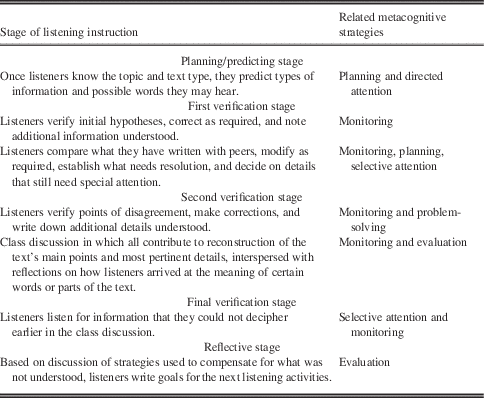
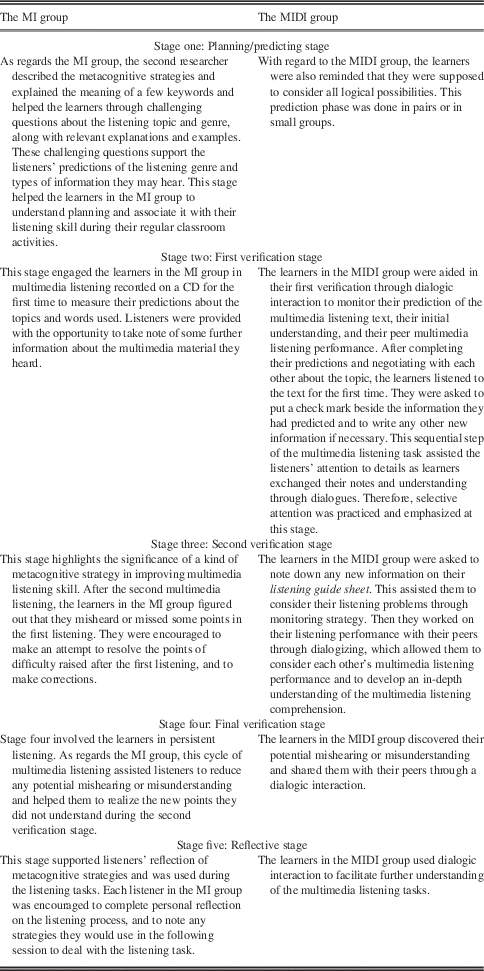
In this study, the intervention program was operationalized in two groups for 10 weeks: metacognitive instruction (MI) and metacognitive instruction through dialogic interaction (MIDI). Both groups received the intervention by the second researcher for 60 minutes from Week 2 to Week 11. The five sequential steps for the multimedia listening tasks (see Table 1) were followed for the two groups. However, the MIDI group used a listening guide sheet (see Appendix A) to provide opportunities for individual learners through peer dialog and interaction. Learners participating in the activities dialogically contribute to their overall learning of each individual in the interaction (Atkinson, Reference Atkinson2002).
Listening instruction stages and related metacognitive strategies (Vandergrift & Goh, Reference Vandergrift and Goh2012)

As regards the MIDI group, the learners were provided not only with the stage-based activities noted for the MI group but also with additional activities to derive cognitive and affective benefits from sharing their learning experience with each other through dialogizing. This dialogic interaction supported them to discover an innovation in learning. Every session, learners were given a handout containing a new multimedia listening task based on their knowledge of the topic and the type of text. They were asked to brainstorm the kinds of information they might have heard, as well as any related vocabulary, and wrote their predictions on the listening guide sheet. Both researchers were in contact weekly to discuss any issues both the second researcher and the learners faced during the intervention program. The intervention program for the MI group and the additional activities for the MIDI group are described in Table 2.
The intervention programs for the MI and MIDI groups

The pedagogical sequence and pedagogical interaction, using multimedia listening tasks in this study, helped the listeners to understand the use of metacognitive strategies through MI and MIDI and the stages used for approaching multimedia listening tasks. This stage-based approach helped the learners to facilitate their understanding of multimedia listening tasks, and the chances are that they would approach unfamiliar multimedia listening tasks strategically in the future. After completing the MI and MIDI for 10 weeks, the second researcher invited the learners to take a second multimedia listening test and the MALQ in Week 12, which took 40 minutes overall.
4 Results
Version 21 of the Statistical Package for the Social Sciences (SPSS) was used to analyze the advanced learners’ multimedia listening tests/MALQ performance. The data were analyzed through independent t-test to respond to the two research questions.
4.1 Pre- and post-test multimedia listening/MALQ
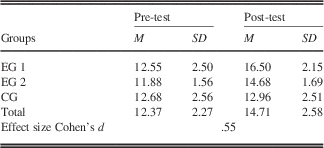
Table 3 shows the learners’ pre-test of multimedia listening and the MALQ, which indicate the listeners’ baseline information. The data collection for the multimedia listening test and MALQ took 35 minutes. Table 3 also shows the post-test data revealing any change in the multimedia listening comprehension and metacognitive awareness. The purpose of the post-test multimedia listening/MALQ was to look into the effect of metacognitive instruction on advanced learners’ listening comprehension and metacognitive awareness.
Descriptive statistics for the scores of the three groups in pre- and post-tests of listening

Research question 1: Does metacognitive instruction through dialogic interaction have any effect on advanced learners’ multimedia listening performance?
The reliability of Cronbach’s alpha reported in the pre- and post-test experimental groups (EG 1 and EG 2, respectively), approximately α=.73, α=.81, and the control group (CG), approximately α=.70, α=.72, of multimedia listening was moderate (Larson-Hall, Reference Larson-Hall2010). The multimedia listening test descriptive statistics from the pre-test EG 1 (M=12.55, SD=2.50), EG 2 (M=11.88, SD=1.56), and CG (M=12.68, SD=2.56) and post-test EG 1 (M=16.50, SD=2.15), EG 2 (M=14.68, SD=1.69), and CG (M=12.96, SD=2.51) are summarized in Table 3, and the total in the pre-test (M=12.37, SD=2.27) and the post-test (M=14.71, SD=2.58) is reported (see Table 3).
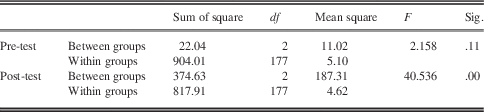
Table 4 shows that the p value (p<.05) represents the probability of the data given the hypothesis. The total test scores of pre-test and post-test in the between and within groups in one-way ANOVAs results were calculated. The multimedia listening scores, examined through the ANOVAs, revealed no significant differences across the three groups, F(2, 177)=2.15, p=.11, in the pre-test. Thus, it can be concluded that the three groups were equivalent in their English proficiency. However, Table 4 shows the advanced listeners’ performance in the two pre- and post-tests of the experimental group and a control group. As the one-way ANOVA test indicated, metacognitive instruction through dialogic interaction elicited a statistically significant change in the post-test of the experimental group of advanced listeners. The pertaining effect size measured by Cohen’s d=.55 between the pre-test and post-test comparison is large (Larson-Hall, Reference Larson-Hall2010). As can be seen in Table 4, the mean difference between the experimental and control group in the post-test scores was significant, F(2, 177)=40.536, p=.00, suggesting that the first research question was verified. This significant difference provided enough evidence to state that metacognitive instruction in the experimental group made a positive variance on the overall post-test of multimedia listening achievement. The results show that metacognitive instruction through dialogic interaction did improve advanced listeners’ multimedia listening in the experimental group.
One-way ANOVA results comparing the three groups in pre- and post-tests of listening

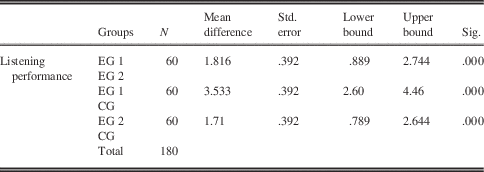
Table 5 contains the results of the requested post-hoc comparisons. As there were three groups, three unique comparisons are made (EG 1 versus EG 2, EG 1 versus CG, and EG 2 versus CG). The post-hoc comparisons show that the choice of post-hoc test can matter. The multiple comparisons in Table 5 show that, for the Tukey HSD post-hoc test, there is a statistical difference between the EG 1 and EG 2, EG 1 and CG, and EG 2 and CG. All comparisons are statistically below α=.05. We can also look at the confidence intervals here for the mean difference between the pairs. In this case, the mean difference (M=3.533) between EG 1 and CG through Tukey’s HSD test in the multimedia listening performance is higher than the other two groups.
Post-hoc multiple comparisons of the three groups in post-test of listening through Tukey’s HSD test

Research question 2: Does metacognitive instruction or metacognitive instruction through dialogic interaction have any effect on advanced learners’ metacognitive awareness?
To answer this research question, the performance of the EG 1 (metacognitive instruction) and EG 2 (metacognitive instruction through dialogic interaction) were analyzed. The reported average Cronbach’s alpha reliability for the experimental and control groups with the current participants was moderate (α=.75) in the MALQ (Larson-Hall, Reference Larson-Hall2010).
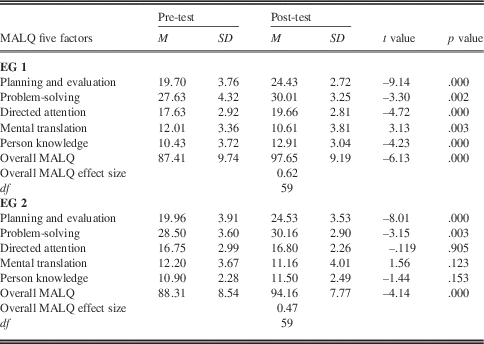
As can be seen in Table 6, there is a difference in means between the pre-test (M=87.41, SD=9.74) and post-test (M=97.65, SD=9.19) of EG 1 in the overall performance analysis. This mean difference through a t test, t(59)=–6.13, was adequate to verify the research question, and the p value (p<.05), representing the probability of the data, was significant (p=.00); the overall MALQ effect size, Cohen’s d=0.62, was medium (Larson-Hall, Reference Larson-Hall2010). The overall results show that metacognitive instruction in EG 1 did improve advanced learners’ metacognitive awareness.
The MALQ overall paired samples t test and the five-factor performance for EG 1 and EG 2 (N=60)

Table 6 shows the mean difference between the pre-test (M=88.31, SD=8.54) and post-test (M=94.16, SD=7.77) of EG 2 in the overall performance analysis. This mean difference through a t test, t(59)=–4.14, was adequate to verify the research question, and the p value (p<.05), representing the probability of the data, was significant (p=.00); the overall MALQ effect size, Cohen’s d=0.47, was medium (Larson-Hall, Reference Larson-Hall2010). The overall results show that metacognitive instruction through dialogic interaction in EG 2 did improve advanced learners’ metacognitive awareness.
The result of the overall analysis of EG 1 and EG 2 of the MALQ showed a significant impact of either the metacognitive instruction or metacognitive instruction through dialogic interaction. However, this section explores more in depth the advanced listeners’ rating of the use of each of the five MALQ factors. The rationale is to examine which of the five MALQ factors was more helpful for developing particular sets of metacognitive strategies as reflected through the MALQ items.
Factor 1: Planning and evaluation in EG 1 and EG 2
Five items (1, 10, 14, 20, and 21) cover the factor of planning and evaluation strategies in the MALQ (see Appendix B). Table 6 shows that the advanced listeners scored M=19.70, SD=3.76 in the pre-test and M=24.43, SD=2.72 in the post-test in EG 1, and M=19.96, SD=3.91 in the pre-test and M=24.53, SD=3.53 in the post-test in EG 2. The Cronbach’s alpha reliability of this factor was moderate (α=.60). Indeed, the differences between the pre-test and post-test in both EG 1, estimated through t(59)=–9.14, p=.00, and EG 2, estimated through t(59)=–8.01, p=.00, were statistically significant, suggesting that both the metacognitive instruction and metacognitive instruction through dialogic interaction assisted the advanced listeners to plan ahead for multimedia listening, and reflected on difficulties and considered alternatives in multimedia listening comprehension.
Factor 2: Problem-solving in EG 1 and EG 2
There were six items (5, 7, 9, 13, 17, and 19) engaged in problem-solving strategies. Table 6 shows that the advanced listeners scored M=27.63, SD=4.32 in the pre-test and M=30.01, SD=3.25 in the post-test for EG 1, and M=28.50, SD=3.60 in pre-test and M=30.16, SD=2.90 in the post-test for EG 2 administration of the MALQ. The reported Cronbach’s alpha reliability of this factor was also moderate (α=.68). Indeed, the differences between the pre-test and post-test in both groups were statistically significant through EG 1, t(59)=–3.30, p=.05, and EG 2, t(59)=–3.15, p=.05, suggesting that both the metacognitive instruction and metacognitive instruction through dialogic interaction supported listeners in monitoring comprehension and solving difficulties as the advanced listeners encounter in EFL multimedia listening comprehension.
Factor 3: Directed attention in EG 1 and EG 2
There were four items (2, 6, 12, and 16) focused on directed attention strategies in the MALQ. The mean scores were M=17.63, SD=2.92 in the pre-test and M=19.66, SD=2.81 in the post-test for EG 1, and M=16.75, SD=2.99 in the pre-test and M=16.80, SD=2.26 in the post-test for EG 2. The reported Cronbach’s alpha reliability of this factor was lower moderate (α=.55). However, as evidenced in Table 6, t-test analysis, t(59)= –4.72, showed that there was a significant difference, p=.00, suggesting that the metacognitive instruction maintained the advanced listeners’ careful attention when attending to multimedia listening comprehension. However, the differences were not statistically significant using t(59)=–.11, p=.90, confirming that the metacognitive instruction through dialogic interaction did not maintain the advanced listeners’ careful attention when attending to multimedia listening comprehension.
Factor 4: Mental translation in EG 1 and EG 2
The mental translation strategy factor in MALQ included three items (4, 11, and 18). Table 6 shows that advanced listeners in total received M=12.01, SD=3.36 from the pre-test and M=10.61, SD=3.81 from the post-test in EG 1, and M=12.20, SD=3.67 from the pre-test and M=11.16, SD=4.01 from the post-test in EG 2 for the administration of the MALQ. The reported Cronbach’s alpha reliability of this factor was moderate (α=.74). Indeed, the differences were statistically significant using t(59)=3.13, p=.00, suggesting that the metacognitive instruction contributed in variance to processing through their first language, which facilitated attention to, and overall processing of, the input when listening in EFL. However, the differences were not statistically significant using t(59)=1.56, p=.12, confirming that metacognitive instruction through dialogic interaction did not contribute in variance to processing through their first language, and the mean difference in the post-test was not noticeable either.
Factor 5: Person knowledge in EG 1 and EG 2
The person knowledge strategy involved three items (3, 8, and 15) in the MALQ. Multimedia listening tasks created anxiety and the listeners reported that low scores related to a high level of anxiety and inadequate confidence. The Cronbach’s alpha reliability reported in this factor was lower moderate (α=.53). In terms of performance, advanced listeners scored M=10.43, SD=3.72 in the pre-test and M=12.91, SD=3.04 in the post-test in EG 1, and M=10.90, SD=2.28 in the pre-test and M=11.50, SD=2.49 in the post-test in EG 2 administration. The differences were statistically significant using t(59)=–6.13, p=.00 (see Table 6). This suggests that the metacognitive instruction through dialogic interaction contributed in variance to the result of person knowledge strategies reported in multimedia listening comprehension. In contrast, the differences were not statistically significant using t(59)=–1.44, p=.15, suggesting that the metacognitive instruction through dialogic interaction did not significantly contribute to the advanced listeners’ multimedia listening comprehension.
5 Discussion
The answer to the first research question concerning the effect of metacognitive instruction through dialogic interaction on advanced learners’ multimedia listening performance is affirmative. The results of this study showed that the advanced EFL learners in the experimental group receiving guided metacognitive instruction through dialogic interaction outweighed the control group receiving no guided metacognitive instruction through dialogic interaction. The finding of this study is consistent with studies such as Bozorgian (Reference Bozorgian2014, Reference Bozorgian2012), Cross (Reference Cross2011, Reference Cross2009), Goh and Hu (Reference Goh and Hu2014), and Vandergrift and Tafaghodtari (Reference Vandergrift and Tafaghodtari2010) in an intervention program (metacognitive instruction). The key similarity of this study with the studies noted previously was the pedagogy used for teaching multimedia listening and the focus on the process of teaching multimedia listening through metacognitive instruction. However, this study used metacognitive instruction through dialogic interaction on multimedia listening, whereas the previous studies did not emphasize the use of dialogic interaction in metacognitive instruction. For instance, Cross (Reference Cross2011) used dialogic interaction in pair and small group work and provided a joint activity system model for L2 listeners as they interacted to complete listening tasks. The dialogic interaction through metacognitive instruction in this study increased learners’ multimedia listening awareness (e.g. attention, reasoning, and reflection) while acting out the sequences of metacognitive pedagogical sequence (Daniels, Reference Daniels2001; Kaptelinin & Nardi, Reference Kaptelinin and Nardi2006).
However, Cross (Reference Cross2009) used multimedia listening (BBC news videotexts) to investigate advanced Japanese EFL learners’ listening comprehension through strategy instruction, but dialogic interaction was not emphasized. Advanced EFL learners in this study lived in a country where English language is not the primary medium for communication outside the classroom, and thus their growth in the multimedia listening performance can be attributed to the metacognitive instruction through dialogic interaction. The advanced EFL learners in this study were provided with the 10-week metacognitive instruction through dialogic interaction for the purpose of promoting their multimedia listening comprehension.
The finding of this study shows that metacognitive instruction through dialogic interaction assisted the advanced learners in improving their multimedia listening performance. The reason is that the mediation in this study was metacognitive instruction through dialogic interaction, which was collective and systematic, and provided support for the learners to improve their multimedia listening comprehension (Engeström, Reference Engeström1987). Aligned with this aspect, Brett (Reference Brett1997) investigated computer-based multimedia listening performance and the finding showed that learners had more effective listening performance using multimedia than audio or video plus pen and paper. The reasons for successful use of multimedia listening were also reported through a learner questionnaire. The intervention program for listening lessons using the pedagogical cycles helped the advanced learners increase their working memory capacity to receive more language chunks from future listening (Bozorgian, Reference Bozorgian2014; Vandergrift & Tafaghodtari, Reference Vandergrift and Tafaghodtari2010). The metacognitive pedagogical sequence used in this study was a useful tool to facilitate dialogic interaction among learners through the intervention program. The usefulness of the interaction among learners in this study was consistent with Fernández-Toro’s (Reference Fernández-Toro2005) aspect, stating that the dialogic interaction is a helpful tool for learners to increase their multimedia listening comprehension. Furthermore, the pedagogical cycle for metacognitive instruction through dialogic interaction in this study assists learners in improving their multimedia listening comprehension. This improvement concurs with Chang and Read’s (Reference Chang and Read2007) findings showing that the input repetition for EFL listening with visual support is the most effective compared with visuals and texts in listening support.
Responding to the second research question, which focused on whether metacognitive instruction through dialogic interaction would improve the advanced listeners’ metacognitive awareness, the response is yes. The advanced listeners’ MALQ performance in the experimental group differed significantly in the post-test MALQ performance. Despite having a statistically significant overall MALQ result in the EG 1 and EG 2 and all factors in EG 1, some factors such as mental translation, direct attention, and person knowledge in EG 2 were not statistically significant.
Developing a problem-solving strategy among the advanced learners in this study is inconsistent with Bozorgian’s (Reference Bozorgian2014) and Vandergrift and Tafaghodtari’s (Reference Vandergrift and Tafaghodtari2010) studies in that problem-solving strategy is described as a model of implicit learning through task performance. Contrary to overall MALQ performance in Bozorgian’s (Reference Bozorgian2014) study, the advanced learners’ MALQ performance in this study, focusing on both EG 1 and EG 2, was significantly reported. The reason for the increase in the metacognitive awareness for both experimental groups might be in relationship to their proficiency in that the advanced learners in this study were mature in terms of linguistic proficiency and could use strategies effectively, as it is not commonly used by beginning and intermediate language learners. Language proficiency and conscious planning helped the advanced learners in this study to execute appropriate tasks through problem-solving strategy to increase the metacognitive awareness performance in L2 listening (Sheorey & Mokhtari, Reference Sheorey and Mokhtari2001).
Like this study, metacognition has been a facilitator factor in many previous studies (e.g. Bozorgian, Reference Bozorgian2014, Reference Bozorgian2012; Cross, Reference Cross2011, Reference Cross2009; Goh & Hu, Reference Goh and Hu2014; Vandergrift & Tafaghodtari, Reference Vandergrift and Tafaghodtari2010), helping learners to increase their listening comprehension. The finding of this study shows that the advanced learners performed significantly in the overall MALQ in both EG 1 and EG 2, and of the five MALQ factors in the EG 2, the advanced learners did not increase their metacognitive awareness in three factors: mental translation, directed attention, and person knowledge. Mental translation strategies in EG 1 assisted learners in translating what they heard in English into their first language. The significant increase in mental translation strategies for this study is consistent with Vandergrift and Tafaghodtari’s (Reference Vandergrift and Tafaghodtari2010) and Bozorgian’s (Reference Bozorgian2014) studies. In contrast, the advanced learners in EG 2 did not use mental translation significantly to lift up their metacognitive awareness. The reason is that this group using metacognitive instruction through dialogic interaction did not tend to use their first language as a medium for exchanging ideas. Unlike the advanced learners in EG 1, the learners in EG 2 did not show a significant increase in person knowledge and directed attention. The reason is that learners in EG 2 used listening guides as well as interaction and went beyond their person knowledge and indicated with certainty that they shared their knowledge, which was not considered their own (person knowledge). Aligned with this notion, adult learners, due to having metacognitive knowledge, focused on completing their goal of listening task (Goh, Reference Goh1997).
The reason for the significant increase in metacognitive awareness might be the linguistic maturity of the learners in the study assisting them in realizing the quality, purpose, demands, and nature of using metacognitive strategies in multimedia listening through dialogic interaction. The metacognitive awareness in a poor input environment encourages learners to be involved actively in learning and to be motivated to seek opportunities to learn independently (Huang, Reference Huang2005).
6 Conclusions and implications
This study used multimedia listening and examined the effect of metacognitive instruction and metacognitive instruction through dialogic interaction in a joint activity on advanced EFL learners. The results provide some empirical support for the idea that metacognitive instruction through dialogic interaction can be helpful for guiding and assisting learners in increasing their multimedia listening comprehension. In particular, the results of this study show that metacognitive instruction through dialogic interaction contributed significantly to the advanced learners’ multimedia listening comprehension, and their metacognitive awareness in multimedia listening. Learners should be provided with adequate support to be involved in practicing the process of multimedia listening in the classroom, and this notion should be considered in the pedagogy of L2/FL learning. Further, teachers should be trained to use sequential stages to teach multimedia listening, as teaching this skill, due to its floating nature, is to be taught differently from three other skills (speaking, writing, and reading). This is because multimedia listening inputs are easily available for learners, and teachers support them through considering the multimedia listening inputs from which metacognitive instruction through dialogic interaction should be integrated in the pedagogy to increase learners’ multimedia listening comprehension. However, the limitation of this study is that the researchers did not consider the advanced learners’ prior metacognitive strategies and awareness used in multimedia listening. Future studies may consider metacognitive instruction through dialogic interaction for other proficiency levels, such as intermediate and elementary, along with qualitative aspects through a mixed method to strengthen the findings.
Acknowledgements
We would like to thank the two anonymous reviewers and the editor for their helpful comments on the earlier paper draft.
Appendix A
Guide sheet for listening
Guide for Listening
A. Write down five main ideas that you think will be mentioned in the text.
1.___________________________________________________________________
2.___________________________________________________________________
3.___________________________________________________________________
4.___________________________________________________________________
5.___________________________________________________________________
B. Discuss your predictions with a partner and then write down at least two more ideas that your partner included in his/her list of predictions and that you consider logical possibilities.
6.___________________________________________________________________
7.___________________________________________________________________
C. Listen to the text. Place a check mark beside the ideas that you and your partner predicted and that were in fact mentioned in the text, and write down any other ideas that you had not predicted but were mentioned.
8.___________________________________________________________________
9.___________________________________________________________________
10.___________________________________________________________________
D. After verifying your predictions and discussing your listening results with your partner, listen to the text again to check your results and to resolve any discrepancies in comprehension between you and your partner. Add any further points and important details that you may not have understood during the first listen.
1.___________________________________________________________________
2.___________________________________________________________________
3.___________________________________________________________________
4.___________________________________________________________________
5.___________________________________________________________________
E. Listen to the text a third time to verify comprehension after a class discussion of the content of the text or a reading of the text transcript.
--------------------------------
Reflections and Goal-Setting
I was successful in anticipating ……… ideas.
What surprised me:
What I will do next time:
Appendix B
Metacognitive Awareness Listening Questionnaire (MALQ)
The statements below describe some strategies for listening comprehension and how you feel about listening in the language you are learning. Do you agree with them? This is not a test, so there are no “right” or “wrong” answers. By responding to these statements, you can help yourself and your teacher understand your progress in learning to listen. Please indicate your opinion after each statement. Circle the number that best shows your level of agreement with the statement (Strongly disagree=1, Disagree=2, Slightly disagree=3, Partly agree=4, Agree=5, Strongly agree=6):

About the authors
Hossein Bozorgian is an Assistant Professor at the University of Mazandaran. He has published several papers in international journals, such as the International Journal of Listening published by Taylor & Francis. His research domains are bilingualism, listening comprehension, and multimedia in listening comprehension.
Ebrahim Fakhri Alamdari is a PhD holder in TEFL. He is currently a lecturer at the Islamic Azad University, Qaemshahr Branch, and a full-time teacher at the Iran Language Institute, Babol Branch. His main research interests are English language teaching, applied linguistics, sociocultural perspectives of teaching and learning, language learning strategies, and bilingualism.