INTRODUCTION
In the past 25 years, research on the neuropsychological aspects of multiple sclerosis (MS) has burgeoned. Even though cognitive dysfunction in MS is not rare, some neurologists specializing in MS still tend to underestimate the prevalence of MS-related cognitive impairments (Fischer, Foley, Aikens, Ericson, Rao, & Shindell, Reference Fischer, Foley, Aikens, Ericson, Rao and Shindell1994). In fact, cognitive dysfunction occurs in 40–70% of cases, depending on the sample (Achiron & Barak, Reference Achiron and Barak2006; Amato, Zipoli, & Portaccio, Reference Amato, Zipoli and Portaccio2006; Huijbregts, Kalkers, de Sonneville, de Groot, & Polman, Reference Huijbregts, Kalkers, de Sonneville, de Groot and Polman2006; Potagas et al., Reference Potagas, Giogkaraki, Koutsis, Mandellos, Tsirempolou and Sfagos2008; Rao et al., Reference Rao, Leo, Bernardin and Unverzagt1991a).
The types of cognitive deficits seen in MS have been well characterized. Controlled neuropsychological studies have consistently shown decline on tasks assessing recent memory, attention, processing speed, working memory, visuo-spatial abilities, and executive functions (Bobholz & Rao, Reference Bobholz and Rao2003; Brassington & Marsh, Reference Brassington and Marsh1998; Fischer et al., Reference Fischer, Foley, Aikens, Ericson, Rao and Shindell1994; Pelosi, Geesken, Holly, Hayward, & Blumhardt, Reference Pelosi, Geesken, Holly, Hayward and Blumhardt1997; Rao, Reference Rao1996; Rao, Grafman, DiGiulio, Mittenberg, & Bernardin, Reference Rao, Grafman, DiGiulio, Mittenberg, Bernardin and Leo1993; Rao et al., Reference Rao, Leo, Bernardin and Unverzagt1991a). Information processing speed may be most affected by the impact of MS on cognitive functioning over time (Denney, Lynch & Parmenter, Reference Denney, Lynch and Parmenter2008).
Although specific neurological deficits and fatigue are frequently the most conspicuous sources of functional impairment in patients with MS, in many of them, cognitive dysfunction may be the most disabling manifestation of the disease. It may have a severe negative impact on everyday function and quality of life (Amato, Ponziani, Siracusa, & Sorbi, Reference Amato, Ponziani, Siracusa and Sorbi2001; Benito-Leon, Morales, & Rivera-Navarro, Reference Benito-Leon, Morales and Rivera-Navarro2002; Bobholz & Rao, Reference Bobholz and Rao2003; Cutajar et al., Reference Cutajar, Ferriani, Scandellari, Sabattini, Trocino and Marchello2000; Gilchrist & Creed, Reference Gilchrist and Creed1994). Past research has suggested that, with equal severity of disability, MS patients with cognitive impairment were less likely than those without cognitive impairment to have a job and to participate in recreational and social activities (Rao et al., Reference Rao, Leo, Bernardin and Unverzagt1991b; Sartori & Edan, Reference Sartori and Edan2006). Affective disorders such as depression, indifference, apathy, euphoria, alexithymia, and pseudobulbar affect are also associated with cognitive deficits (Feinstein, Reference Feinstein1999; Kesselring & Klement, Reference Kesselring and Klement2001; Lieberman & Benson, Reference Lieberman and Benson1977; Montreuil & Lyon-Caen, Reference Montreuil and Lyon-Caen1993; Schiffer, Reference Schiffer and Rao1990; Schiffer & Caine, Reference Schiffer and Caine1991; Siegert & Abernethy, Reference Siegert and Abernethy2005). Compared with the other domains, social maladjustments consequent to cognitive dysfunction in MS have received little attention. The present study aims to partially fill this gap through an examination of MS patients’ “theory of mind” (“ToM”), that is, the capacity to infer others’ intentions or emotional states based on their verbal and social behavior. This “mentalizing” skill, is mostly developed before adolescence and has been well studied in normal development and in autism (Baron-Cohen, Leslie, & Frith, Reference Baron-Cohen, Leslie and Frith1985; Carruthers & Smith, Reference Carruthers and Smith1996; Leslie, Reference Leslie1987). “ToM” in these populations will not be described in detail where cited, as it is not the focus of this present study.
Impairment of “ToM” has been observed following neurological insult, particularly when the frontal lobes are involved (Happé, Malhi, & Checkley, Reference Happé, Malhi and Checkley2001; Rowe, Bullock, Polkey, & Morris Reference Rowe, Bullock, Polkey and Morris2001; Stone, Baron-Cohen, & Knight, Reference Stone, Baron-Cohen and Knight1998; Stuss, Gallup, & Alexander, Reference Stuss, Gallup and Alexander2001). MS patients who suffer cognitive dysfunction frequently show a pattern of frontal deficits, such as executive dysfunction, problems of abstract and conceptual reasoning (Arnett, Rao, Bernardin, Grafman, Yetkin, & Lobeck, Reference Arnett, Rao, Bernardin, Grafman, Yetkin and Lobeck1994; Brassington & Marsh, Reference Brassington and Marsh1998; Foong et al., Reference Foong, Rozewicz, Quaghebeur, Davie, Kartsounis and Thompson1997; Happé, et al., Reference Happé, Malhi and Checkley2001; Stone et al., Reference Stone, Baron-Cohen and Knight1998; Stuss et al., Reference Stuss, Gallup and Alexander2001). The fMRI studies reveal that theory of mind is a widely distributed function with nodes in the fusiform face area (Maurer et al., Reference Maurer, O’Craven, Le Grand, Mondloch, Springer and Lewis2006), the right and left temporo-parietal junction (Apperly, Samson, Chiavarino, & Humphreys, Reference Apperly, Samson, Chiavarino and Humphreys2004; Saxe & Kanwisher, Reference Saxe and Kanwisher2003), the posterior cingulate and the medial prefrontal cortex (Saxe & Wexler, Reference Saxe and Wexler2005; Saxe & Powell, Reference Saxe and Powell2006), the dorsal part of the anterior cingulate cortex and the right lateral rostral prefrontal cortex (Sommer, Döhnel, Sodian, Meinhardt, Thoermer, & Hajak, Reference Sommer, Döhnel, Sodian, Meinhardt, Thoermer and Hajak2007). The frontal lobe semiology, consistent with fontal subcortical demyelinisation, suggests that there might be “ToM” deficits in these individuals as has been recently confirmed using a simple test found to be sensitive with autistic children (Henry et al., Reference Henry, Phillips, Beatty, McDonald, Longley and Joscelyne2009).
The purpose of the present study is twofold: first, to examine possible theory of mind deficits in MS patients with cognitive deficits and the sensitivity of various measures of “ToM” in this population. The second purpose is to examine the contribution of cognitive functions to the ability to infer mental states, in particular high level functions such as executive functions, and reasoning/conceptual thinking. We postulate that (i) patients diagnosed with MS and presenting cognitive deficits consistent with frontal lobe semiology, will also have a deficit in “ToM”; (ii) there will be a significant contribution of high level cognitive functions (executive functions and/or concept formation/reasoning) to performance in “ToM” (iii) since naturalistic tests have proven to be sensitive measures of everyday life social cognitions (Dziobek et al., Reference Dziobek, Fleck, Kalbe, Rogers, Hassenstab and Brand2006; Golan, Baron-Cohen, Hill, & Golan, Reference Golan, Baron-Cohen, Hill and Golan2006; Heavey, Phillips, Baron-Cohen, & Rutter, Reference Heavey, Phillips, Baron-Cohen and Rutter2000; Roeyers, Buysse, Ponnet, & Pichal, Reference Roeyers, Buysse, Ponnet and Pichal2001), a naturalistic measure based on a dynamic interaction between protagonists, as exemplified by the Conversations and Insinuations Task (C&I) will be a more sensitive measure than two short-story type measures, Happé’s Strange Stories and Faux-Pas Task, often used to test “ToM” in adult populations.
METHOD
Participants
Forty-three patients from the MS clinic of the Hôpital Notre-Dame du CHUM who met Macdonald’s criteria (McDonald et al., Reference McDonald, Compston, Edan, Goodkin, Hartung and Lublin2001) for probable or definite MS were entered into the study. Exclusion criteria included (1) severe motor, visual or hearing impairment that might interfere with cognitive testing, (2) a history of drug abuse or a nervous system disorder other than MS, or (3) clinical instability, that is, currently in a relapse or in the process of experiencing noticeable deterioration. Expanded Disability Status Scale (EDSS) (Kurtzke, Reference Kurtzke1983) scores ranged from 0 to 7.5.
Twenty healthy volunteers (10 men, 10 women) were recruited through MS patients, personal contacts and notices on the university bulletin boards and served as control participants. They matched the MS group on age and education. Control participants were excluded if they had a history of drug abuse, psychiatric illness, head injury, or other neurological disease. All subjects were recruited on a voluntary base and their first language was French.
The data included in this study were obtained in compliance with the regulations of the Université du Québec à Montréal and the CHUM ethics committee.
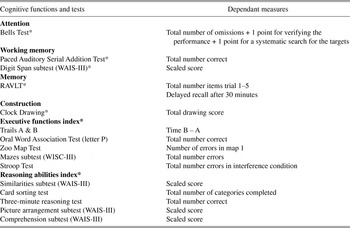
A battery of neuropsychological tests (see below for details) was administered to all subjects (see Table 1). These measures served to identify those patients who were cognitively intact or impaired and to explore the extent to which “ToM” performances could be attributed to these cognitive functions.
Neuropsychological battery

* Measures used for classifying MS patients in cognitively impaired or intact group
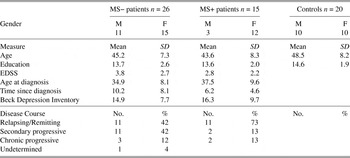
MS patients were classified as either cognitively impaired (MS−) or cognitively intact (MS+) based on the same general procedure described by Rao et al. (Reference Rao, Leo, Bernardin and Unverzagt1991a). We calculated the total number of MS patients who performed at or below the fifth percentile of the control group for each of the 9 neuropsychological measures. Some measures (n = 7) were simple scores from a neuropsychological test, whereas executive functions and reasoning were composite scores created by summing the Z scores on the tests that make up each measure (see Table 1). Composite scores for these cognitive functions were used to avoid overrepresentation of these functions, because they each consisted of five tests, as opposed to one or two tests for other cognitive functions. MS patients were classified as “cognitively impaired” (MS−; n = 28) if they had two or more “failed” measures or “cognitively intact” (MS+; n = 15) if they had zero or one “failed” measure. Table 2 provides summary statistics of demographic and illness variables for the three groups. Comparison between the two MS groups indicated that they did not differ significantly on their mean score on demographic and illness variables.
Demographic and illness characteristics of cognitively impaired and intact patients and control participants

EDSS = Expanded Disability Status Scale
Materials
Neuropsychological measures
To investigate the relationship between performance on theory of mind tasks and cognitive functions, a set of tests tapping frontal functioning covering two main areas, was administered: (1) executive functions were assessed with the Trails-Making Test, the Oral Word Association Test, the Zoo Map Test, the Mazes subtest of the WISC-III and the Stroop Test; (2) Concept formation and reasoning abilities were assessed with the Similarities subtest of the WAIS-III, the Three Minute-Reasoning Test (Baddeley, Reference Baddeley1968), Picture Arrangement and Comprehension subtests of the WAIS-III, and the Card Sorting Test (Delis, Kaplan, & Kramer, Reference Delis, Kaplan and Kramer2001).
Measures of attention (the Bells Test), memory (Rey’s Auditory Verbal Memory Test), and working memory (adapted version of Paced Auditory Serial Addition Test and Digit Span subtest of the WAIS-III) were also administered. Depression was evaluated using the Beck Depression Inventory-II.
Theory of mind measures
The Strange Stories Task—The stimuli were those used by Happé, Winner, and Brownell (Reference Happé, Winner and Brownell1998). The stories were created for an adult population, and are comprised of 16 short stories to be read by the subject. Half of the stories (Strange Stories-Mental) require an appreciation of a character’s mental states (desires, thoughts), whereas the other eight stories (Strange Stories-Physical) involve making a physical inference. The Strange Stories-Mental task was used in many studies and is known to be sensitive to “mentalizing” limitations associated with autism and Asperger’s syndrome, right hemisphere damage, frontal lobe surgery, and old age (Baron-Cohen, Joliffe, Mortimore, & Robertson, Reference Baron-Cohen, Joliffe, Mortimore and Robertson1997; Happe, Brownell, & Winner, Reference Happé, Brownell and Winner1999; Happe et al., Reference Happé, Malhi and Checkley2001; Maylor, Moulson, Muncar, & Taylor, Reference Maylor, Moulson, Muncar and Taylor2002; Sullivan & Ruffman, Reference Sullivan and Ruffman2004). An example of a story is included in the Appendix A. After performing an item analysis, two stories from the physical inferences were deleted from the analyses, due to extremely low scores by the control group, leaving six stories for that portion of the task.
Faux Pas Task—This task is similar to the one described by Stone et al. (Reference Stone, Baron-Cohen and Knight1998). They created short stories where a character unwittingly says something socially inappropriate that might hurt someone’s feelings. We constructed four additional short stories of faux pas along similar lines. The questions are similar to those used by Stone et al. and evaluate subjects’ detection of the faux pas and mental states of the protagonists. The Faux-Pas task has been found helpful in discriminating between small groups of patients with ventromedial vs. dorsolateral prefrontal damage (MacPherson, Phillips, Della Sala, Reference MacPherson, Phillips and Della Sala2002; Stone et al., Reference Stone, Baron-Cohen and Knight1998). An example of a faux pas story and test questions is presented in the Appendix A. (A copy of the expanded faux pas test can be obtained on the Web site http://www.psycho.uqam.ca/NUN/d_pages_profs/P_SCHERZER/.)
Video task: Conversations and Insinuations (C&I)—This task aims at measuring, in a naturalistic way, subtle deficits of theory of “ToM” in an adult population. The C&I task and its validity data have been described in detail elsewhere (Ouellet, Bédirian, Charbonneau, & Scherzer, 2005). Briefly, this video task assesses a participant’s ability to interpret the intention or the emotional state behind an explicit message conveyed by a character. It consists of four clips lasting approximately 2 min each and is presented on a laptop computer. Pauses are programmed to occur automatically during the clips, immediately after a character’s target-line. During the pause, the experimenter asks the participant a test question and a four-choice response appears on the screen. Only one response is correct and the others serve as error measures. The participant can make three types of errors: inappropriate responses, noninterpretive responses and incorrect mental state attributions. The response choices were also used to control for participants’ comprehension of the clip and character interactions and mental states. This step-by-step questioning is designed to minimize the contribution of memory to performance. An example of a character’s explicit message and the four-choice answers proposed for that message is included in the Appendix A. The target-lines spoken by the characters include the following language acts: irony, faux pas, lies and indirect messages.
Procedure
All participants were tested individually in a laboratory at the Université du Québec à Montréal or in their own home as long as it was a quiet environment. Most participants were assessed during three 90-min sessions. The neuropsychological tests and the experimental tests were administered in the same fixed order for all participants.
Strange Stories and Faux Pas tasks
Participants were presented with a test booklet that included all passages of the Mental and Physical Strange Stories, and of the Faux Pas tasks. They were asked to read each story silently, at their own speed and to answer the questions aloud. Participants were allowed to refer back to the story to minimize memory requirements. The participants’ answers to the Strange Stories task were later scored according to the criteria developed by Happé et al. (Reference Happé, Malhi and Checkley2001): 0 points for an incorrect answer; 1 point for a partially correct answer and 2 points for a fully correct and explicit answer. For the Faux Pas task, scoring was either 0 or 1 point for the test questions.
Conversations and Insinuations (C&I)
Clips were shown in a random order across participants, and were stopped at approximately 20-s intervals. The participants were then questioned about what had just been said or done by one of the characters. Participants could take as much time as needed to choose the best possible answer among the four choices. Their answers were recorded on a sheet of paper and scored as either 0 or 1 point.
RESULTS
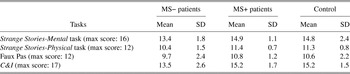
Means for all groups on the three “ToM” measures are presented in Table 3. Data transformation was applied as a remedy for outliers and for failures of normality. All distributions were normalized or near-normalized after transformation, and all inferential analyses that are described below were applied to transformed data. The following transformations were applied: C&I: log 10; Strange Stories-Physical: square root of the reciprocal; Strange Stories-Mental and Faux pas: dichotomized as the other methods were not effective. The procedure for dichotomization was as follows: Strange Stories Mental – maximum of 16 points, 16 = 1 (n = 22), <16 = 0 (n = 39); Faux pas – maximum of 12 point, 12 = 1 (n = 20), <12 = 0 (n = 41) (both variables demonstrated a ceiling effect). Scores for the remaining dependent variables were normally distributed. Because of their extremely low scores on many variables, two participants from the MS− group were deleted from the analysis, leaving 26 cases in this group.
Mean scores and standard deviation scores for the theory of mind tasks

Note
C&I = Conversation and Insinuation; MS− = cognitively impaired; MS+ = cognitively intact.
ANOVAs for Theory of Mind Measures
Results of the comparisons between MS+, MS−, and control participants on the three “ToM” measures are presented in Table 3. A one-way analysis of variance (ANOVA) comparing the three groups showed a significant difference on the C&I measure (F(2,58) = 4.642; p = .013) and the Strange Stories Physical (F(2,54) = 4.723; p = .013) and Mental (χ2 = 12.133; n = 61; p = .002) tasks. Planned contrast comparisons, with the Bonferonni correction for multiple t tests revealed that scores of the MS− group were significantly lower than those of the MS+ and Control group in the C&I task [t(40) = −2.622; p = .012] but no difference in performance between the MS+ and Control group on this task. There was a significant difference between the MS− group and control group (χ2 = 11.994; n = 46; p = .001) on the Strange Stories-Mental task, but no difference between the MS+ and control group, on this task, nor between the MS+ and MS− groups. There were also no significant differences between groups on the Faux Pas task. Further analysis showed that the effect size of the Strange Stories-Mental task [χ2(2) = 12.133; p = .002; χ2 = 0.20] was marginally larger than that of the C&I task [F(2,58) = 4.642; p = .013; η2 = 0.15] in discriminating between groups.
Hierarchical Regression
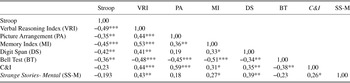
Before examining the contribution of the cognitive variables to the C&I and Strange Stories tasks, all the individual cognitive measures listed in Table 1 were entered into a correlation matrix. We did not use indices here as we did in defining the presence or absence of cognitive impairment. However, only those measures that were significantly correlated with the “ToM” measures were retained for the hierarchical regression with the exception of the Stroop. This decision was made on the basis of the strong evidence of a relationship between inhibitory control in children (Carlson, Moses, & Breton, Reference Carlson, Moses and Breton2002), cognitive flexibility in adults (Ruby & Decety, Reference Ruby and Decety2003) and “ToM.” As a second step, correlations between all retained independent cognitive measures were computed for all three groups to ensure that they were relatively independent from each other. This analysis revealed that some measures were closely linked. The WAIS-III subtests Similarities and Comprehension were correlated at r = 0.65 while the two measures of the Rey Auditory Verbal Memory test correlated at r = 0.77. Consequently, these pairs were combined respectively into a Verbal Reasoning Index (VRI) and Memory Index (MI), created by summing the Z scores on the tests that make up each measure. The final correlation matrix featuring independent variables and indices destined to be entered into the regression model and the dependant variable is presented in Table 4.
Correlations of all independent variables entered into the hierarchical model with the dependant variables (C&I and Strange Stories-Mental) across all subjects (MS−, MS + Controls)

Note
***p < .001; **p < .01; *p < .05. VRI = Similarities + Comprehension; MI = Rey Auditory Verbal Learning Test: Total number items, trial 1-5 + Delayed recall after 30 min; MS− = cognitively impaired; MS+ = cognitively intact.
Hierarchical regression was used to determine the contribution of high level cognitive functions to performance on the two significant theories of mind measures, the C&I and the Strange Stories-Mental task beyond that afforded by differences in attention, memory and working memory. Although differences were significant in the Strange Stories-Physical task, this test was not entered into the hierarchical regression model because, after Bonferonni correction, it no longer distinguished cognitively impaired from cognitively intact subjects with MS (see above). The analysis included all subjects. Six cognitive variables were entered into the regression model on the basis of their correlation with the C&I task and the Strange Stories-Mental task.
The Bell test, Digit Span, and the Memory Index were first entered as a unit into the hierarchical regression model to control for the contribution of the basic functions of attention, working memory and episodic memory to performance on the C&I task and Strange Stories-Mental task. The following variables were then entered one by one: the Stroop test, Verbal Reasoning Index, and Picture arrangement. Finally, group membership was also entered as a dummy variable.
Strange Stories-Mental task results
The block composed of the Bell test, Digit Span, and the Memory Index accounted for 17.9% of the variance in performance (p < .05). In the second step, the addition of the Stroop test did not contribute significantly to predicting the performance on this “ToM” task, and it was removed from the model. The Verbal Reasoning Index accounted for 7.0% of the variance (p < .05). Finally, neither the Picture Arrangement subtest nor the addition of the dummy variable “group membership” to the equation, contributed significantly to predicting the performance on this task.
C&I Results
The combined factor of the performance on the Bell test, Digit Span, and the Memory Index accounted for 20.9% of the variance in performance (p < .005). In the second step, the Stroop test and the Verbal Reasoning Index were added to the equation but these factors did not contribute significantly to predicting the accuracy of performance in the C&I and they were removed from the model. In the third step, the Picture Arrangement subtest was added to the equation and accounted for 17.3% of the variance (p < .001). Finally, addition of the dummy variable “group membership” to the equation did not contribute significantly to predicting performance on the C&I task.
The variables previously entered into the hierarchical regression have a substantial relationship with the diagnostic group membership variable. Consequently, the group membership variable’s relationship to the dependent variable is accounted for by those previously entered variables, rendering the group membership non significant. Table 5 presents a summary of the hierarchical regressions on the two “ToM” measures and the contribution of the independent variables.
Hierarchical regression summary

Note
N/S = Nonsignificant.
DISCUSSION
The purpose of this study was to examine theory of mind (“ToM”) in MS patients with cognitive deficits and the contribution of cognitive functions to the ability to infer mental states in others. Studies suggest that even diffuse pathologic processes, such as those seen in MS, can alter social cognition in adults who are presumed to have had normal development of these skills (Benito-Leon et al., Reference Benito-Leon, Morales and Rivera-Navarro2002; Cutajar et al., Reference Cutajar, Ferriani, Scandellari, Sabattini, Trocino and Marchello2000; Gilchrist & Creed, Reference Gilchrist and Creed1994). Our study takes a wider view of MS patients’ social judgment in that it examines their global capacity to comprehend social situations based on various verbal and nonverbal cues such as prosody, irony, facial expressions, the interaction between protagonists and the content of their conversation. In using a task such as the C&I that approximates the demands of the real world, the present study was designed to elicit performances that reflect patients’ actual ability to grasp the implicit messages in an everyday social situation. These expectations relied on the assumption that such a measure, using dynamic stimuli that require on-line complex processing abilities to adequately interpret events and conversations, introduces a greater challenge for the patients than written short-story type tests. The C&I also allows the subject to determine what is trivial and what is relevant, from among all the information in the situation to derive adequate mental state attributions.
To our knowledge, the present findings are the first to demonstrate that MS patients who suffer mild to moderate cognitive deficits are more prone to experience difficulties in attributing mental states to others than MS patients without cognitive impairment or healthy control participants. Furthermore, there were no differences between the MS+ patients and the healthy controls, supporting the contention that their cognitive functioning was in the normal range. The similarity in performance between the MS+ and control groups on the “ToM” tasks also allows us to conclude that MS, in the absence of cognitive deficits, cannot be considered to be a contributing factor to “ToM” deficits. The contributing factor is the cognitive deficits, not the MS per se.
The Strange Stories-Mental task was marginally better than the C&I task in discriminating between MS−, MS+ and the nonclinical control group. This result with the Strange Stories–Mental task is counter intuitive as it was expected to be an easier task based on the assumption that written tasks allow subjects more time to process information. Moreover, there are no nonverbal cues to contend with, which reduces the amount of information to be processed. Furthermore, in most of the items in the Strange Stories-Mental task, the reader is provided with some “private” information about characters’ personality to compensate for the absence of visual cues. Despite these presumed facilitators, MS− patients had more difficulty with this task than with the C&I task. The particular difficulty that MS− participants have with the Strange Stories-Mental task cannot be explained by postulating subtle language-processing problems. If such were the case, they would also have had a problem with the Faux Pas task that is also a verbal task. The primary difference in content between the two tasks is the diversity of states of mind that are surveyed in the Strange Stories-Mental task. They require the listener to understand a variety of intentions in the mind of the protagonist, not just faux pas.
The C&I task in comparison to Strange Stories-Mental task, provides a broad inventory of verbal, visual and situational cues, which most people use in daily life. Accessing these cues and their prior experiences, may have facilitated the performance of the participants.
In an effort to better understand the processes underlying mental state attribution, we predicted that high level frontal cognitive functions would explain performance on the “ToM” measure. This proved to be only partially true, given that the verbal (VRI) or visual reasoning (Picture Arrangement) abilities appeared to account for performance on the Strange Stories-Mental and C&I tasks, not executive functions. On the other hand, there was a substantial relationship between the basic cognitive functions (attention, memory, working memory) and the dependent variable. These basic functions were entered first in the hierarchical regression, followed by the next block of independent variables. That second block containing the variables of primary interest to this study, was also significant. This suggests that the variables of interest contribute significantly to the dependent variable (“ToM”), even after accounting for the contribution of the basic variables. The contribution of the basic cognitive functions is to be expected. If the integrity of these functions is compromised, the effects should be widespread, affecting most if not all complex cognitive functions. In the second block of variables of interest, the Verbal Reasoning Index (7% of variance for Strange Stories) and the Picture Arrangement subtests of the WAIS-III (17.3% of variance for C&I) explained the remaining significant proportion of the variance. There was also a tendency for the Verbal Reasoning Index to account for the C&I (p = .055; 5.2% of variance). The tests that constitute this index tap the individual’s ability for abstract thinking and deductive reasoning which are related to “ToM” (cf. Strange Stories), although more so for a reading task than one that allows the subject to make judgments based on vital visual information. These findings lead us to question why these two tasks that ostensibly measure the same function, “ToM,” appear to be based on different cognitive functions. Picture Arrangement taps such cognitive abilities as information processing speed, visual attention and scanning (Lezak, Howieson, & Loring, Reference Lezak, Howieson and Loring2004). Beatty, Goodkin, Beatty, and Monson (Reference Beatty, Goodkin, Beatty and Monson1989) found that MS patients’ difficulties on the Picture Arrangement test reflect a relatively specific deficit in sequential thinking in these patients. This deficit includes difficulties seeing relationships between events, establishing priorities, and chronologically ordering activities. Picture Arrangement is also known to be sensitive to socially appropriate thinking (Lezak et al., Reference Lezak, Howieson and Loring2004). Given that these characteristics are shared by Picture Arrangement and the C&I test, it is logical to find that the former partially explains performance on the latter. As for Similarities and Comprehension, they tap concept formation, cognitive flexibility and verbal reasoning (Lezak et al., Reference Lezak, Howieson and Loring2004). In the case of the Strange Stories-Mental task, the participant must be able to retain the relevant information, to abstract, categorize and to verbally reason. These findings help to explain which cognitive functions are deployed in “ToM,” but also they also demonstrate that different measures of “ToM” load on different cognitive abilities and depending on the pattern of cognitive deficits, some measures may be more sensitive than others.
A more detailed analysis of patient’s wrong answers on the C&I and Strange Stories tasks found that poorer performances of the MS− patients were due mainly to their tendency to interpret the events on a literal level, to have difficulties providing insightful explanations about a character’s lies or irony, relying instead on a superficial interpretation of the character’s intentions. This lack of insight was detected both when the patient had to verbally elaborate an answer to a question (Strange Stories) or recognize the correct attribution among four possible choices (C&I). The multiple-choice condition reduces the probability that the poorer performance in the MS− patients can be attributed to their limited verbal oral abilities or to a problem in retrieving the relevant answer. The multiple-choice paradigm might also provide cues for these patients, hence increasing the probability of a false negative, that is, concluding that they did not have a problem with the material when in fact they did. Despite this potential influence, the performance in this group was still deficient on the C&I task.
Finally, there is the question of whether these “mentalizing” disturbances are related to functional social impairments in MS. On an anecdotal basis, relatives of some MS patients from our study reported to have noticed increased difficulties in their family member to “put themselves in other peoples’ shoes,” which sometimes resulted in conflicts. These complaints are consistent with the performances in our social cognitive tasks.
The results presented in this study underline the importance of extending the study of the sequellae of neurologic dysfunction to include possible deficits of social cognitive functioning and conversely, cognitive deficits experienced when studying “ToM” problems in diverse clinical populations. It would also be important in future research to consider the contribution of fatigue to cognitive abilities as a contributing or confounding factor.
ACKNOWLEDGMENT
This study has never been published either electronically or in print and the authors are not in any way in a conflict of interest position for this study.
APPENDIX
The Strange Stories: Theory of Mind Story
During the war, the Red army captures a member of the Blue army. They want him to tell them where his army’s tanks are; they know they are either by the sea or in the mountains. They know that the prisoner will not want to tell them, he will want to save his army, and so he will certainly lie to them. The prisoner is very brave and very clever, he will not let them find his tanks. The tanks are really in the mountains. Now when the other side asks him where his tanks are, he says, “They are in the mountains.”
Question :
Why does he say that?
Faux Pas Story
Susan had baked a blueberry pie and a cake for a friends’ reunion where everybody had to bring food. Unfortunately, the icing on the cake had melted and as a result, few people took a piece. Later in the evening, Susan complained to a friend:
Susan: What a disaster! I can’t even bake a decent cake…
Friend: Don’t be ashamed of your cake! Somebody brought a blueberry pie that was much worse!
Questions
1. Did somebody say something they shouldn’t have?
2. Why shouldn’t she/he have said that?
3. Why did she/he say it?
4. How do you think Susan feels at the end of this story?
Conversations and Insinuations
A brother and sister are arguing about money. The brother says:
“Funny that you think I’m a snob, because I have a pretty good idea of how much you paid for that wall painting in you daughter’s bedroom... Plus I heard you bought a hand-made quilt!”
Question:
Why does he say that ?
Choices of response:
1. Because he knows how much she paid for the wall painting and the quilt (noninterpretative response)
2. Because he has better taste than her in decoration (inappropriate response)
3. Because he thinks those are unnecessary expenses (incorrect mental state attribution)
4. Because he wants her to realize that she too is a snob (correct response)