Introduction
Cost-effectiveness analyses are tools that support public health in prioritizing and efficiently allocating scarce health resources (Reference Campillo-Artero and Ortún1;Reference Russell and Sinha2) as well as in highlighting those treatments that could substantially reduce the burden of chronic disease or improve the quality of life of patients (Reference Jamison, Breman and Measham3).
Health promotion, prevention, and treatment of diseases in their initial stages are necessary to achieve better health results. Therefore, using this strategy for oral diseases such as periodontitis is part of the efforts to improve community health (Reference Petersen and Ogawa4;5). Periodontitis is one of the leading causes of tooth loss, with global prevalence estimates of 11.2 percent in adults and 7.43 million people affected, causing an estimated loss of USD 154.06B in the US and EUR 158.64B in Europe in 2018 (Reference Marcenes, Kassebaum and Bernabé6–Reference Botelho, Machado and Leira8).
In patients with type II diabetes, periodontitis tends to occur with greater frequency and severity (Reference Sanz, Ceriello and Buysschaert9–Reference Wu, Yuan and Liu11). According to several meta-analyses, periodontitis has been associated with poorer glycemic control as measured by HbA1C. Patients with poorer HbA1C at baseline are at greater risk. Moreover, higher insulin resistance levels (HOMA-IR levels) were found in patients with periodontitis (Reference Sanz, Ceriello and Buysschaert9;Reference Graziani, Gennai, Solini and Petrini12). On the other hand, periodontitis is associated with hyperglycemia and insulin resistance in diabetes patients, as well as increased risk for incident diabetes and diabetes complications. (Reference Sanz, Ceriello and Buysschaert9;Reference Preshaw, Alba and Herrera13).
Guidelines recommend diabetes patients should be informed that periodontal disease risks are higher and that untreated periodontitis increases the risk of diabetes complications such as cardiovascular disease and kidney disease (Reference Sanz, Ceriello and Buysschaert9). Given these implications, it is necessary to use safe and effective programs based on the best evidence (Reference Lima, Belém and Abreu14;Reference Alshehri, Alshail and Alshehri15), and in the clinical practice guidelines for the prevention, treatment, and control of periodontitis such as periodontal therapy paired with effective home care (16;Reference Caton, Armitage and Berglundh17). In Colombia, these programs are not government-funded for people with type II diabetes (Reference Guarnizo-Herreño, Watt, Garzón-Orjuela, Suárez-Zúñiga and Tsakos18).
Analyses of this topic have been well documented in the scientific literature (Reference Pennington, Heasman and Gaunt19;Reference Fardal, O’Neill and Gjermo20). Some studies evaluate whether the periodontal treatment has an influence on diabetes and periodontitis healthcare costs in general, or in patients with diabetes and other comorbidities (Reference Smits, Listl, Plachokova, der Galien and Kalmus21;Reference Blaschke, Hellmich, Samel, Listl and Schubert22). Results show a potential reduction of economic burden and an improvement in health outcomes due to periodontal treatment in patients with diabetes.
Other authors compare private specialized periodontal treatment in patients with type II diabetes or the general population versus treatment received in the subsidized system over long-time horizons (30 yr or more). Their results show that specialized periodontal treatment is more effective but generally more expensive. Thus, avoiding tooth loss or reducing other signs of periodontitis, or improving HbA1c levels would be dependent on patients’ willingness to pay (Reference Fardal, O’Neill and Gjermo20;Reference Solowiej-Wedderburn, Ide and Pennington23).
In these studies, the different periodontitis stages and costs of dental treatments in countries with characteristics similar to Colombia have not been considered (Reference Arroyo Martínez, Chía Martínez and González Fortich24–Reference Cortés, Gómez and Acosta26). It is for these reasons that results could not be extrapolated to patients with type II diabetes and mild periodontitis in our country. On the other hand, models do not include the effect of adherence to periodontal treatment. The objective of this study was to evaluate the cost-effectiveness of nonsurgical periodontal treatment (NSPT) versus subsidized conventional therapy (CT) for patients with type II diabetes and early stage periodontitis focused on tooth loss and periodontitis control.
Methods
Variables and Description of the Model
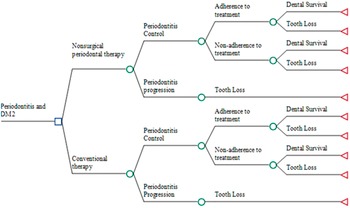
Patients in the model have all recently been diagnosed with type II diabetes in their last medical check-up. After being diagnosed with periodontitis by a dentist, the patient may receive NSPT, or CT subsidized by health insurance. With any of the two options, periodontitis could be either controlled or progress into severe stages, generating changes in the treatment plan. These changes can have a direct effect on a patient’s degree of compliance with specialist recommendations (adherence) (Reference Lee, Shin, Kim and Pang27;Reference Costa, Lages, Cota, Lorentz, Soares and Cortelli28). Finally, adherence could have an effect on the probability of dental survival or tooth loss (Figure 1) (Reference Lee, Huang, Sun and Karimbux29;Reference Seirafi, Ebrahimi, Golkari, Khosropanah and Soolari30).
Model. Decision tree outlining possible outcomes for this study of patients with periodontitis and type II diabetes managed with nonsurgical periodontal treatment or standard treatment.

Interventions and Time Horizon
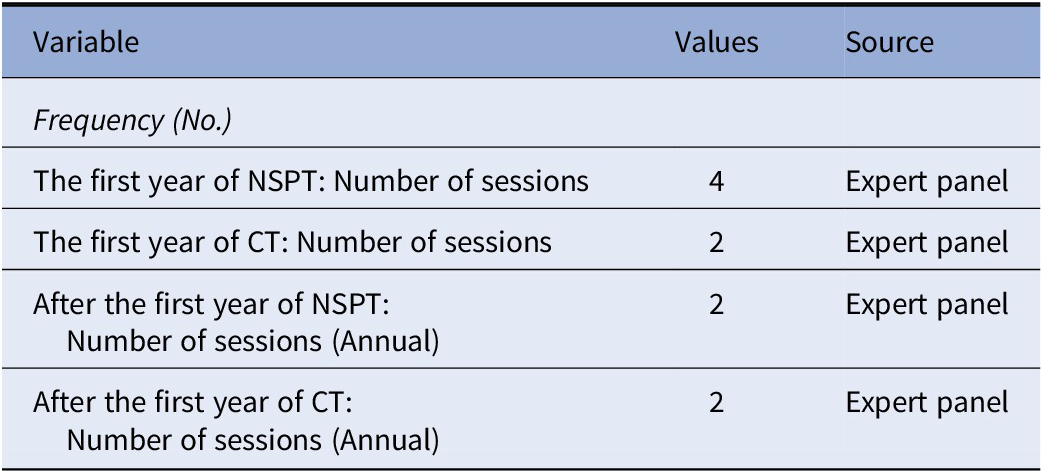
A decision tree analysis was used to estimate the costs and health outcomes of two periodontal therapies in a hypothetical cohort of type II diabetics with periodontitis. This model follows clinical guidelines for the treatment of periodontal and peri-implant diseases that recommend using NSPT as initial therapy for every patient recently diagnosed with periodontitis (Reference Caton, Armitage and Berglundh17;Reference Echeverría and Niklaus31). NSPT involves a periodontal assessment, oral health education, scaling, and root planning by a periodontist. Sessions are provided every 3 months during the first year and every 6 months after the first year.
The comparison is made with standard treatment subsidized by the Colombian health system. It involves oral health education and a supragingival cleaning by an oral hygienist or dentist every 6 months or annually (Reference Ministerio de Salud32). Furthermore, the main outcomes considered were tooth loss and periodontitis control. We also consider the first year and 5-year follow-up as time horizons include follow-up for active therapy and a minimum period for follow-up in long-term supportive periodontal therapy, respectively. (Reference Sonnenschein, Kohnen, Ruetters, Krisam and Kim33;Reference Chambrone and Chambrone34).
Estimation of Costs, Complications, and Resource Use
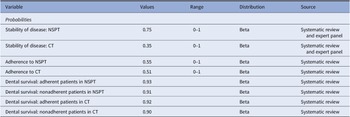
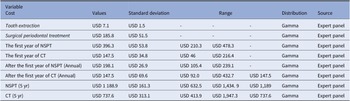
To identify and estimate resources, 15 local experts from periodontics, auditing, and healthcare management participated in a Delphi panel (Supplementary Table S1). Panel members were recruited online with public invitations sent to national periodontal societies, faculties of dentistry, dental clinics, health promotion entities, and healthcare administration organizations. The expert panel questionnaire was based on local costs extracted from two national tariff manuals, SOAT 2019 without adjustment, and ISS 2001 (35) with an inflation adjustment of 30–51 percent following recommendations of the Colombian Institute of Health Technology (IETS) (36;37). The expert panel also considered clinical guidelines for the diagnosis and treatment of periodontitis and the results of systematic reviews to determine the most appropriate values s (Tables 1–3).
Model parameters: Probabilities

CT, standard care/conventional therapy; NSPT, nonsurgical periodontal therapy.
Model parameters: Frequencies

CT, standard care/conventional therapy; NSPT, nonsurgical periodontal therapy.
Model parameters: Costs in 2021 0 USD (25 May 2021, Colombian pesos market exchange rate)

CT, standard care/conventional therapy; NSPT, nonsurgical periodontal therapy.
All costs were expressed on 25 May 2021, Colombian pesos market exchange rate (USD 1 = COP 3,350). The total cost of each treatment was an estimation based on the procedure groups used for each intervention, frequency, and other resources utilized in the base-case analysis (Supplementary Table S2).
This model focuses on periodontal treatment and not on oral rehabilitation. Hence, periodontitis complications were included, and potential dental replacement costs were not considered (Supplementary Table S2). Dental replacement costs are costly and the cost-effectiveness of the two treatments could be distorted.
Clinical Effectiveness
Clinical effectiveness was taken from systematic reviews created for this analysis. We conducted a search in the following databases (Supplementary Tables S3–S5): Cochrane Central Register of Controlled Trials (OVID), PUBMED, Embase, Epistemonikos, ClinicalTrials.gov, and LILACS. The searches covered from the date of inception to 15 Jan 2020. No publication status or language restriction was applied.
The first systematic review was limited to randomized controlled trials (RCTs) that included patients with type II diabetes and periodontitis who received NSPT versus supragingival dental cleaning, with a follow-up of at least 12 months. A total of seven studies were included. In the second systematic review that included cohort studies, any patients who received supportive periodontal therapy were evaluated with regard to adherence to treatment over a 5-year period. A total of seven studies were included.
Using standardized forms, two reviewers independently extracted data and assessed the risk of bias from every included study. Model parameters were constructed with extracted data. Complications were based on the information available on the periodontal status of those who did not receive treatment (Reference Nyman, Lindhe and Rosling38;Reference Lindhe and Nyman39). Tables 1–3 summarize the parameters of the model.
Perspective and Discount Rates
The evaluation was carried out from a third-party payer perspective (Colombian Health System), considering only direct medical costs. Indirect costs (e.g., productivity losses) were not included in this evaluation because third-party payers do not cover them (36;40).
An annual discount rate of 5 percent was used from year 2 to onwards for both costs and outcomes, with 0, 3.5, 7, and 12 percent in the sensitivity analyses also following recommendations of IETS, the national technology assessment agency (41).
Cost-Effectiveness Analysis
Monte Carlo simulations were used to calculate deterministic and probabilistic sensitivity analyses for a hypothetical cohort of 10,000 patients in each indication considering the probability of events, the cost, and the number of dental procedures. All analyses were carried out in TreeAge Pro 2009.
Results
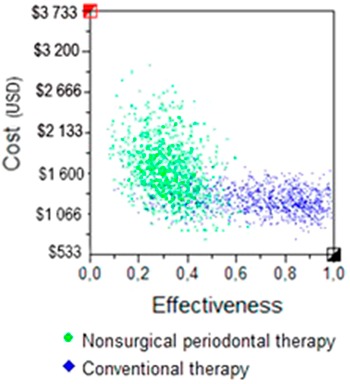
NSPT was a dominant alternative compared with subsidized supragingival therapy in type II diabetics with periodontitis. Supplementary Table S6 and Figure 2 show that both at 1 and 5 years, NSPT has lower costs for the health system and is more effective, compared with subsidized supragingival therapy in patients with type II diabetes mellitus and periodontitis, with an incremental cost for supragingival treatment of USD 87 to 400 and an improvement in the therapeutic effectiveness of 0.37, during the first year and up to 5 years, respectively.
Cost-effectiveness analysis – Five years (scatterplot). Scatter plot showing the cost-effectiveness comparing the two treatment strategies.

The expected dental survival of NSPT was 69 percent, which is higher than the expected dental survival of standard treatment, 32 percent. Therefore, treating a patient with periodontitis and type II diabetes with NSPT provides longer expected dental survival (Supplementary Table S6).
The tornado diagram (Supplementary Figure S1) shows the additional variables that could affect the cost-effectiveness of the cohort modeled. Variables that have the greatest impact on the ICER are the annual cost of conventional treatment, the probability of stability/control in standard care, the cost of surgical periodontal treatment (SPT), and the annual cost of NSPT. However, NSPT remains a cost-effective or dominant alternative. The deterministic sensitivity analysis was carried out by modifying the discount rate to 0, 3.5, 7, and 12 percent (Supplementary Table S7).
Results of the one-way sensitivity analysis show that supragingival cleaning would require an 80 percent probability of effectiveness to control periodontitis and costs ≤ USD 53.3 to be considered a cost-saving treatment (Supplementary Figures S2–S4). Likewise, NSPT would require a 30 percent probability of effectiveness to stabilize periodontitis and costs ≤ USD 640 to be considered a cost-saving treatment (Supplementary Figures S5 and S6).
Regarding the distribution of all costs by performing a Monte Carlo simulation, Supplementary Figures S7 and S8 show that costs can range from USD 394.7 to 453.3 for NSPT and USD 466.7 to 586.7 for CT. Supplementary Figures S9 and S10 show that effectiveness can range from 28 to 39 percent for CT and from 70 to 90 percent for NSPT, which coincides with the univariate sensitivity analyses. Other details of probabilistic sensitivity analysis are available in Supplementary Tables S8 and S9.
Discussion
Early diagnosis of periodontitis is essential in patients diagnosed with type II diabetes (Reference Preshaw and Bissett42). An optimal healthcare route plays an important role in controlling periodontitis (43). Periodontitis control may depend on the diagnosis, timely referral, prompt periodontal treatment, and medical treatment the patient receives when they have just been diagnosed with type II diabetes (16).
NSPT would be indicated as the only treatment under the assumption of a patient with stage I–II and grade B–C periodontitis. If a patient had a worse periodontal condition than described above, this model would only cover the first part of the treatment plan. In other words, the periodontitis progression node would include patients whose condition worsening persists after 3 months of NSPT (Figure 1). It is therefore that SPT costs are necessary to represent the costs of potential complications in periodontitis progression. Procedures used in periodontal surgery, for example, the cost of tooth extraction, were included. These costs were validated by the expert panel to bring them closer to the Colombian context.
A similar situation occurs with the costs of oral rehabilitation. The cost of tooth extraction is included, but not tooth replacement. These costs, which are high and are not covered by the health system, would increase the total value of the alternative with a higher risk of tooth loss. The same trend is observed with surgical periodontal therapy costs. However, different options for tooth replacement are available, such as a dental implant, conventional fixed dental prosthesis, or removable dental prosthesis. So, knowing the probability that a patient would choose a given treatment is needed, and would be out-of-pocket expense. This choice depends on economics, preferences, and access factors, among others (Reference Vieira and Leles44). Addressing these variables adequately would require a different model and was not an objective of this analysis.
In terms of other economic evaluations, two types of approaches and results were found in the literature. First, Pennington and Schwendicke found that periodontal treatment in the private sector is more effective than in public institutions, but is more costly (Reference Pennington, Heasman and Gaunt19;Reference Schwendicke, Stolpe, Plaumann and Graetz45). Hence, it depends on the importance that the patient gives to decrease these periodontal signs to justify the private periodontal therapy costs. Second, Solowiej-Wedderburn and Mohd-Dom found that the specialized periodontal therapy proposal is much more cost-effective than usual care in terms of the effect on HbA1 for diabetics, with additional periodontal and quality of life benefits (Reference Solowiej-Wedderburn, Ide and Pennington23;Reference Mohd-Dom, Wan-Puteh and Muhd-Nur46).
Partly as a result of this, the results of this analysis differ from the other studies mentioned above. The main reason is the difference between dental costs in the countries where economic evaluations were conducted. In these studies, periodontal therapy is more costly than in Colombia, with USD 637.7 on average for two sessions per year, versus what is presented in this analysis, which is USD 445.4 per year for four sessions. This explains why, in the Colombian setting, this therapy may be cost-saving as well as reducing tooth loss.
A potential limitation in the systematic reviews is that most studies do not differentiate by degrees of severity of periodontitis. As a consequence, a decision problem focused on a preventive and treatment model in the initial stages of periodontitis was the most appropriate choice. Included studies do not differentiate tooth loss per year follow-up either. That means, they do not differentiate by tooth loss during the first and second, until the fifth year; for this reason, we use the same effectiveness for the first and fifth years.
Diabetes and periodontitis are diseases that can carry a higher disease burden at older ages. This study contributes to the understanding of the economic impact of periodontitis in patients with diabetes, and associated complications, in an aging population.
Research findings presented in this article apply only to II diabetes patients with periodontitis. The generalizability of results may be limited for other chronic diseases or healthy patients with periodontitis. The results of this analysis may be applicable to countries with similar health care systems and economies to that of Colombia, where the costs of dental materials, procedures, and human capital are low.
Conclusions
Economic evaluations are essential for public health decision makers in creating strategies that provide the most cost-effective alternatives. Findings such as these would help to draw up a health roadmap to prevent and treat periodontitis in II diabetes patients. Thus, NSPT can generate savings for a third-party payer and improve the quality of life of the patient by reducing the complications derived from uncontrolled periodontitis and tooth loss.
An RCT is needed to better address the real-world effectiveness of NSPT versus CT in Colombia.
Supplementary material
To view supplementary material for this article, please visit https://doi.org/10.1017/S0266462322000563.
Funding statement
This research received no specific grant from any funding agency, commercial, or not-for-profit sectors.
Conflicts of interest
The authors declare none.
Ethical approval
Respecting the Declaration of Helsinki of 1964 and its subsequent amendments, this study was approved by the Ethics Committee of Hospital Universitario San Ignacio, Pontificia Universidad Javeriana (No. 02/20) on 27 Feb 2020.