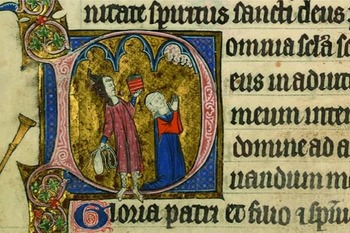
In a French Book of Hours from the early 1300s, a woman appears devoutly kneeling in prayer at the beginning of each hour. With her gaze heavenward, the figure – most likely the manuscript's intended noble patron – resists temptation behind her: a two-faced devil. Throughout the Divine Hours she is shown time and again deep in prayer and seemingly unaware of the devilish dangers looming at her back (Fig. 1).Footnote 1 These depictions of the petition's power against evil summarise visually the function of the liturgical verse that these historiated initials introduce (‘Make haste, O God, to deliver me’) and highlight its significance in the Middle Ages as a popular, salvific interjection. The placement of the prayer within a Book of Hours reflects, too, its broader liturgical function; at least eight times a day in monastic and clerical institutions across medieval Europe, the two-part text ‘Make haste, O God, to deliver me; make haste to help me, O Lord’ (‘Deus in adiutorium meum intende; Domine ad adiuvandum me festina’) was heard and sung.Footnote 2 This opening verse of Psalm 69 (70 in the Hebrew Psalter) was more than an introduction to each of the Office Hours; it was an all-purpose, utilitarian petition that served countless functions in the everyday life of the faithful, refrain-like in its constant reiteration. Recited silently, the Deus in adiutorium verse provided strength before laborious tasks; repeated continually, it served as the backdrop for evening meditations; in the liturgy, as well as in emergencies, it accompanied the sign of the cross; and, in the face of temptation, as with the noblewoman of the Book of Hours, it safeguarded against sin.
Cambrai, Bibliothèque municipale MS 87, fol. 43v, Hours of the Virgin, detail (‘D-’ of ‘Deus in adiutorium’). By kind permission of the Médiathèque d'Agglomération de Cambrai.

Considering its importance throughout the Middle Ages, this intoned, sung, chanted and silently recited prayer has rarely captured scholarly attention. An exception in the realm of musicology resides in discussions of a monophonic and polyphonic trope of the Deus in adiutorium versicle preserved in a group of well-known motet manuscripts from thirteenth-century France, among them the Montpellier (Mo) and Bamberg (Ba) codices, and in an assortment of manuscripts transmitting festive liturgies for Christmastide.Footnote 3 Yet, this broadly circulating northern French trope is a relative anomaly; the verse usually involved only simple, formulaic recitation, not elaborate tropes or polyphony.Footnote 4 However, another reworking of Deus in adiutorium also circulated in thirteenth-century France, alongside the better-known versions in Mo and elsewhere: Pater creator omnium, a monophonic Latin refrain song, or conductus, preserved solely in the final fascicle of the famed Parisian manuscript Florence, Biblioteca Medicea-Laurenziana, Pluteus 29.1 (hereafter F). This song is more than an unicum; unlike the majority of thirteenth-century Latin songs, or conductus, the poetry of Pater creator omnium is built from ‘snippets’ of hymns, prayers, chants and sacred songs. Its text is a patchwork, or ‘cento’, completely fabricated from pre-existing devotional poetry. What connects Pater creator omnium to the Deus in adiutorium trope circulating in thirteenth-century France is the former's refrain: an explicit borrowing of the frequently heard prayer Deus in adiutorium.
In this article, I explore the construction of Pater creator omnium both as a centonate Latin poem and as a musico-poetic expansion of the popular Deus in adiutorium prayer. In so doing, I contextualise this Latin song within the history of poetic and musical centonisation, connecting its piecemeal construction from familiar poetry with similar citational impulses in contemporary repertories. Following a close analysis of Pater creator omnium, including the identification of heretofore unrecognised textual borrowings, I hone in on the refrain's borrowed text to reveal its likely musical source within the family of thirteenth-century Deus in adiutorium tropes transmitted in Mo, Ba and elsewhere. Finally, by focusing on the Deus in adiutorium refrain, I pinpoint the significance of the prayer as a repeated expression of popular piety, bringing the formal structure of Pater creator omnium into dialogue with the rich cultural and devotional history of the verse. Specifically, I suggest that the poetic and theological importance of Deus in adiutorium as a repeated utterance is reflected, and even exemplified, in the refrain of Pater creator omnium, which repeats this psalm text incessantly against its centonate backdrop.
Piecing the song together: centonisation, poetry and medieval music
In the creation of medieval prose, poetry and music, the use of the old to make the new is an overarching compositional tactic. Rather than originality, medieval writers and composers revelled in the reworking of a shared fund of both musical and textual knowledge. Although not strictly the purview of medieval creativity, pedagogical and compositional practices of pre-modern Europe were marked by a high degree of repetition and borrowing.Footnote 5 Text or music with a great deal of borrowing should not be seen as unoriginal and lacking the sophistication associated with ‘newly composed’ works; instead, such creations ought to be considered products of a cultural environment that valued reuse. Constant return to, and citation of, meaningful texts in the construction of new works – whether the sources were liturgical, biblical or even vernacular – was a technique practised by ‘good students’ and clerics, composers and poets whose environment encouraged and valued emulation and reuse.Footnote 6
Within this culture of creative recycling, the poetic technique of centonisation is central, based entirely on the use of pre-existing works to make something utterly new, replete with new meanings. In its early Classical meaning, a cento refers to something pieced together (technically, a garment) from various pieces; in other words, a patchwork.Footnote 7 In its specific poetic usage, cento refers to a poem wholly constructed from lines or half-lines taken from Classical authors or, increasingly, from the Bible or popular medieval writers.Footnote 8 Although the genre appeared to lose ground in the later Middle Ages before a resurgence of interest in the Renaissance, numerous examples of centos are extant, including such early Christian centos as Faltonia Proba's Cento Vergilianus de laudibus Christi, and the less pious Cento Nuptialis of her fourth-century contemporary, Decimus Magnus Ausonius. In his preface, Ausonius provides one of the few existing descriptions of the genre and its construction, praising the cento for its complexity while cautioning against its easy descent into ribaldry:Footnote 9
Centonem vocant qui primi hac concinnatione luserunt. solae memoriae negotium sparsa colligere et integrare lacerata, quod ridere magis quam laudare possis cento quid sit absolvam. variis de locis sensibusque diversis quaedam carminis structura solidatur, in unum versum ut coeant aut caesi duo aut unus <et unus> sequenti cum medio.
They who first trifled with this form of compilation call it a ‘cento.’ ’Tis a task for the memory only, which has to gather up scattered tags and fit these mangled scraps together into a whole, and so is more likely to provoke your laughter than your praise I will expound what a cento is. It is a poem compactly built out of a variety of passages and different meanings, in such a way that either two half-lines are joined together to form one, or one line and one accompanied by the following half-line.
As Ausonius implied, intimate familiarity with the borrowed texts is assumed, making the choice of texts in a centonised work meaningful and revealing of the author's context. While the earliest centos relied strictly on classical authors, later medieval poets moved away from Classical writers, instead citing sacred and vernacular texts ranging from the Bible to Alexander of Villedieu's Doctrinale.Footnote 10
Centonisation entered musicological discourse with the work of Paolo Ferretti in 1934; he introduced the term, previously used by liturgical scholars, as a way to analyse formulaic chant repertories.Footnote 11 The role of centonisation in chant has since undergone various stages of criticism, fuelled especially by a seminal article of Leo Treitler.Footnote 12 Yet, the use of ‘cento’ to describe the technique and appearance of certain genres of music and poetry has persisted, often used inaccurately as a quasi-synonym for the intimately related processes of citation and quotation.Footnote 13 Among the textual and musical works identified as centos in the later Middle Ages, the ‘refrain cento’, a motet in which refrains comprise the entirety of the work, is the most significant. Although the number of motets identified as such has been reduced in order to remain truer to the conventions of the cento genre, these polyphonic works bear certain markers of centonate construction, namely the wholesale use of pre-existing refrains as the musical and textual material of new motets.Footnote 14 In the end, a true ‘refrain cento’, in the sense of reflecting the principles of centonate construction, is a relatively rare occurrence in the motet repertory, and represents a citational technique as opposed to a subgenre.Footnote 15
While the level of borrowing may not be great in chant and motets, it is in the vast conductus repertory of the twelfth and thirteenth centuries that a level of borrowing comparable to that of the classical and later medieval cento genre emerges.Footnote 16 Conducti were, like most medieval centos, fabricated from an array of familiar medieval sources, including hymns, chants, sequences, biblical, patristic, didactic and narrative texts, as well as other conducti. In contrast to contemporary repertories, the Latin conductus sets to music a number of poems that, akin to the Classical and medieval cento, are composed of lines and sentences drawn from other contexts and strung together to create new meanings. In other words, certain conducti could be added to the list of extant poetic centos from the Middle Ages.Footnote 17
With the sheer quantity of citations in mind – both biblical and otherwise, and often echoed from one conductus to another – it becomes clear that the poets behind this repertory were working from a common devotional vocabulary.Footnote 18 Contrary to the broader reception of the medieval cento as a parodic form, in the conductus repertory, the centonate poems are more devotional. In most cases, each new conductus includes a relatively moderate amount of pre-existing material, ranging from one or two lines or incipits of chants and conducti to entire sections or strophes of hymns, sequences and other sacred and secular poems.Footnote 19 A significant number of conducti rework well-known hymns, such as Ave maris stella, while others incorporate substantial segments of sequences, such as Mors vite propitia, modelled on Sexta passus feria.Footnote 20 One conductus takes as its textual authority the introductory line of Cato's Distichs, a medieval textbook, manipulating it into a refrain that grammatically declines over seven strophes.Footnote 21 In such conducti the label ‘cento’ seems somewhat misleading, since the borrowed material comprises only a portion of the total work. Although conducti frequently utilise pre-existing textual and musical material – which argues against the textbook-propagated conception of the conductus as ‘newly composed’Footnote 22 – only a small portion are genuine centos, in the sense that the entirety of the ‘new’ piece comprises ‘old’ bits.Footnote 23
The role of music as a potentially borrowed element in such textually centonate works should also be considered. When centonisation is used to describe the composition of chant repertories, it is typically in reference to melodic construction. In the context of the refrain-cento in the motet repertory, both music and poetry arguably contribute to a centonate construction. With many conducti, centonisation occurs almost solely on the poetic, not the musical, level, and the textual authority of the work often resides in the conductus repertory of which it is a part, rather than in external authorities.Footnote 24 Pater creator omnium, therefore, is one of the few examples of a ‘true’ Latin song-cento, since each line of a song exists as a unit of musico-textual meaning that has been borrowed, reworked and re-contextualised in a new work.Footnote 25 Authorities in Pater creator omnium range from the biblical to the contemporary, namely the conductus repertory. It is to Pater creator omnium that I now turn, examining in detail the systematic musical and poetic construction of this elegantly quilted medieval song.
Pater creator omnium: a patchwork song
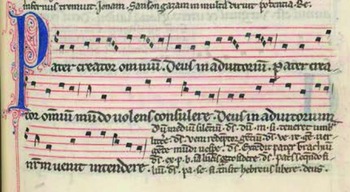
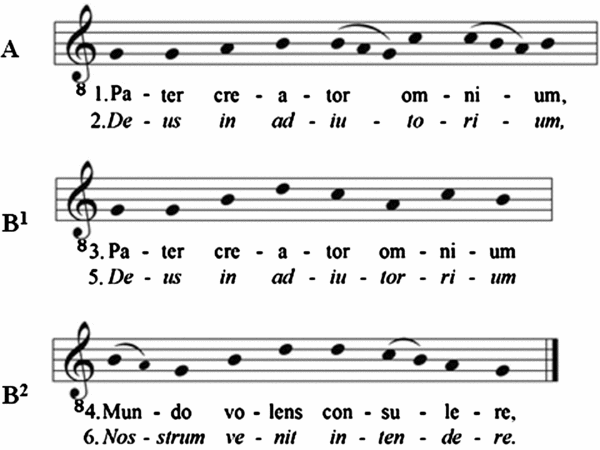
The final fascicle of F transmits five dozen Latin refrain songs; the majority of these formally resemble the vernacular rondeau with a partial repetition of the refrain in the midst of strophes and a full repetition at the end.Footnote 26 Pater creator omnium, which will be more closely examined here, was written in the same rhymed, rhythmical Latin as the other works, with regular eight-syllable proparoxytonic lines organised into five strophes, all set to the same music. Presented in a conventional layout, the first strophe with refrain is fully notated, while all remaining text appears unnotated alongside the musical setting (see Fig. 2).Footnote 27 Unlike the usual two melodic phrases of a rondeau, the musical setting of Pater creator omnium consists of three phrases, each melody presented first with a line of the strophe, and then echoed by a line of the refrain. The resulting six-line form divides into three closely related lines: aAb1b2B1B2 (see Ex. 1).
F, fol. 467r, Pater creator omnium. By kind permission of the Ministero dei beni culturali e del Turismo. Any further reproduction, by any means, is forbidden.

Pater creator omnium, F, fol. 467r.

The melodic contour stays within a fairly limited range of a fifth (G–d), and emphasises stepwise and triadic motion (only the first phrase has a larger leap). The text setting is predominantly syllabic, with a maximum of three notes to a syllable (again, in the initial phrase). All phrases revolve around G, outlined by triadic motion up to d and the beginning and closing pitches of each phrase (G and b). The song's notation and formal structure are by no means unusual in relation to other Latin refrain songs in F’s final fascicle; textually, however, this is an exceptional work, both within F and the larger repertory of medieval Latin song.
Notably, Pater creator omnium is the only song in the final fascicle of F centonised completely from hymns, chants and conducti. Its centonate character is immediately obvious to anyone familiar with the medieval hymnal, since its incipit is drawn from a hymn for the Holy Trinity (‘Pater creator omnium’). If that clue was not clear, the entrance of the refrain mid-way through the first system in the manuscript immediately signals the song's liturgical orientation: ‘Deus in adiutorium’.
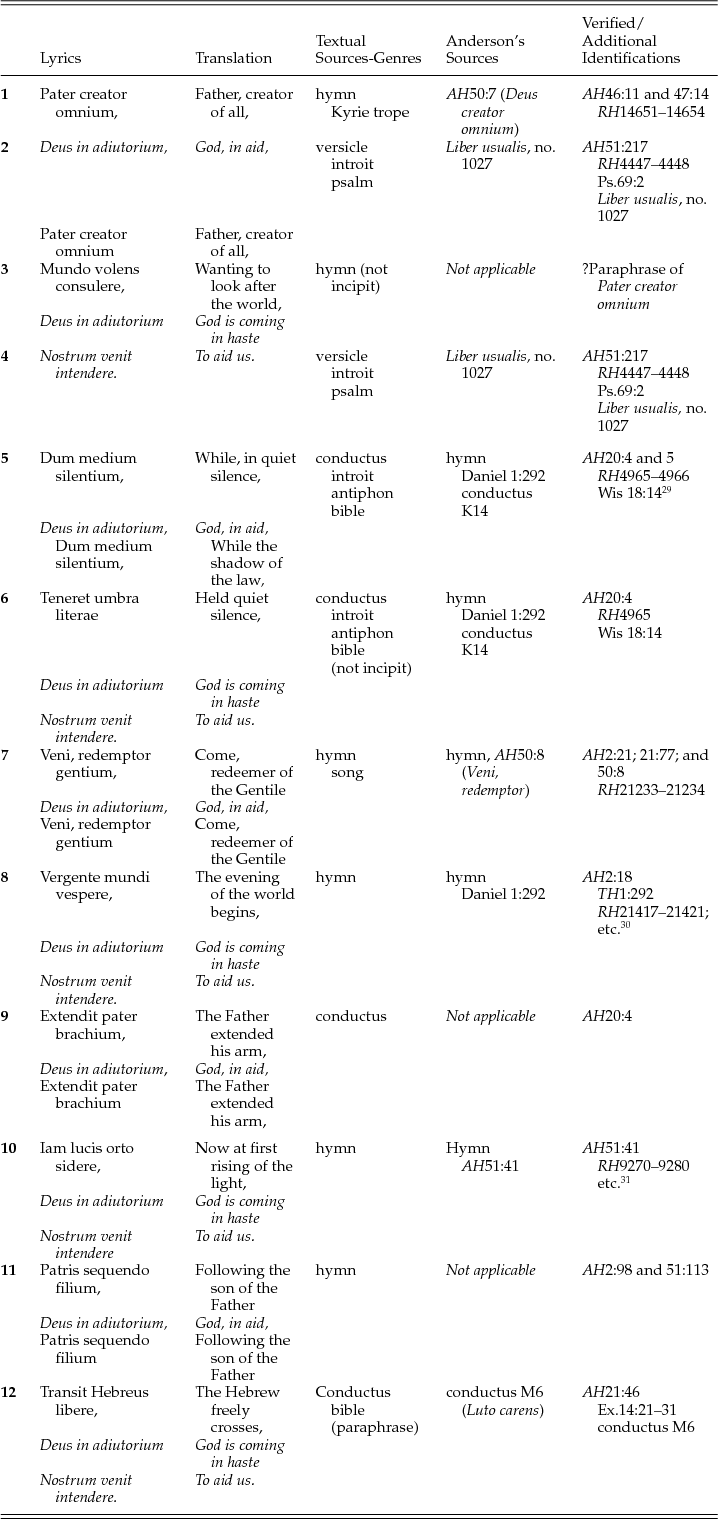
Gordon Anderson's conductus edition identified a number of textual citations in Pater creator omnium; Table 1 lists the remaining identifications, together with further sources for lines already partially identified by Anderson (his misleading identifications are corrected in the right-most column). Each distinct line has its own number from 1 to 12, while line repetitions, including the refrain, are unnumbered. Unless indicated otherwise, the centonised text is an incipit. The previously missing identifications are likely due to the fact that some borrowed lines are either not easily searchable incipits or paraphrases. In the case of line 9, the text is actually found in the same conductus cited in the second strophe, Dum medium silentium. Line 11, also unidentified in Anderson's catalogue, derives from a hymn for one martyr, Martyr dei qui unicum. Textual snippets found in multiple contexts are clearly preferred by the poet; almost every line of the centonised poem would have been familiar to singers from the liturgy. Only two conducti are drawn on, but even these present formulaic ideas with ultimately scriptural origins. In terms of its identification as a cento, the wholesale construction of the conductus Pater creator omnium from pre-existing poetry argues strongly for such a label.
Pater, creator omnium, F, fol. 467r, translation and textual sources.Footnote 28

Pater creator omnium is set apart from other sacred medieval centos, however, by its contextualisation in a deceptively simple, and even popular, devotional song form (thanks to its structural parallel with the rondeau). The guileless melodic form works, in fact, to obscure the significance of the cento genre for the music, as well as the poetry. Given the patchwork character of Pater creator omnium, it should be unsurprising that the music, too, may have been borrowed. Despite the simplicity of its melody, its music nevertheless serves to link it to the larger complex of thirteenth-century tropes that likewise rework its most pervasive text, the refrain ‘Deus in adiutorium / Nostrum venit intendere’.
Borrowed text and music: Pater creator omnium and troping the Deus in adiutorium
In addition to textual citations, contrafacture and melodic borrowing are by no means unusual within F’s conducti, especially the refrain songs of the final fascicle.Footnote 32 Sources for Latin and vernacular as well as sacred and secular medieval song all demonstrate the cultural trend towards reusing music for a range of texts.Footnote 33 Yet, despite the role of musical borrowing in song repertories writ large, no concordance has been posited for Pater creator omnium, although the centonised fabric of hymns, chants and conducti offers many possibilities. By placing Deus in adiutorium in a prominent position in Pater creator omnium as its refrain, the song's creator may have actually been gesturing towards the prior existence of the melody as a whole.
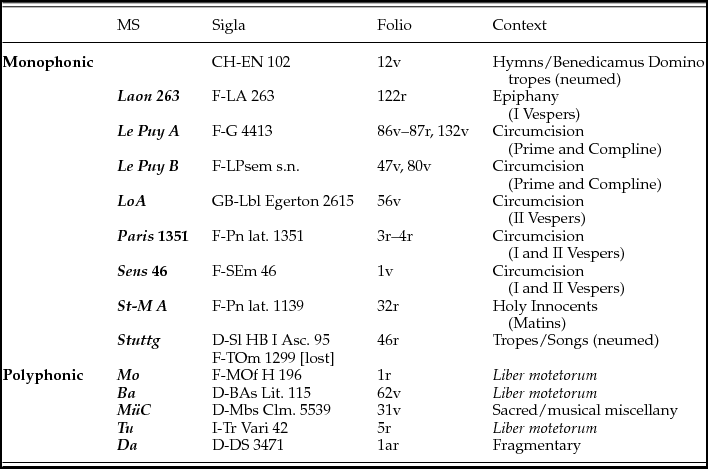
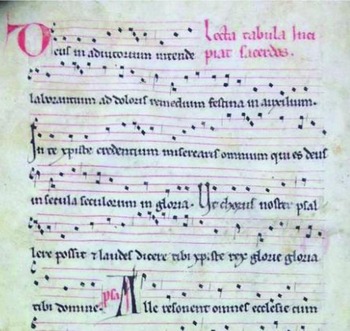
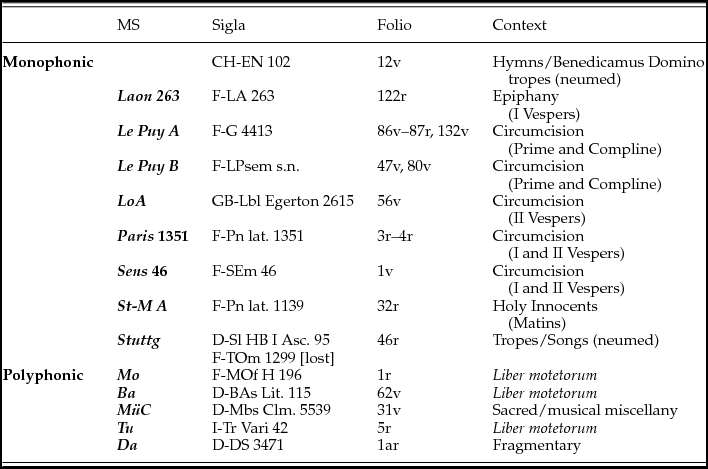
Liturgically, however, settings of the invitatory psalm Deus in adiutorium are typically nondescript. Unlike the numerous melodies circulating for the concluding Benedicamus Domino versicle, Deus in adiutorium did not seem to garner the same level of compositional interest.Footnote 34 Likewise, tropes of the Benedicamus Domino proliferated from the twelfth century onward (a substantial number of which demonstrate ties to the conductus repertory), while only a few medieval Deus in adiutorium tropes of any kind are extant. Considering the lack of melodies for the Deus in adiutorium versicle, the popular versified trope (Deus in adiutorium / Intende laborantium) that circulated in thirteenth-century liturgical and motet manuscripts holds considerable interest. An elaboration of the opening versicle in the form of a rhyming, strophic Latin song, this expansion of Deus in adiutorium is preserved monophonically in at least nine sources, and in the majority of those sources is specifically positioned within festive Christmastide Offices.Footnote 35 Additionally, it is transmitted as the lowermost voice of a conductus-motet in five manuscripts, almost all of which preserve motet collections (Table 2). In festive Offices, the monophonic Deus in adiutorium trope is assigned to the Feasts of Circumcision, the Holy Innocents and Epiphany. Figure 3 presents the version preserved in one of the festive manuscripts transmitting the Office of the Circumcision, Sens 46; here, the rubric preceding the trope provides evidence as to the versicle's liturgical performance within an Office, reading: ‘Let the priest begin at the lectern’ (‘Lecta tabula incipiat sacerdos’).Footnote 36 Constructed as a strophic poem, this expansion of the Deus in adiutorium versicle closely resembles contemporary conductus poetry, with rhythmical, rhymed and eight-syllable proparoxytonic lines:

Sources for Deus in adiutorium trope.
Sens 46, p. 2, Deus in adiutorium trope. By kind permission of the Bibliothèque municipale, Sens.

Like the refrain of Pater creator omnium, only the beginning and end of the versicle is retained (‘Deus in adiutorium intende’ and ‘festina’), troping the biblical text with further petitions to God to have mercy on his believers (and, importantly, the choir). Complementing the Christological bent in the second two strophes, the doxological message in the second strophe (‘in secula / seculorum in Gloria’) concludes the Trinitarian focus and also refers to the doxology following the versicle in the Offices.
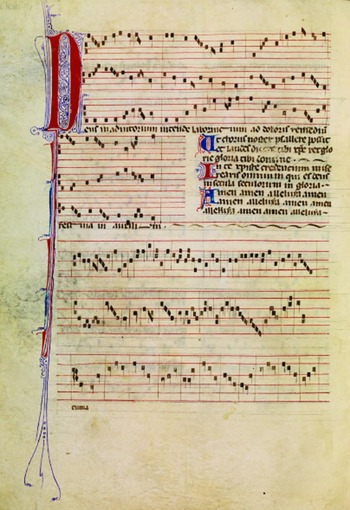
The version of the monophonic trope in Sens 46 provided above is not the only extant textual form of the trope; it expands to four strophes in two different polyphonic settings that circulated, sometimes side by side, in motet sources as a quasi-liturgical introduction.Footnote 38 Only one of the two polyphonic settings is of interest here, since it is this work that shares its lowermost melodic line with the nine monophonic settings. In Figure 4, the polyphonic setting of the trope with four strophes appears as transmitted in Ba, a central source for thirteenth-century French polyphony. Poetically, this version of the trope, which introduces two of the motet collections (Ba and Mo), includes an additional strophe and inverts the order of the middle strophes. This is also the ordering followed in some monophonic sources and one that makes logical sense considering the doxology of the third strophe. Rather than being fully worked-out, the added fourth and final strophe plays on two liturgical refrain words (‘amen’ and ‘alleluia’), emphasising through repetition their traditional function as cadential formulae and their assonant relationship:

Ba, fol. 62v, Deus in adiutorium, polyphonic setting. By kind permission of the Staatsbibliothek Bamberg.

The origin of this trope in either its three or four strophe form, the latter familiar to many musicologists due to its polyphonic existence, is less well known. It is transmitted first not in thirteenth-century motet manuscripts, but in the twelfth-century Aquitanian troper St-M A, and in a hymn from the eleventh-century Irish Liber Hymnorum, attributed to sixth-century Irish abbot and missionary St Columba.Footnote 40 In other words, despite its novel polyphonic appearance, the textual Deus in adiutorium trope was not new to the thirteenth century, but instead represented a reworking of a pre-existing trope.
The more than a dozen settings of this Deus in adiutorium trope are unquestionably linked poetically and musically, with all five polyphonic and nine monophonic sources sharing a virtually identical melodic line (the lowermost ‘tenor’ in multi-voice settings). The shared musical features with the melody of Pater creator omnium, however, have so far escaped notice. Example 2 compares the melody of Pater creator omnium (seen with the refrain text only) with the melodies of the monophonic Deus in adiutorium tropes from festive manuscripts and the lowermost lines of polyphonic settings, the latter two with the first poetic strophe underlaid.Footnote 41 Only melodic relationships among the tropes in Example 2 have been noted, but not the musical link to Pater creator omnium in F. The most significant similarity occurs at the opening of ‘Deus in adiutorium’ and the triadic beginning of the second phrase (‘intende laborantium’ in the tropes), with shared pitches indicated by larger note heads. Shared melodic material becomes less apparent in the final two musical phrases, with only general contours and the closing pitch on G in common between Pater creator omnium and the Deus in adiutorium tropes. Overall, the melody of Pater creator omnium displays strong, almost unmistakable parallels to contemporaneous Deus in adiutorium tropes.
Pater creator omnium compared with monophonic and lowest voice of polyphonic Deus in adiutorium tropes.

Just as the text of Pater creator omnium was constructed from familiar snippets of sacred texts and the all-too-familiar opening versicle Deus in adiutorium, so too does it appear the melody is shared with, or perhaps inspired by, a familiar elaboration of the versicle circulating in the same cultural and geographical areas. With multiple sources for one Deus in adiutorium textual and melodic trope preserved in an array of sources, it seems clear that at least one musical expansion of the versicle was popular and widespread. Due to such melodic and textual connections, Pater creator omnium is a likely candidate to be added to this corpus of elaborations for Deus in adiutorium.
Another striking point of comparison emerges between the texts of Pater creator omnium and these tropes, namely the treatment of the shared text. From the first half of the original psalm verse, the creator of Pater creator omnium fashioned the nearly identical two-line refrain to the contemporary trope: ‘Deus in adiutorium / Nostrum venit intendere .’. Among the alterations made to the verse, the pluralising of the verse is perhaps the most significant, from ‘Deus in adiutorium meum intende’ (singular) to ‘Deus in adiutorium nostrum venit intendere’ (plural).Footnote 42 Although the grammatical shift in the versicle is occasionally found in liturgical uses, such as that of Sarum,Footnote 43 the singular is far more typical, even in the choral response of the second half of the versicle where a plural subject might be expected: ‘Oh Lord, make haste to help me.’ The grammatical shift from singular to plural characterises the refrain song Pater creator omnium entirely, since the adapted versicle text forms the refrain and thus occurs five times throughout the five strophes. This pluralising is significant since it appears in both the monophonic and the polyphonic Deus in adiutorium trope, emphasising a community of believers over the singular faithful. Here, the Lord is petitioned to alleviate the suffering of the people; Christ is asked to have mercy on all his believers; and blessings are asked for ‘our choir’ (‘chorus noster’), presumably the singers of the trope themselves. Whether joining in at the refrain, as in the plural refrain of Pater creator omnium, or joining together in polyphony, both the trope and the song reworking of Deus in adiutorium shift the emphasis away from the individual and towards the larger community by foregrounding the plural, rather than the singular (albeit still collective) voice.
Above and beyond this intriguing musical and poetic connection to a broader repertory of musical and textual tropes of the verse, Pater creator omnium also serves as a significant intertext within the theological history of Deus in adiutorium as an all-purpose Christian prayer. With its continual returns, the borrowed refrain of Pater creator omnium links thirteenth-century song to the centuries-long history of the Deus in adiutorium versicle in exegesis, poetry and devotion.
Deus in adiutorium: the never-ending prayer
Why was Deus in adiutorium chosen as a refrain? What factors led to the reworking of this specific prayer as a refrain, and not (as it appears elsewhere) as a single citation? If the centonate form ‘is a successful literary endeavour because it takes the canon of a given community and assumes it for itself, takes it, and divides it until its reorientation fits the centonist's purposes’,Footnote 44 then the reasons for a continued emphasis on the psalm verse deserves investigation. Few detailed discussions of the theological and liturgical function of Deus in adiutorium are extant from the Middle Ages, apart from its daily performance in the Office Hours.Footnote 45 Liturgically, the psalm verse is prescribed for use in daily rites by the Benedictine Rule and most subsequent rites, in which its recitation and response occur at the beginning of each hour.Footnote 46 That the practice of introducing the Office Hours with this verse quickly became commonplace is confirmed in the ninth-century Concordia regularum of Benedict of AnianeFootnote 47 and the De ecclesiasticis officiis of liturgical commentator Amalarius of Metz.Footnote 48 Into the twelfth and thirteenth centuries, Jean Beleth's Summa Footnote 49 and Guillaume Durand's Rationale divinorum officiorum Footnote 50 also attest to the continued use of the verse ritually and practically. In notated and unnotated manuscripts containing the Offices Hours, the Deus in adiutorium is so standard that it becomes increasingly difficult to gather much information at all about its performance.Footnote 51 The omnipresence of the text in the liturgy and its matter-of-fact acceptance by liturgical commentators leaves no doubt as to its complete integration into daily devotional life.
Above and beyond its liturgical function, the text also inspired a less liturgical but still faith-driven tradition that affects how its repeated appearance in Pater creator omnium might be understood. Psalm 69 from which the verse and refrain derives provides the necessary entry point to a strand of devotional interpretations of the verse:

The psalm itself is constructed as a prayer, with the initial plea echoed in the final verse; it is, as Augustine observes, a prayer for sufferers, martyrs and the persecuted. With a unified voice the brief psalm pleads for protection against sin and evil:Footnote 52
[Diabolus t]entare ergo non cessat; insidiari non cessat. Infrenatus est atque illigatus in cordibus impiorum, ne saeuiat in ecclesiam, et tantum faciat quantum uult Clamemus ergo una uoce omnes uerba haec: ‘deus, in adiutorium meum intende.’ Opus enim habemus sempiterno adiutorio in isto saeculo. Quando autem non. Modo tamen in tribulatione positi maxime dicamus:‘deus, in adiutorium meum intende.
[The devil] never ceases to tempt us, never ceases to lie in wait. In the hearts of the godless he is unleashed and unrestrained, but let him not wreak havoc on the Church, and do what he likes here Let us, then, shout these words with one voice: O God, give heed and help me; for as long as we are in this world we need his constant help. Whenever shall we not? Yet now most of all, when we are in distress, let us say it: O God, give heed and help me.
Augustine's reading resonates with later writings, including those of Durand who essentially transmits a paraphrase of Augustine.Footnote 53 Essentially, Augustine, Durand and others see this verse as a Christian talisman to ward off danger in its various demonic guises.
The usefulness of the Deus in adiutorium extends beyond the evils described by Augustine to more banal tasks. While the prayer served as a distress cry, it simultaneously served as a general interjection of mindfulness, accompanied the signum cruces and was a reminder of God's power when performed before weekly duties. Silent reflection on the prayer is also frequently advised, as in the sixth-century Regula coenobialis by Columbanus:Footnote 54
In commune omnes fratres omnibus diebus ac noctibus tempore orationum in fine omnium psalmorum genua in oratione, si non infirmitas corporis offecerit, flectere aequo animo debent, sub silentio dicentes, Deus in adiutorium meum intende, domine ad adiuvandum me festina.
All the brethren together, every day and night at the time of prayers, on the ending of all psalms, should uniformly bend their knees in prayer, if bodily weakness does not prevent it, saying in silence, O God make speed to save me, Lord make haste to help me.
Other spiritual figures likewise found mundane and domestic uses for the prayer. Catherine of Siena not only incorporated the verse into a longer prayer of her own design (Prayer 12), she also frequently repeated it aloud.Footnote 55 Centuries later, Catholic writer Lady Georgiana Fullerton (1812–85) recorded her use of the prayer before ‘going up or downstairs’, ‘beginning to read’ and ‘closing the book’.Footnote 56 In essence, Deus in adiutorium functioned as an ejaculatory prayer, or aspiration, which could be freely repeated throughout the day just as other short prayers were repeated (e.g., the ‘Jesus Prayer’), all following a Pauline model for unceasing prayer, based on 1 Thessalonians 1:2 and 5:17. It is precisely the prominence of the verse in the practice of unceasing prayer that connects thirteenth-century Deus in adiutorium tropes, and especially Pater creator omnium, to the writings of John Cassian. His Conferences with the Fathers not only reveal the poetic and theological motivations behind the later saturation of the Deus in adiutorium text in devotional life, they also lay the groundwork for the refrain-like function of the psalm excerpt in the Office Hours and in Pater creator omnium.
The Conferences of Cassian and Deus in adiutorium as unceasing prayer
Prayer occupies two conversations of Cassian with desert father Isaac.Footnote 57 Within this extended discussion of monastic prayer, the verse Deus in adiutorium is especially singled out by Abba Isaac, and consequently by his reporter, Cassian, for a special kind of treatment that affords insight into its later devotional usage as a talisman and all-purpose prayer. Conference 10, chapter 10, transmits Abba Isaac's perspective on ‘continual prayer’, foregrounding the importance of the verse ‘Deus in adiutorium’ for ‘perpetual awareness of God’.Footnote 58 The concept of continual prayer has clear implications for the Offices Hours, a form of continual daily prayer of which the verse Deus in adiutorium is a significant element. Indeed, Cassian's Conferences predicts, or even prescribes, the practice of singing Deus in adiutorium at the beginning of the Hours, a practice adopted by Benedict in his Rule and many other rules.Footnote 59
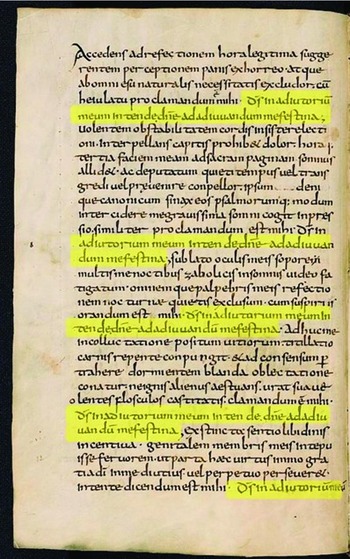
Chapter 10 continues with Abba Isaac noting the amazing malleability of Deus in adiutorium: ‘Not without reason has this verse been selected from out of the whole body of scripture. For it takes up all the emotions that can be applied to human nature and with great correctness and accuracy it adjusts itself to every condition and every attack.’Footnote 60 Indeed, the flexibility of the versicle is evidenced by its repetition a total of fifteen more times within the brief chapter, outlining the occasions on which its recitation would be appropriate.Footnote 61 Figure 5 provides one of the folios from a manuscript in the Vatican Library transmitting the Conferences, although chapter 10 was added later in this source. On the manuscript page, Cassian's rhetorical anxiety to include all possible occasions is immediately clear from the overwhelming repetition of the verse (highlighted here).Footnote 62
Vatican, Biblioteca Apostolica Vaticana, Pal. lat. 560, fol. 104v (c.800). © 2016 Biblioteca Apostolica Vaticana. Used by permission of Biblioteca Apostolica Vaticana, with all rights reserved.

Abba Isaac further reflects on the perpetual meditation of Deus in adiutorium, stressing its saturation even in daily life. The following passage, the most striking in the Chapter, depicts the physicality of the reiterated prayer:Footnote 63
Hunc uersiculum meditanti tibi somnus inrepat, donec incessabili eius exercitatione formatus etiam per soporem eum decantare consuescas. Hic tibi expergefacto primus occurrat, iste euigilantis cogitationes anticipet uniuersas, iste te de tuo surgentem cubili curuationi genuum tradat atque illinc deinceps ad omne opus actus que deducat, hic te omni tempore prosequatur [] hunc scribes in limine et ianuis oris tui, hunc in parietibus domus tuae ac penetralibus tui pectoris conlocabis, ita ut haec ad orationem procumbenti sit tibi adclinis decantatio et exinde consurgenti atque ad omnes usus uitae necessarios incedenti fiat erecta et iugis oratio.
Let sleep overtake you as you meditate upon this verse until you are formed by having used it ceaselessly and are in the habit of repeating it even while asleep. Let this be the first thing that comes to you when you awake, let it anticipate every other thought as you get up, let it send you down to your knees as your arise from your bed, let it bring you from there to every work and activity, and let it accompany you at all times You should write this on the threshold and doors of your mouth, you should place it on the walls of your house and in the recesses of your heart, so that when you prostrate yourself in prayer this may be your chant as you bow down, and when you rise from there and go about all the necessary affairs of life it may be your upraised and constant prayer.
The relationship between these early writings and later poetic and musical reworkings is conjectural but important: Deus in adiutorium was a prayer that could not only be adapted to fit any situation, but also in fact required constant rumination. The versicle's positioning in Pater creator omnium as a repeated refrain, therefore, at least conceptually and poetically reflects this devotional function. The continued significance of Deus in adiutorium as an everyday prayer from Cassian onward increases the likelihood that the creator of Pater creator omnium was aware that, by using the text as a refrain in a poetic cento, he was making reference to a broader tradition of its use in the ritual of unceasing prayer. In this way, Pater creator omnium provides a centuries-later musical counterpart to Cassian's commentary, adapting the versicle to each new strophe, and continually returning to it until the singer is ‘moulded’ by its ‘constant use’.
Prayer in the round
Infiltrating daily life through the liturgy and popular interjections, the verse Deus in adiutorium has served a devotional function marked by versatility. Yet, despite its omnipresence across cultural contexts throughout the Middle Ages and beyond and its inherently vocalic petition, Deus in adiutorium has only rarely found a place in musical repertories outside or alongside the liturgy. The collection of thirteenth-century monophonic and polyphonic tropes of the verse circulating in France within both liturgical and extraliturgical sources represent, consequently, one of the few moments of heightened musical interest in the verse. What has not been noticed previously is the musical and textual connection between these tropes and a song also from thirteenth-century France, Pater creator omnium. A welcome addition to the meagre number of medieval Deus in adiutorium reworkings, Pater creator omnium also belongs firmly to the cento genre, with its construction based on the piecing together of the old to make the new.Footnote 64 In other words, it stands as a pivotal work at the intersection of two important, yet still understudied histories: the musical and textual troping of Deus in adiutorium and the medieval cento.
The significance of Pater creator omnium extends beyond its centonate and tropic features, offering insight into the broader cultural use of Deus in adiutorium. Deus in adiutorium serves not only as a multipurpose prayer, but also as one of the most powerful petitions against sin and for divine intervention. In Pater creator omnium, the salvific properties of the verse are exploited, with the song functioning as an extended supplication to the Lord. More than simply a cry for help, though, Pater creator omnium reflects on a structural level through the continual return in its refrain to Deus in adiutorium the principle of perpetual prayer. Advocated for by Cassian, the continual recitation of Deus in adiutorium is the most important aspect of the verse's devotional history, enacted liturgically through its placement in the Offices and daily in the lives of the devout. Uniquely in pre-modern music and poetry, Pater creator omnium serves as a musical exploration of such meditation on Deus in adiutorium, praying for salvation in and through a song, itself already infused with the meanings of its borrowed verses.