1 Introduction
In Canadian English, as well as some US dialects (e.g. Philadelphian English), the forms done, finished and started combine with the auxiliary be and a direct object to produce a resultative interpretation.
- (1)
(a) I am done dinner
(b) I am finished my homework
(c) I am started this project (Yerastov Reference Yerastov2010, Reference Yerastov2012)
The construction in (1) appears to be a special case of the productive transitive be perfect found in insular Scots (Yerastov Reference Yerastov2012). Its various reflexes have been reported in North America – by Atwood (Reference Atwood1953) for Pennsylvania, by Gold (Reference Gold and Radišić2007) for the Canadian prairies, and by Wolfram (Reference Wolfram1996) for North Carolina.
A worldwide distribution of the transitive be perfect is mapped out and documented by the Electronic World Atlas of Varieties of English (eWAVE) (Kortmann & Lunkenheimer Reference Kortmann and Lunkenheimer2013). Among L1 varieties, the transitive be perfect is obligatory and pervasive in Shetlandic and Orcadian, as well as Newfoundland English; it is neither pervasive nor extremely rare in Scottish English and Southeast American English dialects. There is an attested absence of the feature in Southern English dialects, although this feature is attested as rare in Northern English dialects. Among L1 varieties influenced by contact, the transitive be perfect is attested to be neither pervasive nor extremely rare in Irish English, Australian Vernacular English and Tristan de Cunha English; it is attested as rare in Australian English, St Helena English and African American Vernacular English. The feature is attested as absent in New Zealand English, (Australian) Aboriginal English, White South African English and colloquial American English.
Reflexes of the transitive be perfect with the participle done should be distinguished from constructions with the invariable grammatical morphemes done and be done that mark completion and perfectivity, e.g. He done go fishing, You done ate what I has sent you?, He is done gone (examples from Kortmann & Lunkenheimer Reference Kortmann and Lunkenheimer2013). As completive/perfective markers, these morphemes bear some conceptual resemblance to be and done in [be done NP]. However, they are invariably non-finite, while the auxiliary be in [be done NP] is inflected. Additionally, according to eWave, the geographic distribution of the invariable done and be done is much more restricted than that of the transitive be perfect, and crucially they are attested as absent from insular Scottish varieties, which have a productive transitive be perfect. Because of differences in structure and geographical distribution, the invariable done and be done are excluded from analysis in the present article.
This article focuses on a particular instantiation of the transitive be perfect – a set of three participles done, finished and started, as exemplified in (1); they are collectively referred to as [be done NP] henceforth. This particular instantiation of the transitive be perfect has been investigated both experimentally (Yerastov Reference Yerastov2010, Reference Yerastov2012) and through corpus-based research (Hinnell Reference Hinnell2012).
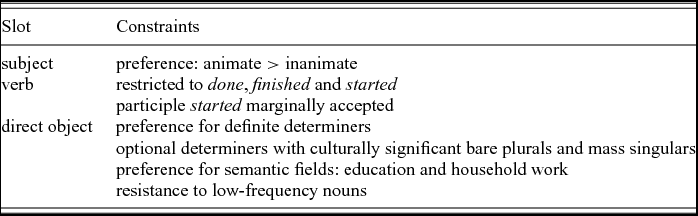
Yerastov (Reference Yerastov2010, Reference Yerastov2012) reports on an acceptability judgment task. This task was administered to speakers of Canadian English (mostly from Alberta), who were asked to rate paragraph- and sentence-level stimuli on a Likert scale. The results show that in Canadian English the construction [be done NP] is subject to a number of constraints (table 1).
Summary of constraints on [be done NP] (based on Yerastov Reference Yerastov2010, Reference Yerastov2012)

Hinnell (Reference Hinnell2012) reports on a corpus study of [be done NP]. This study was conducted through the WebCorp interface, an online tool that allows the web to be studied as a linguistic corpus. Based on her primarily Canadian data set, Hinnell obtains results similar to Yerastov (Reference Yerastov2010, Reference Yerastov2012); she further refines a description of semantic fields in the direct object slot, and introduces another constraint on this slot – exhaustivity. The exhaustivity constraint captures the generalization that the direct object referent must have the property of being exhausted. For example, *we’re done the room is ungrammatical because the room cannot be exhausted; at the same time we’re done the meeting is grammatical because the meeting can be exhausted (be over).
The present article builds on Yerastov (Reference Yerastov2012) by providing a systematic synchronic description of the construction on the basis of Canadian English native-speaker intuitions. Specifically, the present analysis demonstrates how the construction is different from its conceptual and structural relatives. Synthesizing the facts from Yerastov (Reference Yerastov2012) and from the present article, I go on to argue that [be done NP] is better accounted for by construction grammar than its mainstream generative competitor. The present study on [be done NP] adds to the existing construction grammar literature (Fillmore, Kay & O’Connor Reference Fillmore, Kay and O’Connor1988; Goldberg Reference Goldberg1995, Reference Goldberg2003, Reference Goldberg, Östman and Fried2005; Jackendoff Reference Jackendoff1997; Kay & Fillmore Reference Kay and Fillmore1999; Langacker Reference Langacker, Barlow and Kemmer2005) by formulating challenges to generative models of syntax, presented by the morphological indeterminacy of the lexical items do, finish and start, and by the holistic nature of semantic and categorial selection in the direct object slot of [be done NP].
2 [be done NP] and its relatives
In this section, I argue that [be done NP] is distinct from its structural and conceptual relatives, listed in (2), and problematize compositional accounts of [be done NP].
(2)

2.1 Postposed non-finite clause [be done V-ing]
Almost all speakers of Present-day English (PDE) produce sentences like I am done talking to you and I am finished marking these papers with resultative meaning. And some speakers even find it acceptable to use the form started in this structure:
- (3)
(a) When I was finished talking, she’d hand me the napkin. (Crime Neighborhood)
(b) When I was done revisiting these volumes, I was left wishing I could follow the sisters to America and continue to hear, in Piri's voice, how they fared. (Houston)
(c) And the minute I got sworn in, I was started thinking about the speech. (George Bush, PBS News hour)
(Corpus of Contemporary American English)
Because present participles and gerunds are homophonous in English, there arises a question as to whether the V-ing in (3) is a participial adverbial clause or nominalization. The analysis of these V-ing forms as adverbial clauses faces a theoretical challenge. As the data in (4) and (5) show, the V-ing form patterns syntactically like an NP in that it cannot be preposed.
- (4)
(a) I was done working on my homework.
(b) * Working on my homework I was done.
- (5)
(a) I was done my homework.
(b) * My homework I was done.
At the same time, the data in (6) demonstrate the possibility for adverbial clauses to be preposed when modifying main clause predicates (including accomplishment predicates like solve below).
- (6)
(a) Working on my homework I solved five equations.
(b) I solved five equations working on my homework.
Furthermore, when an accomplishment clause is modified by a non-finite adverbial clause, the adverbial clause may typically be introduced with the conjunction while (as in 7a). Such a conjunction is not possible in the structure [be done V-ing], as in (7b).
- (7)
(a) I solved five equations while working on my homework.
(b) * I was done while working on my homework.
Finally, in Canadian English, the V-ing and NP can be coordinated, as in (8), a fact that suggests a certain degree of functional equivalence between the two constituents. We would be hard pressed to account for such coordination if articling in (8) was mentally represented as a participial adverbial clause.
(8) I looked at my life and thought, I could go to law school right away but then I thought most people, after they are done school and articling, they are 26 or 27.
(Canadian Newsstand)
The preposing, conjunction and coordination tests suggest that it is likely that the V-ing in [be done V-ing] is a nominalized form similar to the NP in [be done NP]. A diachronic connection between the two constructions is worthy of investigation. It may very well be that the mainstream PDE construction [be done V-ing] is a special case of [be done NP].
2.2 Progressive [beV-ing]
The progressive structure [be V-ing] and [be done NP] can share the verb be as follows from the following ellipsis data:
- (9)
(a) We were done work early and parking the cube van.
(b) . . . all other teams were done their playoffs and preparing for the tournament anywhere from one to three weeks prior to the OHL Cup.
(c) . . . women sitting nearby are finished lunch and pouring over their Christmas lists, on which one can already see an impressive number of tick marks attached to the names.
(d) I would not suggest you move out until you are finished school and working at a stable job.
(e) They were finished work and going to meet the bus to Canmore.
(Canadian Newsstand)
In these examples, the verb be, present in the left conjunct, [be done NP], elides in the right conjunct, a progressive structure. The verb be in the progressive is standardly analyzed as an auxiliary which, along with the inflectional suffix -ing, expresses the grammatical function of progressivity. Because the progressive in (9a–e) recuperates its auxiliary from the first conjunct, [be done NP], we have evidence that be in [be done NP] is mentally represented as a closed-class, functional item, rather than a lexical one. Otherwise we would predict that language users would insert be in both conjuncts.
However, the sharing of the auxiliary by the two structures does not mean that they cover the same conceptual domain. From an interpretive standpoint, the progressive codes situations ongoing at reference time, and [be done NP] resultative ones. Predictably, we find distributional differences between [beV-ing] and [be done NP]; for example, the progressive cannot occur in temporal adverbial clauses with future interpretation:
- (10)
(a) When I’m finished my homework, I’ll go outside.
(b) * When I’m finishing my homework, I’ll go outside.
2.3 Passive [be V-en]
For a long time, it has been assumed that in English the syntactic configuration [be V-en] is only possible as a passive structure; it has been claimed that the suffix -en suppresses external theta roles, triggering a passive interpretation (e.g. Chomsky Reference Chomsky1957, Reference Chomsky1981; Emonds Reference Emonds2000). However, [be done NP] is an instantiation of [be V-en], and the suffix -en in this structure does not block the generation of external agentive arguments, as in I am done dinner. Nor is the patient argument raised to the Spec, TP position, as would be expected for passive structures in mainstream generative accounts of English syntax. Could it still be that [be done NP] is a surface instantiation of the passive structure with a patient argument staying in situ and with an external agent argument unsuppressed? Syntactic evidence suggests a negative answer to this question; [be done NP] fails the passivization test:
- (11)
(a) * I’m done dinner by you.
(b) * I’m done dinner by me.
The failure of the passivization test provides us with evidence to rule out the possibility that [be done NP] is a verbal/eventive passive; but is it possible that [be done NP] is an adjectival passive. If so, then the participles should exhibit stative properties. Thus, statives are expected to fail the resultative test, which involves modification by manner adverbials (Embick Reference Embick2004). Prima facie, [be done NP] does fail that test *I'm carefully done my homework (cf. The package remained carefully opened/*open). But the construction can be coordinated with predicates that can pass that test. In (12a–d), done/finished school coordinates with the participles grown and settled. Because grown and settled can potentially be modified by manner adverbials, e.g. the kids are comfortably settled, they pass the resultative test and should be distinguished from pure statives (e.g. The door was open). And if we assumed equivalence between the coordinated constituents (e.g. done school and grown), we could claim [be done NP] is not a stative.
- (12)
(a) She doesn't receive EI when the kids are done school and grown.
(b) She added that she would like to stay until her six kids are finished school and settled.
(c) He retired from Ontario Hydro in 1993 and said both his sons are finished school and settled in full-time careers.
(d) “I’m a born-again folkie,” said Needham, who was finished school and married to an oilman . . .
(Canadian Newsstand)
Further evidence of the non-stative nature of [be done NP] can be gleaned from the semantic roles of the participants in the construction. In I am finished my homework the semantic role of the subject is that of agent rather than patient. Because statives do not allow agents in their subject position (cf. The door is open; I am finished ‘ruined’), we have more evidence that [be done NP] is not a stative (in the sense of Embick Reference Embick2004) and therefore not an adjectival passive.
2.4 Predicate adjective [be done with NP]
In section 2.2, the verb be was argued, based on coordination data, to be an auxiliary. Some counterevidence to this claim comes from another set of coordination data:
- (13)
(a) Before long, I was done my course, and on my way to my new posting in B.C.
(b) This tends to be when I am finished work, and in the kitchen, preparing dinner.
(c) . . . there is little traffic in the downtown and more people are finished work and able to attend with their families.
(d) The Palfreys are committed to caring for them until they are finished school and ready to move out, just as they are with their own children.
(Canadian Newsstand)
In (13), the verb be occurs in the first conjunct and elides in the second conjunct. In the second conjunct, the eliding verb be links the subject in the first clause to its complement in the second one – either an adverbial (on my way, in the kitchen) or an adjective (able, ready). This evidence supports the claim that be in [be done NP] is mentally represented as a copula, and done as a predicate adjective.
Indeed, [be done NP] shares some conceptual and distributional similarities with the predicate adjective structure [be done with NP]. In the present tense, both structures may, unlike their present perfect counterpart, have future reference, as in (14–16).
(14) When are you finished school?
‘When will you finish school?’
(15) When are you finished with school?
‘When will you finish school?’
(16) * When have you finished school?
‘When will you finish school?’
Unlike the present perfect, the two structures have similar distributions in that both can occur in reduced, non-finite when clauses:
- (17)
(a) When finished your session, you should log out.
(b) When finished with your session, you should log out.
We know that (17a) is unlikely to be an ellipsis of the present perfect (when you have finished your session) because other transitive participles do not undergo such reduction, e.g. (18a–c). While non-finite reduction does not apply to transitive participles, it does apply to predicate adjectives followed by prepositional complements, e.g. (19). This fact suggests [be done NP] patterns like a predicate adjective structure.
- (18)
(a) * When begun your session, you should save your answers.
(b) * When ended your session, you should log out.
(c) * When completed your session, please log out.
(19) When ready with your homework, please turn it in.
Further similarities between [be done NP] and [be done with NP] vis-à-vis the present perfect can be revealed with modification by an extent adverb (degree word) such as all. Before proceeding to a diagnostic test, I will address the homophony of all as an extent adverb and as a floating quantifier.
In a predicate adjective structure with a plural referent in subject position, all may function either as a quantifier modifying (specifying) the subject NP, e.g. (20a), or as an extent adverb modifying the AdjP in the predicate, e.g. (20b). This structural ambiguity may be avoided if the subject is singular; for example, in (20c) we can interpret all only as an extent adverb modifying the AdjP.
- (20)
(a) Wei are alli ready
(b) We are alli readyi
(c) I am alli readyi
On the other hand, in the present perfect all may act only as a floating quantifier modifying the subject pronoun, e.g. (21); an interpretation wherein all would modify the VP would be highly unlikely. As indirect evidence for this claim, consider the results of a search for the string have all done in the Corpus of Contemporary American English: all 11 results have a plural subject.
(21) Wei have alli done our homework.
Keeping in mind that all modifies the subject NP in the present perfect, and the AdjP in the predicate adjective structure, let us return to the diagnostic test – the modification of [be done NP] by an extent adverb. In (22), the modification of done in [be done NP] by the extent adverb all results in full grammaticality. This result would be consistent with the categorization of done as an adjective: done patterns like predicate adjectives that allow such modification, e.g. (23). At the same time, the modification of the verb by all in the present perfect yields ungrammaticality – with done or with any other past participles, e.g. (24).
(22) I am all done my homework.
- (23)
(a) I am all done with my homework.
(b) I am all prepared to answer your questions.
(c) I was all excited when he told me the news.
(d) I am all ready for school.
- (24)
(a) * I have all done my homework.
(b) * I have all excited him.
(c) * I have all prepared to answer your questions.
Thus, the adverb modification test shows that done in [be done NP] behaves similarly to [be done with NP] and differently from the present perfect.
Categorizing done, finished and started in [be done NP] as adjectives is not without problems. To begin with, [be done NP] is different from the predicate adjective structure in that [be done NP] must have a ‘TP layer’, i.e. it is unable to occur as a small clause:
- (25)
(a) John seemed to be amazed.
(b) John seemed amazed.
(c) John seems to be finished his homework.
(d) * John seems finished his homework.
(e) * John appears done his dinner.
Another problem is that PDE adjectives, whether deverbal or not, do not generally subcategorize for NP complements, e.g. (26). A rare exception is a fossilized class of adjectives that requires historically dative complements, such as near, next, like (Mustanoja Reference Mustanoja1960: 103). In PDE, their NP complements are coincidentally similar to those of [be done NP]; however, their argument structure is different: they do not take agents or patients as their arguments, unlike done, finished and started in [be done NP].
- (26)
(a) * I am ready homework.
(b) * I am surprised your work.
To rescue the adjectival status of done, finished and started, it may perhaps be suggested, within a generative framework, that [be done NP] and [be done with NP] are instantiations of the same underlying adjective structure, with the preposition with phonologically suppressed on the surface. But this claim can be rebutted with semantic evidence; as the contrast between (27) and (28) shows, [be done NP] is interpreted only resultatively, while [be done with NP] can be interpreted both statively and resultatively.
(27) I am done the dishes.
‘I have finished washing the dishes.’
(28) I am done with the dishes.
‘I have finished washing the dishes.’ OR
‘I am in a state of aversion for dish-washing.’
If we still assumed that done, finished and started were deverbal adjectives, we would have to stipulate that these forms tend to be restricted to predicative positions only; their attributive use would lead to ungrammaticality or marginal acceptability: *done homework,Footnote 2? a finished novel, *a started project; cf. The novel seemed finished to me, The cake seemed done when we looked in the oven, The lesson appeared started. However, [be done NP] patterns differently from its predicate adjective relative in that [be done NP] cannot be preposed:
- (29)
(a) ?? Done his homework, John was eager to participate in class.
(b) Done with his homework, John was eager to participate in class.
(c) Ready with his homework, John was eager to participate in class.
2.5 [have V-en NP] vs [be done NP]
The present perfect in English is formed periphrastically by merging the auxiliary have with a past participle: e.g. I have done my homework. The auxiliary have is fully productive in mainstream PDE dialects; it is used with both transitive and intransitive verbs. The auxiliary have does not experience competition from the auxiliary be, as it does in many modern Indo-European languages such as French and German, to name a couple of putative examples. But frozen reflexes of the intransitive be perfect with resultative semantics such as I am gone are still found in PDE.
In Canadian English, a number of morphosyntactic and semantic properties set the present perfect apart from [be done NP]. Some of them (future reference, reduction to a non-finite clause, and modification by an extent adverb) were discussed in section 2.4; in what follows I focus on contrasts resulting from fronting, clefting and combinability with modal auxiliaries and durative adverbials.
The direct object NP in [be done NP] is resistant to fronting and clefting:
- (30)
(a) * What did you say you are done?
(b) What did you say you have done?
- (31)
(a) ?? It's homework that I am finished.
(b) It's homework that I have finished.
When combined with modal auxiliaries, [be done NP] refers to the future, while the present perfect refers to the past:
- (32)
(a) I should be done my homework.
(b) I should have done my homework.
When modified by durative adverbials, which force iterative and experiential interpretations, [be done NP] becomes ungrammatical:
- (33)
(a) * I am not done my homework since 6th grade.
(b) I have not done my homework since 6th grade.
(c) * I am not done my homework for the whole year.
(d) I have not done my homework for the whole year.
(e) * I am never done my homework (in my entire life).
(f) I have never done my homework (in my entire life).
Thus, morphosyntactic and semantic evidence suggests that [be done NP] is sufficiently different from the present perfect, a conclusion that posits a problem for conceptualizing [be done NP] as a surface realization of the present perfect under a derivational approach.
3 A theoretical account of [be done NP]
In what follows I will address theoretical problems that the synchronic facts of [be done NP] pose to mainstream generative syntax and offer an alternative, construction grammar account of it.
3.1 A mainstream generative grammar approach
Generative linguists emphasize that syntactic variation is reducible to a universal blueprint with cross-linguistic parametric variation (Chomsky Reference Chomsky1981; Roeper & Williams Reference Roeper and Williams1987; Lightfoot Reference Lightfoot1991, inter alia). Generative theories of grammatical organization hold productivity and maximal generality to be a feature of grammar, and arbitrariness a feature of the lexicon (a view that has its origins in American structuralism; see Bloomfield Reference Bloomfield1933). On this view, words project their lexical features, determining the specific shape of a theta grid and subcategorization frame, while general properties of phrases and sentences result from phrase structure rules. This theoretical assumption led to the belief in the reducibility of all syntactic structures to a few basic ones; it was prevalent in American structuralism and was taken over unquestioned in early transformational generative theorizing.
In earlier generative work, a battery of rewrite rules of the following sort was proposed (e.g. Chomsky Reference Chomsky1957, Reference Chomsky1965):
(34)
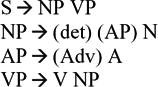
However, this early rewrite rule approach failed to constrain the linearization of sentence structures; addressing this theoretical drawback, generative linguists focused their attention on both syntactic and semantic properties of words and morphemes. Some emphasized thematic grids in accounting for the linear order of arguments of the verb, while others focused on subcategorization frames based on syntactic features. The two approaches differed in the extent to which generative linguists were willing to accept the idiosyncratic nature of lexical categories; subcategorization frames allowed for greater generality of the universal syntactic blueprint and its independence from lexical idiosyncrasies, while theta grids required recognition of the sensitivity of syntax to subclasses within lexical categories. A mild consensus was reached with Grimshaw's (Reference Grimshaw1979) Canonical Realization proposal, which posited that theta grids and subcategorization frames should be partially collapsed; yet within other generative traditions, the view of semantics determining syntax prevailed, as in Baker's UTAH hypothesis (Reference Baker1988).
Whether one assumes that the lexical category controls the direct object slot in [be done NP] syntactically via a subcategorization frame or semantically via a theta grid, the common assumption still remains: a lexical category – rather than the construction as a holistic unit – determines the semantic and syntactic properties of its projections. However, this theoretical premise is challenged by the ambivalent status of done, finished and started; if their categorial status is gradient between verb and adjective, then one is hard pressed to explain how these lexemes uniformly determine argument structures and syntactic frames, especially when, as we saw above, argument structures in turn putatively predict co-occurrence patterns with auxiliaries. Thus, be can co-occur with AdjP (John is tall), with NPs (Clark Kent is Superman) and with present and passive participles (John is drinking beer, Beer was drunk), but it cannot occur with a transitive participle because theta assignment by a verb stem to a direct object NP requires the auxiliary have.
In order to account for the facts of [be done NP] within a mainstream generative theory of grammar, one would need to make a decision about their categorial status. If we were to assume that done, finished and started are adjectives, such a proposal would be dubious because adjectives in PDE do not subcategorize for NPs. One would then have to stipulate that only three deverbal adjectives, done, finished and started, have a lexically inherent feature that allows them to merge with NP complements – a viable theoretical solution, but one which, nonetheless, detracts from the generality of semantic and categorial selection.
If we treated done, finished and started as verbs, we would stipulate the following auxiliary alternation:
(35)
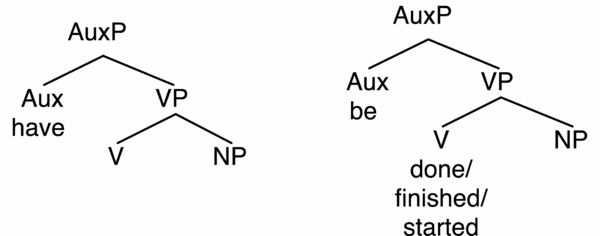
Then, what accounts for the merger of the auxiliary with the VP? If we were to posit that such an alternation is lexically conditioned, this solution would, again, detract from the generality of [be done NP]; such an account would be unprincipled and contrast sharply with the generality of the present perfect structure in which the verb slot is fully open. In search of a principled explanation of be~have auxiliary alternation in Canadian English, I turn to literature on auxiliary alternation in perfect structures.
It is widely noted that cross-linguistically transitive verbs prototypically combine with the auxiliary have, while intransitive verbs combine with the auxiliary be. However, this alternation is not always clear-cut cross-linguistically: certain classes of intransitive verbs seem to vary across languages in terms of selecting the auxiliary be or have. Attempting to account for this variation, some generative theoreticians – most prominently Perlmutter (Reference Perlmutter1978) – argue that the combinability of classes of intransitive verbs with the auxiliary be is syntactically conditioned. At the heart of this explanation lies the observation that the traditional subclassification of verbs into two types – transitive and intransitive – is inadequate. It has been observed that the subjects of some types of intransitive verbs (verbs of motion) actually behave more like direct objects of transitive verbs than like the subjects of other intransitive verbs (such as die). Formally, this observation has been couched in terms of the Unaccusative Hypothesis (Perlmutter Reference Perlmutter1978; Hoekstra Reference Hoekstra1984; Burzio Reference Burzio1986).
The Unaccusative Hypothesis proposes that unaccusative clauses (projected from verbs that have a single non-agentive argument) have an underlying object but no underlying subject. In a perfect structure, the underlying object raises to surface subject position (Spec, TP) in order to satisfy an Extended Projection Principle (EPP) feature of TenseFootnote 3 in the absence of other nominal material available to do the same; for example, consider the derivation of the German clause Ich bin gefallen (I am fallen):
(36)
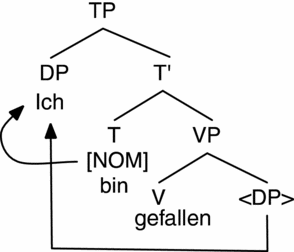
On the other hand, in an unergative perfect clause (projected from verbs whose single argument is an agent) the surface subject DP is projected externally to the VP, meaning, first of all, that it is assigned a semantic role by the VP (rather than the verb alone), and secondly, that there is no need for the auxiliary be to trigger movement of the object DP to Spec TP position (to receive nominative case assigned by the auxiliary be). Thus, have is alternately selected by default, as is shown in the English example in (37a). Unlike the German example, the subject ends up in Spec, TP position through projection rather than derivational movement. Transitive perfect clauses are different in that the auxiliary have assigns accusative case to the direct object, which obviates any need for further derivations (37b); the auxiliary be, on the other hand, lacks the ‘ability’ to assign accusative case.
(37)
The Unaccusative Hypothesis faces significant challenges in accounting for the combinability of the auxiliary be with the verbs do, finish and start, because these verbs are transitive and cannot be fit into unergative or unaccusative configurations. Furthermore, if one were to argue that the auxiliary be somehow assigns accusative case, such an argument would necessitate revision of multiple modules of the generative framework which rest on the assumption that be is incapable of such assignment. If a stipulation were made that be is capable of assigning accusative case as a fact specific to Canadian English, one would need to further accommodate for the ungrammaticality of the tokens in (38) in this variety of English:
- (38)
(a) * I am written a letter.
(b) * I am driven a car.
While the Unaccusative Hypothesis provides syntactic criteria for distinguishing subclasses of verbs that behave differently with regard to auxiliary selection, it does not resolve the central research question: what motivates the division of lexical verbs into various classes and subclasses? In essence, the application of Unnaccusative Hypothesis to be ~ have alternation is an abstract restatement of the observation that cross-linguistically the auxiliary have tends to combine with transitive verbs, while the auxiliary be tends to combine with intransitive ones. Crucially, unsettled questions remain about the behavior of subclasses of transitive verbs in regard to be ~ have alternation.
A hybrid structural/semantic approach to be ~ have alternation has been advanced by McFadden & Alexiadou (Reference McFadden and Alexiadou2010). Based on semantic diachronic evidence from their corpus study, they show that have perfects have developed anterior interpretations while be perfects have always remained stative resultative throughout the history of English. Drawing parallels between their findings and synchronic facts from Modern German and Italian, McFadden & Alexiadou (Reference McFadden and Alexiadou2010) posit the universal existence of two separate structures – an anterior, headed by a Perf head, and a stative resultative, headed by a Copula head. Thus, under their analysis, be and have do not alternate within the same structure; rather, they project different structures, as shown in underlying representations in (39); further, be is not even an auxiliary but simply a copula that combines with predicate adjectives and nouns. They argue that transitive and unergative verbs do not combine with the copula because of incompatibility between resultative Aspect and Voice heads. The output of AspR is stative and conflicts with agentive Voice, which outputs another event with an external argument. While McFadden & Alexiadou's (Reference McFadden and Alexiadou2010) approach allows for semantics to influence structural representations, their generalization still falls short of the facts of [be done NP]. If it was a stative resultative structure, its derivation would be thwarted at the point of merger with agentive Voice.
(39)
Attempts to motivate combinatorial preferences of intransitive verbs have been made from a semantic perspective (most notably Sorace Reference Sorace2000) in terms of prototypicality hierarchies, but none of them has succeeded in identifying clear-cut isomorphism between semantic classes and their syntactic behavior cross-linguistically – individual exceptions still defy universalist explanations. More importantly for the present article, such semantic attempts do not, to my knowledge, have anything to say about subclasses of transitive verbs combining with the auxiliary be rather than have. Therefore, in what follows, I offer a semantic analysis of the verbs do, finish and start in an attempt to find a principled semantic explanation for their combinability with the auxiliary be.
The verbs finish and start are both aspectual; they mark egressive and ingressive aspect, respectively. At the same time, do might be characterized as a light verb – a semantically weak verb that transfers its predicative force to the following nominal complement. However, speakers of Canadian English find other aspectual and light verbs ungrammatical in these constructions:
- (40)
(a) * I am begun my work
(b) * I am ended my work
(c) * I am given you a book
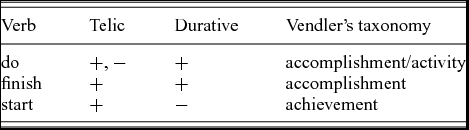
The next logical step is to consider whether there are any semantic similarities in the inherent lexical semantics of the verbs do, finish and start that would justify separating these verbs out into a separate class. An application of Vendler's (Reference Vendler1957) typology to these verbs, for example, does not yield a clear-cut pattern (see table 2).
Semantic analysis of do, finish and start
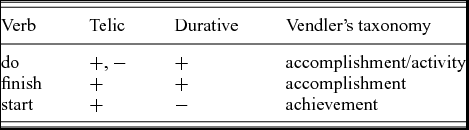
The verb do can form both accomplishment and activity situations, depending on its telicity:
- (41)
(a) I did my homework in 5 minutes.
(b) I did my homework for an hour.
The inherent lexical semantics of the verb finish allows only accomplishment interpretations: predicates formed by finish are both telic and durative. Unlike the verb do, the verb finish is necessarily telic and inherently bars an activity interpretation:
- (42)
(a) I finished my homework in an hour.
(b) * I finished my homework for an hour.
The verb start is inherently telic and punctual; it is different from finish and do in that it cannot render situations that could be conceptualized incrementally:
(43) * I started my homework in an hour.
Thus, what unites do, finish and start is their telicity, a semantic property characterized by an inherent, built-in endpoint. When these verbs are inserted in the structure [be done NP], telicity signals the presence of a goal in a situation. The structure [be done NP] constrains the verb do by making it telic and forcing an accomplishment interpretation. However, telicity does not lend itself to a principled explanation of auxiliary selection; there is a multitude of telic predicates that do not select the auxiliary be in Canadian English, e.g.:
- (44)
(a) * I am written a novel.
(b) * I am played a sonata.
(c) * I am cooked a meal.
In order to account for auxiliary selection one would have to stipulate that done, finished and started have idiosyncratic inherent features that trigger merging with the auxiliary be. But that stipulation would have a number of theoretical difficulties. To begin with, the semantic contribution of the verbs do, finish and start to the structure [be done NP] is somewhat different from their contribution to the present perfect structure. While both structures do produce resultative semantics, the present perfect allows for iterative interpretations of telic predicates modified by durative adverbials (45), while [be done NP] does not (46):
- (45)
(a) I have never done my homework since 6th grade.
(b) I have always finished my assignments on time.
(c) I have started many projects over the years.
- (46)
(a) * I am never done my homework since 6th grade.
(b) * I am always finished my assignments on time. (experiential interpretation)
(c) * I am started many projects over the years.
This contrast suggests that [be done NP] constrains the inherent lexical semantics of the verbs do, finish and start much more so than the present perfect, a conclusion that suggests that the construction itself makes a holistic semantic contribution. Therefore, it would be theoretically inconsistent to treat [be done NP] and [have V-en NP] as results of the same compositional process minus auxiliary alternation.
Additionally, the constraints on [be done NP] contribute to detraction from the generality of the construction, thus setting it apart from fully abstract present perfect. For example, the present perfect construction, unlike [be done NP], allows inanimate referents in the subject slot (47), and singular (48) and undetermined (49) nouns in the direct object slot (Yerastov Reference Yerastov2012):
- (47)
(a) The computer has done the spell-check.
(b) ?The computer is done the spell-check.
- (48)
(a) I have finished an essay.
(b) ?I am finished an essay.
- (49)
(a) I’ve done bad things.
(b) * I’m done bad things.
Thus, the analysis of [be done NP] so far leads to the conclusion that a strict compositional account of [be done NP] poses serious theoretical challenges. The merging of lexical categories encounters problems with categorical selection; the alternative of positing a lexical exception is unsatisfactory because the construction as a whole does demonstrate a certain degree of generality. The present section thus challenges the assumption that lexical items uniformly assign theta grids and subcategorization frames. Consequently, I suggest that the facts of [be done NP] would be more tractable under a construction grammar approach.
3.2 A construction grammar approach
A strict structuralist separation between irregular lexicon and regular syntax has been challenged by a substantial literature on constructions (Fillmore, Kay & O’Connor Reference Fillmore, Kay and O’Connor1988; Goldberg Reference Goldberg1995, Reference Goldberg2003, Reference Goldberg, Östman and Fried2005; Kay & Fillmore Reference Kay and Fillmore1999). On the constuctionist view, grammatical generality and lexical specificity both form a gradient continuum of language users’ generalizations; the generality of grammar is understood in terms of its schematicity (Goldberg Reference Goldberg2003, Reference Goldberg, Östman and Fried2005) – a set of schemas, or organizational patterns, across lexical items (Bybee Reference Bybee2001). In this section, I attempt to demonstrate that a construction grammar approach is more capable of accommodating the gradient properties of [be done NP].
3.2.1 Compositionality and constructional meaning
Construction grammar theorists assume that linguistic constructions may have meaning independent of the meaning of their constituents (Goldberg Reference Goldberg1995; Langacker Reference Langacker, Barlow and Kemmer2005), and may license argument structures and project subcategorization frames (Jackendoff Reference Jackendoff1997):
(50) He sneezed the napkin off the table. (Langacker Reference Langacker, Barlow and Kemmer2005: 162)
- (51)
(a) We are twisting the night away.
(b) Amy pounded the clay flat.
(c) Beth whistled her way across America. (Jackendoff Reference Jackendoff1997)
In (50), the meaning is constructional, rather than derived from the verb sneeze itself, because sneeze is not conventionalized in the sense of ‘causing something to move’. In (51a–c), there is a time away construction (51a), a resultative construction (51b) and a way construction (51c) (Jackendoff Reference Jackendoff1997); they are argued to show different syntactic and semantic properties, thus not being reducible to one universal schema with the lexical heads only assigning thematic roles. Rather, it is the constructions themselves that holistically determine their argument structures.
In the case of [be done NP], we can posit that NPs are assigned their structural and semantic roles by the construction as a whole. This solution would dispense with treating done, finished and started as exceptional deverbal adjectives or as exceptional participles.
The recognition that a construction itself can make an independent contribution to overall meaning can account for the idiomaticity of some constructional exemplars of [be done NP]. For example, in the collocations do dinner and do chores the situation is conceptualized as homogenous, i.e. with no internal structure (beginning – middle – end). The homogeneity of interpretation may be demonstrated for these collocations with results of a Google search:
(52) I have done dinner here and lunch here once. After reading raves about this ‘hidden gem’ I was excited. It was decent food, home made pasta and a surprise for a hotel restaurant, but nothing to blow me away.
- (53)
(a) The only thing is that in the past I have done dinner and a movie for my birthday and I always paid for my friends. This time, however, I said it as more of a ‘oh I want to see that movie so let's do it on my birthday’ thing.
(b) I have shown i am very responsible i have done chores, gotten good grades, done my homework, i went to driving school over the summer so i could drive so next year i could get a job and start paying for my stuff.
(c) I have been retired since 1999. . . I have done chores every morning and night for nearly 30 years and am much stronger than most of my friends at this age. . .but I too, could stand to drop pounds.
(Google search results)
When the collocations do dinner and do chores are inserted into the present perfect structure, the result is a homogenous interpretation, which can be either punctual, as in (52), or distributive as in (53). But in both cases the speakers profile the situation in its entirety. The homogenous structure of the situation leads to an experiential reading of the collocation do dinner in present perfect form. A homogenous interpretation of the collocation do dinner is not limited to the present perfect only; it persists even when inserted into other structures:
- (54)
(a) I think I will do dinner and baseball tickets.
(b) When I get married, I want my wife to cook me breakfast and lunch, but I will do dinner.
(Google search results)
A homogenous reading is unavailable for the collocation do dinner when it is inserted into the structure [be done NP]; I am done dinner, for example, focuses on the endpoint of the situation, profiling its final stage – an interpretation not derivable from the collocation do dinner.
I suggest that the limited idiomaticization of [be done NP], shown as a contrast to (52)–(54), should be understood as emergent (L1) lexicalization, following Brinton & Traugott (Reference Brinton and Traugott2005). This idiomaticization presents difficulties for a compositional account of [be done NP], which predicts that the original semantic contribution of the collocation do dinner should be preserved within the structure [be done NP]. On the other hand, the data do not present difficulties for a construction grammar account approach, which allows for a construction to make a holistic semantic contribution, such as resultativity.
3.2.2 Auxiliary alternation and participle selection
As has been demonstrated above, the mainstream generative approach is hard pressed to account for auxiliary alternation and the restriction of the participle slot to three lexical items. This alternation has been theoretically approached from both semantic and syntactic perspectives. Such explanatory attempts hold that semantic and syntactic criteria for auxiliary selection are constant across languages; however, no such constancy or systematic regularity can be observed in Canadian English where the auxiliary split has been stabilized around three lexical items done, finished and started, and where no underlying semantic or syntactic principle can be abstracted from the properties of these items. While formal generative accounts of such patterning would call for a plethora of lexical exceptions, a parsimonious explanation may be formulated within a construction grammar framework.
We could dispense with a search for principled synchronic grounds for these phenomena, if we assume that grammar is a set of generalizations of varying degree. On this view, syntactic generalizations may weaken or strengthen diachronically over time under the influence of general cognitive factors.
While we do not have a clear understanding of the history of the construction [be done NP], we can, nevertheless, speculate that it is genetically related to the fully productive transitive be perfect found in Scots (Pavlenko Reference Pavlenko1997; Millar Reference Millar2007). If that is the case, then [be done NP] may be conceptualized at the weaker pole of a schematicity continuum, where the Scottish perfect would be at its strongest pole. Such a model would imply a diachrony in which there would have been competition between the transitive be and have perfects, the type of competition presently observed in many languages in the European language area.
Intransitive be ~ have splits in modern European languages may be explained as reflections of their grammaticalization paths; transitive perfects grammaticalize out of possessive sources, and intransitive perfects out of copulas, because cross-linguistically have is prototypically transitive, and be prototypically intransitive. Fluctuations in subclasses of verbs in auxiliary selection may further be interpreted as reflections of frequency effects. For instance, in the case of mainstream PDE dialects, the auxiliary have is argued to have been extended to intransitive verbs because of the higher type frequency of the have perfect, as compared to the be perfect; at the same time, in the case of European dialects of German, the sein ~ haben auxiliary split has not been overcome, because, unlike its English counterpart, the German perfect has grammaticalized from anterior into perfective, a development that has accelerated its frequency of use and ensured the maintenance of the auxiliary split (Smith Reference Smith and Aranovich2007). In English, the resistance of rare, lexicalized tokens of the intransitive be perfect to the auxiliary have (I’m gone, Christ is risen) is akin to the resistance of preterit forms of high token frequency to regularization (e.g. went) (Bybee Reference Bybee1985). In both cases the high token frequency of I’m gone and went made it possible for these individual tokens to resist the encroachment of the have perfect and the dental preterit – patterns of high type frequency (Smith Reference Smith and Bybee2001).
While the transitive be perfect in Scots most likely arose as a result of contact and reanalysis (Pavlenko Reference Pavlenko1997) rather than grammaticalization, the resulting state must have been subject to the same functional pressures as the intransitive be perfect in mainstream English. When speakers of Scottish dialects presumably came into contact with mainstream dialects, their transitive be perfect might have started to erode under the influence of standard British dialects – an erosion that resembles ongoing attrition of the native dialect in Shetland. In a situation of dialect contact, the auxiliary be was probably no match for the auxiliary have; the latter increasingly gained in type frequency, as a prestige feature, which was more conceptually congruent with transitive participles. It is thus unsurprising that only few participles such as done, finished – and occasionally started – became entrenched in Canadian English. As aspectual, semantically general participles, they most likely resisted replacement by the auxiliary have due to their high token frequency (Yerastov Reference Yerastov2012: 451ff. for frequency data).
3.2.3 Generality of grammar and [be done NP]
The construction grammar view does not imply that semantic and categorial selection is always constructional – it only stipulates a possibility that a whole construction may assign theta roles and project subcategorization frames. Such a view may be reconciled with the Universal Grammar hypothesis or exist independently of it. Thus, Culicover & Jackendoff (Reference Culicover and Jackendoff2005) describe grammar as consisting of different autonomous levels of abstraction; in language there are maximally general schemas where lexical heads project argument structures and determine subcategorization frames; within his framework, Universal Grammar is the highest, most general layer of grammar. However, there are also lower levels of abstraction in grammatical organization where the combinatorial properties of lexical categories are less systematic and the transparency of composition is less visible: words, idioms, idiosyncractic – but specialized – constructions, and the most general core-like principles of grammar.
Within a construction grammar framework, the notion of Universal Grammar may be dispensed with altogether, as for example, is done by Bybee (Reference Bybee2006), who, similarly to Culicover & Jackendoff (Reference Culicover and Jackendoff2005), offers four levels of syntactic structure; however, unlike them, she does not attribute the existence of the most general level of grammar to a hypothetical language-specific genetic endowment. Her classification consists of the following levels of schematicity: (i) idioms with fixed lexical content, e.g. go great guns; (ii) idioms that are partially filled, e.g. jog <someone’s> memory; (iii) constructions with some fixed material, e.g. he made his way through the crowd; (iv) fully abstract constructions, e.g. they gave him an award. This classification of constructions represents a continuum from the most lexical to the most schematic. At the most lexical end of it are idioms which indisputably have a direct memory representation because they are in some respect unpredictable. The other three types are so-called prefabs with different degrees of schematization; they are still predictable (although to a varying degree) and may have direct mental representations as well.
The present article has shown that [be done NP] is far from being a fully abstract, compositionally derived construction; multiple lexical idiosyncrasies detract from its generality. Prior work (Yerastov Reference Yerastov2012) has shown that while the participle slot is synchronically closed to new members, the direct object slot of the construction is fairly variable (with only minor constraints), and the subject slot is open to virtually all animate referents. Therefore, I propose the characterization of [be done NP] as a specialized/idiosyncratic construction (following Culicover & Jackendoff Reference Culicover and Jackendoff2005), or as a construction with some fixed material (following Bybee Reference Bybee2006). As such, [be done NP] is most likely stored as a direct mental representation and accessed holistically with such high-frequency items as dinner, chores and homework in the direct object slot. It is further likely that low-probability collocations such as (55) are assembled schematically, with the construction [be done NP] itself assigning its theta roles and determining its subcategorization frame.
(55) I have everything cut out, and I’m all done the bodice except for attaching the sleeves.
4 Conclusion
In this article I have presented a synchronic analysis of an understudied feature of Canadian English – the transitive be perfect construction. I have distinguished it from a set of conceptual and structural relatives, showing that it is not reducible to a surface realization of another underlying structure. I have problematized the parsimony of the mainstream generative approach in accounting for the facts of [be done NP] on strictly compositional grounds. I have further problematized the mainstream view of lexical items as projecting theta grids and subcategorization frames, and argued in support of a construction grammar approach to [be done NP], under which a construction holistically licenses its argument structure. I have proposed that [be done NP] should be characterized as an abstract construction with some fixed material.