In mid-May 1922, newspapers around the country reported that a mob of 2,000 whites killed an African American teenager named Charles Atkins, near Davisboro, Georgia. Some headlines read “Negro, Fifteen, is Burned at Stake,” “Colored Boy, 15, Tortured and Burned by Georgians,” and “Negro Boy Tortured and Burned at State in Georgia After Killing White Woman.”Footnote 1 The reporting reveals the alleged facts of the killing—whites accused Atkins of robbing and killing a white postal carrier named Elizabeth Kitchens. The mob tortured the boy for fifteen minutes before burning him at the stake. Most of the coverage suggests contemporary journalists and their readers accepted Atkins’s alleged confession as the gospel and did not connect it to the torture likely used to extract it. The newspaper coverage of Atkins’s killing was the official, most public record on his young life and atrocious death.
Fitzhugh Brundage, along with Jacquelyn Dowd Hall, Robert Zangrando, and George C. Wright, helped pioneer the establishment of lynching, along with other forms of racist violence against African Americans, as a distinct field of study, and thereby enabled scholars to tell stories about lynching, like Charles Atkins’s. In Lynching in the New South, Brundage explored the dimensions of more than 600 extralegal killings and provided a needed corrective to our understandings of lynching’s complex character, the sociocultural forces informing it, and the factors of its decline and thereby helped to lay the foundation for the field.Footnote 2 He, and many of the scholars following in his wake, entered the archive asking and answering pressing foundational questions. What was lynching? How many were there? When and where did they occur? How did they vary? Who were the perpetrators and victims? How did communities and institutions respond? To what degree was resistance possible? What cultural products did lynching produce? What do the killings say about race, community, the state, or nation?
This essay takes up Brundage’s expansion of the study of racist violence against African Americans and resulting efforts to understand their varied responses to it. In it, I embrace the spirit of this issue’s interest in taking stock of how far we have come as a field while suggesting future directions we might take. I urge more scholars to take seriously the full humanity of the victims whose stories they cover and to explore lynchings’ enduring personal impact on their people.Footnote 3
Using correspondence from a lynched boy’s kin to tell a different story about his killing, I hope to make a case for scholars moving beyond an overreliance on fictive kin (as seen in artistic representations of lynching) and on people who only experienced lynching vicariously, from a distance, and toward learning who victims were in life and how their killings affected their actual kin. Although my call is African American centered, I think a new calculus on lynching’s impact, one that incorporates victims’ kin, has implications for the entire field and for victims from other groups. It also serves an unmet need of victims’ families and descendants to have the fullness of their lynched kin’s lives, the life-sized holes left by their killings, and the lack of accountability over them represented historically. Such an approach could also encourage greater respect and appreciation for today’s victims of state and racist violence as well as foster more support for accountability and redress for them.
Unearthing the history of extralegal killings, historians relied heavily on newspaper reports like the ones on Charles Atkins’s, and photographs. As factual reports of killings or their aftermaths, these records were not produced with the intention of rendering victims, especially the Black ones, as fully human to readers. These vehicles of information about lynching limit the field of historical view, pushing victims’ and their kin’s full personhoods out of the line of sight. We are lucky if we have lynched people’s accurate names and demographic information. And more than that, we rarely see them living in the larger world.
Through these sources actual people who once walked this land are reduced from being fathers, mothers, wives, husbands, sons, and daughters to “lynching victim” or to the disturbing and objectifying “black body,” without individuated subjectivity that is contingent on relations with others, much less worth or the basics of human dignity. This is why histories written using news reporting and photographs so often reflect their points of view, yielding what Amy Kate Bailey and Stewart Tolnay describe in their book, Lynched: The Victims of Southern Mob Violence, as “figurative silhouettes” of lynching victims’ lives. The public historical ledger records Charles Atkins as a generic young Black male victim of lynching, one Black person among thousands.Footnote 4
In Lynched, Bailey and Tolnay attempt to begin the much-needed work of filling in the outlines of Southern Black victims’ lives by searching for them in the population censuses and interpreting the data. From their illuminating quantitative analysis of demographic information for 935 victims, we learn more about their households, occupations, ages, and are able to grasp commonalties that might have lent themselves to them being victimized. We learn, for example, that the median age for victims was 29 years old, and that 56 percent of them were married. Victims were slightly more likely to be employed and to own their homes and/or small farms. Socioeconomic stature as well as deep personal roots within the state or local community could provide some men with a sliver of protection. Bailey and Tolnay’s efforts, especially if extended to other lynching victims and other regions, could be the catalyst needed to propel the field beyond its standstill documentation mode of lynching’s history and culture and toward one that understands who victims were in life and that disinters lynching’s experienced impact—not on the abstract state, “race relations,” or even distant witnesses to this violence but on actual victims’ kin.
As custodians of this history, we need to reflect on our roles and responsibilities for the fields of historical view or sight lines we produce. In order to accurately assess lynching’s toll, especially on victims’ families and the communities in which they lived, and persuade Americans to confront state and racist violence today, I argue that historians must commit to using all the tools at our disposal to reclaim lynching victims by painting fuller pictures of their lives, showing their full personhoods, and rendering their people and them legible to our publics as wholly human.
Recovering Victims’ Personhoods to Access Lynching’s Toll
When humans die, especially for people who do not know them, they lose their personhood, the fullness of their lives, including their emotional characters and social connections in the world. This is even more the case when those deaths are unnatural or occur in large numbers, like Charles Atkins’s.Footnote 5 During the heyday of America’s extralegal killings, many of the individuals and institutions recording and narrating these events stigmatized victims, devaluing their lives, stripping them of their identities along with some of their humanity. They reduced victims from subjects who were living beings, members of families and communities, to objects—with their deaths in aggregate wielded by different groups to satisfy various political agendas. The entire milieu surrounding lynching—from the accusations and the spectacular nature of the killings to the complicity of the state and the photographing of lynching’s aftermaths through the graphic reporting in the newspapers—magnified the dishonor brought to victims and intensified their dehumanization.
The fullness of dead people’s human lives can be made even smaller when researchers initially access them in historical records after their deaths. The way that victims like Charles Atkins surface in the lynching archive—trapped in a horrific death, socially isolated from his kin—plays a great deal in determining what many of us can know about him. What Katherine McKittrick calls the “mathematics of the unliving,” can push historians toward a place where we write about the violence done to Black lynching victims in the abstract and not the lived reality, and where we treat the dead as islands onto themselves or tell only a fraction of their life stories.Footnote 6
The archive and an inability, perhaps unwillingness, to engage, primed scholars to produce of histories of lynching that did not adequately take on victims’ personhoods and familial ties. Accessing lynchings, like Charles Atkins’s, from newspapers or photographs, the entirety of a victim’s life can be eclipsed by their deaths in the histories we write. As caretakers of this history, we need to widen the field of historical view.
The Wrenching Power of a Father’s Love
I discovered letters some lynching victims’ kin wrote to the NAACP during the prime of its anti-lynching crusade. An African American man named Gainer Atkins wrote one that was dated June 19, 1926. He addressed his letter to Walter White, the Association’s assistant secretary, and asked for assistance in seeking damages for the violence committed against his family. In an elegant script written by someone who was educated but spelled some words phonetically, Gainer explained that in May 1922 white Georgians from Washington & Johnson Counties lynched his son. Atkins wanted justice.Footnote 7
Gainer’s letters pulled the lynched teen I had read about from the realm of the abstract and statistical analysis. The undeniable Black-father-love emanating from the microfilm frame I was reading wrenched the boy away from the white mob and planted him where he belonged—with his people. Charlie, as the family called him, was thirteen, not fifteen as the papers reported. Gainer’s grief over his killing revealed that Charlie was a boy who was adored in a way that I know Black children in a white supremacist system to be adored by their families but that was not depicted in the newspaper reports, or in histories written using them as a source base.
Intellectually, I knew, like most historians do, that lynching victims had people. Personhood is formed within families and homes, after all, so finding a fully human Charlie there with and represented by his people, and not in news reporting or other historical accounts, is not entirely surprising. But it was through Gainer’s letters that I saw Charlie the way his father saw him. Gainer did not describe the torture of his boy, details of which he might have known but might not have been willing or able to give voice to in a letter. Nonetheless, Gainer’s letters made Charlie’s personhood visible enough to activate personal recognition. Through his father’s eyes, Charlie was transformed from an anonymous Black male to a cherished, trusting, if naïve, boy, connected to real people, a family and community. Letters like Gainer’s evoked a greater responsibility for respectfully representing lynching victims’ lives and deaths when I told their stories.
Gainer’s letters also revealed details about the factors leading up to and flowing out from the lynching not reported in the papers that raise questions about the veracity of story the mob crafted about the killing and that newspapers reported verbatim. According to Gainer, the mob came for Charlie when he was found in possession of Mrs. Kitchens’s vehicle and some of the cash missing from it. Gainer said Charlie obtained the car from a white man, whom Gainer believed robbed and killed the postal worker and gave the vehicle to Charlie to deflect attention from himself as the murderer and toward an expendable Black boy.
Gainer conceded that Charlie accepted the car because, as young as he was, “he didn’t know any better,” specifically that he should have refused the seeming “gift” of a car given so generously by a white man. If we accept Gainer’s story, then it is reasonable to believe that at thirteen Charlie probably had not yet mastered the African American survival strategy of scrutinizing white people to see if they intend them harm. The danger of his accepting the white man’s seeming charity might not have become clear to the boy until the mob came for him.
Whites also brutalized Gainer and Charlie’s stepmother, compounding the horrors they endured and leaving them struggling to cope and displacing them from their community. They drew a rope around Gainer’s neck, as if to hang him, before tying Gainer and his wife to a stump, and beating them, leaving them with lasting injuries. Authorities arrested the Atkinses, presumably for their complicity in Kitchens’s killing or resistance to Charlie’s lynching, imprisoning him for twenty-one months and her for seven. They probably received minimum medical care for their physical injuries while imprisoned but doubtfully for their likely psychological and psychic ones. The couple hired a lawyer to fight the charges and secure their release. After that, Gainer moved to Camden, New Jersey, leaving his people and home community behind.
Gainer wanted assistance suing the state of Georgia for failing to protect Charlie, false imprisonment, the loss of his earnings and livelihood while imprisoned, and the failure to prosecute the lynchers. His father-love beset by grief is palpable. Atkins explained to White, “The loss of my child is worse than all.” “I am getting old,” Atkins wrote, and “miss the sup[p]ort of my family and fe[e]l that the state should help me to b[u]ry this burden.” Atkins asked White to “answer soon” because, he said, “my child is gone, he suffered death, my wife suffered for a long time and also myself.” Atkins asked White to explain to him “just how to get at it, and just who and how to get at the matter” of securing justice for his family. This is the last I have seen of the Atkinses in the historical records I have consulted.
Countering the Truthful Lies of the Lynching Archive
Accessing the personhood and sociality of victims and understanding lynching’s wide-reaching effects, historians need to wrestle with what McKittrick calls the “truthful lies” of the archive.Footnote 8 Yes, many lynching scholars’ preferred topics—the time lines and numerical counts, the demography of victimization, regional variation, and even the debates over what counts as lynching, to whom and why—do, in fact, matter.Footnote 9 These signify measurable things. At the same time, in both our hands and in those of the different publics who access lynching’s history, the photographs, numerical counts, and generic histories of this violence objectify victims. To tell a fuller, more inclusive and, I would argue, ethical, history of lynching, one that moves beyond the focus on the spectacular physicality of this violence or its legal, cultural, or political implications and provides more reverence for the lives lost and broken and the subjective nature of survivors’ suffering, we need to ask new kinds of questions and devise new kinds of action.Footnote 10
Letters written by lynching victims’ kin help refute what I think are the unintentional half-truths scholars have told about lynching using our preferred sources.Footnote 11 Many of the archival sources for people in and of the African slave trade diaspora tend to represent what Saidiya Hartman calls “a death sentence, a tomb, a display of a violated body … an asterisk in the grand narrative of history.”Footnote 12 Filled as it is with numerical counts that “enumerate the dead,” graphic photos, and “pornographic tales,” the lynching archive, functions like an “archival echo” of the slave trade and slavery, removing the lived experiences of Black historical subjects from many of our analytical lines of sight.Footnote 13 Focusing on lynching victims’ kin and taking advantage of the increasing digitization of historical records to find victims in life and to cross-check and track family members over time could help us better understand who victims were, as Bailey and Tolnay’s work begins to do, and what their deaths meant to people who knew them instead of just what their deaths said about American culture or history.
This is no easy feat. Digitization is slow and expensive and historicizing those records requires a different praxis. Additionally, the post-lynching violence of whites meted out to Gainer and his wife was common in communities where these killings occurred. It made already distressed African Americans understand their vulnerability to be tortured and killed, which often triggered survivors’ flights from their hometowns. Whether they fled or remained, families spent years collecting the broken pieces of their lives and trying to create a world where their offspring were spared the horrors they endured. Because we have not looked at and for families using both quantitative and qualitative approaches, we do not know which families were successful in this endeavor and not, and why.
Another challenge accessing and tracking victims’ kin is some survivors’ silence about lynching, especially with outsiders who might have left solid traces in the historical record. Lynching dishonored families, generating distance between them and the rest of the world. Authorities’ failure to prosecute lynchers and media reports rendered the perpetrators’ claims the final word in the record, stigmatizing the deaths, devaluing the victims’ lives, and disenfranchising their families’ grief.Footnote 14 Lynchers and their abettors surveilled victims’ kin for signs of resistance or criticism and used the real threat of reprisal to silence families and force them to grieve quietly and privately.
Some of this silence from victims’ kin was self-imposed. For these victims and their families there might have been the stigma—born of assumptions they were responsible for the crimes their killers accused them of, even if there was no verifiable evidence to support the allegations or there was ample evidence to contradict them. Fear and shame made some families bury stories of killings in the family, to protect themselves from future harm or from the questioning judgments that came with the disgrace of such horrific deaths. Outside of their immediate families and after the generation that experienced the lynching passed away, many families decided these were not stories to be passed on. In time, some of their descendants simply forgot.
Other families refused. They passed on the stories and kept the memories of alive in their personal archives. And that is one of the reasons why we need to account.
Four years passed from Charlie’s lynching until Gainer’s letters. It is not clear what he did in the intervening years, beyond his incarceration. He might have been fighting all along. Or, just as likely, having been through such a harrowing event as having his boy tortured and lynched, it might have taken this much time for him to land in Camden and then be in the right psychological and psychic space to actually try to do something. What is clear is that Gainer wrote and kept writing because Charlie’s killing and its aftermath was, as he put it, “burdening his heart.”
The questions stories like Gainer’s demand of those of us who are interested in not simply documenting lynching (or resistance to it) but recognizing the full personhood of victims and trying to figure out how their families experienced it speak to how we read and analyze material in the lynching archive. Who were lynching victims in life? What happened to their people? How much did they lose in wealth and earnings? Was their health compromised and their social lives endangered? Did they act out their distress? Where did hurt and heartache, like Gainer’s, go? What happens if we count out the numbers in the archive differently? What of the delayed casualties and belated fatalities, those that lagged behind lynchings? What happens if we tangle with all of the mamas and daddies, sisters and brothers, playmates and cousins, and extended family and friends? How might the histories we write change when we direct the focus of our investigative energies to lynching victims’ kin and the personal trials they endured?Footnote 15
A New Calculus of Lynching’s Impact, and, Maybe, a More Ethical History of Lynching
The short answer is that factual familiarity with what lynching did to the families of victims would enable us to deliver a proper accounting. Lynching was horrifying to all the people embedded in the social matrixes of real and fictive kin tied to victims.Footnote 16 If we establish a new calculus and include kin in the victimization of lynching, then we have thousands of uncounted sufferers whose stories of lynching have not been told.
Gainer’s letters do not detail his challenges but they do point to lynching’s multifaceted shattering of families. Many African American families were often living one mishap or accident away from disaster. Grief from Charlie’s death was likely compounded by Gainer’s indication of the loss of his earnings during his imprisonment and his home community when he fled. More research is required to understand if and how families withstood these killings.
Saidiya Hartman asks, “how does one recuperate lives entangled with and impossible to differentiate from the terrible utterances that condemned them to death, [the macabre photographs that trap them in death, the accounts documenting their last moments of life down to the last horrible detail,] and the banal chronicles that strip them of human features?”Footnote 17 We can tell better histories of who lynching victims were and how their deaths impacted their people. In this case, Charlie was not simply a Black Southern teen; Gainer’s letters reveal he was a beloved son whose killing surely touched everyone who knew him. Until the histories we write encompass lynching victims’ full personhood we will be doing families like Charlie’s and Gainer’s an injustice.
Research like Bailey and Tolnay’s lights a path for scholars interested in doing this work. From it, victims’ social networks can be explored and traced across time and space, which could enable us to connect more dots from newspaper reports of killings to records like Gainer’s letters, filling in the silhouettes with such details as subjectivity and sociality. Research such as this gets us closer to the histories that victims like Charlie and Gainer Atkins deserve.
Recently there has been a groundswell of efforts to capture the histories and memories of people who lived through and with lynching that might help historians access families’ firsthand accounts.Footnote 18 Grassroots projects such as the Alliance for Truth and Racial Reconciliation seek to help local communities to confront their histories of racial violence and address reconciliation.Footnote 19 One feature of these projects is their collection of stories. Angela D. Sims has conducted interviews with lynching survivors and witnesses for “Remembering Lynching: Strategies of Resistance and Visions of Justice.”Footnote 20 Researchers at Northeastern University are currently working to excavate the stories of “Jim Crow era killings.”Footnote 21 The “Refusing to Forget Project” is using local people’s personal archives to recover histories of anti-Mexican violence on the Texas-Mexico border.Footnote 22 Restoring Indigenous peoples and those of Chinese and Mexican descent to this history might open additional windows onto families of these lynching dead.Footnote 23
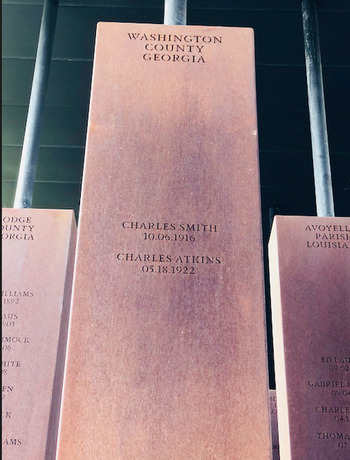
The Equal Justice Initiative’s (EJI) 2018 opening of the National Memorial for Peace and Justice represents a leap forward educating Americans about lynching. Where historians have fixated on traditional sources, the EJI in its larger memorial efforts, which include documentaries and historical markers, reached out to the families of victims and accessed their personal archives. These records, which include government records, personal correspondence, and photographs of victims in life (military uniform, weddings, family portraits), challenge assumptions of the unknowability of lynching victims’ lives. From them we learn a great deal about victims’ full personhoods and how their families fared (fig. 1).
When I visited the National Memorial for Peace and Justice in Montgomery, Alabama, in 2018, I explored as many columns as I could, looking specifically for names I knew. That is where I found Charles Atkins. There amongst the hundreds of columns and thousands of names identifying the dead, he was virtually anonymous to most visitors. But thanks to his father’s loving act of resistance, I knew Charlie Atkins, in a different way, one that all lynching victims and their families deserve. Photo courtesy of the author.

The number of lynching victims’ families stepping forward to tell their story to the EJI and to media outlets marking the memorial’s opening suggests there has been pent-up demand to have their stories known and acknowledged. These were stories that families kept and passed on. They tell stories of the many layers of irreversible damage lynching caused. They speak of displacement from their families and communities. But at the crux of this are people who had their lives shattered not adequately accounted for in the histories we write.
Why It Matters
Making lynching victims more familiar to our readers and including their families in an expanded interpretation of victimization does not simply involve adding people like Gainer Atkins to history for the sake of covering our bases. Research that raises these victims’ and survivors’ stories to the level of historical visibility might trigger the kind of recognition needed to help our readers develop the same respect for lynching victims that survivors of other atrocities enjoy today. Here, the goal is not to provoke empathy, but rather to reveal lynching victims’ personhoods in ways that enable us to write the histories these victims and their people deserve.
Excavating these histories of the indefinite and lifelong tragedy of lynching is the work the field needs right now. In an age when the creep of normalcy is making many Americans turn blind eyes toward police and vigilante killings of unarmed Americans and the detention and deportation of growing numbers of undocumented people and deaf ears to the people crying out against these injustices, moving us past the brink of disaster and into the chasm of fascism, a proper accounting of what state and racial violence did to people could be what it takes to generate the sense of urgency needed to persuade more Americans to confront it today.