Tunisians had mass demonstrations and Syrians were like, “Hmm, interesting.” And then Egypt started. People were like, “Resign already!” And then Mubarak resigned. We thought, “Holy shit. We have power.”
—Syrian organizer, 2013Footnote 1
When France sneezes Europe catches a cold.
—Klemens von Metternich, 1830Footnote 2
For all its unique triumphs and disappointments, the Arab Spring was only the latest in a long series of democratic waves. Starting with the Atlantic Wave of the late eighteenth century, the global spread of democracy has been defined by intense, far-reaching, often unsuccessful cascades of revolution and reform. In recent decades, the Color Revolutions and the 1989 wave stand out as two prominent examples, but these bursts of unrest have been a feature of global regime evolution since the beginning of modern democracy.
Yet democratic waves vary immensely in their origins, reach, and success rates. A royal court escapes to Brazil days before Napoleon’s invasion; a restless crowd jingles their keys in Wenceslas Square; a man immolates himself in a small Tunisian town. All parts of sweeping cross-border waves of contention and reform, but what do they have in common otherwise? How do we meaningfully compare democratic waves, and what do they tell us about the evolution of democracy?
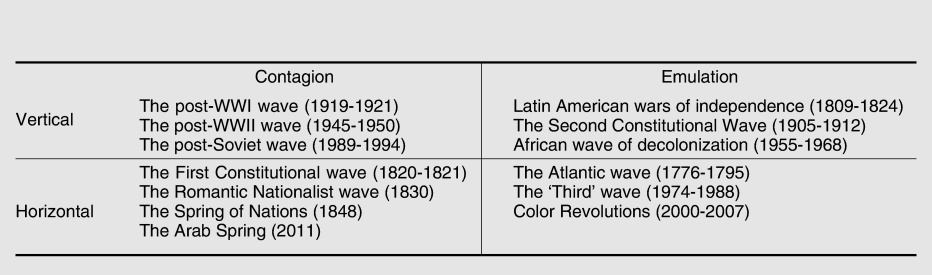
Despite their differences, democratic waves share recurring patterns that point toward theories of regime diffusion. Here I lay out a conceptual framework for examining democratic waves across time, organized along two central dimensions. The first focuses on the origins of external influences—vertical in cases of waves created by geopolitical shifts, horizontal in waves driven by of neighborhood linkages. The second focuses on the strength of external influences in shaping the wave’s timing—contagion in short sweeping waves that override domestic constraints, emulation in protracted waves where domestic factors act as focal points for mobilization. The interaction of these categories yields a four-part typology of democratic waves, each with its own dynamics and causal mechanisms.
This approach, I argue, allows for more meaningful comparisons between these crucial episodes of political contention. It can help clarify, for instance, why neither the 1989 Revolutions nor the Color Revolutions are fitting comparisons for the Arab Spring, despite the claims of some hopeful observers, and why the 1848 Spring of Nations instead offers the closest historical parallel.Footnote 3
More generally, the prevalence of waves highlights the key role of the international system in shaping domestic institutions. Rather than ad hoc anomalies to be bracketed out of comparative analysis, waves are a persistent element of democratization itself. As a result, theories of democratization that focus only on internal factors risk ignoring key determinants of regime change. The evolution of global democracy cannot be reduced to the sum of its national trajectories.
The first key distinction focuses on the role of hegemonic transformations in the international system. Some of the biggest democratic waves of the past century have been the results of hegemonic shifts—moments of abrupt rise and fall of great powers that stem from major wars, economic crises, or imperial collapses. The short-lived but intense wave of European democratization after the Great War, for instance, stemmed directly from the destruction of European empires and the victory of democratic great powers. In fact, both World Wars and, more recently, the Soviet collapse, led to intense if often fragile waves of democratization. In the latter case, the collapse of Soviet power created space for a massive wave of reforms directly linked to the material and ideological consequences of bipolarity’s sudden demise.
Moments of abrupt rise and decline of leading states, in other words, create waves of domestic reforms that sweep across national borders and deeply alter the paths of state development. Other great power conflicts, like the Napoleonic Wars or the Russo-Japanese War, likewise create opportunities for bursts of unrest by temporarily undermining major imperial centers. Russia’s unexpected defeat in 1905, for example, led to the first mass uprising in the nation’s history—a revolution that created a cascade of unrest on Russia’s imperial periphery and beyond.
Vertically-driven democratic waves therefore stem from abrupt shifts at the top of the international order. They originate from sudden disruptions to the structure of global hegemony, whose effects propagate through the international system and create powerful if temporary opportunities for domestic reform. Abrupt hegemonic transitions are the catalysts and the distinguishing marks of vertical waves.
But not all waves are linked to hegemonic transformations. Some instead begin as local sparks of revolt, spreading via cross-border ties and neighborhood contagion. These cascades are often driven by shared grievances, cultural commonalities, and thick communication linkages that allow protests to sweep across borders. The 1848 Spring of Nations, the Color Revolutions, and the Arab Spring are all examples of horizontal waves in which linked episodes of contention were forged through local ties rather than great power transformations.Footnote 4 Horizontal democratic waves still rely on external forces but are unrelated to broader shifts in the structure of global hegemony.
The second distinction—contagion versus emulation—focuses on the relative strength of external factors in shaping the timing and duration of waves. In contagion-driven waves, intense external forces temporarily overwhelm domestic constraints. The result is a rapid burst of contention—as in the European revolutionary waves of the early nineteenth century, which spread across the continent in months or even weeks.Footnote 5 The Spring of Nations, for instance, “spread like a dynamic pulse and electrified Europe” writes Rapport, with revolutions engulfing the continent within a month.
In emulation-driven waves, by contrast, domestic factors remain crucial in shaping the timing of national reforms. The wave unfolds slowly, with external linkages reliant on propitious domestic opportunities. Such waves stretch out over many years rather than months—as was the case, for instance, in the Color Revolutions or the Atlantic wave.
While the average contagion-driven wave lasts three years, the average emulation-driven wave unfolds over more than thirteen years. In these cases, cross-border linkages continue to play an important role, as later attempts draw upon earlier precedents for learning, support, and inspiration. Here emulation shapes the character of the wave, but the timing of its transitions is mediated by local crises, constraints, and windows of opportunity. Rigged domestic elections, for example, served as key focal points for protest mobilization in the Color Revolutions.
The distinction between contagion and emulation is thus essential for understanding the unfolding of the Color Revolutions in the post-Soviet space, particularly when comparing them with other recent waves like the 1989 Revolutions or the Arab Spring. In contagion-driven diffusion the wave itself, rather than domestic windows of opportunity, serves as an international focal point for protest groups. But in processes of emulation-driven waves, domestic opportunities continue to determine the timing of each outbreak.
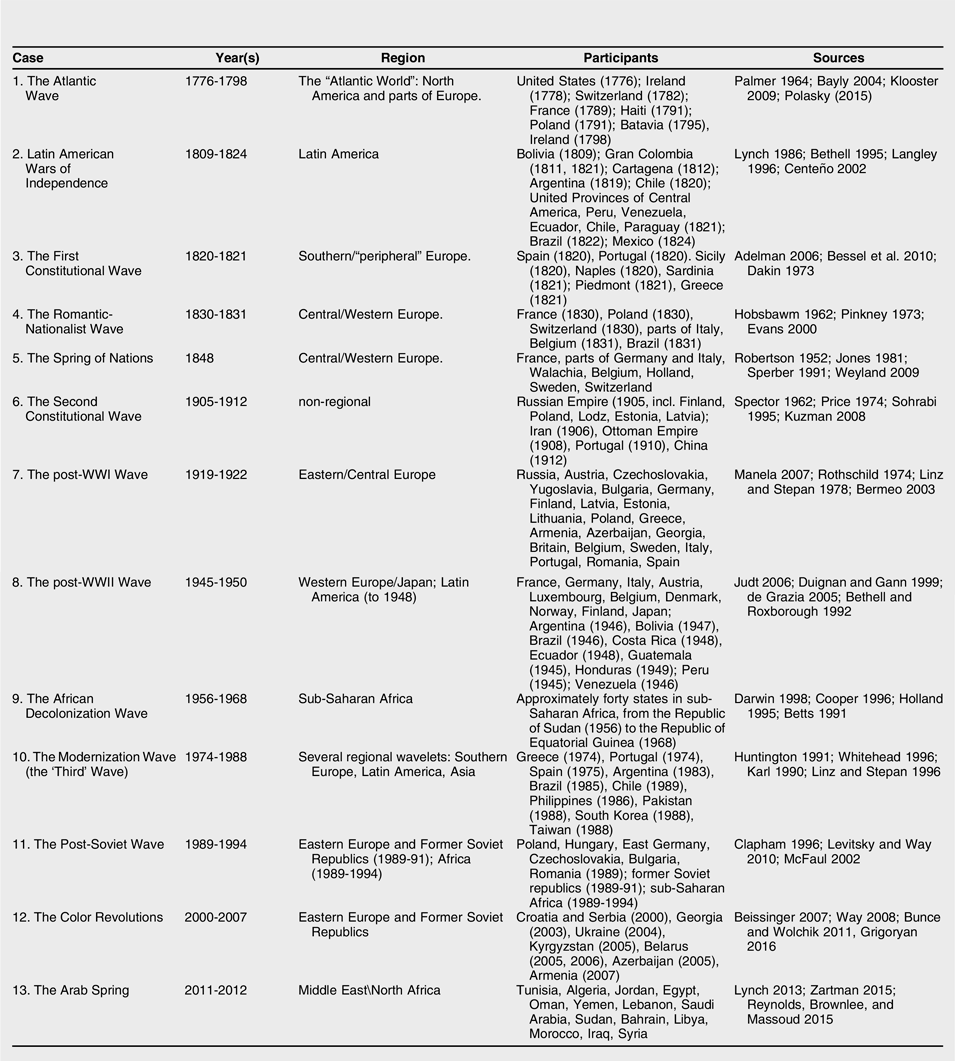
The interaction of these two categories yields a four-fold typology of democratic waves, encompassing thirteen distinct waves over the past two centuries (see table 1, next page). I begin by defining democratic waves, explain my case selection, then examine each of the subtypes in more detail, and conclude with a case study of the little-known Second Constitutional Wave of 1905–1912.
A typology of democratic waves

Defining Democratic Waves
Definitions of democratic waves remain scarce, since the study of waves is a relatively new element of the democracy literature. When Huntington popularized the concept in 1991, he offered a definition that has since become the default.Footnote 6 Namely, he defined democratic waves as “a group of transitions from nondemocratic to democratic regimes that occur within a specified period of time and that significantly outnumber transitions in the opposite directions during that period of time.”Footnote 7
Huntington’s definition focuses on the most visible element of waves: the temporal clustering of transitions.Footnote 8 But in emphasizing on clustering, the definition leaves out another key element—the presence of linkages among the cases. Footnote 9 A burst of similarly-timed transitions could happen for many reasons, such as parallel but independent development within states. Simultaneous transitions are thus not sufficient evidence of a wave unless there are demonstrable links among those transitions.Footnote 10
The case of the Second Constitutional Wave, discussed in more detail below, illustrates the difficulty. Charles Kurzman (Reference Kurzman2008) identifies 1905–1912 as forming a temporal cluster of (attempted) transitions from absolutist to constitutional monarchies. This wave includes the countries of Russia and some of its dependencies (1905), Iran (1906), the Ottoman Empire (1908), Portugal (1910), and China (1912). Yet this period also saw a number of regime transitions that were disconnected from the wave. These included the peaceful reformist democratizations in Austria (1907) and Sweden (1909), failed democracy movements in Argentina (1905 and 1912), and several populist anti-colonial uprisings in dependencies like Indonesia (1908). Despite forming a part of the same temporal cluster, these cases are excluded from the Second Constitutional Wave because they were rooted in domestic forces and lacked concrete links to the episodes above.
I define a democratic wave as a temporally-bound cluster of mass contention and regime change, with linkages among the cases in that cluster.Footnote 11 In that sense, democratic waves are a subtype of the broader phenomenon of democratic diffusion.
The linkages that bind individual cases into a wave can take a variety of forms.Footnote 12 They can be material or geopolitical, as when a decline of a regional hegemon undercuts its ability to sustain and support the regimes of its dependencies (as in 1905). They can be informational, wherein previous precedents reveal useful information about both the hidden preferences of citizens and the chances of revolutionary success (as in 1989).Footnote 13 They can be socio-cultural, as in the Arab Spring, where mass media and cultural ties between the countries facilitated the spread of protest across borders. They can be organizational or tactical, as in the Color Revolutions, where protestors in previous cases like the Bulldozer Revolution trained and supported protesters in later cases like the Orange Revolution. Or they can be ideological, wherein previous examples serve as inspiration for subsequent attempts. “The fire that is burning in America is more than able to set light to the whole of Europe, which is full of fuel,” wrote the Dutch statesman Van der Capellen at the outset of the Atlantic Wave.Footnote 14
Whatever the nature of the links between domestic episodes, their presence is a necessary component of democratic cascades. The source and strength of these linkages can deeply shape the dynamics and outcomes of the wave. Thus in vertical diffusion, waves propagate through relations of asymmetric power created by linkages between great powers and other states; in horizontal diffusion, waves propagate through linkages marked by regional connections and neighborhood ties. In both cases, clustering and links among cases indicate the operation of cross-border diffusion.
A related question remains: transitions to what? Defining waves only by cases of successful transitions (that is, instances where democracy was achieved and consolidated) ignores the massive presence of failure inherent in democratic waves. The spread of democratic protest may not necessarily lead to a full democratic transition, even if the protestors are united in their democratic goals.Footnote 15 And as many scholars have noted, the factors that lead to democratic transitions may be very different from factors that shape democratic consolidation.Footnote 16 While the outcomes of these episodes of mass contention often fell far short of true democracy, my interest here is not in diffusion as an outcome but diffusion as a process—the means through which external ties and domestic factors interact to forge attempts at institutional change.Footnote 17 To that end, failures of transition must be included as part of the defining feature of waves.
In all the cases examined below, from the Riflers of Batavia to the students in Tahrir Square, the many aggressively sought greater political accountability from the few. Yet most failed, or turned to tyrants soon after succeeding (as in the African decolonization wave or the Arab Spring). Many ostensibly democratic revolutions, as Jacques Mallet du Pan noted, devour their own children. But despite subsequent setbacks, cascades like the African decolonization wave began as a series of transitions from colonial monarchies to independent republics. The fact that Egypt has been unable to consolidate the democratic gains achieved in the early stages of the Arab Spring does not negate the democratic character of the revolts that overthrew Mubarak’s regime.
Drawing upon a large secondary literature (see table 2), I find thirteen distinct instances of democratic waves. These vary in speed and reach, but each features a temporally-bound burst of democratic contention in which at least some of the attempts led to institutional change. Many of these attempts failed, and many of the successful transitions were fragile or temporary. Nevertheless, each case comprised a cluster of linked episodes of revolution and reform. Within each cluster, linkages between cases were noticed by contemporary observers and elaborated upon by later historians.Footnote 18 Arguments could be made for the inclusion or exclusion of particular states or even waves, but this list forms a starting point for thinking about the universe of cases of a relatively amorphous but important phenomenon.Footnote 19
Democratic waves since the eighteenth century
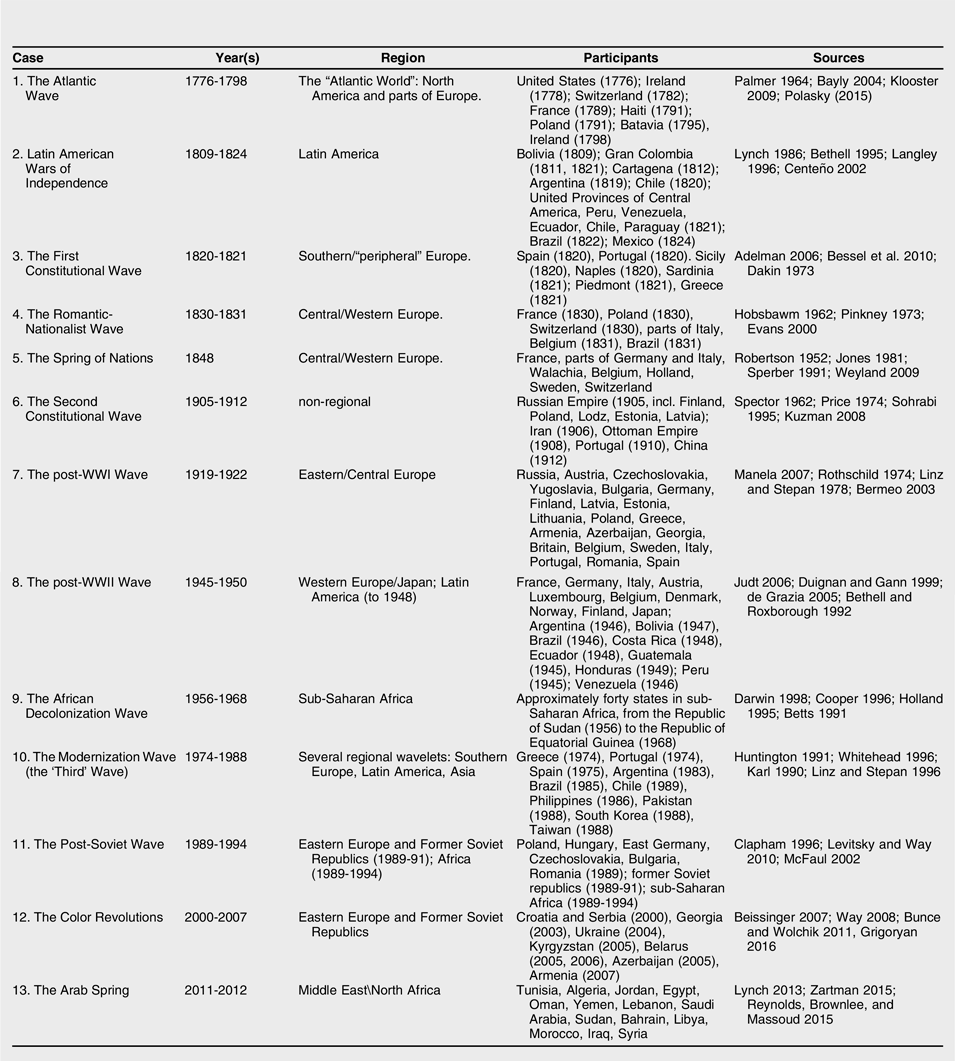
As the table shows, Huntington’s classification of the first, “long” wave of democratization of 1828–1926 hides a high level of variation. Some periods, such as the second half of the nineteenth century, were characterized by democratic stagnation, transitions driven by domestic factors, or incremental changes that never led to an identifiable cross-border cascade. Other periods, however, were marked by repeated bursts of linked transformations, like the European revolutionary waves of the first half of the nineteenth century.Footnote 20
Many scholars from Huntington onward combine the pre- and post-1989 wave under the single rubric of “The Third Wave.” Aside from the issue of questionable numbering, this term hides key variation in the spread of democracy during this period. The two decades after 1974 were not a monolithic expansion of reforms linked by common trends and forces. Until 1989, the Third Wave was a series of regional wavelets—the first in southern Europe in the mid-1970s, the second in Latin America in the early 1980s, and the third in Asia beginning in the mid-1980s.Footnote 21 These regional cascades were driven by common domestic conditions associated with social and economic development. They were diverse in their timing, in their underlying causes, and in the types of regimes they were seeking to escape. With the exception of cultural ties between Iberia and Latin America, there was little cross-pollination among them. These transitions were amplified and facilitated by neighborhood spillover and horizontal linkages, rather than by any sudden changes in the global geopolitical environment.
Unlike the Spring of Nations or the Arab Spring, the Third Wave before 1989 was a case of delayed horizontal diffusion. As such, it bore little relation to the explosion of 1989. It was then that the Third Wave was supplanted by what could be called the Post-Soviet Wave, a global burst of democracy forged by vertical contagion.Footnote 22 “What happened in Moscow was … of such decisive importance,” writes Brown, that we should see the post-1989 transitions as “representing a discrete political phenomenon.”Footnote 23
Classifying Democratic Waves
Given this definition and set of cases, how do we think about comparing and contrasting democratic waves? Here I seek to move beyond a vague focus on “democratic diffusion” to examine the essential recurring attributes and causal mechanisms driving the waves.
Vertical versus Horizontal Waves
The first major distinction among waves can be found in the role played by the global system. Namely, we can distinguish waves stemming from major disruptions to the international system (vertical waves) from those that are unrelated to any broader global transformations (horizontal waves). In vertical waves, major wars or imperial collapses trigger dramatic cascades of institutional reforms by changing the material or ideological opportunities for reform and rebellion. In the nineteenth century, for example, the Napoleonic Wars (namely, the outcome of the Peninsular War) loosened Spain’s hold on South America, provoking the Latin Wars of Independence.Footnote 24 Nearly a century later, the outcome of another war among great powers—the 1905 Russo-Japanese war—weakened the Russian Empire and kicked off another cascade of reforms (the Second Constitutional Wave) around the imperial borderlands and beyond.
The major geopolitical upheavals of the twentieth century—the two World Wars and the Soviet Collapse—each produced powerful, globe-spanning waves of democratic reform.Footnote 25 The immediate aftermath of World War I saw a surge of democratization in countries forged from the ruins of collapsed empires. Between 1918 and 1922, over a dozen newly-created European states adopted independent parliaments, civil liberties, and universal suffrage. Semi-democracies like Britain and Belgium expanded voting rights to previously excluded groups like women and working-class men.Footnote 26
The post-World War I wave was directly linked to the hegemonic transition that accompanied the war’s outcome. The defeat of autocratic monarchs by democratic states created both material and ideological opportunities for the spread of democratic institutions, so that by1920 twenty-six out of twenty-eight European states were democracies.Footnote 27 Similarly, the years after World War II saw the democratization of Western Europe and Japan, and a brief resurgence of democracy in South America—a period that Huntington dubbed “the Second wave” of democratization.Footnote 28 The post-1945 decline of European colonial powers likewise contributed to their abrupt abandonment of African dependencies, leading to an intense (though brief and ultimately unsuccessful) wave of African democratization in the 1950s and 60s, as these new states shifted from colonial monarchies to independent republics. Finally, the collapse of the Soviet system in 1989–1991 led to a profound wave of democratic revolutions in Eastern Europe, as well as a partially successful surge of democracy in the developing world, particularly in sub-Saharan Africa.Footnote 29
All of these episodes of vertical waves were driven by abrupt changes in the hierarchy of leading powers, forging incentives and opportunities for bursts of domestic transformation. I categorize these waves as “vertical” since they stem from top-down geopolitical shifts produced by changes in the hierarchy of great powers. Many of the transitions produced by these waves ended in failure, experiencing partial or total rollback—but in the short term, they generated strong incentives for the cross-border spread of democratic institutions.
Horizontal waves, on the other hand, occur in the absence of geopolitical shifts and are unmoored from any broader transformations of the international order. Instead, they unfold through shared horizontal networks and regional effects. In these cases, a spark of revolt in one country crosses national borders and spreads to neighbors or states with similar grievances and internal dynamics. The process then becomes self-reinforcing—as more countries experience upheaval, opposition leaders and embittered masses elsewhere update their beliefs about the possibility of success, or simply become inspired by the efforts of others, and join in the wave—a process that occurred, most recently and dramatically, in the Arab Spring. Unlike the wave that followed the aftermath of World War I, for example, democratic diffusion in the Atlantic Wave or the Color Revolutions was not driven by major hegemonic shocks or geopolitical transformations.
While vertical waves are the result of changes in the structure of the international system, horizontal waves are instead rooted in the shared linkages that create channels for institutional spillover. The distinction between horizontal and vertical diffusion was well captured by Max Weber: “If at the beginning of a shower a number of people on the street put up their umbrellas at the same time,” he writes, “this would not ordinarily be a case of [social] action, but rather of all reacting in the same way to the like need of protection from the rain.”Footnote 30 In cases of vertical diffusion, an exogenous shock creates a wave of transitions by shifting the institutional preferences and incentives of many domestic actors simultaneously. Or, as Lucan Way puts it, the 1989 revolutions were not the product of a domino effect, in which revolution in one country triggered regional spillover.Footnote 31 Rather, the revolutions were made possible by the abandonment of the Brezhnev doctrine inside the USSR, producing a major shift in the geopolitical structure of the region. Instead of a horizontal process in which a single domino set off a democratic cascade, the dominoes fell because the table itself was beginning to shake.
One critique of this distinction is that vertical diffusion of democracy does not constitute “true” diffusion if we take the latter to mean a process that lacks organized coercion. Elkins, for example, defines diffusion as a process of uncoordinated interdependence, “uncoordinated in the sense that a country’s decision to democratize is not imposed by another.”Footnote 32 Three responses are possible; first and most generally, my goal is not to define diffusion but to examine the causes of democratic waves. To the extent that vertical influences like global shocks can lead to waves, they will be included as part of the analysis even if we remain agnostic about their precise labeling.
Second, a number of diffusion studies include both vertical and horizontal elements in their analysis. Simmons et. al, for example, include “coercion” and “promotion” as two intrinsically vertical mechanisms of diffusion, in which asymmetries of power drive cross-border change, while Gilardi notes that “a significant portion of the literature considers coercion integral to diffusion.”Footnote 33 (Elsewhere, Elkins notes that “the transmission of policies across vertical as opposed to horizontal networks is a common theme in the diffusion literature.”)Footnote 34
Third, “coercion from above” is only one element of vertical diffusion, and often the least important element. In the wake of hegemonic transitions some countries have found democracy imposed upon them by a victorious hegemon, as was the case of Germany and Japan after World War II. Yet both empirical and historical studies show that forced impositions form only a small proportion of reforms that follow systemic transitions.Footnote 35 In most cases, the countries that democratized after these systemic transformations did so either due to self-interest (to ingratiate itself with the rising hegemon or to secure its aid and patronage) or because they felt that the crisis credibly demonstrated that democracy offered the more appealing path forward. The regime diffusion that accompanies vertical shocks is thus driven less by brute force and more by indirect hegemonic inducement and voluntary imitation.
Another possible objection is that vertical shocks still show traces of horizontal linkages. In the 1989 revolutions, for instance, Soviet reforms served as the crucial geopolitical trigger, but the process was reinforced when the region’s pro-democracy movements observed the successes of their peers and were inspired to follow suit.Footnote 36 To come back to Weber’s example: some people may open their umbrellas because they feel the rain, and others may do so because they see people opening their umbrellas. The dominos may fall because the table is shaking, but they may also knock each other down in the process.
A vertical geopolitical shock can thus start a democratic wave that also moves through horizontal diffusion, as in 1989. In this case, however, vertical forces still acted as a necessary pre-requisite for any subsequent contagion. As Thomas Risse argues, “the new thinking in foreign policy and the renunciation of the Brezhnev doctrine enabled the peaceful revolutions in Eastern Europe in the first place.”Footnote 37 And according to Perry Anderson, “nothing fundamental could change in Eastern Europe so long as the Red Army remained ready to fire. Everything was possible once fundamental change started in Russia itself.”Footnote 38 The fact that dissident groups had pushed for reforms long before 1989 only underscores the importance of the USSR, since these groups could do little to actually realize their demands until a realignment in Soviet policy. “The political opportunities that triggered these upheavals in the East,” argues Sidney Tarrow, “became widely understood only after Gorbachev’s well-publicized refusal to use military force.” These revolutions, he concludes, “were set off by a radically new international opportunity structure.” And as Hale concludes, “archival research now makes clear we must consider Mikhail Gorbachev’s USSR as a common cause of similar democratizing events in East Europe.”Footnote 39
The presence of an abrupt hegemonic transition is the unique marker of vertical waves, and what makes them easily distinguishable from horizontal waves. Even where vertical diffusion creates the conditions for horizontal linkages, the process is fundamentally different from waves driven by only by horizontal diffusion. Vertical diffusion creates immensely powerful incentives for bursts of democratization, because the tectonic realignment of global hierarchies influences institutional opportunities in many countries at once.
It is not simply that vertical waves are byproducts of systemic forces, since these may also be important in horizontal waves. A sudden spike in global food prices, for example, probably contributed to the breakout of protests in the Arab Spring.Footnote 40 Rather, the argument here is that a specific kind of systemic volatility, in the form of abrupt hegemonic transitions, creates unique conditions for a particular type of democratic wave.
Contagion and Emulation in Democratic Waves
The second key distinction among waves resides in the role played by domestic factors – namely, in whether the timing of transitions in a wave is mediated by domestic circumstances. In contagion-driven waves, the spread of contention overrides domestic influences, and the timing of national breakouts is often unrelated to internal causes.Footnote 41 Democratization in one country increases the immediate likelihood of democratization in other states, producing diffusion that rapidly sweeps across borders in a matter of months or even weeks, as was the case in 1848 or 1989. This is the so-called epidemiological, quasi-mechanistic model of diffusion as commonly conceived in social science.
By contrast, during the Color Revolutions, the timing of each subsequent upheaval was driven by flawed elections, which served as domestic focal points for the coordinated mobilization of opposition groups.Footnote 42 Starting with the Bulldozer Revolution in Serbia in 2000, a number of countries in the post-Soviet space experienced a series of mass upheavals. In each case, the revolution followed an election widely seen as rigged in favor of the incumbents. As observers noted at the time, these revolutions constituted a common wave linked by shared attributes—participation by youth groups, mass mobilization, non-violence, and ties with the West. Yet the outbreak of one color revolution did not influence the timing of other outbreaks. Instead, the timing was mediated by the interaction of external linkages with domestic opportunities presented by contested elections.
As a result, while contagion-driven waves spread over months or even weeks, emulation-driven diffusion is a much more protracted process—as in the Atlantic wave, the Second Constitutional Wave, or the Color Revolutions, which unfolded over a number of years.
The strength of diffusion within a wave always depends on the relative weight of external and domestic factors. When linkages are weak, domestic conditions are unpropitious, and the organizational capacity of incumbents (that is, their ability to pre-empt, co-opt, or suppress protest) is high, the wave proceeds slowly, with clear links among the cases but with their timing shaped by domestic crises or focal points. When outside influences are powerful, and external linkages are strong, the force of a democratic wave can overwhelm domestic conditions and spread through a process of contagion. (Even under these conditions, domestic factors remain important, by shaping which countries are excluded from the wave or buffeted from its consequences.)
In cases of contagion-driven waves, therefore, external linkages are both necessary and in many cases sufficient for driving waves of reform. In emulation-driven waves, however, international factors become necessary but insufficient for inspiring reforms in the absence of favorable domestic conditions. In these cases, domestic actors are sometimes able to “inoculate” against immediate reforms, making the spread of democratization contingent upon opportune moments. During the Arab Spring, for example, both Russia and China employed social media to promote negative narratives of Western-sponsored destabilization and encourage nationalist sentiment as a defense against these foreign encroachments.Footnote 43 Such counter-diffusion tactics may blunt the reach of transnational social movements that use communication to spread protest tactics and mobilize supporters abroad.
A Typology of Democratic Waves
The causal dynamics, the timing, and the interaction of external and domestic factors all operate in systematically different ways across these two categories of diffusion. The interaction of the two categories—horizontal versus vertical, and contagion versus emulation—produces the four-fold typology of diffusion presented in figure 1.
Models of democratic waves
Note: Each circle is a country case; the timeline is compressed in cases of contagion, expanded in cases of emulation. The end result in each case is a democratic cascade.

By focusing on persistent features across cases, this categorization highlights the contrasts and similarities among historical episodes of diffusion. It demonstrates, for instance, why neither the 1989 wave nor the Color Revolutions are useful precedents for the Arab Spring.Footnote 44 Unlike in 1989, diffusion in the Arab Spring occurred in the absence of a broader geopolitical shift. In the post-Soviet wave, the abandonment of the Brezhnev doctrine removed the major impediment to a democratic wave, which encountered few obstacles in sweeping over the region. The international environment—Western aid conditionality, democracy promotion by Europe and the United States, and the prospects of EC membership—all greatly bolstered both the appeal and the legitimacy of democratic diffusion.
In the Arab Spring, however, the role of the international environment has been either negative or ambivalent.Footnote 45 The wave did not stem from the equivalent of a Soviet collapse; on the contrary, regional powers like Saudi Arabia assisted their autocratic peers in suppressing protests. The United States, meanwhile, at times reinforced the wave by aiding popular uprisings, most notably in the case of Libya. But in other cases like Bahrain or Yemen, it vacillated about promoting regime change or countering the suppression of protests.Footnote 46 The absence of a hegemonic shock that produces systemic pressures for democratization marks a clear distinction between vertical and horizontal waves.
And unlike the Color Revolutions, the timing of transitions in the Arab Spring was not conditional upon domestic focal points. In post-Soviet states, opposition leaders awaited the next flawed election to coordinate their protest efforts. No such waiting took place in the Middle East—after the initial spark of revolt began in Tunisia, the timing of subsequent revolutionary diffusion across borders was rarely related to specific internal triggers.
Instead, as the typology shows, the closest familiar analogy to the Arab Spring is the 1848 Spring of Nations—both instances of horizontal contagion. The Spring of Nations was not driven by geopolitical shifts and stemmed instead from horizontal cross-border contagion. Its timing was largely independent of domestic circumstances, leading it to spread throughout central Europe in a matter of months.Footnote 47 As an instance of horizontal contagion, the Spring of Nations was intense, swift, far-reaching, and ultimately unsuccessful, defeated by the concerted efforts of the region’s autocratic rulers. At the same time, it left a deep footprint on the subsequent evolution of European states. Given these similarities, the Arab Spring is increasingly likely to meet the same fate.
The Failures of Democratic Waves
Despite their underlying differences, what unites the vast majority of waves is the presence of failure—the tendency for democratic cascades to crest, collapse, and roll back. This rollback can be total (as in the post-World War I wave), or partial but persistent (as in the African wave following the Soviet collapse).
Failure is therefore a key component of democratic waves, as demonstrated most recently in the Arab Spring. In fact, there is good reason to think that failure is built into the very process that creates waves.
The impulses that drive democratic waves create extremely powerful but temporary incentives for regime change. In the short term, the euphoric and seemingly immense possibility of revolutionary change produces immense pressures for democratization. Countries with strained class relations, ethnic tensions, low levels of economic development, and no history of democracy suddenly find themselves swept up in the momentum of a powerful wave. In their initial intensity, waves create episodes of “democratic overstretch”—the regime version of a stock market bubble, in which cascading effects lead to an artificially inflated number of transitions.
The strong but vaporous pressures that allow a wave to spread also ensure that at least some of these transitions take place in countries that lack domestic conditions needed to sustain and consolidate democracy. As the initial phase of the wave passes, and the difficult process of democratic consolidation moves forward, domestic constraints reassert themselves and contribute to the failed consolidations that often follow waves.Footnote 48 Democratic transitions that occur within waves may be less likely to succeed than transitions driven by domestic factors.
Most models of democratic diffusion focus on positive feedback—the spread of democratic contention—as the driver of the process.Footnote 49 But the ubiquity of failure in waves suggests that rollback is not simply a common side effect, but an inherent component of the wave. Democratic cascades may therefore be better understood as the complex interplay of positive and negative feedback, rather than the unilinear process of “spreading” implied by many theories of democratic diffusion.
Moreover, different kinds of waves may be associated with particular types of democratic failure. For example, elite adaptation designed to stymie and co-opt protests may be especially prevalent in waves driven by emulation, for two reasons. First, emulation-based diffusion centers around predictable domestic events like elections; and second, it operates on a longer time scale than contagion-based diffusion. Both factors allow autocratic rulers to anticipate and co-opt for any potential rebellions. Learning from the fates of their peers allows autocratic elites to update their beliefs about the best tactics for suppressing protests.Footnote 50 It may be worth noting that since Kyrgyzstan’s 2005 Tulip Revolution, no electoral revolution until Armenia in 2018 had succeeded in overturning an incumbent regime, with failed attempts in Azerbaijan (2005), Belarus (2006), Iran (2009), and Russia (2011). Incumbent elites may have learned enough from the failures of their peers to pre-empt most revolutions centered around flawed elections.Footnote 51
Theories of democratic consolidation have generally overlooked its external dimensions, focusing instead on the domestic origins of democratic rollback. Yet for countries that democratize in waves, such failure may be built into the conditions that allowed the initial democratic transitions in the first place.
This interplay of external and local forces can also help shed light on the rise of hybrid regimes after the Soviet collapse. These regimes experienced enormous systemic pressures to democratize after 1991, but quickly discovered the fickleness of these pressures once the initial democratic euphoria wore off. Rulers soon found a way to placate foreign donors and sideline the opposition while maintaining a democratic façade. The rise of hybrid regimes since the end of the Cold War can therefore be viewed as the long-term interplay between the global overstretch of the post-Soviet wave and local counterwave dynamics that followed it.
Case Study: The Second Constitutional Wave (1905–1912)
As a rarely-examined episode of democratic diffusion, the Second Constitutional Wave offers an illustration of how hegemonic disruptions, working through material and ideological linkages, can create bursts of democratic reform. This wave included Russia and several of its imperial dependencies (1905), as well as Iran (1906), the Ottoman Empire (1908), Portugal (1910), and China (1912).Footnote 52 These countries were bound by concrete linkages—in the form of organizational tactics, material influences, and ideological inspiration—through which earlier cases shaped the attributes, opportunities, and expectations for later episodes of contention. The 1905 revolution, according to Steven Marks, had “a worldwide impact,” forging opportunities for reform across Asia and beyond.Footnote 53 And Kurzman argues that the revolution inaugurated “a global wave of democratic revolutions” and “gave an enormous boost to democracy movements around the world.”Footnote 54
The vertical element of this democratic wave was Russia’s defeat in the 1905 Russo-Japanese war, which acted as a temporary but real shock to the global hierarchy of leading states. The war marked Japan’s ascent to the small club of official “Great Powers” while undermining the Tsarist government’s standing and precipitating the 1905 revolution.Footnote 55 The prosecution and outcome of the war generated enough discontent to ignite the first large-scale uprisings in Russia’s history. Even the military, the regime’s most reliable ally, grew dissatisfied with the Tsar’s unwillingness to undertake military reforms. Industrialists, meanwhile, chafed at the massive growth of foreign debt brought on by the expense of the war, while nationalists grew increasingly furious over the incompetence displayed over the course of the conflict.Footnote 56 The Russian defeat thus forged a broad anti-government coalition that succeeded in mounting a powerful challenge to the Tsarist regime.
For hopeful democrats in Iran, the Ottoman Empire, and the imperial peripheries, the war had temporarily undermined the Empire’s ability to suppress regional revolutionaries (as it had done so brutally in eastern Europe in 1848) by displacing most of its armed forces to the Far East. The temporary vacuum of power bolstered revolutionary and protest movements in Russia and dependencies like the Grand Duchy of Finland, Łódź, Latvia, and the Governorate of Estonia. In Poland, the country’s future leader Joseph Pilsudski took advantage of the disruption to lead a failed revolution. For Iranian reformers, the war offered hope that Russia’s “grip on the country could be loosened,” reducing the threat of intervention.Footnote 57 And indeed, the external influence of Russian power was muted as the government recovered from its recent military defeat and domestic unrest. Despite a record of interference in Persian politics, and repeated pleas from the beleaguered Shah, Nicholals II proved unable to step in to prevent a revolt and the signing of a constitution in 1906.Footnote 58
As in 1989, hegemonic decline and volatility left Russia unable to suppress democratizing movements around its borderlands, enabling a cascade of regime reforms throughout the region.Footnote 59 Beyond the material opportunities for reform in nations previously fearful of Russian intervention, 1905 also clarified an ideological precedent. As John Foran puts it, the fact that “the only Asian constitutional state had defeated the major Western nonconstitutional one further suggested the desirability of constitutional forms of rule.”Footnote 60 As Don Price argues, 1905 “encouraged revolutionaries by showing how strong the revolutionary movement was, even in the world’s most powerful autocracy.”Footnote 61
Like their counterparts in the Color Revolutions a century later, the pro-democracy movements of this wave drew upon earlier episodes for ideological inspiration, and explicitly exchanged tactics and protest repertoires that shaped their anti-regime strategies. The informational role of these linkages, and their creation of demonstration effects, was especially important because of widespread preference falsification in the non-democratic states of the wave. As a result, the 1905 revolution “contributed substantially to the awakening of nationalism and the development of constitutional government” in Asia.Footnote 62 It “encouraged revolutionaries by showing how strong the revolutionary movement was, even in the world’s most powerful autocracy.”Footnote 63 The Young Turks, for instance, not only had their commitment to constitutionalism reaffirmed by the revolutions in Russia and Iran, but also drew upon these precedents to shift from their original approach of an elite “revolution from above” to a more populist mobilization strategy.Footnote 64
In both material and ideological terms Russia served as a keystone state in this wave, similar to the role played by France in 1848. The pan-national and cross-class nature of the 1905 revolution meant that “it had a strong appeal, both inside Russia and abroad, stronger in many respects than the October Revolution of 1917,” which instead emphasized the dictatorship of the proletariat spearheaded by a select cadre.Footnote 65
In Iran, Russia’s revolution played “an inordinate role in placing revolution on the agenda.”Footnote 66 An Iranian prodemocracy newspaper exhorted its readers to “adopt the peoples of Russia as a model.”Footnote 67 In Portugal, an observer noted that events in Russia “have echoed throughout the world like a powerful recurrent cry.”Footnote 68 In the Ottoman Empire, the Russian precedent both “opened the possibility for a more popularly based movement” and “suggested concrete protest strategies” such as public refusals to pay taxes and the centrality of revolutionary cadres and extra-legal groups.Footnote 69 The pro-democracy newspaper Min-pao, argues Spector, offers “the best proof of the impact of the Russian Revolution of 1905” on Chinese revolutionaries, as “practically every issue included articles, pictures, and references to events in revolutionary Russia, including frequent admonitions to the Chinese to profit by the Russian experience.”Footnote 70 The Chinese laborers working in Russia, like their Iranian counterparts, “were strongly influenced” by 1905. Upon their return, they helped organize Russian-style political strikes on the Chinese Eastern Railroad.Footnote 71 And according to Price, Russia’s defeat “eliminated the last powerful argument for autocracy in China”; it “had exposed Russia’s backwardness and internal disarray and clearly demonstrated that China must have a constitution.” As a result, it bolstered “that strain in Chinese revolutionary thought which conceived of revolution as a natural, sometimes unavoidable category of modern progress toward universal humanitarian goals.”Footnote 72
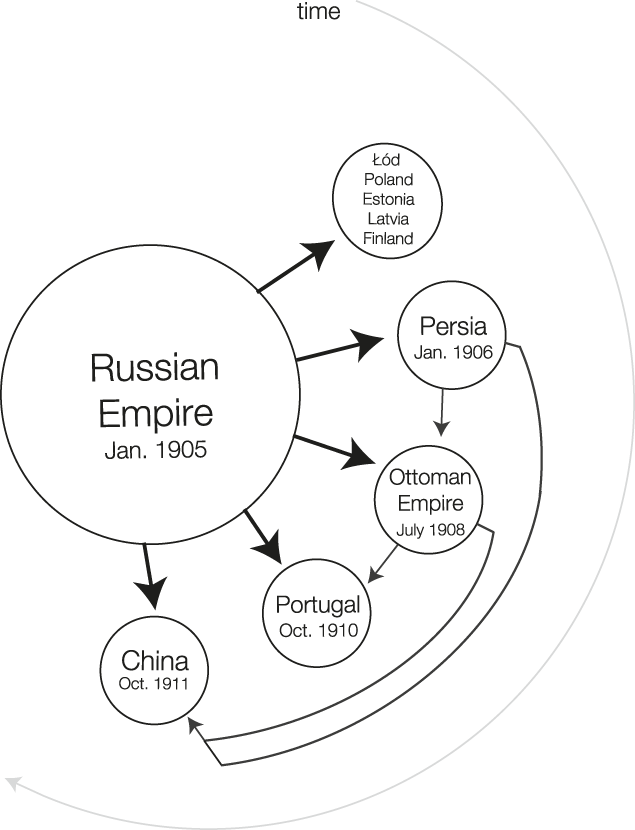
After the initial vertical catalyst of (temporary) Russian hegemonic decline, the wave also propagated through horizontal diffusion, with linkages that extended beyond Russia (see figure 2). For the Ottoman Empire, the Iranian precedent established the viability of Islamic constitutionalism, demonstrated the value of religious rhetoric, and served as “the ideal proof that a constitutional revolution could be at once popular and bloodless.”Footnote 73 In turn, Chinese reformers drew upon the lessons of Iran and the Ottoman Empire both as sources of inspiration and as models of revolution. In the Chinese debate over the role of monarchy, for example, the Turkish example “powerfully recommended itself for emulation” by demonstrating that the sultan’s removal was compatible with popular rule by elite parties with the support of military forces.Footnote 74
The second constitutional wave, 1905–1912

These shared attributes and linkages separated the countries of this wave from other democracy movements of the same period. While the revolutionary movements of the Constitutional Wave drew upon disparate domestic grievances, and internal circumstances shaped the timing of diffusion, its ideology and attributes were shaped by common linkages, with Russia’s defeat as the initiator of the wave. The geopolitical shock of the war created a window of opportunity for rebellion, served to reaffirm the appeal and legitimacy of constitutionalism as a path toward modernization, and facilitated the emulation of successful protest strategies.
While rooted in a vertical disruption to the hierarchy of great powers, the timing of the wave’s spread still relied upon domestic circumstances. At the start of the twentieth century, the linkages among pro-democracy movements were still too frail, and their cultural contrasts too vast, to diffuse with the speed and intensity associated with contagion. As a result, the outbreak of later revolutions was mediated by domestic opportunities.
Conclusion
As the persistence of waves makes clear, the international system has played a key role in the evolution of domestic regimes. Yet democratic waves resist easy comparisons. They occur in vastly different regions and historical contexts. They vary in speed, scope, intensity, and range of outcomes. How do we compare these turbulent and seemingly diverse democratic cascades?
I engage this question by laying out a conceptual framework for analyzing democratic waves. The historical typology of waves is organized along two dimensions. The first contrasts horizontal waves driven by cross-border linkages and neighbor ties (as in the Spring of Nations) with vertical waves driven by shifts in global hegemony (as in the post-Soviet wave).
The second dimension contrasts emulation-driven and contagion-driven waves. In cases of emulation, domestic factors serve as key focal points shaping both the duration of the wave and the timing of its transitions. The result is long episodes of contention linked by common grievances or tactics, yet reliant on domestic circumstances for their spread (as in the Color Revolutions). In processes of contagion, on the other hand, external linkages temporarily overwhelm domestic constraints to produce short, intense waves (as in Arab Spring).
My goals here were three-fold: to offer a definition of democratic waves, to identify a plausible universe of cases, and to lay out a framework for comparing these episodes across time. Instead of a single notion of democratic diffusion, it may be better to think of “varieties of democratic diffusion,” akin to the literature on varieties of capitalism.
This approach also highlights the key role of abrupt hegemonic transitions as important if unreliable drivers of democratic waves. Sudden shifts in the structure of hegemonic power have produced some of the most consequential regime cascades in modern history. In some ways, the twentieth century can be imagined as a series of hegemonic shocks and institutional waves. Yet the links between systemic shifts and institutional waves were not limited to democracy: German economic recovery in the 1930s led to the diffusion of fascist ideas and institutions, and the Soviet victory in World War II prompted a global communist wave that spread through both force and admiration. Future hegemonic transitions, including the decline of American dominance, are likely to produce similar anti-democratic cascades, particularly in case of a sudden U.S. decline.
As a first cut at a broad topic, this approach offers some venues for future research. Each of the waves, treated here with inevitable brevity, would benefit from case studies that examine the strength and types of cross-country linkages, and their effects on the timing and outcome of regime change. The framework can also be applied to the small but growing literature on autocratic waves, some of which appear to be driven by similar dynamics.Footnote 75
Beyond the two distinctions emphasized here, there may be other ways to categorize democratic waves—for instance, by looking at how major actors organize themselves, or the role of violent conflict in the transition.Footnote 76 There is also more room for exploration of linkages among the waves themselves. The Atlantic Wave, for instance, also influenced Latin American independence movements of the early nineteenth century. Finally, the failures inherent in democratic waves deserve more attention, especially if different types of waves are more likely to experience different rates of failure. If democratic rollback is a “natural” component of waves, we should reconceptualize democratic diffusion as a two-way interaction of contention and resistance, rather than as the unidirectional, quasi-mechanistic spread of revolt.
The looming presence of waves suggests that studies of democratization cannot focus only on the local drivers of revolts from below or elite concessions from above. Episodes of mass political contention were often embedded in broader transnational processes that involved regional cross-border ties and global hegemonic rivalries.
More generally, examining the causes of democratic waves is a reminder that global democratization is more than the sum of its parts.Footnote 77 The spread of democracy embodies multiple facets of a systemic phenomenon, driven by cross-border linkages that cannot be reduced to their individual components. Examining how democracy spreads, in other words, can offer fundamental insights into the nature of democracy itself.