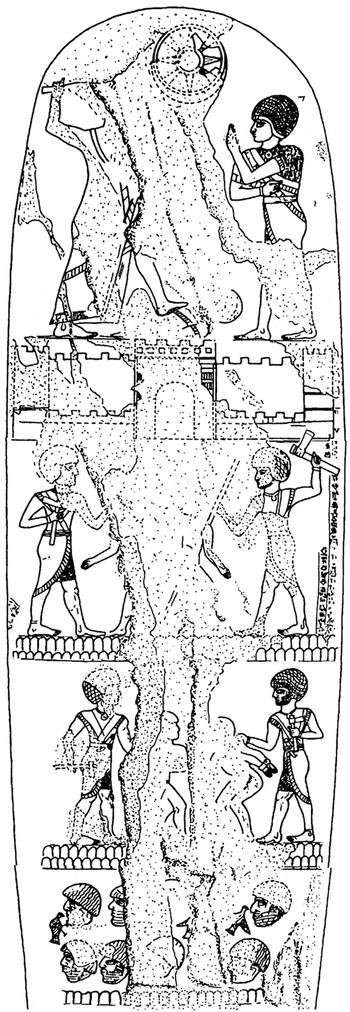
In 1983 a stela was found at Tell Asmar, the ancient city of Ešnunna, that originates from the reign of king Dāduša (c. eighteenth century b.c.) (Fig. 1).Footnote 1 The stela is a unique monument in many respects. It bears an extraordinary long historical inscription which has no known Old Babylonian parallels.Footnote 2 Moreover, it also testifies to a unique correlation of text and images. Both text and images celebrate Dāduša's heroic victory over Bunu-Eštar, “king of the land of Urbel” (xii 12: bu-nu-eš 4 -tár šàr ma-a-at úr-bé-el ki), i.e. Arbil in the transtigridian region.Footnote 3 The text presents Dāduša as a king of the universe who “carries out the rule over the totality of the land” (iii 4f: ana bēlūt kiššat mātim epēšim) and who was instructed by Anum and Enlil “to execute kingship over the universe forever and govern the totality of the people” (v 2–4: šarrūt kiššatim ana ūm ṣiātim epēšam û kullat nīšī šapram). Concerning historical events, the inscription focuses on one specific campaign launched by the glorious king of Ešnunna, i.e. the siege and conquest of the city of Qabarā and the capture of its king Bunu-Eštar. The main text celebrates this key event in the following way:
In ten days I seized this city by means of a surrounding siege wall, by heaping up earth, with the help of a breach, an attack and my great strength. I swiftly bound its king Bunu-Eštar by the blaze of my strong weapon and I truly had his head quickly brought to Ešnunna.Footnote 4
Drawing of the Dāduša stela © Sabrina Buchebner and Robert Rollinger

Apparently, the king of Urbel was executed and beheaded and the war came to an end.Footnote 5 But this is not the whole story. At the end of the text, just before the curse formulae, there is a long passage describing the images on the stela that are presented in four registers and that, despite heavy damage to the central part, can still be recognized fairly well. The lowest register exhibits the heads of decapitated enemies and three vultures feasting on them. The second and third registers from the bottom show two armed soldiers from Ešnunna who capture (third register) and bind (second register) two defeated enemies in the mountainous regions east of the Tigris.Footnote 6 The top register presents three persons positioned above the city walls of Qabarā with a combined divine symbol of sun and crescent hovering over them. To the left there is a large figure with his right arm raised, holding a weapon. He stands with his left foot on an enemy lying on the ground, obviously still alive. He is apparently about to smite and kill the defeated and helpless foe. To the right there is another person dressed in helmet and splendid attire. He raises his left hand in a gesture of reverence and prayer towards the slaying figure to the left. Who are these figures?
Recent scholarship has replied to this vexed question in very different ways. Opinions agree in identifying the supine figure on the ground as Bunu-Eštar but disagree almost entirely about the other two protagonists. According to Bahija Ismaïl and Antoine Cavigneaux, as well as Peter Miglus, the slaying figure to the left is the god Adad whereas the person to the right must be interpreted as Dāduša. However, their reading has not met with unanimous approval. Dominique Charpin thought that the main scene showed Dāduša twice, in two different functions: once as the king smiting (māḫiṣum) an enemy, i.e. Bunu-Eštar; once as the king praying and paying reverence to the god (kāribum).Footnote 7 Zainab Bahrani followed this suggestion.Footnote 8 Neither Christoph Uehlinger nor Frans van Koppen accepted these interpretations. They agreed with Charpin and Bahrani that the smiting person represents Dāduša but disagreed with all previous identifications of the second person to the right. Uehlinger interpreted him as Dāduša's son and successor Ibāl-pî-El II.Footnote 9 Meanwhile Van Koppen thought that he “may represent the crown prince, or perhaps a general”.Footnote 10
Uehlinger presented a seminal set of methodological principles for interpreting the visual representation on the upper register that deserve attention.Footnote 11 First, text and image do not exhibit historical reality but reflect upon it. This can be done differently by both media following different conventions.Footnote 12 Second, the main scene of the upper register has first to be interpreted by iconographical criteria without taking the text into account.Footnote 13 Third, only in a second step should one evaluate the compatibility of image and text. If this does not work each of them has to be interpreted in its own right.Footnote 14 Fourth, likelihood of any hypothesis increases with its ability to offer an interpretation that is able to harmonize image and text.Footnote 15
The first argument does not need any further comment, while the second to fourth are indeed excellent starting points for any interpretation. However, I would like to modify argument number two. Although it is true that text and image do not have to be convergent in every detail and have to be evaluated on their own terms, they are nevertheless related to each other.Footnote 16 Since the upper register is undoubtedly the main scene of the monument,Footnote 17 one should expect the figures depicted there at least to be mentioned in the inscription. If this is not the case, any interpretation loses considerable plausibility. With these premises in mind one gains a reasonable starting point for interpreting the upper register anew.
Since neither a general nor a crown prince are mentioned in the text, these interpretations of the second figure to the right are entirely arbitrary and can be abandoned. Uehlinger's main argument against interpreting this person as Dāduša was the fact that this person is depicted as beardless.Footnote 18 He argued that Dāduša was already an aged person and thus could not have been depicted as beardless. Yet, as a comparison with other roughly contemporaneous monuments shows, beardlessness does not have to be equated with youth.Footnote 19 Therefore the argument loses its force and can be ignored. This also applies to arguments about the position of the main figures. Tally Ornan thought the trampling figure to the left had to be Dāduša because on “earlier sculpted reliefs the deities are shown on the right”.Footnote 20 However, she herself adduces evidence where this is not the case, concluding that, “the visual positioning of king and deity in triumphal scenes was not yet fixed at the close of the third and in the early second millennium”.
The interpretation of a double image of the king cannot be ruled out completely, but is very improbable for two reasons. First, there is, so far, no other testimony of any image of a king doubled in this particular way, i.e. as smiting an enemy on the one side and as praying on the other side. The stela of Mardin (see below) cannot be adduced as evidence in this respect, since its interpretation is also uncertain. Thus, there is, at least for the moment, no iconographic basis for such an interpretation.Footnote 21 Second, the figure to the right is obviously depicted with a gesture of prayer that is directed to someone else. Of course, one could argue that he is paying reverence to the divine symbols hovering above but this is not a very convincing explanation. For a modern or ancient observer of the monument this person is paying reverence to the figure to the far left. Thus, the king of Ešnunna would have prayed to himself, or would have given the impression of praying to himself. These observations weaken this interpretation considerably.
Every interpretation has to start with the main protagonist of the scene, which is undoubtedly the person to the far left standing on Bunu-Eštar. Peter Miglus, who believed this to be the weather god Adad, underpinned his observation by various references to similar iconographies on Old Babylonian cylinder seals and terracottas. In these contexts, images of a god treading on defeated enemies, smiting and killing vanquished enemies, standing on subjugated adversaries who beg for mercy, are very well attested.Footnote 22 However, the problem remains, since this is also true for rulers who stand on defeated opponents and kill them.Footnote 23 Thus, at first glance, this iconographic perspective does not pave the way to a firm and definitive interpretation since gods as well as kings smiting their opponents are common motifs. However, this is not the case on second viewing. Since the person on the right has to be interpreted as a human being, the praying gesture of this person must be directed towards a god or a person of much higher status. As we have seen, it is not an attractive option to identify him as the crown prince (Ibāl-pî-El II) praying to his father (or as a general to his king), nor as Dāduša gesturing towards his double, smiting Bunu-Eštar. Therefore, Miglus' identification of the smiting person as the god Adad is an iconographically fitting and attractive solution.
However, there is another interpretative option that has not yet been discussed.Footnote 24 If one interprets the smiting figure as Dāduša—an interpretation which is, as we have seen, entirely possible from an iconographic point of view—then the figure to the right can only be a person who is mentioned in the text and who, from Dāduša's perspective, could be depicted on a monument erected in his hometown as paying reverence to him. And indeed, there is such a person mentioned in the inscription. In other words, this figure could very well represent Dāduša's “vassal” Samsi-Addu I, who pays reverence to his “overlord”. At least, lines x 4–11 of the stela present Samsi-Addu I as a vassal of the king of Ešnunna. This is, of course, a highly subjective view,Footnote 25 but may nevertheless represent Dāduša's vision of events as he wanted it to be disseminated. Thanks to a fragment of the so-called Mardin stela, now housed in the Louvre and probably originating from the reign of Samsi-Addu I, king of Ekallatum, we know Samsi-Addu's view of the same events.Footnote 26 From its inscription, together with the information we gain from Dāduša's stela, it becomes evident that both kings waged war against Bunu-Eštar as allies in the same historical events. But it is also obvious that both kings consciously tend to downgrade each other's part in the victorious campaign. What is more, one unfortunately fragmentarily preserved scene of the Mardin stela appears to show the same image as the upper register of Dāduša's stela. It likewise depicts three persons from left to right: one smiting, one supine, and one standing to the right. Thus, not only the content of each of the inscriptions but also the visual vocabulary of the two stelae are undoubtedly related to each other. If one interprets the smiting figure on the Dāduša stela as a god this must also apply to the Mardin stela. And vice versa, if this person is thought to represent Dāduša on his stela then it should be Samsi-Addu I on the Mardin stela. The same implication is also valid for the third person to the right, where each of the two kings presents his ally as his “vassal”.
Thus, from an iconographic point of view, there are only two real options for interpreting the couple plus vanquished enemy on the upper register of Dāduša's stela: either as Adad – Bunu-Eštar – Dāduša; or as Dāduša – Bunu-Eštar – Samsi-Addu I. For further analysis the inscription has to be consulted.
Without doubt, the inscription offers an important clue to interpreting the pictorial scenes of the registers, although, as Uehlinger has demonstrated, one has to respect the fact that each of the two media follows its own formal principles and does not have to be entirely congruent with the other.Footnote 27 However, the singularity of Dāduša's inscription is not only marked by its long narrative passages on historical events but also by the fact that a whole section offers a description of the reliefs.Footnote 28 Therefore, to a certain extent, the text is relevant for interpreting the image. The crucial passages are lines xii 1 – xiv 3, where the stela is described.Footnote 29 They read as follows:Footnote 30
(xii 1) Because of […] (2) an eternal name [that I have had engraved on a stela Footnote 31 ]: (3) upon which (there is) an image of my heroism, (4) I as a slayer whose splendour of battle (5) in order to overwhelm the enemy land (6) is majestically set in place. (7) Above (on the stela) Sin and Shamash, (8) who strengthen my weapon, (9–10) appear radiantly in order to prolong the years of my reign. (11) Above the wall of Qabarā (12) (there is) Bunu-Eštar, the king of the land of Urbel, (13–14) whom I angrily bound with my strong weapon, (xiii 1) on whom he treads from above, (2) (and) stands in a lordly way. (3–5) Below (on the stela) (there are) raging warriors who attentively hold the bound (enemies). (6) (This is a stela) the stonecutter's work on which has no rival, (9) that has been executed according to a preconceived plan (7) in skilful labour (8) by artisans, (10) that surpasses words of praise. (13) In order to maintain my well-being (11) day after day in front of Adad, (12) the god who created me, (14) (and thereby) to renew the destiny of my reign, (xiv 3) I truly erected (this stela) for all time (1) in Etemenhursag, the temple of Adad, (2) the god who raised me.
As becomes immediately evident, the seminal passage for interpreting the smiting figure on the left comprises lines xiii (1) – (2). However, there are serious difficulties in understanding and interpreting these lines adequately.Footnote 32 This is not only due to the fact that line xiii (1) is damaged, but also because in this very line the subject changes from the 1st to the 3rd person singular. Scholars have offered different interpretations of this seminal passage and their different translations have resulted in different explanations of the image in the upper register.
Frans van Koppen translated, “(Bunu-Eštar) on whom he (the royal figure) treads from above, standing in a lordly way”.Footnote 33 Consequently he identified the smiting person as Dāduša, and commented, “the figure in adoration opposite of him is unidentified, but may represent the crown prince, or perhaps a general”. Thus for him the king of Ešnunna represents the main protagonist, who “treads on the slain king”.Footnote 34
The same interpretation, combined with a slightly different translation, had already been put forward by Dietz Otto Edzard, who translated xiii 1–2 as: “(Bunu-Eštar …), on whom I (Dāduša) tread from above, in order to stand in victory pose”.Footnote 35
Bahija Ismaïl and Antoine Cavigneaux, who published the editio princeps of the text, proposed a similar translation: “(Dāduša …), about to tread on him (Bunu-Eštar) proudly, standing resplendently”.Footnote 36
Finally, Zainab Bahrani also agreed with this understanding of the text: “I am standing on top of him, I am standing like a young hero”.Footnote 37
It was Edzard who clearly pointed out the difficulties in understanding the whole passage.Footnote 38 The verb ka-ab-sú-šu (xiii 1) was apparently either interpreted as a participle kābsu-šu Footnote 39 or as a stative 3rd person subjunctive kabsu-šu.Footnote 40 The first explanation seems difficult to accept, for one would rather expect kābissu. Anyway, in both cases, the subject is unclear, since in the preceding passage Dāduša speaks of himself in the 1st person singular or is referred to by a possessive suffix of the 1st person singular. However, xiii (2) iz-za-az-zu can only represent a 3rd person singular subjunctive, i.e. izzazzu; it can neither be an infinitive, i.e. izuzzum, nor a participle, i.e. muzzazum. Thus, a translation referring to the 1st person is impossible.
An apparently perfect solution to this serious problem was proposed by Jean-Marie Durand, followed by Dominique Charpin, who read line xiii (1): ša ki-i[b-s]i ka-ab-sú-šu.Footnote 41 Thus one got rid of the difficulty of interpreting šaqiš Footnote 42 and was able to offer a coherent translation of xiii (1) – (2): “… on whom (i.e. Bunu-Eštar) my foot treads, (and on whom) it stands in a lordly way”.Footnote 43
Yet, one has to admit that this reading is no more than astute guesswork and that Edzard's claim that the passage urgently needs collation is still valid.Footnote 44 The traces on the photograph published by Ismaïl and Cavigneaux are difficult to identify.Footnote 45 However, the sign after the break appears to be a firm IŠ, whose right hand side with its 4 horizontal wedges and 1 vertical wedge is clearly visible. This definitely excludes the reading SI. The sign before the break is not so obvious, but there appear to be two horizontal wedges, and not a vertical one, which makes the reading I much more plausible than IB.
Moreover, it has to be noted that all finite verbs in the passage describing the stela are qualified either by an adverb (xii 6: rabiš ramû, xii 10: nawriš šupû, xii 14: ezziš akmûšu, xiii: etelliš izzazu, xiii 4–5: naḪdiš … ukallū, xiii 9: <šu>teṣbiš epšu) or by an apposition (xiii 6: šāninam lā išu, xiii 10: ana tanādatim šūtequ).Footnote 46 Thus the tentative kibsī kabsušu would be the only phrase of the entire section under discussion, without such an embellishing and elevating element. This is not very convincing.Footnote 47 Therefore it still seems that the best option is to stick to van Koppen's translation of xiii (1) – (2): “on whom he treads from above, and (on whom) he stands in a lordly way”.Footnote 48 However, the subject of the sentence is still not at all obvious.
Charpin's main argument for identifying the person on the left as Dāduša is the passage xii 3–4, where the stela is referred to as “image of my heroism, I as a slayer” (ṣalam qarradūtīya māḫiṣum).Footnote 49 It cannot be denied that the person to the left is a māḫiṣum but does this mean that this māḫiṣum is a reference to the relief? I would like to object to this conclusion. Charpin takes the whole passage xii 1 – xiv 3 as “la description de l'iconographie de la stele et de son installation dans la temple d'Adad”.Footnote 50 But this view creates problems which become immediately evident. It would imply that the passage has the following structure:
-
xii 1–2 [narûm] šumam darīam (stela and eternal name)
-
xii 3–6 ina libbišu (upon which): ṣalmum of Dāduša as warrior
-
xii 7–10 elēnušu (above it): Sîn and Šamaš
-
xii 11– xiii 2 elēnu dūrim Qabarā (above the wall of Qabarā): Bunu-Eštar + X (= Dāduša)
-
xiii 3–5 šaplānuššu (below it): soldiers and prisoners
-
xiii 6–10 (narûm / stela): praise of craftsmanship
-
xiii 11 – xiv 3: erection of the stela in Adad's temple
Identifying X with Dāduša, however, destroys the balance of the whole section, since it would mean that the king of Ešnunna is referred to in two different passages, separated by lines that hint at the depiction of Sîn and Šamaš. Since the whole passage introduces different parts of the monument, including a reference to where these parts are found, the double presence of Dāduša appears strange. Yet this problem can easily be solved, if one understands the entire passage not as a description of the registers of the stela, but as a description of the stela as such and its various parts.Footnote 51 This implies a different structure:
-
xii 1–2 [narûm] šumam darīam (stela and eternal name)
-
xii 3–6 ina libbišu (upon which): ṣalmum of Dāduša as warrior
-
xii 7–10 elēnušu (above it): Sîn and Šamaš
-
xii 11–xiii 2 elēnu dūrim Qabarā (above the wall of Qabarā): Bunu-Eštar + X
-
xiii 3–5 šaplānuššu (below it): soldiers and prisoners
-
-
-
xiii 6–10 (narûm / stela): praise of craftsmanship
-
xiii 11 – xiv 3: erection of the stela in Adad's temple
According to this scheme, narûm (together with šumam darīam) refers to the stela as a whole, i.e. its peculiar shape and form plus its two main components, i.e. inscription and reliefs.Footnote 52 These elements are designated as ṣalmum, a noun which thus refers not only to the relief but to the text as well.Footnote 53 This means that there is a clear descriptive hierarchy. Lines xii 1–2 and xiii 6 – xiv 3 celebrate the narûm. This narûm is embellished by ṣalmum, i.e. by text and relief, which are both “upon it”. The description of the relief only starts at xii 7 and runs through to xiii 5. It is interesting to note that the description does not follow the visible disposition of the four registers, but develops a more general and abstract view of the object. “Above it”, i.e. the top of the narûm, and “above the wall of Qabarā” focus on the upper register. “Below it”, i.e. the lower part of the narûm, considers the second and third registers. The fourth register is ignored by the description.
This view has consequences for the interpretation of the whole section. It is true that Dāduša appears in prominent position, for he is introduced as the main actor on the monument. However, ṣalam qarradūtīya and māḫiṣum no longer refer to the relief alone but to the text as well.Footnote 54 For this reason māḫiṣum gains a more general meaning.Footnote 55 It can easily be connected with the report of Dāduša's glorious campaign as outlined in lines v 12 – xi 8.
There is also a second consequence. If the relief is described in lines xii 7 – xiii 5 then, with the exception of Bunu-Eštar (and the protective gods Sîn and Šamaš) no other main protagonist of the upper register is mentioned by name. Dāduša is only referred to indirectly by the first-person possessive suffix (xii 8, 9, 13) and by the first-person verbal form (xii 14). This is an important observation. It proves that the description of the relief is not meant as a detailed outline of every single register addressed to someone who does not know anything about the relevant images.Footnote 56 On the contrary, the description can only be understood properly by someone who already has some knowledge of the main scene in the upper register. It only explains what is not self-evident: the supine enemy on the ground, i.e. Bunu-Eštar, and the name of the city shown in silhouette, i.e. Qabarā. By contrast, the main protagonists were very well known. This must have been the case not only because, in ancient times, the stela was undamaged and one could see whether the figure to the left had a horned crown or not, but also because, apart from the text and image on the stela, there was a third set of information available to everyone, i.e. the place where the monument actually stood. As the inscription testifies, the stela was erected in Adad's temple Etemenursag at Ešnunna (xiv 1–3) as a means of daily communication between god and king (xiii 11–14). Thus everyone was very well aware that the stela represented Dāduša and his eager ambition to pay reverence to the weather god.Footnote 57 The inscription itself makes this special relationship evident again and again. Adad appears as Dāduša's protective godFootnote 58 and he figures as a main protagonist throughout the text. The inscription starts with a passage of praise to the weather god (i 1 – ii 6) and a dedication to him (ii 7–10). Adad legitimizes Dāduša's rule (iii 1 – iv 4), and the last passage immediately before the curse formulae is again a prayer addressed to Adad, highlighting the commemorative function of the monument (xiv 4 – xv 4). There can be no doubt that this special relationship was celebrated in cult and ritual and was obvious to everybody. The “where” and “who” were always known and did not need to be singled out in the descriptive part of the text. This insight, of course, opens up a new perspective in identifying X, i.e. the smiting person to the left, as Adad, as already suggested by Miglus. As a closer look reveals, the crucial passage xiii 1 can very well refer to Adad as the main actor of the whole campaign:Footnote 59 “(Bunu-Eštar …) on whom he (Adad) treads from above, standing (on him) in a lordly way”. As in Dāduša's case, the descriptive section refers to Adad only indirectly. Yet by switching from the first to the third person the text signalled clearly to its readers who was meant. There was also no need to explicitly mention Adad in the introductory part xii 1–6. These lines only made clear whose narûm it was that stood in Adad's temple. The presence of the weather god on the stela, in his own temple, did not have to be announced. It is this specific setting that adds the crucial elements for correctly understanding the main scene of the upper register. The protagonists could not have been Dāduša–Bunu-Eštar–Samsi-Addu I, for no one would have understood this combination without a detailed explanation. They were in fact Adad – Bunu-Eštar – Dāduša, an identity which was evident to everybody who visited the temple and saw the monument. For this reason the scribes could keep the descriptive part short, sticking to the elements that needed futher explanation. The stela self-evidently displayed the slaying god Adad to the left standing on the defeated Bunu-Eštar and, to the far right, the pious king of Ešnunna paying reverence to his god who guaranteed victory over his enemies in the city of Qabarā.