INTRODUCTION
This note evaluates the application of the prospective overruling doctrine by Ghana's Supreme Court (the Court) to resolve a dispute between the General Legal Council (GLC) and the plaintiff, who maintained that the GLC had unconstitutionally imposed an entrance examination and interview requirements on LLB degree holders seeking entry into the school for training new lawyers (the School).Footnote 1 The GLC is statutorily empowered to make regulations by legislative instruments concerning all matters connected with legal education, including the conduct of examinations and admission to practise as a lawyer.Footnote 2 The plaintiff was not an LLB degree holder, nor was he seeking entry into the School, but had invoked the Court's original jurisdiction pursuant to the innovative standing rule under Ghana's Constitution (the Constitution).Footnote 3
Historically, the GLC's regulations provided that a person who held an LLB degree from an approved university had to be admitted to the School.Footnote 4 With effect from 2012, the GLC introduced the passing of a post-LLB entrance examination and an interview as conditions for gaining admission to the School.Footnote 5 Pursuant to these requirements, the GLC, over the years in question, excluded approximately 3,000 LLB degree holders from the School. As the School enjoys a statutory monopoly in Ghana over the provision of professional legal training and access to the Bar examination, the exclusions effectively denied these students the opportunity to qualify as lawyers. These requirements and exclusions culminated in the lawsuit at the Court in 2015.Footnote 6 The plaintiff alleged that the requirements and exclusions violated both substantive and procedural due process.Footnote 7
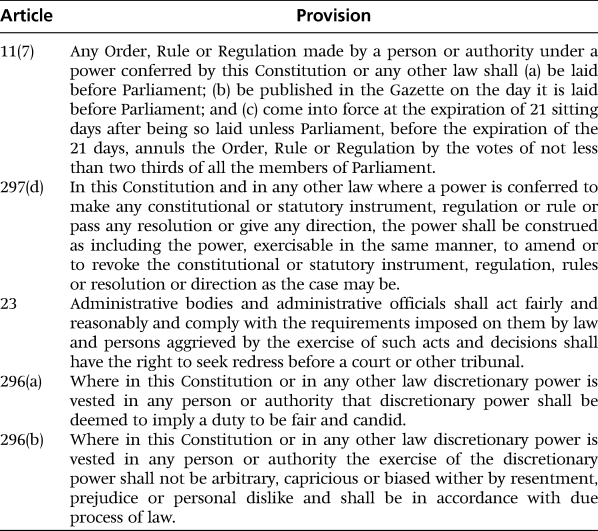
On 22 June 2017, the Court unanimously declared that the impugned requirements for entering the School violated several articles of the Constitution.Footnote 8 The Court also affirmed that LLB degree holders automatically qualified for admission to the School.Footnote 9 Lastly, the Court declared that the exclusion of qualified LLB degree holders violated the constitutional provisions listed in the Appendix to this note.Footnote 10 Notwithstanding these important declarations, the Court issued consequential orders that essentially validated the unconstitutional actions. The Court also directed the GLC to put in place a new admissions system, within six months of the judgment day, to govern admissions to the School in 2018.Footnote 11
The following conclusions are drawn, based on evaluating the Court's application of the prospective overruling doctrine to the facts of the case. First, by approbating, with its declarations, and reprobating, with its consequential orders, the Supreme Court subverted the ancient maxim of ubi jus ibi remedium [for every wrong, the law provides a remedy]. Secondly, the Court seemed to misconstrue its power to issue consequential orders so as to allow it to grant fresh and unclaimed reliefs that are at variance with the declarations upon which they are consequent. Thirdly, the Court misapplied the prospective overruling doctrine to validate the regulator's violation of the Constitution. Fourthly, Ghana's constitutional supremacy article explicitly states that declarations of unconstitutionality must relate backward, raising questions about the applicability of the principle of forward operation.Footnote 12 Fifthly, the Court's peculiar application of the prospective overruling doctrine could potentially sink the Constitution's liberal standing requirement into atrophy and embolden administrative bodies to abuse their powers. Sixthly, the Court's order to the GLC to put in place a new admissions process within six months was brutum fulmen [an empty threat] that failed to appreciate that any such changes must be legislatively sanctioned. It came as no surprise when the GLC failed to comply with the order by the deadline and the Court refused to enforce it.Footnote 13
The next part of this note provides a brief overview of the facts. The note then presents the decision and evaluates it, before offering concluding remarks.
FACTS
With effect from 2012, the GLC introduced the passing of an entrance examination and an interview as conditions precedent to gaining admission to the School.Footnote 14 In the five year period following these new requirements, about two thirds of the hitherto qualified population of LLB degree holders presumably failed either the entrance examination, the interview or both.Footnote 15 Before the 2012 directive, admission to the School was governed by regulation 2 of LI 1296, which provided that a person shall qualify for admission to the School, if “(a) he is of good behavior; (b) he has a degree conferred by the University of Ghana or any other University or institution approved by the Council; and (c) he has passed final examinations in 7 subjects”. Under this bifurcated model, legal education was a continuous process, which started with academic training at GLC approved faculties of law and ended with professional training at the School.Footnote 16
The plaintiff's case was that the GLC had impermissibly deployed administrative fiats to undo the bifurcated legal education architecture established by LI 1296.Footnote 17 Thus, the new requirements violated substantive and procedural due process. In turn, the disqualification of students based on those fiats was void and the students were entitled to be given the opportunity to pursue the professional component of their legal education.Footnote 18 Substantive due process was implicated because there is a fundamental right to administrative justice under article 23 of the Constitution. Procedural due process was implicated because the GLC did not follow the notice and hearing requirements that are provided for by articles 11(7) and 296 of the Constitution. In addition to questioning the plaintiff's standing and the Court's jurisdiction, the defendants argued that the requirements were introduced in response to the large numbers of students seeking admission to the School, and with the implied consent of the various faculties of law as well as the affected students.Footnote 19
THE DECISION
The Court dismissed the jurisdiction and standing challenges.Footnote 20 Further, the Court held that the impugned requirements had been effected without using the prescribed constitutional mode.Footnote 21 Consequently, the GLC had violated the constitutional provisions listed in the Appendix to this note. The Court also declared that LLB degree holders automatically qualify for admission and their exclusion from the School was impermissible. Remarkably, however, the Court issued the following consequential orders:Footnote 22
“By virtue of and in accordance with Article 2(2) of the Constitution, it is hereby ordered that the Council puts in place a mechanism that would enable it to make changes to LI 1296 in terms of what it thinks appropriate in order to properly exercise its mandate under Act 32 having regard in particular to sections 1, 13 and 14 by putting in place a system of legal education in terms of articles 11(7) and 297 of the constitution. As preparations towards admissions in October 2017 have already been initiated and bearing in mind that persons who would avail themselves of such opportunities are qualified within the scope of regulations 2 and 3 as pronounced in this judgment, we do not think it is in the public interest to interfere with such arrangements. It is hereby further ordered that the new system should be in place within 6 months from today such that admissions into the professional law course in October 2018 shall not be conducted under the system which has informed the declaration to which the consequential orders herein relate.”Footnote 23
Explaining these surprising orders, the Court stated:
“Ordinarily declarations of inconsistency result in avoiding acts and or omissions founded thereon. What this means is that once a declaration of invalidity has been made in relation to the examination and interview, then all things done based on the conduct of such acts from 2015 [sic] must be struck down. Such a direction would have a retrospective effect and have exceptional prejudicial effects on persons who relied on the directions which have been declared unconstitutional in these proceedings. It would be unprecedentedly detrimental to the students concerned if we should make an order that would invalidate admissions offered into the School as those likely to be affected by such an order satisfied the additional requirements which are exterior to LI 1296”.Footnote 24
The Court justified the consequential orders by relying on the prospective overruling doctrine, its own seemingly related precedents and cases from other jurisdictions.Footnote 25 In particular, the Court relied heavily on the case of Spectrum, where Nichols LJ said, “there could be circumstances in this country where prospective overruling would be necessary to serve the underlying objective of the courts of this country: to administer justice fairly and in accordance with the law”.Footnote 26 Relying on Spectrum, the Court in Asare said:
“[O]n the evidence placed before us, we are faced with a similar situation that requires that prospective overruling be preferred in the matter herein in order as Nichols LJ put it in the course [sic] of the In re Spectrum case (supra) to avoid a decision which: ‘would have such gravely unfair and disruptive consequences for past transactions or happenings that this House would be compelled to depart from normal principles’. We think that the path of prospectivity would better serve the needs of justice as we are authorised to do by article 2(2) of the constitution. And in seeking to adopt this approach, we are not altogether without precedent in the jurisdiction.”Footnote 27
The Court in Asare also referred to Canada and Ireland as other jurisdictions that “confronted with problems similar to ours arising from legitimacy declarations have adopted the prospective approach”.Footnote 28
ANALYSIS OF THE COURT'S DECISION
Misstating the perceived harm
The Court's consequential orders and related justifications raise several troubling issues. First, with respect to the students who had been exposed to the unconstitutional requirements (ie, the 2012–16 cohorts), the Court's seeming concern about a miscarriage of justice rests solely on the mistaken assumption that voiding the impugned entrance requirements would have automatically annulled the underlying admissions to the School. This is palpably false. In fact, voiding the impugned entrance requirements merely affirmed that the law then in force (LI 1296) governed the admissions. Any admission decisions based on the unconstitutional requirements are void, but admission decisions are valid to the extent that they were based on LI 1296. As the students automatically qualified for admission under LI 1296, the perceived harm (ie, annulling the admissions) that occasioned the consequential orders was entirely imaginary. Put differently, the declaration of unconstitutionality should have had no effect on the admitted students, other than highlighting that they were inconvenienced by being put through an unlawful exercise.
While the Court was needlessly worried about the admitted students, it seemed unconcerned about the “uncommon inconvenience, hardship and miscarriage of justice” that the consequential orders would visit on those who were unlawfully excluded from the School.Footnote 29 These qualified students were those who suffered and continue to suffer substantive constitutional injury. Unfortunately, the Court provided them with no remedy, curiously suggesting that to do so would be prejudicial to their interests. These students remain candidates for monetary damages under the Court's precedents.Footnote 30 Damages are warranted because the GLC's conduct was clearly wrong, carried out in bad faith and symptomatic of abuse of power. By affirming their rights without giving them an effective remedy, the Court subverted the ancient maxim of ubi jus ibi remedium.
With respect to the students who were on the verge of taking the scheduled examination (ie, the 2017 cohort), the declaration of unconstitutionality should have automatically operated to stop them from being subject to the entrance requirements. However, the consequential orders removed the benefit of their constitutional bargain. They won a pyrrhic declaratory victory and suffered consequential constitutional harm when they were ordered to go through the unconstitutional requirements. The Court's theory that the GLC had taken steps to violate the Constitution and should therefore be allowed to finish the act flies in the face of article 1(2) of the Constitution, any existing constitutional doctrines and the Court's prior cases.Footnote 31 Further, the Court's theory that it was in the public interest not to interfere with the preparations toward admissions because the students were already qualified is both unfathomable and unconvincing. In this instance, it would seem that the public interest would rather have called for halting the arrangement to violate the Constitution, as the cumulative harm that would fall on the students outweighed any cost of cancelling the examination. Under those circumstances, ordering this cohort to take the unlawful examination and interview was a travesty of justice.
In contrast, a Kenyan judge recently held that a direction to applicants who had obtained the LLB degree in Kenya to take the entrance examination, pursuant to an existing regulation, was at variance with the parent act and therefore null and void.Footnote 32 Notwithstanding that the decision came down on 6 November 2017 and the entrance exam was scheduled for 10 November 2017, the judge ordered the applicants not to take the scheduled exam or any such future examination. Unquestionably, the approach adopted by the Kenyan judge is not just the obvious and right approach, it is also the only approach that is consistent with respect for the rule of law and justice.Footnote 33
Secondly, the Court seemed to misconstrue its power to issue consequential orders so as to allow it to grant fresh and unclaimed reliefs that are at variance with the declarations upon which they are consequent.Footnote 34 On close inspection of the Constitution, the Court's power to issue consequential orders is not that extensive, is derived from its power to make declarations of unconstitutionality, and cannot be used to undermine the declaration. To see why, it is important to consider articles 1(2), 2(1) and 2(2) together. Article 1(2) provides: “[t]he Constitution shall be the supreme law of Ghana and any other law found to be inconsistent with any provision of this Constitution shall, to the extent of the inconsistency, be void”. Article 2(1) provides: “[a] person who alleges that (a) an enactment or anything contained in or done under the authority of that or any other enactment; or (b) any act or omission of any person is inconsistent with, or is in contravention of a provision of this Constitution, may bring an action in the Supreme Court for a declaration to that effect”. Article 2(2) provides: “[t]he Supreme Court shall, for the purposes of a declaration under clause (1) of this article, make such orders and give such directions as it may consider appropriate for giving effect, or enabling effect to be given, to the declaration so made”.
Notice that article 1(2) settles the question of whether the principle of “relation backward” or “forward operation” should be applied to unconstitutional laws. A law that is inconsistent with the Constitution is deemed void.Footnote 35 A person who brings an action under article 2(1) seeks more than a mere declaration that the impugned law is unconstitutional. He brings the action with the understanding that, under article 1(1), a declaration that the law is unconstitutional automatically voids the law. The Court's task is to determine whether a law is constitutional or otherwise. However, once a determination is made that a law is unconstitutional, the Constitution does not leave it to the Court to determine whether the law is void. The Constitution has a voice on that matter. This highlights that the Court's declarations of unconstitutionality are consequential.
Moreover, even a casual reading of article 2(2) makes it clear that the power given to the Court to issue consequential orders is solely to allow it to make orders and give such directions that effect or enable effect to be given to the declaration of the unconstitutionality. Article 2(2) merely saves the Court's inherent power.Footnote 36 Article 2(2) is not an independent source of power but exists solely to give effect to the declaration of unconstitutionality. A consequential order must necessarily flow directly and naturally from the declaration to which it relates and must be consequent upon it. Regrettably, in the instant case, the primary, if not sole, effect of the Court's consequential order was to undermine its declaration, thereby validating the actions that the Court itself had declared unconstitutional. It shocked the polity's constitutional conscience to find out that the apex court was ordering LLB degree holders to take an unconstitutional entrance examination and interview.
Thirdly, the Court arguably created a problem of separation of powers by ordering the GLC to “put in place a mechanism that would enable it to make changes to LI 1296 in terms of what it thinks appropriate within 6 months from the date of judgment”.Footnote 37 The problem arises because the GLC has no control over the timing of such changes. It is true that the GLC, as a regulator, can propose amendments to LI 1296. However, when and whether these amendments will become law lies in the complete control and discretion of Parliament.Footnote 38 The GLC has no power to place its proposals on Parliament's agenda. Even if it could, it has no power to direct legislators to vote for its proposed amendments. In fact, given the number of affected students and the perceived injustice done by the Court, it is highly probable that Parliament would have rejected any such amendments, as happened recently in Sierra Leone.Footnote 39 Further, the Court failed to specify the consequence of the GLC's failure to put in place a mechanism by the deadline, which only muddied the constitutional waters. Thus, the order was a mere brutum fulmen. It came as no surprise, to anyone familiar with the subsidiary legislative process, that the GLC was unable to meet this deadline. Nor was it surprising that the Court refused to enforce its order, considering how far the Court had already travelled to undermine its declaration of unconstitutionality.
In March 2018, Parliament passed a new regulation (LI 2235), raising the issue of whether the new LI or the old LI (LI 1296) governed the 2018 admissions process.Footnote 40 A strong case can be made that LI 2235, even if it were constitutional, came too late to be relevant for the 2018 admissions vis-à-vis the Court's order of 22 June 2017. To see why, recall that the Court in Asare alluded to the principle of legal certainty in formulating its declarations and consequential orders.Footnote 41 The certainty principle stands for the proposition that the Court's orders, indeed all laws, must be applied in a precise and predictable manner. Regulations, such as LI 1296, are important because they delineate admission and examination requirements to qualify as a lawyer. This advance specification removes uncertainties in applicants’ planning processes and eliminates opportunities for regulatory arbitrariness and capriciousness. This protection is important because legal education entails material financial and intellectual commitments. Put differently, the regulations create reliance interests that the courts should protect.
The legal profession regulations specify exit requirements from the faculties of law and entry requirements to the School. Therefore, an important legal consideration is the point at which the reliance and other substantive interests in attending the School vest in the students. Is it when students matriculate at a faculty of law or when they seek admission to the School? It is a consequential question because the regulation that is in place at matriculation in the Faculty of Law may differ from that in place when admission to the School is sought, with the potential for the latter to be more restrictive and burdensome. The certainty principle will require that these interests vest once a student matriculates at the faculty of law. Otherwise, matriculating law students cannot plan ahead and would not be protected from the regulator's arbitrariness and experimentation with the programme, contrary to the certainty principle. For instance, a rule regarding automatic qualification to the School that had been in force and was probably a consideration in a student's decision to study law could change to something more burdensome on the eve of their seeking admission to the School. To avoid such uncertainty, carefully drafted new regulations would typically have a saving clause to preserve any such accrued rights and interests.
The certainty principle, therefore, requires that LI 1296 should govern the 2018 admissions to the School. This is because the students who matriculated in the law faculties in 2014–15 had a reasonable expectation that LI 1296 set out their path to the School in 2018. By the same reasoning, LI 1296 should also have governed the admission of all law students who started their academic legal education in or before March 2018 when the new LI was passed. On the other hand, LI 2235, to the extent that it is constitutional, should govern the admission of those who started their academic legal education in the 2018–19 academic year and thus, strictly speaking, should govern only those seeking to start their professional education in the 2022–23 academic year.
An equally compelling case could be made that LI 2235 is unconstitutional in that it dispenses with the bifurcated legal model endorsed by and ensconced in the parent act.Footnote 42 It is trite law that a regulation cannot be at variance with the parent act.Footnote 43 Further, LI 2235 effectively operated to vary the law governing admissions for 2018, even though this had been fixed by the Court in Asare. Parliament, however, has no power to pass any law to alter the decision or judgment of any court as between the parties subject to that decision or judgment. Thus, to have allowed LI 2235 to govern the 2018 admissions, when the Court's order states that the law in place on 22 December 2017 shall govern the admissions, violated the order and the principle governing the retroactive application of legislation, thus substantially breaching the Constitution.Footnote 44
Prospective overruling doctrine
Judicial rulings ordinarily have retroactive as well as prospective effect.Footnote 45 Exceptionally, judges employ the prospective overruling doctrine when they invalidate a statute or precedent while simultaneously limiting the effect of the new rule to future cases.Footnote 46 Thus, the new rule does not disturb actions prior to it.Footnote 47 The ultimate purpose of this common law doctrine is to allow courts to make changes without unduly disrupting the status quo.Footnote 48 In this vein, the doctrine seeks to avoid reopening settled issues and to prevent multiplicity of proceedings.Footnote 49 In civil cases, the doctrine is animated by the principles of reliance, settled expectations, fairness and avoidance of disruption in the running of the public service.Footnote 50 It must be emphasized that the prospective overruling doctrine is an exception to the general rule that judicial rulings have retroactive effect. As such, judges employ the doctrine only when they believe that retroactive application of the precedent will upset serious and reasonable reliance on the prior state of the law.Footnote 51
The Court in Asare relied on Spectrum, cases from Ireland and Canada and two Ghanaian cases to support its application of the prospective overruling doctrine. On closer inspection, the Court misinterpreted the authorities. For instance, while the Asare Court relied heavily on Spectrum, particularly the judgment of Nicholls LJ, that case explicitly considered but did not adopt the prospective overruling approach.Footnote 52 In Spectrum, the House of Lords unanimously held that a prior precedent on the classification of debenture charges was wrong in law and should be overturned.Footnote 53 The Lords also announced a new rule that operated retrospectively to affect the status of the debenture in Spectrum.Footnote 54 An affected party argued, in the alternative, that, if the Court was to overrule the precedent, it ought to do so prospectively as it was reasonable to rely on the overruled case at the time the contract was formed.Footnote 55
It was this argument that Nicholls LJ was addressing, in the paragraph cited by the Court in Asare. The Court in Spectrum recognized that the prospective overruling doctrine might be within its powers but did not take that approach.Footnote 56 In fact, Lord Nicholls concluded his opinion by saying “in my view, it is miles away from the exceptional category in which alone prospective overruling would be legitimate”.Footnote 57
Similarly, the Irish courts did not apply the prospective overruling doctrine in the two cases cited by the Court in Asare. In de Búrca, the Supreme Court of Ireland declared parts of the Juries Act, 1927 to be unconstitutional.Footnote 58 The court in de Búrca merely raised the possible impact of the decision on the thousands of criminal trials that had taken place under the act and noted, in an obiter dictum, that any argument that criminal trials concluded by juries selected under the act were invalid would be defeated by the overriding considerations of an ordered society.Footnote 59 In State (Byrne), an applicant who had been tried and convicted under the Juries Act attempted to rely on de Búrca's declaration of the act's unconstitutionality.Footnote 60 Although de Búrca was handed down during the course of Byrne's trial, he did not raise the issue. Nor did he raise the issue in the court of appeal following his conviction by a jury. The applicant then instituted a habeas corpus proceeding on the grounds that his conviction was unlawful. The Irish Supreme Court rejected his appeal, although the court split on whether estoppel precluded the applicant from protesting that the jury was unlawful or whether the public interest militated against invalidating such trials.Footnote 61 Thus, the Irish cases do not support the proposition advanced by the Court in Asare. In fact, the Irish cases hold that the Irish Constitution requires that an unconstitutional statute be declared void from the outset.Footnote 62
In Schachter, the Supreme Court of Canada found that a provision of the Federal Unemployment Insurance Act violated the guarantee of equality in section 15(1) of the Canadian Charter of Rights and Freedom by giving adoptive parents more generous childcare benefits than those given to natural parents.Footnote 63 The court in Schachter pointed out that striking down the statute deprived everyone of the benefits and held that, “the logical remedy is to strike down but suspend the declaration of invalidity to allow the government to determine whether to cancel or extend the benefits”.Footnote 64 Similarly, in Carter, the Canadian Supreme Court held that the laws prohibiting physician-assisted dying interfered with the liberty and security of the person of individuals who have a grievous and irremediable medical condition.Footnote 65 The court in Carter suspended the declaration of invalidity for 12 months to give the country's Parliament and provincial legislatures time to respond.Footnote 66 The Canadian court has acknowledged that the suspended invalidity doctrine is an extraordinary solution and has issued guidelines to circumscribe its use.Footnote 67
It can readily be observed that the Canadian Supreme Court rarely makes orders that operate only prospectively.Footnote 68 Rather, that court has resorted to making orders the effects of which are suspended for a defined period to allow law makers to address the potential hardships that might arise from invalidating a statute.Footnote 69 On the expiry of the period, the order becomes retroactive, but the suspension allows the legislature to intervene and react to the court's order with new legislation before the order takes effect.Footnote 70 This approach is better characterized as a “suspended invalidity” doctrine rather than an application of the prospective overruling doctrine.Footnote 71
The sole issue in Kpebu was whether a provision in the Criminal Procedures Statute that restricted the Court's power to grant bail for certain offences was constitutional.Footnote 72 The Court invalidated the provision on the ground that it conflicted with the Constitution's provisions regarding liberty. Significantly, the Court's lead opinion did not discuss the implications of the invalidation for past cases. However, two of the five justices in the Court's majority specifically stated that the holding of unconstitutionality should be applied prospectively.Footnote 73 In particular, Wood CJ urged the application of the doctrine “in order to avert a crisis in the administration of justice” and to “manage the full effects of this decision in a way that would not overburden our already distressed criminal justice system”.Footnote 74 This, of course, was an obiter dictum which could, in any event, not be applied in the case since it did not involve a real dispute affecting the legal rights of parties before the Court. That is, Kpebu presented the Court with a legal question devoid of specific facts and the Court's opinion could best be considered as advisory.Footnote 75 Thus, it is difficult to determine how the Court would have treated past transactions, including the case of an actual plaintiff who was denied bail. Kpebu can be distinguished from Asare in other material ways. First, the latter did not involve the invalidation of an existing statute. Secondly, the Court in Kpebu, unlike in Asare, declared the invalidated statute null, void and of no effect and did not issue any consequential orders for the statute to be tolerated for a certain period of time; this contrasts with the Asare Court's order to the 2017 cohort discussed above. Therefore, Kpebu is of questionable value as a precedent for applying the prospective overruling doctrine.Footnote 76
Likewise, Ramadan (No 2) did not involve the invalidation of a statute or precedent and did not present an occasion for the Court to apply the prospective overruling doctrine.Footnote 77 The issue in Ramadan (No 2) was whether the voters’ register was compiled unconstitutionally merely because it contained the names of ineligible persons and deceased persons.Footnote 78 The Court held that, although the presence of ineligible names and deceased persons impacted the register's accuracy and credibility, it did not render it inconsistent with the Constitution. The only possible incidental reference to the prospective overruling doctrine was an obiter dictum, to the effect that “as the registrations were made under a law that was then in force, they were made in good faith and the subsequent declaration of the unconstitutionality of the use of the cards should not automatically render them void”.Footnote 79 This obiter dictum is clearly not of precedential value.
From this review, it appears that the Court in Asare misinterpreted the prospective overruling doctrine and was misguided in relying on the foregoing authorities to support the application of the doctrine. Prospective overruling requires the invalidation of a statute or precedent followed by the limiting of its effect to future transactions. Asare, in sharp contrast, involved the retroactive and prospective validation of unlawful actions taken by an administrative body. Thus, there is no merit in the Court's position that it was faced with a “similar situation” that required the application of the doctrine.
The application of the prospective overruling doctrine presents four additional issues. First, the framers of the Constitution settled the question of the temporal effect of a declaration of unconstitutionality by providing that, “any other law found to be inconsistent with any provision of this constitution shall, to the extent of the inconsistency, be void”.Footnote 80 This contrasts with constitutions that have no voice on the subject.Footnote 81 In this vein, it will seem that the prospective overruling doctrine is of limited applicability in Ghana. This is not to say that the Court could not apply the doctrine in other areas of law not involving the violation of the Constitution.
Secondly, application of the doctrine can be a disincentive to litigants as it creates uncertainties about the temporal operation of constitutional remedies.Footnote 82 As Ghana's Constitution has a novel standing requirement that empowers any person to enforce it, the Court must be careful not to introduce doctrines that would discourage such enforcements and thereby sink the novel standing requirement into atrophy. Thirdly, because article 2(1) litigants are not necessarily the real parties-in-interest, any attempt to apply doctrines that do not conform to the Constitution's voice on backward operation is likely to do more injustice than justice. That is, the Court should be wary of applying a doctrine that has been used in jurisdictions where the litigants are also the real parties-in-interest. The standing requirement in article 2(1) is such that, in many cases, as in the extant one, the litigants are not those who actually possess the substantive right being litigated and lack the legal rights to enforce the underlying claim. Thus, plaintiffs may argue for, or not oppose, the application of the prospective overruling doctrine because they are not directly affected by forward operation and are content with an inconsequential declaration of unconstitutionality, while the real parties-in-interest suffer immense injustice from such a forward operation. Fourthly, the doctrine introduced by the Court in Asare would probably embolden administrative bodies to violate substantive and procedural due process, thereby undoing the carefully constructed constitutional checks.
CONCLUSIONS
Ghana's Constitution explicitly empowers the Supreme Court to exercise judicial review and make orders or give such directions as are appropriate to effect its declarations of unconstitutionality.Footnote 83 In Asare, the Court seems needlessly to decouple these powers, leading to the untenable situation of it issuing consequential orders, which not only failed to facilitate the modalities for the implementation of its declaration of unconstitutionality but, in an unusual manner, actually undermined the declaration, thereby rendering it inconsequential. The Court created a jurisprudential-baffling solution that ordered LLB degree holders to take an unconstitutional entrance examination and interview. This case note demonstrates that there is no constitutional or doctrinal basis for this decoupling. Plainly, the power to issue consequential orders is not an independent power but must flow from, not undermine, the declaration of unconstitutionality.Footnote 84
Undoubtedly, the prospective overruling doctrine can do justice when it is properly applied. However, the Court's application of the doctrine in Asare seems manifestly inapposite and unjust. In Asare, the Court did not strike down any statute or precedent as done by courts that have applied the doctrine. Rather, the Court found that the body charged with regulating the legal profession was not following its own regulations and was abusing students’ administrative rights. The proper solution in these circumstances was to enforce the Constitution and to provide the students with a remedy. A declaration that students’ rights have been violated without granting a remedy is mere vanity.Footnote 85 There is a fundamental difference between applying a law, which is later deemed unconstitutional, and violating an existing law. While upholding settled expectations may provide a basis for validating actions based on the latter, the former's validation disturbs settled expectations and can only breed injustice and unnecessary hardship. The Court must not be seen to give judicial blessing to unconstitutional actions by administrative bodies.
Further, because the Constitution speaks clearly on the principles of “forward operation” and “relation backward”, the prospective overruling doctrine may be of limited applicability in constitutional disputes. In Ghana, any law found to be unconstitutional is incurably void.Footnote 86 While the Court should have the freedom to explore doctrines from other jurisdictions, the freedom to explore is not the freedom to vindicate administrative actions that offend the Constitution. It seems evident that the Court's power to issue consequential orders cannot and must not be used to validate the unlawful actions of administrative bodies to the detriment of justice and citizens’ settled expectations.
The Constitution grants standing to all citizens to enforce it. This liberal standing rule is important in an emerging democracy where parties whose interests are directly affected may be unwilling or unable to assert their rights. The framers must have taken this standing requirement into account in opting for a supremacy article that voids unconstitutional actions. It is, therefore, important that any imported doctrines be rigorously evaluated for compatibility with this constitutional architecture.
Potential plaintiffs are less likely to enforce the Constitution if they perceive that the Court can utilize such doctrines effectively to undermine a declaration of unconstitutionality. On the other hand, the use of such doctrines to validate the unconstitutional actions of administrative bodies emboldens them to engage in further unlawful acts. Furthermore, the Court's use of such doctrines should not, as here, come as a surprise to the parties to the litigation. Rather, where the Court intends to apply them, the parties must be given a chance to respond to them. Respectfully, it is inapposite for consequential reliefs to be granted that are not endorsed on the writ of summons, argued in the statement of case, indicated in the memorandum of issues and are based on doctrines that the parties only found out in the Court's opinion. This “ambush” approach deprives the Court of the adversarial arguments that illuminate the issues upon which it largely depends for the resolution of constitutional questions.
This case note raises some potentially interesting comparative questions. Specifically, the regulators of the legal profession in Ghana, Kenya and Sierra Leone, at or about the same time, attempted to introduce post-LLB entrance examinations as a condition for assessing professional education at the various schools of law. Further, while both the Supreme Court in Ghana and the court in Kenya declared the entrance examination to be unconstitutional, the former allowed it to continue while the latter stopped it. In the legislative terrain, while Ghana's Parliament allowed a new LI to be introduced, seeking to regularize the regulator's unlawful actions, albeit without the interview requirement, the Sierra Leone Parliament rejected an equivalent proposed regulation. It might be interesting to examine the drivers of this post-LLB entrance examination phenomenon and the disparate jurisprudential and legislative solutions adopted.
Finally, Asare raises other fundamental questions about the architecture that is appropriate for delivering legal education in Ghana. In particular, is the distinction between professional and academic legal education, drawn in the late 1950s, still relevant?Footnote 87 Even if relevant, should the professional component be taught only at the School or should it be outsourced to the accredited faculties of law? Should the GLC, like other peer regulators of legal education, limit its activities to quality assurance, enforcing ethical standards and administering the Bar examination? Is the current monopoly of professional legal education consistent with the constitutional objective of allowing private sector participation in all facets of education?Footnote 88
The bottom line is that the Court in Asare misinterpreted and fatally misapplied the prospective overruling doctrine to legitimize, retroactively (the 2012–16 cohorts) and prospectively (the 2017 cohort), actions that it had declared unconstitutional and, therefore, void. A declaration of unconstitutionality must be consequential and the primary, if not sole, purpose of consequential orders must be to assure that it is so.
Summary of constitutional provisions deemed violated by the Court in Asare