

Introduction
Around dusk on 10 June 1963, a car carrying a Buddhist monk pulled to a stop outside Xa Loi pagoda in Saigon. The monk, a young Vietnamese named Duc Nghiep, did not know the purpose of the meeting to which he had been summoned, but he was sure that it was an urgent matter. In normal times, Xa Loi would have been quiet and uncrowded on a Monday evening. But on this occasion, the grounds of the pagoda were alive with activity. In the main courtyard, bonzes and nuns mingled with hundreds of students and other lay Buddhists.
Like Thich Duc Nghiep, the Buddhists at Xa Loi were participants in a protest movement directed against Ngo Dinh Diem, the president and founding leader of South Vietnam.Footnote 1 Their movement had been launched a month earlier, after South Vietnamese government security forces killed several people during a demonstration in the central Vietnamese city of Hue. Shortly after that incident, Buddhist representatives in Saigon began negotiating with Diem. But those talks had failed to produce an agreement and the government now appeared to be taking a harder line. Since Diem was a devout Catholic, believed by many to be hostile to Buddhism, the leaders of the movement were under growing pressure to find some way to compel the government to meet their demands.
After making his way through the crowd in the courtyard, Duc Nghiep was shown into a room where the meeting of senior monks was already in progress. Presiding over the session was Thich Tam Chau, the head of an ‘Intersect Committee’ formed in Saigon a few weeks earlier by the leaders of several southern Vietnamese Buddhist organizations. After greeting Duc Nghiep, Tam Chau explained the purpose of the secret conclave. Because the negotiations with the government were not going well, the Intersect Committee had decided to show the Buddhists’ resolve by organizing a new kind of protest. The demonstration was set to take place the following morning during a monastic procession through the streets of downtown Saigon. While marching toward Xa Loi from another pagoda, a group of bonzes and nuns would stop at a major intersection on the road leading to the Saigon airport. There, an elderly bonze named Quang Duc would burn himself to death. This stunning act, Tam Chau explained, was intended ‘to rescue Buddhism from the present danger’.Footnote 2
Two weeks earlier, Thich Quang Duc had informed the Intersect Committee that he wanted to ‘sacrifice’ himself on behalf the movement. The Committee now needed to know: was the old monk still prepared to do what he had proposed? As soon as the meeting ended, Duc Nghiep set out to look for Quang Duc. He found him at another pagoda in a different part of the city.
‘Master, are you still willing to sacrifice yourself, as you previously told the Intersect Committee?’ Duc Nghiep asked him.
‘I am prepared to burn myself as an offering to Buddha and for the purpose of persuading the government to fulfil the five demands,’ Quang Duc replied.Footnote 3
What led Thich Quang Duc to his decision to end his life in such a shocking and painful way in June of 1963? What explains the emergence of the Buddhist protest movement whose icon he became? And why did his death fail to resolve the conflict between his fellow protestors and the Diem government, as he had hoped it would? These questions were fiercely debated in Vietnam and around the world during the summer of 1963. They have remained contentious ever since. Historians and other commentators agree that Quang Duc's death by fire and the ‘Buddhist crisis’ of 1963 were enormously consequential events in modern Vietnamese history and in the history of the Vietnam War. In August, two months after Quang Duc's self-immolation, the Diem government moved to crush the protest movement with a series of midnight raids and mass arrests. The crackdown helped crystallize opposition to Diem among American government officials and within the high command of the South Vietnamese army. This led to a military coup on 1 November that resulted in Diem's overthrow and assassination—a development that Vietnam War historians now view as a key step in the subsequent escalation and Americanization of the War during 1964–1965. But there is no consensus over how to explain the origins of the Buddhist movement or its rapid evolution into a broad-based popular uprising during the spring and summer of 1963.
To a remarkable extent, scholarship on the 1963 crisis has echoed the polemics voiced by those who observed or participated in the events that took place in South Vietnam that year. For example, many authors maintain that the Buddhist movement was a struggle for religious freedom waged in response to the Diem regime's blatantly anti-Buddhist policies and practices—an interpretation that fits with the claims advanced by the Buddhists and their supporters at the time.Footnote 4 An alternative view—one much more sympathetic to the Diem government—suggests that the leaders of the Buddhist movement used specious claims about religious persecution to cloak their real goals, which included overthrowing Diem. In some versions of this argument, Buddhist leaders are said to have wanted power for themselves; in other versions, the Buddhists are alleged to have been working on behalf of other groups, such as the communist government of North Vietnam, or even the United States Central Intelligence Agency.Footnote 5 A third set of interpretations maintains that the Buddhist movement was a manifestation of ancient religious or cultural practices that had defined Vietnamese religious and political life for centuries. According to this view, Buddhist leaders were traditionalists who were pushing back against an onrushing modernity.Footnote 6 Yet another representation of the 1963 movement portrays it as an expression of opposition to the escalating war in the South Vietnamese countryside between the Diem government and the communist-led National Liberation Front. This view connects the protests to other episodes of Buddhist activism on behalf of peace and democracy.Footnote 7
This paper approaches the 1963 crisis in South Vietnam from a different interpretive perspective. I begin by situating the Buddhist movement within a larger and longer historical phenomenon known as the Vietnamese Buddhist revival. This revival, which began in the 1920s, was linked to a form of Vietnamese nationalism that represented Buddhism as the core of Vietnamese national identity. The Buddhists who embraced the revival and its nationalist principles did not imagine themselves as opponents of modernity. While espousing a return to original Buddhist principles, these activists believed that the reform of Buddhist practices and institutions would pave the way for Vietnam to realize its modern destiny as a ‘Buddhist nation’. Although these reformist and nationalist goals have been mostly ignored by historians of the Vietnam War, they profoundly shaped the views and decisions of Quang Duc and other participants in the 1963 movement.
By examining the intellectual commitments of Vietnamese Buddhist leaders to the Buddhist revival, relations between Buddhist groups and the Diem government—both before and during 1963—are cast in a different light. It is clear that the protests of 1963 were fuelled by Buddhist anger over the discriminatory actions and bigoted attitudes of some of the Catholics who held positions of power in the Diem government, including members of Diem's family. But the Buddhists’ concerns went beyond discrimination and religious freedom. Many of those who joined the movement were also deeply uneasy about the nation-building agenda that Diem was pursuing in South Vietnam. Like the supporters of the Buddhist revival, Diem was a self-styled modernizer. His vision of national development, which he called the ‘Personalist Revolution,’ was a rather abstruse form of communitarianism; among other things, it combined ideas from French Catholic philosophy with contemporary Vietnamese discourses about Confucianism.Footnote 8 During the early years of Diem's rule, most Buddhist leaders in South Vietnam did not see the Personalist Revolution or the policies carried out in its name as antithetical to their reformist goals. By the early 1960s, however, they had concluded that Diem's policies and programmes gravely threatened their plans. The crisis of 1963 therefore emerged from a clash between two forms of Vietnamese nationalism, each of which was associated with a distinctive vision of Vietnam's postcolonial future. Viewed from this perspective, the crisis can be seen as part of what I describe as the politics of nation building—a long-running, multi-sided contest in which Vietnamese groups and leaders vied with each other and with various foreign actors (including the United States) to promote their respective approaches to development and social transformation in Vietnam.Footnote 9
By connecting the 1963 crisis to contests about nation building and national identity in South Vietnam, I do not mean to suggest that the confrontation between the Buddhists and the Diem government was bound to happen, nor that the violent culmination of the crisis in August was unavoidable. Although the roots of the crisis lay in the differences between the two sides’ respective visions of Vietnam's national development, the actual course of events during the spring and summer was also affected by the personalities and agendas of individual Buddhist and government leaders. Indeed, both the Buddhist leadership and the Diem regime were internally divided over how to react to the unfolding crisis. From the outset, the Buddhists were split over whether or not a lasting reconciliation with the government was desirable or even possible. Meanwhile, the government was wracked by an internal Ngo family dispute involving three of Diem's brothers, each of whom wielded considerable power in South Vietnam. At first, it seemed likely that the advocates of compromise on both sides would prevail; it was only later that the proponents of confrontation gained the upper hand. A more complete account of the 1963 crisis requires attention to these internal political divisions and rivalries, as well as an examination of the broader postcolonial and transnational contexts in which the crisis unfolded. The Buddhist revolt of 1963 helped to write the fate of the Diem government, but the way in which this came to pass was anything but foreordained.
The Vietnamese Buddhist revival and Buddhist relations with the Diem government before 1963
For the past century, Vietnamese Buddhism has been profoundly shaped by a social and intellectual movement known as the Buddhist revival (Chấn Hưng Phật Giáo). Beginning around 1900, growing numbers of Vietnamese monks, nuns, and laypeople became convinced that Buddhism was in decline in Vietnam. According to these reformers, Buddhist beliefs and practices had become distorted by corruption, superstition, and spiritual lassitude. The reformers also worried that Buddhist institutions were losing adherents to other religious groups—not only to old rivals such as the Catholic Church but also to new heterodox competitors such as Cao Dai and Hoa Hao—and that Buddhism was increasingly viewed as backward and as antithetical to modernity. As several historians have pointed out, this ‘decline’ may have been more imagined than real; by many measures, Buddhism remained socially and spiritually vital in Vietnam throughout the nineteenth and early twentieth centuries. Nevertheless, admonitions about decline and calls for revitalization figured prominently in Buddhist sermons, pamphlets, and journals throughout the 1910s and afterwards.Footnote 10
In their efforts to promote the reform of Vietnamese Buddhism, the proponents of the revival emphasized three key themes. The first of these was the concept of ‘engaged Buddhism’, which was derived from the conviction that Buddhists should involve themselves in efforts to liberate their fellow humans from worldly suffering and oppression. Second, many of the reformers subscribed to a distinctively Buddhist form of Vietnamese nationalism in which Buddhism was held to be the essence of Vietnam's identity as a nation. Finally, many participants in the revival sought to promote unity and solidarity among all Vietnamese Buddhists through the establishment of new regional and national organizations. These three concepts—social engagement, Buddhism-centred nationalism, and the promotion of Buddhist unity—figured prominently in the discourse and activism of Buddhist reformers throughout the middle decades of the twentieth century. Not coincidentally, these notions also shaped the views and strategies of the leaders of the 1963 protests.
The rise of engaged Buddhism in Vietnam reflected the transnational origins of the Vietnamese Buddhist revival. Although the English term ‘engaged Buddhism’ did not gain broad currency until the 1960s, the concept had its origins in early twentieth century Buddhist discourses about modernization, progress, and social activism. Many Vietnamese Buddhists drew inspiration from the Chinese monk Tai Xu (1890–1947), who advocated a form of Buddhism that ‘reforms society, helps humankind to progress, and improves the whole world’. Tai Xu's writings on what he called ‘Buddhism for human life’ (Chinese: rensheng fojiao) were circulated widely in Vietnam during the 1920s and 1930s, and his ideas about education, social welfare, and proselytization were frequently cited by Vietnamese Buddhists. Some authors began to discuss the need to ‘actualize’ (hiện đại hóa) Buddhism in Vietnam to make it more relevant to contemporary social conditions. Such concerns shaped the overhaul of monastic educational practices in Vietnam during the 1930s and 1940s and eventually led to the establishment of Buddhist high schools for lay students. To make Buddhist ideas more accessible to their lay co-religionists, the reformers also translated many classical Mahayana texts from Chinese into quốc ngữ, the romanized Vietnamese script.Footnote 11
For many of the reformers, the attempts to make Buddhism more relevant to ‘human life’ in Vietnam went hand-in-hand with new thinking about the relationship between Buddhism and Vietnamese national identity. If the revival was produced in part by the spiritual upheaval that swept through Vietnam in the years between the world wars, it was also shaped by the concurrent transformation of Vietnamese political life. Buddhists were among those who drew inspiration from the revolutionary radicalism that swept Vietnam during the 1920s.Footnote 12 As various groups and organizations experimented with ideas about revolution and national liberation, Buddhist reformers pondered how their efforts to revitalize Buddhism might be connected to resistance against French colonial rule. Some Vietnamese monks borrowed from their Chinese peers the concept of ‘patriotic’ Buddhism, which posited that charitable acts and social activism were desirable because they made Asian nations stronger and fitter for independence. Other Buddhists embraced more overt forms of anticolonialism, such as participation in public demonstrations against French policies.Footnote 13
Like other Vietnamese nationalists, the leaders of the Buddhist revival often framed their activism and their appeals to their co-religionists in historical terms. During the 1930s, Buddhist writers began to construct a distinctive narrative of Vietnamese history. According to this narrative, the premodern kingdom of Dai Viet had experienced a golden age of prosperity lasting from the tenth to the thirteenth centuries. The kings of this era were said to have been devout Buddhists who relied on virtuous monks for advice in both religious and political affairs. It was only after the fourteenth century invasion and conquest of the country by Ming armies that Vietnam became ‘corrupted’ by superstition and by the infusion of ideas borrowed from ‘foreign’ ideologies such as Confucianism and Taoism. As a result, Buddhist practices degenerated and the Vietnamese state became susceptible to manipulation by outside powers, thus paving the way for the nineteenth-century conquest of the country by France. The prescriptive implications of this Buddhist historical narrative were clear: if the Vietnamese nation was to recover the independence and prosperity it had lost, it would have to return to the Buddhist principles and practices it had once embraced. It would also be necessary for Vietnamese Buddhist leaders and teachers to regain the positions of esteem and influence they had formerly enjoyed.Footnote 14
To promote national redemption under the aegis of Buddhism, the reformers knew they would have to unite Vietnamese Buddhists in support of their agenda. But Buddhist unity would prove an elusive goal. Although foreign journalists often described Vietnam as a country in which 70 per cent or more of the population was Buddhist, the sectarian reality was vastly more complex—and more fragmented—than such statistics implied. Buddhists in Vietnam had long been divided by sect, geography, and political affiliation. While such divisions were usually born of differences within Buddhist groups and communities, they were frequently exacerbated and exploited by outsiders. During the nineteenth century, for example, the Nguyen dynasty imposed a system of patronage on Buddhist temples to prevent them from becoming centres of subversion. This system had a pronounced effect in the Nguyen capital of Hue, where Buddhists used the money and resources provided by the court to promote the city's reputation as the ‘heartland’ of Vietnamese Buddhism—a claim that was often viewed with scepticism and even resentment in other parts of the country.Footnote 15
To overcome such divisions, reformers advocated the establishment of new national Buddhist organizations. They hoped in particular to create Vietnam's first national sangha (a clerical organization of monks and nuns) as well as a national association of lay Buddhists. But French authorities initially refused to endorse these proposals for fear that they would lend themselves to anticolonial purposes. The reformers therefore focused first on building regional institutions. By the mid-1930s, pro-revival associations were operating in Cochinchina, Annam, and Tonkin. These regional groups would play a key role in the subsequent promotion and perpetuation of the revival and its ideals. By the late 1940s, representatives of the regional associations were working together in a bid to advance the agenda of the revival on a nationwide stage.Footnote 16 Their efforts led to the establishment of a network of Buddhist youth groups that provided religious education and training to tens of thousands of Buddhist children. This network also provided Buddhist leaders with the means to mobilize large numbers of their followers—a capability that would prove invaluable during the 1963 crisis.Footnote 17
The reformers claimed a major breakthrough in 1951 when they secured permission from French officials to hold the first National Congress of Vietnamese Buddhism in Hue. Delegates from all three regions of the country participated in the event, which was held up as proof that the Buddhist revival was gaining momentum. Participants used the Congress to reiterate their claims about the deep linkages between Buddhism and Vietnam's national identity. In a statement issued at the conclusion of the Congress, the delegates declared that the ‘popular sympathies, customs, culture and politics of the country all reflect the profound influence of Buddhism’.Footnote 18 Of course, such assertions elided the inconvenient historical fact that institutional Buddhism was just one of several prominent spiritual traditions with large followings in Vietnam. But they were entirely consistent with the evolving trajectory and goals of the Buddhist revival.
In the eyes of many Vietnamese Buddhists, the highlight of the 1951 Congress was the creation of a new organization known as the General Buddhist Association of Vietnam (Tổng Hội Phật Giáo Việt Nam). In its initial incarnation, the Association was an umbrella organization which included both lay and clerical Buddhists. For reformers who had struggled for years to overcome the ‘unity problem’ in Vietnamese Buddhism, the new Association appeared to be a major step in the right direction. The Association quickly became the flagship organization of the Buddhist revival—a status that would allow its leaders to play central roles in the 1963 protests.Footnote 19
The links between the Association and the Buddhist revival can be glimpsed in the pages of the Association's official journal, Vietnamese Buddhism (Phật Giáo Việt Nam), launched in 1956. The journal was edited by Thich Nhat Hanh, a monk from central Vietnam who would later become famous in Western countries for his writings on engaged Buddhism and other topics. In the journal's inaugural issue, Nhat Hanh argued that Buddhism formed the core of Vietnam's national identity. ‘The truth,’ he declared, ‘is that Vietnamese Buddhism is a national religion’:
In the mind and heart of the Vietnamese people there is already the seed of Buddhism. For nearly two thousand years, the destiny of the nation and Buddhism have been intertwined. Let us join hands in cultivating national Buddhism [Phật Giáo dân tộc] in order to bring peace and happiness to the country.Footnote 20
In retrospect, Nhat Hanh's celebration of ‘national Buddhism’ seems sharply at odds with his later writings on peace, interfaith dialogue, and international reconciliation.Footnote 21 But such nationalistic zeal was not unusual among Buddhist authors during the 1950s and early 1960s, especially those aligned with the Association. For these activists, Vietnam's national future depended on the outcome of their ongoing efforts to reform Vietnamese Buddhism. Anything that endangered these efforts was therefore a threat to the entire nation, and needed to be resisted at all costs. In their framing of sectarian objectives by reference to the survival and wellbeing of the nation, Buddhist leaders sometimes resembled their Catholic counterparts more than they cared to admit.
The Diem government and the Buddhist Revival in South Vietnam
Like other Vietnamese nationalists, Buddhist reformers faced new dilemmas in 1954, following the end of the First Indochina War between France and the communist-led Viet Minh movement. Although most Buddhists welcomed the demise of French colonialism, many were worried about how Buddhism might fare under communist rule. These worries were especially acute for many Buddhists living north of the seventeenth parallel, in the Viet Minh-controlled ‘regroupment zone’ set up during peace negotiations in Geneva during the summer of 1954. In the year following the Geneva conference, large numbers of Buddhists joined a massive exodus of refugees moving from the northern to the southern zone, which fell under the authority of the newly established Diem government. Although the majority of these refugees were Catholics, approximately one-quarter of them—more than 200,000 people—were Buddhists. Like their Catholic counterparts, the Buddhist refugees who arrived in South Vietnam during 1954–1955 usually retained a distinct identity and communal status. For example, northern monks and nuns established separate pagodas and clerical associations in Saigon. Many of the northern Buddhists were also more staunchly anti-communist than their co-religionists in the South. The migrations of the mid-1950s thus reconfigured the political geography of Vietnamese Buddhism in ways that paralleled the changes in Vietnamese Catholicism.Footnote 22
During Diem's first years in power, he was more accommodating to Buddhists and Buddhism than many had expected. Relations between Buddhist and Catholic communities in Vietnam had long been marred by mutual suspicion and occasional eruptions of sectarian violence; each group had bitter memories of atrocities committed by the other.Footnote 23 But Diem seemed determined to put these animosities aside and cultivate good relations with Buddhist groups. Many high-ranking government officials—such as Vice President Nguyen Ngoc Tho and Foreign Minister Vu Van Mau—were Buddhists. The top echelons of the Army of the Republic of Vietnam (ARVN) were occupied mostly by Buddhist generals.Footnote 24 One northern monk who came to the South in 1954 later recalled that ‘there was no feeling against Diem among the Buddhists’ and that many prominent Buddhist patriarchs had endorsed the new government.Footnote 25
Diem's dealings with Buddhists during the late 1950s were reminiscent of the old Nguyen attempts to co-opt Buddhist leaders and groups via patronage. In April 1956, Diem granted the Association's request to stage a second National Congress. Significantly, this Congress took place in Saigon rather than Hue and its chief organizer was Mai Tho Truyen, a prominent lay Buddhist leader whom Diem knew and trusted. After the Congress ended, Diem agreed to provide funds for the General Buddhist Association to build a large new headquarters in downtown Saigon. Xa Loi pagoda (‘Pagoda of the Relics’) was dedicated in 1958. The government also supported the renovation of existing pagodas, including the well-known Tu Dam pagoda in Hue. Although Diem would later view these decisions ruefully—both Xa Loi and Tu Dam would become centres of anti-government protest activities during the 1963 crisis—his actions seemed at the time to be a good way to ensure Buddhist support for his government.Footnote 26
Unfortunately for Diem, his patronage strategy was not always sufficient to ensure smooth relations with Buddhist groups and leaders, and his goodwill gestures were sometimes undermined by other actions and policies. For example, the government's blatant favouritism towards Catholics rankled with many Buddhists. Despite the presence of Buddhists in some high-profile posts, Catholics dominated many parts of the South Vietnamese government bureaucracy. Starting in the late 1950s, some Buddhist civil servants complained that their superiors were pressuring them to convert to Christianity.Footnote 27 Buddhists also reported trouble in dealings with Catholic officials at the provincial and local levels. Buddhist groups frequently encountered delays and resistance when seeking official permission for religious activities and events, and found themselves at a disadvantage in disputes with Catholic organizations.Footnote 28
Such harassment raised doubts among Buddhists about the motives behind Diem's Personalist Revolution. Like almost everyone else in South Vietnam, Buddhists found the philosophical details of Diem's vision to be highly opaque. They noted, however, that Diem seemed to be drawing his ideas from certain Catholic thinkers, such as the French philosopher, Emmanuel Mounier. For example, Diem frequently referred to nhân vị, the term that Vietnamese Catholics used to render Mounier's concept of ‘the person’ (la personne). Although Diem insisted that nhân vị was not a specifically Catholic idea and tried to invest it with Confucian overtones, many Buddhists came to believe that the government was seeking to impose Catholic beliefs and values on non-Catholic Vietnamese.Footnote 29
By the early 1960s, Buddhist complaints about discrimination and mistreatment were being voiced most loudly in central Vietnam. During the early years of Diem's rule, Buddhists in the central provinces had mostly refrained from criticizing the regime. This was thanks mainly to the policies of Diem's younger brother Ngo Dinh Can, who had served as the de facto governor of the central region since 1954. Can was autocratic and corrupt; however, he had generally followed Diem's pattern of cultivating local Buddhist leaders. It was only after 1960 that the patronage ties which Can had forged with Buddhist groups in the region began to fray.Footnote 30
Much of the trouble in central Vietnam had to do with Ngo Dinh Thuc, the eldest of the Ngo brothers. Thuc was a Catholic prelate who had served as bishop of a Mekong Delta diocese since the 1930s and was widely considered to be the most powerful figure in the Vietnamese ecclesiastical hierarchy. In late 1960, the Vatican promoted Thuc to the newly created post of Archbishop of Hue. Unlike the reclusive Can, who preferred to wield power behind the scenes, Thuc like to flaunt his personal authority in ostentatious ways that often raised Buddhist hackles. Since Thuc had been heavily involved in the regime's efforts to indoctrinate government officials in the intricacies of nhân vị and the Personalist Revolution, some Buddhists worried that his move to Hue signalled the start of a new government-backed effort to impose Christianity on the region. The Buddhists’ fears were reinforced by Thuc's decision to build a ‘National Marian Center’ at the site of a Catholic shrine in the town of La Vang, located close to the border with North Vietnam. In 1961, the La Vang cathedral became Vietnam's National Basilica, a designation which underscored Thuc's declared intent to make the town into a stronghold of Vietnamese Catholicism.Footnote 31
Buddhist feelings of anger towards Thuc in central Vietnam were compounded by reports that Catholic leaders were carrying out forced conversions in certain provinces. Church statistics showed that the number of communicants in and around the cities of Nha Trang and Qui Nhon rose sharply after 1957; Buddhists claimed that many of these new converts had been coerced by Catholic prelates acting in collusion with local government officials.Footnote 32 Buddhist leaders also alleged that settlers living at government-built settlements in remote highland areas had been compelled by Catholic administrators to become at least nominally Christian in order to receive food and other supplies.Footnote 33 While the frequency of such episodes is difficult to determine, it is clear that Buddhist leaders considered them a serious threat to the survival of their faith in the region.
In response to the dangers they perceived, some Buddhists in central Vietnam launched a proselytization campaign of their own and claimed great progress in their efforts to reinvigorate Buddhist practices in the area.Footnote 34 Buddhist groups also benefited from a popular backlash against some of the more heavy-handed of the actions taken by Thuc and other Catholic leaders. In 1959, government officials in the central region launched an anti-atheism campaign in which citizens were told that those who did not declare a religious affiliation would be considered communist sympathizers. Catholic leaders hoped that the campaign would encourage people to convert to Christianity, but its main effect was to produce a surge in membership in Buddhist organizations.Footnote 35
By 1962, the situation in the centre had become so tense that Buddhist leaders decided to appeal directly to Diem for help. In a letter to the president, General Buddhist Association Chairman Thich Tinh Khiet described several cases where Buddhists had been abused by government officials in the central region. The chairman asked for an audience with Diem to present proof of the charges, promising that ‘the president—and the world—will be surprised’ at the scope and scale of the official wrongdoing. Diem declined to meet personally with the Buddhists and instead ordered Bui Van Luong, his interior minister, to investigate the complaints. In his subsequent report to Diem, Luong strove to be even-handed, but also attempted to shift the blame for the Buddhists’ problems away from the government. The minister candidly acknowledged that many of the complaints had indeed been sparked by the clumsy actions of ‘sub-par’ Catholic officials. At the same time, there were agitators within the Buddhist ranks who disliked Catholics; Luong insinuated that at least some of these agitators were communist agents. In his view, there was no evidence that the situation had become the ‘national tragedy’ that Buddhist leaders alleged. Diem's response to the report has apparently not been preserved, but there is no evidence that he acted on Luong's recommendations.Footnote 36
Diem's failure to respond to the Buddhists’ complaints only exacerbated their resentment. By 1963, Buddhist anger was palpable in many parts of central Vietnam. In Hue, the seat of Thuc's archdiocese, relations between Buddhist leaders and Catholic officials were particularly fraught. As a stronghold of Buddhist reform sentiment, Hue had long played a leading role in the efforts to promote Buddhist national unity. For many of the bonzes, nuns, and lay Buddhists who lived there, Thuc's behaviour in the ‘heartland’ of Vietnamese Buddhism posed a challenge that could not be ignored. In part, the Buddhists were worried that Thuc and his Catholic allies were seeking to constrain their religious freedom. But these worries went hand-in-hand with the fear that Thuc's aggressive Catholicism left no room for Buddhists to participate as Buddhists in the building of Vietnam's national future. Unlike Diem and Can, both of whom had at least tolerated the Buddhists’ reform agenda, Thuc appeared to have ruled out the possibility of a role for Buddhism in the regime's nation-building plans. Hue thus became the site of a confrontation that pitted the exponents of a particularly fervent brand of Buddhist nationalism against the most ardently Catholic member of the Ngo family. Given the volatile mix of anger, ambitions, and personalities that existed in Hue in early 1963, it is not surprising that the spark which ignited the Buddhist protest movement was struck there.
The making of the 8 May incident
The springtime Buddhist celebration of wan wisakha puja, known in English as Vesak day, is a holiday of special significance in Hue. Because of the city's reputation as a centre of spiritual devotion, the annual observation of the Buddha's birth, enlightenment, and death attracts large and enthusiastic crowds of the faithful. The 1963 Vesak day celebrations in Hue began in the early hours of Wednesday, 8 May, with a traditional procession of monks, nuns, and laypeople winding through the streets of the city. As in previous years, the marchers carried a polychromatic array of flags and banners, including the festively coloured flag of international Buddhism. But the marchers’ mood was more angry than celebratory. Several of the banners explicitly criticized the Diem regime and its attitude toward Buddhism: ‘Respect the celebration of Vesak’ one read. ‘Oppose the policy of injustice and cruelty’ and ‘We are forced to struggle for religious equality, and we will not refuse any sacrifice’ declared others. The monks organizing the procession were caught off guard by these statements of protest; several of them asked that the provocative banners be taken down lest the local government officials in attendance take offence. The protestors reluctantly complied.
The procession made its way to Tu Dam pagoda, one of the largest in Hue. There, the monks began the formal programme of Vesak prayers and rituals. But the crowd, which now numbered around 3,000 people, remained restless. ‘The atmosphere was electric,’ one participant later remembered. Recognizing this, the presiding monk asked one of the co-organizers of the event, a bonze named Tri Quang, to address the marchers’ complaints. The crowd was silent as Thich Tri Quang made his way to the microphone. In quiet but dramatic fashion, he asked for the protest banners to be unfurled so he might read the slogans aloud. ‘The aspirations of the Buddhists are legitimate and constructive,’ the bonze declared. ‘They will benefit not only Buddhism and other religions, but also the government.’Footnote 37
Several hours later, the Buddhists’ anger flared again. According to a schedule approved by city authorities, the Hue radio station was to broadcast a special Vesak day programme shortly after 8pm. However, the tape that Buddhist leaders delivered to the station had not been cleared by government censors. It contained a recording of the morning ceremony at Tu Dam, including the remarks by Tri Quang about the protest banners. The radio station director quickly concluded that he did not have the authority to air the tape. Despite the complaints of the monks, the director decided to wait for instructions from his superiors.
Meanwhile, several thousand people had gathered on the street and in the courtyard outside the station. Most were Buddhists who had expected to listen to the programme on loudspeakers set up for the event. When the broadcast did not start as scheduled, the crowd began to shout for it to begin. Several witnesses later reported that the protestors seemed to be on the verge of storming the station. At one point, someone climbed to the top of the building, pulled down the South Vietnamese national flag and replaced it with the international Buddhist flag. The crowd cheered approvingly. While some of the demonstrators had come to the station that evening on their own initiative, others may have been encouraged to go by Buddhist leaders—possibly even by Tri Quang himself, who appeared on the scene at around 9pm and immediately joined in the argument between the station director and the other monks inside the building.Footnote 38
Shortly before ten o’clock, a combined detachment of South Vietnamese Army soldiers and police officers arrived. They were under the command of Major Dang Si, an Army officer and the deputy chief of Thua Thien, the province in which Hue was located. As Dang Si himself later acknowledged, he intended to disperse the protestors in order to prevent them from attacking the station. He first used loudspeakers to admonish the crowd to leave. When that failed, he ordered his soldiers to use firefighting equipment to spray the demonstrators with water—an action that only served to stoke their anger.
Dang Si then made the fateful decision to approach the radio station building by having his men force their way through the throng. On his orders, one of the armoured personnel vehicles that had brought the security forces to the scene began inching across the crowded courtyard. Several soldiers armed with rifles and grenades advanced on foot behind the vehicle. The car was marked with the name of Ngo Dinh Khoi—an official tribute to the eldest of Diem's brothers, who had been captured and murdered by communist fighters in 1945. The military vehicle was still about ten metres from the station building when the courtyard was rocked by one or more loud explosions, followed by several gunshots. The crowd, now terrified, scattered quickly. As the courtyard emptied, police discovered the bodies of seven protestors who had been killed in the mêlée; two others were seriously injured and died soon after. The victims were all between 12 and 20 years old.Footnote 39
The 8 May incident was controversial from the moment it took place. Almost before the smoke had cleared, South Vietnamese government officials insisted that the deaths were the result of a communist bomb attack. Investigators later claimed to have found forensic evidence showing that the initial explosion was caused by a type of plastic explosive not used by South Vietnamese security forces. However, no independent confirmation of this evidence was ever made, and the government's theory was dismissed by many in South Vietnam and elsewhere.Footnote 40 For the protestors and most other eyewitnesses, it was obvious that Dang Si and his men, not communist terrorists, had caused the carnage. Their conviction on this point was later strengthened by the major's admission that he and his soldiers had indeed fired live ammunition and detonated several concussion grenades during the incident. The evidence, while not definitive, seemed to support the conclusion that at least some of the fatal injuries had been inflicted by the security forces.Footnote 41 This did not mean, however, that the killings were premeditated, as many of the Diem regime's critics—and some historians—would later allege.Footnote 42 In retrospect, Dang Si's behaviour at the radio station was probably a very inept attempt at crowd control. His decision to force his way through the angry protestors suggests remarkably poor judgement rather than a determination to use deadly force.
Dang Si would eventually be convicted and sentenced to hard labour for his role in the events of 8 May. However, the verdict in his highly politicized 1964 trial did little to settle the question of who was ultimately responsible for the bloodshed.Footnote 43 To focus only on the actions of Dang Si and his men at the radio station is to overlook the critical sequence of decisions and responses involving both government and Buddhist leaders in the days leading up to the incident. As the evidence demonstrates, there were leaders on both sides who sought to defuse the rising tensions before they led to violence. The leading advocate for compromise was Ngo Dinh Can, who was apparently the only member of the Ngo family who grasped both the depth of the Buddhists’ anger and the danger that it posed to the regime. But Can's efforts to find a compromise were undermined by other leaders—both on the government side and among the Buddhists—who preferred confrontation to negotiation. The most decisive steps toward a showdown were taken by Archbishop Ngo Dinh Thuc, who overruled his younger brother and issued orders that seemed calculated to inflame Buddhist opinion against the government. Some culpability also lies with the monk Tri Quang, who hoped to exploit the popular backlash against Thuc's actions. Thus, the 8 May incident was caused neither by government persecution of the Buddhists nor by a Buddhist conspiracy to bring down the government. Instead, it emerged out of a complex action-reaction sequence involving multiple leaders and their conflicting agendas. The result was bloodshed and a political crisis that took almost everyone in South Vietnam by surprise.
Tri Quang and the flag ban controversy
The chain of events that culminated in the events of 8 May began a few days earlier as a dispute over a seemingly prosaic matter: the display of religious flags. On the weekend before Vesak day, Hue had been festooned not with Buddhist flags but with Catholic ones. By coincidence, the twenty-fifth anniversary of Ngo Dinh Thuc's 1938 elevation to the rank of bishop fell on Saturday, 4 May. Across South Vietnam, Catholics marked the occasion with ‘silver jubilee’ celebrations honouring the Archbishop. Catholic banners were conspicuously displayed at many of these ceremonies. The staunchly pro-government newspaper, the Times of Vietnam, noted that Thuc himself attended one such ceremony at the ‘flag-bedecked’ Catholic University in Dalat before returning to Hue for a series of special masses and other events.Footnote 44
Because the display of religious flags and banners was a long-standing tradition in Vietnam among Christians and non-Christians alike, the Catholics’ use of such banners to mark Thuc's anniversary was not unusual. However, their actions were in violation of recent government regulations. Ever since his military clashes with Hoa Hao and Cao Dai militias during the mid-1950s, Diem had worried that religious flags might lend themselves to subversive purposes. He was particularly concerned that they might displace the Republic of Vietnam national flag, or even become an emblem of resistance to his regime. In 1962, Diem revoked an exemption that had allowed religious banners to fly above the national flag on religious holidays. Henceforth, religious flags could be displayed in public only if they were positioned below a larger version of the national flag.Footnote 45
According to high-ranking government officials, Diem was angry that Catholics had blatantly disregarded the 1962 flag decree during the festivities for Thuc during the weekend prior to Vesak day. If these accounts are true, Diem's subsequent actions were inspired not by any anti-Buddhist impulse, but by pique with his fellow Christians. Given that Catholics and Buddhists had both violated the rules about flag displays previously, Diem probably saw his response as an even-handed attempt to force both groups to obey the law.Footnote 46 But while Diem was convinced of his own impartiality, many Buddhists were not. Any government move to impose strict new flag regulations immediately after Catholics had flagrantly violated the old ones—and immediately before one of the most important Buddhist holidays of the year—was certain to provoke accusations of hostility toward Buddhism.
On the afternoon of Monday, 6 May 1963, Diem's office dispatched Telegram number 9195 to province chiefs and mayors throughout South Vietnam. Effective immediately, all displays of religious flags in public places, including on the exteriors of private homes and places of worship, were banned, without exception—a measure even more severe than the 1962 decree. The wording of the telegram appeared to anticipate accusations of Catholic favouritism. For example, the term ‘places of worship’ was parenthetically defined as ‘churches, pagodas, etc.’. The telegram also took the unusual step of explaining the measure in historical terms: ‘In previous times, because of their desire to avoid using the Viet Minh flag or the French tricolor, religious groups displayed many types of flags. Now the motherland is independent, and therefore we should only display the national flag.’Footnote 47
Buddhists in many parts of South Vietnam immediately concluded that the sweeping new flag ban was a deliberate attempt to disrupt the Vesak day celebrations that were just two days away. However, it was only in Hue that Buddhist dismay with the ban triggered public protests against the government. The eruption of the Buddhist movement in the Ngos’ hometown was due largely to the sheer depth of local dissatisfaction with the regime, and especially to the unpopularity of Ngo Dinh Thuc. But it was also shaped by the actions of Tri Quang, the monk who would become the movement's most famous leader. If not for his actions during and after 8 May, the popular anger in Hue might not have coalesced into the anti-government rebellion it became.
Although virtually unknown outside of Vietnamese Buddhist circles before May 1963, Tri Quang was already an accomplished author and teacher.Footnote 48 He had also earned a reputation as an ardent reformer and nationalist. Born in 1923 in the central province of Quang Binh—the same province in which the Ngos’ ancestral home was located—Tri Quang became a monk at the age of 12 and moved to Hue, where he enrolled in a Buddhist studies institute. Over the next few years he completed his formal training while immersing himself in the ideals and politics of the Buddhist revival.
Like many of his fellow reformers, Tri Quang dreamed of uniting Vietnam's disparate Buddhist sects and groups on a nationwide basis. When the August Revolution took place in 1945, he hoped that the realization of this dream might be within reach. In early 1946, the young monk drafted a charter for a new national organization of Buddhists and sent it to Viet Minh officials in Hanoi. He subsequently learned that his proposal had been well received not only by Buddhist leaders in the north but also by Ho Chi Minh, who viewed it as a means to garner Buddhist support for the new government. But the outbreak of war with France in December 1946 effectively put the plan on hold. In early 1947, Tri Quang returned to central Vietnam and briefly participated in the Viet Minh-led resistance against the French reoccupation of the region. But his enthusiasm for the revolutionaries had already begun to wane. By 1948, he had left the movement and returned to Hue, determined to promote Buddhist solidarity by other means.
In 1950, Tri Quang travelled to Saigon, where he worked to overcome sectarian rifts among Buddhist groups and to promote cross-regional cooperation on reform. Back in Hue in 1951, he participated in the historic first National Buddhist Congress and celebrated the formation of the General Buddhist Association—an organization not unlike the one he had proposed five years earlier. Following the Geneva conference of 1954, Tri Quang pondered whether to remain in his home province of Quang Binh, which lay to the north of the seventeenth parallel. In the end, he decided to remain in the Diem government-administered southern zone. After returning to Saigon to help install the Association in its new headquarters, Tri Quang withdrew from the leadership of the organization until shortly before the launch of the 1963 protests.
After Tri Quang became internationally famous, commentators offered diverse interpretations of the motives that supposedly lay behind his activism. European and American journalists variously depicted him as Machiavellian, as ‘right wing’ or as an anti-Western traditionalist.Footnote 49 Other authors, more sympathetic to the bonze and the movement he led, represented him as a pacifist and advocate for democracy.Footnote 50 Yet another view—the one preferred by many supporters of the Diem government—held that Tri Quang was actually a sleeper communist operative who secretly acted on orders from the government in Hanoi.Footnote 51
While each of these interpretations of Tri Quang and his career seems plausible at first glance, there is remarkably little evidence to support any of them. Denunciations of Western culture and anti-modernism are notably absent from Tri Quang's writings and speeches; like most other Buddhist reformers, he styled himself a proponent of social and political development. The representation of Tri Quang as a pacifist and an advocate for democracy also seems dubious. During 1964 and 1965, Tri Quang told American officials that he supported American military intervention in Vietnam—including the bombing of North Vietnam.Footnote 52 The assertion that Tri Quang was a communist is perhaps the least convincing interpretation of all. A 1964 Central Intelligence Agency investigation of Tri Quang noted that the allegations of his communist ties were based on ‘hearsay, gossip and accusations without any supporting evidence’; the study concluded that he was neither a communist agent nor a communist sympathizer.Footnote 53 The notion that he took his orders from Hanoi is further weakened by the lack of any discussion of his alleged service to the Party in the officially sanctioned histories of the Buddhist movement published in Vietnam since 1975.Footnote 54 While it is indisputable that Tri Quang briefly supported the Viet Minh during the mid-1940s, the available evidence strongly suggests that his subsequent disillusionment with the revolutionaries was genuine. A 1951 Viet Minh intelligence report specifically denounced Tri Quang and other reformist bonzes as ‘reactionaries’—a clear indication that party leaders considered him to be hostile to their revolutionary goals.Footnote 55
Instead of seeing Tri Quang as a power-mad Machiavellian, a pacifist, or a communist, he is more accurately understood as a zealous proponent of the ideals of the Buddhist revival. In a 1956 article on ‘Buddhist ideology’, Tri Quang identified the most pressing issues facing Vietnamese Buddhism. The ‘essential problem’, in his view, was ‘the unity of the Buddhist faithful’ and the need to overcome the historically fragmented nature of Buddhism in Vietnam. But the problem of unity was closely tied to a second problem—namely, that Vietnamese Buddhism had too frequently found itself in conflict with the ‘national character’ of the people of the country. Tri Quang embraced the notion that Vietnamese Buddhism must find ways to address the practical ‘needs’ of ordinary Vietnamese. He concluded that Vietnamese Buddhism, if it was to prosper, must be nationalist in outlook and socially engaged in practice:
If we deny the national character [of Vietnam] then how will Buddhism remain with the people? If we do not address human needs to a relatively greater extent, how will Buddhism survive—indeed, how can it possibly survive or have meaning if it is useless to humanity?Footnote 56
This troika of reform concepts—the unity of Buddhists, the reconciliation of Buddhism with Vietnamese national identity, and the relevance of Buddhism to the social needs of ordinary Vietnamese—were the foundation of Tri Quang's efforts to build mass movements under the banner of Buddhism during the 1960s. ‘The more [the monks] penetrate the concepts of Buddhism, the more they are concerned about the daily life of the nation,’ he once remarked to an interviewer. ‘The more deep-rooted one is in Buddhist studies, the more one's concern spreads for the daily life of the people.’Footnote 57
Like many of his fellow monks, Tri Quang initially did not see the Diem regime as a threat to Buddhist efforts to promote reform and revitalization. During the 1950s, Tri Quang eagerly collaborated with Ngo Dinh Can, who allowed the bonze to establish new Buddhist organizations in central Vietnam and even provided funds for the restoration of pagodas.Footnote 58 However, as Buddhist discontent with the regime grew, Tri Quang began to distance himself from the Ngos. Even before the flag controversy erupted in May 1963, he was already seeking to channel Buddhist anger into a new anti-government movement that would promote Buddhist unity and other reform objectives. His efforts in this regard can be seen in an open letter he wrote to the commander of the South Vietnamese armed forces a few weeks before the 8 May incident. The letter complained about the lack of Buddhist chaplains serving in the Army and also asked that Buddhist soldiers be given leave so they could participate in the upcoming Vesak day celebrations. His implicit point was that Buddhists should band together to oppose the favouritism that the Army was displaying toward Catholic soldiers.Footnote 59
By Tri Quang's own account, the regime's clumsy attempt to impose a total ban on the display of religious flags just before Vesak day played perfectly into the hands of those Buddhist leaders who favoured confrontation with the Diem government. The suppression of the Buddhist flag, the bonze later remarked, was like ‘the drop that makes the bowl of water overflow’.Footnote 60 At first, however, it was unclear if the government's handling of the affair would actually produce the flood-tide of protest that Tri Quang anticipated. It took several further missteps by Diem government officials—and some highly provocative actions by Tri Quang himself—to transform the flag ban into the event that precipitated the 1963 Buddhist movement.
Ngo Dinh Can, Ngo Dinh Thuc, and the 8 May incident
On the afternoon of Monday, 6 May 1963—the same day on which Diem's office issued the new order about religious flags—the Mayor of Hue appeared at Tu Dam pagoda and asked to meet with Tri Quang. The mayor, who also served as chief of the province in which Hue is located, was known to be a loyal subordinate of Ngo Dinh Can. However, he was also a devout Buddhist who was sympathetic to the monks’ complaints about the government and its policies.Footnote 61 The mayor came to the pagoda with a strange message: in keeping with the just-issued presidential order, Ngo Dinh Can intended to ask the Buddhists not to display their flags on Vesak day. However, the mayor quickly added, Can was making this request only for the sake of appearances. If the Buddhists would nominally agree to observe the ban, Can would order Hue city authorities to look the other way, the ban would not be enforced, and the Vesak celebrations would proceed as in previous years.Footnote 62
Tri Quang was instantly suspicious. He told the mayor that he would not cooperate unless the ‘hidden agenda’ behind Can's request was revealed. His suspicion turned into dismay a few hours later, when he obtained a copy of the just-issued presidential order. In his capacity as chair of the central Vietnam branch of the General Buddhist Association, he immediately called a meeting of his fellow bonzes to discuss what to do. After a lengthy debate that lasted well into the night, the monks approved the dispatch of three telegrams. The first was an appeal for support from the international Buddhist community. The second was addressed to Diem himself, asking him to rescind the presidential order. The final telegram was sent to Buddhist groups elsewhere in Vietnam to inform them of developments in Hue and to advise them to ‘prepare their units and await directives’. The monks of Hue appeared to be on the verge of rebellion.Footnote 63
At this critical moment, Ngo Dinh Can intervened directly, in an attempt to quell the incipient crisis. On the morning of Tuesday, 7 May, the mayor of Hue returned to Tu Dam pagoda. He informed Tri Quang that Can had learned of the Buddhists’ telegrams and wanted to discuss the situation with them. An invitation for a face-to-face meeting with the secretive Can was not to be taken lightly, so Tri Quang set out immediately for Can's house in the company of the mayor and two other monks. When they arrived, the bonzes were greeted by Can and the interior minister, Bui Van Luong, who happened to be in Hue on other business. By all accounts, the ensuing discussion was amicable and productive. Can and Luong listened to the monks’ complaints and solemnly assured them that the flag ban would be suspended in Hue for the duration of the Vesak celebrations. Luong, who was well aware of the growing Buddhist-Catholic tensions in central Vietnam from his earlier investigation of Buddhist complaints, said he would return to Saigon that day and seek to have the new regulations rescinded. Luong later remembered that ‘the leaders of the monks were very pleased’ with the outcome of the session. Tri Quang recalled that Can ended the meeting by remarking that ‘We can hardly afford to let the flag of the largest religion to be suppressed in this manner!’Footnote 64
Internal South Vietnamese government documents show that Can intended to make good on his promises to the monks. Shortly after the meeting at Can's house ended, the mayor contacted the head of the National Police office in Hue. Observing that the Buddhists had been caught unawares by the previous day's presidential order, the mayor recommended that the police inform Buddhists of the new ban on flags without actually forcing them to comply with it.Footnote 65 If this advice had been followed, the Vesak celebrations the following day might have proceeded without controversy, and the bloodshed at the radio station could have been avoided. But Can was about to be overruled.
During the afternoon of 7 May, just hours after Can had given his assurances to Tri Quang, the monks at Tu Dam pagoda learned that National Police units had been deployed throughout the city and were tearing down all of the Buddhist flags and lanterns on public display. By evening, Tri Quang recalled, it was clear that a government-sponsored campaign of ‘terrorism’ against Buddhists was underway. The scene at Tu Dam now ‘resembled a demonstration’ as angry members of the faithful gathered there. At six o’clock that evening, Tri Quang led a delegation of monks to the mayor's office. As a large crowd formed on the street outside, the bonzes demanded an audience. After an hour, they were finally permitted to see the nervous mayor, who was surrounded by a phalanx of equally nervous subordinates. The mayor insisted that he had ordered the police not to enforce the ban, but that his instructions had been disregarded. Tri Quang was not persuaded. The monk gave the mayor an ultimatum: the government must immediately lift the flag ban and allow the Vesak celebrations to go ahead as scheduled. The mayor gave his word that he would do as Tri Quang asked.Footnote 66
Who ordered the crackdown on the Buddhist flags in Hue? The evidence points to Archbishop Ngo Dinh Thuc. According to testimony later recorded by the journalist Ellen Hammer, Thuc returned to Hue from a visit to the countryside during the afternoon of 7 May. From the back seat of his limousine, the prelate was annoyed to see Buddhist flags and banners still flying in apparent defiance of the government order issued the previous day. Thuc called the regional delegate for Central Vietnam—an official who reported directly to the presidency in Saigon—and demanded that the police enforce the ban.Footnote 67 Hammer's account is corroborated by Army General Tran Van Don, the former commander of the military region in which Hue was located. According to Don, Thuc viewed the profusion of Buddhist flags as an unwelcome reminder that the people of the region, despite his best efforts, retained their strong sympathy for Buddhism.Footnote 68
Thuc's actions on 7 May put the Diem government on a collision course with the Buddhists of Hue. Nevertheless, it fell to Tri Quang to take the final steps that precipitated the clash at the radio station. The public remarks delivered by the monk at the Vesak ceremony on the morning of 8 May showed his intent to exploit the outrage that the government's actions had provoked. The lengths to which Tri Quang was willing to go in pursuing this risky strategy became apparent that evening, in the tense moments before government security forces arrived at the radio station. In the midst of trying to persuade the radio station director to broadcast his controversial speech, Tri Quang made a point of appealing to the angry crowd. At one point, when the protestors seemed about to storm the building, the monk emerged from inside and asked them to hold off, assuring them that he would struggle ‘until the bitter end’ on their behalf. After a heated discussion with the Hue mayor, who had belatedly arrived on the scene, Tri Quang announced that the broadcast was about to begin. Shortly thereafter, Dang Si ordered his troops to advance through the crowd.Footnote 69 Dang Si later claimed that he rushed into the station immediately after the bloodshed in the courtyard and confronted Tri Quang. ‘You are responsible for the events which have taken place tonight!’ he shouted at the monk.Footnote 70 The major's accusation was a disingenuous attempt to obscure his own culpability for the deaths of the protestors, but he was correct to suggest that Tri Quang had been seeking to turn the situation to his own advantage.
In the aftermath of the 8 May incident, Tri Quang moved quickly to use the episode to build support for an anti-government protest movement. At a meeting of monastic leaders at Tu Dam on the morning of 9 May, he argued for an immediate and forceful Buddhist response to the killings. Under his direction, the monks drafted a document entitled ‘Manifesto of the Vietnamese Buddhist Faithful’. Although framed as an appeal to the government, the manifesto criticized the attitudes and actions of the Diem regime in terms much harsher than those used in previous Buddhist complaints. While not mentioning Diem or any other government leader by name, the monks denounced ‘those who have exploited their power to inflict untold suffering on the Buddhist clergy and laypeople throughout the country’. They specifically decried the suppression of the Buddhist flag as contrary to the South Vietnamese constitution and to the principle of religious freedom, and declared that Buddhists everywhere in Vietnam must ‘stand up and struggle for our ideals’.Footnote 71
After calling upon the faithful to protest against the government, the manifesto listed five ‘aspirations’ (nguyện vộng) that would serve as the Buddhists’ main demands in their subsequent negotiations with the regime. While some of the demands were responses to the events of the previous few days—such as the calls for a repeal of the flag ban and for ‘worthy compensation’ for the 8 May victims and their families—most reflected the monks’ view that the radio station incident was merely the latest episode in a long-running campaign to suppress Buddhism. For example, the manifesto called on the government to end the practice of ‘arresting’ and ‘terrorizing’ Buddhists, and demanded that Buddhist clergy and laypeople be permitted ‘freedom to proselytize and carry out religious work’. In effect, the document accused the regime of persecuting Buddhists in order to promote the fortunes of Catholicism.
The most revealing of the five demands was also the most specific. The monks declared that Buddhist groups ought to ‘enjoy a special status like the one assigned to Christian missionary societies’. This referred to Ordinance number 10, a South Vietnamese law which specified procedures for the regulation of private associations, including religious groups. Although the Ordinance predated the establishment of the Diem government—it had been promulgated by the French-backed Bao Dai government in 1950—the Buddhists deemed it the legal lynchpin on which the regime's programme of repression rested. The Buddhists did not object to the existence of Ordinance 10 per se; rather, their complaints focused on a single sentence in the law which established a separate oversight system for Christian missionary organizations. Diem regime officials later argued that the Ordinance did not reflect any pro-Catholic bias, since it promised the same exemption to Protestant missions and to congregations formed by overseas Chinese communities in Vietnam.Footnote 72 The Buddhists insisted, however, that Ordinance 10 effectively subjected them to government surveillance and interference while allowing Catholic groups to operate as they pleased. Yet the Buddhists did not ask the government to rescind the special status granted to Catholics; instead, they wanted the same exemption to apply to Buddhist organizations. Throughout the crisis, the monks consistently defined ‘religious freedom’ not as an abstract principle, but as the securing of the General Buddhist Association's ability to pursue its reform agenda. Tri Quang considered this demand the ‘essential point’ of the manifesto.Footnote 73
On the morning of Friday, 10 May, Tri Quang presented the monks’ manifesto to an overflow crowd at Tu Dam pagoda. The new movement, the bonze declared, would engage only in non-violent forms of protest, even if confronted by force. He warned his listeners that they must be prepared to die for their beliefs. The crowd roared its willingness to follow his leadership.Footnote 74
But it was far from clear that the confrontation with the government predicted by Tri Quang would actually take place. Among the speakers who followed Tri Quang to the podium was the Hue mayor, who also received loud applause after he expressed sorrow over the deaths and promised that the government would make payments to the grieving families of the victims. Many observers concluded from the mayor's remarks that the government had decided to meet the protestors’ demands. ‘Believe crisis nearing end’ the American consul in Hue cabled to Washington. Events would prove otherwise, but the consul's assessment seemed reasonable at the time. No one, not even Tri Quang, could foresee the conflict and violence that would unfold in South Vietnam over the next three months.Footnote 75
The Intersect Committee and the self-immolation of Thich Quang Duc
The dispute between Ngo Dinh Can and Ngo Dinh Thuc prior to the 8 May incident reflected a broader difference of opinion within the Diem government. Even before the bloodshed in Hue, the regime was split over how to treat the Buddhists and other groups who were critical of the government. In the weeks following the incident, this internal conflict grew sharper. Some government officials supported Can's attempts to defuse the Buddhist ‘problem’ via dialogue with moderate bonzes and lay leaders. Such a dialogue, they argued, would undercut those monks who were pushing for confrontation with the government and strengthen the advocates of reconciliation.
But not all the members of Diem's inner circle endorsed this line of thinking. For Archbishop Thuc, Can's co-optive approach was a manifest failure, since it had not prevented the present crisis. By patronizing Buddhist leaders and groups, Thuc and his fellow hardliners warned, the government had unwittingly provided the most belligerent monks with the means to draw attention to their cause. Greater firmness, not greater flexibility, was what was needed; compromise was neither necessary nor desirable. ‘Mass movements are like straw fires,’ Thuc remarked shortly after the crisis began. ‘They flare up quickly but then are extinguished in an instant.’Footnote 76
Diem initially favoured Can's view that the emerging crisis should be resolved via talks with Buddhist leaders. His willingness to do this was not born of any sympathy for the protestors or their demands. Like almost all senior government officials and advisers, Diem believed that the Buddhists’ complaints were mostly without merit. He conceded that some Buddhist had been mistreated by Catholic officials but maintained that such cases were rare and not indicative of any larger pattern of discrimination by the government. Diem was also firmly convinced that events of 8 May in Hue had been engineered by communist agents.Footnote 77 Nevertheless, he still believed that the government could exploit differences of opinion and personality among the Buddhists, and that negotiations provided the best means to accomplish this.
Diem had good reason to believe that a divide-and-conquer approach to dealing with the Buddhists could be successful. Although Buddhists across South Vietnam were united in outrage over the 8 May killings, they disagreed over the next steps to take. The tone and course of the demonstrations in Hue during and immediately after 8 May had been shaped mainly by Tri Quang, who appeared uninterested in compromise.Footnote 78 But other Buddhist leaders showed more willingness to talk to the government. One such leader was Thich Tam Chau, a bonze from northern Vietnam who had served as vice chairman of the General Buddhist Association since 1954. Like other Buddhist leaders in Saigon, Tam Chau had prior dealings with Diem and knew that the president had been willing to hear Buddhist concerns in the past. Tam Chau also had a long record of collaboration with Vietnamese Catholics, having played a key role in the formation of an anti-Viet Minh coalition between Buddhist and Catholic groups during the late 1940s. This background had helped Tam Chau to remain on good terms with the palace even as the overall state of relations between the regime and Buddhist groups deteriorated during the early 1960s.Footnote 79
Upon hearing the news of the 8 May incident, Tam Chau moved quickly to maximize the Association's ability to put pressure on the government. His first concern was to build support for the movement among his fellow Buddhists in Saigon—many of whom, he knew, might hesitate to embrace a cause that was championed by monks from another part of the country.Footnote 80 On 9 May, as Buddhist leaders in Hue were drawing up their list of five demands, Tam Chau issued a ‘heart letter’ addressed to all monks, nuns, and lay Buddhists throughout Vietnam. In stirring language, he described the killings of the previous evening as merely the latest episode in a century of anti-Buddhist violence in Vietnam. He then proclaimed that the time had come ‘to step onto the martyrs’ path and to defend the Dharma in orderly, peaceful and non-violent fashion’. The letter asked Buddhists to pray for unity ‘under the guidance of the General Buddhist Association’. In a single rhetorical flourish, Tam Chau transformed the nascent movement from a regional group into a national one. He also positioned the Association and its leadership at the forefront of the movement.Footnote 81
On 15 May, Diem received Tam Chau and several other Buddhist leaders at Gia Long palace. While the three-hour discussion was amicable, the monks were disappointed by Diem's intransigence on several key issues. The president pointedly refused to rescind the 6 May ban on the display of religious flags, arguing that both Buddhists and Catholics had used flags in ‘disorderly’ fashion in the past. He also insisted that communist operatives were to blame for the deaths at the radio station. The Buddhists’ frustration with Diem was compounded when they returned to Xa Loi pagoda after the meeting and were roundly criticized by a group of their fellow monks and nuns for failing to gain any concessions from the regime.Footnote 82
Over the next two weeks, Tam Chau and his allies in Saigon sought to affirm the strength and unity of the Buddhist movement, while also taking steps to consolidate their control over it. On 21 May, Buddhists in Saigon and other cities organized a series of memorial ceremonies for the victims of the 8 May massacre—the first such commemorations outside of Hue. The Association's leadership in Saigon also published an ‘appendix’ to the original list of five demands in which they denied accusations that they were seeking to sow disorder or to pit ‘religion against religion’. This was followed on 25 May by the establishment of a new Saigon-based organization to coordinate the movement's activities. The ‘Intersect Committee for the Defense of Buddhism’ (Ủy ban liên phái bảo vệ Phật giáo) included representatives from nine Buddhist clerical and lay organizations, each of which pledged to pursue the five demands through lawful and non-violent means. Tam Chau served both as the Association's representative and as head of the Intersect Committee, a position that appeared to confirm his authority to negotiate with the government on behalf of the movement.Footnote 83
By late May, Buddhist leaders in Saigon decided that the time had come to make a new show of strength. On the morning of 30 May, 400 monks and nuns converged on the traffic circle in front of the RVN National Assembly building. As journalists snapped photographs, the saffron-clad protestors sat in rows on the pavement in the lotus position. After four hours of singing and chanting, the demonstrators moved to the Association's headquarters at Xa Loi pagoda, where they began a 48-hour hunger strike.Footnote 84
The 30 May demonstrations in Saigon were coordinated with similar events in Hue, where feelings of anger over the killings at the radio station were still raw. On 1 June, as the end of the hunger strike approached, large crowds began to gather at pagodas throughout Hue. Local authorities responded by deploying police, paratroopers, and armoured vehicles onto the streets, and by cutting off water and electricity to the pagodas. This prompted many of the demonstrators to vow to stay at the pagodas until the government abandoned its siege tactics. Both sides refrained from violence until 3 June, when soldiers used tear gas against a crowd that had gathered near Tu Dam pagoda. Several dozen people were hospitalized and some developed blisters on their skin, briefly raising fears that the security forces had resorted to the use of mustard gas. (A later investigation showed that the troops had used tear gas from old stocks that had become unsafe.) Buddhist leaders subsequently expanded their list of demands to include compensation for those injured in the 3 June events.Footnote 85
With Hue once again on a knife's edge, Diem took new steps aimed at bringing the crisis to an end. On 1 June, the palace announced that Dang Si, the Catholic officer reviled by the Buddhists for his role in the 8 May incident, had been relieved of his duties. Also sacked was the mayor of Hue and the government delegate for central Vietnam. The palace portrayed these moves as gestures to placate public opinion in Hue, where many demanded that those responsible for the killings be punished.Footnote 86 But Diem's primary objective was to assert his personal authority over the central region. In a bid to impose a truce on his feuding brothers, Thuc and Can, the president sent several of his own loyalists to take control of the government administrative and security apparatus in Hue. Diem hoped that these men would find a way to reduce tensions in the restive city while he negotiated with Buddhist leaders in Saigon.
One of the officials tapped by Diem for reassignment to Hue was Dao Quang Hien, a southerner serving in the RVN National Police. Prior to his departure from Saigon, Hien was summoned to the palace for a private meeting with the president. Diem ordered Hien to contact Buddhist leaders in Hue who disliked Tri Quang and his confrontational tactics and gauge their willingness to negotiate with the government. The president also wanted Hien to investigate the Catholics known to be close to Thuc to find out if they had in fact abused their power at the expense of Buddhists in the region. ‘You will report your findings directly to me,’ the president told Hien.Footnote 87
On 3 June, Diem's cabinet advised him to open direct talks with the newly formed Intersect Committee. The next day, Diem appointed Vice President Tho, who favoured a negotiated settlement, to head the government commission that would meet with the Committee. Other members included Interior Minister Bui Van Luong, who had backed Ngo Dinh Can's ill-fated efforts to head off the 8 May incident, and Secretary of State at the Presidency Nguyen Dinh Thuan, who had also advised Diem to negotiate with the Buddhists. By assigning responsibility for the talks to these officials, Diem seemed to indicate his readiness for compromise.Footnote 88
Over the next two days, Tho's commission held intensive meetings with Tam Chau's Intersect Committee. The Buddhists were joined by Thich Thien Minh, a monk from Hue who spoke on behalf of the protestors there. In the eyes of Tho and the other government officials who favoured a negotiated settlement, Thien Minh was an ideal interlocutor. Although he was a trusted associated of Tri Quang and the other protest leaders in Hue, he had cooperated with government officials in the past. Ngo Dinh Can described Thien Minh as his ‘eyes and ears’ inside the Buddhist movement and hoped that he would be able to moderate the confrontational stance taken by Tri Quang and other protest leaders.Footnote 89
In a meeting on 4 June, Thien Minh and Secretary Thuan sketched an agreement that addressed all five of the Buddhists’ main demands. The deal included a ‘truce’ under which the Buddhists would suspend demonstrations in exchange for the withdrawal of security forces from the pagodas in Hue. Each side also promised to cease attacking the other in speeches and printed materials. By the evening of 5 June, both the Intersect Committee and Vice President Tho's commission had endorsed the draft. The next morning, the two sides jointly announced they had come to terms ‘in an atmosphere of friendship and mutual understanding’. Thien Minh then flew back to Hue to secure the formal approval of the Buddhist leadership there. Later that day, Diem delivered a conciliatory radio address in which he seemed to acknowledge that government officials had made mistakes during and after the 8 May incident. Both the joint statement and the radio address were published on the front page of the newspaper Cách Mạng Quốc Gia, the regime's main Vietnamese-language mouthpiece. Once again, the end of the crisis seemed at hand.Footnote 90
Then, on 7 June, the incipient deal was suddenly thrown into doubt. The Central Committee of the Women's Solidarity Movement—a government-controlled organization that had not been involved in the negotiations—chose this delicate moment to issue its first official comments on the crisis. Declaring that ‘the robe does not make the bonze’, the Committee stated ‘it is necessary to examine very closely the comportment of certain so-called Buddhist monks’ who had dared to make ‘false utterances’ and to ‘contest the legitimate precedence of the national flag’. In a swipe at the bonze's use of hunger strikes, the statement demanded that protestors ‘no longer brandish fasting as blackmail’. Significantly, the Committee also accused RVN leaders of being too lenient in their dealings with the protestors; the government ought ‘to cease allowing itself to be deafened by idle clamour of political inspiration and immediately expel all foreign agitators whether they wear monks’ robes or not’. The Committee's resolution was published on 8 June and appeared in a pro-government newspaper the following day.Footnote 91
The statement by the Women's Solidarity Movement was the work of Tran Le Xuan, who was better known in Vietnam and abroad as Madame Nhu. By virtue of her marriage to Ngo Dinh Nhu, another of Diem's brothers, Madame Nhu had long been a controversial figure in Saigon. A self-proclaimed feminist, she had alienated many South Vietnamese through her moralistic attempts to reform the country's marriage and vice laws. She was also sharp-tongued and notoriously intolerant of any criticism of the Ngo family or the Diem government. Contrary to what some observers supposed, Madame Nhu's actual role in the formulation of government policies and decisions was relatively limited, especially in comparison to the broad power wielded by her husband. Nevertheless, the scathing broadsides she issued could not be ignored, if only because they served as an indicator of the political atmosphere inside the presidential palace.Footnote 92
It is unlikely that Diem gave advance approval to Madame Nhu's resolution, or that he was even aware of it before it appeared. An American diplomat who gave a copy of the resolution to Diem on the evening of 8 June noted that the president ‘read it line by line as if he had never seen it before’. Although Diem refused American pleas to repudiate the statement, he did make an abortive attempt to limit its distribution in the Vietnamese-language press. These gestures, combined with Diem's previous support for a negotiated settlement, suggest that he had been blindsided by Madame Nhu's actions. The internal dispute within the government—and among the members of the Ngo family—was coming to a head.Footnote 93
The publication of the 7 June Women's Movement resolution transformed the complexion of the crisis. Buddhist leaders, even those who had previously supported the efforts to compromise with the regime, took the statement as proof that the palace was not negotiating in good faith. As it became clear that the government would not disavow Madame Nhu's actions, the members of the Intersect Committee concluded that it had become impossible to conclude an agreement with the government under current conditions. Different and more dramatic forms of protest were needed to compel the regime to meet the movement's demands.
Less than two weeks earlier, the Intersect Committee had learned that a septuagenarian monk named Quang Duc had volunteered to burn himself to death in public to demonstrate his support for the movement. At the time, the Committee turned the bonze down in the belief that a deal with the government was pending. But Madame Nhu's attack prompted Committee members to reconsider Thich Quang Duc's offer. As described at the beginning of this paper, the Committee met secretly on 10 June and issued instructions for the self-immolation to take place the next day, during a monastic procession through downtown Saigon. After confirming that Quang Duc was still willing to do what he had proposed, the Committee hastily made arrangements. In a bid to secure international media coverage, Committee spokesman Duc Nghiep telephoned several foreign journalists and advised them that ‘something very important may happen’ during the procession the following day. But he declined to offer any specifics, and most of the reporters concluded that the early morning event was not worth attending. The key exception was Malcolm Browne, an American who worked for the Associated Press.Footnote 94
At 9am on Tuesday, 11 June 1963, a group of more than 300 monks and nuns set out on foot from Phat Buu Tu pagoda. They carried protest banners and marched in two parallel columns. Ahead of them, just behind the white police jeep, which city officials had provided as an escort, was a grey Austin sedan. The Buddhists moved slowly down Phan Dinh Phung street, their hands pressed together in prayer. At the intersection with Le Van Duyet street, the Austin abruptly stopped and the marchers formed a circle around it. Quang Duc emerged from the vehicle and walked to the centre of the circle, accompanied by three younger monks. He sat motionless on the pavement in the lotus position as one of the other bonzes doused him with gasoline. The intersection was eerily silent as another of Quang Duc's companions handed him a packet of matches. The bonze struck one of the matches and was instantly engulfed by fire. As Malcolm Browne later recalled:
A wail of horror rose from the monks and nuns, many of whom prostrated themselves in the direction of the flames. From time to time, a light breeze pulled the flames away from Quang Duc's face. His eyes were closed, but his features were twisted in apparent pain. He remained upright, his hands folded in his lap, for nearly ten minutes as the flesh burned from his head and body. The reek of gasoline smoke and burning flesh hung over the intersection like a pall. Finally, Quang Duc fell backward, his blackened legs kicking convulsively for a minute or so. Then he was still, and the flames gradually subsided.[A]
Among the horrified onlookers were the police escorts, who summoned fire trucks to the scene. But the monks had anticipated this and blocked the trucks’ path by lying down on the pavement. Meanwhile, another bonze addressed the crowd via a microphone and portable loudspeaker. ‘A Buddhist priest becomes a martyr,’ he intoned repeatedly in both Vietnamese and English. After the flames died away, several monks placed Quang Duc's corpse into a wooden coffin, from which his limbs, now charred and rigid, protruded grotesquely. Amid cries of mourning, the procession resumed its march toward Xa Loi pagoda. They were met at the gates by a distraught Buddhist leader, who threw himself on the ground in front of the coffin.Footnote 95
The members of the Intersect Committee had hoped that Quang Duc's self-immolation would attract international attention and support for their movement. They hoped especially to gain support from other Asian countries with large Buddhist populations—hence their decision to have the spectacle take place directly in front of the official legation of Cambodia. As it happened, however, the impact of Quang Duc's death would be even more powerful than the Intersect Committee had imagined. Thanks to a series of photographs taken by Malcolm Browne, the event garnered an extraordinary amount of attention. In his most memorable shot, Browne captured Quang Duc seated in the middle of a column of fire, displaying an apparently transcendent ability to remain calm as he was burning to death (see Figure 1). Although images taken by other photographers recorded the awful physical outcome of the conflagration rather more graphically, none of them seemed to capture the spiritual dimensions of Quang Duc's act as Browne's did, and they never entered into wide circulation (see Figure 2).
The self-immolation of Thich Quang Duc, as photographed by Malcolm Browne, 11 June 1963.
Source: Associated Press.

The gruesome aftermath of Quang Duc's self-immolation, as seen from the other side of the intersection. The Cambodian legation is in the background. Malcolm Browne is standing in profile on the opposite side of the circle of demonstrators, to the right of the traffic light.
Source: General Sciences Library, HCMC.
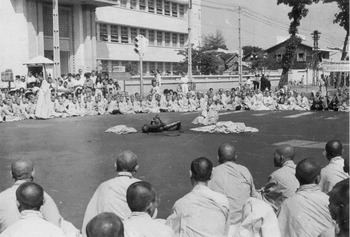
For millions of people around the world, Browne's photographs demanded explanation. In the United States and many other countries, most observers interpreted Quang Duc's death as a response to religious persecution by the Diem government. For many American newspaper editors and other commentators, the bonze's self-immolation was most easily understood as a demand for religious freedom.Footnote 96 Other authors, in contrast, suggested that Quang Duc's actions were best understood as a latter-day manifestation of premodern Buddhist practices and traditions. For example, some experts suggested that it was likely that Quang Duc drew inspiration from a chapter of the Lotus Sutra, a classical Mahayana text, in which a boddhisatva burned himself as an offering to the Buddha.Footnote 97 A third set of interpretations sought to connect Quang Duc to contemporary forms of political activism, especially those having to do with peace and human rights. Finally, some authors portrayed Quang Duc's death as a protest against the Vietnam War and an expression of opposition to the American intervention in Vietnam.Footnote 98
All of these interpretations are plausible, and the various motives which they ascribe to Quang Duc—the promotion of religious freedom, the upholding of Buddhist traditional practices, antiwar convictions—probably did play a part in his decision to burn himself. To a remarkable extent, however, almost all of the authors who have attempted to fathom Quang Duc's motives have done so without making reference to his life history or to his actions prior to his death. As a result, they have overlooked important information and sources, including two key texts in which he explained why he was willing to die by fire. These sources, when read in conjunction with Quang Duc's biography, suggest that he understood his self-immolation as the culmination of his lifelong efforts to promote Buddhist unity and the reformist ideals of the Vietnamese Buddhist revival.
As a young bonze growing up in Central Vietnam during the early twentieth century, Quang Duc embraced the Buddhist revival and the conviction that monks and nuns ought to involve themselves in the daily lives of Buddhists and their communities. He would eventually be credited with establishing or renovating 14 pagodas in his native province of Khanh Hoa—evidence of his commitment to the revitalization of Buddhism. During the 1940s, he moved to southern Vietnam, where he continued to work and preach among the laity; he also spent time in Cambodia, where he learned Pali, the ‘pure’ language that many Buddhist reformers believed more perfectly conveyed the original essence of Buddhism's canonical texts. By the early 1950s, Quang Duc had settled in Saigon, where he served in leadership roles in both the Southern Vietnamese sangha and the newly founded General Buddhist Association. Although he retired in 1958, he continued to mentor younger monks who shared his enthusiasm for the Buddhist revival and its core ideals.Footnote 99
Quang Duc apparently came up with the idea of immolating himself shortly after the 1963 protest movement began. In a 27 May letter to Buddhist leaders, he framed what he described as his ‘sacrifice’ by reference to the nationalist historical narrative elaborated by other Buddhist authors:
The spirit of Buddhism is bound together with the spirit of the nation (tinh-thần Quốc-gia dân-tộc). When Buddhism prospers, the nation prospers; when Buddhism declines, the nation declines. History has demonstrated this point clearly.
Quang Duc approvingly noted that Buddhists had responded to the 8 May incident by invoking the principle of religious freedom (tự do tín ngưỡng). Yet he also made clear his belief that the movement's primary objective had less to do with constitutional rights than with the restoration of Buddhism to its place of national primacy. For example, he eulogized the 8 May victims as martyrs who had died ‘to defend the true [Buddhist] law, to defend the way of life of the faithful, and to defend the international Buddhist flag’. His emphasis on Buddhism's national destiny was driven home in the letter's closing lines: ‘Vietnamese Buddhism is everlasting. The Buddhist flag must not be suppressed.’Footnote 100
Quang Duc invoked many of the same themes in his final testament, which he drafted on the night of 10 June, after learning that he would die the next day. Entitled ‘My Heartfelt Wishes’, the testament explained that Quang Duc had decided ‘to cremate this temporary body as a sacrifice to Buddha in order to merit virtue and to promote the preservation of Buddhism’. In the short document, Quang Duc addressed several different audiences. He called on Diem by name and implored him to accept the Buddhists’ five demands and ‘to implement a policy of religious equality’. He hoped that his fellow Buddhists would henceforth ‘escape from harm and from the terror of arrest and imprisonment at the hands of dishonest men’—clearly a call for an end to abuses by government security forces. At the same time, he included a plea to Buddha for Vietnamese Buddhism to be ‘strengthened and protected’ so that it might ‘endure forever’. Finally, he addressed himself explicitly to his co-religionists, and exhorted all Buddhist monks, nuns, and laypeople ‘to unite in sacrifice in order to defend Buddhism’.Footnote 101
Quang Duc's 27 May letter and his final testament make clear that he was concerned about religious freedom, the preservation of Buddhist traditions, and peace. Yet it is equally clear that he saw his sacrifice first and foremost as a means to defend and advance the reformist ideals of the Buddhist revival. In this regard, Quang Duc's actions are best explained by his personal experiences and his spiritual convictions, and by the era in which he lived his remarkable life. Like his generational contemporaries, Ngo Dinh Diem and Ho Chi Minh, Quang Duc sought to fashion an agenda for social and political change by connecting a particular understanding of Vietnam's past to a particular vision of its national future. Quang Duc was very much a man of his times, and no less of a revolutionary than the other members of his generation of Vietnamese leaders.
In the immediate aftermath of Quang Duc's death, it appeared that his self-immolation might lead to the result that the Intersect Committee wanted: approval and implementation of the agreement that they had already negotiated with the government, followed by a quick resolution of any remaining issues between the two sides. On the evening of 11 June, Diem delivered a radio address in which he professed to be ‘deeply grieved’ about the bonze's death; he also declared that ‘any problem, however difficult it may be, can be equitably solved in the spirit of fraternal solidarity which will always sustain our people’.Footnote 102 Diem's disquiet about the self-immolation was probably genuine. A government official who saw him privately later that day remembered that his face was ‘soaked with sorrow’.Footnote 103 Stunned both by Quang Duc's act and by the international uproar it produced, Diem ordered his negotiators to redouble their efforts to reach an accord with the Intersect Committee. On 16 June, the two sides issued a joint communiqué in which the government consented to allow the public display of Buddhist flags on Buddhist holidays, provided that they appeared in tandem with larger versions of the South Vietnamese national flag. The Buddhists, for their part, decided not to insist that the government take responsibility for the deaths inflicted during the 8 May incident, and instead settled for a promise of further investigation.Footnote 104
But the joint communiqué would not prove sufficient to bridge the divide between the two sides. Madame Nhu's vitriolic attack—and Diem's failure to denounce her remarks—were taken by many Buddhists as evidence that the Ngos had become implacably hostile to the movement. As a result, even those Buddhist leaders who had previously backed the negotiations were now sceptical of the government's true intentions. At the same time, Diem had growing doubts about the motives of Buddhist leaders. While he had always viewed the Buddhists’ complaints as overblown or spurious, he had not previously seen the movement as a threat to the power and legitimacy of his government. But the death of Quang Duc led him to conclude that more sinister forces were at work. Even as he lamented the monk's passing, the president refused to believe that Quang Duc had acted voluntarily; the fiery spectacle, he concluded, must have been orchestrated by ‘crypto-communists’ who had drugged the unsuspecting bonze.Footnote 105 With positions on both sides hardening, the possibility of a compromise deal was rapidly diminishing. The events of mid-June, far from signalling the end of the crisis, instead marked the moment at which the last hopes for reconciliation began to slip away.
Crackdown: Ngo Dinh Nhu and the August pagoda raids
In the two months following Quang Duc's self-immolation, Diem moved steadily away from his initial attempts to defuse the confrontation via negotiation. He was increasingly persuaded that the movement had ‘ceased to be a religious affair, and became a plot against the security of the State. . . It became a treasonable plot against both Buddhism and the Vietnamese Fatherland.’Footnote 106 As Diem's conviction on this point grew, he began to consider the possibility of using force to crush the movement.
In part, this shift in Diem's thinking was a reaction to the changing attitudes of Buddhist leaders, who were becoming more strident in their denunciations of the regime. But an equally important factor was the advice provided to Diem by his brother, Ngo Dinh Nhu. By the early 1960s, Nhu had consolidated his status as the most powerful member of Diem's inner circle. Indeed, his influence over government policy had surpassed even that of Can and Thuc. In addition to serving as the president's ‘political adviser’ (cố vấn chính trị), Nhu was the founder and head of the semi-clandestine Can Lao party, a key component of the repressive apparatus on which Ngo family power rested. He also designed and directed the Strategic Hamlet Program, the centrepiece of the government's strategy for combating the communist-led insurgency in the South Vietnamese countryside. As the regime's chief ideologue and the self-proclaimed champion of the ‘Personalist Revolution’, Nhu recognized that the Buddhist movement aimed to be more than just a nuisance to the government. In his view, Buddhist leaders had seized on the issue of religious freedom as a pretext to challenge the legitimacy of the government's entire nation-building agenda. He therefore counselled Diem to take a hard line in his dealings with the protestors.Footnote 107
Nhu's determination to treat the Buddhists as a threat to the government was derived in part from parallels he drew between the crisis of 1963 and events that had taken place in South Vietnam eight years earlier. During Diem's first year as leader of South Vietnam in 1954–1955, his authority had been challenged by a daunting array of rivals; these included several militias linked to the Cao Dai and Hoa Hao religious groups, as well as a Saigon-based criminal cartel known as the Binh Xuyen. In the spring of 1955, it briefly appeared that these opponents might succeed in forcing Diem from office. But Diem turned the tables on his enemies by ordering the South Vietnamese army to attack the Binh Xuyen. In a climactic battle lasting several days, the army drove the gangsters out of Saigon. Diem's decision to use force was made over the strong objections of the American ambassador to South Vietnam, who warned on the eve of the battle that compromise was the only way to ensure the survival of Diem's fledgling government.Footnote 108
For Nhu, the lessons to be drawn from the Battle of Saigon were obvious: American recommendations about internal Vietnamese political affairs were not to be trusted, especially when it came to dealing with the regime's internal opponents. In an interview a few weeks after the death of Quang Duc, Nhu recalled that Washington had pressed the regime to compromise with its enemies in 1955. This ‘was exactly the same advice given by United States representatives now,’ he complained. Although Nhu did not tell his interviewer what course of action he favoured, he made it clear that the regime would keep its own counsel when dealing with the Buddhists.Footnote 109
It is not known if Nhu helped craft the incendiary 7 June resolution issued by Madame Nhu's Women's Solidarity Movement, but there is no doubt that he sympathized with the views it expressed. A few days after the resolution appeared, Nhu told senior government officials that the Buddhists’ demands were without merit. He declared that the regime would block the schemes of the ‘political opportunists and rebels’ who were exploiting Buddhism in order to pursue ‘treasonous plots’. Echoing the language of the resolution, Nhu accused the protestors of acting on behalf of ‘international imperialism’. He added that ‘whoever instigates illegal acts will be punished severely’.Footnote 110
Many journalists and historians have claimed that Nhu and his wife strongly opposed Diem's decision to sign the 16 June joint communiqué. The palace rumour mill reported that Madame Nhu expressed her displeasure with her brother-in-law by hurling epithets and a tureen full of soup at him.Footnote 111 In reality, the Nhus’ response to the 16 June agreement was rather more crafty and calculating than this story suggests. After government representatives and Buddhist leaders completed work on the communiqué in the early hours of 16 June, Vice President Tho brought the text to Diem. Diem read and reread the document several times but did not sign it right away. A few hours later he endorsed it, but only after adding a sentence above his signature: ‘All of the points in this document have been approved in principle by me from the beginning.’ According to Foreign Minister Vu Van Mau, the president added this seemingly innocuous statement on the advice of the Nhus. By asserting that the contents of the communiqué had been backed by the government ‘from the beginning’, Diem implied that the Buddhists’ complaints had no basis in fact. At the same time, by stating that he had approved the document only ‘in principle’, Diem seemed to declare the communiqué was merely a non-binding statement of intent. Thanks to the Nhus’ legerdemain, Diem had reserved the right to destroy the agreement even as he appeared to approve it.Footnote 112
Anyone in South Vietnam who believed that the joint communiqué marked the end of the crisis soon learned otherwise. In the late morning of 16 June, only hours after the news of the agreement had been released, thousands of Buddhists gathered in downtown Saigon for the funeral of Quang Duc. Some of the mourners stormed a large formation of riot police blocking the streets near Xa Loi pagoda. The police responded with tear gas, triggering ‘the worst riot Saigon had witnessed in years’ and forcing the postponement of the funeral.Footnote 113 Although both government officials and senior Buddhist leaders subsequently affirmed their commitment to the communiqué, there was no doubt that each side's trust in the other was ebbing. In a letter to Diem dated 26 June, the General Buddhist Association chairman accused the government of failing to hold up its side of the bargain.Footnote 114 Over the next few weeks, relations between the Intersect Committee and Vice President Tho's negotiating team grew increasingly frayed.
As the summer wore on, the protests continued and tensions in Saigon and other cities reached new highs. On 7 July, the accomplished Vietnamese novelist and anti-communist political leader, Nguyen Tuong Tam—better known by his nom de plume Nhat Linh—killed himself by drinking poison. In a suicide note, Tam denounced the Diem government and declared ‘I kill myself as Thich Quang Duc burned himself in order to send a warning to those who are trampling on our freedoms.’ Tam's funeral, held a few days later in Saigon, was attended by thousands of mourners.Footnote 115
By mid-July, many Buddhist leaders were certain that the government was not really interested in a negotiated settlement and was merely waiting for the right moment to strike against the movement. Tri Quang, who had moved from Hue to Saigon and taken up residence at Xa Loi pagoda, was the most vocal proponent of this view. He told associates that he intended to continue protest activities until Diem fell from power.Footnote 116 Intersect Committee Chairman Tam Chau also appeared to have lost hope that the crisis could be resolved by peaceful means. On 7 July, he secretly asked American embassy officials to place Xa Loi pagoda under American military protection. In a letter to the American ambassador, the bonze justified this extraordinary request on the grounds that ‘nothing will [restrain] our government when it wants to achieve its aim’. He further suggested that a South Vietnamese version of the St Bartholomew's Day massacre—a 1572 pogrom during which thousands of French Protestants were slaughtered by their Catholic compatriots—might be imminent. The embassy turned down Tam Chau's request, but the Buddhists continued to seek American sympathy and support.Footnote 117
Tam Chau's request for American protection was inspired in part by rumours that government security forces had drawn up plans for an assault on Xa Loi and the other pagodas used by protestors. Codenamed ‘Operation Flood’, the scheme allegedly aimed to detain the top leaders of the movement and to force all other protestors to return to their homes. The palace did little to squelch these rumours—on the contrary, Nhu aimed to give them the widest possible circulation. In an interview on 4 August, Nhu ominously suggested that the risk of a coup d’etat against the Diem government had risen sharply since the Buddhist crisis began. He also warned that the coup plotters were both anti-American and anti-Buddhist. ‘The first action of a new government after carrying out a coup would be to crush Xa Loi,’ he declared.Footnote 118
While Nhu's hostility toward the movement was obvious, Diem's attitude was harder to fathom. Throughout the summer, the president spoke often of his desire to end the crisis peacefully and he mostly refrained from using the harsh rhetoric employed by Nhu and his wife. In mid-July, after intense lobbying by American officials, Diem delivered a radio broadcast in which he reiterated his backing for the 16 June joint communiqué and spoke of the government's ‘utmost desire for conciliation’.Footnote 119 On other occasions, however, Diem seemed to suggest that the time for negotiations had passed. In discussions with foreign journalists in early August, he suggested that the Buddhist leadership had been ‘overwhelmed’ by ‘extremist political elements’ and that at least some of the movement leaders were aiming to overthrow his government.Footnote 120
Diem's growing anger with the Buddhists was particularly apparent during a rambling five-hour interview with the American journalist, Marguerite Higgins on 7 August. Among other things, he complained that Buddhist leaders had spurned his proposal to set up a special commission to investigate violations of the 16 June agreement:
Why won't they accept these offers? It is because they want, not a solution, but an excuse to continue agitation against this government. There are Communist Viet Cong in those pagodas, Miss Higgins, and we know it. . . The more passive we are, the more the demonstrators will be emboldened. How can I, in the middle of a war, allow these disorders in the streets to go on?Footnote 121
In a follow-up interview with Higgins a week later, Diem declared that ‘I always keep my word, rain or sunshine’ and that his policy of ‘extreme conciliation’ was ‘irreversible’. Yet, in the very next breath, he seemed to call the very meaning of ‘conciliation’ into question. ‘[I]n order that such a policy may be carried out,’ he declared, ‘the saboteurs must be eliminated.’Footnote 122
On 4 August, a monk in the coastal city of Phan Thiet burned himself to death. It was the first Buddhist self-immolation since Quang Duc's nearly two months before, but it would not be the last. In a four-day period starting on 13 August, three more deaths by fire took place, including two in Hue. Around the same time, a female high school student in Saigon attempted to chop off her own hand as a gesture of protest. Although none of these actions became the international media sensation that Quang Duc's death had been, they nevertheless appeared to reinvigorate the movement within South Vietnam. On Sunday 18 August, thousands of Buddhists attended large and boisterous rallies in both Hue and Saigon. In Hue, a hapless South Vietnamese Army officer who had attempted to drive in front of a crowd of demonstrators was dragged from his jeep and beaten. At Xa Loi pagoda in Saigon, an estimated 15,000 Buddhists cheered and chanted during a day-long series of speeches. The crowd seemed especially enthusiastic in its denunciations of Archbishop Thuc. Buddhist leaders indicated that they planned even larger demonstrations at the end of the month, when Henry Cabot Lodge, the newly appointed American ambassador to South Vietnam, was scheduled to take up his post. As one Army general later recalled, the events of 18 August marked the peak of Buddhist protest activities, and seemed to show that the movement was more powerful than ever.Footnote 123
Two days later, the Diem regime launched its long-dreaded crackdown on the Buddhist movement. During the night of 20–21 August, Xa Loi pagoda was crowded with hundreds of sleeping monks, nuns, and other movement supporters, as it had been for weeks. Shortly after midnight, the quiet was pierced by a cacophony of warning bells and gongs. A large detachment of police, Army Special Forces soldiers, and other security personnel were at the gates, trying to force their way in. A Buddhist lay leader later recalled the pandemonium and terror:
I rushed into the sanctuary and found at least two-thirds of the monks and nuns who had locked themselves inside. I heard from downstairs shouting and hammering on the doors. The nuns and the young monks were shouting for help, bells were ringing, the gong was sounding, there was a fantastic din which must have been heard for three miles around. [The attackers] threw their gas grenades and shot in the air to frighten us and finally all the doors were broken through: the metal doors by breaking window panes and then slipping a hand inside to lift the latch; the wooden doors were broken with axes. Then began the mass arrests.Footnote 124
During the first night of the crackdown, security forces occupied 12 pagodas in Saigon and detained more than 700 monks, nuns, and other protestors. Hundreds more were taken into custody in Hue, Da Nang, and elsewhere. Despite later media reports to the contrary, there is no proof that any of the protestors were killed or suffered serious injuries during the raids; the attackers seem to have been at pains to avoid hurting the demonstrators, even as they inflicted heavy damage on the pagodas. Those arrested included many of the movement's top leaders, including Intersect Committee chairman, Tam Chau. Remarkably, Tri Quang managed to escape from Xa Loi amid the chaos of the assault and remained at large. He would eventually make his way to the American embassy, where he received asylum.Footnote 125
By dawn on 21 August, government forces were in control of Xa Loi and the other pagodas that had served as the main centres of protest activities. At 5.30am, the members of Diem's cabinet were summoned to Gia Long palace for an emergency meeting. The president had not previously consulted with his ministers about the raids, nor even informed them that he was contemplating the use of force against the Buddhists. Was he still in charge of the government? Upon entering the meeting, Diem immediately read out a prepared statement. Invoking the ‘presidential responsibility conferred on me by history’, he announced that he was imposing martial law throughout the country. He was doing so, he declared, because military commanders had learned that communist forces were massing outside Saigon in preparation for a coup attempt. In such a situation, Diem declared, he could not afford to wait to act against the Buddhists. He had therefore granted his commanders’ request and proclaimed martial law. In an apparent reference to the just-completed raids on the pagodas, Diem stated that the army had achieved the goals of the ‘first phase’. He exhorted his ministers to show a ‘united front’ as the government implemented the ‘second phase’.Footnote 126
The ministers knew that Diệm's story about an imminent communist attack on Saigon was bogus. As Foreign Minister Mau later noted, the official intelligence reports which they read on a daily basis did not contain any evidence of such a plot. Clearly, the threat had been fabricated to justify both the imposition of martial law and the crackdown on the Buddhists. But why had Diem finally opted to use force? Mau discerned the hand of Nhu behind Diem's actions. The minister observed that Diem, who had previously conducted cabinet meetings informally, had read his prepared remarks from a small card. Mau also noticed that the statement, although written in Vietnamese, was sprinkled with French terms and phrases—a practice that Diem normally eschewed in cabinet meetings. Mau concluded that Nhu had gained so much influence over Diem that he was literally putting words into his brother's mouth.Footnote 127
By endorsing Nhu's plan to raid the pagodas, Diem had decisively abandoned his earlier attempts to resolve the 1963 crisis through negotiation and piecemeal concessions to Buddhist leaders. But Diem had not simply traded a strategy of co-option for a hardline approach. He had also adopted Nhu's assessment of the root causes of the crisis, as well as his view of how to exploit it. More specifically, he had come to see the Buddhists as a threat analogous to those he had faced shortly after he took power in South Vietnam in 1954. By crushing the protestors—as he had crushed the Binh Xuyen and the other groups that had previously resisted him—Diem expected not merely to end the 1963 crisis but to emerge from it stronger and more powerful than before, just as he had after his victory in the Battle of Saigon. For Ngo Dinh Diem, there could be no compromise with any rival leader or group—communist or anti-communist, internal or external—who refused to embrace his vision of Vietnam's national future. Diem had never given ground on this critical point before, and he was not about to do so now.
Conclusion: the crisis of 1963 and the politics of nation building
As Diem and Nhu had anticipated, the pagoda raids marked a turning point in the crisis of 1963 in South Vietnam—though the ultimate consequences of the raids were far from what they had expected. In a narrow sense, the crackdown was a successful attempt to contain the Buddhist movement, insofar as all of the movement's key leaders were jailed or forced into hiding. But the raids did not end anti-government agitation in South Vietnam. Demonstrations and other forms of public protest continued in the weeks after the raids, despite police attempts to quash them. At the same time, the crackdown sharply intensified the struggle between the Diem government and its critics in the international sphere. The raids were widely denounced by newspaper editors, government officials, and other prominent figures in the United States and around the world.Footnote 128 At the United Nations, several Asian and African governments called for a discussion of ‘the violation of human rights in South Vietnam’. While the Diem government managed to avoid a vote of censure by inviting the international body to send a fact-finding mission to Saigon, it was clear that international public opinion was running strongly against the regime.Footnote 129
The pagoda raids also intensified South Vietnamese and American efforts to bring about the overthrow of the Diem government. Various coup plots involving South Vietnamese military officers and civilian officials had been percolating for months prior to the crackdown. Army General Tran Van Don, a ringleader of the group that would eventually succeed in overthrowing Diem, later recalled that he and his colleagues began plotting in earnest in early July, after he read the international media coverage of Quang Duc's death during an official trip to Thailand.Footnote 130 Nevertheless, it was only after the August raids that Don and his fellow generals signalled to American officials that they were ready to move against the government. Diem's critics within the Kennedy administration—including Henry Cabot Lodge, the newly arrived American ambassador to South Vietnam—seized the opportunity to inform the plotters that Washington would not stand in their way. Although the generals’ initial coup attempt in late August never got off the ground, American policy had shifted to a stance of qualified support for Diem's removal from power. When the generals finally launched their coup against Diem and Nhu on 1 November 1963, they knew that Kennedy and other top administration leaders had concluded that regime change in Saigon was essential for the long-term success of the war effort against the communists.Footnote 131
The dramatic and far-reaching impact of the Ngos’ crackdown on the Buddhist movement underscores a central contention of this paper: the crisis of 1963 is best understood as an episode in the politics of nation building in South Vietnam during the Vietnam War era. The clash between the Buddhists and the Diem government cannot be persuasively explained as a struggle for religious freedom, as a political conspiracy, or as a battle over cultural meaning—even though all of these phenomena were present and important in South Vietnam during 1963. Although the crisis seemed to arrive suddenly (like ‘the drop in pressure preceding a hurricane’,Footnote 132 according to one author), it was not created merely by the exigencies of the moment. Neither was it simply an expression of ancient beliefs or traditions. Instead, the crisis of 1963 resulted from the collision of two distinct visions of how Vietnam ought to pursue its destiny as a modern nation. At the same time, the course and consequences of the crisis were also critically affected by the personalities, ambitions, and actions of certain Buddhist and government leaders. In this regard, neither the 8 May incident nor the subsequent chain of events was bound to happen—no matter how inevitable they might seem in retrospect.
As a growing body of scholarly research demonstrates, contests over nation building and development deeply shaped the history of the Vietnam War. The governments and groups that participated in the war did not treat nation building as an auxiliary activity that was only of incidental importance to the main business of combat, nor was nation building an exclusively American enterprise to which the Vietnamese remained indifferent. Instead, nation building and development were fields of contest in which multiple leaders and groups put forward diverse and conflicting visions of South Vietnam's future. The events of 1963 in South Vietnam were a moment in which the differences and tensions between several of these visions—not only those espoused by the Buddhists and the Diem government but also those promoted by Vietnamese communist leaders and American government officials and experts—became particularly acute. These differences and tensions would persist and intensify even after the demise of the Diem government in the November coup. The ‘Buddhist crisis’ thus helped to propel the struggle to define South Vietnam's modern destiny into a new and vastly more destructive phase. Viewed with hindsight, the events of 1963 seem to have been suffused with even more danger and tragedy than they appeared to be at the time.



