INTRODUCTION
Habitat destruction is one of the main factors contributing to worldwide biodiversity declines (Millennium Ecosystem Assessment 2005). Thus, recent European Mediterranean region transformations of large areas under traditional agricultural management (see Symeonakis et al. Reference Symeonakis, Calvo-Cases and Arnau-Rosalen2007) have affected species associations within a wide range of biogeographical and ecological origins (Schmitt & Rákosy Reference Schmitt and Rákosy2007). Most studies of the effect of the loss of traditional agricultural landscapes on bird communities within European Mediterranean countries have been diachronic studies of population dynamics (for example Stouffer et al. Reference Stouffer, Bierregaard, Strong and Lovejoy2006; Wretenberg et al. Reference Wretenberg, Lindström, Svensson and Pärt2007), or synchronic ones of species habitat selection (for example Sergio et al. Reference Sergio, Scandolara, Marchesi, Pedrini and Penteriani2005). Few studies have simultaneously employed historical and recent data of landscape composition and species abundance (for example Sirami et al. Reference Sirami, Brotons and Martin2007).
In general, habitat specialists are expected to be more sensitive to alterations in landscape structure (Bender et al. Reference Bender, Contreras and Fahrig1998). Therefore, high profile conservation species that are strongly associated with human-maintained semi-natural landscapes are especially endangered by current changes in land use, such as the disappearance of traditional agricultural lands. The red-legged partridge (Alectoris rufa) may be one of these species (Vargas & Cardo Reference Vargas and Cardo1996; Blanco-Aguiar Reference Blanco-Aguiar2007). Although it is currently classified as ‘least concern’ by BirdLife International (Birdlife International 2012), its populations have declined markedly over recent decades. Estimates indicate that, in Spain, the red-legged partridge population has decreased by > 50% between 1973 and 2002 (Blanco-Aguiar Reference Blanco-Aguiar2007).
The decrease in partridge populations in the Iberian Peninsula may be due to overhunting, changes in pesticide management policies, changes in livestock densities and the effect of the release of farm-reared partridges (leading to hybridization between red-legged partridges and chukar partridges [A. chukar] and the transmission of parasites; Blanco-Aguiar Reference Blanco-Aguiar2007; Blanco-Aguiar et al. Reference Blanco-Aguiar, González-Jara, Ferrero, Sánchez-Barbudo, Virgós, Villafuerte and Dávila2008; Villanúa et al. Reference Villanúa, Pérez-Rodríguez, Casas, Alzaga, Acevedo, Viñuela and Gortázar2008; Casas et al. Reference Casas, Mougeot, Sánchez-Barbudo, Dávila and Viñuela2012; Blanco-Aguiar et al. Reference Blanco-Aguiar, Delibes-Mateos, Arroyo, Ferreras, Casas, Real, Vargas, Villafuerte and Viñuela2012). Nevertheless, agricultural changes have been suggested as the main cause of the decline in partridge populations (Blanco-Aguiar Reference Blanco-Aguiar2007), for example, agricultural intensification may have had negative consequences for partridge habitat selection (Buenestado et al. Reference Buenestado, Ferreras, Delibes-Mateos, Tortosa, Blanco-Aguiar and Villafuerte2008), survival (Buenestado et al. Reference Buenestado, Ferreras, Tortosa, Blanco-Aguiar and Villafuerte2009) and nesting success (Vargas & Cardo Reference Vargas and Cardo1996; Casas & Viñuela Reference Casas and Viñuela2010). However, at a local scale, no data on these effects exist at the landscape level.
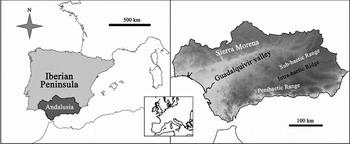
In this study, our primary aim was to identify changes in favourable areas for the red-legged partridge in Andalusia (southern Spain; Fig. 1) between the 1960s and 1990s. We studied the environmental and land-use factors that determined these areas during both periods. We also identified areas where favourability for partridges had changed markedly (either increased or decreased) during recent decades, and examined the evolution of the main land uses that determined favourability for partridges both in these areas and throughout the study area. Finally, we discuss the potential effects that land-use changes may have had on partridge distribution and abundance in recent decades in southern Spain.
Study area. The most important valley and the main mountain ranges are shown in schematic form. Provinces boundaries are also indicated.

METHODS
Study area
Andalusia is one of the 17 autonomous regions in Spain. It covers over 87 000 km2 in the southernmost part of mainland Spain and is administratively divided into 771 municipalities. Physiographically, medium-sized mountains predominate in the Andalusian landscape (42 % of the total area). Thus, 38 % of the agricultural land is mountainous, and crops are generally restricted to the inner valleys (flat depressions) or to gently sloping hillsides. The main mountain ranges are the Sierra Morena and the Baetic System, consisting of the Sub-Baetic and Penibaetic Mountains, separated by a ridge of discontinuous depressions largely devoted to agriculture (Fig. 1; Ortega Reference Ortega1991). The Sierra Morena is situated along the northern fringe of Andalusia (400–1300 m elevation, with poor and moderately acid soils), and belongs to the southern border of the Iberian Plateau (Fig. 1). The dominant vegetation is natural (evergreen oak forests and scrublands) and is currently used for extensive livestock raising and hunting. The Baetic System presents greater lithological heterogeneity, is north-east–south-west oriented and mainly occupies the eastern part of Andalusia (Fig. 1). The dominant vegetation is also natural (pine forests, evergreen oak forests and scrublands) and the hilly areas are dedicated to dry farming woody crops. The maximum elevation is 3479 m, in the Penibaetic range. The most important plain is the Guadalquivir Valley, which is oriented approximately longitudinally between the Sierra Morena and the Baetic System (Fig. 1). The valley bottom is covered by herbaceous crops and river terraces, and the hill slopes by woody crops (Fig. 1). The climate of this region is Mediterranean, with mild winters and severe summer droughts. There is a decreasing west-to-east precipitation gradient.
Variables
Municipalities were classified according to whether red-legged partridges were abundant or not during the 1960s and in the 1990s. For this purpose, we used game species abundance and hunting yields, respectively.
To estimate average hunting yields (HY) of the red-legged partridge in each municipality (n = 771) during the 1990s, we analysed 32 134 annual hunting reports (AHRs) for the period 1993–2001 from 6049 game estates. Hunting yields per municipality were expressed by the number of birds killed per 100 ha of game estate where the species was hunted (Vargas et al. Reference Vargas, Farfán, Guerrero, Barbosa and Real2007). Abundance and hunting yields are not always equivalent, as they are not the same quantitative variable. However, hunting yields are a coarse but realistic picture of good and poor areas at broad spatial scales when absolute abundance values are lacking (Vargas et al. Reference Vargas, Guerrero, Farfán, Barbosa and Real2006). In any case, we used hunting yields to estimate where partridge abundances were highest in the 1990s, but not to define specific values of partridge abundance (see below).
For the 1960s data, we employed abundance maps (scale 1:2 000 000) for game species. The number of animals hunted were supplied by hunters to the government agency responsible for regulation of hunting, the Mainland Spanish Fish, Game and National Parks Service, who used the data to produce maps displaying the abundance of the main game species throughout Spain. A nominal scale of 1–6, where 1 = absent, 2 = rare, 3 = scarce, 4 = frequent, 5 = abundant and 6 = very abundant, was employed (Ministerio de Agricultura 1968; Gortázar et al. Reference Gortázar, Herrero, Villafuerte and Marco2000; Delibes-Mateos et al. Reference Delibes-Mateos, Farfán, Olivero, Márquez and Vargas2009). Unfortunately, because the original raw data from which these maps were developed were not available, we were not able to directly compare partridge abundance between the 1960s and the 1990s (see below). Given this, our study aimed to identify areas favourable for partridges in the 1960s, as used in previous studies with other species (Delibes-Mateos et al. Reference Delibes-Mateos, Farfán, Olivero, Márquez and Vargas2009, Reference Delibes-Mateos, Farfán, Olivero and Vargas2010; Acevedo et al. Reference Acevedo, Farfán, Márquez, Delibes-Mateos, Real and Vargas2011; Farfán et al. Reference Farfán, Duarte, Vargas and Fa2011). Using this information, we extracted the mean value of red-legged partridge abundance within each municipality using the following procedure: the original maps were scanned, the red-legged partridge abundance was digitally converted on screen into polygons and then into raster images, and finally the mean abundance value was extracted in each municipality (Delibes-Mateos et al. Reference Delibes-Mateos, Farfán, Olivero, Márquez and Vargas2009).
As our aim was to detect areas favourable to red-legged partridges (see Delibes-Mateos et al. Reference Delibes-Mateos, Farfán, Olivero and Vargas2010), we estimated where the abundance of this species was good (index of abundance, IA = 1) or poor (IA = 0) according to the following criteria: for the 1990s, six hunting yield classes were established using a logarithmic scale among the extreme values obtained for the Andalusian municipalities, from which we then considered the three highest classes to represent good abundance and the three lowest poor abundance (Farfán et al. Reference Farfán, Guerrero, Real, Barbosa and Vargas2004, Reference Farfán, Vargas, Duarte and Real2009; Vargas et al. Reference Vargas, Guerrero, Farfán, Barbosa and Real2006). According to the extreme values obtained for hunting yields of red-legged partridge, the threshold value was 12 (Vargas et al. Reference Vargas, Guerrero, Farfán, Barbosa and Real2006). For the 1960s, classes in the original data source quantifying abundance as frequent, abundant or very abundant were considered representative of good abundance, whereas classes indicating absent, rare and scarce populations were considered representative of poor abundance. Thus, for the 1990s, IA = 1 when HY > 12 and IA = 0 when HY ≤ 12, while for the 1960s, IA = 1 when the map abundance value was ≥ 4 and IA = 0 when the abundance value was < 4. An important point to take into account is that good and poor abundances were contextualized separately in the 1960s and in the 1990s and may indicate differing abundance, or hunting yield, values in each decade. As mentioned previously, our intention was not to compare absolute partridge densities in the 1960s and in the 1990s directly, but to compare the geographical change in favourable areas for partridges. IA was thus used as a target variable in the modelling procedure.
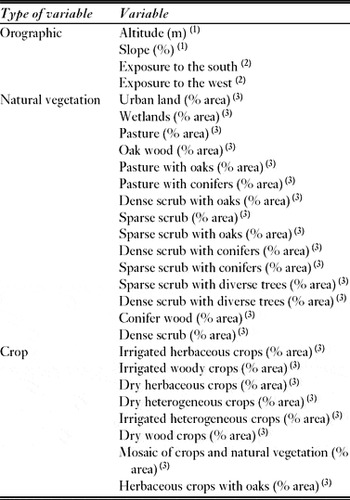
We related the IA to 27 predictor variables that provided information on environmental characteristics, land use and vegetation in the Andalusian municipalities (Table 1). Orographic variables were derived from the United States Geological Survey (USGS 1996) and GlobDEM50 (Farr & Kobrick Reference Farr and Kobrick2000), whereas natural vegetation and crop variables were obtained by calculating surface areas per municipality according to the 1960s and 1990s land-use maps of the study area (Mapa de Usos y Coberturas Vegetales de Andalucía; Junta de Andalucía 2009). For a detailed explanation of the process used to derive the orographic, natural vegetation and crop variables (Table 1), see Vargas et al. (Reference Vargas, Farfán, Guerrero, Barbosa and Real2007) and Delibes-Mateos et al. (Reference Delibes-Mateos, Farfán, Olivero and Vargas2010). Finally, to determine the existence of collinearity between predictor variables, we used the coefficient of determination (R2) and variance inflation factor (VIF) proposed by Kleinbaum et al. (Reference Kleinbaum, Kupper, Nizam and Muller2007). According to these authors, collinearity exists when R2 > 9 and VIF > 10.
Variables used to model the potential distribution of red-legged partridge abundance in south Iberian municipalities. Sources: (1) USGS (1996); (2) Derived from GlobDEM50 (Farr & Kobrick Reference Farr and Kobrick2000); (3) 1960s and 1990s land use maps from Andalucía (Mapa de usos y coberturas vegetales del suelo de Andalucía; Junta de Andalucía 2009).

Predictive models
To select a subset of significant predictor variables, we performed stepwise logistic regression (Hosmer & Lemeshow Reference Hosmer and Lemeshow1989) for the IA on the predictor variables, using SPSS 16.0 statistical software. The stepwise method is a procedure that ensures objectivity in the variable selection, as it is based on statistical significances, and maximizes the explanatory power of the models following predefined induction rules (Hosmer & Lemeshow Reference Hosmer and Lemeshow1989). In other words, a stepwise procedure seems to be the best option to obtain a model inductively, without a priori hypotheses (see Stephens et al. Reference Stephens, Buskirk, Hayward and Martínez del Río2005 for potential uses of this procedure; see an example in Delibes-Mateos et al. Reference Delibes-Mateos, Farfán, Olivero and Vargas2010). We then used the environmental favourability function of Real et al. (Reference Real, Barbosa and Vargas2006) to eliminate the effect of the uneven proportion of ones and zeros in the dataset from the model. The favourability F for good abundance (IA = 1) in each municipality was obtained by using the formula:
 \begin{equation}
F = (P/(1-P))/((n_{\it 1}/n_{\it 0}) + (P/(1-P)))
\end{equation}
To obtain an explanatory model, the variables introduced in the final predictive models were grouped into orographic, natural vegetation and crop factors (Table 1), and each group of variables was used to obtain partial orographic, natural vegetation and crop favourability models. To account for relationships between factors (Borcard et al. Reference Bocard, Legrendre and Drapeau1992; Legendre Reference Legendre1993), we performed a variation partitioning procedure to specify how much of the variation of the final model was explained by the pure effect of each explanatory factor, and which proportion was clearly attributable to more than one factor (Legendre Reference Legendre1993; Legendre & Legendre, Reference Legendre and Legendre1998; see applications in Farfán et al. Reference Farfán, Vargas, Guerrero, Barbosa, Duarte and Real2008 and Delibes-Mateos et al. Reference Delibes-Mateos, Farfán, Olivero and Vargas2010).
We assessed the discrimination ability of the resulting models using the AUC parameter (Pearce & Ferrier Reference Pearce and Ferrier2000). To compare the results obtained by the models for the two periods, we followed the criterion used by Delibes-Mateos et al. (Reference Delibes-Mateos, Farfán, Olivero and Vargas2010): all municipalities whose favourability was ≥ 0.8 were considered favourable, namely municipalities where the odds of good abundance were at least 4:1 (Rojas et al. Reference Rojas, Cotilla, Real and Palomo2001; Muñoz & Real Reference Muñoz and Real2006); conversely, we considered unfavourable all municipalities whose favourability was ≤ 0.2 (namely those where the odds for poor abundance was at least 4:1). Favourability values between 0.2 and 0.8 were considered intermediate. We then compared the models obtained for the red-legged partridge during the two periods to determine changes in favourability. For this comparison, we assumed that the term ‘favourable’ denoted conditions promoting good abundances (IA = 1), although good abundance may mean quite different abundance values between the 1960s and the 1990s.
Changes between 1960s and 1990s in the areas dedicated to different land uses within every municipality were calculated according to the 1960s and 1990s land-use maps of the study area (Mapa de Usos y Coberturas Vegetales de Andalucía; Junta de Andalucía 2009). We quantified land-use changes within the areas that were during the 1990s more or less favourable to partridges.
RESULTS
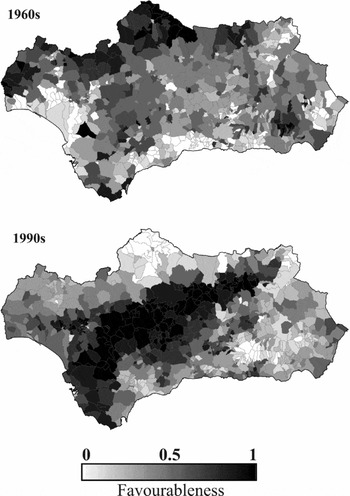
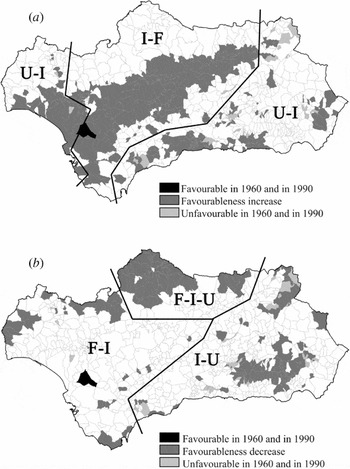
In all the cases R2 < 9 and VIF < 10, therefore there was no collinearity between predictor variables for either model. Past and recent areas favourable to Red-legged Partridge in Andalusia show markedly different geographical patterns according to the logistic regression models. In general, lowlands have replaced mountains as highly favourable areas for this species (Fig. 2). Only a few municipalities that were either environmentally favourable or unfavourable in the 1960s have remained stable (Fig. 3). Environmental conditions in municipalities next to the coast (either Atlantic or Mediterranean) have frequently changed favourability from low to intermediate, and the Guadalquivir Valley has improved from intermediate to high favourability (Fig. 3a). In contrast, changes from high to intermediate favourability have occurred in the western Sierra Morena and mountains next to the Strait of Gibraltar, from intermediate to low in the Sierra de Segura (north-eastern Sub-Baetic System) and the Sierra Nevada (eastern Penibaetic System), and directly from high to low in the central and eastern Sierra Morena (Fig. 3b).
Favourability for the red-legged partridge in each municipality of Andalusia, shown on a scale ranging from 0 (white) to 1 (black). Note: identical favourability values for the 1960s and 1990s do not imply identical absolute density values.

Municipalities where favourable and unfavourable conditions for the red-legged partridge remained stable from the 1960s to the 1990s (black and light grey, respectively), and where these conditions have changed (dark grey). (a) Dark grey shading indicates a change toward more favourable conditions, either from intermediate to favourable (I–F zone), or from unfavourable to intermediate (U–I zone); (b) dark grey shading indicates a change toward less favourable conditions, either from favourable to intermediate (F–I zone), and from intermediate to unfavourable (I–U zone). The crooked lines indicate the approximate boundaries between zones, where municipalities whose favourability changed followed a given trend. Thresholds for favourable and unfavourable areas are 0.8 and 0.2, respectively. Some areas that remain white may have changed in favourability between the 1960s and 1990s, but not sufficiently to register on the maps with these thresholds.

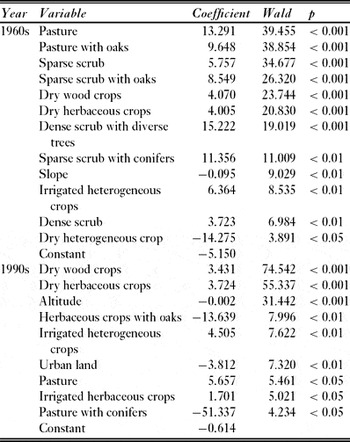
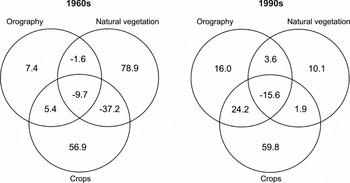
Both models show an excellent discrimination ability (1960s model: AUC = 0.826; 1990s model: AUC = 0.821), and include variables related to orography, natural vegetation and crops (Table 2). The 1960s model shows natural vegetation as the factor most consistently present in the landscapes favourable to the red-legged partridge (Fig. 4). Crops were also of great importance, whereas orography (represented by slope) had little explanatory power (Fig. 4a). The overlap between natural vegetation and crops is high but negative in this model. This indicates that favourable natural vegetation conditions tended not to coincide with favourable crop conditions during the 1960s. However, the 1990s model shows that landscapes favourable to partridges were mainly croplands, whereas orography (represented by elevation, negatively related to favourability) was during the 1990s more important than natural vegetation (Fig. 4b). In this model, there is a wide positive overlap between orography and crops; that is, much of the effect of crops on favourability for partridge cannot be distinguished from what is explained by orography.
Favourability models, including coefficients of variables in the favourability functions. The Wald parameter indicates the relative importance of each variable.

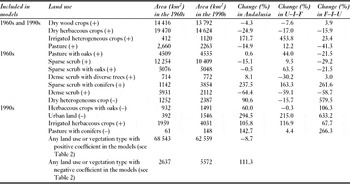
Past and recent models share less than 50% of the variables: dry wood crops, dry herbaceous crops, irrigated heterogeneous crops and pastures (Tables 2 and 3), all of which indicate high favourability for partridges. The most important landscapes included only in the 1960s model are also favourable: pasture with oaks (namely savannah-like habitats, or dehesas) and five other variables related to scrubland. In contrast, most variables that are exclusive to the 1990s model indicate low favourability landscapes, the most important being herbaceous crops with oaks (a cultivated version of dehesas) and urban land.
Change in the percentage area occupied by land use and vegetation types included in the favourability models. Signs + and – indicate the sign of the effect of land uses on favourability. Abbreviations: U–I–F = municipalities where the environment has become more favourable for Alectoris rufa (U = unfavourable; I = intermediate favourability; F = favourable); F–I–U = municipalities where the environment has become less favourable for Alectoris rufa.

Variation partitioning of the final model. Values shown in the diagrams are the percentages of variation in favourability in the 1960s and in the 1990s explained by the factors orography, natural vegetation and crops, and by their interactions.

Since the 1960s, the surface area occupied by landscapes that favour partridge populations in Andalusia has decreased by c. 10% (c. 6000 km2), whereas there has been a considerable increase in unfavourable landscapes (> 100%; c. 3000 km2; Table 3). Overall, partridge habitat became impoverished in > 10% of the total study area (c. 9000 km2). Pastures were the most important land use for partridges in the 1960s and by the 1990s had decreased by 15%. However, this decrease was higher (c. 40%) in municipalities where favourability also decreased, whereas the trend regarding pastures was positive in the areas where conditions had become more favourable for partridges. Other landscapes’ areal extents have undergone opposing trends over the last 40 years. Areas of pasture with oaks (dehesas) and sparse scrubs (with and without oaks) increased in extent as favourability increased, while areas of dense scrubs with diverse trees, dry heterogeneous crops and herbaceous crops with oaks decreased in extent as favourability increased (Table 3). In addition, the extent of areas of both urban land and pasture with conifers increased considerably as favourability decreased (Table 3).
DISCUSSION
The location of areas favourable to red-legged partridge has changed considerably in southern Spain over recent decades. During the 1960s, areas favourable to the species were found in mountain areas, but in the 1990s, they were associated with lowlands. During the 1960s, areas favourable to partridge were associated with environmental and land-use factors that differed from those of the 1990s; < 50% of the variables were common to both models. In Andalusia, tracking preferred habitat of species between both study periods revealed a similar pattern of change for the Iberian hare (Lepus granatensis; Farfán et al. Reference Farfán, Duarte, Vargas and Fa2011), but not for European rabbits (Oryctolagus cuniculus; Delibes-Mateos et al. Reference Delibes-Mateos, Farfán, Olivero and Vargas2010).
Our models have clearly shown that, during the 1960s, natural vegetation was consistently present in most of the landscape favourable for the red-legged partridge. Several decades ago, the dominant vegetation in the mountain ranges within Andalusia was scattered scrubland and open evergreen oak forests with underlying grasslands (Fernández-Alés et al. Reference Fernádez-Alés, Martín, Ortega and Ales1992). This landscape was favourable to partridges because food was available (for example in pastures) and scrub provided appropriate cover to breed (see for example Fortuna Reference Fortuna2002). This is confirmed by the inclusion of pasture, pasture with oaks, sparse scrub and sparse scrub with oaks among the main variables explaining partridge favourability in the 1960s model. Dense scrublands were also positively related to favourability for partridges in this model, which can be attributed to the landscape (and not habitat) scale of our research. Thus, it is highly probable that dense scrubs acted as refuges closely associated with open areas during the 1960s (Fernández-Alés et al. Reference Fernádez-Alés, Martín, Ortega and Ales1992). With the exception of dry heterogeneous crops, which had little importance in the model, the other types of crops were positively associated with partridge favourability during the 1960s.
During the 1990s, areas favourable to partridges were linked to the existence of large areas of cropland (for details, see Vargas et al. Reference Vargas, Guerrero, Farfán, Barbosa and Real2006), including wood crops, the main variable in the model. This is unsurprising because the red-legged partridge usually selects crop patches delimited by natural hedges (Rands Reference Rands1986), and frequently uses olive groves and vineyards throughout the Iberian Peninsula (Borralho et al. Reference Borralho, Rito, Rego, Simoes and Vaz Pinto1996, Reference Borralho, Carvalho, Rego and Pinto1999). However, only two variables related to natural vegetation were selected in the 1990s favourability model. This is explicable because, in recent times, natural vegetation has become restricted to unproductive mountain ranges in Andalusia, which are mainly covered by large patches of dense scrublands and woodlands (Fernández-Alés et al. Reference Fernádez-Alés, Martín, Ortega and Ales1992), unsuitable as partridge habitat (see Lucio Reference Lucio1991).
We found partridge favourability increased in the lowlands and decreased drastically in mountain areas; greatest densities were linked to the mountain areas in the 1960s and the lowlands during the 1990s. As mentioned, this does not necessarily imply that the most abundant populations had the same densities in both decades. In fact, it is widely known that the red-legged partridge population has declined sharply in Andalusia; 7.8 partridges per hunter were hunted in 1973 (the first year for which game bag data are available; Virgós et al. Reference Vargas, Farfán, Guerrero, Barbosa and Real2007), whereas an average of 3.2 partridges per hunter were shot in the period 1993–2001 (the period used in this study; Blanco-Aguiar Reference Blanco-Aguiar2007). Interestingly, this negative trend has not been reflected by significant changes in the number of municipalities favourable to this species (Figs 2 and 3), and in the area occupied by land uses positively related to favourability in our models, which decreased by c. 6000 km2, representing only a 8.7% decrease. A potential explanation is that hunting policies and hunting effort changed between study periods. While hunting pressure was seemingly higher during the 1990s than several decades ago, as in Andalusia 143 000 hunters were registered in 1973 and > 225 000 hunters in the 1993–2001 period (J. A. Blanco-Aguiar, unpublished data 2011), both the length of the hunting season and the daily hunting effort were shorter in the 1990s than in the 1960s. Thus, we estimate that overall hunting effort was similar between both study periods. The methods employed to hunt partridges were the same during the 1960s and 1990s, and these birds were hunted throughout most of the territory during both periods (partridge hunting took place in 84.6% of Andalusia in the 1990s; Farfán Reference Farfán2010). In our opinion, a more plausible explanation of the small decline in favourability observed in this study despite the general partridge drop in status is the applied definition of favourability. Thus, partridge abundances in the most favourable areas during the 1960s could be higher than abundances in the most favourable areas during the 1990s. Although the extent of area quantified as most favourable for partridges was similar in both decades, there was an apparent decline in the quality of the most favourable landscapes by the 1990s.
Our results strongly suggest that the change in the location of favourable areas for partridges is a consequence of recent landscape changes in this region. For instance, it is noteworthy that the percentage of area occupied by the most relevant natural vegetation variables in the 1960s model has decreased in areas that have become unfavourable to the species; in contrast, the area under these vegetation types increased where partridge favourability also increased, especially in the case of open scrubland and pastures. During recent decades, the resources used in the mountain ranges decreased (for example charcoal burning and shifting cultivation have almost disappeared and livestock has decreased), and, as a consequence, open areas that were abandoned are now covered by large areas of dense homogeneous scrubland (see Fernández-Alés et al. Reference Fernádez-Alés, Martín, Ortega and Ales1992; Romero-Calcerrada & Perry Reference Romero-Calcerrada and Perry2004). This contrasts with the structure of the landscape during the 1960s, when small patches of dense scrubland were interspersed with feeding habitats for partridges, such as pastures (Fernández-Alés et al Reference Fernádez-Alés, Martín, Ortega and Ales1992). Hence, landscapes suitable for partridges have become impoverished. Similar results have been found for black grouse (Tetrao tetrix) in Germany (Ludwig et al. Reference Ludwig, Storch and Graf2009). Urban areas, which were negatively associated with partridge favourability in the 1990s model, have strikingly increased in recent years in southern Spain. Urbanization has been especially evident in areas where partridge favourability has decreased, which suggests that it may have had a highly detrimental effect on partridges. This is in agreement with studies of some native birds in Arizona (Green & Baker Reference Green and Baker2003).
CONCLUSIONS
Our results suggest that the abandonment of traditional activities in mountain areas has resulted in a loss of suitable landscapes for the red-legged partridge. However, we cannot provide evidence of partridge landscape impoverishment due to agriculture intensification. The most plausible explanation is that some factors are not easily captured by large-scale studies: for example, the decrease in the availability of lindes (linear annual herbaceous-vegetation strips of unploughed land placed between cultivated plots or between these plots and tracks) caused by agricultural intensification, which may have been highly detrimental to partridges (Vargas & Cardo Reference Vargas and Cardo1996; Casas & Viñuela Reference Casas and Viñuela2010). These findings support the idea that land-use changes have substantially contributed to the decline in partridge numbers. To the best of our knowledge, the present study provides the first empirical evidence that the habitat suitable to partridges has become impoverished during recent decades in southern Spain. The red-legged partridge is a species of conservation concern, not only because its populations have markedly decreased in recent times, but also because it plays major ecological roles in Iberian Mediterranean ecosystems (Calderón Reference Calderón1983). From this perspective, landscape management should be encouraged to conserve partridge populations by, for instance, maintaining or increasing natural vegetation areas among crops, such as lindes and hedgerows, thus promoting a positive effect on the breeding success of partridges (Casas & Viñuela Reference Casas and Viñuela2010). The clearance of scrubland in mountain areas and the creation of small patches of pastures and crops interspersed within the scrubland matrix should also be promoted. These management measures would help to conserve not only partridge populations, but also those of other species of farmland birds that inhabit the same habitat (see Vickery et al. Reference Vickery, Carter and Fuller2002). We believe that management measures aimed at improving habitat for farmland birds should be included among the measures of the new Common Agrarian Policy.
The favourability function used in this study enables the assessment of geographical relationships, not only between species, but also for the same species over different study periods (Real et al. Reference Real, Barbosa and Vargas2006), for example, to evaluate how land-use changes in the long term have determined geographical variation in the areas favourable to different species (see Delibes-Mateos et al. Reference Delibes-Mateos, Farfán, Olivero and Vargas2010; Farfán et al. Reference Farfán, Duarte, Vargas and Fa2011). This methodology has also been used to forecast the future distribution of favourable areas for several species under different scenarios of land-use change (Acevedo et al. Reference Acevedo, Farfán, Márquez, Delibes-Mateos, Real and Vargas2011) or even climate change (Real et al. Reference Real, Márquez, Olivero and Vargas2010). This makes this a highly interesting statistical approach to predict how future changes in land use or climate characteristics will affect specialist species, such as farmland birds. Indeed, a recent study has forecasted a contraction of favourable areas for Montagu's harrier (Circus pygargus) and hen harrier (Circus cyaneus) (Estrada et al. Reference Estrada, Arroyo and Márquez2010). Unfortunately, at the geographic scale and spatial resolution of this study, this approach does not permit the identification of changes in land use at finer spatial scales, such as microhabitat characteristics (see above, but also Acevedo et al. Reference Acevedo, Farfán, Márquez, Delibes-Mateos, Real and Vargas2011). However, the assessment of how land-use changes affect the distribution of favourable areas to determined species at the landscape level can be used to identify general population patterns and, additionally, to design further complementary works at smaller scales. This study highlights how analysing the favourability for species with a temporal perspective provides information about the relationships between species and environment that cannot be perceived by analysing a single time period.
ACKNOWLEDGEMENTS
M. Delibes-Mateos was supported by a Juan de la Cierva research contract awarded by the Ministerio de Ciencia e Innovación and the European Social Fund. We are indebted to E. Martínez for providing the maps of the abundance of the game species during the 1960s, and J.A. Blanco-Aguiar for providing data on partridge trends and hunting licences. The Consejería de Medio Ambiente de la Junta de Andalucía kindly supplied the Annual Hunting Reports. This study was partially supported by project CGL2009–11316 of the Ministerio de Ciencia e Innovación, and by the European Commission under the HUNT project of the 7th Framework Programme for Research and Technological Development. Neither the European Commission nor any person acting on behalf of the Commission is responsible for the use made of the information. The views expressed in this publication are the sole responsibility of the authors and do not necessarily reflect the views of the European Commission. Special thanks go to Drs J. E. Fa, D. Chamberlain, A. Meriggi, L. Lens and three anonymous reviewers for their helpful comments on previous versions of the paper.