Maya screenfold codices from the Late Postclassic period, believed to have been painted in the fourteenth and/or fifteenth centuries, contain a number of hieroglyphic texts that reference events of an astronomical and meteorological nature dating from the Classic period, the earliest corresponding to the fifth century (e.g., Aveni Reference Aveni2001:169–203; H. Bricker and V. Bricker Reference Bricker, Bricker and Aveni1992, Reference Bricker, Bricker, Ruggles and Urton2007, Reference Bricker and Bricker2011; V. Bricker and H. Bricker Reference Bricker and Bricker1986, Reference Bricker, Bricker and Aveni1992, Reference Bricker, Bricker and Boone2005; Lounsbury Reference Lounsbury, Aveni and Brotherston1983; Thompson Reference Thompson1972:63). Although the provenience of the three extant Maya screenfolds housed in European collections (the Dresden Codex, the Madrid Codex, and the Paris Codex) remains uncertain, substantial evidence exists to suggest that they came from the Yucatan Peninsula and were taken to Europe during the Colonial period (see Vail Reference Vail2006:503–505). References to Classic period dates in Postclassic manuscripts, as found, for example, in the Dresden Codex Venus, eclipse, and seasonal tables, is analogous, as many scholars have noted (e.g., Edmonson Reference Edmonson1982:xi; Knowlton Reference Knowlton2008, Reference Knowlton2010; Roys Reference Roys1967 [1933]:3), to the recording of pre-Hispanic Maya texts in colonial Yucatec alphabetic sources such as the Books of Chilam Balam. Indeed, recent studies indicate that “books” compiled by both pre-Hispanic and post-Conquest Yucatec scribes represent compendia of astronomical, mythological, calendrical, and divinatory information from earlier codical manuscripts, some of which were newly drafted by the scribe, whereas others were copied from earlier manuscripts and subsequently modified, and still others were transcribed verbatim from earlier texts (Bricker Reference Bricker, Vail and Macri2000; V. Bricker and H. Bricker Reference Bricker, Bricker and Aveni1992; Bricker and Miram Reference Bricker and Miram2002; Hernández and Vail Reference Hernández, Vail, Vail and Hernández2010). Although the Books of Chilam Balam were heavily influenced by the European tradition (Bricker and Miram Reference Bricker and Miram2002), recent analyses suggest that they nevertheless include a substantial amount of information gleaned from the memories and writings of their pre-Conquest ancestors (Knowlton Reference Knowlton2008, Reference Knowlton2010).
What is of interest to us in this study is why ancient texts were considered of such importance that they were preserved (presumably through copying from one generation to the next) and recorded in books post-dating their original composition by many centuries. The answer can be found, we would suggest, in the belief, central to pre-Hispanic Maya cosmology, that time and the events underlying both human and mythic history are cyclical. As a result of this belief, past events, including the primordial events of destruction and creation, are bound to repeat, with potentially devastating consequences. In order to know when these events might recur and thereby exercise some measure of control over them, calendrical specialists kept a close watch on celestial phenomena, weather patterns, and other natural cycles and recorded this information for their own and future reference. This information was then recorded in instruments referred to as almanacs and tables, the two being distinguished by the fact that almanacs, unlike tables, do not contain explicit information for calculating Long Count dates. In succeeding centuries, the records compiled would have proven invaluable for inferring patterns concerning how astronomical cycles interacted with key events of the tropical year, such as the rainy season. Centuries-old almanacs and tables, therefore, provided a model not only of the past, but also of critical events that might repeat during the current generation's lifetime, and again in the future. Their hieroglyphic texts and pictures were essential, it was believed, to appeasing the deities and staving off the misfortunes foretold.
Such records were kept, we can presume, because of the importance of past events in understanding, preparing for, and interpreting the future. Yet it should also be noted that the scribes who drafted the extant codical tables often provided supplementary information that could be used by future scribes to extend their period of efficacy for predicting events of a celestial nature into subsequent centuries (Bricker and Bricker Reference Bricker, Bricker, Ruggles and Urton2007; V. Bricker and H. Bricker Reference Bricker, Bricker and Aveni1992; Lounsbury Reference Lounsbury, Aveni and Brotherston1983; Thompson Reference Thompson1972:62–63). In this way, they served not only as a source of information about the past, but also as a means of prognosticating for current and future events.
Also of interest for understanding the multivariate workings of Maya astronomical tables is the recent finding that much of the imagery and captions to these tables contain references to mythological time, including visual metaphors that recall the former destruction of the world and its re-creation (as initially noted by Taube [1988:143–152] and commented on more extensively in subsequent publications [e.g., Vail 2009; Vail and Hernández 2012]). By symbolically re-enacting certain rituals at important junctures in calendrical cycles (discussed below), the memory of that mythic time was honored and the dangerous forces that it unleashed were contained. Without the writings composed by their ancestors and copied from earlier texts, however, such a resolution could not have been achieved.
MAYA CYCLES OF TIME
To accurately make prophecies, Maya calendar priests and daykeepers had to understand the workings of a number of natural and numerological cycles on which pre-Hispanic Maya culture depended. These included both solar and lunar calendars (which allowed for the prediction of eclipses), the cycles of Venus (which had two periods of visibility and two of invisibility over the course of its 584-day synodic cycle and a longer cycle of 2,920 days during which it traces out five different patterns across the sky), and seasonal calendars that tracked the solstices and equinoxes, primarily to determine their relationship to critical points in the agricultural year (Aveni Reference Aveni2001:173–196; V. Bricker and H. Bricker Reference Bricker, Bricker and Aveni1992).
Maya hieroglyphic inscriptions show that these natural phenomena were recorded in the framework of a number of different calendrical cycles. Perhaps the most important of these was the tzolk'in of 260 days, which combined two cycles—one consisting of 13 deified numbers, and the other of 20 named days. Each had its own series of associations which, when combined, determined the fate or character of the tzolk'in day.
Also of importance was the solar calendar (haab'), consisting of 18 months of 20 days followed by a final month of five days (often called the “nameless” days). This calendar ran concurrently with the tzolk'in so that a day could be named for both its position in the 260-day calendar (e.g., 1 Ahaw) and in the haab' (e.g., 2 Pop). At the time of the Conquest, the years were named for their first day (1 Pop). Yearbearer days in the tzolk'in (i.e., those that could be paired with 1 Pop) included K'an, Muluk, Ix, and Kawak. Maya years could therefore only be named according to one of these four days. For example, a year beginning on 1 K'an 1 Pop was followed 365 days later by one beginning on 2 Muluk 1 Pop, and then by 3 Ix 1 Pop, 4 Kawak 1 Pop, 5 K'an 1 Pop, and so forth until the cycle returned to 1 K'an 1 Pop in the 53rd year. Other yearbearer systems were also used, including one that is documented in the Dresden Codex (see below) and appears to have its basis in a system established during the Classic period. It is based on pairing 0 Pop with the days Ik', Manik', Eb', and Kab'an.
The cycle of 52 yearbearers (termed the Calendar Round by Mesoamerican archaeologists) was another important calendrical structure among Late Postclassic Maya cultures, where it seems to have assumed the significance held by the Long Count calendar during the Classic period. Although no longer being actively used during the Late Postclassic period, Long Count dates are recorded in several of the astronomical tables in the Dresden Codex. This appears to be a legacy of the creation of these instruments during the Classic period when Long Count dating was still in widespread use. Dates in the Paris Codex refer to k'atun endings within a cycle of 13 repeating k'atuns named for the Ahaw date on which they end. Harvey and Victoria Bricker (Reference Bricker and Bricker2011) have demonstrated that the Paris k'atun almanac refers to a particular cycle of 13 k'atuns dating to the Early Classic period. A similar convention for placing events in time is used in the “histories” related in the colonial Books of Chilam Balam. The Paris Codex also includes an almanac focused on tun endings, which likewise form the basis for the north wall mural of Structure 1 at Santa Rita, documented by Thomas Gann in 1900 (see Love Reference Love1994:33–39; Vail and Hernández Reference Vail, Hernández, Fort, Gardiol, Matteo and Helmke2009). Additionally, an almanac depicting a series of five lahuntun endings (representing a period of 10 tuns each) occurs on pages 49c–50c of the Madrid Codex (Milbrath Reference Milbrath1999:225; Vail Reference Vail2002:99–100).
More commonly, almanacs depicting rituals contemporary with the painting of the three codices focus not on the Long Count calendar or its components such as the k'atun, but rather on the tzolk'in and the Calendar Round. It has been suggested that this may be one result of increased interaction, during the period immediately prior to the Spanish Conquest, between members of the literate classes from regions of Mesoamerica where the 52-year calendar formed the basis of calendrical reckoning (Vail and Aveni Reference Vail and Aveni2004; Vail et al. Reference Vail, Bricker, Aveni, Bricker, Chuchiak, Hernández, Just, Macri and Paxton2003; Vail and Hernández Reference Vail and Hernández2010).
We know from ethnohistoric documents that the 52-year period played a fundamental role in central Mexican Nahuatl culture (Sahagún Reference Sahagún, Anderson and Dibble1953:VIII). Sahagún (Reference Sahagún, Anderson and Dibble1953:VIII:25) also noted the existence of a larger cycle, consisting of two 52-year periods called “One Old Age” of 104 years. This 104-year period may have been involved in calculating Venus cycles, as suggested by the calendrical structures of Venus almanacs preserved in three of the codices of the Borgia Group (Bricker Reference Bricker2001). There is little textual evidence to suggest that the Calendar Round played an important role in lowland Maya culture prior to the Postclassic period, although it might be argued that the sample is biased, since we have no painted manuscripts that are in tact from the earlier periods. Nevertheless, very few references to haab' or Calendar Round ceremonies have been documented in the Classic period glyphic corpus, with the exception of several painted texts from the northern lowlands (Grube et al. Reference Grube, Lacadena and Martin2003).
TEXTS FROM THE MAYA CODICES AND A CYCLICAL PERCEPTION OF TIME
One of the more interesting examples of a Classic period text recorded in a Late Postclassic manuscript (presumably through copying from an earlier source) involves the seasonal table in the Dresden Codex (Dresden 65–69), which has a cognate in almanac form in the Madrid Codex (pages 10bc–11bc). A preface to the Dresden table indicates that it was drafted for use in a.d. 950; the Brickers (Reference Bricker and Bricker1988) have proposed that its counterpart in the Madrid Codex was relevant slightly earlier—in a.d. 924. The two instruments each include a series of frames that incorporate information about the seasonal year, including the dates of the vernal equinox and the summer solstice, as well as that of the New Year and the halfway point of the haab' (which the Brickers term the “Half Year”).
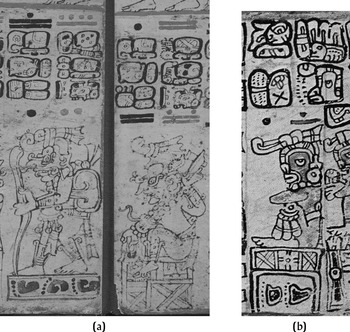
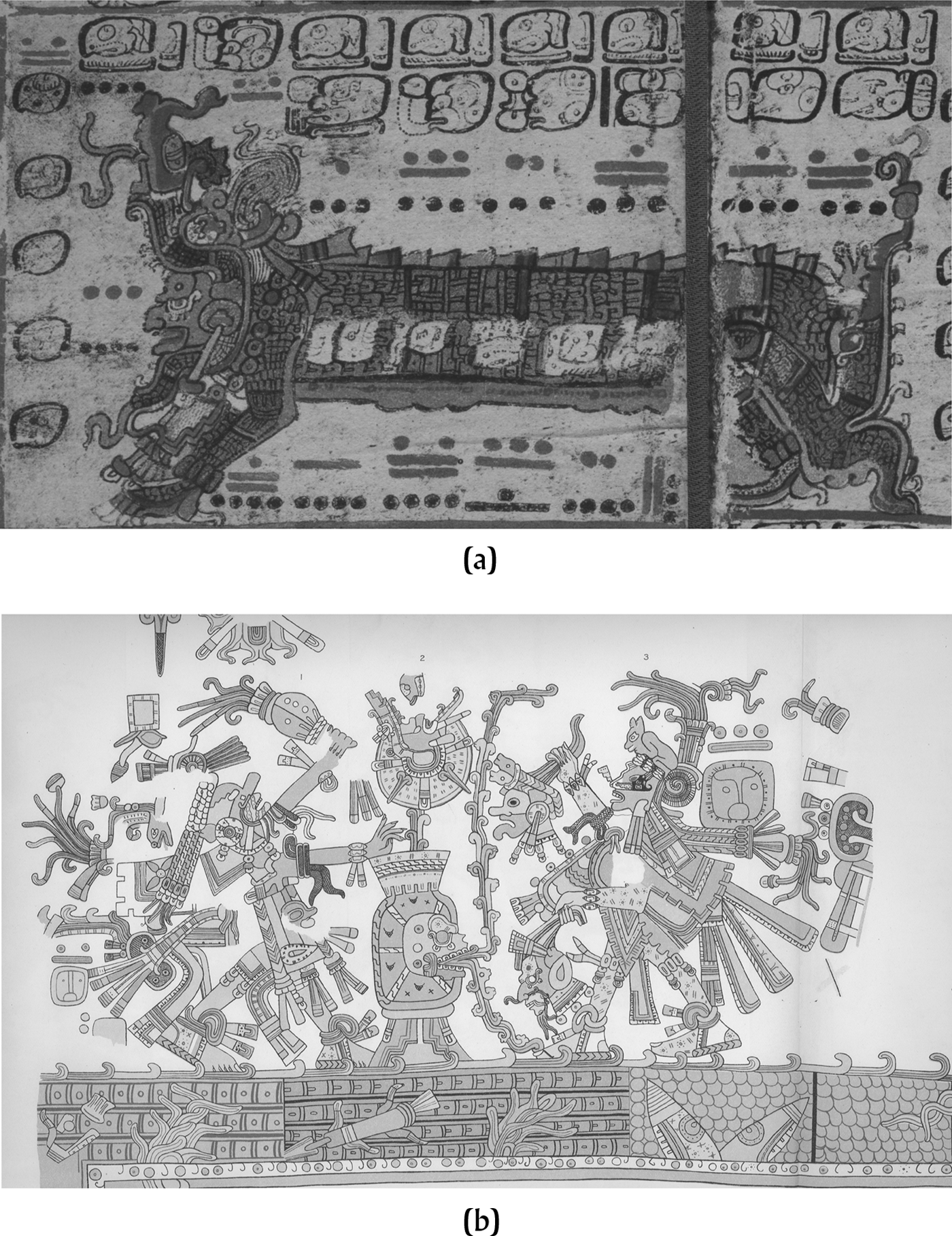
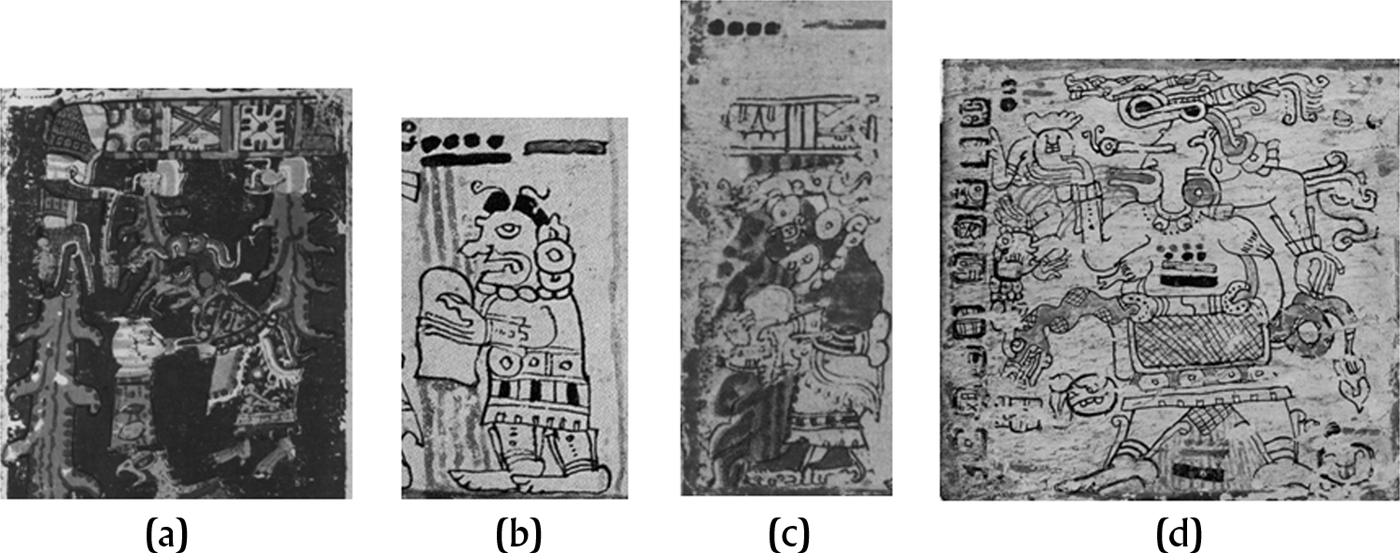
The question of why these particular instruments were preserved and recorded in codices post-dating their composition by approximately 500 years is an intriguing one. The Brickers suggest that these instruments were important because they record the relationship between the tropical year of 365.2422 days (the more accurate measure of the time it takes the Earth to revolve one time around the Sun) and the 365-day haab'. This was accomplished by measuring the distance between the midpoint of the haab' and the day on which the summer solstice fell. Whereas the Half Year preceded the summer solstice in the Dresden table (the former is pictured in Frame 3 of Dresden 65b–69b and the latter in Frame 4) (see Figure 1a), the two occur on the same day in the Madrid almanac (see Figure 1b). The different intervals between the Half Year and the summer solstice recorded in both instruments are a consequence of the recession of fixed dates in the haab' relative to the tropical year. Other almanacs in the two codices are also concerned with pinpointing this relationship (V. Bricker and H. Bricker Reference Bricker, Bricker and Aveni1992). Rather than using a leap year to keep the haab' aligned with the tropical year, the pre-Hispanic Maya instead incorporated this method of determining the slippage between the two (V. Bricker and H. Bricker Reference Bricker, Bricker and Aveni1992).
(a) Summer solstice and Half Year iconography on pages 65b–66b of the Dresden seasonal table and (b) from page 11c of the Madrid seasonal almanac (courtesy of the Museo de América, Madrid). The former is symbolized by the deity Chaak (or another deity substituting for him) seated on a skyband, whereas the latter is symbolized by Chaak on a road with footprints leading from right to left, according to a model proposed by Bricker and Bricker (Reference Bricker and Bricker1988). After Anders (Reference Anders1967) and Förstemann (Reference Förstemann1880).

Why this relationship would have been of such importance to Late Classic and Postclassic Maya scribes undoubtedly lay in the need to accurately track the seasonal year with regard to the timing of events and activities crucial to Maya culture, including preparations for planting the crops and the advent of the rainy season. Indeed, the focus of Madrid 10b–11b is almost exclusively on these matters. Tracking these events was of significant concern to a culture in which life was ruled by the fate of particular time periods and the deities who influenced them. By knowing in advance which upcoming days had unfavorable associations, the appropriate rituals could be enacted to mitigate their effects.
Other events recorded in the Dresden seasonal table include references to eclipses or eclipse seasons (the time during which the appropriate conditions necessary for a solar or lunar eclipse occurred) (see V. Bricker and H. Bricker Reference Bricker and Bricker1988, Reference Bricker, Bricker and Aveni1992) and to Venus stations (Hernández and Vail Reference Hernández and Vail2007). These events are depicted on a page from the Dresden Codex (Dresden 74) that appears to concern a specific point in the cosmic cycle of world destruction, followed by re-creation (the latter seen on Dresden 25–28), as suggested by Karl Taube (Reference Taube1988:143–147).
These examples reveal some of the kinds of cultural knowledge gleaned from the past that were vital to the functioning of Late Postclassic Maya society. Doubtless there were many forms of transmission of such knowledge, including oral media (such as stories or songs) as well as written. The fact that they were considered of sufficient importance to have been recorded in a Late Postclassic screenfold means that they are available to us for examination and scrutiny. It is of considerable interest to see what earlier texts were considered salient and how these texts reflect the worldviews of the Classic period and Late Postclassic scribes.
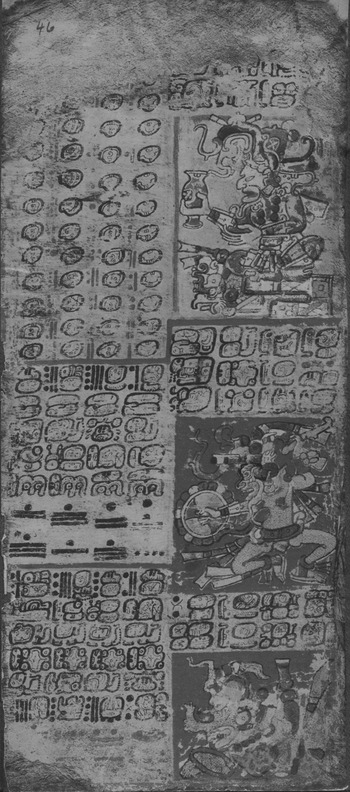
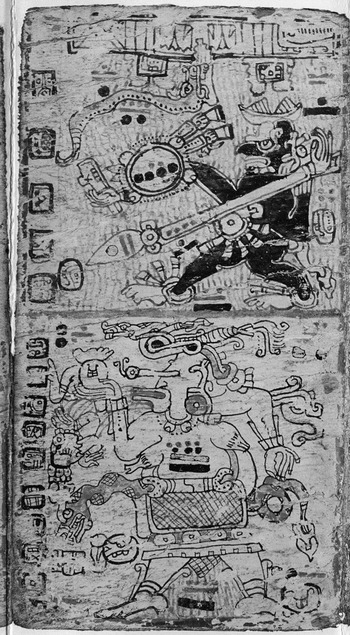
A case in point involves the Venus table that appears on pages 24 and 46–50 of the Dresden Codex (Figure 2). Page 24 contains introductory information required for using the table and linking it to the Maya Long Count. The table itself appears on pages 46–50 and includes Calendar Round dates, pictures, and hieroglyphic texts that were used to calculate dates and prognostications associated with the passage of Venus through its four synodic stations: first and last visibility as a morning star (MFIRST and MLAST, respectively) and first and last visibility as an evening star (EFIRST and ELAST, respectively). It appears that this table was originally drafted for use in the tenth century (Bricker and Bricker Reference Bricker, Bricker, Ruggles and Urton2007; Lounsbury Reference Lounsbury, Aveni and Brotherston1983). Evidence from the table's preface on page 24 suggests that the Classic period version was copied into the Dresden Codex with updated base dates and additional multiples required for calculating relevant dates for Venus cycles as late as the thirteenth century from an earlier table (Bricker and Bricker Reference Bricker, Bricker, Ruggles and Urton2007). It is even the case, as the Brickers note, that the table of multiples on page 24 takes into account corrections that would allow the Venus table to have been used accurately in the eighteenth century, almost a full millennium after it was initially composed (V. Bricker and H. Bricker Reference Bricker, Bricker and Aveni1992:84).
Dresden 46, showing the eastern aspect of Venus (its heliacal rise) on the right side of the page. The deity pictured in the middle register is a personification of Venus as a warrior; he hurls his darts at the figure in the lower register. After Förstemann (Reference Förstemann1880).

A recent re-analysis of the Dresden astronomical tables suggests that depictions of events from mythological time before humans inhabited the earth form the basis of a number of almanacs and tables in the Maya hieroglyphic codices (Vail and Hernández Reference Vail and Hernández2012). Although they highlight episodes from creation stories, their primary purpose was to contextualize historical events in terms of the actions of the deities and the forces that gave birth to the present world and its inhabitants. In this sense, then, they serve a metaphorical role.
Recent research reveals that one creation episode in particular was utilized by Late Postclassic Maya scribes, both in the codices and in narratives recorded in the form of murals on the walls of structures (Vail Reference Vail, Cecil and Pugh2009; Vail and Hernández Reference Vail, Hernández, Fort, Gardiol, Matteo and Helmke2009). Texts from the Books of Chilam Balam suggest that it continued to be recorded by scribes into the Colonial period. It refers specifically to the ascent of a crocodilian figure known as Itzam Kab' Ayin (Itzam Cab Ain in the colonial orthography) into the sky, at which time its throat was cut and its body thrown to earth to become the surface of the land. This event is linked in some as yet unexplained way to a later flood that resulted in the destruction of the world, followed by its re-creation when trees or pillars associated with specific birds were raised in each of the four quarters and the center of the world. The Chilam Balam text references these events as follows:

The Chilam Balam text appears just prior to the 11 Ahaw myth of the flood, which details the destruction and re-creation of the world. The flood itself, which is described as “one fetching of rain, one lancing of rain” (Chumayel 43.14; translated by Knowlton [2009:117]), is paralleled by the scene on Dresden 74 (discussed below), where rain is shown being poured from an olla by the deity Chak Chel (its “fetching”), in association with a black deity with a spear (which symbolizes the “lancing” of the rain), as Timothy Knowlton (Reference Knowlton2010:62) convincingly demonstrates.
This event—the destruction of the world by water—is followed by its re-creation:

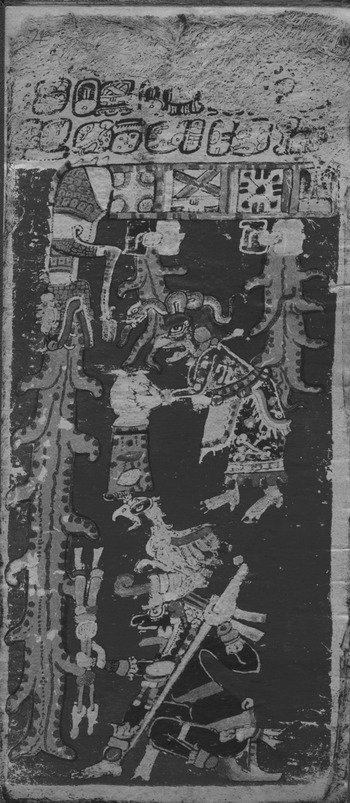
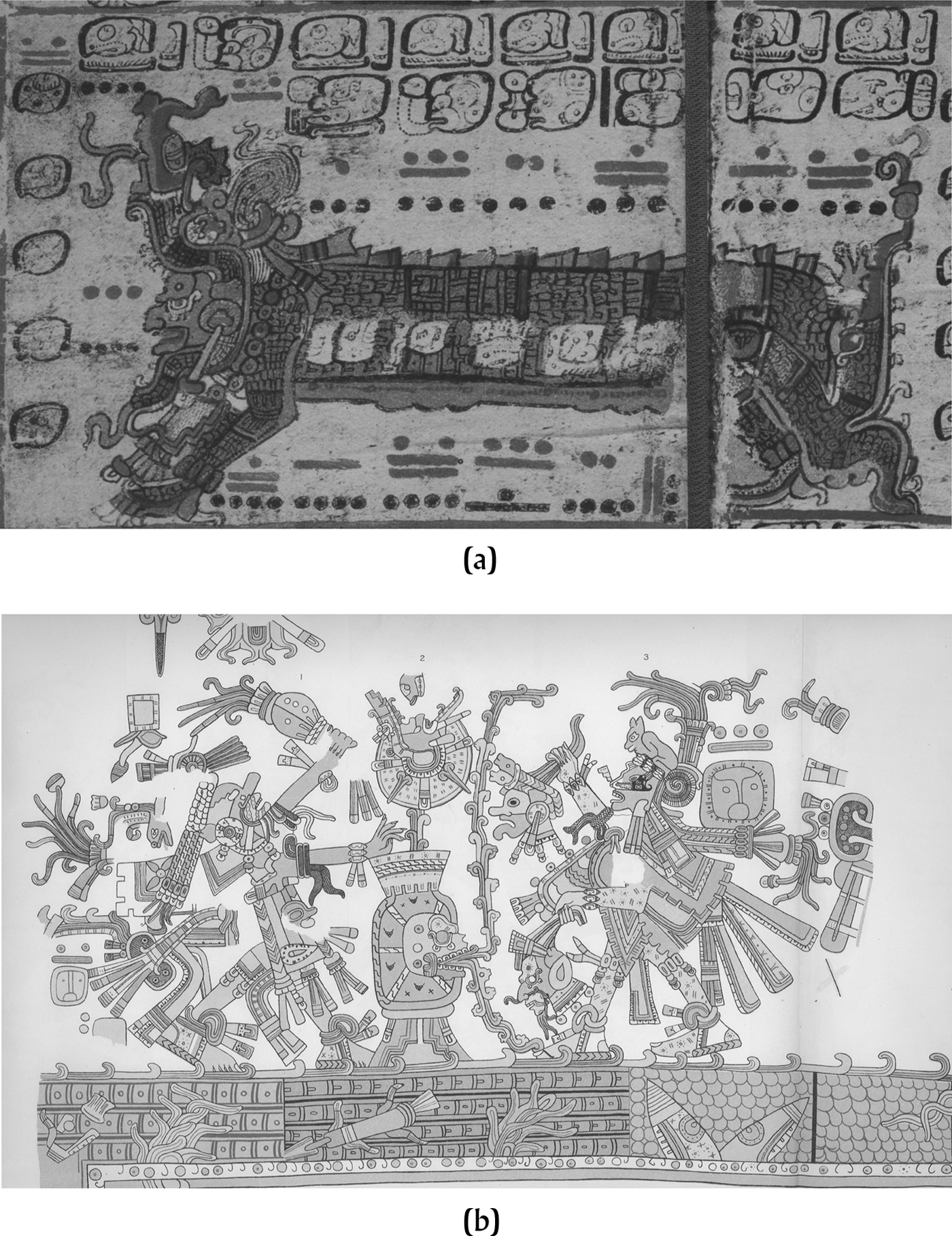
Several examples serve to illustrate how imagery relating to these episodes of creation and destruction were utilized by codical scribes to give meaning to and provide a metaphorical context for specific intersections of calendrical and astronomical cycles that have a bearing on important seasonal events and activities. The first, on Dresden 74 (Figure 3), pictures the ascent of a crocodilian into the sky (as suggested by the band of glyphs indicating celestial elements on its body), its possible dismemberment (note that only the front part of its body is shown and that it no longer appears to be whole), and the resulting flood. Water gushes not only from the crocodilian's mouth, but also from solar and lunar eclipse glyphs dangling from its body (signifying an eclipse season that could have repercussions for the weather or for fertility more generally) and from the olla being overturned by the female creator deity Chak Chel. At the bottom of the page, a black deity known as God L appears in a pose and carrying weapons suggesting his association with the deities depicted in the Venus table on pages 46–50 of the Dresden Codex (Hernández and Vail Reference Hernández and Vail2007; Milbrath Reference Milbrath1999) (compare to deity in middle register of Figure 2). In his warrior aspect, God L was a deity to be especially feared. Lore associated with Venus suggests that the “great star” was considered especially dangerous at the time of its reappearance in the celestial sphere, following its sojourn in the Underworld realm (equated with its disappearance during inferior and superior conjunction) (see Aveni Reference Aveni2001:186; Thompson Reference Thompson1972:67).
The ascent of the earth crocodilian into the sky on Dresden 74, an event linked to the mythological flood that destroyed the previous creation. Water also flows from the overturned olla held by Chak Chel; note the series of numerals in the flow of water—a bar for five, a dot for one, and the symbol for zero, followed by the glyph for the day Eb'. At the bottom of the scene, a black deity known as God L (also pictured in Figure 2) appears in the guise of Venus as warrior. After Förstemann (Reference Förstemann1880). Images (b) and (d) courtesy of the Museo de América, Madrid.

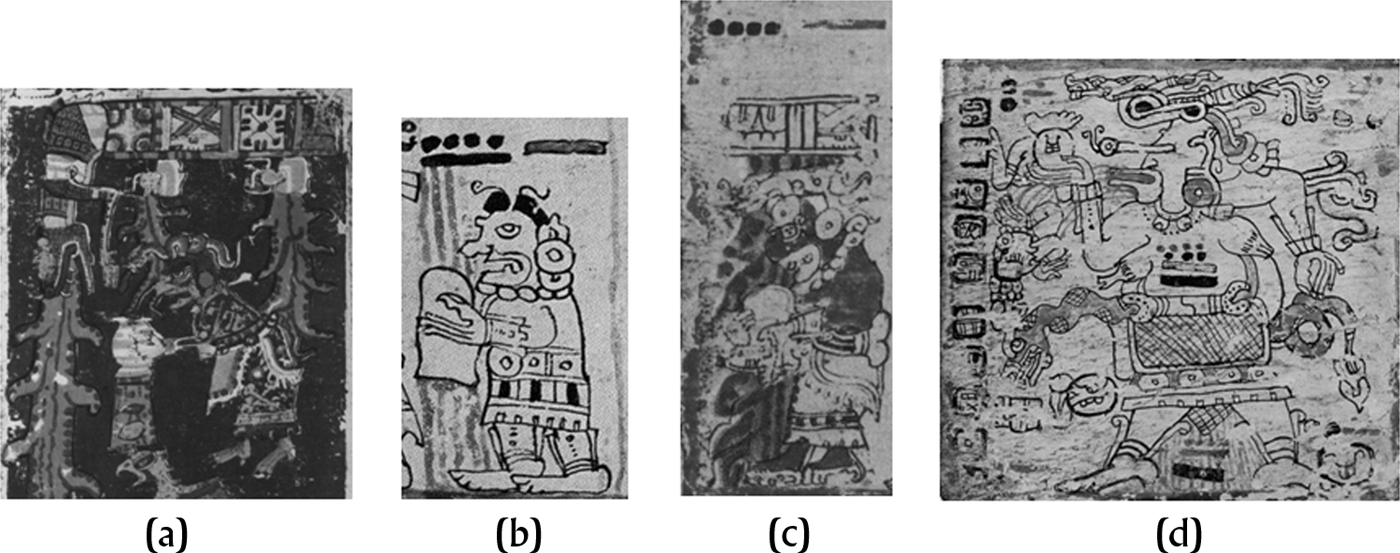
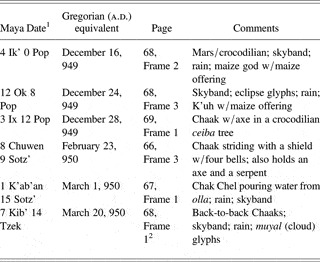
We interpret the Dresden 74 scene as follows: The water issuing from the crocodilian's mouth is a reference to the primordial flood, whereas the eclipse glyphs portend possible solar and lunar eclipses, times of danger associated in Maya mythology with the end of the current world era (Closs Reference Closs and Aveni1989; Milbrath Reference Milbrath1999:25–27). Chak Chel is pictured overturning an olla of water in various almanacs throughout the codices (Figure 4). In several of these contexts (Table 1), this iconography appears to be a seasonal indicator calling attention to the coming rainy season. Chak Chel's appearance (i.e., whether she is depicted in human or bestial form) serves, we believe, as an omen signaling the character of the weather to come. On Dresden 74, she has clawed hands and feet and wears a death-eye apron with a crossed-bones motif, clearly a negative “forecast” for the anticipated rains and the success of the upcoming agricultural season.
Chak Chel overturning an olla of water on: (a) Dresden 79; (b) Madrid 10b; (c) Dresden 67a; and, (d) Madrid 32b. After Anders (Reference Anders1967) and Förstemann (Reference Förstemann1880).
Calendrical contexts in which Chak Chel is seen pouring water from an olla in the Maya codices

1Calendar Round dates are given in Classic period notation.
2Aspect is determined by the presence or absence of particular iconographic elements. Those linked to the “destructive” aspect include clawed feet and/or hands, a death-eye collar or apron, skirt with crossed-bones, skulls, and dead figures.
Within the stream of water falling from her jar, there is a numeral in notational format that reads 5.1.0, corresponding to 5 tuns, 1 winal, and 0 k'ins (Taube Reference Taube1988:147), which relates directly to the table of which this page forms a part—the lower “water” table on Dresden 71–74 (see discussion by Bricker and Bricker Reference Bricker, Bricker and Boone2005). Adding this distance number to a base date identified in the upper corner of page 73 (reconstructed as 9.4.16.8.12 4 Eb' 10 Muwan) produces a starting date of 4 Eb' 5 Muwan, or January 6, a.d. 536. The tzolk'in day glyph Eb' appears below the distance number in the stream of water, as an abbreviated reference to this date.
Each of the 28 panels in the lower water table, including that on Dresden 74, is associated with an interval of 65 days. During the 65 days referenced on Dresden 74, the following events occurred: 23 days into the interval, on 1 Men 8 Pax, or January 29, a.d. 536, Venus made its first appearance as an evening star in the western sky (hereafter referred to as EFIRST). This, we believe, explains not only the presence of the black Venus deity at the bottom of the scene, but also why imagery tied to creation mythology is used in this first interval that marks the starting point of the table (see below). Twenty-five days later, an eclipse season opened on 13 Ahaw 13 K'ayab', or February 23, a.d. 536 (note that this is referenced by the paired solar and lunar eclipse glyphs). A solar eclipse occurred on the penultimate day of the interval on 3 Kib' 9 Kumk'u, or March 10, a.d. 536. This date in early March correlates with other dated examples of Chak Chel overturning ollas of water, as we discuss below.
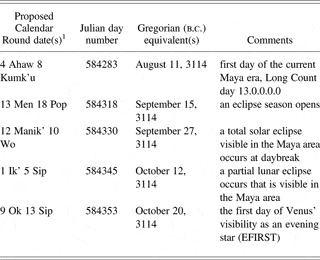
The Classic period scribe who initially compiled this information, which was later copied in tabular format into a Late Postclassic codex, sought to warn the Maya of his time about the dangerous portents that foretold an inauspicious start to the upcoming rainy season—the time of year associated with planting. These included the overlap of a possible eclipse with a Venus EFIRST (or, in Maya terms, the appearance of Venus as a warrior in the western evening sky, and the possibility that the sun would be swallowed 25 days later), a recurrence of similar astronomical events that took place shortly after the creation date (4 Ahaw 8 Kumk'u) of the current era (Table 2). This information would have been considered extremely relevant by the Late Postclassic Maya, who included it in the Dresden Codex to remind themselves and future generations to pay close attention to periods of time when similar conditions prevailed in order to perform the appropriate rituals to counteract the negative influences associated with references to events in the mythological past that had led to the destruction of the previous world age.
Astronomical events of significance occurring shortly after the 4 Ahaw 8 Kumk'u date corresponding to August 11, 3114 b.c.

1Calendar Round dates are given in Classic period notation.
Almanacs on pages 32a and 32b (Figure 5) of the Madrid Codex suggest that another like-in-kind event, which also mirrored the mythic flood (although the crocodilian is not pictured), was of concern to the Late Postclassic scribes who drafted the Madrid Codex. Like the scene on Dresden 74, the upper almanac depicts a skyband with rain, an eclipse season, and a black Venus deity carrying weapons, whereas Madrid 32b shows a deity presumed to be Chak Chel with a serpent at her waist, a distended eye, and lips similar to those that characterize the central Mexican wind god Ehecatl. She is shown in her destructive aspect, as indicated by the femur at her waist and her death-eye collar. Water gushes from her open mouth and from between her legs, and she holds the glyph for ‘wind’ in her hand. Below this, a figure with a closed (kimi) eye indicating death falls through the stream of water issuing from her mouth. A glyphic collocation referring to ‘dead person’ appears below the blue-painted serpent (which may be indicative of flood waters); it is paired with the glyph for sun, k'in, perhaps signifying the death of the sun. A calendrical reconstruction of the two almanacs (discussed below) indicates that Madrid 32b overlaps with the eclipse season referenced in the almanac above it on Madrid 32a. This suggests that its iconography can be understood as showing the repercussions of the predicted eclipse season, which included heavy rains and destructive weather, for the upcoming rainy season.
Almanacs on Madrid 32a and 32b showing elements comparable to those on Dresden 74. The upper almanac includes a skyband, rain, and references to Venus (the black deity) and an eclipse season. Madrid 32b shows Chak Chel in her destructive aspect, linked to a torrential downpour and winds. After Anders (Reference Anders1967). Image courtesy of the Museo de América, Madrid.

A tentative dating for this pair of almanacs associates them with spring dates in a.d. 1503 (Hernández and Bricker Reference Hernández, Bricker, Vail and Aveni2004:303, Table 10.8), correlating well with the astronomical events depicted in the almanacs' iconography (a partial solar eclipse visible in northern Yucatan and a Venus EFIRST). Additionally, the scene on Madrid 32b seems very clearly to portray the personification of a hurricane, storms that we know from historical times to periodically ravage the Yucatan Peninsula. We find this of interest in light of ethnographic data linking the destruction of the world in Lacandon accounts to the aftermath of a hurricane caused by Chäk-ik'al, the east wind god (McGee Reference McGee1989). The scene from Madrid 32b may serve as a pre-Hispanic analogue to this Lacandon belief, in light of the explicit references made to flood waters and devastating winds. We believe that the Madrid scribe made use of an iconographic tradition of world destruction and renewal passed down from his Classic period predecessors to call attention to an event that was like-in-kind to that recorded in creation mythology and depicted on Dresden 74—destruction on a massive scale involving wind, rain, and flooding, converging with predictions for solar and lunar eclipses and a Venus EFIRST, much as had occurred on the era base date referenced mythologically (see Table 2). In the case of Madrid 32b, the combination of two such dangerous portents at the critical point in the year just before the start of the rainy season led to the prognostication of hurricanes for the months ahead. This is an especially compelling example of mythical and historical data being transmitted through generations of scribal hands to create an instrument relevant to the Late Postclassic users of the Madrid Codex.
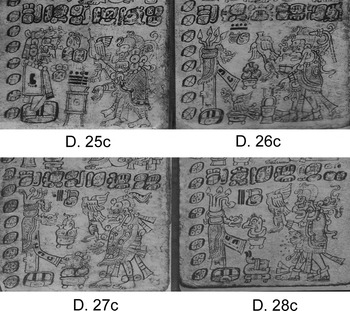
In both the Dresden Codex and the Madrid Codex, these episodes of metaphoric world destruction are linked to almanacs concerned with the performance of rituals associated with the start of a new cycle, here tied to the yearbearer ceremonies (Taube Reference Taube1988:265–266). A similar patterning may be seen in the Paris Codex as well, although there the ceremonies revolve around the ending of k'atuns rather than years (Taube Reference Taube1988:266; Vail and Hernández Reference Vail, Hernández, Fort, Gardiol, Matteo and Helmke2009). The Dresden yearbearer almanac is reminiscent of later texts from the Books of Chilam Balam that describe the setting up of world trees at each of the four quadrants. Such rituals are performed in association with the east, north, west, and south on Dresden 25c–28c (Figure 6), as represented both iconographically and textually. The ‘first tree of creation,’ we are told on Dresden 25c, ‘was set up in the east’ by the sun god K'inich Ahaw, who is pictured in the corresponding scene. The remaining three directional trees are similarly set up by the gods Itzamna (north), Kimil (west), and K'awil (south), although they are not represented in this order in the codex. Rather, as previous researchers have noted, pages 26c and 28c appear to have been transposed by the scribe (Taube Reference Taube1988:221–222; Thompson Reference Thompson1934:214). We believe this is yet another example indicating the likelihood that almanacs were copied from earlier sources by Late Postclassic scribes. A transcriptional error of this nature would have been far more likely to have occurred in the act of copying, rather than when the almanac was originally being composed.
The setting up of the directional world trees on Dresden 25c–28c. After Förstemann (Reference Förstemann1880).

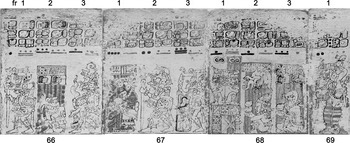
A sequence of events mirroring those found on Dresden 74 and 25–28—and also documented in the Chilam Balam texts cited previously—occurs, as we have recently discovered, in the seasonal table on Dresden 65–69 (Table 3). The scenes in question depict the ascent of the earth crocodilian, which is associated with a deluge, followed by an eclipse season (Figure 7). The former event appears to be represented in the second frame of Dresden 68a, where we see a creature that is identified as Mars in the text with the scales commonly found on the back of the earth crocodilian (Figure 8). This depiction calls to mind the Classic period antecedent of Itzam Kab' Ayin, known as the “Starry Deer Crocodile” (Stuart Reference Stuart2005:70), which has attributes of various creatures, including a crocodile and a deer, as well as “star” glyphs similar to those believed to symbolize Venus in the codices. Although the Starry Deer Crocodile has been associated with the Milky Way by recent scholars (Milbrath Reference Milbrath1999:275–282; Stuart Reference Stuart2005:72), we believe that there is room for other interpretations of its significance (see Vail and Hernández Reference Vail and Hernández2012). In the Chilam Balam text, the ascent of Itzam Kab' Ayin into the sky (represented by the skyband in Figure 7) is a prelude to the destruction of the earth by flood. The latter event may be seen in this and the following frame of the Dresden seasonal table, where rain waters pour from two eclipse glyphs dangling from a skyband. The two scenes have a number of elements in common with Dresden 74, although there are significant differences as well, as we discuss below.
Pages 66a–69a of the Dresden seasonal table. After Förstemann (Reference Förstemann1880).

Examples of the earth crocodilian Itzam Kab' Ayin from (a) Dresden 4b–5b, where Itzamna's head appears in its jaws, and from (b) the west wall mural of Santa Rita Structure 1, where it may be seen as forming an “earth band.” After Förstemann (Reference Förstemann1880) and Gann (Reference Gann1900:Plate 31).
Historical events recorded in the upper seasonal table on Dresden 65a–69a linked with creation-related iconography

1The Calendar Round dates are given in Classic period notation.
2For a discussion of this frame and its seasonal implications, see Bricker and Bricker (Reference Bricker and Bricker1988). It was not included in the present discussion.
In the final frame of Dresden 65a–69a (see Figure 7), the rain god Chaak is perched in a tree with spines that appears to be formed from the body of the crocodilian earth monster (note the crocodilian's head at the base of the tree). This scene has several possible interpretations; the most likely, we believe, is that it alludes to the tearing apart of the earth monster referenced in central Mexican texts (Taube 1993:37). This act can be associated with world creation in that the crocodilian's body was used to form both the earth (the red half of the tree in the Dresden image) and the sky (the blue half of the tree). Additionally, the scene calls to mind the trees of creation referenced in the Chumayel text from the Books of Chilam Balam (quoted above) and depicted in the lower register of the Dresden yearbearer pages.
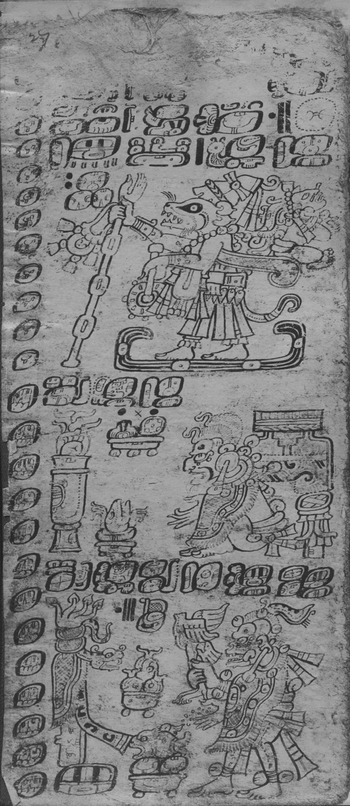
Despite the similarities noted above, the Dresden seasonal table can be distinguished from the Chilam Balam account in various respects, the most important being that it is placed in historical time and encompasses events that are not included in the creation story, including the visibility of Mars and the presence of the maize god (Dresden 68a, Frame 2), and the deity K'uh holding an offering (Dresden 68a, Frame 3). An analysis of the seasonal table by Bricker and Bricker (Reference Bricker and Bricker1988) indicates that each of its frames can be correlated with two different sets of dates, one associated with the upper set of distance numbers and coefficients and the other with the lower set. The Brickers' study proposes dates for Dresden 68a (Frames 2 and 3) and Dresden 69a (Frame 1) corresponding to December 16, 24, and 28, a.d. 949 (upper set), and March 25, April 1, and April 9, a.d. 950 (lower set) (Bricker and Bricker Reference Bricker and Bricker1988). Mapping the sky for the dates in question reveals that the astronomical events depicted (Mars rising as a morning star and the onset of the eclipse season) correspond with the December dates, rather than with those in the late spring. Moreover, the picture of the maize god holding an offering (see Figure 7) provides a better fit with the December 16, a.d. 949 date, which corresponds to 4 Ik' 0 Pop in the Maya calendar. This is a yearbearer date, and iconography from the middle register of Dresden 25–28 indicates that the deities associated with particular years were given offerings on 0 Pop. The maize god is shown as one of the deities associated with Ik' years on Dresden 27 (Bricker and Bricker Reference Bricker and Bricker1988:S13–S14) (Figure 9).
Page 27 of the Dresden yearbearer almanac, showing the maize god as the patron of Ik' years (upper register), where he is being carried by the opossum deity. In the middle register, Itzamna is seated within a temple, where he has been given offerings. After Förstemann (Reference Förstemann1880).

It is our contention that, rather than expressing real-time events, the rain associated with the frames picturing the maize god and K'uh serves rather to indicate the portents for the coming year, which include torrential rains “caused” by the celestial events depicted—the heliacal rise of Mars within several days of an eclipse season. That this is the case is borne out by the iconography and text of two additional frames in the seasonal table (see Figure 7) that depict Chak Chel (Dresden 67a, Frame 1) and a Venus event (Dresden 67a, Frame 2).
In the first of these frames, Chak Chel appears in her destructive aspect pouring water from an olla; above her is a skyband with water falling from it. The next frame (Dresden 67a, Frame 2) contains a picture of a striding Chaak, who holds a spear, a shield decorated with an ix (jaguar) glyph and four bells, and an incense bag. We contend that the imagery in these two frames can be linked to events in real time, like those on Dresden 74, and that they, too, make reference to the primordial flood story.
We begin with a discussion of the second frame on Dresden 67a, which can be correlated with the following dates:
upper: 8 Ahaw 3 Kumk'u (November 24, a.d. 949), with an interval of 7 days
lower: 5 Imix 19 Sotz' (March 5, a.d. 950), with an interval of 2 days
The hieroglyphic caption to the frame refers to the “throwing down” or spearing of the god K'awil by a black manifestation of Chaak called Ek' Xib'? Chaak. The final two glyph blocks can be read as na'ak-aan sak k'in or ‘the white [or false] sun rose’ (Bricker and Bricker Reference Bricker and Bricker2011) (Figure 7). The Brickers argue that this phrase refers to the visibility of Venus as a morning star in the late fall of a.d. 950, as per the upper set of dates for this frame, but in the third run of the table. We contend, on the other hand, that the caption does indeed refer to the visibility of Venus, but as evening star in the early spring of a.d. 950, using the lower set of dates in the first run of the table. This corresponds with one of the astronomical events referenced on Dresden 74—the first visibility of Venus as an evening star (EFIRST). In support of our interpretation, we note that among the contemporary Lacandón Maya, the evening aspect of Venus is called ah sah k'in ‘false sun’ (Bruce et al. Reference Bruce, Robles U. and Chao1971:15) or ‘white sun’ (Rätsch Reference Rätsch1985:37–38), whereas the morning star goes by a different name.
The heliacal rise of Venus as an evening star technically occurred on February 23, a.d. 950, corresponding to Frame 3 on Dresden 66a (which also has iconography that we believe refers to this aspect of Venus). However, over the next 10 days Venus set fairly early (before the end of twilight); it was not until the dates referenced in Frame 2 of Dresden 67a (March 5 and 6, a.d. 950) that Venus stayed above the horizon as an evening star long enough once the sky had darkened to appear to have risen. That the evening star aspect of Venus was the event of importance to the scribe who composed the Dresden seasonal table is moreover suggested by the second date in the interval of Frame 2.
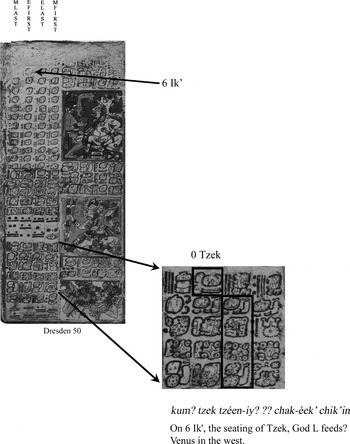
This date, 6 Ik' 0 Tzek, is a Calendar Round that appears explicitly on the fifth page of the Dresden Venus table (Figure 10), where it refers to the canonical date for Venus' first appearance in the western sky as evening star (EFIRST) for the 18 K'ayab' version of the table, which begins with Venus' heliacal appearance as morning star on November 23, a.d. 934 (discussions of the structure of the Venus table may be found in Bricker and Bricker [2011]; Milbrath [1999:163–177]; Schele and Grube [1997]; Thompson [1972]; and Vail and Hernández [2012]). This event (Venus' canonical rise as evening star) recurs every 584 days, according to the table appearing on pages 46–50 constructed by the Dresden scribes. 6 Ik' 0 Tzek corresponds to March 6, a.d. 950, the same date as that reached by adding one day to the starting interval of Frame 2 on Dresden 67a, using the lower set of distance numbers. Other correspondences between that frame and the relevant text from the Venus table include the mention of black-colored deities (the black God L, who is also seen on Dresden 74 and is named on Dresden 50, and a black manifestation of Chaak on Dresden 67a), suggesting an association with the west, based on the system of color-directional symbolism in use in the Maya codices. Indeed, chik'in ‘west’ is mentioned explicitly in reference to God L on Dresden 50, although it must be inferred for the black Chaak pictured on Dresden 67a.
Page 50 of the Dresden Venus table. The highlighted date and text refer to the canonical starting date of the predicted interval of Venus' first appearance in the western sky as an evening star, followed by the name of the deity who presides during the interval predicted for Venus to appear as an evening star. This particular section refers to the thirteen EFIRST occurrences that take place in the early spring of the tenth and early eleventh centuries (see http://mayacodices.org/AlmDetail.asp?almNum=377, column 19). As is usual in Maya tables and almanacs, the tzolk'in date is given in the frame previous to that containing the relevant hieroglyphic caption.

The previous frame on page 67a, picturing Chak Chel in her destructive aspect, begins on March 1, a.d. 950, several days prior to the Venus event. It occurs on the same day in the tropical year as the frame depicting Chak Chel with an overturned jar on Madrid 10b (see Figure 4 and Table 1), according to a model proposed by Bricker and Bricker (Reference Bricker and Bricker1988) for dating this almanac in real time. In the Madrid almanac, however, Chak Chel is not shown in her destructive aspect. The Madrid example has been dated to a.d. 925 and the example on Dresden 67a to a.d. 950. Additionally, the 65-day interval represented on Dresden 74 ends on March 10, a.d. 536, meaning that the same period of time is represented.
We interpret the first two frames on Dresden 67a as being cognate with the scene on Dresden 74. In the second frame on Dresden 67a, the black (or western) aspect of Chaak refers to the first visibility of Venus as evening star, much as the black-colored God L does on Dresden 74. We believe that Chak Chel is shown in her destructive aspect on both Dresden 67a and Dresden 74 because of the negative influence exerted by Venus' appearance as evening star. The ill omens associated with Venus when it first appears as a morning star are well known from the iconography and texts contained in the Dresden Venus table (e.g., Schele and Grube Reference Schele and Grube1997:148–156; Thompson Reference Thompson1972:67–68), and it is likely that similar associations pertained to its initial appearance as an evening star as well (Carlson Reference Carlson, Aveni and Brotherston1983).
The scenes discussed above from the Dresden seasonal table can clearly be shown to encompass the mythologies recorded in the Books of Chilam Balam (Knowlton Reference Knowlton, Fort, Gardiol, Matteo and Helmke2009, Reference Knowlton2010), which are also expressed in specific scenes from pages 74 and 25–28 of the Dresden Codex. In fact, the upper seasonal table appears to include imagery from both Dresden 74 (the skyband, crocodilian, eclipse glyphs, Venus deity, Chak Chel emptying a year of water, and rainwaters) and Dresden 25–28 (the yearbearer deities, presentation of offerings, and world directional trees).
DISCUSSION AND CONCLUDING REMARKS
Whether the emphasis is on Long Count, tzolk'in, or Calendar Round dates, the purpose of the almanacs and tables recorded in the Maya codices appears to be two-fold: that of scheduling (and providing mnemonics for the performance of) rituals and related activities, and of predicting the occurrence of certain events such as the appearance of a particular aspect of Venus or a solar eclipse in order to avert the harmful influences that could occur when one was unprepared for such perilous moments in time, perils caused by the deities corresponding to these celestial bodies when the appropriate ritual actions were not undertaken.
In order to perform their functions adequately, Maya calendrical specialists relied on the knowledge of previous generations, who spent countless hours tracking seasonal, meteorological, and astronomical phenomena to determine the cycles best suited to predicting the recurrence of those events having the most profound impact on their lives. These data, the collective knowledge gathered by the predecessors of the Late Postclassic Maya, were recorded for future generations in the form of almanacs and tables in painted screenfold manuscripts.
Information from the extant Maya codices indicates the importance of this medium for the transmission of cultural knowledge over the course of many generations. Scholarship over the past three decades reveals that the Dresden, Madrid, and Paris codices contain almanacs and/or tables originally compiled for use in the Classic period (H. Bricker and V. Bricker Reference Bricker, Bricker and Aveni1992, Reference Bricker, Bricker, Ruggles and Urton2007; V. Bricker and H. Bricker Reference Bricker and Bricker1988, Reference Bricker, Bricker and Aveni1992; Lounsbury Reference Lounsbury, Aveni and Brotherston1983), whereas the Dresden and Madrid codices also have instruments intended for use in the Late Postclassic period (Bricker Reference Bricker, Bricker and Vail1997; V. Bricker and H. Bricker Reference Bricker, Bricker and Aveni1992). Dated references span the fifth through the fifteenth centuries. In contrast to the historical events involving specific individuals and lineages that were recorded in public media, the emphasis in the codices on tracking astronomical and seasonal events stems from their importance in scheduling activities necessary to survival (planting, harvesting, hunting and trapping game animals, etc.). They also contained the data necessary for making accurate predictions and prophecies which provided the means of placating the deities.
We know from sources such as Landa's Relación de las cosas de Yucatán that the sons of the Maya elite were trained by priests, who taught them “their sciences, to make known their needs and the remedies for them, to preach and to publish the festival days, to offer sacrifices and to administer their sacraments” (Tozzer Reference Tozzer1941: 111–112). We also know, from recent studies of cross-cultural influences, that Late Postclassic Maya priests and scribes continually sought new ways of understanding their world and of transmitting this knowledge (Hernández and Bricker Reference Hernández, Bricker, Vail and Aveni2004; Just Reference Just, Vail and Aveni2004; Vail and Hernández Reference Vail and Hernández2010, Reference Vail and Hernández2012). One of the ways they accomplished this was by drafting almanacs for their own use that were intended to be passed on to their apprentices and descendants. The almanacs on Madrid pages 32–33 are a classic example of how past knowledge, as recorded on Dresden 74, could be reinterpreted and applied to situations affecting the Yucatec Maya in the fifteenth century.
It has been proposed that Mesoamerican codices were used as memory aids for the performance of mythic narratives (King Reference King, Bonne and Mignolo1994; Tedlock Reference Tedlock1996:29–30). Whether the Maya divinatory codices functioned in a similar fashion is a matter of debate. Certainly, they provided mnemonics for the performance of various types of rituals (fire drilling, bloodletting, rain making ceremonies, etc.). The fact that the protagonists in these manuscripts are the deities themselves may provide support for the interpretation that rituals were performances in the sense that the officiate impersonated—or was believed to actually embody—the deity associated with the particular day or period of time on which the ceremony was being enacted. This is suggested by the texts of certain almanacs, such as that on Madrid 38b, in which the hieroglyphic captions state that “___'s fire was drilled” (“___” being the name of a particular deity, which changes based on the date associated with the event). In other words, the action depicted in the codex is meant to be performed on behalf of a certain deity. Additionally, a number of codical texts specify not only the types of ritual offerings to be made, but also the number of offerings required by the gods who will receive them.
Whether the Maya codices were used for the performance of mythic narratives as well is something that remains a subject of speculation. The recent recognition that there are narrative texts in these manuscripts, found for example in the prefaces to the Dresden astronomical tables, offers a glimpse of the possibilities. Dennis Tedlock (Reference Tedlock1996:30) suggests that the Popol Vuh is an expanded version of a hieroglyphic codex and that it details in written form “what readers would say when they gave a long performance, telling the full story that lay behind the charts, pictures, and plot outlines of the ancient book.” That the sixteenth-century text of the Popol Vuh was copied from an earlier source (or several earlier sources) is evident from comments the redactor(s) included in the manuscript. In this way, it is similar to the histories we have outlined for the Late Postclassic Maya codices, which likewise represent documents that were compiled from earlier sources. Although these earlier codices no longer exist, the memories of their creators live on in the manuscripts we know of today as the Dresden Codex, the Madrid Codex, and the Paris Codex.
It was likely from codical sources such as these, coupled with stories passed on verbally through the generations, that the scribes who recorded the texts that reference the time before the Spanish Conquest in the Yucatecan Books of Chilam Balam derived their material. It is not hard to imagine a Colonial period scribe drawing inspiration for the account of Itzam Kab' Ayin and the flooding of the world from one of the many depictions of this event that undoubtedly filled the pages of the pre-Hispanic codices. It is telling as well that the authors of the Popol Vuh from the distant Maya highlands related a similar story about a crocodilian (Zipacna, from the Nahuatl term cipactli) and its destruction.Footnote 1 Clearly, parallel narrative traditions existed in many parts of the Maya area (and throughout Mesoamerica more generally), stories learned from the ancestors and passed down through the generations in written form, and undoubtedly also as narrative performances. Memories from the distant past were linked to the present and future through like-in-kind events first noted by celestial observers in what we today call the Preclassic period; many of them continue to have cultural salience among the descendants of pre-Hispanic Maya cultures living in Mexico, Guatemala, Belize, and Honduras today.
RESUMEN
Los códices mayas fueron depósitos importantes del conocimiento cultural y las tradiciones pasaron por los siglos. En vez de enfocar en los actores humanos, sin embargo, los códices del periodo posclásico contienen almanaques que predican los movimientos de planetas y la luna durante tiempos mucho más tempranos. El propósito de estos instrumentos aparentemente anticuados fue predecir el futuro según las nociones de los mayas del tiempo cíclico. Investigaciones recientes sugieren que los almanaques astronómicos de siglos pasados hacen más que reflejan el pasado o formulan rituales. En vez de eso, estiman la interacción de acontecimientos celestiales con otros ciclos de tiempo y los contextualizan con la mitología, en particular la destrucción del mundo anterior por inundación. La memoria de este acontecimiento primordial calamitoso, encuadrado en términos de ciclos astronómicos y temporales, es conservada en los documentos prehispánicos e históricos para transmitir la mala fortuna asociada con eventos similares que están predestinados a repetir y ayudar en el realizar de acciones rituales apropiadas para mitigar su potencial destructivo.
ACKNOWLEDGMENTS
The senior author would like to thank Travis Stanton for the invitation to participate in the symposium “Collective Memory in Middle America” at the 72nd Annual Meeting of the Society for American Archaeology in Austin, Texas, which served as the inspiration for the present study. Comments from the symposium participants and audience were especially helpful in reworking the ideas presented in the original paper. We also appreciate the feedback from the two reviewers, whose comments were extremely constructive and helped us to clarify our discussion of this complex topic.