Introduction
Identifying healthy individuals with genotypes that suggest increased risk of psychiatric illness provides an opportunity to reduce the burden of disease through environment-specific intervention at a pre-symptomatic stage. Heritability estimates of 33–48% provide evidence of a genetic component for major depressive disorder (McGuffin et al. Reference McGuffin, Katz, Watkins and Rutherford1996; Kendler & Prescott, Reference Kendler and Prescott1999) whereas lifetime risk for unaffected individuals with a first-degree relative with major depressive disorder is estimated to be 10–25% (Hill & Sahhar, Reference Hill and Sahhar2006). However, as a complex disorder, the contribution of any single gene to the causation of depression is likely to be small as additional genetic and environmental risk factors must be taken into account.
Disclosure of genotyping information about risk for major depressive disorder (Wilhelm et al. Reference Wilhelm, Meiser, Mitchell, Finch, Siegel, Parker and Schofield2009) or Alzheimer's disease (Green et al. Reference Green, Roberts, Cupples, Relkin, Whitehouse, Brown, Eckert, Butson, Sadovnick, Quaid, Chen, Cook-Deegan and Farrer2009) to asymptomatic adults has been shown to provide a benefit to individuals with ‘low-risk’ variants and to cause low to modest distress to those with an ‘increased risk’ variant. Although most genetic testing is currently available only through a health-care provider, an increasing range of tests are being offered direct-to-consumer (DTC; Hudson et al. Reference Hudson, Javitt, Burke and Byres2007) without medical supervision, raising concerns about the psychosocial impact of risk disclosure. This has stimulated popular debate about the right-to-know or not to know one's own genetic information, and whether predictive genetic tests, especially those available DTC, provide useful information about one's health (Shetty, Reference Shetty2008). Many genetic tests offered DTC involve unreplicated gene–disease associations and have uncertain predictive value and clinical utility (Kraft & Hunter, Reference Kraft and Hunter2009). Furthermore, without medical supervision, consumers may be at risk of making uninformed health decisions (Cameron et al. Reference Cameron, Sherman, Marteau and Brown2009).
Few data exist on both the determinants of community interest in such testing and its psychosocial impact. Given current international concern about unregulated predictive genetic testing, such data are required urgently to inform national and international policy development.
Previous studies on attitudes towards genetic testing for susceptibility alleles thought to be involved in some mental illnesses have been limited predominantly to preliminary and/or qualitative studies involving people with an unspecified psychiatric diagnosis (Laegsgaard & Mors, Reference Laegsgaard and Mors2008), people with multiple relatives affected by bipolar disorder (Smith et al. Reference Smith, Sapers, Reus and Freimer1996; Trippitelli et al. Reference Trippitelli, Jamison, Folstein, Bartko and Depaulo1998; Jones et al. Reference Jones, Scourfield, McCandless and Craddock2002; Meiser et al. Reference Meiser, Mitchell, McGirr, van Herten and Schofield2005, Reference Meiser, Kasparian, Mitchell, Strong, Simpson, Tabassum, Mireskandari and Schofield2008) or schizophrenia (Austin et al. Reference Austin, Smith and Honer2006; DeLisi & Bertisch, Reference DeLisi and Bertisch2006), and psychiatrists (Smith et al. Reference Smith, Sapers, Reus and Freimer1996; Jones et al. Reference Jones, Scourfield, McCandless and Craddock2002; DeLisi & Bertisch, Reference DeLisi and Bertisch2006). These studies have generally found positive attitudes towards predictive genetic testing for predisposition to psychiatric disorders. One recent quantitative study involving families with a high density of bipolar disorder showed that interest in hypothetical genetic testing increased with the degree of certainty indicated by the test (Meiser et al. Reference Meiser, Kasparian, Mitchell, Strong, Simpson, Tabassum, Mireskandari and Schofield2008). Further studies reported strong support for predictive genetic testing for predisposition to psychiatric disorders but were limited to people with a diagnosis of major depressive disorder, bipolar disorder, schizophrenia and/or anxiety disorders participating in psychiatric genetic studies (Illes et al. Reference Illes, Rietz, Fuchs, Ohiraun, Prell, Rudinger, Maier and Rietschel2003; Laegsgaard et al. Reference Laegsgaard, Kristensen and Mors2009). Our previous qualitative study found positive public interest in depression risk genotyping, which was negatively influenced by the potential for discrimination and loss of privacy (Wilde et al. Reference Wilde, Meiser, Mitchell and Schofield2010). Participants showed trust in obtaining such a test through the medical system but were wary of DTC genetic testing services.
The present investigation is the first national population study to examine this issue for genetic variations associated with mental health in general. This study uses the hypothetical example of serotonin transporter genotyping as it has been previously reported to convey a gene–environment risk for major depressive disorder (Caspi et al. Reference Caspi, Sugden, Moffitt, Taylor, Craig, Harrington, McClay, Mill, Martin, Braithwaite and Poulton2003; Eley et al. Reference Eley, Sugden, Corsico, Gregory, Sham, McGuffin, Plomin and Craig2004; Kaufman et al. Reference Kaufman, Yang, Douglas-Palumberi, Houshyar, Lipschitz, Krystal and Gelernter2004; Kendler et al. Reference Kendler, Kuhn, Vittum, Prescott and Riley2005; Taylor et al. Reference Taylor, Way, Welch, Hilmert, Lehman and Eisenberger2006; Wilhelm et al. Reference Wilhelm, Mitchell, Niven, Finch, Wedgwood, Scimone, Blair, Parker and Schofield2006).
The present study proposes the following hypotheses: interest in predictive testing for a depression-risk genotype will be (i) greater if available from a doctor rather than DTC on the internet; and will be positively associated with (ii) having a personal history of mental illness and (iii) lower perceived social stigma attached to mental illness.
Method
Participants across Australia were recruited by a contracted market research company in May 2008 using random digit dialling of a computer-generated list of landline telephone numbers that use prefixes based on the geographic coverage of the sample's area, with the aim of producing a nationally representative sample. Respondents were selected from each household using a Computer Assisted Telephone Interviewing (CATI)-generated algorithm. Only those aged ⩾18 years and fluent in English were eligible to participate. Only one individual per household could participate. The interviews were completed until a target sample size of at least 1000 was reached. Ethical approval for the study was provided by the relevant Institutional Review Board.
Measures
Demographic characteristics
Data on sex, age, highest level of education achieved, current marital status and country of birth were collected using specifically designed multiple-choice items.
Clinical and family history data
Data on self-estimation of risk of depression were collected in a three-part question early in the survey: ‘Compared with the average person, would you say your risk of depression is higher than average; lower than average; the same as the average person?’
Self-reported data on personal history of mental illness and exposure to mental illness through close relatives or close friends were collected on completion of the survey. Participants were asked ‘have you or has a close relative or friend ever been diagnosed with depression, bipolar disorder or schizophrenia?’ These terms were defined to participants.
Causal attributions for mental illness
Causal attributions to assess the perceived importance of different factors in causing a mental illness were derived from Meiser et al. (Reference Meiser, Mitchell, Kasparian, Strong, Simpson, Mireskandari, Tabassum and Schofield2007). Participants responded to all items using a five-point Likert-type scale ranging from 1 ‘not at all important’ to 5 ‘extremely important’. For statistical analysis, items were grouped according to the exploratory factor analysis of Meiser et al. (Reference Meiser, Mitchell, Kasparian, Strong, Simpson, Mireskandari, Tabassum and Schofield2007), which yielded a four-factor solution with good internal consistency with item groupings representing (i) genetics, (ii) life stress, (iii) abuse and (iv) family environment.
Three items with five-point Likert-type response options were used to assess the degree of endorsement of perceptions about: gene–environment interactions as a causal mechanism (framed as ‘mental illnesses are caused by an interplay of genetic risk and stressful life experiences’), incomplete penetrance as a mechanism of inheritance (framed as ‘it is possible to have a genetic risk for a mental illness but never actually get the disorder’) and no causal genetic factors (framed as ‘it is possible to have a mental illness without a genetic risk’).
Stigma
Perceptions about the impact of evidence for a genetic component for mental illness on stigma were explored using a three-point scale: ‘stigma would decrease’, ‘a genetic basis for a mental illness would make no difference to stigma’, and ‘stigma would increase’.
Perceived benefits and disadvantages
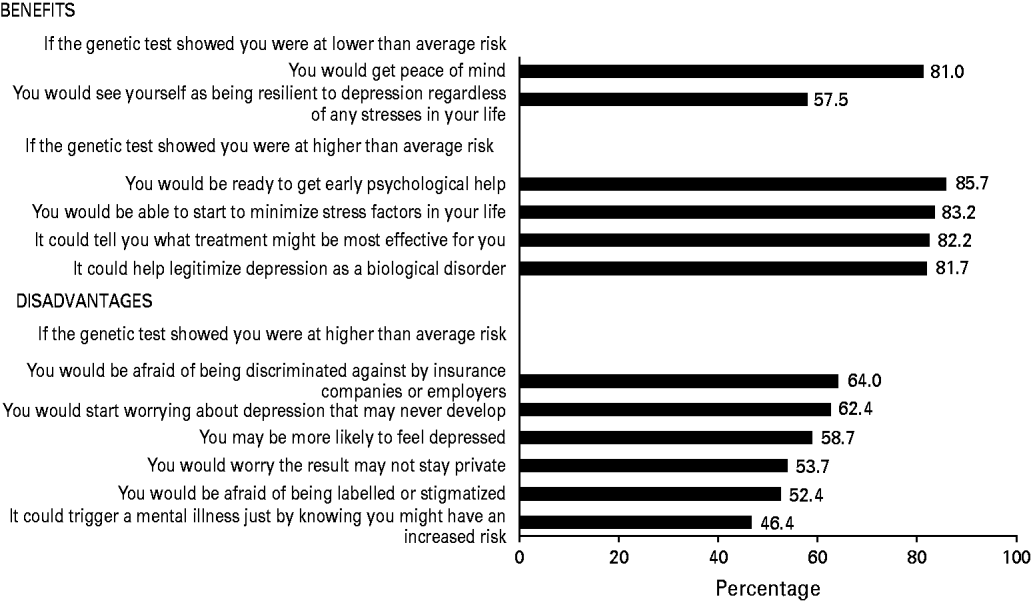
Perceived benefits and disadvantages of predictive genetic testing were assessed using 12 items (see Fig. 1 for item wording) with five-point Likert-type response options ranging from 1 (‘strongly disagree’) to 5 (‘strongly agree’). The measure is based on the results of our qualitative study, which explored the range of perceived benefits and limitations of genetic testing for major depressive disorder (Wilde et al. Reference Wilde, Meiser, Mitchell and Schofield2010). These measures demonstrated good internal consistency in the present samples, with Cronbach's α=0.65 (benefits) and 0.76 (disadvantages). Summary scores were calculated for perceived benefits and disadvantages separately, with higher values indicating greater endorsement of perceived benefits or disadvantages.
Percentages of participants indicating agreement or strong agreement with a range of perceived benefits and disadvantages of depression-risk genotyping (maximum n=1046).

Outcome variable: interest in having genetic testing for depression risk
Data on interest in predictive genetic testing were collected by (i) channel of access (i.e. through a doctor or DTC) and (ii) before and after participants were asked about perceived benefits and disadvantages of predictive testing. The latter two are reported as ‘naïve interest’ and ‘considered interest’ respectively. This produced four variables: naïve interest in having the test through a doctor; naïve interest in having the test DTC; considered interest in having the test through a doctor; and considered interest in having the test DTC. Interest in having depression risk testing was assessed by one item with four Likert-type response options ranging from ‘no, definitely not’, ‘no, probably not’, ‘yes, probably’, to ‘yes, definitely’ plus ‘don't know’.
Questions were framed as: ‘If a genetic test to determine your risk for developing depression in the event of experiencing stressful life events was available through (1) your own doctor, (2) via the internet directly to you from an overseas laboratory, would you be interested in having it?’
As the public health system is likely to be a future provider of predictive genetic testing to informed patients, ‘considered interest in genetic testing through a doctor’ was selected as the most appropriate outcome variable for the purposes of multivariate analyses. This variable was recoded into a binary variable by merging the ‘definitely’ and ‘probably’ options and redefining the new variable as ‘yes, would consider’ versus ‘no, would not consider’ genetic testing. ‘Don't know’ responses were not included in the new variable.
Statistical analyses
Data were explored initially with descriptive statistics. χ2 cross-tabulations were analysed for naïve and considered interest through a doctor and through DTC channels. Bivariate associations between possible predictor variables and the outcome variable were first examined using an independent samples t test for continuous predictor variables, Mann–Whitney U tests for ordinal predictor variables and Pearson's χ2 cross-tabulations for categorical predictors. All variables with a bivariate association with p<0.1 were entered into a backward stepwise removal regression model until the only remaining variables were those with p<0.05.
The following variables were assessed as possible predictor variables in the analysis of considered interest in depression-risk testing through accredited medical services: personal history of a mental illness, experience of a mental illness through a close relative or close friend, self-estimation of risk for major depressive disorder, causal attributions for mental illness, gene–environment interaction as a causal mechanism, incomplete penetrance as a hereditary mechanism, no causal genetic factors, perceived impact of a genetic component for mental illness on social stigma, and perceived benefits and disadvantages of having such a genetic test. All regression analyses were adjusted for age, sex, education level and country of birth.
Results
Participant characteristics
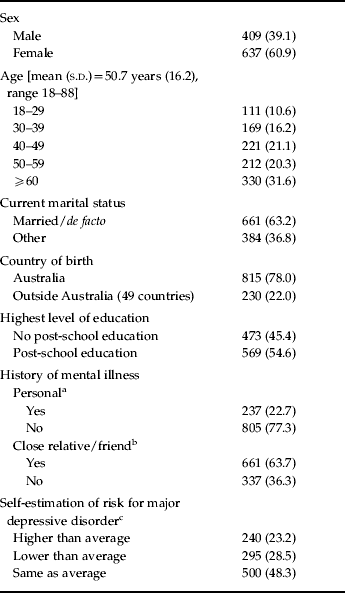
Of the 1544 eligible individuals contacted, 498 declined, resulting in 1046 completed surveys and a participation rate of 68%. Sociodemographic characteristics of the participants are presented in Table 1. Sixty-one per cent were female and 39% male compared to 50.2% and 49.8% respectively in the Australian adult resident population. The mean age of participants was 50.7 years [95% confidence interval (CI) 49.7–51.7, range 18–88 years], compared to a mean of 47.0 years among the resident Australian population aged ⩾18 years. Twenty-two per cent (95% CI 22–25) were born overseas, compared to an estimated 25% of the resident population of Australia born overseas (Australian Bureau of Statistics, 2006).
Summary of participant characteristics (maximum n=1046)

s.d., Standard deviation.
Values are given as n (%).
a Refers to personal history of depression, bipolar disorder or schizophrenia.
b Refers to experience of depression, bipolar or schizophrenia through a close relative or close friend.
c Refers to personal estimation of risk for major depressive disorder compared to average population risk.
Perceived benefits and disadvantages of predictive genetic testing for depression risk
Figure 1 details the proportions of participants who agreed or strongly agreed with a range of perceived benefits and disadvantages of genetic testing.
Interest in predictive genetic testing for depression risk by channel of access
Interest in depression-risk genotyping varied according to channel of access (doctor versus DTC on the internet) and before versus after consideration of positive and negative implications, information about which was provided during the telephone interview (‘naïve interest’ versus ‘considered interest’). When naïve, 60% of participants were interested in depression-risk genotyping through a doctor, which marginally increased to 63% after consideration. When naïve, 49% of participants were interested in accessing the same test DTC on the internet, which significantly decreased to 40% once given the opportunity for consideration (n=981, χ2=476, df=1, p<0.001). Interest in accessing depression-risk genotyping through a doctor was significantly greater than interest accessing such a test DTC in both cases, when either naïve (p<0.001) or considered (p<0.001).
Factors associated with considered interest in predictive genetic testing for depression risk
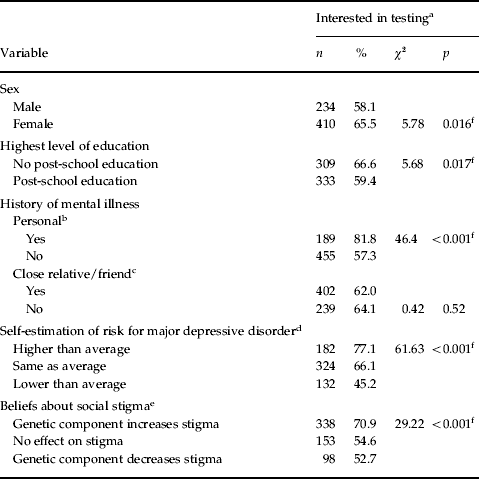
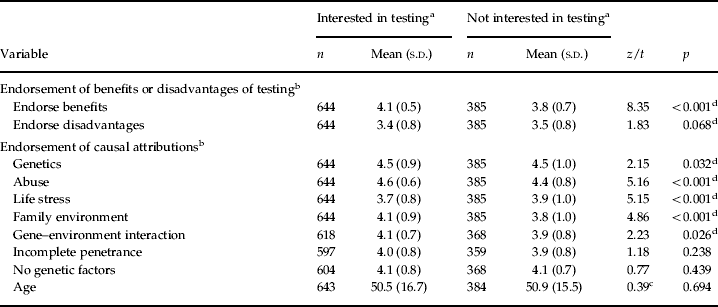
Table 2 shows the results from bivariate analyses of factors associated with considered interest in depression-risk genotyping. Considered interest in depression-risk genotyping was significantly and positively associated with having a personal history of a mental illness; self-estimation of having a higher than average risk for major depressive disorder; being female; having no post-school education; endorsement of perceived benefits of having such a test; perceiving genetics, life stress and/or abuse as causal attributions for mental illness; and perceiving gene–environment interaction as a causal mechanism. Among participants who thought evidence of a genetic component would affect stigma associated with mental illness, a significantly greater proportion believed stigma would increase rather than decrease (n=670, 72% v. 28%, p<0.001). Despite this, we found that considered interest in having depression-risk genotyping was significantly associated with beliefs that social stigma would increase.
Items assessed for association with considered interestFootnote a in depression-risk genotyping (maximum n=1046)

a Refers to considered interest in genetic testing through a medical clinic.
b Refers to personal history of a mental illness (depression, bipolar disorder or schizophrenia).
c Refers to experience of depression, bipolar or schizophrenia through a close relative or close friend.
d Refers to personal estimation of risk for major depressive disorder compared to average population risk.
e Refers to belief that genetic evidence for mental illness would increase or decrease stigma. χ2 values are from Pearson's χ2 tests.
f p values <0.1 entered into logistic regression.
Items assessed for association with considered interestFootnote a in depression-risk genotyping (maximum n=1046)

s.d., Standard deviation.
a Refers to considered interest in genetic testing through a medical clinic.
b Range 1 to 5, with higher values indicating greater endorsement. Values are absolute values from Mann–Whitney U tests.
c t value is from an independent samples t test.
d p values <0.1 entered into logistic regression.
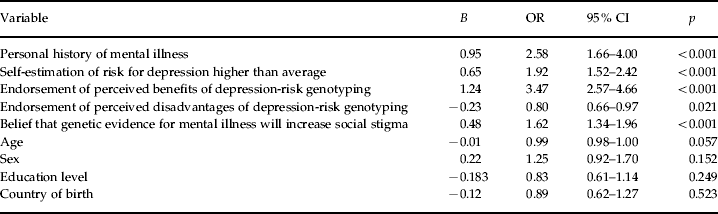
When these variables were entered into a logistic regression model using a backward stepwise (likelihood ratio) elimination method (Table 3), personal history of mental illness [odds ratio (OR) 2.58, p<0.001], higher than average self-estimation of risk for major depressive disorder (OR 1.92, p<0.001), endorsement of benefits of testing for a depression-risk variant (OR 3.47, p<0.001), and the belief that genetic evidence for mental illness would increase social stigma (OR 1.62, p<0.001) were all significantly and positively associated with considered interest in depression-risk genotyping after controlling for sex, age, education level and country of birth. A significant negative predictor of interest was endorsement of perceived disadvantages of depression-risk genotyping (OR 0.80, p=0.021).
Final model of logistic regression analysis predicting factors influencing interestFootnote a in having depression-risk genotyping after controlling for demographic factors (n=930)

OR, Odds ratio; CI, confidence interval.
Final model: −2 log likelihood ratio=1030.679, Cox and Snell R 2=0.189, Nagelkerke R 2=0.258, p<0.001.
a Refers to considered interest in genetic testing through a medical clinic.
Discussion
This large, national population-based study suggests that formal medical services are likely to be the preferred channel for accessing predictive genetic testing as demonstrated in this example of serotonin transporter genotyping for depression risk. This preference was significantly higher compared to interest in accessing genetic tests DTC after considering the benefits and disadvantages of predictive genetic testing. Nevertheless, considered interest in accessing such a test commercially prevailed, suggesting that concerns about the availability of unregulated DTC genetic testing need to be addressed. This finding supports results of our previous qualitative study, which demonstrated greater trust among participants in obtaining such a test through the medical system, with interest modified by concerns about genetic discrimination and loss of privacy (Wilde et al. Reference Wilde, Meiser, Mitchell and Schofield2010).
Of the 1029 participants who answered the question, 63% indicated considered interest in having predictive genetic testing for susceptibility to depression, if it were available. This level of interest is similar or marginally lower than that reported in previous studies that have demonstrated rates of interest in predictive genetic testing of 61% (Green et al. Reference Green, Roberts, Cupples, Relkin, Whitehouse, Brown, Eckert, Butson, Sadovnick, Quaid, Chen, Cook-Deegan and Farrer2009), 69% (Jones et al. Reference Jones, Scourfield, McCandless and Craddock2002), 83% (DeLisi & Bertisch, Reference DeLisi and Bertisch2006; Laegsgaard et al. Reference Laegsgaard, Kristensen and Mors2009) and 97% (Smith et al. Reference Smith, Sapers, Reus and Freimer1996) for susceptibility to Alzheimer's disease, bipolar disorder (Smith et al. Reference Smith, Sapers, Reus and Freimer1996; Trippitelli et al. Reference Trippitelli, Jamison, Folstein, Bartko and Depaulo1998; Jones et al. Reference Jones, Scourfield, McCandless and Craddock2002; Meiser et al. Reference Meiser, Kasparian, Mitchell, Strong, Simpson, Tabassum, Mireskandari and Schofield2008), schizophrenia (Austin et al. Reference Austin, Smith and Honer2006; DeLisi & Bertisch, Reference DeLisi and Bertisch2006) and psychiatric disorders in general (Illes et al. Reference Illes, Rietz, Fuchs, Ohiraun, Prell, Rudinger, Maier and Rietschel2003; Laegsgaard & Mors, Reference Laegsgaard and Mors2008; Laegsgaard et al. Reference Laegsgaard, Kristensen and Mors2009) in relatively small groups with direct experience of the illness including patients, relatives and professionals. The lower rate of interest demonstrated in this large national sample is likely to reflect a more realistic indication of community interest in predictive genetic testing for depression risk and other psychiatric conditions. Actual uptake of such testing once clinically available could be lower than predicted by intention to test (Lerman et al. Reference Lerman, Croyle, Tercyak and Hamann2002).
The present study identified strong positive significant associations between considered interest in genetic testing for susceptibility to depression and personal self-reported history of mental illness; a higher than average self-estimation of increased risk for major depressive disorder; endorsement of the perceived benefits of having such a test; and a belief that a genetic explanation for mental illness would increase social stigma linked with the disorder. These associations were independent of age, sex, level of education and country of birth.
The finding that perceived personal susceptibility to the disorder is a strong predictor of interest in predictive genetic testing is consistent with that reported for other multifactorial disorders such as heart disease (Sanderson et al. Reference Sanderson, Wardle, Jarvis and Humphries2004), schizophrenia (DeLisi & Bertisch, Reference DeLisi and Bertisch2006), bipolar disorder (Trippitelli et al. Reference Trippitelli, Jamison, Folstein, Bartko and Depaulo1998; Jones et al. Reference Jones, Scourfield, McCandless and Craddock2002; Meiser et al. Reference Meiser, Kasparian, Mitchell, Strong, Simpson, Tabassum, Mireskandari and Schofield2008) and psychiatric disorders in general (Laegsgaard & Mors, Reference Laegsgaard and Mors2008). However, predictors of uptake of predictive genotyping in clinical situations may differ. Uptake rates are likely to be influenced by differences in patient perceptions about predictive validity of the genetic test in question; potential benefits of such a genetic test, such as accessing early help; potential disadvantages such as employment and insurance discrimination; and differences in implications for members of affected families.
The finding of a significant positive association between considered interest in genetic testing for susceptibility to depression and endorsement of perceived benefits of having such a test, and a significant negative association with endorsement of perceived disadvantages, supports prevailing beliefs that perceived benefits may outweigh risks (Trippitelli et al. Reference Trippitelli, Jamison, Folstein, Bartko and Depaulo1998). The most frequently rated perceived benefits, namely a greater preparedness for accessing early psychological help and minimizing stress, are consistent with beliefs reported in a previous study that such testing could facilitate prevention and earlier intervention of major depressive disorder (Wilhelm et al. Reference Wilhelm, Meiser, Mitchell, Finch, Siegel, Parker and Schofield2009). The findings also confirmed perceptions that potential for discrimination by insurance companies or employers was the most frequently identified disadvantage of genetic testing for susceptibility to depression. Several governments have issued a ban on marketing genetic tests for common complex disorders directly to the consumer in the absence of appropriate regulation (ALRC, 2003; Hudson et al. Reference Hudson, Javitt, Burke and Byres2007; Human Genetics Commission UK, 2007). Despite the signing of the Genetic Information Nondiscrimination Act (GINA) into law in 2008 in the USA, where many of the commercial vendors of DTC genetic tests are based, there may be no guarantees of protection against discrimination (Van Hoyweghen & Horstman, Reference Van Hoyweghen and Horstman2008). Considering DTC genetic tests are marketed internationally, consumers may have no legal protection from genetic discrimination for insurance or employment in their own country. The recent proposal to introduce a mandatory registry of genetic tests aims to overcome some of these problems and improve the genetic testing system by providing the public and health providers with accurate, reliable and validated information about the options available before decisions are made about obtaining a genetic test (Zonno & Terry, Reference Zonno and Terry2009). Thus, the study's findings highlight that, although predictive genetic testing as an intervention tool for target groups is likely to be acceptable to the general community, they indicate the need for appropriate legislation to prevent genetic discrimination if such interventions are to be effective.
Finding a significant positive association between beliefs that evidence of a genetic component for mental illness would increase rather than decrease social stigma and considered interest in having genetic testing for susceptibility to depression seems surprising at first. It could be that perceived benefits of genetic testing outweigh concerns about stigma, that major depressive disorder is perceived as less likely to have a genetic basis than other mental illnesses, or that there is less stigma attached to depression than bipolar disorder and schizophrenia.
It should be noted that the use of landline telephone numbers may have skewed the sample towards older age groups and females, consistent with reported participation bias in public health surveys (Purdie et al. Reference Purdie, Dunne, Boyle, Cook and Najman2002; Sogaard et al. Reference Sogaard, Selmer, Bjertness and Thelle2004). The present study used strategies known to minimize self-selection bias caused by non-response, including randomization of participant selection per household, achieving a moderately high participation rate, and controlling the results for demographic confounders statistically (Mishra et al. Reference Mishra, Dooley, Catalano and Serxner1993).
Other limitations relate to the possibility that some participants may have interpreted the term ‘life stress’ to mean everyday life stress rather than significant stressors associated with mental illness, such as child abuse, which could have affected interest in testing based on perceptions about the modifiable nature of risk factors. Attitudes towards genetic testing for susceptibility to a psychiatric disorder may be influenced by naivety about the low predictive power of such tests. The low risk rates for first-degree relatives for developing psychiatric disorders with incomplete penetrance compared with Mendelian traits should be kept in perspective when informing the public and designing mental health interventions.
Conclusions
This is the first study to provide data from a large national cohort in which the determinants of community interest in predictive genetic testing for mental illness and its psychosocial impacts have been investigated. Using the example of testing for a genetic variant for depression risk, the results indicate that there is likely to be strong interest in predictive genetic testing for a complex trait such as major depressive disorder if it were to become available, even though the predictive validity and clinical utility of such tests remain unclear. It is likely that interest will persist despite finding attitudes that genetic links to mental illness would increase rather than decrease stigma. The study provides objective data in place of the current subjective commentaries on community concern about unregulated predictive genetic testing. Large population surveys such as that reported here are important in informing public debate, public education programmes and policymaking.
Acknowledgements
This study was supported by an Australian National Health and Medical Research Council (NHMRC) Public Health Ph.D. scholarship (455414), Career Development Award (350989), Program Grant (510135) and Project Grant (510216); and by the University of New South Wales. We thank the study participants who answered the survey.
Declaration of Interest
None.