

Neopatrimonial rule, which combines ruler appropriation of resources from the state with ruler discretionality in the use of state power, is ubiquitous in many developing countries. A long scholarly tradition in comparative politics has sought to assess the effects of neopatrimonialism on political and economic outcomes, as well as the factors that cause its continuity or decline (Cardenal and Martí Puig Reference Cardenal and Martí i Puig1998; Crabtree Reference Crabtree2010; Giraudy Reference Giraudy2015; Mazzuca Reference Mazzuca2010; Shrank 2009; Stein and Monge Reference Stein and Monge1988; Chehabi and Linz Reference Chehabi and Linz1998; and studies below, among others). For instance, scholars who have studied its political effects have argued that extreme forms of neopatrimonialism are inimical to the emergence of democracy (Linz and Stepan Reference Linz and Stepan1996) and that in less extreme form, neopatrimonialism can coexist, if uneasily, with democracy while inhibiting further democratic evolution and deepening (Bratton and van de Walle Reference Bratton and van de Walle1997; Budd Reference Budd2004).
Likewise, scholars examining neopatrimonialism’s socioeconomic effects across various world regions have argued that it negatively impacts economic growth; social outcomes, such as poverty reduction; and institutional performance (van de Walle Reference Van de Walle2001; Bach and Gazibo Reference Bach and Gazibo2012; Kohli Reference Kohli2004; Charrad and Adams Reference Charrad and Adams2011).Footnote 1 Other scholars, in turn, have examined factors that may undermine neopatrimonial rule in the contemporary period. For example, Mazzuca and Munck (Reference Mazzuca and Munck2014) have argued that within democracy, certain types of party competition can lead to less neopatrimonial rule, rather than the causal arrow flowing the other way.
This rich and influential body of literature has two important limitations. Despite a shared agreement on the main traits of neopatrimonialism, the concept has sometimes risked being employed in an excessively fluid or “catchall” manner (Theobald Reference Theobald1982; see also Erdmann and Engel Reference Erdmann and Engel2007; Woods Reference Woods2012). Scholars have struggled to operationalize and measure the concept’s key dimensions and aggregate them, and to produce systematic measures of neopatrimonial rule. And partly for this reason, it has largely not been possible to employ quantitative, cross-national, and longitudinal analyses to examine key arguments advanced by the mostly comparative-historical and qualitative studies of neopatrimonialism, such as its negative effects on poverty reduction.
This article seeks to fill this gap by fulfilling two goals: presenting a careful conceptualization and measurement of neopatrimonialism and testing its effects on poverty in Latin America using cross-national and longitudinal quantitative analysis. For the first goal, we begin with Weber’s core insight and build on the work of other scholars to distill the concept of neopatrimonialism as a combination of ruler appropriation of resources from the state and ruler discretionality in the use of state power. These two dimensions combined provide a measure of how power is exercised, ranging from a more neopatrimonial fashion to one more based on a rational-legal basis. In this way, we distinguish neopatrimonialism conceptually from the issue of access to power (i.e., the type of political regime, ranging from authoritarian to democratic).Footnote 2 Focusing on Latin America, we provide annual measures for the period 1950 to 2016. The analysis reveals that even though Latin America has experienced its most extensive and prolonged, if territorially uneven, wave of democratization, beginning in the late 1970s (see Mainwaring and Pérez-Liñán Reference Mainwaring and Pérez-Liñán2013a), many elected politicians have inherited and continue exercising neopatrimonial rule to varying degrees.
Regarding the second goal, we examine the effect of neopatrimonial rule on poverty employing cross-national quantitative analysis, which has been done only in limited form or at the subnational level (see Budd Reference Budd2004; Von Soest et al. Reference Von Soest, Bechle and Korte2011; Giraudy Reference Giraudy2015). Building on the comparative literature and intending to bolster its arguments, we expect to find that these legacies negatively impact poverty levels. Indeed, our results show that countries with higher levels of neopatrimonialism exhibit higher poverty rates, controlling for other relevant socioeconomic factors. We confirm the argument that cumulative years of democracy favor poverty alleviation. In line with some studies, our analysis also finds that left governments do not result in lower poverty levels (Weyland Reference Weyland2004; Madrid Reference Madrid2003; Brooks Reference Brooks2009). This contradicts a strand of literature that argues that left parties have been important for reducing poverty (Pribble et al. Reference Pribble, Huber and Stephens2009), though we believe our study, which centers on neopatrimonialism, helps to reconcile these seemingly contradictory findings.Footnote 3
The following section of this article advances a conceptualization of neopatrimonialism and explains our measurement strategy. In the subsequent section, we generate annual measures for 18 Latin American countries since 1950 and provide an overview of neopatrimonial rule for this period. We then advance our hypothesis about the impact of neopatrimonialism on poverty. A review of control variables and alternative hypotheses, an explanation of our model, statistical analyses, and results are presented and discussed. A conclusion summarizes the findings and future research directions.
Conceptualizing and Measuring Neopatrimonialism
Neopatrimonialism, as understood in the Weberian tradition, refers to how rulers exercise political authority and manage state resources. According to Weber, neopatrimonial rulers typically blur differences between the private and public realms, and thus engage in appropriation, or abuse of state resources (i.e., personnel and goods) for private economic or political gain. They also implement decisions with great discretionality, based on particularistic and arbitrary criteria. In contrast, under perfect legal-rational authority, there is a clear separation between the ruler and the means of administration, and rulers exercise power with adherence to impersonal rules (Weber Reference Weber, Roth and Wittich1978, 220, 1028-29, 1041; Mazzuca Reference Mazzuca2010).
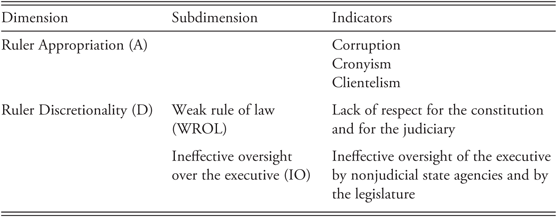
From these conditions it follows that neopatrimonial rulers blur public and private interests and purposes within the administration through corrupt practices while employing cronyism and clientelism to generate loyalty and dependence among followers from different social strata. These features enable ruler concentration of power through the appropriation and use of public resources for private and political gain, which we term ruler appropriation (A). In turn, ruler appropriation is facilitated by and can reinforce weak rule of law and ineffective oversight of the executive by other branches of government or state agencies, facilitating ruler discretionality, which we label (D).
Appropriation
As table 1 shows, ruler appropriation has three key indicators: corruption, cronyism, and clientelism. Rulers are interested in appropriating resources through the exercise of state power and deploying some of that power strategically to permit their continued rule in this fashion. Under traditional patrimonial rule, corruption, in principle, may not exist, since there is no clear distinction between public and private domains. However, in neopatrimonial regimes, legality exists at some level, with norms and laws against the use or abuse of public resources for private gain. Therefore, corruption can be identified, and its extent can vary (see Medard Reference Medard and Clapham1982, 180–81).
Conceptualizing Neopatrimonialism

Another central aspect of neopatrimonial rule is to obtain the allegiance of different groups in society (the so-called followers). In turn, these groups are expected to contribute to rulers’ permanence in power, helping them appropriate state resources for personal political (and sometimes private economic) gain. Conceptually, we can distinguish between cronyism and clientelism. Cronyism taps into the misuse of public resources to gain the support of followers in the upper echelons of society while typically benefiting them economically, and state rulers politically and frequently economically. By contrast, we define clientelism as the appropriation or misuse of public resources through personalistic channels to obtain the loyalty or allegiance of poorer groups in society; it can also include what some scholars have termed patronage (the allocation of public sector jobs based on partisan criteria).
Discretionality
Neopatrimonial rulers seek to exercise power in as unconstrained a fashion as possible, not limited by legal requirements or bureaucratic procedures. We focus on two key ways that ruler discretionality may be limited or enhanced. One is whether constitutional and judicial constraints are effective or if there is a weak rule of law. The other is whether nonjudicial state agencies or the legislature are effective or ineffective in their oversight of the executive. Under neopatrimonial rule, the design and implementation of public policies and public decisions are carried out without adherence to impersonal rules or respect for the rule of law, and without effective oversight.
Aggregation
Building on past scholarship, we conceptualize neopatrimonial rule as combining high levels of ruler appropriation with high levels of ruler discretionality. Theoretically, then, if either dimension is absent, the state cannot be considered neopatrimonial. Hence, our definition of neopatrimonialism utilizes one of the prototypical concept structures; that is, the “necessary and sufficient condition” structure (Munck and Verkuilen Reference Munck and Verkuilen2002; Goertz Reference Goertz2006). To translate this concept structure into mathematical terms without violating concept-measure consistency, we follow Goertz’s (Reference Goertz2006) suggested aggregation procedure of multiplying the two dimensions, which limits the extent of impact that a higher presence of one dimension has on the overall measure of neopatrimonialism more than if the two dimensions were added together.4
As do other multidimensional concepts, neopatrimonialism, we believe, identifies a single important political phenomenon, in this case centered on the exercise of power. Conceptually, appropriation and discretionality can partially operate independently from each other, though they are likely to establish mutually reinforcing virtuous or vicious cycles as they move to higher or lower levels, respectively. This means that they are likely to be highly correlated with each other. Shifts in neopatrimonialism can be initiated first in either of the dimensions. For example, rulers might evade the law in order to appropriate resources to deploy strategically to gain followers, even in countries with a strong rule of law and oversight mechanisms. However, if the rulers do not also enhance ruler discretionality (weakening the rule of law or executive oversight), high levels of ruler appropriation are unlikely to be sustainable over time.
Similarly, rulers can conceivably exercise power in environments that have a weak rule of law and limited oversight of the executive without expanding ruler appropriation. This could happen as new nonpatrimonial leadership institutes critical changes from above, initially rejecting opportunities for ruler appropriation and then gradually strengthening practices and institutions that limit ruler discretionality. Yet rulers who initially carry out this practice may also shift toward renewed discretionality and higher levels of appropriation over time.
Operationalization
For the main analysis, we rely extensively on the Varieties of Democracy database (V-Dem Version 7.1, Coppedge et al. Reference Coppedge2017). V-Dem questions tap into key institutional and behavioral issues of interest to us and not just formal rules or laws, and in our view, do so better than other data sources. They also enable us to generate annual measures for a longer time period than is possible relying on other existing databases. At the same time, we fully recognize that these measures are imperfect. Supplementary appendix B online provides confirmatory results of our analyses employing measures that draw from database alternatives, demonstrating that our findings are robust to other measurement sources.
We calculate neopatrimonialism using the following basic formula: NP = A * D. To measure ruler appropriation (A), we rely on V-Dem questions that concentrate on corruption as well as cronyism and clientelism. To measure corruption, we employ the question that most clearly focuses on the top ruler and close associates: “How often do members of the executive (the head of state, the head of government, and cabinet ministers) or their agents steal, embezzle, or misappropriate public funds or other state resources for personal or family use?”
We measure cronyism and clientelism through two questions, each of which asks, to some extent, about both phenomena. One focuses primarily on cronyism and asks how routinely members of the executive (the head of state, the head of government, and cabinet ministers) or their agents “grant favors in exchange for bribes, kickbacks, or material inducements.” This question taps into how much societal actors induce the abuse of state power or the misuse, misappropriation, or noncollection of state resources—which are the favors that top-level state actors and their agents provide, most probably to higher-income societal actors. Another question focuses on clientelism and related phenomena, asking, “Considering the profile of social and infrastructural spending in the national budget, how ‘particularistic’ or ‘public goods’ are most expenditures?” Particularistic spending is understood as “narrowly targeted on a specific corporation, sector, social group, region, party, or set of constituents,” and “such spending may be referred to as ‘pork,’ ‘clientelistic,’ or ‘private goods.’“ The partial overlap in the questions of cronyism and clientelism mirrors our argument that both form part of the same dimension of ruler appropriation. Because of the centrality of corruption and because we see cronyism and clientelism as two sides of the same phenomenon, we calculate A = Corruption*.5 + (Cronyism + Clientelism)*.5.
Ruler discretionality (D) consists of weak rule of law and ineffective oversight of the executive. To measure weak rule of law, we employ three V-Dem questions and weight them equally. One asks, “Do members of the executive (the head of state, the head of government, and cabinet ministers) respect the constitution?” The other two focus on how extensively the government complies with important decisions of the high court or other courts with which it disagrees. We measure ineffective oversight of the executive through two equally weighted V-Dem questions. One asks how much a nonjudicial agency other than the legislature is capable of questioning, investigating, and exercising oversight of the executive, and the other asks the same with regard to the legislature. We calculate D as follows: WROL*.5 + IO*.5.Footnote 5
Temporal and Cross-National Trends
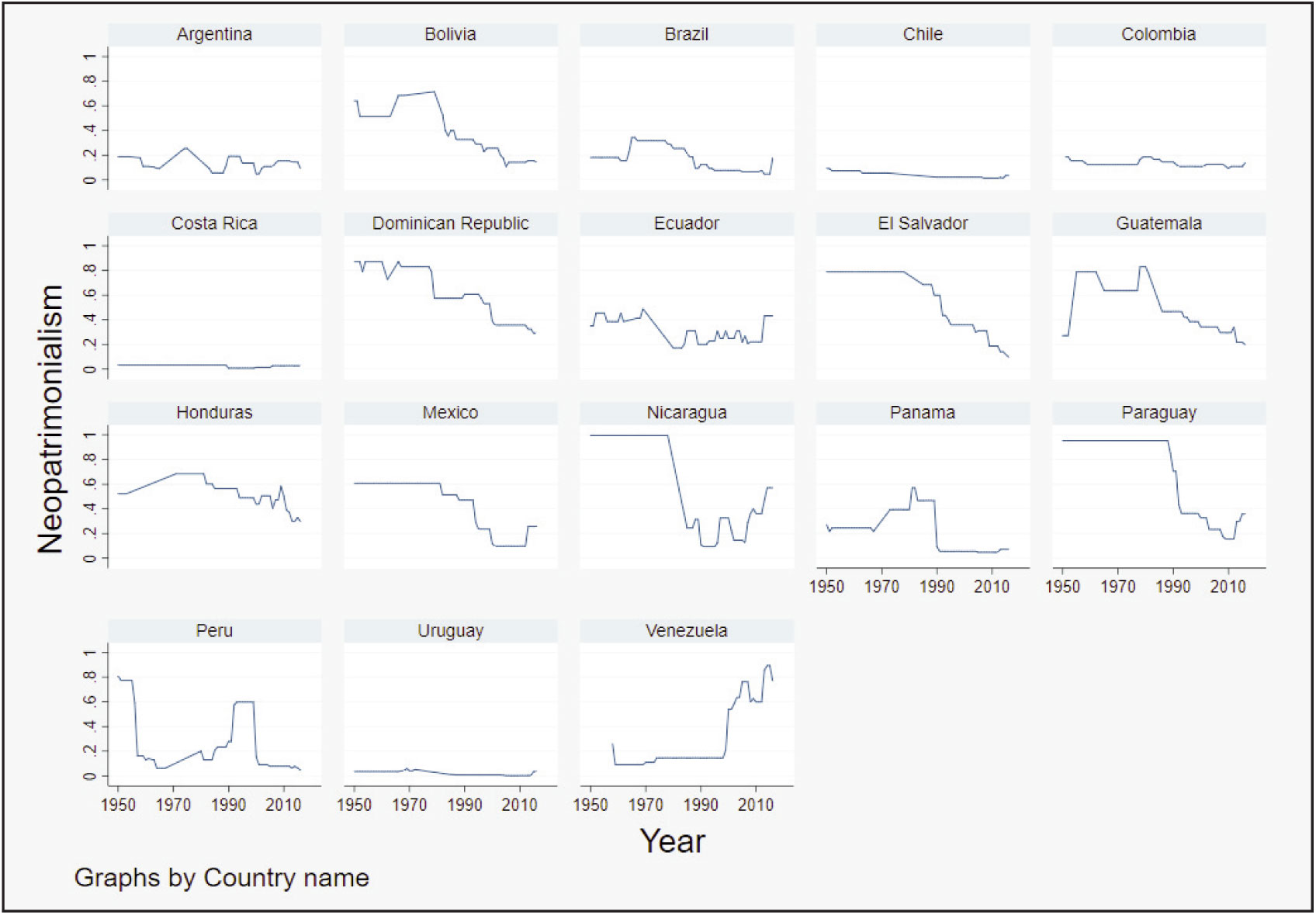
Figure 1 presents the evolution of neopatrimonialism for 18 Latin American countries for the period 1950–2016. Neopatrimonialism scores can range hypothetically from a low of 0 (least neopatrimonial) to a high of 1, and our measure shows a wide range of temporal and cross-national variation.Footnote 6
Neopatrimonialism Across Time (1950–2016) for 18 Latin American Countries Note: Neopatrimonial scores standardized between 0 and 1.

The lowest score is found in Uruguay (.0013) from 2005 to 2012, and the highest score in Nicaragua (.995) during the years that the extremely neopatrimonial Somoza family was in power (1950–1978). Both numbers are consistent with analyses of these two countries’ very different historical trajectories. There is a gradual but uneven decline in neopatrimonialism in the region from the 1950s to 2016. The mean score in the 1950s is .45, with considerable variation across countries (standard deviation, S.D. 33). In the 1980s, the mean score is .36 (S.D. .26), and by the 2010s, it declines farther, to .21 (S.D. .19). The data show that there are outliers in each decade, such as Panama in the 1980s, Peru in the 1990s, and Venezuela in the 2000s.
Our statistical analysis covers the period from 1990 to 2012.Footnote 7 Over this period, the average neopatrimonial score across all countries is .22 (with a S.D. of .19). In turn, the lowest average country scores are in Uruguay (.005), Chile (.02), and Costa Rica (.02). And the average highest country scores are found in Honduras (.49), the Dominican Republic (.46), and Venezuela (.42), consistent with evidence from qualitative studies (see Ortega Reference Ortega2011; Hartlyn Reference Hartlyn1998; Corrales and Penfold-Becerra Reference Corrales and Penfold-Becerra2011). A number of countries saw relatively little change over this time, in spite of other socioeconomic or political changes they experienced, such as economic crises or growth spurts. Those with the least movement are found at different average levels of neopatrimonialism and include Brazil, Colombia, Costa Rica, and the Dominican Republic (with S.D.s below .05). Other countries have seen dramatic shifts in how power was exercised over this period. The most significant changes in scores occur in Paraguay (with an S.D. of .21), followed by Peru (with an S.D. of .20).
The Impact of Neopatrimonialism on Poverty
There are several reasons to believe that higher levels of neopatrimonialism lead to higher levels of poverty. First, the cross-national literature has argued that neopatrimonial rule is unlikely to lead to coherent policy, whether in the form of universalistic policies or appropriately targeted programs to reduce poverty. Extreme forms of neopatrimonialism are associated with predatory or near-predatory states (cf. Chehabi and Linz 1998; Bach 2012; Evans Reference Evans1994), whereby, as Kohli notes, even if the rhetoric of development is employed by these state rulers, it is usually to mask their real goal of deploying high levels of discretionality to employ “state resources for personal benefit or for the benefit of personal associates” (Kohli Reference Kohli2004, 393). This appropriation of resources, in turn, has dire consequences for population and poverty levels.
Second, less extreme forms of neopatrimonialism are still marked by consequential levels of the dimensions of both appropriation—corruption, cronyism, and clientelism—and discretionality. Even when not at their highest levels, these features continue to constrain a government’s ability to sustain coherent programs to target poverty (Bratton and van de Walle Reference Bratton and van de Walle1997; Weyland Reference Weyland1996; Van de Walle Reference Van de Walle2001; Stein et al. Reference Stein, Tommasi, Echebarría, Lora and Payne2005; Bach and Gazibo Reference Bach and Gazibo2012; Hartlyn Reference Hartlyn1998; Giraudy Reference Giraudy2015). This finding is also reflected in analyses of phenomena that partially overlap neopatrimonial rule, such as clientelism (Abente Brun and Diamond Reference Abente Brun and Diamond2014), vote buying (Stokes et al. Reference Stokes, Dunning, Nazareno and Brusco2013), and corruption (Gupta et al. Reference Gupta, Davoodi and Alonso-Terme2002). Moreover, what enables rulers to appropriate, extort, or manipulate resources in this way is their ability to act in a discretionary manner in a context of a weak rule of law and ineffective executive oversight. Thus, analyses of state policies and economic measures that favor economic growth and poverty reduction also typically emphasize the role for legal-rational state action and the importance of the quality of state institutions and governance, including competent bureaucracies, which are associated with lower levels of neopatrimonialism (cf. Perry et al. Reference Perry, Arias, Humberto López, Maloney and Servén2006; UNRISD 2010; Stein et al. Reference Stein, Tommasi, Echebarría, Lora and Payne2005; see also Rothstein Reference Rothstein2011 on the quality of government and Mainwaring and Scully 2010 on democratic governance).
Third, in Latin America, other political and institutional factors associated with the most successful universalistic social policy programs, such as the internal organization of political parties, are also shaped by levels of neopatrimonialism. Programmatic parties, whose internal organizational structures enable party rank and file to monitor and influence policy implementation and thus limit the discretionary action of politicians, are more likely to exist in countries where rulers refrain from neopatrimonial rule. By contrast, nonprogrammatic parties, which lack internal mechanisms of control, allow politicians to carry out discretionary policies, pursue narrow policies in order to monitor voter compliance (through clientelism), strengthen a leader’s appeal, or cater to special interests (Pribble Reference Pribble2013). Programmatic parties are typically present in less neopatrimonial countries, such as Chile and Uruguay. These party organizations are much less common in countries with higher levels of neopatrimonialism, such as the Dominican Republic, Honduras, or Venezuela. Because neopatrimonialism shapes the type of party organization, we expect that it will foster the presence of nonprogrammatic parties (of the left and right) and, in turn, will be less likely to reduce poverty levels. In sum, we expect that higher levels of neopatrimonialism are causally related to higher levels of poverty, and that neopatrimonial legacies cannot be overcome immediately.
We draw the causal arrow from neopatrimonialism to high poverty levels. At the same time, we recognize potential issues of endogeneity or reverse causation. Some scholars have argued that poverty and inequality may facilitate conditions that favor neopatrimonial rule. For example, focusing on Asian cases, Jong-Sung You (Reference You2015) traces the relationship from inequality to clientelism and then corruption. Yet though extreme cases of neopatrimonialism (“neosultanism”), such as the Somozas in Nicaragua or Trujillo in the Dominican Republic, are more likely in poor countries, poverty is not a sufficient factor, and once in power, these rulers clearly reinforced social injustice.Footnote 8 Clientelism and vote buying are found in poorer countries, though the link between average income and clientelism is attenuated in contemporary Latin America (Stokes et al. Reference Stokes, Dunning, Nazareno and Brusco2013, esp. 156). Thus, there are several reasons to believe that levels of neopatrimonial rule are not simply endogenous to socioeconomic factors.
This study takes several approaches to address concerns about reverse or mutual causation. One is to employ in the models a ten-year moving average of neopatrimonialism as the key independent variable. In so doing we also recognize that efforts to modify states and state policies in areas such as poverty alleviation are not instantaneous but experience a substantial lag effect. (See appendix B, figures 1 and 2 for country graphs of this variable and of its two key dimensions separately.) By choosing a ten-year moving average, we strike a balance between arguments that neopatrimonial legacies have a strong continuing impact on state policy and those that focus on the ability of leaders to effect change more quickly.Footnote 9 We include a measure for level of economic development, GDP per capita, as a control variable.
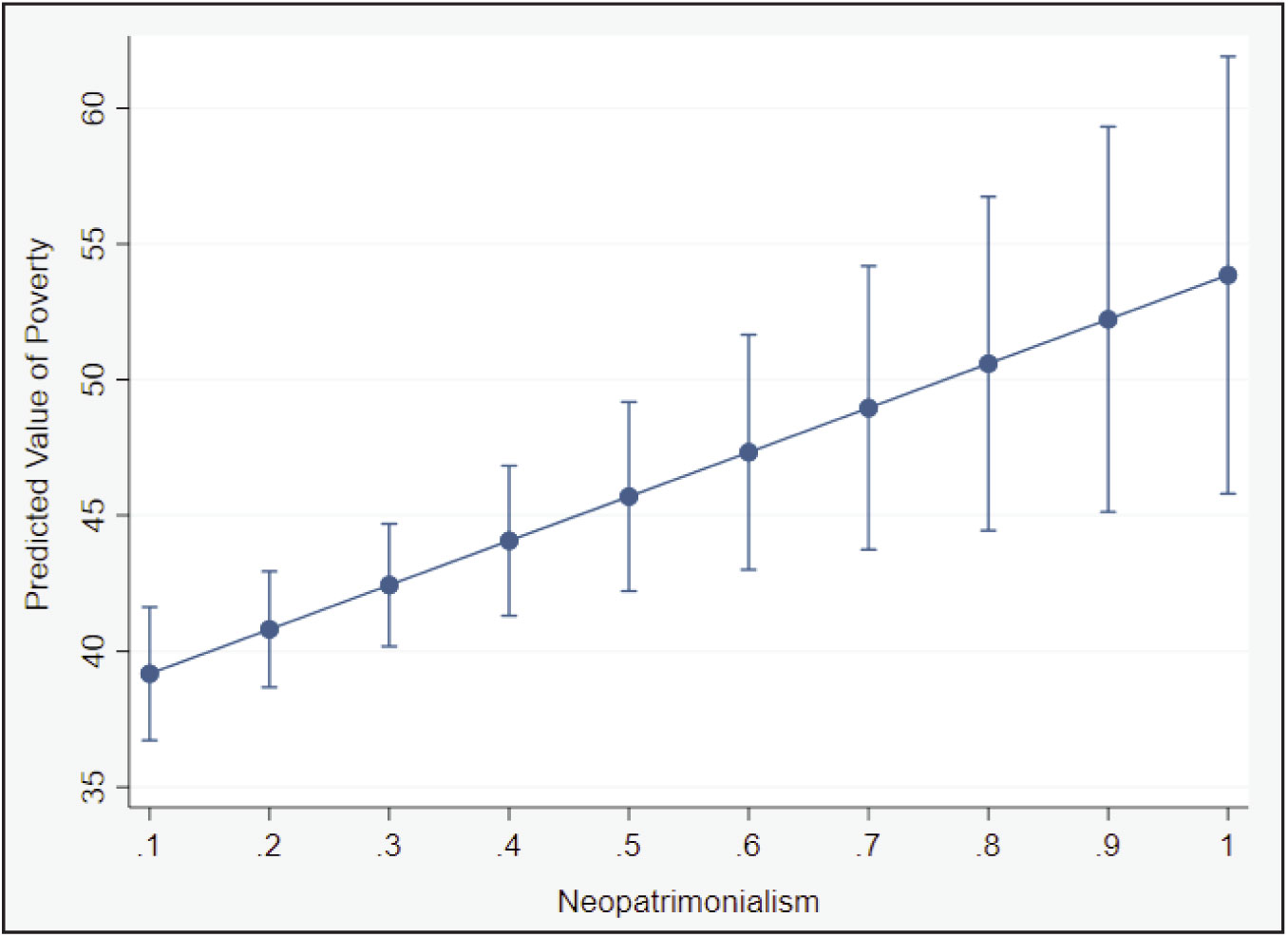
Predicted Poverty Across Values of Neopatrimonialism (Table 2, Model 1)

Quantitative Analysis of the Impact of Neopatrimonialism on Poverty
In what follows we describe how we measure our dependent and control variables and discuss alternative hypotheses. Then we turn to our statistical models, results, and discussion.
Dependent Variable: Poverty
Considerable debate surrounds the best operationalization and measurement of poverty and social spending variables. The measure used in this article for Poverty is the percentage of the population living below a country-specific poverty line, as defined by the Economic Commission for Latin America and the Caribbean (ECLAC). ECLAC uses common standards for the cost of basic food and nonfood items across the region, while also considering national differences in consumption, relative prices, and other factors.
We employ the ECLAC measure because it provides a realistic assessment of poverty, addressing the criticism that measures such as the World Bank $1.90 or $3.20 a day poverty lines are static and do not sufficiently consider differences across countries with regard to consumption patterns and prices. At the same time, the ECLAC measure also permits cross-national analysis within the region (cf. Pribble et al. Reference Pribble, Huber and Stephens2009). We combine two series of ECLAC measures, employing the newer measures when available and the previous series to fill in missing values for a given country-year.Footnote 10
Independent Variable: Neopatrimonialism
We have already presented the conceptualization and operationalization of neopatrimonialism and sources employed to measure its dimensions and subdimensions of neopatrimonialism. We have also shown that these annual measures provide for variations across countries and over time, and we have explained why we focus on a cumulative impact measure for neopatrimonialism, employing a ten-year moving average. Here we also report on results for a longer cumulative impact and for a shorter, five-year moving average.
Control Variables and Alternative Hypotheses
We include several variables related to the political system to control for additional factors that may affect the relationship between neopatrimonialism and poverty. Considering the argument that extended democratic rule provides greater opportunities for societal groups in favor of pro-poor policies to impact policy, we include the variable Years of democracy, measured as the cumulative democracy score over the years since 1945.Footnote 11 We expect this variable to have a negative relationship with poverty.
We also include a measure for Left party seat share, measured as the percentage of seats in the lower house of the legislature held by secular leftist parties.Footnote 12 In line with some past research (Huber and Stephens Reference Huber and Stephens2001, Reference Huber and Stephens2012; Pribble et al. Reference Pribble, Huber and Stephens2009), the expectation is that left ideology will be negatively associated with higher levels of poverty. Still, we have strong reasons to believe that high left party presence, in the presence of neopatrimonial rule, will not result in poverty reduction. High levels of neopatrimonialism inhibit the existence of programmatic parties (from both the right and the left). And clientelistic ruling parties, despite being from the left, do not necessarily implement programs and policies that reduce poverty, or they do so in combination with corruption and discretional rule that make poverty reduction unsustainable.
We also control for the “radical left” presidential administrations of Argentina (2004–15), Bolivia (2006–16), Ecuador (2007–16), and Venezuela (1999–2016), following Weyland et al. (Reference Weyland, Madrid and Hunter2010). Based on their orientation and rhetoric, these rulers appear highly committed to social reform, though some scholars have questioned the sustainability of their programs (Weyland Reference Weyland2009; Weyland et al. Reference Weyland, Madrid and Hunter2010). Otherwise, countries during the time period under study are coded as nonradical. Given the contradictory arguments, we do not have a clear directional hypothesis about the radical left.
We also include several socioeconomic variables that have been shown to impact poverty and social spending. One is Female workforce participation, as a higher level of female participation is expected to lower poverty. We measure this as the percentage of females aged 15 and over who are considered active participants in the labor force, or those who supply labor for the production of goods and services during a specified period (CEPALSTAT 2018). Ethnic diversity is another control variable; given Latin America’s history of slow political incorporation of people of African descent and indigenous populations, and thus their lower incomes, we expect them to be poorer than other population groups (Pribble Reference Pribble2011; Huber and Stephens Reference Huber and Stephens2012). It is a dummy variable coded 1 when at least 20 percent but not more than 80 percent of the population in a country in a given year is ethnically diverse (from Huber and Stephens Reference Huber and Stephensn.d.a, values extended through 2016).
We include four economic control variables. We expect higher levels of economic growth to be associated with lower levels of poverty. Therefore, one is GDP per capita, calculated as logged real GDP per capita in constant dollars using the Chain index based on PPPs (Purchasing Power Parities) in 2005 international prices. A second is Natural resource rents, measured as the sum of oil, natural gas, coal, mineral, and forest rents as a percent of GDP.Footnote 13 Some scholars have argued that countries with high levels of revenues from natural resources can more easily reduce poverty because they do not need to rely on domestic taxation. This may be more likely if associated with leaders of the radical left (Weyland et al. Reference Weyland, Madrid and Hunter2010; Flores-Macias Reference Flores-Macías2010; Mazzuca Reference Mazzuca2013). Alternatively, others have argued that states with access to natural resource rents are more prone to corruption and boom and bust cycles, defeating effective efforts to address poverty (Weyland Reference Weyland2009; Mazzuca Reference Mazzuca2013). Therefore, we do not have a clear directional expectation for the impact of this variable on poverty.
Third, to address significant shifts in export and import prices for countries in the region, we control for Terms of trade. We measure terms of trade using the net barter terms of trade index (World Bank 2018). Unfavorable terms of trade should be associated with higher levels of poverty. We also control for Inflation, measured as the annual growth rate of the GDP implicit deflator (World Bank 2018); we would expect dramatic increases in inflation to be associated with higher levels of poverty.
Rulers may spend more state resources in social areas, such as health and education, in order to improve people’s lives, garner favorable publicity, or expand a clientelist base in the state. Overall, we expect state spending in health and education to improve human capital and to create a more equal distribution of skill levels and life changes, thereby reducing poverty levels (Pribble et al. Reference Pribble, Huber and Stephens2009). For that reason, we include Health spending and Education spending by the state as control variables. We measure these as public spending on health and education as a percent of GDP.Footnote 14
State spending on education, however, can be problematic as a measure of state efforts to improve education, for several reasons. The measure available to us does not differentiate investments across educational levels based on where the greatest need is for a particular country. This measure also does not address issues of quality, which is even more problematic than it is with regard to health expenditures. For these reasons, we also include Average years of schooling as a control variable, with the expectation that higher years of schooling reduce poverty levels. We measure this as the average years of schooling of the population aged 15 and over.Footnote 15
Models, Results, and Discussion
Table 2 provides a summary of our key results. We employ Prais-Winsten regression estimation models with panel corrected standard errors. We do so to help correct for issues arising from the structure of our cross-sectional time series data and to address concerns about serial correlation on poverty, our dependent variable. As Hicks notes (Reference Hicks, Hicks and Janoski1994, 172), “errors for regressions equations estimated from pooled data using OLS procedures tend to be (1) temporally autoregressive, (2) cross-sectionally heteroscedastic, and (3) cross-sectionally correlated as well as (4) conceal unit and period effects and (5) reflect some causal heterogeneity across space, time, or both.”
Effect of Neopatrimonialism on Poverty

+ p < 0.10, * p < 0.05, ** p < 0.01, *** p < 0.001
Prais-Winsten estimation; standard errors in parentheses.
Reduced observations in model 2 due to data limitations.
While first-order autocorrelation can be corrected with the inclusion of a lagged dependent variable (Beck and Katz Reference Beck and Katz1996), this method suppresses the power of other independent variables (Achen Reference Achen2001). This is why we consider Prais-Winsten models to be the better option.Footnote 16 We also ran OLS models with panel-corrected standard errors of all our main and supplementary analyses, and they confirm the results reported here.Footnote 17
The results show that higher levels of neopatrimonialism have a significant positive effect on the level of poverty. This is true in both model 1 and model 2 presented in table 2. Model 1 does not include the variables focused on health spending or on education spending and average years of schooling. In model 2, where we control for these factors, the effect of neopatrimonialism remains present and significant, if not as strong as in model 1.Footnote 18
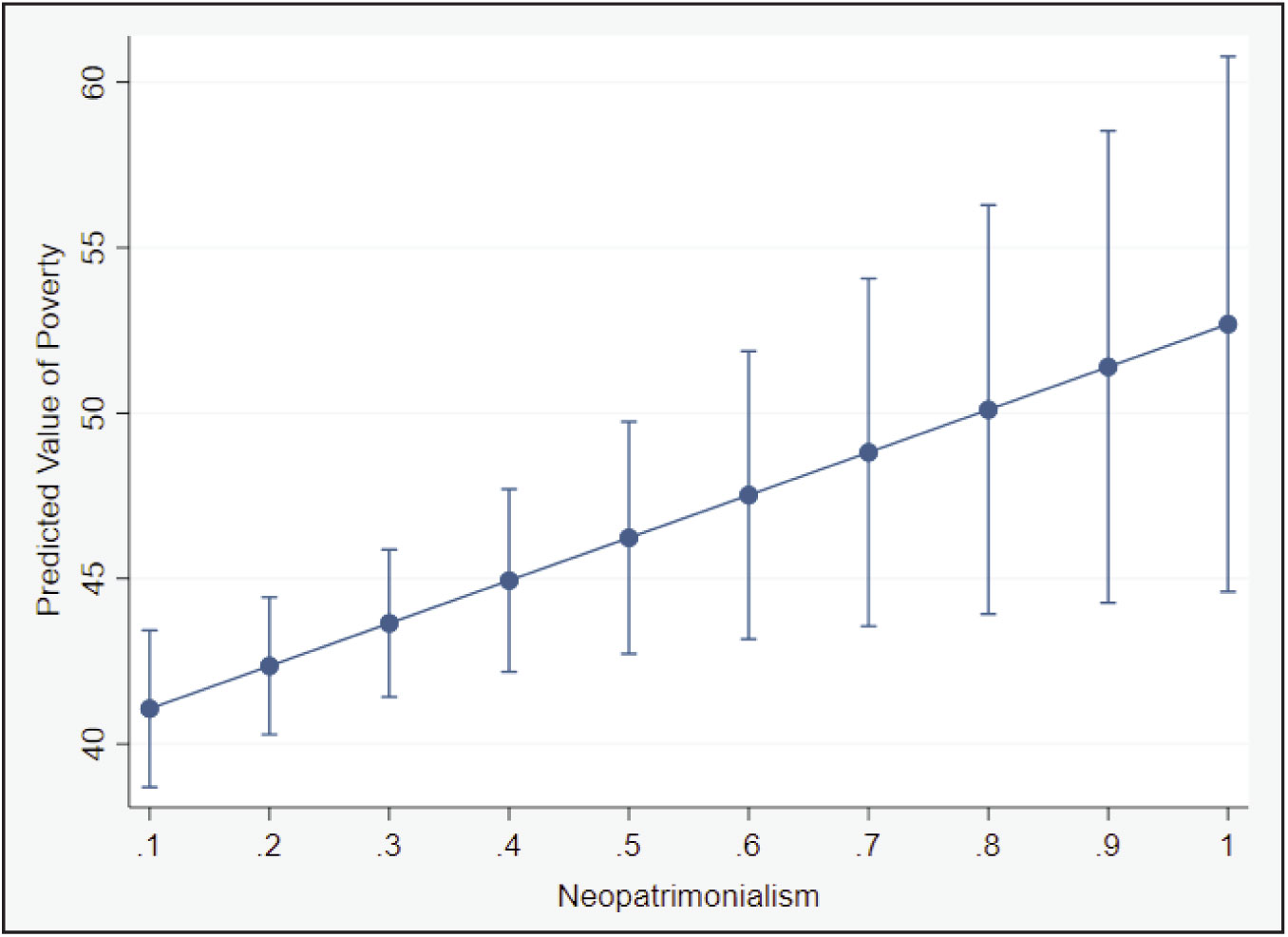
As a measure of substantive impact, we calculate the predicted values of poverty for different levels of neopatrimonialism, holding all other variables at their mean (figures 2 and 3). As figure 2 shows, the predicted percentage of the population living in poverty in a country with no neopatrimonialism is about 39 percent. In contrast, at the highest level of neopatrimonialism, the predicted value of poverty increases to around 54 percent. When health spending, education spending, and average years of schooling are included (figure 3), these values change slightly, with the predicted value of poverty in a country with no neopatrimonialism around 41 percent and the predicted poverty in country with the highest level of neopatrimonialism increasing to around 53 percent. In sum, both models reveal a statistically significant and substantively important increase in levels of poverty as neopatrimonialism increases, congruent with our expectation.
Predicted Poverty Across Values of Neopatrimonialism (Table 2, Model 2)

With regard to the political control variables, and in line with extant literature, we find clear support for the argument that cumulative democracy matters for poverty alleviation. Our models in table 2 find a negative relationship between cumulative years of democracy and higher levels of poverty, as do most of the additional models presented in appendix B.Footnote 19 At the same time, and contradicting earlier findings in the literature on social policy, we do not find a statistically significant relationship between either of the variables measuring left governments and poverty, although the coefficients are in the correct direction.Footnote 20 We attribute this lack of significance to the effect that neopatrimonialism has on party leadership in power and the likelihood of party organizations to be nonprogrammatic, and how these factors negatively affect social policy.
Because some past studies have run models for cumulative democracy and leftist governments separately, we also tried this (appendix table B.9). Neopatrimonialism remains positive and significant, and we still do not find a significant impact for left party seat share or radical left on poverty, though the coefficients remain in the correct direction.Footnote 21
Regarding the economic control variables, we also find a strong negative relationship between GDP per capita and poverty in table 2 and other model specifications. As expected, low rates of GDP per capita are associated with higher poverty levels. Similarly, higher levels of ethnic diversity are also associated with higher poverty levels. We do not find statistically significant relationships for the other social or economic control variables in table 2, including female labor force participation, natural resource rents, inflation, or terms of trade.Footnote 22 As past research would lead us to expect, in table 2 (and in the alternative model specifications) we find a negative relationship between greater spending on health and poverty. Similarly, for our proxy measure for public effort in education, the average years of education in the population, we also find a negative relationship with poverty. However, for potentially both methodological and substantive reasons, as we had anticipated (and why we included an alternative measure), there is no relationship in table 2 between spending on public education and poverty, and it is signed in the wrong direction; the same is true for the models presented in appendix B.Footnote 23
We conducted several robustness checks. First, we provide results employing different moving averages for neopatrimonialism in appendix B. Country case studies frequently emphasize the strong historical legacies of neopatrimonial rule in the region (cf. Hartlyn Reference Hartlyn1998), indicating that entrenched habits of ruler appropriation and discretionality are extremely difficult to overcome. For that reason, we test a model that employs a cumulative measure of neopatrimonial rule in the region from 1945 to the present, with the same controls as those in table 2. The results in appendix table B.3 confirm that neopatrimonialism has a positive and statistically significant impact on poverty in both models. Second, though we believe that it is the cumulative impact of neopatrimonialism that matters (as with democracy), we also examine an argument that provides more weight to present factors by testing models with a five-year moving average for neopatrimonialism, retaining the cumulative measure for democracy. The results in appendix table B.6 for neopatrimonialism are positive, though weaker, missing statistical significance in the model that includes the health and education variables.Footnote 24
We also examine results measuring neopatrimonialism by drawing on alternatives to V-Dem for as many indicators as possible. In one set of models, we employ measures from the International Country Risk Guide (ICRG) for corruption, bureaucratic quality, and law and order, complementing them with V-Dem measures only for ineffective executive oversight. These model results for different specifications of neopatrimonialism (ten-year moving average, cumulative since 1984, and five-year moving average), shown in appendix tables B.15, B.16, B.17, and B.18, all provide consistent results for the effect of neopatrimonialism on poverty levels, with other variables of interest also showing similar results (e.g., cumulative democracy is related to lower poverty levels, and variables about the left are not significant except in the OLS model).
In other models, we employ the WGI indicators for corruption and the rule of law, supplementing with a measure of latent judicial independence created by Linzer and Staton (2012, Reference Linzer and Staton2015). These begin in 1996, and thus we can report results only on models run with a five-year moving average for neopatrimonialism (appendix table B.19). Again, these confirm a positive, statistically significant, and substantively important impact of neopatrimonialism on poverty.Footnote 25
Conclusions
This article fills a gap in studies of comparative politics both by addressing how neopatrimonialism is best conceptualized and measured and by examining its impact on poverty in contemporary Latin America. In so doing, the article contributes to an incipient, but long overdue, discussion of how neopatrimonialism should be measured, while also advancing our empirical understanding of its consequences. We created annual measures of neopatrimonialism and demonstrated that Latin American countries exhibit wide cross-national and longitudinal variation of neopatrimonialism. These measures show that while countries in the region have become democratic, neopatrimonialism continues to be ubiquitous.
These results are in line with those by Sigman and Lindberg (Reference Sigman and Lindberg2017), who conceptualize neopatrimonialism somewhat differently (as explained in appendix A), but similarly find considerable variation in its evolution across countries and over time, specifically in Africa, showing that neopatrimonialism is still present in that region despite increasing democratization.
The quantitative findings and analysis here contribute to refining existing works on poverty in several ways. First, they confirm our expectation that legacies of higher levels of neopatrimonialism—that is, high appropriation and discretionality—have a negative impact on poverty alleviation. In this way, this study makes an additional important contribution to the literature on the politics of social welfare in the region, which has emphasized the importance of a sustained, cumulative record of democracy. While the existing literature has argued that sustained democracy is a strong predictor of poverty alleviation (as this analysis also reveals), we find that in neopatrimonial contexts, poverty reduction is also less likely to occur.
At the same time, with the inclusion of neopatrimonialism, our quantitative analysis does not confirm arguments that left-wing parties in contemporary Latin America are central to reducing poverty levels. In countries with higher levels of neopatrimonialism, the exercise of power by party leaders, as well as their linkages to voters and the left party’s internal organization (Pribble Reference Pribble2013; Pribble et. al Reference Pribble, Huber and Stephens2009), are less conducive to the implementation of policies of poverty reduction. Specifically, poverty alleviation programs are not likely to be sustainable in countries whose rulers are part of nonprogrammatic and highly personalized left-wing parties or movements, some of which have been categorized under the so-called radical left, even as certain right-wing parties or movements may sometimes implement such programs.Footnote 26
This article opens up several avenues for future research. We believe that our findings strongly bolster arguments made previously by comparative-historical and qualitative analysis but now tested across a much wider set of countries. In future research, quantitative work should be combined with these types of analyses in order to address complex interaction, longer-term reciprocal causation, and other issues. Additionally, though we have focused on the contemporary period, important elements of variation in current patterns of neopatrimonial rule in the region have deep historical roots, probably in more path-dependent fashion for some countries than for others.
Future work can also examine the effects of neopatrimonialism on related areas of social policy. The importance of the nature of a country’s party system can be studied more directly, to test the argument that neopatrimonialism negatively affects ideological and programmatic structuring of parties and party systems. Future research can consider arguments about how neopatrimonialism affects the nature of a state’s coercive capabilities and capacity to penetrate throughout the territory the national state nominally controls. There are also important questions regarding how the two dimensions of neopatrimonialism, appropriation and discretionality, interact with each other over the short and long terms and how they interact with democracy. Under what circumstances can democratization lead to an effective sustained reduction of inherited legacies of neopatrimonialism? Alternatively, when and why are vicious reinforcing cycles between heightened neopatrimonial rule and democratic erosion generated, and how can they be stopped?
There is more concept and measurement validation, cross-regional and within-nation work that can be carried out. As new empirical indicators for dimensions of our concept become available for longer periods, we can further cross-validate our measures. Moreover, many of the issues we have discussed here can also be examined across world regions, depending on sufficient comparable data for relevant variables.
Supporting Information
Additional supporting materials may be found with the online version of this article at the publisher’s website: Supplementary Appendixes.