Standard economic theory of market failures argues that, in some cases, markets fail to allocate resources optimally. This conclusion is then often offered as a justification for government intervention. However, the literature also suggests that government intervention does not necessarily solve the problems it is supposed to solve, but can lead to various unintended or negative outcomes. The theoretical literature on market failures is enormous, but there are differing views on precisely when and how governments should intervene. This is not surprising; the complexities of market economies and government decision making are such that, after reviewing government activity in various spheres, Julian Le Grand, an economist and later professor of social policy at the London School of Economics, concluded in 1991 that “the extent of government failure in each case (and whether it is greater or smaller than the corresponding areas of market failure) is ultimately an empirical question, not a theoretical one.”Footnote 1
Market failure is a concept employed mainly, but not only, by economists. It is highly relevant for business historians as well, however, and in particular those looking at government–business relations or regulation.Footnote 2 Government intervention frequently has a crucial impact on the operations of companies. Hence, it is vital to recognize why policy makers decide to interfere and what impact their policies have on the business environment, as well as how the companies try to influence the behavior of governments. This article considers these issues by studying one empirical case, the investment decisions of Finnish forest industries in the late 1960s and early 1970s. At that time, government intervention was deemed to be particularly necessary by both policy makers and the forest industry trade association to ensure that the only substantial natural resource of this small country would not be overexploited. Of all European countries, only the Soviet Union and Sweden had larger forest areas than Finland, but the Finns still controlled only 0.5 percent of all forest land in the world. Conversely, the country’s forest industries—producers of pulp, paper, board, and sawn goods—grew fast during the twentieth century, and, by the mid-1980s, they had captured a 10 percent share of global cross-border trade and a 20 percent share of European trade in this sector.Footnote 3
It is argued that the policy makers failed to predict the growth level of forest resources and the consumption of wood. Furthermore, the industry managed to “capture” the regulation system, as many studies of regulation indicate that interest groups frequently do.Footnote 4 This article argues that, in reality, Finnish industrialists were not simply trying to tackle market failure, but their actions reflected a deeply entrenched aversion to competition and a desire to resort to restrictive practices. The industry had previously set up lumber purchasing cartels, but they had failed to control prices effectively enough. They were, therefore, looking for new ways to limit competition.
However, did all this mean that the intervention could be classified as failure? What consequences did it have? Regulatory capture is usually presented as a negative outcome, not only on normative, but also on economic grounds. For example, Ernesto Dal Bó has underlined the need to study the costs of capture. He assumes that it can have negative distributive consequences—for example, by transferring income from consumers to firms—and that it can cause net wealth losses.Footnote 5 However, the case of Finnish forest industries’ investment regulations suggests that the economic consequences can be much more mixed and that “capture” can, in fact, be seen as a sign of economically sensible cooperation, which nevertheless is difficult to defend on equity grounds, as it favors particular interest groups at the expense of others. Environmentally, the system does not look like a failure. The feared overexploitation of forest resources was avoided, but we argue that this was due mainly to other factors—in particular, more intensified forestry methods.
Failures and Alleged Failures
Most economists accept that market failures do, indeed, occur. Standard economics textbooks tend to habitually include a section explaining that, in some cases, the attempts by individuals or companies to promote their own self-interest can lead to suboptimal outcomes, and even negative results for society as a whole.Footnote 6 These market failures may occur for different reasons, but one in particular is relevant to this study: externalities.Footnote 7 The actions of companies or individuals in markets may affect third parties not involved in the transaction. Positive externalities benefit third parties, whereas negative externalities harm them. The existence of negative externalities, such as pollution caused by industrial production or tariff congestion, has often led to government intervention.Footnote 8
Although the belief in the effectiveness of intensive government planning, as applied in the communist states and dirigiste Western countries, gradually crumbled in the last decades of the twentieth century, the conviction that market failures do exist did not suffer a similar fate, and continues to provide a common—or perhaps even the most important—justification for government intervention in market economies.Footnote 9 However, it is not self-evident which events or outcomes should be classified as market failures and which should not. As Brian E. Dollery and Joe L. Wallis pointed out, “the instances of real or perceived market failure are probably limited only by the imagination of the economists.”Footnote 10 During the past few decades, they have identified countless alleged market failures in various fields of economic activity and other aspects of society.Footnote 11 Economically inefficient outcomes have traditionally been identified as market failures, but it has become more common also to regard environmentally and socially unacceptable outcomes as such. Therefore, there is often a strong normative element in the discussions about market failures as well as ample room for ideologically biased conclusions based apparently on economic theory.Footnote 12
Although most economists seem to be convinced that market failures do exist, the literature on them has come under considerable criticism. A vocal minority of economists claim that market failures do not occur.Footnote 13 Most critics are unwilling to go that far, but argue that many alleged instances of market failure do not stand up to detailed scrutiny and that, in general, markets work better than claimed.Footnote 14 Furthermore, even if we accept the notion of market failures, this does not automatically mean that governments should intervene in economic life, as this may create more problems than it solves.
There are three main reasons for this. First, the policies may serve the interests of particular groups and not the general public. In many cases, regulated industries have persuaded governments to introduce restrictions to gain economic benefits.Footnote 15 Murray L. Weidenbaum, a well-known economist and a former U.S. Assistant Secretary of the Treasury for Economic Policy, has argued, “Given the power of the regulatory process, it is not surprising that many interests have cloaked their pleas for special treatment with a reference to some broader public purpose.”Footnote 16 Even without such outside pressure, the policies are not necessarily designed to advance the overall interests of the nation. Policy makers are often more interested in promoting their personal interests or those of their supporters than the common good. In 1990, Anne O. Krueger wondered “why economists were ever comfortable with the simultaneous beliefs that individuals in the private sector act in their self-interest and that individuals in the public sector are motivated by a Benthamite vision of social justice.”Footnote 17
Second, intervention may be decided on for the right reasons from a societal point of view, but may be ineffective or actually cause substantial negative results. Even if, in some cases, markets have failed, this does not automatically mean that politicians and government officials would have done any better. It is not enough, therefore, to simply identify market failures; policy makers and scholars should also be able to explain why and how governments can remedy them. Too often, policy makers and economists tend to adopt what Harold Demsetz has called the “nirvana” approach to public policyFootnote 18 and present their case as if they are able to choose between imperfect real-world conditions and ideal norms. They analyze the imperfections of the private commercial activity, but fail to scrutinize the political and administrative processes that are intended to replace market forces. In short, they fall victim to the “grass is always greener” fallacy and forget that policy makers may not have adequate skills to design and implement efficient policies, and that involving a multitude of actors in policy formulation can take these processes in directions that have little to do with the original goals. Thus, intervention easily leads to “government failure.”Footnote 19 Third, the theory of second best suggests that government intervention that removes a particular market imperfection might not increase social welfare in a situation in which one or more other Pareto-suboptimal imperfections continue to exist.Footnote 20 Moreover, government intervention can have considerable side effects on other areas, some of which are very hard to predict in advance.Footnote 21
The rest of this article is divided into four parts. The next two sections tell the story of the Finnish investment regulation system from two differing perspectives. First, we explain how the system was created by government officials and businesspeople who argued that it was necessary because, otherwise, natural resources would be overexploited. We then challenge this view by analyzing the introduction of the system as an additional step in the cartelization of the Finnish forest industries. Having done so, we examine what the actual effects of the regulatory system were. The final section considers and discusses the main conclusions of the article and the implications we can draw from them.
For the Good of the Nation and Its Industry
On December 18, 1970, the managing directors of no fewer than twenty-three Finnish forest industry (pulp, paper, and lumber) companies, as well as the leaders of the industry’s most important cooperative organs, gathered at the headquarters of the Central Association of the Finnish Woodworking Industries (CAFWI, from 1973 onward the Central Association of the Finnish Forest Industries [CAFFI]). The impressive building was located at the very heart of the nation’s capital, Helsinki, near the presidential palace and other leading institutions of the state. The distinguished physical surroundings were fitting because the top management of the country’s leading industry had a momentous decision to make: whether to accept a proposed agreement on investments that would have substantial impact on the activities of every one of them.Footnote 22
The proposed terms were harsh. According to the draft text of the agreement, the companies could henceforth invest in a new production capacity only with the approval of the CAFWI and the nation’s central bank, the Bank of Finland. This traditional and influential institution was a part of government machinery and was run mainly by professional economists, as well as some politically appointed directors. As the most important companies were represented in the decision-making bodies of the CAFWI, key industrialists could, at least in theory, block any plans of their competitors. Furthermore, as the government-controlled central bank was involved in the new investment regulation procedures, and was in fact officially the ultimate decision maker, there was a risk that, in the future, the politicians could decide which companies could invest and which could not. The businesspeople were generally not keen on government regulation and tended to be dismissive of the abilities of politicians to implement sound economic policies.Footnote 23 Not surprisingly, the prospect of government involvement raised some eyebrows even though the Bank of Finland was run mainly by permanent officials. Paavo Honkajuuri, the chairman of CAFWI, remarked that there was “terrible risk” that, in the future, politicians could intervene in the procedures.Footnote 24
Despite all this, the agreement was approved unanimously. Why did this happen? The simple answer was that the industrialists had no choice but to accept the new system because the Bank of Finland was concerned about the state of Finnish raw wood resources,Footnote 25 and the industrialists were not in a position to ignore its views. After all, the bank had a central role in the Finnish financial system. It—and, to a lesser degree, other government institutions—supervised the financial system, including private institutions such as commercial banks. In particular, borrowing from abroad was possible only with permission from the Bank of Finland. This was a crucial aspect of the government regulatory system, as the Finnish domestic capital markets were too thin to supply capital-intensive enterprises such as the pulp and paper companies with adequate funding. Furthermore, some of the domestic sources were government owned. As the legislation also severely restricted direct foreign ownership of Finnish companies, the right to control foreign lending gave the Bank of Finland, in practice, the right to control the investments of the nation’s leading manufacturers.Footnote 26
In 1969, the bank received several applications for foreign loans from forest industry companies planning to build factories in western Finland. It refused to approve any of them and argued that not all companies could be allowed to invest freely because this would lead to overexploitation of the forests. The bank demanded detailed information on the country’s wood resources and urged the forest industry to scale down its investment plans.Footnote 27 The explanation given by the Bank of Finland for its actions was clear-cut: there was a need to limit investment to preserve the nation’s forests. Reino Rossi, the acting governor of the Bank of Finland, gave a statement in which he pointed out that forestry experts had suggested that there was going to be a “growing imbalance” between the country’s forest resources, the estimated level of felling, and the expanding capacity of forest industries. Helsingin Sanomat, the leading Finnish newspaper, summarized this somewhat complicated announcement in clear terms in the title of its article: “Bank of Finland Warns: Wooden Raw Materials May Run Out.”Footnote 28 In a later joint statement, which referred to Rossi’s original one, the Bank of Finland and CAFWI recalled that “the bank announced that it cannot give its permission for the financial plans for these kinds of new investments, before it had been established and ensured that our forest resources are adequate, and the raw material supply” of domestic industry is “secured.”Footnote 29 By limiting investments in the pulp and paper industry, the government could reduce the growth of the demand for wood, thereby ensuring that trees would not be felled in an unsustainable fashion.
Immediately after World War II, Finnish forest industries had to direct all their resources to repairing the damage caused by the war, but during the 1950s, they had already managed to invest heavily in new production. This, however, was only the beginning. Between 1960 and 1970, the total volume of the Finnish forest industries rose by no less than 75 percent. Most of this growth occurred in the pulp and paper industries: The production of paper and board, in particular, more than doubled during this period, from 2.0 million tons in 1960 to almost 4.3 million tons in 1970.Footnote 30 There were also substantial structural transformations. For example, pulp companies shifted their production from sulfite to the more economical, technologically and ecologically advanced sulfate pulp.Footnote 31 As a result of the expansions, the consumption of domestic raw wood by the Finnish forest industries grew from 27.0 to 35.4 million solid cubic meters within a decade.Footnote 32 CAFWI comparisons between expected growth of forests and planned investments suggested that consumption of wood was going to exceed growth rate by almost six million cubic meters in 1974.Footnote 33
During the late 1960s, many companies introduced new investment plans. There was enough wood for a few new plants, but not for all of them. If even a substantial part of the plans were to materialize, this would put too heavy a burden on the natural resources of the country. Trees would be felled faster than new ones could grow. Ultimately, this would threaten not only the raw material supply of all economic actors dependent on the “green gold” of Finland, but also the economic well-being of the country as a whole, as it was heavily dependent on the utilization of the forests. In 1969, 56.8 percent of all Finnish export revenues came from the sales of sawn goods, pulp, paper, and other forest industry products.Footnote 34
Overexploitation of natural resources is one classic example of market failure, but this is often caused by the absence of property rights.Footnote 35 In this case, however, this was not the problem. From the beginning of the twentieth century, legislation had severely restricted the right of woodworking companies to expand their forest holdings,Footnote 36 which had therefore remained mainly in the hands of farmers, who had formed both an influential pressure group, the Central Union of Agricultural Producers (Maataloustuottajain Keskusliitto), and one of the most influential political parties in the country, the Agrarian Party (Maalaisliitto). Furthermore, the Finnish political and legislative system effectively protected the rights of individual owners.Footnote 37 However, property rights do not automatically preserve forests. As various studies show, economic pressures, poverty, and the slow growth of resources can lead to their overexploitation by private owners with secure property rights.Footnote 38 James M. Acheson found that the pulp and paper companies in Maine, which were suffering from low profitability and cutthroat price competition, have consistently maintained an unsustainable rate of felling in their own forests.Footnote 39 The Finnish forests were thus not automatically secure, even if their owners’ property rights were.
Both the Bank of Finland and the CAFWI saw the overexploitation of forest resources as a problem because it threatened the raw material supply of the country’s most important industrial sector. Neither of them used ecological rhetoric; both talked about trees as raw materials.Footnote 40 This is not surprising. The discussion on ecological issues in the forest sector at the end of the 1960s concentrated on the issue of water pollution, which had become a major problem for people living close to rivers. The forest industry was the main source of water pollution in the country, and its emissions were still growing. This attracted much negative attention from politicians and journalists, and outside pressure eventually forced the industry to invest in more environmentally friendly production methods.Footnote 41
The Finnish forest policy at the time was based on the principle of sustained yield industrial forestry, according to which lumber drain should not exceed growth. The Finnish authorities and an emerging group of nation’s forestry specialists borrowed this idea from Germany and Austria during the late nineteenth century. In the first half of the next century, academics developed sophisticated methods of analyzing how the standing stock of trees was evolving. The state also instituted laws against deforestation. A landowner who cleared forest land had to plant new trees and take care of regeneration. This did not automatically mean that the standing stock would not diminish, because extensive cutting could exceed the growth on a national level. At a local level, results could be even more drastic, as the Finnish ecological movement pointed out during the 1970s and more intensively during the following decades. Despite attempts of regeneration, clear-cutting had left empty spaces in vulnerable areas in Lapland in northern Finland. Modern forestry methods, which aimed at the maximization of standing tree stock, led to the emergence of monotonous forests with less biodiversity than before. Finally, local residents felt a sense of loss when large forest areas in their neighborhoods were cleared, because it would take decades for the new trees to grow to the height of previous ones. When the investment regulation system was created in 1969–1970, these debates were beginning, but had not yet had a proper impact on policy or forestry methods. Rather, forestry specialists and policy makers directed their attention to the need to ensure that lumber increment was higher than lumber drain in national and provincial calculations to meet the demand of forest industries and, thus, the needs of the Finnish economy.Footnote 42
In short, there was a cause for restraint in investments, as they would lead to increased use of wood, but it was hard to persuade any individual company to give up its project. Why would it do so if the others would press forward with their plans at the same time? In other words, market failure seemed imminent. The companies’ free pursuit of self-interest would lead to negative results for the nation as a whole. As the literature on market failures suggests, such negative externalities are often offered as a justification for new regulation.Footnote 43 In the case of the Finnish forest industry, the only way to ensure that overinvestment would not occur, as the proponents of the investments restrictions agreement argued, was to introduce regulatory mechanisms that would ensure that only investments that were compatible with the level of local raw material resources were made.Footnote 44 In other words, the emerging problem of externalities should be solved by introducing joint business–government regulation.
It has to be noted, however, that the Finnish industry representatives and the Bank of Finland did not use the concept of “market failure” to describe the alleged problem they were going to solve. Even though the concept, which had first been introduced in the 1950s,Footnote 45 had still not entered the vocabulary of the Finns in question, the underlying phenomenon was familiar to them.Footnote 46 As Charles Wolf has pointed out, this kind of reasoning can influence decision makers even though they are unfamiliar with the concept and theory of market failures: “They simply perceive that operation of the market fails to accomplish something regarded as wholesome, desirable or otherwise appropriate. Hence, government intervention may be advocated to remedy the perceived miscarriage.”Footnote 47
Special Interest Influence: Was the System Just Another Cartel?
The investments of the Finnish forest industries sound like a textbook case of looming market failure averted by government intervention. However, was this actually the case? Taking a more longitudinal view of the history of the Finnish forest industries, and telling the story from the perspective of business cooperation, an alternative explanation starts to emerge. Strong links between companies had traditionally been a dominant feature of Finnish business life. Not surprisingly, Finland has often been considered as a prime example of “cooperative capitalism,”Footnote 48 and the network of alliances and institutions created by the Finnish forest industries were at the center of this cooperative national business system. The companies, which were small compared with many of their foreign rivals—and had limited financial and labor resources at their disposal—had decided to pool their resources in many fields and to reduce competition between each other whenever possible. They had, for example, set up export cartels, a joint research institute, and jointly owned energy producers. The rivalry was hence restrained with various formal and informal arrangements to the extent that the performance of the Finnish forest industry sector was close to monopolistic.Footnote 49
Among the weakest links in this cooperative system were the raw wood purchasing cartels, which were supposed to ensure that the companies did not pay too much for the wood they bought from forest owners. Despite efforts to set common purchasing prices and allocate preferential areas to individual buyers, the industrialists continued to compete with one another and therefore drove stumpage prices up. The high investment level maintained by the paper and pulp producers from the end of the 1950s onward ensured that there were always several willing buyers for most lots of wood that came onto the market.Footnote 50 If one analyzes the investment restrictions from this perspective, they begin to resemble yet another system designed to reduce competition. The purchasing cartels had never worked efficiently enough; hence, the companies decided to strengthen them by expanding cooperation to cover investments. Traditions, as well as the basic characteristics of the forest industries, offered a strong basis for any extension of cooperation, as Bengt G. Rehbinder, the CEO of Ahlström, explained to his colleagues: All companies used same raw material resources, production processes were similar, products relatively homogeneous, and the long history of the joint export associations had taught the companies how to cooperate with one another.Footnote 51
Regulation of investments was seen as an effective indirect way to intervene in markets for wood. By reducing the increase in demand, prices would be forced down, or at least they would climb more slowly. In fact, closer inspection of the events leading to the birth of the new regulation system shows that it had not actually originated with the Bank of Finland, as many studies still claim,Footnote 52 but in the industry itself. In January 1969, when key industry leaders considered how existing cooperation in wood markets could be continued, many of them pointed out that it was vital to also coordinate investments in some way. Johan Nykopp, the CEO of Tampella, stated that if a company was going to expand its production, it should reduce its activities in another sector so the total consumption of wood would not increase. Bengt Rehbinder and Kurt Swanljung, CEO of Kymmene, both emphasized that if a company invested, its competitors should have the right to resign from the purchasing cartel.Footnote 53
By the time the Bank of Finland became involved in October 1969, the industrialists had already been considering the introduction of some sort of a regulatory system for several months, as previous comments from January 1969 indicate. However, the industrialists could not agree on precisely what to do. The issue was discussed repeatedly in the executive committee of the CAFWI, where most committee members expressed deep concern. For example, Jacob von Julin, the chairman of the board of Kaukas, stated that “quick actions” were needed. However, they could not agree on any drastic measures. In the spring of 1969, Rehbinder was asked a write a memo to his colleagues. He duly did so, but “this had not led to any concrete actions,” as Honkajuuri complained later. Gustaf Serlachius, the managing director of G. A. Serlachius, concluded that negotiations between companies “were not going to lead to a result. The Bank of Finland nevertheless has the chance to stop construction, until the situation can be cleared up.” Most did agree that there was a need to gather more information on the forthcoming investments, but it proved difficult to get all companies to disclose their plans to one another, or to determine which plans were actually going to materialize, and which rested on a shaky foundation for financial or other reasons. Furthermore, CAFWI could not control the actions of nonmembers, who could seize the opportunity to build new mills.Footnote 54 Almost all important large forest industry companies were members of the CAFWI, but there were countless small sawmills, which were not.
It was even more difficult to persuade companies to abandon their current plans. The situation on the shores of the Gulf of Bothnia in western Finland was a case in point. Several companies had decided to build pulp plants in this area. The raw materials resources of the area could not support such an increase in demand, although there were some reserves. Honkajuuri contacted the CEOs of these companies and warned them of overexploitation. All admitted that he was right in principle, but none were willing to abandon their own investment plans.Footnote 55 A consortium of companies called Satasellu, which was planning to build a joint pulp mill in this area, replied that there was room for their plant if raw materials resources were exploited more effectively and if some old mills, owned by the members of the consortium, were shut down. Metsäliitto Corporation, a cooperative owned by forest owners who had a rival project, replied that it had “the right” to use wood sold by its members. Finally, the owners of the existing local mills stated that they had “the right to expand” because there were raw material reserves. Presumably, they meant that they had the right to do so because they were already established in the area. Honkajuuri reported these views to the executive committee and underscored the bigger picture: “It is not just about Western Finland but about the whole country, refraining from investing there [Western Finland] does not solve the issue, if production capacity is increased at the same time in Eastern Finland.”Footnote 56
Faced with such problems, it is not altogether unexpected that Honkajuuri decided to seek help from the Bank of Finland, as he revealed to a historian almost two decades later. Honkajuuri and Lauri Kirves, the managing director of the CAFWI, visited the Bank of Finland and proposed the introduction of a regulatory system. The Bank of Finland was worried about the “imbalance” between forest resources and industrial use of wood and therefore accepted the proposal.Footnote 57 A separate interview with another leading industrialist of the time lends support to Honkajuuri’s account. Gustaf Serlachius stated that “in reality the Bank of Finland was asked to help. This is the cold truth.”Footnote 58 In short, the initiative for the restriction system did not come from the Bank of Finland, as implied in public. The investment regulation system was “acquired regulation”—that is, it was sought by and beneficial for the industry.Footnote 59
It is not startling that the Bank of Finland was willing to help the forest industries. They constituted such an important economic sector for national economy that many policy makers were often willing to protect its interests, for example, in trade policy.Footnote 60 The Bank of Finland had always considered them to be the backbone of the Finnish economy and had therefore gone to extraordinary lengths to support the growth of pulp and paper companies in particular. The bank had channeled domestic funding for them and also given them preferential treatment in the allocation of foreign loans. The forest industrialists and the leaders of the bank had created a close and warm relationship with each other, and Honkajuuri had probably every reason to believe that the bank might again be willing at least to give his proposals serious consideration. The bank was run mainly by nonpolitical professionals such as Acting Governor Reino Rossi, an economist who had gradually climbed higher in the bank’s hierarchy, but who had also worked briefly as an economics professor at the Helsinki School of Business. Klaus Waris, another experienced nonpolitical economist, had led the bank between 1957 and 1967. During this period, he had strongly supported the expansion of Finnish forest industries, mainly because it strengthened the country’s balance of payments. Waris’s successor, Mauno Koivisto, was a Social Democrat politician, with considerable experience on economic affairs, but he served as the Prime Minister of Finland between 1968 and 1970. Rossi ran the bank during Koivisto’s absence.Footnote 61
The fact that the regulatory system promoted cartel-like cooperation within the forest industries was not problematic from the point of view of the Finnish authorities, because at this time, it still had a benevolent attitude toward restrictive practices, particularly those business alliances expected to help the country’s export industries to pool their resources and hence strengthen their ability to compete against foreign rivals.Footnote 62 Existing general historical scholarship offers some support for policy. Historians have recognized that, in some circumstances, cartels can be beneficial for the wider society.Footnote 63
If the leaders of the CAFWI had come to the conclusion that regulation was necessary, why did they turn to a government agency instead of presenting the case to their members? The answer can be derived from an article by the economist George J. Stigler, currently recognized as one of the classic pieces of literature on regulation, which was written roughly at the same time as the Finnish industrialists were contemplating the future of their investments. According to Stigler, who was a leading figure in the Chicago School and later won the Nobel Prize in Economics, the “state has one basic resource which in pure principle is not shared with even the mightiest of its citizens: the power to coerce.” The state can seize money from its citizens through taxation and control their economic activities and behavior in many ways. If an industry or other interest group can control or at least influence how this power is used, it can increase its profitability.Footnote 64
The managing director and the chairman of the CAFWI had considerable influence within the industry. They lead a key cooperative organization, and Honkajuuri was also the head of a major industrial company, Rauma-Repola. However, they were not able to dictate CAFWI’s policies. The executive committee of the association was filled with Honkajuuri’s main competitors, and even if these men could reach an understanding, there was no guarantee that they could control the activities of the many medium and small enterprises. The minutes of the executive committee clearly show that the leaders of the large companies were aware that they could not control the investments of members or outsiders without government help: “It is difficult to get all members to agree to this,” Honkajuuri said, and continued that outsiders constituted an “additional problem.” Mikko Tähtinen, the CEO of Kajaani, said that strict CAFWI regulations might lead to a situation in which the members of the association could not invest, but outsiders could. It did not seem wise even to try because “coercive means are needed” and industrialists felt they did not have any.Footnote 65 Moreover, a purely voluntary negotiation process involving dozens of companies could take years. The officials of CAWFI remembered very well that it had taken no less than four years of intensive negotiations in the early 1960s to create the pulpwood purchasing cartel,Footnote 66 which in the end did not work effectively enough from the companies’ standpoint.
The members of the executive committee were all convinced of the need to limit investments, but they also knew that self-regulation was insufficient. Paavo Honkajuuri perceived both the basic problem and its solution in very much the same way as Stigler did. According to the chairman, the “[i]ndustry had no authority to stop anyone from investing”; therefore, the industrialists should “negotiate with the authorities and try to acquire power to support the proposed actions” to limit investments. When another member of the executive committee suggested a purely voluntary arrangement, Honkajuuri replied that coercive methods were needed.Footnote 67 Hence, the leaders of the association needed the government’s help and thus invited the Bank of Finland to put pressure on its own member companies. Not only did they manage to get the required assistance, but the Bank of Finland also took the moral responsibility of introducing the regulatory framework and argued that it was the bank’s “duty” to intervene. The industry merely stated that they would “support” the bank in its efforts.Footnote 68 As a result, the Bank of Finland became a target of criticism for those who did not like the new system, although it was merely fulfilling the wishes of the regulated.
One could argue, of course, that Honkajuuri asked the Bank of Finland to become involved only because he believed that otherwise the government would have intervened later, and on its own terms, which might be unwelcome to the industrialists. Honkajuuri warned repeatedly that outsiders might start to regulate the investments of the forest industry if the companies did not do it themselves.Footnote 69 There is little evidence, however, that such intervention was imminent, although it was possible later. A few well-known forestry specialists, Professors Seppo Ervasti, Lauri Heikinheimo, Kullervo Kuusela, and Dr. Veikko O. Mäkinen, had proposed that the Economic Council of Finland, a cooperative body consisting of the representatives of the government and major interest groups, set up a new subsection to consider the coordination of investments.Footnote 70 CAFWI rejected this option and argued that many of the groups represented in this broad-based council were outsiders in this issue. The chairman and secretary of the Council also agreed that the issue was outside its remit. The fact that the country’s leading industry, which was represented in the council, opposed to the proposal may very well have influenced their view. They did, however, imply that the council might reconsider the issue again later if the problem could not be solved in other ways.Footnote 71
There were also some doubts as to whether intervention was, in fact, necessary. Many of the investment plans might not materialize at all, and increased support for silviculture, the systematic effort to support the growth and quality of forests, could substantially promote the expansion of raw wood resources. During the 1960s, the government, forest industry companies, and forest owners had jointly set up three successive National Forestry Financing Programs (Metsätalouden rahoitusohjelma, MERA) that directed funds to various silvicultural purposes, such as fertilization, artificial regeneration, and the drainage of swamps. The first two programs, launched in 1964 and 1966, were implemented successfully, and as a result, the growing stock of the Finnish forests and the volume increment began to increase considerably. The third program, which was launched in 1969, soon ran into trouble when the government cut its funding—a decision that was due partly to budgetary difficulties and partly to disputes between political parties. Lack of funds undermined the efficiency of MERA III, which created widespread anxiety.Footnote 72 Honkajuuri admitted that if the program were implemented as originally planned, the state of the forest resources would have not become “really catastrophic.”Footnote 73 In 1970, an expert group recruited by CAFWI estimated that the overconsumption of wood would be just 2.5 million cubic meters in 1974 if MERA III were implemented. It also pointed out that more efficient use of waste wood could further reduce the pressure on forest resources.Footnote 74
There was, of course, one obvious alternative to the new system: free unrestricted competition. Honkajuuri did point out in the meeting of the CAFWI executive committee that the industry could simply abandon their efforts to jointly regulate markets for lumber completely. As a result, lumber prices would rise to a level that would make the operation of many forest industry companies unprofitable. Hence, some plants would probably be shut down. Honkajuuri warned that closing down plants and the resulting increase in unemployment would attract unwelcome attention from outsiders—above all the government, which might intervene in an undesirable way. This was likely not the only reason that Honkajuuri’s suggestion was abandoned in the executive committee without any discussion.Footnote 75 The industrialists were generally reluctant to increase competition with one another, as the existence of a wide variety of cartels indicates. They usually talked about open rivalry as “disruptive” or “cutthroat” competition that should be avoided whenever possible. Little attention was paid to the fact that competition might help to weed out high-cost producers and to force others to improve their production methods or to divert resources to other more promising industries.Footnote 76
The power in the new regulatory system was formally in the hands of the Bank of Finland, which was, however, willing to let the industry representatives plan the details of the regulatory system.Footnote 77 This was not as difficult as the most important problem—how to force unwilling companies to join—had now been solved, and many other issues had been under consideration in the industry organs since 1969. The Bank of Finland continued to support the system during the following years, and, for example, in 1977, when the agreement had just been renewed, the governor of the Bank of Finland, Mauno Koivisto, assured the industry that the continuation of the agreement policy was of primary importance in spite of some problems. In particular, he complained that many projects that had received a “green light” had never materialized.Footnote 78
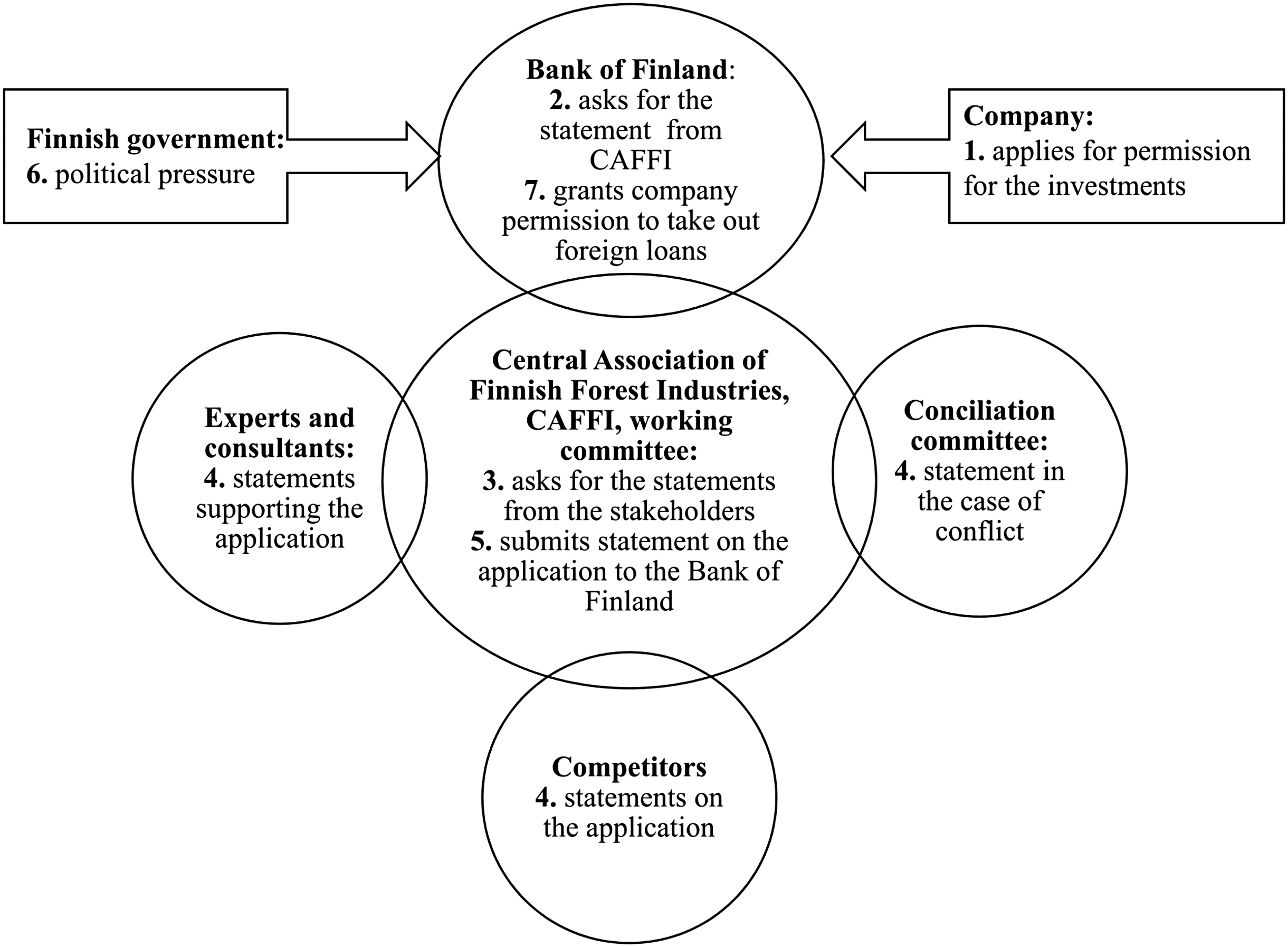
Figure 1 gives an idea of the investment restriction agreement formulated by the industry and approved by the bank. At the first stage, the company made plans for an investment. The exact calculations, including estimates of the raw wood consumption, financing, and profitability, were sent to the Bank of Finland. The bank then examined the proposed investments, sometimes with the help of an outside consultancy, and also asked for a statement from CAFWI/CAFFI. These statements played an important role; only seldom did the Bank of Finland withhold its permission for a loan for an investment that had received a positive response from the association. To be exact, the Bank of Finland did not give permission for investments, but it gave permission for loans for the investments. However, as the bank could control most sources of funds in some way, it was very difficult for a company to find alternative sources of funding.
Actors in the investment restriction system. Note: Numbers show the chronology of the events. Sources: Based on SMKL files, for example ELKA. SMKL, file 1012: “Investointihankkeiden käsittely.” Juhani Numminen, September 7, 1973, and its attached graph.

CAFWI/CAFFI, for its part, consulted competing firms likely to be affected by the investment, made its own calculations, and acquired assistance from an outside consultancy. The supply of lumber was the most important issue considered. The decision-making power within CAFWI/CAFFI was in the hands of the executive committee, but the representative of the applying company could not take part in the decision-making process. If the executive committee failed to make a decision, or if the applicant was dissatisfied with the decision, the investment application was sent to a special conciliation committee. This committee usually consisted of three members. Two of these were forestry or forest industry experts, who were appointed by the CAFWI. These were supposed to be persons without any obvious links to individual companies, and hence to be neutral specialists. Key figures in the 1970s included Professors Viljo Holopainen, the head of the Finnish Forest Research Institute, and Seppo Ervasti, a specialist on raw wood markets. The third member was appointed by the company that was trying to get the permission to invest. When the committee considered the first applications in the early 1970s, it decided to consider all applications together; hence, the size of the committee grew temporarily to no fewer than eight people. Many of the applicants chose well-known specialists, such as Professors Niilo Ryti, a specialist on paper technology, and N. A. Osara, an internationally known forest expert and a former head of the Finnish State Forest Administration.Footnote 79 The applicants probably assumed that such individuals could influence the views of others. The decision of the committee was final; neither the applicant company nor its competitors could appeal against it.
However, even after a negative response from the conciliation committee, the applying company could seek the permission required for the investment. It could simply draft a modified application that attempted to address some of the issues that had led to the rejection of the original one. The company could also use political channels to influence the view of the Bank of Finland, which was done successfully in at least a few cases.Footnote 80 After all, although the decisions of the Bank of Finland were based on the statements by the CAFFI organs, the ultimate decision-making power rested with the bank.
Outcomes of the System
Did the intervention have the desired effect? It would be easy to conclude that the investment regulation system was yet another example of government failure. First, analysis of the statistics of accepted and rejected proposals, could lead to the conclusion that the system was not as restrictive as it was supposed to be, although originally it seemed that the system would prevent all the investments of the Finnish forest industries. In the spring of 1971, CAFWI considered and rejected eight substantial investment applications. All these first applications were criticized by the competitors of the firms planning to invest and were forwarded to the conciliation committee. The committee also rejected all the applications, with the exception of three chipboard factories that did not increase lumber consumption.Footnote 81
Later proposals fared better, and during the 1980s, almost all applicants received a positive response. In total, more than 200 investment plans were scrutinized between 1971 and 1988, and of these, about two-thirds were given positive statements from CAFWI/CAFFI. One-third were sent to the conciliation committee, and about half of these obtained permission for their proposed investments. What these figures tell us is that the industrialists soon learned to manipulate the system. Above all, they realized that anyone willing to support or oppose a competitor’s investment proposal could expect reciprocal treatment in the next round. Hence, they were soon involved in multi-round games, to use a familiar concept from game theory. Even if an application for investment was rejected, it might re-emerge later in a slightly different form. Some companies, like United Paper Mills, were accused of applying for a number of permissions just to be on the safe side, without any actual immediate need for such investments.Footnote 82
Second, the industrialists—or, more precisely, the most influential ones, who sat in the executive committee of the CAFWI—managed to capture the regulatory system. From the start, this was likely a predictable outcome, not merely because the initiative for the regulations had come from the industry. The Bank of Finland also lacked detailed enough information about the industrial operations to judge who could invest and who could not. The industry, on the other hand, had a better idea of the economics of its own business. The literature shows that this kind of asymmetry of information often promotes regulatory capture.Footnote 83 The Finnish case was no exception. The Bank of Finland had urged the forest industry companies early on to consider what to do to limit the growth of investments,Footnote 84 and it also usually accepted CAFFI recommendations.
Third, it turned out that the administrators were no better than the markets at deciding who should be allowed to invest and who should not. The industrialists hired Klaus Waris, a former governor of the Bank of Finland and perhaps the most distinguished economist in Finland, to chair the conciliation committee. Waris soon became very frustrated and resigned on realizing that there was “no rational way” of deciding which applications to accept and reject.Footnote 85 This state of affairs offered both outsiders and insiders opportunities to manipulate the system, or even to circumvent it.
In particular, Paavo Honkajuuri’s fears had been justified: The “terrible risk” of politically motivated intervention soon materialized. In a couple of cases, the Finnish government (that is, the politicians) interfered in the process. The most notable case was the Metsä-Botnia pulp plant, which was granted permission to go ahead even though the investigations suggested that the raw material supply in the area was insufficient and that the project was economically questionable. However, the main applicant, Metsäliitto Corporation, was owned by a forestry cooperative that was closely connected to the politically powerful Agrarian Party. The Metsä-Botnia investment was agreed upon as a part of a larger deal between a number of political parties.Footnote 86 The permission for Metsä-Botnia antagonized other companies, but in the long run, Metsä-Botnia did indeed become one of the most profitable forest industry plants in Finland—a result that indicated that the original system had failed to correctly assess its economic and environmental merits. From the point of view of the investment restrictions system, the Metsä-Botnia case was therefore a failure in more ways than one.
Fourth, attempts to tackle market failures may generate distributional inequality.Footnote 87 In this case, they supported some producers at the expense of others. In particular, the system favored large chemical wood processing companies—producers of paper and pulp—at the expense of independent small and medium-sized sawmills and other mechanical wood processing companies. This could be defended on economic grounds: It was better to export the highly processed goods of the paper industry than the relatively less processed sawn goods. The sawmill industry was also more cyclical, and as barriers to entry were lower than in the case of the chemicals industry, its total production capacity tended to grow to an unsustainable level during boom periods.Footnote 88 However, the independent sawmill companies suspected, probably with some justification, that the Bank of Finland and CAFFI favored pulp and paper producers because these large companies had more influence within the cooperative industry organs, and also had greater political clout. For example, during the early 1980s, both the Bank of Finland and CAFFI asserted that there was a need to limit capacity in the sawmill industry but, at the same time, let the paper industry expand its production considerably.Footnote 89
In light of all this, it is not altogether surprising that, according to a survey conducted in the late 1980s, the representatives of the chemical wood processing industry were quite satisfied with the investment regulation system, but only about one-fifth of the sawmill companies thought that the system had been beneficial for their businesses.Footnote 90 By this time, it had become clear that the system greatly strengthened the position of the chemical wood processing companies at the expense of the mechanical ones. The former could acquire and shut down individual sawmills just to get their hands on the lumber allocations of these producers.Footnote 91 Many small mechanical wood-processing companies disappeared this way, but it was not only the small or inefficient producers that suffered. The pulp and paper companies were also willing to block the ambitious investments of sawmills. As underlined by Stigler, control over entry by new competitors is one of the most important benefits, which industrialists seeking regulation try to acquire from governments.Footnote 92
Finally, one could argue that ultimately the system was not even necessary. In 1970, the total harvesting of wood from Finnish forests was indeed roughly at the same level as their growth, and if all of the new investment plans materialized, the rate of felling could be expected to rise to an unsustainable level. However, in the long run, the growth of forest resources turned out to be higher, and the demand for wood lower, than expected. The creators of the regulatory system failed to accurately predict both the impact of previous forestry policies and the future developments in timber, board, pulp, and paper markets. During the 1960s, the government, private forest owners, and forest industry companies had worked hard to accelerate the growth of forests. From the late 1970s onward, the results of these efforts became apparent in forestry assessments. Furthermore, problems related to the funding of the Mera III national forestry improvement program disappeared when, in 1972, the World Bank decided to grant a loan of 20 million dollars for this purpose.Footnote 93
There was a clear increase in gross annual increment of the growing stock volume in Finland from the 1960s onward, shown in the National Forest Inventories. Whereas the total volume of Finnish forests during the late 1960s was around 1,500 million cubic meters, this figure grew to more than 2,000 million cubic meters by the early 1990s, and during the early 2000s to more than 2,300 million cubic meters. The investment regulatory system might have had impact on this development, thus supporting the argument that the system had also environmental impact. However, this increase was due mostly to intensive silviculture and forest improvement. Thus, as a whole, the forest resources developed favorably as lumber resources were underutilized and the growing stock volume increased from the mid-1960s and accelerated from the 1980s as a consequence of improvements, especially in cutting methods and artificial seeding and planting.Footnote 94
From the 1970s onward, the standing lumber stock continued to grow steadily, with no corresponding increase in the demand for domestic wood. Arguably, the lower-than-expected demand reflected the operation of the regulatory system, but several other factors also contributed to this result. Raw wood imports increased more than expected,Footnote 95 and some of the original investment plans proved impractical. Furthermore, international economic fluctuations had a crucial impact on the consumption of wood. The industry’s demand for wood stagnated during the early 1970s after the regulatory system had been created. At the time, the pulp markets were weak, but after 1974, the demand for pulp dropped dramatically with the onset of a severe international recession, from which the Finnish forest industry companies suffered considerably. When the recession ended, consumption resumed, but never reached an unsustainable level.Footnote 96 Despite all of this, the restrictive system was only abandoned at the end of the 1980s, when the whole cooperative structure of the Finnish forest industries began to crumble and the government relinquished many of its regulatory powers.Footnote 97
The investment regulation system had no major long-term impact on the overall level of wood consumption in Finland, but it did have a clear effect on the structure of the forest industries, and hence on Finnish economic life in general. If the applicant could prove that the investment permission applied for would not increase raw material consumption, permission would be granted without discussion. The industrialists, therefore, had an additional strong incentive to invest in technologies that increased the degree of processing of the acquired roundwood. Instead of selling it to customers as sawn goods and wood pulp, they became increasingly interested in selling more refined products. During the 1970s, a number of pulp producers started to produce paper because they could not grow by investing further in pulp-making capacity. One of the best examples was Kaukas, a pulp producer that, in a mere eleven years, constructed eight large modern paper machines.Footnote 98
The share of sawn goods and pulp of total exports of the Finnish forest industry had been declining for a long time, but this process accelerated. Between 1970 and 1990, the share of sawn goods of the forest industries’ total exports declined from 17 to 12 percent and the share of wood pulp from 23 to 10 percent. At the same time, the share of paper and board increased from 49 to 71 percent.Footnote 99 Even more importantly, Finnish companies did not build just any paper mills, but those producing high-end products, in particular magazine papers. Partly as a result of these developments, Finnish companies’ share of the total European production of high-value-added printing and writing papers rose from 6 percent in 1980 to 14 percent in 1990.Footnote 100 Compared with those of their major competitors, the investment rates of Finnish paper and pulp industries were high from the late 1960s to the early 1990s. Consequently, the production machinery in the Finnish pulp and paper industries was relatively new in the early 1990s, and the average size of the machines was the largest in the world—some 25 percent larger than in Sweden or in Canada.Footnote 101 By the end of the 1980s, Finland was the fourth largest producer, and the largest exporter, of printing and writing papers in the world.Footnote 102
The system also encouraged companies to adopt new technologies that gave a high yield of fiber from the wood. Thermomechanical pulp (TMP) gave a yield of 95 to 97 percent, compared to the 50 percent yield in conventional pulp production. Traditionally, the remaining fiber had been burned for energy, but energy prices were relatively low in Finland; therefore, the companies that adopted TMP could rely on other energy sources. United Paper Mills was the leader in TMP production, and, in fact, also in the construction of the required machinery, whereas Tampella became the world leader in pressure-mechanical pulp (PMP) machinery.Footnote 103
At least some of the leading industrialists understood from the outset that the system might have various unintended consequences. In December 1970, when the agreement was accepted by the industrialists, Niilo Hakkarainen of United Paper Mills noted that the agreement would make production “more effective.” However, Hakkarainen warned that the new system might also impede the necessary structural change and development within the industry in the future.Footnote 104 In his memoirs, he compared regulation to the Soviet economic system.Footnote 105
Weak Justifications, Excellent Results?
In retrospect, it is easy to criticize the investment regulation system of the Finnish forest industries on both economic and normative grounds. It turned out that the administrators were unable to predict neither future developments in Finnish forest resources nor the consumption of raw wood with sufficient accuracy. Market fluctuations, government policies, and business actions all undermined efforts to plan the operations of the forest industries. Furthermore, the system often operated incoherently and produced a number of unintended outcomes. In short, the grass was not greener on the regulator’s side of the fence.
It might seem unfair to criticize businesspeople and policy makers for their inability to predict the future. However, it must be recognized that attempts to tackle assumed market failures are (in this case and in many others) based on the implicit assumption that policy makers are able to predict that markets are incapable of tackling “failures” and that government intervention will lead to an improved situation. After all, no one would support an intervention if the failure is expected to disappear anyway.
In this case, the most influential leaders of the regulated industry managed to capture the system, and in the end, it benefited them more than the less influential ones. Although the Bank of Finland and industry leaders were probably genuinely worried about the possible overexploitation of forest resources, the industrialists were at least just as concerned about their repeated failure to limit competition in the roundwood markets as they were about the state of their future wood supply. However, they managed to build a cartel-like system to support existing restrictive business alliances. This could not have been done without government help. The leaders of the Finnish pulp and paper industry managed to convince government decision makers that free competition would be harmful for the nation as a whole.
Nevertheless, it is important to ask whether the system really did fail to promote the interests of the country as a whole. Regulation helped to preserve vital raw material sources, which was also important from an environmental point of view. It also had a substantial impact on the structure of the forest industries. The system offered strong incentives for industrialists to direct their investments to the production of refined paper products instead of investing in other fields of forest industries. If the incentives were not effective enough, the regulators could have also used compulsion. As a result of the new system, the leaders of the largest Finnish forest industry companies and the Bank of Finland jointly gained the right to control the investments of a fragmented industry, which meant that they could direct the development of the industry sector in the direction they perceived to offer the best prospects for both the country and the forest industry companies. Hence investment funds were increasingly channeled to the production of high-end paper grades, a field that seemed most promising from the point of view of the large pulp and paper companies. In the two decades following the introduction of the regulatory system, the Finnish forest industry managed to transform itself from a producer of various standard forest industry products to a highly specialized supplier of high-end paper grades. In this case, government failed, and big business managed to create cartel-like structures, but these results turned out to be beneficial for the national economy. This conclusion suggests that scholars should give more attention to what the actual effects of regulatory capture are rather than simply assuming that they are undesirable from the public’s point of view.
However, this is not the end of the story. The system promoted one forest industry sector, the production of printing and writing papers, at the expense of others. This chosen sector prospered during the last decades of the twentieth century, but since then it has suffered from weak demand and overcapacity. In hindsight, it is no longer clear whether it was wise to put all the eggs in one basket instead of allowing economic actors to distribute them freely to various places. The regulated system helped to create a champion in one business area, but a less regulated model could have created a more diversified industry, which would have been less dependent on printing paper markets. In short, in the long run, the controlling system diminished flexibility that is often crucial to economic development.