Introduction
… art ephemera, which typically consist of exhibition and event related materials, serve a distinct purpose for a brief period of time, after which they become historical records. Ephemera document transience and express a timeless quality by being both of their time and in the present.Footnote 1
Ephemera is collected in both print and digital form by a wide range of New Zealand libraries and forms a significant part of many local art library collections.Footnote 2 All the respondents in a 2004 survey of New Zealand art libraries collected visual arts ephemera which typically included gallery and museum notices, pamphlets, leaflets, fliers, posters, postcards, announcements, invitations, souvenirs, exhibition checklists, manuscript and typewritten notes, and unpublished exhibition catalogues. However, the survey also demonstrated that this material was the least likely to be listed, indexed or catalogued out of all other types of material being collected.Footnote 3
In the past decade many New Zealand art libraries have made their ephemeral collections, often in the form of artist or gallery files, more discoverable for users by providing alphabetical lists of their vertical file holdings on their websites or by creating OPAC records at file level, to name two common approaches. In 2013 the Find New Zealand Artists website, a collaborative project between the libraries of the publicly-funded Auckland Art Gallery and Christchurch Art Gallery, was launched to provide a federated list of artist files and an index of artist names drawn from the files and a variety of other resources such as art society records and exhibition catalogues.Footnote 4
Two versions of exhibition invitation in an artist file in late 1990s. E H McCormick Research Library, Auckland Art Gallery Toi o Tāmaki

However, there are as yet no coordinated efforts by New Zealand's art libraries with respect to perhaps the most vulnerable class of ephemera: material that is born digital. Is it being preserved and made accessible for researchers, and for posterity? There are some excellent national initiatives particularly around the archiving of websites in New Zealand Footnote 5 but, as noted in the final report of Tate Library's 2012 survey of electronic ephemera, which New Zealand art librarians were invited to respond to, “e-ephemera is still relatively new ground with no case studies or models of workflows to look to for guidance as of yet.”Footnote 6 Furthermore, writes Grandal Montero:
There is no doubt that we are in a transitional period, but this cannot be an excuse for inaction…as a potential digital black hole of primary sources starting ca. 1990 could be its final consequence. The development of best practices for collecting born digital content relating to art and artists, including a definition of the notion of e-ephemera … would be a significant step in the right direction, and encourage libraries to consider projects in this area.”Footnote 7
With that call to action in mind this article will discuss the collections of e-ephemera of two Auckland art libraries: the E H McCormick Research Library at Auckland Art Gallery Toi o Tāmaki, a specialist art library within one of New Zealand's major public art galleries, and the Fine Arts Library Te Herenga Toi at the University of Auckland which supports the research and teaching needs of the Elam School of Fine Arts and the Department of Art History.
The libraries themselves are located very close together, about 500 metres apart on opposite sides of Auckland's inner city Albert Park, and their institutions have some elements of a shared history beginning in 1890 when Elam students were taught in the Tower Room at Auckland Art Gallery. Both libraries have collected New Zealand visual arts ephemera in print form since the mid-1960s. More recently collections of electronic ephemera on the subject have also been retained by both libraries. The changing nature and scope of each library's ephemera collections in a digital environment, and the unique challenges posed by e-ephemera will be discussed. While there are some differences in approach it is clear that both institutions see the value in preserving both print and e-ephemera and are looking to make this material more accessible to users.
E-ephemera at the E H McCormick Research Library
Background
The earliest pieces of electronic ephemera found in the artist files at the E H McCormick Research Library at Auckland Art Gallery date from the late 1990s. They are printouts of rather plain looking emails addressed to one of the librarians or curators at the Gallery. There is text in the body of the email setting out the date and time of a gallery exhibition opening for a particular artist or group show with none of the imbedded links or images that are now commonplace. Some emails included image attachments which were also printed out and then carefully paper-clipped together for filing. The e-invites often, at least at first, have a companion piece: the print version of the announcement that was mailed by post to the Library and sits alongside its ‘electronic’ counterpart in the file.
Another feature of the early e-ephemera found in the artist files are printouts of pages from gallery and artist websites, such as exhibition pages, lists of works or artists’ online résumés. By the early to mid-2000s these website page printouts almost no longer feature in the artist files, the proliferation of website content making this a near impossible task to sustain even in a small country like New Zealand.
It was not until 2009 – nearly a decade later – that the born digital ephemera collected by the Library was also saved in electronic form, and not until 2012 that the dual system of also printing out e-ephemera for inclusion in the artist files ceased. Part of the reluctance to treat e-ephemera as a separate collection stemmed from a desire to continue the, as yet, unbroken narrative of an artist's career found in the artist files. When some galleries and organisations began to produce announcements and newsletters in electronic form alone the printout became the only ‘signpost’ within the artist's file of that activity. But the balance was tipped by the sheer insistence of the material itself, in particular: its nature, which was considerably more sophisticated than those early emails so the integrity of the original demanded preservation and couldn't be successfully replicated in a printout; and scale, as the volume alone demanded e-storage rather than physical storage to ameliorate the space issues inherent in printing out born digital material.
Artist E-Files
The E H McCormick Research Library still actively collects ephemera in both hardcopy and electronic format but now treats them as separate but complementary collections. Hardcopy ephemera is filed in the physical Artist Files collection and born digital material such as e-invites and notices are stored in the Artist E-file collection on the Gallery's shared drive on a Microsoft Windows platform. Both types of filing are undertaken by volunteers who sort and file or name and save the material on a weekly basis. Access to the e-files is available to all Gallery staff and research interns via their desktops and, starting in 2016, to the general public in the Library's reading room. The Tate e-ephemera report determined that both preservation by its library and access onsite by users was legally permissible; this is also the conclusion we have reached in the context of New Zealand copyright law.Footnote 8
Researcher looking at E-files in the public reading room. E H McCormick Research Library, Auckland Art Gallery Toi o Tāmaki
The focus of the Artist E-file collection is to create an archive of born digital New Zealand art exhibition invitations and notices on the premise that these provide essential markers of both an artist's career and a gallery's activities. In practical terms they are also the most straightforward to collect, by signing up to a gallery's online mailing list, which still remains a standard channel by which galleries disseminate information about their activities. It is worth considering though whether the utilisation of social media by galleries, particularly artist-run spaces, may eventually come at the expense of email lists: a potential trend that may signal yet another shift in terms of sourcing and collecting ephemera.
The documents received are saved in a non-proprietary format (PDF in most instances or JPEG if the invitation is only an image) and stored in folders organised by the artist's surname. Earlier material that was saved in its original email format rather than in an open standard has so far remained usable but at some point should be converted to PDF/A, which will become the Library's new standard in 2016 due to its ongoing compatibility and the recent increase in storage capacity made available on the Gallery's shared drive.Footnote 9 There have been ongoing technical issues with ensuring the emails are received, and then saved, in their original form. The local government body who provide the Gallery with IT services have a security framework which sometimes strip out elements of email content, such as images, particularly for messages arriving from ‘on the fly’ servers. Workarounds to cope with this issue include accessing the emails remotely from the external mail server which bypasses the limitations placed on certain content, but it continues to be an issue that requires staff time, and persistence, to resolve.
A convention for file naming e-ephemera has been established as follows: yy-Artists name Title of exhibition Gallery Name ddmmyy. The purpose of this is two-fold: so that the items self-arrange within the artist's folder by year for ease of browsing and also to allow reasonably effective searching within Microsoft's search capacity by keyword including gallery name and title of exhibition. Electronic invitations for group shows of 2 to 5 artists are saved into multiple artist folders using the prescribed naming convention, so, as with the physical files, there is some duplication of the material stored when an item is about more than one artist.
However, the hardcopy artist files and the e-files are quite different in character in terms of their overall composition and management. Since their establishment in the mid-1960s there are now 3753 artists with a physical file (or files) ranging from nineteenth-century New Zealand artists to the present day. A physical file is only opened after certain criteria have been met, including that around seven to ten items on that artist have already been collected in the ‘General Files’. Once a file is opened – the selection is made once a year and usually results in around 10 new artist files – a MARC record is added to the online library catalogue following a standardised template and to the record for that artist on the Find New Zealand Artists website.
By comparison, an e-file for an artist is created on the shared drive immediately upon receipt of the first item relevant to that artist. The Artist E-file collection, which began only six years ago in 2009, already totals 2671 individual artist folders and is strongly skewed towards current practitioners. There is no attempt, as was the case with the pre-digital hardcopy artist files, to source and retain a wide variety of material for the e-files: the focus is almost exclusively on exhibition invitations or notices, and for the most part any other material received via email is deleted. Because it is the galleries rather than the artists that are ‘selected’, a list is kept and updated which notes which galleries provide material in print and electronic or both. One of the challenges is keeping up with new developments in the gallery scene and signing up for material early enough. This is especially true in the current contemporary art environment where ventures may be significant but short-lived such as Auckland artist-run space Snake Pit (2011–13) and commercial gallery Gloria Knight (2012–14). There may still be residual evidence of these galleries online, at least for the time being – websites, Facebook pages, blogs, Instagram accounts – but probably not long-term.
The e-files demonstrate their value as a resource when Gallery staff or research interns are seeking information on emerging New Zealand artists. (As an aside, it is worth mentioning that staff need to be reminded fairly regularly that the e-files exist. There is still a much greater awareness of the print artist files and this is something the Library could address in its inductions and ongoing training). This was apparent with a recent contemporary New Zealand painting exhibition (Necessary Distraction: A Painting Show curated by Natasha Conland) which highlighted predominantly young practitioners where the majority of artists had an e-file about them but not a hardcopy artist file. It is certainly conceivable that as more and more content on contemporary artists is produced in electronic format alone that the hardcopy files will at some point become a legacy collection. Out of the 87 commercial, artist-run, community, academic and public galleries mailing lists the Library is currently signed up to, less than a quarter now also regularly mail out material in print.
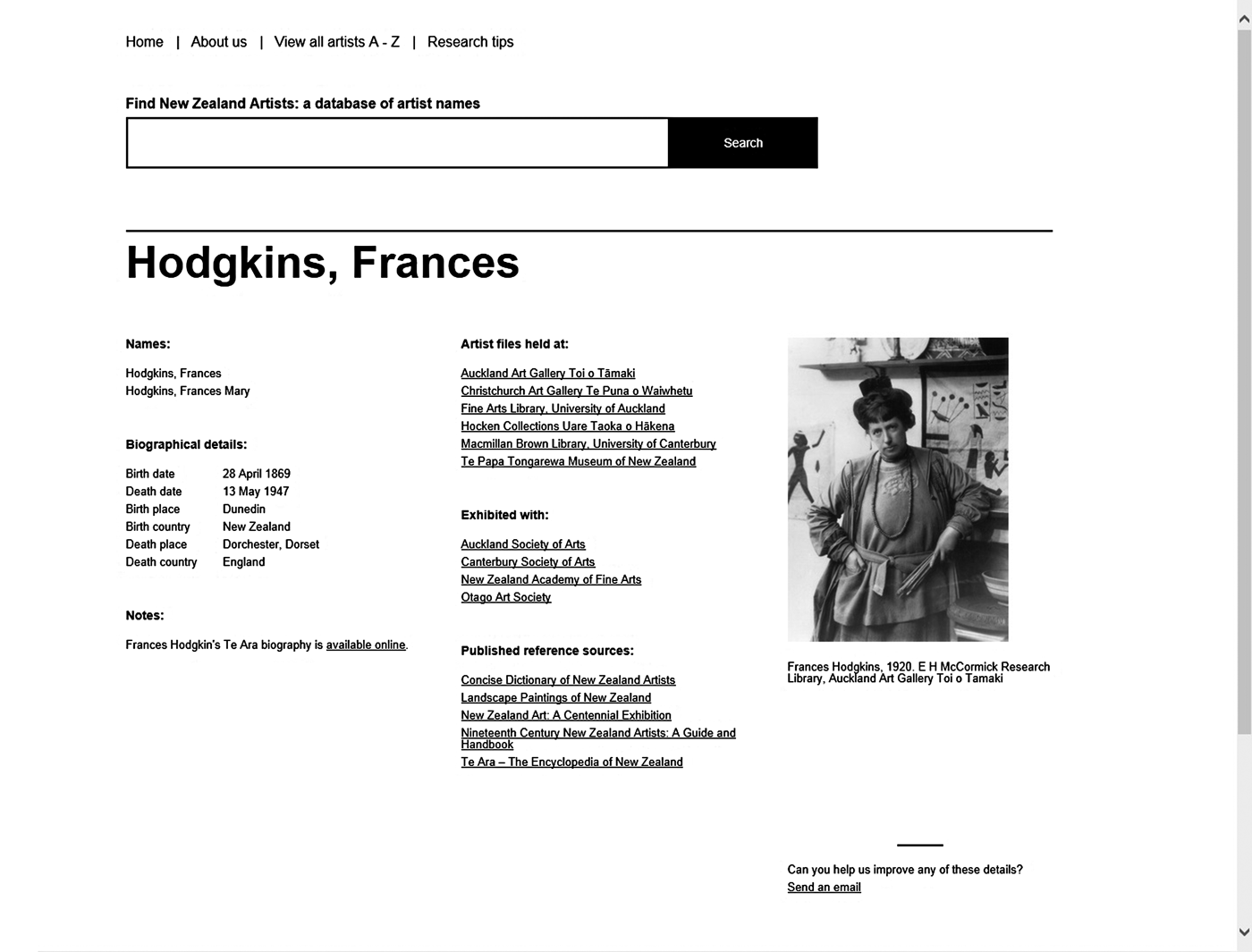
Entry for Frances Hodgkins’ on Find New Zealand Artists website
Channels in which users might discover the existence of the Artist E-files will need to be established once they become accessible to the wider public this year. The Find New Zealand Artists website has obvious potential given its current role as a central hub for artist names and artist file listings. It is however, a database of names that points to resources, not a database that contains the resources (such as the emails or PDFs). It would indicate to the user that an e-file exists but a visit to the Library would then be required, as with the physical files, unless an e-ephemera database – and here things could get complicated due to copyright issues – were developed for online public access.
E-ephemera at the Fine Arts Library, University of Auckland
Background
The Fine Art Library's e-ephemera collection has similarly developed alongside a well-established existing print ephemera collection which numbers 1898 artist files, 381 gallery files, and 53 festival, awards and events files. An artist file is usually opened after 10 items about them have been collected. Items in the files typically include flyers, posters, small catalogues and price lists. Material is received as the result of the Library's inclusion on mailing lists as well as by donation from University staff members who are either on a mailing list themselves or who attend galleries in person and collect material directly. Sometimes artists send through CVs, notes or statements to be added to the file. Print ephemera for group shows is duplicated for each artist file either through filing additional original items or photocopying as many as necessary. There is a catalogue record for each individual file on the University of Auckland online catalogue and artist files are also added to the Find New Zealand Artists website. There is, however, a general sense – supported by the Library's statistics on the number of items filed each year – that the production of print ephemera by galleries is on the decrease. Print ephemera is mostly filed when student assistants are available in the summer months and the usage of the files is fairly modest with 47 recorded requests in 2015.
Description of collection
The e-ephemera collection consists of born digital items collected via email to the Library's generic email account. The earliest item in the e-ephemera collection dates from 2003. The amount of emails received grows year on year: 59 emails were saved in 2004; by 2014 there were 1042 items retained. The Library sources e-ephemera by subscribing to mailing lists and joins new lists in a fairly ad hoc way – usually through word of mouth from staff or students. All items are currently saved without any further selection process unless they are clearly spam. The emails received are predominantly e-invitations to exhibition openings and events as well as other material such as newsletters and media releases.
As with the E H McCormick Research Library, e-ephemera was initially stored both electronically and printed out for the artist files but, again, duplication with print and storage issues meant this dual filing was not done for long. E-ephemera is now stored digitally only and is kept in Microsoft Outlook folders arranged by year, or month and year in some instances. There are two versions of the email kept – one in the original email format and the other in PDF. The Fine Arts Library is considering XML as an alternative long-term storage format. The stored emails are backed up on an external hard drive and the University's main server. There is currently no user access to the e-ephemera collection but it is retained with the view that it should be preserved and with the intention that it be accessible in the future.
Future plans
In terms of the broader picture, a new overall library platform is planned for the Fine Arts Library's in-house databases which will allow disparate collections to be linked up and searched across a single interface. The Library has developed a number of in-house databases, including INZART: Index to New Zealand Art which covers newspaper and journal articles from the early 1960s onwards. Library members can access an online scanned version of the articles via the University's website, and a bibliographic details-only version is available to the wider public through subscription to a local content aggregator The Knowledge Basket where it forms part of the New Zealand Index.Footnote 10
Within the context of a new platform for an in-house database with a federated search, the Fine Arts Library is considering making its e-ephemera collection accessible to users in the near future. Discussions have been held with the University of Auckland's Library Applications, Development and Support team to identify possible database solutions. Recommendations include utilising a system that allows email messages to be directly forwarded to a database and indexed automatically with data retrieved from the message's metadata. Having the capacity to tag additional artists to the email would be essential in terms of providing an access point by artist, and would be consistent with the physical ephemera files. As the content of all the Library's in-house databases will reside in the same place, the validation list of artist names created for INZART could be used for ease and consistency.
A working model for another potential use of the e-ephemera collection is the University of Auckland's art collection website which provides links to relevant articles on INZART on its search results page (although these are only accessible to Library members of the University).Footnote 11 Copyright issues, though likely low risk for most e-ephemera, may require investigation if the databases were made more broadly available.
Conclusion
The experiences of both libraries corroborate many of the key findings of the 2012 Tate report on e-ephemera: namely, that there is no clear pathway for art libraries in dealing with born digital ephemera and no stand-out solution to the issues of storage, access and preservation. The variables of institutional priorities, the availability of technical support, and the fact that libraries will do what they are resourced and mandated to do all are factors in decision-making around e-ephemera. This can be seen in the case studies of these two libraries: the immediate, practical access required by a working gallery resulting in an e-file solution compared with an educational institution with more technical support planning to create an e-ephemera database that can be searched in tandem with its other resources.
Both the E H McCormick Research Library and the Fine Arts Library have e-ephemera collections that appear to have now reached a critical mass in terms of research value. A decade of retaining and collecting emails on exhibitions and events has created a resource on a wide range of New Zealand artists that is not replicated elsewhere. As print ephemera produced on artists, galleries and their activities decreases, the information value of the e-ephemera only increases, as does the need to make it more broadly available.
My grateful thanks to Tom Irwin at Auckland Art Gallery and William Hamill at the University of Auckland for assisting in the preparation of this article.