Introduction
The bilingual advantage refers to the positive effect of bilingualism on the executive control system, especially conflict management and inhibitory control processes (suppression of automated and/or irrelevant responses to stimuli; Baum & Titone, Reference Baum and Titone2014; Bialystok, Reference Bialystok2017; Kroll & Bialystok, Reference Kroll and Bialystok2013; Valian, Reference Valian2015). While the components of the executive control system are debated, a widely supported view is that, in addition to inhibitory control and conflict management, they include cognitive flexibility (shifting between rules) and working memory (Miyake & Friedman, Reference Miyake and Friedman2012; Miyake, Friedman, Emerson, Witzki, Howerter & Wagner, Reference Miyake, Friedman, Emerson, Witzki, Howerter and Wagner2000). Superior ability has been demonstrated in each of these components in bilinguals relative to monolinguals, with most research focused on inhibitory control using the Flanker, Simon or Stroop tasks (Antón, Duñabeitia, Estévez, Hernández, Castillo, Fuentes & Carreiras, Reference Antón, Duñabeitia, Estévez, Hernández, Castillo, Fuentes and Carreiras2014; Bialystok & Barac, Reference Bialystok and Barac2012; Dong & Li, Reference Dong and Li2015; Kazemeini & Fadardi, Reference Kazemeini and Fadardi2015; Yang, Yang & Lust, Reference Yang, Yang and Lust2011). While there is considerable research on the bilingual advantage, there is some controversy about whether these advantages manifest in all of the executive functions. Working memory has received the least attention in this regard, with few studies examining all components of working memory (Calvo, Ibáñez & Garcia, Reference Calvo, Ibáñez and Garcia2016; De Bruin, Treccani & Della Sala, Reference De Bruin, Treccani and Della Sala2014; Dong & Li, Reference Dong and Li2015; Paap & Greenberg, Reference Paap and Greenberg2013). In addition, limited research has investigated whether proficiency in more than two languages, or multilingualism, confers similar executive control advantages. With multilinguals it is unclear whether there would be further advantages through strengthened use of executive control mechanisms (Diamond, Reference Diamond2010), or whether multilingualism would exert a deleterious effect because of the additional cognitive resources required to manage interference between more than two languages.
In the current study, we investigated whether there were any working memory advantages for multilingual speakers of English and two African languages relative to English-speaking monolinguals. Four components of working memory (verbal and visuospatial storage, verbal and visuospatial processing) were evaluated. In addition, the current study addressed many of the shortcomings of previous research which often failed to measure and control for potential group differences in vocabulary, intellectual ability, language proficiency and socioeconomic status (SES). The latter variable is particularly important to consider as it has been suggested that the benefits of bilingualism on the executive control system may stem from correlated SES effects, with participants belonging to a high SES benefitting most (Morton & Harper, Reference Morton and Harper2007). The young adult multilinguals in the current study all came from low SES backgrounds and all had high levels of self-reported proficiency in their three languages, qualities that make them an unusual and under-researched sample.
Evidence for a bilingual advantage in working memory
The bilingual advantage of monitoring conflict and inhibiting irrelevant information is believed to arise from the need for young bilinguals to manage two languages while their executive control mechanisms are developing (Filippi, Karamini & Thomson, Reference Filippi, Karamini and Thomas2013; Green, Reference Green1998). Since lexical items linked to concepts are activated in both languages, bilingual speakers have to select the target language and suppress the interference from the non-target one, a process related to inhibitory control (Filippi et al., Reference Filippi, Karamini and Thomas2013; Green, Reference Green1998; Hoshino & Thierry, Reference Hoshino and Thierry2011). Alternative views are that the continuous monitoring of the appropriate language for a particular communicative situation, and/or learning to keep two languages separate, may serve to strengthen the executive control system in bilinguals (Costa, Hernández, Costa-Faidella & Sebastián-Gallés, Reference Costa, Hernández, Costa-Faidella and Sebastian-Galles2009; Colzato, Bajo, van den Wildenberg, Paolieri, Nieuwenhuis, La Heij & Hommel, Reference Colzato, Bajo, van den Wildenberg, Paolieri, Nieuwenhuis, La Heij and Hommel2008). These views suggest that dual language management augments executive control.
The cognitive advantages of bilingualism are assumed to extend beyond conflict management and inhibitory processes to the other executive control processes, namely cognitive flexibility and working memory (Hilchey & Klein, Reference Hilchey and Klein2011). This view is based on Miyake and Friedman's (Reference Miyake and Friedman2012) “unity and diversity” conceptualisation of executive control processes as correlated yet separate abilities that share a common underlying mechanism. It is through the shared underlying mechanism that the positive effects of bilingualism are hypothesised to extend beyond inhibitory control to cognitive flexibility and working memory. Our focus in this study was on the working memory system, responsible for briefly holding and manipulating limited amounts of visuospatial and verbal material prior to storage in long-term memory (Baddeley, Reference Baddeley1986). These processes rely on the functioning of a series of separate, but inter-related components. According to the augmented Baddeley and Hitch (Reference Baddeley and Hitch1974; Baddeley, Reference Baddeley2000, Reference Baddeley2012) model, working memory comprises three storage components, namely a visuospatial sketchpad (responsible for visuospatial material), a phonological loop (responsible for auditory-verbal material), and an episodic buffer (responsible for integrating different types of material into meaningful episodes and communicating with long-term memory). These storage components are supervised by an attentional controller, the central executive, responsible for controlled processing such as co-ordination of multiple tasks, temporary activation of long-term memory, maintaining task goals, and resolving interference during complex cognition (Baddeley, Reference Baddeley2000; Engle, Tuholski, Laughlin & Conway, Reference Engle, Tuholski, Laughlin and Conway1999). The processing functions of the central executive are most closely linked to the other executive control functions in which a bilingual advantage has been found, and previous research has predominantly focused on exploring an advantage in this component, using visuospatial stimuli (Bonifacci, Giombini, Bellocchi & Contento, Reference Bonifacci, Giombini, Bellocchi and Contento2011; Morales, Calvo & Bialystok, Reference Morales, Calvo and Bialystok2013). Few studies have investigated whether these advantages affect other components of working memory.
There is evidence that the components of working memory are differentially related to second language proficiency (Linck, Osthus, Koeth & Bunting, Reference Linck, Osthus, Koeth and Bunting2014), and so it is possible that multilingualism may exert qualitatively different effects on each working memory component. This formed the premise for the current study, which included four components of working memory in its investigation (namely, phonological loop/verbal storage, visuospatial sketchpad/visuospatial storage, central executive and phonological loop/verbal processing, and central executive and visuospatial sketchpad/visuospatial processing). The episodic buffer was not included here as its measurement is an unresolved issue due to debates regarding its role in binding across the stores and its relationship to the central executive (Baddeley, Reference Baddeley2012; de Pontes Nobre, de Carvalho Rodrigues, Burges Sbicigo, da Rosa Piccolo, Zortea, Duarte Junior & Fumagalli de Salles, Reference de Pontes Nobre, de Carvalho Rodrigues, Burges Sbicigo, da Rosa Piccolo, Zortea, Duarte Junior and Fumagalli de Salles2013). While the central executive is depicted in the Baddeley (Reference Baddeley2000) model as a single component, it is typically operationalised by separate tests that tap processing via either a verbal or visuospatial modality. Although storage and processing aspects of working memory are described in the literature as being theoretically distinct, this is not strictly true. In measuring working memory processing there is some degree of task impurity, as these tasks typically involve some storage, although the predominant reliance is on processing (Valian, Reference Valian2015). A comprehensive battery, the Automated Working Memory Assessment (AWMA; Alloway, Reference Alloway2007), based on Baddeley's (Reference Baddeley2000) model and which comprises three tests of each component, was employed to ensure construct validity.
Understanding how the components of working memory may be impacted by multilingualism is important because working memory is arguably the most important of the executive functions (Morales et al., Reference Morales, Calvo and Bialystok2013). Working memory underlies many cognitive abilities and is particularly important for those that deal with interference, conflict or distraction (Kane, Conway, Hambrick & Engle, Reference Kane, Conway, Hambrick, Engle, Conway, Jarrold, Kane, Miyake and Towse2007), and strongly predicts academic ability such as reading comprehension, mental arithmetic in children (Alloway & Passolunghi, Reference Alloway and Passolunghi2011; Cowan & Alloway, Reference Cowan, Alloway, Courage and Cowan2008; Gathercole, Pickering, Knight & Stegmann, Reference Gathercole, Pickering, Knight and Stegmann2004).
Due to the limited literature on working memory or executive control advantages in multilinguals (discussed later), the hypothesis for the current study was derived predominantly from evidence with bilingual samples, while acknowledging that bilingual frameworks may be limited in their application to the study of multilinguals. The overlap between working memory and inhibitory control suggests that bilingual advantages would occur in the executive, processing components of working memory, rather than in the passive storage components (Miyake & Friedman, Reference Miyake and Friedman2012). This has been confirmed in 5- and 7-year old bilinguals on a Simon-type task, assessing the visuospatial processing component of working memory (Morales et al., Reference Morales, Calvo and Bialystok2013), and in low SES bilingual children aged between 4 and 6 years (Blom, Küntay, Messer, Verhagen & Leseman, Reference Blom, Küntay, Messer, Verhagen and Leseman2014). In the latter study, bilinguals outperformed monolinguals under conditions where the working memory demands were high on tasks of both visuospatial and verbal processing, when differences in vocabulary were statistically controlled. In keeping with these findings, Carlson and Meltzoff (Reference Carlson and Meltzoff2008) found a significant advantage in inhibitory control for low SES Spanish–English bilinguals (aged 4–6 years), when compared with English monolinguals, while Engel de Abreu, Baldassi, Puglisi, and Befi-Lopes (Reference Engel de Abreu, Baldassi, Puglisi and Befi-Lopes2012) found an advantage in the attentional control of 7 year old Portuguese–Luxembourgish bilinguals in comparison to Portuguese monolinguals. In both studies, differences in vocabulary between the monolingual and bilingual samples were statistically controlled. Not all research corresponds with these findings, however. Engel de Abreu (Reference Engel de Abreu2011) did not find a bilingual advantage, although she used similar tasks to those employed by Blom et al. (Reference Blom, Küntay, Messer, Verhagen and Leseman2014) and Morales et al. (Reference Morales, Calvo and Bialystok2013), sampled children of the same ages as Morales et al. (5 and 7 year olds), and all three studies controlled for group differences in IQ, vocabulary and SES. It is difficult to reconcile Engel de Abreu's (2011) results with the others. A possible reason for the differing result may be that the group sizes were too small (n = 22 in each) in the former study, and statistical power might not have been sufficiently sensitive to small differences.
Thus, while not unequivocal, there is persuasive evidence for a working memory advantage in bilingual children, particularly in visuospatial processing. Considerably fewer studies have explored working memory advantages in young adults. This may be because a bilingual advantage is difficult to detect in this population, who are at a peak in their working memory skills, perhaps allowing for no further improvement to be demonstrated, as well as the possibility that the tasks used may not be challenging enough for this age group (Bialystok, Reference Bialystok2017; Gathercole, Pickering, Ambridge & Wearing, Reference Gathercole, Pickering, Ambridge and Wearing2004). Bialystok, Craik, and Luk (Reference Bialystok, Craik and Luk2012) suggest that bilingual advantages in young adults tend to emerge on tasks or conditions that are cognitively demanding. For example, in a comparison of bilingual and monolingual adults (30–80 years) using the Simon task, bilinguals outperformed monolinguals only when the working memory demands were high, with the difference increasing with age (Bialystok, Craik, Klein & Viswanathan, Reference Bialystok, Craik, Klein and Viswanathan2004).
While there is some evidence of a bilingual advantage in the visuospatial working memory of young adults, the effects are not as strong as those found in children (Bialystok, Reference Bialystok2008, Reference Bialystok2017; Feng, Reference Feng2009). It is speculated that this advantage may reflect a general cognitive control advantage, rather than being specific to working memory. For example, Hernández, Costa, and Humphreys (Reference Hernández, Costa and Humphreys2012) investigated visual attention in working memory in highly proficient Catalan–Spanish bilinguals and Spanish monolingual university students (18-30 years). Bilinguals were faster at deploying attention than monolinguals, and were better able to resist interference in working memory. This suggests that bilingualism aids general top-down, executive guidance of attention, facilitating higher-order processes that keep representations in working memory separate from those that guide visual attention. Thus, while there is some evidence of a bilingual advantage in young adults, in comparison to other age groups (children, older adults), these findings are among the most muted (Bialystok, Reference Bialystok2017; Bialystok, Craik & Luk, Reference Bialystok, Craik and Luk2008; Bialystok et al., Reference Bialystok, Craik and Luk2012; Bialystok & Barac, Reference Bialystok and Barac2012; Blom et al., Reference Blom, Küntay, Messer, Verhagen and Leseman2014; Dong & Li, Reference Dong and Li2015; Engel de Abreu, Reference Engel de Abreu2011). Furthermore, of the few studies that considered working memory in this population, most focused only on visuospatial processing.
Investigating bilingual advantages in the verbal aspects of working memory is difficult because of the existence of two ostensibly opposite effects in bilinguals. The one effect relates to the bilingual advantage in nonverbal executive control tasks (Carlson & Meltzoff, Reference Carlson and Meltzoff2008; Martin-Rhee & Bialystok, Reference Martin-Rhee and Bialystok2008; Morales et al., Reference Morales, Calvo and Bialystok2013), while the other relates to evidence that bilinguals are at a disadvantage relative to monolinguals on verbal tasks, particularly those drawing on vocabulary size, verbal fluency, naming, and speed of access to lexical items (Bialystok, Barac, Blaye & Poulin-Dubois, Reference Bialystok, Barac, Blaye and Poulin-Dubois2010; Bialystok et al., Reference Bialystok, Craik and Luk2012; Thordardottir, Rothenberg, Rivard & Naves, Reference Thordardottir, Rothenberg, Rivard and Naves2006). The proposed explanation for the verbal disadvantage in bilinguals is that the second, non-target language interferes with, and slows down, the production of a relevant linguistic response (Costa et al., Reference Costa, Hernández, Costa-Faidella and Sebastian-Galles2009; Filippi et al., Reference Filippi, Karamini and Thomas2013). An alternative hypothesis is that, because bilinguals use each of their languages less frequently, they form weaker links between lexical items in each of their languages and their respective components (Shook, Goldrick, Engstler & Marian, Reference Shook, Goldrick, Engstler and Marian2015). The verbal disadvantage has been challenged, however, as it tends to disappear when vocabulary is statistically accounted for (Bialystok et al., Reference Bialystok, Craik and Luk2008; Fernandes, Craik, Bialystok & Kreuger, Reference Fernandes, Craik, Bialystok and Kreuger2007; Luo, Craik, Moreno & Bialystok, Reference Luo, Craik, Moreno and Bialystok2013) and may be more evident in childhood, at points when verbal skills are still developing.
Despite these challenges, there are a few studies that have investigated verbal working memory in young adults. For example, Smithson and Nicoladis (Reference Smithson and Nicoladis2013) explored the role of verbal working memory in iconic gesture production in bilingual and monolingual university students (18-28 years). They found that verbal and visuospatial working memory resources were relatively independent among monolinguals, while there was a positive association between verbal short-term memory and visuospatial short-term memory (storage), and between verbal working memory and visuospatial working memory (processing) in bilinguals. This suggests that the components of working memory may be differentially related in monolinguals and bilinguals. In another study, Rosselli, Ardila, Lalwani and Vélez-Uribe (Reference Rosselli, Ardila, Lalwani and Vélez-Uribe2015) found a bilingual advantage in the verbal working memory of university students (18–45 years) on the Digits Forwards and Backwards tasks, where language proficiency affected performance. High proficiency balanced bilinguals performed better than low proficiency balanced bilinguals, while unbalanced bilinguals scored in between both balanced groups. When language proficiency and balance were statistically controlled, there were no significant working memory differences between these groups of young adults. These findings suggest that differences in language proficiency may be responsible for differences in verbal working memory performance, making proficiency an important variable to measure and consider in such comparisons.
Background factors that influence bilingualism
Many studies have been criticised for not adequately measuring language proficiency, SES, age of second language (L2) acquisition, frequency of language use and intellectual ability, which are all likely to influence investigations into the bilingual advantage phenomenon. Variations in these variables may account for the inconsistent results in the literature (Baum & Titone, Reference Baum and Titone2014; Dong & Li, Reference Dong and Li2015; Luk, de Sa & Bialystok, Reference Luk, de Sa and Bialystok2011; Valian, Reference Valian2015). In our study, we attempted to address the limitations of earlier studies by measuring as many of these sample characteristics as possible. Language proficiency was measured with the Language Experience and Proficiency Questionnaire (LEAP-Q, Marian, Blumenfeld & Kaushanskaya, Reference Marian, Blumenfeld and Kaushanskaya2007). The multilingual participants in our study rated themselves as highly proficient in all three of their languages, with spoken proficiency in all reportedly acquired before the age of 6 years.
It is uncertain how proficiency in three languages may affect the components of working memory. On the one hand, multilingualism may further boost the executive processing advantage through greater reinforcement of these control mechanisms (Diamond, Reference Diamond2010). On the other hand, multilingualism could exert a negative effect due to the additional cognitive resource requirements of managing interference across three languages. Of the handful of available studies, none appear to have found significant advantages for multilinguals over bilinguals, while evidence for an advantage of multilinguals over monolinguals is equivocal. The measures used, as well as the ages of the samples in these studies are highly diverse, ranging from infants to young adults, which limits their comparability. Nonetheless, given the dearth of literature in this area, we report these here by age of sample.
Brito, Sebastián-Gallés, and Barr (Reference Brito, Sebastián-Gallés and Barr2015) found no significant working memory differences between trilingual and bilingual infants (aged 18 months) on the Hide the Pots task. Advantages in memory flexibility (measured with a memory generalisation task) were found for bilingual infants only, regardless of whether infants were exposed to two languages that were orthographically similar (Spanish–Catalan) or more different (English–Spanish). Trilingual infants did not show any memory advantages relative to monolinguals or bilinguals. In another study, bilingual and trilingual children (aged 5–8 years) outperformed monolinguals on the Simon Task and the Attentional Networks Task (ANT), but there were no differences in performance between the bilingual and trilingual groups (Poarch & van Hell, Reference Poarch and van Hell2012). Two other studies (Humphrey & Valian, Reference Humphrey and Valian2012; Paap, Johnson & Sawi, Reference Paap, Johnson and Sawi2014) found no differences in inhibitory control and switching between mono-, bi- and trilingual young adults. It is possible that more experience is needed with processing three languages and that cognitive advantages may only manifest at a later age. In support of this, research with older adults found that the number of languages mastered throughout the lifespan predicted general cognitive task performance, where trilinguals outperformed bilinguals, and multilinguals outperformed both bilinguals and trilinguals. This effect was found even after controlling for level of education and was observed within a group of individuals from low SES circumstances, who received very little schooling (Kavé, Eyal, Shorek & Cohen-Mansfield, Reference Kavé, Eyal, Shorek and Cohen-Mansfield2008). Thus, while it seems that multilinguals do not exhibit an executive control disadvantage relative to bilinguals, it is unclear whether they possess advantages above and beyond those demonstrated by bilinguals. The studies reported here do not give detailed sample descriptions, and so demographic factors which could influence outcomes – such as extent of proficiency and vocabulary in each language, IQ and SES – were not considered.
Research into the bilingual advantage has turned increasing attention to the role of SES. This is because a positive effect of higher SES on executive control functions has been demonstrated as early as infancy (Lawson, Hook, Hackman & Farah, Reference Lawson, Hook, Hackman, Farah, Griffin, Freund and McCardle2016), while low SES has been associated with lower executive control in children, most likely due to reduced access to resources and stimulation (Mezzacappa, Reference Mezzacappa2004; Morton & Harper, Reference Morton and Harper2007; Noble, McCandliss & Farah, Reference Noble, McCandliss and Farah2007; Noble, Norman & Farah, Reference Noble, Norman and Farah2005). There is some evidence, however, that bilingual advantages on tasks drawing on inhibitory control are present regardless of SES background (Blom et al., Reference Blom, Küntay, Messer, Verhagen and Leseman2014; Calvo & Bialystok, Reference Calvo and Bialystok2014; Engel, Santos & Gathercole, Reference Engel, Santos and Gathercole2008; Engel de Abreu, Puglisi, Cruz-Santos, Befi-Lopes & Martin, Reference Engel de Abreu, Puglisi, Cruz-Santos, Befi-Lopes and Martin2014). This has resulted in the suggestion that the negative effects of a low SES background and the positive effects of bilingualism may cancel one another out (Blom et al., Reference Blom, Küntay, Messer, Verhagen and Leseman2014). Support for this comes from Engel de Abreu et al. (Reference Engel de Abreu, Puglisi, Cruz-Santos, Befi-Lopes and Martin2014) who found no effects of SES on two visuospatial working memory (processing) tasks or on a verbal storage task (Digit Recall) with a sample of 7- and 8-year olds. However, high SES children outperformed their low SES counterparts on a verbal working memory (processing) task. The contribution of SES background appears to be minimal on verbally reduced tasks, such as Digit Recall, as well as on nonverbal tasks, but background experience appears to affect performance on tasks that have greater verbal demands. It follows that working memory tests that focus on processing and which are based on material that is either not explicitly taught (such as patterns), or is very well learned (such as digits and letters), may be less likely to disadvantage individuals from varying SES circumstances (Engel et al., Reference Engel, Santos and Gathercole2008; Rinderman, Flores-Mendoza & Mansur-Alves, Reference Rinderman, Flores-Mendoza and Mansur-Alves2010). On the other hand, storage-based working memory measures do not tap any processing of information, and have stronger connections with acquired knowledge structures (such as vocabulary knowledge), making them more likely to be influenced by SES background (Alloway, Gathercole & Pickering, Reference Alloway, Gathercole and Pickering2006). These hypotheses are based on evidence from children, and different results may be yielded with adult populations since prolonged exposure to poverty produces chronic stress. The negative effects of such stress on cognitive functioning may only manifest later, in adulthood (Evans & Schamberg, Reference Evans and Schamberg2009). Socioeconomic status is a particularly important variable for South African participants, because past apartheid policies which oppressed the multilingual majority still persist in the form of egregious socioeconomic inequality, and so the majority of multilingual South Africans belong to low SES backgrounds (Spaull, Reference Spaull2013).
This discussion highlighted the fact that demographic factors that may shape executive control have not been rigorously measured in many investigations of the bilingual advantage (Bialystok, Reference Bialystok2017; Dong & Li, Reference Dong and Li2015). Consequently, these confounding variables, such as level of proficiency and vocabulary in each language, age of L2 acquisition, frequency of language use, SES, as well as intellectual ability, may, at least in part, be responsible for bilingual processing advantages (Antón, Garcia, Carreiras & Duñabeitia, Reference Lawson, Hook, Hackman, Farah, Griffin, Freund and McCardle2016; Bialystok, Reference Bialystok2009; Dong & Li, Reference Dong and Li2015; Hilchey & Klein, Reference Hilchey and Klein2011). Research on how multilingualism affects the different components of working memory in young adults with carefully documented demographic backgrounds could make a meaningful contribution to the body of knowledge. The current study makes this contribution in several respects. Firstly, the focus was on an under-researched population, namely multilinguals, who were all highly proficient in two African languages (L1 and L3) and English (L2). Secondly, the sample comprised young adults, a population where the evidence for a bilingual advantage is not strong (Bialystok, Reference Bialystok2017; Dong & Li, Reference Dong and Li2015). Thirdly, the focus was on whether there is an advantage in the components of working memory. Research on a bilingual advantage in working memory is limited, and has generally focused only on the visuospatial aspects of working memory. Finally, demographic factors which may influence a multilingual advantage – such as IQ, vocabulary, proficiency in each language and SES – were carefully measured and compared between the language groups. Drawing from the evidence predominantly with bilinguals, we hypothesised that the multilingual young adults in our sample would show superior functioning in the processing components of working memory, relative to a group of monolinguals.
Method
Participants
Participants were 78 South African undergraduate students between 18.11 and 22.11 years, attending the same English-medium university. They represented two groups, monolinguals (n = 39) and multilinguals (n = 39), matched on gender and age. The artificial nature of this categorical assignment is acknowledged, given the continuum of bilingual/multilingual experience (Green, Reference Green2011; Luk & Bialystok, Reference Luk and Bialystok2013). This is particularly the case with our sample as the monolinguals were not pure – although they were all native English speakers, they had been exposed to a second language at school. They were coded as monolingual since they all rated their proficiency in their second language as weak (less than 5 out of 10 on reading, comprehension and speaking on the LEAP-Q), while they rated their proficiency in their first language as good to excellent (more than 6 out of 10 on the LEAP-Q). In contrast, the multilinguals spoke between three and five languages. The first three languages had all reportedly been acquired before the age of 6 years, and were used on a regular, weekly basis. This information should be interpreted cautiously as it was obtained by self-report and may be influenced by a confirmation bias. This group rated their proficiency in speaking, reading and comprehension in all three languages as good to excellent (more than 6 out of 10 on the LEAP-Q). Their first and third languages fell into two different African language groups, namely Nguni (Zulu, Xhosa, Swazi) and Sotho (Sotho, Tswana). These languages are agglutinative and tonal, and are structurally different from English. English was the second language for all of the multilinguals. They tended to speak their first and third languages at home and socially, while English was the medium of instruction at the university they attended.
In terms of behavioural ecology, South Africa recognises 11 official languages, and has a majority of English second language speakers (only 8.1% of the population have English as their mother tongue; Statistics South Africa, 2016). Although the South African Constitution promotes multilingualism, English still typically enjoys a higher status than any of the other languages, as it is perceived as the language of economic empowerment and academic achievement (De Klerk, Reference De Klerk2006).
Since the focus was on neurotypical individuals, exclusion criteria for both groups were any self-reported issues that may negatively affect cognitive functioning, such as a history of drug or alcohol use, head injury or concussion, diagnosed psychiatric, learning or language disorders.
Working memory measures
The Automated Working Memory Assessment (AWMA; Alloway, Reference Alloway2007) – a standardised, computer-based battery which assesses working memory according to the multicomponent model (Baddeley, Reference Baddeley2000) – was used to provide a comprehensive assessment of the components of working memory. The AWMA was used in the studies by Blom et al. (Reference Blom, Küntay, Messer, Verhagen and Leseman2014), Engel de Abreu (Reference Engel de Abreu2011), Engel de Abreu et al. (Reference Engel de Abreu, Puglisi, Cruz-Santos, Befi-Lopes and Martin2014) and Smithson and Nicoladis (Reference Smithson and Nicoladis2013), and was employed here to allow for task comparability. It consists of three tests of each working memory component – complex tasks involving executive processing and simple tasks involving passive storage. These components are assessed via two modalities, verbal and visuospatial.
Verbal storage
These span tasks (Digit Recall, Word Recall, and Nonword Recall) measure the storage capacity of the phonological loop using different types of verbal material. In these tasks, either digits, words or nonwords are stated in sequences that increase in number over each trial, starting with two items. The participant must recall them in the same order in which they were heard.
Verbal processing
Phonological loop and central executive functioning were measured in the complex span tasks of Listening Recall, Counting Recall, and Backwards Digit Recall. In Listening Recall, participants judge the legitimacy of a spoken sentence by noting it as ‘true’ or ‘false’, and must recall the final word of each sentence in sequence, after hearing a minimum of one and a maximum of six sentences. For Counting Recall, an array of shapes are presented, and participants must count and report the red circles, and then attempt to recall the total red circles for each array, in the original sequence. In Backwards Digit Recall, participants must reverse the order of a sequence of heard digits, starting with two digits.
Visuospatial storage
Visuospatial sketchpad functioning (storage only) was measured with the Dot Matrix, Mazes Memory, and Block Recall tasks. In Dot Matrix, participants view four-by-four matrices and must identify the location of a previously shown red dot, by tapping on the correct square on the computer screen. For Mazes Memory, participants view a maze with a red pathway drawn through its course, and after a three second delay, must trace the path on a blank maze. In Block Recall, participants view a series of tapped blocks, and must reproduce the same sequence by tapping on each block on the screen.
Visuospatial processing
Visuospatial sketchpad and central executive functioning were measured with the Odd One Out, Mister X, and Spatial Recall tests. The Odd One Out test comprises three shapes, each presented in a row, and participants must detect the shape that is odd. At the end of each presentation (starting with one and reaching a maximum of six rows), participants must tap on the screen to recall the location of each odd-one-out shape in the correct order presented. In Mister X, pictures of two Mister X characters are shown, each wearing different coloured hats, each holding a red ball, and each positioned in different orientations. Participants must identify whether the Mister X with the blue hat is holding the ball in the same hand as the Mister X with the yellow hat. At the end of six presentations, participants must recall, in the correct order, the position of each red ball by pointing to its location on the screen. The Spatial Recall test presents two objects (the target image has a red dot above it), and participants must identify whether the target object is identical to or opposite from another presented object. The position of the red dot must be recalled at the end of each set of six presentations by pointing to its location on the screen.
The order of tests is automated in the AWMA to provide variability between task demands and to reduce fatigue. Each test starts with a series of practice trials, immediately followed by test trials, which progressively increase in difficulty. On practice trials, the correct response is given following the participant's response, while no feedback is given on test trials. Test trials are presented in blocks of six trials, and stop automatically after three incorrect trials. Administration took between 45 and 60 minutes. In the standardisation sample, the tasks in the AWMA showed significant inter-correlations (p < .001), with the within-construct coefficients in all cases higher than the between construct coefficients, suggesting good internal validity of the four working memory components (Alloway, Reference Alloway2007).
Intellectual ability
In order to control for possible group differences in intellectual ability, two verbal and two nonverbal tests from the Wechsler Adult Intelligent Scale – Third Edition (WAIS-III) (South African edition) (Claassen, Krynauw, Paterson & Wag a Mathe, Reference Claassen, Krynauw, Paterson and Wa ga Mathe2001; Wechsler, Reference Wechsler1997) were administered. In the Vocabulary subtest, a measure of word knowledge, participants are presented (verbally and visually), with a series of 33 English words which must be defined. In the Similarities subtest, a measure of verbal abstraction and concept formation, participants are orally presented with pairs of words (e.g., fork and spoon), and must explain the similarity between each pair. In the Block Design subtest, a measure of visuospatial integration and construction, participants must use coloured blocks to replicate images of two-dimensional designs, which increase in difficulty from simple two-block designs to complex nine-block designs. The Matrix Reasoning subtest measures analogical reasoning, pattern completion and classification. Participants must complete a series of incomplete gridded patterns by selecting from five possible options, the correct response. The four subtests took approximately 45 minutes to complete.
Language proficiency and use
The Language Experience and Proficiency Questionnaire (LEAP-Q) (Marian et al., Reference Marian, Blumenfeld and Kaushanskaya2007) is a self-report, paper-and-pencil questionnaire of reading, speaking and comprehension proficiency in multiple languages on a scale of 0 (none) to 10 (excellent). It also captures information concerning age of language acquisition, and prior and current language exposure and learning contexts. On average, the questionnaire took 15 minutes to complete.
Socioeconomic Status
This was measured with the Living Standards Measure (LSM) (South African Audience Research Foundation, 2001), which uses a set of marketing differentiators to group participants according to their living standards. Participants respond ‘True’ or ‘False’ to 29 presented statements assessing living standard, degree of urbanisation, and household ownership of various items, such as a motor vehicle and major appliances. The LSM is manually scored using a weighting system; each question is weighted according to economic trends in South Africa in a given year. Scores range from 1 to 10, with higher scores indicating a higher living standard.
Procedure
Participants were recruited from the undergraduate community of an urban, English-medium university. Each participant was assessed individually, in English, during a single session of approximately 120 minutes by a trained Psychology Masters student. The order of tasks was alternated across participants, to control for order effects. Each of the cognitive tasks had a series of practice items to ensure that the participants understood what was required of them.
This study was approved by the Humanities Research Ethics Committee, at the authors’ academic institution. Participants were all over 18 years and signed a written informed consent form prior to participation, with appropriate opportunities for withdrawal without prejudice. Anonymity and confidentiality of results was assured. Participants received a small monetary stipend to compensate for their time, as well as information on strategies that can enhance their memory capacity and aid with academic performance.
Results
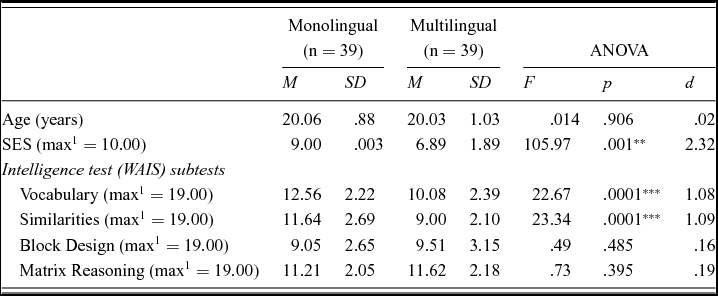
The aim of the study was to examine whether the multilinguals would show higher performance on the working memory tasks relative to the monolinguals. Skew and kurtosis for all the variables met the criteria for univariate normality (Kline, Reference Kline2005). There were no ceiling or floor effects. Alpha was set at .05, and standard scores were used for all analyses. Preliminary analyses of variance (ANOVAs) revealed that the language groups were balanced in terms of age (F[1, 76] = .014; p = .906) and gender (30 females and 9 males in each group), while SES (F[1, 76] = 105.97; p = .001; d = 2.32), Vocabulary (F[1, 76] = 22.67; p = .0001; d = 1.08) and Similarities (verbal conceptualisation) (F[1, 76] = 23.34; p = .0001; d = 1.09) were all significantly lower in the multilingual group (See Table 1).
Group comparisons on age, SES and IQ variables.

Note. SES = Socioeconomic status; 1max= maximum possible score; ** = p ≤ .001, ***p ≤ .0001; d = Cohen's d effect size
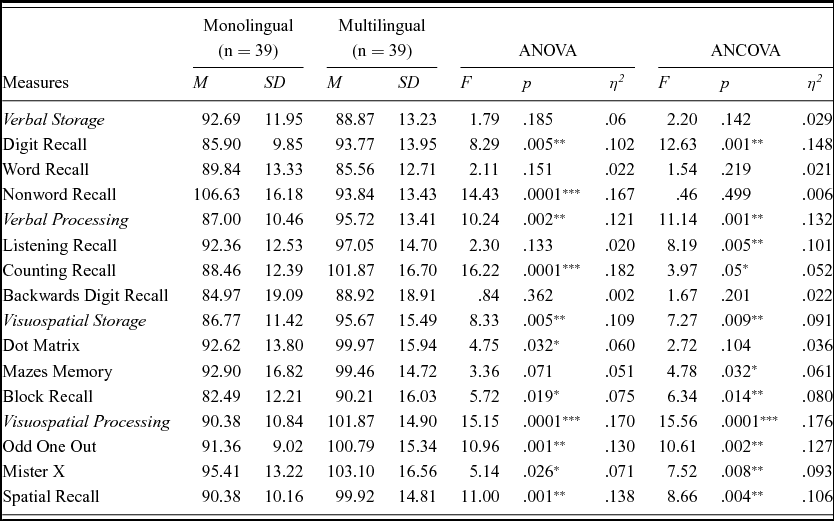
The groups’ performance (means and standard deviations) on each of the working memory tasks is shown in Table 2. This table also shows the results of analyses of variance (ANOVAs) between the multilingual and monolingual groups on the working memory measures, without controlling for differences in SES and verbal ability. The standardised test scores were the dependent variables, while the independent variable was language group. In these analyses, the multilingual group showed superior performance on one verbal storage task (Digit Recall), one verbal processing task (Counting Recall), two visuospatial storage tasks (Dot Matrix and Block Recall) and on all three visuospatial processing tasks (Odd One Out, Mister X and Spatial Recall). The monolingual group outperformed the multilinguals on Nonword Recall, a measure of verbal storage.
Means, standard deviations, ANOVAs, and ANCOVAs between groups (controlling for SES and verbal intelligence) on working memory subtests.

Note: *p < .05, **p < .01, ***p ≤ .0001; η2 = partial eta squared
Since significant group differences emerged on measures of verbal ability (Vocabulary and Similarities) and SES, in favour of the monolingual group, these could mask the effects of multilingualism on between-group differences in the working memory tasks. Therefore, analyses of covariance (ANCOVAs) were also run, with SES, Vocabulary and Similarities as covariates (See Table 2). In these analyses, the superior monolingual performance on Nonword Recall fell away, as did the superior multilingual performance on Dot Matrix. The other multilingual advantages remained, and two new multilingual advantages emerged on Listening Recall (verbal processing) and Mazes Memory (visuospatial storage).
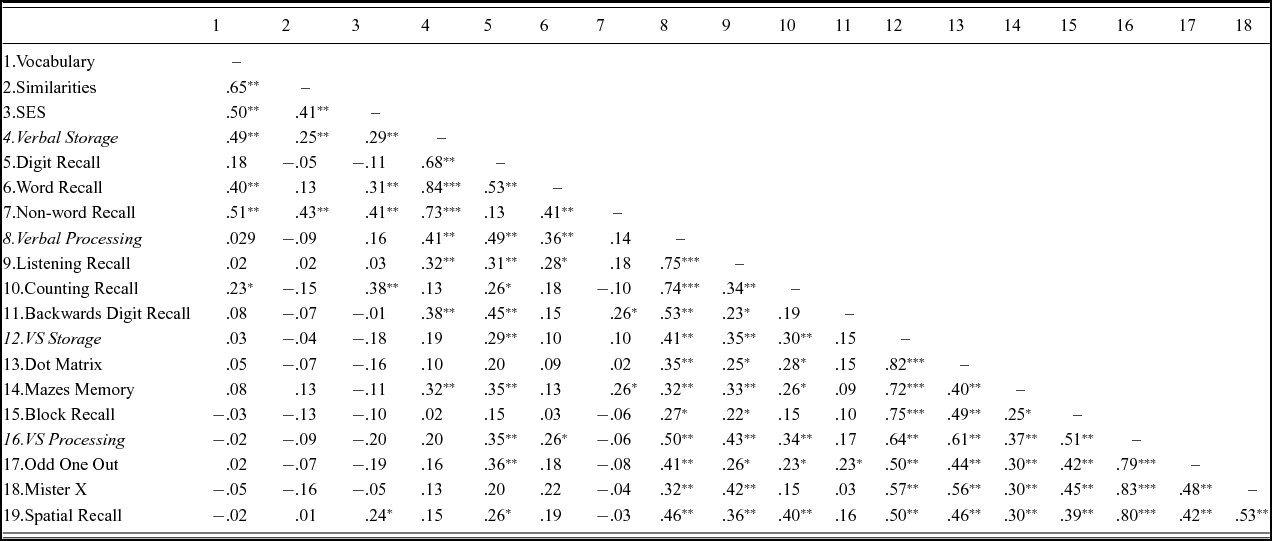
Table 3 shows the correlations between the various working memory tasks, SES and the verbal intelligence measures (Vocabulary and Similarities) to ascertain whether they were related. Vocabulary was significantly correlated with the verbal storage tasks (with the exception of Digit Recall), only with Counting Recall from the verbal processing tasks, and not with any of the visuospatial tasks. Similarities only correlated significantly with Nonword Recall. Socioeconomic status correlated mostly with verbal storage (Word Recall, Nonword Recall) and to a lesser extent with verbal processing (Counting Recall) and visuospatial processing (Spatial Recall).
Correlation matrix between the working memory, SES and verbal IQ variables for the entire sample (N = 78)

Note. SES = Socioeconomic status; VS= Visuospatial; *p < .05, **p < .01; ***p < .001
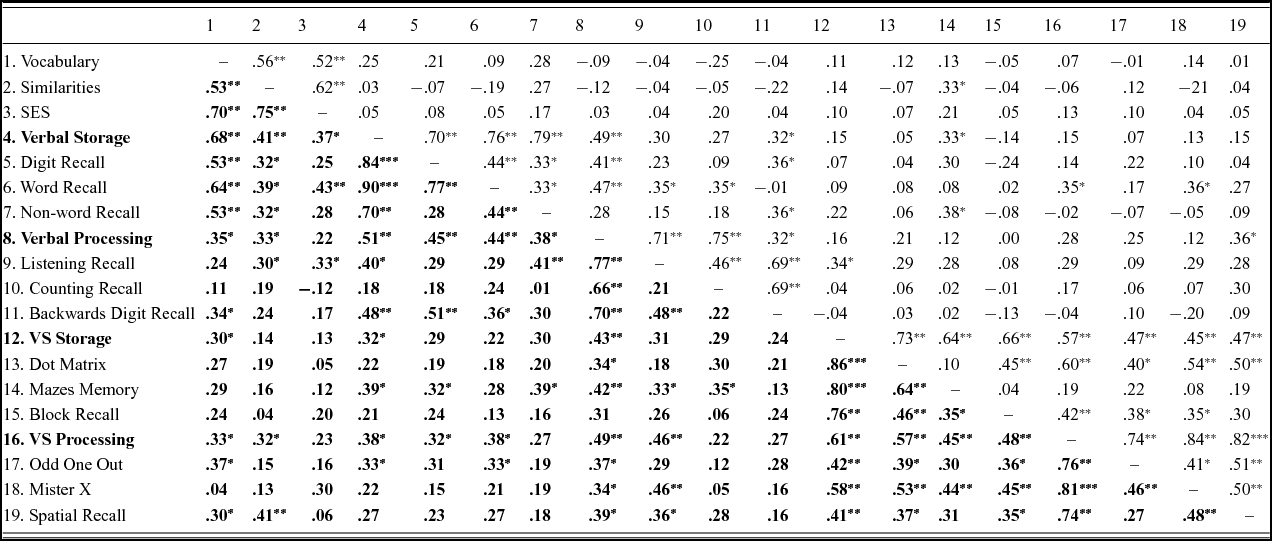
Correlations were also run separately, by language group, to determine whether the associations among the different working memory components differed for monolinguals and multilinguals (see Table 4). The correlations between the various components of working memory showed good convergent validity of the AWMA for each language group. Fisher's z transformations revealed that only two sets of correlations were significantly stronger in the multilingual group. This was between Digit Recall and Word Recall (verbal storage; z = −2.33; p = .01) and between Dot Matrix and Mazes Memory (visuospatial storage; z = −.279; p = .005). There were no significant differences between the groups in terms of any of the other working memory measure correlations, suggesting that verbal and visuospatial working memory resources are similarly associated in the two language groups.
Correlation Matrix between the working memory, SES and Verbal IQ variables, by language group.

Note. Monolinguals (n = 39) above the diagonal, Multilinguals (n = 39) below the diagonal in bold; *p < .05, **p < .01, ***p <.001
Discussion
This study examined which components of working memory are sensitive to the effects of multilingualism. The strongest finding was evidence of a multilingual advantage on the processing-loaded working memory tasks that are less dependent on English vocabulary knowledge, most notably those that tapped visuospatial processing. This advantage was apparent in our sample on all of the visuospatial processing tasks (Odd One Out, Mister X and Spatial Recall), as well as on the verbal processing task, Counting Recall, both when SES and verbal IQ were and were not statistically controlled. Although not as strong a finding, multilingual advantages were also evident on verbal (Digit Recall) and visuospatial (Block Recall) storage, both when SES and verbal IQ were and were not covaried. These results are similar to those of Blom et al. (Reference Blom, Küntay, Messer, Verhagen and Leseman2014), who used the AWMA with monolingual and bilingual children. This suggests that multilinguals, like bilinguals, develop an advantage in the domain-general executive control aspect of working memory (Bialystok & Craik, Reference Bialystok and Craik2010; Blom et al., Reference Blom, Küntay, Messer, Verhagen and Leseman2014; Costa et al., Reference Costa, Hernández, Costa-Faidella and Sebastian-Galles2009; Hilchey & Klein, Reference Hilchey and Klein2011). This advantage also appears, to a reduced extent, in some storage tasks (Digit Recall and Block Recall), particularly those that are less reliant on acquired knowledge stored in long-term memory.
In our study, the monolingual group showed an advantage on Nonword Recall (verbal short-term memory), which disappeared when SES and verbal IQ were controlled. This corroborates the suggestion of Messer, Leseman, Boom, and Mayo (Reference Messer, Leseman, Boom and Mayo2010) that Nonword Recall is heavily dependent on language ability. In a study of Dutch monolingual and Turkish–Dutch bilingual 4 year old children, Messer et al. (Reference Messer, Leseman, Boom and Mayo2010) found that the latter had greater difficulty in remembering novel phonological forms (nonwords) based on Dutch, because they have less support from stored phonotactic knowledge of Dutch. Although the multilinguals in our sample rated their proficiency in English (their second language) as high and had frequent exposure to it from a young age, they nevertheless appeared to be at a disadvantage compared to the English monolinguals in the recall of nonwords based on English phonotactic forms. The poorer performance of the multilingual group on Nonword Recall supports the view that verbal tasks that entail both language proficiency and effortful working memory processes require more resources for bilinguals (and in our case, multilinguals) than for monolinguals (Bialystok & Barac, Reference Bialystok and Barac2012).
The absence of a multilingual disadvantage on any of the working memory measures also warrants consideration. Given the reported poorer performance of bilinguals compared to monolinguals on a range of verbal tasks (Bialystok et al., Reference Bialystok, Barac, Blaye and Poulin-Dubois2010; Thordardottir et al., Reference Thordardottir, Rothenberg, Rivard and Naves2006), it would be anticipated that multilinguals have even greater interference between languages, and would possibly perform at a level that is significantly lower than their monolingual counterparts on such tasks. Despite smaller vocabularies, poorer verbal conceptualisation ability, and impoverished backgrounds, our multilinguals manifest equivalent ability to monolinguals in two of the three tasks of verbal processing, and superior ability in the third task. Although the tasks used in this study were not timed, so that the slower verbal retrieval found in bilinguals would not be relevant here, they often required a verbal response. Verbal tasks that require only a button press response may yield a different result, and may explain the mixed results in the few studies of the bilingual advantage in verbal working memory (Duñabeitia, Antón, Macizo, Estévez, Fuentes & Carreiras, Reference Duñabeitia, Antón, Macizo, Estévez, Fuentes and Carreiras2013). Thus, while multilingualism may bear a cost, it does not appear to result in a significant disadvantage on measures of verbal working memory for multilinguals who speak structurally different languages compared to monolinguals. It is possible that multilingualism may strengthen the central executive or the shared executive control processes and this may ameliorate any verbal disadvantage on verbal processing tasks.
Findings from our study add to the body of evidence in support of a bilingual advantage in nonverbal executive control (Bialystok, Reference Bialystok2017; Bonifacci et al., Reference Bonifacci, Giombini, Bellocchi and Contento2011; Morales et al., Reference Morales, Calvo and Bialystok2013; Paap & Greenberg, Reference Paap and Greenberg2013). Our results suggest that such an advantage exists in the working memory functions of multilinguals as well, even when group differences in verbal IQ and SES are not statistically controlled. This multilingual advantage may not be specific to working memory, and may reflect the general executive control strength suggested by Green (Reference Green1998), which is closely linked to the attentional control processes of the central executive (Hernández, Costa, Fuentes, Vivas & Sebastian-Galles, Reference Hernández, Costa, Fuentes, Vivas and Sebastian-Galles2010; Paap & Greenberg, Reference Paap and Greenberg2013). Highly proficient multilinguals may have increased opportunities to strengthen these control mechanisms, and, when measured by means of a visuospatial modality, these strengths become evident. However, alternative interpretations of these results should also be considered. For example, the association may work in the opposite direction to the commonly held assumption. That is, individuals with strong executive control functions may be more likely to become highly proficient in multiple languages (Klein, Reference Klein2015).
This study addressed the limitations of earlier studies by objectively measuring verbal and nonverbal intelligence and SES, and by measuring and considering language proficiency in the design (Bialystok et al., Reference Bialystok, Craik, Klein and Viswanathan2004; Costa et al., Reference Costa, Hernández, Costa-Faidella and Sebastian-Galles2009; Wodniecka, Craik, Luo & Bialystok, Reference Wodniecka, Craik, Luo and Bialystok2010). Other strengths of this study are that it was grounded in an extensively researched and validated theoretical and conceptual framework of working memory (Baddeley, Reference Baddeley2000); it employed a standardised and validated measure of the components of working memory that corresponds to this conceptual framework; and each component of working memory was measured with three tasks. Additional, novel elements of the study included that the multilingual participants were proficient in two African languages and English, and were all early, simultaneous multilinguals.
Some limitations of this study should also be acknowledged. The multilingual participants represented young adults living in a multilingual society, who had early, consistent and regular exposure to three languages, while the monolinguals had exposure to a second language during formal schooling. This background, together with the fact that both language groups represented young adults whose working memory abilities are at their peak, limits the generalisability of the findings. Cognitive control may be strengthened in young adulthood, particularly in university students who are (hopefully) being cognitively challenged, while working memory capacity declines after middle age (Garcia-Pentón, Fernández, Garcia, Costello, Duñabeitia & Carreiras, Reference García-Pentón, Fernández García, Costello, Duñabeitia and Carreiras2016; Hartshorne & Germine, Reference Hartshorne and Germine2015; Valian, Reference Valian2015), and thus differences in working memory, and other aspects of executive functioning may show varying trajectories over the lifespan, highlighting the need for longitudinal studies. Secondly, bilingual frameworks for executive functioning advantages may not necessarily be directly applied to the study of multilingual processes (Cenoz & Genesee, Reference Cenoz and Genesee1998; Grosjean, Reference Grosjean1985), since there is evidence of different word-learning strategies for monolinguals, bilinguals, and trilinguals in infancy (Byers-Heinlein & Werker, Reference Byers-Heinlein and Werker2009). Consequently, the current study would have benefitted from a comparison group of bilinguals in order to infer whether the components of working memory are differentially affected for multilinguals and bilinguals. Finally, classification of participants into the two groups created an artificial dichotomy between monolingual and multilingual groups, and was based on self-report of proficiency because objective measures of proficiency were not available in all of the languages spoken by the participants.
Despite poorer verbal abilities and lower SES circumstances, our multilinguals exhibited a range of working memory advantages, and no disadvantages in comparison to monolingual peers. These findings extend the body of evidence for a bilingual advantage in visuospatial measures of executive control (Blom et al., Reference Blom, Küntay, Messer, Verhagen and Leseman2014; Bonifacci et al., Reference Bonifacci, Giombini, Bellocchi and Contento2011; Morales et al., Reference Morales, Calvo and Bialystok2013; Paap & Greenberg, Reference Paap and Greenberg2013), by showing that such advantages exist in the working memory functions of young adult multilinguals. This advantage may not necessarily be specific to working memory, but may reflect a strengthened general cognitive control mechanism (Hilchey & Klein, Reference Hilchey and Klein2011). Further, these results suggest that the positive effect of multilingualism may mitigate some of the negative influence of low SES on cognition.