

Introduction
Morada Nova sheep are small animals adapted to the semi-arid climate of northeastern Brazil, which exhibit high prolificacy and no reproductive seasonality (Facó et al., Reference Facó, Paiva, Alves, Lobo and Villela2008). In extensive farming systems such as those that predominate in the northeastern region of Brazil, the small size of the animals is a strategical advantage, particularly during periods of feed scarcity when the nutritional requirements for maintenance of small animals are lower than those of large animals (Silva, La Scala Jr. and Tonhati, Reference Silva, La Scala and Tonhati2003; Gonzaga Neto et al., Reference Gonzaga Neto, Silva Sobrinho, Resende, Zeola, Silva, Marques and Leão2005; NRC, 2007). On the other hand, the birth of very low weight animals increases lamb mortality during the preweaning period (Everett-Hincks et al., Reference Everett-Hincks, Mathias-Davis, Greer, Auvray and Dodds2014), a fact that becomes even more important in extensive farming systems.
In 2007, a centre for genetic improvement was formed with the participation of Morada Nova sheep breeders from the region of origin of the breed (Facó et al., Reference Facó, Lobo, Bomfim, Lima, Silva and Nobre2009). The first years of this work revealed the existence of a high rate of lamb mortality during the preweaning period. In view of the genetic variability in birth weight demonstrated by Shiotsuki et al. (Reference Shiotsuki, Oliveira, Lobo and Facó2014), selection for higher birth weight in this population would have indirect benefits, such as a reduction in mortality (Everett-Hincks et al., Reference Everett-Hincks, Mathias-Davis, Greer, Auvray and Dodds2014), with positive impacts on the genetic improvement of the population studied.
However, animals of this population are frequently removed from breeding because they do not comply with the official racial pattern. This pattern, which was approved by the Ministry of Agriculture, Livestock and Food Supply (Ministério da Agricultura, Pecuária e Abastecimento – MAPA) and is maintained by the Brazilian Association of Sheep Breeders (Associação Brasileira de Criadores de Ovinos – ARCO), establishes a coat colour ranging from light to dark red, dark coloured hooves and muzzle, no horns or only rudiments, and the absence of cryptorchidism for the red variety of the Morada Nova breed (ARCO, 2015). A high culling rate of animals due to the lack of compliance with the established racial pattern may reduce the number of animals suitable for selection and the intensity of selection, and consequently affect the genetic gain that could be obtained with selection.
Therefore, the objective of the present study was to describe the frequency of the main racial traits of Morada Nova sheep and simulate the impact of this culling on the response to selection for birth weight.
Material and methods
Data collected at weaning from 385 Morada Nova sheep of the red variety, born between 2010 and 2012, which belonged to four different flocks in the state of Ceará, Brazil, were used. The data were collected individually before any selection and the following variables were studied: sex, coat colour, hoof pigmentation, muzzle pigmentation, polled and cryptorchidism.
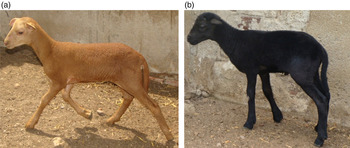
Coat colour was classified as red (Figure 1A) or black (Figure 1B). It should be noted that animals with a black coat are usually culled because they do not comply with the official racial pattern (ARCO, 2015).
Morada Nova sheep with red (a) and black (b) coat colour.

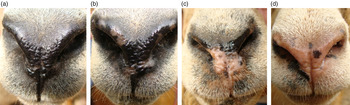
Another feature considered for standardization is pigmentation of the muzzle, which was classified as follows:
-
– pigmented: completely pigmented mucosa (Figure 2A);
-
– predominantly pigmented (animals with more than 50 percent muzzle pigmentation) (Figure 2B);
-
– predominantly depigmented (animals with less than 50 percent muzzle pigmentation) (Figure 2C);
-
– depigmented (animals without muzzle pigmentation) (Figure 2D).
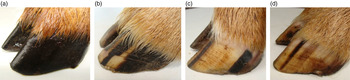
Hoof pigmentation is also a feature of the racial pattern. Hooves were evaluated together in each animal. Thus, a single degree of overall pigmentation was assigned to each animal considering the four hooves and classified as follows:
-
– pigmented: animals with completely pigmented hooves (Figure 3A);
-
– predominantly pigmented (animals with more than 50 percent hoof pigmentation (Figure 3B);
-
– predominantly depigmented (animals with less than 50 percent hoof pigmentation (Figure 3C);
-
– depigmented (animals without hoof pigmentation) (Figure 3D).
Animals with muzzle and/or hoof pigmentation classified as predominantly depigmented and depigmented are considered defective or outside the racial pattern and are therefore culled from the flock.
The muzzle pigmentation degree in Morada Nova sheep: Pigment (a), predominantly pigmented (b), predominanthly dudley (c) and Dudley (d).

Degree of pigmentation in hooves of Morada Nova sheep: Pigmented (a), predominantly pigmented (b), predominantly Dudley (c) and Dudley (d).

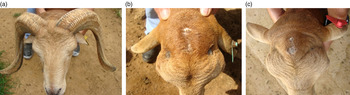
Animals with horns are also culled. The presence or absence of horns was defined as:
-
– animals with horns if horns (Figure 4A) were present;
-
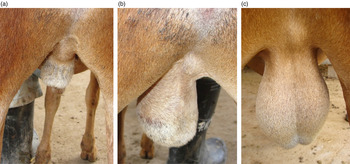
– polled animals if horns were rudiments (Figure 4B) or absent (Figure 4C).
Animals in which the testes fail to descend are considered outside the racial pattern. In addition, these animals are infertile or subfertile. Testicular descent was classified as follows:
-
– normal: no failure of testicular descent or absence of cryptorchidism (Figure 5C);
-
– cryptorchidic: failure of one (unilateral cryptorchidism, Figure 5B) or both testes (bilateral cryptorchidism, Figure 5A) to descend.
The data were analysed statistically by the chi-squared test (χ 2). For this purpose, the variables are listed in contingency tables. The χ 2 test was used to evaluate the following associations:
-
– Between muzzle pigmentation and hoof pigmentation: to evaluate the association between these traits, it was necessary to divide them into two levels: class 1 was attributed to animals with less than 50 percent pigmentation of the muzzle or hooves (predominantly depigmented and depigmented), while class 2 was attributed to animals with more than 50 percent pigmentation of the muzzle or hooves (predominantly pigmented and pigmented). This classification of hoof and muzzle pigmentation was used to permit a more direct interpretation of the results.
-
– Between sex and hornlessness: for the hornless trait, animals with rudiments and animals with horns were grouped in a single class due to the difficulty in differentiating these animals.
-
– Between cryptorchidism and hornlessness: for application of the chi-squared (χ 2) test, animals with bilateral and unilateral cryptorchidism were grouped in a single class.
According to McDonald (Reference McDonald2014) when the sample sizes are too small (an expected number is less than 5), an alternative, such as an exact test of goodness-of-fit or a Fisher's Exact Test of Independence. The Fisher's Exact Test was used to evaluate the following associations since expected number was less than 5:
-
– Between coat colour and flocks;
-
– Between flocks and hornlessness.
The frequencies of animals culled due to racial pattern were used to verify the impact of this culling on the genetic gain in birth weight per generation. First, a χ 2 test was applied between sex and all traits analyzed to determine whether the dispersion of frequency depends on sex. For traits that were not dependent on sex, the same culling rate was considered for males and females. Additionally, a zero culling rate for sex was assumed when the trait was not expressed, as was the case of horns and cryptorchidism in females. Birth weight was chosen as a trait since it is easily measured and subject to few errors and loss of information.
Presence of horn (a), presence of rudiment (b) and absence of horns (c) in Morada Nova sheep.

Bilateral cryptorchidism (a), unilateral cryptorchidism (b) and normal testes (c) in Morada Nova sheep.

To estimate the impact of culling of animals due to racial pattern on the genetic improvement of the Morada Nova population, the genetic gains in birth weight per generation were calculated considering the following different scenarios of culling due to racial pattern in a simulated population:
-
scenario 1: absence of culling of animals due to racial characteristics;
-
scenario 2: animals culled because of a black coat;
-
scenario 3: animals culled because of hoof and/or muzzle depigmentation;
-
scenario 4: animals culled because of the presence of horns;
-
scenario 5: animals culled because of a black coat, hoof depigmentation, muzzle depigmentation, and presence of horns.
The formula described by Falconer and Mackay (Reference Falconer and Mackay1996) was used for these estimations:
 $$\Delta G = \left\{ {\left[ {\displaystyle{{(im + if)} \over 2}} \right]*h^2*\sigma p} \right\};$$
where ∆G = genetic gain i m = selection intensity for males; i f = selection intensity for females; h 2 = heritability of the trait; σ p = phenotypic standard deviation of the trait;
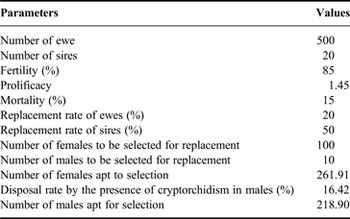
The heritability (h2 = 0.19 ± 0.08) of birth weight used to calculate the genetic gains per generation was obtained from Shiotsuki et al. (Reference Shiotsuki, Oliveira, Lobo and Facó2014). The selection intensities for males and females were calculated as a function of the proportion of animals selected to meet replacement rates of 20 and 50 percent for males and females, respectively. The number of males and females available for selection was obtained considering a flock of 500 ewes, with one ram per 25 ewes, and the fertility, prolificacy and mortality rates described by Lôbo et al. (Reference Lôbo, Pereira, Facó and McManus2011) and the culling rates due to cryptorchidism summarized in Table 1.
Herd structure and parameters assumed to calculate the genetic gain for birth weight in Morada Nova breed

The proportion of animals selected in both sexes was calculated by the ratio between the number of females or males necessary to meet the replacement rates and the number of females or males available for selection after culling due to racial pattern. The intensities of selection for males and females according to each proportion selected before and after culling due to racial pattern were obtained using an Excel spreadsheet elaborated by Van Der Werf (Reference Van Der Werf, Kinghorn, Van der Werf, Ryan, Cardoso and Carvalheiro2011). The losses of genetic gain in birth weight were calculated considering the ratio between genetic gain after culling due to racial pattern and genetic gain before culling due to racial pattern, −100 percent by the result of this ratio.
Results
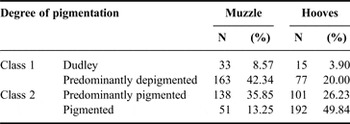
No association was observed between coat colour and flock by the χ2 test (Table 2) and almost 3 percent of the animals are culled due to coat colour outside the racial pattern. With respect to the muzzle, the proportion of individuals with a depigmented or predominantly depigmented muzzle (class 1) was similar to the proportion of animals with a pigmented or predominantly pigmented muzzle (class 2) (Table 3).
Frequency dispersion of coat colour in the herd Morada Nova breed

N = number of animals according with its coat colour; (χ 2 = 2.39; P < 0.05); a herds have red or black coat frequency statistically similar by the Fisher's test.
Number of animals per degree of pigmentation of the muzzle and the hooves of sheep Morada Nova breed

N = Number of animals; Class 1 = In this class was considered dudley and predominantly depigmented animals; Class 2 = In this class was considered predominantly pigmented and pigmented animals.
When hoof pigmentation of Morada Nova sheep is considered, 23.9 percent of the animals evaluated would be culled exclusively due to this characteristic, i.e. the animal would be culled irrespective of its productive and reproductive skills following the official racial pattern (Table 3).
Approximately 58 percent of the animals of the population studied would be culled due to the predominance of a depigmented muzzle and/or hooves (Table 4), since these animals would not obtain the definitive genealogical record. Only 42.34 percent of the animals studied would comply with the racial pattern for these two characteristics.
Frequency dispersion between pigmentation of muzzle and hooves classes in Morada Nova breed

%TEM = percentage of total effective number; Class 1 = In this class was considered dudley and predominantly depigmented animals; Class 2 = In this class was considered predominantly pigmented and pigmented animals; (P = 4.635 × 10−06) for Fisher's exact Test).
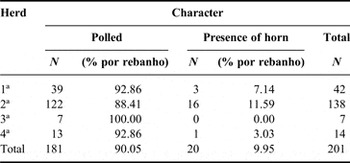
According to the official racial pattern, 9.95 percent of males would be culled due to the presence of horns, regardless of their genetic potential for other traits. On the other hand, none of the females exhibited this characteristic and a significant association was observed between sex and polled (Table 5). This association suggests that the horn can be related to sex heritage, however, further studies are needed to confirm.
The frequency dispersion of polled in Morada Nova sheep

N = Number of animals; % ET = percentage of the total effective; %/sex = percentage by sex; (χ 2 = 13.31; P < 0.05).
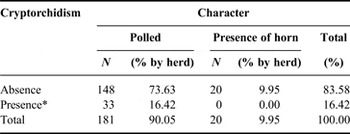
In males, 16.42 percent were cryptorchid despite intense selection against this trait (Table 6). The culling of animals because of the lack of compliance with the official racial pattern reduced the number of males and females available for selection (Table 7). There was a significant association between cryptorchidism and polled (Table 8).
The frequency dispersion of males polled by herds in Morada Nova sheep

N = number of animals; (χ 2 = 1.68; P < 0.05); Herds followed by different letters have polled and presence of horn frequency statistically different by the Fisher's test (P < 0.05).
Impact on the genetic gain (∆G) for birth weight by generation in sheep of Morada Nova breed when there is no disposal of animals by breed standard (Scenario 1), when animals are discarded because the black coat (Scenario 2) animals discarded by depigmentation of the hull and/or nasal mirror (Scenario 3), animals are discarded by the presence of horn (Scenario 4) and when animals are discarded by the black coat, depigmentation of hooves, nasal depigmentation mirror and presence of horn (Scenario 5)

NFS, Number of females apt to selection; NMS, Number of males apt for selection; PFD, Discarded Females proportion; PMD, Proportion of discarded males; PFS, Proportion of selected females; PMS, Proportion of selected males; ISF, Intensity females selection; ISM, Intensity males selection; ∆G, Genetic gain; P∆G, Loss of genetic gain for the disposal of racial pattern (%).
Frequency dispersion between cryptorchidism and the polled in males of Morada Nova breed

* = animals with unilateral or bilateral cryptorchidism; N = number of animals; (χ 2 = 4.36; P < 0.05).
A strong negative impact of culling animals with less than 50 percent hoof and muzzle pigmentation on genetic gain (loss of 37.1 percent in genetic gain) was observed in the present study. When the animals were culled due to all characteristics imposed by the racial pattern (coat colour, hoof pigmentation, muzzle pigmentation, and presence of horns), the loss in genetic gain was even greater (46 percent).
Discussion
Coat colour is a selection criterion for Morada Nova sheep according to the official racial pattern (ARCO, 2015). Animals with a black coat colour are not accepted by the racial pattern. However, the results indicate that animals with this coat colour can appear in any Morada Nova flock, even when selection is performed against this trait. There are no studies in the literature investigating the inheritance of coat pigmentation in Morada Nova sheep. However, in individuals of other breeds and other species the dominant allele (A Wt) of the Agouti locus is responsible for a yellow or red coat colour, while animals homozygous for the recessive allele (A a) have a black or brown coat (Searle, Reference Searle1968; Brooker and Dolling, Reference Brooker and Dolling1969; Jackson, Reference Jackson1994; Lu et al., Reference Lu, Willard, Patel, Kadwell, Overton, Kost, Luther, Chen, Woychik and Wilkison1994; Cone et al., Reference Cone, Lu, Koppula, Vage, Klungland, Boston, Chen, Orth, Pouton and Kesterson1996). Considering that the coat colour in Morada Nova sheep is expressed by the action of a single gene with complete dominance, the selection against a black coat (recessive) becomes progressively slower because a larger proportion of the recessive allele is protected in heterozygous individuals. In our study, the frequency of this allele would be 0.1691, and 85 percent of these alleles are in heterozygotes.
Black animals are culled not only based on the criterion of the genealogical records, but also because of the marked rejection by breeders, who understand this selection as a means to maintain the adaptability of the breed, since animals with dark skin and a light coat are more adapted to the climatic conditions of subtropical and tropical regions (McManus et al., Reference McManus, Prescott, Paludo, Bianchini, Louvandini and Mariante2009). Within this context, Silva, La Scala Jr. and Tonhati (Reference Silva, La Scala and Tonhati2003) showed that light-coloured animals reflect more light and absorb 40–50 percent less radiation than dark-coloured animals. Furthermore, heat stress directly affects reproductive functions (particularly embryo development and gestation), growth, and water and food intake (Silva, Reference Silva2000). Hence, the use of coat colour as a culling criterion would protect the adaptive ability that the breed possessed originally.
Pigmentation of the muzzle showed an almost normal distribution, in which the central classes (predominantly depigmented and predominantly pigmented) contained the largest number of individuals, while the frequency of pigmented and depigmented animals was lower. Following the racial pattern of Morada Nova sheep, slightly more than half of the animals would be culled due to this characteristic. This culling rate is high, especially when considering that there are no studies comparing the benefits or disadvantages of this pigmentation for sheep production.
There are no studies on the chemical composition of hooves in sheep. However, a study on Mangalarga Marchador horses found no difference in dry matter, crude protein, ether extract, ashes, calcium, phosphorus, copper, zinc, amino acid profile or biotin between light and black hooves (Faria et al., Reference Faria, Rezende, Sampaio, Lana, Moura, Madureira and Resende2005). Also in horses, Butler (Reference Butler and Evans1992) and Nascimento (Reference Nascimento1999) confirmed that the dark pigment in hooves does not improve quality or resistance. Taken together, there is no evidence justifying the depreciation of light-coloured hooves over black hooves since their amino acid composition is very similar. In Morada Nova sheep, hoof pigmentation is more related to visual features rather than any adaptive trait. However, no study has been conducted to confirm this observation. Thus, culling animals taking into consideration only hoof colour may not be a good parameter since studies establishing any type of association between hoof colour and resistance to diseases are sparse.
A significant association was observed between muzzle and hoof pigmentation, i.e. it is more likely that animals with a pigmented muzzle also exhibit pigmented hooves. This type of association is desirable since the official racial pattern establishes that Morada Nova sheep should have a dark muzzle and dark hooves. In practice, breeders do not keep animals that do not comply with the racial pattern, especially as sires since there is no added value of animals of this breed without a genealogical record.
It is known that in animals, especially mammals, pigmentation is mainly determined by the relative amount of melanin, eumelanin (black or brown) or pheomelanin (yellow or red). Furthermore, the production of melanin is controlled by alleles of the Agouti and extension loci (Searle, Reference Searle1968; Jackson, Reference Jackson1994). Possibly, pigmentation of the hooves, muzzle and coat is controlled by the same alleles of the Agouti locus and may be genetically the same trait. Additionally, all animals with a black coat have a completely pigmented muzzle and hooves, suggesting that the three characteristics (coat colour, muzzle pigmentation, and hoof pigmentation) are determined by the same set of genes. It is necessary to test this hypothesis since, if confirmed, it would make it virtually impossible to achieve the established racial pattern. In this respect, the more pigmented the muzzle and hooves, the greater the likelihood of birth of black animals and, consequently, animals that do not comply with the racial pattern.
Another characteristic defined by the racial pattern is that Morada Nova sheep are polled. One advantage of the presence of horns in sheep, especially in extensive systems, is that these animals can use their horns as a defensive weapon against the aggression of predators. Under conditions of wild sheep creation, the horn plays an important role in the competition between males for access to ewes (Johnston et al., Reference Johnston, Mcewan, Pickering, Kijas, Beraldi, Pilkington, Pemberton and Slate2011). On the other hand, polled is valued by breeders mainly because of the ease of management and transport and skin quality. Dolling (Reference Dolling1970) observed in Australian Merino sheep that the autosomal Hoh1 allele (Ho locus) produces sex-limited horns.
No significant association was observed between flock and polled and the frequency of animals with horns was similar in all flocks. These results highlight the importance that all breeders give to this type of characteristic and consequently to the culling of these animals, since animals with horns or rudiments do not obtain a genealogical record. The frequency of animals with horns was 30 percent lower than that observed in the Soay sheep population, which are wild animals that mate at random (Johnston et al., Reference Johnston, Mcewan, Pickering, Kijas, Beraldi, Pilkington, Pemberton and Slate2011). The frequency of Morada Nova sheep with horns would probably be higher if the animals mate at random.
No cryptorchid animal with horns was observed and all animals with problems of cryptorchidism were hornless. It is therefore possible that selection for hornless animals as required by the racial pattern increases the frequency of animals with problems of cryptorchidism. Cryptorchidism animals are culled not only to comply with the racial pattern, but also due to the fact that these animals are infertile or subfertile, causing great damage to the flock.
The genes encoding insulin-like hormone 3 (INSL3) and relaxin/insulin-like family peptide receptor 2 (RXFP2) have been reported by several authors to be responsible for testicular descent (Nef and Parada, Reference Nef and Parada1999; Zimmermann et al., Reference Zimmermann, Steding, Emmen, Brinkmann, Nayernia, Holstein, Engel and Adham1999; Emmen et al., Reference Emmen, McLuskey, Adham, Engel, Grootegoed and Brinkmann2000; Overbeek et al., Reference Overbeek, Gorlov, Sutherland, Houston, Harrison, Boettger-Tong, Bishop and Agoulnik2001; Adham et al., Reference Adham, Steding, Thamm, Büllesbach, Schwabe, Paprotta and Engel2002; Kumagai et al., Reference Kumagai, Hsu, Matsumi, Roh, Fu, Wade, Bathgate and Hsueh2002; El Houate et al., Reference El Houate, Rouba, Sibai, Barakat, Chafik, Chadli, Imken, Bogatcheva, Feng, Agoulnik and McElreavey2007; Feng et al., Reference Feng, Bogatcheva, Truong, Korchin, Bishop, Klonisch, Agoulnik and Agoulnik2007, Reference Feng, Ferlin, Truonget, Bathgate, Wade, Corbett, Han, Tannour-Louet, Lamb, Foresta and Agoulnik2009; Yuan et al., Reference Yuan, Li, Lin, Schwabe, Büllesbach, Rao and Lei2010). RXFP2 is associated with the cryptorchid phenotype in dogs (Zhao, Du and Rothschild, Reference Zhao, Du and Rothschild2010), rats (Zimmermann et al., Reference Zimmermann, Steding, Emmen, Brinkmann, Nayernia, Holstein, Engel and Adham1999; Yuan et al., Reference Yuan, Lin, Rao and Lei2006; Feng et al., Reference Feng, Ferlin, Truonget, Bathgate, Wade, Corbett, Han, Tannour-Louet, Lamb, Foresta and Agoulnik2009), and humans (Foresta and Ferlin, Reference Foresta and Ferlin2004; El Houate et al., Reference El Houate, Rouba, Sibai, Barakat, Chafik, Chadli, Imken, Bogatcheva, Feng, Agoulnik and McElreavey2007; Feng et al., Reference Feng, Ferlin, Truonget, Bathgate, Wade, Corbett, Han, Tannour-Louet, Lamb, Foresta and Agoulnik2009). Furthermore, a reduction in the action of INSL3 has been suggested to be a possible cause of cryptorchidism in rats (Nef and Parada, Reference Nef and Parada1999). Similarly, INSL3-deficient rats exhibited bilateral cryptorchidism (Zimmermann et al., Reference Zimmermann, Steding, Emmen, Brinkmann, Nayernia, Holstein, Engel and Adham1999). It is possible that the occurrence of cryptorchid animals in the Morada Nova breed is due to the action of these genes.
Since there are no studies investigating the association between these genes and cryptorchidism in sheep, it is important to test this hypothesis in future studies. The hypothesis of genetic linkage between INSL3 and RXFP2 does not seem reasonable since the two genes are located on different chromosomes in humans and rats (Ferlin et al., Reference Ferlin, Pepe, Gianesello, Garolla, Feng, Giannini, Zaccolo, Facciolli, Morello, Agoulnil and Foresta2008; Kojima et al., Reference Kojima, Mizuno, Kohri and Hayashi2009; Zhao, Du and Rothschild, Reference Zhao, Du and Rothschild2010). On the other hand, the hypothesis of a pleiotropic action of the RXFP2 gene can be raised since this gene has been associated with cryptorchidism in dogs, rats, and humans (Zimmermann et al., Reference Zimmermann, Steding, Emmen, Brinkmann, Nayernia, Holstein, Engel and Adham1999; Foresta and Ferlin, Reference Foresta and Ferlin2004; Yuan et al., Reference Yuan, Lin, Rao and Lei2006; El Houate et al., Reference El Houate, Rouba, Sibai, Barakat, Chafik, Chadli, Imken, Bogatcheva, Feng, Agoulnik and McElreavey2007; Feng et al., Reference Feng, Ferlin, Truonget, Bathgate, Wade, Corbett, Han, Tannour-Louet, Lamb, Foresta and Agoulnik2009; Zhao, Du and Rothschild, Reference Zhao, Du and Rothschild2010) and with the horn phenotype on chromosome 10 in sheep (Johnston et al., Reference Johnston, Mcewan, Pickering, Kijas, Beraldi, Pilkington, Pemberton and Slate2011). Another possibility is epistatic interaction between the RXFP2 and INSL3 genes, in which failure in the interaction of the INSL3 product with the product of RXFP2 results in problems of testicular descent (Kumagai et al., Reference Kumagai, Hsu, Matsumi, Roh, Fu, Wade, Bathgate and Hsueh2002; Foresta and Ferlin, Reference Foresta and Ferlin2004; Ferlin et al., Reference Ferlin, Pepe, Gianesello, Garolla, Feng, Giannini, Zaccolo, Facciolli, Morello, Agoulnil and Foresta2008; Yuan et al., Reference Yuan, Li, Lin, Schwabe, Büllesbach, Rao and Lei2010).
The reduction in the number of animals available for selection increased the probability of an animal to be chosen as a breeding animal. As a consequence, the intensity of selection on birth weight for males and females was reduced. This reduction in selection intensity was much greater for females than for males, since the number of females necessary for replacement is higher than the number of males. Fewer males are necessary for breeding because of the higher reproductive rate and the selection intensity is therefore generally greater for males. The intensity of selection is one of the main factors that influence genetic gain. As the proportion of selected animals increases, the intensity of selection, and consequently the genetic gain, decreases (Falconer and Mackay, Reference Falconer and Mackay1996).
A loss in genetic gain was observed when animals were culled due to one or more of the racial characteristics evaluated in this study. The loss in genetic gain for birth weight was small when the animals were culled due to coat colour and presence of horns. This finding can be explained by the low frequency of animals with a black coat or horns. Once the possible genetic association between polled and cryptorchidism is confirmed, the impact of selection against the presence of horns will prove to be much higher than that estimated in this study.
These results highlight that the high culling rate of animals due to the lack of compliance with the official racial pattern impairs genetic progress of the flock because there is a risk of not achieving the minimum number of animals necessary for annual replacement in the flock.
The results obtained in this study demonstrate that the selection of animals based on racial pattern causes losses in the genetic gain that would be possible when selection for birth weight is performed. These results were somehow expected since the true intensity of selection and consequently the genetic gain decrease drastically when other traits that are not part of the selection objective of a genetic breeding program are considered (Van der Werf, Reference Van Der Werf, Kinghorn, Van der Werf, Ryan, Cardoso and Carvalheiro2006). Thus, similar losses in genetic gain are expected for other traits of economic interest.
The establishment of an official racial pattern is a fundamental tool to permit a trained observer to identify animals that are products of crosses with other breeds and to avoid their decharacterization. On the other hand, this racial pattern should not be excessively restrictive. Otherwise, the possibility of genetic improvement of a breed would be reduced and the breed will become unfeasible in the long term as an alternative for use in commercial production systems.
In the case of the Morada Nova breed, the need for readaptation of the official racial pattern seems to be evident in an attempt to reduce culling due to the lack of compliance with this pattern and to permit co-evolution of the breed with the production system(s). In this respect, the present results indicate that the most urgent step is flexibilization of the requirement of dark muzzles and hooves. In parallel, further studies are fundamental to elucidate the mechanisms of inheritance of coat colour and particularly the association of polled with cryptorchidism.
The selection of Morada Nova sheep based on racial pattern has caused losses in the genetic gain for productive traits such as birth weight. Readaptation of the official racial pattern established for Morada Nova sheep is necessary so that the racial pattern is achieved and an adequate number of animals will be available for selection.
Acknowledgement
The authors acknowledge the financial support from Bank of Northeast of Brazil (BNB), the Cearense Foundation for the Support of Scientific and Technological Development (FUNCAP) and Brazilian Association of Morada Nova Sheep (ABMOVA) for providing the data.