Subpulmonic muscular left ventricular outflow tract obstruction is common in patients with congenitally corrected transposition of the great arteries and may be challenging to repair. Although surgical placement of a left ventricle-to-pulmonary artery conduit will relieve the obstruction, there is a risk of impaired systemic output from septal shift and left ventricular decompression.Reference El-Zein, Subramanian and Ilbawi 1 In addition, variant coronary anatomy may complicate conduit placement. Owing to the variable anatomy in patients with this condition, alternative interventions beyond surgical and percutaneous approaches are important developments.
We present a patient with congenitally corrected transposition of the great arteries, dextrocardia, situs inversus, and severe left ventricular outflow tract obstruction who underwent a successful hybrid stent placement.
Case report
A 3-year-old, 11-kg boy with situs inversus, dextrocardia, congenitally corrected transposition of the great arteries, ventricular septal defect, and anomalous right superior caval vein entering the pulmonary venous atrium presented with progressive left ventricular outflow tract obstruction. As he developed severe left ventricular outflow tract obstruction at 2 years of age, he underwent surgical ventricular septal defect repair, resection of a subpulmonary fibro-muscular segment with removal of accessory atrioventricular valve tissue, and re-implantation of the anomalous right-sided superior caval vein into the systemic venous atrium. The postoperative left ventricular pressure was 2/3 systemic with a gradient of 20 mmHg into the pulmonary arteries. Postoperatively, there was mild–moderate systemic atrioventricular valve regurgitation.
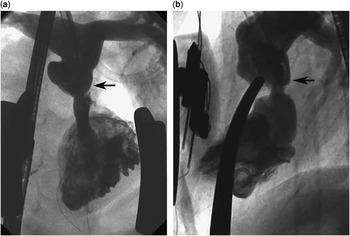
His course 1 year after repair was complicated by failure to thrive and an admission for heart failure. Cardiac catheterisation 5 months postoperatively demonstrated supra-systemic pressure in the left ventricle with a left ventricle-to-pulmonary artery gradient of 59 mmHg, with normal pulmonary artery pressure. Angiography showed severe subpulmonary obstruction and the circumflex coronary artery crossing the pulmonary outflow tract (Fig 1a and b). The position of the crossing coronary artery underneath the pulmonary valve on the left ventricle left insufficient space for a safe left ventriculotomy and construction of a conduit. Owing to the proximity of the coronary artery to the obstructive subpulmonary tissue, further resection was not possible. Given the lack of surgical options, hybrid stenting of the obstruction was performed 1 year after initial repair.
Pre-intervention angiogram in the anterior-posterior/cranial ( a ) and lateral projections ( b ), demonstrating severe left ventricular outflow tract obstruction. Arrows indicate the position of the pulmonary valve in both projections.

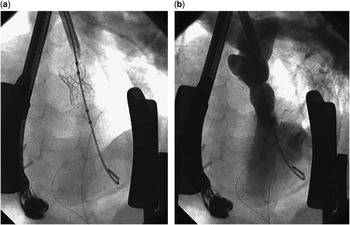
Under anaesthesia, the chest was opened and a purse-string suture was placed in the main pulmonary artery, through which a 10-French sheath was placed. Pre-intervention measurements demonstrated a left ventricle pressure of 140 mmHg, pulmonary artery pressure of 18 mmHg (gradient=122 mmHg), and systemic pressure of 80 mmHg (left ventricle:systemic ratio=1.75). A left ventricle angiogram demonstrated severe outflow tract obstruction below the inferior aspect of the pulmonary cusps measuring 4×5 mm. Under fluoroscopic and transoesophageal echocardiographic guidance, a Genesis XD 1910 stent (Johnson and Johnson Health Care Systems, Piscataway, New Jersey, United States of America) mounted on a 12-mm BIB balloon (NuMED Inc., Cornwall, Ontario, Canada) was positioned across the narrowing and the pulmonary valve. The stent was deployed by inflating the inner balloon to 6 mm followed by gentle inflation of the outer balloon to create a dog-bone effect on the stent. The left ventricular pressure was near systemic with a waist diameter of 6.5 mm. A 10-mm Boston Scientific balloon (Boston Scientific, Marlborough, Massachusetts, United States of America) was inflated to 15 atm, resulting in an 8.5-mm waist and a final left ventricle pressure of 50 mmHg, pulmonary artery pressure of 24 mmHg (gradient 26 mmHg), and systemic pressure of 82 mmHg (Fig 2a and b). A post-intervention echocardiogram showed the stent in good position with stable mitral valve function, free pulmonary insufficiency, and moderate systemic atrioventricular valve regurgitation. A post-intervention left bundle branch block progressed to a complete atrioventricular block on postoperative day 4, and a dual-chamber epicardial pacemaker was inserted.
Fluoroscopic image of the stent in situ following deployment and creation of the dog-bone profile ( a ). Angiogram of the left ventricular outflow tract after stent deployment ( b ).

At 5 years of age – 3 years after the intervention – he is stable with moderate tricuspid regurgitation and preserved ventricular function. His atrioventricular node function has recovered. The stent is patent with no evidence of stent fracture, and the peak and mean gradients are 60 and 30 mmHg, respectively.
Discussion
Subpulmonary left ventricular outflow tract obstruction is associated with congenitally corrected transposition of the great arteries in 44% of cases.Reference El-Zein, Subramanian and Ilbawi 1 – Reference Connelly, Liu, Williams, Webb, Robertson and McLaughlin 3 Following initial repair of the ventricular septal defect and subpulmonary resection, this child became symptomatic with recurrent left ventricular outflow tract obstruction and systemic atrioventricular valve regurgitation. Neither surgical techniques nor percutaneous catheter-based interventions were options in this case because of anatomical and haemodynamic factors.
Surgical placement of a left ventricle-to-pulmonary artery conduit was not pursued for two reasons. First, the position of the crossing coronary artery underneath the pulmonary valve on the left ventricle left very little room for a safe left ventriculotomy and construction of an left ventricle-to-pulmonary artery conduit. Second, decompressing the left ventricle with a conduit could compromise systemic output due to a change in septal position and exacerbate pre-existing tricuspid valve regurgitation.Reference El-Zein, Subramanian and Ilbawi 1 Further resection of subpulmonary tissue was also not feasible because of the proximity of the circumflex coronary artery to the obstructive tissue. Stenting has previously been demonstrated as an option for the management of left ventricular outflow tract obstruction in various types of CHD.Reference Porras, McElhinney, del Nido, Lock, Meadows and Marshall 4 A percutaneous approach has been used predominantly with one reported hybrid procedure in a 46-year-old patient with d-transposition of the great arteries and subaortic ventricular septal defect.Reference Porras, McElhinney, del Nido, Lock, Meadows and Marshall 4 As there was no feasible surgical option, an interventional approach was pursued. Owing to the multiple acute angles that would need navigation with a long sheath, we performed a hybrid procedure to access the left ventricular outflow tract directly from the main pulmonary artery instead of a percutaneous approach. The hybrid approach allowed for easy access to the left ventricular outflow tract, a short procedure, no cardiopulmonary bypass, and short recovery.
In consideration of preserving systemic output while relieving the obstruction, stenting provided a means for monitoring haemodynamics. By gently inflating a balloon-in-balloon system, we were able to dog-bone the stent and serially re-evaluate the haemodynamics and echocardiographic findings during dilatation, eventually achieving our left ventricle-to-pulmonary artery target gradient (25–30 mmHg). This was performed without affecting systemic output. With a stent in situ, future dilation or hybrid valve implantation may be performed.
This is the first report of hybrid stenting used to manage left ventricular outflow tract obstruction in congenitally corrected transposition of the great arteries and may be considered as an alternative to surgical and percutaneous methods.
Acknowledgements
None.
Financial Support
This research received no specific grant from any funding agency or from commercial or not-for-profit sectors.
Conflicts of Interest
None.