Was it happenstance or a fleeting act that symbolized the struggle for local identity and authority? In the process of covering over the massive plaster frieze that encircled the roof of the Castillo, the multitiered acropolis at the center of Xunantunich, someone wedged large pieces of a common black-slipped bowl into the white stucco. As far as I know, no other artifacts have been found among the buried sculptured elements—a Pax god, seated ancestors, and plaited cloth or twisted cords—that together reified the ruler's role as the axis mundi of his community (Fields Reference Fields and Garber2004). By burying the frieze, the ancient Maya attempted to mitigate the power of the dead king and erase the collective memory of Xunantunich's previous royal charter. Although these sherds might have been part of the prosaic remains of a feast consumed during the building's termination rites, their significance may have had as much to do with the identity politics of the people involved as the rites themselves. As a fleeting—but to my mind—deliberate act, it juxtaposed common people and mundane things against kingly personages and divine programs, hinting at the tension between these social groups and their ability to imprint their own ideas and practices into the collective memory of the group.
In this article I explore how collective memories and linear histories worked to embody multilayered, and sometimes conflicting, identities among the people of Xunantunich, Belize, during the Late and Terminal Classic periods (a.d. 600–1000). Here, I take a bottom-up approach to understanding the formation of community identity by suggesting that the creation of a sense of commonality among all members of the Xunantunich polity was only partially rooted in the actions of its elites, whose political relationships with external overlords provoked local identity politics (Schortman et al. Reference Schortman, Urban and Ausec2001). Although the site's rulers may have identified more strongly with nonlocal kings in terms of class, strong political and social identities were constructed and communicated through local practices and symbols. Identities, whether they are of class, polity, or community, are dependent on collective memories and histories. They provide the mental frameworks that people draw upon to construct shared pasts, no matter how long, how short, or how fragmented these pasts might have been.
To study the mental and physical “acts of transfer that make remembering in common possible,” researchers must look not only at written histories and other explicit material symbols, but also the bodily practices of people (Connerton Reference Connerton1989:39). Grand symbols of the Xunantunich polity can be understood through civic monuments that served to inscribe the histories of kings and the polity's place within the larger political landscape. But the hieroglyphs and associated images provided the rulers only a starting point to recount the past during commemoration rites. It was the spoken words and repeated performances associated with these rites that cemented polity interests and sentiments into the hearts and minds of its members. Ideas about who were members of the Xunantunich community also were rooted in bodily practices that all polity members shared through their collective memories of daily routines and more common annual rituals. Paul Connerton (Reference Connerton1989:35–36) suggests that repetitive bodily practices, like inscribing history, are legitimating performances, and as such, they are essential for membership in a kin group, community, or social class. Salient identities were performed, therefore, not only through high public art and civic rituals, but also ordinary community practices and symbols, which embodied a sense of people, place, and polity in the collective memories of its members.
Histories, as surviving individual narratives, and collective memories, as more generalized notions of a shared heritage, exist in an uneasy and contested relationship. In order to resonate and survive as collective memories, histories must play an essential role in a master narrative that pulls together group interests and sentiments. If not, they may easily be forgotten, modified, or rewritten. Histories are more likely to be retained in the collective memory of the larger group if they are publicly read or performed as part of a more complex set of public ceremonies (Connerton Reference Connerton1989). In this way they are embedded both in the mind and the body. Therefore, it is conceivable that reenacted or recited parts of histories are inseparable from the larger group's collective memory of the past.
The proliferation of competing histories among antagonistic Maya kings indicates that few histories became collective memories, at least for long. During the Late and Terminal Classic periods, when many kingdoms cycled through times of dominance and subordination, there was not one history but many histories; there was no monolithic collective memory but a set of overlapping and often conflicting notions about the ways things were in the past (Connerton Reference Connerton1989; Van Dyke and Alcock Reference Van Dyke, Alcock, Dyke and Alcock2003). It is within these histories and collective memories that the symbols and bodily practices of multilayered identities can be found.
History and collective memory are different in the ways they were reproduced by the ancient Maya and understood by archaeologists through material remains and practices. Oral histories, as well as legends, are accessed through cognitive memory—something that is remembered. For literate societies, like the Maya, histories were available through surviving texts and associated images. On the other hand, collective memories are often encoded in habit-memory—a performance that can be reproduced without resort to recall or cognitive memory (Connerton Reference Connerton1989:40). After years of constant chores, muscles remember how to perform tasks and minds subconsciously access embodied memories that they already “know” (Joyce Reference Joyce, Dyke and Alcock2003:105). Archaeologists can gain an understanding of past collective memories by focusing on the shared domestic tasks that were repeated daily across all households. But as I suggested earlier, histories are unlikely to be retained in collective memory, whether written down in texts or recalled from memory devices, unless they are repeated during public performances. Therefore, identities built upon histories and collective memories require repetitive actions, the most salient of which are embedded in bodily practices.
Maya foodways, including the tools and practices of cooking and serving, are a rich source of histories and collective memories since they are embedded in bodily practices. Surviving fragments of histories are available through the translation of the Primary Standard Sequence (PSS) text along the rim of Late Classic vases. PSS texts are often proprietary statements that not only identify the owner of the vessel but also its maker, its use, and the social status of its owner (Houston et al. Reference Houston, Stuart and Taube1989). These texts also describe vases as containing chocolate; therefore, many researchers assume that their primary function was for drinking chocolate. Vases that display PSS texts are elaborately decorated with painted scenes, some of which appear to portray the owner engaged in a variety of elite practices. Other figural vases display mythological and cosmological themes, especially elements from the legend of the Hero Twins from the Popul Vuh (Kerr Reference Kerr1989). Although some may have been used solely as funerary items or as pristine memory devices to recall political, religious, or social relations (Coe Reference Coe1978:11), close examination of vases reveals heavy wear patterns on their surfaces (Chase Reference Chase, Robertson and Benson1985; Reents-Budet Reference Reents-Budet1994:75). Therefore, they were repeatedly used during the lifetime of the owner.
It is possible that the inscriptions along the rim of vases, as well as the scenes painted on the body of the vessel, may have functioned as memory devices to recall legends or histories while offering toasts during feasts or public events. Painted scenes on Classic period vases, cups, and plates, only some of which contain PSS texts, appear to confirm this. Those that display historical scenes focus on kings and queens exercising their authority including presentations, performances, religious rites, and feasts (Reents-Budet Reference Reents-Budet, Kerr and Kerr2000, Reference Reents-Budet, Inomata and Houston2001). Food service and toasts were important parts of these courtly activities as evidenced by the central position pottery vessels command in these scenes and the fact that people in some scenes are shown gesturing with vases. Vases and the bodily practices they reflect, therefore, can be used to understand how elite foodways embodied individual and class-based identities.
Commoners also used foodways and domestic pottery to evoke collective memories, but rather than using highly decorated and inscribed pottery to recall particular events, quotidian foodways may have elicited collective memories by linking an experiential present to a communal past. All families cooked and served meals in the home around the hearth using domestic pottery, and these daily repetitive tasks were embedded in bodily practices. As such, cooking and serving meals may have evoked feelings similar to what Steven Feld and Keith Basso (Reference Feld and Basso1996) call a “sense of place, ” especially a sense of home and family, and as I hope to demonstrate, a collective memory of the larger community as well.
Reconstructing what the Classic Maya ate and drank or the kinds of vessels in which they cooked and served their meals is beyond the scope of this paper. In other publications I have linked common bowls and jars found at Xunantunich to the preparation of maize and the hauling of water (LeCount Reference LeCount1996, Reference LeCount, LeCount and Yaeger2010), and many epigraphic, formal, and chemical analyses have identified the specific uses of serving forms (Houston et al.Reference Houston, Stuart and Taube1989; Reents-Budet Reference Reents-Budet1994; Stuart Reference Stuart1988; Taube Reference Taube1989). Rather, it is the ritualization of domestic practices (Bradley Reference Bradley2005) and the construction of collective memory that forms the body of this discussion. Certainly, many foodways inculcate habit-memory among the people who perform them every day—but which practices become integral parts of the collective memory of the community, so much so that they come to embody community identity? Similarly, which foodways allow individual histories to be “written” in the collective memory of community? It is not enough to say that many components of domestic life form the basis of collective memories; one must understand how collective memories and histories are constructed out of the materials of everyday life.
ANCIENT XUNANTUNICH: THE CREATION OF A NEW IDENTITY AND A VENERATED PAST
Unlike many Classic period sites in the Maya Lowlands, Xunantunich had an abbreviated past. Although occupation of the hilltop stretches back to the earliest known ceramic phase of the Preclassic period (LeCount et al. Reference LeCount, Yaeger, Leventhal and Ashmore2002), the immediate area sustained only modest construction and habitation until the site was established as a major center in the Samal phase (a.d. 600–670). After this time, Xunantunich rapidly grew to its maximum size and architectural grandeur during the early Hats' Chaak phase (a.d. 670–750), when the area was likely directly incorporated into the Naranjo state and the center served as the larger site's provincial capital in the upper Belize River valley (LeCount and Yaeger Reference LeCount, Yaeger, LeCount and Yaeger2010). By the latter part of the Hats' Chaak phase, approximately a.d. 750 or so, the center appears to have experienced a violent event and many parts of the site were abandoned. It was during this time that local rule was restored and the plaster frieze on the summit building of the Castillo discussed in the opening paragraph was likely buried. In a.d. 820, Xunantunich erected stelae and proclaimed supreme political authority over the area in the Tsak' phase (a.d. 780–890). But the site's ties to Naranjo were never entirely broken. Naranjo's influence was written in Xunantunich's architecture, stelae, and other permanent monuments during the Late and Terminal Classic periods (Ashmore Reference Ashmore and Ruiz1998; Leventhal and Ashmore Reference Leventhal, Ashmore and Garber2004).
Besides Xunantunich, many major centers are found on or near the tributaries that form the Belize Valley, including Actuncan, Buenavista del Cayo, Baking Pot, Blackman Eddy, Cahal Pech, Las Ruinas, and others, whose deep and substantial histories stretched back into the Middle Preclassic period (Garber Reference Garber2004). Contrary to expectations, these centers are virtually the same size and do not exhibit equidistant spacing predicted by Central Place theory for the gradual emergence of centers on the landscape. Based on recent epigraphic evidence, it appears that perpetual competition for political dominance between the tightly-spaced sites of the upper Belize River valley likely resulted in a succession of territorial capitals beginning with Actuncan in the Late Preclassic period and ending with Xunantunich in the Terminal Classic period (Helmke and Awe Reference Helmke and Awe2008; see also LeCount and Yaeger Reference LeCount, Yaeger, LeCount and Yaeger2010).
Xunantunich's sudden and rapid expansion within this political longue durée reorganized political relations in the valley and may have prompted the people of the upper Belize River valley to clarify their affiliations through local symbols associated with sculpture (Fields Reference Fields and Garber2004) and pottery (Connell Reference Connell2000; LeCount Reference LeCount, LeCount and Yaeger2010; Preziosi Reference Preziosi2003), and perhaps other salient markers of identity. Before this time, pottery types and their frequencies are nearly indistinguishable between sites found in this part of the Belize valley and those downstream, a pattern often associated with interactive polities that mutually reinforce each other (Freidel Reference Freidel, Jones and Kautz1981; McAnany Reference McAnany and Haas2001; Sabloff Reference Sabloff, Renfrew and Cherry1986). The formation of a pottery-style zone around Xunantunich during the Late Classic period suggests a breakdown of social and political relations between polities and a conscious development of a new local identity and a new past to differentiate this polity's members from surrounding populations. Elsewhere, I present data that document the rise in popularity of an obscure domestic pottery group, called Mount Maloney, to become a collective symbol of social identity for the people of the upper Belize River valley (LeCount Reference LeCount, LeCount and Yaeger2010). Assemblages from sites down valley, such as Cahal Pech and Baking Pot (Audet Reference Audet2006:319, Table 6.5), contain more red-slipped groups of similar forms and composition, while those from Minanha, located on the Vaca Plateau, are distinctly brown in color (Gyles Iannone, personal communication 2006). These local style zones are interesting because they are distinguished from each other by simply-decorated pottery groups used in the home to cook and serve food, not the more highly embellished groups that form the bases of ceramic spheres across the Maya lowlands.
In many cases, a collective identity is forged in the face of competition and boundary marking (Jones Reference Jones1997; Wobst Reference Wobst, Dobres and Robb2001) and materialized through ordinary items such as clothing (Anawalt Reference Anawalt1981), lip plugs (Brumfiel Reference Brumfiel, Brumfiel and Fox1994), and pottery (Thompson Reference Thompson1958). Rarely are these kinds of core symbols sacred in the conventional sense; rather, they are powerful metaphors for life (Ortner Reference Ortner1973:1340–1342). Their prominent display reinforces the prosperity and strength of the group (Wiessner Reference Wiessner1983) and promotes a collective memory of shared heritage. Since all individuals can obtain and use these items, they unify people separated by social class, economic background, or original homeland.
An equally important factor for the development of a salient identity for members of the Xunantunich society was their relationship to powerful groups in the Peten. Naranjo, one of the largest and most bellicose Classic Maya centers situated in the eastern Peten, was less than a day's walk to the west and a major player in social and political affairs of the Belize valley (Helmke and Awe Reference Helmke and Awe2008; Houston et al. Reference Houston, Stuart, Taube and Kerr1992; Reents-Budet Reference Reents-Budet, Awe, Morris and Jones2005). Naranjos's influence in Belize valley politics may have prompted Xunantunich's populace to define themselves in opposition to or affiliation with them.
Although Xunantunich's rulers were subordinated to Naranjo overlords during portions of the Late Classic period, they nonetheless participated in elite Maya identity politics. Maya kings actively sought to associate themselves with other individuals of the same political rank and social status and distance themselves from others of lesser sociopolitical status. Good relations were marked through gift giving, marriage alliances, and visitations, but bad relations did not deter the display of broadly shared elite symbols and practices such as clothing canons and protracted burial rites. Ideas about kingship, cosmology, and other conceptual frameworks transcended geopolitical rivalries.
Like other lowland elites, Xunantunich's rulers garnered international pottery styles that conveyed membership in the upper echelons of lowland society (Schortman et al. Reference Schortman, Urban and Ausec2001). One of the best examples of international pottery styles are highly decorated figural and textural vases that display PSS texts, described above. These items were produced by specialists for elite patrons and often circulated through the elite stratum as reminders of social and political relations (Reents-Budet Reference Reents-Budet1994). The histories inscribed on them were likely read during toasts at feasts to recall personal events and relations.
Possibly because of their provincial status, Xunantunich leaders did not commission or receive many vessels that displayed PSS texts. Instead, vases that exhibit pseudo-glyphs rather than readable inscriptions are common at Xunantunich. Pseudo-glyphs do not conform to the established canons of glyph morphology; rather they repeat glyphs in the same position as PSS text (Longyear Reference Longyear1952). Some pseudo-glyphs cannot be pronounced, but others are words with decipherable meanings (Calvin Reference Calvin2009). Fragments of texts and repetitive glyphs may have acted as mnemonic devices to reactivate the presence of a known individual (Meskell Reference Meskell, Dyke and Alcock2003:44–45) or recall personal events and relations in the same way figural and textural vases were used.
In sum, pottery styles from Xunantunich lend evidence to suggest that the Late and Terminal Classic Maya who lived in the upper Belize River valley created new social and political identities based on a venerated past. Interestingly, these new identities are more easily understood through practices associated with domestic pottery groups than elite vessels. Xunantunich's rulers and nobles were tied together with other lowland Maya elites through class and therefore they performed many of the same international foodways seen at other sites. As I will argue below, their specific social identities derived from the creation of linear histories associated with estates and ancestors through feasting practices. Classic-period domestic pottery, on the other hand, expressed affiliation to the immediate area through shared bodily practices associated with cooking and serving practices all Xunantunich community members shared.
COMMON POTS AND BODILY PRACTICES AMONG THE MAYA: PAST AND PRESENT
The importance of common pots in memory work derives from the ways they are used to cook, store, and serve food and how these practices embody collective memory. In this section, Mount Maloney pottery vessels from Xunantunich are linked to bodily practices associated with cooking food and hauling water. Today, similar kinds of pottery and bodily practices are sources of cultural and community identities, patterns that are used to infer similar linkages among the ancient Maya of Xunantunich.
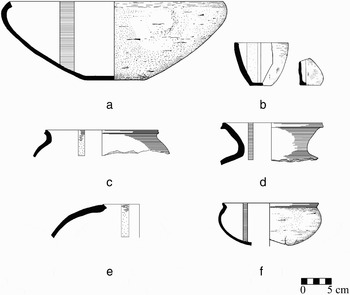
At Xunantunich, Mount Maloney vessels were the most common tools for cooking and serving daily meals at Xunantunich. These sturdy black-slipped, calcite-tempered bowls and jars were made in seven forms, including incurving bowls, ritual forms, jars, closed bowls or ollas, and rimmed bowls (Figure 1). As a ceramic group, they dominate Xunantunich domestic assemblages, comprising 38–47% of the Late and Terminal Classic complexes (LeCount Reference LeCount1999). Their initial use among people of the upper Belize River valley dates to the transformation of Xunantunich as a major center in the Samal phase, and possibly earlier. Early Classic assemblages at the nearby center of Actuncan contain an early prototype of this pottery, but it makes up a very small percent of the assemblage (Wyman Reference Wyman2006). Based on ethnographic analogies and archaeological data, I have suggested that Mount Maloney bowls were the primary vessels used to prepare maize-based foods for everyday consumption, and restricted-necked jars were the primary water-carrying containers (LeCount Reference LeCount1996; Reference LeCount, LeCount and Yaeger2010).
Mount Maloney Group forms: (a) incurving bowl, 79DD/3.7050, (b) rare forms, 116M/3.12917, and 117A/3.12123, (c) open-necked jar, 90G/8.7552, (d) restricted-necked jar, 22O/3.4464, (e) large closed bowl, 117G/1.10711, and (f) rimmed bowl, 18C/5.4047.

For the Classic Maya, daily meals consisted of simple foods made with water and ground maize meal or dough (nixtamal). Beans, root crops, avocados, chiles, insects, greens, fruits, and mushrooms lent variety to a repetitive diet, and meat was a minor component of the meal (Lentz Reference Lentz1991; Powis et al. Reference Powis, Stanchly, White, Healy, Awe and Longstaffe1999).
For the vast majority of ancient Maya people, growing and preparing maize and fetching water from a sacred waterhole were strenuous everyday chores, much like those performed by Maya women today. Modern Maya women spend the better part of each day preparing and grinding nixtamal for meals using pottery bowls as vessels to soak, mix and store the maize dough (Vogt Reference Vogt1969:24–25). Girls fetch water by balancing jars on the head, hip, or back depending on the costumbre (tradition) of the community (Reina and Hill Reference Reina and Hill1978). Because washing, soaking, and grinding maize kernels for nixtamal and hauling jars full of water are laborious chores, these bodily practices are fixed within the muscles, bones, and minds of people who perform these tasks. A lifetime of chores inculcates habit-memory of community foodways into the collective memory of women.
Domestic foodways code for more than habit-memory; they also recall associations with family, home, and community. David Sutton (Reference Sutton2001:5) suggests that foodways are a potent source of collective memory because they create relatedness among people who eat together. Eating food together constitutes a communal whole, essentially a family, whose members understand that they are bound together and altered through “shared substance.” Shared substances need not be special foods. For the Japanese, rice is a metaphor of self, community, nation, and ethnicity (Ohnuki-Tierney Reference Ohnuki-Terney1993), just as feta cheese is a source of metaphors of Greek life (Sutton Reference Sutton2001:85).
For the Classic Maya, shared substances were maize and water, which not only made up the bulk of their meals, but the human body as well. According to legends in the Popul Vuh, the first true human beings were created when the gods made people out of maize dough (Tedlock Reference Tedlock1996). In their ritual role as recapitulators of the Maya creation, rulers wore ritual paraphernalia that transformed their appearance to match the maize god (Freidel et al. 1993; Taube Reference Taube, Robertson and Fields1985). In death, maize dough was placed in the corpse's mouth, presumably to sustain them on their journey to the underworld. Maize was governed by a deity, who was placated by a series of rituals tied to the agricultural cycle.
For the Classic Maya, maize and blood sustained humans and gods alike (Taube Reference Taube1989), much the same way the modern Maya believe these elements invest the body with both spirit and energy. Chimaltecos call maize qtxu? Kjo?n, “Our Mother Corn,” which suggests profound respect for this source of all life and livelihood (Watanabe Reference Watanabe1992:66–67). Maize plants, like humans, have inner souls or ch'ulel (Vogt Reference Vogt1969:36). Eating corn transfers this spirit to the human body. Similarly, the Nahua of Amatlan, Veracruz, believe that the force that provides human energy is carried in the blood and is renewed when people eat corn. Thus the Nahua say “corn is our blood” (Sandstrom Reference Sandstrom1991:247). According to June Nash (Reference Nash1970:17), flowing water, liquor, and blood are symbolically linked as spirit media, and this connection may be one reason that excessive drinking is allowed at public festivals among the Tzo?ontahal Maya of Chiapas. For the modern Maya of Zinacantan, water is drawn daily from a sacred waterhole, which is considered to be an opening in the earth's crust where people can communicate with the Earth Lord (Vogt Reference Vogt1969:387). Water from these sacred waterholes is not only used to draw water for people and livestock, but to heal the sick (Vogt Reference Vogt1969:146).
Pottery vessels are part and parcel of this transfer of energy since they are the containers in which raw ingredients are cooked into daily meals and made available to family. Pots, hearths, and homes are therefore similar generative loci. They transform the outside world into the inside world of the family and community (Douglas Reference Douglas1966, Reference Douglas and Geertz1971; also see Goody Reference Goody1982, Levi-Strauss Reference Lévi-Strauss, Weightman and Weightman1970, and Sahlins Reference Salhins1976). In a “natural” world of annual cycles centered on family reproduction, horticultural activities, and ceremonies tied to the solar calendar, domestic practices were the foundation of a collective memory of community (see Gillespie 2010).
For the modern Maya, common pottery forms and styles are considered community property, not the property of individual families (Riena and Hill 1978:254; Thompson Reference Thompson1958:123, 145). This connection may be due to the fact that the Maya believe they were invented by the first ancestors, who became models for correct behavior (Warren Reference Warren1978:49). Nash (Reference Nash1970:53) suggests that the Tzo?ontahal Maya metaphorically equate parts of pottery vessels to those of the human body, and more importantly, believe that they have a soul. The close relationship between community property, corporeal identity, and domestic pottery might have also been true for the ancient Maya, who also modeled pottery attachments after human body parts. Pots may have reflected human aspects of the people who made them, a pattern recognized by many anthropologists (David et al. Reference David, Sterner and Gavua1988; DeBoer Reference DeBoer, Leeuw and Pritchard1984; Hodder Reference Hodder1988; Miller Reference Miller1985).
COMMEMORATIVE RITUALS AND COLLECTIVE MEMORY AT XUNANTUNICH
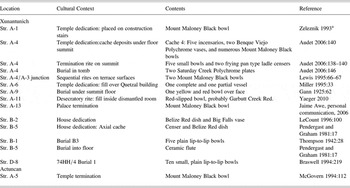
If Mount Maloney pottery were found only in domestic contexts, it would be harder to argue that it played an integral part in the formation of a collective memory at Xuantunich. But not only is Mount Maloney the most frequent pottery group found in domestic contexts in upper Belize River valley sites, it is also one of the most common whole vessel types found in Late and Terminal Classic civic caches at Xunantunich (Table 1). The connection of Mount Maloney bowls with dedication and termination rites indicates that practices associated with maize preparation were important elements in ritual performances at Xunantunich.
Whole Pottery Vessels Recovered from Ritual Contexts at Xunantunich and Actuncan*

* Chart modified from Jamison (Reference Jamison, LeCount and Yaeger2010) to include Hats' Chaak and Tsak phase caches only.Caches may include other items including sherds, obsidian, shell, and human remains, but only whole or reconstructable vessels are listed.
aUnpublished field notes.
Whole Mount Maloney bowls were placed beneath the south construction stairs of Structure A-1 and on a west-facing terrace of Structure A-4. Large rim fragments were found wedged into the Castillo's western frieze (Robin Reference Robin, Leventhal and Ashmore1994) and burnt on a bench in Structure D-7 (Braswell Reference Braswell and Leventhal1993). At Actuncan, a whole Mount Maloney bowl was placed atop a large termination ritual deposit of smashed vessels on the stairs of one of the structures making up the major triadic temple group. Other kinds of vessels were also cached. Incensarios are also found in termination and dedicatory deposits, but they are often broken. Small, unslipped lip-to-lip bowls are common in burials, as are decorated vases and plates. But these are more likely to be found in house dedicatory caches or burials than in civic contexts.
As the most common civic cache vessel, Mount Maloney bowls can be thought of as votives associated with public commemorative rites. Richard Bradley (Reference Bradley1990) suggests that votives were not intended to be retrieved, but were offerings given to the gods as part of rites of passage associated with life or death. The objects deposited in these kinds of caches do not reflect the status or achievement of the individual who deposited them per se but are intended to placate supernatural powers for the benefit of the entire group. For the Classic Maya, temple dedicatory and termination rites may have been indirectly associated with events in the life and death of a particular leader who commissioned civic works, but they are not directly linked to a person like grave goods. They are more strongly associated with public rituals and sacred offerings enacted at the dedication or termination of civic buildings.
It could be suggested that the bowls themselves were not votives but merely containers that held food offerings. This certainly may be true. As the primary vessel for the preparation of maize, the presence of Mount Maloney bowls in caches lend evidence to suggest that maize-based foods were offered to the gods when civic buildings were dedicated or terminated. They could have held kernels, cobs, maize dough, or possibly a maize-based food item such as tamales or atole (maize gruel). Offerings of maize kernels and stalks have been found in caves (Brady Reference Brady1989, Reference Brady1995; Brady and Stone Reference Brady and Stone1986; Brady et al. Reference Brady, Ware, Luke, Cobb, Fogarty and Shade1997; Lentz Reference Lentz1991:272), but it is unclear how or why they were cached there. Scenes on plates and vases illustrate tamales in ritual settings associated with important Maya deities such as the Tonsured Maize God, God K, and God N (Taube Reference Taube1989), but most are shown offered in shallow serving vessels such as plates and dishes. It is more likely that deep bowls held maize dough or soupier food items like atole.
Maize-based foods are the most common form of sacred food offering among the modern Maya today. Sacramental meals include tuti-uah, a baked maize cake and maize gruel in which chicken may be added (Redfield and Villa Rojas Reference Redfield and Rojas1967:141, 145; Vogt Reference Vogt1993:69). The Yucatec Maya state that maize-based foods are suitable for gods, not simply because they are traditionally correct, but because they evoke the rain-giving functions of the gods and signify purity and divinity (Redfield and Villa Rojas 1967:128–129). Offerings placed on altars are called “substitutes” among Zinacantecos (Vogt Reference Vogt1969:70). Much like torma for the Buddhists (Ortner Reference Ortner and Willis1975:139), they provide a temporary body for the ancestor or deity while they eat at the mesa. After the ancestors have eaten their fill, ritual participants consume the food and drink (Tozzer Reference Tozzer1941:154) presumably because eating these gifts transferred spirit to the bodies of the participants.
Nash (Reference Nash1970:210) suggests that Tzo?ontahal Maya of Chiapas are tied together as a community by eating together at sacred ritual meals and large-scale public feasts associated with festivals. Because these meals offer the same kinds of foods, the Tzo?ontahal Maya merge profane and sacred domains together into an unbroken universe. Ritual meals are intended to integrate rather than differentiate participants, even though senior men initiate and coordinate action. In Zinacantan, “men of low status may sit around the foot of the ritual table, [but] no one sits at the head” (Vogt Reference Vogt1993:41). Elders preside over the meal as ritual drinking and eating is repeated until all participants are served. According to Evon Vogt (Reference Vogt1993:41), ritual meals express communality and continuity from deceased ancestors down to the youngest Zinacanteco capable of drinking and eating.
In sum, Mount Maloney vessels, as the most common household container and votive item, linked the sacred realm of the supernatural world and the profane world of daily bodily practices. Catherine Bell (Reference Bell1992:74) suggests that ritual is a part of the reality of social life and cannot be clearly differentiated from more quotidian activities. Daily routines and ritual actions are therefore better understood as a range of actions and materials that reveal dominant concerns of society (Bradley Reference Bradley2005). If ritual is recognized as a form of action, context can be used to determine the importance of ordinary things (Bradley Reference Bradley2005:34). For the Classic Maya at Xunantunich, Mount Maloney bowls were an integral component of both bodily practices and commemorative rites, and as such, they fostered a collective memory about family and community, and their place within the greater universe.
Classic Maya Feasting Paraphernalia: Performing Histories and Legends
Public ceremonies associated with mortuary rites or civic rites recognize political personages and the inheritance of social or political positions (Helms Reference Helms and Robb1999:63). They established linear histories and bounded recollections that allowed some individuals to appropriate a separate past and legitimate their positions. By tapping into a temporally defined world order, these kinds of rituals secured a point of origin and a memory of named ancestors for a house, corporate group, or polity (see McAnany Reference McAnany and Haas2001:127). Most public ceremonies would have provided food and drink for honored people, ancestors, or gods who cement bonds of affiliation by eating shared substances. Public feasts therefore are powerful venues to create, reinforce, or modify history. As integral parts of commemorative rites, they bring together large numbers of people to eat and witness oral presentations and performances.
Among the Classic Maya, the host may have also danced and performed legends. Based on the scenes painted on figural vases, they ate and drank. Personal feasting paraphernalia, especially vases with texts and scenes, would have acted as memory devices for the narration and reenactment of history, legends, and calendrical events. Toasting, as a way to honor important people and command the audience, stands out as a way to separate the histories of a few men and—possibly some women—from the redundant and cyclic memories shared by all Maya.
Classic Maya festival foods, as opposed to more sacred ritual meals, included tamales, roasted meats, chocolate drinks, and balche or other fermented beverages. Much of what we know about Classic period celebratory feasting comes from hieroglyphic texts and scenes painted on ceramics (Reents-Budet Reference Reents-Budet1994; Taube Reference Taube1989). By far, the most commonly depicted items are tamales served on plates and chocolate drunk from vases. Bishop de Landa stated that the sixteenth-century Yucatec Maya festival foods were served in abundance, and eating meat—specifically deer, peccary, turkey, and dog—was one of many important treats consumed at festivals (Tozzer Reference Tozzer1941:92).
These festival foods, as well as the pottery forms used to serve them, probably had deep historical precedents for the Classic Maya. Plates date back to the Middle Preclassic period in the Central Lowlands (Gifford Reference Gifford1976; Merwin and Vaillant Reference Merwin and Vaillant1932; Smith Reference Smith1955), which indicates that solid foods, such as roasted meats and possibly tamales, were an important component of Maya festivals for a very long time. The ancient Maya also consumed freshwater snails or jute (Pachychilus spp.) in large quantities at public ceremonies. Massive pits filled with jute shells at the base of Preclassic pyramids are common in Belize valley civic centers (Powis et al. Reference Powis, Stanchly, White, Healy, Awe and Longstaffe1999). Jute shells have been found in pits within Xunantunich's plaza on the north side of Structure A-1 (Jamison Reference Jamison and Leventhal1992; Zeleznik Reference Zeleznik and Leventhal1993), as well as in Classic period construction fills at Xunantunich and Actuncan.
Consuming chocolate also had deep antiquity for the Classic Maya (Coe and Coe Reference Coe and Coe1996; Joyce and Henderson Reference Joyce and Henderson2007; McNeil Reference McNeil2006). Charles Miksicek and colleagues (Reference Miksicek, Bird, Pickersgill, Donaghey, Cartwright and Hammond1981) found evidence of cacao charcoal at Cuello dating back to Preclassic times, and more recent chemical studies have documented cacao compounds in Preclassic spouted vessels (Hurst et al. Reference Hurst, Tarka, Powis, Valdez and Hester2002). The word ka-ka-wa is inscribed on an Early Classic cup from Uaxactun (Grube Reference Grube and Grube2001:33), and the earliest chemical evidence of cacao drinking from vases or cups also dates to the Early Classic period (Stuart Reference Stuart1988). Cacao seeds found at Ceren also date to the Early Classic period (David Lentz, personal communication 2006).
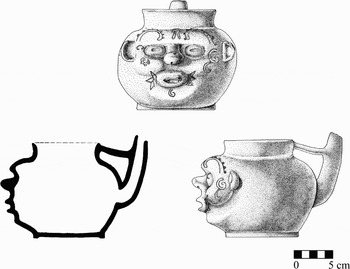
The drinking paraphernalia used to consume chocolate changed during the transition from the Preclassic to Classic period, and this shift has important implications concerning how personal histories proliferated in the Classic period. Terry Powis and colleagues (Reference Powis, Valdez, Hester, Hurst and Tarka2002) suggest that Preclassic period chocolate consumption revolved around small spouted jars with basket-like handles. Although some are effigy vessels, they do not appear to be portraits. A Terminal Preclassic effigy vessel from Actuncan (Figure 2) is similar to an “old god” vessel from K'axob (McAnany Reference McAnany2004). These pots may depict a deity, possibly associated with cacao beans or cacao rites, rather than historical individuals. They might have functioned as pitchers or “teapots” for the serving of cacao but could have been preparatory vessels used to froth the chocolate before serving.
Preclassic period chocolate preparation and drinking may have been similar to modern tea ceremonies in Asian societies, where religion, aesthetics, philosophy, discipline, and political relations are brought into play by the simple act of serving and receiving tea (Plutschow Reference Plutschow2003; Sen Reference Sen XV1979; Tanaka and Tanaka Reference Tanaka and Tanaka2000). The objective of a modern tea ceremony is to create a “sacred” environment in which the host and guests strengthen their bonds of friendship by performing a tightly choreographed ritual. First, a secluded setting is properly constructed to reflect the larger universe. Utensils, bowls, and braziers are arranged in a way to facilitate the smooth and tranquil performance of the ritual. Then tea is brought to the guest in a small individual-sized container and consumed after a series of spoken exchanges. An enduring aspect of the ceremony is the way making and sharing tea establishes a personal bond between the host and guests.
Protoclassic orange ware spouted effigy pot from Actuncan, (1D/25B4SA3).

In the Classic period, chocolate was drunk from personally-owned cylinder vases. Scenes painted on Classic vases illustrate that drinking was a vital part of competitive feasting and history making. Men drank on the steps of range buildings, while women and bystanders looked on (Reents-Budet Reference Reents-Budet, Inomata and Houston2001). The large size of some cylinder vases confirms that chocolate drinking was meant to be a conspicuous performance, or possibly a drink that was consumed by more than one person in a public venue. Drinking also occurred in intimate palace settings between a few individuals, and in some cases, cylinder vases can be seen next to divination mirrors, patterns which indicate that chocolate drinking was part of personal private rituals.
Making chocolate during the Classic period, however, does not appear to be part of the drinking ritual itself. Sophia and Michael Coe (1996:50) suggest that women might have made chocolate behind the scenes by pouring chocolate from vase to vase in order to froth it. This interpretation is supported by the high frequency of vases in middens associated with the service area adjacent to the ruler's compound at Xunantunich (LeCount Reference LeCount1996:268). Classic period chocolate drinking, therefore, was obligatory in both public and private sociopolitical and religious rites and helped establish personal histories associated with political and social position within families.
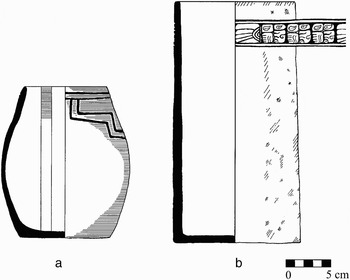
At Xunantunich, Classic period chocolate vases are highly diverse in style and form and not limited to cylinder vases bearing PSS texts. Nearly all lineage heads apparently owned drinking paraphernalia since cylindrical and barrel-shaped vases are found in both elite and commoner households (LeCount Reference LeCount2001). Most commoner and noble vases lack hieroglyphic texts, but many display repetitive pseudo-glyphs or simple images (Figure 3). In some commoner burials, rim sherds bearing portions of PSS texts have also been found (Chase Reference Chase and Leventhal1992:50). Although vases with personal messages inscribed in hieroglyphs may have been limited to Xunantunich kings, the fact that pseudo-glyph vases are common at households in the center and hinterland settlements indicates that many men may have used vases with mnemonic inscriptions to recount oral histories and legends. As mnemonic devices, these textual fragments may have helped individuals recall stories during presentations, but as non-readable texts, they were subject to reinterpretations. The power of these “texts” to maintain linear histories therefore comes from the repetition of the message conveyed during toasts and feasts.
Late and Terminal Classic vases from Xunantunich: (a) Belize Red Incised Type barrel-shaped vase, 85L/7.6596 and (b) unspecified ash ware pseudo-glyph cylinder vase, 1E/12.20066.

This functional and contextual difference between Preclassic period spouted vessels as preparatory and serving vessels and Classic period vases as solely drinking vessels signals a shift in the nature of ceremonies that called for chocolate. Rituals surrounding the Classic Maya chocolate ceremony were more prone to competitive displays and personal narratives than Preclassic rites, which might have been more intimate and communal. There is additional written evidence to support this contention. In Classic Mayan hieroglyphs wi', “to eat or to consume,” is often the verb associated with “flint and shield” warfare expression and interchangeable with jub', “to down or to topple.” Therefore, eating and war were ways to absorb, to conquer, to rob, and to eliminate in later Maya society. As a competitive act, wi' allowed one individual to supplant another or one group to supersede its rival.
Painted scenes on Classic period cylinder vases illustrate much drinking and carousing at public festivals. Festival behavior shocked sixteenth-century Spaniards who commented on the debauched nature of these affairs.
“These Indians were very dissipated in drinking and getting intoxicated, on account of which many evils resulted, such as killing each other and violating the conjugal rights of each other, the poor women thinking that they were receiving their husbands, behaving also with their fathers and their mothers as if they were in the houses of their enemies, and setting fire to their house, and in spite of all this they ruined themselves (in order to) get drunk. And when the drunkenness was general and accompanied with sacrifices, everyone contributed to it; because when it was a private occasion the host bore the expense of it with the aid of his relations” (Tozzer Reference Tozzer1941:92).
As the antithesis of structure, festival eating and drinking can be seen as liminal, the liberation of human cognition from the normative constraints imposed on individuals by society (Turner Reference Turner1982:44). As such, Maya celebratory feasting contained the germ of future social and political developments. The overwhelming affects of celebratory drinking and eating were ripe for tactics that enhanced the host's prestige and forged individual memories.
CONCLUSIONS
Inscribed memory practices associated with elite symbols and individual histories are often times privileged over more mundane material culture and bodily practices that form the foundations of collective memories for all community members (Connerton Reference Connerton1989:4; Thomas Reference Thomas1996). With examples from the Maya center of Xunantunich, Belize, I make the case that common bodily practices associated with preparing maize and hauling water contributed to the collective memory of community identity as strongly as the personal histories of kings. This situation was especially true during the Late and Terminal Classic periods, when shifting political power erased the history of many Maya kings. I suggest that if histories are embodied in public performances, they are more likely to survive, at least in part, to become collective memories shared by all members of the community than those that are not.
For the ancient Maya, daily commensality and ritual feasting were a continuum of performance and meaning. In the upper Belize River valley, a black-slipped pottery group, called Mount Maloney, was the most common pottery in households, as well as in civic caches. Based on ethnographic analogy and archaeological data, I suggest that Mount Maloney bowls were used to prepare nixtamal and that constricted-neck jars were used to carry water. Today, pottery styles and bodily practices of preparing maize and hauling water are considered community property and tradition, patterns evidenced in the Classic period archaeological record as well. Therefore, the repetition of these strenuous practices over a lifetime of daily chores created habit-memory shared by all community members.
The fact that these vessels were found in both domestic and civic contexts indicates that bodily practices associated with the preparation of nixtamal were not limited to the preparation of daily meals but also to sacred public offerings. In a world structured by short-term cycles centered on horticultural activities, domestic reproduction, and annual ceremonies, these food practices blurred the separation between the past, present, and the future in the collective memory of polity members. Conceived as ancient practices and rites even to the Classic Maya, food rites centered on maize-based foods were deeply embedded in the cosmological order of things and the cognitive memory of community members. Because collective memory forms part of the mental framework people use to construct a shared past, it is a necessary component of identity formation. A salient identity of community was played out, therefore, through ordinary practices and symbols of community affiliation.
The formation of a community identity around common bodily practices did not prevent Maya men or women at Xunantunich from developing linear histories of their own, which were layered on top of the group collective memory. Indeed, the maintenance of linear history was a tool by which kings and nobles could appropriate a separate past that legitimatized rights to power. As a critical aspect of many Classic Maya rituals, chocolate drinking served to create linear histories through toasts that commanded the audience to honor individuals, ancestors, and gods. Some kinds of feasting paraphernalia, such as personalized chocolate vases, marked individuals and their houses as people and places of prominence with separate identities and histories. Therefore, drinking chocolate was incorporated into the rites used to codify the linear memories and histories of some men and their associated houses, which marked them as distinct from those cyclical memories of the larger group.
RESUMEN
Costumbres de memoria inscrita relacionadas con los símbolos de los élite son a veces mas privilegiado que la cultura material banal y las costumbres corporales que constituyen los fundamentos de la memoria colectiva de todos los miembros de la comunidad. Con ejemplos de un centro de los maya en Xunantunich, Belize, yo hago el caso que las costumbres corporales asociados con preparando maiz y el transporte de agua, contribuyeron a la memoria colectiva de la identidad comunal tanto como las historias personales de los reyes. Esta situación era especialmente cierto durante los períodos clásico tardío y clásico terminal, cuando cambios en poder político borro la historia de muchos de los reyes maya. Yo propongo que si historias fueran representadas en actuaciones publicas seria mas probable que durarían, al menos en parte, para llegar a ser memorias colectivas compartidas por todos los miembros de la comunidad mas que los que nos son representadas en actuaciones publicas.
Para los maya antiguos, comensalia diaria y banquetes rituales eran un continuo de actuación y sentido. En el Upper Belize River valley, un grupo de engobe-negro cerámica, llamada Mount Maloney, era el más común tipo de cerámica en los hogares, así como caches cívica. Basada en estudios ethnograficos y datos arqueológicos, yo propongo que los cuencos de Mount Maloney fueron usados para preparar nixtamal y jarros para cargar agua que tenían cuello apretado. En día presente, estilos de cerámica y costumbres corporales de preparar maiz y cargar agua, son consideradas propiedad comunal y tradicional, también demostrado en el periodo clásico de el registro arqueológico. Por lo tanto, la repetición de estas costumbres agotadororas durante el curso de vida de tares domesticas, crío memoria de habito compartido por todos los miembros de la comunidad.
El hecho de que estos buques fueron encontrados en ambos contextos, domésticos y cívicos corporal, indica que las prácticas relacionadas con la preparación de nixtamal no se limitaba a la preparación de las comidas diarias, sino también las sagradas ofertas públicas. En un mundo estructurado por ciclos de corto plazo, se centraron en las actividades hortícola, reproducción doméstica y las ceremonias anuales, estas prácticas del alimento hizo borroso, la separación entre el pasado, el presente, y el futuro en la memoria colectiva de los miembros de la clase política. Concebido como antiguas prácticas y ritos hasta para los maya clásicos, los ritos centrados en alimentos elaborados a base de maíz estaban profundamente arraigados en el orden cosmológico de las cosas y la memoria cognitiva de los miembros de la comunidad. Porque la memoria colectiva forma parte del armazón mental de las personas, lo utilizan para construir un pasado compartido, es un componente necesario para la formación de identidad. Una identidad más destacados de la comunidad fue formada, por lo tanto, a través de las prácticas ordinarias y los símbolos de la comunidad de afiliación.
La formación de una identidad comunal, centrados en prácticas corporales comunes, no previno hombres o a mujeres del maya en Xunantunich de desarrollar historias lineares propios, que fueron acomodadas encima de la memoria colectiva del grupo. De hecho, el mantenimiento de la historia lineal es un instrumento mediante el cual los reyes y nobles podían apropiar un pasado diferente que legitimabae los derechos al poder. Bebiendo chocolate, un aspecto crítico de muchos rituales de maya clásico, sirvió para crear historias lineales a través de brindis, que comandaba la audiencia a dar honor a las personas, antepasados y los dioses. Algunos tipos de parafernalia de la fiesta, tales como jarrones de chocolate personalizado, marcaba las personas y sus casas como las personas y los lugares de preeminencia que tenían identidades y historias distintas. Por lo tanto, beber chocolate se incorporó a los ritos y fue utilizado para codificar los recuerdos y la historia lineal de algunos hombres y sus casas, que los marcaron como distintos de los recuerdos del grupo grande.
ACKNOWLEDGMENTS
I would like to thank Charles Golden and Sharon Aponte Misdea for inviting me to think about memory and history in ancient Maya secondary centers. Not only did this endeavor challenge me to explore more deeply my own ideas about how foodways create multilayered memories and identities, but it also led to thought-provoking conversations with Michael Dietler, Susan Gillespie, Dorie Reents-Budet, Patricia McAnany, and Tom Jamison. I thank Susan for her insightful comments on earlier versions of the manuscript, as well as James Garber and an anonymous reviewer. John Blitz remains my most faithful muse. Excavations at Actuncan were funded by H. John Heinz III Grant for Latin American Archaeology and Research Advisory Committee Grants from the College of Arts and Sciences at the University of Alabama. Elmer Martinez drafted the Actuncan effigy spouted vase illustration. Bernadette Cap helped with the final preparation of the illustrations, and Denise Gonzalez translated the abstract into Spanish.