Introduction
In Australia, an estimated 63 per cent of people living in residential care have dementia (Access Economics 2010), a figure similar to that reported for the United Kingdom (Alzheimer's Society 2007). The majority of people with dementia who are living in residential care in Australia require high-level care because of their severe dementia symptoms and their need for assistance with activities of daily living (Australian Institute of Health and Welfare 2007). People with severe dementia often present with a complex set of symptoms including: memory loss, language impairment, and behavioural and psychological symptoms such as pacing, hallucinations, anxiety, depression and aggression (Boller et al. Reference Boller, Verny, Hugonot-Diener and Saxton2002). The progressive effects of dementia on the individual's everyday communication skills are often compounded in the residential care setting by the lack of opportunity for meaningful conversation (Carpiac-Claver and Levy-Storms Reference Carpiac-Claver and Levy-Storms2007), leading to the risk of withdrawal and isolation. Thus, an important challenge for dementia-care practice is to ensure that care staff have the necessary communication skills to facilitate conversation with residents with dementia, not only in relation to everyday care tasks, but in order to provide essential social interaction and recognition as a person (Ward et al. Reference Ward, Vass, Aggarwal, Garfield and Cybyk2008).
Conversation in dementia
The main difficulties affecting the conversation abilities of people with dementia include word-retrieval problems, leading to frequent circumlocutions and imprecise word substitutions such as ‘stuff’ (Dijkstra et al. Reference Dijkstra, Bourgeois, Burgio and Allen2002); difficulty with initiating, maintaining and contributing new information to conversation topics (Mentis, Briggs-Whittaker and Gramigna Reference Mentis, Briggs-Whittaker and Gramigna1995); reduced discourse coherence, including difficulty in structuring information to take account of the listener's perspective (Hamilton Reference Hamilton, Giles, Coupland and Coupland1991); reduced appropriate use of cohesive devices such as pronouns with a clear referent (Ripich and Terrell Reference Ripich and Terrell1988); and the over-use of formulaic sequences, such as prefabricated multi-word strings such as ‘I don't care’ (Wray Reference Wray2011). However, some aspects of interactional competence, defined as the appropriate application of conversational rules, are relatively resilient to dementia, and include the awareness of turn-taking conventions in conversation (Ripich et al. Reference Ripich, Vertes, Whitehouse, Fulton and Ekelman1991), and the ability to use routinised exchanges like the conventional opening turns in a telephone call (Kitzinger and Jones Reference Kitzinger and Jones2007).
Rather than dismissing the speech of people with dementia as vague, empty and incoherent, researchers over the last 20 years have examined the ways in which the conversation partner accommodates to the person with dementia, and takes a greater share of the responsibility for the joint development of a conversation (Hamilton Reference Hamilton, Giles, Coupland and Coupland1991, Reference Hamilton1994). Sabat (Reference Sabat1991) introduced the notion of turn-giving as a form of accommodation, having observed that allowing much longer pauses than normal, both between turns and within the turns of the person with dementia, enabled optimal contribution in the face of word-retrieval difficulties. Ramanathan (Reference Ramanathan1997) showed that the person with dementia could contribute more talk if the conversation partner gave open-ended prompts rather than pushing for recognition of information selected by the partner. Other studies (e.g. Small and Perry Reference Small and Perry2005) have examined the extent to which different question types facilitate responses by the person with dementia (e.g. alternatives questions, which contain response options in the question, versus questions requiring the self-initiated retrieval of information).
Insights from studies such as these can be translated into accommodative strategies that can be used to foster participation in conversation by people with dementia. They can also explain why certain communication behaviours might be non-facilitative. Conversation partners may naturally accommodate appropriately to people with dementia, or they may need assistance in learning to do so. A supportive and skilled conversation partner can greatly enhance participation in communication by a person with dementia, and this becomes increasingly important as dementia progresses.
Conversation and care staff
For the 40 per cent of people with dementia in Australia who live in residential care (Access Economics 2009), it is likely that their main potential conversation partners will be care staff. Although it is acknowledged that remaining in communication with others is essential to the wellbeing and personhood of people with dementia, opportunities for conversation are often limited in residential care settings (Carpiac-Claver and Levy-Storms Reference Carpiac-Claver and Levy-Storms2007). Indeed, Tappen et al. (Reference Tappen, Williams-Burgess, Edelstein, Touhy and Fishman1997) reported that care staff generally avoid communicating with residents with dementia, perhaps because of difficulty understanding them and because of the lack of feedback received from them. Observational data reported by Ward et al. (Reference Ward, Vass, Aggarwal, Garfield and Cybyk2008) showed that direct contact between care staff and residents was generally very brief and sometimes silent, and that social interaction was heavily outweighed by ‘carespeak’, comprising directive speech and encouragement in relation to the efficient completion of a care task. Yet Ward et al. (Reference Ward, Vass, Aggarwal, Garfield and Cybyk2008) reported that responses from these residents during semi-structured interviews indicated that many craved social engagement.
The importance of conversation between care staff and residents with dementia is powerfully stated by Young et al. (Reference Young, Manthorp, Howells and Tullos2011: 1017): ‘Conversation is caring. You aren't just chatting, you are acknowledging someone as a person and it is, in part, a therapeutic exercise.’ However, there has been little study of social conversations between care staff and residents with dementia. If dementia-care practice is to prioritise communication skills, as recommended by Ward et al. (Reference Ward, Vass, Aggarwal, Garfield and Cybyk2008), it is necessary to begin with an understanding of the extent to which care staff currently display accommodative skills and non-facilitative communication behaviours when asked to hold a social conversation with a resident with dementia. In this study we addressed this issue using a novel approach to the analysis of conversation data involving the use of conversation visualisation techniques.
Discursis conversation visualisation
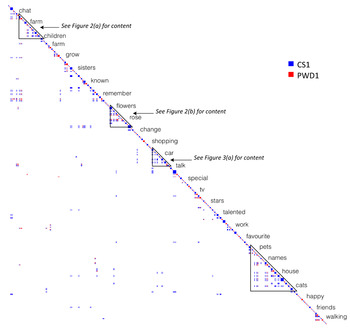
Discursis software (Angus, Smith and Wiles Reference Angus, Smith and Wiles2012a, Reference Angus, Smith and Wiles2012b) is an automated information visualisation system that extracts and displays the main content of a conversation over its time-course. Using a conversation transcript as input, the term-based version of Discursis identifies and tags recurrence of individual words within the conversational turns. Discursis then generates an interactive visual representation of the input, showing the similarity in term use between turns at all time-points in the conversation (see Figure 1 for an example). This plot provides a global overview of both the structure and content of the conversation, the relative lengths of turns, and the degree of similarity between turns within and between speakers. Discursis also provides options for interaction with the plot at a local level, allowing closer examination of short blocks or single turns of interest within the conversation. For instance, patterns of engagement between speakers (i.e. blocks of turns with recurrence of terms used between speakers) can be identified and further analysed with respect to topics used or the communication behaviours that may underlie engagement (see Figure 2 for an example).
Discursis plot of Conversation 1, between care staff member CS1 and participant with dementia PWD1, where most talk (72%) was by CS1.

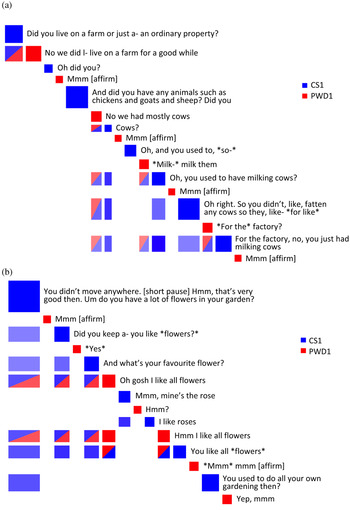
Zoom-in views of (a) ‘farm’ and (b) ‘flowers’ sequences from Conversation 1.

To date, Discursis has been successfully applied to the analysis of interview interactions within the fields of journalism and medicine (Angus, Smith and Wiles Reference Angus, Smith and Wiles2012a, Reference Angus, Smith and Wiles2012b). Angus, Smith and Wiles (Reference Angus, Smith and Wiles2012a) used Discursis to analyse television interview data, and interpreted the graphical output to identify communication patterns such as engagement around a topic and topic avoidance between the speakers. Angus et al. (Reference Angus, Watson, Smith, Gallois and Wiles2012) applied Discursis in a clinical setting, examining doctor–patient interactions, and were able to identify engagement patterns that corresponded with effective and ineffective consultations (in terms of diagnosis reached and patient satisfaction). Angus et al. (Reference Angus, Watson, Smith, Gallois and Wiles2012) went on to suggest that the Discursis visual displays of trainee doctors’ own consultations might be helpful for use in training to facilitate reflection on communication behaviour and its impact on consultation outcomes. The successful application of Discursis to the analysis of interview interactions demonstrates its utility to facilitate the inspection of the structure and content of interactions as a whole, the exploration of topics discussed, and the analysis of mechanisms underlying patterns of engagement between speakers, without separating the content from its communicative and temporal contexts. However, Discursis is yet to be applied to social conversation data, or interactions involving people with communication impairments. The current study will use Discursis to enable novel insights into interactive communication behaviours between staff and residents with dementia.
Study objectives
With the aid of Discursis conversation visualisation, this study sought to answer the following questions in relation to a set of individual care staff–resident conversations:
1. What overall patterns of contribution by the conversation participants are observed, and how do these different patterns of contribution affect the level of engagement a participant has in a conversation?
2. What communicative behaviours by care staff appear to facilitate (or impede) conversational contributions by participants with dementia?
Method
This study formed part of a larger project investigating memory and communication support strategies for use by care-givers of people with dementia (Broughton et al. Reference Broughton, Smith, Baker, Angwin, Pachana, Copland, Humphreys, Gallois, Byrne and Chenery2011; Liddle et al. Reference Liddle, Smith-Conway, Baker, Angwin, Gallois, Copland, Pachana, Humphreys, Byrne and Chenery2012). Data collection took place in June and October 2009, at the baseline stage of the larger project. Ethical approval was granted by The University of Queensland and by the service provider responsible for the participating care homes.
Participants
Participants were 20 residents with a diagnosis of dementia and 14 members of the care staff in three not-for-profit residential care homes in Queensland, Australia. The residents were recruited via the care home managers, who sent information to the families of potential participants. Written informed consent to participate was obtained from a legally authorised person, and the residents also gave assent on the day of data collection. The care staff members were volunteers who at a later stage received training in communication and memory support strategies.
The 20 participants with dementia (PWD) comprised 13 women and seven men, ranging in age from 72 to 94 years (mean 87.4 years, standard deviation (SD) 4.8). Specific diagnoses were available for only five of the PWD (four of vascular dementia and one of Alzheimer's Disease); for the remaining 15 PWD, the diagnosis was Dementia Not Otherwise Specified. Three PWD spoke English as a second language: one at a basic level, one at intermediate level and one at an advanced level. As part of the larger project, the 30-item Mini-Mental State Examination (MMSE; Folstein, Folstein and McHugh Reference Folstein, Folstein and McHugh1975) was administered to the participating residents on the same day, to indicate level of cognitive impairment. Using Mungas’ (Reference Mungas1991) MMSE score range interpretations, ten of the 20 PWD had severe cognitive impairment (score 0–9), nine moderate (score 10–20) and one mild (score 21–24).
The 14 participating care staff (CS) comprised 11 women and three men. Twelve were personal care or nursing assistants, one was a registered nurse and one was a diversional therapist. Only seven CS provided age data: of these, six were in their fifties or late forties, and one was in his early twenties.
Procedure
Data collection took place during visits by members of the research team to the participating care homes. For each dyad individually, and in a comfortable, familiar setting, either in the resident's room or in a lounge, a research assistant (RA) asked the CS and PWD to have a chat with each other for 10 minutes about anything they wished. The conversation was recorded using an Olympus DS-30 digital voice recorder placed near both participants. The PWD varied in how long they wished to continue, and the recordings obtained ranged in length from 5 minutes 4 seconds to 13 minutes 1 second (mean 9 minutes 4 seconds, SD 2 minutes 19 seconds). As recording was conducted in participants’ usual environment rather than in a test room, and the audio-recorder was unobtrusive, there were occasionally interjections from other people who did not realise that participants were being recorded for research. As there were more PWD than CS, two CS took part in two separate conversations, and a further two CS took part in three.
The audio recordings were transcribed into written text using a modified Jeffersonian transcription (see Atkinson and Heritage Reference Atkinson and Heritage1984). Notation relevant to the interpretation of the extracts discussed below was as follows. Overlapping speech was marked with asterisks, and by carets when overlaps were close together. False starts and word fragments or stutters were marked with a hyphen. Turns continuing over an utterance by the other speaker were marked with (=). Pause lengths were marked as short (1 second), medium (2–3 seconds), long (4 seconds) and extra-long (5 or more seconds). Where needed for disambiguation, utterances of ‘mmm’ were marked from intonation to show their function (e.g. affirm, filled pause). Non-verbal vocalisations such as laughter were also marked. Names were replaced with e.g. SONname, both to remove identifying information and to aid topic identification. The transcripts were also prepared for input to SALT (Systematic Analysis of Language Transcripts) Research Version (Miller and Iglesias Reference Miller and Iglesias2010).
Analysis
SALT
The following SALT discourse summary measures were obtained for each participant in each conversation: the total number of complete words (excluding fragments), and the mean length of turn in words excluding mazes (defined as false starts, filled pauses such as ‘umm’, and word or sentence fragments that were revisions or reformulations of the utterance).
Discursis analysis and interpretation
Discursis analyses are typically restricted to showing the recurrence of semantically meaningful words. Before processing of transcript data begins, the user selects or specifies a list of ‘stopwords’ that are not included in the words identified for analysis; depending on the purpose of the analysis, this would often be words that do not directly contribute meaning, such as articles, pronouns, prepositions and auxiliary verbs. For the current analysis the stopwords specified included grammatical words and frequent responses such as mmm, oh, and variants of yes and no. We aimed to retain as much lexical content as possible, but initial trials showed that common words with multiple uses gave rise to spurious connections between utterances, and so some were added to the stopwords. Examples were ‘good’ (e.g. ‘We did live on the farm for a good while’; ‘Oh that's good then’) and ‘like’ (e.g. ‘You didn't, like, fatten any cows?’; ‘I like roses’). For each transcript, up to 200 terms were identified and analysed, as this number was found to result in optimal inclusion of content across the range of lexical richness in the transcripts.
With respect to interpreting the graphical output (see Figure 1 for an example), each turn in the conversation is represented by a block, colour-coded by speaker, proceeding from top left to bottom right along the diagonal. The size of each block is proportional to the total word length of the turn (counting all words). To the left of the diagonal are additional blocks representing the recurrence of words (excluding stopwords) across turns, plotted to show the other turn(s) with which they share content, and shaded according to the degree of similarity between the turns. Single-colour blocks represent recurrence of a speaker's own content, whereas two-colour blocks represent recurrence between speakers, with the colour of the upper portion of the block indicating which speaker initiated the content. As can also be seen from Figure 1, there is an option to display a series of ‘theme’ words extracted at selected intervals from the input transcript to provide an indication of the thematic content over the course of the conversation. Although these were not necessarily the topic words that a human analyst would extract, they nevertheless gave an indication of the themes arising in the conversation. For the current analysis, the maximum number of theme words was selected for printing on each plot. Where words initially extracted were not sufficiently informative (e.g. ‘little’ from ‘We'll have a little chat’), they were suppressed and automatically replaced.
Results
Based on the SALT discourse summary statistics, the conversations formed three broad categories in terms of the relative contributions in words of the two participants. In ten of the 20 conversations, the CS talked considerably more than the PWD, with CS contributing 70–84 per cent of the total words. In a further five conversations, the talk was more shared between the two participants, with CS contributing 46–65 per cent of the words. In the remaining five conversations, PWD talked noticeably more than CS; in these cases, CS produced only 33–40 per cent of the words.
We present Discursis graphic displays for three whole conversations representing these categories. In Conversation 1 most of the talk was by CS, in Conversation 2 it was relatively shared between CS and PWD, and in Conversation 3 most of the talk was by PWD. For each of these, we describe the global patterns of contribution and content, with reference to whole-conversation plots, and then zoom in on local patterns of communication behaviour. We also present related extracts from four other conversations (Conversations 4–7). All participants in the cases presented spoke English as a first language except for CS4, and all CS were personal care or nursing assistants.
Conversation category 1: most talk by CS
The Discursis plot in Figure 1 represents a conversation lasting 7 minutes 27 seconds between a female CS (CS1) and a female PWD aged 92 years (PWD1) with moderate cognitive impairment (MMSE 15). In this conversation, CS1 contributed 72 per cent of the total words, and PWD1 28 per cent. The mean turn length (excluding mazes) was 7.4 words for CS1 and 2.6 words for PWD1.
The blue and red blocks along the diagonal in Figure 1 represent, from top left to bottom right, each conversational turn by CS1 and PWD1, respectively. The relatively large blue blocks, compared with the red ones, reflect longer turns by CS1 than by PWD1. The coloured blocks to the left of the diagonal represent recurrences of terms. For Conversation 1 as a whole, these blocks are predominantly blue, indicating that most recurrence of content came from CS1.
A noticeable pattern in this plot, and also in other cases where CS spoke most, was the series of triangular clusters of blocks directly off the diagonal. These triangles, four of which are marked in Figure 1, represent the recurrence of terms within local sequences of turns. At the apex of each triangle is the block representing the turn in which the word was first mentioned; it is thus visible from Figure 1 that CS1 initiated all of these sequences (these starter blocks being blue). The colours of the blocks within these triangular clusters indicate which participant(s) repeated the word(s) that recurred. The top three triangles marked in Figure 1, which represent sequences on the themes of ‘farm’, ‘flowers’ and ‘car’, embodied three different engagement patterns, as can be seen by zooming in on each of these in turn (Figures 2a, b and 3a).
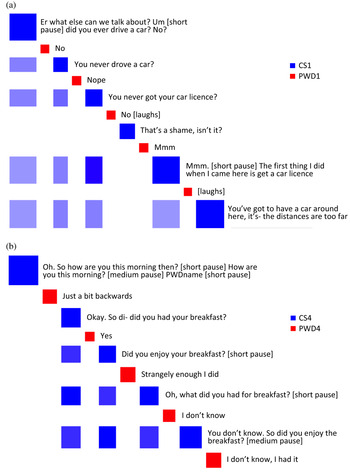
Zoom-in views of (a) ‘car’ sequence from Conversation 1 and (b) ‘breakfast’ sequence from Conversation 4.

In the farm sequence in Figure 2a, both participants contributed new information to the topic. Having first established the name of the place where PWD1 used to live, CS1 initiated this sequence with an alternative question, asking whether she had lived on a farm or in an ordinary property. PWD1 responded using one of the alternatives (farm), hence the combined blue/red block next to the second turn, indicating recurrence of CS1-initiated content. After acknowledging this response, CS1 continued the topic by asking a question about animals and suggesting several possible responses (chickens, goats, sheep). PWD1 responded with a new animal term, ‘cows’, and the red block representing this first mention heads its own triangular cluster of blocks reflecting subsequent engagement of the participants around this PWD1-initiated subtopic. The red/blue ordering within the combined blocks in this cluster shows that all subsequent recurrence was of new terms initially contributed by PWD1 (milk, factory, cows). Thus the overall combination of blue and red in Figure 2a reflects an engagement pattern where CS1 introduced a topic and then maintained it by taking up new content contributed by PWD1. Within this semantic field, PWD1 not only displayed successful word retrieval but also repaired CS1's false starts and incomplete sentences by supplying the words ‘milk’ and ‘factory’. Overall, the farm topic was sustained for 30 turns, as CS1 immediately resumed it after finding out that PWD1 had no children (see the theme words in Figure 1).
In the flower sequence in Figure 2b, PWD1's turns contained recurrence of content introduced by CS1, but no novel content. The question with which CS1 introduced this new topic was phrased in a somewhat unclear present-tense form, in view of PWD1's current care home setting (‘Um do you have a lot of flowers in your garden?’). PWD1 gave minimal affirmative responses to this and to CS1's subsequent yes–no question containing a reformulation. When asked for her favourite flower, PWD1's response was appropriate but not specific (‘Oh gosh I like all flowers’), and although the pattern of blue and red blocks reflects some engagement around this topic, closer inspection reveals that topic development was driven solely by CS1 (indicated by the blue/red ordering in the combined blocks). PWD1's turns brought in no new terms, but just two mentions of liking flowers, which CS1 had already introduced. Thus the flower topic yielded less contribution by PWD1 than the farm topic, and was sustained over fewer turns (14), and the favourite flower mentioned by CS1 did not prompt any flower name retrieval by PWD1. A similar pattern of contributions was observed in the sequence about pets, which is represented in the bottom triangle marked on Figure 1. At 28 turns, this was one of the longest maintained topics in the conversation. However, apart from a first mention of dogs by PWD1, all new content about pets was contributed by CS1, and PWD1 either used the same terms in responding to CS1's questions and comments, or responded minimally with yes, no or mmm.
A third pattern of contributions within the triangular clusters is seen in the car sequence in Figure 3a, where the blocks off the diagonal are all blue, indicating that all recurrence was self-repetition by CS1. Here, PWD1 gave minimal responses and used no content words at all. The topic of driving was unrelated to any preceding content, and CS1's first turn in this sequence signalled not only a change of topic but also responsibility for trying to sustain the conversation (‘Er what else can we talk about?’). When it transpired that driving was not part of PWD1's experience, CS1 continued the topic for a few more turns by using question forms requiring only confirmation by PWD1, and by offering some personal and general information that did not require any particular response. PWD1 was therefore able to maintain appropriate turn-taking in this 11-turn sequence while engaging only minimally with the topic.
Although CS1 set the agenda for this conversation, she displayed attentive listening and accommodation to PWD1. She took up any new content offered by PWD1, and where none was offered, or responses were minimal, she continued and rounded off each topic, to produce natural conversational sequences. She used self-disclosure (e.g. ‘I like roses’; ‘The first thing I did when I came here is get a car licence’) and general information to sustain the conversation when PWD1 gave non-specific or minimal responses, and her reflecting back of PWD1's meaning (e.g. ‘Oh, you used to have milking cows?’; ‘You never drove a car?’) showed interest, and enabled PWD1 to continue the exchange without needing to provide more information. The overall tone was that of an enjoyable conversation.
The zoom-in sequence about breakfast from Conversation 4, in Figure 3b, looks similar in structure to the car sequence in Figure 3a, but provides a contrasting example in terms of accommodation and management of the interaction. This conversation involved a female CS with an intermediate level of English as a second language (CS4), and a male resident (PWD4) aged 91 years with a MMSE score of 4 (suggesting severe cognitive impairment). In the sequence in Figure 3b, CS4 asked PWD4 two yes–no questions about breakfast, which he answered. She then asked what he had had for breakfast – a potentially difficult type of question for a person with dementia because of problems with recent memory. Having thus far asked a series of questions without reflecting back any of PWD4's responses, CS4 then reflected the one response that highlighted his memory difficulty (‘You don't know’). (This recurrence does not show in the coloured blocks because ‘know’ was a stopword.) CS4 immediately followed this with a repetition of one of the questions he had already answered, which appeared to lead to some confusion. The difference between the two extracts in Figure 3 thus illustrates the importance of the interactive exploration of patterns seen in the whole-conversation plot.
The most extreme case in terms of disparity in overall contributions was Conversation 6 (6 minutes 44 seconds), between a female CS aged 48 years (CS6) and a male resident aged 88 years (PWD6) with moderate cognitive impairment (MMSE 14). Here, 84 per cent of the words were spoken by CS6 and 16 per cent by PWD6, and their mean turn lengths differed by over 13 words (15.6 words for CS6 and 2.5 words for PWD6). The Discursis plot accordingly showed a string of very large blue blocks along the diagonal, with small red blocks in between. The blocks off the diagonal were extremely sparse, and mostly blue. The extract below illustrates how this pattern arose.
CS6: How was lunch?
PWD6: Good
CS6: What did you have?
PWD6: I ate it
CS6: You ate it? [short pause] And did you have a drink? [medium pause]
PWD6: I had
CS6: [interruption] I think there was some green cordial. [long pause] Did you enjoy the concert yesterday? [short pause] All the music, and the singing? [long pause] Hmm? [extra-long pause] What did you used to be PWDname? What was your job?
PWD6: Electrician
CS6: An electrician?
PWD6: Yeah
CS6: So you were a tradie? [short pause]
PWD6: No
CS6: [interruption] An electrician. *Did you en-*
PWD6: *I worked* [unintelligible]
CS6: Pardon?
PWD6: I worked for the Suppl- Suppl- Supply Authority
This extract again illustrates the difficulty of remembering an earlier meal. CS6 accommodated by accepting PWD6's response of ‘I ate it’, but then impeded his response to her next question by interrupting him with the suggested answer. She then tried unsuccessfully to engage him on the topic of yesterday's concert (perhaps because of difficulty with recent memory), before finding a topic that elicited an immediate response (his former job). Although the many pauses marked suggest that CS6 was aware of the need to allow extra response time, her tendency not to let PWD6 complete his turns persisted into the job topic, when she did not leave him time to elaborate on his work as an electrician, but began a further (abandoned) question about whether he enjoyed it. Although it may have been difficult to engage PWD6, this conversation left the impression that he could have contributed more if allowed considerably more time.
Conversation category 2: talk relatively shared
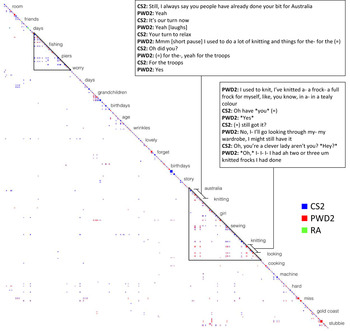
Figure 4 shows the Discursis plot for Conversation 2 (10 minutes 20 seconds), between a female CS aged 50 (CS2) and a female resident aged 84 (PWD2) with moderate cognitive impairment (MMSE 15). In Conversation 2 the contributions to the total words were 57 per cent by CS2 and 43 per cent by PWD2, and their mean length of utterance differed by less than two words (CS2 6.21 words, PWD2 4.26 words).
Discursis plot of Conversation 2, between care staff member CS2 and participant with dementia PWD2, where talk was relatively shared (57% by CS2). RA: research assistant.

This plot shows a relatively shared pattern of talk overall: the blue and red blocks along the diagonal are similar in size, and the blocks off the diagonal are a mixture of blue and red, indicating repetition of terms by both participants. The two turns by the research assistant (RA), shown near the beginning in green, occurred when CS2 asked her a question about the procedure.
Two triangular clusters of blocks are marked on Figure 4. Within these, the blocks formed longer vertical stripes than were seen in Conversation 1, reflecting the recurrence of content over longer topic sequences. The marked sequence on fishing, which spanned 38 turns, was initiated by CS2 in an indirect way using a rhetorical question that provided orientation to the topic, rather than by posing a sudden, direct question:
CS2: PWDName, do you know where I think we should be? I think we should be out fishing
PWD2: Yes
CS2: Do you agree?
PWD2: Yes, I used to do a lot of fishing at one time
CS2: I love fishing
PWD2: Yes
CS2: Do you like fishing too?
PWD2: Oh yes too
There was relatively little repetition of terms by PWD2 in the fishing sequence, but it represented an accommodative exchange. As the extract below shows, CS2 enabled PWD2 to express her intended meaning despite word retrieval difficulty, by making use of clues and checking her own understanding of these:
CS2: Did you used to go in a boat? [short pause]
PWD2: Hmm. [short pause] No, we on the shore [short pause]
CS2: On the shore
PWD2: No
CS2: On the *beach?*
PWD2: *No, on-* no on the um when you- you go right out in the
CS2: Oh, out in the ocean?
PWD2: No
CS2: On the piers?
PWD2: Pier
CS2: Right
PWD2: Walk out
The most striking example in Conversation 2, however, was a sequence about knitting and sewing which spanned 81 turns, and, as suggested by the predominance of red blocks within the marked triangle, included a high level of participation by PWD2. The beginning of this sequence, printed in the upper box in Figure 4, shows that the topic of knitting was in fact initiated by PWD2 in response to a general remark by CS2 about the older generation's contribution to Australia. Thus, rather than setting the agenda throughout, CS2 provided an opportunity for PWD2 to draw from her available repertoire of memories. As the extract printed in the lower box in Figure 4 shows, quite detailed information emerged spontaneously, such as the colour of a dress that she had knitted (‘a tealy colour’). During this long sequence, a brief enquiry by CS2 (‘Any sewing?’) prompted PWD2 to recount that she had been a sewing teacher for ‘Stubbie’ shorts (an iconic Australian clothing brand). She returned to this topic at the end of the conversation, in a turn (represented by the large red block) that was indicative of her current memory problems:
PWD2: Yes, um. [short pause] Now I'm just trying to think what it was I used to teach. [short pause] Isn't it terrible? My memory's fading. [short pause] I was a teacher for something, they used a- a- a machine, you know
CS2: Mmhmm
PWD2: Stubbie shorts and that, all that sort of thing
CS2: Oh, a sewing teacher?
PWD2: Yes, a sewing teacher
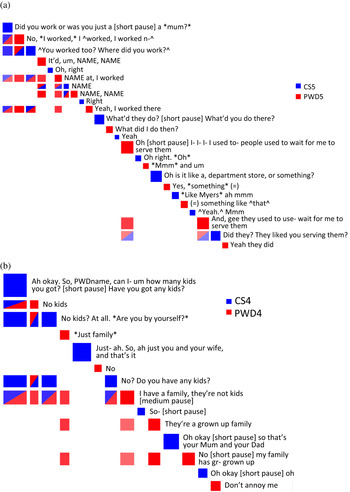
Figure 5a shows a related example from Conversation 5, between a male CS (CS5) and a female resident aged 93 (PWD5) with severe cognitive impairment (MMSE 6). In this sequence, the initial cluster of blocks reflects engagement around the topic of work (which CS5 introduced via an alternatives question), and then repetition of the name mentioned by PWD5 when asked where she worked. PWD5 under-accommodated by giving insufficient information, and the subsequent string of turns represents the process of CS5 seeking clues and deducing from her response about serving that she worked in a shop. He sensed her enjoyment of this memory (‘They liked you serving them?’), and although referring back to earlier topics was infrequent in the dataset as a whole, PWD5 later spontaneously returned to this theme with apparent pleasure.
Zoom-in views of (a) ‘work’ sequence from Conversation 5 and (b) ‘kids’ sequence from Conversation 4.

Figure 5b shows a contrasting example from Conversation 4 (from which the earlier example about breakfast came). The recurrence in this case was around the topic of kids and family, and although the sequence looks structurally quite similar to Figure 5a, it in fact represented a misunderstanding by CS4, and an effort by PWD4 to correct her. The problem appeared to originate through CS4 not understanding that PWD4 did not regard his adult children as kids, and when he explicitly stated that he had a grown-up family, she took this to mean his parents, despite the impossibility of a person aged over 90 years having living parents. This inadequate listening (or comprehension) on CS4's part resulted in an effortful and annoying exchange for PWD4, as indicated by PWD4's response to CS4 ‘Don't annoy me’. This pattern underlined the need for care staff to attend closely to residents’ meaning.
Conversation category 3: most talk by PWD
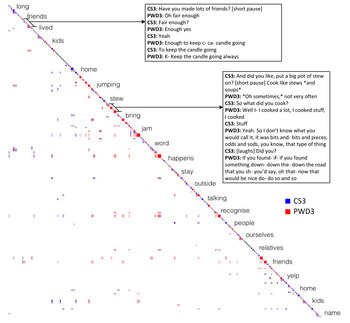
Figure 6 shows the Discursis plot for most of Conversation 3, in which PWD3 talked considerably more than CS3. The entire conversation lasted 11 minutes 20 seconds, but this included three interjections by others. Two of these are marked by black lines on the diagonal, and the transcript was cropped to remove the third one near the end. The portion shown in Figure 6 represents the 9 minutes 40 seconds retained. CS3 was a female care assistant and PWD3 a female resident aged 84, with severe cognitive impairment (MMSE 7). The mean length of utterance was shorter for CS3 (5.9 words) than for PWD3 (8.8 words), and the overall contribution in words was 39 per cent by CS3 and 61 per cent by PWD3.
Discursis plot of Conversation 3, between care staff member CS3 and participant with dementia PWD3, where most talk (61%) was by PWD3.

Overall, the plot for Conversation 3 in Figure 6 shows much larger red than blue blocks along the diagonal, reflecting longer turns by PWD3, and more red than blue blocks off the diagonal, though recurrence was sparse. In this conversation CS3 introduced topics by asking questions, and PWD3 tended to respond with long turns that were relevant but that contained many imprecise substitutions (‘I cooked stuff’) and formulaic language (‘bits and pieces, odds and sods’), as illustrated in the lower box in Figure 6. Thus, the filled triangular clusters seen in previous plots were not evident here, as PWD3 was not repeating many content words. There were, however, small pockets of recurrence, such as that relating to the upper box in Figure 6. Here also, PWD3 used formulaic language in her responses (‘fair enough’; ‘keep the candle going’), and CS3 accommodated by reflecting back these responses. This prompted a follow-up repetition by PWD3 in each case, thereby sustaining a conversational exchange despite the reduced informational content.
The most extreme case where PWD spoke more than CS was Conversation 7, involving a female PWD aged 84 (PWD7) and a female CS aged 52 (CS7). PWD7 was the only person in the sample whose MMSE score (21) suggested mild cognitive impairment, and she contributed 67 per cent of the words in the conversation. Her mean turn length was 11 words, compared with 4.9 words for CS7. The blocks along the diagonal of the Discursis plot showed that the participants’ turns were mostly similar in length, but that PWD7 had several noticeably longer ones. One in particular stood out, both for its length and for the concern she expressed about her apartment:
CS7: You're settled now, I think, aren't you?
PWD7: Oh God yes, *yes I have*
CS7: *Yeah yeah,* you're one of the family
PWD7: Yes, I haven't got a home
CS7: This is your home, *isn't it?*
PWD7: *Yes I know* but I-I said ‘What did you do with my unit?’ They said ‘It's been sold’ and I said ‘Did you drive d-did you four get a part of it?’ It was 80 dollars, I think, oh it- oh it was about 80. I- I was asking for 80 dollars, er 80 thousand I should say, and uh I said ‘What did you do with the money, love?’ And he said ‘I put it in your bank,’ and I said ‘Why didn't you split it up the four of you, you know, had your 20 dollars each?’ and he said ‘Mum, it's your property, and we've sold it’ (=)
CS7: *Yep*
PWD7: (=) *and* it's in your bank
This example highlighted the importance of having opportunities to chat with and express concerns to care staff other than just in passing. It also underscored the need for staff to have the skills for the therapeutic aspects of this role as well as the social one.
Discussion
The use of Discursis enabled efficient, automatic processing of the 20 conversation transcripts, and provided a readily interpretable visual representation of the overall amount of talk and content recurrence in each one, the relative contributions of the participants, topic structure, duration and themes, and turn-taking dynamics. It also permitted detailed, interactive inspection of local patterns identified in the overall graphic display, without separating the content from its communicative and temporal contexts. Overall, the interactive inspection highlighted key characteristics of topic management used by people with dementia and care staff, emphasised the importance of topic selection to the facilitation of participation by people with dementia in social conversation, and allowed the identification of accommodative strategies used by staff to support successful engagement with people with dementia.
The inspection of the overall plots and local patterns of recurrence enabled links to be made with studies of specific features of conversation and topic management in dementia. First, the overall sparseness of the Discursis plots in the current analysis, compared with previous investigations involving people without communication impairments (Angus, Smith and Wiles Reference Angus, Smith and Wiles2012a), reflects the reduced information content characteristic of speech in dementia, as well as reductions in responding and topic elaboration. The overall Discursis plots also highlighted a common communicative style used by care staff, namely a tendency to treat the conversation as an interview, in which they were responsible for the questions. As a result, conversations contained discrete series of frequent topic changes with short durations, rather than a connected flow. Mentis, Briggs-Whittaker and Gramigna (Reference Mentis, Briggs-Whittaker and Gramigna1995) reported similar patterns of topic change, and suggested that conversation partners of people with dementia took the role of topic manager in response to the passive style of topic maintenance used by the person with dementia. This pattern is linked to the production of fewer units of new information within a topic (topic elaboration) and an increase in repetition of old information (Mentis, Briggs-Whittaker and Gramigna Reference Mentis, Briggs-Whittaker and Gramigna1995). More recent investigations have similarly suggested that people with dementia had difficulty producing new information, but little difficulty remaining on topic (Rousseaux et al. Reference Rousseaux, Seve, Vallet, Pasquier and Mackowiak-Cordoliaani2010). The predominance of topic-maintaining utterances that did not contribute new information, but that did continue the topic, was evident in the local block patterns within ‘conversation category 1’ data, particularly as described for the ‘flower’, ‘pets’ and ‘cars’ sequences. However, not all topics elicited this pattern of recurrence; PWD1 contributed new information within the ‘farm’ sequence and PWD2 produced new information in the self-initiated ‘sewing’ topic, perhaps reflecting the salience of those topics for each individual and individual variation in communication style.
Individual variation in communication style between different people with dementia in the sample was reflected in the recurrence plots, whether this took the form of responding very briefly, or responding at length using a great deal of formulaic language. The differences in communicative styles between the people with dementia in this investigation did not appear to relate to the severity of cognitive impairments, as people with low MMSE scores were included in each conversation type. However, it is noted that the ‘more talk by PWD’ conversation type was the only group that included a person with a mild impairment. Additional contextual factors will also contribute to the amount of participation observed for each conversation partner; for example, the level of rapport and familiarity between conversation participants, the degree of communicative skill used by the staff member, and the premorbid conversational style of the person with dementia. On a clinical level, there is an emerging understanding of greater variability in conversation participation of people with dementia over the course of the disease (Hamilton Reference Hamilton1994), and between individuals, as described in this investigation and others (e.g. Muller and Guendouzi Reference Muller and Guendouzi2005). These findings can inform education for care staff, by highlighting the need to view people with dementia as individuals with different communicative strengths, and by emphasising that the selection of strategies to facilitate engagement with different people with dementia is very individual.
The graphic displays also helped to pinpoint topics that were particularly engaging and that prompted a flow of memories and information. It was noted throughout the processing of our dataset that many people with dementia, irrespective of the severity of their cognitive impairment, had topics that they were able to provide information and elaborate on, and occasionally return to at later stages of the conversation. These topics tended to be matters of particular personal relevance, such as former occupations (electrician, store work, sewing teacher) and meaningful activities (knitting for the troops) from earlier adulthood. In the dataset as a whole, topics relating to family members and earlier domestic life also often led to engagement. Topics concerned with general preferences (e.g. for colours, types of flower) and with what the person had eaten at the last meal yielded much less engagement, though demonstrated the preserved ability of people with dementia to contribute a turn without supplying the expected information.
The finding that topics relating to early life memories led to better participation and engagement for people with dementia, compared to information relating to the current day, is supported by experimental findings regarding the temporal gradient of autobiographical memories in dementia. Various reports have proposed that people with dementia are better at recalling memories from the distant past, such as childhood and early adulthood, compared to recent decades (e.g. Graham and Hodges Reference Graham and Hodges1997; Kopelman Reference Kopelman1989; Sagar et al. Reference Sagar, Cohen, Sullivan, Corkin and Growdon1988). Alternatively, but still in keeping with the current finding of the benefit of a personally relevant topic, Morris (Reference Morris1994) suggests that people with dementia are able to talk about memories from both early life and more recent times, because the early and later life-periods correspond to important life events, and it is the salience of the memories, rather than the temporal gradient, that determines the strength of recall.
Few investigations have explicitly identified topics that elicit engagement with people with dementia. This practical information has implications for care staff in practice; specifically, it has the potential to facilitate the social and personhood-enhancing environment within residential care. Firstly, given the difficulty that people with dementia have in initiating topics in conversation (Mentis, Briggs-Whittaker and Gramigna Reference Mentis, Briggs-Whittaker and Gramigna1995), it is often left to the staff member to initiate conversational topics; therefore it is important to be able to educate staff in topics or types of topics that will facilitate the most participation by a person with dementia. This type of practical information may give staff confidence to initiate conversation with residents, leading to increased social engagement during care, which is often lacking in residential care contexts (e.g. Ward et al. Reference Ward, Vass, Aggarwal, Garfield and Cybyk2008). Secondly, encouraging staff to tap into a person's life history during conversation can increase their understanding of the person as an individual with a life history, unique personality, knowledge and wisdom. This understanding is key to the provision of person-centred care, and will allow for enhanced personhood of the person with dementia (Brooker Reference Brooker2004).
The results have implications for the accommodative communication skills needed by care staff to foster participation by people with dementia in conversation. Paramount would be allowing residents sufficient processing and response time, to compensate for slowed cognitive processing; there were numerous examples throughout the dataset of overlaps where the staff member started speaking again too soon, when the person with dementia still had something to say. Listening with full attention is also imperative, both for the clues to meaning that need to be picked up and also to avoid unfortunate misunderstandings. Showing evidence of listening by reflecting back the meaning expressed, even if formulaic in nature, seemed to result in the dual benefits of acknowledging the person's contributions and providing opportunities for extra turns to maintain a pleasant exchange. Types of questions used can also facilitate participation by the person with dementia. Recurrence resulting from responses from people with dementia to questions where the possible alternatives were available from the question form (e.g. discussed by Small and Perry Reference Small and Perry2005) was also reflected. Attention was also drawn to a particularly long and fruitful sequence where the person with dementia's contributions resulted from an open-ended prompt which enabled her to select her own topic (Ramanathan Reference Ramanathan1997).
The information extracted via the Discursis analysis regarding conversation style and accommodative strategies has the potential to inform staff education. Extracts from the current data, with support from the visual displays reinforcing the types of engagement that occur, have the potential to be valuable training materials for care staff, as staff would be able to see a concrete representation of the impact of their communication behaviour on conversation participation of people with dementia. In addition, the use of visualisations of care-givers’ own conversations could be an even more powerful tool that encourages self-reflection, and facilitates the provision of direct feedback to staff. Previous research has used excerpts of transcripts to assist with staff learning (Williams, Kemper and Hummert Reference Williams, Kemper and Hummert2003); however, having both the words and a visual representation that can be easily interpreted at a gross level would provide additional opportunities to highlight for staff the impact that accommodative (or non-accommodative) conversational behaviour can have on the participation of a person with dementia.
A limitation of this study was that the conversations did not arise spontaneously, but took place at a set time with a relatively fixed time allocation. The persons with dementia no doubt varied in how well they knew (and could relate to) the particular staff member available to participate with them, and this may be reflected in the observed individual variation in conversation style. Although conversations could be terminated after less than ten minutes, most care staff tried to complete the time, and so this differed from the real-life setting, where other factors would determine the start and end of an interaction. It is also possible that the staff who agreed to be recorded for this study were those with confidence in their communication skills, and that those less comfortable with conversing with residents, or with lower levels of English proficiency, might have excluded themselves from the sample.
Unlike the study of doctor–patient consultations by Angus et al. (Reference Angus, Watson, Smith, Gallois and Wiles2012), we had no set outcomes that would define the success of the conversation, and no specific information the care staff needed to elicit. The goal was simply to engage with the people with dementia in a social interaction for its inherent benefits. We also did not have a direct measure of residents’ satisfaction with the conversations. However, different reactions could be heard in the recordings, such as a cheerful tone with laughter at times in Conversations 1, 3 and 5, and some irritation and frustration in Conversation 4, as evidenced by PWD4's clear statement of annoyance in the turn ‘Don't annoy me’. It should be noted, though, that there was variation within the conversations as to how smoothly the interaction proceeded in different parts, and so judgements of overall quality were not thought helpful. From the viewpoint of the person with dementia, it is possible that as long as the experience was not negative, the personal attention and interest from care staff, and the opportunity to retrieve memories and express concerns, would be beneficial in most cases.
Conclusion
The use of Discursis to facilitate visualisation of conversations between care staff and people with dementia provided insight into the conversation styles used by staff and people with dementia, and the types of topics that facilitate participation and elicit new information. It also helped to identify the strategies that staff are using to support the engagement of people with dementia. These insights provide a better understanding of social communication within the aged care context, and could be used clinically to inform education programmes for staff working with people with dementia in order to facilitate the social interactions within the residential aged care environment.
Acknowledgements
We are grateful to the managers, staff and residents of the participating care facilities. We also thank Megan Broughton, Kathryn Havas, Catherine Mak, Katharine Vearncombe and Polly Warburton for assistance with data collection and transcription, and Jacki Liddle for additional research assistance. This research was funded by J. O. & J. R. Wicking Trust (administered by ANZ Trustees) Project 2007002685; National Health & Medical Research Council Grant 511208; and Australian Research Council Thinking Systems Grant TS0669699. The funding bodies played no role in the design, execution, analysis, interpretation or writing of the study. The study was approved by The University of Queensland Behavioural and Social Sciences Ethical Review Committee (project number 2008000841) and by the Blue Care Human Research Ethics Committee (reference Baker 3008). The authors contributed as follows: Rosemary Baker: conception and design, analysis and interpretation, drafting article, approval; Daniel Angus: conception and design, analysis and interpretation, critical revision, approval; Erin Smith-Conway: conception and design, analysis and interpretation, critical revision, approval; Katharine Baker: analysis and interpretation, drafting article, approval; Cindy Gallois: conception and design, analysis and interpretation, critical revision, approval; Andrew Smith: conception and design, critical revision, approval; Janet Wiles: conception and design, critical revision, approval; Helen Chenery: conception and design, critical revision, approval. The authors have no conflict of interest to declare.