Introduction
There are no agreed upon serological or radiological criteria to determine the growth rate of vestibular schwannomas.Reference Henschen and Lundbourg1 This lack of predictability is even more pronounced in cases requiring longitudinal surveillance because of subtotal tumour resection (95 per cent of tumours resected, as verified by magnetic resonance imaging (MRI)).Reference Olivecrona2 Charabi et al. reported that vestibular schwannoma with high proliferative patterns on histopathological study had more rapidly developing symptoms when compared to tumours with low proliferative indices.Reference Charabi, Engel and Jacobsen3
The histopathological appearance of vestibular schwannoma is characterised by a combination of densely packed zones of elongated spindle cells and small densely staining elongated nuclei (Antoni A), mixed with zones of loosely packed, small vacuolated cells (Antoni B), hyaline thickening of blood vessel walls, perivascular hemosiderin deposits, and foci of palisading nuclei (Verocay bodies).Reference Rutka, Davidson, Tos and Thomsen4 Positive S-100 immunohistochemical staining is typical for well-differentiated Schwann cells.Reference Morris, Cotran, Kumar and Robbins5
Ki-67 immunohistochemical staining, which can be used to analyse vestibular schwannoma growth, utilises a monoclonal antibody to rapidly evaluate the growth fraction of normal and neoplastic human cell populations.Reference Gerdes, Lemke, Baisch and Wacker6,Reference Baserga7 Ki-67 is an antigen present in the second half of the G1 phase of the cell cycle, and stains more intensely during the S (synthesis), G2 and M (mitosis) cell cycle phases. It has not been found in the G0 and early G1 phases.
The Ki-67 index is estimated as the percentage of stained cell nuclei (marked antigen Ki-67) among all nuclei visible per high power field. The current standard of acceptance holds that dysplasia generally falls below a 3 per cent maximal Ki-67 index, and neoplasia is above 3 per cent.Reference McKeever, Venneti and Dabbs8 Using Ki-67 staining, the proliferation potential can be measured. We hypothesised that the Ki-67 index is associated with recurrence of vestibular schwannoma.
Materials and methods
A retrospective cohort study was conducted of 141 consecutive patients who underwent total or subtotal resection of a vestibular schwannoma, between 2007 and 2017, at our tertiary skull base centre. Subtotal resections were performed when the risk to the facial nerve was thought to be higher with complete resection. None of the patients in the study had undergone pre-operative radiotherapy for their tumours.
Ki-67 staining was performed on all vestibular schwannomas. Specimens were then divided into two groups according to Ki-67 activity: less than 3 per cent (low index), and 3 per cent or greater (elevated index). Data on age, sex, gross total resection versus subtotal resection, and greatest tumour dimension (measured via MRI) were also included as baseline demographics.
All patients were followed radiographically with MRI annually, to determine the presence of recurrence and to monitor for growth in tumours requiring subtotal resection. This human subject study protocol was approved by Providence Health and Science Institutional Review Board committee (approval code: STUDY2017000590).
Bivariate analysis was performed to compare the two Ki-67 exposure groups (in terms of percentages), with respect to age, sex, total resection, subtotal resection, greatest tumour dimension and recurrence. For categorical variables, frequency counts were computed and presented along with their percentages. For continuous variables, means were computed and presented along with their standard deviations. The chi-square test was used to compare categorical variables. For continuous outcomes, a t-test was used. Statistical significance was set at the p < 0.05 level.
In light of the difference in Ki-67 groups, and the fact that risk of recurrence may be confounded by other factors that were unevenly distributed between groups, we sought to perform a multivariable analysis using only those outcomes that were approaching statistical significance in the bivariate analysis (p < 0.10). We included the primary exposure variable (Ki-67 high vs low) and all baseline factors in the multivariable model. Only those variables where p < 0.05 were considered statistically significant; however, variables that ‘approached’ significance (p < 0.15) were included in the final models, to get as precise an estimate of the effect of Ki-67 percentage as possible (in case of some confounding). We tested all variables for collinearity; when there was a high level of collinearity, we chose the most clinically relevant variable to include in the model.
Results
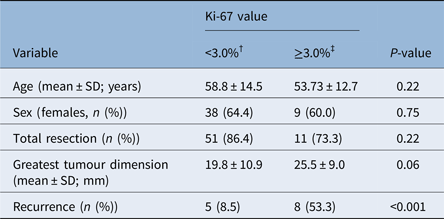
Among the 141 patients who met the study criteria, 74 (52 per cent) had documented follow-up data and were included in this analysis. Among these, 15 had elevated Ki-67 values (3.0 per cent or more) and 59 had low Ki-67 values (less than 3.0 per cent). In patients with elevated Ki-67 values, 8 (53.3 per cent) had recurrence or regrowth, versus 5 (8.5 per cent) in the low Ki-67 group (Table 1). The other baseline factors were fairly evenly distributed between exposure groups. The most recent average follow-up MRI was conducted at 29.2 and 24 months for the elevated and low index groups respectively.
Measured study variables by Ki-67 threshold*

* Total n = 74
†n = 59
‡n = 15. SD = standard deviation
The bivariate analysis revealed that greatest tumour dimension was highly correlated with subtotal resection. Given this collinearity, we chose to model greatest tumour dimension rather than subtotal resection, as subtotal resection is more of a surrogate than an actual measurement.
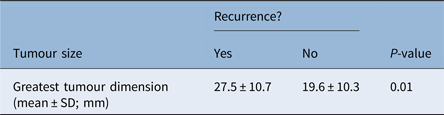
Patients with larger tumours had a higher chance of recurrence (p = 0.0147). The mean greatest tumour dimension was 27.46 mm for patients with recurrence and was 19.55 mm for those without recurrence (Table 2). Patients with higher Ki-67 values tended to have larger tumour dimensions, but this finding was not statistically significant. The mean greatest tumour dimension was 25.53 mm for patients with elevated Ki-67 values and was 19.78 mm for those with low Ki-67 values (p = 0.06) (Table 3).
Tumour size and relationship to schwannoma recurrence

SD = standard deviation
Tumour size and relationship to Ki-67 value

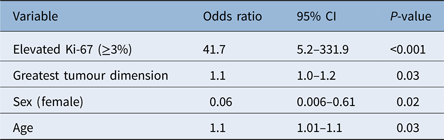
In the final multivariable model, patients in the elevated Ki-67 group had over a 40 times chance (odds ratio = 41.7; 95 per cent confidence interval = 5.2–331.8; p < 0.001) of experiencing a recurrence or regrowth compared to those in the low Ki-67 group, adjusting for age, sex and greatest tumour dimension. Older age and female gender were associated with a greater likelihood of recurrence. Every 1 mm increase in greatest tumour dimension was associated with a 1.1 greater chance of recurrence (Table 4).
Results of multivariable logistic regression analysis, estimating effect of elevated Ki-67 on schwannoma recurrence*

* Controlling for greatest tumour dimension, sex and age. CI = confidence interval
Discussion
There is currently no single accepted biological marker to predict regrowth or recurrence in vestibular schwannoma patients who undergo gross total or subtotal resection. The clinical growth rate of vestibular schwannomas has been correlated, such that 60 per cent are in the very slow to no growth group, 30 per cent are in the 0.2 cm/year group, and 10 per cent are in the 1.0 cm/year group.Reference Lesser, Janzer, Kleihues and Fisch9
Bedavanija et al. showed that large vestibular schwannomas exhibit enhanced proliferative activity (greater than 2.5 per cent) and show higher growth rates than smaller tumours.Reference Bedavanija, Brieger, Lehr, Maurer and Mann10 Patients with tumours larger than 1.8 cm in diameter and who are younger than 50 years of age have an enhanced risk for fast-growing tumours because of the lesions’ enhanced proliferative activity.Reference Bedavanija, Brieger, Lehr, Maurer and Mann10 Szeremeta et al. demonstrated that there may be three distinct tumour cell proliferation rates within vestibular schwannomas.Reference Szeremeta, Monsell, Rock and Caccamo11 They found that tumour growth is not homogeneous within a tumour, and proliferation may be more active near the surface. Light et al. suggested that vestibular schwannomas with elevated mitotic activity should be designated as atypical vestibular schwannoma.Reference Light, Roland, Fishman, Miller and Cohen12
Yokoyama et al. reviewed vestibular schwannoma regrowth in 16 patients and found that tumours with more than 2 per cent Ki-67 labelling index had a significant difference in tumour doubling time.Reference Yokoyama, Matsudam, Nakasu, Nakajima and Handa13 Malignant brain tumours have elevated Ki-67 labelling indexes ranging from 6 to 56.9 per cent.Reference Tsanaclis14 Ki-67 expression is used to evaluate other tumours of the central nervous system. Pituitary adenomas that infiltrated the dura were found to have a higher Ki-67 index compared to those that did not.Reference Paek, Kim, Song and Choi15
The residual vestibular schwannoma in patients who had undergone near total resection versus subtotal resection showed a regrowth incidence of 0.0–3.5 per cent versus 18.4–73.9 per cent respectively.Reference Chen, Prasad and Di Lella16–Reference El-Kashlan, Zeitoun and Arts24 Our review showed that there is an extremely high odds ratio of recurrence for subtotal excision and those with Ki-67 values greater than 3 per cent. In our study, vestibular schwannoma patients with Ki-67 values greater than 3 per cent had a greater chance of recurrence. Those who had recurrence were less likely to have undergone total resection and had elevated Ki-67 values. Kazimierz et al. found that vestibular schwannoma patients with a stable growth pattern had a Ki-67 index of 1.11 per cent; the Ki-67 index in those with growing tumours was 3.17 per cent.Reference Kazimierz, Vaneecloo, Lecomte, Lejeune, Lemaitre and Skarzyński25
The greatest limitation in this study was the number of patients lost to clinical follow up. Seventy-four of 141 patients had documentation of the presence of recurrence or regrowth; it could not be confirmed as to whether the remaining 67 patients experienced a recurrence. Sixty-three (52 per cent) of those lost to follow up were from the low Ki-67 group and four (21 per cent) were from the elevated Ki-67 group. We infer that the majority of those lost to follow up live in distant locations and received their follow-up imaging at an outside centre. We could not verify radiological results in those patients. We speculate that the majority of those in the low Ki-67 group did not experience a recurrence or regrowth, and were less likely to have undergone subsequent MRI imaging. Regardless of the very high odds ratios for both Ki-67 and resection, the confidence intervals were very wide.
• Ki-67 is a monoclonal antibody that provides a means of evaluating the growth fraction of normal and neoplastic human cell populations
• A Ki-67 index of less than 3 per cent is expected for a typical schwannoma
• Vestibular schwannomas with an index of greater than 3 per cent are presumed to be actively proliferating and pose a theoretically higher risk for regrowth or recurrence
• Ki-67 labelling index reliably identifies vestibular schwannomas with elevated potential for recurrence or regrowth in subtotal or total resection cases
• In patients with a Ki-67 index of greater than 3 per cent, more frequent clinical examination and radiological follow up are recommended
In this retrospective cohort study, with a level of evidence of 3, Ki-67 labelling index reliably predicted vestibular schwannomas with an elevated potential for regrowth or recurrence in subtotal or total resection cases. In patients with a Ki-67 index of greater than 3 per cent, we recommend more frequent clinical examination and radiological follow up.
Competing interests
None declared