Introduction
Overlying the Pierre Shale and underlying the delta plain deposits of the Hell Creek Formation (Sheridan Delta), the Fox Hills Formation is the youngest Mesozoic marine unit in the central Western Interior Seaway (WIS) of North America. The Late Cretaceous (late Maastrichtian) Fox Hills Formation in North Dakota and South Dakota (Fig. 1.1) has long been noted for a remarkable diversity of invertebrates that spanned a range of habitats from open marine to brackish-water estuarine or lagoonal (Meek and Hayden, Reference Meek and Hayden1856a, Reference Meek and Haydenb, Reference Meek and Haydenc; Meek, Reference Meek and Hayden1876; Waage, Reference Waage1968; Speden, Reference Speden1970; Erickson, Reference Erickson1974, Reference Erickson, Erickson and Hoganson1992; Feldmann and Palubniak, Reference Feldmann, Palubniak and Caldwell1975; Bouchard et al., Reference Bouchard, Erickson and Hoganson2002; Hoganson and Erickson, Reference Hoganson and Erickson2005). Many of these habitats have now been verified geochemically as well as sedimentologically (Carpenter et al., Reference Carpenter, Erickson and Hoganson2002, Reference Carpenter, Erickson and Holland2003; Cochran et al., Reference Cochran, Landman, Turekian, Michard and Schrag2003; Petersen et al., Reference Petersen, Tabor, Lohmann, Poulsen, Meyer, Carpenter, Erickson, Matsunaga, Smith and Sheldon2016; Landman et al., Reference Landman, Grier, Cockran, Grier, Petersen and Towbin2018). One of the most difficult paleoenvironmental-paleogeomorphic settings to interpret, however, is the intertidal condition. Rocks that demonstrate presence of an intertidal deposetting are rare.
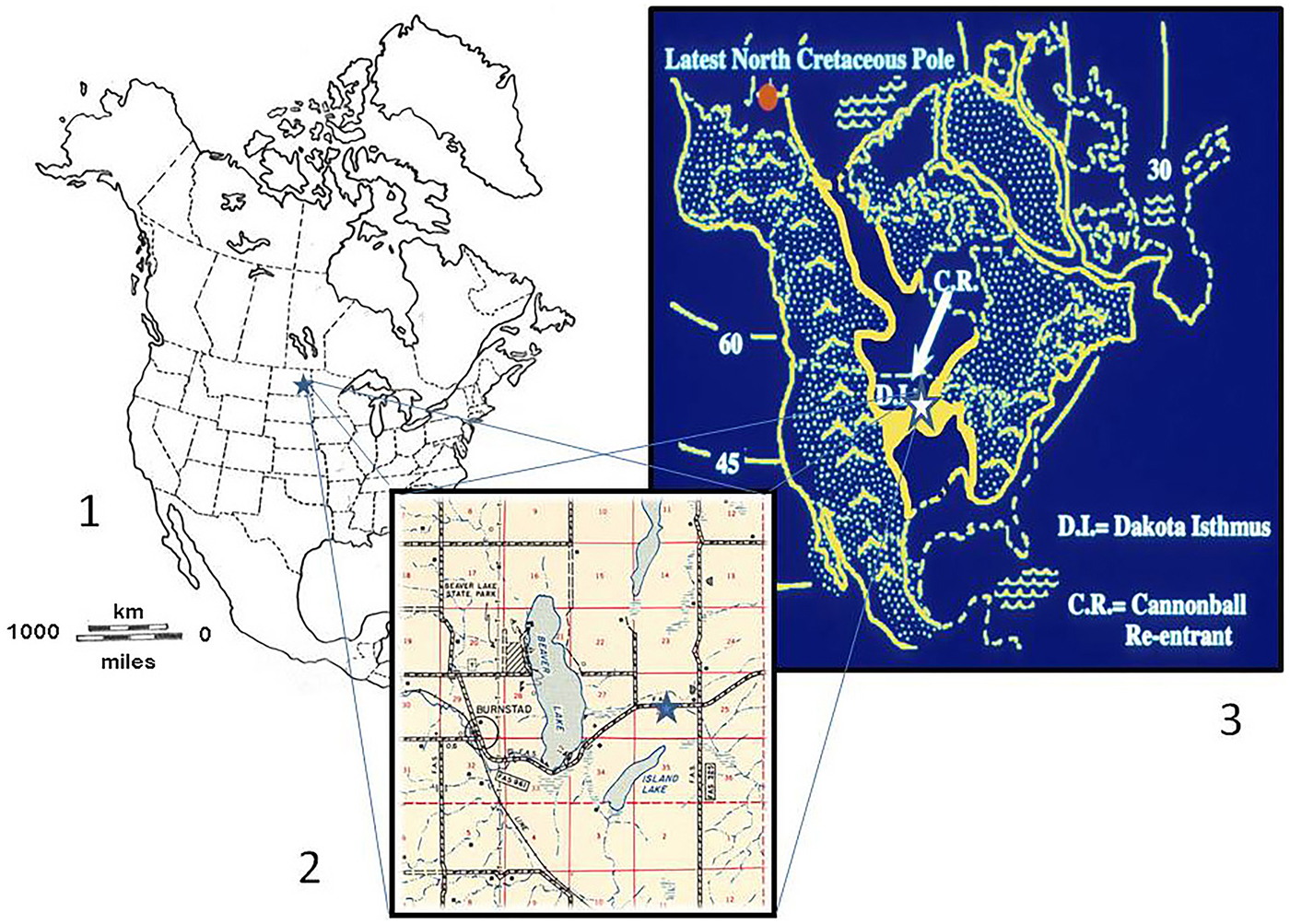
Location maps related to type locality of Neritoptyx hogansoni n. sp. from North Dakota, USA. (1) Outline map of North America and Greenland with star marking type locality in North Dakota; (2) detail of the type locality taken from the general highway map of Logan County, North Dakota, for 1967, with star marking collecting site (North Dakota State Highway Department, 1967), (sections are 1 mile square); (3) collecting site (star) superimposed on schematic, Late Cretaceous paleogeographic map taken from initial illustration of the Dakota Isthmus (DI) in the WIS, modified from Erickson (Reference Erickson1978).

Today, Hell Creek deltaic sediments have been removed from the eastern margin of the Western Interior Seaway (WIS) by post-Mesozoic erosion. Defining as precisely as possible when the intertidal condition developed on the eastern-most margin of the Sheridan Delta is the most pragmatic means of interpreting closure of the seaway. Demonstrating that an intertidal deposetting existed in south-central North Dakota by the late Maastrichtian greatly strengthens inference for the completion of the Dakota Isthmus. Therefore, description of a new species of intertidal gastropod has broad implications for understanding WIS coastal paleogeography and late Maastrichtian paleoceanography before the Chixalub event and Cretaceous-Paleogene (K-Pg) boundary.
Dakota Isthmus deposetting
The lower portion of the Fox Hills Formation contains molluscan faunas that are fully marine and occur in beds that show offshore and barrier island shoreface sedimentary structures (Bailey and Erickson, Reference Bailey and Erickson1973; Chayes and Erickson, Reference Chayes and Erickson1973). Waage (Reference Waage1968) and Feldmann (Reference Feldmann1972) each documented this shallowing-upward transition represented by the Trail City and Timber Lake members.
The formation and its geologic history become more complicated in the upper two members, the Iron Lightning and Linton, interpreted as lagoonal and estuarine deposits, which stratigraphically overly the Timber Lake shoreface sandstones (Feldmann, Reference Feldmann1972). They contain invertebrate faunas recognized both taxonomically and geochemically as freshwater or brackish water species as well as floral elements that include terrestrial and freshwater forms (Waage, Reference Waage1968; Feldmann, Reference Feldmann1972; Feldmann and Palubniak, Reference Feldmann, Palubniak and Caldwell1975; Erickson, Reference Erickson, Erickson and Hoganson1992; Bouchard et al., Reference Bouchard, Erickson and Hoganson2002; Carpenter et al., Reference Carpenter, Erickson and Hoganson2002, Reference Carpenter, Erickson and Holland2003; Peppe and Erickson, Reference Peppe and Erickson2002; Hoganson and Erickson, Reference Hoganson and Erickson2005; Peterson et al., Reference Petersen, Tabor, Lohmann, Poulsen, Meyer, Carpenter, Erickson, Matsunaga, Smith and Sheldon2016). The site of the present study (Fig. 1.2) lies 50 km to the east (distal) of both the present limits of the upper Fox Hills members and the overlying Hell Creek deltaic beds, including its lateral marine tongues the Breien and Cantapeta members in the Hell Creek Formation in North Dakota (Laird and Mitchell, Reference Laird and Mitchell1942; Hoganson and Murphy, Reference Hoganson, Murphy, Hartman, Johnson and Nichols2002), in the Missouri Valley.
A marine-to-freshwater faunal transition has been recognized in the midcontinent since Meek and Hayden (Reference Meek and Hayden1856a, Reference Meek and Haydenb, Reference Meek and Haydenc) defined the Late Cretaceous Western Interior stratigraphy in 1856, and it was once the source of considerable dispute regarding placement of both the Fox Hills–Hell Creek lithostratigraphic contacts and the chronostratigraphic K-Pg boundary (Murphy et al., Reference Murphy, Nichols, Hoganson and Forsman1995, Reference Murphy, Hoganson, Johnson, Hartman, Johnson and Nichols2002; Hartman, Reference Hartman, Hartman, Johnson and Nichols2002; Hartman et al., Reference Hartman, Butler, Weiler, Schumacker, Wilson, Clemmens, Horner and Hartman2014). Gill and Cobban (Reference Gill and Cobban1973) explained much of the complexity by demonstrating that withdrawal of the Maastrichtian Fox Hills Sea and exceptional sediment volumes stimulated a rapid, eastward progradation of the Sheridan Delta represented in North Dakota and South Dakota by those same Hell Creek Formation fluvial and lacustrine beds. Murphy et al. (Reference Murphy, Nichols, Hoganson and Forsman1995) have clarified Hell Creek stratigraphy and the location of the K-Pg boundary in the Missouri Valley of central North Dakota, which marks the eastern erosional limit of the formation. Somewhere to the east of that region the first closure of the WIS occurred (Fig. 1.3) when the eastern margin of the Sheridan Delta prograded against the structurally positive Sioux Arch, producing a feature described as the Dakota Isthmus by Erickson (Reference Erickson1978, Reference Erickson and Hartman1999). This Fox Hills/Hell Creek deltaic deposystem possessed a morphologically complicated coastline of bars, bays, estuaries, and major distributary channels.
Paleontologically, this complexity was emphasized by the intermingling of marine, estuarine, and terrestrial fossils in upper Fox Hills strata. Presence of the marine limulid, Casterolimulus kletti Holland, Erickson, and O'Brien, Reference Holland, Erickson and O'Brien1975, in the estuarine, uppermost member of the Fox Hills Formation (Klett and Erickson, Reference Klett and Erickson1976) in association with a well-preserved flora of dicots and some freshwater aquatic plant taxa (Holland et al., Reference Holland, Erickson and O'Brien1975; Peppe and Erickson, Reference Peppe and Erickson2002) and Champsosaurus laramiensis (Hoganson et al., Reference Hoganson, Erickson, Holland, Martin and Hoganson2007) indicates proximity of the marine habitat to an otherwise estuarine setting in the Missouri Valley. Numerous molluscan taxa also provide evidence of estuarine or brackish-water conditions (Hartman and Kirkland, Reference Hartman, Kirkland, Hartman, Johnson and Nichols2002), but east of the erosional limit, absolute proximity to intertidal zone deposition has not yet been demonstrated. Although the principle of parsimony suggests that the Dakota Isthmus was constrained by the structurally high Sioux Arch during Fox Hills time, the stratigraphic proof of this has been removed by both fluvial and glacial erosion during the Cenozoic (Witzke et al., Reference Witzke, Ludvigson, Poppe, Ravn, Reynolds and Dolly1983). Eastward from the Hell Creek limit, proof of the proximity of a coastal/terrestrial setting relies upon establishing faunal evidence that demonstrates existence of a Fox Hills tidal flat or peritidal conditions. The site from which Neritoptyx hogansoni n. sp. originated (Fig. 1) is potentially such a site (Erickson, Reference Erickson1974, Reference Erickson, Erickson and Hoganson1992; Feldmann and Palubniak, Reference Feldmann, Palubniak and Caldwell1975). The objective of this paper is to provide that evidence by describing a new intertidal or peritidal snail.
Materials and methods
Specimens discussed herein were collected over a 45-year period by both surface gleaning and excavation at a single, small roadcut exposure (Fig. 1) located in Logan County, North Dakota. It was first investigated by Feldmann (Reference Feldmann1972) in the mid 1960s and later by the author in 1969, during field study of Fox Hills Formation gastropods (Erickson, Reference Erickson1974). Subsequent visits to the outcrop by Erickson and St. Lawrence University students in 1972 and 1973 yielded additional gastropod species, including the first specimens of the species described here. In 1993, 1995, and 1997, JME, J.W. Hoganson, and F.D. Holland Jr. conducted extensive, gridded excavation and sieving of sediment. Large volumes of sieved material were returned to the Johnsrud Paleontology Laboratory at the North Dakota Heritage Center (State Museum) in Bismarck, North Dakota, where it was hand picked under magnification over a period of six years. Collections were made under permit to J.W. Hoganson, then North Dakota State Paleontologist.
In May of 2018, the writer revisited the locality after 20 years of absence. The graveled road has been ‘improved’ by straightening, widening, incising to remove a slight elevation, and paving. The outcrop was destroyed during this process of highway development. Collections noted in the preceding are now the only record of this significant site. Figure 1.2 indicates where the site was located during the years of collection.
Repositories and institutional abbreviations
Both invertebrate and vertebrate material was collected and now resides in the North Dakota State Fossil Collection at the North Dakota Heritage Center, Bismarck, ND. Type material for this study is housed in that collection and is listed with a North Dakota Geological Survey (NDGS) state fossil catalog number (ND).
Systematic paleontology
Phylum Mollusca Linnaeus, Reference Linnaeus1758
Class Gastropoda Cuvier, Reference Cuvier1797
Subclass Neritimorpha Golikov and Starobogatov, Reference Golikov and Starobogatov1975
Order Cycloneritida Bouchet and Rocroi in Bouchet et al., Reference Bouchet, Rocroi, Hausdorf, Kaim, Kano, Nützel, Parkhaev, Schrödl and Strong2017
Superfamily Neritoidea Rafinesque, Reference Rafinesque1815
Family Neritidae Rafinesque, Reference Rafinesque1815
Genus Neritoptyx Oppenheim, 1892
Type species
Nerita goldfussi Keferstein, Reference Keferstein1829 (non Zekeli, Reference Zekeli1852) by original designation (Oppenheim, Reference Oppenheim1892, p. 773, pl. 36, fig. 5). Gosau Formation of Austria (Bandel and Kiel, Reference Bandel and Kiel2003).
Diagnosis
Shell smooth with collabral growth lines, becoming ornamented with spiral cords by the third whorl; inner lip with one strong, posterior denticle set off from zero to five subequal denticles; outer lip without denticles.
Occurrence
Nerita (=Neritoptyx) goldfussi Keferstein, Reference Keferstein1829, the type species of Neritoptyx was described from the Austrian, Late Cretaceous Gosau Formation. Species are recognized from France, Austria, Germany, Spain, California, the Campanian Owl Creek Formation of Mississippi, and late Campanian and early Maastrichtian Ripley Formation of Tennessee (de Montfort, Reference de Montfort1810; Keferstein, Reference Keferstein1829; Vidal, Reference Vidal1917; Cossmann, Reference Cossmann1925; Dockery, Reference Dockery1993; Kowalke and Bandel, Reference Kowalke and Bandel1996; Bandel and Kiel, Reference Bandel and Kiel2003). Late Maastrichtian N. hogansoni n. sp. is the youngest member of the genus yet recorded.
Remarks
Six genera of Neritidae are believed to be represented in rocks of Late Cretaceous age globally (Bandel and Kiel, Reference Bandel and Kiel2003). These include Mesoneritina, Schwardtina, Otostoma, Neritoplica, Neritoptyx, and Nerita. This is a reduced number because several neritid genera have been synonymized in recent years. Corsania, an Old World taxon, and its recognized subgenera C. (Corsania) and C. (Januncia) (Woods and Saul, Reference Woods and Saul1986) as well as Nerita (Bajanerita) (Squires Reference Squires1993) have been synonymized with Otostomia and Neritoplica, respectively, as discussed by Bandel and Kiel (Reference Bandel and Kiel2003) and Kiel and Aranda-Manteca (Reference Kiel and Aranda-Manteca2002).
A key to genera of the Neritimorpha accompanying the description of seven new species by Bandel and Kiel (Reference Bandel and Kiel2003) seems less able to distinguish between genera than one might wish in this complicated clade, which has evolved similar morphologies among its numerous species several times since the Jurassic (Quintero-Galvis et al., Reference Quintero-Galvis and Castro2013). Applying the key to assign the genus, four genera are eliminated based on absence of strong axial ornament, smooth inner lip, or flared, Hydrobia-like aperture, leaving assignment of the new taxon between Nerita and Neritoptyx. Although the new species has multiple teeth on the inner (columellar) lip as in Nerita, the posterior tooth is clearly the strongest and is set off from the lesser denticles by a gap indentation (for opercular muscle accommodation) of the lip as in Neritoptyx (Reference Bailey and EricksonFigs. 2, Reference Bandel3). Furthermore, the early shell is smooth; cords only develop late in the ontogeny of the new species as in Neritoptyx, to which the new species is assigned. The emended diagnosis follows the treatment of Bandel and Kiel (Reference Bandel and Kiel2003) for spirally sculptured neritid shells.
Bandel and Kiel (Reference Bandel and Kiel2003) noted that both Wenz (Reference Wenz and Schindewolf1938) and Cossmann (Reference Cossmann1925) considered the type species of Neritoptyx, Nerita goldfussi, to belong to Neritopsis, which would place the present genus in the Neritopsidae. However, Kowalke and Bandel (Reference Kowalke and Bandel1996) pointed out that Neritoptyx goldfussi dissolved the interior walls of the spire, thus placing it in the Neritidae (see also Scheltema, Reference Scheltema1971). It is noted that in computer-based taxonomic references such as the Paleobiology Database, Neritoptyx is listed in the Neritopsidae, contrary to this present morphological understanding of the genus; the same familial assignment is made in the GBIF Database although the status of the genus is given as ‘doubtful’ in this iteration.
Neritoptyx hogansoni new species
Figures 2–4
1975 Oligoptycha? concinna (Hall and Meek, Reference Hall and Meek1856) Feldmann and Palubniak, p. 229, pl. 1, fig. 15.
Types
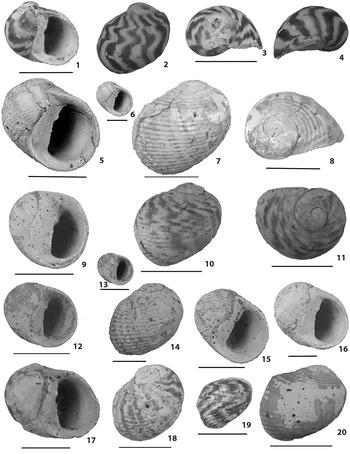
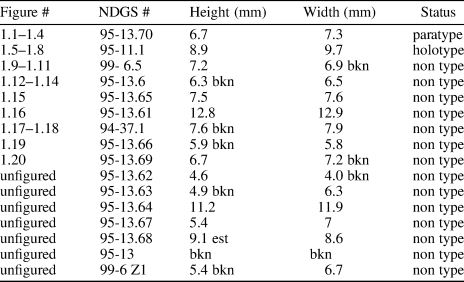
Sixteen specimens constitute the studied material (Table 1). All 13 specimens of the type series are housed in the North Dakota State Fossil Collection in the Heritage Center, Bismarck, North Dakota. The collection is curated by North Dakota Geological Survey staff. The holotype is ND 95-11.1 (Fig. 2.5–2.8). Illustrated paratypes include ND 95-13.70 (Fig. 2.1–2.4), ND 99-6.5 (Fig 2.9–2.11), ND 95-13.60 (Fig. 2.12–2.14), ND 95-13.65 (Fig. 2.15), ND 95-13.61 (Fig. 2.16), ND 94-37.1 (Fig. 2.17, 2.18), ND 13.66 (Fig. 2.19), ND 95-13.69 (Fig. 2.20). Unillustrated paratypes are ND 95-13.62, ND 95-13.63, ND 95-13.4, ND 95-13.67. Three additional unfigured specimens are listed in Table 1 but are not part of the type series.
Neritoptyx hogansoni n. sp. (1) Apertural, (2) abapertural, (3) spiral, and (4) umbilical views of pigment (= color?) patterned, juvenile smooth paratype ND 95-13.70; (3, 4) showing initiation of spiral ornament. (5–8) Views of the holotype, ND 95-11.1, a repaired specimen that shows well-preserved parietal shelf with columellar denticles and strong spiral ornamentation on mature specimen; (5) apertural view showing position of large posterior denticle relative to smaller anterior denticles; (6) apertural view of holotype approximately twice natural size; (7) abapertural view of holotype illustrating spiral ornament and shape of posterior slope (= ramp) and well-preserved spire; (8) posterior view of holotype spire showing protoconch and juvenile (smooth) shell transitioning to spiral cord ornament. (9–11) Apertural, abapertural, and spiral views of mature paratype, ND 99-6.5, illustrating pigment pattern on shell with spiral cord transition completed but without development of a strong shoulder; (9) apertural view illustrating complete parietal callus (deck) and denticles; (10) abapertural view illustrating transition from zig-zag to weakly collabral color bands as cord ornament strengthens; (11) ornament and pattern transition in posterior (spiral) view. (12–14) Paratype, ND 95-13.60; (12, 13) apertural views of specimen with somewhat worn inner and outer lips and ornament of smooth, fine, collabral growth lines before transition; (14) abapertural view, posttransition, illustrating small size at which ornament of cords begins. (15) ND 95-13.65 paratype, apertural view of specimen with poorly developed denticles. (16) ND 95-13.61 apertural view of paratype and largest specimen. (17, 18) ND 94-37.1 paratype, slightly decorticated shell with mature pigment pattern of straighter bands on worn, corded shell. (19) Abapertural view of ND 95-13.66 illustrating transition from smooth to spiral ornament on specimen with strongly patterned shell. (20) Abapertural view of ND 95-13.69, paratype, a mature specimen with corded ornament and lack of pigment banding; a strong shoulder is developed on last whorl of this partly decorticated specimen. Scale bars = 5 mm. Scale bars for 1.1 and 1.3 apply also to 1.2 and 1.4, respectively.

Data for figured and unfigured specimens of Neritoptyx hogansoni n. sp. studied. NDGS # = North Dakota Geological Survey state fossil catalog number; bkn = broken specimen.

All specimens are from NDGS L140 (Fig. 1.2), a north-facing road cut at the center, Sec. 26, T. 134 N., R. 71 W., Logan County, North Dakota, USA, which constitutes the type locality.
Diagnosis
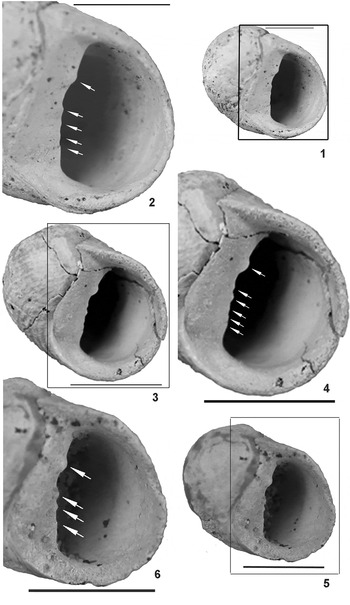
Neritoptyx of 3.5 whorls expanding at average rate for genus; larval shell of 1.5 nearly planispiral, unpatterned whorls; juvenile conch smooth, transitioning to spirally ornamented with approximately 27 rounded cords on an adult shell of 3.25 whorls; ramp flat, gently sloping; shoulder rounded (juvenile?) becoming subangular (mature?); parietal shelf flat, calloused, well developed; columella bearing one strong denticle (posterior-most) separated from variably four, occasionally five, evenly distributed, weak denticles by proportionately larger, excavated space (Fig. 3); outer lip smooth, subovate, nonflaring; pigment (color) pattern, when preserved, zig-zag on younger shells becoming somewhat axial as ornament transitions from smooth to spiral (Fig. 4).
Characteristics of the apertural region of Neritoptyx hogansoni n. sp. (1) Index view of ND 95-13.61, the largest paratype; (2) aperture of ND 95-13.61 enlarged to illustrate five subtle denticles of inner lip marked by arrows on this gerontic specimen, posterior–most is largest, separated from rest by indentation in columella; (3) index view of holotype, ND 95-11.1, demonstrating repaired fractures; (4) arrows indicate locations of six denticles on inner lip of deck and ridge formed where apertural wall merges with callus of inner lip, which defines the margins of missing operculum; (5) paratype, ND 94-37.1, with index frame in apertural view; (6) apertural details of ND 94-37.1, an eroded specimen, with arrows indicating locations of four denticles on inner lip, a fifth, anterior-most denticle is very subdued and is not arrowed. Scale bars = 5 mm.

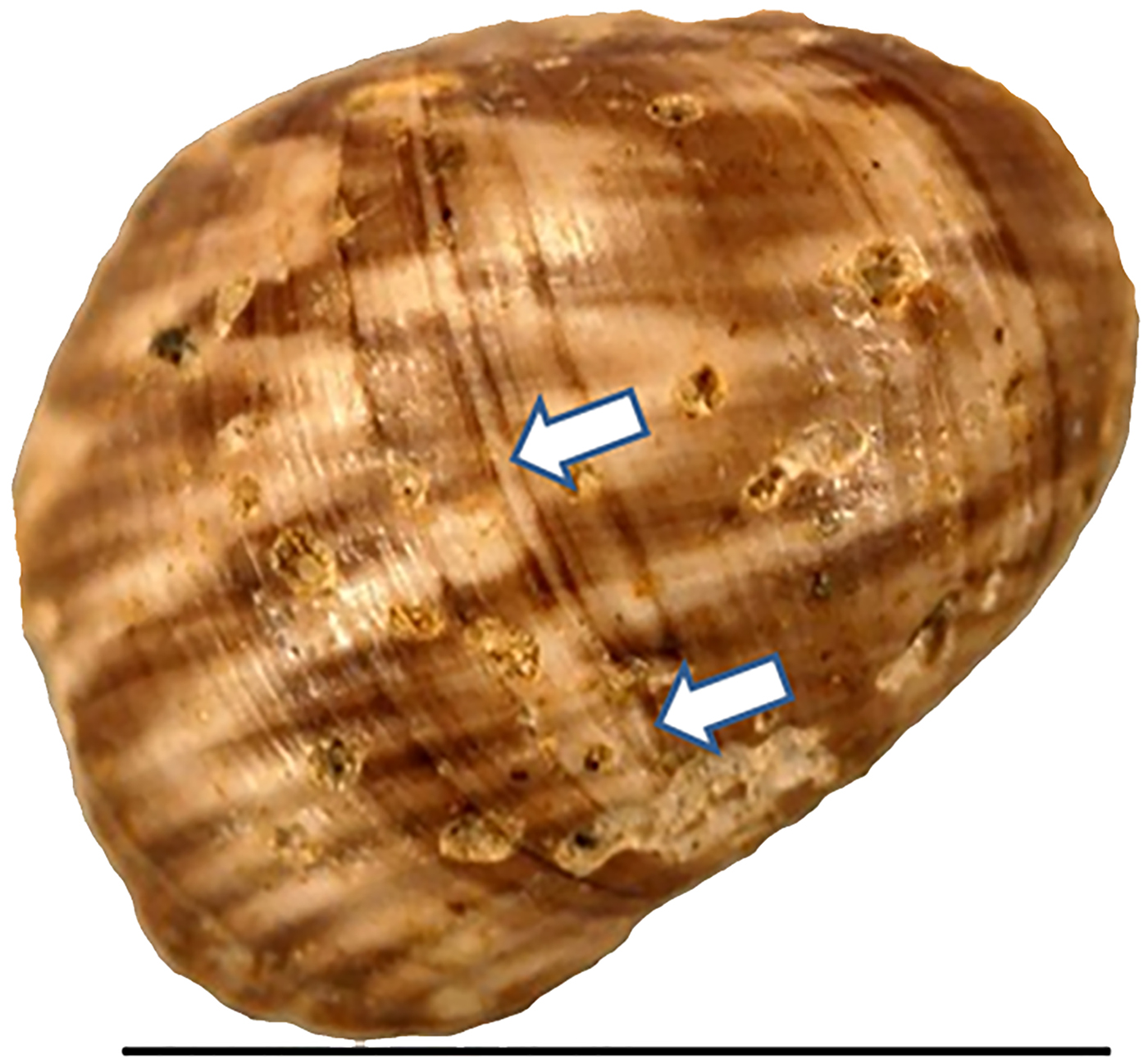
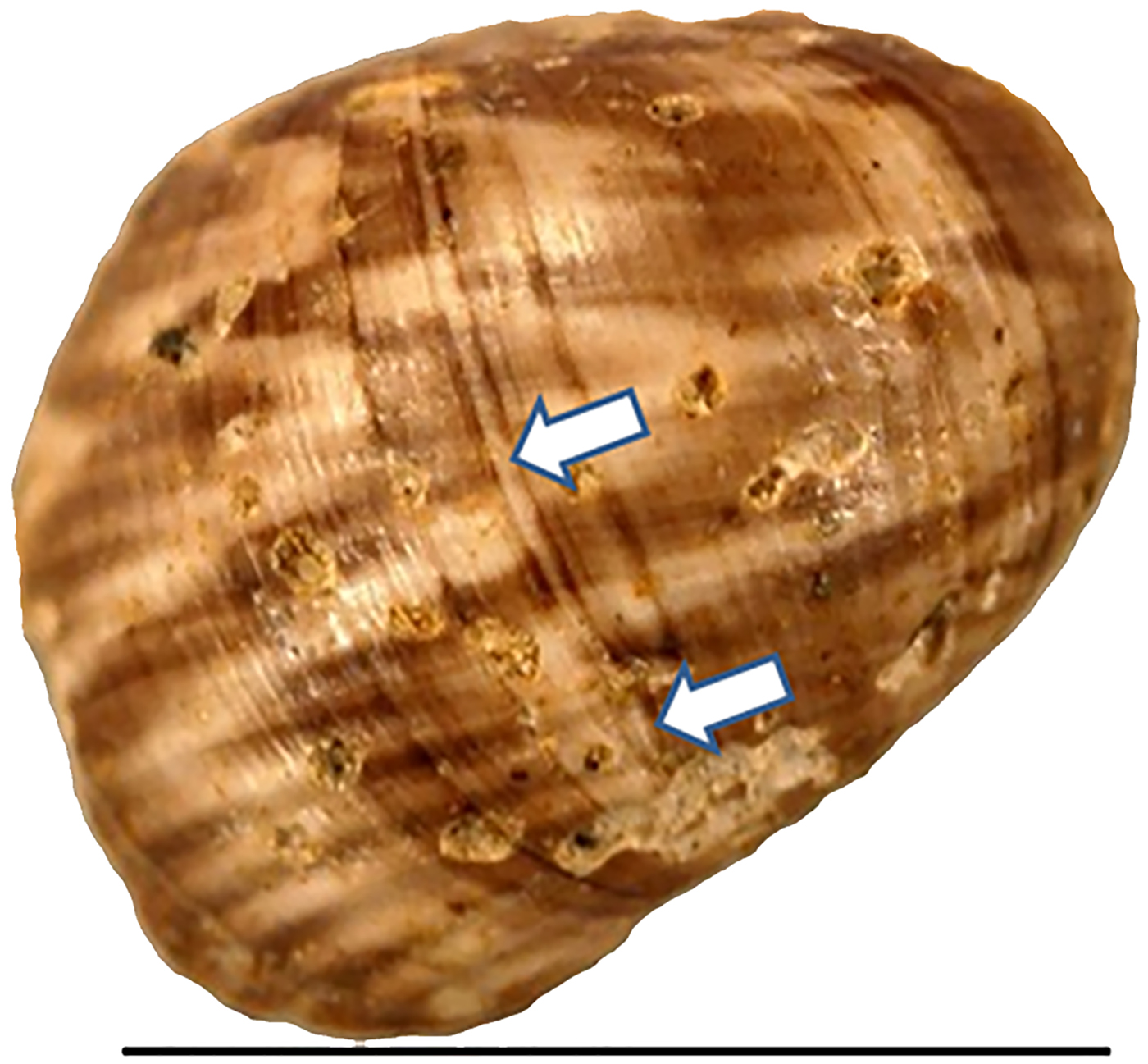
Neritoptyx hogansoni n. sp. View of paratype, ND 95-13.66, enlarged to illustrate conditions of shell morphology and pigment pattern at the transition from smooth to corded ornament with beginning of the transition marked by arrows at collabral growth line. Cords appear first near anterior of shell and are developed toward the posterior as the conch is produced. Scale bar = 5 mm.
Occurrence
Neritoptyx hogansoni n. sp. is known from a single outcrop where it occurred with a mixed fauna of estuarine and marine fossils in the upper Timber Lake Member (Feldmann and Palubniak, Reference Feldmann, Palubniak and Caldwell1975) of the Fox Hills Formation in south-central North Dakota. The unit is late Maastrichtian in age. At the site, which is one of the eastern-most exposures of the formation, the Fox Hills is a medium to fine, friable, marine sandstone that overlies the Pierre Shale and underlies the terrestrial Hell Creek Formation, which is the youngest Cretaceous unit in the Williston Basin. Molluscan taxa occurring with it included the gastropods Neritina (= Neritoplica) loganensis Erickson, Reference Erickson1974, Euspira obliquata (Hall and Meek, Reference Hall and Meek1856), Piestochilus feldmanni Erickson, Reference Erickson1974, Pachymelania wyomingensis, (Meek, Reference Meek1873), P. insculpta, (Meek, Reference Meek1873), Rhombopsis subturritus,(Meek and Hayden, Reference Meek and Hayden1857), Acmaea sp., and Amuletum sp., and bivalves Crassostrea subtrigonalis (Evans and Shumard, Reference Evans and Shumard1857), Anomia gryphorhycha Meek, Reference Meek1873, Tancredia americana (Meek and Hayden, Reference Meek and Hayden1856b), , Panopea occidentalis, Meek and Hayden, Reference Meek and Hayden1856b, Crassatellina hollandi Feldmann and Kammer,Reference Feldmann and Kammer1976, Corbicula spp., Dosiniopsis deweyi (Meek and Hayden, Reference Meek and Hayden1856a) Cymbophora warrenana (Meek and Hayden, 1865b), and Nucula sp.
Description
These are typical neritiform gastropods of small to medium size; the largest studied specimen (Fig. 2.16) is 12.8 mm high and 12.9 mm wide. Undamaged, mature specimens normally slightly wider than high; younger specimens nearly equidimensional (Table 1). Number of cords varies during growth of the shell; young (immature?) specimens are smooth, obvious transition to spiral; corded ornament begins when shell reaches 4 to 4.5 mm width; cords appear earliest at anterior and posterior apertural margins and increase in number to cover the shell as growth continues (Fig. 2.3, 2.10, 2.18, 2.19). This ‘transition’ is recognized as an allometric change in the shell margin (see Figs. 2.4, 2.19, 4.1). As transition progresses, a shoulder develops on posterior slope of body whorl (Fig. 2.7, 2.8, 2.20). Posttransition cord count is 17 to 19, a number that increases as growth continues, reaching a maximum of 27 cords on the largest specimens seen.
Neritoptyx hogansoni n. sp. possessed a pigment (color?) pattern of strong, zig-zag bars on juvenile shells (Fig. 2.1–2.4, 2.10, 2.11, 2.18, 2.19). At the transition from smooth to corded ornament, a change began from zig-zag to somewhat more axial pigmented bars of the type seen on the holotype (Fig. 2.7) and paratype ND 94-37.1 (Fig. 2.18). It is assumed that pigmented lines represent original colored patterns on N. hogansoni. Three unillustrated paratypes (ND 95-13.62, ND 95-13.63, and ND 95-13.67) also show such patterns but have broken apertures or other damage (Table 1).
The spire is elevated and is capped by a protoconch of 1.5 whorls, which is flat. Teleoconch is produced by rapid streptospiral expansion of the aperture having posterior margin sutured to previous whorl exposing a small fraction of that whorl (Fig. 2.2, 2.7, 2.10, 2.14) but resorbing interior portion. A slightly curved posterior shoulder on whorl 2 gradually becomes a flatter ramp by whorl 3, and an angular shoulder (Fig. 2.7, 2.20) is produced after approximately 3.25 whorls as part of this allometric maturational change.
Aperture somewhat D-shaped but modified in posterior corner of the inner lip near where largest of the columellar denticles is present (Figs. 2.9, 2.12, 2.16, 3.1–3.6). Outer lip smooth, whereas the inner lip possesses five or six weak denticles of which the posterior-most is roughly twice as large as the next largest, that one being approximately central on the inner lip (Fig. 3). Inner lip (parietal) callus is flat. Anterior and posterior margins of the aperture create a rim that, in the case of the anterior margin, borders a thickened shelf extension of the inner lip (parietal) callus that housed the operculum when the animal was emerged in life (Fig. 3.1–3.4). This morphology is well defined on the holotype (Fig. 3.3, 3.4).
Etymology
The trivial name honors Dr. John W. Hoganson, State Paleontologist Emeritus of North Dakota, who has greatly advanced the public understanding of both fossils and the geologic history of life throughout the state of North Dakota.
Materials
Sixteen specimens collected between 1972 and 1999. Holotype ND 95-11.1 (Fig. 2.5–2.8) is a repaired specimen preserving a very weak pigmented pattern and displaying all characters of the mature shell. Paratypes include a range of sizes and degrees of maturity. Measurements of studied material are presented in Table 1. Preservation is quite variable and includes nearly pristine specimens that demonstrate color patterns of axial bands and zig-zag lines as illustrated in Figure 2.1, 2.10, 2.18, and 2.19 and discussed further in the following. Protoconchs are poorly preserved.
No opercula have been discovered after sieving hundreds of kilograms of associated sediment, leading to belief that the operculum, which is indicated by the shelf margins on the inner lip, was probably corneous and flexible or, at best, corneous with a thin, inner, calcareous layer as is most common in Neritimorpha (Bandel, Reference Bandel2008). Flexibility is inferred from the lack of denticles on the outer lip, allowing the operculum to be withdrawn variable distances into the shell so that it fitted as tightly to the outer wall as the animal's safety required. It is possible that these specimens have been transported and thus separated from their opercula, and their taphonomy suggests this possibility as discussed in the following, but given the amount and diversity of millimeter-sized fragments we sorted, nonpreservation of opercula seems most likely.
Remarks
The Late Cretaceous was a time of global diversification of the Neritoidea. At least four invasions of brackish and freshwater habitats by neritids took place during the Mesozoic, with the marine Neritoplica giving rise to brackish Neritina during the Maastrichtian (Bandel and Kiel, Reference Bandel and Kiel2003). Neritoptyx remained a fully marine genus throughout the Cretaceous and is not known in the Paleogene. Both marine taxa occur in the Fox Hills at this locality, but a portion of the associated fauna is distinctly estuarine based on the presence of dense populations of Crassostrea subtrigonalis.
Erickson (Reference Erickson1974) described Neritina loganensis, and considered it a brackish-water species, from the same site as the present material. Bandel and Kiel (Reference Bandel and Kiel2003) reassigned Neritina loganensis to Neritoplica, to which it has some resemblance as a smooth, high-spired neritid, but teeth of N. loganensis are better developed and do not wrap around the columella (Bandel and Kiel, Reference Bandel and Kiel2003, p. 61), and its sutures are not impressed as in most Neritoplica species, so perhaps that assignment needs to be further evaluated. Until that time, however, I follow Bandel and Kiel (Reference Bandel and Kiel2003). Neritoplica loganensis (Erickson, Reference Erickson1974), is a smooth form, quite distinct from the present species.
Nerita reticulirata Dockery, Reference Dockery1993, from the Campanian Coffee Sand of Mississippi, was reassigned to Neritoptyx by Bandel and Kiel (Reference Bandel and Kiel2003) based on its single columellar tooth and the presence of two smooth teleoconch whorls before ornament transitions to spiral cords. Neritoptyx reticulirata differs from N. hogansoni by having a more rapidly expanding, flaring last whorl, smooth shoulder, and a single tooth that is more central on the columellar lip.
Nerita? minnesotensis Bergquist, Reference Bergquist1944, was described from a small group of molds collected from the matrix of a conglomerate in the Coleraine Formation of the Iron Ranges region of Minnesota. Geographically, this is the nearest occurrence of a neritid to the Fox Hills location, albeit from an older rock unit, and notwithstanding the Neritoplica loganensis from this same locality as Neritoptyx hogansoni n. sp. Although the Coleraine material is not well preserved, the mold presents sufficient information that it should not be disregarded because the neritids have been used to infer bioprovincialism (Sohl, Reference Sohl1971; Kiel, Reference Kiel and Wagreich2002). Bergquist's (Reference Bergquist1944, pl. 11, figs. 12–14, 20, 21) illustrated material shows six parietal denticles represented by grooves on the molds as described by Bergquist. The largest specimen is 2.0 cm in diameter and 1.2 cm high. These are not conspecific with Neritoptyx hogansoni because the number of parietal teeth is more numerous on N.? minnesotensis and teeth are more evenly sized and distributed; shell sizes are larger and seem to have been much wider than high and more convolute as expressed by the molds. The description is thorough enough to confirm that Bergquist's species is a neritid, and likely a Nerita, but the genus should remain questionable until reexamined. It is noteworthy that a neritid was present in this Santonian (?) formation as will be discussed in the following.
Feldmann and Palubniak (Reference Feldmann, Palubniak and Caldwell1975) illustrated a suite of fossils collected at the present locality. Their specimen identified as Oligoptycha? concinna (p. 229, pl. 1, fig. 15) is not that opisthobranch, but is a partial specimen of Neritoptyx hogansoni.
Results
Sixteen Neritoptyx hogansoni n. sp. were studied for comparative morphology, taphonomic properties, ecological properties, and paleogeographic properties. Germaine observations and their implications for Late Cretaceous WIS conditions are discussed.
Table 1 records the size range of specimens that make up type and studied material that formed the basis for systematic description. Juvenile specimens are smooth; adult specimens possess spiral cords that cover the entire whorl, including the posterior slope. Consistent with Neritoptyx morphology, the columella has one large tooth and multiple denticles of lesser, varying strength. A parietal shelf and callus are evident, and the inner lip is smooth. These specimens would be considered on the cusp between small and medium size when compared with modern neritids (Eichhorst, Reference Eichhorst2016).
A significant property of these fossils is the presence of pigmented patterns on many of the shells, some strongly defined, others ranging to faintly preserved indications of pattern as illustrated on Figures 2 and 4. Pigment patterns are very rarely preserved on fossil gastropods; therefore, these are noteworthy. Neritids preserve such patterns more often than do other fossil snails. Designs of the patterns are zig-zag lines on smaller, smooth specimens and become more axial bands on larger specimens with spiral corded ornament. A transition between the two pigmentation patterns was observed as seen on Figure 4.
One specimen (ND 95-13.61) has two definite repair scars, possibly a third, midway around the last whorl. This is the largest specimen. Several specimens show broken apertures (Table 1) without stereotypical form to the breaks. Multiple specimens (Fig. 2.5, 2.9, 2.15–2.17) are abraded on the adapertural surface but not on any other surface of the shell. Protoconch and planispiral larval shell are somewhat eroded on all specimens.
The new neritid represents the twenty-sixth genus and the thirty-eighth species to be recorded from the Fox Hills Formation in North Dakota. This snail fauna is small when compared with Maastrichtian faunas of the Mississippi Embayment (Stephenson, Reference Stephenson1941; Sohl, Reference Sohl1964, Reference Sohl1971; Dockery, Reference Dockery1993) but is similar compared with the Red Bird fauna of the Pierre Shale and other Western Interior latest Cretaceous sites (Sohl, Reference Sohl1967a, Reference Sohl, Kauffman and Kentb; Slatterly et al., Reference Slatterly, Harries and Sandness2018).
Neritoptyx hogansoni n. sp. provides strong evidence that the ecologically mixed fauna in which it was found was deposited in a broad, shallow estuary having a definite intertidal zone. This setting would be the preferred habitat condition of modern Neritidae (Younge, Reference Younge and Moore1960; Abbott, Reference Abbott1974; Squires, Reference Squires1993; Eichhorst, Reference Eichhorst2016).
Biostratinomy
Paguroid occupation
Walker (Reference Walker1989, Reference Walker1995) described postmortem conditions of epibiont associations and of shell abrasion that demonstrate occupation of spent shells by hermit crabs in littoral conditions. Neither Neritoptyx hogansoni n. sp. nor the other gastropods present at this locality demonstrate significant epibiont activity that might be characteristic of pagurid presence, although scarce examples of both sponge and barnacle boring into Crassostrea subtrigonalis valves were noted by Feldmann and Palubniak (Reference Feldmann, Palubniak and Caldwell1975). However, Walker (Reference Walker1995) also noted that a pattern of abrasion on the adapertural side of hermit-occupied shells sometimes resulted from the occupant dragging the shell over the substrate in intertidal conditions. A very similar, consistently shaped pattern of abrasion appears on several of the specimens of Neritoptyx hogansoni present at this site (Fig. 2.5, 2.9, 2.12, 2.16, 2.17). Other surfaces (Fig. 2) show no similar abrasion, suggesting that it is confined to the adapertural side as Walker (Reference Walker1995, fig. 2) illustrated for drag marks due to abrasion from hermit crabs moving across tidal flats.
Hermit crabs (Paguroidea) may have transported shells of N. hogansoni short distances over the tidal flats and thereby separated them from their site of death. Opercula would have been left behind in this process, thus providing one possible reason for their absence from the sample site as previously noted. It seems unlikely that such transport would remove shells far enough from their life habitat to completely segregate them from opercula, yet no opercula of any type are preserved at the site.
Fossil members of the Paguroidea are rare, but they are known from rocks as old as Jurassic (Fraaije et al., Reference Fraaije, Krzemiński, van Bakel, Krzemiński and Jagt2012). Only four paguroid carapaces have been described from the Cretaceous (Fraaije et al., Reference Fraaije, Krzemiński, van Bakel, Jagt, Klompmaker and Artel2009). An investigation of all known decapod crustaceans of the Fox Hills Formation (Crawford et al., Reference Crawford, Feldmann, Waugh, Kelley and Allen2006) did not report paguroids from the formation. For that reason, it is important to recognize evidence that suggests they were once a part of the fauna.
Predation
Paratype ND 95-13.61, the largest specimen, shows that its aperture had been broken and repaired by new shell growth on two occasions prior to its eventual demise. For completeness of interpretation, it is notable that these breaks likely resulted from predation attempts by one of the decapod species such as the calappid crab Campylostoma siouxensis (Feldmann, Awotua, and Welshenbaugh, Reference Feldmann, Awotua and Welshenbaugh1976), reported as Necrocarcinus by Crawford et al. (Reference Crawford, Feldmann, Waugh, Kelley and Allen2006). Erickson and Jones (Reference Erickson and Jones.1998) demonstrated predation effects, both repair scars and fatal breaks, on numerous small naticid gastropod shells from the Fox Hills Formation, and it is reasonable to suggest that Neritoptyx hogansoni, being of similar size and shape, occasionally met, or evaded, the same fate.
Pigment patterns
The Fox Hills Formation has yielded some of the best-preserved marine Late Cretaceous material yet discovered, most of which is extracted from dense limestone and siltstone concretions, ammonites of which are world famous for their beautiful, unaltered, aragonitic nacre (Landman and Waage, Reference Landman and Waage1993). Bivalves and gastropods typically retain original aragonite as well, a preservation shown to have been the result of early sediment diagenesis (Carpenter et al., Reference Carpenter, Erickson, Lohmann and Owen1988). Some bivalves from concretions have been known to retain pigment patterns (Feldmann, Reference Feldmann1968; Carpenter et al., Reference Carpenter, Erickson, Lohmann and Owen1988), which are interpreted to reflect original color patterns on the shells.
Rather than being concretionary, Neritoptyx hogansoni n. sp. was taken from unconsolidated, friable, fine to very fine sandstone. Of the many molluscan specimens at the site, only a few of the N. hogansoni and a single acmaeid have preserved pigmented color patterns. Some specimens, although seemingly well preserved, show little or no pattern (Fig. 2.20). Multiple pattern designs on the same species are a hallmark of this group. Considered a polymorphism, they persist in modern neritids (Eichhorst, Reference Eichhorst2016) and have been present since at least the Late Cretaceous. Specimens that show signs of having spent time in the swash zone are often unpatterned (Squires, Reference Squires1993). Both patterned and unpatterned specimens are included in the figured Neritoptyx hogansoni type material (Fig. 2.1–2.20).
Fossil specimens of neritid gastropods are noted to reveal color patterns more often than many other gastropod groups (Woods and Saul, Reference Woods and Saul1986; Squires, Reference Squires1992, Reference Squires1993; Dockery, Reference Dockery1993; Squires and Saul, Reference Squires and Saul1993) without use of chemical agents or fluorescent photography to retrieve the pattern (Hendricks, Reference Hendricks2018). As Squires (Reference Squires1993, p. 1086) pointed out after a study of 114 specimens of the Late Cretaceous neritid Neritoplica californiensis, nearly half showed a color pattern. On those that were patterned, there was a color-pattern polymorphism; a faint, divaricate pattern was nearly twice as common as a zig-zag pattern. Squires (Reference Squires1993) noted that this polymorphism is frequent among neritids today as well as in the late Campanian and Maastrichtian. His specimens came from buildups of the rudist Coralliochama sp. during the Maastrichtian of southern California and Baja California, Mexico. He suggested a shallow photic zone to rocky intertidal zone habitat range for Neritoplica californiensis in tropical waters. This is the same sort of polymorphism that is demonstrated by N. hogansoni, suggesting the species occupied a similar shallow subtidal to intertidal habitat where they were similarly attached to shell debris.
Organisms evolve colorings and color patterns that serve to provide advantage of one sort or another. Mate attraction and aposematic or cryptic visibility are generally invoked as behavioral applications for coloration (Thayer, Reference Thayer1918) and pattern in invertebrates. Because most stimuli for snails were likely thermal and chemical, it is unlikely that color was a useful reproductive stimulus for Neritoptyx hogansoni. Its presence in the intertidal zone may well have made variable color patterns helpful as camouflage when avoiding predation by sighted predators (Thayer, Reference Thayer1918) such as marine birds, chimaeroid fish, marine turtles (Hoganson et al., Reference Hoganson, Erickson, Holland, Martin and Hoganson2007), decapod crustaceans, or as yet unidentified predators of the Fox Hills marine littoral zone.
Interpretation of the Neritoptyx hogansoni habitat
Although these organisms can occupy a broad range of shallow marine and estuarine habitats, neritid snails of this morphotype bespeak the tropical intertidal zone where modern forms adhere to hard substrates from which they rasp algae during high tide (Abbott, Reference Abbott1974). At low tide, they cluster in crevices or shady spots where they will not be overheated in the sun. It is probable that neritids have occupied the intertidal zone since the Jurassic (Woods and Saul, Reference Woods and Saul1986; Bandel and Kiel, Reference Bandel and Kiel2003), making them a reliable proxy for a restricted habitat that is otherwise difficult to identify with certainty. The Fox Hills specimens are believed to reflect intertidal conditions because of their morphology, their color patterns, and their association with oysters and other bivalve shells found predominantly in stable position and because their shells show abrasion patterns interpreted as produced from the friction generated by hermit crabs dragging them over subaerially exposed tidal flats.
Fox Hills intertidal setting.—Two iterations of the modern intertidal, muddy and rocky, are generally broadly recognized, and particular invertebrate taxa can be used to characterize each of them (Lewis, Reference Lewis1964; Kowalke, Reference Kowalke2005; Shaw, Reference Shaw2006). Rocky intertidal settings generally involve some amount of erosion-produced relief in the form of a wave-cut cliff, notch, or knickpoint, which, in sheltered positions, need not be more than a matter of a meter or less in height where coastal terrain is flat lying. Patellaform and neritiform gastropods, pholadid and mytilid bivalves, and polyplacophorans usually are indicative of this coastal bedrock terrain (Lewis, Reference Lewis1964; Ricketts and Calvin, Reference Ricketts and Calvin1968). The nearest rocky intertidal setting to central North Dakota during the Maastrichtian was the northeast corner of South Dakota three hundred kilometers to the southeast (Bergquist, Reference Bergquist1944; Witzke et al., Reference Witzke, Ludvigson, Poppe, Ravn, Reynolds and Dolly1983).
Muddy intertidal settings occupy protected coves or extensive, muddy or sandy, tidal flats depending on local geomorphology. These are characterized by wave-built or wave-cut platforms with mobile sediment flux and low-angle dune-to–beach face and tidal-flat profiles that support a multiplicity of infaunal organisms. Faunas are rich in bivalves and both infaunal and epifaunal gastropods (naticids, cerithiids, littorinids) and scaphopods (Ricketts and Calvin, Reference Ricketts and Calvin1968; Shaw, Reference Shaw2006). The Timber Lake Member represents such a wave-built platform supporting a rich bivalve diversity. Normally Timber Lake sandstone beds produce a stereotypical set of marine clams such as Tancredia americana, Panopea occidentalis (Meek and Hayden, Reference Meek and Hayden1856b), Cucullaea nebrascensis Owen, Reference Owen1852, Dosiniopsis deweyi, and Cymbophora warrenana (Speden, Reference Speden1970; Feldmann, Reference Feldmann1972). When interpreting paleohabitats of the Fox Hills Seaway, bivalves such as species of Crassostrea, Corbicula, Anomia, and occasional unionoids (Waage, Reference Waage1968; Speden, Reference Speden1970) provide evidence commonly used to define estuarine, euryhaline conditions common to the Iron Lightning Member. Similar taxa occur in modern situations in a muddy, euryhaline, nearshore habitat (Kowalke, Reference Kowalke2005).
Neritoptyx hogansoni n. sp. was a small neritid that occupied a sandy, littoral habitat in which oyster shells dominated the associated spent bivalves. This study as well as that by Feldmann and Palubniak (Reference Feldmann, Palubniak and Caldwell1975) recorded the separated valves of Crassostrea subtrigonalis, Tancredia americana, Dosiniopsis deweyi, Panopea occidentalis, Corbicula spp., Tellina sp., Crassatellina hollandi, Nucula sp., and Anomia micronema Meek, Reference Meek1875 in that approximate order of abundance. These valves plus other tidal flat debris, rather than boulders or bedrock, provided the hard substrate preferred by neritids for attachment, concealment, and algal grazing in the littoral zone (Abbott, Reference Abbott1974; Squires, Reference Squires1992, Reference Squires1993; Kowalke, Reference Kowalke2005). The snails sheltered on the spent valves of Crassostrea subtrigonalis, which served as the dominant hard substrate from which they derived algae and shelter. In this respect, N. hogansoni followed the habitat strategy described by Squires (Reference Squires1993) for neritids associated with rudist bivalves in the Maastrichtian of Baja California. They used spent rudist valves as the hard substrate on which they preferred to live.
Neritoptyx hogansoni lived on a broad tidal flat littered with spent shells of both marine and estuarine bivalves in equally good condition. Color patterns served as camouflage from predators searching tidal flats for edible invertebrates. The tidal flat was near, or in, the mouth of a large estuary, a setting consistent with interpretations of regional Fox Hills Formation habitat (Erickson, Reference Erickson, Erickson and Hoganson1992).
Paleobiogeography and paleoceanography
Presence of the new taxon also has significant paleoceanographic implications for presence of a subtropical–tropical oceanic thermal boundary, an extension of the Tethys into the WIS (Sohl, Reference Sohl1971; Kauffman, Reference Kauffman and Westermann1984; Kiel, Reference Kiel and Wagreich2002). The boundary fluctuated regionally during the Campanian and Maastrichtian. Those fluctuations affected the distribution of late Maastrichtian biotic provinces and the flow patterns of oceanic currents, becoming increasingly more variable in latitude and strength as the Dakota Isthmus (Fig. 1.3) closed (Erickson, Reference Erickson and Hartman1999).
Biotic provinces
Initial application of gastropod distributions to paleobiogeography of the central WIS was presented by Sohl (Reference Sohl1971), who recognized Late Cretaceous snail species whose distributions ranged northward and westward as well as members ranging southward and eastward along the Gulf Coastal Plain. A prominent part of his analysis was from snail taxa included in the Red Bird Section of the Campanian/lower Maastrichtian Pierre Shale of Wyoming (Sohl Reference Sohl1967a, Reference Sohl, Kauffman and Kentb), which were compared with faunas of the Coon Creek Tongue of the Ripley Formation of Tennessee and Mississippi (Sohl Reference Sohl1960). He concluded that the seaway contained temperate as well as subtropical or tropical water masses.
Subsequently, Erickson (Reference Erickson1973) applied Sohl's (Reference Sohl1971) analysis to the Maastrichtian Fox Hills snail fauna in North Dakota to explain its origins. He presented two hypotheses: (1) Although most Fox Hills snails were related to taxa from the Mississippi Embayment and Gulf Coast, at least three species entered the WIS from the Arctic connection, which, he believed, was a temperate water source; and (2) tropical/subtropical taxa in the Fox Hills fauna showed subdued shell ornament compared with their more highly ornamented Coon Creek and Ripley Formation tropical relatives, an indication that marine temperatures were qualitatively cooler (Brenchley and Harper, Reference Brenchley and Harper1998) in the north-central WIS. Petersen et al. (Reference Petersen, Tabor, Lohmann, Poulsen, Meyer, Carpenter, Erickson, Matsunaga, Smith and Sheldon2016) have verified that Maastrichtian marine temperatures in the Fox Hills Sea were 5 °C to 10 °C cooler than Mississippi Embayment/Gulf Coast waters according to clumped data from isotopic studies of marine bivalves that included Coon Creek fossils.
Kauffman (Reference Kauffman and Westermann1984, p. 299) synthesized biogeographic data from mollusks throughout the Cretaceous WIS, including earlier works by Jeletzky (Reference Jeletzky1971) and Sohl (Reference Sohl1971), to produce a model of temperate and subtropical paleobiogeographic ‘units’ during the last incursion of warm, normal-marine waters into the central WIS in the late Campanian. The eastward-younging Fox Hills Sandstone in South Dakota resulted from the withdrawal of the sea from that highstand. As a result of deltaic progradation, the most rapid withdrawal took place from west to east across southern North Dakota and northern South Dakota as the seaway was divided by the Sheridan Delta (Gill and Cobban, Reference Gill and Cobban1973). These workers regarded tropical conditions within the Tethyan Realm to have been demarcated by the presence of the Gulf-marginal, rudist reef line. Subtropical conditions in the WIS lay north of the reef line in waters that supported solitary or clustered rudists. Faunal assemblages, primarily of Foraminiferida, ammonites, bivalves, and gastropods (Kauffman, Reference Kauffman and Westermann1984) defined the Tropical Caribbean Province, Subtropical Gulf and Atlantic Subprovince, Warm Temperate Southern Interior Subprovince, Mild Temperate Central Interior Subprovince, and Cool Temperate Northern Interior Subprovince. Kauffman (Reference Kauffman and Westermann1984) pointed out that boundaries of this system fluctuated with the dynamism of Late Cretaceous sea level cyclicity. During the early Maastrichtian, brief transgression returned warm Gulf Coast waters to the region of the North Dakota–South Dakota border based on the presence of the rudist ‘Ichthyosarcolites’ in the base of the Fox Hills Formation (Speden, Reference Speden1970; Erickson, Reference Erickson1973; Kauffman, Reference Kauffman and Westermann1984). At the time that research was done, these warm currents were termed ‘Tethyan’ in as much as the Caribbean and Gulf of Mexico are considered to have originated as part of the ancestral Tethys Seaway. Tethys was defined biogeographically by the presence of rudist bivalves and by those gastropods, including Neritidae, often found associated with them. The Neritidae remained tropical throughout the Cenozoic (Costa et al., Reference Costa, Nehm and Hickman2001; Eichhorst, Reference Eichhorst2016).
Kiel (Reference Kiel and Wagreich2002) reevaluated the relationship between rudist distributions and tropical marine temperatures. He suggested that water chemical factors, including salinity, had more impact than temperature. This decoupled rudist distributions from those of tropical gastropods, which were more likely to have been thermally determined. Temperate gastropods were noted to have overlapped the Tethyan Realm as defined by rudists. He also postulated that a cool-water, or ‘Boreal,’ marine condition was absent from the Arctic (Kiel, Reference Kiel and Wagreich2002, p. 116) although Arctic Late Cretaceous gastropod faunas are as yet too poorly known to be certain. Further, he believed that a temperate gastropod fauna did not exist in the North Atlantic during the Cretaceous.
These conditions led Kiel (Reference Kiel and Wagreich2002, p. 116, fig. 2) to present a new, tropical ‘Atlanto-Indian Province,’ which included the entire North Atlantic from the American Gulf Coastal Plain to the European Atlantic Coast and ranged eastward through the central Tethys to Oman and India and southward through the South Atlantic to the southwest Indian Ocean. Temperate thermal conditions bordered this region both north and south according to this model. He speculated that the distribution of tropical gastropods was likely controlled by the 20 °C isotherm. Campanian/Maastrichtian distributions of three families, Neritidae, Strombidae, and Xenophoridae, were plotted and used to model the limits of the Atlanto-Indian Province of tropical marine waters (Kiel, Reference Kiel and Wagreich2002, fig. 1). The northward limit of tropical waters in the WIS was defined by the occurrence of Neritidae and Xenophoridae in the Ripley Formation of Mississippi and Tennessee. Precise location of the province boundary in the late Maastrichtian WIS was not a feature of the Kiel (Reference Kiel and Wagreich2002, fig. 2) diagram.
Discovery of Neritoptyx hogansoni n. sp. doubles the number of neritid species in the Fox Hills fauna and moves the tropical limit (Atlanto-Indian Province) several hundred kilometers northward in the WIS during the late Maastrichtian to a paleolatitude that Sohl (Reference Sohl1971) considered subtropical and Kauffman (Reference Kauffman and Westermann1984) considered at the subtropical–temperate boundary. Positions and movements of warm, temperate, and cool marine currents within the WIS are of immediate interest because of their potential influence on the central WIS as a center of endemism for Late Cretaceous mollusks (Jeletzky, Reference Jeletzky1971; Sohl, Reference Sohl1971, Reference Sohl1987; Kauffman, Reference Kauffman and Westermann1984). Therefore, the present work adds precision to biogeographic boundaries as well as marine thermal boundaries in the WIS.
Paleoceanographic implications of the Dakota Isthmus
Early studies of WIS paleoceanographic conditions used isotopic data from pristine carbonates of Pierre Shale and Fox Hills mollusk shells of South Dakota to interpret paleotemperatures (Tourtelot and Rye, Reference Tourtelot and Rye1969). Applications of isotope geochemistry to explain seaway thermal and chemical environments have become numerous, and results are often broadly applied geographically and chronostratigraphically (Tourtelot and Rye, Reference Tourtelot and Rye1969; Wright, Reference Wright1987; Carpenter et al., Reference Carpenter, Erickson, Lohmann and Owen1988; Tsujita and Westermann, Reference Tsujita and Westermann1998; Barrera and Savin, Reference Barrera, Savin, Barrera and Johnson1999; Cochran et al., Reference Cochran, Landman, Turekian, Michard and Schrag2003; Dennis et al., Reference Dennis, Cochran, Landman and Schrag2013; Niezgodzki et al., Reference Niezgodzki, Knorr, Lohmann, Tyszka and Markwick2017). The more refined the chronologic span of data becomes (Barrera and Savin, Reference Barrera, Savin, Barrera and Johnson1999), the more important a clear understanding of both marine and terrestrial paleogeography is for correct interpretation of current flows, plankton drifts, animal migration routes, freshwater sources, and proper understanding of endemism, organismal paleobiology, and evolution in the WIS (Carpenter et al., Reference Carpenter, Erickson and Hoganson2002, Reference Carpenter, Erickson and Holland2003; Petersen et al., Reference Petersen, Tabor, Lohmann, Poulsen, Meyer, Carpenter, Erickson, Matsunaga, Smith and Sheldon2016; Landman et al., Reference Landman, Grier, Cockran, Grier, Petersen and Towbin2018, Slatterly et al., Reference Slatterly, Harries and Sandness2018).
At the late Maastrichtian time of deposition, the Logan County, North Dakota, site was an extensive tidal flat and the WIS was severely restricted by encroachment of the Hell Creek-Sheridan Delta onto a basement sill represented by islands of the Sioux Arch. The Dakota Isthmus was closing (Erickson, Reference Erickson and Hartman1999), supported by the presence of littoral Neritoptyx hogansoni. When that deposystem became a complete barrier to deepwater currents, oceanic current exchange between Arctic and Gulf Coast water masses ceased.
As a result of closure, local climates became more continental. Marine influence on temperatures became much less homogeneous, with potentially as much as a 10 °C difference in submarine water masses between the north and south sides of the isthmus. Terrestrial floras began to demonstrate this influence by presence of northern (Arctic) plant assemblages such as the Nilssonia or Nilssoniocladus species (Peppe et al., Reference Peppe, Erickson and Hickey2007) assemblage (Spicer and Herman, Reference Spicer and Herman2010). This relationship was demonstrated using clumped isotope data from Campanian and Maastrichtian specimens including Fox Hills marine and estuarine fossils (Petersen et al., Reference Petersen, Tabor, Lohmann, Poulsen, Meyer, Carpenter, Erickson, Matsunaga, Smith and Sheldon2016, fig. 3). Whether considered subtropical (Kauffman, Reference Kauffman and Westermann1984) or tropical (Kiel, Reference Kiel and Wagreich2002), Neritoptyx hogansoni was part of the last Maastrichtian fauna to have a warm-water current connection to the North Dakota portion of the WIS.
Whether N. hogansoni represents a species that originated within the Western Interior Endemic Center (Kauffman, Reference Kauffman and Westermann1984), or one with zoogeographic origins elsewhere, remains unknown. The nearest Neritoptyx was N. reticulirata (Dockery, Reference Dockery1993) from the late Campanian Coffee Sandstone of Mississippi, but that species is quite distinct from N. hogansoni. Likewise, Neritoplica dockeryi Bandel and Kiel, Reference Bandel and Kiel2003, from the late Campanian or early Maastrichtian Coon Creek Tongue of the Ripley Formation of Mississippi, was a brackish-water neritid related to Neritoplica loganensis. This connection with southern gastropod faunas is the biogeographic linkage with the tropics that Erickson (Reference Erickson1974) noted as ‘Tethyan’ and presently is considered part of the larger Atlanto-Indian Province defined by Kiel (Reference Kiel and Wagreich2002). The neritids demonstrate that the Dakota Isthmus marked the northern limit of that province in the WIS by the early late Maastrichtian in central North Dakota.
Conclusions
The new species Neritoptyx hogansoni is a neritid gastropod that is smooth in early whorls and has a zig-zag color pattern. During growth of the last whorl, the shell transitioned allometrically to a spirally ornamented morphology with axial color banding and an angular, posterior shoulder. Although still a diminished fauna by Gulf Coast comparisons, the description of N. hogansoni adds a thirty-eighth species and twenty-sixth genus to the gastropod fauna of the Fox Hills Formation in North Dakota. Taphonomy of the specimens suggests this snail was occasionally prey of crabs and that its shells were host to hermit crabs in the intertidal zone. Its presence along with Neritoplica loganensis verifies that the Atlanto-Indian Province of subtropical marine water extended northward into south-central North Dakota during the early late Maastrichtian.
Neritids demonstrate proximity of the intertidal zone. The new gastropod is the most definitive representative of a deposetting close to the tidal zone among the Fox Hills littoral fauna. It occurred among a mixed group of marine and estuarine mollusks including Neritina loganensis, Pachymelania insculpta, P. wyomingensis, Crassostrea subtrigonalis, Piestochilus feldmanni, Crassatellina hollandi, Tancredia americana, Panopea occidentalis, and Corbicula spp. at this site. This suggests that, as a barrier to marine currents, the Dakota Isthmus was effectively closed across the Western Interior Seaway by the time this fauna was being deposited in the late Maastrichtian. Warm currents from the Gulf Coast were being excluded from the northern interior and Arctic North America. The marine fauna of the Breien Tongue of the Hell Creek Formation (Hartman and Kirkland, Reference Hartman, Kirkland, Hartman, Johnson and Nichols2002; Hoganson and Murphy, Reference Hoganson, Murphy, Hartman, Johnson and Nichols2002) is much less diverse and likely of residual, local origin. Following closure of the Dakota Isthmus, terrestrial floras and faunas that had been isolated on Laramidia and Appalachia for 30 million years began to mix, a biogeographic scenario that would have stressed ecosystems on each subcontinent only a million or so years before the close of the Mesozoic.
Acknowledgments
Initial collections were made with assistance from NSF-URP #GY-9761 to Erickson. Collections were made under permit from the North Dakota Geological Survey and the North Dakota Highway Commission. Over a three-year period, the late T. Ringland meticulously sorted specimens sieved from this site, which was a labor of love for her and a tremendous help to this work. Curation was done by B. Woodward and J. Persons. K. Kornecki, T.A. Smrecak, and W.T. Jones suggested important improvements to a draft of this manuscript. I appreciate the efforts of the ND State Paleontologist and logistics support of the North Dakota Geological Survey on several occasions. Reviewers R.M. Feldmann and A. Kaim provided insightful comments and important details to the final version of this paper, for which I am grateful. Assistance of the Paleontological Society editors J. Jin, J.O. Ebbestad, and J. Kastigar and freelance copyeditor M. Rudy is greatly appreciated.