INTRODUCTION
Conservation tillage offers an opportunity to reverse land degradation that prevails in many parts of sub-Saharan Africa (Fowler and Rockstrom, Reference Fowler and Rockstrom2001) due to its positive effects on enhancement of physical, biological and chemical properties of soil when compared to conventional tillage practices (Madari et al., Reference Madari, Machado, Torres, Andrade and Valencia2005; Wander and Yang, Reference Wander and Yang2000). However, in Kenya, as in many other countries in sub-Saharan Africa, conservation tillage has not been widely adopted (Rockstrom et al., Reference Rockstrom, Kaumbutho, Mwalley, Temesgen, García-Torres, Benites, Martínez-Vilela and Holgado-Cabrera2003), and the majority of farmers still practice seasonal and mid-season tillage operations. Among the reasons for low adoption of conservation tillage by smallholder farmers in eastern Africa is low crop productivity under conservation tillage compared with conventional tillage systems commonly practiced by farmers (Taa et al., Reference Taa, Tanner and Bennie2004). Positive effects on crop productivity resulting from the effects of improved soil–plant moisture and nutrient relations in reduced tillage generally become evident only after long periods of applying the technique (Ghuman and Sur, Reference Ghuman and Sur2001; Malhi et al., Reference Malhi, Lemke, Wang and Chhabra2006). However, such long-term evaluation is hampered by the lack of trials with sufficient replication in time. In Kenya, conservation tillage studies have traditionally concentrated on the drier zones where soil moisture is often limited and soil erosion is prevalent (Biamah, Reference Biamah2005), with little work in the sub-humid zone. In such sub-humid environments, benefits of conservation tillage are not clear and yields can be depressed by water logging in high rainfall seasons (Hussain et al., Reference Hussain, Olson and Ebelhar1999; Rusinamhodzi et al., Reference Rusinamhodzi, Corbeels, van Wijk, Rufino, Nyamangara and Giller2011). A long-term experiment involving reduced tillage was therefore established in 2003 in the sub-humid zone of western Kenya to evaluate crop performance under the reduced tillage compared to the conventional tillage system.
Crop residue is an important component of reduced tillage and affects crop yields by reducing runoff and direct evaporation from the soil (Biamah, Reference Biamah2005), besides adding nutrients to the soil (Erenstein, Reference Erenstein2003). Crop residue effects on yields vary, for example, according to the crop residue type, quantity (Scopel et al., Reference Scopel, Muller, Tostado, Guerra and Maraux1998), placement and the rate of its disappearance (Erenstein, Reference Erenstein2003). Finding sufficient quantities of crop residue for use as mulch is often a problem in smallholder farms in Africa due to competing uses such as for fodder and fuel wood (Fowler and Rockstrom, Reference Fowler and Rockstrom2001). Many studies, however, use unrealistic quantities of crop residue (Kimani et al., Reference Kimani, Esilaba, Odera, Kimenye, Vanlauwe, Bationo, Bationo, Waswa, Kihara and Kimetu2007; Mtambanengwe et al., Reference Mtambanengwe, Mapfumo and Vanlauwe2006), and the results cannot be easily transferred to the on-farm situation. If crop residue is to be tested under conservation tillage, it is best to use amounts that have been realistically accessed by smallholder farmers. Fowler and Rockstrom (Reference Fowler and Rockstrom2001) implied such accessible crop residue amounts to be 2–3 t ha−1, and the amount of maize residues that can provide 30% soil cover required in reduced tillage systems at planting is estimated at about 2 t ha−1 (Erenstein, Reference Erenstein2003).
Crop rotation, such as the planting of legumes after cereal crops, is one of the principles of conservation tillage (Benites, Reference Benites, Goddard, Zoebisch, Gan, Ellis, Watson and Sombatpanit2008; Erenstein et al., Reference Erenstein, Sayre, Wall, Dixon, Hellin, Goddard, Zoebisch, Gan, Ellis, Watson and Sombatpanit2008). However, in Kenya, besides continuous cereal monocropping and legume–cereal rotation, some farmers also practice legume/cereal intercropping. In either rotation or intercropping, legumes can minimise crusting problems that are sometimes associated with low yields in reduced tillage relative to conventional tillage systems (Hoogmoed, Reference Hoogmoed1999), and this can be reflected in yields. In Kenya, it is not clear as to what extent having a legume in the cropping system can affect agronomic performance and profitability of reduced tillage relative to conventional tillage system, compared with regions where legumes are not included. Testing different tillage systems in different cropping systems that represent farmers’ practices offers the best way to enable comparisons of their performance. The aim of this study was to identify those cropping systems that are used by small-scale farmers, in which reduced tillage practices that avoid the known negative impacts of continuous tillage might achieve similar or higher yields compared to the conventional tillage practices.
This study investigates the effect of tillage and crop residue application on maize and soybean productivity over 10 seasons in different cropping systems on the predominant clay soil in sub-humid western Kenya. We hypothesised the following:
1. Crop yield following a modest application of 2 t ha−1 of crop residue in a reduced tillage system is similar to the yield obtained from a conventional tillage system.
2. Incorporation of legumes in a cropping system, as rotation and also as intercrop, leads to greater economic benefits as opposed to a cropping system involving continuous maize.
MATERIALS AND METHODS
Site description
The study was conducted in an on-farm researcher-managed experiment in Nyabeda (oxidic Ferralsol), a sub-humid site in western Kenya. The soils are characterised by 64% clay, 15% sand, water pH 5.1, carbon (C) 1.35%, nitrogen (N) 0.15% and phosphorus (P) 2.99 mg kg−1 of soil. The mean annual rainfall is 1800 mm and occurs in two distinct seasons (long rains from March to August and short rains from September to January).
Treatments
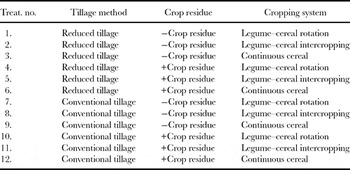
The experiment was set up in 2003 as a split–split–split plot design with four replicates and involved a factorial combination of tillage system (reduced and conventional tillage), crop residue (maize stover) management (plus and minus crop residue) and cropping system (continuous cereal, soybean–maize rotation and intercropping) (12 treatments; see Table 1). For continuous maize, treatments were split to accommodate an N response, using 0, 30, 60 and 90 kg N ha−1. Rotation plots were split into four to accommodate 0 and 60 kg N ha−1 each for legume and cereal crops. Since all treatments received P, additional rotation treatments without P were incorporated to enable investigation of P effects. All intercropping treatments received P 60 kg ha−1 but no mineral fertilizer N was applied. This was because the experiment was also intended for biological N-fixation studies. The high P application rate was due to high P-fixation in those soils (Nziguheba et al., Reference Nziguheba, Palm, Buresh and Smithson1998).
Treatments combining tillage practice, crop residue and cropping system in Nyabeda, western Kenya.

Crop residue (maize stover) was applied at 2 t ha−1.
Maize (Zea mays L.) was planted at 0.25 m (between plants) by 0.75 m (between rows) with two seeds per planting hole and thinned to one plant per hill (53,000 hills per hectare). Soybean (Glycine max L.) was planted at 0.05 m by 0.75 m (266,000 seeds per hectare). Maize was harvested from the plots at maturity leaving two border plants (0.25-m spacing) on both ends of row and one row (0.75-m spacing) from the other ends to eliminate edge effects. Cobs were separated from stover and the fresh weight of each was determined. After air-drying the sub-sample, grains were separated from the cobs, oven-dried at 60 °C for 48 h and their separate dry weight was determined. Similarly, legume grain and biomass, harvested from equal plots as maize, were measured on an oven-dry basis. The yields are reported at 13% moisture content.
Fertilizer K (from murate of potash) was applied to all plots at 60 kg ha−1, while P (from triple super phosphate – TSP) and N (from urea) were applied at the specified rates every season. N was split-applied with 1/3 at planting and 2/3 at knee height (five weeks after planting). Fertilizer application method was hill placement.
Field management
At the start of the experiment, land preparation was done uniformly across all plots by hand-ploughing to 15-cm depth. Subsequent tilling operations were hand-hoeing up to about 10-cm depth in conventional tillage, and surface scratching to about 3-cm depth only in portions with weeds in reduced tillage. There were two weeding operations and one hand-pulling operation under continuous cereal and intercropping for each of the seasons. For rotation, while the part under maize was weeded in the same way as the continuous cereal plots, the part under soybean was weeded once and hand pulled once every season. Crop residue (maize stover, i.e. N 0.35%, P 0.04%, K 0.98%, C 40%, polyphenols 0.5%, lignin 4.0% and ash 5.3%) was applied seasonally at 2 t ha−1 before planting; surface was applied in reduced tillage and incorporated in conventional tillage. Legume residues were left on respective plots.
Determining economic benefits
Partial budget analysis was carried out following the methodology of International Maize and Wheat Improvement Center (CIMMYT) (1988). Cumulative input and output data for the first nine seasons (except a drought season, i.e., season 6 (see Figure 1)) were used. For partial budgeting, the treatments in the continuous cereal system had 60 kg N ha−1 applied, while those in intercropping and rotation had no N applied. In order to reflect difference between experimental yield and the yield that farmers could expect, the yields were adjusted downwards by 10% for farmer management and a further 5% for small plot size (Spencer, Reference Spencer1993). Farm gate price of output at harvest (using the prices of the year 2007) was US$16.7 (US$1 = 72 Kenya shillings) for a 90-kg bag of maize and US$62.5 for a 90-kg bag of soybean. Since maize stover is often used as a source of fuelwood and livestock feed in the study area, opportunity cost was used to determine its imputed (derived) price at US$13.9 per tonne. Gross revenue was calculated by multiplying yield data with the relevant constant price. The price of maize and soybean seed planted was US$0.69 per kg. Farm gate cost of fertilizer was US$22.2 per 50-kg bag of urea and US$25.7 per 50-kg bag of triple superphosphate (TSP). These, together with costs of labour (US$1.7 per day) to plant and weed were used to calculate the total variable costs. Gross margin was calculated as the difference between gross revenue and total variable costs. Sensitivity analysis, in order to reflect the range of gross margins that can be expected for each practice based on seasonal yield variability, was done by including plus and minus one standard error for each of the practices tested. A similar sensitivity analysis approach has been used before (Tursunov, Reference Tursunov2009).
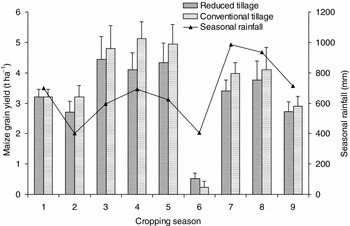
Maize grain yield in reduced and conventional tillage as observed in continuous maize cropping system in Nyabeda, western Kenya, from March 2003 to August 2007. Nitrogen and phosphorus fertilizers at 60 kg ha−1 and 2 t ha−1 of crop residue were applied every season in both treatments; error bars are standard errors.

Dominance analysis and marginal rate of returns (MRR) were determined as explained in our earlier manuscript (i.e., Kihara et al., Reference Kihara, Vanlauwe, Waswa, Kimetu, Chianu and Bationo2010).
Data analysis and presentation
The data were analysed using Statistical Analysis Software (SAS) version 9.1 for Windows. The mixed model procedure was used for analysis of variance between treatments allowing for analysis of random effects of season, replicate, tillage practice and applied crop residue. Multiple pair-wise comparisons of least square means were done directly in SAS using the Tukey–Kramer method.
RESULTS
Seasonal trend of maize yield
Seasonal maize grain yield varied considerably as expected, mainly influenced by amount of rainfall and distribution (Figure 1). For example, the extremely low yields in season 6, which had similar rainfall as season 2, were attributed to severe crop water-stress, as only <60-mm rainfall was received in 70 days of planting in that season. The last three seasons (seasons 7–9) coincidentally had greater seasonal rainfall than the earlier seasons, but this did not translate to greater maize yields. For example, the yield in season 7 was likely reduced due to excess soil water in the clay soil, as up to 500-mm rainfall was received in 35 days of planting.
Since season 6 resulted in crop failure, it was excluded from the subsequent analysis involving averaging the yields over the March 2003 to August 2007 period. The legume analysis season 1 was also excluded, as a different legume (common beans) was grown.
Effect of N and P fertilizers on maize yield
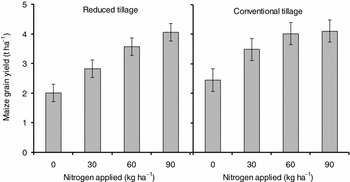
For both reduced and conventional tillage systems, the effects of N and P fertilization were first investigated to determine the best options for further analysis. As expected, maize responded to fertilizer N in both reduced and conventional tillage systems (Figure 2). Applying 30 kg N ha−1 increased yield by about 40% (p < 0.05) over the control (zero N application) in both tillage systems and further 26% (p < 0.05) and 15% (not significant) in the reduced and conventional tillage systems, respectively, at 60 kg N ha−1. The response to N application in this continuous maize cropping system beyond 60 kg N ha−1 was small (13% and 2% in reduced and conventional tillage, respectively).
Effect of nitrogen fertilization on maize grain yield in continuous maize cropping system under two tillage practices in Nyabeda, western Kenya, from March 2003 to August 2007. Bars represent least significant differences (LSD) comparing means within the specific tillage system; all treatments had crop residue applied at 2 t ha−1; season 6 (crop failure) not included; phosphorus was applied to all treatments at 60 kg P ha−1.

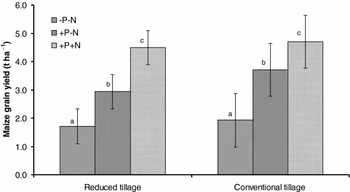
Results from the rotation system showed that combined application of N and P fertilizers (+P+N) resulted in higher maize grain yields in conventional tillage (25%) and reduced tillage (54%) than for P applied alone (+P−N; Figure 3). Also, applying P alone was better than no P at all, thereby increasing the grain yield by 100% in conventional tillage and 80% in reduced tillage over the yield in the no P control treatments (−P−N). The maize yield in the rotation system for the ‘+P−N’ regime was somewhat similar to that in continuous cereal at 60 kg N ha−1 (also applied with P; see Figure 2) for both reduced and conventional tillage, indicating that the maize benefitted from residual effects of the legume. Therefore, only the ‘+P−N’ treatments in rotation (and also in intercrop) and 60 kg N ha−1 treatments in the continuous maize cropping system were investigated further in this study.
Effect of phosphorus and nitrogen fertilization on maize yield in soybean–maize rotation system in Nyabeda, western Kenya, from March 2003 to August 2007; bars are confidence limits; different letters indicate significant differences; season 6 (crop failure) not included.

Effects of tillage and crop residue
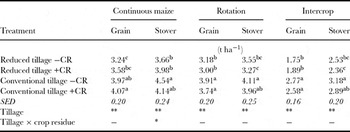
Seasonal average maize grain yields, over the March 2003 to August 2007 period, were 3.2–4.1 t ha−1 in continuous maize, 3.0–3.9 t ha−1 in soybean–maize rotation and 1.8–2.8 t ha−1 in the soybean–maize intercropping system (Table 2). The lower yield in the intercropping system was expected due to competition for soil water and nutrients with the accompanying legume.
Maize grain and stover yield (t ha−1) in continuous maize, soybean–maize rotation and soybean–maize intercropping in Nyabeda, western Kenya, from March 2003 and August 2007.

Numbers in the same column followed by a different letter are significantly different at p < 0.05; CR = crop residue; SED = standard error of the differences of means; *significant at p < 0.05; **significant at p < 0.01; crop failure season (season 6) not included.
Practicing conventional tillage resulted in 11–26%, 17–30% and 36–58% higher grain yields than reduced tillage, in continuous maize, soybean–maize rotation and intercropping systems, respectively. Lower yield with reduced tillage was attributed to soil surface crusting, resulting in surface runoff, nutrient loss and reduced infiltration, and hence greater plant–water stress than in the conventional tillage system. The intercropped maize likely suffered a higher water and nutrient stress due to the ensuing competition, hence the greater reduction in yield in intercrop relative to rotation and continuous maize. Stover yield followed a pattern somewhat similar to that of grain yield, having 4–24%, 12–26% and 14–35% higher yields in conventional than in reduced tillage in continuous maize, rotation and intercropping systems, respectively. We did not find yield differences due to tillage in continuous maize and rotation systems during the last three seasons (seasons 7–9), although there were differences in the previous seasons (seasons 2–5; data not shown). Although those last three seasons received higher rainfall than the earlier seasons, the rainfall distribution in season 9 was poor (only 70-mm rainfall received between 58 and 106 days after planting), and thus the lack of differences in yield during the last seasons is likely due to soil improvement and not just higher rainfall.
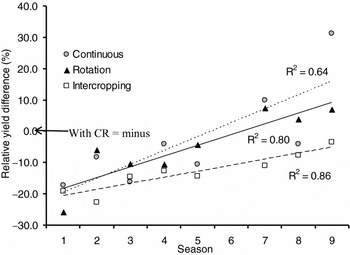
There was no significant effect of crop residue on yield and only small variations (−9% to +11%) were observed. Also, the tillage × crop residue interaction effect observed for the maize stover yield in continuous maize resulted in only 8% yield increase in reduced tillage and 8% yield decrease in conventional tillage when residue was added. Decrease in yield following incorporation of low-quality crop residue in conventional tillage is usually associated with immobilisation of soil available N, while surface application results in benefits such as soil–water conservation. Decrease in yield in the conventional tillage system following application of crop residue was greater during the first five seasons, but additive yields over the no-crop residue treatments were observed in some cases during the last three seasons (Figure 4). Thus, application of crop residue reduced yield to a greater extent during the earlier seasons than during the last seasons, perhaps due to slow improvement in soil fertility with continued fertilization. This pattern was only observed in treatments that had not received chemical fertilizer N, thereby implying that the applied crop residue led to immobilisation of some of the available soil N.
Trend of relative differences in maize grain yield between treatments with and without crop residue in different cropping systems under conventional tillage in Nyabeda, western Kenya, from March 2003 to August 2007. Drought season (season 6) not included; all treatments received 60 kg P ha−1 but not N; CR = crop residue.

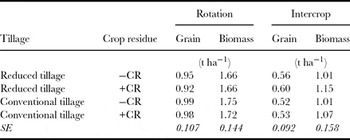
Seasonal average soybean grain yields were from 0.92–0.99 t ha−1 in the soybean–maize rotation and from 0.52–0.60 t ha−1 in the soybean–maize intercropping system (Table 3). Although the soybean grain and above ground biomass yields were expected to be affected by tillage and crop residue similarly to maize, no such effects were observed. The lack of differences can be attributed to quick establishment and maximum canopy (reaching up to 100% in about two months after planting), which completely covered the soil and protected soil water from surface evaporation. The soil under the bushy soybean was visually observed to be wetter than in the other cropping systems.
Average soybean grain and above ground biomass yield (t ha−1) in soybean–maize rotation and intercropping systems in Nyabeda, western Kenya, from March 2003 and August 2007.

CR = crop residue; all treatments received 60 kg P ha−1 but not N; season 1 (common beans) and crop failure season (season 6) not included; SE = standard error.
Partial budget analysis and marginal rate of return
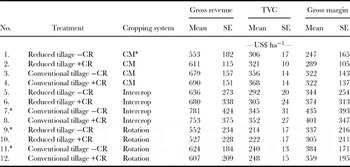
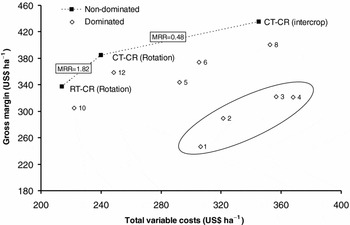
For each of the tillage practices and crop residue systems, the gross margins over the nine seasons were positive and ranged from US$247 in the continuous cereal (‘reduced tillage minus crop residue’) to US$435 in the soybean–maize intercropping system (‘conventional tillage minus crop residue’) (Table 4). These gross margins were not significantly different among the cropping systems, being only by 6 to 39% more in legume–cereal systems (intercropping and rotation) relative to similar treatments in the continuous maize monocropping system.
Average seasonal gross margins (US$ ha−1) of different tillage and crop residue combinations in different cropping systems in Nyabeda, western Kenya, from March 2003 to August 2007.

CM = continuous maize; CR = crop residue; SE = standard error; TVC = total variable costs; *non-dominated alternatives.
Based on the average variable costs and gross margins, all the treatments in continuous maize cropping systems were dominated, having 5 to 28% lower gross margins than those of corresponding legume-based treatments (rotation and intercropping), the latter having 3 to 33% lower total variable costs. The other dominated options are intercropping treatments (except ‘conventional tillage minus crop residue’) and soybean–maize rotation treatments that had received crop residue. The non-dominated alternatives were ‘conventional tillage minus crop residue’ in intercropping, ‘conventional tillage minus crop residue’ in rotation and ‘reduced tillage minus crop residue’ in rotation. The MRR computed for the three non-dominated alternatives showed that by adopting reduced tillage farmers would lose revenue, since conventional tillage had an MRR of at least 182% over reduced tillage (Figure 5). This is due to the fact that saving in labour under reduced tillage was not sufficient to compensate for the lower income from the lower yield obtained under this practice. A change from ‘conventional tillage minus crop residue’ in soybean–maize rotation to ‘conventional tillage minus crop residue’ in soybean–maize intercropping was not very appealing, as the MRR was only 48%.
Average seasonal gross margins for different cropping systems, tillage and crop residue combinations in Nyabeda, western Kenya, from March 2003 to August 2007. Numbers in the dominated options correspond to the treatment numbers in Table 4; RT = reduced tillage; CT = conventional tillage; CR = crop residue; MRR = marginal rate of return; circled treatments are continuous maize treatments tested; drought season (season 6) not included.

DISCUSSION
Tillage
Worldwide, Research on agronomic performance of conservation tillage practices has generated contrasting results. For instance, lower yields in reduced tillage compared with conventional tillage practices have been often reported (Hoogmoed, Reference Hoogmoed1999; Laryea et al., Reference Laryea, Pathak and Klaij1991; Mazzoncini et al., Reference Mazzoncini, Bene, Coli, Antichi, Petri and Bonari2008; Taa et al., Reference Taa, Tanner and Bennie2004; Wilhelm and Wortmann, Reference Wilhelm and Wortmann2004), but higher yields have been also observed (Ozpinar and Cay, Reference Ozpinar and Cay2005; Six et al., Reference Six, Feller, Denef, Ogle, de Moraes and Albrecht2002). The similar soybean yields under reduced and conventional tillage in our experiment suggest that soybean could be an excellent crop under reduced tillage conditions. Since yields were similar, soybean production in western Kenya is better done under reduced tillage due to additional environmental benefits, such as greater biodiversity, better soil structure and reduced erosion (see also Landers Reference Landers, Goddard, Zoebisch, Gan, Ellis, Watson and Sombatpanit2008).
Lower cereal yields under reduced tillage than conventional tillage systems have been attributed to factors such as invasive grass species and higher competition by weeds (Bàrberi and Cascio, Reference Bàrberi and Cascio2001), making it necessary to reduce weeds through spraying with herbicides. Other factors are decreased N mineralisation (Camara et al., Reference Camara, Payne and Rasmussen2003), surface crusting and soil compaction leading to low water infiltration, higher soil bulk density, high root penetration resistance and reduced porosity (Osunbitan et al., Reference Osunbitan, Oyedele and Adekalu2005; Rosolem et al., Reference Rosolem, Foloni and Tiritan2002), and water logging due to high rainfall (Hussain et al., Reference Hussain, Olson and Ebelhar1999; Rusinamhodzi et al., Reference Rusinamhodzi, Corbeels, van Wijk, Rufino, Nyamangara and Giller2011) in reduced tillage practices as opposed to conventional tillage practices. Lower maize grain yield in reduced tillage observed in our study could be due to surface crusting, which was visually observed mainly during early crop growth when crop cover was also minimal. Increased runoff due to surface crusting in reduced tillage has been associated with P losses (Andraski et al., Reference Andraski, Bundy and Kilian2003), which limit crop growth, a factor that could affect yields in reduced tillage in our study also. Previously, it has been reported that the initial lower yields in reduced tillage increase after some seasons of continued practice (Ghuman and Sur, Reference Ghuman and Sur2001; Malhi et al., Reference Malhi, Lemke, Wang and Chhabra2006). This is consistent with the results of our study. Thus, similar maize yields between reduced and conventional tillage systems can be expected within year 3 for western Kenya, although it may take more than five years for the intercropping system.
The greater reduction in cereal yield in intercropping than in rotation and continuous maize in reduced tillage relative to conventional tillage was attributed to greater water stress in the intercropping than in other systems. Yamoah et al. (Reference Yamoah, Bationo, Shapiro and Koala2003) found intercropping millet with cowpea to lead to a higher soil moisture stress than in monocropped millet. The rainfall up to 100 days after planting in our study was better related with yield than was the whole-season rainfall (data not shown), and thus measures that improve plant and soil–water relations up to 100 days after planting are urgently needed, especially in the intercropping system. In general, our results relate to rain-fed conditions and could be quite different under controlled irrigation where some dynamics, such as mineralisation, are different.
Effect of crop residue
Several studies have reported positive effects of application of crop residue on yield (Doran et al., Reference Doran, Wilhelm and Power1983; Erenstein, Reference Erenstein2003; Lal, Reference Lal1974). Our results show only slight variations in yields due to crop residue application. Low response to crop residue is in agreement with the finding of Erenstein (Reference Erenstein2003) that there are no clear immediate benefits of crop residue in sub-humid environments. Nevertheless, crop residue is known to significantly improve soil structure, hence the need for seasonal application of crop residue in western Kenya, especially in the reduced tillage system. Also, the positive trends following continued application of crop residue, as observed in our study, indicate that farmers continuing with conventional tillage can apply crop residue and expect yield increases later. We propose that crop residue, even under conventional tillage, be preferentially surface-applied to increase its soil–water conservation effect and reduce negative effects on yield.
Combining reduced tillage with surface residue has been shown to improve crop performance (Dam et al., Reference Dam, Mehdi, Burgess, Madramootoo, Mehuys and Callum2005; Woyesa and Bennie, Reference Woyesa and Bennie2004). Lower yield in ‘reduced tillage with crop residue’ than in the conventional tillage system in our study, especially during the first five seasons, indicates that the 2 t ha−1 crop residue applied in our case may be insufficient to immediately boost productivity to match that of conventional tillage for all systems tested. Thus, our hypothesis of similar or higher yield in ‘reduced tillage plus 2 t ha−1 crop residue’ relative to the conventional tillage is supported after more than three years of continued practice in continuous maize and soybean–maize rotation, but it takes longer for the intercropping system. We suggest that further investigations on the use of crop residue, based on the amount that farmers are most likely to access, explore supplementing the crop residue with additional soil cover resources such as use of cover crops.
N and P fertilization
Crop productivity in most parts of Africa is mainly limited by the availability of N and P (Schlecht et al., Reference Schlecht, Buerkert, Tielkes, Bationo, Bationo, Waswa, Kihara and Kimetu2007), and this is also the case for western Kenya. Low use of fertilizer, estimated at only 8 kg ha−1 in year 2002 in sub-Saharan Africa (Maatman et al., Reference Maatman, Wopereis, Debrah, Groot, Bationo, Waswa, Kihara and Kimetu2008; Morris et al., Reference Morris, Kelly, Kopicki and Byerlee2007) and less than 20 kg N ha−1 for western Kenya (Okalebo et al., Reference Okalebo, Othieno, Woomer, Karanja, Semoka, Bekunda, Mugendi, Muasya, Bationo, Mukhwana, Bationo, Waswa, Kihara and Kimetu2007), results in low yields, which are often less than 1.5 t ha−1 for maize grain (Mugwe et al., Reference Mugwe, Mugendi, Kungu and Muna2009; Tittonell et al., Reference Tittonell, Shepherd, Vanlauwe and Giller2008). The positive yield increase following application of fertilizers N and P is not unique to our study, as this has been reported in several other studies (Kamara et al., Reference Kamara, Kwari, Ekeleme, Omoigui and Abaidoo2008; Kihara et al., Reference Kihara, Kimetu, Vanlauwe, Bationo, Waswa, Mukalama, Bationo, Waswa, Kihara and Kimetu2008; Muleba, Reference Muleba1999). Integration of legumes in the cropping system, as in the intercropping and rotation systems, results in positive improvements in subsequent cereal yields, believed to be due to legume N-fixation benefits, especially where all legume biomass is retained on the field, among other advantages (Kamara et al., Reference Kamara, Kwari, Ekeleme, Omoigui and Abaidoo2008).
Yield increase due to P application is often high in soils with low available P (Gachengo et al., Reference Gachengo, Palm, Jama and Othieno1999), such as those of western Kenya where less than 4.0-mg P kg−1 soil on smallholder farms is commonly observed (Tittonell et al., Reference Tittonell, Shepherd, Vanlauwe and Giller2008). This shows that there is a need not only to use fertilizers but also to raise the levels applied. This requires that the cost of chemical inorganic fertilizer, which is frequently high in Africa (Kelly et al., Reference Kelly, Adesina and Gordon2003), i.e. two- to six-fold higher than that in Europe, North America and Asia in 2002 (Sanchez, Reference Sanchez2002), be addressed, since it is a major hindrance to fertilizer application, especially among smallholder farmers.
Economic analyses
In order to improve farmers’ incomes, it is important to pay more attention to net benefits than mere yields. Reduced cost of production, such as reduced labour, fuel and machinery, is a key advantage of reduced tillage practices (Fowler and Rockstrom, Reference Fowler and Rockstrom2001) and is reported to result in more net benefits in reduced than in conventional tillage (Knowler and Bradshaw, Reference Knowler and Bradshaw2006). For example, Astatke et al. (Reference Astatke, Jabbar and Tanner2003) found a higher gross margin of US$132 per hectare for wheat production in reduced than in conventional tillage in Ethiopia. In another study carried out over a 16-year period in Spain, no significant differences in gross margins between reduced and conventional tillage were found, although the margins tended to be higher for the former than for the latter tillage practice (Sánchez-Girón et al., Reference Sánchez-Girón, Serrano, Hernanz and Navarrete2004). In contrast, economic assessment of a shorter-term (four-year) study in a tropical sub-humid environment similar to our site had found that the conventional tillage with residue removed had the highest net benefits among the tillage and crop residue alternatives tested (Fischer et al., Reference Fischer, Santiveri and Vidal2002). The savings in labour due to reduced tillage could not sufficiently offset the benefits of increased yields in conventional tillage system in our case, even though the yields for the last seasons in this study were similar among tillage systems. Thus, the adoption of reduced tillage can be hampered by depressed returns during the lag phase. But the standard errors associated with gross margins were large, suggesting that most of the treatments are not so different. Thus, despite that many farmers may not be attracted to switch from conventional tillage to reduced tillage based on the gross margins, reduced tillage could still be an attractive option to farmers who are weakened by HIV/AIDS, a highly prevalent condition in western Kenya (at 15%; Amornkul et al., Reference Amornkul, Vandenhoudt, Nasokho, Odhiambo, Mwaengo, Hightower, Buve, Misore, Vulule, Vitek, Glynn, Greenberg, Slutsker and De Cock2009).
Legume-based systems have been found to be economically more attractive to farmers than continuous maize systems. Sánchez-Girón et al. (Reference Sánchez-Girón, Serrano, Hernanz and Navarrete2004), for example, reported 16% higher gross margins in a wheat–vetch rotation compared to winter barley monoculture. In our case, the gross margins resulting from different cropping systems could not be sufficiently discriminated due to high standard errors even though intercropping, for example, increased average gross margins over similar treatments under continuous maize monocropping by at least 24%. The somewhat increased net benefits in intercropping are consistent with the higher land equivalence ratios usually reported relative to monocropping systems (Bationo, Reference Bationo2008; Niringiye et al., Reference Niringiye, Kyamanywa and Ssekabembe2005; Worku, Reference Worku2004). However, the MRR gained by switching from conventional rotation to intercropping is not so attractive, being at the lowest minimum of 50%, generally acceptable to farmers (CIMMYT, 1988). Even though the economic returns are only improved marginally in legume-based systems, promoting legume production in western Kenya is necessary in order to improve nutrition among HIV/AIDS-affected populations.
CONCLUSIONS
Soybean yields in western Kenya are similar in reduced and conventional tillage systems (i.e. not showing the typical crop yield reduction when introducing reduced tillage), and thus soybean is an excellent crop for reduced tillage systems. However, practicing conventional tillage results in 11 to 58% higher maize grain yield than reduced tillage due to problems associated with surface crusting in the reduced tillage system. Our hypothesis of similar yields between ‘reduced tillage with crop residue’ (applied at 2 t ha−1) and the conventional tillage system treatments is supported only after three years of continued reduced tillage practice. After 10 seasons of reduced tillage practice, the economic benefits are still not attractive for a switch from the conventional tillage to reduced tillage practice. Applying chemical fertilizer P increases maize grain yield by at least 80% compared to regions where P is not applied, and a further minimum of 25% when N is also applied. Practicing legume–cereal rotation and intercropping attracts only 6 to 39% gross margins over continuous cereal monocropping system on average, and these are not statistically significant. For the smallholder farming households in western Kenya ravaged by HIV and AIDS, reduced tillage with crop residue in a legume-based cropping system is a feasible alternative. Except for soybean production, our results do not readily support a switch from conventional to reduced tillage. More work is needed to supply greater soil cover in the reduced tillage system to avoid soil crusting problems, which lead to lower maize yields soon after reduced tillage is adopted.