





Introduction
Healthcare-associated infections (HAIs) represent a significant public health challenge, contributing substantially to patient morbidity, mortality, and healthcare expenditure.Reference Klevens, Edwards and Richards1–Reference Balasubramanian, Van Boeckel, Carmeli, Cosgrove and Laxminarayan6 In Singapore acute care hospitals, HAIs were associated with prolonged hospitalizations of approximately 1.7 days, a 32% increase in in-hospital mortality, and additional costs of S$1,809 per case.Reference Cai, Venkatachalam and Kwa7 These burdens may be particularly relevant in intermediate and long-term care settings, where patients often present with multiple comorbidities and prolonged lengths of stay.Reference Bennett, Tanamas and James8
Long-term acute care hospitals (LTACHs), commonly referred to in Singapore as community hospitals, occupy a crucial position within Singapore’s healthcare continuum by bridging the transition between acute care facilities and long-term care settings.Reference Foo, Chia and Tan9,Reference Teo, Low, Gan, Low and Lee10 These institutions primarily serve patients requiring rehabilitation services, completion of parenteral antimicrobial therapy, and other ongoing subacute care needs. Reference Foo, Chia and Tan9,Reference Teo, Low, Gan, Low and Lee10 As Singapore’s population ages and healthcare needs evolve, LTACHs have become increasingly integral to the efficient functioning of the healthcare system, making the understanding of HAI burden in these facilities particularly important. Reference Foo, Chia and Tan9,Reference Teo, Low, Gan, Low and Lee10
The epidemiology of HAIs in acute care settings has been well-characterized through systematic surveillance efforts.Reference Cai, Venkatachalam and Tee11 In Singapore, the first point prevalence survey (PPS) of HAIs in acute care hospitals, conducted in 2015–2016, revealed a HAI prevalence of 11.9%.Reference Cai, Venkatachalam and Tee11 However, comparable data from LTACHs have not previously been reported, leaving a critical knowledge gap in understanding the burden of HAIs across the full continuum of Singapore’s healthcare system.
To address this knowledge gap, the Ministry of Health, Singapore, through the National Infection Prevention and Control Committee (NIPC), commissioned the first national PPS of HAIs in Singapore’s LTACHs. The objectives of this study were to determine the prevalence and distribution of HAIs, characterize the microbiological profile of causative organisms, and identify the factors associated with HAIs. These data provide an evidence base for developing targeted infection prevention and control (IPC) strategies specific to the LTACH setting, while establishing baseline measurements for future surveillance efforts.
Methods
Study period and setting
The national PPS was conducted across Singapore LTACHs between July and November 2024. In Singapore, LTACHs, referred to locally as community hospitals, are intermediate inpatient facilities for patients transitioning from acute hospitals to home or long-term care settings. These facilities operate as either public or not-for-profit institutions, and provide a range of care services including rehabilitation, subacute care, and in some cases, specialized services such as dialysis, wound care, and inpatient palliative care.12 Ten eligible LTACHs in Singapore were invited to participate in the survey. Of these, 9 (90%) participated, while 1 LTACH did not participate due to operational constraints.
Study design and inclusion criteria
The cross-sectional survey methodology was developed by the Infection Prevention, Control and Outreach Office (ICON) of the National Centre for Infectious Diseases (NCID) and adapted from the Singapore acute hospital PPS protocol,Reference Cai, Venkatachalam and Tee11 which was based on the European Centre for Disease Prevention and Control protocol for HAI PPS in acute care hospitals.13 The full survey protocol in LTACHs is provided in the Supplementary Protocol. Surveillance was conducted in all adult inpatient wards providing care for ≥24 hours. The study population comprised adult patients aged ≥18 years who were admitted before or at 8 a.m. on the day of survey and had not been discharged at the time of data collection. Data collection was conducted sequentially across all eligible wards and was completed within 1 month at each LTACH. Supplementary Table 1 provides the surveillance schedule for each participating facility.
Surveillance coordinators’ training
Data collection at all participating sites was conducted by 7 surveillance coordinators from the ICON office. The coordinators underwent a 3-week training program on data collection procedures and case definitions. The training program was developed and delivered by 2 survey leaders—an Infectious Diseases clinician and an epidemiologist. Following training, competency was assessed through implementation of the survey in a pilot LTACH and cross-verification by the survey leaders. Details of training and competency assessment are provided in the Supplementary Protocol.
Data collection
Data on patient demographics, clinical variables, and HAI details were collected from electronic medical records, including clinical documentations, laboratory results, and radiological reports. Study data were collected and managed using REDCap Electronic Data Capture ToolsReference Harris, Taylor, Thielke, Payne, Gonzalez and Conde14,Reference Harris, Taylor and Minor15 hosted at the National Healthcare Group Health, which employed integrated validation algorithms and logic-based branching rules. The design and implementation of these branching rules followed the methodology previously developed and published for Singapore’s national acute care hospital HAI PPS.Reference Cai, Venkatachalam and Tee11 Hospital-level characteristics were collected from IPC units of participating LTACHs. Variable definitions used in this PPS are listed in the Supplementary Protocol. Case classification criteria for active infection comprised either (1) presence of signs and symptoms of infection on the survey day or (2) ongoing antimicrobial treatment for a previous infection. All identified active infections were classified as HAIs, except those manifesting within 2 days of admission.
Quality assurance
Quality assurance was implemented through a multi-tiered validation framework as outlined in the Supplementary Protocol. Primary validation comprised same-day, unblinded cross-verification of at least 10% of surveyed patients, selected pragmatically by surveillance coordinators. Separately, secondary validation by epidemiologists was conducted on 10% of cases, with prioritization of patients who had ongoing antimicrobial treatment or who were diagnosed as having HAIs. Upon completion of data collection at each LTACH, the entire data set was systematically reviewed for data entry errors, including missing data fields, outliers, and apparent inconsistencies. Discrepant data were rectified following thorough re-examination of relevant patient records and verification with survey leaders.
Statistical analysis
Categorical variables were expressed as absolute frequencies with corresponding percentages, while continuous variables were summarized as median values with interquartile range (IQR) or range, as indicated. The point prevalence of HAI was calculated as the proportion of patients with at least 1 HAI among the total surveyed population. The relative distribution of infection types was quantified by calculating the proportion of each specific HAI category among total HAIs identified. This analytical approach was also applied to characterize the distribution of causative microorganisms.
Factors associated with HAI were evaluated through univariate logistic regression comparing patients with and without HAI. Subsequent multivariate logistic regression analysis incorporated both variables with clinical plausibility (Charlson comorbidity index (CCI) and presence of invasive devices) and covariates demonstrating statistical significance (P < .05) in univariate analysis. Effect estimates are presented as odds ratios (ORs) with corresponding 95% confidence intervals (CIs). Data analysis was conducted using STATA version 17 (StataCorp, College Station, TX, USA) and Microsoft Excel 2019 (Microsoft Corporation, Redmond, WA, USA).
Ethical considerations
This work involved analysis of data collected for routine national surveillance under Singapore’s statutory public health mandate; therefore, ethics approval was not required.
Results
Hospital-level data
Hospital-level characteristics of participating facilities are summarized in Supplementary Table 2. 9 of 10 eligible LTACHs participated in this survey, with a median capacity of 245 beds (range: 80–382). 7 institutions provided complete annual hospital metrics for 2023, demonstrating a median of 2,473 admissions (range: 1,301–3,737) and 71,118 patient-days (range: 40,201–104,593); 2 newly built LTACHs were unable to provide these data.
All participating hospitals maintained dedicated IPC programs. The median number of infection control nurses was 1 (range: 1.0–2.0) and that of infection control doctors was 0.4 (range: 0.0–1.0). Single rooms constituted a median of 6.5% (range: 1.7–16.7) of total bed capacity. Established antimicrobial stewardship programs were present in 6 hospitals (66.7%).
Patient characteristics
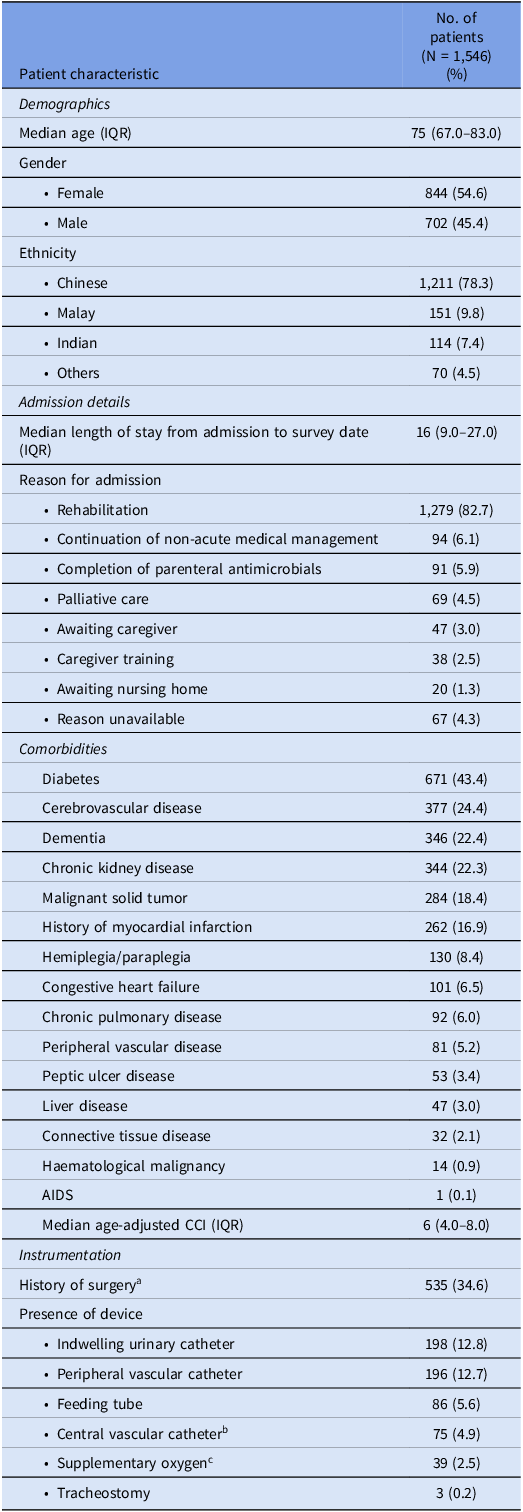
A total of 1,546 patients met the inclusion criteria and were included in the data analysis. Detailed patient characteristics are summarized in Table 1. The median age was 75 years (IQR: 67.0–83.0), with female predominance (54.6%). The median length of stay at the time of survey was 16 days (IQR: 9.0–27.0). Rehabilitation was the primary admission indication (82.7%), followed by continuation of non-acute medical management (6.1%) and parenteral antimicrobial completion (5.9%).
Baseline characteristics of patients surveyed

Table 1. Long description
Table 1 presents patient characteristics for all 1,546 patients surveyed. The median age was 75 years (IQR: 67.0–83.0), with a slight female predominance (54.6%) and a majority of Chinese ethnicity (78.3%). The median length of stay from admission to survey date was 16 days (IQR: 9.0–27.0), with rehabilitation being the most common reason for admission (82.7%). The cohort had a high comorbidity burden, with a median age-adjusted Charlson Comorbidity Index of 6 (IQR: 4.0–8.0); the most prevalent comorbidities were diabetes (43.4%), cerebrovascular disease (24.4%), and dementia (22.4%). A history of surgery was documented in 34.6% of patients. Device use was relatively low, with indwelling urinary catheters (12.8%) and peripheral vascular catheters (12.7%) being the most common.
Data presented as no. (%) unless otherwise indicated.
AIDS, autoimmune deficiency syndrome; CCI, Charlson’s comorbidity index; IQR, interquartile range.
a History of surgery was defined as any surgical procedure without implant in the past 30 days prior to the date of survey or any surgical procedure with implant performed within 1 year prior to the survey date.
b Central vascular catheters include peripherally inserted central catheter, dialysis catheter, Hickman catheter, and other general catheter types. Patients may have one or more types.
c Supplementary oxygen includes face mask and nasal prong.
The cohort demonstrated comorbidity burden, with a median age-adjusted CCI of 6 (IQR: 4.0–8.0). Prevalent comorbidities included diabetes mellitus (43.4%), cerebrovascular disease (24.4%), and dementia (22.4%). Prior surgical intervention was documented in 34.6% of patients. Device utilization included indwelling urinary catheters (12.8%), peripheral vascular catheters (12.7%), central vascular catheters (4.9%), and feeding tubes (5.6%).
HAI prevalence and distribution
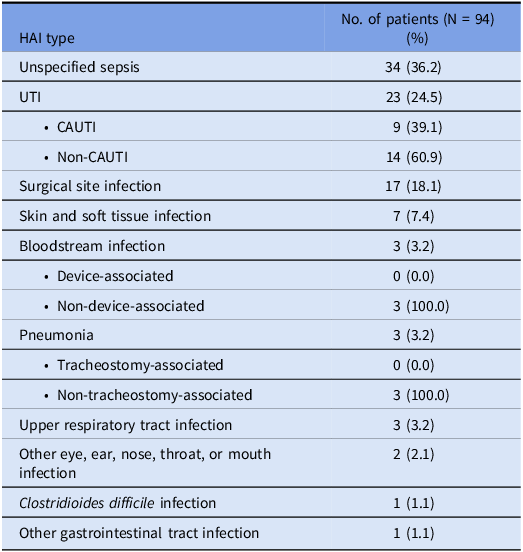
A total of 94 HAIs were identified in 86 patients, yielding a point prevalence of 5.6% (95% CI: 4.5–6.8). Of these, 78 patients had a single HAI and 8 had 2 concurrent HAIs. The most frequent HAI types were unspecified sepsis (36.2%, n = 34), urinary tract infection (UTI, 24.5%, n = 23), and surgical site infection (18.1%, n = 17). Device-associated infections accounted for 9.6% of all HAIs and were exclusively catheter-associated UTI (CAUTI). The complete distribution of HAI types is detailed in Table 2.
Distribution of HAI types in Singapore LTACHs

Table 2. Long description
Table 2 presents the distribution of 94 HAIs by infection type. Unspecified sepsis was the most common HAI (36.2%), followed by urinary tract infection (24.5%) and surgical site infection (18.1%). Of the 23 UTIs, the majority were non-catheter-associated (60.9%), with the remainder being catheter-associated (39.1%). Skin and soft tissue infections accounted for 7.4% of HAIs. Bloodstream infections, pneumonia, and upper respiratory tract infections each accounted for 3.2% of HAIs; notably, none of the bloodstream infections were device-associated and none of the pneumonia cases were tracheostomy-associated. Less common infection types included other eye, ear, nose, throat or mouth infections (2.1%), Clostridioides difficile infection (1.1%), and other gastrointestinal tract infections (1.1%).
Data presented as no. (%) unless otherwise indicated.
CAUTI, catheter-associated urinary tract infection; HAI, healthcare-associated infection; LTACH, long-term acute care hospital; UTI, urinary tract infection.
Causative organisms and AMR
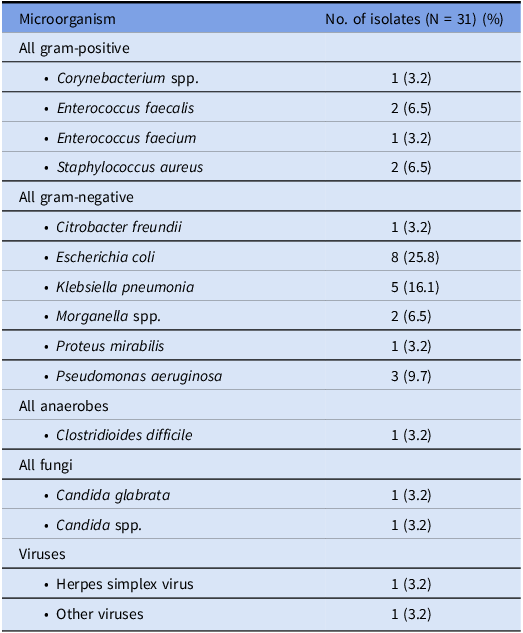
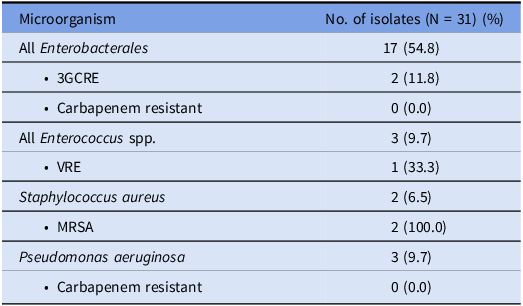
Causative microorganisms were identified in 24 of 94 HAIs (25.5%), yielding 31 confirmed microbiological results. Microbiological confirmation was most frequently achieved in bloodstream infections and Clostridioides difficile infections, where causative organisms were identified in all cases (100%). Among UTIs, 78.3% (n = 18) were microbiologically confirmed, while confirmation rates were lower for upper respiratory tract infections (33.3%, n = 1) and skin and soft tissue infections (14.3%, n = 1). The most common pathogens were Escherichia coli (25.8%, n = 8), Klebsiella pneumoniae (16.1%, n = 5), and Pseudomonas aeruginosa (9.7%, n = 3). Antimicrobial resistance (AMR) was observed among key pathogens: methicillin resistance in all Staphylococcus aureus (methicillin-resistant Staphylococcus aureus [MRSA]) isolates, vancomycin resistance in 33.3% of Enterococcus (vancomycin-resistant Enterococcus [VRE]) isolates, and third-generation cephalosporin resistance in 11.8% of Enterobacterales. The complete microbiological profile and resistance patterns are detailed in Tables 3 and 4, respectively.
Distribution of microorganisms isolated from HAIs in Singapore LTACHs

Table 3. Long description
Table 3 presents the distribution of microorganisms isolated from HAIs across 31 isolates. Gram-negative organisms were the most predominant group, with Escherichia coli being the most frequently isolated microorganism overall (25.8%), followed by Klebsiella pneumoniae (16.1%) and Pseudomonas aeruginosa (9.7%). Among Gram-positive organisms, Enterococcus faecalis and Staphylococcus aureus were the most common (6.5% each). One isolate each was identified from the anaerobe (Clostridioides difficile, 3.2%), fungal (Candida glabrata and Candida spp., 3.2% each), and viral (Herpes simplex virus and other viruses, 3.2% each) categories.
Data presented as no. (%) unless otherwise indicated.
HAI, healthcare-associated infection; LTACH, long-term acute care hospital.
AMR patterns of key pathogens isolated from HAIs in Singapore LTACHs

Table 4. Long description
Table 4 presents the antimicrobial resistance profiles of 31 microorganisms isolated from HAIs. Of the Enterobacterales isolates, 11.8% were third-generation cephalosporin-resistant (3GCRE) and none were carbapenem-resistant. 1 in 3 Enterococcus spp. isolates was vancomycin-resistant (VRE, 33.3%). Both Staphylococcus aureus isolates were methicillin-resistant (MRSA, 100.0%). No carbapenem-resistant Pseudomonas aeruginosa was identified.
Data presented as no. (%) unless otherwise indicated.
3GCRE, third-generation cephalosporin resistance; AMR, antimicrobial resistance; HAI, healthcare-associated infection; LTACHs, long-term acute care hospitals; MRSA, methicillin-resistant Staphylococcus aureus; VRE, vancomycin-resistant Enterococcus.
Factors associated with HAIs
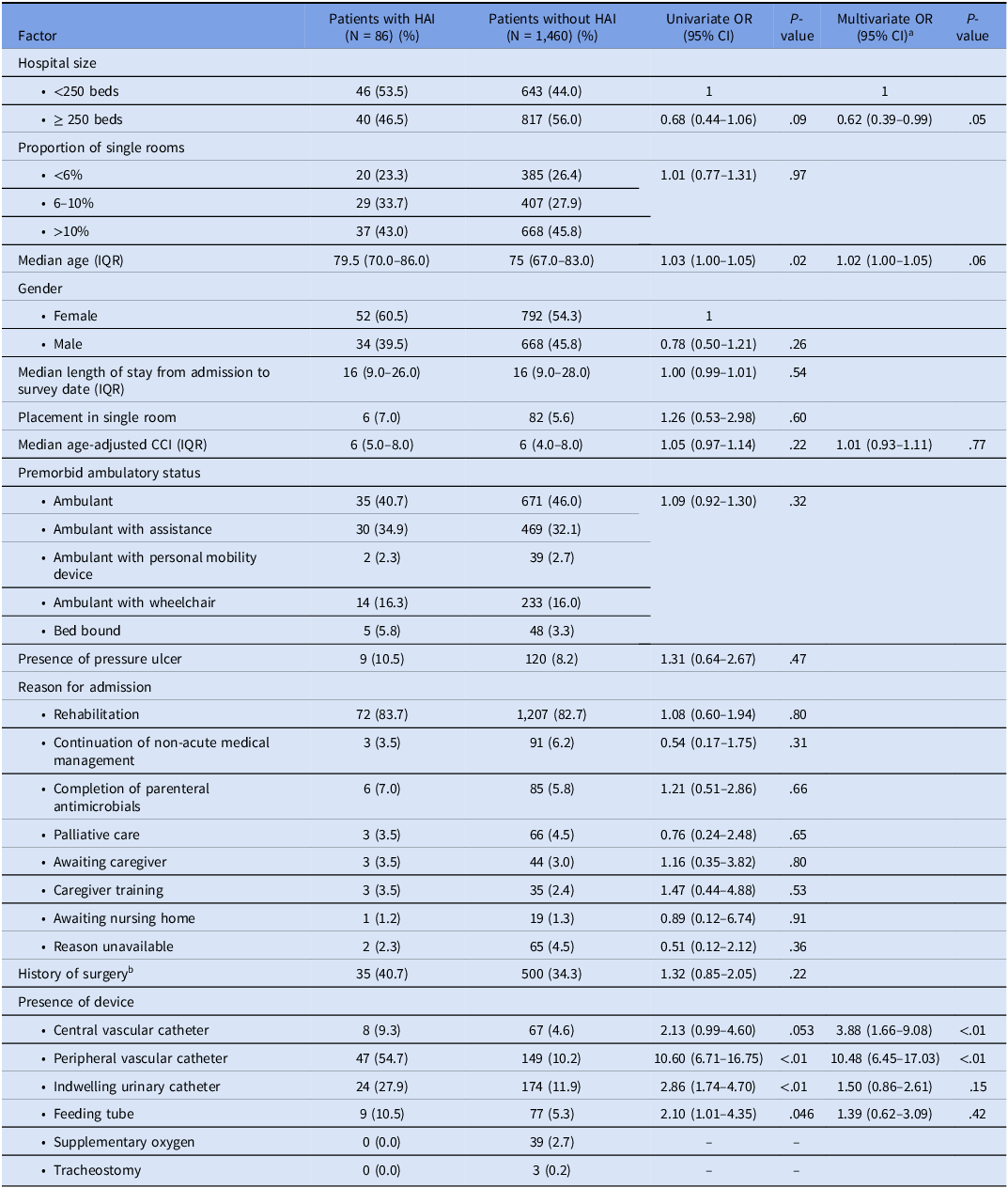
Univariate analysis identified several significant risk factors for HAI: age (OR: 1.03, 95% CI: 1.00–1.05, P = .02), and use of peripheral vascular catheter (OR: 10.60, 95% CI: 6.71–16.75, P < .01), indwelling urinary catheter (OR: 2.86, 95% CI: 1.74–4.70, P < .01), and feeding tube (OR: 2.10, 95% CI: 1.01–4.35, P = .046). Central vascular catheter use demonstrated borderline significance (OR: 2.13, 95% CI: .99–4.60, P = .053).
After adjusting for confounders in multivariate analysis, use of central vascular catheters (OR: 3.88, 95% CI: 1.66–9.08, P < .01) and peripheral vascular catheters (OR: 10.48, 95% CI: 6.45–17.03, P < .01) remained significant independent predictors of HAI whereas larger hospital size (≥ 250 beds) was associated with decreased HAI risk (OR: 0.62, 95% CI: 0.39–0.99, P = .05). Variables analyzed for association with HAI are presented in Table 5.
Variables analyzed in relation to HAIs among patients in Singapore LTACHs

Table 5. Long description
Table 5 presents univariate and multivariate logistic regression analyses of factors associated with HAI. In multivariate analysis, presence of a peripheral vascular catheter was the strongest independent risk factor for HAI (OR 10.48, 95% CI 6.45–17.03, p<0.01), followed by presence of a central vascular catheter (OR 3.88, 95% CI 1.66–9.08, p<0.01). Hospital size of 250 beds or more was independently associated with reduced HAI risk (OR 0.62, 95% CI 0.39–0.99, p=0.05). Factors that were significant in univariate analysis but did not retain significance on multivariate analysis included indwelling urinary catheter (univariate OR 2.86, p<0.01), feeding tube (univariate OR 2.10, p=0.046), and older age (univariate OR 1.03, p=0.02). Other factors including gender, length of stay, comorbidity burden, reason for admission, history of surgery, and pre-morbid ambulatory status were not significantly associated with HAI on either analysis.
Data presented as no. (%) unless otherwise indicated.
CCI, Charlson’s comorbidity index; CI, confidence interval; HAI, healthcare-associated infection; IQR, interquartile range; LTACHs, long-term acute care hospitals; OR, odds ratio.
a Variables with p-values < .05 in the univariate analysis or with clinical plausibility were included in the multivariate model.
b History of surgery was defined as any surgical procedure without implant in the past 30 days prior to the date of survey or any surgical procedure with implant performed within 1 year prior to the survey date.
Discussion
This inaugural national PPS provides the first comprehensive assessment of HAIs in Singapore’s LTACHs. The survey found that 5.6% of patients had at least 1 HAI on the day of assessment, equivalent to approximately 1 in 18 patients. Use of central and peripheral vascular catheters was independently associated with HAI risk, while larger hospital size was associated with decreased HAI risk. These findings establish an important epidemiological baseline for IPC efforts in Singapore’s intermediate care sector.
The overall HAI prevalence observed in Singapore LTACHs was lower than that reported in Singapore acute care hospitals (11.9% in the national PPS conducted in 2015–2016).Reference Cai, Venkatachalam and Tee11 This difference likely reflects the step-down nature of LTACH care, where patients generally have lower acuity, undergo fewer invasive procedures, and are primarily managed for rehabilitation, completion of therapy, or ongoing subacute care. Direct international comparisons, while challenging due to differences in healthcare system structures and care definitions across healthcare systems, provide valuable context. Our prevalence exceeds that reported in European LTACHs (3.9% in 2016/2017),Reference Suetens, Latour and Kärki16 and although North American LTACHs would likely represent the most comparable setting given similarities in patient populations and clinical functions, published point prevalence estimates from such facilities remain scarce.
The distribution of HAI types in this study demonstrated several notable features. Unspecified sepsis accounted for the largest proportion of infections, which likely reflects limitations inherent to point prevalence surveillance in LTACH settings. In many cases, patients were receiving antimicrobial therapy for clinically suspected infection without clear localization or microbiological confirmation at the time of survey, resulting in classification as unspecified sepsis according to PPS definitions. Longitudinal follow-up studies may therefore help clarify whether such cases reflect infections with delayed diagnostic confirmation or differences in diagnostic practices across care settings. UTIs constituted the second most common HAI category, with a substantial proportion occurring in the absence of urinary catheters. This finding suggests that factors beyond catheter use may contribute to UTI risk in LTACH populations.
Multivariate analysis identified the presence of central and peripheral vascular catheters as factors associated with HAI. However, device-associated infections observed in the survey were exclusively CAUTI, and no infections were directly attributed to vascular access devices. The observed association between vascular catheters and HAIs, therefore, likely reflects confounding by indication rather than a causal relationship. In LTACH settings, vascular access devices are frequently inserted for administration of intravenous antimicrobials or other therapies in patients already suspected to have infection, making their presence a marker of clinical illness rather than a primary risk factor for infection. Additionally, the cross-sectional nature of PPS methodology captures co-occurrence of devices and infections without establishing temporal sequence, which may further contribute to the observed association.
Previous point prevalence studies in acute and long-term care settings have identified a range of patient-level characteristics associated with HAI prevalence, including older age, greater underlying comorbidity, longer length of stay, reduced mobility, pressure ulcers, disorientation, and urinary and fecal incontinence.Reference Cai, Venkatachalam and Tee11,Reference Mosquera-González, Alonso-García, Jiménez-Bueno and Arce-Arnáez17–Reference Hassan, Tuckman, Patrick, Kountz and Kohn19 Our study assessed age, comorbidity burden, length of stay, mobility, and pressure ulcers, but none of them were associated with HAI. Differences in patient populations and care settings, as well as the smaller sample size of our study, may partly account for differences in observed associations. Nevertheless, residual confounding from factors not captured in our study, including disorientation and urinary or fecal incontinence, cannot be excluded.
The finding that larger hospitals were associated with reduced odds of HAI is noteworthy and warrants further exploration. Although IPC staffing did not differ significantly between larger and smaller institutions, larger facilities may nonetheless benefit from more established infection prevention programs and improved access to diagnostic and antimicrobial stewardship resources. Differences in case-mix may also contribute to this observation. Future studies examining organizational factors and resource allocation in LTACHs may help clarify the mechanisms underlying this association and identify strategies to support smaller facilities.
The microbiological profile revealed that only 25.5% of HAIs had identified causative organisms, substantially lower than the 45.5% reported in Singapore’s acute care hospitals.Reference Cai, Venkatachalam and Tee11 However, interpretation of this finding is limited by the design of the PPS. The survey captured microbiological results only when organisms were identified and did not collect information on microbiological tests performed but yielding negative results. Consequently, the study cannot determine whether the lower confirmation rate reflects differences in testing practices, lower diagnostic yield, or infections diagnosed clinically without microbiological testing. Importantly, all LTACHs in Singapore have access to microbiology laboratory services through affiliated acute hospitals, suggesting that limited laboratory access is unlikely to explain this observation.
The microbiological profile was dominated by Enterobacterales species, with evidence of antimicrobial resistance, including MRSA and VRE. However, the small number of microbiologically confirmed infections limits interpretation of pathogen-specific resistance patterns. Consequently, pathogen-specific interventions are unlikely to be appropriate at this stage. Instead, the overall distribution of HAIs suggests that broad IPC initiatives focusing on horizontal measures are likely to yield the greatest benefit in LTACH settings. These may include improving hand hygiene compliance, strengthening environmental hygiene practices, enhancing staff education and training, optimizing stewardship of invasive device utilization, and reinforcing adherence to standard precautions. At the same time, the relatively high proportion of UTIs observed suggests that targeted interventions addressing UTI prevention may have substantial impact.
This study also has important implications for national IPC policy and strategy. By covering 9 of 10 LTACHs in Singapore, representing approximately 90% of national LTACH capacity, the survey provides a robust national baseline for HAIs in this sector. Beyond generating epidemiological data, the conduct of this survey reflects leadership commitment to infection prevention in intermediate care settings and provides a foundation for continued surveillance and quality improvement. The findings also highlight opportunities for cross-institutional learning, particularly in relation to antimicrobial stewardship programs, which were not yet implemented in several participating hospitals.
More broadly, the findings may also be relevant to other healthcare systems where intermediate or step-down care facilities play an increasing role in managing aging populations and reducing pressure on acute hospitals. As many countries expand postacute and rehabilitative care services,20 understanding the epidemiology of HAIs in these settings becomes increasingly important for designing appropriate infection prevention strategies. The results of this study may therefore provide useful insights for similar intermediate care settings internationally, particularly in healthcare systems with comparable patient populations and care models.
Several limitations should be considered when interpreting these findings. As with all PPS studies, the cross-sectional design captures only point prevalence and cannot determine incidence or temporal relationships between risk factors and infection. The associations identified therefore represent correlations rather than causal relationships. In addition, microbiological confirmation was limited in many cases, and residual confounding due to unmeasured factors such as case-mix or clinical severity cannot be excluded.
In conclusion, this study provides the first national estimate of HAI prevalence in Singapore’s LTACHs and establishes an important baseline for future surveillance. Although overall HAI prevalence was lower than that observed in acute care hospitals, the findings highlight the need to further strengthen infection prevention efforts in intermediate care settings and provide a useful reference point for national IPC initiatives as well as for similar postacute care systems internationally.
Supplementary material
The supplementary material for this article can be found at https://doi.org/10.1017/ice.2026.10546.
Acknowledgments
We thank the data collection team from ICON of NCID, Singapore (Abel Tan Hong Ming, Bryan Chan Huan En, Caleb Ho Wen An, Charlene Wee Chwee Yin, Danielle Tan Hui Ru, Huan Xiao Wei, Nur Hafizah Binte Hamed, and Sharifah Farhanah Binte Syed Husen) for their invaluable contributions to this study. We extend our appreciation to the leadership of the LTACHS for their support and participation in this HAI PPS, and we are grateful to the staff of the participating hospitals for their cooperation and support throughout the study. Finally, we acknowledge the secretariat for the NIPC, Singapore (Ong Xin Yi, Ong Wei Jun Jeffrey, Norine Goh Zhi Leh, and Abel Tan Hong Ming) for their assistance.
Financial support
This study was undertaken as part of routine national healthcare surveillance under Singapore’s statutory public health mandate. No external funding was received for this study.
Competing interests
All authors report no conflict of interest relevant to this article.


 Open access

