

Canadian women have slowly been climbing the political ladder to ever more powerful positions since the mid-1980s (Trimble and Arscott, Reference Trimble and Arscott2003). Women now comprise an equal number of federal cabinet ministers (Bloomberg News, 2015), and many have competed to be a party or government leader. A consequence of seeking an executive position is intense media scrutiny. A certain degree of attention to a candidate's leadership abilities, qualifications and policy positions is to be expected, but international research on the role of gender in political reporting has documented greater media interest in women's personal lives and physical characteristics than in their substantive qualities (Kahn, 1992, Reference Kahn1996; Murray, Reference Murray2010). As a result, the gendered mediation field has focused on the extent to which personalized news coverage raises questions about women's suitability for political office. Quantitative studies investigate the amount of coverage devoted to women's gender, fashion, bodies, marital status and children (Murray, Reference Murray2010; Trimble et al., Reference Trimble, Wagner, Sampert, Raphael and Gerrits2013) and qualitative studies explore the gender stereotypes circulating within such personalization (compared with Beail and Longworth, Reference Beail and Longworth2013).
While researchers have statistically analyzed media attention to women's qualifications (Devitt, Reference Devitt1999; Niven, Reference Niven, Tolleson-Rinehart and Josephson2005) or leadership stereotypes (Aaldering and Van Der Pas, Reference Aaldering and Van Der Pas2018), to our knowledge, no study in the gendered mediation field has examined the discursive gendering of specific leadership traits. Scholars have instead taken a global view, assessing how the media's reliance on language from sports and war constructs politics as a masculine domain (Gidengil and Everitt, Reference Gidengil and Everitt1999, Reference Gidengil and Everitt2003; Harmer et al., Reference Harmer, Savigny and Ward2017). Yet as feminist insights from psychology and leadership studies indicate, media gendering of leadership abilities helps to explain why women are still not regarded as competent political leaders. Gender stereotypes prescribe men as possessing the strength, intelligence and experience to be leaders but women as more naturally suited to be helpmates because of their warmth, honesty and compassion (Eagly and Carli, Reference Eagly and Carli2003, Reference Eagly and Carli2007). As a result, mediated assessments of aspiring party leaders might depict men as embodying the “right stuff” and women as lacking the requisite experience and qualifications. If they prompt voters to believe that women are not suited to political leadership, such disparities in news coverage will be detrimental to women's electoral chances (Fridkin and Woodall, Reference Fridkin, Woodall, Thomas and Wilcox2005; Huddy and Terkildsen, Reference Huddy and Terkildsen1993).
While the gendered mediation field has overlooked leadership abilities, the gender and political leadership literature has not sufficiently explored the role of the news media in shaping gendered understandings of leadership. It has focused instead on excavating the masculine norms underpinning political institutions, parties and understandings of leadership (Duerst-Lahti, Reference Duerst-Lahti and O'Connor2010; Duerst-Lahti and Kelly; 1995; Stevens, Reference Stevens and Helms2012). Our study fills an important gap in the gendered mediation and political leadership literatures by examining the role of the news media in the gendering of traits considered important for political leaders. Media texts are important to study because they are “powerful cultural forms” through which political events are interpreted and meanings are constructed (Gerrits et al., Reference Gerrits, Trimble, Wagner, Raphael and Sampert2017: 2; Trimble, Reference Trimble2007).
If media discourses about political leadership foster misconceptions about women's ability to lead, these gendered meanings will be manifest in news coverage of women politicians who compete for leadership positions. Canada provides an excellent case study because its parliamentary system, federal structure and leadership selection processes are similar to those in many Western liberal democracies, which enables our insights to inform research on other parliamentary systems. Unlike the American context, party leadership contests in parliamentary systems provide the first real opportunity for many politicians to present themselves to the electorate and for voters to assess their abilities. Since direct contact between politicians and voters is rare, news coverage is an important venue through which voters learn about leadership candidates. As a result, media representations create potent first impressions of the individuals who could become prime minister by offering rich descriptions and evaluations of candidate performances. These accounts also reveal the extent to which party leadership is mediated by gender-based norms and assumptions.
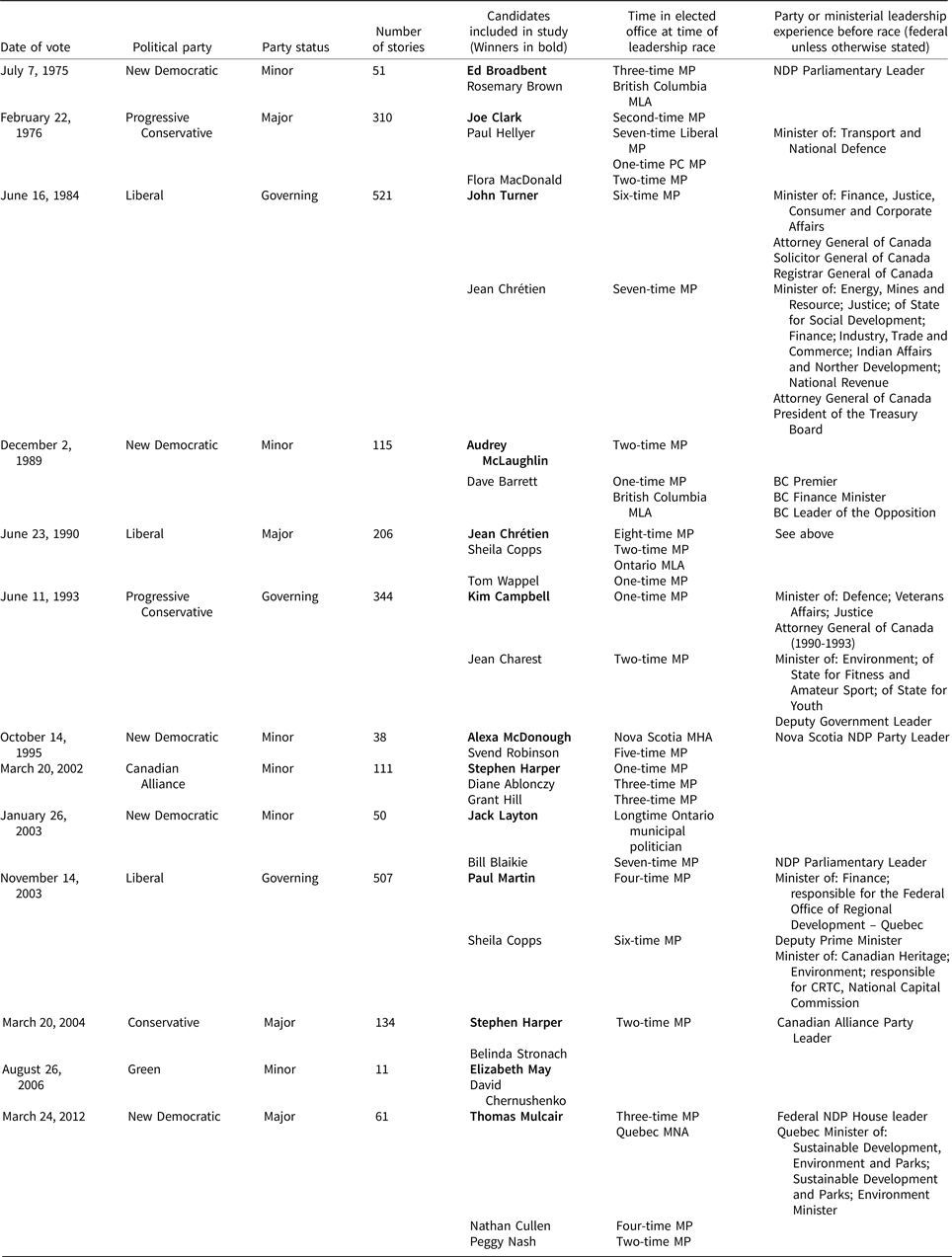
To explore these propositions, we address the following research question: Which leadership qualities are most likely to be emphasized in news reports about leadership competitions, and are they attributed differently to women and men candidates? To answer this question, we conducted content and discourse analysis of 2,463 articles published by the Globe and Mail newspaper about 10 women and 17 men who sought the leadership of Canadian political parties between 1975 and 2012. We begin by identifying the masculine underpinnings of political leadership and political journalism that render men the norm in politics. After detailing our methodology, we present the results on leadership coverage. We conclude by discussing the major findings and their implications for women and men seeking high-level political positions. In so doing, this study illuminates how the news media present gendered understandings of the skills and qualities associated with political leadership.
Gendering political leadership
The multifaceted nature of leadership makes it difficult to define, but we agree that it is “an inherently social process driven in large part by social perceptions … with leaders’ influence dependent upon other individuals granting them their authority” (Hoyt and Burnette, Reference Hoyt and Burnette2013: 1316). In a democratic system, political leadership is typically associated with individuals holding executive positions such as party leader, cabinet minister or prime minister (Peele, Reference Peele2005: 193). Political leaders are not only expected to provide a policy vision and to be able to win elections but also to possess the necessary traits and skills to achieve these goals. As government watchdogs, the news media play an essential role in assessing the performance of political leaders and in evaluating the potential of leadership hopefuls. Aaldering and Vliegenthart (Reference Aaldering and Vliegenthart2016) argue that the media are especially interested in six traits: political craftsmanship, vigorousness, integrity, responsiveness, communicative performances and consistency. Our analysis of Canadian news coverage reveals that two traits have high saliency during national party leadership contests in Canada: communicative performances and political craftsmanship. Since craftsmanship is a gendered word, we have adopted the neutral term of political acumen.
Competence, intelligence and experience are key to political acumen. A leader with political acumen possesses knowledge about various policy domains and political institutions and the experience and skills to successfully navigate the political system and handle opponents (Aaldering and Vliegenthart, Reference Aaldering and Vliegenthart2016: 1874). Mediated reflections on levels of political acumen can range from positive depictions of candidates as well-educated, knowledgeable and experienced to negative characterizations as uninformed, thoughtless and stupid. Aaldering and Vliegenthart's understanding of communicative performance focuses on a politician's ability to convey a clear message and mobilize supporters. Because politicians need to use the news media to transmit their messages to supporters, media skills are integral to leadership. As these authors argue, “party leaders with the image of good communicators are discussed in the media as being able to express their vision in a clear way; inspire people with their ideas; and present themselves as empathic, energetic, sympathetic and charming. Party leaders with the opposite image, on the other hand, are described as boring, unpleasant, antipathetic or uninspiring” (2016: 1880).
The qualities associated with effective communication and political acumen appear, on the surface, to be gender neutral since they are required of anyone holding a leadership position. However, because men created and then populated political institutions, these qualities have gendered associations. Commonplace understandings of leadership and governance are “embedded inside assumptions, practices, norms, belief systems that make men normal” (Duerst-Lahti and Kelly, Reference Duerst-Lahti, Kelly, Duerst-Lahti and Kelly1995: 19). One consequence is that “good” male traits and “good” leadership traits overlap (Sjoberg, Reference Sjoberg, Rhodes and Hart2014: 76). Psychological research finds strong support for this proposition. Men are presumed to be ambitious, analytical, intelligent, decisive and experienced (Dolan and Lynch, Reference Dolan and Lynch2014; Prentice and Carranza, Reference Prentice and Carranza2002). Men are assumed to possess the necessary traits to be strong political leaders unless they demonstrate otherwise. This is not the case for women. Traditional gender stereotypes posit women as honest, compassionate, consensus-builders, loyal, shy, soft-spoken and yielding (Dolan and Lynch, Reference Dolan and Lynch2014; Prentice and Carranza, Reference Prentice and Carranza2002). Because masculinity and femininity are constructed in opposition to one another (Duerst-Lahti and Kelly, Reference Duerst-Lahti, Kelly, Duerst-Lahti and Kelly1995), “good” female traits do not align with “good” leadership traits. Women must therefore prove that they possess the requisite competence, intellect and experience to be effective leaders. An important ramification of the cultural association between masculinity and political leadership is that “a woman tends to have a harder time both in seeing herself as a leader and in being seen as a leader” (Duerst-Lahti, Reference Duerst-Lahti and O'Connor2010: 23). Women who advance their leadership ambitions face challenges in convincing others of their ability to fill executive positions.
The norms, practices and narratives of political journalism tend to replicate the gender order. Gender stereotyping is commonplace in news representations of politicians. Several studies have found that, despite the inroads for women in leadership roles, news framing of women politicians continues to draw attention to stereotypical feminine qualities by emphasizing their sex, sexuality, appearance and domestic roles (Devitt, Reference Devitt1999; Heldman et al., Reference Heldman, Carroll and Olson2005; Herzog, Reference Herzog1998). Conventional news frames about politics are stereotypically masculine in tone and meaning. The game frame, also known as horse-race coverage, is common in election reporting and is replete with the language of the boxing match or battlefield (Gidengil and Everitt, Reference Gidengil and Everitt1999, Reference Gidengil and Everitt2000, Reference Gidengil and Everitt2003). The use of masculine language reinforces the cultural links between masculinity and political power (Gerrits et al., Reference Gerrits, Trimble, Wagner, Raphael and Sampert2017). Furthermore, women politicians often face harsher evaluations of their electoral viability and leadership competency than their male counterparts, thereby undermining their political legitimacy (Falk, Reference Falk2008; Gidgenil and Everitt, 1999, 2000, 2003).
By emphasizing personal traits, the news media downplay the leadership traits of competence, intellect, experience and media skills that might convince voters she has the political acumen and communication skills to perform a role historically interpreted as masculine. Add to this the tendency of journalists to use masculine language to describe political events and it becomes clear that women candidates face a challenge in being depicted as capable political leaders. But while feminist scholars urge the news media to focus on women politicians’ substantive qualities, their own focus has been on monitoring coverage of women's personal traits and circumstances. Few studies substantively and systematically examine media representations of women's leadership abilities (Harmer et al., 2016; Lunenborg and Maier, Reference Lunenborg and Maier2015; Rosas-Moreno and Bachmann, Reference Rosas-Moreno, Bachmann, Raicheva-Stove and Ibroscheva2014). As a result, less is known about the role of gender in media discourses of political leadership than about the nature and impact of personalized coverage. Understanding media representations of political leadership is important because, as Anne Stevens argues, “politics functions, in many ways, at the level of discourse” (Reference Stevens and Helms2012: 502). Party members might be less inclined to choose women candidates if media discourses suggest they lack the requisite leadership skills.
Data and methods
Our study contributes to research on media discourses about political leadership by analyzing the role of gender in news representations of the skills and abilities of prospective party leaders. While politicians face constant scrutiny of their leadership abilities, these qualities are especially salient during a leadership contest when rank-and-file members must select a replacement for a retiring or recently deceased party leader. A candidate's leadership potential is one of the factors that influence how members vote. The media strive to provide a range of information about candidates, including their leadership capabilities, policy ideas and career track record. To identify gendered discourses about political leadership, we examined news coverage of 27 individuals running in 13 Canadian party leadership campaigns between 1975 and 2012. The sample included all female candidates except those who finished in last place on the first ballot in multi-candidate competitions. For male comparators, we chose the man who came closest to the female candidate on the first round of voting (Falk, Reference Falk2008). If neither won, the male winner was included in the sample to facilitate across-campaign comparisons between female and male winners. The sample was rounded out by two all-male contests to control for the possible effects of a woman candidate on the nature of leadership coverage. Our analysis of each contest focused on one female and male candidate, with the 1975 Progressive Conservative (PC), 1990 Liberal, 2002 Canadian Alliance and 2012 New Democrat (NDP) campaigns examining two male candidates. While the 2006 Green Party contest was the focus of just 11 stories, the fact that the Globe covered its leadership race at all, despite the party's lack of representation in the House of Commons, demonstrates that it thought the party's star was on the rise. Indeed, Elizabeth May also went on to win a seat in the 2011 federal election. Hers was also only one of four national leadership campaigns won by a woman. As Appendix A shows, the final totals were 10 women and 17 men, with 1 woman and 2 men running twice for their party's leadership.
The longitudinal approach of our study necessitated that we analyze coverage in the Globe and Mail, which was founded in 1844 and began national distribution in 1980. The Globe has long been considered the country's paper of record (Bain, Reference Bain1994) and an agenda setter within the Canadian news industry (Taras, Reference Taras1999). Canada's only other national newspaper, the National Post, did not start publishing until 1998. All Globe stories that focused on the leadership contests were included in our dataset. Articles mentioning the campaign in passing, as in a single sentence, as well as candidate-written articles and all letters to the editor, were excluded. Collection started the day after the former leader's announcement of plans to resign, or their death, and ended a week after the leadership vote. In total, our sample included 2,463 news items.
In this study, we employed content analysis and feminist critical discourse analysis to understand the gendered dimensions of news representations. Content analysis is a quantitative method for examining written, visual or spoken texts (Krippendorff, Reference Krippendorff2004). Our codebook included a leadership skills variable, which records any descriptor or evaluator of performance, skills, qualities or character traits considered relevant to the job of Canadian party leader (see online appendix C for additional methodological details). Feminist critical discourse analysis is a qualitative technique that takes account of the gender structures of news production in mainstream media (van Zoonen, Reference Van Zoonen1994: 43) and is averse to totalizing approaches to analyzing gender-based representations and performances. Our analysis was designed to reflect the view that the relationship between discourses and social and political contexts are dialectical and that gender norms and performances are neither static nor stable (Lazar, Reference Lazar and Lazar2005).
MAXQDA, a qualitative data analysis software, was employed to systematically record the discursive context in which journalists noted candidates’ leadership skills. A preliminary analysis conducted by the three coders identified key words and phrases related to leadership skills. Using MAXQDA, lexical searches detected all instances of each word or phrase. Relevant mentions were given a code, with sentences before and/or after the word or phrase recorded. We then read through each story to identify any mentions of leadership skills not recognized by the lexical searches. This approach enabled us to develop a corpus of leadership skills and abilities highlighted in news coverage of leadership candidates.
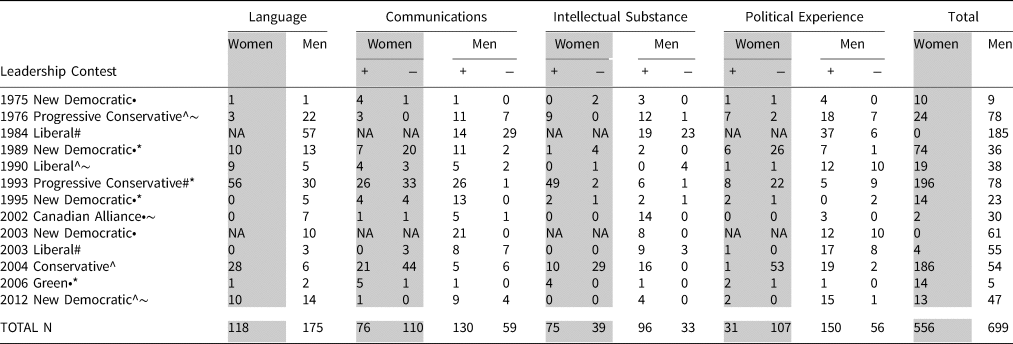
Lexical searches for language skills included all mentions of a candidate's competencies in any language. Communication skills were measured through explicit evaluations of a candidate's performance at debates or speaking events as well as during media interviews or before television cameras. Positive references included variations of terms such as “articulate,” “listens” and “skilled communicator.” Negative references incorporated terms such as “scripted,” “wooden” or “flat speech” and “shrill voice.” Intellectual substance mentions included variations of the words “intellect,” “brilliant,” “bright” and “smart” as well as evaluations of the candidate as possessing “expertise” or “substance.” Negative terms included “intellectual lightweight,” “stupid” and “dumb.” Political experience mentions featured synonyms of the words “experience” or “inexperience” but also “competence” or “incompetence.” Other negative references were “neophyte,” “rookie” and “newcomer.” MAXQDA was used to produce an overview of the variables, the results of which are presented in Table 1, as well as in Figures 2–5 in online Appendix B.
Specific leadership skill mentions by Canadian political party leadership contest, 1975 to 2012

Note: Positive mentions are indicated by a plus sign (+) and negative mentions by a negative sign (-). Governing parties are denoted by a hashtag (#), major parties by a caret (^), minor parties by a circle (•), and analyses including two male candidates are indicated by a tilde (~). Leadership contests won by a female candidate are indicated with an asterisk (*). The Language variable was not broken down into positive and negative mentions because of the wide range of evaluations made about each candidate's ability to speak French and/or English as well as other languages.
The next stage of the discourse analysis focused on observing gendered differences in journalists’ evaluations of leadership abilities. We concluded by assessing how these discourses reinforced or subverted the gendered norms of political leadership, demonstrating that, despite women's advancement in politics, the news media continue to express discomfort with the idea of women in powerful political positions (Bashevkin, Reference Bashevkin2009). This article focuses on four key leadership traits discussed in Globe coverage: language skills, communication skills, intellectual substance and political experience. For the media, strong language and communication skills signalled an effective communicative performance, while intellectual abilities and political experience were aligned with a high level of political acumen.
Results
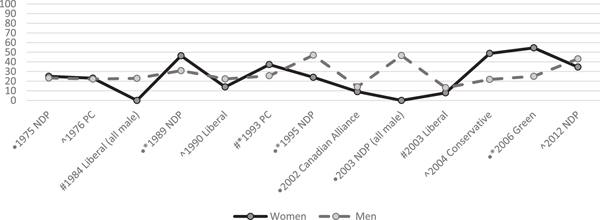
Figure 1 reveals that the Globe routinely evaluated the leadership skills of prospective party leaders, but their level of interest varied from one contest to another depending upon the nature of the campaign and the individuals seeking the post. Almost one-quarter (24%) of stories listed at least one leadership trait held by a candidate. Not surprisingly, cross tabulations show that editorial writers and columnists were a significant source of such evaluations: one-third of opinion pieces (35.5%) contained explicit leadership evaluations compared to less than one-fifth (18.7%) of regular news items (Pearson chi-square p < 0.000). An additional cross tabulation suggests a gendered element to this coverage. Women candidates (27.5%) were significantly more likely than their male counterparts (22.4%) to see their leadership abilities noted in news coverage (Pearson chi-square, p < 0.001).
Percentage of stories with at least one mention of a leadership skill in Globe and Mail coverage of each Canadian party leadership contest, by gender of candidate

However, interest in women's skills was most evident in three campaigns, illustrating the media's “fetish for firsts” (Trimble and Arscott, Reference Trimble and Arscott2003). In winning the 1989 NDP contest, Audrey McLaughlin became Canada's first female national party leader. Kim Campbell became the country's first woman prime minister when she emerged victorious in the 1993 PC contest. Finally, considerable attention was given to the leadership bid of businessperson Belinda Stronach, who had no experience in politics before seeking the leadership of the newly formed Conservative Party in 2004. As with the descriptions of soon-to-be Liberal leader Paul Martin in 2003, the Globe devoted considerable space to predicting what kind of prime minister Campbell would become and what policies she might pursue. A desire to understand the person who would soon lead the country did not motivate interest in McLaughlin's or Stronach's capabilities, as the prime minister's seat was not at stake in their contests. But each woman was intriguing in her own way. McLaughlin broke a barrier for women in national politics, while Stronach's wealth, attractiveness and celebrity status made her highly unusual for a party leadership candidate (Trimble and Everitt, Reference Trimble, Everitt, Sampert and Trimble2010). Party competitiveness does not appear to have played a role in the media's decision to mention leadership abilities. The NDP was a minor party at the time of McLaughlin's election, and the Conservatives were a major party when Stronach ran. The women who received little attention to their leadership abilities ran for governing, major and minor parties. Our findings thus indicate that highly newsworthy women are subjected to much greater mediation than less notable candidates. As our discourse analysis reveals, women and men are often subjected to different evaluations of their leadership abilities.
Language skills
The most consistently evaluated leadership skill in Globe coverage was the candidate's level of fluency in Canada's two official languages. News discourses repeatedly made it clear that parties hoping to form government need a leader who can appeal to francophone voters in Quebec and to anglophone voters in the rest of the country. Unilingual candidates were seen as unlikely to lead their party to victory in the next election and therefore were dismissed as serious contenders. Since many candidates in our sample were anglophones, coverage mostly focused on French language abilities. Journalists and opponents alike criticized candidates who did not speak French or had only rudimentary skills in the language. Candidates who were working on their French received more complimentary coverage but were still scrutinized for the extent to which they could deliver an unscripted answer. Not surprisingly, those who were effortlessly bilingual were warmly praised. Breaking down results by gender, our analysis reveals that language skills might be one of few leadership abilities not subjected to gendered assessments. Journalists discussed the linguistic dexterity of the 17 male candidates a total of 175 times and 118 times for the 10 female candidates (see Table 1 as well as Figure 2 in online Appendix B), for an average of 10.3 mentions per male candidate and 11.8 mentions per female candidate. As these results indicate, individuals aspiring to lead a national party in an officially bilingual country can expect to face media scrutiny of their language skills. Women will not likely be singled out for extra attention.
Communication skills
Language skills are part of an expectation that prospective party leaders be strong communicators. They should be able to discuss politics at the level of their interlocutors, whether it involves debating the finer points of policy with experts or discussing general ideas with voters. They should be comfortable in both small and large groups, before television cameras and media microphones, and at debates and campaign stops. As commercial enterprises, the news media have self-interested reasons for insisting on strong communication skills. They need politicians to be entertaining to help attract news audiences (McNair, Reference McNair, Kuhn and Neveu2002; Neveu, Reference Neveu, Kuhn and Neveu2002). Politicians who perform poorly, especially during televised debates or convention speeches, threaten the media's ability to deliver a compelling product to news consumers and advertisers. It was unsurprising that the Globe regularly evaluated the speaking and debating abilities of both women and men, criticizing those who were perceived as overly scripted, wooden or just plain boring, and praising those who were captivating, engaging and warm.
Even though all candidates had their communication abilities assessed, women were subjected to greater mediation if they did not live up to expectations. Journalists offered 110 negative evaluations of women's communication skills compared to only 59 for men (see Table 1 above, and Figure 3 in online Appendix B). As with much of the leadership coverage analyzed in this study, Campbell, McLaughlin and Stronach bore the brunt of the gendered mediation. These women came under heavy criticism for disappointing performances, but for different reasons. One columnist noted that McLaughlin “fizzled so badly in her opening press conference” (Simpson, Reference Simpson1989) while another said she “gave a flat and uninspiring performance in her keynote speech” at the 1989 NDP leadership convention (Winsor, Reference Winsor1989). In the 1993 PC contest, journalists saw Campbell's scripted delivery as a defensive strategy to protect her frontrunner status (Fraser, Reference Fraser1993). Stronach's “stilted” and “wooden” performances in the 2004 Conservative race, in contrast, were interpreted as incompetence. Journalists questioned her ability to debate her opponents without the aid of a script (Globe and Mail, 2004a) and pilloried her appearance on a talk radio program (MacGregor, Reference MacGregor2004).
Negative evaluations of Campbell, McLaughlin and Stronach contrasted starkly with those of their male counterparts. Journalists praised the men's communication skills 130 times compared to just 76 times for the women. Jean Charest in 1993 and Stephen Harper in 2004 were consistently described as well spoken, with Charest earning praise for having “uncanny, almost unnatural, verbal skills” (Corcoran, Reference Corcoran1993). The two men's communicative performances were rarely criticized.
Intellectual substance
Although Aaldering and Vliegenthart (Reference Aaldering and Vliegenthart2016) have treated communicative performance and political acumen as distinct characteristics of leadership, the two have been repeatedly linked in Globe coverage. Candidates have been described as bright and articulate or knowledgeable and well spoken. Political leaders not only had to be excellent communicators but also had to possess intellectual substance; they had to be intelligent and offer substantive policy ideas (Broadbent, Reference Broadbent2002). All candidates were expected to discuss policy on the campaign trail.
Depending upon the campaign, though, men were more likely than women to see their intelligence, knowledge and expertise noted in news coverage. Journalists touted men's intellectual substance 96 times compared to 75 times for women (see Table 1 as well as Figure 4 in online Appendix B). Notably, two-thirds of the female mentions were devoted to Campbell, while the male mentions were distributed across several individuals. Stephen Harper in 2002, Paul Martin in 2003 and Thomas Mulcair and Nathan Cullen in 2012 were described as smart men. The intellectual capacities of their respective female competitors barely rated a mention, if at all.
Coverage of Harper's two leadership runs was especially flattering. One columnist was delighted at his entrance in the 2002 Canadian Alliance race after a four-year absence from federal politics: “Welcome back, Mr. Harper. It is great to have substance to deal with again” (Winsor, Reference Winsor2001). During the 2004 Conservative contest, Harper was described as an ideas man who had “a formidable grasp of policy” (Ibbitson, Reference Ibbitson2004b) and was “the best public policy mind in the House of Commons” (Manning, Reference Manning2004). In contrast, Stronach, Harper's main opponent in 2004, was depicted as the prototypical dumb blonde. Journalists raised explicit doubts about her intellectual substance 29 times throughout the campaign, the highest for any candidate. Stronach was described as “not very bright” (MacGregor, Reference MacGregor2004) and a “politically uneducated person” who was “still learning the rudiments of important issues” (Simpson, Reference Simpson2004). One editorial went so far as to claim that “she appears literally not to understand what she's talking about” (Globe and Mail, 2004b). The evaluation of Harper as intelligent and Stronach as dumb reinforced gender stereotypes that position men as more capable of governing.
Doubts about some men's intellectual acumen were more muted. Men received 33 negative evaluations of their intellectual substance, with 23 coming in the 1984 Liberal contest. Jean Chrétien was the only male leadership hopeful in the sample whose intellectual abilities were consistently questioned, and this occurred more so during his failed 1984 run for the Liberal leadership (13 mentions) than during his successful bid in 1990 (4 mentions). What is striking about the 1984 references, however, is that criticism of his intellect was either downplayed or accompanied by positive assessment of other abilities. One story said Chrétien was “known as a wonderful politician but one without intellectual rigor” (Simpson, Reference Simpson1984). In the 1990 campaign, references were less numerous but more negative in tone. Chrétien was described as a lightweight who “was incapable of absorbing complicated problems” (Delacourt, Reference Delacourt1990a). Unlike Stronach, negative evaluations of Chrétien's intellectual abilities did not dominate his coverage: 5 of his 13 mentions in 1984 appeared in a single story. Nor were his intellectual deficiencies seen as a threat to his leadership ambitions. While Chrétien and Stronach were both seen as lacking a strong grasp of policy, Chrétien was able to recast himself as a “practical guy” who got things done. The Globe's continuous criticism of her real and perceived intellectual shortcomings meant Stronach was not able to do the same.
To be fair, some women leadership hopefuls were recognized for their competence. Coverage of the 2006 Green Party contest noted that eventual winner Elizabeth May was “quick thinking, tanked up with political experience and, shall we say, ha[d] energy to burn” (Martin, Reference Martin2006). But praising May's expertise did not disrupt the gendered political order, as the Greens are minor players on the federal scene in Canada with little chance of forming government. The same could not be said about Campbell. Her intellectual prowess was the focus of intense mediation as it became clear that she would likely become Canada's first female prime minister. Journalists noted Campbell's intellectual substance an astonishing 49 times, compared to just 26 references for other women candidates. She was repeatedly described as intelligent, bright, smart and sharp.
Discussion of Campbell's intellectual abilities appeared on the surface to be positive, but they were often accompanied by negative evaluations about other aspects of her character. The Globe suggested that her intellect violated gender norms because she was not sufficiently humble about her abilities. She was accused of intellectual arrogance, arguing that she is “more than a little proud of her refinement and her intellect” (Whyte, Reference Whyte1993) and “sometimes cannot help demonstrating that brightness to others” (Simpson, Reference Simpson1993a). That her self-confidence allegedly made her sensitive to criticism also suggested to journalists that she did not possess the requisite toughness to be prime minister (Simpson, Reference Simpson1993b). By describing Campbell's intellect as both a positive and a negative trait, the Globe raised doubts about her leadership abilities (see also Trimble, Reference Trimble2017: 40–46).
While praise of Campbell's intellect was often accompanied by accusations of conceit, news representations of Harper as an intellectual heavyweight were rarely accompanied by claims of arrogance. In keeping with gender stereotypes that posit men as naturally self-confident, Harper was allowed to be confident in his abilities, while Campbell's confidence was read as conceit. Male leadership hopefuls were not punished for any intellectual shortcomings or excesses in the same way as their female counterparts. Men's ability to lead was not thought to be compromised by being too smart or not smart enough. That women's intellectual abilities came under greater scrutiny shows that the same assumption was not made about them: women had to prove they had the smarts to be leader but were chastised when they were seen to flaunt their cleverness.
Political experience
Political experience is another important metric by which journalists judge the potential of individuals aspiring to head a national party. In the Globe's view, candidates should have held elected office, with federal experience clearly preferred. The media discourse suggests that the ideal candidate is someone who has been a member of Parliament for several years and has held important cabinet portfolios, giving them a strong understanding of how the Canadian parliamentary system works as well as a track record that journalists and voters can use to assess their leadership competencies and policy leanings. Candidates for minor parties such as the NDP and Greens are at an obvious disadvantage here: they do not have the opportunity to hold cabinet positions and accumulate the kind of political experience that their Liberal or Conservative counterparts do. Still, an extensive background in party politics or provincial legislatures, which some NDP candidates had, is looked upon favourably. One consequence of these expectations is that news coverage across the 13 leadership campaigns was replete with discussion of candidates’ political backgrounds.
The newspaper characterized individuals with little or no prior experience in federal or party politics by calling them political neophytes. This was true even if the individual had been politically active at other levels of government. Toronto city councillor Jack Layton was called a neophyte and a rookie to federal politics during his successful NDP leadership bid in 2003 (Lunman, Reference Lunman2002, Reference Lunman2003). Possibly, this was due to his lack of experience in party politics, owing to the nonpartisan nature of municipal government in most parts of Canada. Notable exceptions to the neophyte trend were NDP candidates Dave Barrett in 1989 and Alexa McDonough in 1995, both of whom had been provincial party leaders and, in Barrett's case, provincial premier. That party leaders and heads of government have similar responsibilities at the federal and provincial levels likely explain why the Globe treated these candidates’ provincial experience as equivalent to federal experience. That Barrett and McDonough both received credit for their provincial service suggests this aspect of political experience is not seen through a gendered media lens.
In contrast, other evaluations of candidates’ political backgrounds were highly gendered. Women candidates were noticeably more likely than their male counterparts to be criticized for a lack of political experience: women received 107 negative evaluations compared to men's 56 (see Table 1 as well as Figure 5 in online appendix B). This practice was especially pronounced in Stronach's coverage. She was the focus of 53 negative comments, constituting half of all the female references. Journalists continually noted, especially when she was deemed to have performed poorly at campaign events, that Stronach had never been elected to any political office before seeking the Conservative leadership (Ibbitson, Reference Ibbitson2004a). Stronach was viewed as no match for Harper. One columnist argued that the “continuing front-runner in the leadership race has a formidable grasp of policy, years of experience in the House, and can take credit for rebuilding the Alliance Party and then merging it with the Progressive Conservatives” (Ibbitson, Reference Ibbitson2004b).
Journalists also tended to minimize the experience of women candidates who did have a background in federal politics. The Globe described both McLaughlin and Campbell as neophytes with limited political experience because they were one-term MPs when they ran for the leadership of their respective parties. Yet during Campbell's time in Ottawa, she held the important cabinet portfolios of justice and defence, guiding more than two dozen bills through the legislature (Howard, Reference Howard1993). Her main competitor, Jean Charest, had just two more years in the House of Commons and was appointed to the minor posts of minister of state for fitness and amateur sport and, later, environment minister. Charest's legislative record was sparse in comparison to Campbell's, yet her track record came under media scrutiny and was found wanting (Globe and Mail, 1993a). While Charest was judged to have “the makings of a prime minister” (Globe and Mail, 1993c), the Globe's pundits assessed Campbell as “unsuitable” for the job (Winsor and Howard, Reference Winsor and Howard1993) and as lacking “the necessary experience” to be prime minister (Globe and Mail, 1993b). Devaluation of McLaughlin's experience was less surprising because she had never held a cabinet post and her main competitor was a former premier.
The news media tend to present gender-differentiated interpretations of candidates with objectively equivalent levels of political experience, which is evident in two additional examples. Flora MacDonald was in her second term as a member of Parliament when she sought the PC leadership in 1976. So was Joe Clark, who surprised everyone by winning the contest. Both had spent four years on Parliament Hill before seeking the top job. But while Clark's relatively short tenure as MP was heralded—he was “a fine fellow with a lot of parliamentary experience” (Newman, Reference Newman1976)—MacDonald's “years of service within the back rooms of the party” were emphasized in her coverage (Globe and Mail, 1976). MacDonald was cast as the party help-mate, applauded for working behind the scenes, while Clark was judged for his experience in the House of Commons. In 2003, Sheila Copps was the only contender to challenge Paul Martin for the Liberal leadership. Despite having 19 years in office and 10 years in cabinet, including a stint as deputy prime minister, Copps garnered only one experience mention (Simpson, Reference Simpson2003). Martin, whose term in office was shorter, was lavishly praised for his “nine exemplary years as Finance Minister” (McCarthy, Reference McCarthy2003). Media discourses around political resumes raise the question of how much political experience a woman needs to be considered a legitimate leadership contender. If gendered evaluations of women's political experience were limited to when women first began to seek the leadership of Canadian political parties, we could argue that it reveals an initial discomfort with women's growing political ambitions that has dissipated as more women seek and win these posts. But that this form of gendered mediation continued into the 2003 Liberal leadership contest suggests an ongoing discomfort with women seeking important political leadership positions (Bashevkin, Reference Bashevkin2009).
While journalists chided women candidates for not having spent enough time in political office, they were more likely to criticize men candidates for having been in office for too long—the only negative gendered mediation exclusively targeted at men. Men whose political careers spanned decades were depicted as spent forces. Their extensive experience as campaigners and legislators was not taken as evidence of their ability to be effective leaders but rather of their inability to tackle contemporary problems. A former long-time federal MP when he sought the Liberal leadership in 1990, Jean Chrétien was described in news stories as an “outdated politician” (Delacourt, Reference Delacourt1990b; Howard, Reference Howard1990). The Globe used gendered terminology to characterize Chrétien and other male candidates as lacking innovative ideas for resolving pressing issues, for instance by calling them “yesterday's man” (Gray, Reference Gray2003; Howard, Reference Howard1989; Simpson, Reference Simpson1990). John Turner faced the most extensive criticism on this front: he was routinely depicted as having ideas, mannerisms and approaches to politics that were more appropriate for the 1950s and 1960s than for the 1980s. In contrast, male candidates with shorter political resumes were more likely to be called “fresh faces,” subtly inferring they might have new ideas and approaches to governing.
Discussion and conclusions
Our large-scale, longitudinal study of news coverage of 13 Canadian party leadership contests held between 1975 and 2012 found that the Globe and Mail considered political acumen and communicative performances integral to the proper performance of political leadership. Journalists were especially keen to assess candidates’ linguistic fluency, communication skills, intellectual substance and political experience to determine the extent to which they would be effective as a party leader or prime minister. However, normative expectations regarding the qualities a political leader should possess, and gendered assumptions about male and female traits, resulted in news coverage featuring a curious mix of neutral and gendered appraisals. With language, we found that all leadership hopefuls were expected to reflect the bilingual identity of the country. Women and men were both admonished if they could not converse easily in both English and French.
While all candidates faced intense scrutiny of their linguistic skills, women candidates were subjected to more negative and gendered assessments of other communication skills and political acumen. Women found wanting on these dimensions often had their leadership potential openly questioned in the pages of the Globe. They faced gendered evaluations if they performed poorly or not to expectations during candidate debates, media interviews or stump speeches. Their intelligence, expertise, knowledge and experience were downplayed if extensive, as in the case of Campbell, Copps and MacDonald, or belittled if found lacking, as in the case of Stronach. Notably, however, gendered mediation was the most intense for the most newsworthy of women candidates, specifically women who were about to achieve a historic first in politics (McLaughlin, Campbell) or were highly atypical for female candidates (Stronach). Party competitiveness did not appear to play a major role. McLaughlin's NDP was a minor party in the 1980s while women who ran for the leadership of major parties, like Copps for the Liberals in 2003, experienced far less mediation of their skills and abilities. In comparison to their female counterparts, men usually received complimentary coverage of their leadership strengths and muted attention to their leadership weaknesses. Only men who had spent decades in politics were subjected to negative evaluations of their leadership potential, with the media openly questioning their ability to respond to contemporary problems. It is unclear at this point whether this form of gendered mediation is only a problem for male leadership hopefuls, as significantly fewer women than men can claim similar tenures in provincial and federal politics.
We also found little evidence that gendered media discourses about political leadership have changed over time, especially in the case of women in the strongest position to become party leader or prime minister. Over the 37-year period of our study, gendered narratives were most commonly applied to highly newsworthy women candidates—specifically Campbell, McLaughlin and Stronach. News coverage of Stronach in 2004 was every bit as gendered as McLaughlin's in 1989 and Campbell's in 1993. Overall, mediation was less pronounced for less competitive women or those running for small parties like the Greens. One downside to this limited mediation, though, was that it was often accompanied by limited interest in their leadership abilities overall. If the Globe did not negatively discuss women's abilities, they often did not discuss them at all. One conclusion to be drawn from these results is that only women candidates who are set to break barriers or who have qualities that make them highly newsworthy can expect to receive protracted media assessments of their political acumen and communicative performances. But these conclusions remain to be tested on the most recent leadership contests, held by the Liberals in 2013 and the Conservatives and NDP in 2017. The latter two competitions featured strong women candidates and competitive racialized men whose coverage might be infused with racial stereotypes (Tolley, Reference Tolley2016). Because the women who sought the leadership of these three parties were neither front runners nor political trailblazers, it is unlikely that their coverage will break from the pattern of low gendered mediation for previous female contenders. What might challenge our findings are results for the racialized male candidates. Research on other minority candidates (Tolley, Reference Tolley2016; Ward, Reference Ward2017) suggests that these men will experience racial mediation, with racial stereotypes shaping media evaluations of their communication skills, intellectual substance and political experience.
Canada's parliamentary system, federal structure and leadership selection processes are similar to many other Western liberal democracies; therefore, findings from this study can inform research on other national contexts. At this point, the media's gendered treatment of the most successful women politicians in Canada demonstrates discomfort with, and anxieties around, women's advancement in politics (Bashevkin, Reference Bashevkin2009). For instance, Campbell received considerable praise for her intellect, but, in her case, it was often accompanied by claims that she was arrogant and perhaps too smart. The result was a complicated narrative of the eventual Progressive Conservative leader as both highly qualified and unqualified to be prime minister, the real job for which the media evaluated her. No woman has won the leadership of a major party since 1995, however, which means that we cannot determine the extent to which women's presence as national party leaders is contested—or normalized—in the twenty-first century.
Supplementary material
To view supplementary material for this article, please visit https://doi.org/10.1017/S0008423918000471
Acknowledgements
The authors thank Daisy Raphael and Bailey Gerrits for their assistance with the content analysis, as well as individuals who commented on earlier versions of this paper at the Canadian Political Science Association and American Political Science Association conferences.
Funding
Funding for this project was provided by a Standard Research Grant from the Social Sciences and Humanities Research Council of Canada.
APPENDIX A
Leadership Races and Candidates