





Introduction
Today, when thinking about Tibet cartographically, most Tibetans find it hard not to conceive of it as a geo-body (a nation imagined as a bounded figure with precise map-line boundaries)Footnote 1 composed of three bounded regions known as chölkha sum (defined as Ü-Tsang, Kham/Dotö, and Amdo/Domé), whose external boundaries mark the sacred and natural limits of Tibet (Figure 1). Each chölkha is assumed to possess unique historical, dialectal, or cultural characteristics that differentiate it from the others. In exile, identification with one of these three chölkha is nearly universal. Article 46, sub-clause 1 of the Tibetan Government-in-Exile’s election regulations (adopted as law on 8 April 2000) stipulates that voters must adhere to their registered chölkha constituency as it appears in the voter registry.Footnote 2 While some flexibility exists, for example children of mixed-chölkha couples may select their affiliation at 18, chölkha remains the basic subunit of national belonging. This subnational regional affiliation is deeply intertwined with a broader sense of belonging to Tibet. To be Khampa or Amdowa, for instance, is to be Tibetan, an identity that mobilizes the regime of meanings (and obligations) associated with national belonging.
A map of Tibet depicting the three chölkha. (Not to scale, intended for illustrative purposes only.) Source: Author’s own illustration.

While chölkha identity occupies a central place in Tibetan nationalist thought, exiled Tibetan elites have long viewed it as a major threat to national unity. This has become particularly salient in recent times, with many arguing that narrow chölkha allegiances have fractured the cohesion of the exile community. In March 2021, a Tibetan parliamentarian, addressing the pervasiveness of chölkha-based partisanship, likened it to a ‘virus’ and warned that if left unaddressed, it could become ‘even more dangerous for our society than the current COVID-19 pandemic’.Footnote 3 As recently as February 2024, the Dalai Lama publicly condemned this chölkha-based identitarian politics, calling it ‘regrettably shameful’ and urging Tibetans to abandon their narrow chölkha loyalties and think of themselves first, and perhaps only, as Tibetans.Footnote 4
Exile nationalist discourse attributes this ‘problem’ of chölkha-based partisanship to the atavistic forces of territoriality, which, they argue, have historically contributed to Tibet’s division and consequent colonization by China. In the dominant nationalist account, the ‘chölkha problem’ stems from the incomplete modernization of Tibetan society, another sign of ‘old Tibet’ impeding its march towards progress. For nationalists, who view themselves as children of modernity, the only legitimate belonging is to the nation, which is regarded as a more evolved stage of socio-political organization.
Whether celebrated or criticized, chölkha has become central to contemporary Tibetan nationalist thinking. As an epistemic category, it organizes Tibetan historical imagination, current socio-political realities in exile, and visions of the future. Yet, despite its centrality, scholarship on the idea of chölkha sum is sparse.Footnote 5 The few studies that exist, with the notable exception of Eveline Washul’s work,Footnote 6 focus predominantly on its premodern history, tracing the term’s origins and historical intricacies, largely in an effort to answer modern questions about the boundaries of chölkha using premodern data. The underlying assumption is that modern chölkha identity is a direct continuation of its premodern antecedent. Consequently, it is assumed that the answer to contemporary boundary questions lies buried deep in history, simply waiting to be uncovered through empirical inquiry. While indebted to these studies in understanding premodern chölkha, especially the work of Hortsang Jigme, Lobsang Shastri, and Eveline Washul, this article diverges in its focus and interpretation.
This article develops five interrelated arguments. First, it differentiates between premodern and modern chölkha collectives in exile. While scholarship on Tibetan nationalism and identity has generally acknowledged that modernity has reshaped Tibetan subjectivities, little systematic effort has been made to delineate precisely how modern identity formations differ from their premodern antecedents. Any argument about the ‘newness’ of modern identity formation needs to take the premodern as a baseline. Drawing on this distinction, this article argues that modern chölkha identity in exile, as we know it today—a clearly delineated, mutually exclusive popular identity category inextricably tied to the nationalist imagination of Tibet—is not an unchanging continuation of premodern Tibetan identity. Instead, it is a modern phenomenon that emerged first in exile as a result of the Tibetan encounter with the globalizing forces of colonial modernity, particularly its adoption of new rationales (such as democracy) and technologies of government (such as modern institutions of censuses and elections). This is not to argue that chölkha identity was invented ex nihilo. Rather, it demonstrates how modern institutions of governmentality reshaped pre-existing identity categories, preserving their nomenclature while operating within entirely different systems of meaning, practice, and institutional reality.
Second, it demonstrates the historical contingency of modern identity, arguing that the chölkha outcome was not inevitable. It was contingent not only upon exogenous factors, such as the Tibetan encounter with colonial modernity, but also upon contingent discursive interventions. Even if we were to regard some form of modernization of the Tibetan political system as an ‘inevitable’ response to modern Chinese colonialism, given the global historical trajectory since the mid-nineteenth century, there were competing frameworks that could have been marshalled to imagine Tibet’s geo-body and to organize democratic politics in exile, even as late as early 1960.
Third, it highlights the critical role that modern governmental institutions like elections and censuses play in inscribing the nation onto the bodies of Tibetans, a key point that has been overlooked in existing scholarship on Tibetan identity and nationalism.Footnote 7 When these institutions enumerate exiled Tibetans into the chölkha categories, they simultaneously inscribe the nation onto their bodies. After all, according to the nationalist paradigm, there are no Tibetans without chölkha and no chölkha without being Tibetan; both are mutually co-constitutive. By reducing what was at the beginning of the twentieth century fuzzy, fluid conceptualizations of the imagined community held by Tibetan nationalist elites to the institutional grid of governmentality, institutions of census and election precisely delimit who belongs to the Tibetan nation and who does not.
Fourth, by tracing the role of modern governmentality in the formation of modern chölkha identity and national subjectivities more broadly, this article aims to show that the formation of modern Tibetan identity is directly tied to the broader problem of the formation of collective subjectivities in the modern world. Nation may manifest differently in the Tibetan world setting; however, nationalism itself is a paradigmatic global phenomenon, one that first emerged in the eighteenth-century modern West before spreading worldwide. Its emergence in Tibet is inextricably linked to the global history of modernity, specifically what Benedict Anderson describes as the spread of ‘new material, institutional and discursive foundations’ of modern collective subjectivities.Footnote 8 This is most visible, as Anderson observes, in the ‘remarkable planetary spread, not merely of nationalism, but of a profoundly standardized conception of politics’.Footnote 9
Finally, while building on Anderson’s theoretical framework, this article addresses a central limitation in his approach: in describing two typologies of modern collective subjectivities as unbound and bound serialities, Anderson treats them as neatly distinct analytical modalities that exist simultaneously. This overlooks the recurring, although contingent, historical link between these two modalities. Instead, I argue for a ‘sequential thesis’ as a way of reframing Anderson’s typologies: rather than existing as simultaneous modalities, ‘unbound’ and ‘bound’ serialities, in many cases, represent historical sequences in the construction of modern collectives. Recognizing this recurring sequence allows us to better understand the global history of the formation of modern collective subjectivities, especially the history of nation-formation.
Premodern chölkha: Establishing a baseline
The term chölkha is a derivative of the Mongolian geo-administrative term cölge, meaning district.Footnote 10 According to the traditional Tibetan historical narrative, such as Taktsang Paljor Zangpo’s fifteenth-century Gya Bod Yiktsang Chenmo (The Great Records of China and Tibet), after the Tibetan regions came under the dominion of the Mongol empire in the thirteenth century,Footnote 11 the Mongols conducted a systematic census of Tibet’s population and divided it into three geo-administrative regions called chölkha sum.Footnote 12 This narrative asserts a unique chöyön (commonly translated as priest-patron) relationship between the spiritual master, the Sakya lama Drogon Chogyal Phakpa, and the lay patron, the Mongol ruler Kublai Khan—a political-religious ideology that historically framed the relationship between Tibet and foreign imperial powers. As part of this symbiotic arrangement, Kublai Khan is said to have offered the chölkha sum of Tibet to Drogon Phakpa in return for the second tantric initiation conferred upon him and his family. While a more recent study by Eveline Washul has convincingly questioned the historicity of this narrative for the Mongol-Sakya period, arguing that the chölkha sum during this time likely referred to Ü, Tsang, and Ngari,Footnote 13 it is nevertheless undisputed that by at least the fifteenth century the chölkha sum was understood in the Tibetan-speaking world as comprising Dotö, Domé, and Ü-Tsang.Footnote 14 Following the collapse of the Sakya-Mongol regime (1270–1354), the chölkha lost its political significance as an administrative unit. In the centuries that followed, chölkha survived not as a functioning governmental unit, but as a discourse; an idea rather than something with institutional reality.Footnote 15
Yet, despite this lack of institutional relevance, the discourse of chölkha sum became an important part of how Tibetans imagined themselves, the geographical landscape of Tibet, and its internal divisions. However, as this article contends, these premodern conceptions of chölkha, or collective identity more broadly, were not only distinct from modern ones, but their subsequent linkage was neither straightforward nor inevitable for four key reasons.
Limited social reach
First, to be sure, identification with large, abstract regional categories such as Ü-Tsang, Kham, and Domé certainly existed in the premodern era. The early nineteenth-century author from the modern-day Amdo chölkha, Tsanpo Nomönhan, for instance, described the inhabitants of Ü-Tsang as ‘gentle and honest, and sharp’ but not particularly ‘profound’ in learning, while characterizing Khampas as ‘honest and courageous’ yet ‘sectarian’.Footnote 16 Such tropes indicate that these regional categories were meaningful identity markers in premodern Tibet. However, in the absence of modern technologies of communication (e.g. newspapers) and movement (e.g. railways)—when the horizons of belonging were significantly smaller—the sense of belonging to large abstract collectives, such as the chölkha (and Tibet as a whole), was limited largely to a comparatively small segment of the mobile and connected population: primarily literati and political elites, as well as the mobile class of monks, pilgrims, and traders. For the non-literate rural majority, the boundaries of belonging, despite how they may have been conceived from above, would likely have been defined locally, rooted primarily in smaller face-to-face communities such as kinship groups, tribes, and their native homelands. Even if the religio-historical narratives of imperial Tibet, and by extension the idea of ‘Greater Tibet’, reached the rural majority via Tibet’s wandering bards, as George Dreyfus has pointed out, it is difficult to imagine (and given the lack of subaltern voices from history, we can only speculate) that in the absence of their institutional and political reality, these ideas were anything other than fleeting and peripheral to people’s sense of identity.Footnote 17 Larger social identities beyond one’s immediate smaller communities did not, for the most part, constitute an important category through which this majority organized its world. This is best evidenced by the early twentieth-century observation of Robert Ekvall, a missionary and scholar who worked in the Tibetan borderlands before Chinese colonization, that in Amdo, in the northeastern parts of Tibet, nomadic tribes saw themselves as ‘sovereign states’ that had complete control over their territory and were fiercely resentful of any encroachments on their sovereign rights.’Footnote 18
Fluid and fuzzy boundaries
Second, perhaps as a result of the institutional and political intangibility of chölkha (and Tibet more generally), the geographical references of these categories, as Hortsang Jigme demonstrates, were historically unstable.Footnote 19 For instance, historically, the term ‘Domé’, synonymous with Amdo chölkha today, lacked a stable definition. It was at times used to designate an area roughly aligned with the modern-day Amdo;Footnote 20 at other times, it covered what is now Amdo and lower Kham/Dotö;Footnote 21 and in still other instances, it referred to a region closely aligned with the modern-day Kham/Dotö chölkha.Footnote 22 Consistency was rare, sometimes even within a single text.Footnote 23
Moreover, because the post-Sakya-Mongol discourse of chölkha sum was primarily concerned with abstractly representing the regions of ‘Greater Tibet’ through the narrative of Kublai Khan’s offering of Tibet to the Sakya hierarch, rather than defining chölkha as fixed territorial–administrative units, chölkha’s boundaries were conceived only in fuzzy and fluid terms. Geographers call this type of imagining ‘perceptual geography’: a shared, yet imprecise, geographical categorization among the literati that lacks formal institutional or legal reality.Footnote 24 This fuzziness is best exemplified by the fifteenth-century text, Gya Bod Yiktsang Chenmo, by Taktsang Paljor Zangpo, the earliest known source to delineate the boundaries between the chölkha. Taktsang delineated them as:
From Jayul Ngari Gungthang to the Sokla Kyawo (Grey Mountain Pass in Sok), marking the chölkha of sublime religion (Ü-Tsang); from the Sokla Kyawo to Machu khugpa (the bend of the Yellow River), marking the chölkha of the black-headed people (Dotö); and from Machu khugpa to the Gya Chorten Karpo (White Chinese stupa), marking the chölkha of the horse (Domé).Footnote 25
Neither Taktsang nor the later sources that adopted his framework specified, for instance, which bend of the Yellow River in Tibet served as the boundary between Dotö and Domé, let alone how to draw a contiguous map-line. This absence of precise boundaries did not stem from any lack of ability in precision (strategic border points, when required, were precisely marked) but from the fact that they served the purposes of the time very well, namely, to imagine the realm of Tibet in abstract religio-cultural and political terms, rather than as a political administrative unit defined by neat boundaries. As a result, while the idea of Tibet as covering most of the Tibetan Plateau is at least a millennium old, the boundaries of elite-imagined ‘bod’ (Tibet) and ‘bod mi’ (Tibetans), especially at the edges, varied across sources. This is best illustrated by Langelaar and Bialek’s recent study demonstrating the shifting borders of Tibet across five historical sources (and sometimes within the same sources) between the twelfth and seventeenth centuries, depending on each source’s geographical provenance, the political context, and literary genre.Footnote 26 This fluid and fuzzy conception of boundaries was reflected on the ground, where the differences between communities (both among Tibetans and with others) existed along a spectrum, rather than as clear-cut divisions separating internally homogeneous groups by elite-imagined boundaries, whether nationalist or colonialist. At the margins of these communities, boundaries were porous, and those living at the edges often had more in common with one another than with the distant centres of their respective groups.
Pre-nationalist paradigm
Third, and perhaps most importantly, identity and difference in premodern Tibet operated within distinct ontological and epistemological frameworks, thereby mobilizing discrete regimes of meaning from their modern counterparts. Historically, while Tibetan literati elites shared a broad civilizational sense of belonging—founded on a common language, religion (Buddhism predominantly), a shared origin myth, and the memory of the imperial period (seventh to ninth century)—this collective identity was expressed within a religio-cultural and political framework,Footnote 27 but not a nationalist one organized around the logic of the nation-state, an idea that became dominant globally only in the twentieth century.Footnote 28 The majority of the population, as elsewhere in the premodern world, would have found the idea absurd that not only did they belong to a large abstract community called the Tibetan nation (bod mi rig), most of whose members they would never meet in their entire lives, but that this large abstract community deserved their undivided primary loyalty. Tibet was imagined as a Buddhist sentinel under the divine protection of Avalokitesvara, the Bodhisattva of Compassion and Tibet’s patron saint and mythic progenitor, whose sacred mission was to guide the Tibetan people towards spiritual awakening. This religio-historical narrative gave coherence to the idea of Tibet as a sacred land and its people as a chosen one, but it did not translate into a modern political project of unifying disparate regions and their people under a single, ethnically defined national state.Footnote 29 Operating within this pre-nationalist paradigm, identification with a chölkha did not always mobilize a sense of political belonging to Greater Tibet, let alone the nationalist desire for a unified Tibetan state. Consequently, it was entirely normal for individuals to identify with Domé or Kham, seen as part of Greater Tibet, while perceiving the Central Tibetan government (Ganden Phodrang) as a foreign entity. This is vividly illustrated by the 1889 Nyarong Revolt. Following the suppression of Gonpo Namgyal in 1865, Nyarong was incorporated into the Lhasa government’s rule; however, burdened by corvée labour and heavy taxation, the populace revolted against the Lhasa-appointed commissioner in 1889, reinstated Namgyal’s grandson as chief, and petitioned the Qing emperor to incorporate the region into China proper.Footnote 30 This event makes explicit the idea that while Nyarong’s inhabitants, especially the elites, may share a common origin myth with Greater Tibetan regions, their political allegiances were fluid and pragmatic, aligning with Qing China against the Lhasa government when required. This pragmatic shifting of allegiances, incomprehensible and immoral within modern nationalist logic, made perfect sense in a world where cultural affinity and political sovereignty were not expected to align.
Competing frameworks
Lastly, despite its importance, historically, chölkha sum was not the only framework for imagining Tibet; other frameworks coexisted alongside it, right up until the exile.Footnote 31 One of the most prominent of these was the idea of Tibet as comprising Ngari Korsum (Three Circuits of Ngari), Ü-Tsang Rushi (Four Horns of Ü-Tsang), and Dokham Gangdruk (Six Ranges of Dokham). This framework, which predates the chölkha sum categorization of Ü-Tsang, Dotö, and Domé by at least a century, and frequently appears alongside it, offers a different model of Tibet’s regional composition.Footnote 32 In this schema, Ngari Korsum (presumably subsumed under Ü-Tsang in the chölkha sum framework) is treated as a distinct region. Similarly, Dotö and Domé (separate in the chölkha sum framework) are merged into the singular region of Dokham Gangdruk (or Gangsum, Three Ranges). Historical evidence suggests that the schema of ‘Ngari Korsum, Ü-Tsang Rushi, and Dokham Gangdruk’ was equally, if not more, important as a framework for imagining Tibet’s geographical landscape than the chölkha sum until the mid-twentieth century. Many historical sources, including the decrees of the Great Fifth Dalai Lama, employed this categorization without any reference to chölkha sum.Footnote 33 Even in cases where both frameworks were used, such as in the case of the Great Fifth Dalai Lama’s history of Tibet, this categorization was treated as the primary way of defining Tibet, with the chölkha sum framework appearing in connection to the historical narrative of the Sakya-Mongol period.Footnote 34
Modernity and collective subjectivity: A global genealogy
Many features of premodern collective identities in Tibet were not entirely unique to the region; on the contrary, Tibet’s case might provide a rare example of a relatively much more stable and continuous sense of belonging to a larger religio-cultural and political unit. Historians have noted similar structures and patterns of identity across premodern societies, including in the WestFootnote 35—though here premodern refers to different temporalities: Europe before the eighteenth century and Tibet before the twentieth century.Footnote 36 Historically, the vast majority of the non-literate population identified with smaller, overlapping, localized communities.Footnote 37 And while a sense of belonging to a large, abstract collective, such as Germans, Kurds, Somalis, Jews, and Hanren (Han/Chinese), existed historically, these ideas were largely confined to the small class of literati elites, who not only lacked a clear sense of the boundaries of their imagined community but also imbued these identities with a different scope, meanings, and practices from their modern counterparts.Footnote 38
This similarity in structures and patterns of premodern identity persisted because the overarching ideological and structural conditions across the world were remarkably not dissimilar until the global spread of the infrastructures of modernity, an uneven historical process beginning in the late eighteenth-century West. This is not to suggest that premodern societies and states were static and identical in their structures or attributes; we know that diverse forms of empires and states, with varying levels of bureaucratic sophistication, record-keeping systems, urbanization, literacy, and technologies of government, existed in premodern times. Furthermore, we know that historically, from at least the fifteenth century—what historians call the ‘early modern period’—new structures, technologies of communication, and practices of government emerged in many parts of the world, which together, through connected histories, reshaped the medieval world.Footnote 39 Rather, the key point is that premodern societies were similar in terms of what was absent: namely, infrastructures of modernity, such as ideas of nationalism and popular sovereignty, infrastructural connectivity (e.g. railways, steamships), modern means of communication (e.g. newspapers, radio), institutions of universal elections, modern forms of census-taking, state-led universal education, and national registration of births and deaths, among others. These technologies were not merely administrative tools; they were, in Benedict Anderson’s words, the new ‘material, institutional, and discursive bases’ of modern collective subjectivities.Footnote 40 To conceptualize exactly how these new bases reshaped the modern imagination, Anderson proposed considering the central role played by print capitalism, especially newspapers, and the modern technologies of governmentality (such as the census and elections) in generating two profoundly contrasting types of serialities: unbound and bound.Footnote 41
Anderson’s seriality and the grammar of modern identity
Unbound seriality, according to Anderson, has its origin in print capitalism, primarily in newspapers, and in the representations of popular performances, and is exemplified by open-to-the-world plurals (no fixed ceiling on membership) such as nationalists, anarchists, bureaucrats, and workers.Footnote 42 In principle, every human being on earth could simultaneously be a nationalist, and the category would still function perfectly well. These unbound serialities were produced by newspapers through their ways of reporting on the diverse sets of world populations, languages, beliefs, and conditions of life in a profoundly homogenized manner. By doing so, the newspaper transposes local, unique identities into modular universal categories, stripping characters of their singular, unique status (for instance, ‘Tennō’ in Japan and ‘Huángdì’ in China) and recasting them as a type (‘an Emperor’), creating a standardized vocabulary of identity. This allows individuals to imagine themselves as members of larger-than-face-to-face communities without simultaneously enumerating them into a bounded totality. This type of seriality is, in Anderson’s understanding, the origin of modern nationalism.
In contrast, bound seriality is the product of modern governmentality, especially the modern institutions of census and elections, and is exemplified by finite series such as Asian Americans, Muslims, and Dalits, among others. By enumerating populations into discrete, mutually exclusive, bounded totalities, censuses and elections produce distinct, mutually exclusive identity categories, counterposed as majorities and minorities. After all, censuses and elections operate on the logic of integers: individuals can only belong to one category or none. Crucially, the logic of bound seriality is anti-fractional. It eliminates real-life partial or mixed affiliations, forcing subjects to choose a single, non-negotiable designation. One is either Dalit or not, Asian American or not; there is no in-between. For Anderson, this type of seriality is the origin of modern ethnic politics.
While Anderson’s distinction between unbound and bound serialities is analytically productive, the neat demarcation he maintains between these two modalities is not always tenable in the real world. For instance, as Partha Chatterjee points out, unbound serialities like the nation, under specific conditions, could very well be finite and countable.Footnote 43 After all, as he noted, with its explicitly laid-down procedures and criteria of membership at the United Nations, ‘the imagining of nationhood has been reduced to the institutional grid of governmentality’.Footnote 44 Similarly, as this article demonstrates, modern governmental institutions such as the census and elections, while enumerating a population into mutually exclusive, bounded serialities (chölkha in this case), also simultaneously inscribe the nation onto the bodies of the inhabitants, since the context of census-enumeration is always national, turning Anderson’s open-to-the-world plurals like nation into closed, finite, and countable bounded series.
The sequential thesis: Reframing Anderson’s model
Yet, despite these limitations, Anderson’s ideal-type serialities remain useful. After all, not all unbound serialities are subjected to the institutional grids of modern governmentality. For instance, religious communities and sometimes race and ethnicity, often by deliberate choice, have not been subject to census-enumeration in many parts of the world, let alone used as a basis for allocating electoral representation.Footnote 45 The primary limitation of Anderson’s model lies in its implied static dualism, where newspaper-induced unbound and census-induced bound serialities are presented as two different grammars of identity that emerged either in tandem or across different spheres. This overlooks the well-documented historical trajectory often connecting these two serialities. Addressing this limitation, this article proposes a ‘sequential thesis’ as a way of reframing Anderson’s model, arguing that unbound and bound serialities, whether involving nations, races, or ethnicities, often reflect historical sequences rather than opposing or simultaneous phenomena. Collective subjectivities were historically first conceived and defined in fuzzy, indeterminate terms, whether by colonialists or nationalists, and then subjected to enumeration through the census and electoral systems, thereby becoming bound.
This is not to suggest that the transition from ‘fuzzy’ unbound to ‘countable’ bound seriality is inevitable, linear, or permanent. The claim here is about the order of occurrence, not a teleological progress or advancement. To say that imagining precedes enumeration is not to say that enumeration represents a more advanced or superior form of collective life; rather, it underlines that large, imagined communities (like nations, races, or religions) are historically first imagined and defined in fuzzy, indeterminate terms before they are enumerated into mutually exclusive, bounded totalities. Neither the transition from unbound to bound seriality, nor the specific content (which category) and scope (who is included and excluded) of the categories being bound, is predetermined. They depend on contingent decisions made by specific actors at particular historical moments. Indeed, many unbound serialities, for various reasons, remain unbound when they are not subjected to the institutional grid of modern governmentality. And where the initial ‘bindings’ proved disastrous, states have pursued deliberate reversal, either through abolishing racial categories from census data, as in the case of post-Second World War Europe,Footnote 46 or in rare instances by abolishing census practice altogether, as in the case of Lebanon since 1932.Footnote 47 In colonial contexts, although this sequence generally holds, a crucial qualification persists. Because colonial rule is characterized by what Ranajit Guha calls ‘dominance without hegemony’,Footnote 48 the governmental categories used to manage the population are constantly contested, in their scope, their meaning, and their legitimacy, even as they demonstrably reshape the identities of those they enumerate.Footnote 49
Anderson’s own evidence supports this sequential reading. The discursive foundations of unbound seriality—propelled by the rise of the modern novel and newspapers in the seventeenth and eighteenth centuries (first in North America and Europe, and then in the colonies)Footnote 50—predate the bureaucratic ‘binding’ of populations that occurred as the modern census and electoral systems were introduced in the late eighteenth and nineteenth centuries with the rise of modern nation-states and modern colonialism.Footnote 51
Admittedly, census-taking and elections were not without precedent in the premodern world. Some form of census-taking and population enumeration (into social strata and religious communities, etc.) had occurred worldwide, including in Tibet, before the eighteenth century, as they were required for taxation and conscription purposes.Footnote 52 However, such censuses were typically crude, irregular, localized, counted only sections of the population (usually taxable ones), and focused primarily on households rather than individuals.Footnote 53 Comprehensive, nationwide counts and tallies were rare, if not non-existent. Moreover, many people actively avoided being counted as the image of tax collectors and conscription officers loomed large over premodern census practices.Footnote 54 In stark contrast, the modern practice of the full, regular census first emerged in 1790 in the United States as a result of its novel republican characteristics, and evolved into its modern form—‘recording’ myriad identities (nationality, race, ethnicity, religion, language, caste, etc.) of everyone within the state—from the mid-nineteenth century. Where premodern states were content with being ‘partially blind’, possessing little knowledge of the population they governed, the advent of modern technologies and the rise of nationalist and democratic ideologies transformed legibility, as James Scott argues, into a central project for the emergent modern state.Footnote 55 As the image of tax collectors and conscription officers began to recede, and as the census became tied to new regimes of rights and entitlements, individuals and groups increasingly sought not only to be counted, but to be counted correctly.Footnote 56
A similar development occurred with democracy and elections. While various forms of deliberative, consensus-based decision-making, including councils of elected officials and even direct election, had already existed across the ancient and medieval worlds, they were typically practised in small polities, involving the participation of only a small fraction of the population, excluding women and slaves.Footnote 57 Until the late nineteenth century, ‘democracy’ remained a pejorative term associated with ‘mob rule’.Footnote 58 Modern democracy, as we understand it today—a political system in which representatives are chosen through competitive elections under universal suffrage in large, impersonal states—first emerged in the late eighteenth century in the United States and, briefly, in France.Footnote 59 Rather than being purely endogenous, these systems were shaped by colonial and global encounters.Footnote 60 Though these early forms were initially restricted to propertied white men, the demand for inclusion by marginalized groups in both the metropole and the colonies eventually transformed democracy into a global ideal. By the turn of the twentieth century, this shift gradually introduced a new global logic of legitimacy in which the ruled majority emerged as the locus of sovereignty, a principle that permeated even non-democratic regimes.Footnote 61
Colonial encounter and the emergence of national imaginary
Over the following centuries, as these new material, institutional, and discursive bases of modern collective subjectivities spread globally from the West through colonialism and imperialism, they became a defining feature of the modern state everywhere. Newspapers in standardized national languages began to be adopted across the globe. Modern technologies of government, such as censuses and elections, even limited and rigged ones, were implemented. Once again, a sequential pattern was generally followed in this global spread. For instance, in China, the newspaper-induced unbound imagined seriality of the minzu (nation) reshaped the ancient dynastic label of Hanren (Han person)—according to Mark Elliot, first used by Hu groups from the northern steppe to describe a much smaller group of Central Plains dwellersFootnote 62—into a racialized imagined community of Han Minzu in the late nineteenth and early twentieth century.Footnote 63 As the modern state consolidated in China, especially with the establishment of the People’s Republic of China (PRC) in 1949, this unbound seriality of ‘Han minzu’ was subjected to modern governmental enumeration through technologies of censuses, reducing it to a bound seriality, a clearly defined Han population with mutually exclusive boundaries with other minoritized groups in the PRC.Footnote 64
In the Tibetan context, this trajectory unfolded differently and comparatively late in world history. The full force of colonial modernity, especially the new material, institutional, and discursive bases of modern collective subjectivities, arrived in Tibet only at the turn of the twentieth century, driven by the competing imperial/colonial pressures of British India and the late Qing empire (and later the PRC). Newspapers in the Tibetan language, along with modern schools and maps, published in Republican China and British India, although with different intentions and effects, introduced a new nationalist discourse among multilingual and mobile Tibetans (see Figure 2). This discourse engendered, among many Tibetans, a new sense of belonging to an imagined national community, internally divided into distinct regions, yet each conceived as an indivisible part of the whole. Traditional regional categories began to acquire new layers of meaning, mobilizing a regime of meaning associated with nationalist thought. For the burgeoning nationalist elites, being Khampa or Amdowa (or any other constituent part) began to mean being Tibetan, understood as having a unique and common calling to fulfil for their nationality. It was this new idea that inspired Phuntsok Wangyal and his associates in the diaspora in China to compose the following nationalist song (sung to the American Civil War tune ‘Marching through Georgia’):
Rise up, rise up, rise up,
Tibetan brothers.
The time for fighting has come, but
Still haven’t you awoken from sleep?
We can no longer bear to live
Under the oppression of powerful officials.
Rise up, rise up, rise up.
Tsampa eaters, rise up.
Seize control of your own land.
Seize political power.
Ü-Tsang [Central Tibet] and Do-Kham [Eastern Tibet] unite as one.
For the purpose of achieving development in a new Land of Snow [Tibet]
And for the people, fight to the end.
Spread happiness to all the people,
Spread happiness to all the people,
Spread it.Footnote 65
‘Map of Tibet based on Sir Charles Bell’s Book, Tibet, Past and Present’, Tibet Mirror, 2 December 1929, p. 8. Source: The Library of Tibetan Works and Archives, Dharamsala. Accessed via Collège de France Digital Library. Reproduced with the permission of Daniel Tharchin’s Archive, holder of the Tibet Mirror copyright.

Figure 2 Long description
This map of Tibet, based on Sir Charles Bell’s book, illustrates regional divisions and geographic features. It includes Tibetan-script labels identifying key regions and landmarks. The map outlines Tibet with internal divisions marked by lines. Geographic features such as mountains and rivers are sketched. The map lacks a legend, but boundaries and features are distinguished by line styles and shading. Major labeled regions include Ü-Tsang and Kham. The map is oriented with north at the top, focusing on traditional regional boundaries and significant geographic features.
This early emergence of pan-Tibetan nationalist discourse was neither inevitable nor monolithic. As a result, it should not be read as a simple awakening of a latent, pre-existing nation as a result of external pressure. At this early moment of discursive formation, the nation as ‘realized’ in the present was far from predetermined. Influenced by the same nationalist discourses circulating in British India and the Republic of China, some in the Tibetan world, such as those involved in ‘Kham for Khampa’ movements (Khampé rangsi rangkyong), pursued alternative futures organized around Kham.Footnote 66 To free themselves from the Chinese warlords’ rule as well as the Lhasa government’s expansion, these groups strategically aligned with Nationalist China, which promised, at least in principle, ‘national equality’, ‘self-rule’, and modernization for Kham.Footnote 67 While these movements remained marginal and failed to win broad local support,Footnote 68 their history highlights the contingent nature of emergent nationalist discourse. For this small yet emergent group, Kham became a nationalist object in its own right, while for others, it was imagined as an indivisible part of a larger national whole shaped by the traditional and fuzzily conceived idea of ‘Greater Tibet’.Footnote 69 Crucially, the ‘Kham’ that these ‘Kham-for-Khampa’ movements envisioned was a strategic political project, not a timeless geographical reality, as evidenced by the participation of regions such as Labrang and the Meu kingdom, regions universally understood as Amdo.Footnote 70
Regardless of these competing nationalist visions, the new national imagining at the turn of the twentieth century was characterized by two key features. First, for various reasons, one being the limited reach of early newspapers produced in China and India, the new nationalist imagination did not spread beyond the confines of a small group of mobile multilingual literati elites. Underneath this emerging world of nationalist elites, most people’s sense of identity remained rooted in smaller communities organized around kinship networks, local monasteries, tribes, kings, and religious hierarchies. Second, given that the modern practices of nationwide census-taking and elections had not yet been introduced in the Tibetan world, this new imagining of the nation was variously and fuzzily conceived with no consensus on its internal regional compositions.Footnote 71 Some, like the thirteenth Dalai Lama, envisioned Tibet as comprising four regions: Ü-Tsang, Dokham Gangdruk, Ngari Korsum, and Jangrig Deshi.Footnote 72 Others, such as Phuntsok Wangyal and his associates in the Tibetan Communist Party, appear to have conceptualized it as having two primary regions: Ü-Tsang and Dokham (later comprising both Kham and Amdo).Footnote 73 Still, others, like Gendun Chophel, imagined Tibet as primarily comprising three regions of Ngari Korsum, Ü-Tsang, and Dokham Gangdruk.Footnote 74 Notably, across almost all these early nationalist discourses, the idea of chölkha sum was conspicuously absent.Footnote 75
Colonial rule and anti-colonial imagination, 1949–1959
Some of these early twentieth-century dynamics began to change with the advent of modern Chinese colonialism in Tibet in 1949. Mao’s China was fundamentally a modernist state whose conceptual alphabet had been thoroughly reshaped by imperial and colonial modernity. Consequently, its colonization of Tibet brought the infrastructure of colonial modernity (the new material, institutional, and discursive bases of modern collective subjectivities) from the margins of the Tibetan world to the centre. Central to the colonial state’s self-representation was the image of ‘new China’ as a multinational state, in which Tibetans, as a separate nationality (Ch. Zangzu/Tib. Bod rig), constituted one of its ‘indivisible’ parts. Yet, perhaps primarily because this relation between the colonial state and Tibetans was marked by what Partha Chatterjee calls the ‘rule of colonial difference’Footnote 76—the colonial state claiming Tibetans as its own while simultaneously discriminating against them as the backward and suspicious ‘other’—it produced a paradoxical effect. Rather than inducing among Tibetans a sense of belonging to this ‘new China’, it reinforced the centrality of bod rig among the emergent class of Tibetan nationalist elites, who then employed that very category to mobilize against their colonizers.
While the large-scale introduction of Tibetan-language newspapers and modern schools spread the idea of bod rig among a broader segment of Tibetan society, the colonial state’s census project subjected this unbound ‘national imaginary’ to the institutional grid of modern governmentality, thereby precisely delimiting the boundaries of Tibetan national belonging. Although in the first decade this national enumeration was carried out indirectly across much of the Tibet Autonomous Region (TAR) and many remote Tibetan areas beyond it,Footnote 77 once completed, census-enumerated categories became central to the colonial state’s nationality-based governmentality. For the first time in history, this created a condition in which individuals within the traditional Tibetan cultural space were forced to define their belonging in unequivocal terms. People who had historically inhabited a world shaped by the fluid convergence of culture and language, under no pressure to declare a fixed identity, were now being compelled to fit themselves into the rigid categories imposed by the colonial state. The case of Gyarong illustrates this dynamic vividly: initially classified as a distinct nationality (Gyarongzu, with zu denoting minzu, or nationality) following Chinese colonization, the former nobles of Gyarong began asserting their Tibetan identity for various reasons, ultimately compelling the colonial state to reassign them to Tibetan nationality in 1954.Footnote 78
The colonial state’s transformative reach during this first decade was, however, constrained by several compounding factors. The political and technological challenges of accessing Tibet’s vast, rugged, and sparsely populated regions, the deliberate early policy of co-opting the Tibetan ruling elites, and the subsequent preoccupation with combating Tibetan armed resistance (especially from 1956 onwards, when localized resistance escalated into full-scale war), together meant that the colonial state’s influence remained largely confined to a relatively small section of Tibetan society: traditional political and literati elites, colonial-educated youth, and segments of the impoverished class, mostly concentrated in towns with a sustained colonial presence.Footnote 79 For instance, even after the establishment of the Preparatory Committee for the Tibetan Autonomous Region (PCTAR) in 1956, the Dalai Lama recounts an incident in Reting that points to this general attitude of indifference among the masses:
On one particular occasion, not far from Reting, I fell into conversation with a herdsman. ‘Who are you?’ he asked … ‘a servant of the Dalai Lama,’ I replied. We talked about his life out here in the countryside and about his hopes and fears for the future. He knew little about the Chinese and had never been to Lhasa. He was too busy coaxing a living for his family from the earth, with its thin, bitter soil, to worry about what was going on in the cities and beyond.Footnote 80
The high discourse of colonial modernity did not make deep inroads into the lower orders of society, since, as Kaviraj observes in the Indian context, the non-literate masses (unlike the educated elites) remained less receptive to cultural instruction from the top.Footnote 81 Moreover, since the primary unit of colonial census enumeration was nationality, the various ways of imagining Tibet’s internal regional composition remained largely unstandardized and fuzzily conceived, even among those susceptible to colonial cultural pedagogy. While the colonial state’s division of Tibet into various administrative units, which was both strategic and built on immediate historical precedent,Footnote 82 may have had some impact on people’s sense of identity during the first decade, many nationalist elites rejected it as a ‘divide and rule’ strategy aimed at subverting Tibetan national unity.Footnote 83 Consequently, disparate calls for pan-Tibetan unity arose from various quarters, both within Tibet and from the diaspora. Crucially, these calls lacked a singular geographic vision; in these early years of nationalist discursive formation, Tibet’s geo-body remained fluid (especially at its edges) and imagined in diverse ways.
For instance, in central Tibet, in a 1952 petition submitted to the Kashag (Tibetan cabinet) and the Chinese colonial authorities by the Tibetan People’s Association, one of the first grassroots anticolonial nationalist organizations, Tibet was described as comprising Tö, Mé, and Bar.Footnote 84 Contrastingly, when three great monasteries of Lhasa sent a petition to the Tibetan and Chinese government in 1956, requesting the colonial state to withdraw the so-called ‘democratic reform’ in Tibet, it described Tibet as comprising ‘Ngari Korsum, Domé Kham Gangdruk, Ü-Tsang Rushi, Ja-Dag-Kong-sum (Jayul, Dagpo, Kongpo), Jangrig deshi, and others like Amdo’.Footnote 85 Around this time (circa 1955–1956), a Tibetan manifesto by unknown author(s) from Kham envisioned a unified Tibet that included a vast array of regions, from Ü-Tsang, Balyul (Nepal), Ngari, Liyul (Khotan), Grugu (Turks, in modern-day Xinjiang),Footnote 86 to Tsongön (Qinghai lake region), Amdo, Gyarong, Dokham, Menling, the Jangsa (Dali area in Yunnan), Minyak, and Bhutan.Footnote 87
Outside Tibet, between 1954 and 1958 when the Tibetan Welfare Association (Bodmi Dedon Tsogpa)—a clandestine diaspora pan-Tibetan political organization led by, among others, Shakabpa Wangchuk Deden, an important official in the Dalai Lama’s Lhasa government, and Gyalo Thondup, the Dalai Lama’s elder brother—repeatedly called for the unity of the Tibetan people, they imagined Tibet’s ‘geo-body’ through shifting regional clusters: sometimes imagining it as ‘Ngari Korsum, Ü-Tsang, and Dokham Chushi Gangdruk’;Footnote 88 at other times as ‘Ü, Tsang, Dokham, Amdo, and Golok’;Footnote 89 and at still other times as ‘Ü-Tsang, Domé Chushi Gangdruk, and Amdo’.Footnote 90 Similarly, around this time, when Tharchin Babu, joined by other Tibetan nationalist groups in exile, published numerous editorials and political cartoons in his newspaper, Tibet Mirror, exhorting all Tibetans to unite against the colonial state, he described Tibet’s geo-body primarily as comprising ‘Ngari Korsum, Ü-Tsang Rushi, and Domé Gangdruk’ (Figures 3 and 4).Footnote 91 Even as late as 1959, Chushi Gangdruk, a pan-Tibetan nationalist armed organization, alternated between describing Tibet as ‘Ngari Korsum, Ü-Tsang Rushi, and Dokham Gangdruk’ (also referred to as Trikor Choksum, the Thirteen MyarchiesFootnote 92) in some instances and ‘Domé Chushi Gangdruk, Amdo, Golok, Ü, and Tsang’ as chölkha sum in others.Footnote 93
Map of Tibet with the three regions of ‘Ngari Korsum, Ü-Tsang Rushi, and Dokham Gangdruk’ inscribed on the existing lines dividing Tibet into administrative regions, Tibet Mirror, 22 September 1954, p. 2. Source: Columbia University Libraries Digital Collections. Reproduced with permission of Daniel Tharchin’s Archive, holder of the Tibet Mirror copyright.

Illustrating the Power of Unity between three regions of Tibet, namely ‘Upper Ngari, Middle Ü-Tsang, and Lower Dokham’, with the Tibetan government inscribed at the top, Tibet Mirror, 1 August 1957, p. 4. Source: Columbia University Libraries Digital Collections. Reproduced with permission of Daniel Tharchin’s Archive, holder of the Tibet Mirror copyright.

Exile, democracy, and the contingent rise of chölkha sum
Despite nationalist opposition to the colonial state, a decade-long experience (1949–1959) of living under colonial rule and its promises of modernity had altered the Tibetan nationalist elite’s cultural priorities and world view. The colonial state brought about a new political reckoning among the disparate groups of Tibetan nationalist elites: Tibet had fallen behind in the global race towards modernization, and if it wanted to survive (and thrive) in the modern world, it would need to ‘catch up’ with the universal customs of the world (zamling chiyi gro lugs).Footnote 94 In the political realm, this meant coming to terms with the fact that the age of dynasties was over, and that the new international order was one of nation-states, where, as Anderson puts it, ‘even the surviving imperial powers came dressed in national costume rather than an imperial uniform’.Footnote 95
Consequently, immediately after coming into exile, and as part of the twin goals of building an anticolonial nationalist struggle and pursuing modernization to ‘catch up’ with the modern world, the Tibetan leadership, led by the Dalai Lama, adopted democracy, a modern cabinet system, and modern technologies of government. Explaining the rationale for this radical change, the Dalai Lama told his fellow exiled Tibetans:
In modern times … except for a few tribal groups, every country has these [cabinet system] departments and their respective ministers … The old system of the past is no longer suitable. Our Kashag, Tsikhang … which were established two hundred years ago, are not appropriate today. We have established [the Tibetan Government-in-Exile] in accordance with modern times and our particular needs…Footnote 96
Accordingly, the Dalai Lama abolished the old system of hereditary appointment and continued usage of old titles, replacing them with a meritocratic order regardless of social status, religion, homeland, or gender.Footnote 97 Although the traditional religio-political discourse of legitimation continued to be used, the leadership of the Dalai Lama and the Tibetan Government-in-Exile increasingly came to be legitimized by presenting itself as representing the mandate of the people. This discursive shift in the justificatory structure of the Tibetan Government-in-Exile was reflected in the emergent self-description as the ‘new people’s government’ (Mimang shung sar pa), clearly distinguished from the ‘old government’ of the past (Shung nyingpa).Footnote 98 For the first time in history, the entire adult Tibetan population in exile was enfranchised (the total exile population around the late 1960s was roughly 85,000).Footnote 99 And, because a functioning democracy and effective nationalist struggle were seen as contingent upon an educated citizenry, modern institutions such as schools and newspapers were introduced. Together, these institutions and practices not only spread early nationalist imaginaries to a wider segment of the population but also, through the practice of census, elections, and cartography, subjected these fluid and loosely conceived imaginaries to the institutional grid of modern governmentality, thereby introducing new ways of thinking about the self and others.
Yet this was far from straightforward. Given that the early nationalist imaginaries were fuzzily conceived, the boundaries of Tibet’s geo-body remained unsettled, as did the definition of the national community and who, exactly, constituted ‘the people’. Moreover, since democracy is fundamentally tied to the concept of a fair apportionment of electoral representation among its people—who are imagined as having been historically divided along various axes of identities (region, gender, religion, and so on)—the question remained: how was this fair apportionment to be determined in exile?
Today, with the benefit of hindsight, the answers to this question may appear self-evident. We know the present shape of Tibet’s geo-body, whose ‘map-as-logo’ has been etched into our imagination, and how the electoral representation in exile was eventually distributed: one representative each from the four schools of Tibetan Buddhism (Bon, a non-Buddhist minority, remained outside the official purview for over a decade) and three representatives each from three chölkha: Dotö (synonymous with Kham), Domé (synonymous with Amdo), and Ü-Tsang. However, at the moment of its promulgation, multiple possibilities existed, none more inherently ‘natural’ than the others. How were these internal and external boundaries of belonging drawn? Two contingent factors primarily shaped these outcomes.
The primary factor in determining the exact boundaries of Tibet’s geo-body was geopolitical. Given that the exile Tibetan democratic experiment and nation-building project were unfolding in India, the host state’s geopolitical constraints shaped and limited how exiled Tibetans could define their homeland and national community. According to the Criminal Law Amendment Act, 1961, questioning the territorial integrity or frontiers of India by any means, including by visual representation such as publishing a map, is deemed a criminal offence.Footnote 100 Any publication of a map depicting the boundaries of India must seek prior approval from the Survey of India. As such, regions falling within modern Indian state borders, for instance, the northern district of Tawang, which the Tibetan government in Lhasa had either administered or claimed until a decade earlier,Footnote 101 were cartographically surrendered from the territorial scope of the nationalist claim of Tibet’s geo-body and its imagined community.Footnote 102 This realignment of Tibet’s geo-body is vividly illustrated by the forced divergence between the two maps of Tibet produced in the 1970s. The first map (Figure 5), produced in 1974 by Lhamo Tsering, a prominent exile Tibetan political figure, attempted to mark Tawang and Aksai Chin as an ‘unsettled region’, reflecting the tension between Tibet’s historical claims and exilic realities.Footnote 103 The map was immediately withdrawn under pressure from the Government of India, and the source book was subsequently republished without it.Footnote 104 When the Tibetan Government-in-Exile undertook the project to draw a new official map of Tibet in 1976, the ‘unsettled’ ambiguity was abandoned. Although this project utilized Tsering’s 1974 map as a reference,Footnote 105 the southern and western borders of this official map of Tibet, published in 1981 (Figure 6), were now neatly aligned with India’s boundaries to ensure political and legal compliance.
Map of Tibet, marking Arunachal Pradesh and Aksai Chin as ‘unsettled boundaries’, by Lhamo Tsering, in Bod gzhung dril bsgrags las khungs, Bod nang gi gnas tshul (1974). Source: Reproduced with permission of Tenzing Sonam.

Figure 5 Long description
Political map of Tibet showing administrative boundaries and unsettled regions, particularly in Arunachal Pradesh and Aksai Chin. Roads are marked with lines and settlements are indicated with symbols. The map includes a legend explaining these symbols. Major labeled areas include Lhasa and Shigatse. The map is oriented with north at the top. Unsettled areas are highlighted along the eastern and southern edges, emphasizing disputed boundaries.
Official map of Tibet. Source: Issued and copyright by the Department of Information and International Relations (DIIR), Central Tibetan Administration (the Tibetan Government-in-Exile), 1981. Cartography by Changling Lobsang Tsering and Jeshong Lobsang Tsultrim. All rights reserved. Reproduced with permission of the DIIR.

Figure 6 Long description
The topographic map of Tibet displays various geographic features, including mountains, rivers and lakes, with labels in Tibetan script. Settlements are marked across the region, indicating populated areas. Water bodies are highlighted, showing their distribution throughout Tibet. The map includes a legend categorizing features such as settlements, water bodies and geographic landmarks. Symbols represent different elements, with settlements marked distinctly. The map is oriented with north at the top, providing a detailed view of the region′s topography and human settlements. Major rivers and lakes are labeled, offering insight into the physical landscape. Boundaries are shown, indicating political divisions. The map′s purpose is to illustrate the physical geography and settlement patterns of Tibet.
While the fact of exile in India may have ‘settled’ the question of Tibet’s external boundaries, at least on the Indian front, the internal apportionment of electoral representation remained unresolved, except perhaps for the acknowledgement that it needed to be extended to the people of the eastern Tibetan regions, who had historically lived outside the Dalai Lama-ruled central Tibet. This question was eventually resolved not by demographic data, as a systematic census was impossible in the early months of 1959,Footnote 106 but by a contingent discursive choice made by the Tibetan leadership, specifically, the young Dalai Lama. This shift was far from inevitable. As discussed, multiple ways of conceptualizing Tibet’s regional divisions existed. The available records of the Dalai Lama’s pre-exile speeches and official edicts suggest that the chölkha sum, if recognized, was not part of his conception of Tibet’s geo-body. In his 1955 speech in Lhasa, for instance, the Dalai Lama urged people from Ü, Tsang, Tö, and Kham to put aside factionalism and unite as Tibetans.Footnote 107 Even as late as 26 March 1959, when, following his escape from Lhasa, the Dalai Lama issued a historic edict in Lhuntse Dzong advocating for Tibetan independence and proclaiming a new government of Greater Tibet, he described it as comprising Ü, Tsang, Tö, Mé, and Bar.Footnote 108 In fact, the 1960 Oath of Unity, which immediately preceded the Dalai Lama’s announcement of the election, while employing chölkha sum, defined Tibet as ‘Ngari Korsum, Ü-Tsang Rushi, Dokham Gangdruk, Amdo, and Golok’.Footnote 109
These diverse frameworks were ultimately abandoned in favour of a streamlined tripartite chölkha sum (Ü-Tsang, Dotö/Kham, Domé/Amdo), a model that, as discussed above, had been marginal to the Tibetan nationalist imagination until recently. Much like the withdrawal of the 1974 map, this shift was not an organic evolution, but a contingent and strategic deployment of a specific nationalist discourse (re)introduced in the late 1950s. Historical evidence, primarily Alo Chonze’s memoir—an account by another prominent member of the pre-1959 diaspora Tibetans in India—suggests this specific tripartite model was first (re)introduced into the nationalist discursive landscape by Shakabpa in India around 1958.Footnote 110 This is supported by the Tibet Mirror’s reporting on the establishment of two rival diaspora political organizations, one led by Shakabpa and Gyalo Thondup, organized around the idea of chölkha sum, and the other led by Alo Chonze himself.Footnote 111 Before 1958, as discussed above, the Tibetan Welfare Association (of which Shakabpa was a prominent member) did not employ chölkha sum framework, although fragments of Shakabpa’s diary reveal that, as early as 1956, he was already framing Tibet’s geo-body as comprising ‘Ü-Tsang, Amdo, and Kham’, but without the term chölkha sum.Footnote 112
While Chonze’s account notes early debates over the term’s suitability, including his opposition, chölkha sum appears to have gained traction with the support of Kham and Amdo diaspora members, who likely saw a greater possibility of representation in this framework. Shakabpa himself later recounted, although without specifying a clear timeline, his initial confusion when he first encountered the term ‘chölkha’.Footnote 113 ‘After extensive research,’ he noted, ‘I found its origins and exact definition in the writings of the nineteenth-century scholar Ngulchu Dama Bhadra, where chölkha was described as a Mongol term for source and chölkha sum as ‘Ü-Tsang, Dotö, and Domé.’Footnote 114
Shakabpa’s archival rediscovery of the traditional Tibetan literati conception of chölkha sum in the modern nationalist context resulted in its deployment for the modern purpose of imagining the nation’s geo-body. Although the chölkha sum did not achieve immediate prominence, as alternative frameworks continued to be used,Footnote 115 its hegemony was ultimately secured through the Dalai Lama’s specific endorsement of Shakabpa’s framework upon his arrival in India, a move that effectively canonized a previously marginal model as the official bedrock of the exiled nation.
Fixing boundaries: The problem of chölkha delimitation
When the Dalai Lama announced the election to the Assembly of Tibetan People’s Deputies based on chölkha sum, the underlying assumption among nationalist leaders may have been that, since the chölkha existed in the past (even if largely forgotten in recent times), identifying these groups on the ground would be a relatively straightforward task. Consequently, the responsibility for determining the boundaries of chölkha was left to the people. They were to self-identify where they belonged, and as a result, were to be active ‘agents’ of history, not passive subjects of governmental enumeration.
Shortly after the Dalai Lama’s announcement, Chushi Gangdruk, which in its early years comprised members from modern-day Kham and Amdo, held a meeting in Kalimpong to discuss, among other matters, electing representatives for the new People’s Assembly from Dotö and Domé chölkha.Footnote 116 In the first year of exile, given the challenges of conducting elections across the newly displaced population, it was decided that the representatives would be elected from the meeting. However, what seemed straightforward in theory quickly became entangled in complications. The logic of the election required that every homeland unit (such as Nangchen or Golok) and its inhabitants be categorized unambiguously into one of the three chölkha categories. The election process thus forced fixity into what had historically been unstable and fluid categories. The terms Dotö and Domé were fixed and made synonymous with Kham and Amdo, respectively. This posed a challenge. Most Tibetans had not heard of the term chölkha before arriving in exile. For those who did know, as in the case of diaspora Tibetans from mid-1958, a few months before the mass exodus in India, these categories were unstandardized (Kham was still referred to as Domé Chushi Gangdruk) and fuzzily conceived, since there was no pressure to delineate their boundaries unambiguously before the introduction of elections in exile.
During the meeting, Gungthang Tsultrim, a treasurer from Labrang Monastery, argued that since both Nangchen and Golok were part of Tsongön (Qinghai province), they should be considered part of Amdo.Footnote 117 However, Drawupon Rinchen Tsering, one of the chieftains of the 25 tribes in Nangchen, and Jago Namgyel Dorjee, a prominent leader from Dege, disagreed. Drawupon remembers arguing that Nangchen was undeniably part of Kham, based on its manner of dress, dialect, custom, and history.Footnote 118
This was not the only disagreement in the meeting, however. Some participants refused to identify with any of the three chölkha. Unfortunately, their voices are available only in fragments. Dorjee Pasang, the king of the Trochu principality in Gyarong, was one of them. Dorjee Pasang argued that Gyarong was historically neither part of Kham nor Amdo.Footnote 119 The available details of the negotiations are sparse. Many seem to have agreed that Gyarong was historically neither part of Kham nor Amdo; however, given the imperative to classify all of Tibet into one of the three chölkha, not belonging to one of them was not an option either.Footnote 120 Eventually, Gyarong was included in Amdo and Nangchen in Kham. On 2 September 1960, the 11 newly elected representatives from the three chölkha and the four schools of Tibetan Buddhism took the oath of office from the Dalai Lama. Drawupon Rinchen Tsering from Nangchen and Trochu Dorjee Pasang from Gyarong were among the newly elected representatives of Dotö and Domé chölkha, respectively.
Although a tentative consensus regarding the definition and the boundaries between Dotö and Domé chölkha was reached at the Chushi Gangdruk’s meeting, the issue remained far from resolved. In the initial years of exile, older and overlapping terminologies persisted, even if marginally, alongside the new dominant chölkha sum framework. For example, as late as 1964, Defend Tibet’s Freedom (Rangwang Sungkyob, 1963–1965), one of the earliest Tibetan-run newspapers in exile, referred to Gyalthang (universally considered part of Kham) as ‘Domé’.Footnote 121 Similarly, Freedom (Rangwang Sarshog, 1960–1965),Footnote 122 another Tibetan-run newspaper in exile, sometimes employed ‘Domé’ to describe the entire Kham region, such as in the phrase ‘Domé Chushi Gangdruk and Amdo’.Footnote 123 While these terms gradually became standardized (Domé/Amdo and Dotö/Kham), their boundaries continued to be renegotiated over the following decades in exile. One notable case involved the exiled Golok group. According to a popular narrative among first-generation exiles from Golok, a group of elders, unable to decide their chölkha affiliation, travelled to Lucknow to consult with Sherap Radu, a compatriot who was then working as a scholar at Lucknow University.Footnote 124 Despite their lack of historical association with any chölkha, it was assumed that the truth lay buried deep in history, waiting to be uncovered through empirical inquiry. They hoped that as an expert, Radu might know the truth of the matter: where did Golok truly belong? Unfortunately, Sherap Radu could not provide a definitive answer. Ultimately, the leaders of the exiled Golok, who by then had resettled in the settlement founded by Amdo Gungthang Tsultrim, made a pragmatic decision to join the Amdo chölkha that would define their community’s sense of belonging for decades. Their rationale was simple: they found it easier to understand Tsultrim’s dialect than others.Footnote 125
What is striking about these debates is not just their inconclusiveness, but what they reveal: many well-informed political elites, many of whom had lived their entire lives in these regions, genuinely did not know which chölkha they ‘belonged to’. This was not ignorance but rather evidence that the question itself was new. The categories demanding answers had not previously organized their social world.
Electoral enumeration and the modern grammar of identity
What we see so far is that, with the introduction of the election, the modern grammar of bound identity was introduced among Tibetans. The election created a rare public space for Tibetans to openly discuss their identity and belonging in unequivocal terms. These were not abstract, existential musings such as ‘Who am I?’ (an inquiry, perhaps, as old as thought itself), but rather identity-focused questions: ‘Who am I—Khampa, Amdowa, or Ü-Tsangpa?’, shaped by the emerging categories of governance. So, while exiled Tibetans, particularly those from the borders of chölkha, had agency in choosing their belonging, this choice had to be made within the categories of governmental enumeration imposed by the Government-in-Exile. After all, as discussed above, within this electoral mode of enumeration, belonging operates solely on what Anderson refers to as the ‘logic of integers’; individuals can only belong to one category or none. You are either Amdowa or not Amdowa. Fractional representation or belonging to two categories, such as Amdo-Khampa or Ü-Tsang-Khampa, which might have been the sensible option for children of mixed-chölkha couples, was not legally permissible. There is no in-between. All real-life partial or mixed affiliations to different categories are ruled out in favour of one another. This choice effectively erased alternative imaginaries like the ‘Dokham’ or subsumed ‘Ngari’, a category in itself, into a subcategory of Ü-Tsang. Consequently, when, for instance, Ngari is invoked, it is strictly understood as an internal unit of the U-Tsang chölkha. Because these alternative categories were not given a column in the new census and electoral ‘grid’, they effectively ceased to ‘count’. The modern governmentality did not just record identity; it in many ways dictated the grammar in which identity could be legally spoken. Moreover, given the national context of this census and election, belonging to a chölkha, that is to be ‘Amdowa’ or ‘Khampa’, was inextricably linked to being Tibetan, who are imagined as having unique national characteristics and a common calling to fulfil.
Where there were ambiguities and contestations, the rationale for answering these questions of belonging was often conflicting and arbitrary. As seen in the 1960 Chushi Gangdruk meeting, some defined chölkha based on the existing Chinese administrative divisions (Qinghai province was established by the Republic of China in 1928), while others invoked shared culture, dialect, or history. Yet not only had chölkha not been ruled as a single administrative unit since the end of the Sakya-Mongol period in the middle of the fourteenth century, but each chölkha also encompassed a diverse array of dialectical groups and subcultures, making these two criteria impractical for defining the chölkha’s boundaries.
However, once established, gradually, the discourse of chölkha sum became the framework for thinking about Tibet as a whole. Increasingly, the standardized idea of chölkha sum quickly became inscribed into a wider network of discourses, institutions, and practices. The early exile Tibetan newspapers—Tibetan Freedom (1960–) and Defend Tibet’s Freedom (1963–1965)—were saturated with the imagery and discourse of unity among the chölkha sum (see Figure 7). From 1964 onwards, the chölkha-based representation at the national level was emulated at the local level by appointing representatives from three chölkha in all larger Tibetan settlements, to assist the welfare officers appointed by the Tibetan Government-in-Exile.Footnote 126 Gradually, Tibetans began to organize themselves into chölkha-based associations: the Amdo United Association (Amdo Chigdril Tsogpa) formed in Kalimpong, India, in 1963, followed by the Ü-Tsang Association (Ü-Tsang Kyiduk) in 1966. The Chushi Gangdruk, initially comprising members from both Amdo and Kham, gradually changed to primarily represent the Kham chölkha. The emerging grassroots nationalist organizations—such as the Cholsum United Tibetan Association (Cholsum Chigdril Tsogpa; chölsum being short for chölkha sum) and Chölsum Tibetan Women Association (Chölsum Budmed Tsogpa)—adopted chölkha sum as their fundamental organizing principle, even embedding it in their names. Having representatives from each of the three chölkha became essential to organizing nationalist politics in exile.
Tibetan Chölsum United Association’s New Year greetings, featuring a man and a woman from each chölkha depicted in traditional dress. Tibetan Freedom Newsletter, 21 February 1966, p. 4. Source: Reproduced with permission of the Central Tibetan Administration (Tibetan Government-in-Exile).

Numbers, power, and the making of minority consciousness
The election results for the Commission of the Tibetan People’s Deputies, once tallied, produced statistical knowledge regarding the different chölkha within the nation. For example, the results of the 1963 election reveal that the highest vote shares in each chölkha were as follows: Ü-Tsang (Kalsang Dradul, 1,556 votes), Kham (Lobsang Nyendrak, 1,591 votes), and Amdo (Tongkor Tulku, 765 votes).Footnote 127 By 1975, over a decade later, this had changed to Ü-Tsang (Lobsang Tenzin Rekha, 6,407 votes), Kham (Juchen Thupten Namgyal, 3,425 votes), and Amdo (Alag Jigme Tulku, 553).Footnote 128 For the first time in history, this election tally brought to the public imagination the existence of the ‘x’ number of Kham, Amdo, and Ü-Tsang voters and their resulting relative demographic strengths and weaknesses.
This awareness of their relative numerical strength and weakness, particularly among the members of Kham and Amdo, combined with the persistent perception (whether real, imagined, or both) that the newly reorganized Tibetan Government-in-Exile and its nation-building project was dominated by sectarian (Gelugpa) and sectional (Lhasa aristocratic) interests, fostered a sense that their identity was under threat.Footnote 129 Over time, a new language of belonging to a minority emerged.Footnote 130 ‘Minority’ as a general concept was historically tied to the idea of citizenry and the logic of mathematics and voting, gaining political weight and prominence as a legal category, especially among those so designated, following its institutionalization in the international system with the establishment of the League of Nations.Footnote 131 This way of thinking in majority-minority terms gradually cultivated a widespread sense of group identification among individuals who, historically, might have had little in common, and in many cases, may even have seen each other as arch-enemies.
This correlation between the election and the emerging chölkha-based identity politics among the exile population was not lost on the Tibetan nationalist elites, many of whom saw it as dividing the nation.Footnote 132 Some even believed this chölkha-based division was being exploited by external enemies, both the Communist government in China and the Nationalist government in Taiwan, to sow discord within Tibetan society.Footnote 133 In response, they sought to counteract it by intervening in electoral politics.
In the 1970s, the newly founded Tibetan Youth Congress (TYC) launched concerted efforts to weaken chölkha-based identitarian politics.Footnote 134 It was led by an exile-educated generation that rejected the earlier model of organizing politics around mandatory three-chölkha representation. Over the years, they introduced a series of electoral reform proposals that ranged from abolishing chölkha-based elections altogether to restructuring the voting system so that all adult exiles, regardless of their own regional origin, could collectively elect the representatives for every chölkha.Footnote 135 From the beginning, however, these efforts faced resistance.Footnote 136 Many interpreted TYC’s reform agenda as an extension of earlier efforts by the Tibetan United Association, which had made no secret of its opposition to these minority groups.Footnote 137 Throughout the 1970s, TYC’s proposals were repeatedly debated in the National Working Committee (NWC), the highest governing body comprising the cabinet, deputies, and directors of governmental departments, but were ultimately rejected by the majority each time.Footnote 138 Their reasons were threefold: first, preserving the chölkha sum framework countered the colonial state’s attempt to equate Tibet with the Tibet Autonomous Region (TAR or Xizang), which excludes Amdo and most of Kham; second, basing elections on exile constituencies would reduce the Parliament-in-Exile to representing only exile Tibetans; third, TYC’s proposal was seen as unrealistic, likely due to expected resistance from leaders of the nation’s newly configured minorities, who believed that, as numerical minorities, such changes would lead to their political underrepresentation.Footnote 139
Kongpo’s contested affiliation: Renegotiating the boundaries of belonging
Around the time the TYC launched its campaign to reform the exile Tibetan election system, another issue was simmering: a debate over Kongpo’s chölkha affiliation, which once again brought to the forefront the fraught question of where one chölkha ends and another begins.
In 1975, during the election for the Sixth Commission of Tibetan People’s Deputies, two candidates from Kongpo, Nyingtri Wangyal and Drenme Tenkhar Thupten, were nominated for the Ü-Tsang chölkha in the preliminary round.Footnote 140 However, both withdrew their nominations, arguing that Kongpo belonged to the Kham chölkha rather than Ü-Tsang, and noting that newly adopted election regulations prohibited candidates from standing outside their own chölkha.Footnote 141
This triggered a contentious debate among Kongpowa (inhabitants of Kongpo), who were divided over their chölkha identity; some claimed Kongpo as part of Kham, while others insisted it was part of Ü-Tsang. While the Tibetan leadership initially attempted to settle the dispute by allowing Kongpowa to vote for either chölkha based on their individual identification, thus deferring rather than resolving the underlying question of affiliation,Footnote 142 the issue resurfaced through petitions a few years later, forcing the leadership to reckon with it.
While the immediate catalyst was the change in the Tibetan election regulations, which mandated strict adherence to one’s chölkha, the underlying cause ran much deeper.Footnote 143 In the early years, given that most Tibetan refugees were new to democracy and were struggling for survival, the question of who would be elected to the Tibetan People’s Assembly was simply not a priority. As a result, although the exact data are unavailable, all available accounts from the period suggest extremely low voter turnout. Moreover, among those who did vote, practices were unregulated and varied widely.Footnote 144 For instance, during the 1963 election for the second Commission of Tibetan People’s Deputies, since there was no candidate list yet,Footnote 145 many voters, often from different chölkha, submitted collective votes via letters to Dharamsala.Footnote 146 Some letters named specific candidates, while others simply stated that ‘the same people should continue’.Footnote 147 For the additional reserved seat for women introduced in 1963, voters often deferred to others’ choices, suggested one of the Dalai Lama’s sisters, or left the decision entirely to the Dalai Lama.Footnote 148 Even when voting individually, many cast ballots indiscriminately, sometimes voting in two chölkha or selecting candidates from different chölkha.Footnote 149 Often, inhabitants of the same homeland, including Kongpowa, cast votes in different chölkha.Footnote 150
However, by the early 1970s, after over a decade of what Anderson calls the ‘marriage between statistical logic and politics’, this dynamic began to shift. The institution of the census and election, once marginal to the everyday life of exiled Tibetans, was increasingly politicized and brought to the centre of their political life. Consequently, the question ‘Which chölkha do you belong to?’ was no longer a neutral (and inconsequential) inquiry about historical origins, as it might have been in the early 1960s for most, but rather a political question that was increasingly understood in terms of its implications for the existing relations of power between chölkha. This new-found awareness of the relationship between numbers and power in electoral politics transformed what had previously been a largely passive subject of governmental enumeration into an actively engaged refugee-citizenry, contesting and shaping the very categories used for such counting. For the first time, a compelling reason emerged to be counted, and to be counted ‘correctly’.
It was within this shifting political landscape that the Tibetan Government-in-Exile’s attempt to impose order (through clear, mutually exclusive chölkha boundaries) by regulating discrepancies in voting practices created its own problems. Escalating tensions ultimately forced the Tibetan Government-in-Exile to establish a five-member committee known as the Kongpo Investigation Committee (Kongzhib tsogchung), tasked with discovering the truth of the matter.Footnote 151 The assumption was that an unbiased empirical inquiry into the past could unequivocally establish the truth of Kongpo’s chölkha affiliation. On 24 June 1978, the Committee asked both sides of the dispute, as well as knowledgeable elders and experts, to submit evidence to support their claims within two months.Footnote 152 History, imagined as a scientific truth, was called upon to settle, once and for all, the question of where Kongpo belonged.
Both sides submitted detailed historical evidence to the Kongpo Investigation Committee, which then reported to the National Working Committee (NWC). The NWC deliberated over the matter for 16 days without any substantial breakthrough.Footnote 153 What became immediately clear was that it was (and remains) impossible to conclusively determine Kongpo’s chölkha based on empirical inquiry into the past.Footnote 154 Historically, there was no single definitive answer: at times it was categorized as part of Ü-Tsang,Footnote 155 at other times as part of Kham,Footnote 156 and at others as distinct from both,Footnote 157 or in rare instances outside the Tibetan sphere entirely.Footnote 158 Furthermore, the exact location of Sogla kyawo (Grey Mountain Pass in Sok), widely recognized as the boundary marker between Ü-Tsang and Kham, was impossible to determine, let alone the question of how a contiguous map-line could be drawn across it. This was because, as discussed above, the Sogla kyawo, like other boundary markers between chölkha, was historically only vaguely conceived, remaining indeterminate even today. In fact, the available accounts of the debate indicate that the very boundaries of Kongpo itself were also a point of contention.Footnote 159
Unable to resolve the issue, the NWC decided to refer the matter to the Dalai Lama for final adjudication. After consulting a range of distinguished scholars, including widely recognized figures like Khetsun Sangpo, Dongthok Rinpoche, and Dudjom Rinpoche, the Dalai Lama favoured placing Kongpo under the Ü-Tsang chölkha for the time being.Footnote 160 ‘If you all give me the authority,’ he emphasized to the gathered members of NWC, ‘this is my decision.’Footnote 161 As the Tibetan Government-in-Exile was in the process of drafting an official map of Tibet, the Dalai Lama reassured the NWC that key historical locations, such as Kongpo Drena and the Sogla kyawo, would be identified in due course. Any necessary adjustments could then be made later without difficulty.Footnote 162
When the NWC publicly announced its decision to temporarily place Kongpo under Ü-Tsang chölkha until the truth of the matter could be unequivocally established in the future, many Kongpo-for-Kham and Khampas protested by calling for a boycott of the upcoming preliminary elections.Footnote 163 Many within the ‘Kongpo-for-Kham’ group viewed the NWC’s decision as shaped by partisan politics, denying them their ‘authentic’ identity.Footnote 164 Both sides believed they had history on their side and viewed others as politically motivated.
Amid these polarizing debates, some decried the futility of the controversy, arguing it could have been handled more wisely by the Tibetan leadership, while others questioned the very framework of engagement. ‘Let the Kongpowa stand for or vote for any side they wish’, one wrote in Tibetan Review, a widely read English-language monthly.Footnote 165 Another asked why the whole of Tibet should be necessarily divided into three chölkha at all: ‘What do we Kongpowas stand to gain by associating ourselves with a particular chölkha, and vice versa?’Footnote 166 Instead of aligning with Ü-Tsang or Kham, he argued, Kongpowas should leverage their distinct identity to form their own electoral constituency to secure greater representation in the Commission of People’s Deputies. ‘Besides having unique and peculiar customs, dress, and language,’ they noted, ‘the population of Kongpowas in exile would be equal to that of the Domé constituency.’Footnote 167
Yet, these voices remained marginal, at least in the public discourse. For the majority of those involved, the question of Kongpo’s chölkha was both a matter of affirming their ‘authentic’ identity and countering the ‘political machinations’ aimed at weakening their chölkha’s numerical strength vis-à-vis others. These debates were finally quelled when the Dalai Lama publicly intervened, advising the demonstrators to temporarily acquiesce to the NWC’s decision and continue to gather additional evidence for future deliberations. Although many from the Kongpo-for-Kham group believed that the Dalai Lama was being misled,Footnote 168 they publicly acquiesced to his advice and called off the boycott.
This dispute highlighted a profound cultural shift: with the configuration of the new logic of nationalism and democratic politics, Kongpo—once seen by the central Tibetan elite as a site of political exile and ‘barbaric’ others (particularly its forested borderland)Footnote 169—was now being actively embraced and claimed as an essential chölkha member, who, as co-regional kin, constituted equal members of the larger national community. The old hierarchical conception of the Tibetan world, with its distinction between civilized and barbaric, higher and lower, insider (Buddhist) and outsider (non-Buddhist), was no longer ideologically acceptable nor politically desirable under the new nationalist and democratic paradigm. Today, while the majority of the Kongpowa vote in the Ü-Tsang chölkha, some continue to vote in the Kham chölkha, a lingering testament to the friction generated when fluid historical identities are forced into the rigid grid of modern governmental enumeration.
Conclusion
Today, after over six decades of exile, although the boundaries dividing the chölkha sum remain contested, chölkha as a category of belonging has become a core and largely uncontested part of how exiled Tibetans imagine themselves and their relation to one another and Tibet.Footnote 170 Consequently, while the first generation of exiles from regions such as Kongpo, Golok, and Gyarong initially rejected or exhibited ambiguity towards the chölkha system—with some first-generation Gyarong elders still contesting their categorization as either Amdo or Kham—subsequent generations born and raised in exile have largely moved towards an unambiguous identification. Through a ‘marriage of statistical logic and politics’ sustained over six decades, what began as a contingent technology of government has been transformed into a deeply felt, ‘authentic’ facet of Tibetan subjectivity. So, in a way, the ‘virus’ of chölkha partisanship, if that is how it is to be imagined in the nationalist discourse, is not a residue from the past infecting the body of the nation but a price of the very medicine of modernization the Tibetans adopted in exile.
This sense of authenticity is reinforced by the proliferation of a whole infrastructure of knowledge organized around chölkha categories. Since 1996, for example, Radio Free Asia’s Tibetan Service has segmented broadcasts by putative chölkha dialects; similarly, academia has seen the rise of sub-specializations like Amdo and Kham studies.Footnote 171 While scholars and broadcasters acknowledge the historical complexities, by relying on these categories as a practical necessity to build the infrastructure of knowledge about Tibet—perhaps inevitable for any project of knowledge production (if not chölkha, some other categories)—they reinforce the political and conceptual significance of these regional identities that, until recently, most Tibetans did not view as central to understanding their place in the world.Footnote 172 This exile-fixed and standardized nationalist discourse does not remain contained within the diaspora; it circulates back across the Himalayas into occupied Tibet. While this article focuses on identity in exile, its framework has important implications for formations inside Tibet, where pre-exile history served as a shared baseline. Given that chölkha sum discourse was first standardized in exile, its emergence in occupied Tibet, and the marginalization of alternative regional frameworks, likely results from an influential ‘feedback loop’ from exile.Footnote 173 Yet, a crucial distinction remains: because the Chinese colonial state does not employ chölkha as a census unit nor possess an equivalent electoral institution, the chölkha category inside Tibet operates differently. Without the institutional grid of governmentality to fix its borders, chölkha identity within Tibet remains an ‘unbound’ seriality, a potent symbol of pan-Tibetan unity yet characterized by the fuzzy and overlapping boundariesFootnote 174 that exile institutions have worked to fix and standardize. When Tibetans from the homeland enter exile in India, the governmental regime of chölkha once again reduces these overlapping boundaries of belonging into fixed integers.Footnote 175
How should we understand this history? One approach is to view modern chölkha identity as the revival and popularization of a previously forgotten (or elite-restricted) identity through the structures of modern governmentality. From this perspective, this is a history of the gradual realization of something that was always latently present in Tibetan society: its chölkha identity (and, by extension, its Tibetan national identity). This article cautions against such a reading. Rather than objectively representing pre-existing social realities, together newspapers, censuses, elections, and other modern institutions contingently (that is, not inevitably) construct new realities by guiding their subjects to think about reality through these governmental categories in a new way, reshaping collective subjectivities not just in Tibet, but across the world, often in a fairly standardized way. That is, chölkha as a fluid regional identity category (Ü-Tsang, Amdo, Kham) is, to be sure, old. Yet the way exile Tibetans think about it is new: as a mutually exclusive popular identity category that shapes the way they organize their world, both within exile Tibetan society (with its numeral relation vis-à-vis other chölkha) and within the broader world of nation-states (by inextricably linking chölkha to the Tibetan nation). That exile Tibetans today experience chölkha identity as deeply authentic—much as many Americans experience race,Footnote 176 many Indians their caste,Footnote 177 and many Chinese their nationalityFootnote 178 as biologically real—does not validate the pre-existence of these categories in the social world, awaiting recognition. Rather, it testifies to the power of institutional inscription to naturalize historically contingent, elite-conceived distinctions into popular subjectivity.
Four insights emerge from this history, each with implications beyond the Tibetan case. First, the case demonstrates how modern identity formations often build on premodern categories while constructing entirely new social realities with a new grammar of belonging. This new grammar of identity was not just an expansion and refinement of older categories; it was a product of a profound shift in how we exist and perceive the world, reshaped by the rise of the nation-state and the demand for democratic legitimacy.
Second, the Tibetan case illuminates the central role of modern governmentality—and its project of rendering the messy, fluid realities of society ‘legible’ (to use James Scott’s term) by reducing them to standardized, countable units—in the formation of modern collective subjectivities worldwide.Footnote 179 Crucially, it contributes to emerging scholarship demonstrating that a formal state is not a prerequisite for the project of governance and legibility, thus decoupling governmentality from the state.Footnote 180 Much as the modern state censuses (and elections in democratic regimes) inscribe racial, ethnic, and other taxonomies onto their citizens (or in a colonial situation onto their colonial subjects), the Tibetan Government-in-Exile deployed these technologies in its own project of legibility, inscribing chölkha categories onto exiled Tibetans. This illustrates that the sovereign state is not a requirement for a successful project of legibility.
Third, while the process of colonial modernization may historically follow a predictable pattern, namely the global spread of modern European institutions and technologies of government, the specific content subjected to that process, as well as its scope and the meanings with which it is imbued, remains historically contingent. A simple counterfactual reveals this contingency: had the Dalai Lama adopted the Ngari Korsum framework in 1960 to imagine the Tibetan nation and organize its democratic politics in exile, a move historically equally viable, today’s Tibetans would likely identify as Ngaripa, Ü-Tsangpa, and Dokhampa, with entirely different internal boundaries of belonging and allegiances. Yet the underlying dynamics shaping modern Tibetan identity would have remained unchanged: electoral enumeration, bounded seriality, and minority consciousness. The same modern institutions and practices (newspapers, schools, censuses, elections) would have inscribed different categories onto Tibetan bodies, unless the project of modernity itself had been rejected. After all, the machinery of modern governmentality is indifferent to which historical categories it processes; what matters is that it processes them according to its standardizing, enumerating logic.
Lastly, the Tibetan case ultimately reveals a recurring global sequential pattern of modern identity formation. Whether examining the construction of neat, mutually exclusive, popular identity categories such as caste or religion in colonial India,Footnote 181 race in the United States,Footnote 182 ethnicity in the Polish-Soviet borderland,Footnote 183 or Han/Chinese nationality in modern China,Footnote 184 we find a similar historical sequence: 1) political elites, whether colonialist or nationalist, first use premodern or modern newspaper and print-culture induced ‘unbound seriality’ to imagine modern communities in fuzzy, indeterminate terms; 2) modern states (or governments-in-exile), to make their population legible for governance, deploy censuses (linked with elections in democratic regimes) to transform selected imaginaries into standardized, countable units; 3) the ‘marriage of statistical logic and politics’, the hallmark of modern political culture, especially in democratic regimes, generates new political dynamics between these groups organized around majority-minority terms. In each case, the irreducible complexity of lived identity is subordinated (though never entirely eliminated, especially in the colonial context) as the price of legibility. This is a trade-off that appears inevitable within the modern state system, yet whose costs remain deeply contested wherever bounded serialities harden into political fault lines.
Acknowledgements
I am grateful to the two anonymous reviewers of this journal for their careful and constructive feedback, which significantly improved this article. This article developed from research conducted during my doctoral studies at Penn State, and I owe particular thanks to my supervisor, David Atwill, for his guidance throughout. I also wish to thank Tsering Wangmo Dhompa, Gendun Gyatso, Chime Youdon, Tashi Yangzom, Jamyang Phuntsok, Kaveri Gill, Natalia Mikhailova, Meghan Howard, and Mila Samdub for their comments on earlier drafts. Any remaining mistakes and inaccuracies are mine.
Competing interests
The author declares none.
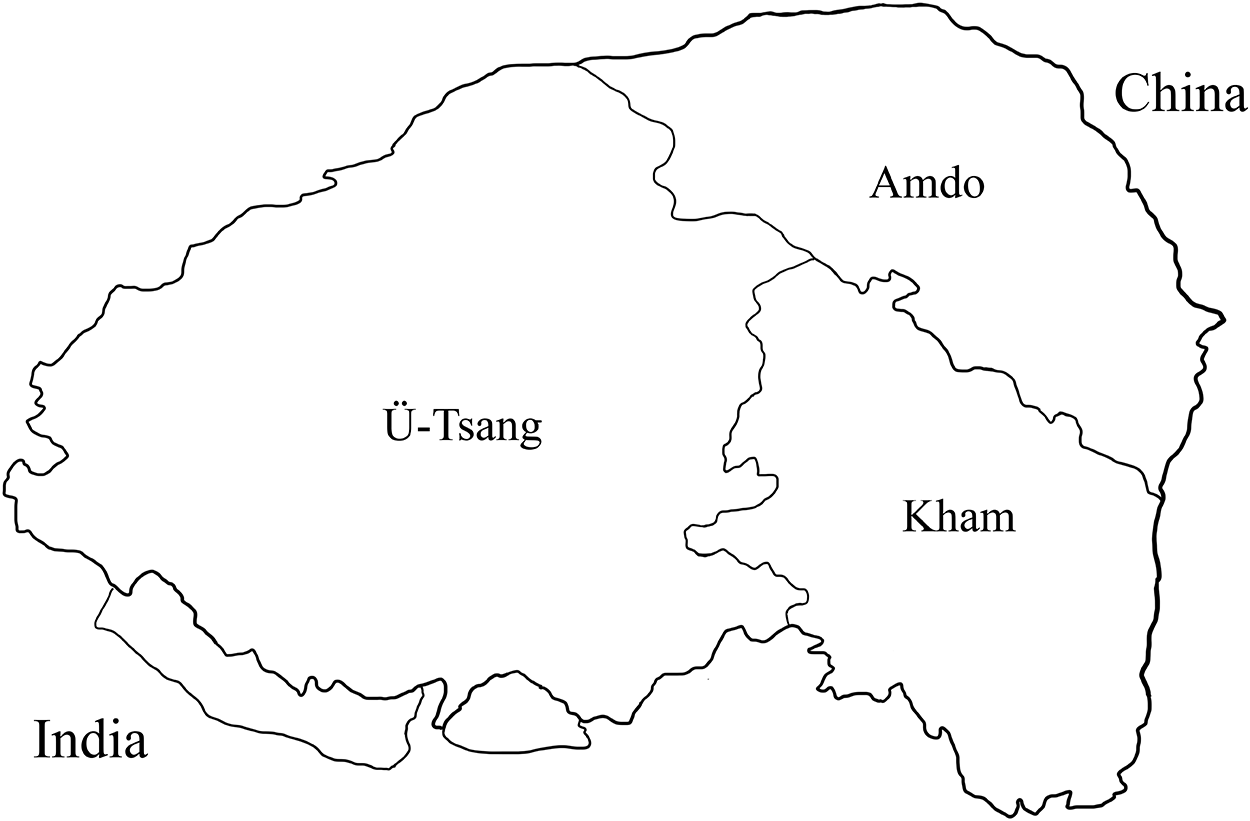


 Open access

