Children with cardiac defects requiring surgical correction present potential challenges to successful extubation including prolonged ventilatory support, pulmonary arterial hypertension, underlying chromosomal abnormalities, and airway malacia. Furthermore, some of these patients may not respond to sedation medications in the typical manner. They may require higher doses or multiple drug combinations leading to a higher risk of associated respiratory depression. Prolonged positive pressure ventilation can also have significant implications, particularly for those with single ventricle and restrictive or obstructive right ventricular physiology who would benefit from early and rapid return to spontaneous respiration. Therefore, physicians caring for this population of children may need alternative ways to maximise the chances for expedient but successful extubation after cardiac surgery.
Propofol is a sedative hypnotic agent with a rapid onset and very short half-life that is titratable to effect, and it often allows for spontaneous breathing in a sedated state. Concerns surrounding the use of a peri-operative continuous propofol infusion in paediatric cardiac patients are based upon the potential for haemodynamic instability in already vulnerable and labile patients and the potential threat of propofol infusion syndrome. Published data are very limited, although clinical experience suggests that propofol is widely used by experienced anaesthesiologists and intensivists for this population to achieve successful extubation in a spontaneously breathing and sedated patient. Therefore, we performed this study to document the use of propofol in the cardiac intensive care unit to facilitate extubation.
Materials and methods
After institutional review board approval, with waiver of the need for informed consent, we conducted a review of patients admitted to the Cardiac Intensive Care Unit requiring mechanical ventilation who received propofol as a continuous infusion at or before extubation over a 20-month period (January, 2007 to September, 2008). The use of propofol was exclusive to those patients with co-morbidity (pulmonary hypertension, airway malacia, or syndrome), and refractory to or requiring high escalating doses of traditional sedation and analgesia to achieve balanced sedation and pain control (as evaluated by the State Behavior Scale, modified FLACC and numeric scale, NIPS or PIPS scores, depending on the patient’s characteristics) that jeopardised their respiratory drive. Before starting propofol, sedation and analgesia were provided with what the authors describe in this paper as “traditional therapy”, namely opioids (morphine, or fentanyl or remi-fentanyl), benzodiazepines (midazolam, clonazepam) and/or alpha-agonists (ketamine or dexmedetomidine). Propofol was administered as a continuous infusion with sporadic boluses, to limit the potential side effects associated with the latter.
Patients were on standardised fluid requirements depending on the post-operative day (50% of requirements of day 1, 75% on day 2, and 100% on day 3), adapted to the clinical evaluation of the fluid status, central venous pressure, and to the estimation of insensible losses. Loop diuretics were administered as required based on the above criteria and aiming for an even or negative fluid balance.
Criteria for extubation were as follows: attending physician’s clinical criteria, doses of opioids, narcotics and/or benzodiazepines allowing spontaneous breathing, minimal ventilation settings (FiO2 < 0.50, respiratory rate within normal limits for the age, peak inspiratory pressure <25 centimetres H2O, spontaneous tidal volume >6–10 millilitre per kilogram, pressure support <10 centimetres H2O), and adequate pressure support trials, adequate neurologic status, no multiorganic failure, no haemodynamically significant residual lesions, and biological screening within the normal range.
The only exclusionary criterion was age greater than 17 years. Demographic data were obtained that included age, weight, gender, diagnosis, type of surgery, associated chromosomal abnormalities, presence of airway anomalies, and presence of pulmonary hypertension. Vital signs including heart rate and mean arterial pressure, as well as vasopressor and fluid requirements, were documented during infusion as well as pre- and post-infusion. In addition, other sedative and analgesic infusions that each patient received throughout the propofol infusion and periextubation period were noted.
Primary outcome measures were successful extubation (defined as no re-intubation for respiratory failure within 48 hours); and haemodynamic stability (defined as less than a 10% decrease from baseline) including heart rate and arterial blood pressure measured at 1-hour intervals from 4 hours before the propofol infusion, during the propofol infusion, and 4 hours post-infusion. Secondary outcomes were level of haemodynamic support as reflected by trends in inotropic/vasopressor infusion rates; need for fluid resuscitation; and evidence of propofol infusion syndrome as identified by metabolic acidosis and elevated serum lactate when available.
Results
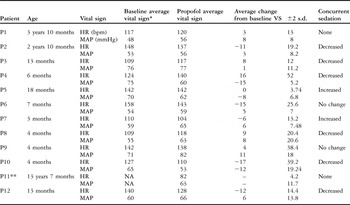
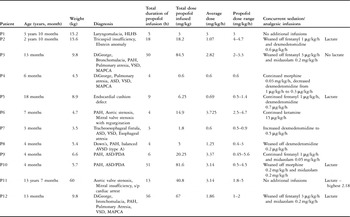
There were eleven patients, eight male and three female, who met our inclusion criteria; one patient had two separate planned extubations with propofol infusion, giving a total of 12 separate events; three patients had documented airway malacia, four patients had documented chromosomal abnormalities, and six patients had documented pulmonary hypertension (Table 1). The age range was 3–163 months (mean = 26 months; median = 6 months). The weight range was 3.5–60 kilograms (mean = 12.5 kilograms, median = 6.6 kilograms). Diagnosis and interventions are described in Table 2. The dose of propofol used with these patients ranged between 0.4 and 5.6 milligram per kilogram per hour, and it was delivered over a range of 3–36 hours (mean = 12.2 hours, median = 7 hours; Table 1).
Patient characteristics, hemodynamic profile, and sedation requirements

HR, heart rate; MAP, mean arterial pressure; NA, not applicable
*Average of the vital signs over a 4-hour period before initiation of propofol infusion
**This patient was started on propofol infusion on admission
Patient diagnosis and interventions

HLHS, hypoplastic left heart syndrome; PAH, pulmonary arterial hypertension; VSD, ventricular septal defect; MAPCA, major aorto-pulmonary collateral arteries; ASD, atrial septal defect; AVSD, atrio-ventricular septal defect; PDA, persistent ductus arteriosus
All patients were successfully extubated as previously defined. There was one patient who was electively re-intubated within 24 hours in preparation for returning to the operating room.
During the propofol infusion at this dose range, there were few decreases in the mean values of heart rate or mean arterial pressure within normal values for age, as defined by Horan and Park.Reference Horan1, Reference Park2 There were three patients who had a decrease in mean arterial pressure more than 10% from baseline; however, for two patients, their pre-infusion value was greater than normal for age, and therefore their mean arterial pressure did not fall outside of normal values for age. The heart rate and mean arterial pressure of one patient dropped more than 10% from the baseline values after receiving a bolus of propofol (prior to starting the infusion), and after a second bolus of propofol about 15 hours into his infusion for increased agitation. However, his heart rate remained within normal range for age. No patients required an increase in vasoactive medications. There was one patient who received 15 millilitre per kilogram of albumin before starting the propofol infusion and 5 millilitre per kilogram of albumin during the infusion. In addition, there were six out of 11 patients who returned from the operating room with epicardial pacer wires; two of the 11 patients were actively being paced on admission, one of whom had to briefly resume pacing during the propofol infusion for an intermittent junctional rhythm and the other had to have a permanent pacemaker placed for underlying cardiac block.
Of the six patients who had pulmonary arterial hypertension, there was one post-propofol infusion episode of a documented desaturation to 67%. Another patient had saturations in the 84–88% range in the 4 hours before propofol infusion and improved saturations to more than 93% during his propofol infusion. All other pulmonary arterial hypertension patients remained stable with saturations in the 90s.
Doses of propofol and additional sedative and analgesic drugs are described in Table 2. There were two patients who had a propofol infusion initiated on admission and did not require other sedatives during their admission. The majority of patients had two additional infusions running simultaneously with the propofol drip including fentanyl, midazolam, morphine, dexmedetomidine and/or ketamine, all of which started before the institution of propofol. There were six patients who were able to wean at least one of their additional sedative infusions: five patients continued on at least one additional infusion aiming to provide analgesia; one patient required an increase in the dexmedetomidine infusion during the propofol infusion and one patient had an increase in his dexmedetomidine infusion after the propofol infusion was discontinued (Table 1).
No patients had overt evidence of propofol infusion syndrome during or after infusion. There was no increasing or refractory metabolic acidosis as evidenced by pH or base deficit. Only three patients had serum lactate levels measured during the propofol infusion, and all lactate values remained below 1 millimolar per litre. This was explained by the fact that these patients had achieved steady haemodynamic stability (unless agitated), some were followed by other markers of tissue perfusion (that is, SvO2, Near Infra-Red Spectroscopy), and also because the institutional protocols at the time of the study period did not include lactate blood level follow-up for propofol infusion for less than 24 hours.
Discussion
In our study, propofol infusion was successful in facilitating the extubation of patients at high risk for extubation failure due to comorbidity, and due to the difficulty in sedating with traditional therapy. Propofol allowed efficient extubation without the need for additional haemodynamic support. In addition, no patients developed overt evidence of propofol infusion syndrome.
Successful extubation of the peri-operative and medical congenital cardiac patient offers particular challenges to the cardiac intensivist. Providing adequate sedation and analgesia in the post-operative period is imperative, but weaning of benzodiazepines and opioids before extubation can lead to withdrawal and agitation, exposing the patient to the risk of disruption of the existing catheters and tubes, pulmonary hypertensive crisis, or airway collapse. This delicate balance can be all the more complex such that patients may be particularly resistant to sedation and require high doses that depress their respiratory status.
The risk for extubation failure further increases in the presence of significant comorbidity. Airway anomalies such as laryngo, tracheo, or bronchomalacia may impair a patient’s ability to maintain effective spontaneous respirations and necessitate increased ventilatory support. In our experience, chromosomal anomalies such as 22q11− deletion and Down’s syndrome have been correlated with the need for higher doses of medications to maintain adequate sedation and patient-ventilator synchrony in the post-operative period. Furthermore, patients prone to pulmonary hypertension may not tolerate weaning of sedation in anticipation of extubation and may develop pulmonary hypertensive crises triggered by agitation, jeopardising the potential for successful extubation.
As far as we are aware, the use of propofol as an adjunct to extubation in paediatric critical illness has been previously described only in paediatric burn patients, in spite of a significant empirical acumen of clinical experience.Reference Sheridan, Keaney and Stoddard3
Propofol is an intravenous anaesthetic with no analgesic properties, and thus it may require the addition of a second agent to achieve adequate pain control. It is widely used for the maintenance and induction of anaesthesia in children. Concerns about the use of propofol for sedation of children in the intensive first arena arose in the early 1990s when five children intubated for respiratory viral illnesses, who received propofol for sedation, developed a constellation of findings (acidosis, tachydysrhythmias, myonecrosis, and cardiovascular collapse), collectively described as propofol infusion syndrome.Reference Parke, Stevens and Rice4 Reported cases of propofol infusion syndrome are generally associated with infusions lasting more than 24 hours and with doses greater than 6 milligram per kilogram per hour.Reference Bray5 A putative mechanism for propofol infusion syndrome has been identified, and although the occurrence is rare, it is difficult to identify who is at risk during prolonged infusions; therefore, long-term use has been curtailed.Reference Wolfe and Potter6, Reference Withington, Decell and Ayed7 There may be pharmacogenetic factors at play, although no data are yet available.Reference Fudickar, Bein and Tonner8 In the cardiac population, there is additional hesitation to use propofol because of its propensity to cause bradycardia and/or hypotension in an already haemodynamically delicate patient. Propofol is a direct negative inotrope, but this effect may be partly mitigated in the euvolemic patient by an increase in myofilament sensitivity to calcium ions.Reference Chen, Lee and Hung9, Reference Bovill10
Propofol has many unique properties, however, that make it a desirable sedative and attractive for controlled use in this patient population. It has rapid onset and is short acting, making it ideal for sedation holidays or for easy awakening of patients to evaluate readiness for extubation. Propofol as a bridge to extubation is an intriguing and attractive option to help achieve the fine balance between adequate sedation and spontaneous respiration.
The patients in this review experienced few side effects and showed no overt evidence of propofol infusion syndrome with doses ranging from 0.5 to 5.6 milligram per kilogram per hour and infusion times of less than 36 hours, although more subtle markers of early propofol infusion syndrome were not measured. All of the patients had satisfactory primary outcomes: all were successfully extubated, and very few had haemodynamic changes: one patient had a transient decrease in blood pressure from baseline values following a propofol bolus of 2 milligram per kilogram given to facilitate adequate sedation while transitioning from a dexmedetomidine infusion to a propofol infusion. This is common after a 2 milligram per kilogram dose of propofol and may be predicted by the administration of a small “test dose”.Reference Sato, Saito and Jonokoshi11 However, this patient’s mean arterial pressure remained in the normal range for age. Of note, the dexmedetomidine infusion had been discontinued for hypotension and bradycardia. The only significant decrease in blood pressure, which was most unlikely to be related to propofol, was documented in one patient who received 15 millilitre per kilogram of 5% albumin for hypotension in the 2 hours before starting the propofol infusion and an additional 5 millilitre per kilogram following the start of the propofol infusion.
There are limitations to this study. Extubation failure rates in paediatric critical illness are low, and thus it is difficult to determine whether using propofol as a bridge to extubation is necessarily a better alternative than the standard of care in patients in certain high-risk populations. Nevertheless, in this specific patient population, propofol was used exclusively in patients who had previously shown refractoriness to or the need for high doses of traditional therapy. This is a retrospective study which does not attempt to evaluate safety and efficacy; it rather presents the feasibility of an alternative option for a smooth and successful extubation. There are further considerations that must temper the strength of our conclusions, including the small sample size, a single centre experience, and the lack of protocolised approach to using the propofol infusion.
Conclusions
This study suggests that continuous propofol infusion may be an alternative bridge to extubation in children with congenital cardiac disease and comorbid chromosomal abnormalities, airway malacia, or pulmonary hypertension, who might otherwise be difficult to manage towards successful extubation. This is a small and retrospective review, and thus further studies are required to confirm these findings.
Acknowledgements
The authors would like to gratefully acknowledge the contributions and expertise of David M. Polaner, MD and Daksha J. Ranade, MPH. The authors received no financial support for this study.