Seasonal influenza is responsible for >200,000 hospitalizations and as many as 49,000 deaths in the United States annually.Reference Thompson, Weintraub and Dhankhar 1 – Reference Thompson, Shay and Weintraub 3 Nosocomial outbreaks are well documented, and each case adds an estimated $7,545 to the cost of care.Reference Malavaud, Malavaud and Sandres 4 – Reference Serwint and Miller 12 Influenza transmission in healthcare settings may occur among patients, visitors, and healthcare workers (HCWs). Accordingly, influenza vaccination of HCWs has been associated with decreased patient morbidity and mortality in long-term care facilities (LTCFs) as well as reductions in the incidence of influenza-like illness (ILI) and absenteeism among HCWs.Reference Saxen and Virtanen 13 – Reference Lemaitre, Meret and Rothan-Tondeur 16 For these reasons, the Advisory Committee on Immunization Practices of the Centers for Diseases Control and Prevention (CDC) and many professional societies recommend that all HCWs receive the seasonal influenza vaccination annually.Reference Pearson, Bridges and Harper 17
Previous studies have demonstrated a decrease in risk of nosocomial influenza or ILI in acute care hospital settings with increasing compliance of HCW influenza vaccination.Reference Amodio, Restivo, Firenze, Mammina, Tramuto and Vitale 18 , Reference Salgado, Giannetta, Hayden and Farr 19 However, HCW vaccination coverage rates in these studies were as low as 3% and only as high as 67%, which is lower than the average HCW compliance in the United States during the 2012–2013 influenza season (70%) and the Healthy People 2020 goal of 90%. 20 , 21 Studies using mathematical models to evaluate the effect of HCW influenza vaccination in LTCFs and acute care hospitals have identified decreases in nosocomial influenza infections at every level of HCW vaccination, suggesting that there is no threshold for herd immunity in the healthcare setting.Reference van den Dool, Bonten, Hak, Heijne and Wallinga 22 – Reference van den Dool, Bonten, Hak and Wallinga 24 However, evidence to support this finding in acute care hospitals is lacking. In this study, we sought to assess the association between nosocomial influenza and HCW vaccination at relatively high compliance and to describe the incidence of influenza at an academic medical center across several flu seasons.
METHODS
This retrospective, cross-sectional study was conducted at the University of New Mexico Hospital (UNMH), a 550-bed tertiary academic medical center. Flu season was defined as October 1 through May 31 of the following year. All direct fluorescent antibody (DFA) or polymerase chain reaction (PCR) assays positive for influenza that were collected during flu seasons from 2010 to 2015 were reviewed. The first positive influenza diagnostic test per patient per admission in each flu season was included. Patients were excluded if they were not admitted to the hospital (eg, were discharged from the Emergency Department). DFA was the primary diagnostic test for influenza while PCR was used to test only for H1N1 in the 2010–2011 flu season and through January of the 2011–2012 flu season. PCR was the primary test for the remainder of the study period. PCR was used on at least 1 patient in all 5 seasons. Age, date of admission, date of specimen collection, type of assay used, and type of influenza, including subtype, if known, were collected for each admitted patient with influenza.
Nosocomial influenza was defined as a positive influenza DFA or PCR ≥48 hours after admission without signs or symptoms of ILI present within 24 hours of admission. ILI was defined using the CDC ILINet criteria of a temperature ≥37.8°C plus a sore throat and/or a cough without other known cause. 25 Potential nosocomial cases were reviewed for inclusion by a physician trained in infectious diseases. The relative frequency of nosocomial influenza was determined for each season by dividing the number of nosocomial influenza cases by the total number of admitted patients with influenza. HCW influenza vaccination coverage for the hospital included vaccinations for all hospital employees, licensed independent practitioners, students, and volunteers, which were obtained from the Occupational Health department. Influenza vaccine efficacy for each flu season was collected from the CDC. 26
Statistical Analysis
Data were analyzed using SPSS (Version 22, IBM Corp, Armonk, NY). Linear-by-linear association was used to assess trends in the relative frequency of nosocomial influenza and HCW influenza vaccination coverage across seasons. Univariate logistic regression analysis was conducted to assess the association between the relative frequency of nosocomial influenza and HCW influenza vaccination coverage. Multivariate logistic regression analysis was conducted to adjust for vaccine efficacy.
RESULTS
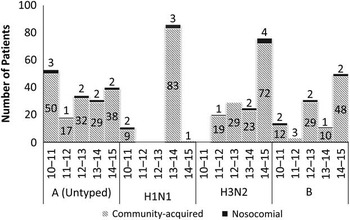
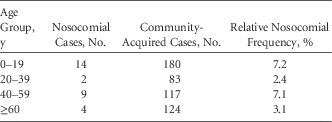
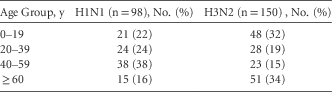
A total of 1,478 patients with a positive influenza test were screened; 533 were collected from patients admitted to the hospital (Figure 1). Of these 533 patients, 29 (5.4%) had nosocomial influenza infection. The median time from admission to influenza diagnostic test sample collection was 5 days among patients with nosocomial influenza. The number of admitted patients with influenza varied across seasons, with the 2014–2015 season having the highest number of cases. Influenza A was most common in all seasons with subtype H1N1 predominating in 2010–2011 and 2013–2014 seasons and subtype H3N2 most frequent in the other seasons (Figure 2). Influenza B ranged from 7% to 34% of cases. Relative nosocomial influenza frequency was highest in patients less than 20 years of age and those between 40 and 59 years of age (Table 1). H1N1 occurred more frequently in the adult population while H3N2 tended to affect children and those ≥60 years (Table 2).
Flow diagram of patients included in the study.

Incidence of influenza in hospitalized patients by type or subtype across seasons.

Incidence of Influenza by Age Among Hospitalized Patients

Relative Frequency of Influenza A Subtype by Age Among Hospitalized Patients

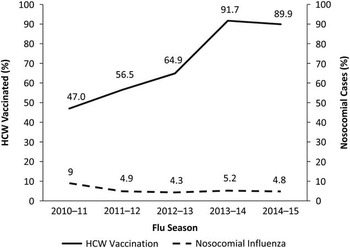
HCW influenza vaccination coverage increased across the 5 seasons (P<.001) (Figure 3). Despite an initial decrease in the relative frequency of nosocomial influenza between the 2010–2011 and 2011–2012 seasons, it remained relatively stable in each of the next 3 seasons, and the overall decrease was not statistically significant (P=.282). No association was found between HCW vaccination coverage and relative frequency of nosocomial influenza in the univariate logistic regression with an odds ratio (OR) of 0.990 (95% confidence interval [CI], 0.970–1.011). After accounting for vaccine efficacy, there was still no association between HCW vaccination and nosocomial influenza (aOR, 0.993; 95% CI, 0.968–1.019).
HCW vaccination coverage and relative frequency of nosocomial influenza across flu seasons.

DISCUSSION
Our study found a statistically significant increase in HCW vaccination coverage over 5 seasons with implementation of mandatory influenza vaccination for HCWs. Previous studies have shown that HCW influenza vaccination compliance is directly related to an employer’s support and policies surrounding influenza vaccination. A study conducted by the CDC found HCW vaccination coverage of 50.4% when vaccinations were neither promoted nor required, 76.9% in facilities promoting but not requiring vaccination, and 96.5% when employers required vaccination. 27 Reyes et alReference Reyes, Kilgore, Karwowski, Johnson, Weinmann and Zervos 28 demonstrated increases in HCW vaccination compliance from 52.3% with education efforts to 84.4% with opt-out measures such as declination forms to as high as 99.1% when vaccination was made mandatory.
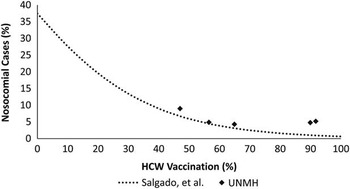
However, substantially higher compliance of HCWs with the influenza vaccination policy did not impact the relative frequency of nosocomial influenza. The lack of association between HCW vaccination coverage and relative frequency of nosocomial influenza may be explained by a ceiling effect of HCW vaccination. Salgado et alReference Salgado, Giannetta, Hayden and Farr 19 demonstrated a decrease in nosocomial influenza with increasing HCW vaccination compliance, and they used logistic regression to build a predictive model (Figure 4). However, there did not appear to be a clear trend in relative frequency of nosocomial influenza when HCW vaccination coverage was >40% in their study; they found relative frequencies as low as 0% with 41% vaccination compliance but as high as 12% with 60% HCW vaccination coverage.Reference Salgado, Farr, Hall and Hayden 9 Additionally, the highest HCW vaccination rate in their study was 67%, which was well below the 91.7% seen in our study. A ceiling effect of HCW vaccination has also been suggested by other researchers. Carman et alReference Carman, Elder and Wallace 14 found a 0% (0/17) incidence of nosocomial influenza among patients at necropsy at LTCFs with an average HCW vaccination rate of 50.9%, compared with 20% (6/30) at LTCFs with an average HCW vaccination rate of 4.8% (p=0.055). Another study of LTCFs by Wendelboe et alReference Wendelboe, Avery, Andrade, Baumbach and Landen 29 found no additional reductions in laboratory-confirmed nosocomial influenza after HCW vaccination reached 50%; however, a small additional benefit was seen when HCW vaccination compliance was increased to 75% when cases diagnosed by ILI criteria were also included.Reference Wendelboe, Avery, Andrade, Baumbach and Landen 29
HCW vaccination coverage vs nosocomial influenza cases compared with a previous predictive model.

The potential ceiling effect of HCW vaccination may be attributable to other factors that affect influenza transmission in healthcare settings. Compliance with appropriate isolation precautions has been shown to reduce nosocomial transmission of other respiratory viruses.Reference Leclair, Freeman, Sullivan, Crowley and Goldmann 30 Policies and procedures surrounding visitation of families and others may also impact transmission to patients. Influenza vaccination may reduce the severity and duration of symptoms, resulting in a subclinical or asymptomatic infection. However, viral shedding is lower in those with subclinical and asymptomatic influenza than symptomatic infection, and the contribution of this population to viral transmission is unclear.Reference Patrozou and Mermel 31 Lastly, policies surrounding HCW sick leave, such as using fever as the criterion for exclusion from work, may also lead to working while ill (ie, presenteeism).Reference Mermel 32 The relative contribution of other such factors that may impact nosocomial influenza transmission remains to be fully defined.
This study does have some potential limitations. Although policies regarding isolation and visitors at UNMH were consistent throughout the study period, adherence to these policies was not assessed and may have varied across seasons. DFA was the primary method used in the first season and first half of the second season. Because this assay is less sensitive than PCR, it may have led to underdetection of nosocomial cases in these first 2 seasons, which would have a significant effect on the rate of nosocomial influenza due to the low overall numbers of cases. However, flu infections peaked in March of the 2011–2012 season, after the switch to PCR. 33 There was also a significant difference between HCW vaccination coverage without a difference in the proportion of nosocomial influenza in each of the last 3 seasons when only PCR was used. Additionally, reporting of vaccination received outside of the health system to our institution’s Occupational Health department may have been lower in the seasons for which vaccination was not required, which would have lowered the observed HCW vaccination compliance in these seasons. As the vaccine was provided at the hospital free of charge to all HCWs, it is unlikely that a large proportion of HCWs received vaccination outside the health system.
The results of our study suggest that HCW vaccination compliance >50% does not have a significant effect on the incidence of nosocomial influenza. While it is important to continue to promote HCW vaccination to reduce absenteeism and HCW morbidity, other interventions, such as more robust screening and patient vaccination efforts, enforcement of isolation precautions and visitor policies, and reduction of HCW presenteeism, may have more of an effect on the incidence of nosocomial influenza than HCW vaccination when coverage is above this threshold.
ACKNOWLEDGMENTS
Financial support: No financial support was provided relevant to this article.
Potential conflicts of interest: All authors report no conflicts of interest relevant to this article.