Introduction
In organic cropping systems, legumes are often used to supply nitrogen (N) for the growth of grain crops in rotations (Moncada and Sheaffer, Reference Moncada, Sheaffer, Moncada and Sheaffer2010; Baldock et al., Reference Baldock, Hedtcke, Posner and Hall2014). Crops in the legume (Fabaceae) family, including alfalfa (Medicago sativa) are hosts to symbiotic N-fixing rhizobacteria that convert atmospheric N2 to a form usable for plant growth. Legumes are therefore often N fertilizer independent and produce N-rich grain and forage. Forage legumes such as alfalfa used in crop rotations have a dual purpose of supplying forage for livestock and N for fertilization of subsequent crops in the rotation (Sheaffer and Seguin, Reference Sheaffer and Seguin2003).
Alfalfa contributes N to subsequent crops through root exudates, root turnover, and incorporation of biomass, including roots, crown and herbage (Sheaffer et al., Reference Sheaffer, Barnes and Heichel1989). In addition, harvest losses, in the form of cut leaves and stems remaining after hay removal, can contribute N to the soil (Tomm et al., Reference Tomm, Walley and van Kessel1995). Therefore, in the Midwest, corn grown in the year following alfalfa termination often requires little N fertilization (Lawrence et al., Reference Lawrence, Ketterings and Cherney2008; Yost et al., Reference Yost, Coulter and Russelle2013). Long-term organic crop rotation trials in Minnesota found that even a single year of alfalfa produced corn yields similar to or greater than those from 2-year corn–soybean rotations grown with synthetic fertilizers and pesticide inputs (Coulter et al., Reference Coulter, Sheaffer, Wyse, Haar, Porter, Quiring and Klossner2011).
Guidelines for application of N fertilizer to conventional corn grown following alfalfa vary from state to state (Yost et al., Reference Yost, Russelle and Coulter2014) and have not been developed for organic rotations. In Minnesota (Rehm et al., Reference Rehm, Randall, Lamb and Eliason2006), current N credits for first year corn are 45, 112 and 168 kg ha−1 for alfalfa populations of <11, 22–32 and >43 plants m−2, respectively. However, in a comprehensive review of research conducted in the northern USA, Yost et al. (Reference Yost, Russelle and Coulter2014) reported that soil texture, stand age, termination time and weather conditions before planting were the primary factors affecting first-year corn response to N fertilizer. They also reported, and confirmed in a subsequent field experiment with conventionally grown corn (Yost et al., Reference Yost, Russelle, Coulter, Schmitt, Sheaffer and Randall2015), that for medium textured soils with fall alfalfa termination, stand age was a critical factor in determining N response in first-year corn.
Since alfalfa herbage is N-rich relative to the roots and crowns, it is likely that management of herbage will affect N contribution to the following crops. Some state recommendations adjust N fertilizer rates following alfalfa based on herbage regrowth incorporated in the fall (Laboski et al., Reference Laboski, Peters and Bundy2006). However, Yost et al. (Reference Yost, Coulter, Russelle, Sheaffer and Kaiser2012) concluded that the amount of herbage regrowth incorporated in the fall following the alfalfa-growing season had no effect on the stand's N contribution to a subsequent corn crop.
Alfalfa is a particularly desirable addition to organic crop rotations, because it can address a variety of challenges faced by organic farmers. Organic farming often relies heavily on tillage for weed control, which can disrupt soil structure and deplete organic matter (Balesdent et al., Reference Balesdent, Chenu and Balabane2000; Six et al., Reference Six, Elliott and Paustian2000). Alfalfa stands can be productive for three or more years, allowing growers to continue to harvest a valuable forage without tilling during that portion of the rotation. Alfalfa stands can produce 13–16 Mg ha−1 of herbage and approximately 2 Mg ha−1 of net root growth per year (Bowren et al., Reference Bowren, Cooke and Downey1969; Heichel et al., Reference Heichel, Barnes, Vance and Henjum1984, Wells et al., Reference Wells, Holen and Sheaffer2015), resulting in high potential input of organic material to the soil, particularly if cut forage is left in place rather than removed (Groya and Sheaffer, Reference Groya and Sheaffer1985; Hesterman et al., Reference Hesterman, Sheaffer, Barnes, Lueschen and Ford1986). Multi-year alfalfa stands can also provide effective suppression of weeds, particularly Canada thistle (Cirsium arvense) and other perennials (Schreiber, Reference Schreiber1967; Ominski et al., Reference Ominski, Entz and Kenkel1999).
In organic cropping systems, information is needed on approaches to increase alfalfa N contribution and yield benefit to subsequent crops, including cutting management practices and stand age effects. We conducted two field experiments at three Minnesota locations under organic management. The objectives of these experiments were to determine the influence of cutting frequency and alfalfa stand age on alfalfa dry matter production and N content, and on subsequent soil N availability and corn yields.
Materials and Methods
Two experiments were conducted to determine the effects of alfalfa management on soil N content and subsequent corn yields. Experiment 1 evaluated the effect of alfalfa cutting management, while experiment 2 evaluated the effect of alfalfa stand age.
Study sites
Experiments were conducted at Lamberton (44°15′N, 95°19′W), Rosemount (44°43′N, 93°06′) and Waseca (44°04′N, 93°31′W), MN. The soil at Lamberton was a Normania loam (fine-loamy, mixed, mesic Aquic Hapludoll); at Rosemount a Tallula silt loam (coarse-silty, mixed mesic Typic Hapludoll); and at Waseca a Webster clay loam (line-loamy, mixed mesic Typic Haploquoll). Soil pH (>6.5), exchangeable K (>350 kg ha−1), and Bray-1 P (>30 kg ha−1) were considered non-limiting for alfalfa and corn growth (Rehm and Schmitt, Reference Rehm and Schmitt1989).
The land was certified organic at Lamberton and Waseca, and at Rosemount had been managed without prohibited inputs for 2 years prior to the beginning of the study. Alfalfa and corn were managed using only practices permitted under the USDA's National Organic Program.
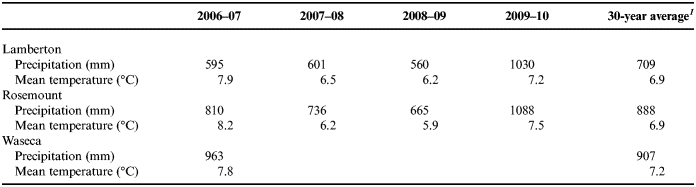
Annual mean precipitation and temperature are presented in Table 1. At all locations, annual precipitation from October–September in the 2009–2010 growing season was greater than the 30 year average.
Precipitation and mean temperature from October to September for each site during the experimental period and 30-year average data.

1 Based on 30-year normal data, 1981–2010 (University of Minnesota Climatology Working Group, 2012).
Experiment 1: Alfalfa cutting management effects
Established stands of Pioneer ‘54V46’ alfalfa were subject to five harvest treatments in year 1, and then followed in rotation by corn in year 2. Harvest treatments consisted of differential schedules of biomass cutting and forage removal and are described in Table 2. A three-cutting schedule is generally recommended to maintain high forage yield and stand persistence in Upper Midwest systems (Undersander et al., Reference Undersander, Cosgrove, Cullen, Grau, Rice, Renz, Sheaffer, Shewmaker and Sulc2011). A no-cut control was included to provide a baseline for comparison with cutting treatments. The experiment was repeated in nine field environments at different sites and years, and in alfalfa stands of different ages. At Lamberton, 1- and 3-year old stands were used in 2006; 1- and 2-year-old stands in 2007, and 2-year-old stands in 2008 and 2009. At Rosemount, 3-year-old stands were used in 2007 and 2008 and at Waseca a 3-year-old stand was used in 2006. The experimental design in each environment was a randomized complete block with four replicates. Plots were 5 m × 10 m.
Alfalfa cutting treatments.

In early November, aboveground alfalfa herbage was measured by cutting two 1.0 m2 areas from within each plot to a 7-cm stubble height. Root and crown samples were collected to a 30-cm depth from a 0.5 m2 area and washed before drying. Wet herbage and root and crown yields were adjusted to dry weight. All plant samples were subjected to the Kjeldahl procedure for N determination (Horwitz, Reference Horwitz1980). Fall-incorporated N represented the N in the herbage, roots and crown for all cutting treatments, except 4C + R, where herbage was removed in the final cut before crowns and roots were incorporated.
On about 15 November, plots were chisel plowed to a 20-cm depth. The following spring the plots were disked on about 1 May and then field cultivated on about 15 May to kill germinating weeds and any regenerating alfalfa. Soon after secondary tillage, corn (Pioneer ‘38H67’) was seeded at 84,000 seeds ha−1 into four-row plots with 76-cm spacing between rows that were 10 m long. Weed management after planting consisted of one rotary hoeing and two inter-row cultivations.
Corn grain yield was determined by harvesting 8 m of the center two rows of each plot after corn had reached physiological maturity. Grain yields were adjusted to 155 g kg−1 moisture.
Soil samples were collected at the beginning of June in the corn year following alfalfa incorporation to depths of 0–15, 15–30 and 30–60 cm in 2007 at Lamberton, and 0–30 and 30–60 cm in 2008, 2009 and 2010 at all sites. Total carbon (C) and N were analyzed using a Vario MAX C/N analyzer (Elementar, Hanau, Germany).
Potentially mineralizable N and C (PMN and PMC) were determined with 28-day incubations using a modification of the aerobic incubation method described by Drinkwater et al. (Reference Drinkwater, Cambardella, Reeder, Rice, Doran and Jones1996). Soil samples were sieved, air-dried, and 30 g air-dried soil was incubated for 28 days. Sodium hydroxide traps (20 ml) were removed and replaced on days 10 and 28 to determine the amount of C mineralized (0–28 days). Carbon dioxide trapped by NaOH was analyzed using the inorganic carbon method on a Phoenix 8000 C analyzer (Tekmar-Dohrmann, Cincinnati, OH). Mineral N content (NH4+ and NO3−) was analyzed at the beginning and the end of incubation to determine the amount of N mineralized (0–28 days), using a Lachat Quick Chem AE flow injection system (Lachat Instruments, Milwaukee, WI).
Experiment 2: Alfalfa stand age effects
This experiment was conducted at Lamberton and Rosemount, MN on soils of similar type and fertility to those described in the alfalfa cutting experiment. The experimental design at each location was a randomized complete block with four replications. Treatments were alfalfa stands from 1 to 4 years old, and a non-alfalfa control with soybean as the crop preceding corn.
Stands of ‘54V46’ alfalfa were established in mid-May by broadcast seeding at 17 kg ha−1 in a conventionally prepared seedbed. The previous crop was wheat at Rosemount and corn at Lamberton. To achieve 1-, 2-, 3- and 4-year-old stands before termination and corn planting, alfalfa was established in 2006, 2007 and 2008 for seeding corn in 2009; and in 2006, 2007, 2008 and 2009 for seeding corn in 2010. Alfalfa harvest in all stand age treatments consisted of three cuttings at first flower (target dates 1 June, 15 July and 1 September) with removal of the forage. In early November, alfalfa herbage regrowth yields were measured by cutting two 1-m2 areas from within each plot to a 7-cm stubble height. Fall-incorporated N represented the N in the herbage, roots and crowns, as described above. Root and crown samples were collected and processed for mass and N content as described in the alfalfa cutting management experiment.
Alfalfa was terminated and corn was planted and managed as described for the cutting experiment. Corn grain yield was measured and soil samples were collected and analyzed in mineral N (NH4+ + NO3−), total C, and potentially mineralizable C and N as described in the cutting experiment.
Statistical analysis
Data were analyzed using R v.3.2.2 (R Core Team, 2015). Analysis of variance using mixed models was done with function lmer of package lme4 (Bates et al., Reference Bates, Maechler, Bolker and Walker2015), and mean separations were done with function difflsmeans of package lmerTest (Kuznetsova et al., Reference Kuznetsova, Bruun and Bojesen2014). In the cutting experiment, treatment and environment were treated as fixed effects, with block as a random effect. When a significant interaction of treatment × environment was detected, environments were also analyzed separately. In the stand age experiment, environments were analyzed separately because fixed effect treatments were not consistent across environments. Statistical significance was determined at α = 0.05.
Correlations involving soil variables used measurements from the 0–60 cm depth for total C (TC) and mineral N, and 0–30 cm depth for PMN and PMC. Correlations among corn yield, fall-incorporated N, and soil N and C parameters were assessed using unadjusted values as well as values that were re-centered to site-year averages. Re-centered values were obtained by subtracting from each value the mean value of all samples from that site-year. Re-centering was done to isolate management-driven variation from potentially confounding effects arising from differing soil types and weather conditions among environments.
Results
Alfalfa cutting experiment
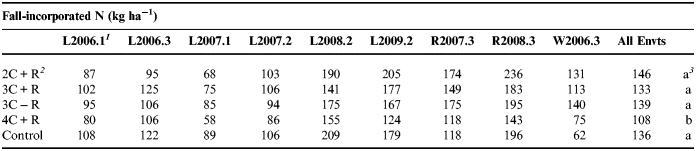
Nitrogen incorporated in alfalfa root/crown and herbage biomass (referred to hereafter as fall-incorporated N) was lower (P < 0.001) in the 4C + R treatment than in the other treatments, which did not differ from each other (Table 3). Fall-incorporated N differed among environments (P < 0.001), but treatment effects were consistent across environments, with no treatment × environment interaction (P = 0.063).
Fall-incorporated alfalfa herbage, crown and root biomass N (kg ha−1) in alfalfa cutting treatments at Rosemount, Lamberton and Waseca, MN.

1 L2006.1, first-year alfalfa stands at Lamberton in 2006–07; L2006.3, third-year stands at Lamberton in 2006–7; L2007.1, first-year stands at Lamberton in 2007–08; L2009.2, second-year stands at Lamberton in 2009–10; R2007.1, first-year stands at Rosemount in 2007–08; R2008.3, third-year stands at Rosemount in 2008–09. Mineral N was not measured below 30 cm at Lamberton in 2008–09 or at Waseca.
2 2C + R, two cuttings with biomass removal; 3C + R, three cuttings with biomass removal; 3C − R, three cuttings without biomass removal; 4C + R, four cuttings with biomass removal; control, uncut alfalfa.
3 Mean separations are across all environments, because there was no significant interaction of treatment × environment.
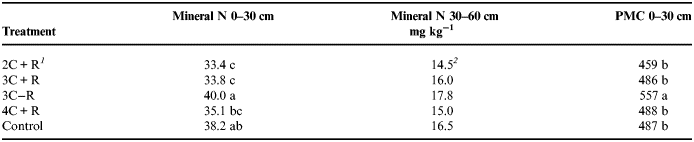
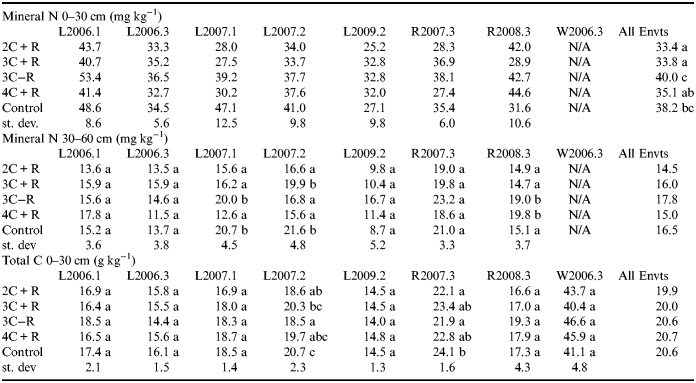
At both the 0–30 and 30–60 cm depths, soil mineral N tended to be highest in the 3C−R treatment and the no-cut control, the two treatments in which alfalfa biomass was not removed. Two- and three-cut treatments with removal of biomass reduced soil mineral N at 0–30 cm compared with the no-cut control and 3C−R treatments (P = 0.046; Table 4). There was no treatment × environment interaction at this depth. At the 30–60 cm depth, there was a main effect of treatment (P = 0.002; Table 4) as well as a significant (P = 0.003) treatment × environment interaction effect on mineral N. Cutting treatments affected mineral N at this depth in three of nine environments (Appendix A). There was no main effect of alfalfa cutting treatment on potentially mineralizable N (PMN); however, PMN differed sharply between locations. Average PMN was 19.9 and 27.4 mg kg−1 at Lamberton and Rosemount, respectively; PMN was not measured at Waseca.
Average soil mineral N at 0–30 cm and 30–60 cm depth and potentially mineralizable C (PMC) at 0–30 cm depth measured in June following alfalfa cutting treatments at Rosemount, Lamberton and Waseca, MN.

1 2C + R, two cuttings with biomass removal; 3C + R, three cuttings with biomass removal; 3C−R, three cuttings without biomass removal; 4C + R, four cuttings with biomass removal; control, uncut alfalfa.
2 There was a significant treatment × environment interaction effect on mineral N at 30–60 cm. Details of this interaction are presented in Appendix A.
The effect of cutting treatment on potentially mineralizable soil C (PMC) was consistent across all environments, with no treatment × environment interaction (Table 4). We observed an average of 77 mg kg−1 greater PMC in the 3C−R treatment compared to all other treatments. However, the 3C−R treatment had the opposite effect on TC in two environments (Table A1); in the second-year stand at Lamberton in 2007 and the third-year stand at Rosemount in 2007, TC was lower in 3C−R than in the no-cut control by an average of 2.3 and 2.2 g kg−1, respectively. There was no main effect of treatment on TC across all environments. Cutting treatment did not affect TC at the 30–60 cm depth. Average of TC at the 0–30 cm depth was 16.9, 20.2 and 43.5 g kg−1 and at the 30–60 cm depth was 11.3, 19.2 and 26.0 g kg−1, at Lamberton, Rosemount and Waseca, respectively.
Because of a significant (P < 0.001) treatment × environment interaction, effects of alfalfa cutting treatment on corn grain yield were examined separately for each environment as well as together across environments. On average over all environments, the 3C + R treatment, in which biomass was removed, produced 607 kg ha−1 less corn yield than the no-cut control (P = 0.002) and 673 kg ha−1 less than the 3C−R treatment (P < 0.001), in which accumulated biomass was left in the field. However, considerable variation occurred in corn yield response to treatment among locations. Cutting treatment affected corn yields in six of nine environments (Figure 1). The 3C−R treatment produced higher corn yields than the 3C + R treatment in four environments and lower corn yields in only one environment. The addition of a fourth alfalfa cutting generally did not have an adverse effect on corn yield. Yields were similar between the 3C + R and 4C + R treatments in six environments, were higher in 3C + R in two environments, and were higher in 4C + R in one environment.
Corn yields following alfalfa cutting treatments at Lamberton, Rosemount and Waseca, MN. Environments are L2006.1, first-year alfalfa stands at Lamberton in 2006–07; L2006.3, third-year stands at Lamberton in 2006–7; L2007.1, first-year stands at Lamberton in 2007–08; L2008.2, second-year stands at Lamberton in 2008–09; L2009.2, second-year stands at Lamberton in 2009–10; R2007.1, first-year stands at Rosemount in 2007–08; R2008.3, third-year stands at Rosemount in 2008–09; and W2006.3, third-year stands at Waseca in 2006–07. Treatments are 2C + R, two cuttings with biomass removal; 3C + R, three cuttings with biomass removal; 3C−R, three cuttings without biomass removal; 4C + R, four cuttings with biomass removal; and control, uncut alfalfa. Mean separations are within environments.

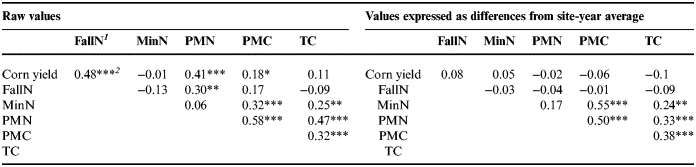
Correlations among corn yields, fall-incorporated N and soil C and N parameters are shown in Table 5. Using unadjusted values, corn yield was positively correlated with fall-incorporated N (P < 0.001), PMN (P < 0.001) and PMC (P = 0.042). However, when values were expressed as differences from site-year averages, corn yield showed no correlation with any of the measured soil variables. Strong positive associations were observed between TC and mineral N, PMN and PMC using both raw and site-year-centered values.
Correlations among fall-incorporated N, corn yield, and soil N and C parameters following alfalfa cutting treatments at Lamberton, Rosemount and Waseca, MN.

1FallN, fall-incorporated alfalfa biomass N; MinN, mineral N; PMN, potentially mineralizable N; PMC, potentially mineralizable C; TC, total C.
2Correlation values represent Pearson's r. Significance is indicated as: *P < 0.05, **P < 0.01, ***P < 0.001.
Alfalfa stand age experiment
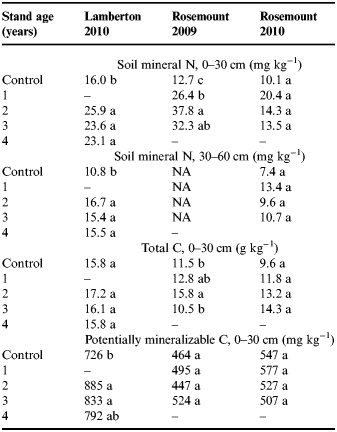
Alfalfa stand age had no effect on fall-incorporated N at Lamberton in 2009–10 or at Rosemount in 2008–09. Average fall-incorporated N in these environments was 160 and 154 g ha−1, respectively. However, at Rosemount in 2009–10, fall-incorporated N for the 1, 2 and 3 year-old stands was 177, 145 and 80 kg ha−1, respectively, and differed (P = 0.009) between the first- and third-year stands. Soil mineral N, measured in June of the year following alfalfa incorporation, was higher in alfalfa treatments than in the no-alfalfa control in two of three environments (P = 0.012 and P = 0.002 in Rosemount 2008–09 and Lamberton 2009–10, respectively), but generally did not increase with increasing stand age (Table 6). PMN was similar among alfalfa treatments; however, as in the cutting experiment, it differed by location, averaging 28.4 mg kg−1 at Lamberton and 18.2 mg kg−1 at Rosemount.
Soil N and C parameters following 1-, 2-, 3- and 4-year alfalfa stands and no-alfalfa control.

At Rosemount in 2008–09, total C was higher (P = 0.016) in the second-year stand than in the no-alfalfa control, although the other alfalfa stand ages did not differ from the control (Table 6). Total C did not differ with treatment in the other environments. Potentially mineralizable C was higher in the second- and third-year stands than in the control at Lamberton in 2009–10, but the fourth-year stand did not differ from the control. Potentially mineralizable C did not differ with treatment in the other environments.
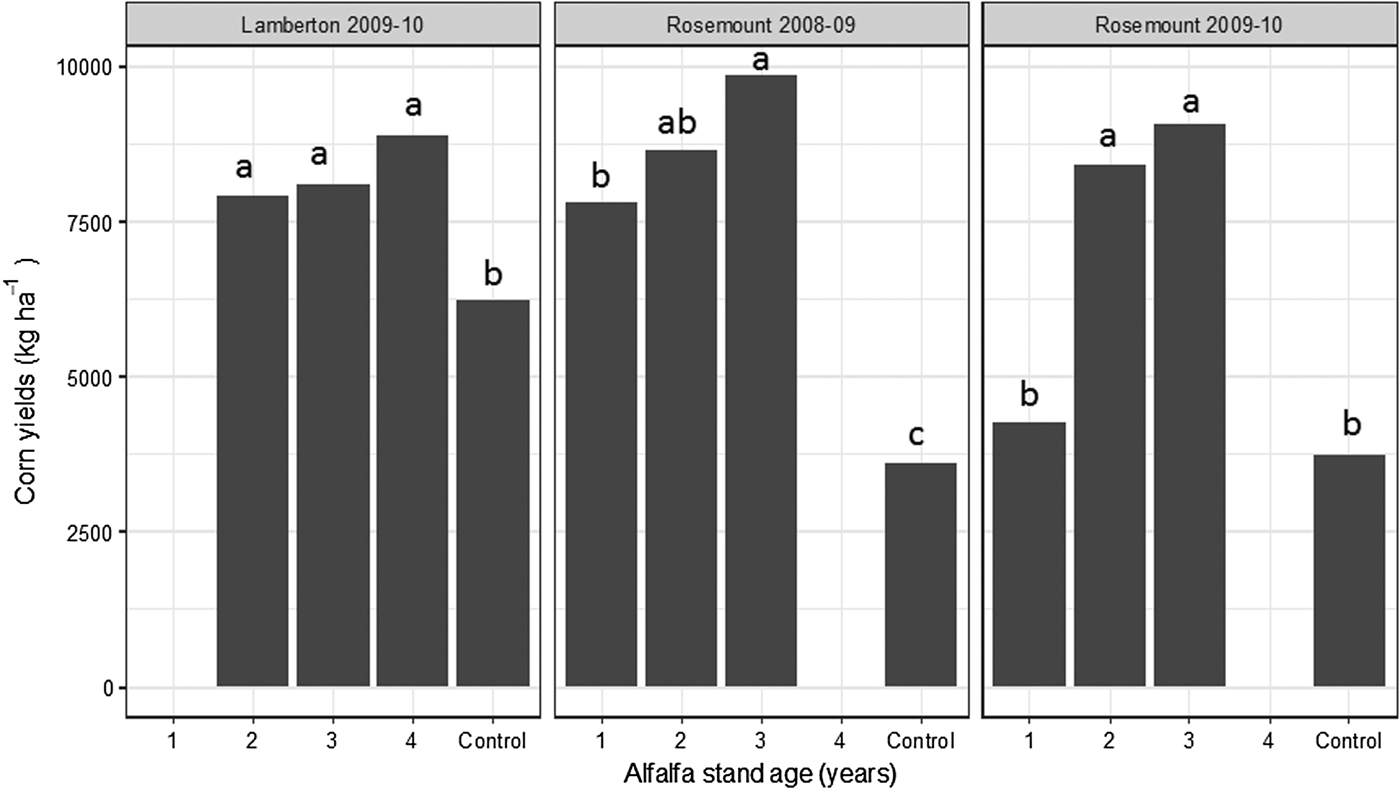
Alfalfa stand age affected corn yields in all three environments (P < 0.001, P < 0.001, and P = 0.003 at Rosemount in 2008–09, Rosemount in 2009–10, and Lamberton in 2009–10, respectively). Corn yields were higher following alfalfa than following the no-alfalfa control, and increased from first-year stands to older stands at the locations where first-year stands were included (Figure 2). On average over all environments, corn yields were 29% higher following first-year, 77% higher following second-year, and 90% higher following third-year alfalfa stands, compared with the no-alfalfa control.
Corn yields following 1-, 2-, 3- and 4-year-old alfalfa stands and no-alfalfa control at Lamberton and Rosemount, MN. Mean separations are within locations and years.

Correlations among corn yields, fall-incorporated N, and soil C and N pools were examined using values expressed as differences from site-year averages (Table 7). Across all treatments, corn yield was positively correlated with stand age and fall-incorporated N, as well as with soil mineral N and potentially mineralizable N (P < 0.001, P < 0.001, P = 0.024 and P = 0.014, respectively). Soil total C was not associated with stand age, fall-incorporated N, or corn yield, but was positively correlated with mineral N and potentially mineralizable N (P = 0.008 and P = 0.004, respectively). When no-alfalfa control plots were excluded from the analysis, increased stand age continued to be associated with increased corn yield, but corn yield was no longer associated with soil N variables, and there were no associations between soil C and N variables.
Correlations among fall-incorporated N, corn yield and soil N and C parameters following 1-, 2-, 3- and 4-year alfalfa stands and no-alfalfa control at Lamberton, Rosemount and Waseca, MN, using values re-centered to environment averages.

1FallN, fall-incorporated alfalfa biomass N; MinN, mineral N; PMN, potentially mineralizable N; PMC, potentially mineralizable C; TOC, total C.
Correlation values represent Pearson's r. Significance is indicated as: *P < 0.05, **P < 0.01, ***P < 0.001.
2 Value was excluded because no-alfalfa control plots had no fall alfalfa biomass.
Discussion
Cutting experiment
The removal of a fourth cutting of aboveground biomass, leaving only roots and crowns at the end of the season, unsurprisingly resulted in less N incorporated in the alfalfa biomass. However, this difference in fall-incorporated N did not translate into lower soil mineral N or PMN during early corn growth compared with the two- and three-cutting treatments with biomass removal. The discrepancy between fall-incorporated N and spring soil N may be partly due to the fact that mineralized N is vulnerable to leaching and runoff losses from unvegetated soil during the winter and early spring (Dinnes et al., Reference Dinnes, Karlen and Jaynes2002). Our results also echo the finding of Yost et al. (Reference Yost, Coulter, Russelle, Sheaffer and Kaiser2012) that fall herbage regrowth was not a significant contributor to soil N. The biomass removed at the fourth cutting, which consisted of regrowth following the third cutting around 1 September, likely represented only a small fraction of the total alfalfa biomass N over the course of the growing season, which included not only harvestable herbage, but also crowns; leaf litter; and root structures, exudates and turnover (Sheaffer et al., Reference Sheaffer, Barnes, Heichel, Marten and Lueschen1988; Harris and Hesterman, Reference Harris and Hesterman1990; Tomm et al., Reference Tomm, Walley and van Kessel1995).
In most cases, where treatments affected spring mineral N, it was lowered by cutting with removal during the growing season and increased or unaffected when forage was cut, but left in place. The exception was the second-year alfalfa stand at Lamberton in 2007, where mineral N was unexpectedly low at the 30–60 cm depth in the 3C−R treatment (Appendix A). One possible explanation for this could be that conditions in this environment led to mats of cut biomass inhibiting new alfalfa growth and root formation. Stand age, year and location may all have contributed to differences in the performance of cutting treatments among environments; however, we did not have a factorial design that would allow us to separate the effects of these three environmental factors. The pattern of lower mineral N in biomass removal compared with non-removal treatments highlights the fact that hay harvest entails a large removal of labile N from the cropping system, lowering—but not necessarily eliminating—the net contribution of alfalfa to plant-available soil N.
The observed increase in PMC and decrease in TC with the 3C−R treatment in some environments, while seemingly contradictory, may reflect a ‘priming effect,’ in which the addition of fresh organic matter stimulates the activity of microbial decomposers, resulting in increased mineralization of native SOM. Loss of C via microbial respiration is particularly stimulated by addition of high-N material such as alfalfa shoots, which have a C:N ratio of around 17 (Bolger et al., Reference Bolger, Angus and Peoples2003; Pascault et al., Reference Pascault, Ranjard, Kaisermann, Bachar, Christen, Terrat, Mathieu, Leveque, Mougel, Henault, Lemanceau, Pean, Boiry, Fontaine and Maron2013). Our observations concur with the findings of Bell et al. (Reference Bell, Sparling, Tenuta and Entz2012) that the inclusion of alfalfa in a rotation does not necessarily increase TC in the short term, especially if the herbage is being removed for hay. However, in the long term, incorporation of legumes and their residues in cropping systems is thought to increase overall C and N retention and soil organic matter levels (Gregorich et al., Reference Gregorich, Drury and Baldock2001).
There was little consistency in which cutting frequency produced the highest corn yields, or in whether cutting treatments with biomass removal produced higher or lower yields than the no-cut control. Although both corn grain yields and mineral N tended to be higher in the 3C−R than the 3C + R treatment (Table 4; Figure 1; Appendix A), these effects did not coincide strongly enough to produce an overall correlation. The lack of correlation between corn grain yields and mineral and potentially mineralizable N also suggests that higher available N was not the main driver of the yield increase in the treatments where biomass remained in place. This experiment was conducted at relatively high-fertility sites, where corn yield may not have been limited by N availability. This concurs with previous research indicating that the benefits of alfalfa to a following corn crop are not limited to N contribution (Bruulsema and Christie, Reference Bruulsema and Christie1987; Angers, Reference Angers1992). Instead, it is possible that stimulation of soil biological activity in the no-removal treatments was also stimulating to plant growth, potentially increasing nutrient cycling, aggregate formation, and other microbial functions conducive to crop growth (Moore et al., Reference Moore, Klose and Tabatabai2000; Six et al., Reference Six, Elliott and Paustian2000; Richardson et al., Reference Richardson, Barea, McNeill and Prigent-Combaret2009).
PMN and PMC were correlated with corn yield and fall-incorporated N in raw data, but these correlations were no longer present when values were re-centered to environment averages (Table 5). This suggests that, although cutting treatments affected fall-incorporated N, we should not assume that choosing a cutting schedule to produce greater fall-incorporated biomass N will result in subsequent increased corn yields or higher soil PMN or PMC. Instead, it indicates that sites with higher PMN and PMC also tended to have higher yields of both corn and alfalfa. This does not indicate that the correlations observed were invalid, but does indicate that they were the result of differences among environments rather than effects generated by our treatments.
Stand age
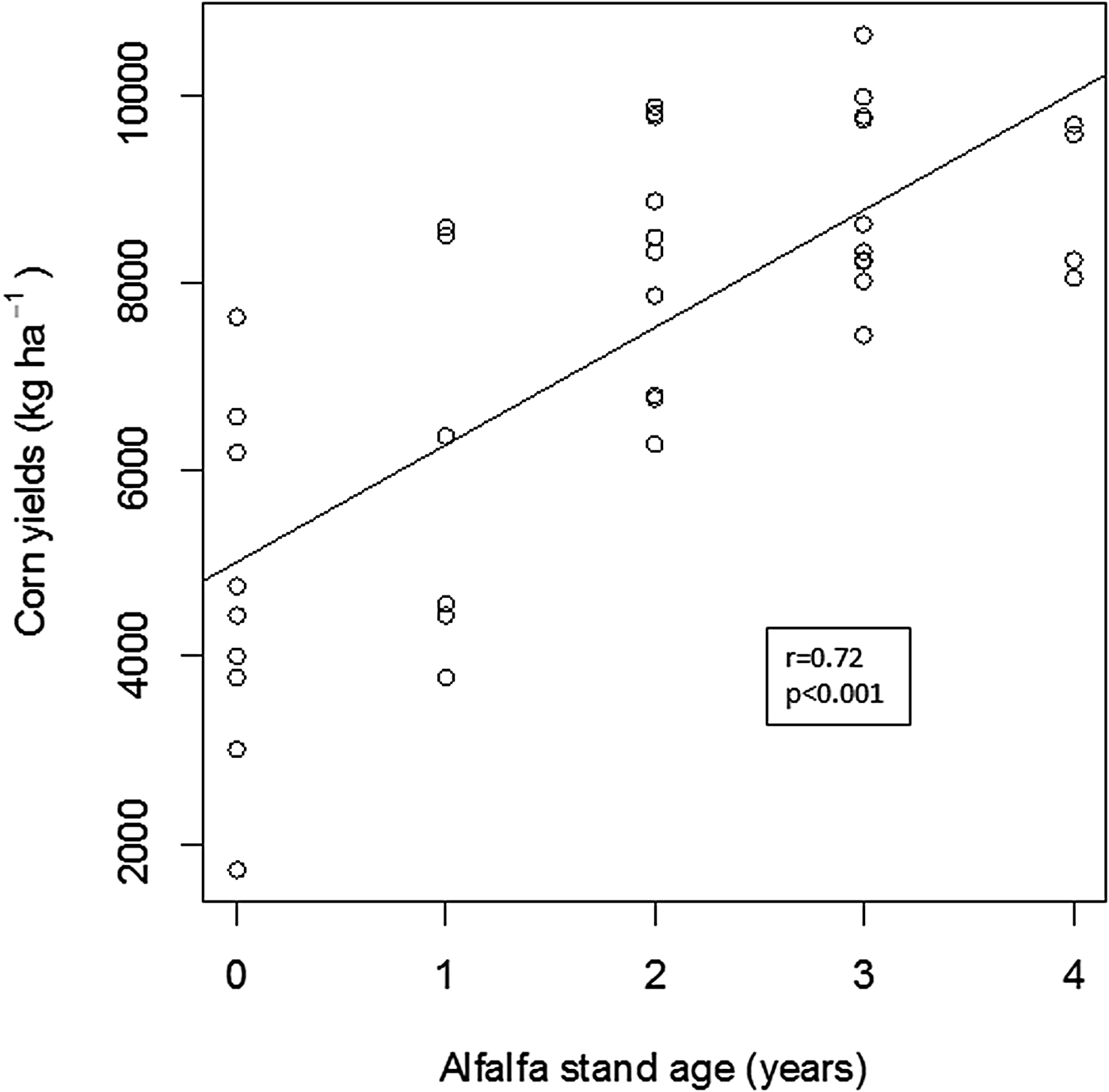
The results of the alfalfa stand age experiment supported the conclusion that the effects of alfalfa on a succeeding corn crop are not limited to provision of available N. Beyond the first year, increased alfalfa stand age did not lead to increased soil mineral N or potentially mineralizable N. However, corn yield did continue to increase progressively with stand age (Figure 3). Yost et al. (Reference Yost, Russelle, Coulter, Schmitt, Sheaffer and Randall2015) found that corn response to fertilizer N addition declined following older alfalfa stands, and speculated that this was due to accumulation of labile N in soil organic matter over years of alfalfa growth. Our results suggest that we may need to look beyond the quantity of N accumulated to explain the benefit of older alfalfa stands to a following corn crop. Potential mechanisms of this benefit may have included increased P or micronutrient availability, reduced weed pressure, or improved soil texture stimulated by the extended growth of alfalfa in these stands.
Relationship between alfalfa stand age and subsequent corn yield.

We observed some increases in soil C pools with increased alfalfa stand age, but these were not consistent. As discussed above, addition of low C:N organic matter can contribute to soil C stabilization, but can also ‘prime’ the decomposition of native soil OM. Most of the observed correlations among alfalfa stand age, corn yield, and soil C and N pools were no longer present when the control plots were removed from the analysis (Table 7), suggesting that these correlations reflected the differences between alfalfa treatments and the no-alfalfa control. The correlation between stand age and corn yield, however, was still present when control plots were removed. This further supports the conclusion that the mechanism of the alfalfa's yield benefit to the corn was not captured by the soil N and C parameters measured in this experiment. Alfalfa has been observed to improve P availability (Li et al., Reference Li, Mahler and Everson1990; Iyamuremye et al., Reference Iyamuremye, Dick and Baham1996), suppress disease-causing organisms such as the potato pathogen Rhizoctonia solani (Snapp et al., Reference Snapp, Swinton, Labarta, Mutch, Black, Leep, Nyiraneza and O-Neil2005), and serve as a host to beneficial mycorrhizal fungi (Bradbury et al., Reference Bradbury, Peterson and Bowley1991). Alfalfa can also suppress weeds, particularly difficult-to-manage perennials such as Canada thistle (Ominski et al., Reference Ominski, Entz and Kenkel1999). These effects have been less studied than the N credit, but are especially valuable in organic systems, where weed and disease control can be particularly challenging.
Conclusions
The alfalfa cutting management experiment indicated that choosing a management regime without biomass removal could further increase corn yields and soil mineral N in some cases, although these differences were small and inconsistent across environments. In the stand age experiment, alfalfa stands of all ages, managed with a standard regime of three biomass harvests per year, improved corn yields compared with a no-alfalfa control, and corn yields continued to increase with increased stand age up to 4 years. These results suggest that farmers need not forgo hay harvest to obtain the rotational benefits of an alfalfa stand.
Our findings indicate that the benefits of alfalfa in rotation with corn are not limited to the N credit provided through symbiotic fixation of atmospheric N. We conclude, therefore, that alfalfa is a valuable addition to organic crop rotations even in systems where N fertility is not limiting to yield.
Acknowledgements
This research was supported by the USDA Risk Management Agency under Partnership Agreement Number 05IE08810211, ‘Tools for Managing Pest and Environmental Risks to Organic Crops in the Upper Midwest.’
Appendix A
Soil mineral N (mg kg−1) at 0–30 and 30–60 cm depth and total C at 0–30 cm depth in alfalfa cutting treatments at Rosemount, Lamberton and Waseca, MN.