I. INTRODUCTION
Hydrogenated carbon nanotubes are typically prepared by metal reduction reactions via two distinct methods: the modified Birch reduction in ammoniaReference Pekker, Salvetat, Jakab, Bonard and Forro1–Reference Borondics, Jakab and Pekker3 and the reaction with alkali metal naphthalides in tetrahydrofuran (THF).Reference Penicaud, Poulin, Derre, Anglaret and Petit4–Reference Chattopadhyay, Sadana, Liang, Beach, Xiao, Hauge and Billups8 The reduced carbon nanotube materials were found to undergo what appeared to be a limited hydrogenation via a reaction with methanol.Reference Pekker, Salvetat, Jakab, Bonard and Forro1 Alternatively, the reduced carbon nanotube materials were utilized for a series of diverse sidewall functionalization reactions, including in situ polymerization reactions.Reference Borondics, Bokor, Matus, Tompa, Pekker and Jakab2, Reference Borondics, Jakab and Pekker3, Reference Liang, Alemany, Beach and Billups5–Reference Chattopadhyay, Sadana, Liang, Beach, Xiao, Hauge and Billups8 Utilizing similar alkali metal reduction chemistries, Teprovich et al.Reference Teprovich, Wellons, Lascola, Hwang, Ward, Compton and Zidan9 showed that a lithium-doped fullerene could reversibly store 5 wt% hydrogen with a 6:1 molar ratio of Li:C60 via a chemisorption mechanism. In this study, it was observed that under controlled conditions, the reaction of sodium naphthalide with purified laser-generated single-walled carbon nanotubes (SWNTs) in THF leads to an efficient hydrogenation of the nanotube backbone. Through a series of isotope labeling experiments, we were able to establish that an unstable SWNT radical anion intermediate mimics the known reactivity of organolithium reagents with THF.Reference Bates, Kropskai and Potter10–Reference Clayden and Yasin12 Here, THF was susceptible to deprotonation by a SWNT radical anion intermediate. The final isolated product was a novel hydrogenated nanotube material that contained 3.5–3.9% w/w hydrogen.
II. EXPERIMENTAL DETAILS
A. General
All reactions were performed under a nitrogen atmosphere using standard Schlenk line techniques. The isotope-labeled solvents used in this study were purchased from Cambridge Isotope Laboratories, Inc. (Andover, MA), and used without further purification. Dry THF was distilled from sodium–benzophenone under nitrogen.
B. Temperature programmed desorption apparatus
The temperature programmed desorption (TPD) apparatus and calibration have been described in detail previously.Reference Heben, Dillon, Gilbert, Parilla, Gennett, Alleman, Hornyak, Jones, Myneni and Chattopadhyay13 TPD measurements were performed on ∼2 mg samples evacuated to 10−8 Torr at room temperature and then heated at 1 °C/s to 700 °C. The desorbing species were monitored as a function of temperature with mass spectrometry.
C. Raman spectroscopy
Raman spectroscopy was performed using the 2.54 eV (488 nm) line of an Ar ion laser and the 1.96 eV (632.8 nm) line of a HeNe laser. The backscattered light was analyzed with a Jobin Yvon 270M spectrometer (Horiba Scientific, Edison, NJ) equipped with a liquid-nitrogen-cooled Spectrum One CCD and a holographic notch filter. A Nikon 55 mm camera lens (Nikon, Melville, NY) was used both to focus the beam on the sample and to collect the scattered light. Averaging three 30-s scans was sufficient to obtain high-resolution Raman spectra.
D. Infrared spectroscopy
Absorbance spectra were measured using a nitrogen-purged Nicolet 510 G series Fourier Transform Infrared Spectrometer (Thermo Scientific, West Palm Beach, FL) with a deuterated tryglycine sulfate detector. Each spectrum averaged 256 scans operating at 8 cm−1 resolution. Air- and moisture-sensitive samples were handled in a helium-filled glovebox and loaded into a custom infrared (IR) sample holder consisting of two 50-mm silicon wafers sealed using Ultra Torr compression fittings. The sample holder was transported to the spectrometer in a double sealed bag under helium. The spectrometer sample chamber was purged continuously with dry nitrogen. IR samples were degassed on the TPD apparatus at 135 °C to remove absorbed solvents before analysis.
E. Electron spin resonance
Electron spin resonance (ESR) spectra were obtained with a Bruker Elexsys 500 X-Band ESR spectrometer (Bruker Biospin, Billerica, MA) system at 25 °C.
F. SWNT purification
In the first step of the purification process the raw laser generated SWNT soot was refluxed for 16 h in 2 M nitric acid. The resulting solution was filtered through 5 micron Polytetrafluoroethylene (PTFE) 47 mm filters, washed with a sequence of water, 3 M NaOH, water, acetone solutions until the filtrate was clear. To maximize the yields of purified SWNTs, the buckypapers obtained after refluxing and filtration were kept below a mass of 10 mg. The refluxed nanotubes were dried in an oven at 70 °C for 10 min. The resultant buckypapers were then burned in air at 525 °C, 760 Torr for 30 s, at which time an approximate 50% loss in mass was typically observed. The air-oxidized SWNTs were then immersed in concentrated HCl for 5 min to remove residual metal impurities; the papers were then immersed in 6 M NaOH and subsequently allowed to soak for several minutes in three separate water washes to remove excess base. This purified SWNT material was then heated to 800 °C for 5 min in 100 sccm flowing carbon dioxide after which additional concentrated HCl, 6 M NaOH, and water soaks were repeated until no further metal was removed. After removal of the residual metals, samples were dried in an oven at 70 °C for 10 min and a final vacuum anneal step to 600 °C at 10−7 Torr was conducted to degas a significant portion of the oxygen moieties attached to the nanotubes after the purification process. In the end, about 30% of the original mass was recovered and contained less than 1% metal impurities as determined by thermogravimetric analysis.
G. SWNT reduction reaction
In a glovebox, under an inert helium atmosphere, 5 mg of purified SWNTs, 100 mg of naphthalene, and 100 mg of sodium metal were added to a round bottom flask with a magnetic stir bar. The naphthalene and sodium were added in excess to minimize side reactions from any residual water or oxygen in the reaction vessel. The flask was transferred to a Schlenk line, backfilled with N2, and 100 mL of dried THF was added. The mixture was sonicated for 30 min and then allowed to stir for 12 h to ensure the complete reduction of the SWNTs. The suspension of SWNTs was transferred via the Schenk line into a centrifuge tube. The SWNT suspension was centrifuged at 2000 rpm for 20 min, the THF was removed, and the pellet was washed with an additional 100 mL of dry THF. This procedure was repeated until the supernatant solution was clear. The products were dried under nitrogen, transferred to a vacuum line, and dried for 12 h at approximately 10−6 Torr to remove residual solvent and naphthalene. The resulting powder was then transferred to a quartz TPD sample holder inside of a helium-filled glovebox. Utilizing this sample preparation procedure limited the amounts of solvent and reagents present during the initial degas at room temperature of the sample on the TPD apparatus. Samples were initially degassed on the TPD apparatus in vacuo until an overpressure of 10−8 Torr was obtained. Under these conditions, any residual solid sodium naphthalide that remained would decompose to sodium and naphthalene, of which the latter is immediately removed in vacuo.Reference Stevenson, Wiedrlch, Zlgler, Echegoyen and Maldonado16, Reference Wang, Levin and Szwarc17
III. RESULTS AND DISCUSSION
The SWNTs used in this investigation were produced utilizing a well-developed laser vaporization process described elsewhere.Reference Dillon, Gennett, Jones, Alleman, Parilla and Heben14, Reference Gennett, Dillon, Alleman, Jones, Hasoon and Heben15 The SWNTs were purifiedReference Dillon, Gennett, Jones, Alleman, Parilla and Heben14 and hydrogenated using procedures similar to those previously reported.Reference Penicaud, Poulin, Derre, Anglaret and Petit4–Reference Chattopadhyay, Sadana, Liang, Beach, Xiao, Hauge and Billups8, Reference Curtis, Gennett, Engtrakul, O’Neill, Ellis, Heben, Dillon, Moen, Choudhury and Keller18 TPD measurements were performed to investigate the reactivity of the SWNT surfaces by monitoring the desorbing material as a function of temperature with mass spectroscopy. An unexpected high hydrogen gravimetric content was observed that ranged from 3.5% to 3.9% w/w as compared to the 0.64% to 1.5% w/w reported in the literature for similar materials after the reaction with methanol.Reference Pekker, Salvetat, Jakab, Bonard and Forro1 Theoretical calculations for the coverage of the nanotube backbone with atomic hydrogen predict a thermodynamically stable coverage of ∼4.5% w/w, so the hydrogen content we report is within the predicted upper limit.Reference Bauschlicher19, Reference Park, Seo and Lee20
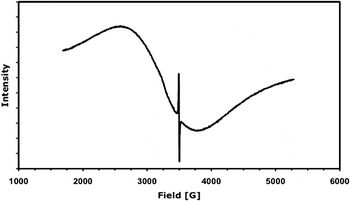
Through the analysis of ESR, TPD, Raman spectroscopy, and IR spectroscopy data, the hydrogenation mechanism for the reaction of SWNTs with sodium naphthalide in THF was determined as illustrated in Scheme 1. The proposed reaction mechanism illustrates that after the generation of sodium naphthalide, a highly reactive SWNT radical anion intermediate [I] is formed. This reactive intermediate [I] was not isolated. It is this SWNT radical anion [I] that cleaves the THF heterocyclic ring via the removal of the acidic α proton, similar to the behavior observed for butyl lithium reagents.Reference Bates, Kropskai and Potter10–Reference Clayden and Yasin12 The resultant air-sensitive hydrogenated nanotube material [II] is paramagnetic as evidenced by its ESR signal (Fig. 1). The ESR spectrum, obtained at 25 °C, of the hydrogenated-free radical SWNTs [II] generated during the chemical reduction with sodium naphthalide is quite unique with the superimposition of the sharp and broad signals. The g value for the sharp peak is 1.99459. This characteristic spectrum was also observed for SWNTs reduced via electron irradiation at 10 K.Reference Martino, Egger, Hallberg and Balseiro21, Reference Salvetat, Fehér, L’Huillier, Beuneu and Forró22 Detailed information about SWNT spin coupling is limited because of the existence of ferromagnetic impurities and localized defects in the nanotube sp 2 network.Reference Martino, Egger, Hallberg and Balseiro21, Reference Salvetat, Fehér, L’Huillier, Beuneu and Forró22 It is important to note that unlike arc- and HiPco-generated SWNT materials, the final product [II] produced using laser-generated SWNTs was insoluble in most organic solvents.Reference Borondics, Bokor, Matus, Tompa, Pekker and Jakab2–Reference Penicaud, Poulin, Derre, Anglaret and Petit4 The hydrogenation process is reversible. The SWNTs were regenerated after dehydrogenation to 550 °C. The dehydrogenated SWNT materials were then rehydrogenated to the same gravimetric level using the experimental procedure described within this article.
A representative ESR spectrum obtained for the isolated [II].

Hydrogenation mechanism for the reaction of SWNTs with sodium naphthalide in THF.

The source of hydrogen for the hydrogenation reaction was determined through detailed isotope labeling experiments using naphthalene-d 8, THF-d 8, and SWNT samples purified using all deuterated reagents (e.g., D2O, DNO3, DCl, NaOD, acetone-d 6). The various m/e signals for H2, HD, and D2 were monitored during the thermally initiated desorption of the hydrogen/deuterium moieties from [II]. Interestingly, only the reactions carried out in THF-d 8 led to the evolution of HD and D2. When the total area under the curve for each individual mass was integrated and normalized to m/e = 2, the total hydrogen content was 3.8% w/w.
The mechanism in Scheme 1 was examined by conducting the reduction reaction in vacuo. The increase of pressure over the reaction mixture was measured after the sodium naphthalide reduction reaction was allowed to proceed to completion. The headspace gas was sampled and found to consist of a mixture of ethylene [III] and THF. After correcting for the vapor pressure of THF, the amount of hydrogenation predicted from the molar amount of ethylene produced was ∼5% w/w on the basis of the original SWNT mass. When [II] was isolated and completely degassed under the conditions described above on our TPD apparatus, we calculated 3.9% w/w hydrogen. These experiments confirm Scheme 1, whereby the SWNT radical anion [I] is a very strong reactive base that can cleave THF under ambient conditions resulting in the hydrogenation of the SWNTs.
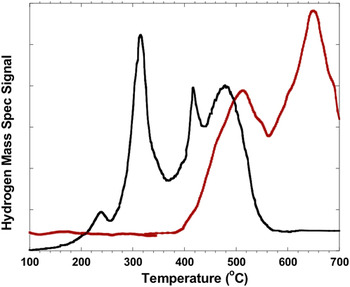
Figure 2 illustrates the distinct hydrogen desorption signals for [II]. The hydrogen mass signal was the only mass signal of significance above 75 °C. A considerable amount of hydrogen desorbs below 450 °C suggesting that the hydrogen is bound to the carbon surface in a manner, which is different from hydrogenated carbon materials prepared via a Birch reduction method.Reference Pekker, Salvetat, Jakab, Bonard and Forro1 We tested this observation by reacting [II] with methanol. The red curve in Fig. 2 is the hydrogen desorption signal after the chemical reaction of [II] with methanol. As can be seen, the low temperature desorption peaks are no longer present in the TPD spectrum. The high temperature peaks traditionally observed in a Birch reduction hydrogenation are now present. Furthermore, after the chemical reaction of [II] with methanol, the total gravimetric hydrogen content was reduced to ≤1% w/w, also in agreement with the literature.Reference Pekker, Salvetat, Jakab, Bonard and Forro1
The black curve illustrates a typical TPD spectrum of [II] degassed at a heating rate of 1 °C/s. Hydrogen desorbed at a series of temperatures <500 °C. The total hydrogen content of the samples ranged from 3.5% to 3.9% w/w. The red TPD curve is of [II] after a chemical reaction with methanol. The hydrogen for this sample desorbed at temperatures >500 °C. The total hydrogen content of these samples was ≤1% w/w. This curve intensity was normalized for graphical clarity. In both cases, all residual solvent or naphthalene were removed in vacuo (10−6 Torr).

It has been shown theoretically that an increase in the aromatic nature of a polycyclic aromatic is possible upon reduction.Reference Rosokha and Kochi23 Since little information is known experimentally concerning the intrinsic thermodynamic stability of a radical anion polycyclic aromatic species, the presence of four hydrogen desorption peaks (Fig. 2) is not completely obvious and may be due to a variety of reasons including but not limited to the following: (i) SWNTs with different helicities; (ii) variation in the hydrogen binding sites, i.e., interstitial, groove, and edge sites; and (iii) variation in the chemical stability of the remaining C–H bonds as subsequent hydrogen atoms are desorbed.
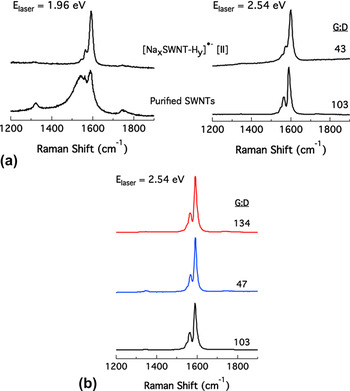
Raman scattering has been used extensively to evaluate the purity of carbon nanotube materialsReference Dillon, Yudasaka and Dresselhaus24 and their interaction with alkali metals.Reference Claye, Rahman, Fischer, Sirenko, Sumanasekera and Eklund25–Reference Rao, Eklund, Bandow, Thess and Smalley27Figure 3(a) shows the Raman spectra for purified SWNTs and [II]. After sodium reduction and hydrogenation via reaction with THF, the ratio between the tangential mode (G-band, ∼1590 cm−1) and the disorder peak (D-band, ∼1350 cm−1), i.e., the G:D ratio, decreased by ∼50%. As suggested previously,Reference Zhang, Qi, Wang, Lu, Mann, Li and Dai28 the change in the G:D ratio was expected as the hydrogenation reaction with THF causes the formation of C–H bonds and introduces disorder on SWNT sidewalls, thus increasing the D-band intensity. In conjunction with the increase in intensity of the D-band, the reduction of the SWNTs alters the resonance frequency of the G-band, possibly reducing its intensity as well.Reference Dillon, Yudasaka and Dresselhaus24, Reference Dillon, Parilla, Alleman, Gennett, Jones and Heben29 Using an excitation laser of 1.96 eV, a significant reduction of the asymmetric Breit–Wigner–Fano line shape of the G-band for [II] is consistent with previous work that attributes this decrease to the loss of continuum states due to chemical reduction of the SWNT surface.Reference Penicaud, Poulin, Derre, Anglaret and Petit4 As stated previously, [II] decomposes by the reaction with methanol resulting in the formation of covalent hydrogenated SWNTs. Raman spectra for these hydrogenated materials are shown in Fig. 3(b). The reaction of [II] with methanol reduces the G:D ratio by ∼50% relative to purified SWNTs. After TPD annealing (up to 550 °C in vacuo) and the desorption of the hydrogen, the G:D ratio was recovered and improved relative to the initial purified SWNTs indicating that the high temperature anneal may have removed possible imperfections in the SWNTs [Fig. 3(b)].
(a) Raman spectra obtained at 1.96 eV (left panel) and 2.54 eV (right panel) for purified SWNTs and [II]. The G:D ratios calculated for spectra at 2.54 eV. (b) Raman spectra, including G:D ratios, obtained at 2.54 eV for purified SWNTs (black), and [II] after reaction with methanol (blue), and subsequent annealing to 550 °C to remove the atomic hydrogen (red).

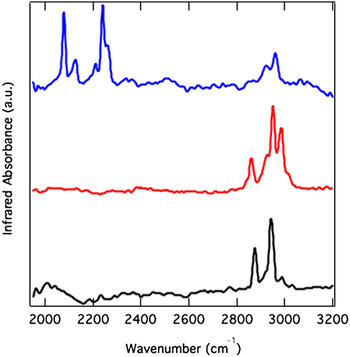
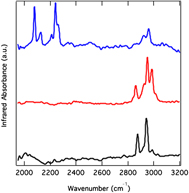
IR spectroscopy measurements of [II] before and after the chemical reaction with methanol were carried out to further elucidate the C–H bonds on the SWNTs (Fig. 4).Reference Zhang, Qi, Wang, Lu, Mann, Li and Dai28, Reference Khare, Meyyappan, Cassell, Nguyen and Han30–Reference Miller, Kintigh, Kim, Weck, Berber and Tomanek32 Due to the sensitivity of [II] to air and water, samples were loaded in a glovebox under helium into a custom anaerobic IR sample holder. The ortho addition of hydrogen in zigzag lines parallel to the tube axis was predicted to be the more favorable geometry for the high coverage of hydrogen on SWNT surfaces and observed experimentally for polyamine hydrogenated SWNTs.Reference Miller, Kintigh, Kim, Weck, Berber and Tomanek32 The observed C(sp 3)–H stretching vibrations for [II] indicate that the hydrogen is systematically arranged on the SWNT surface preferentially in the ortho hydrogen pairing and are in agreement with previous experimental results for polyamine hydrogenated SWNTs.Reference Miller, Kintigh, Kim, Weck, Berber and Tomanek32 A more complex spectrum was obtained for [II] after the chemical reaction with methanol-d 1. Interestingly, after the chemical reaction with methanol-d 3, mostly, deuterated SWNTs were produced (sp 3 C–D bonds). These results suggest that the majority of hydrogen that remains on the SWNT after the reaction of [II] with methanol is from the methyl group of methanol. This preferential reactivity of [II] with methanol parallels the chemistry of phenyl radicals with methanol, i.e., phenyl radicals abstract H atoms from the α-C–H bonds of alcohols since the O–H bonds are more stable.Reference König, Musso and Záhorszky33 These data suggest that the majority of the hydrogen initially on [II] is desorbed by the chemical reaction with methanol. Finally, it is important to note that no significant evidence for sp 2 C–H bonds was observed in Fig. 4.
IR spectra for [II] (black) and [II] after the chemical reaction with either CH3OD (red) or CD3OH (blue). For comparison, spectra were manually baseline corrected using Nicolet proprietary Omnic spectroscopy software.

A similar set of reduction experiments utilizing lithium or potassium naphthalide as the reducing agent were also investigated. Interestingly, significant decreases in the nanotube hydrogenation levels were observed, ≤1.1% w/w. It is well established that the intercalation of graphite with alkali metals typically yields LiC6 and KC8, while sodium leads to NaC64.Reference Edmana, Herold, Jacobsson, Lelaurain, McRaeb and Sundqvista34–Reference Pruvost, Herold, Herold and Lagrange36 A direct correlation of SWNT alkali metal intercalation levels to graphite intercalation compounds can be made due to the highly crystalline (i.e., graphitic) nature of our laser-generated SWNTs.Reference Dillon, Parilla, Alleman, Gennett, Jones and Heben29 Therefore, we postulate that the higher hydrogenation levels observed are due to a larger availability of binding sites on the SWNT surface for hydrogen when sodium naphthalide is used as the reducing agent.
The hydrogenated material [II] was analyzed for sodium content via elemental analysis and found to contain approximately one sodium atom per ∼60–70 carbon atoms, similar to the NaC64 stoichiometry previously reported for sodium–graphite intercalation compounds.Reference Edmana, Herold, Jacobsson, Lelaurain, McRaeb and Sundqvista34, Reference Metrot, Guerard, Billaud and Herold35 Contribution from absorbed sodium hydride species to the hydrogen gravimetric content cannot be ruled out. If all the sodium in [II] are in the form of sodium hydride, only 0.1% w/w of the hydrogen gravimetric content observed in Fig. 2 can be attributed to sodium hydride based on the NaC64 stoichiometry. Therefore, the majority of the hydrogen gravimetric content in [II] is due to C–H bonds on the SWNT surface. The low concentration of sodium (NaC64) also accounts for the insolubility of our reduced materials in common organic solvents as the sodium to carbon content is less than the ratio necessary to dissolve the reduced SWNTs.Reference Penicaud, Poulin, Derre, Anglaret and Petit4
IV. CONCLUSIONS
In summary, we have observed a marked improvement of the solution phase hydrogenation of SWNT materials through the use of sodium naphthalide as the reducing agent and THF as the reaction solvent and hydrogen source. Current experiments are underway to determine the specific binding energy of these the hydrogen–SWNT interactions observed in Fig. 2. The fact that sodium is the least effective graphite alkali metal intercalant relative to lithium and potassium appears to contribute to the increased hydrogenation level observed in [II]. Finally, these results further illustrate that significant differences in reactivity and overall physiochemical properties of SWNTs exist and are due to the how the SWNTs were synthesized and processed.
ACKNOWLEDGMENTS
Funding for this effort was provided by the U.S. Department of Energy’s Office of Energy Efficiency and Renewable Energy within the Center of Excellence on Hydrogen Sorption Materials as part of DOE’s National Hydrogen Storage Grand Challenge and by the Office of Science, Basic Energy Sciences, Materials Science and Engineering under subcontract DE-AC36-99GO10337 to NREL.