How couples manage untimely conflict conversations is an important area of study because couples are often required to gracefully manage the timing, depth, and quality of an emotionally charged conversation (e.g., Christensen & Shenk, Reference Christensen and Shenk1991; Gottman, Reference Gottman1994; Johnson & Roloff, Reference Johnson and Roloff2000). While a wide body of work has examined the communication processes that contribute to healthy and productive disagreements (e.g., Christensen & Shenk, Reference Christensen and Shenk1991; Gottman Reference Gottman1993, Reference Gottman1994; Karney & Bradbury, Reference Karney and Bradbury1995), fewer studies have examined the argument in context (Vuchinich, Reference Vuchinich1987). Arguments do not occur in a vacuum; for example, couples often lead busy lives with competing demands for their attention and constraints on their time. Partners must transition out of disagreements for a variety of reasons; for example, the time and setting may be problematic (visiting friends or relatives, or the presence of children) or they simply do not have the time available to naturally enter and conclude the conversation. Clinically, when couples are unable to transition out of conflict conversations they can fall into ‘marathon fights’ where they get stuck in a disagreement for hours and are unable to carry on with the necessary events in their lives. Further, not all, perhaps not even many, disagreements can end naturally with a sense of resolution and closure (Johnson & Roloff, Reference Johnson and Roloff2000). We propose that the way couples navigate these situations may be an important component of their relationship health. Couples who can successfully manage untimely conflict conversations by transitioning gracefully with minimal frustration (Bowles, Reference Bowles2005), may have healthier relationships in the long run because they are not compromising other areas of their lives or other important relationships with poorly timed arguments. On the other hand, couples who do not successfully manage untimely conflict conversations may suffer from deteriorating relationship health as they repeatedly strain other relationships, inadvertently upset their children, or suffer the repeated frustration of having untimely conflict conversations interfere with their other important life goals (e.g., work, sleep). Further, difficulty managing untimely conflicts may contribute to the accumulation of negative interactions in relation to positive interactions, thus upsetting the 1-to-5 ratio that has been argued to characterise healthier relationships (Gottman, Reference Gottman1994).
Relationship scientists already know a great deal about the effects of couples’ communication in general. It is well established that the overall quality of couples’ communication is associated with relationship stability and satisfaction (e.g., Karney & Bradbury, Reference Karney and Bradbury1995; Weiss & Heyman, Reference Weiss, Heyman, Halford and Markman1997). Negative communication is particularly pernicious: it has consistently been associated with decreased relationship satisfaction (Karney & Bradbury, Reference Karney and Bradbury1995), divorce (Gottman, Reference Gottman1994), increased levels of stress-related hormones (Malarkey, Keicolt-Glaser, Pearl, & Glaser, Reference Malarkey, Kiecolt-Glaser, Pearl and Glaser1994), poor immune response (Kiecolt-Glazer, Fisher, Ogrocki, Stout, Speicher, & Glaser, Reference Kiecolt-Glaser, Fisher, Ogrocki, Stout, Speicher and Glaser1987) and negative child outcomes (e.g., Cummings & Davies, Reference Cummings and Davies1994). In addition, Markman, Rhoades, Stanley, Ragan, and Whitton (Reference Markman, Rhoades, Stanley, Ragan and Whitton2010) examined how the communication patterns of 210 couples before marriage predicted relationship functioning within the first 5 years of marriage. They found that both positive and negative communication patterns are associated with divorce within and relationship distress over the first 5 years of marriage. Relationship scientists have also discovered a great deal about the general patterns that couples fall into when communicating about relationship conflicts, such as destructive/competitive resolution (Bertoni & Bodenmann, Reference Bertoni and Bodenmann2010); avoidant, validating, volatile, hostile, and hostile/detached (Gottman, Reference Gottman1993); and integrative, downplaying, and conflictive (Shulman, Tuval-Mashiach, Levran, & Anbar, Reference Shulman, Tuval-Mashiach, Levran and Anbar2006). For example, volatile couples are observed as more intensely emotional; validating couples tend to be calm, empathic, and understanding during conflict; and avoidant couples minimise persuasion attempts. On the other hand, hostile couples are observed as defensive and critical (Gottman, Reference Gottman1994). Several of these patterns have been directly linked to relationship distress (e.g., Gottman, Reference Gottman1994). These researchers have demonstrated that it is possible to observe important and replicable phenomena in couples’ dyadic communication interactions and that how couples engage in conflict communications influences the development of relationship distress.
Relationship researchers have also studied how arguments within the family naturally unfold and conclude (e.g., Vuchinich, Reference Vuchinich1986, Reference Vuchinich1987; Vuchinich, Emery, & Cassidy, Reference Vuchinich, Emery and Cassidy1988). In a study of dinnertime interactions of 52 different families (75% Caucasian, 25% African American) they found that conflicts between family members came to a close in one of four ways: submission, compromise, standoff, or withdrawal (Vuchinich, Reference Vuchinich1987). Submission involves one partner ‘giving in’ to the other; compromises evolved when the family found a middle ground; standoffs emerged when partners agreed to disagree; and withdrawal was coded when one partner physically left the room or refused to continue talking. The majority of these conflicts ended without resolution in a standoff (61%). While the researchers conducted comprehensive naturalistic observations of families starting, managing and stopping conflicts, they did not examine the transition to another topic when circumstances required the family members to do so.
Although we have learned a good deal about general communication patterns and the natural process of conflict interactions, we do not know as much about how contextual constraints affect couples’ communication. As noted, all couples have to manage untimely conflict conversations and how successfully they do so may have important implications for their long-term relationship health. Although prior research has required couples to stop a conversation in order to move on to another topic (e.g., Gottman, Reference Gottman1994), these standard protocols have not required couples to negotiate the transition on their own. Consequently, there are no existing studies that examine the process of couples transitioning from one type of conversation to another. The current study builds on the existing literature by developing a protocol to investigate how couples transition out of a conflict conversation when circumstances require them to move on to another task and the extent to which couples’ transition styles are associated with longer-term changes in couples’ relationship satisfaction.
Objectives
This study had three primary research objectives:
-
1. To develop a reliable protocol sufficiently analogous to a situation in which a couple has to disengage from a conflict conversation to attend to another required task.
-
2. To observe and codify how couples negotiate the transition from an interaction about an area of disagreement to a required subsequent activity; in this case, a subsequent conversation on an unknown topic. Given the novelty of this methodology and exploratory nature of this research, we had no hypotheses regarding how couples would transition out of conflict conversations.
-
3. To examine the association between immediate and longer-term relationship satisfaction and the different styles and qualities of transitioning. More specifically, we wanted to know (a) how relationship satisfaction affects which transition styles couple engage in and (b) how transition styles and qualities affect relationship satisfaction over a 6-month follow-up period.
Method
Participants
Thirty couples (N = 60) who identified as being part of a committed romantic relationship were recruited through psychology courses and flyers at a New England university to participate in this study. Participants were offered research credit for completing the study and were also entered into a drawing with the chance to win one of two $50 gift cards to a local restaurant. Of the 30 couples, 28 identified as heterosexual and 2 identified as female same-sex couples. The average age of the sample was 20.2 years (SD = 2.58). While the length of relationship ranged from 1 to 51 months, the average relationship length was 15.4 months (median = 13 months).
This sample was representative of the university's population. In terms of race, 68% identified as Caucasian, 2% as African American, 14% as Asian, 5% as Multi-Racial, and 11% as Other. Thirteen percent of the sample identified as Hispanic, Latino or Spanish.
Measures
In addition to the coded variables, this study also examined demographic and relationship satisfaction variables. Participants also completed a number of additional items assessing intimacy, affect, attachment, and sportsmanship, to be analysed as part of a separate study.
Demographic variables
Demographics assessed were sex, age, race, ethnicity, relationship status (whether currently in a committed romantic relationship), and relationship duration (in months).
Relationship satisfaction
Relationship satisfaction was assessed using the Quality of Marriage Index (QMI; Norton, Reference Norton1983) The QMI is a six-item measure on a Likert scale. It is adapted here for dating couples by replacing the word ‘marriage’ with ‘relationship’. The first five items are scored from 1(very strongly disagree) to 7 (very strongly agree). Sample items from the measure include: ‘We have a good relationship’, ‘My relationship with my partner is strong’, and ‘My relationship with my partner makes me happy’. The final item assessing global satisfaction, ‘All things considered, what degree of happiness best describes your relationship?’ is scored from 1–10. The QMI is summed with scores ranging from 6–45. Higher sum scores on the QMI indicate greater satisfaction. Funk and Rogge (Reference Funk and Rogge2007) provided a cut score of 30Footnote 1 and below as representing a clinically significant level of relationship distress.
Procedures
Couples were scheduled for a 1-hour laboratory session. Following consent to participate, couples completed demographic and relationship satisfaction questionnaires. The researcher interviewed the couple to identify an area of disagreement in their relationship. The couple was instructed to participate in two conversations in a 20-minute period. They were asked to first discuss the conflict they identified in their relationship as they would in their everyday lives. They were told that they could spend the time working towards a resolution or discussing the conflict issue, but that they should make sure they also switched to the other conversation within the allotted time. The instructions for the second conversation were then placed face down on the table between the partners. Partners were not told what the topic of the second conversation was. The instructions for the second conversation prompted the couple to discuss the story of how they met. The entire interaction was videotaped. The couple then completed the post-interaction relationship satisfaction measures.
The participants were contacted by phone approximately 6 months later to assess for relationship satisfaction and stability.
Coding Strategy
A system for coding transition patterns and qualities was developed through a process of observation, discussion, and revision between the authors. Coders were four undergraduate research assistants trained in reliability by the first author using pilot sample interactions not included in subsequent data analyses. Training included review and demonstration of the coding manual, watching sample videos, group discussions, and independent coding practice. Once coders were consistently reliable, the five coders, including the first author, independently watched and coded all 30 recorded interactions.
An interrater reliability analysis using Krippendorff's alpha (Hayes & Krippendorff, Reference Hayes and Krippendorf2007) was performed, including all five coders, with the confidence interval set to 95%. The interrater reliability was high (Kalpha = .96; CI = .95, .97) indicating excellent reliability.
Results
Development of the Protocol
In line with the first objective, the final communication protocol resulted from piloting multiple prompts with a separate sample of pilot couples until we discovered one that both elicited a conflict conversation and prompted a transition to the second conversation without leading to premature closure of the first conversation. We discovered that if couples knew the content of the second communication task, they almost universally discontinued the conflict conversation very quickly. After numerous trials and modifications, we found a protocol that elicited the most natural transition in a way analogous to how couples transition out of untimely conversations in their day-to-day lives. In the current protocol, couples were not aware of the topic of the second conversation, which seemed to allow them to focus on the conflict topic for a longer period of time. Of note, the time to transition varied widely between couples from almost immediately to even beyond the suggested 20-minute limit, with some couples rushing to transition and others having much more difficulty transitioning. The final protocol was employed for all couples in the current study.
Transition Style Codes
Addressing our second research objective, we observed four primary transition styles and three transition qualities. The transition styles were labelled Mutual Avoidant, Mutual Collaborative, Abrupt/Controlling, and Withdraw/Resign. The transition qualities were labelled smoothness, stuck-ness, and depth. Transition qualities were rated for each transition style. Every couple was given a score from 1 (not at all) to 5 (completely), rating how much each transition style/quality characterised their transition from the conflict conversation to the story of how they met. For example, a couple could be rated as a 4 on Mutually Collaborative and a 2 on Abrupt Controlling for the same transition if it had aspects of both styles. Each transition style and transition quality is described in further depth below. Frequencies are also included for the transition style. Transition styles that were rated as 1 (not at all) or 2 (somewhat) were coded as 0 and therefore not included in the frequency count. Transition styles rated as a 3 (moderately), 4 (mostly), or 5 (completely) were coded as 1. Frequencies consist of the number of conversations coded as 1 out 30 (total number of conversations within the current sample) for each transition style. An example of each transition follows the description.
Mutual avoidant (n = 8/30, 27%)
In a mutually avoidant transition, the couple used the second conversation as a way to avoid discussing the conflict. They typically mentioned the disagreement but did not discuss it at any length (typically not more than 2 minutes). They often stated they did not want to ‘get into it’. They avoided eye contact and displayed nervous laughter. They were both visibly uncomfortable discussing the issue and they typically made the transition early on (within 2 minutes) in the conversation and quickly. The partners both showed signs of avoiding the conflict and they made this transition together. The following conversation is characteristic of the Mutual Avoidant transition style:
Disagreement about miscommunication.
Time to transition: 40 seconds.
M : It was really a misunderstanding that escalated.
F : Completely.
M : But that's about it. Question number two?
F: Yeah.
Mutual collaborative (n = 17/30, 57%)
This is the most common transition style. In a mutual collaborative transition the couple engaged with the conflict topic and spent time discussing it. The couple then discussed making the transition to the second conversation together as a team. They checked in with each other to see if they were ready to transition and they BOTH agreed that they should move on to the second conversation.
Disagreement about friends.
Time to transition: 6 minutes.
F : Yeah I guess we're good.
M : Yeah, do you want to do that? (pointing to the instructions for the second conversation)
F : Yeah. Do you want to do it or do you want me to?
M : You can do it.
F : Me? Okay.
The Mutual Avoidant and Mutual Collaborative transition styles were highly negatively correlated (r = ‒.76). Therefore, for statistical analyses, we collapsed these styles into a single variable by reverse coding the Mutual Avoidant transition style and creating a new transition style that we will refer to as Mutual Engagement. Due to the high correlation between these transition styles in practice, future researchers should code these transition styles as a single code — Mutual Engagement.
Abrupt/Controlling (n = 4/30, 13%)
This is the least common style of transition. In an Abrupt/Controlling transition one partner decided they were done discussing the conflict and insisted on transitioning to the second conversation without consulting the other partner. This type of transition was typically abrupt. One partner made a statement that he/she was going to transition or demanded that they transition. The partner who made this decision typically grabbed the instructions for the second conversation and started reading them as the final signal to his/her partner that he/she was done discussing their disagreement.
Disagreement about different tastes in music and movies.
Time to transition: 5 minutes and 35 seconds
M : Like, my favourite kinds of movies are psychological thrillers.
F : You're weird. Let's move on. That thing (points to and grabs instructions to second conversation).
M : (Says nothing, but tacitly consents to the transition).
Withdraw/Resign (n = 7/30, 23%)
In the Withdraw/Resign transition style one partner, physically or verbally, moved to avoid or exit the conflict conversation. The other partner communicated verbally or physically that he or she wanted to continue the conversation. The withdrawer continued to withdraw from the conversation and the other partner gave up or resigned to allow the conversation to transition.
Disagreement about emotional cheating.
Time to transition: 22 minutes.
F : Do you understand what I mean by talking to me differently? Instead of being, like pissed, you know? I feel like that would kind of mellow out the situation.
M : (Silence and looking down).
F : Is there anything else you'd like to say?
M : Nope.
F : Are you sure?
M : (silence)
F : Okay.
Transition Quality Codes
We also observed three general transition qualities that characterised couples’ transitions to the second conversation — how smoothly the transition was made, how stuck the couple became in the conflict conversation, and how deep the conversation was.
Smooth transitions
Couples were rated on a scale from 1 (not at all) to 5 (completely) to capture the extent to which they transitioned from the first conversation to the second conversation in a smooth, mutual, and fluid way. Smooth transitions flowed from one topic to the next without an abrupt interruption or excessive back and forth discussion.
Getting stuck
Couples were also rated on a scale from 1 (not at all) to 5 (completely) to capture the extent to which they got stuck discussing their disagreement. Couples who were rated highly on this scale struggled to disengage from the conflict conversation. They continued to discuss the conflict well past the 10-minute (or half-point) mark and they did not easily think of transitioning to the second conversation. They may have made multiple unsuccessful attempts to transition, only to find themselves revisiting their conflict.
Since Smoothness and Stuckness were highly negatively correlated (r = ‒.67), we collapsed them into a single variable (Ease) for statistical analyses. Due to the high correlation between these qualities in practice, future researchers could initially code these transition qualities as a single code — Ease.
Depth
This study also coded for the depth of the couple's conversation. Coders rated each couple's conversation on a 5-point scale from (1) very superficial to (5) deeply meaningful. This code was meant to capture both the conversation topic and the couple's ability to engage the conversation in a meaningful way. Depth is unique in that it is illustrative of the communication during the conflict, rather than the transition to another topic.
Correlations Between Transition Styles and Baseline Relationship Satisfaction
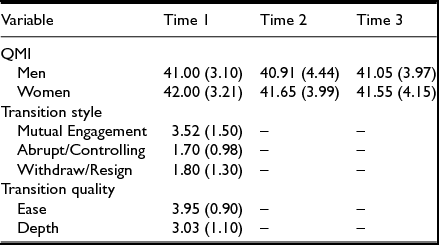
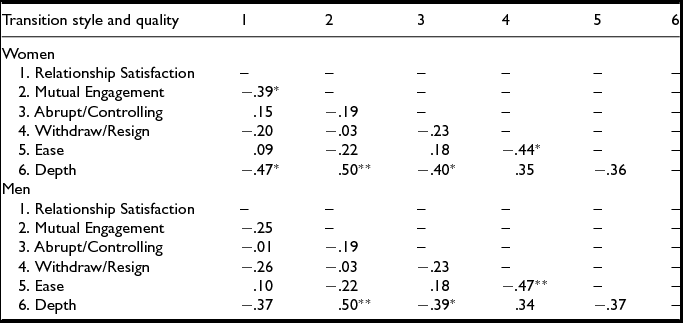
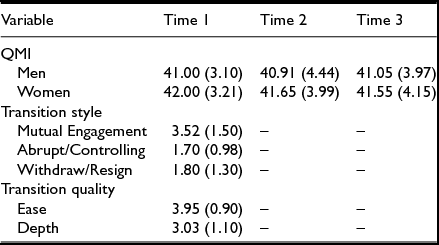
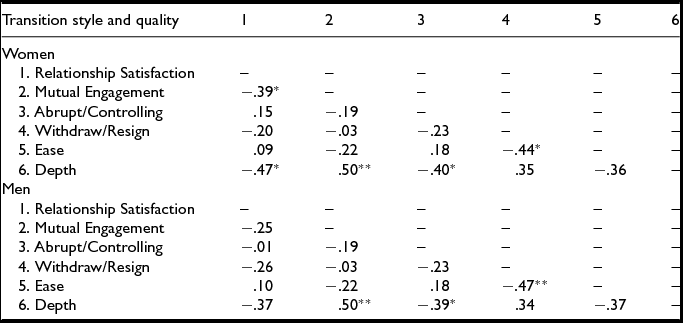
Means and standard deviations for all study variables are presented in Table 1. Relationship duration and age were not significantly associated relationship satisfaction or any of the transition styles. Relationship satisfaction ranged from a low of 33 on the Quality of Marriage Index (30.5 is considered the clinical cutoff for distress; see Funk & Rogge, Reference Funk and Rogge2007) to a high of 45, with a median score of 42, suggesting the sample ranged from mildly distressed to highly satisfied. Table 2 includes intercorrelations for study variables. After collapsing the Mutual Avoidant and Mutual Collaborative transition styles, the three remaining transition styles had relatively low intercorrelations, indicating their conceptual distinction.
Means and Standard Deviations for Study Variables
Note: Standard deviations are in parentheses.
Intercorrelations for Transition style Codes and Relationship Satisfaction at Time 1 for Men and Women (N = 58)
Note: *p <.05, ** p <.01, ***p <.001 (two-tailed).
In order to assess the association between baseline relationship satisfaction and transition style, we calculated bivariate correlations between couple codes and satisfaction at Time 1. Because partner data are non-independent, we analysed men and women's data separately. Since there were only two same-sex couples, we were unable to analyse their data due to a lack of power.
We found that women who reported greater relationship satisfaction were less likely to exhibit a Mutual Engagement transition style than women who reported lower relationship satisfaction, indicating that happier women tended to be more avoidant and less collaborative. The Abrupt/Controlling and Withdraw/Resign transition styles were not significantly associated with baseline relationship satisfaction for women, and none of the transition styles were associated with baseline relationship satisfaction for men. Results are presented in Table 2.
Transition Styles and Relationship Satisfaction Over Time
Analytic strategy
The purpose of this analysis was to determine the effect of couples’ transition styles on the change in relationship satisfaction that occurred in the short term — immediately before and after the lab task — as well as the relationship between these transition styles, and couples’ changes in relationship satisfaction over a longer-term, 6-month follow-up period. Because both Time 2 and Time 3 were hypothesised to be qualitatively distinct time points, we used separate models to determine the change from baseline to Time 2 and the change from baseline to Time 3, respectively. We used multilevel modelling, nesting partners within the couple, to account for non-independence. We regressed the endpoint of each analysis on the baseline measure to control for initial status. Because of the small size of this sample, we generated standardised parameter estimates using the sample standard deviation from Funk and Rogge's (Reference Funk and Rogge2007) study, which administered the same measure to a much larger community population. IBM SPSS Version 22 was used for all analyses.
Power analysis
We conducted a simulation study to determine the power necessary for this study. We found that in a sample size of 30 couples with a model controlling for baseline satisfaction, we had the power to detect a moderately sized true effect of β = 0.40 71% of the time.
Model 1
In model 1, we tested whether couples’ transition styles were related to their change in relationship satisfaction immediately after the lab task. Results are presented in Table 3. Although there was significant residual variability (p < .001), indicating that many couples’ levels of relationship satisfaction changed from before to after the task, none of the transition styles were associated with this change.
Model 1: Transition Styles Predicting Relationship Satisfaction at Time 2

Note: Regression coefficients were standardised using the Quality of Marriage Index standard deviation derived from Funk & Rogge (Reference Funk and Rogge2007) rather than our sample to mitigate small sample bias.
Model 2
In model 2, we tested whether couples transition styles were related to their change in relationship satisfaction after 6 months. Results are presented in Table 4. We found that the Withdraw/Resign Transition style was significantly associated with declines in relationship satisfaction over time. The other two transition styles (Mutual Engagement and Abrupt Controlling) were not associated with changes in satisfaction over time.
Model 2: Transition Styles Predicting Relationship Satisfaction at Time 3

Note: Regression coefficients were standardised using the Quality of Marriage Index standard deviation derived from Funk and Rogge (Reference Funk and Rogge2007) rather than our sample to mitigate small sample bias.
A post-hoc power analysis, using the effect sizes actually obtained in the study, indicated that we had the power to detect an effect of β = 0.24 approximately 39% of the time, indicating that if the observed effect were the true population effect, this study was underpowered.
Missing Data
Four opposite-sex couples dissolved their relationship over the course of the study, so their data were unavailable at long-term follow-up. Although these couples were included in the model, because they had data at only one timepoint, they did not affect the parameter estimates of the transition styles on Time 2 relationship satisfaction scores. Models run excluding these couples indicated the results were not sensitive to their inclusion or exclusion. Because of the small number of dropouts, we did not perform formal statistical tests of between-group differences, but we describe the directionality of two notable differences such that readers can understand the patterning of dropout observed in this study. First, all four couples whose relationships dissolved before the 1-month point had the lowest possible score on the mutual avoidant shift style (M dropout = 1.00, M completer = 2.25, SD = 1.59). Second, the mean relationship satisfaction was lower for women (M dropout = 39.00, M complete r = 42.75, SD = 3.21) and men (M dropout = 39.50, M completer = 41.25, SD = 3.10). Although these mean differences may be suggestive of meaningful differences between the two populations, we emphasise that no formal statistical tests were performed.
Transition Quality and Relationship Satisfaction
Ease and depth
We also tested whether couples transition qualities (ease of transition and depth of conversation) were related to their changes in relationship satisfaction immediately after their interaction and at the 6-month follow-up. Results are presented in Tables 5 and 6. Since these codes are conceptually different from one another and the transition styles (whereas Depth refers to the quality of the conflict and Ease refers to the quality of the transition), we conducted separate models in order to test their effects on relationship satisfaction. Ease of transition was associated with gains in relationship satisfaction in the long run but not the short run. We also found that couples who engaged in a deeper conversation reported decreased relationship satisfaction at both Time 2 and Time 3.
Model 3: Association of Transition Ease with Relationship Satisfaction at Time 2

Note: Regression coefficients were standardised using the Quality of Marriage Index standard deviation derived from Funk and Rogge (Reference Funk and Rogge2007) rather than our sample to mitigate small sample bias.
Model 5: Association of Depth of Conversation with Relationship Satisfaction at Time 2

Note: Regression coefficients were standardised using the Quality of Marriage Index standard deviation derived from Funk and Rogge (Reference Funk and Rogge2007) rather than our sample to mitigate small sample bias.
Discussion
This study developed a new methodology for observing time-constrained couples’ conflict interactions — those disagreements that arise when couples do not have the time to fully address them because of other pressing life demands, such as having to get to bed or go to work. During the development phase of this study, a trial-and-error process resulted in a communication task in which partners were given 20 minutes in which to start with a discussion of a conflict topic and then switch to an unknown conversation topic before the time expired. We discovered that the set-up of this task allowed couples to engage the conflict conversation without immediately switching to the next, more pleasant task, while still creating the pressure of having to find a way to transition out of the conflict conversation in order to move on to another demand. We would argue that this task is sufficiently analogous to real-life situations in which couples are under some pressure to manage an untimely conflict discussion to allow us to adequately study the phenomenon in the lab. Thus, we were able to observe a phenomenon that has not been previously studied in the relationship literature, namely how couples navigate the transition out of an untimely conflict when circumstances require them to do so.
Development of an observational coding system based on repeated observations of participant couples resulted in the identification of four transition styles (Mutual Avoidant, Mutual Collaborative, Abrupt/Controlling, and Withdraw/Resign) and three transition qualities (smoothness, stuckness, and depth) that were found to exemplify how couples shift out of a conflict conversation. Since the mutual transition styles were capturing different ends of a similar phenomenon they were collapsed into a new variable: Mutual Engagement. Similarly, smoothness and stuckness were collapsed into an Ease variable.
We examined whether relationship satisfaction predicted couples’ transition style and found that women who reported greater relationship satisfaction were less likely to exhibit a Mutual Engagement transition style, indicating that happier women tended to be more avoidant and less collaborative. This was an interesting and somewhat counterintuitive finding, given that most of the empirical research on romantic relationships indicates a strong association between conflict avoidance and relationship dissatisfaction (e.g., Caughlin & Golish, Reference Caughlin and Golish2002; Golish, Reference Golish2000; Knobloch & Carpenter-Theune, Reference Knobloch and Carpenter-Theune2004). Additionally, a recent study on dating couples found that avoidance goals, or efforts to avoid disagreement and conflict within the relationship, were associated with decreases in relationship satisfaction over time (Impett et. al., Reference Impett, Gordon, Kogan, Oveis, Gable and Keltner2010). Speculatively, within the demands of the current interaction set-up and the analytical presumption that dissatisfaction is predicting greater engagement, it may be that greater dissatisfaction motivates more active and persistent engagement in conflict conversations in an attempt to find an emotional resolution that might diminish the aversive experience of dissatisfaction. Thus, more satisfied women may find it easier to remain disengaged from an untimely conflict conversation because they are not under the same level of negative emotional pressure as more dissatisfied women. Theoretically, dissatisfaction is not experientially neutral, but is experienced as a kind of chronic aversive stimulation, which in turn catalyses other, more immediate negative interactions — a vicious negative cycle.
We next examined the associations between the observed transition styles and change in relationship satisfaction from pre- to post-interaction. We found no association between transition styles and change in relationship satisfaction from before to directly after the interaction. One interpretation is that transition styles have no detectable immediate effects, either positively or negatively. Transition styles may not be immediately palpable to partners and thus may not draw the partners’ attention in the same way that communication processes such as the four horsemen might (Gottman, Reference Gottman1994). Thus, although transition styles may have longer-term effects on relationship satisfaction, those accumulating effects may be undetectable to the couple at the time of the interaction itself.
Next, we examined the associations between transition styles and longer-term relationship satisfaction changes. These analyses revealed that the Withdraw/Resign Transition style was associated with declines in relationship satisfaction over time. In keeping with existing research on the negative long-term effects of withdrawal as a communication style (e.g., Caughlin & Huston, Reference Caughlin and Huston2002; Christenson et al., Reference Christensen, Eldridge, Catta-Preta, Lim and Santagata2006; Gottman & Krokoff, Reference Gottman and Krokoff1989; Gottman & Silver, Reference Gottman and Silver1999; Heavey, Christensen, & Malamuth, Reference Heavey, Christensen and Malamuth1995), our results indicate that although withdrawal may have no effect on relationship satisfaction in the short run, it is detectably corrosive in the long run. A unique addition of the current project is that we coded the exchange between partners, in which one partner's withdrawal ultimately results in the other partner's resignation. Previous research has demonstrated that ineffective communication, coupled with frustration meeting one's perceived needs, contributes to the escalation of conflict in any relationship (Bowles, Reference Bowles2005). In fact, the coders for the study reported that the partner's eventual resignation was the most poignantly palpable quality of this transition style. Thus, the set-up that requires partners to find a way to transition out of the conflict conversation and move on to the next task allows us to observe that withdrawal is not necessarily unidimensional, but that it appears to lead the other partner to experience a kind of frustrated or hopeless resignation. In fact, it may be that this resignation is the phenomenon that actually ultimately metastasises into measurable relationship deterioration, since it may be the more emotionally toxic intrapersonal experience. In other words, it raises the question whether it is the withdrawing partner who ultimately becomes relationally dissatisfied or the resigning partner. This question might be directly addressed by future studies with greater power that are able to examine partner effects.
We next examined the association between transition qualities and change in relationship satisfaction. We found that couples who were able to make an easier transition demonstrated significant gains in relationship satisfaction in the long run but not immediately after the interaction. These are the results most consistent with our theory that couples who are better able to transition out of conflict conversations in the service of other life demands are more relationally healthy in the long run, versus couples who are more prone to getting stuck in marathon arguments that thus interfere with other important goals and responsibilities.
Finally, we found that couples who engaged in a deeper conversation reported decreased relationship satisfaction immediately after the interaction as well as at 6-month follow-up. These results suggest that in the current context (i.e., transition demands), delving deeply into conflict is not necessarily our friend. Depth appears to be experienced as detrimental to relationship health both in the short run and in the long run, suggesting that collaborative avoidance of depth, at least in the context of untimely conflict conversations may be a skilful communication tactic. We suspect that the key difference in our study was the set-up of the communication task such that the couple was required to both engage and then disengage from the conflict conversation in a relatively short period of time. Again, this protocol was intended to effectively analog those real-world situations in which circumstances require couples to disengage from an untimely conflict conversation in order to transition to other important tasks. To the degree that the communication task we created effectively approximates these real world challenges, it may be that couples’ ability to carefully choose not to get too deeply into a conflict conversation that they know they will not have time to effectively engage is an important relationship health-preserving skill. In other words, if couples are good at discerning when and when not to deeply engage in a difficult conversation, then they are more likely to remain satisfied in the long run. If couples lack this set of skills and are therefore more prone to getting stuck too deeply in a conflict conversation at a genuinely inconvenient time, then they are more prone to relationship dissatisfaction in the long run. Thus, there appear to be specific times when a skilful form of conflict avoidance is genuinely healthy.
A few studies have found that avoiding communicating about certain topics, such as complaints about one's partner, is actually beneficial for the relationship (Afifi & Gurerro, Reference Afifi, Guerrero and Petronio2000; Roloff & Ifort, Reference Roloff, Ifert and Petronio2000). Our results may speak to a couple's awareness of the possible negative effects of communicating about conflict at inopportune times, and evidence a skilful choice to move on quickly and smoothly. More specific to our particular protocol, if couples know that they are going to have to transition out of a conflict conversation because it is time for bed or they have friends coming over for dinner, then it may actually be relationally skilful to not get into the disagreement too deeply. Therefore, healthy couples may pick their battles wisely both in terms of content and timing.
Limitations
It is important to note several limitations. First, couples researchers have widely debated the usefulness of problem-solving discussions in artificial settings. Many studies show that communication varies according to the context and environment. While most agree that couples do bring their relationship stressors into the laboratory setting, some still argue that studying communication outside of a naturally occurring interaction results in researchers losing important information (Fincham & Beach, Reference Fincham and Beach1999). While this argument clearly has merit, there is also evidence that structured clinical observations are representative of couples’ usual interactions as reported by the couples themselves (Margolin, John, & Gleberman, Reference Margolin, John and Gleberman1989). While a laboratory setting where participants are aware that they are being videotaped may not be perfectly representative of the couple's typical communication style, it does allow us to observe a sample of how they interact with one another. One advantage of the laboratory is the ability to control these important contextual elements, and a strength of this study is that it brings one important contextual piece to bear in the laboratory: time constraints. Future studies might manipulate the length of the interaction, thus increasing or decreasing the external time pressure and allowing us to disentangle whether couples are picking their battles wisely versus avoiding at all costs.
Additionally, since there was no requirement concerning the length of the relationship, there was likely a wide range of commitment level and experience in the sample. Couples who have been together 2 months versus 2 years likely have very different experiences. However, relationship length was not significantly associated with any of the transition styles or relationship satisfaction in the current study, mitigating the likelihood that it confounded the relationship between transition style and long-term change in relationship satisfaction. In addition to relationship length, this sample is limited in age range and diversity. The results of the study therefore must be interpreted with caution, since they may not be generalisable past the current sample of young, dating, college students in a particular geographical region. Finally, our post-hoc power analysis indicated that if the true effect sizes were equal to the effects observed in this sample, the study was underpowered to detect effects, and may have generated an excessive number of false negative findings. Although post-hoc power analyses have been roundly criticised for underestimating true power (e.g., Levine & Ensom, Reference Levine and Ensom2001), future work, guided by the exploratory findings here, should engage larger samples to protect against false negatives.
A particular strength of this study is its longitudinal measurement. Because transition styles were observed temporally prior to changes in relationship satisfaction, we were able to control for earlier relationship satisfaction and increase our confidence that a Resign/Withdraw transition style leads to a decrease in relationship satisfaction. However, because we did not assess transition styles at the end of the study, we cannot also rule out the possibility that it is a dynamic process, whereby lower levels of relationship satisfaction lead to a Resign/Withdraw style, which in turn contributes to decreasing relationship satisfaction. Disentangling the temporal stability of transition styles and their dynamic relationship with satisfaction may be a fruitful area for future research.
Conclusion
The results of the current study are consistent with our supposition that the ways in which couples disengage from untimely conflict conversations affects relationship satisfaction and stability. The implication is that relationship health depends to a large degree on the wisdom with which partners discern whether to deeply engage a conflict conversation or not. An implication of these results is that therapeutic interventions and relationship education programs might specifically promote healthy disengagement and help instruct or coach couples to transition in a mutual and healthy way. It might be beneficial to guide those couples who have marathon arguments that persist to the wee hours of the morning to quickly agree to disagree and move on from the argument in order to get on with the immediate demands of the moment. This is not to say, however, that therapists should be encouraging couples to withdraw from conflict or sweep their problems under the rug, but rather to take note of their external time constraints and make judicious decisions about whether they have the time and energy to do the issue at hand justice, and if not, to let discretion be the better part of valour.
Financial Support
This research received no specific grant from any funding agency, commercial, or not-for-profit sectors.
Conflict of Interest
None.
Ethical Standards
The authors assert that all procedures contributing to this work comply with the ethical standards of the relevant national and institutional committees on human experimentation and with Helsinki Declaration of 1975, as revised in 2008. This study was been approved by the Clark Committee for the Rights of Human Participants in Research and Training Programs (IRB).