This article reviews emerging interest across academic disciplines in formulaic language. Properties of formulaic expressions, as well as methods for identifying and quantifying them in natural speech, are described. Knowledge and use of formulaic expressions in native and second language speakers and in persons with neurological disorders and psychiatric disabilities are surveyed, leading to a dual process model to describe the normal and disordered production of formulaic expressions.
As is apparent in this special issue, formulaic language has taken a prominent place in the language sciences, with good representation in most of the modern linguistic disciplines (Kuiper, Reference Kuiper2009; Sidtis, Reference Sidtis and Kuiper2011; Van Lancker Sidtis, Reference Van Lancker Sidtis, Corrigan, Moravcsik, Ouali and Wheatley2008; Wray, Reference Wray2002). Scholars of first and second language learning, sociolinguists, and psychologists have explored the special status of formulaic expressions in their domains of interest: acquisition by children and adults (Kempler, Van Lancker, Marchman, & Bates, Reference Kempler, Van Lancker, Marchman and Bates1999; Perkins, Reference Perkins, Garman, Letts, Richards, Schelletter and Edwards1999), use in everyday settings (Biber, Reference Biber2009), incidence in corpora (Fellbaum, Reference Fellbaum2007; Moon, Reference Moon1998), and mental representation (Kuiper, Van Egmond, Kempen, & Sprenger, Reference Kuiper, Van Egmond, Kempen and Sprenger2007).
There appears to be less emphasis given to the importance of formulaic language in the field of speech pathology or communicative disorders. Formulaic language plays, at best, a casual role in evaluation and treatment of adult language disorders. For example, two well-regarded texts on aphasia (Davis, Reference Davis2000) and aphasia therapy (Basso, Reference Basso2003) make little or no mention of formulaic expressions. An exception arises in observations in autistic speech and Tourette's syndrome, but these lack a theoretical underpinning.
Interest arising from related fields, such as neuropsychology, has focused on cerebral representations of idiom and sarcasm comprehension, with conflicting results implicating the left as well as the right hemisphere in comprehension of literal and/or nonliteral meanings of idioms (Bottini et al., Reference Bottini, Corcoran, Sterzi, Paulesu, Schenone and Scarpa1994; Cacciari et al., Reference Cacciari, Resti, Colombo, Padovani, Rizzo and Papagno2006; Fogliata et al., Reference Fogliata, Rizzo, Reati, Miniussi, Oliveri and Papagno2007; Giora, Zaidel, Soroker, Batori, & Kasher, Reference Giora, Zaidel, Soroker, Batori and Kasher2000; Mashal, Faust, Hendler, & Jung-Beeman, Reference Mashal, Faust, Hendler and Jung-Beeman2008; Myers, Reference Myers1998; Oliveri, Romero, & Papagno, Reference Oliveri, Romero and Papagno2004; Papagno, Curti, Rizzo, Crippa, & Colombo, Reference Papagno, Curti, Rizzo, Crippa and Colombo2006; Papagno, Tabossi, Colombo, & Zampetti, Reference Papagno, Tabossi, Colombo and Zampetti2004; Van Lancker & Kempler, Reference Van Lancker and Kempler1987). Attempts to measure cognitive processing of idioms are highly vulnerable to the effects of task demands, experimental design, nature of the stimuli, and mode of acquiring data. The conflicting results for neurological substrates underlying comprehension of idioms and other nonliteral expressions will not be addressed here, as the focus of this review is instead the production of formulaic expressions. Studies of cerebral function underlying production of formulaic expressions are rare (but see Belánger, Baum, & Titone, Reference Belánger, Baum and Titone2009).
This oversight in the communicative disorders clinic is perplexing for several reasons. The sheer volume of formulaic expressions in normal language use has made its mark through numerous corpus and field studies, dictionaries, and surveys. Studies indicate that 25 percent of typical conversational speech consists of formulaic expressions (Van Lancker & Rallon, Reference Van Lancker and Rallon2004). It is now generally held that formulaic expressions have a different status with regard to their utilization of structure and meaning, when compared to newly generated language. Structurally, they are fixed and unitary, and their meanings are complex and usually nonliteral; they are rife with nuance and connotations, and they depend in special ways on social context. Most importantly, speakers in a community know these chunks intuitively. This means that speakers endorse formulaic expressions as familiar, while matched novel expressions are not so categorized, and when asked to enter missing words in a cloze procedure, speakers agree in the words they enter for formulaic but not for novel expressions (Van Lancker Sidtis & Rallon, Reference Van Lancker and Rallon2004). These facts are reflected in brain processing underlying loss and rehabilitation of production and comprehension of speech and should therefore be of interest to neurolinguists and speech pathologists (Van Lancker Sidtis, Reference Van Lancker Sidtis2004).
In the communication disorders sciences, there is a long tradition of interest in automatic speech, utterances that are preserved in severe aphasia (acquired language disorder following brain damage; Van Lancker, Reference Van Lancker, Blanken, Dittmann, Grimm, Marshall and Wallesch1994). This refers to the consistently observed fact that the majority of victims of left hemisphere strokes are able to fluently produce at least some serial speech (counting from 1 to 10, days of the week); interjections and swear words; nursery rhymes; and routinized, conventional expressions (called speech interaction formulas such as thank you, goodbye) with normal articulation and prosody, although impaired to varying degrees in producing newly created utterances or propositional speech. In later survey studies, familiar proper nouns were identified in preserved speech in severe aphasia (Code, Reference Code2005). That is, following damage to the language areas of the brain, while newly generated speech is impaired (Code, Reference Code2005), in many cases, a great variety of overlearned expressions (different ones for different persons) are retained with normal-sounding competence.
Until recently, beyond the level of description, little was understood about these types of utterances. There was no agreement about how brain structures modulate these preserved expressions, nor was there any theoretical understanding about how or why some kinds of speech are preserved in severe aphasia while other kinds are lost. With the modern development of formulaic language as a vibrant scholarly field (e.g., Kuiper, Reference Kuiper2009), it can now be said that automatic speech constitutes the tip of the iceberg of normal formulaic language competence, which has unique properties and purposes in communication (Van Lancker Sidtis, Reference Van Lancker Sidtis, Guendouzi, Loncke and Williams2010), and is selectively impacted by brain damage and cerebral dysfunction.
PROPERTIES OF FORMULAIC EXPRESSIONS
Four important characteristics distinguish formulaic from novel expressions: stereotyped form, conventional meaning, specific conditions of use or pragmatics, and their status as known (stored in memory) to the native speaker (and to some nonnative speakers). Formulaic language consists of canonical forms or formulemes, with specific words in a certain order spoken on a fixed prosodic shape. The concept of ‑emic forms refers to conceptual categories (e.g., phoneme, morpheme, lexeme) that are instantiated in actual performance as variants (allophones; allomorphs, that is, the various versions of the English plural; and lexical units, declined or conjugated variants of the canonical lexeme). Like these other well-understood and well-studied ‑emic forms, instantiation of the phrase, referred to as a formuleme or superlemma, allows for flexibility, as long as the underlying form is recognizable or “recoverable” (Kuiper, Reference Kuiper and Munat2007, p. 96). For example, Senator Tom Harkin, chairman of the U.S. Senate Education Committee, speaking recently of accrediting agencies, stated, This is a whole different horse of a whole different color inserting words in the verb complement to enhance the formulaic expression horse of a different color, which, despite the addition of three words into a five-word phrase, retains its recognizability (Field, Reference Field2011). Meanings inhering in these expressions are usually complex and pack innuendos of evaluation and commentary. She has him eating out of her hand carries intimations of questionable sociopolitical relationships with a decidedly judgmental overlay. Conversational speech formulas signal solidarity (Right!, You bet!), incredulity (You're kidding!, Get out!), or nonagreement (Not really, whatever). It has often been mentioned that a formulaic expression means more than the sum of its lexical content (e.g., Wray, Reference Wray2002). For example, a young woman's formulaic use of I met someone, spoken in a low, often breathy tone, packs an intense meaning of romance and excitement, very different from the utterance spoken propositionally to refer to a neutral meeting. The third important characteristic of formulaic expressions relates to their use. Studies of the pragmatics of formulaic expressions indicate that unlike novel sentences, which are much more independent of context, formulaic expressions are especially sensitive to social conditions, such as social register, formality indexes, discourse styles, and the format of the communication, speaker, topic, purpose of the talk, and numerous other variables. The novel sentences such as The cat often sits on the sofa or Traveling through Europe takes time and money are not tied to particulars of the social setting. On the other hand, Good morning can only be said at the first meeting with a friend or colleague in the time before noon; I'll see you later can be said only on leave-taking; What's up, baby? and You've got to be kidding are best said between close social acquaintances and not to one's professor, and so on.
Finally, speakers know and recognize a very large repertory of formulaic expressions. The novel examples in the previous paragraph do not intrinsically convey attitudinal nuances, while most formulaic expressions inherently carry such nuances. Novel expressions, given their flexibility, can be adapted to conditions through lexical choice, while formulaic expressions carry complex meanings as part of their holistic semantic content. For example, the formulaic phrase That's what I'm talkin’ about provides an endorsement of a particular thematic content in the setting, even when there had been no previous verbal mention of the theme. In this way, formulaic expressions further the talk through processes that are best thought of as ritualistic. This forms a significant contrast to the contribution by novel expressions. All these properties (form, meaning, use, known to speakers), which are inherent in formulaic expressions, contribute in different degrees to the likelihood that formulaic language is associated with cerebral resources other than those used for novel language.
This review draws on modern scholarship to describe how formulaic language operates in mind and brain. Evidence is presented that formulaic and novel language production are differentially affected by left, right, or subcortical brain damage due to stroke. Pathological loss or overabundance of formulaic language following other kinds of cerebral dysfunction are described. Use and knowledge of formulaic expressions may be differentially affected by specific neurological lesions. The conclusion is that these modes of language behavior are processed in the brain according to principles and in cerebral sites that are different from those known to govern novel, newly created language, leading to the dual process model of language competence (Van Lancker Sidtis, Reference Van Lancker Sidtis and Faust2012; Wray & Perkins, Reference Wray and Perkins2000).
IDENTIFYING AND STUDYING FORMULAIC EXPRESSIONS IN PRODUCTION
Formulaic expressions can be identified and categorized with adequate reliability by native speakers, using linguistic intuition in the same way that such intuitions were used for 50 years in generative linguistics to identify well-formed sentences. From our informal surveys and formal studies, we are assured that native speakers will endorse the notion that She has him eating out of her hand and by the way are familiar expressions. Personal knowledge of the expressions is a most compelling factor distinguishing formulaic and novel language. Formal and functional criteria aid in the process of identifying formulaic expressions throughout a corpus. Swear words, interjections, pause fillers (uh, um), and discourse elements (well, so) are all easily identified. Some formal criteria include nonliteral lexical meanings for idioms (He was at the end of his rope) and for proverbs, extension from a superficially literal expression to a general meaning (A rolling stone gathers no moss). Functional criteria pertain mostly to the repertory of speech formulas, such as Hello, Right, If you say so, How could you?, Here's back atcha, and thousands of others that signal turn-taking, commentary, and assent, conveying countless attitudinal stances, in conversational interaction (Kreiman & Sidtis, Reference Kreiman and Sidtis2011). Procedures for identifying formulaic expressions generally elicit full agreement among three raters. A few expressions raise questions and must be adjudicated. This is to be expected during the examination and analysis of linguistic objects, which exist only in the minds of speakers.
Most linguistic and neuropsychological studies focus on comprehension and use formal testing techniques, usually targeting idioms or other nonliteral expressions. As already mentioned, performance derived from comprehension studies of nonliteral expressions are heavily influenced by task and design effects. However, formulaic language is best encountered in discourse, specifically, in spontaneous conversational speech. Transcripts of naturalistic talk provide the most authentic source of formulaic expressions. To gain some control over speech samples for conversational speech, structured interviews can be used, whereby the experimenter directs the conversation by producing questions or statements that are consistent across subjects. We shall see that use of formulaic language (incidence in the talk) can be differentiated from knowledge (endorsement of familiarity) of formulaic expressions, in that either can be selectively impaired while the other remains intact.
SECOND LANGUAGE STUDIES: KNOWLEDGE AND USE OF FORMULAIC EXPRESSIONS
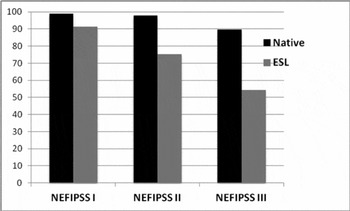
To examine use of formulaic expressions in the methodology developed in our laboratory, conversational speech samples are analyzed; formulaic expressions are identified and classified; and an incidence measure is expressed as a proportion of the speech sample word count. To probe knowledge of formulaic expressions, a formal test, the Northridge Evaluation of Formulas, Idioms and Proverbs in Social Situations was used (NEFIPSS I, II, III; see Hall, Reference Hall1995). This protocol provides brief verbal descriptions of a social setting to elicit the correct social interaction formula. NEFIPSS I and II use two multiple choice designs, the first with foils chosen for semantic and phonological likeness and the second for phrasal similarity; in NEFIPSS III, subjects write the phrase in blanks provided (See appendix). The NEFIPSS protocols were designed by Edward Hall (Reference Hall1995) to probe knowledge and use of formulaic language in various populations, including second language speakers and persons with neurogenic language disturbance. By design, healthy persons who are native speakers typically perform near ceiling on these protocols. In the ensuing years, we have tested over 300 first and second language speakers of English ranging in age from 25 to 30 years with a mean of 16 years of education using the NEFIPSS (Figure 1). When subjects must select between comparable phrases that could plausibly fit the situation, greater difficulty is encountered. This is especially so for second language speakers, who may not have acquired the formulemes in their standard, canonical shapes. These results, which support the aspect of the dual process model which posits personal familiarity of formulaic expressions by native speakers, can fruitfully be compared with findings from persons with neurological disorders. Second language speakers, by definition, have acquired their second language at some point after developing their first language. When this process occurs near or after puberty, which is considered a critical period for native sounding speech and language competence, a decrement in competence as compared with the native speaker is often in evidence. Details surrounding the critical period hypothesis have been controversial, but the basic concept remains robust (DeKeyser, Reference DeKeyser2000; Flege, Reference Flege and Strange1995; Johnson & Newport, Reference Johnson and Newport1989; Lenneberg, Reference Lenneberg1967; Scovel, Reference Scovel2000). The notion implies that second language speakers, learning a language after the critical period, acquire language using brain mechanisms that do not have the same structure and/or functionality as first language speakers. Second language speakers can be viewed as having measurable and quantifiable deficiencies in use and knowledge of formulaic expressions based on these neurological differences. Therefore, these performance results can usefully be compared to results obtained from persons with neurological disorders.
Performance by native and nonnative speakers on NEFIPSS I (multiple choice with linguistically balanced foils), NEFIPSS II (multiple choice with phrasal equivalents as foils), and NEFIPSS III, slot-filler format (“fill in the blank”).

Focal Brain Damage
Early hints that formulaic expressions are stored and produced differently in the brain arose from observations of adults with language disturbance, usually those with nonfluent aphasia due to a left hemisphere stroke, who preserve some kinds of speech while sustaining serious loss to generative language competence (Code, Reference Code2005). The categories identified by Code (Reference Code2005) included greetings, interjections, conventional phrases, and, for the first time in the study of this topic, proper nouns. It likely that the names reported as preserved by persons with severe nonfluent aphasia were personally familiar names, in agreement with findings for preserved famous proper name recognition in severe aphasia (Van Lancker & Klein, Reference Van Lancker and Klein1990) and the role of the right hemisphere in processing personally relevant phenomena (Van Lancker, Reference Van Lancker1991). The notion that the kinds of speech called automatic are processed by cerebral structures that differ from those modulating novel speech was supported by a brain imaging study using PET (positron emission tomography) in healthy subjects. Word generation was associated with activity in left anterior lobe language areas, but counting from 1 to 10 was not (Van Lancker, McIntosh, & Grafton, Reference Van Lancker, McIntosh and Grafton2003). Counting forms one type of the very large array of overlearned expressions preserved in left hemisphere damage, referred to variously as automatic or nonpropositional speech, unitary phrases, and formulaic expressions.
It is dramatic to observe persons with aphasia produce these expressions with normal articulation and prosody in the context of severe deficits in production of propositional language. These preserved components of expressive language are similar in type but differ in the actual forms across individual patients. Because of their extreme variety, these verbal behaviors have been dismissed as incidental, as if they were merely randomly broken-off pieces of a damaged system. This bias was supported by naming the phenomena stereotypes, emotional utterances, and automatic speech. These terms are misleading because the utterances are often standard conventional expressions used intentionally to communicate and they are not exclusively emotional expressions. When viewed from another perspective, they betray a striking soundness somewhere in the communication system.
Example 1 is a published typical example of 31 words spoken by a patient with nonfluent (Broca's) aphasia, of which only three words (hospital, doctors, teeth) are lexical items not included in traditional list of stereotyped speech. (Formulaic language is underscored in all examples.) Following the survey research of Code (Reference Code2005) and later studies on persons with global aphasia, proper nouns are included in the highlighted samples (Van Lancker & Klein, Reference Van Lancker and Klein1990).
Example (1)
Yes. . . ah. . . Monday. . . er. . . Dad and Peter and Dad. . .. er. . . hospital. . . and ah. . . Wednesday. . . Wednesday, 9 o'clock. . . and oh. . . Thursday. . . 10 o'clock, ah doctors. . . two. . . an’ doctors. . . and er. . . teeth. . . yah., (Goodglass & Geschwind, 1976, cited in Carroll, Reference Carroll2007, p. 357)
The modern view of formulaic language provides a satisfying explanation for the phenomenon of preserved utterances in severe aphasia. The preserved utterances constitute remnants of natural competence for the very large repertory of formulemes, expressions that are learned in a special way with unique linguistic properties (Reuterskiold & Sidtis, in press). The stored repertory is very large: Experts estimate that between 200,000 and 500,000 fixed expressions are known to the native speaker (Jackendoff, Reference Jackendoff, Everaert, van der Linden, Schenk and Schreuder1995). The size of this repertory accounts for the variety of preserved expressions seen in severely aphasic persons.
Examination of persons with mild expressive aphasia and those with fluent aphasia but poor comprehension has revealed an abnormally high proportion of formulaic expressions in their speech. Striking results arose from the study of an adult with transcortical sensory aphasia (Sidtis, Canterucci, & Katsnelson, Reference Sidtis, Canterucci and Katsnelson2009), whose speech contained 60–90 percent of formulaic expressions, depending on the conversational setting. With his other preserved linguistic ability, repetition, his fluent, socially based speech often deluded interlocutors into assuming normal communicative skills as shown in Example 2.
Example (2)
Clinician: Good job.
PT: What're you laughin’ ‘bout?
Clinician: ‘Cause, it's so good! It makes me smile.
PT: Really?
Clinician: Yes, it causes me to smile with happiness.
PT: You know, you're very handsome.
Clinician: (Laughs) See, you're getting your language back, I can tell.
PT: Well, can I tell you something? It wasn't easy, but I think I understand what you're saying.
Clinician: I think you're getting it back.
PT: Well, I'm trying.
Even identifying formulaic expressions conservatively (you're very handsome and I'm trying are probably also formulaic expressions in this patient's idiolect), over half of the words spoken by the patient in this short dialogue (underlined) are in formulaic expressions. Further examination of speech from aphasic patients undergoing rehabilitation often reveals that the quantity of speech increases, but that a large proportion in the increased language samples is formulaic (see examples in Van Lancker Sidtis, Reference Van Lancker Sidtis and Faust2012.)
The picture is very different in right hemisphere damage. Persons who have suffered a stroke in the right cerebral hemisphere do not have obvious language deficits: Speech production and comprehension appear intact, and deficits are not usually seen in grammar, phonology, or word retrieval. For this reason, these individuals seldom undergo language testing. It is only in recent years that practitioners have become aware of right hemisphere communicative deficits, or pragnosia (this term was first used in development of a neuropsychological protocol for the evaluation of affect; Nelson et al., Reference Nelson, Satz, Mitrushina, Van Gorp, Cicchetti, Lewis and Van Lancker1989). Pragnosia, or pragmatic deficit, defined as deficiency in the social use of language, occurs in association with a broad range of neurological and psychiatric disorders (Cutting, Reference Cutting1990; Mitchell & Crow, Reference Mitchell and Crow2005; Myers, Reference Myers1998). In persons who have sustained right hemisphere damage, many of the elements belonging to the pragmatics of language are deficient: maintaining topic and theme, conversational turn-taking, recognizing when speaker's meaning overrides linguistic meaning in utterances (e.g., in indirect requests, sarcasm, idiomatic expressions), processing humor, and appropriately using social expressions. When recalling that certain of the natural properties of formulaic language pertain to their appropriate use in social context, it follows that the right hemisphere, so adept at the pragmatic component of language, would play a major role in use of formulas. Conversely, as sequela of pragnosia, persons with right hemisphere damage are likely to produce significantly fewer formulaic expressions in their spontaneous speech (Van Lancker Sidtis, Reference Van Lancker Sidtis2004).
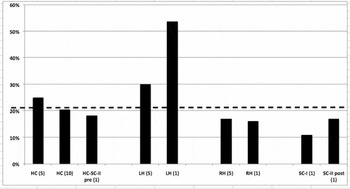
Studies comparing proportions of formulaic expressions in unilateral brain damage to the left or right hemisphere showed striking differences in these two groups (Van Lancker Sidtis & Postman, Reference Van Lancker Sidtis and Postman2006). Left cerebral hemisphere damage was associated with abnormally high proportions of formulaic language production, while measures of persons with right hemisphere damage revealed speech that was deficient in formulaic expressions, containing about 16 percent, with normal speakers’ values (obtained from the control group) at around 25 percent (Figure 2). The formulaic language impoverishment in neurological subjects with right hemisphere damage, despite their intact grammatical, phonological, and semantic competence, negatively affects their communicative abilities, sometimes giving the impression of being cold, unengaged, distracted, or otherwise not cooperative in interaction. This arises from the large role played by formulaic language in naturalistic conversation. One of its functions is to foster socialization, which includes achieving empathy and bonding (Wolf & Van Lancker Sidtis, Reference Wolf and Van Lancker Sidtis2012; Wolf, Van Lancker Sidtis, & Sidtis, Reference Wolf, Van Lancker Sidtis and Sidtis2012).
Percentage of words in formulaic expressions in speech samples obtained from two groups of healthy control subjects (HC 5 and 10) and a single subject previous to the stroke; a group of five and a single case study of left hemisphere damaged subjects; a group of five and a single case study of right hemisphere damaged subjects; two single cases with subcortical damage (SC-I and SC-II). For SC-II, speech samples before the stroke (pre) were compared to highly comparable speech samples produced after the stroke (post). The normal-control average (21.6) is represented by the dashed line.

The first evidence that subcortical nuclei contribute significantly to the production of formulaic language came from a single case study of stroke (Speedie, Wertman, T'air, & Heilman, Reference Speedie, Wertman, T'air and Heilman1993), reporting a patient who no longer was able to say his daily prayers. In another single case study, a survivor of a basal ganglia stroke, complained that she no longer knew the everyday common expressions to use in social settings (Van Lancker Sidtis, Pachana, Cummings, & Sidtis, Reference Van Lancker Sidtis, Pachana, Cummings and Sidtis2006, p. 276). Quantitative studies of the spontaneous speech of persons with subcortical stroke supported these findings (Sidtis et al., Reference Sidtis, Canterucci and Katsnelson2009). Figure 2 shows two healthy control groups, left and right hemisphere damaged groups, and four single case studies with focal damage in left or right hemisphere or subcortical nuclei. In one case, the second person with subcortical damage (SC-II) and pre- and postmorbid speech samples were obtained; a significant decline in proportion of formulaic expressions was documented. Overall, findings point to an impact of right hemisphere and subcortical damage on production of formulaic expressions.
Parkinson's Disease
As further confirmation of the role of subcortical nuclei in the execution of formulaic expressions, studies of persons with Parkinson's disease (PD), which affects the basal ganglia, lent support to the findings from stroke studies. In PD, a reduction in a crucial neurotransmitter, dopamine, normally infusing the basal ganglia from the midbrain, leads to motor dysfunction in gait, limb movements, and speech. In our ongoing studies, persons with PD produce significantly fewer formulaic expressions than healthy speakers, and their proportion of formulaic language diminishes with progression and severity of the disease (Rogers, Sidtis, & Sidtis, 2009). Other studies of basal ganglia function reveal its important role in configuring holistic and routinized gestures (Graybiel, Reference Graybiel1998; Lieberman, Reference Lieberman2002). A range of procedurally based processes are impacted by the subcortical disturbances in PD. These include production of overlearned and routinized expressions, those making up formulaic language.
Alzheimer's Disease
In contrast to PD, Alzheimer's disease (AD) affects the cortical layers but leaves basal ganglia intact until late in the disease progression. Neurologically, AD presents with cortical degeneration of the temporal and parietal lobes that gradually progresses frontally, co-occurring with the presence of amyloid plaques and neurofibrillary tangles, the cause of which remains unclear. Individuals afflicted with AD often suffer significant language impairments that worsen as the disease progresses. Numerous anecdotal, clinical observations highlight the presence of formulaic language in AD speech. In our laboratory, two studies of formulaic language in AD speech were conducted. Spontaneous speech of persons diagnosed with AD and age- and education-comparable healthy control participants were analyzed using previously published methods (Van Lancker & Rallon, Reference Van Lancker and Rallon2004), whereby the proportions of words in formulaic expressions were calculated. Results indicate that AD subjects used significantly (p < .001) more words in formulas (M = 35.54 percent, SD = 5.54) than healthy subjects (M = 21.79 percent, SD = 4.81) (Bridges, Van Lancker Sidtis, & Sidtis, Reference Bridges, Van Lancker Sidtis and Sidtis2012).
In the second study, persons with AD participated in a structured conversational interview, followed by administration of the NEFIPSS II and III (Hall, Reference Hall1995). Again, persons with AD had greater proportions of formulaic language than healthy participants or than PD participants (Rogers et al., Figure 3). On the NEFIPSS, the PD and AD groups differed. Despite the lesser use (i.e., lower incidence of formulaic expressions), the PD group revealed relatively intact knowledge of formulaic expressions (NEFIPSS II = 94.4 percent, NEFIPSS III = 84.7 percent), while the AD group performed poorly on the knowledge probe (NEFIPSS II = 78.7 percent, NEFIPSS III = 57.2 percent). These results suggest a double dissociation regarding formulaic language, whereby AD subjects used the expressions but show insufficient knowledge, while the PD group failed to use the expressions normally but knew them. The results for the AD speakers were supported by their occasional formulaic errors, which reflected a distortion not seen in formulaic speech errors performed by normal speakers (Kuiper et al., Reference Kuiper, Van Egmond, Kempen and Sprenger2007). For example, AD errors were If I can't say anything pleasant, just keep quiet, which was probably derived from “if you can't say anything nice, don't say anything at all”; and Put down my mind to it, likely from “put my mind to it”). For healthy speakers, speech errors generally represent blends from two recognizable formulaic expressions, as in That's the way the cookie bounces (Cutting & Bock, Reference Cutting and Bock1997; Kuiper et al., Reference Kuiper, Van Egmond, Kempen and Sprenger2007).
It might be speculated that cortical integrity is associated with declarative or linguistic knowledge of formulaic expressions, while intact basal ganglia are needed for normal use. Declarative knowledge of formulaic expressions in right hemisphere damage or in many other neurological populations has not yet been assessed. The distinction in performance between use, whereby productive speech is examined, and knowledge, which evaluates language competence, is a very important one. Differences between procedural memory and use of formulaic expressions and declarative knowledge of their forms and meanings remain to be studied.
Schizophrenia
Studies in our laboratory of persons with a diagnosis of schizophrenia have indicated a significant paucity of formulaic expressions in their conversations (Karibis et al., Reference Karibis, Van Lancker Sidtis, Tartter, Rogers, Sidtis and Rabitt2009). Measures of spontaneous speech were obtained from eight persons diagnosed with schizophrenia and compared to speech samples from age and education matched healthy control subjects. The schizophrenic group had a significantly lower proportion of words comprising formulaic expressions (12.3%) compared to the normal group (21.3%) in their spontaneous speech. Results obtained from formal testing using the NEFIPSS (86%) suggested that the schizophrenic subjects had sufficient knowledge of the formulaic expressions. Here again a distinction between use and knowledge is encountered. Taken together, their performance on the structured interviews and on the NEFIPSS suggested that schizophrenia is associated with intact knowledge but significantly reduced use of formulaic expressions.
Results for the schizophrenic group may account for the impression that their speech is abnormal, although no grammatical deficits have been found, and the semantic disturbance has been traditionally attributed to cognitive dysfunction (i.e., thought disorder). Impoverishment of formulaic expressions provides a quantitative measure of social cognitive deficits recently proposed for this condition (Mitchell & Crow, Reference Mitchell and Crow2005; Subotnik et al., Reference Subotnik, Neuchterlein, Green, Horan, Nienow, Ventura and Nguyen2006). Although the sites of cerebral disorder underlying schizophrenia are not known, and many brain areas and neurochemical conditions have been proposed, there is some evidence of subcortical dysfunction (Carlsson & Carlsson, Reference Carlsson and Carlsson1990; Prestia et al., Reference Prestia, Boccardi, Galluzzi, Cavedo, Adorni and Soricelli2011; Salvador et al., Reference Salvador, Sarró, Gomar, Ortiz-Gil, Vila and Capdevila2010), which is concordant with other observations reviewed here that associate intact basal ganglia with formulaic language production abilities.
Autistic Spectrum
As already mentioned, persons with autistic characteristics, including those with severe linguistic impairment, are observed to verbally produce fixed expressions in a repetitive manner with clear articulation but often hypo- or hypermelodic or otherwise abnormal prosody (Bogdashina, Reference Bogdashina2005). These verbal chunks may arise from imitating radio or television, such as advertising jingles, or they may be the result of echoing the utterances of other speakers. Using the terminology of scientists and clinicians studying autistic language, verbal repetition is either mitigated (with altered grammar and pronouns) or unmitigated (unaltered or exact repetitions; Stark, Reference Stark2007). As the sites or sources of cerebral disorder are not known for these linguistically handicapped children, little is understood about this behavior. It has been proposed that these repetitive expressions are sometimes used to communicate (Dobbinson, Perkins, & Boucher, Reference Dobbinson, Perkins and Boucher2003). Experts in child language acquisition have posited two processes, analytic and holistic, as operating side by side in the development of language competence (e.g., Locke, Reference Locke1993). Drawing on the dual process model of language, it might be of interest to consider that while grammatical abilities are profoundly impaired in these children, the learning process that provides for acquisition of holistic verbal material may be selectively preserved.
In contrast, persons diagnosed with high-functioning autism and/or Asperger's syndrome appear to be deficient in routinized expressions. They are noted to use literal, formal speech; they fail to follow conversational cues in turn-taking; they interpret nonliteral expressions concretely; and they exhibit a range of social communicative deficits (Landa, Reference Landa, Klin, Volkmar and Sparrow2000; Peppe, McCann, Gibbon, O'Hare, & Rutherford, Reference Peppe, McCann, Gibbon, O'Hare and Rutherford2006). Although few quantitative studies have been undertaken, it is to be predicted that this population, although verbal, is deficient in production of formulaic expressions, contributing importantly to the negative impression of their communicative competence. In these autistic-spectrum populations, as in so many others, one can conclude that production of holistic utterances (formulaic language) appears to be neurologically separate from production of novel, propositional speech, lending support to the dual process model of language processing. This fact is heightened in interest by the observation that persons falling toward the severely impaired end of the autistic spectrum may be observed to produce formulaic expressions almost exclusively, while those toward the higher-functioning extreme end of the spectrum communicate with an abnormal paucity of formulaic expressions. While discussion of detailed neurobiological substrates associated with these disorders is beyond the scope of this review, the considerable progress in understanding brain behavior relationships may further elucidate disparate brain mechanisms underlying formulaic and normal language production competence (e.g., Minshew & Williams, Reference Minshew and Williams2007).
Other Neurological Disorders
Tourette's syndrome is known for vocalizations of taboo words and phrases indigenous to a culture (Van Lancker & Cummings, Reference Van Lancker and Cummings1999). In this disorder, damage to functionality in the basal ganglia is suspected, involving hyperactivation of motor behaviors leading to excessive physical and verbal tic-like gestures. The semi-involuntary vocal-motor gestures may be coughing, yelling, grunting, hissing, spitting, or emitting taboo words, which include expletives, insults, curses, and other words and phrases considered socially interdicted in the native language. These behaviors affect only some of the sufferers some of the time in the course of the disease; the cause remains mysterious. In normal brain function, the basal ganglia—modulating motor behaviors—are intimately intertwined within limbic system structures, in which emotional experiencing is represented. It might be speculated that emotional and reflexive cries in human communication (which some view as antecedent in biological evolution to emotional utterances; see review in Kreiman & Sidtis, Reference Kreiman and Sidtis2011) involve orchestrated activation of these structures, and that in Tourette's disease, a normal process is thus distorted by the obsessive compulsive component of the neurological disorder (Van Lancker & Cummings, Reference Van Lancker and Cummings1999). This phenomenon highlights the uniqueness of expletives, as a subset of formulaic language, in human verbal expression.
While Tourette's syndrome is associated with excessive production of a narrowly specific category of formulaic language, impoverishment of formulaic expressions can be inferred from studies in persons with agenesis of the corpus callosum. In a study of such individuals, poor performance in comprehension tasks using the Formulaic and Novel Language Comprehension test (FANL-C, a test of formulaic language comprehension; Kempler & Van Lancker, Reference Kempler and Van Lancker1996) and significantly weaker proverb interpretation was found (Paul, Van Lancker, Schieffer, Dietrich, & Brown, Reference Paul, Van Lancker, Schieffer, Dietrich and Brown2003). Possible explanations include a failure of communication from the right hemisphere, a major facilitator of formulaic expressions. It is likely that whole brain involvement is necessary for normal production of formulaic expressions.
In summary, observations from second language speakers and clinical subjects, taken together, suggest that exposure before puberty as a native speaker to language in the indigenous culture as well as a whole, intact, and communicating brain are required to achieve and maintain linguistic competence in formulaic language.
DUAL PROCESS MODEL OF LANGUAGE PROCESSING
Although the story is surely much more complex than can be posited at this early time in the neurolinguistic study of formulaic language, some preliminary proposals seem viable. First, it appears clear from converging sources that formulaic language and novel language are produced during spontaneous speech according to separate and distinct principles. That is, they are dissociated in cerebral function. Each can be selectively preserved or impaired following specific types of brain damage or dysfunction. The neurolinguistic results already described lead to the dual processing model with respect to speech production, which posits two different functional modes: novel and formulaic (Perkins, Reference Perkins, Garman, Letts, Richards, Schelletter and Edwards1999; Van Lancker Sidtis, Reference Van Lancker Sidtis, Corrigan, Moravcsik, Ouali and Wheatley2008). Second, studies for which underlying neurological disorders are known or understood (stroke, AD, PD) strongly suggest that a right hemisphere-subcortical circuit modulates the production of formulaic expressions (Van Lancker Sidtis, Reference Van Lancker Sidtis and Faust2012). A third observation, made from second language speakers and persons with neurological disease, is that knowledge and use of formulaic expressions are dissociated skills. English as a second language (ESL) speakers may score high in incidence, but the repertory of formulaic expressions may be small, and their knowledge impoverished compared to native speakers. In AD, incidence or use of formulaic expressions is in excess of normal but knowledge of formulaic language is impaired, whereas the opposite is true of PD subjects. The causes and conditions of deviant formulaic language behaviors in other neurological conditions, such as schizophrenia, autism, agenesis of the corpus callosum, and Tourette's syndrome, remain to be explained.
IMPLICATIONS FOR EVALUATION AND TREATMENT
Failure to recognize the essential differences between formulaic and novel language in the speech clinic has serious implications for accurate evaluation of the language disorder and of language recovery, as evidenced in Example 2. It could be beneficial to identify clinically when aphasic speech is made up primarily of formulaic language, either in the first months following neurological injury or at a later assessment following a course of therapy. While formulaic expressions are useful and prevalent in communication, they do not achieve the same goals of novel language. Further, predominant preservation of formulaic expressions, when recognized in the patient, can be utilized and optimized in treatment planning, whereas persons with a pathologically low incidence and/or knowledge of formulaic language might be trained into the realm of social interaction formulas.
CONCLUSIONS
Because formulaic language pervades all human language use, it can be expected to play an important role in neurogenic communication disorders. Knowledge and use of formulaic expressions are affected by brain maturation and by brain damage and dysfunction. Following neurological impairment, formulaic language may be either selectively impaired or preserved, either in use or knowledge, leading to an abnormal language profile and loss of functionality in social settings. Studies of formulaic language in persons with neurological disorders hold the promise of casting light on these disparate modes of language use as well as improving models of brain function underlying communication.
ACKNOWLEDGMENTS
This work was supported in part by a grant from the National Institutes of Health: NIH R01 DC007658. The contribution of Kelly Bridges is gratefully acknowledged.
Appendix
NEFIPSS sample item, with three kinds of response options
1. Bob opens the door and gestures for Mary to go through first. He would probably say. . .
Response options:
NEFIPSS I: a. Open the door
b. Leather shoe
c. Come here
d. Before you
e. After you
NEFIPSS II: a. After yourself
b. After you
c. Behind you
d. First, you
e. Go through
NEFIPSS III: After _____.