Introduction
The modern memory clinic was developed as a center of expertise for the initial diagnosis of memory disorders, and the institution of a management plan (van der Cammen et al., Reference van der Cammen, Simpson, Fraser, Pretzer and Exton-Smith1987; Bayer et al., Reference Bayer, Pathy and Twining1987; Philpot and Levy, Reference Philpot and Levy1987; Verhey et al., Reference Verhey1993). Some clinics also follow up patients for a period of time. A variety of memory clinic models have evolved around the world. In France, memory clinics have been in existence since the early 1980s. They serve as expert multidisciplinary centers for the early diagnosis and management of dementia, and also incorporate an educational role (Mahieux, Reference Mahieux2000). Dutch memory clinics routinely provide a home assessment visit, involve the general practitioner and have a strong research emphasis (Bleeker and Diesfeldt, Reference Bleeker, Diesfeldt, O'Brien, Ames and Burns2000). In Switzerland there is a collaborative group of 11 memory clinics which utilize a two-step approach. The primary care physician conducts the initial assessment and then the clinic completes a comprehensive multidimensional diagnostic procedure and gives treatment recommendations back to the primary care physician (Monsch et al., Reference Monsch1998). Other memory clinics have been established and described for Hong Kong (Chiu and Zhang, Reference Chiu, Zhang, O'Brien, Ames and Burns2000) and Mexico (Resnikoff, Reference Resnikoff, O'Brien, Ames and Burns2000). There have been surveys of memory clinics in the U.K. (Wright and Lindesay, Reference Wright and Lindesay1995; Lindesay et al., Reference Lindesay, Maradkar, Diepen and Wilcock2002) but, to date, none in Australia.
Case series from Australian memory clinics have been published (Ames et al., Reference Ames, Flicker and Helme1992; Stratford et al., Reference Stratford, Lo Giudice, Flicker, Cook, Waltrowicz and Ames2003), which reveal that the mean age of presenting patients was over 70, most were women and the most common diagnosis was dementia, with Alzheimer's disease predominating. This current survey of Australian memory clinics was developed to better understand how these facilities function and to provide a baseline with which to compare future multicenter databases that may arise from a nation's memory clinics.
Methods
A memory clinic was defined as an ambulatory assessment service dedicated solely to those with memory and related cognitive disorders. In most cases the service bore the title “memory clinic” or related titles such as “memory disorders clinic” and “memory loss clinic.” In Victoria, these services usually bear the title “CDAMS” (Cognitive, Dementia and Memory Assessment Service). All Australian services were identified by utilizing the list of (funded) Victorian CDAMS and contacting key opinion leaders (KOLs) in other state/territories of Australia. Every clinic so identified was approached. There is no central list of all Australian memory clinics.
A survey form was developed and piloted at two sites in Victoria. Both sites made minor recommendations which were incorporated and the final survey was sent out to all sites, which were given just under two months to respond. Surveys were mailed out in June 2006 and were addressed to the co-ordinator of the service with encouragement to respond even if not all of the requested information was available. Sites were not obliged to provide full identifying details and reminders were not sent out as some responses were anonymous. Data were collated manually. Missing responses were noted and the total number of respondents to each question became the denominator for that item.
Results
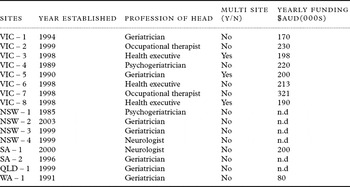
A total of 23 memory clinics was identified: 14 in Victoria (VIC), 4 in New South Wales (NSW), 2 in South Australia (SA), 2 in Western Australia (WA) and 1 in Queensland (QLD). Responses were received from 16 with enough information to identify that the missing responses were from Victoria (6) and Western Australia (1). Characteristics of the responding clinics are shown in Table 1. It can be seen that the majority were established in the 1990s, the heads were generally specialists from the three professional areas most responsible for assessing cognitive disorders, and only a minority were multi-site.
Characteristics of clinics

n.d: = no data provided.
Health executive = administrator or professional affiliation not provided.
VIC = Victoria; NSW = New South Wales; SA = South Australia; QLD = Queensland; WA = Western Australia.
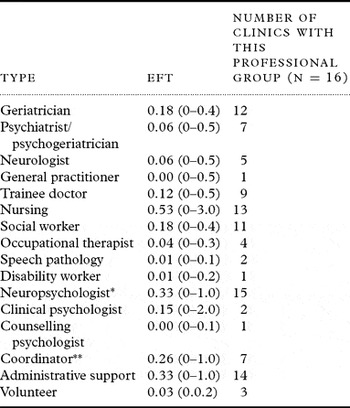
Clinic staffing is shown in Table 2. The total mean number of clinical staff per clinic was 1.7 effective full-time (EFT) with non-clinical staff averaging 0.6 EFT per clinic. An average clinic had two sessions of geriatric medical input (where a session is one half day), one session with a psychogeriatrician or general psychiatrist, one session with a neurologist, one trainee specialist session, five nursing sessions, two or three allied health sessions, five neuropsychology or clinical psychology sessions, three co-ordinator sessions and three sessions dealing with administrative support.
Staffing

EFT = effective full time (1.0 = 40 hour/week).
*The one clinic without a neuropsychologist had a clinical psychologist.
**Co-ordinator: time dedicated to non-clinical co-ordination.
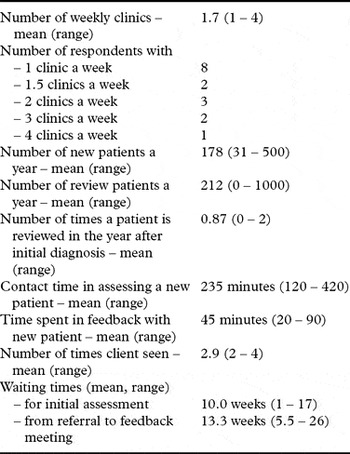
Clinic activity is shown in Table 3. An average clinic was run twice a week and each clinic had two new patients and three review patients. A new patient is seen twice on average (once for initial assessment and once for feedback – apart from other investigations and specific cognitive assessment sessions). The patient then returns once more over the next 12 months. The average patient waited 10 weeks for an initial assessment and spent 4½ hours undergoing assessment and feedback.
Clinic activity

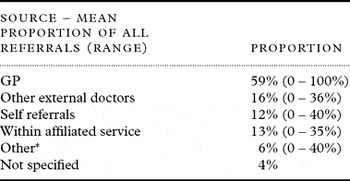
Most patients were referred from general practitioners, as shown in Table 4. The initial client assessments were usually conducted by a doctor (15/16 clinics), but most services also had patients seen by a nurse (13/16) and allied health staff (10/16). Some 50% (8/16) of clinics had patients seen routinely by a psychologist (usually neuropsychologist) and in 50% (8/16) of clinics a psychologist saw clients upon initial referral. Other staff were seen only upon internal referral and included speech pathologist, social worker and counseling psychologist (7/16 clinics for these staff combined). Other identified staff and services external to the clinic that are available upon referral included Alzheimer's Australia, an occupational therapist for driving assessment, Aged Care Assessment Service, Mental Health Services (including psychiatrist and Aged Psychiatry Assessment Service), neurologist, counselor, speech pathologist, sleep physician, cardiologist and other (unspecified), allied health staff.
Referral sources

*Other = Aged Care Assessment Service; case managers; community health centres, other public hospitals.
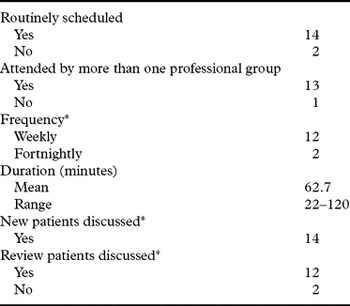
Most services routinely scheduled clinical meetings to formulate diagnoses and management plans, as shown in Table 5. The average meeting was held weekly, attended by several professional groups, lasted an hour and discussed both new and review patients.
Clinic meetings

* No response from two clinics.
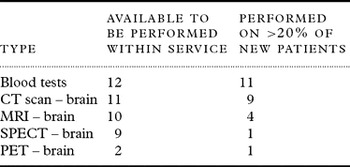
Some 11 of the 16 responding services performed a routine set of investigations and 11 stated that clients may be referred back to their referral sources for further investigations. The investigations performed within the service are shown in Table 6.
Type of investigations

CT = ; MRI = magnetic resonance imaging; SPECT = single photon emission computerized tomography; PET = positron emission tomography.
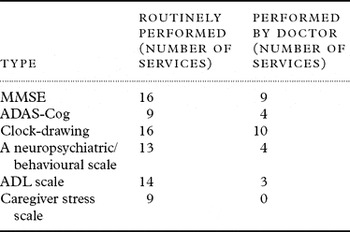
Assessments routinely performed are shown in Table 7. Most services had a doctor perform the MMSE and clock-drawing test, although in most cases other staff were also able to perform these. The ADAS-Cog was always performed by a doctor in three services and in other services was performed by a psychologist (4), nurse (4), or allied health staff (2). Non-cognitive assessments were more frequently performed by non-medical staff. A large range of other assessment scales were identified as being routinely performed by some services – these included the Weschler Adult Intelligence Scale, National Adult Reading Test, Hopkins Verbal Learning Test, California Verbal Learning Test, Consortium to Establish a Registry of Alzheimer's Disease Battery, Ray figures, Trails tests, EXIT-25, Cambridge Dementia Examination and CAM-Cog subscale, Functional Assessment Scale, Frontal Assessment Battery, Barthel scale, Instrumental Activities of Daily Living scale, an Audio Recorded Cognitive Screen (developed by that service) and the computerized Cognitive Health (Cog Health) program.
Test and scales routinely performed

A routine psychometric battery was performed by 15 of 16 services and 14 services had a detailed neuropsychological assessment available within the clinic; the remaining two had an assessment available externally and two had this available both internally and externally. The proportion of new patients undergoing full neuropsychological assessments ranged from 2% to 100%, with a mean of 57% when the number of new clients per clinic was factored in.
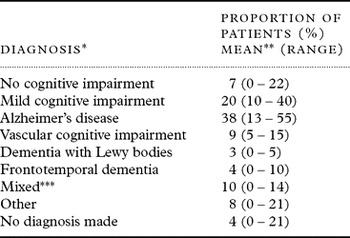
Diagnoses were routinely collected by 12 of the 16 services and are shown in Table 8. The most common diagnosis was Alzheimer's disease but only approximately one third of patients had this diagnosis. Mixed dementia was diagnosed in approximately 10% of patients. Some services recorded mixed dementia both as such and as separate diagnoses, accounting for the total in Table 8 being 102%.
Diagnoses made

*Data provided from 11 of 12 clinics that collect this information.
**The clinic activity was factored into the calculations.
***In two clinics diagnoses can be entered both as mixed and as an individual category.
Thirteen clinics were entirely (12) or largely (one was 82% funded this way) funded by state health departments, reflecting the funding of ambulatory services in Australia. The clinic funded 82% by the state health department was also funded 10% by academic/research and 8% by fundraising.
The funding of the other three clinics comprised:
• donated time (80%) and research/academic (20%)
• patient charges (50%) and research/academic (50%)
• patient charges (70%) and Department of Veterans' Affairs (30%).
Eight clinics indicated that they were lobbying for extra yearly funds, with targets from A$40,000 to A$500,000 extra annually.
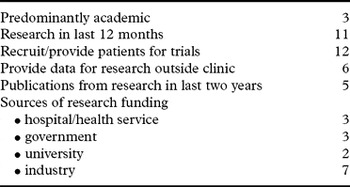
The academic affiliation, research funding and research outputs of clinics is shown in Table 9. While only three clinics identified themselves as predominantly academic, most had performed research in the last 12 months and most had recruited or provided patients for dementia research trials.
Academic affiliation and research*

*Responses for each item were received from all 16 clinics.
Discussion
The survey provides a cross-section of memory clinic activity across Australia. While only 16 of 23 identified clinics responded, most of the non-respondents were from Victoria where there is a degree of homogeneity across CDAMS, and it could be expected that the non-responding clinics were similar to those that did respond. Indeed, it was possible to identify nearly all of the clinics that did respond, as contact details were voluntarily provided, and the non-responding clinics, which included one very large academic service, and several smaller services, are known by the author to be very similar to those that responded. CDAMS in Victoria hold regular meetings and an annual conference, where assessment protocols and data management are routinely discussed and synchronized. A recent review of CDAMS demonstrates their similar functions (Department of Human Services, 2005).
Australian memory clinics provide a thorough assessment of those with memory disorders, with the average client attending three times and spending nearly five hours being assessed. This thoroughness, however, limits the number of clients able to be assessed this way. New patients, usually referred from their general practitioner, wait 10 weeks for an initial assessment (and up to 17 weeks) and the 16 responding clinics assessed a total of 2,848 new patients a year. It is difficult to determine how many Australians newly develop memory concerns or symptoms in a year but Access Economics has estimated that in 2006 some 60,000 Australians newly developed dementia (Access Economics, 2006). In this survey 63.3% of patients had dementia diagnosed, representing 1,804 patients a year. Even when non-responding clinics are added in, it is unlikely that more than 3,000 cases are being diagnosed annually in these 24 clinics. This is only a small fraction of those new cases estimated by Access Economics and suggests that most people with Alzheimer's disease are not being diagnosed in a specialized memory clinic. It is likely that most of those with other cognitive disorders are also not attending memory clinics – they may not be presenting to a doctor or may be assessed in other services. The characteristics of those who do attend a memory clinic, as opposed to those who do not, needs further evaluation. It does seem, however, that these highly specialized and comprehensive services should be expanded to assess a greater proportion of those with memory concerns or symptoms. This has been recognized in Victoria, which has the only funded network of memory clinics covering the whole state and which could serve as a model for the other Australian states and territories. Even in the state of Victoria, which has the most memory clinics, only 1,413 dementia cases were diagnosed each year, yet Access Economics estimated there were 14,000 new cases a year in that state (Access Economics, 2005).
The memory clinics were more commonly headed by a doctor from one of three following specialties: geriatric medicine (7), psychogeriatrics (2) and neurology (2). However, while a geriatrician was on staff in 12 of the 16 responding clinics, only a minority had a psychiatrist (7) or neurologist (5). It is not possible to determine whether these differences in medical specialty staffing affect assessments, but it is likely that an expertise in memory disorders, rather than a professional background, is more important to an accurate assessment. In overseas memory clinics, medical staffing also varies. For instance, geriatricians are rarely present in memory clinics in the U.S.A. and neurologists rarely present in the U.K. (Wright and Lindesay, Reference Wright and Lindesay1995).
All services had a neuropsychologist or clinical psychologist on staff and in half of the clinics a psychologist performed initial assessments of clients. While all patients had an MMSE and clock-drawing test performed, there was wide variation in the other psychometric testing, although most (15) clinics had a routine psychometric battery and 57% of clients proceeded to full neuropsychological assessment. Generally, neuropsychological assessment is regarded as the “gold standard” in cognitive disorder evaluation, short of neuropathology, and it appears that most clinics do have this available. It is likely that selection of patients for full neuropsychological evaluation was determined on clinical grounds, although one service provided this evaluation to all new clients. It is not possible to determine whether a greater proportion of clients would have proceeded to full neuropsychological evaluation if there had been more neuropsychology/clinical psychology availability, but this survey does set the current benchmark at 0.48 EFT neuropsychologists or clinical psychologists per service. With an average of three new patients per service per week this benchmark is around 1.5 sessions of neuropsychology or clinical psychology per new patient.
The clinics varied considerably in their other staffing, with nurses predominating. Again, it is unclear whether these differences affect patient evaluation but, as noted above, a comprehensive knowledge of memory disorders is probably at least as important as the professional grouping of the clinic staff members. Where specific expertise was required and not available, the clinics did seem frequently to have mechanisms to access this via external referral. The nursing and allied health staff frequently conducted initial assessments of clients, suggesting they were indeed multi-skilled and working within a multidisciplinary model.
It is noteworthy that in only 9 of the 16 clinics was CT scanning performed on more than 20% of new patients. This may be partly because new clients frequently came with recently performed neuroimaging, but the fact that only 11 of the 16 clinics had CT scanning available suggests resource issues may have limited neuroimaging. However, in 11 clinics patients were sometimes those who had been referred back for further investigations, so it is possible that neuroimaging was performed on the majority of clients deemed to need this. It could, however, be argued that on-site availability is important, especially as dementia neuroimaging is a developing field and a memory service should be able to access a neuroimaging service with this specific expertise. Most of this neuroimaging development is occurring with magnetic resonance imaging (MRI), single photon emission computerized tomography (SPECT) and positron emission tomography (PET) scanning, yet this survey shows that these investigations are only being performed on a minority of new patients, with only two services having PET scanning available. PET scanning is increasingly being recognized as a valuable technique in dementia diagnosis (Jagust, Reference Jagust2006; Rowe et al., Reference Rowe2007) and greater availability to memory clinics is desirable.
The final diagnoses in this survey are broadly reflective of those in other surveys; for example, AD had a prevalence of 38% in this survey and the prevalence was 40–50% in multi-site U.K. and single-site Australian surveys (Wright and Lindesay, Reference Wright and Lindesay1995; Ames et al., Reference Ames, Flicker and Helme1992; Stratford et al., Reference Stratford, Lo Giudice, Flicker, Cook, Waltrowicz and Ames2003). Similarly, the prevalence of vascular cognitive impairment was 8.5% in this survey and 7.5% in the other large Australian single-site survey (Stratford et al., Reference Stratford, Lo Giudice, Flicker, Cook, Waltrowicz and Ames2003). It is difficult to compare diagnoses further due to differing diagnostic criteria over time and increased awareness of some diagnoses such as dementia with Lewy bodies (not reported in earlier surveys but comprising 3% in this survey).
These were predominantly service clinics, with most funded by state health departments and only three identifying themselves as predominantly academic. Yet a majority have participated in research, including providing patients with information that allowed them to participate in research. Memory clinics have a long history of research activity (van der Cammen et al., Reference van der Cammen, Simpson, Fraser, Pretzer and Exton-Smith1987) and it is reassuring that this activity is still maintained; much still needs to be learnt about cognitive disorders and better dementia therapies are desperately needed. While there must always be a balance between service and research, it is arguably desirable that these clinics should have an even greater research emphasis, including academic funding. It is not surprising that half the clinics are currently lobbying actively for extra funding, although it is likely that this is to expand their service rather than their research activities.
This study has provided details of the functioning of Australia's memory clinics and provides some benchmark data that other services can utilize. Research elsewhere involving samples of Australian memory clinics can compare the characteristics of their samples with this survey to see if their sample is reflective of Australian memory clinics in general. It is not possible from this survey to identify a “best practice” model. Quality indicators have been developed for memory clinics and these do include structural indicators but they were based on a Delphi consensus process and it not been proven that one particular structure is more effective than another (Drašković, Reference Drašković, Vernooij-Dassen, Verhey and Scheltens2008).This survey does suggest, however, that better resourcing could improve patient throughput and enhance the assessment of the increasing number of Australians with cognitive symptoms and disorders.
Conflict of interest
None.
Description of authors' roles
M. Woodward formulated the research question, designed and sent out the survey tool, analyzed the data and wrote the paper. E. Woodward entered all the data and assisted in the analysis, writing and final editing of the paper.