Introduction
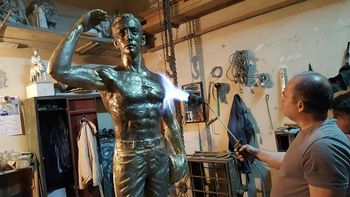
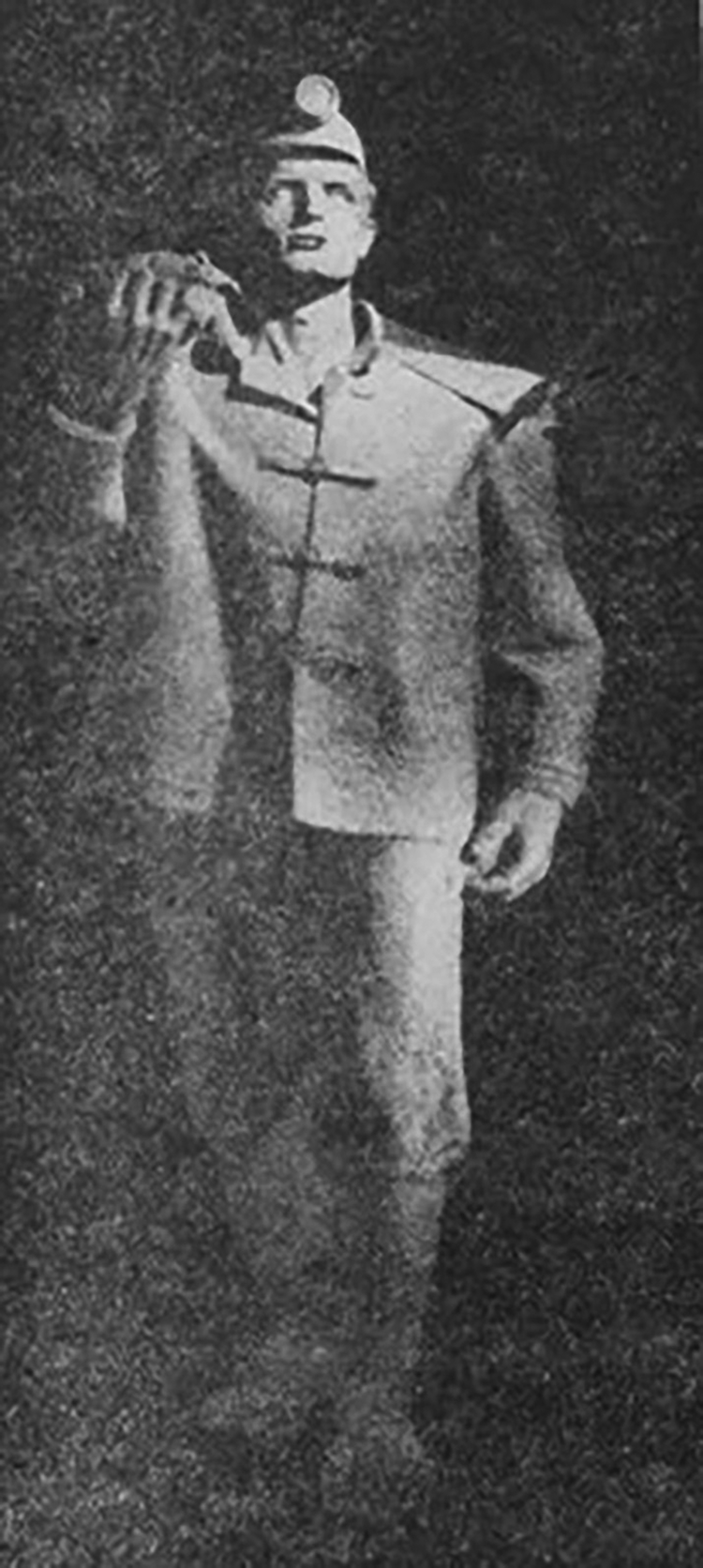
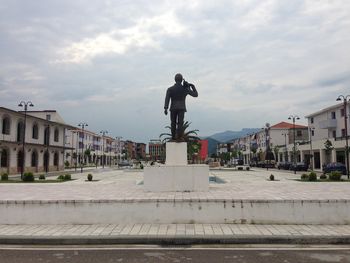
On June 1, 2017, the Albanian online news and entertainment portal Jeta Osh Qejf published a short article with the title “Memaliaj: Miners Expected a Statue of a Miner, but the Municipality Gave Them a Statue of Rocky Balboa.”Footnote 1 The article was accompanied by a gallery of photographs, including one of a statue of a coal miner located in Bentham, Kentucky (presumably to illustrate the kind of statue the residents of Memaliaj had expected), and several others showing a sculpture of a young man, shirtless, with one arm raised to shield his eyes from the sun and the other arm holding a miner's cap at his waist (see Figure 1). The latter statue had recently been unveiled in the small, southern Albanian town of Memaliaj, in the same location, in the town's central square, where a statue of a miner had stood during the country's socialist period (see Figure 2). As the sensational title of the news article suggests, the new statue created an uproar with the locals, who protested the statue for a number of reasons, both historical and aesthetic. The article explained, the residents “see it as an insult on the part of the mayor of the town. Ironically, the square where the statue is placed is called ‘Miner Square,’ but the sculpture depicts a muscular man who looks like he comes from a ‘Body Builder’ parade, or like Rocky Balboa, more than he looks like a miner.”Footnote 2 Ultimately, the statue of the shirtless young miner was removed, and replaced with a new one the following year (see Figure 3). This second version more directly recalled the composition of the socialist statue: a middle-aged miner, dressed in a jacket, wearing a helmet, and holding a jackhammer over his right shoulder, striding forward.
Vladimir Llakaj at work on the first version of the new miner statue for Miner Square in Memaliaj, Albania. Photo courtesy of the artist.

Muharrem Turkeshi, original miner statue for Miner Square in Memaliaj, 1969. Published in Drita, September 28, 1969. Image courtesy of the author.

Vladimir Llakaj, miner statue, 2017. Miner Square, Memaliaj, Albania. Photo by the author.

Despite the changes made to the design, residents of the town continue to express a certain dissatisfaction with the new miner statue,Footnote 3 a dissatisfaction that is linked to the recent renovation of the entire central square of Memaliaj, carried out as part of the Albanian national government's current project of urban renewal throughout the country.Footnote 4 The controversy surrounding the miner statue in Memaliaj thematizes several important issues about the reception of recent transformations of public space in postsocialist Albania,Footnote 5 but it also raises broader and more crucial questions regarding the presence and commemoration of working-class bodies in public spaces in postsocialist contexts. Across former Eastern Europe, the transition from state socialism toward neoliberal capitalism has often been accompanied by a denigration of working-class identities.Footnote 6 In the place of class-based narratives,Footnote 7 a variety of new identities promoted by neoliberal social relations have emerged after 1989. Because of the centrality of class to socialist-era identity-construction projects, the recent and relatively sudden ascendancy of various forms of individualist, consumption-oriented subjectivity in “postrevolutionary” societies has produced conflicts that are often more visible than in societies where capitalism has been the accepted economic paradigm for much longer.Footnote 8
Concurrent with the rise of neoliberal social conditions, many systems of signs common to prior political systems have become obsolete. For example, over the course of the roughly three decades since the end of the dream of global socialism, images of workers—a common feature of socialist-era communal spacesFootnote 9—have often disappeared almost entirely from public circulation, replaced by advertisements that emphasize the consumer individuality emergent in patterns of neoliberal consumption. There is a growing attention to the spatial dynamics of labor in recent capitalist conditions.Footnote 10 However, this literature has—as yet—engaged relatively little with art historical studies of the representation of the worker in public spaces (in murals, posters, or monumental sculpture, for example), especially in the urban and suburban contexts of postsocialist nations.Footnote 11 Where workers are represented in public spaces in postsocialism, these representations can tell us a great deal about the navigation of new economic ideologies and their interaction with the still-present ideological frameworks of socialism.
This article examines the way workers have been depicted in public spaces in several recent artistic projects, taking Albania as a case study. It considers three different kinds of artistic engagement with the theme of the worker: government commissions for public sculpture, private commissions for spaces of consumption, and activist interventions by contemporary artists. As such, it treats both works that are in some way complicit with the “forgetting” of the worker under neoliberal capitalism, as well as works that attempt to re-assert the importance of workers’ lives in contemporary society. The article builds upon anthropological and historical studies of the transformation of public spaces and their meanings in postsocialist contexts, and aims to merge the concerns of recent work in the field of labor geography with art historical studies of commemoration and working-class representation before and after 1989.
Methodologically, this article builds upon a combination of unstructured interviews with community members and artists,Footnote 12 research in printed and online periodicals, and close visual analyses of particular works of art. This variety of methodological approaches offers both advantages and challenges. On the one hand, engaging both artists and community members in dialogue about figurative public art is crucial to understanding how—and if—such art really reflects the interests, aspirations, or tastes of the people who live with it every day. However, at scales beyond relatively small communities, the possibility of easily surveying “the public” of public art becomes difficult, and this article opts to consider several different cases within a specific country. While focused on Albania, the article aims to articulate more general patterns in the social significance of public artworks focused on workers and working-class identity, and as such it is not feasible to incorporate exhaustive surveys of the communities (however construed)Footnote 13 of each of the works discussed. Instead, the analysis also relies on art history's tradition of close visual readings of artworks in situ, recognizing that certain traditions of image making inflect the creation of public art dedicated to the theme of the working classes. The combination of these different approaches—extrapolating the ideas of artists and the public from both interviews and published archival sources, as well as reading artworks according to established visual paradigms—inevitably creates instances in which the viewpoints of different actors clash. The public, artists, and academics writing about public art often draw very different conclusions about its meanings, and in this article, these different perspectives do indeed diverge.Footnote 14 Recognizing the ways that they diverge is important for understanding how images of the worker in public space can still become sites around which and in which other political and ideological conflicts can play out.
Ultimately, the analysis presented here suggests that the image of the worker in postsocialism still possesses a semiotic multiplicity that allows it to serve a variety of political purposes in contemporary contexts. At times, these meanings reinforce a contrast between working-class identity as a thing of the past, and pleasurable consumption as the defining characteristic of present identities.Footnote 15 At other times, the artistic representation of workers in public space serves as a call to recognize the dignity of contemporary working classes, and even more specifically, to mourn the sacrifices of those workers who have died in a context that valorizes privatization and profit as the necessary components of a peaceful transition to economic stability. As labor geographer Andrew Herod writes, modern cities can in fact become “emancipatory landscapes” of “socio-spatial praxis” for the working classes, including through the production of “spaces of representation.”Footnote 16 Following Henri Lefebvre,Footnote 17 Herod suggests that these spaces allow workers ways—through both their lived practice and their efforts to reshape the urban landscape—to make cities places that reflect their interests, agendas, and collective memory.Footnote 18 This article builds upon this notion, but focuses not on workers’ images of themselves or their lives, but on how artists (with various political and social affiliations of their own) make efforts to transform public spaces into areas symbolically occupied by workers.
In taking the worker as a subject of both artistic and spatial representation in the postsocialist context, this article articulates broader interactions between art and the politics of space in what has been called “actually existing neoliberalism”—the concrete conditions of neoliberal capitalist existence.Footnote 19 Paying close visual attention not only to the way workers are represented in public art projects but also to how those projects are situated in relation to historical spaces and recent urban renewal projects, allows art historians and labor historians alike to chart the ways that politics and art interact to reveal or obscure laboring bodies. As art historian Miwon Kwon argues, in her study of site-specific art, the relationship between artists and particular communities (whether they are construed in terms of class solidarity or locational specificity) is always fraught, and the desire for the rootedness and stability of community representation must always be understood dialectically with the contingency of mobility and shifting community interests.Footnote 20 In the contexts discussed in this article, the representation of the worker in public space—even in spaces traditionally associated symbolically with the working class—does not always reinforce their interests or ideas, but rather a complex nexus of ideas emerging from government actors, artists, and community members. Rather than offering a single overarching theorization of how the representation of the worker functions in postsocialist spaces, the present article articulates the multiple and often contradictory ways that artists, politicians, and activists configure space in relation to a collective imaginary (the global unity of the proletariat, one of the key narratives of state socialism) that neoliberalism tends to undermine.Footnote 21
The (re)placement of the worker: Memaliaj's miner statue
The town of Memaliaj was first founded along the Vjosa River in southern Albania in 1946, shortly after the Second World War, but the development of the town in relation to the nearby coal mine began in earnest in 1949.Footnote 22 During the socialist period, workers from around Albania were relocated there, both to work in the mine and to provide services supporting the miners, and the town's population grew significantly. Built with the aid of foreign architects (from Poland), the town also housed foreign engineers brought to work at the mine as part of transnational networks of socialist exchange of expertise.Footnote 23 The town became a key success story for the socialist regime, an example of a thriving community of workers: it contained a hospital, an extensive workers’ club, and a palace of culture.Footnote 24 It boasted a well-known football team and its own polyphonic singing group. In the late 1960s, the central plaza of the town was renovated, and took on the general configuration that would characterize it until nearly half a century later.Footnote 25 In these years, the mine employed around 550 workers, but this number would more than quadruple by the final years of the socialist regime.Footnote 26 To this day, Memaliaj remains associated with minersFootnote 27—despite the fact that closure of the mine sometime after the end of socialism, in the early 2000s, resulted in a significant economic downturn,Footnote 28 and Memaliaj is now known for its high unemployment levels.Footnote 29 In this sense, Memaliaj is typical of many industrial towns established in socialist nations during the early- and mid-twentieth century.
The original miner statue that stood in the center of Memaliaj was created and installed in 1969, a year that marked the twenty-fifth anniversary of Albania's liberation from fascist forces.Footnote 30 The miner statue was one of numerous public sculptures commissioned and inaugurated in socialist Albania for this anniversary.Footnote 31 While many of the sculptures created during this period focused on the commemoration of Partisan soldiers who had died during Albania's National Liberation War,Footnote 32 some also celebrated the contributions of workers to the “building of socialism.”Footnote 33 Unlike some statues from this period that were dedicated to specific exemplary workers, the statue of the miner for Memaliaj's center—created by sculptor Muharrem TurkeshiFootnote 34—represented an anonymous figure. At the time of the statue's commission, the residents of Memaliaj gave the artist several photographs of miners who had died in the coal mine over its period of operation, but Turkeshi ultimately chose to create an anonymous miner who would honor not only those who had lost their lives in the mine but all those who undertook the difficult labor that work in the mine entailed.Footnote 35
The miner statue remained in Memaliaj's center until 1997, when it was destroyed in the wake of the collapse of the pyramid schemes that constituted Albania's postsocialist economy in the nineties. The collapse of the pyramid schemesFootnote 36 lead to widespread civil unrest in the country, including the destruction of public spaces and infrastructure as well as pervasive armed robbery. Many citizens protested the government's inaction and the loss of substantial investments when the pyramid schemes declared bankruptcy, and protests and riots broke out, especially in the south of the country.Footnote 37 According to residents of Memaliaj, the concrete miner statue was destroyed by gunfire in 1997; later, in its place, a simple marble pedestal was installed.
Memaliaj's square remained essentially unchanged until 2016, when the local municipality received funds from the state to renovate the town center. These funds were distributed as part of the Rilindja Urbane (Urban Renaissance) project implemented by Prime Minister Edi Rama's government, which has aimed to carry out widespread urban renewal projects in Albania's capital Tirana, as well as in large and mid-size cities and towns throughout the country.Footnote 38 The initial project for the reconstruction of Memaliaj's square contained no statue of a miner, but the plan was later amended after protests from residents (who noted that the square itself bore the name Miner Square). Significantly, the debate over the inclusion of the miner statue in the plan for reconstruction revolved around the visual identity of the square and the town itself. In the protests and polemics that took place in Memaliaj surrounding the topic in 2016, one contingent (including representatives from the local municipality) held that the symbolic center of the square should be the monument to the National Liberation War, installed in 1967, located at the southern end of the square in front of the palace of culture. The other contingent, composed primarily of former miners and their families, felt that “the symbol of the town center should not be the war monument, but instead a statue of a miner, placed in honor of the miners who had lost their lives” while working there.Footnote 39 The former miners accused the municipality of failing to generate new jobs for those who once worked in the mine, while simultaneously seeking to erase their history by hiding behind debates over the importance of commemorating war veterans.
In the wake of these heated debates, the municipality commissioned sculptor Vladimir Llakaj to create a new miner statue for the town center. Llakaj, whose family has roots in the region, had completed several other busts and sculptures for parks and urban spaces in the south of Albania. Llakaj explains his approach to the project:
When I received the commission, I tried to create a sculpture that would be more lyrical, more contemporary [than the one that had stood in the square during socialism], one that would be closer to the European idea of the worker, of the miner. But when I sent the statue to Memaliaj, there were very strong reactions [against it], all from the older generations. They were used to the depiction of the miner produced by Socialist Realism … [such a figure] had to be vigorous, energetic, strong, had to project self-confidence, wellbeing, and happiness, a miner that might be a poet as well.Footnote 40
Llakaj sought out significant European precedents for the depiction of miners, such as the works of Belgian sculptor Constantin Meunier,Footnote 41 and he also consulted other sources, including statuary commemorating miners in contemporary North Korea. Llakaj places a great deal of importance on the role of sculpture—both lyrical sculptures placed in parks as well as historical statuary placed in architectural settings—in fostering the cultural and moral development of Albanian citizens. He attributes his interpretation of sculpture as “educative for the masses,” as well as his stylistic leanings, to his time spent in Bologna, where he attended university, and elsewhere in Italy. Llakaj argues, “[Sculpture] should be approachable for the people; it should tell their history, reflect their mentality…but at the same time it should lead them forward, it should be lyrical and free of these kinds of outdated concepts, the idealisms that guided Socialist Realism.”Footnote 42 Ultimately, the artist chose to represent the miner destined for Memaliaj's square as a youth:
This bare-chested miner; this 20-year-old, full of optimism about life; this freedom, working to ensure a life for his family and his parents—that was how I conceptualized it, anyway. But people [in Memaliaj] didn't like it. …So, I made another statue, one that was closer to the concept of Socialist Realism, not completely, but similar, and people liked it. They accepted it.Footnote 43
Llakaj's second statue of the miner does indeed hew closer to Turkeshi's version, although there are important differences. Llakaj's version lacks the jaunty contrapposto that characterized Turkeshi's; the miner's stride is much stiffer, his left arm extending straight in a decidedly non-naturalistic movement. While such stiff poses were often characteristic of Socialist Realism, the original miner statue in Memaliaj in fact expressed a liveliness (and specifically an enthusiastic liveliness) that Llakaj's final version does not possess. Turkeshi's miner's facial expression betrayed a slight smile, and the figure's legs choreographed movement; Llakaj's miner appears frozen in space, as if the figure is posing rather than actually stepping forward.
In the new plan for Memaliaj's center, certain changes had been made to the orientation of the statue: It now faced the square, rather than away from it (toward the mine and toward Tirana, as the socialist statue had) (see Figure 4). Llakaj, like many residents of Memaliaj, is not in favor of this new compositional orientation. He has also expressed dissatisfaction with other aspects of the statue's incorporation into the layout of Memaliaj's main square—he considers the statue too small in relation to the square, and also considers its pedestal to be poorly proportioned.Footnote 44 Turkeshi's miner statue was surrounded by bushes and flowers, creating a more intimate environment that separated it visually from the entirety of the open space. The new square, however, dispenses with much of the green space present in the earlier layout, and creates a much larger integrated space. The miner now stands juxtaposed to essentially the entire expanse between it and the Palace of Culture at the opposite end of Miner Square. Several residents still hold the project for the square to express the municipality's disdain for the population, especially those who belong to the generation that worked in the mine under socialism.Footnote 45 They perceive construction to have been rushed in order to celebrate Memaliaj's participation in the national government's Rilindja Urbane.Footnote 46 Some residents take aesthetic issue with Llakaj's statue, and some feel it is primarily a distraction from the government's other failures.Footnote 47 In the summer of 2018, over twenty former miners gathered in Memaliaj's center to show their solidarity with protests taking place at the same time in Tirana, in front of the prime minister's building. The protesters in both places sought a special legal status that would grant them increased funds for medical care, given their years of hard and deleterious labor in mines.Footnote 48 These events evidence the contrast between the current conditions of miners and former miners in Albania, and the image projected by the inclusion of the miner statue in Memaliaj's new square.
Vladimir Llakaj, miner statue, 2017. Miner Square, Memaliaj, Albania. Photo by the author.

The controversy surrounding the new statue reveals the complexity of the current political situation and its implications for public art related to class identities. At first, it appears that the local government (and by extension the national government, which funded the project) sought to remake the square with little regard for the working population (now mostly unemployed) that had defined the place during socialism. When the figure of the miner was reintroduced into the square, the statue emphasized a youthful vision of the trope; in effect, it represented a hopeful view that belied the concrete experiences of many inhabitants, especially former miners. By the time Llakaj introduced his second version of the sculpture, many who had first protested were fully convinced that the statue's only purpose was to placate them, to distract from the large amount of money spent beautifying (and radically restructuring) the central square. In part, they rejected the implication that they should simply enjoy the renovated square, and let go of their work-related identities—in short, that they should focus on their identities as consumers (of space) rather than as (former) producers.
Workers in the space of consumption: Arben Bajo's sculpture at Ring Center
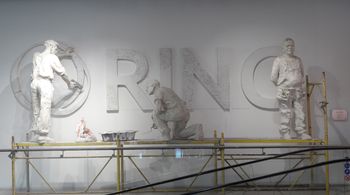
The shift from socialism to postsocialism is often characterized—in terms of space—as a shift from the privileging of public space and publicity to the privatization of public spaces in order to encourage consumption, entrepreneurship, and market rationality.Footnote 49 The conditions of postsocialism are often intensely neoliberal social conditions, and this is certainly true in Albania,Footnote 50 after the official end of the socialist regime in 1991.Footnote 51 The expansion of neoliberalism has produced not only new forms of subjectivity and behaviorFootnote 52 but also new spatial foci. One type of site where the navigation of neoliberal ideologies in postsocialism is particularly salient is the shopping mall, which has become a symbol of the new economic order in former socialist nations.Footnote 53 As Anna Zhelnina points out, the shopping mall epitomizes the privatization of space in the postsocialist context, but it also functions as a kind of public space.Footnote 54 In general, the image of the worker is absent from spaces emphasizing consumption, such as shopping malls, but Albania's capital city Tirana possesses a fascinating counterexample. In Ring Center, a mall located at Zogu i Zi, one of the city's major roundabouts, artist Arben Bajo created a sculpture entitled Workers (see Figure 5). Dedicated to laborers, and specifically to builders, the work presents an anomalous but illuminating case of the image of the worker represented in one of the newly emerging forms of neoliberal public space.
Arben Bajo, Workers (Punëtorët), 2015. Ring Center, Tirana, Albania. Photo by the author.

Ring Center opened in the spring of 2015. While modest in size compared to some of the other malls in Tirana (such as Citypark, opened in 2009, and Tirana East Gate, opened in 2011), Ring Center is far more centrally located, only 1.5 kilometers from Tirana's central square. By curious coincidence, the mall is located directly opposite one of the apartment buildings that was painted as part of the second Tirana Biennale in 2003. During the contemporary art biennale, several of Tirana's socialist-era concrete public housing blocks were painted according to designs created by a series of well-known artists, including Olafur Eliasson, Carsten Höller, and Rirkrit Tiravanija.Footnote 55 These interventions in the image of Tirana's built environment were curated by Hans Ulrich Obrist and artist Anri Sala, and they represented a continuation of a project that Edi Rama (then mayor of Tirana) had begun in 2000. As mayor, Rama (a painter and the son of one of socialist Albania's most famous monumental sculptors, Kristaq Rama) undertook a project to re-enliven the capital city's gray socialist housing architecture by painting several of the building façades in bright colors and patterns.Footnote 56 Rama's interventions were documented by Anri Sala, a friend of Rama's, in Sala's video Dammi i Colori (2003).Footnote 57 This fusion of politics, urbanism, and art subsequently made Rama a paradigmatic figure for that segment of the transnational contemporary artworld that desires to proclaim a continued political relevance for the arts in the age of global capitalism,Footnote 58 and the involvement of other famous artists in the project through the second Tirana Biennale lent the initial interventions even greater cultural credibility. The building across from Ring Center features a design by Rirkrit Tiravanija (known primarily for his role in the development of relational aesthetics), centering on the words “These are the things we are fighting for,” written in cursive along the lower level of the apartment's façade, immediately above a row of storefront spaces on the first level. The juxtaposition of the shopping center with Tiravanija's design introduces an element of the prophetic into the mall's appearance: It represents—potentially, at least—the desired outcome of Tiravanija's utopian declaration. This spatial correspondence between hopefulness (“These are the things we are fighting for”) and a massive consumer space in fact serves as an apt reflection of postsocialist society, which measures progress through possibilities for consumption.
The inclusion of Arben Bajo's Workers within Ring Center is thus all the more paradoxical. Workers was installed in the building immediately prior to its inauguration, and thus has always been part of visitors’ experience of the site. The owners of the center sought out Bajo to create a piece for the interior of the new mall, and he proposed a sculpture dedicated to laborers, which they approved.Footnote 59 Workers is located in the entry space to the mall, on the first main level of the structure. When visitors enter or exit the center, they proceed past Workers on a pair of escalators installed immediately in front of the sculpture. The artwork is an ensemble of three figures, depicted in the process of mortaring and texturing a section of wall, as if in preparation for tiling. The figures stand on a yellow metal scaffold that raises them slightly above the level of visitors passing on the escalator. Although they are modeled in plaster, two of the figures hold real trowels, and a real bag of mortar and mixing trough rest on the scaffolding, creating a kind of transition between the actual space of the mall and the world of the artwork.Footnote 60 Bajo explains that the workers represent generalized types: a youth, an older worker, and a lazy worker.Footnote 61 The figure at far left, the younger worker, leans against the wall, troweling its surface, while the older man crouches in the middle of the narrow scaffolding, also with a trowel in hand. At right, the lazy worker stands with hands clasped behind his back, gazing distractedly out, away from the wall (and thus from the focus of the other figures’ labor).
The first two figures are engaged in mortaring the logo of Ring Center itself (two interlocking circles and the word “RING’”, which stands out in high relief from the expanse of wall. Some of the letters are smooth, while others are textured by the teeth of the trowel, and on the wall itself leveling lines and drips of mortar are visible under the letters. These elements create the sense that the shopping center is perpetually “under construction,” that the labor of the three workers is ongoing. This implication of perpetual building is one of several aspects that align the sculpture with the tradition of Socialist Realist art. The depiction of labor and the process of creation or production was one of the central themes of Socialist Realism,Footnote 62 which aimed to directly reflect the dynamic transformation of society under state socialism. Indeed, some have argued that producing the image of production (as opposed to reflecting the reality of production) was the central goal of Socialist Realism as a style.Footnote 63 This kind of meta-representation appears in Bajo's sculpture in a specific way: The workers are engaged in creating precisely the logo of the shopping center. That is, their labor is sited at the point where the entire space is metaphorically condensed into a single image that can circulate easily amidst advertising networks.
In a postsocialist context, the very act of representing the figure of the worker already takes on immediate connotations of Socialist Realist ideology. However, Bajo's depiction of the laborers as a trio of types relates to a specific characteristic of Socialist Realism: its predilection for ideal types, for mythic representatives that reflected its “realist” content.Footnote 64 Furthermore, the representation of three character types together (creating a harmonious tripartite composition) was one of Socialist Realism's frequent visual tropes.Footnote 65 Bajo's use of plaster also recalls the aesthetic of much socialist-era public sculpture, which was frequently plaster or concrete, appearing starkly white in photographs.Footnote 66 All of these relationships to the prior dominant sculptural tradition in Albania suggest that Bajo's work might exercise a kind of subversive critique of its surroundings, using the language of a highly ideological leftist art style to complicate its consumerist context. However, Bajo states that he had no such intention:
I considered this possibility when I made the work, that people would call this a postcommunist work. In fact, I simply wanted to make a sculpture of three workers engaged in the process of labor, similar to Jean-François Millet's planters, or Constantin Meunier's miners. … In the work, I didn't want to reflect any ideological viewpoint on either the capitalist system, or the socialist one.
The artist insists that his message in the work was a general one: “Everything made in the world is made through labor. All material goods are the product of labor.”Footnote 67
Like Llakaj, Bajo is more interested in linking his work to a broader European tradition of Realist art, to which it indisputably belongs. Workers relates not only to the work of Meunier and of Millet, but perhaps even more directly to that of Courbet. The left and central figures of the sculpture seem to be quite direct references to Gustave Courbet's The Stonebreakers (1849), in which the leftmost figure (a younger man) turns his back to the viewer in his labor, and the middle figure (a visibly older man) kneels on the ground. Even the narrow stage of the scaffolding recalls Courbet's compositional space.
Bajo also cites American sculptor George Segal as one of the major influences on the sculpture.Footnote 68 The monochromatic whiteness of Workers’ plaster figures and the interaction of the sculpted protagonists with real objects and the environment around them certainly recall Segal's tableaus of cast figures and found and assembled objects.Footnote 69 Bajo used students and friends as models for the workers, and he intended to create an everydayness in the work that would parallel the mundane aspects of many of Segal's sculptures, which are so frequently focused on unremarkable moments. However, the difference in artistic technique between Segal and Bajo produces an important conceptual difference between the two artists. Segal cast real people, and thus left some of the agency for the emotional impact and interpretation of poses and scenes in their hands.Footnote 70 This also heightened the relationship of Segal's work to certain kinds of photographic Realism, since it relied on the plaster cast as an index of the physical qualities of an actually existing figure.Footnote 71 By contrast, Bajo's composition is constructed, and the aggressive modeling of the human figures indicates the importance of the sculptor's hand in the creation of a scene that is clearly artificial.
The inclusion of the logo for Ring Center as an integral element of the composition also mirrors the Pop Art sensibilities of Segal's works (especially examples such as Cinema of 1963, or Times Square at Night of 1970, where figures are juxtaposed to signs and advertisements). However, in Segal, the environment is always distinguished materially from the figures, through the contrast between white plaster and real assembled materials, such as signs, light-up displays, or countertops. In Workers, the surface of the wall with the plaster logo of the shopping center in fact serves as a bridge, a point of transition that serves to blur the distinction between sculptural figures and “real” surroundings. The inclusion of the logo as an element of the composition also echoes the Socialist Realist tendency (usually in painting) to depict workers in the process of producing public propaganda, painting slogans on walls or preparing banners.Footnote 72 In this sense, Bajo's sculpture operates productively in the overlap of the legacy of Pop Art and that of Socialist Realism, even while it retains its connections to earlier traditions of genre sculpture.
In a manner comparable to some of Segal's public commissions, which “restore intimacy” to spaces that are otherwise indifferent to human scale,Footnote 73 Bajo's sculpture injects a kind of everydayness into the space of shopping mall. Of course, the mall is already a site of everyday life, but Bajo's sculpture produces a reminder of the world of physical labor that exists alongside the world of purchasing power. The world of labor is often an invisible one, overwhelmed by the proliferations of advertisements across the surfaces of the lived environment, and by the preponderance of spaces for leisure activity in cities like Tirana. For example, Workers is located directly across from a café (situated on the first level, opposite the escalators from the sculpture), one of the paradigmatic leisure spaces of modern Albania.
The café as a space in Albania is semiotically complex; it is a site that simultaneously connotes the Ottoman past (from which the present coffee culture in Southeastern Europe derives, although in Albania it also relates to Italian coffee culture), the high levels of unemployment that have resulted in Albanian citizens spending entire days in cafés, and—in more prestigious sites, such as the new shopping malls of the capital city—middle- and upper-middle-class affluence.Footnote 74 The juxtaposition of the scaffolding and sculptures with the café opposite cannot help but make explicit the widespread forgetting of labor in spaces celebrating leisure: when café-goers look up, they are immediately greeted with an image that contrasts with the ideology of their surroundings and potentially with their own social class.
This contrast exists, of course, in terms of the entire Ring Center: The mall contains a number of shops with well-known foreign brands (Pierre Cardin, Armani, and Adidas, for example), as well as a food court and extensive children's entertainment area. Amidst these spaces for consumption, the image of production stands out sharply, not only because of its whiteness but also because of its rough, unfinished quality. Of crucial interest, then, is the character of the relationship that Workers constructs with its audience. The sculpture's relationship to the history of genre scenes and Realism suggests that it might be productively discussed within Michael Fried's well-known dichotomy of absorption and theatricality,Footnote 75 a paradigm that has shaped art historical understandings of depictions of workers and labor from the early modern through the postmodern period.
Fried identifies this dichotomy as a defining structure of art (particularly painting) beginning in the 1750s, when artists began to strive to “evok[e] the perfect obliviousness of a figure or group of figures to everything but the objects of their absorption”—everything including, most significantly, “the beholder's presence.”Footnote 76 This attempt to picture absorption developed in distinction to what Fried has called theatricality, a characteristic that he also identified as endemic to certain trends in sculpture beginning in the latter half of the 1960s.Footnote 77 Theatricality “is concerned with the actual circumstances in which the beholder encounters [the] work,” creating “a situation . . . that . . . includes the beholder.”Footnote 78 This situational context is produced through a marked distancing of the viewer from the object, and this occurs through a kind of stagelike relationship between the artwork and the viewer.Footnote 79
Clearly, Workers straddles this dichotomy, but the ways it explores both an absorptive and a theatrical mode of presentation are useful for understanding its possible meanings. On the one hand, the laborers of Workers are absorbed, in different ways. The two at left are preoccupied by their task, and appear to be engaged in a conversation with each other: The young man turns his head just slightly to the side, while the older worker raises his head as if to listen. However, while the action of these two seems as much frozen in time as absorbed,Footnote 80 the “lazy” worker at right is completely immersed in reverie, ignoring both viewers of the work and his fellows. As the figure situated closest to the entrance to the ascending escalator (and thus the figure most likely to “intrude” on visitors’ physical space), his absorption closes the work off in a particular way. At the point at which the viewer is able to draw closest to the work, it offers no welcoming insinuations, but simply obliviousness. On the other hand, the precisely human scale of the figures, the presence of the scaffolding, and the Ring Center logo as real objects in space produce a theatrical paradigm: They assert the situational quality of the encounter with the sculpture. The incongruity of the sculpture's theme and the figures’ whiteness in the space produces a distancing that is, in many ways, analogous to Fried's assessment of theatrical art.
There are profound political aspects to this distancing, as there are to the absorption of the workers. This political content relates primarily to the way it reflects class relations in postsocialism. The suggestion of the workers’ absorption (and thus the hermetically sealed quality of the artwork's world) suggests a situation parallel to the relative invisibility of the working class in postsocialist Albania. The space of labor is marginalized or compartmentalized, allowing a visual, spatial, and ideological separation between working conditions and the spaces of consumption (when, of course, the two are intimately intertwined). The workers appear to occupy a sphere of their own, and while this autonomy might grant their image a kind of dignity, it also asserts their continued separation from middle- and upper-class spaces.Footnote 81 At the same time, the distancing that operates through the sculpture's theatrical aspect forces the viewer to acknowledge their co-presence with the world of labor (or, at least, of forms of manual labor, such as construction). This confrontation could present an aggressive challenge to the dominance of consumerism as the basis of postsocialist subjectivity; it could present an enduring reminder that spaces of consumption are never entirely separate from realms of production, as well as asserting that the dignity of those who work to produce such spaces is often obfuscated. Given Bajo's steadfast insistence that the work is apolitical, this latter possibility is perhaps unlikely. However, it exists at least as the potential catalyst for an alternate, more radical interpretation of public spaces of consumption in postsocialist Tirana, an interpretation that re-centers workers’ lives in the narrative of economic development.
The worker as an image of public resistance to neoliberalism
Both Vladimir Llakaj's miner statue and Arben Bajo's Workers represent decidedly ambivalent instances of the worker's (re)appearance in postsocialist public space. They assert the worker's importance, but also obscure other relationships of economy and power that are central to the precarious positions of workers in neoliberal capitalism. In this final section, I turn to more overtly activist works of art and public interventionsFootnote 82 in urban contexts. Some artistic interventions in the postsocialist city aim to engage with the urban environment primarily in a formal way, by emphasizing design aesthetics and spatial relationships.Footnote 83 The works I consider here, however, seek to foreground workers and the working class. These works have differing relationships to the socialist past, but they are united in their critique of present as oppressive to workers and violent in its erasure of working-class issues.
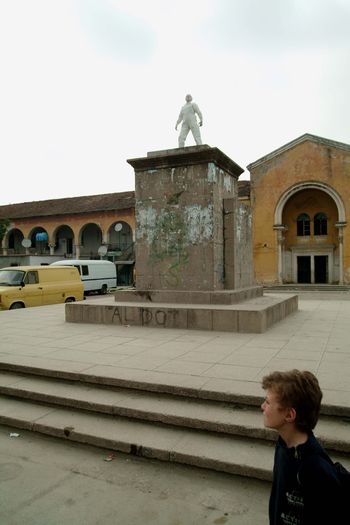
One of the most iconic artistic engagements with the theme of the worker in postsocialist Albania is Enisa Cenaliaj's performance Welcome, Dear Workers (see Figure 6). On a grey and cloudy day in late March of 2005, Cenaliaj stood motionless atop an empty pedestal in front the building once known as the Stalin Textile Factory, located in the southwestern part of Tirana. Dressed in worker's coveralls and painted all in white, the artist remained on the pedestal for approximately forty minutes, while workers employed within the factory (which no longer produced textiles, and which was now privately owned) passed by below her.Footnote 84 Cenaliaj adopted a characteristic pose, her body appearing to stride forward while her arms remained held at her sides, matching the implied motion of her gait. Though from a distance her gaze seemed to be focused directly ahead, her eyes remained closed. The whiteness of her form contrasted sharply with the fading orange façades of the factory and with the bedraggled state of the pedestal, the stone surface of which was obscured by graffiti and the torn remains of posters advertising candidates for local political positions. The iconic Communist red star that graced the front of the pedestal was barely legible, its color and form eroded by time and neglect.
Enisa Cenaliaj, Welcome, Dear Workers (Mirësevini të Dashur Punëtorë), 2005. Former Stalin Textile Factory, Kombinat neighborhood, Tirana, Albania. Photo courtesy of the artist.

With Welcome, Dear Workers, Cenaliaj intended to draw attention to the situation of the working masses in the context not only of socialism but even more so of contemporary capitalism. Realized as part of the project 1.60 Insurgent Space, organized by Italian artist and curator Stefano Romano, the work was one of several actions and interventions carried out in various spaces around the capital city during the first nine months of 2005. Describing her performance, Cenaliaj explained,
[T]he whole neighborhood took its name from that textile factory, which is why even today the area is called Kombinat [the Albanian term for an industrial combine].Footnote 85 Furthermore, the whole façade of the former factory remains generally unchanged. However, if you go deeper into the complex, everything has fallen down, and it gives you the impression of being in the specter of a factory. This impression also comes from the fact that, at the beginning and end of work shifts, the workers themselves “disappear” into nothing, only to return from nothing at the close of the workday.Footnote 86
She continued,
. . . I believe that the workers of the socialist times are, in essence, the same workers that we see today, except that in those days the conditions were the same for everyone and today the working conditions are much worse. . . . My placing the worker on a pedestal had nothing to do with the role played by statues in the time of the dictatorship. Rather, it emphasizes the fact that this class [the working class] still exists—not just that they exist, but that they must insist on the rights that, at minimum, should belong to them. It's an attempt to say, “people, listen, we exist, and we deserve better.”
The pedestal where Cenaliaj stood had once been home to one of the first works of public sculpture created in Tirana under state socialism: Odhise Paskali's 1949 bronze statue of Joseph Stalin, standing in a rather atypical posture, with his right arm extended benevolently to welcome the throngs of (primarily female) workers employed in the factory. Paskali's statue epitomized the masculine imaginary of socialist sculpture: the regal form of the male leader presiding benignly over the working masses, but the consolidation of socialist ideals in that single form was always incomplete. Its counterpart was the masses themselves, that often amorphous and diverse body that perpetually functioned as both the ambiguous product and the uncertain origin of socialist culture.Footnote 87 At the time of Cenaliaj's intervention, the Stalin statue had been relocated to a foundry elsewhere in Tirana, but Cenaliaj's performance does not function primarily as a critique of the fate of such statues.Footnote 88 Rather, she takes up certain elements of socialist art's symbolic imaginary (such as the projection of working-class solidarity) and reimagines their relevance in neoliberal capitalist society.
While Cenaliaj's Welcome, Dear Workers takes place primarily within a tradition of performance art in the former Eastern Europe,Footnote 89 other recent interventions in Albanian public space have reacted to current events in much more politically explicit ways. For example, the works of the Albanian street art collective Çeta are far more immediately political in their reference (although they often draw importantly from art historical precedents). The collective—whose membership remains anonymous as well as fluid—was first formed between January and March of 2016, by a group of students, activists, and artists.Footnote 90 They took their name, Çeta, from the Albania term used to describe guerilla antifascist units active in the Balkans during the late Ottoman period through the Second World War.Footnote 91 The group is made up of members of various ages, with various backgrounds: designers, political scientists, artists, and physicists. The design of individual works by the collective, and the responsibilities for their creation and installment, is carried out by different members according to the needs of the group and their commitments to other forms of political action in a given period.Footnote 92 Çeta's interventions in public space have dealt with a variety of topics, from the current Albanian government's crackdown on ambulant vendors of fruits and vegetables, to the plight of residents whose homes are destroyed to make way for new highway projects in and around Tirana.Footnote 93 They have also created works emphasizing the current plights of both skilled and unskilled workers during the process of Albania's aggressive neoliberalization.
In early August of 2016, in the Sharra landfill on the southwest outskirts of Tirana, the body of seventeen-year-old Ardit Gjoklaj was found buried beneath piles of garbage.Footnote 94 Gjoklaj, according to an autopsy, was killed when his body was (accidentally) crushed by the shovel of an excavator. Gjoklaj had been employed—illegally, given his age—by a private company called 3R,Footnote 95 and the company's management of the landfill had been touted by Tirana's current mayor as one of the most exemplary public-private partnerships in contemporary Albania. The Sharra landfill—where numerous workers are employed to separate refuse produced in Albania's capital city and environs—had featured in Veliaj's rhetoric as evidence of the vital relationships constructed between Albania's current government and private companies contracted to provide services such as landscaping, public transportation, and waste disposal.Footnote 96 Gjoklaj's death became a touchstone for critics of the current Albanian government's servile attitude toward private companies: mayor Erion Veliaj was accused of suppressing reporting about the boy's death,Footnote 97 and at least one reporter who covered the incident was subsequently fired from her position.Footnote 98 With the exception of coverage in certain left-wing media sources, however, the young worker's death remained generally unremarked on.
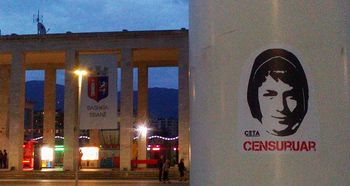
In early November of 2016, however, the street art collective Çeta stenciled and stickered Ardit Gjoklaj's face across Tirana's public spaces, accompanied by the caption censuruar, “censored” (see Figure 7). Çeta added the seventeen-year-old's face to the city's visual vocabulary by pasting his image across several prominent locations, including on the doors of the municipality, on lampposts in the city's largest public park, and on a large art installation in front of the National Gallery of Arts.Footnote 99 In contrast to many socialist-era representations, and the works discussed earlier in this article, Çeta's intervention focused not on Ardit's body but instead on the image of his face that had circulated in the media at the time of his death. This emphasis no doubt reflects the traumatic circumstances of Gjoklaj's demise, and the fact that any image of his entire body would necessarily have created severely traumatic resonances, not least among his family members. But Çeta's decision also reflects a different kind of effort to foreground the (in this case, precarious and unskilled) worker, by declaring Gjoklaj's individuality and dignity.Footnote 100 Indeed, the stickers spread throughout Tirana served as portraits, and called for Gjoklaj's remembrance as a particular individual whose death nonetheless reflects the dangerous working conditions of numerous working-class and underclass citizens across the globe.
Çeta, The Death of Workers Will Not Be Censored (Vrasja e Punëtorëve Nuk Censurohet), 2016. Tirana, Albania. Photo courtesy of the artists.

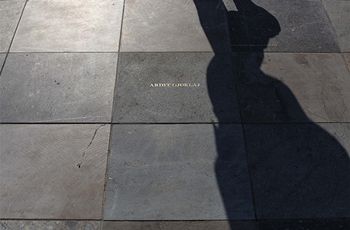
Çeta's works are not the only ones to focus attention on Ardit Gjoklaj's death, which even years later still serves as a rallying point for critics of Albania's economic and political conditions. In 2017, artist Pleurad Xhafa inscribed Gjoklaj's name on one of the stones in the recently renovated Skanderbeg Square (see Figure 8).Footnote 101 The square, whose new design was created by the Belgian architecture firm 51n4e (together with artist Anri Sala), has become the symbolic center of a number of different debates about the Rama government's use and transformation of public spaces.Footnote 102 Plans for the transformation of the square began in 2008 and construction began in earnest in 2016, since which time the square has become one of the key examples of the success of the Rilindja Urbane project, discussed above.Footnote 103 Several of the stone tiles in the new square are engraved with the name and logo of the company responsible for carrying out its construction, Fusha Ltd. When it was announced that the company had won the bid for the square, several media sources pointed out that the owner of the company was related to the prosecutor in the case in which all parties were found innocent in relation to Ardit Gjoklaj's death.Footnote 104 The new square became a focus of debates not only about aggressive urban renewal but also about continued efforts to erase the deaths of workers occurring in the employ of companies contracted to carry out these same renewal projects.
Pleurad Xhafa, Untitled, 2017. Skanderbeg Square, Tirana, Albania. Photo courtesy of the artist.

Xhafa's artistic practice frequently incorporates small-scale interventions into urban spaces, creating extremely localized and temporary sites of memory,Footnote 105 and his inscription of Gjoklaj's name belonged to this paradigm. The inscription remained on the square for a few days, but was eventually removed by authorities when it was discovered.Footnote 106 Unlike Çeta's intervention, Xhafa's aimed not only to focus attention on Gjoklaj's life but also to demonstrate the ways that contemporary urbanistic and architectural interventions both erase and conceal the economic networks driving political change in postsocialist Albania. Xhafa's work emphasized the way that the lives of workers can briefly enter public discourse, only to be obscured, while attention remains focused on broader, more abstract transformations of urban space that are linked to notions of national progress.Footnote 107 Skanderbeg Square is the quintessentially nationalist space of modern Tirana,Footnote 108 and the inscription of Ardit Gjoklaj's name upon it functioned as a sort of inversion of this nationalism. Against the unnamed and anonymous collectivity of a nation, Gjoklaj's name represented the need to remember the death of a specific individual, and to rescue that death from orchestrated oblivion.
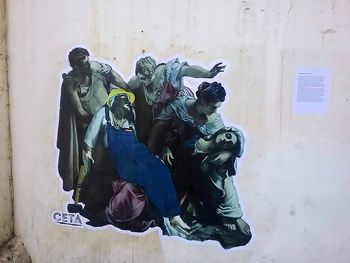
A final example will expand our understanding of how the worker's life (and death) can take on symbolic associations in postsocialist public art. On April 8, 2018, Çeta created an image based upon Jacopo Tintoretto's famous sixteenth-century tableau The Deposition of Christ (see figure 9). Pasted on a wall in Tirana and accompanied by an explanatory text, the image shows the central figures of Christ's deposition, but the figure of Christ himself has been augmented, transformed into a worker.Footnote 109 He wears a white shirt, blue coveralls, and a stereotypical yellow protective plastic helmet. From his limp right hand, he lets slip a hammer. The description pasted next to the work indicated its title as Descent and Rebirth (Rënia dhe Ringjallja), and the text explained,
In the last two decades, hundreds of workers have died while on the job. Primarily, these have been construction workers, miners, and oil drillers, but there have also been laborers working in the recycling industry, and electricians. For some time, the news has abounded with reports of accidents at work, including fatal ones. Sometimes these reports appear in the “Crime” section of news portals, since everything that surrounds the worker and the workplace is criminal: illegal work; the absence of basic decent working conditions; blaming workers for their own deaths; secret agreements between companies, the state, and unions; unknown or unread work contracts; work hours that depend upon the whims of business owners; absent laws and lack of legal clarity; the absence of union organization; corrupt unions; etc. . . . The Deposition, one of Tintoretto's most famous works . . . has changed its subject. Here it shows a construction worker killed on the job, now released from the sufferings and exploitation of his labor, depicted in the final act that foreshadows his rebirth.Footnote 110
Descent and Rebirth reckons with the problems of workers’ current existence in conditions of neoliberal capitalism, and offers hope that there will be a rebirth—of workers’ solidarity, of respect for workers’ lives, of awareness that the working class still exists in neoliberalism, if rarely as a subject of representation.
Çeta, Descent and Rebirth (Rënia dhe Ringjallja), 2018. Tirana, Albania. Photo courtesy of the artists.

The “rebirth” of the worker in shared spaces is far from a certainty in postsocialist neoliberal contexts. Even where legible images of workers exist in public space, they sometimes do as much to obscure existing relationships of economic exploitation. As in the case of Vladimir Llakaj's new miner statue for the town of Memaliaj, they stand for workers, but fail to represent their current conditions. In a sense, they remain as abstract as other modernist public art projects that eschew representation entirely. At other times, such as in the case of Arben Bajo's Workers, the ambiguity of sculptural representations of workers leaves them open to be read as either critical commentaries upon capitalism, or as tacit celebrations of neoliberal consumption as the ultimate desirable outcome of labor. Finally, even explicitly activist attempts to present working-class issues in public space must wrestle with questions of both attention and representation. They must assert the worker's image in competition with the dense visual stimuli of late capitalist urban space, and they must contend with prevailing negative associations between the celebration of working-class solidarity and socialist history. In other words, they must overcome the belief, on the part of younger generations, that all references to the importance of the working class are merely nostalgia for authoritarian communist propaganda.Footnote 111
Conclusion
To understand how the worker fits into the neoliberal imaginary, we must consider how politicians, artists, and activists alike mobilize the worker's image in public space, through street art, traditional public statuary, and other modes of presentation. Such representations are necessarily created in relation to a long history of worker representations in art, especially in Realism and Socialist Realism, and as such their form of address carries its own additional political valences. This article has examined the complexities of imaging the figure of the worker in various contexts in postsocialism, through an examination of several case studies from twenty-first-century Albania. These examples show that the worker continues to figure prominently in negotiations of space, power, and identity in postsocialist Europe, in a variety of urban contexts. The strength that these images possess is often dependent precisely on their resonance with the communities to whom they speak. Examining such contexts closely allows for a productive dialogue between art history and labor history, focusing on the multiple ways that images of workers both highlight and obscure the narratives of working-class lives.
Exploring the ways that images do this work of emphasis and obscuring means expanding the investigation of such public artworks along a variety of methodological lines. More work is needed, for example, to determine how workers see themselves in such postsocialist representations, and how they interpret artists making works of and about them. Such research requires careful ethnographic engagement with working-class communities across a variety of postsocialist contexts. A very different, but equally necessary, avenue of investigation would be to examine how official public art policies approach questions of class representation—in the make-up of decisionmaking committees on art policy, in the selection of artists, and in the language used to discuss the incorporation of the worker into public commissions. Yet another necessary area of investigation is the way that socialist-era (especially Socialist Realist) images of the worker become commodified in ways that make them as amenable to capitalist ideologies of urban representation as they are to leftist ideologies proclaiming class solidarity. Above all else, what this article aims to suggest is the fruitfulness of merging the interests of labor history and labor geography with the methods of art history, and the ways that this constellation of approaches can help us understand how postsocialist space is developing in the world today. The images of the worker in postsocialist public space discussed here highlight the forces, actors, and mimetic strategies at work in dialectically shaping postsocialist public spaces into spaces of representation, places where the worker is both seen and indexed as a force contributing to the neoliberal urban landscape. These spaces are sites of consumption, sites of memory, sites of forgetting, and in some cases the contemporary “empty centers”Footnote 112 where artists point precisely to the semiotic instability of representing the worker. In these instabilities, contradictions, and erasures, we might yet nonetheless find a language for producing new spaces in which workers—rooted or uprooted by the shift from socialism to capitalism—are freer to shape their own public image.