

INTRODUCTION
Schizophrenia (SCZ) is a genetically complex mental disease affecting approximately 1% of the general population worldwide (Sullivan et al., Reference Sullivan, Kendler and Neale2003; Gysin et al., Reference Gysin, Kraftsik, Sandell, Bovet, Chappuis and Conus2007). Various structural genetic variants including deletions, insertions, inversions, duplications and translocations of DNA sequences have been identified and reported to be associated with the condition (Sharp et al., Reference Sharp, Cheng and Eichler2006), which significantly contribute to disease susceptibility (Hebbring et al., Reference Hebbring, Adjei, Baer, Jenkins, Zhang and Cunningham2007). Although the topic has long begun to be explored at molecular genetics levels, data about genetically based functional modifications still remains sparse (Ross et al., Reference Ross, Margolis, Reading, Pletnikov and Coyle2006). Recent molecular genetics studies have led to the hypothesis that deregulation of glutathione (GSH) metabolism may be involved in the pathogenesis of SCZ (Tosic et al., Reference Tosic, Ott, Barral, Bovet, Deppen and Gheorghita2006; Behrens and Sejnowski, Reference Behrens and Sejnowski2009). Glutathione S-transferases (GSTs) are an enormous family of multifunctional proteins that are vital to the adaptive, antioxidant response to reactive oxygen species (ROS) and the clearance of exogenous toxic compounds. The GSTs are encoded by eight different gene families: alpha, chi (or omega), mu, pi, theta, zeta and kappa (Kordi-Tamandani et al., Reference Kordi-Tamandani, Hashemi, Birjandian, Bahari, Valizadeh and Torkamanzehi2011a). The most important function of these enzymes is to catalyze the formation of glutathione-S-conjugates with electrophiles, whether of endo- or exogenous origin, which is critical for the inactivation and subsequent excretion of these particles (Bjork et al., Reference Bjork, Saarikoski, Arlinde, Kovanen, Osei-Hyiaman and Ubaldi2006). In the brain, most of the GSTs are found in glial cells, which contain a great deal of GSH and may protect neurons with low levels of GSH against oxidative damage. Neurons are particularly susceptible to oxidative stress due to the fact that they are non-replicating cells with high metabolic rates and relatively low levels of natural antioxidants (Zeevalk et al., Reference Zeevalk, Manzino, Sonsalla and Bernard2007). The balance between neurodestructive oxidants and neuroprotective antioxidants is controlled by means of the redox mechanism, which plays an important role in development of neurons in the brain (Smythies, Reference Smythies1999). This mechanism also plays a part in destruction of glutamate synapses, which are altered in patients with SCZ. The ROS decreases the GSH level and increases the intracellular calcium and glutamate neurotoxicity. These results suggest that oxidative stress may have a considerable effect on the etiopathogenesis of SCZ (Pae et al., Reference Pae, Kim, Lee, Lee, Lee and Paik2003). On the other hand, GST enzymes play a critical role in cellular detoxification (Pemble et al., Reference Pemble, Schroeder, Spencer, Meyer, Hallier and Bolt1994). The GSTT1-0 (GSTT1 null) and GSTM1-0 (GSTM1 null) alleles correspond to deletions of glutathione S-transferase T1 (GSTT1) and glutathione S-transferase M1 (GSTM1) genes, respectively. Functionally, the homozygosity for the GSTM1 and GSTT1 null alleles (null genotypes) is not accompanied by enzymatic activity. Several studies have also highlighted the association between these polymorphisms and several types of cancers (Csejtei et al., Reference Csejtei, Tibold, Varga, Koltai, Ember and Orsos2008; Masoudi et al., Reference Masoudi, Saadat, Omidvari and Saadat2009; Simic et al., Reference Simic, Savic-Radojevic, Pljesa-Ercegovac, Matic and Mimic-Oka2009), cardiovascular diseases (Martin et al., Reference Martin, Collier, Bowen, Pritsos, Goodrich and Arger2009) and bipolar disorder (Mohammadynejad et al., Reference Mohammadynejad, Saadat, Ghanizadeh and Saadat2011).
Alteration in glutathione S-transferase P (GSTP) levels may be involved in oxidative stress and apoptosis, leading to the progress of SCZ by means of alterations in neurodevelopment. The relationship between polymorphisms of several members of the GST family (GSTM1, GSTT1 and GSTP1) and SCZ has been investigated (Pae et al., Reference Pae, Kim, Lee, Lee, Lee and Paik2003; Gravina et al., Reference Gravina, Spoletini, Masini, Valentini, Vanni and Paladini2011).
The aims of this study were to explain the role of GSTM1, GSTT1 and GSTP1 genes polymorphisms in progress of SCZ in a sample of Iranian population.
MATERIALS AND METHODS
Study subjects
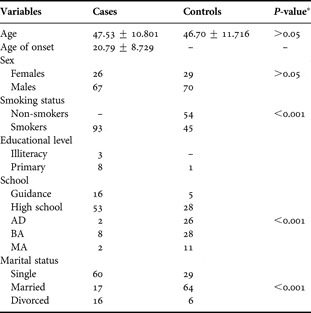
This case-control study, approved by the Ethics Committee of Azadi Hospital, was conducted in 2010–2011 in Tehran, Iran. One hundred newly diagnosed and untreated individuals with SCZ admitted to Azadi and Emam Hossein Hospitals were included in this study. Those with a history of neurological or mental disorders apart from SCZ were excluded. DSM-IV (Diagnostic and Statistical Manual of Mental Disorders-IV, American Psychiatric Association, 1994) was applied in diagnosis of the patients. The healthy control group (n = 99) included volunteers from the medical and paramedical staff, who were free from any signs of neuropsychiatric illness. A signed consent form was obtained from all of the participants once the study had been thoroughly explained. The demographic characterizations of the participants are presented in Table 1.
The socio-demographic characteristics of the case and control groups.

*Chi-square test.
DNA isolation and polymerase chain reaction (PCR)
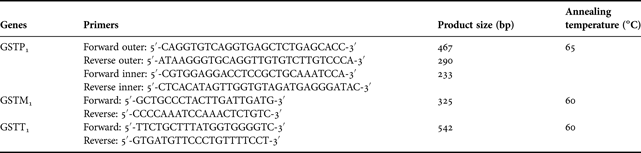
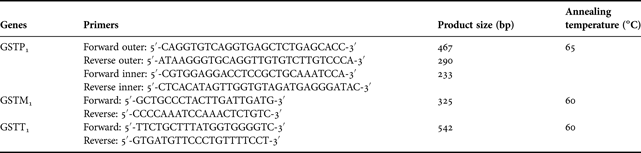
Blood samples were collected in EDTA-coated tubes for DNA extraction and genotypic analysis, as previously described (Kordi-Tamandani et al., Reference Kordi-Tamandani, Hashemi, Sharifi, Kaykhaei and Torkamanzehi2011b). Polymorphisms were identified by PCR using the Tetra Amplification Refractory Mutation System (ARMS), a simple and rapid detection method for different types of mutations. Amplification of GSTT1 and GSTM1 genes were set according to the following PCR conditions: 0.5 µl of Taq (5 U µl−1), 1 µl of each primer (10 µmol l−1), 2.5 µl of 10× buffer, 1 µl of dNTPs mix (10 µmol l−1), 5 µl of Mg2+ (25 µmol l−1) and 10.5 µl of RNase-free double distilled water. The PCR was heated at 95°C for 5 min, followed by 25 cycles at 95°C for 30 s, annealing at 60°C for 20 s, extension at 72°C for 30 s and final extension by incubation at 72°C for 10 min. Two outer and two inner primers (forward and reverse) were used to detect variations in the GSTP1 gene and were heated at 95°C for 5 min, followed by 25 cycles of denaturation at 95°C for 30 s; annealing at 65°C for 20 s; extension at 72°C for 15 s, and incubation completed at 72°C for 10 min. The set of primers used to genotype GSTT1, GSTM and GSTP are listed in Table 2.
Primers sequence and annealing temperature.
Statistical analysis
Statistical analysis was conducted using SPSS statistical software version 16 (SPSS, Chicago, IL) and Epical version 3.2. The relationship between polymorphisms in GST genotypes and the risk of SCZ was tested by estimating odds ratios (OR) and 95% confidence intervals (95% CI). Categorical data were analyzed by Pearson's χ2.
RESULTS
Three GST polymorphisms were successfully genotyped in 93 SCZ patients (aged 47.53 ± 10.8 years) and 99 controls (aged 46.70 ± 11.7 years).
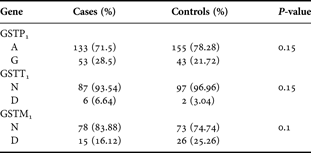
The allelic frequency of GST genes was found to vary among different ethnic groups. Thus, an Iranian population has a higher frequency of the N allele for GSTT and GSTM genes compared with online data for European and/or Asian populations. Meanwhile, the frequency of the allele for the GSTP gene does not vary among different populations (Table 3).
Allele frequency (%) of GSTP1 & GSTT1 & GSTM1 among individuals with SCZ and healthy controls.
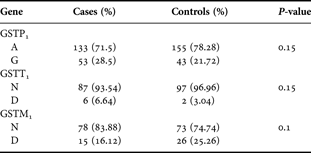
D (deletion allele); N (non-deletion allele).
The AG and combined AG + GG genotypes of GSTP1 are accompanied by an increased risk of the disease (OR = 1.83, 95% CI: 0.94–3.75 and OR = 1.71, 95% CI: 0.92–3.19, respectively). Nonetheless, the difference is not statistically significant (Table 4).
Number and frequency of GSTP1 genotypes in SCZ and healthy controls.

*It was adjusted with age and sex.
The GSTT/NULL, NULL/GSTM and NULL /NULL genotypes appear to have an increased risk of the disease (OR = 2.05, 95% CI, 0.9–4.74; OR = 2.0, 95% CI, 1.68–2.31; and OR = 1.8, 95% CI, 0.57–2.46, respectively), although the difference is not significant (Table 5).
Number and frequency of GSTT1 & GSTM1 genotypes in schizophrenics and healthy controls.

NULL (negative).
*It was adjusted with age and sex.
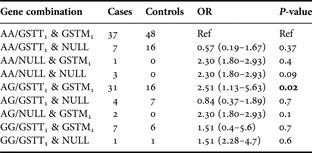
An analysis of the gene–gene interaction between GSTs indicates that the magnitude of the association is greater for the combined AG/GSTT1 & GSTM1 genotypes (OR = 2.51; 95% CI: 1.13–5.63; P = 0.02) than for other genotype combinations (Table 6).
Association of different genotypic combination with SCZ for the GST, GSTM1 and GSTT1.

DISCUSSION
As previously mentioned, GSTP has been suggested to serve a critical function in antioxidant and apoptosis by means of modulating various kinesis, which affects the progress of SCZ (Pae et al., Reference Pae, Kim, Lee, Lee, Lee and Paik2003). A great deal of oxidation biology data have been gathered for SCZ, bipolar and major depressive disorders (Berk et al., Reference Berk, Ng, Dean, Dodd and Bush2008). We hypothesized that patients with SCZ may demonstrate different distribution genotypes or allele frequencies for GSTs genes than the controls. Ultimately, we attempted to assess the gene–gene interaction relationship between patients with SCZ and healthy controls. Our findings suggest an association between the AG/GSTT1 & GSTM1 genotypes and a risk of SCZ (P = 0.02). Based on the GSTM1 function, which is a crucial antioxidant in preventing neurotoxicity, the deletion of GSTM may lead to an increase in catecholamine o-quinone as a neurotoxin in the brain (Koizumi et al., Reference Koizumi, Hashimoto, Kumakiri, Shimizu, Sekine and Ozaki2004). Gravina et al. determined a combination of GST polymorphism to be involved in predispositions toward SCZ among Italian populations (Gravina et al.). Meanwhile, a study conducted by Gysine et al. provides genetic and functional evidence of the notion that oxidative stress serves as a dependent factor for SCZ (Gysin et al.). Similarly, an association between polymorphism and the altered expression of genes has been demonstrated to be involved in the oxidative stress response in bipolar disorder but not in SCZ (Benes et al., Reference Benes, Matzilevich, Burke and Walsh2006). The findings of Saadat et al. indicate that a positive GSTT genotype significantly increases the risk of SCZ (Saadat et al.). An association of the Null genotypes of the GSTT1 and GSTM1 polymorphisms has been reported for certain types of multifactorial diseases, such as glaucoma, varicocele, breast cancer, acute myocardial infarction and biliopancreatic diversion (BDP) (Acar et al., Reference Acar, Kilinc, Guven and Inan2011; Mishra et al., Reference Mishra, Chandra, Mehrotra, Bajpai and Agrawal2011; Mohammadynejad et al., Reference Mohammadynejad, Saadat, Ghanizadeh and Saadat2011; Rocha et al., Reference Rocha, Talbot, Magalhaes da Silva, Almeida, Menezes and Di Pietro2011; Singh et al., Reference Singh, Sinha, Kumar, Pandey and Agrawal2011). Certain studies indicate that the Null genotypes of GSTM1 and the positive genotype of GSTT1 are linked with an increased risk in SCZ (Harada et al., Reference Harada, Tachikawa and Kawanishi2001; Saadat et al., Reference Saadat, Mobayen and Farrashbandi2007). Although our results are in line with research discussed above, the number of samples is one of the limitations of the present study in comparison with other studies. Thus, we suggest that this study be confirmed in further investigations with large sample sizes in different populations across the world, as genetic and molecular research supplies fundamental data regarding the involvement of oxidative stress in psychiatric disorders.
ACKNOWLEDGEMENTS
The authors wish to thank the University of Sistan and Baluchestan and the Islamic Azad University Branch of Rod Hen for financially supporting this project through grants to D.M.K.T., A.T. and S.V.