

INTRODUCTION
Low-temperature is one of the most important abiotic factors limiting the growth and productivity of crop plants (Ao et al., Reference Ao, Li, Fan and Gong2013; Campos et al., Reference Campos, Quartin, Ramalho and Nunes2003; Hendrickson et al., Reference Hendrickson, Ball, Wood, Chow and Furbank2004). Many crops and horticultural plants that originate from tropical or subtropical regions are susceptible to low-temperature stress (Liu, Reference Liu2003; Popov et al., Reference Popov, Antipina and Trunova2010). Exposure to low temperature could induce significant changes in physiological processes, such as photosynthesis, ion uptake, mitochondrial respiration and membrane lipid peroxidation (Apel and Hirt, Reference Apel and Hirt2004; Hendrickson et al., Reference Hendrickson, Ball, Wood, Chow and Furbank2004; Popov et al., Reference Popov, Antipina and Trunova2010; Prasad et al., Reference Prasad, Anderson, Martin and Stewart1994).
Diversities of substances have been studied on their functions of cold tolerance improvement. Jennings and Saltveit (Reference Jennings and Saltveit1994) found that calcium nitrate was able to elevate cold tolerance of cucumber (Cucumis sativus) seedling remarkably. Raese (Reference Raese1997) indicated that the application of ammonium nitrate in proper season could enhance cold tolerance of pear (Pyrus communis). Apart from inorganic fertilizers, many plant growth substances or plant hormones were explored thoroughly in the tolerance of plants to low-temperature stress. For instance, Glycine betaine (GB) could induce FAD7 (fatty acid desaturase 7) and LOX13 (lypoxygenase 13) expression in the plasma membrane of tomato (Solanum lycopersicum) leaf, which could ameliorate lipid peroxidation, maintain stability and intactness of plasma membrane, and thus increase the resistance of plants to low-temperature stress (Karabudak et al., Reference Karabudak, Bor, Özdemir and Türkan2014). A similar alleviating effect of GB was also observed in tobacco (Nicotiana tabacum) leaves suffering low-temperature stress (Wang et al., Reference Wang, Ma, Hui and Wang2008). GB could protect plasma membrane via lowering H+-ATPase activity, acting as a cryoprotectant against dehydration and keeping reactive oxygen species balance (Fan et al., Reference Fan, Zhang, Zhang and Zhang2012; Zhang et al., Reference Zhang, Liang, Wang, Luo and Wang2010). Salicylic acid (SA) plays as a plant hormone and a signal molecule as well as a stress factor to plants (Ouyang et al., Reference Ouyang, He and Liu2011; Singh et al., Reference Singh, Mishra and Jha2014; Wei et al., Reference Wei, Zhang, Han, Guan and Chai2008). Proper concentration of SA has a great potential to enhance the tolerance of crop to various stresses (Miura and Tada, Reference Miura and Tada2014). Wang et al. (Reference Wang, Chen, Wang, Nikolay, Vladimir and Gao2010) implied that SA-mediate GoDREB gene expression contributed to cold resistance of forage legume (Galegae orientalis). However, the advantage of SA in tobacco seedlings is insufficiently elucidated in response to low-temperature stress.
Tobacco is a thermophilic crop. Optimal temperature for tobacco growth in fields ranges from 23 °C to 28 °C. When the daily average temperature is lower than 17 °C, the growth of tobacco seedlings will be inhibited gradually (Liu, Reference Liu2003). If low-temperature stress happens during the seedling stage to rosette stage of tobacco plants, tobacco seedlings will blossom early, which will reduce production and quality of tobacco leaves (Liu, Reference Liu2003; Xu et al., Reference Xu, Li, Hu, Guan, Ma, Zheng and Zhu2010). Therefore, the products that can improve the tolerance of tobacco seedlings to low-temperature stress are very important for tobacco farmers. Traditionally, tobacco farmers use plastic membrane to cover tobacco seedlings to avoid low-temperature-induced injuries. However, it costs much labour and money to cover plants in fields. Furthermore, it is not convenient to fertilize and irrigate tobacco plants, or receive rain water (Caldwell et al., Reference Caldwell, Leib and Savoy2010). Here, we presented a low-temperature-resistant agent (LTRA) and examined its effect on tobacco growth at low-temperature stress.
MATERIALS AND METHODS
Materials incubation and experiment design
Tobacco seeds (cv. ‘K326’) were provided by China Tobacco Hunan Industrial Co. Ltd., Changsha. Tobacco seeds were germinated in a growth chamber at 26 °C for 7 days beginning in 10th December 2012, and then transferred to solution culture. The nutrient solution was consisted of 1/4 Hoagland's solution. The solution was changed every 7 days. After incubation, tobacco seedlings with 4-leaf heart were used for experimental treatments. Light intensity in a growth chamber was 400 μmol m−2 s−1. Day/night time was 14/10 hours. Normal- and low-temperature treatment was 26 °C and 12 °C, respectively. An LTRA was produced by the Laboratory of Root Layer Control, College of Resources and Environment, South China Agricultural University. LTRA was composed of SA, GB and calcium ammonium nitrate (CAN). The concentrations of SA (0.1 g L−1), CAN (1.0 g L−1) and GB (0.2 g L−1) were selected on the basis of preliminary assays on the stability of LTRA and their effects on tobacco growth (data not shown). Three treatments were performed as follows: the control at 26 °C: spraying deionized water; the control at 12 °C: spraying deionized water; LTRA at 12 °C: spraying LTRA solution. Each treatment had 5 replicates. Treatment time was 6 days. Spraying volume of treatment solution was 5 ml per plant for each time. Spraying time was 9:00 and 16:00 of each day, respectively. After 6-day treatment, tobacco leaves were harvested for measurements. All measurements were made on the third to the fourth leaf from the bottom of tobacco seedlings. Each experiment was replicated twice independently.
Measurement of tobacco growth
After treatments, tobacco plants were harvested. Shoots and roots were separated and rinsed. Tap root length was measured by a ruler, and the number of roots was counted manually. Shoot and root fresh weights were weighed by electronic balance. SPAD (soil and plant analyzer development) value was measured by chlorophyll meter on the upper fourth leaf of each plant, and four sites on a leaf were measured as replicates in each plant.
Measurement of proline and ascorbic acid in tobacco leaves
After treatment, tobacco leaves (the fourth leaf from the bottom of tobacco seedling) were collected and 0.2 g of fresh leaf segment was weighted. Then leaf segments were frozen in liquid N2 and ground with a pestle and a mortar by adding metaphosphoric acids. Leaf extracts were obtained after centrifugation. The amount of ascorbic acid was measured according to the hydrazine method on a spectrophotometer (Model 754, Shunyuhengfeng, Shanghai, China). The standard reagent was L-ascorbic acid (Sigma Chemical Co. Inc., USA). For proline measurement, leaves were collected, cut into 0.5-cm length and mixed. Proline in leaves was extracted in 3% (w/w) sulfosalicylic acid. The amount of proline was estimated by adding acid ninhydrin reagent and measured according to the absorbance of the toluene chromophore at 520 nm. The amount of proline in each sample was then determined according to a standard curve.
Antioxidant enzyme activity
After treatment, tobacco leaves of 0.2 g was excised and ground in a 2-mL ice-cold 50 mmol L−1 phosphate solution buffer (pH 7.8). The mixture solution was centrifugalized at 12 000 r min−1 for 15 minutes at 4 °C, and the supernatant was collected to measure the enzyme activity. To determine the activity of superoxide dismutase (SOD), nitroblue tetrazolium (NBT) was used to inhibit the photochemical reduction. One unit of the activity of SOD was defined as being present in the volume of extract that caused the inhibition of the photoreduction of NBT by 50% (Thounaojam et al., Reference Thounaojam, Panda, Mazumdar, Kumar, Sharma, Sahoo and Panda2012). Catalase (CAT) activity was measured by calculating the decline in absorbance at 240 nm due to the decline of extinction of H2 O2. The reaction mixture was composed of 25 mmol L−1 sodium phosphate buffer (pH 7.0), 10 mmol L−1 H2 O2 and 0.1 mL enzyme extracts. The reaction was started by adding hydrogen peroxide (Kato and Shimizu, Reference Kato and Shimizu1987). Peroxidase (POD) activity was detected by measuring the increase in absorbance at 470 nm due to guaiacol oxidation. An increase in absorbance per minute at 470 nm was defined as one unit of enzyme activity. The activity of enzyme was presented as U mg−1 protein (Dias and Costa, Reference Dias and Costa1983).
Membrane permeability
After treatment, tobacco leaves were harvested for measurement of membrane permeability. Electrolyte leakage was expressed by relative electrical conductivity as described by Liu et al. (Reference Liu, Zeng, Wang, Li, Chen and Guo1985). Briefly, tobacco leaf segments were submitted to deionized water for 5 minutes, and the electrical conductivity in the solution was determined at 25 °C. Then the solution was boiled for 5 minutes and cooled down to 25 °C. Electrical conductivity was determined again. Relative electrical conductivity indicated the ratio of the value of the first (unboiled) value to the last (boiled) value. In this section, three experiments were performed. The first experiment was the effect of different temperature treatments on membrane permeability. Three treatments were the control at 26 °C, the control at 12 °C, and LTRA at 12 °C. The second experiment was the effect of different LTRA concentrations on membrane permeability. Treatments were 0, 0.5, 1.0, 2.0, 4.0 or 8.0 g L−1 LTRA. The third experiment was the effect of different LTRA components on membrane permeability. Treatments were 0.1 g L−1 SA, 1.0 g L−1 CAN, 0.2 g L−1 GB, 0.1 g L−1 SA + 1.0 g L−1 CAN, 0.1 g L−1 SA + 0.2 g L−1 GB and 1.0 g L−1 CAN + 0.2 g L−1 GB. Treatment duration and spraying method were described as the above. After treatments, tobacco leaves were collected to determine relative electrolyte leakage.
Observation of leaf structure
After treatments, small segments (about 2.0 mm2) from the middle of the leaf blade were cut in 0.5 mmol L−1 CaCl2 solution. Agar powder of 5 g was mixed with 95 ml of distilled water. Then agar mixture was boiled in a microwave machine. When the temperature of agar solution declined to 40 °C to 50 °C, leaf segments were fixed in agar mixture. After fixation, the sample was cut with a vibrate microslicer. Leaf sections were 60-μm thick. Ten cross-sections from each leaf sample were captured by the light microscope (Olympus BX 40, Tokyo, Japan) equipped with a one-chip TV camera (COHU, San Diego, CA, USA). Palisade and spongy cell thickness were calculated. The number of chloroplast in each cell was calculated.
Statistical analysis
The experiments were done in a completely randomized design and all treatments were replicated 5 times. The data were analysed statistically by Microsoft Office Excel 2000 and by Duncan's New Multiple range test, P < 0.05. Significant difference was analysis by using SAS software (version 8.1, the SAS Institute, USA).
RESULTS
Effect of LTRA on tobacco growth
Low-temperature stress, which occurs at temperature below 17 °C, is one of the major environmental factors affecting tobacco growth (Liu, Reference Liu2003; Xu et al., Reference Xu, Li, Hu, Guan, Ma, Zheng and Zhu2010). In South China, late spring coldness occurs and the temperature declines to less than 12 °C frequently. Furthermore, long cloudy and rainy weather days inhibit the growth of tobacco seedlings. To solve the problem, we examined the effect of an LTRA on the growth of tobacco seedlings. Tobacco seedlings were treated with the temperature of 12 °C for 6 days, a significant inhibition of tobacco growth was observed as shown in Table 1. Tap root length was inhibited by 25.6%. Root number was reduced by 27.6%. Shoot and root fresh weights were decreased by 23.1% and 30.6%. Treatment with LTRA ameliorated the inhibitory effect of low-temperature stress on tobacco biomass and root number significantly. Shoot and root biomass and root number were recovered by 53.8%, 57.9% and 60%, respectively. However, LTRA treatment did not influence the length of tap root significantly under low-temperature stress (Table 1).
Effect of LTRA on the growth of tobacco seedlings.

Note: *Data indicated mean ± SE (n = 5). The data with different letters in the same column indicated significant differences at P ≤ 0.05 (Duncan's test).
Effect of LTRA on leaf proline and ascorbic acid
Proline was a stress-responsive physiological index (Apel and Hirt, Reference Apel and Hirt2004; Kocsy et al., Reference Kocsy, Pal, Soltesz, Szalai, Boldizsar, Kovacs and Janda2011; Liu et al., Reference Liu, Zeng, Wang, Li, Chen and Guo1985). In this study, we examined the content of proline and ascorbic acid in tobacco leaves at both normal- and low-temperature treatments. Results from Table 2 indicated that low-temperature stress could induce a significant accumulation of proline. Low-temperature stress increased proline content by 58.3%. Treatment with LTRA could not suppress low temperature-induced increase of proline obviously (Table 2). The response of ascorbic acid was different from that of proline. Low-temperature stress decreased the content of ascorbic acid significantly, while a remarkable increase in the content of ascorbic acid was observed in the tobacco leaves when treated with LTRA at low-temperature stress. Ascorbic acid at low-temperature stress was only 65.2% of that at normal temperature condition. Treatment with LTRA could recover 69.1% of decrease of ascorbic acid triggered by low-temperature stress (Table 2).
Effect of LTRA on proline and ascorbic acid content of tobacco leaves.

Note: *Data indicated mean ± SE (n = 5). The data with different letters in the same column indicated significant differences at P ≤ 0.05 (Duncan's test).
FW = fresh weight.
Effect of LTRA on antioxidant enzyme activity
In plants, the antioxidant enzymes represent the first line of defense against environmental stress (Kocsy et al., Reference Kocsy, Pal, Soltesz, Szalai, Boldizsar, Kovacs and Janda2011; Prasad et al., Reference Prasad, Anderson, Martin and Stewart1994). In this study, low-temperature stress for 6 days decreased the activity of SOD significantly. SOD activity at low-temperature stress was only 53.5% of that at normal temperature condition. CAT showed a similar varying pattern to SOD in response to low-temperature stress. Low-temperature stress also decreased the activity of CAT by 67.9%. LTRA treatment increased the activities of SOD and CAT significantly. SOD and CAT activities were recovered by 76.2% and 63.6%, respectively. POD showed a different response to low-temperature stress compared with SOD and CAT. Low-temperature stress induced a significant increase of POD activity. POD activity was 72.0% higher at low-temperature stress than that at normal temperature condition. Treatment with LTRA inhibited the increase of POD activity triggered by low-temperature stress slightly (Table 3).
Effect of LTRA on antioxidant enzyme activity and membrane permeability.

Note: *Data indicated mean ± SE (n = 5). The data with different letters in the same column indicated significant differences at P ≤ 0.05 (Duncan's test).
Effect of LTRA on membrane permeability
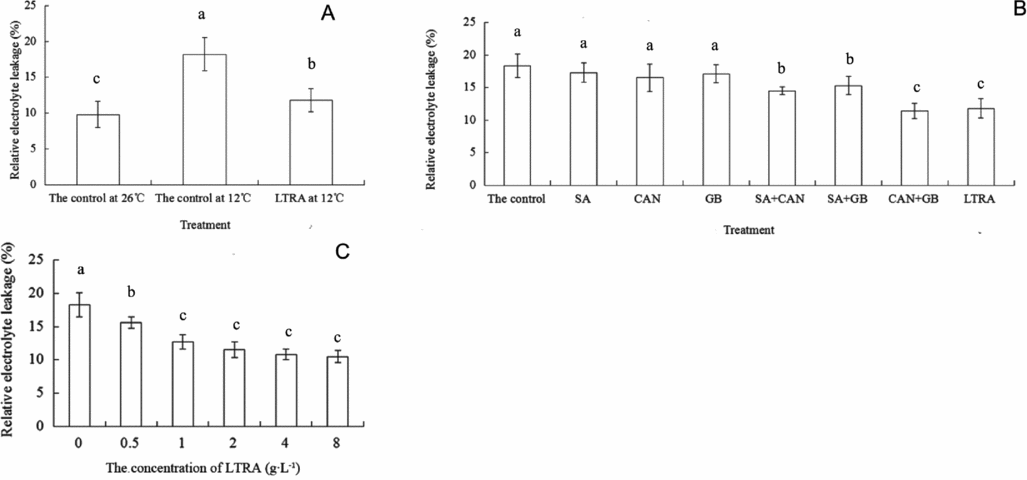
The electrolyte leakage is often used as an indicator of functionality and integrity of cell membrane. In this study, the effects of different temperatures, different LTRA dosages and different LTRA components on membrane permeability were measured in tobacco leaves. Results from Figure 1a indicated that low-temperature stress increased the membrane permeability obviously. Relative electrolyte leakage was elevated by 85.7%. Noteworthy, the increased electrolyte leakage could be recovered to almost normal level when tobacco seedlings were sprayed with LTRA. LTRA treatment decreased low temperature-induced increase of electrolyte leakage by 77.4%. Figure 1b indicated that LTRA of 0.5 g L−1 recovered electrolyte leakage triggered by low-temperature stress slightly. LTRA over 1.0 g L−1 had significant effects in decreasing membrane permeability. When the concentration of LTRA was 1.0 g L−1, the relative electrolyte leakage of tobacco leaves was not different from that of 2, 4 or 8 g L−1. The results suggested that the most effective and economic concentration of LTRA was 1.0 g L−1 in ameliorating low-temperature stress.
Effect of LTRA on membrane permeability of tobacco leaves. A: different temperature effects; B: different LTRA dosage effects; C: different LTRA component effects. Data represented mean ± standard error. The bar above the column indicated standard error. Different letters above the column indicated significant differences at P ≤ 0.05 (Duncan's test).

To explore the effective component of LTRA in ameliorating low-temperature stress, we examined the effect of various LTRA components on membrane permeability. Results from Figure 1c indicated that any single component of LTRA, including SA, CAN or GB, did not show a significant effect in ameliorating the injury of low-temperature stress on membrane permeability. Noteworthy, the complex of CAN + GB decreased the leakage of electrolyte significantly. Its ameliorating effect was similar to that of SA + CAN + GB treatment. The result suggested that the complex of CAN and GB was the main effective components of LTRA in enhancing the tolerance of tobacco seedlings to low-temperature stress.
Effect of LTRA on leaf structure and chlorophyll
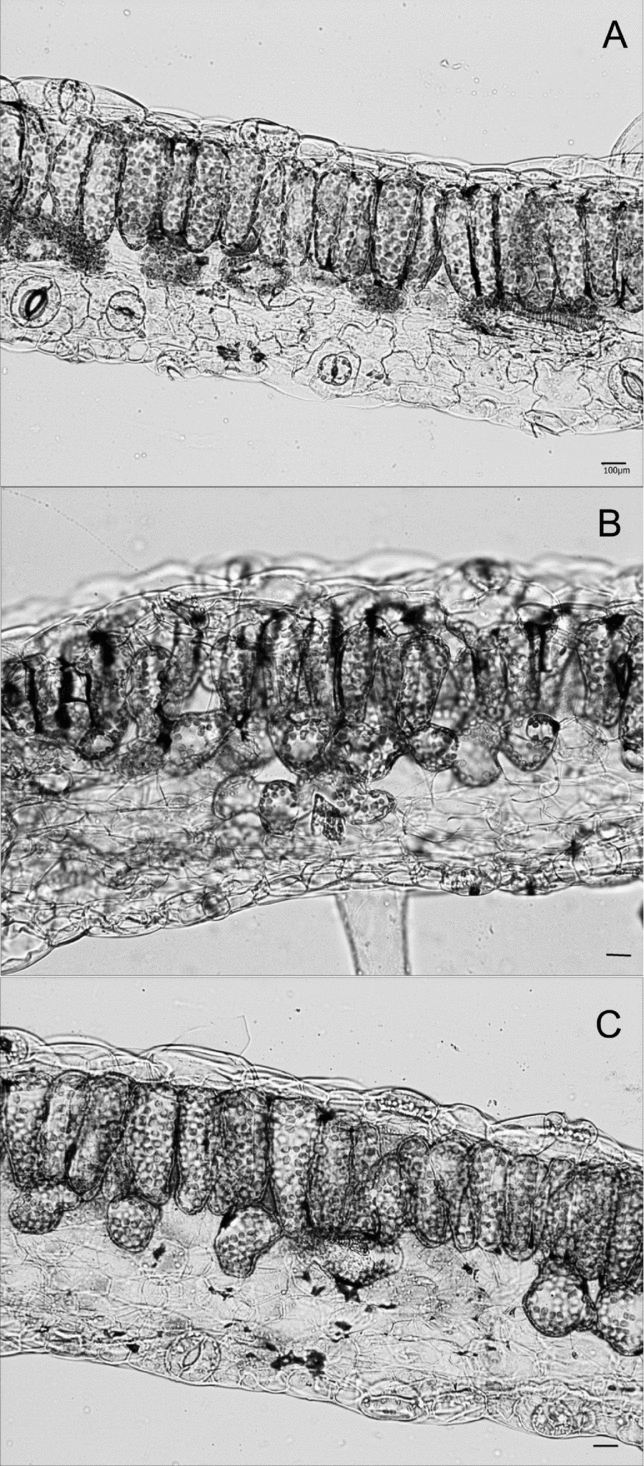
The leaf structure of tobacco seedlings showed the density of cell arrangement and the development of leaf cells (Huang et al., Reference Huang, He, Zhang and Zhou2012; Liu et al., Reference Liu, Hu, Wei, Wang, Li and Hu2010). Figure 2a indicated that at the normal temperature condition (26 °C), leaf structure of tobacco seedling was intact. Both palisade and spongy cells of tobacco leaves were arranged in order and closely. Chloroplasts were equally attached to the inner side of palisade cells and were scarcely distributed in spongy cells. The boundary line of palisade cell and spongy cell was obviously seen in Figure 2a. Exposed to low-temperature stress (12 °C), the arrangement of palisade cells became rambling. The arrangements of palisade and spongy cells were loose (Figure 2b). The chloroplasts in palisade cells became less and irregularly distributed, while free chloroplasts also appeared in spongy cells. The boundary line between palisade and spongy tissue became indistinctly. However, treatment with LTRA turned to inhibit low-temperature-induced disarrangement of palisade and spongy cells. The internal structure turned to be intact. Palisade cells arranged tightly.
Effect of LTRA on leaf structure of tobacco seedlings. A: the control at 26 °C; B: the control at 12 °C; C: LTRA at 12 °C. The images are at 20× magnification, with the bar representing 50 μm.
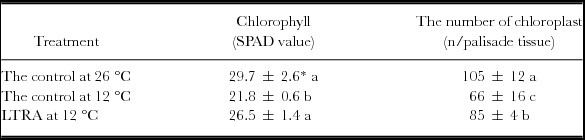
The content of chloroplast in palisade cells increased when tobacco leaves were treated with LTRA (Figure 2c). There were 90 to 116 chloroplasts in a palisade cell at normal temperature condition. Exposed to low-temperature stress, the number of total chloroplasts in a palisade cell decreased significantly, and 10 to 16 chloroplasts were distributed in a spongy cell. Treatment with LTRA tended to increase the number of chloroplast in palisade cells. The content of chlorophyll showed a similar tendency to that of chloroplast in response to different treatments (Table 4).
Effect of LTRA on chlorophyll and chloroplast in palisade tissue of tobacco leaves.
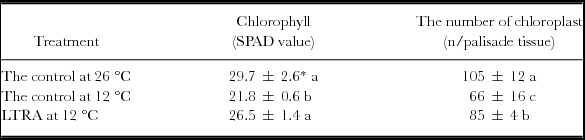
Note: *Data indicated mean ± SE (5). The data with different letters in the same column indicated significant differences at P ≤ 0.05 (Duncan's test). SPAD value indicated soil and plant analyzer development value.
DISCUSSION
Plants respond to low-temperature stress through a number of physiological and biochemical changes (Alonso et al., Reference Alonso, Queiroz and Magalhaes1997; Hara et al., Reference Hara, Terashima, Fukaya and Kuboi2003). Activities of SOD, POD and CAT are considered as effective physiological indices. Their varying activities in plants under stress conditions have been considered to be essential for plant adaptation during stress (Ao et al., Reference Ao, Li, Fan and Gong2013; Xu et al., Reference Xu, Li, Hu, Guan, Ma, Zheng and Zhu2010). In this study, low-temperature stress decreased the activities of SOD and CAT obviously, but increased POD activity. Low-temperature stress eventually led to high membrane permeability. Variation of antioxidant enzyme activity could not compensate for this injury (Figure 1). Noteworthy, spraying LTRA had a significant ameliorating effect on membrane permeability and a positive effect on the activities of SOD and CAT (Table 3). LTRA might contribute to the stabilization of damaged membrane structure under low-temperature stress. Our observations confirmed the previous findings that plant tolerance to low-temperature stress was related to the activities of antioxidant enzymes (Ao et al., Reference Ao, Li, Fan and Gong2013; Deng et al., Reference Deng, Chen, Luo, Wang, Ling and Wang2012; Liu et al., Reference Liu, Zeng, Wang, Li, Chen and Guo1985). Low temperature-induced reactive oxygen species (ROS) accumulation might affect the functions of cell membranes, elevate membrane viscosity and promote lipid transition from a liquid crystalline to a gel phase when antioxidant enzymes could not remove excess ROS species (Heidarvand et al., Reference Heidarvand, Amiri and Naghavi2011; Los and Murata, Reference Los and Murata1998).
Exogenous application of SA and GB in LTRA might contribute to the resistance of tobacco seedlings to low-temperature stress. The beneficial functions of LTRA on tobacco growth might be associated with its SA and GB (Deng et al., Reference Deng, Chen, Luo, Wang, Ling and Wang2012; James et al., Reference James, Humberto, Christine and Ian2000; Zhang et al., Reference Zhang, Jiang, Lou, Lu, Yang and Chen2011). Our results from Figure 1 supported the above view. Different LTRA components played an important role in protecting cell membrane from damaging caused by low-temperature stress. GB is an effective compatible solute that improves the tolerance of plants to various stresses. As a GB non-accumulator species, the effect of applying exogenous GB or expressing foreign GB synthesis-related genes for cold resistance is quite significant in tobacco (Wang et al., Reference Wang, Ma, Hui and Wang2008). Tobacco line transformed with foreign GB accumulation gene codA presented 33% to 6 times higher CAT activity than wild type in cold stress (Parvanova et al., Reference Parvanova, Ivanov, Konstantinova, Karanov, Atanassov, Tsvetkov, Alexieva and Djilianov2004). Apart from the difference of plant species, the main reason for large difference in increment range was probably related to the stress strength in above experiment (2 °C or −2 °C). Wang et al. (Reference Wang, Ma, Hui and Wang2008) reported that 2 mmol L−1 GB could improve thylakoid membrane function of tobacco leaves under low-temperature stress. In our experiment, LTRA contained 0.2 g L−1, close to 2 mmol L−1 GB. Wani et al. (Reference Wani, Singh, Naorem, Haribhushan and Mir2013) indicated that GB could mediate osmotic adjustment and protect the sub-cellular structures in stressed plants. In addition, GB could protect some transcriptional and translational machinery and intervene as a molecular chaperone in the refolding of enzymes (Holmstrom et al., Reference Holmstrom, Somersalo, Mandal, Palva and Welin2000). Deng et al. (Reference Deng, Chen, Luo, Wang, Ling and Wang2012) indicated that exogenous application of 1 mmol L−1 of SA enhanced the activity of SOD by 25 to 43% and CAT by 32 to 46% in leaves of flue-cured tobacco under the temperature of 5 °C. The concentration of SA in LTRA solution was 0.1 g L−1, which was close to 1 mmol L−1. Although it is a little higher than the upper bounder of optimal concentration of SA for tobacco (Miura and Tada, Reference Miura and Tada2014), SA in LTRA might stimulate the activity of antioxidant enzymes. Kang et al. (Reference Kang, Wang, Sun and Wang2003) indicated that SA could change the activities of H2 O2-metabolizing enzymes and increase the tolerance of banana seedlings to chilling stress. Mutlu et al. (Reference Mutlu, Karadağoğlu, Atici and Nalbantoğlu2013) pointed out that SA could alleviate low temperature-induced decreases of apoplastic antioxidant enzyme activities in barley (Hordeum vulgare) leaves and thus elevate cold resistance. Our results suggested that LTRA might activate the activities of antioxidant enzymes and non-enzymatic (ascorbic acid and proline) antioxidant system, enhance the resistance to oxidation, thus reduce ROS accumulation, and ameliorate the injury of low-temperature stress to tobacco seedlings (Zhang et al., Reference Zhang, Jia, Zhang, Qiao, Shi, Zhou and Yu2012).
The content of chlorophyll is a good criterion to estimate the effect of stress factor on the photosynthetic apparatus (Kato and Shimizu, Reference Kato and Shimizu1987). In this study, low temperature decreased chlorophyll content by 26.6% and the number of chloroplast by 37.2%, respectively (Table 4). The response was a typical symptom of oxidative stress. Meanwhile, it was also an adaptive mechanism to protect the possible photoinhibition/photodynamic damage. The application of LTRA mitigated low temperature-induced decline in chlorophyll content and chloroplast number, and even elevated its level compared to the control (Table 4). This finding was consistent with those reported by previous studies (Ao et al., Reference Ao, Li, Fan and Gong2013; Xu et al., Reference Xu, Li, Hu, Guan, Ma, Zheng and Zhu2010). In LTRA-spraying seedlings, high chlorophyll and chloroplast content could be associated with lower ROS content and higher antioxidant activity. In addition, LTRA application might have simulated chlorophyll biosynthesis or reduced chlorophyllase activity directly or indirectly. Noteworthy, the internal structure of tobacco leaves treated with LRTA turned to be intact. Since the leaf structure of tobacco seedlings indicated the density of cell arrangement and the development of leaf cells (Huang et al., Reference Huang, He, Zhang and Zhou2012), LTRA spraying might contribute to the protection of leaf structure of tobacco seedlings.
CONCLUSION
In a conclusion, the present findings clearly showed that exogenously applied LTRA could enhance the tolerance of tobacco seedlings to low-temperature stress, which might be attributed to the elevation of the level of antioxidant compounds, activities of antioxidant enzymes, as well as reduction of membrane permeability. These findings might be helpful in the practice of tobacco production resistance to low-temperature stress.
Acknowledgements
The research work was supported by China Tobacco Hunan Industrial Limited Company Scientific Research Project (2011-YC-001) and the Guangdong Provincial Tobacco Monopoly Bureau Project of Science and Technology (201307).