Rest followed by a gradual return to activity is commonly recommended for mild traumatic brain injury (mTBI; Hobbs, Young, & Bailes, Reference Hobbs, Young and Bailes2016). There are various forms of this recommendation in return-to-play (Purcell, Reference Purcell2009), return-to-learn (Eastman & Chang, Reference Eastman and Chang2015; Kasamatsu, Cleary, Bennett, Howard, & McLeod, Reference Kasamatsu, Cleary, Bennett, Howard and McLeod2016; Popoli, Burns, Meehan, Reisner, & Children's Health of Atlants, Reference Popoli, Burns, Meehan and Reisner2014; Santiago, Reference Santiago2016), and return-to-work advice (Cancelliere et al., Reference Cancelliere, Hincapie, Keightley, Godbolt, Cote, Kristman and Cassidy2014b). Interest in this topic is strong, especially as the field is moving towards a consensus on this advice in specific contexts, but there are still some unanswered questions (Iverson & Gioia, Reference Iverson and Gioia2016; McCrory et al., Reference McCrory, Meeuwisse, Dvořák, Aubry, Bailes, Broglio and Vos2017).
Rest was considered beneficial acutely after mTBI to free up metabolic resources for neural repair (Asken et al., Reference Asken, McCrea, Clugston, Snyder, Houck and Bauer2016; Leddy, Baker, & Willer, Reference Leddy, Baker and Willer2016). Support for this idea came from animal studies that showed that there was a neuronal ‘energy crisis’ after concussion (Giza & Hovda, Reference Giza and Hovda2014). However, the candidate brain metabolites have not proved strongly correlated with clinical recovery (Giza & Hovda, Reference Giza and Hovda2014). Rest could also potentially worsen outcomes according to the biopsychosocial model of mTBI outcome (Iverson, Reference Iverson, Vasterling, Bryant and Keane2012). A period of prolonged rest (e.g., 1 month or more) could disrupt social support or routine (Leddy, Baker, & Willer, Reference Leddy, Baker and Willer2016), or reduce the numerous health benefits normally conferred by physical activity, including psychological (e.g., on depressive symptoms; Janssen & LeBlanc, Reference Janssen and LeBlanc2010). It seems that there are several plausible ways in which rest or activity (whether continued or resumed) might affect mTBI outcomes, and these mechanisms might be temporally sensitive.
There has been a handful of trials of physical activity and rest following mTBI. Most of the published activity trials show no deleterious effects on acute or post-acute post-concussion symptoms for light- or graded-subsymptom threshold exercise (Buckley, Munkasy, & Clouse, Reference Buckley, Munkasy and Clouse2016; Howell et al., Reference Howell, Mannix, Quinn, Taylor, Tan and Meehan2016; Leddy et al., Reference Leddy, Kozlowski, Donnelly, Pendergast, Epstein and Willer2010). The exception is one study that found that “playing through” injury in a contact sport slowed recovery (Asken et al., Reference Asken, McCrea, Clugston, Snyder, Houck and Bauer2016). The rest trials have not typically revealed benefits (de Kruijk, Leffers, Meerhoff, Rutten, & Twijnstra, Reference de Kruijk, Leffers, Meerhoff, Rutten and Twijnstra2002; Thomas, Apps, Hoffmann, McCrea, & Hammeke, Reference Thomas, Apps, Hoffmann, McCrea and Hammeke2015). For example, Thomas and colleagues showed no difference in outcomes for injured children advised to take “strict rest” vs. “usual rest” (Thomas et al., Reference Thomas, Apps, Hoffmann, McCrea and Hammeke2015).
In practice, very little is known about the way in which mTBI rest advice is formulated for specific patients or injury contexts, and it is unclear how an injured person would understand or implement the advice, and if this could also depend on the context. A recent descriptive epidemiological study by McKeon and colleagues showed that over a 2-year period, approximately 70% of individuals with a first-event concussion (n = 81) had returned to play within 7 to 10 days of injury (McKeon et al., Reference McKeon, Livingston, Reed, Hosey, Black and Bush2013). Conversely, approximately three in ten players did not return to play until 10 days after their injury. The McKeon et al. study suggests that the rest taken by injured individuals is highly variable (McKeon et al., Reference McKeon, Livingston, Reed, Hosey, Black and Bush2013). In a study of 1124 athletic trainers by Kasamatsu and colleagues, there was also wide variation in the issuing of advice (Kasamatsu, Cleary, Bennett, Howard, & McLeod, Reference Kasamatsu, Cleary, Bennett, Howard and McLeod2016). “Complete cognitive rest” (including no reading) was recommended by almost half (45%) of the trainers (Kasamatsu, Cleary, Bennett, Howard, & McLeod, Reference Kasamatsu, Cleary, Bennett, Howard and McLeod2016). The recommendations also varied in terms of their frame of reference (whether rest was achieved through restriction of effortful activities in general; or for a specific activity such as work, study, or sport; or a high-risk activity, such as contact sport), and whether they promoted specific behaviours, such as sleep or mediation. A metric for studying the behaviours that might constitute rest or activity after mTBI could be very useful to elucidate these differences.
In summary, research in the area of rest and activity following mTBI is rapidly expanding (Cancelliere et al., Reference Cancelliere, Hincapie, Keightley, Godbolt, Cote, Kristman and Cassidy2014; Johnson, Provenzano, Shumaker, Valovich-McLeod, & Welch Bacon, Reference Johnson, Provenzano, Shumaker, Valovich-McLeod and Welch Bacon2017), but we currently lack a tool for measuring rest and activity plans or behaviours. Such a tool could enable exploration of interactions between rest and activity following mTBI. It could also be useful when formulating patient advice, for example, to determine how patients have understood the advice, or to frame discussions about its implementation (e.g., if advising rest, which behaviours should be changed and for how long?). Very few prior mTBI studies have examined cognitive, physical, and restful behaviours in a single study; yet, this approach seems promising. Further, as the evidence unfolds as to if and when rest or activity is needed after mTBI, it could be beneficial to have a tool that captures the intention to continue or change a specific activity. This study aimed to devise a measure of mTBI-relevant behaviours and explore item properties (descriptive statistics) in an injury-simulating sample. In this study, rest was operationalized as a cognitive or physical activity that could be reduced in amount relative to usual levels (such as study or sport, respectively) or increased (such as sleep), and the behaviours were assessed for two injury contexts (i.e., an injury from sport vs. a motor vehicle accident). An effect on rest and activity expectations due to context was anticipated because of research showing that context can change expected symptoms (Sullivan & Wade, Reference Sullivan and Wade2017) as well as the increased media coverage about concussion specifically (Ahmed & Hall, Reference Ahmed and Hall2017). Specifically, it was expected that people would expect more rest for a mild TBI resulting from a MVA than from SPORT. We also sought to describe differences in the type of rest and activity (e.g., cognitive or physical) planned for each context.
Materials and Method
Scale Development: The Mild Traumatic Brain Injury Rest–Activity Questionnaire (MTBI-RAQ)
Items were generated via a multi-step process, commencing with a two-stage literature review. This review identified behaviours nominated in mTBI rest recommendations, including in current patient advice (stage 1) and the broader literature (stage 2). In total, 39 behaviours were identified and classified by the authors into three categories: behaviours that might be decreased (cognitive, n = 17; or physical, n = 16) or increased (restful, n = 6). Items were framed to elicit two relative judgements about the amount post-injury compared to pre-injury (1 = not applicable, 2 = much less, 3 = less, 4 = same, 5 = more, 6 = much more), and perceived effort for each behaviour (0 = much less effort than before the injury to 100 = much more effort than before the injury). This distinction was drawn because rest can involve a qualitative or quantitative behaviour change.
Next, the MTBI-RAQ underwent a formal, independent evaluation. A convenience sample of 40 reviewers, comprising experts (n = 7) and non-experts (n = 33) was asked to complete the MTBI-RAQ. This panel was drawn from the researchers’ contacts. Experts had previously published at least one scholarly paper about mTBI in the peer-reviewed literature. Non-experts were included to obtain impressions of the measure from the general public (intended study population), including any ambiguous terms. The panel was asked to answer three questions about the measure (e.g., should any items be added or removed?), to comment on the categorisation of items, and to provide any other observations. A total of 16 reviewers including two experts responded (40% response rate). This feedback led to seven minor modifications (e.g., elaborated instructions) and one major change: the effort rating scale was dropped from the analysis because it was considered too complex. No new behaviours were nominated for inclusion. One item was queried for potential removal (sexual activity), but it was retained because this was not the majority view of the panel.
Participants
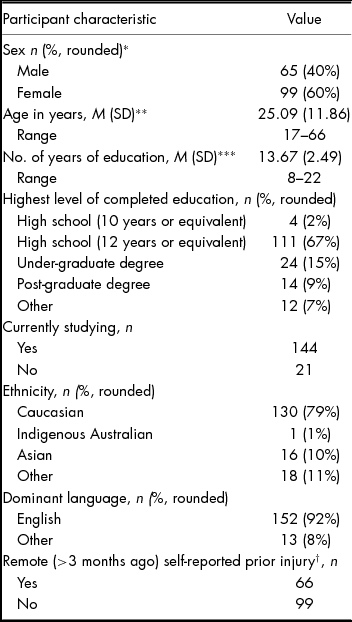
In total, 165 adults volunteered for the study. These participants were recruited from a metropolitan university (staff and students) and via the researchers’ contacts (snowball sampling). Table 1 shows the demographic characteristics. Only data from injury-naïve individuals (n = 99) or individuals with a remote injury history (>3 months prior) were included. Individuals with a recent injury (<3 months prior) were not eligible because this would have introduced a potential confound (e.g., ongoing treatment). The sample was selected from an original pool of 179 volunteers. The selected sample excluded those volunteers who failed a data integrity check, n = 14 (described below). The demographic characteristics of the groups differed on two of the three variables: age (MVA, M(SD) = 29.05 (13.73); SPORT, M(SD) = 21.70 (18.76), p < .05, Cohen's d = .65, medium effect) and completed years of education (MVA, M(SD) = 14.35 (3.14); SPORT, M(SD) = 13.11 (1.60), p <.05, Cohen's d = .52, medium effect) but not sex (p > .05).
Participant Characteristics of the MTBI-RAQ Sample

N = 165; MTBI-RAQ = mild traumatic brain injury rest–activity questionnaire; *Missing, n = 1; **Missing, n = 2; ***Missing, n = 10. †A positive remote prior injury was defined conservatively as a ‘yes’ response to the following question: [Have you]. . .suffered a head injury with loss of consciousness and/or memory difficulties and/or confusion?
Mild Traumatic Brain Injury Vignette
An mTBI vignette was used for the simulation. Such vignettes have a long history of use in mTBI research (Aubrey, Dobbs, & Rule, Reference Aubrey, Dobbs and Rule1989; Kelly & Erdal, Reference Kelly and Erdal2016; Mittenberg, DiGiulio, Perrin, & Bass, Reference Mittenberg, DiGiulio, Perrin and Bass1992). The vignette is a single short written paragraph that describes an event in which a person sustains an mTBI, with a focus on the immediate and clinically relevant after effects (World Health Organization, 2010). For this study, two previously established mTBI vignettes were used, each with the same injury parameters (e.g., duration of loss of consciousness and post-traumatic amnesia), but from a different context (MVA or SPORT, respectively) (Edmed & Sullivan, Reference Edmed and Sullivan2014; Sullivan & Edmed, Reference Sullivan and Edmed2016; Sullivan, Edmed, & Cunningham, Reference Sullivan, Edmed and Cunningham2012). The use of the vignettes allows full experimental control over key injury defining elements, whereas in clinical samples such elements can vary (Dikmen, Machamer, & Temkin, Reference Dikmen, Machamer and Temkin2017; Kristman et al., Reference Kristman, Borg, Godbolt, Salmi, Cancelliere, Carroll and JD2014), it thereby enables a controlled comparison of the effect of context.
Mild Traumatic Brain Injury Rest Questionnaire (Supplementary Digital Content 1)
The MTBI-RAQ assesses everyday activities that an individual might reduce (e.g., jogging or studying) or increase (e.g., meditating) if advised to rest after an mTBI. Participants were instructed as follows: please answer the questions about the activities that you. . .[would do]. . .in the week following. . .[mTBI]. To facilitate data processing in the main study, the six response categories from the pilot study were converted to a five-point Likert response scale (1 = much less than before the injury to 5 = much more than before the injury) and not applicable (I don't do this activity) was coded as missing. Items were reversed scored if they assessed a behaviour that “should” be reduced for rest according to current advice (such as computer use and as opposed to sitting quietly). Three subscales (physical, cognitive, and restful) and a total MTBI-RAQ score were calculated by summing across the respective items. A higher item, subscale or total score indicates a greater amount of post-injury rest, and an item score of ‘3’ indicates that the participant did not anticipate change.
Procedure
This study was conducted as part of a larger project that also collected qualitative information. Ethical clearance was provided by the Human Research Ethics Committee of the QUT (Queensland University of Technology). The research materials were prepared using an online survey platform (Key Survey, World App, 2016, v8.7). This platform was used to increase study reach and provide a single point of data entry. Consenting volunteers were first presented with demographic and injury-history questions. They were then presented with a randomly allocated vignette, followed by the MTBI-RAQ. The participants were instructed to carefully read the vignette, and answer the MTBI-RAQ. The order of the MTBI-RAQ items was blocked and fixed for the study. There were seven blocks in total. Four of the seven blocks comprised, in quasi-random order, six of the 39 items to assess the amount of a specific behaviour, followed by six items to assess the required effort for each of those behaviours (effort data not used). The remaining three blocks comprised five ‘amount’ items plus a data-check item, followed by five effort items. The data-check items specified the required response (e.g., select less than before the injury) and if this response was missed more than once, the protocol was classed as invalid (high probability of indiscriminate responding; Oppenheimer, Meyvis, & Davidenko, Reference Oppenheimer, Meyvis and Davidenko2009). At the end of the study, three questions from a post-experimental questionnaire were used to verify that the participants had read the vignette and could recall key details from it. If a participant failed more than one such item, their data were also regarded as questionable. Failure by a participant on both of these checks resulted in the data from that participant being excluded from further analysis (Figure 1). There was no significant group difference in the proportion of participants who failed this test, χ 2 = 0.0061, p < .05
Participant flow chart. IMC = instructional manipulation check; invalid protocol = failed both IMC and post-experimental checks.

Statistical Analyses
For all statistical analyses IBM SPSS (version 23) was used. Unless otherwise stated, statistical significance was determined according to convention (α < .05). As this was a first attempt to develop the scale, the analytic goals were as follows: examine the descriptive statistics for each of the items and test for item differences within and across vignettes; explore the viability of calculating subscales, including their internal consistency (Cronbach's alpha); test for differences between the nominal rest and activity subcategories (physical, cognitive, and restful); and determine if individuals planned to rest.
Results
MTBI-RAQ Descriptive Statistics
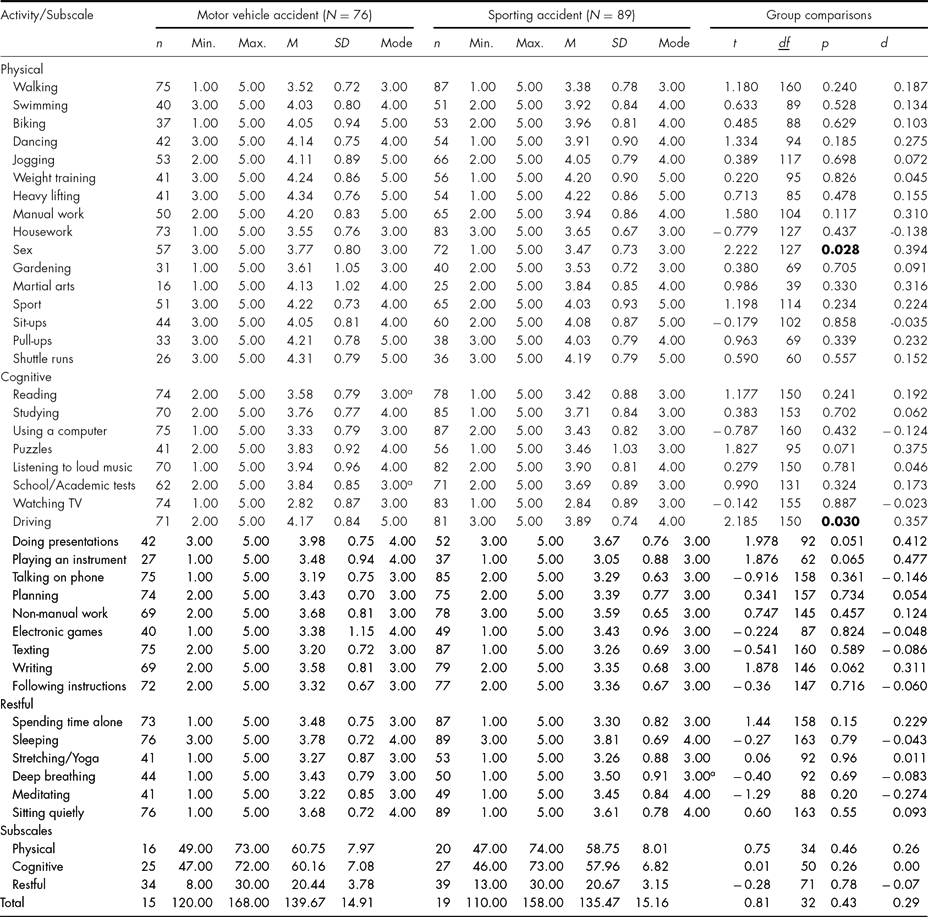
Table 2 shows the descriptive statistics and item distribution for each of the 39 MTBI-RAQ items for each vignette. There were four behaviours with a relatively low n (i.e., undertaken by <50% of the participants in each group; martial arts, pull-ups, shuttle runs, and playing a musical instrument) and two behaviours that were below this threshold for the MVA group only (biking and gardening).
Descriptive Statistics and Independent Samples t-tests for Each of the 39 MTBI-RAQ Items and the Four Summary Scores (Physical, Cognitive, Restful, and Total) for Two Injury Causes (Motor Vehicle Accident and Sports Injury) Showing the Acute Rest/Activity Expectations for a Simulated mTBI

Note: MTBI-RAQ = mild traumatic brain injury rest-activity questionnaire. *multiple modes, smallest value is shown. Ratings are the expected change in pre-injury behaviours that participants expected in the week following an mTBI. The mTBI was simulated: it was described to participants in a vignette, and they were asked to report planned behaviour. Higher scores indicate more ‘rest’. Item scores range from 1 to 5. Summary scores have a minimum value equivalent to the number of scale items, and a maximum value equivalent to that number, multiplied by 5. T-values assume equal variances. P-values are for two-tailed tests. Bolded p values are significant at with an unadjusted p of .05, but not with a Bonferroni-corrected alpha (p =.001). df = degrees of freedom. d = Cohen's d’s. d’s indicate small effects (≈ .3 or less) for all but three items (sex, playing a musical instrument, doing presentations = small-to-medium effects, d ≈ .4).Min. = minimum. Max. = maximum. The direction of the (non-significant) mean differences for the majority (28) of the 39 items favoured more ‘rest’ for the MVA- than the SPORT-related mTBI vignette (the exceptions are identified by negative t-values), but this difference was not statistically significant, p > 0.05.
As the measures of central tendency show (Table 2), small changes indicative of rest or decreased activity were anticipated for about half of the behaviours in both conditions (54% and 64% of items in the MVA and SPORT contexts, respectively). A modal score of ‘3’, indicating no change in pre- to post-injury behaviour was reported for 18 (MVA) and 22 (SPORT) of the 39 items. This group difference was non-significant, χ 2 = .821, p = .365. A modal score of ‘4’ or ‘5’ was recorded for all other items. A series of one-sample t-tests was used to determine if the most extreme of these responses (i.e., the 12 items with a modal score of ‘5’, the maximum possible rest) was significantly different from the test value of ‘3’. The modal rating for the following 12 items was statistically significantly different from the test value (all p’s <= .001): for the MVA vignette, weight training (MVA), t(40) = 9.265; heavy lifting (MVA), t(40) = 11.274; jogging (MVA), t(52) = 9.091; biking (MVA), t(36) = 6.812; pull-ups (MVA), t(32) = 8.916; shuttle runs (MVA), t(36) = 6.812; and driving (MVA), t(70) =11.658. For the sport vignette, weight training (SPORT), t(55) = 9.916; heavy lifting (SPORT), t(55) = 9.916; sport (SPORT), t(64) = 8.889; sit-ups (SPORT), t(59) = 9.653; shuttle runs (SPORT), t(35) = 9.115. None of the restful behaviours and only one cognitive item (driving following an MVA) received a modal score of ‘5’, suggesting that, on average, the greatest anticipated behaviour changes were for physical activities. Further, on average, there was no anticipated increase in physical activity (as would be indicated by a mean score < 3, or modal score of ‘1’ or ‘2’ for behaviours other than restful behaviours). There was only one item with a mean score < 3 (watching TV, suggesting a plan for increased television watching in both conditions), but this score was not statistically significantly different from the test value MVA, t(73) = −1.146. p = .085; SPORT, t(82) = −1.603, p = .113.
A one-sample t-test of modified subscale scores was performed to determine if the domain scores differed from a test value indicating ‘no change’. The modified subscale scores were created for each condition from items with n higher than 75% of the number available for each group. For both conditions, and relative to the respective test value, this analysis showed a significant expected decrease in physical (MVA t(53) = 7.373; SPORT t(41) = 9.281) and cognitive activities (MVA t(41) = 9.367; SPORT t(51) = −3.521) and a significant expected increase in restful behaviours (MVA t(72) = 10.006; SPORT t(86) = 9.566).
At the group level, the domain differences were explored with two separate repeated-measures ANOVA (one for each condition). This analysis had one dependent factor, with three levels. The three levels corresponded to z-score transformed subscale scores for physical, cognitive, and restful behaviours, respectively. To account for the low n for some subscales, modified subscales comprising only items with data from at least 75% of the available sample were used for this analysis. There was no significant within-group effect for the domains, MVA F(2,33) = .839, p = .441, SPORT F(2,34) = .570, p = .571.Footnote 1
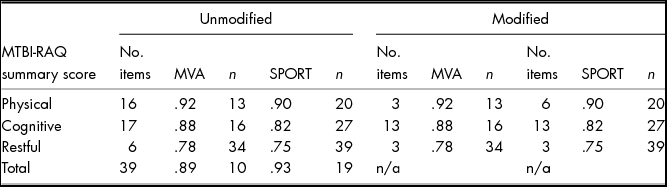
To explore differences by injury cause, a series of independent-samples t-tests was run on the MTBI-RAQ items, subscales, and total score. For these analyses, there was one independent variable with two levels (MVA or SPORT). The dependent variable for each analysis was the relevant MTBI-RAQ score. Differences were not observed with the application of a Bonferroni-corrected alpha. Table 2 also reveals that the number of participants who rated each behaviour was highly variable, irrespective of group. The internal consistency (Cronbach's alpha) for the subscale and total scores (and the modified forms of these scores) for each vignette was calculated and is shown in Table 3. These values ranged from .75 to .92 for the unmodified subscales. The value for the unmodified total score for each vignette was in the order of .90.
Scale Reliabilities by Vignette for MTBI-RAQ Subscale and Total Scores

N = 165. MVA group, N = 91; SPORT group, N = 89. Analysis with listwise deletion. MTBI-RAQ = mild traumatic brain injury rest-activity questionnaire. Modified subscales were calculated for a subset of items. The subset was formed by selecting only items with a sample size that was ≥ 75% of the full group. The reliability for modified total scores was not calculated as this score was not used in the MTBI-RAQ summary score analysis.
Discussion
This study described the development of a new mTBI rest–activity questionnaire, the MTBI-RAQ. The measure was applied in an injury-simulating sample to generate descriptive data for the items and to explore the potential effect on rest and activity plans of two injury contexts (MVA and SPORT). This study represents an initial partial evaluation of the MTBI-RAQ. It represents an important first step in establishing a measure that is injury specific, in that it allows people to rate their intentions for behaviours that have been identified as important for mTBI recovery. Given that the recovery advice for mild TBI is changing and is becoming more specific (see McCrory et al., Reference McCrory, Meeuwisse, Dvořák, Aubry, Bailes, Broglio and Vos2017), a measure that captures this specificity is needed and arguably confers a benefit over a more generic approach.
This study showed that rest was anticipated by injury simulators in both conditions, but this effect was highly dependent on specific behaviours. Some examples of the behaviours that were the least likely to change were reading and making phone calls (talking on the phone). However, rest, which we defined as a decrease in the amount of a pre-injury behaviour (or an increase in a restful behaviour), was anticipated for about half of the assessed 39 behaviours (modal response > 3; MVA, 54% of items; SPORT, 46% of items), including behaviours such as decreasing swimming, jogging, and ‘sport’, and increasing sleep and sitting quietly. The findings represent the ratings of participants who were already undertaking the respective behaviours. There may be other behaviours that participants would change that were not included on the MTBI-RAQ, and the questionnaire could not capture any new behaviours that participants would change (such as starting meditation). Future uses of this measure could specifically probe these options. Whether this pattern of planned rest is consistent with notion of active rest is difficult to determine, but it could suggest a tendency towards unnecessary activity restriction if the planned rest was to continue without gradual resumption in the first week post-injury (assuming no worsening symptoms) (McCrory et al., Reference McCrory, Meeuwisse, Dvořák, Aubry, Bailes, Broglio and Vos2017).
Despite the general trend for relatively modest anticipated changes to cognitive or restful behaviours, driving in the week following injury was an exception but only if the simulated injury cause was an MVA. This suggests that rest plans are specific even with the various domains and that a blanket reduction of all physical activities (as might occur with full-bed rest) was not planned.
There was an item-level trend, which suggested that, as hypothesized, more rest was expected for the hypothetical MVA-related mTBI as opposed to a sports injury, but the effect sizes were typically small and with an adjusted alpha the differences were not significant. The absence of this effect could mean that the contextual cues were not sufficiently manipulated (we achieved the variation with a minor change of wording in the vignette, i.e., injured ‘while playing sport’ vs. ‘in a motor vehicle accident’), and instead that responses were driven by the standardized injury parameters (e.g., duration of loss of consciousness). Alternately, it could mean that people do not have different activity plans as a function of injury cause. This could potentially contribute to a mismatch in understanding between patient and provider because the advice issued by providers may be based on the cause (e.g., for sports injury see McCrory et al., Reference McCrory, Meeuwisse, Dvořák, Aubry, Bailes, Broglio and Vos2017). A further possible explanation for the findings is that the data represent a public perception of recovery advice for mild TBI.
The item content of the MTBI-RAQ is a potential limitation of this study. The items were drawn primarily from existing patient advice, including advice offered to military service members. This accounts for some of the very specific items (such as shuttle runs). In this particular sample, which included a large number of student volunteers, there were some items that more than 50% of the sample considered ‘not applicable’. By contrast, items such as studying were regarded as applicable by a majority of the sample; this pattern might not be observed in other populations. This discussion highlights a difficulty in trying to represent meaningful behaviours with a single scale, and as noted above, we encourage the future use of open-ended questions about other activities about which individuals might need or want advice because they form part of their weekly routine. Future studies could also determine if items sets for specific populations should be developed, and factor analysis could be used to explore the underlying constructs. The subscales were reliable (all α’s > .70), but these data may not be stable given the small sample available for the calculations. Therefore, the MTBI-RAQ subscale and total scores should be used cautiously.
This study has several other limitations. First, the concepts of rest and activity and those that are related to it (such as activity restriction, sedentary behaviour, and non-effortful activity) are widely acknowledged as challenging to define (Rhodes, Mark, & Temmel, Reference Rhodes, Mark and Temmel2012). Rest may not equate to the absence of (or a reduction in) activity amount or effort. Similarly, it may not be measureable from a count of non-effortful or restful activity, even with a point of reference as was used in this study (a self-referenced estimate of the ‘usual’ amount of a specific behaviour). Related, this study sought to measure three domains but these were identified on face value, and this approach could be overly reductionist. Some activities (such as yoga) might contribute to both physical and mental rest, they could be physically tiring and mentally restful, or a state of mental rest might be achieved through the physical activity. Indeed, there is a growing acceptance of the complexity of the notion of rest and activity. We acknowledge that the MTBI-RAQ may not adequately capture this complexity, yet we still regard it as promising because it opens a discussion of these issues and warns against generic, rather than behaviourally based advice. We also suggest that this problem could be explored in future studies that examine how the MTBI-RAQ compares to other relevant measures (including physiological measures of arousal). Other fruitful directions for future research include exploring the rest-activity ratio (Lim et al., Reference Lim, Yu, Costa, Leurgans, Buchman, Bennett and Saper2012); examining the perceived quality of behaviours or their intended objective; and revisiting the attempt to assess effort which, if successful, could support exploration of an effort-frequency ratio. The use of the simulation design also confers limitations. It is unclear if patients would report similar plans to simulators. This measure should be tested in a clinical sample. Further, this study did not examine individual difference factors that may cut across groups or affect expectations about continuing or changing activity (e.g., sense of invincibility). Group comparisons should be interpreted cautiously because the groups were not matched on age or education, and this difference was not controlled in the analysis. Finally, this study did not assess return to contact-sport or other high brain-injury risk activities, and the use of this tool is not intended to replace any such processes.
In conclusion, this study introduces the MTBI-RAQ. This paper may spur others to develop the measure and related concepts. Future research should investigate the stability of the MTBI-RAQ scores (test-retest reliability) and their validity (e.g., via association with other rest and activity measures, including objective measures such as actigraphy). The MTBI-RAQ could prove useful in research studies of rest and activity following mTBI, for example, to examine the relation between intention and behaviour, or to understand how patients have understood and plan to implement the advice they received. In clinical applications, the MTBI-RAQ could be completed by patients before hospital release and their plans adjusted or clarified as necessary in consultation with the treating team. This process would enable a degree of tailoring of the advice for the individual context, and it would open up discussions about the implications for everyday activities that might otherwise be overlooked. If used in repeat administrations over the course of the recovery, the MTBI-RAQ could quantify when and how people engage or re-engage in everyday cognitive, physical, and restful activities, and how this relates to longer term outcomes, such as symptom persistence.
Acknowledgements
The Queensland University of Technology Human Research Ethics Committee (QUT HREC no. 1600000435) approved this research. The QUT approved the health and safety risk management plan for this research.
Financial Support
This research received no specific grant from any funding agency, commercial or not-for-profit sectors. The prizes were paid for by QUT using general project funds allocated to Rebecca Cox.
Conflicts of Interest
Rebecca Cox has no conflicts of interest to disclose. Karen Sullivan has no conflicts of interest to disclose.
Ethical Standards
The authors assert that all procedures contributing to this work comply with the ethical standards of the relevant national and international committees on human experimentation and with the Helsinki Declaration of 1974, as revised in 2008.
Supplementary material
To view supplementary material for this article, please visit https://doi.org/10.1017/BrImp.2018.5