


INTRODUCTION
Sugarcane (Saccharum sp. hybrid complex) is an important agro-industrial crop of South Asia. It is cultivated on 5.63 million ha (4.44 million ha in India, 0.97 million ha in Pakistan, 0.16 million ha in Bangladesh, 0.06 million ha in Nepal and 1700 ha in Sri Lanka) (Yadav et al., Reference Yadav, Yadav and Sharma2008). In India, sugarcane is cultivated under two distinct agro-climatic conditions, commonly referred to as tropical and sub-tropical belts. The productivity of sugarcane in the tropical belt is 26.4% higher than in the sub-tropical belt (57.8 t ha−1). This is primarily due to the ideal climatic conditions over a longer period for its growth. In spite of this, sugarcane in the sub-tropical belt makes up 64% of total cane acreage of India, on account of higher economic returns per unit area and time compared to other field crops.
Low productivity of sugarcane in the sub-tropical belt is a major bottleneck in enhancing overall production of cane and sugar in the country. In order to meet the per capita requirement of 35 kg sweeteners per year by the year 2020, India would need to produce 415 million t of sugarcane with a sugar recovery of 11% (Bachchhav, Reference Bachchhav2005). These projections assume cane productivity of 100 t ha−1 over an area of 4.2 m ha. This goal of high sugarcane production coupled with higher sugar recovery, without impairing soil environment and its sustainability, may be achieved through increasing the area under autumn planting in the sub-tropical belt under the existing cropping system with rice.
It is an established fact that autumn-planted sugarcane gives about 20–25% higher cane yield and 0.5 unit more sugar recovery than spring-planted sugarcane (Verma et al., Reference Verma, Motiwale, Chauhan and Tiwari1981). In sub-tropical India, sugarcane is planted in three distinct seasons namely: autumn (September–October), spring (February–March) and late spring (April–May). The crop, irrespective of its planting season, stops vegetative growth to switch over to ripening phase with the onset of winter from the second fortnight of October. Since planting of autumn sugarcane commences soon after the cessation of south-west monsoon rains, the crop establishes well under favourable soil moisture and moderate weather conditions. This gives a good initial crop stand which, coupled with a longer growing period for its vegetative growth, leads to generally better yield of cane and sugar from the autumn-planted crop. Nevertheless, one of the major constraints in the adoption of autumn (October) planting of sugarcane in sub-tropical India is late (November) clearing of fields of lowland rice (particularly the scented varieties), which occurs in wet conditions particularly in states of Uttar Pradesh, Uttarakhand, Bihar and Asom. Further, soils with a higher content of clay or silt or both remain sticky for longer due to their higher water-holding capacity. In addition, the decreasing air temperature delays the field coming in to condition for proper tillage operations. Under such circumstances, low temperatures at planting of sugarcane result in less germination of cane buds and poor initial growth of the plants. Consequently, a majority of the farmers in central and eastern parts of the sub-tropical zone have no option but to plant sugarcane in spring (February–March) after harvesting of potato (November–February), the most prominent crop following rice (July–November). Farmers of this region have a great affinity with sugarcane because of it being a sure and profitable crop. That is why, in some cases, they plant sole sugarcane after rice in November knowing fully well that it gives poor germination and plant stand and thereby less cane yield. In western parts of the zone, planting of sugarcane after rice harvest is not technically feasible due to faster decrease in air temperature than in the central and eastern parts. Under these circumstances, farmers have no option but to adopt the monotonous and yield stagnating crop rotation of rice-wheat-sugarcane. In this area, sugarcane is planted from the last week of April to first fortnight of May, after the wheat harvest. Thus, sugarcane planted during spring and late spring seasons gives 20–25% and 40–50% less cane yield, respectively in comparison to that of autumn-planted cane (Rana et al., Reference Rana, Kumar, Saini and Panwar2006).
The success of zero tillage technology for wheat under the rice-wheat cropping system and its adoption by the Indian farmers in Indo-Gangetic Plains has led scientists to review the tillage requirement for other crops. Thus, planting of autumn sugarcane may be advanced if it is planted without pre-planting tillage operations. It will save the time (6–8 days) required for soils to come in condition for field preparation and energy required for tillage. Chand et al. (Reference Chand, Lal, Khippal, Kumar and Singh2007) have reported that there was no adverse effect of reduction in preparatory tillage on the productivity of sugarcane in sub-tropical India. Therefore, direct planting of sugarcane at the end of September as a relay intercrop in skipped rows of rice may be explored to maximize the productivity of cane and sugar by providing longer crop duration than for spring-planted sugarcane. Besides, direct planting of sugarcane in rice fields in November without pre-planting tillage operations may also be another alternative to boost the productivity of crop with saving of time and energy. The inclusion of potato as a sequential crop between rice and sugarcane plays an important role in enhancing the overall productivity and profitability of the system. Various field operations, such as ridge planting, earthing-up and digging of potato tubers, are performed for potato cultivation. These tillage operations create a favourable soil tilth, provide better soil aeration and a weed-free environment for the succeeding crop, sugarcane. However, if potato is taken as an intercrop with autumn-planted sugarcane rather than growing these crops in sequence or isolation, it may exert some additive effects on the growth and yield of cane.
In order to increase the productivity of cane and sugar and sustain soil productivity, it becomes imperative to explore the possibilities of planting autumn sugarcane during late September as a relay intercrop in skipped rows of the standing rice crop. A study in India has demonstrated that skipping one rice row after every four or five rows remained superior to non-skipped normal planted rice, which is a farmer's practice (Das, Reference Das2002) in terms of saving seed and producing higher rice grain yield. The above method gives an opportunity to plant autumn sugarcane in skipped rice rows in late September (before flowering) and, the system is described as relay intercropping of autumn sugarcane with rice. The present study was, therefore, undertaken (i) to explore the feasibility of planting autumn sugarcane as a relay intercrop in the vacant rows of rice planted by the skipped row method in late September, and (ii) to compare the production potentials and economic returns of different rice-based crop sequences under test.
MATERIALS AND METHODS
The experimental site and soil
A field experiment was conducted for three consecutive crop seasons (2003–05, 2004–06, 2005–07) at the Indian Institute of Sugarcane Research, Lucknow, India (26°56′N, 80°52′E; 111 m amsl) in a semi-arid sub-tropical climate with dry hot summers and cold winters. The soil of the experimental field was sandy loam (13.7% clay, 23.8% silt and 62.8% sand) of Indo-Gangetic alluvial origin, very deep (>2 m), well drained, flat and classified as non-calcareous mixed hyperthermic Udic Ustochrept.
Before planting the sugarcane, soil samples from 0 to 15 cm depth were collected by a core sampler of 8-mm diameter from five spots in the field and average bulk density was determined. These samples were pooled together, and the representative homogeneous sample was analysed for determination of organic carbon (Walkley and Black method), available N (KMnO4 method), 0.5 M sodium bicarbonate (NaHCO3, pH 8.5) – extractable P and 1N, NH4OAC-extractable K, following Jackson (Reference Jackson1973). The initial contents of organic carbon, and available N, P and K of the experimental soil were 0.42%, and 193.5, 19.7 and 239.6 kg ha−1, respectively. The infiltration under field conditions was measured at planting and 60 days after planting of sugarcane with a double-ring infiltrometer (Mishra and Ahmad, Reference Mishra and Ahmad1990). The inside ring, from which measurements were taken, was of 30-cm diameter and the outer guard ring, to check the lateral movement of water, was of 50-cm diameter.
Crop culture and treatments
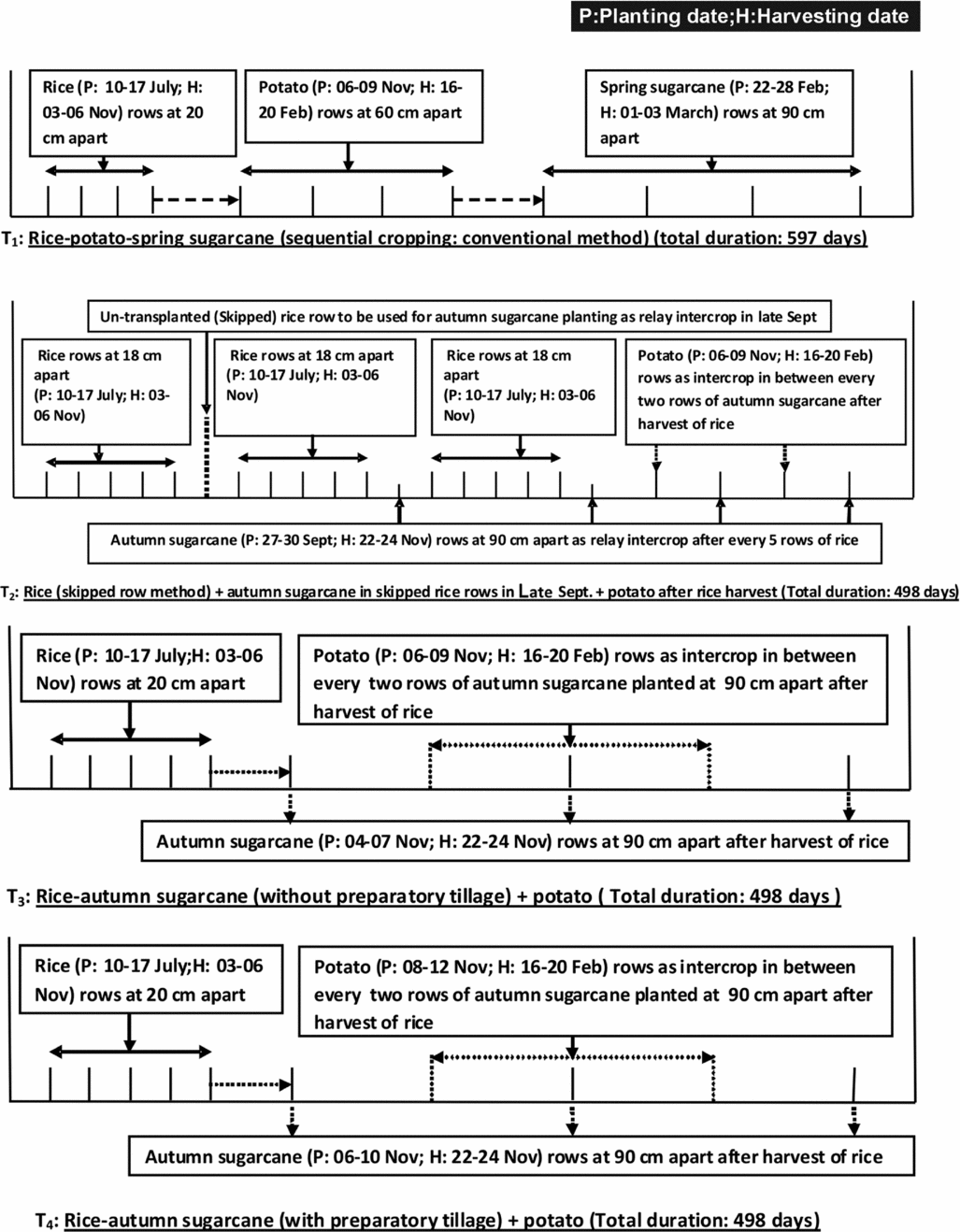
The experimental treatments consisted of basically four cropping systems, namely, T1 (rice-potato-spring sugarcane, sequential crops), T2 (rice + autumn sugarcane + potato after rice), T3 (rice–autumn sugarcane planted without preparatory tillage + potato) and T4 (rice–autumn sugarcane planted after preparatory tillage + potato). Treatments were tested in a randomized block design having six replications (blocks). Each block contained all the four cropping systems and their distribution was randomized block-wise. Plot size for each cropping system was 10.0 m × 5.4 m. Thirty-five days old seedlings of rice (cv. Pusa Basmati-1) were transplanted in mid July in rows 20-cm apart (normal spacing) in T1, T3 and T4 treatments. However, in T2, such seedlings were transplanted in rows 18-cm apart leaving every sixth row devoid (skipped) of rice to accommodate subsequent planting of autumn sugarcane in these rows at 90-cm row spacing. Sugarcane (cv. CoSe 92423) was planted as a relay intercrop, using 38 000 three-bud setts ha−1 in these rows during late September in standing rice. For this purpose, 5-cm deep furrows/slits were opened with the help of a hand hoe to place cane setts end-to-end and covered with wet soil. Sugarcane in other treatments, at the same seed rate and row spacing, was planted with normal preparatory tillage in T1, without preparatory tillage (direct planting by opening furrows) after rice harvest in T3 and with preparatory tillage after rice harvest in T4 at 90-cm row-to-row spacing (Table 1). After harvesting of rice, potato was planted traditionally in rows 60-cm apart as a sequential crop in T1, whereas in T2, T3 and T4, it was intercropped between every two rows of autumn sugarcane. The rows in the different cropping systems are shown diagrammatically in Figure 1. Sugarcane crop was manured with 150, 60 and 40 kg N, P2O5 and K2O ha−1, respectively. One-third of total N and full doses of P and K were applied as side dressing after rice harvesting in T2 and as basal application in T1, T3 and T4 at the time of sugarcane planting. The remaining N dose was top-dressed in two equal splits in all the treatments at the maximum tillering stage of sugarcane. Fertilizers of N, P2O5 and K2O at 120:60:60 kg ha−1 for rice and 160:60:80 kg ha−1 for potato (cv. Kufri Bahar) were applied separately. All the crops in the cropping systems were grown with normal package of practices and harvested at their respective maturity stages (Table 1).
Fertilizers application, transplanting/planting and harvesting details of rice, sugarcane and potato in different cropping systems during 2003–05, 2004–06 and 2005–07.

T1: Rice–potato–spring sugarcane; T2: Rice (skipped row method) + autumn sugarcane in skipped rice rows in late September + potato after rice harvest; T3: Rice–autumn sugarcane (without preparatory tillage) + potato; T4: Rice–autumn sugarcane (with preparatory tillage) + potato.
Diagrammatic representation of rows in each treatment.
Calculation of energy requirement
Energy requirement for various treatments was calculated by taking values of 0.18 MJ human labour-hour−1, 2.68 MJ bullock-hour−1 and 44.5 MJ litre−1 for fuel oil and lubricant. The above values were multiplied by the actual time taken either by human labour-hour or pair of bullocks or actual consumption (litre) as fuel oil and lubricant by a 35 HP tractor in field operations.
Observations on growth, yield and economics
Experimental data on cane germination, growth, cane yield contributing characters, and yield of rice, potato and cane were recorded at their respective growth and harvesting stages during all three years. Juice purity and commercial cane sugar (CCS) were calculated by the following formulae.
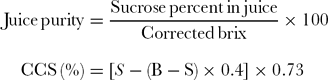
Where, S is the sucrose percent in juice, and B is the corrected brix. Brix refers to the percentage of total solids dissolved in sugarcane juice. It was measured directly from an instrument, the Brix Saccharometer, to determine the degree of ripeness of sugarcane plant. Sucrose percent in juice was determined using the method described by Spencer and Meade (Reference Spencer and Meade1955). Sugar yield (t ha−1) was calculated by multiplying CCS (%) with cane yield.
To compare different cropping systems, yield of all the crops were converted to sugarcane equivalent yield on the basis of prevailing market prices (Verma and Modgal, Reference Verma and Modgal1983). The production efficiency (kg ha−1 day−1) was worked out by dividing total production in a cropping system with total duration in that particular system. An economic efficiency (Rs ha−1 day−1) was calculated by dividing the net monetary returns of the cropping system with total duration of the crop in that particular system (Tomar and Tiwari, Reference Tomar and Tiwari1990).
Statistical analysis
Data for each crop season were statistically analysed separately. The homogeneity of error variance was tested using Bartlett's χ2 test. As the error variance was homogeneous, pooled analysis was done according to Cochran and Cox (Reference Cochran and Cox1957). Since the variations among three seasons were not significant, the mean data have been presented in the paper for discussion. The least significant difference (LSD) was computed to determine statistically significant treatment differences.

where, VE is the error variance, r is the number of replications, t5% is the table value of t at 5% level of significance for the error degree of freedom.
RESULTS AND DISCUSSION
Growth characters
The experimental data (Table 2) reveal that the germination of buds and population of sugarcane shoots varied significantly according to its planting under different cropping systems. Accordingly, T2 treatment registered markedly higher sugarcane bud germination and shoot number than in T1, T3 and T4 cropping systems. The higher germination of sugarcane buds in T2 was due to the congenial rhizospheric environment created by higher relative humidity (72.4%), adequate soil moisture (21.4%) and optimum ambient temperature (31.4 °C) measured at 14:00 hours under the canopy of standing rice in late September. The adjoining fallow field had 58.4% relative humidity, 9.3% soil moisture and 36.3 °C ambient temperature. These conditions favoured a quick germination of cane buds, and provided an excellent opportunity for planting sugarcane as a relay intercrop with skipped method grown rice. The key advantage of sugarcane planting in T2 is associated with better root growth without any hindrance resulting in a good start for the crop. Physiologically, roots grow by a process of cell division in the apical meristem just behind the tip and cell expansion in a zone just behind the apex. This mechanism needs optimum soil moisture since water influx into cells generates turgor pressure, which provides the driving force in order to displace soil particles, overcome friction and elongate through the soil. Therefore, a suitable soil moisture regime plays a paramount role in the process of germination and root development. That is why, sugarcane planted in T2 under sufficient soil moisture paved the way for higher germination of cane buds in spite of no preparatory tillage operations. When soil water content is not limiting, soil strength in many soil types will not increase (Whiteley and Dexter, Reference Whiteley and Dexter1982). However, when soil strength increases, root elongation decreases due to increasing resistance of the soil particles to displacement (Clark et al., Reference Clark, Whalley and Baraclough2003). T2 also had more shoots than in T1, T3 and T4 treatments due to enhanced germination, early establishment of cane plants and longer growth period of autumn sugarcane as a relay intercrop with rice (Table 2). Since the shoot population in T3 and T4 treatments was more or less the same, it indicates that the pre-planting tillage operation did not exert any effect on this parameter. This observation is in conformity to that of Hamblin et al. (Reference Hamblin, Tennant and Cochrane1982) who reported that the growth of roots below 20 cm depth would be inhibited in soils under conventional tillage, while, with minimum or no preparatory tillage, the same would remain uninhibited to a soil depth of 35 cm. Conclusively, direct planting of sugarcane by opening furrows without providing pre-planting tillage can be done to save time and energy and also to get more cane and sugar particularly in light soils. Jain and Agrawal (Reference Jain and Agrawal1970) found that soil aggregates in the range of 3.2–6.4 mm in a sandy loam soil gave the highest percent emergence, increased number of shoots and the final cane yield. Similarly, Cole (Reference Cole1939) stated that the number of tillage operations used in the preparation of seedbeds is often a matter of habitual practice, rather than a consideration of the physical conditions to be attained for a particular crop. He also found that not all tillage operations may be necessary as only a small change occurs in aggregate size distribution before and after tillage. All growth parameters in spring-planted sugarcane in the rice-potato-sugarcane cropping system were markedly lower than in other cropping systems because of the reduced period of cane growth.
Effect of sugarcane planting under different cropping systems on growth, yield attributes and yield of millable cane and sugar yield (pooled data of 2003–05, 2004–06 and 2005–07).

CCS: Commercial cane sugar.
The same superscript letter within the column indicates values do not differ markedly at 5% level of significance.
Yield attributes and yield of cane and sugar
Yield attributes of sugarcane like number, girth, length and individual stalk weight of millable cane were superior in T2 to that in T1, T3 and T4 treatments (Table 2). These results clearly indicate that the number of tillage operations can be reduced in sugarcane by direct planting (without preparatory tillage operations) as a relay intercrop with rice, and also advancing the planting by a week or so. According to Chand et al. (Reference Chand, Lal, Khippal, Kumar and Singh2007) a reduction in pre-planting tillage operations after wheat harvest had no adverse effect on yield and yield attributing characters of sugarcane. Moreover, the success of zero-tillage technology in wheat under rice-wheat cropping system and its adoption by the farmers on a large scale in the Indo-Gangetic Plains (Gupta, Reference Gupta2002) has opened new vistas for curtailing tillage operations, which is particularly important regarding energy use in a crop like sugarcane that requires more tillage. Further, the yield attributing characters with (T4) or without (T3) tillage operations did not differ markedly. This implies that planting of sugarcane in autumn, after the harvest of rice may be conveniently adopted, without providing preparatory tillage to save both time and energy.
The maximum cane yield (111.4 t ha−1) was obtained in T2, which was 19.8, 24.3 and 35.4% higher than that of T3, T4 and T1 treatments, respectively (Table 2). The better cane yield in T2 is attributed to more taller, thicker and heavier millable canes. On the other hand, T1 treatment could not match these attributes because of a reduced growth period resulting in markedly less cane yield than that of T2, T3 and T4 treatments. Similarly, T2 also produced more sugar yield (13.2 t ha−1) than that of T1 (8.2 t ha−1), T3 (10.5 t ha−1) and T4 (9.9 t ha−1) treatments. A significantly higher sugar accumulation in terms of commercial cane sugar (CCS %) resulted in significantly higher sugar yield in T2 than that in the other treatments. Verma et al. (Reference Verma, Motiwale, Chauhan and Tiwari1981) also observed that sugarcane planted during autumn (October) yielded 20–25% more cane yield and 0.5 unit better sugar recovery as compared to spring (February–March) planted sugarcane.
Yield of rice and potato, sugarcane equivalent yield and economic returns
The different treatments under test did not affect the yield of rice differently (Table 3). Das (Reference Das2002) also found that if rice and wheat are grown with skipped rows, the crops tiller profusely and have greater photosynthetic efficiency, which resulted in 11–17% more grain yield than that of regular normal planting/sowing. The yield of potato tubers in rice-potato-spring cane (T1) was markedly better than that of T2, T3 and T4 treatments. In T1, potato was grown as sole crop in rows 60-cm apart, while in T2, T3 and T4, it was intercropped between every two rows of sugarcane spaced 90-cm apart. Accordingly, the plant population of potato was two-thirds of normal potato planting (T1) resulting in less yield of potato tubers in T2, T3 and T4.
Yield of rice, potato and sugarcane equivalent and economic analysis as influenced by different cropping systems (pooled data of 2003–05, 2004–6 and 2005–07).

n.s.: Not significant.
Prevailing market price (Rs t−1). (i) Rice: 6800; (ii) Potato: 4000; (iii) Sugarcane: 1030.
The same superscript letter within the column indicates values do not differ markedly at 5% level of significance.
The sugarcane equivalent yield (216.4 t ha−1) in T2 was 10.9, 14.0 and 14.7% more than that obtained in T3, T4 and T1, respectively. Though potato yield was markedly more in T1 than in the other treatments but rice yield being almost similar in all the treatments, T2 excelled in sugarcane equivalent yield due to its higher cane yield against 89.4, 84.3 and 71.9 t ha−1 in T3, T4 and T1 treatments, respectively. Moreover, on account of higher sugarcane equivalent yield, T2 treatment with no expenditure incurred on pre-planting tillage operations fetched better gross returns. As a result, T2 proved the best performer owing to higher production efficiency (420 kg ha−1 day−1) and economic efficiency (Rs. 258 ha−1 day−1), overall net returns (Rs. 134 608 ha−1) and benefit:cost ratio (1.5) than other treatments in the study. T3 and T4 treatments had similar results in terms of sugarcane equivalent yield and production efficiency, but T3 had a better benefit:cost ratio, net returns and production efficiency than that of T4. It was so because T3 had more sugarcane equivalent yield with no extra cost in pre-planting tillage operations than T4. The T4 and T1 had similar benefit:cost ratio and net returns. However, T4 had an edge over T1 in terms of per day economic gain due to a shorter period of crop duration (Table 3).
Bulk density and infiltration rate of soil
Experimental data indicate that T2 and T3 with no pre-planting tillage (Table 4) did not differ markedly but had higher soil bulk density in the surface layer (0–15 cm) at planting than that of T1 and T4, where sugarcane was planted after pre-planting tillage operations. An increase in bulk density in T2 and T3 was, however, not found detrimental to germination, growth and final yield of sugarcane. In these treatments preparatory tillage was not provided, but sugarcane was planted placing its setts in furrows and covering them with 4–5 cm soil layer, which minimized the ill effect of higher bulk density. The bulk density of the 15–30 cm soil layer at planting did not vary with different treatments indicating that pre-planting tillage operations did not exercise significant impact in altering soil bulk density in the sub-surface soil layer. This shows that different cultural operations and diversified crop production techniques have an over-riding effect on soil compaction with time.
Effect of cropping systems on bulk density and infiltration rate (mean of three years).

DAPS: Days after planting of sugarcane.
The same superscript letter within the column indicates values do not differ markedly at 5% level of significance.
At planting, infiltration rate was the highest in T1 followed by T4; it was lowest in T3 followed by T2 (Table 4). However, after the second irrigation at 60 days after sugarcane planting, all the treatments recorded a similar infiltration rate. The differences in infiltration rates with different tillage operations are due to the fact that untilled soil has more macro-pores, but increase in tillage intensity increases micro-porosity, thereby increasing infiltration rate. Kumar et al. (Reference Kumar, Singh, Yadav, Malik and Hobbs2002) also reported similar findings.
Energy requirement
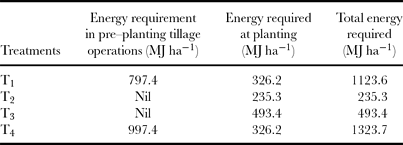
The energy requirement for pre-planting tillage operations in T4 was maximum (997.4 MJ ha−1), followed by T1 (797.4 MJ ha−1) and nil in case of T2 and T3 where sugarcane planting was done without any pre-planting tillage operations (Table 5). The energy requirement for planting operation was the maximum in T3 (493.4 MJ ha−1), equally followed by T1 and T4 (326.2 MJ ha−1), and the lowest in T2 (235.3 MJ ha−1). Total energy requirement was maximum in T4 followed by T1 and T3, and the lowest in T2. The T2 required the least energy due to direct planting of sugarcane and thus, effected 79.1% energy saving over conventional preparatory tillage operations. No-till technology based on energy saving has also been reported under rice-wheat cropping system (Dhiman et al., Reference Dhiman, Hari Om and Kumar2001).
Energy requirement of sugarcane under different cropping systems (mean of three years).
CONCLUSIONS
In rice-sugarcane growing areas of the Indian sub-tropics, sugarcane planting in autumn (October) is not feasible due to delayed harvesting of lowland rice (specially scented varieties) and fields remaining wet. In such agro-ecosystems, autumn planting of sugarcane as a relay intercrop with rice in late September can conveniently be adopted to improve the overall productivity and profitability of the cropping system. The system may be worth adopting by sugarcane farmers as it saves not only time and energy on pre-planting tillage operations but also insures higher productivity and better economic returns.
Acknowledgements
The authors wish to express their deep sense of gratitude and thankfulness to the Editor of the journal and both the reviewers for their critical comments and thoughtful suggestions in improving the merits of the manuscript. Thanks are also due to Shri Yogesh Mohan Singh, Artist of the Institute, who helped us in the preparation of Figure 1 of this manuscript.



