INTRODUCTION
The Darcythompsoniidae are a family of harpacticoid copepods with considerably cylindrical and slender body shape. This family comprises worldwide distributed taxa, containing presently 27 species, designated to the following 4 genera: Leptocaris T. Scott, 1899; Darcythompsonia T. Scott, 1906; Kristensenia Por, Reference Por1983; and Pabellonia Gomez, Reference Gomez2000. These four genera are defined by the following characters: (1) the absence, or presence of rudimentary or well developed maxillipeds; (2) sexual dimorphism in the male P2 enp-2, anal operculum and caudal rami; (3) shape of anal operculum and caudal rami; (4) sexual dimorphic structures on the 2nd and 3rd male urosomite; and (5) P1 enp-1 without or with an anteriorly directed inner seta with combed tip (Gomez, Reference Gomez2000).
Historically Sars (Reference Sars1909) considered D'Arcythompsonia, Cylindropsyllus, Stenocaris, and Leptocaris as belonging to the Cyclindropsyllidae. Gurney (Reference Gurney1920) added Horsiella to this family. Kessler (Reference Kessler1913) considered even Parastenocaris as being closely related to these. Later Monard (Reference Monard1927) established the phylum Agnatha for the families Metidae, Cylindropsyllidae and Louriniidae. At the same time he excluded the genera Parastenocaris and Stenocaris and established the family Stenocaridae for them. Lang (Reference Lang1936) demonstrated the close phylogenetic position of Stenocaris and Cylindropsyllus (belonging to the Stenocaridae). At the same time he reallocated Leptocaris, D'Arcythompsonia and Horsiella to a new family he named D'Arcythompsoniidae (Lang, Reference Lang1936). Thus, the genera Leptocaris T. Scott, 1899 with Darcythompsonia T. Scott, 1906 and Horsiella Gurney, Reference Gurney1920, belonged to the family Darcythompsoniidae Lang, Reference Lang1936. Later, Kunz (Reference Kunz1961) considered the genus Horsiella as a synonym of the genus Leptocaris and provided a key to species of this genus, and Lang (Reference Lang1965) followed Kunz in unifying the two genera with descriptions of three species from the California coast.
Kunz (Reference Kunz1994) placed the then nine species of the genus Leptocaris including two new species and one new subspecies, into four groups all having the maxilliped either completely absent or reduced to a small triangular lobe and the P1 endopod proximal with an anteriorly directed seta bearing a terminal comb. The 4 groups are characterized by the number of segments of the endopod of P1 and the number of setae on exopod 3 of P2 to P4: brevicornis-group (10 spp.); ignavus-group (10 spp.); minimus-group (3 spp.); and mangalis-group (3 spp.). The species L. ignavus (Noodt, Reference Noodt1953) that was redesignated by Kunz (Reference Kunz1994) was later synonymized with L. minutus T. Scott, 1899 by Huys et al. (Reference Huys, Gee, Moore and Hamond1996). Recently, one species and one subspecies were described: L. islandica Apostolov, Reference Apostolov2007 collected from brackish water rock pools from Iceland (Apostolov, Reference Apostolov2007) and L. trisetosus pacificus Lee & Chang, Reference Lee and Chang2008 collected from salt marshes in Korea (Lee & Chang, Reference Lee and Chang2008). These taxa belong to the ignavus-group and brevicornis-group, respectively. The genus Leptocaris T. Scott, 1899 currently comprises 27 species.
During a comprehensive study of marine harpacticoid assemblages of Ryukyu, Japan, a new species of the genus Leptocaris was discovered and was named L. ryukyuensis sp. nov. The new species belongs to the ignavus-group and is the third record of the genus in East Asia including L. brevicornis (van Douwe, Reference Douwe1905) and L. trisetosus pacificus Lee & Chang, Reference Lee and Chang2008. Herein, we describe this new species of Leptocaris and compare it to other species within the genus. A revised key to Leptocaris is presented.
MATERIALS AND METHODS
Sediment samples were collected from a sandy beach of the island of Ikeijima, Okinawa Prefecture, of Ryukyu Islands, Japan, and specimens were fixed in 95% ethanol. In the laboratory the sediment samples were thoroughly rinsed on a 38 µm sieve to collect the meiofauna. Harpacticoid copepods were sorted, using an Olympus SZ11 (Tokyo, Japan) stereomicroscope. Specimens were then cleared and dissected in lactic acid. Dissected parts were mounted on slides in lactophenol as a mounting medium, and these slide preparations were sealed with transparent nail varnish. All drawings were prepared using an Olympus BX60 (Tokyo, Japan) differential interference contrast microscope equipped with Nomarski optics and drawing tube. Abbreviations used are: A1, antennules; A2, antenna; Benp, baseoendopodite; Cr, caudal ramus; Enp, endopod; Exp, exopod; Md, mandible; Mxl, maxillula; Mx, maxilla; Mxp, maxilliped; P1-P6 = leg 1–leg 6; R, rostrum.
The descriptive terminology is adopted from Huys et al. (Reference Huys, Gee, Moore and Hamond1996). Abbreviations used in the text are: ae, aesthetasc; exp, exopod; enp, endopod; and P1-P6, first to sixth thoracopod; exp (enp)-1 (2, 3) to denote the proximal (middle, distal) segment of a ramus. The term acrothek is the trifid seta complement found apically on the distal antennulary segment. Scale bars are in micrometre (μm).Type species are deposited in the collection of The Natural Institute of Biological Resources (NIBR), Incheon, Korea.
RESULTS
TYPE MATERIAL
Holotype (NIBRIV0000226070): ovigerous female preserved in alcohol; 25 August 2004, Coll. Dr Sung Joon Song and Dr Hyun Soo Rho.
Allotype undissected male in ethanol (NIBRIV0000226071), sampling data as in holotype.
Paratypes: 5 females and 43 males preserved in alcohol (NIBRIV0000226072). One female and one male dissected on 12 and 6 slides, respectively, are kept in the personal research collection of the first author (S.J.S.) (SACOP3007 and SACOP3008)—having the same collection data as the holotype.
TYPE LOCALITY
Ikeijima, Okinawa, Japan (26°23′06″N 127°59′54″E); 1 m depth, sandy beach.
ETYMOLOGY
The species is named after the ancient name for the type locality, Ryukyu Archipelago (being equivalent to the Japanese name Okinawa).
FEMALE
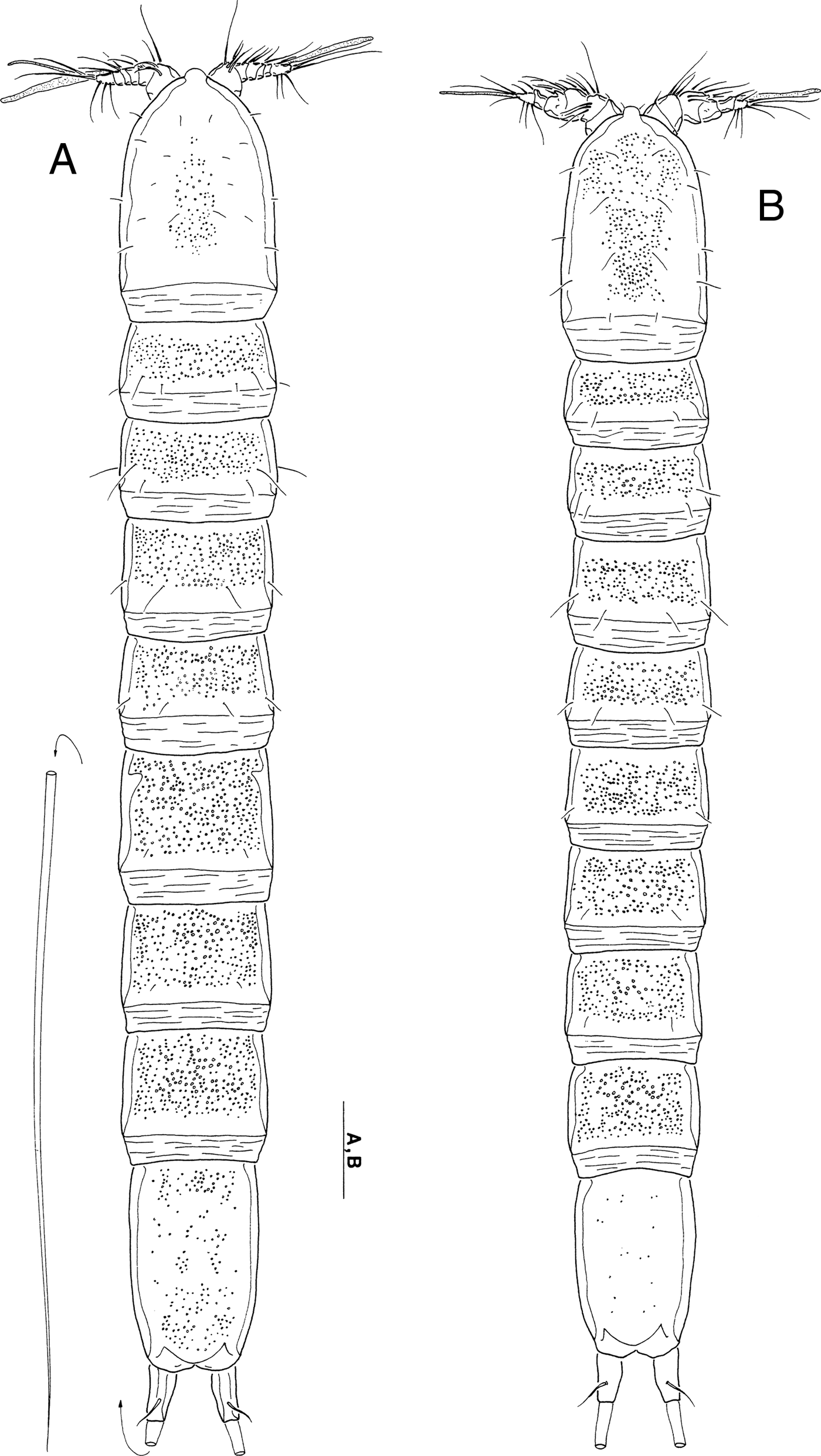
Body shape (Figure 1A) vermiform, cylindrical with parallel margins except for the anal somite; total body length 688 µm (mean 609 ± 54 µm, N = 9), measured from the anterior margin of the rostrum to the posterior margin of the caudal rami. Largest width measured at posterior margin of cephalosome, 81 µm. Cephalothorax elongate, with few integumental sensilla (Figure 1A); posterior and posterolateral margin smooth. Rostrum small and curved downward. Pedigerous somites (Figure 1A) with sensilla on dorsal surface, and small protuberances on surface.
Leptocaris ryukyuensis sp. nov., female: (A) habitus, dorsal; male: (B) habitus, dorsal. Scale bars: A, B = 50 µm.
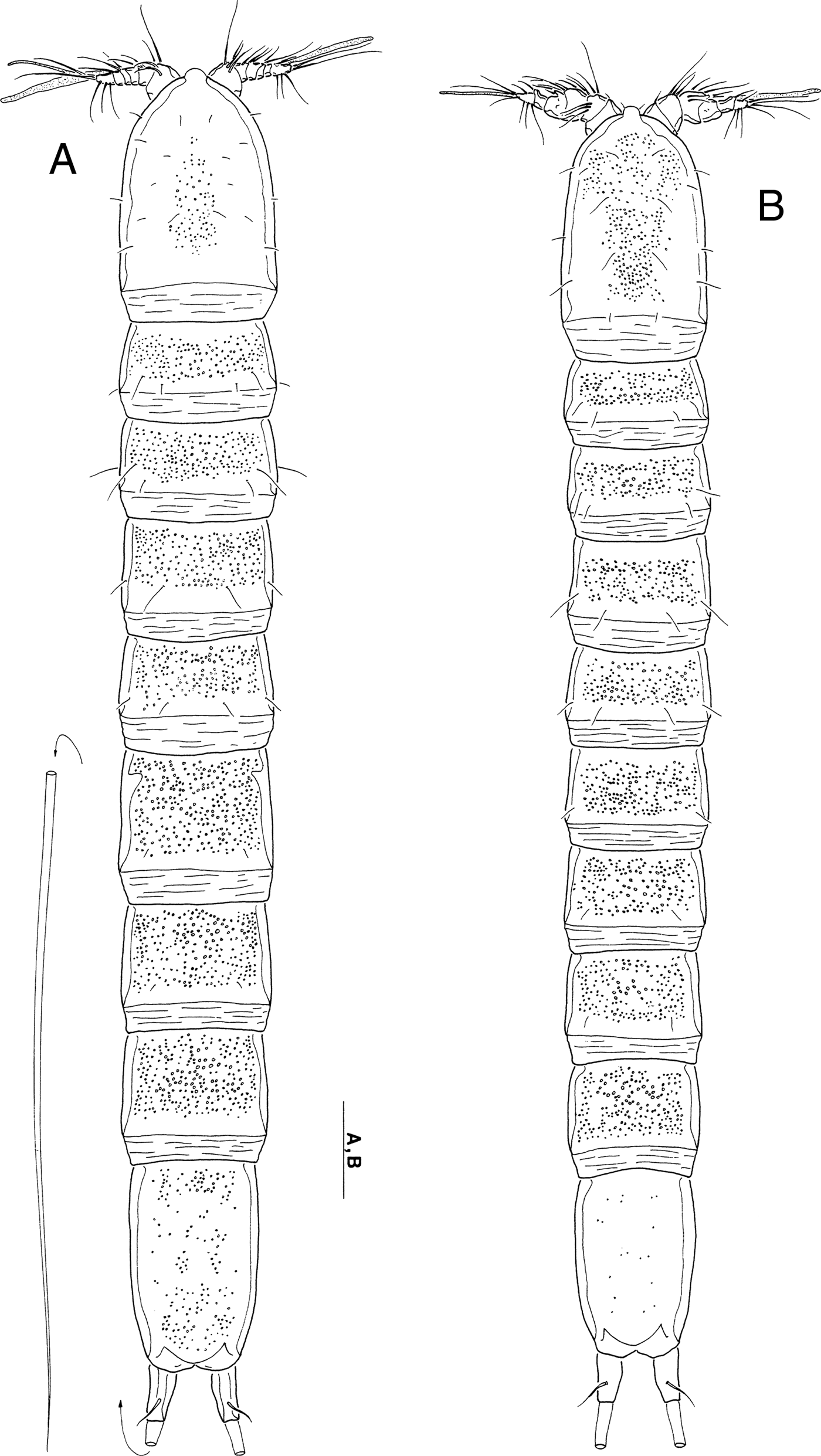
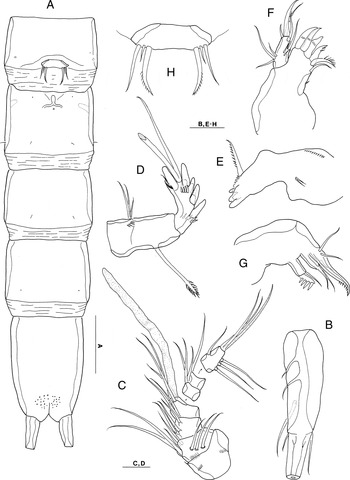
Urosome (Figures 1A & 2A) 5-segmented, comprising P5-bearing somite, genital-double somite and 3 free abdominal somites. All urosomites with many protuberances on dorsal surface. Genital-double somite (Figure 2A) as long as wide, with 2 lateral and 2 ventral sensilla; urosomites 2 and 3 (genital-double somite) completely fused dorsally and ventrally with weakly sclerotized traces laterally.
Leptocaris ryukyuensis sp. nov., female: (A) urosome, ventral; (B) caudal ramus, ventral; (C) antennule; (D) antenna; (E) mandible; (F) maxillule; (G) maxilla; (H) P5. Scale bars: A = 50 µm; B–H = 10 µm.

Anal somite (Figures 1A & 2A) tapering posteriorly, about 1.5 times as long as wide. Anal operculum semicircular, without ornamentation on posterior margin. Caudal rami (Figures 1A & 2B) cylindrical, about 2.6 times as long as wide; each ramus tapering distally with 6 bare setae, and 1 long, thick seta.
Antennule (Figure 2C): the limb is 7-segmented; segment 1 longest, with 3 spinular rows on outer surface and 1 tiny seta on distal corner; segment 4 with aesthetasc fused basally to a seta on a pedestal; segment 5 shortest. Armature formula: 1-[1 tiny], 2-[7], 3-[5], 4[3 + ae], 5-[3], 6-[1], 7-[4 + acrothek]. Acrothek composed of 2 bare setae and 1 aesthetasc.
Antenna (Figure 2D): allobasis with vestigial suture line indicating fusion of 2 segments; with several spinules on inner margin; exopod represented by 3 bare setae on small protuberance; strong abexopodal seta mid-length bearing thorns on its tip. Endopod stout, ornamented with 2 rows of spinules on surface and 1 transverse hyaline frill subapically. Lateral armature consisting of 2 blunt spines; distal armature consisting of 1 blunt spine and 2 bare setae.
Mandible (Figure 2E): strong gnathobase bearing several multicuspidate teeth ventrally and 1 pinnate long seta in proximal corner; with a spinular row on surface. Palp reduced and represented by 2 tiny setae.
Maxillule (Figure 2F): praecoxa without ornamentation. Arthrite strongly developed, with 1 unipinnate seta and 1 bare seta on inner corner, and 4 distal spines. Palp elongated and 1-segmented, with 3 outer setae, 2 surface setae, 1 inner seta and 4 distal setae.
Maxilla (Figure 2G): syncoxa without ornamentation. Proximal endite with 1 strong spine bearing 4 spinules and 1 bare seta; distal endite with 2 bare setae. Allobasis drawn out into pectinate claw; accessory armature consisting of 1 small seta posteriorly. Endopod represented by 2 long setae on its distal surface.
Maxilliped: absent.
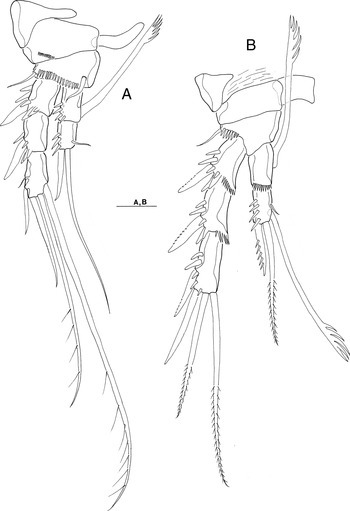
P1 (Figure 3A): wide intercoxal sclerite lacking ornamentation. Praecoxa triangular without ornamentation. Coxa with 1 row of spinules on anterior surface. Basis with robust spinular row on anterior surface, with bare seta/spine on inner and outer corners. Exopod 3-segmented; exp-1 with strong outer spinules around outer spine; exp-2 slightly longer than first segment and with similar ornamentation; exp-3 longest, with 1 tiny seta and 1 seta on outer margin, 1 bare seta and 1 unipinnate seta distally, and 1 unipinnate inner seta. Endopod 2-segmented, reaching end of exp-2; enp-1 with spinules on outer corner and 1 peculiarly barbed inner seta; enp-2 ornamented with 3 spinules on outer margin, with 2 distal setae and 1 tiny inner seta.
Leptocaris ryukyuensis sp. nov., female: (A) P1; (B) P2. Scale bars: A, B = 10 µm.

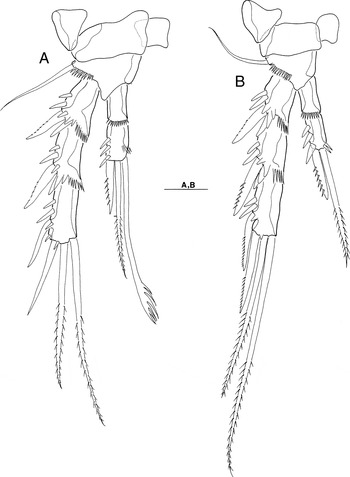
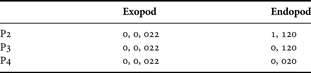
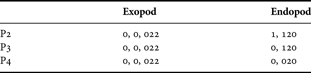
P2-P4 (Figures 3B & 4A, B): narrow intercoxal sclerites lacking ornamentation. Praecoxa and coxa without ornamentation. Basis wider than long, with lateral seta and spinular row on distal margin. Rami 3-segmented (exopod) and 2-segmented (endopod); P2 enp-1 and enp-2, P3 enp-2 with peculiar barbed seta similar to that on P1. Armature formulae of P2-P4 as in Table 1.
Leptocaris ryukyuensis sp. nov., female: (A) P3; (B) P4. Scale bars: A, B = 10 µm.

Setal formula of swimming legs of Leptocaris ryukyuensis sp. nov.
P5 (Figure 2H): forming a small plate protruding medially, both rami of P5 confluent basally, with 1 bare long seta, 1 bare tiny seta and 1 bipinnate curved spine.
MALE
Habitus (Figure 1B) similar to female, except somatic setae and protuberances more numerous, and dorsal protuberances more prominent and complexly sculptured. Total body length 659 µm (mean 585 ± 50 µm, N = 6), measured from anterior margin of rostrum to posterior margin of caudal rami. Largest width measured at posterior margin of cephalic shield, 75 µm.
Prosome (Figure 1B) 4-segmented, comprising cephalothorax and 3 free pedigerous somites. Cephalothorax elongate, with few integumental sensilla as figured (Figure 1B); posterior and posterolateral margin smooth. Rostrum as in female.
Urosome (Figures 1B & 5A) 6-segmented, comprising P5-bearing somite, genital somite and 4 abdominal somites.
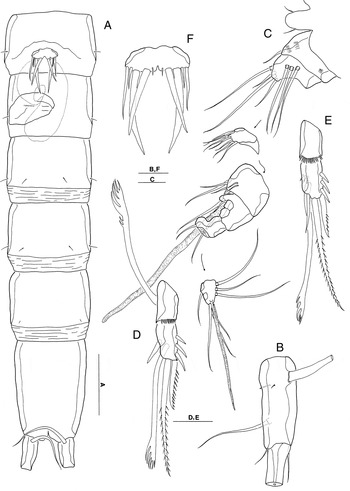
Caudal ramus (Figures 1B & 5B) sexually dimorphic, slightly shorter than that of female (about 2.3 times); seta I very short, seta II modified as a thick and long seta ventrally, seta VII long; other setae similar to those of female.
Leptocaris ryukyuensis sp. nov., male: (A) rosome, ventral; (B) caudal ramus, lateral; (C) rostrum and antennule; (D) P2 endopod; (E) P3 endopod; (F) P5. Scale bars: A = 50 µm; B–F = 10 µm.

Antennule (Figure 5C) 7-segmented; subchirocer, with geniculation between segment 5 and 6; segment 1 with 3 outer spinular rows and 1 seta; segment 4 longest; segment 5 and 6 modified. Armature formula: 1-[1 bare], 2-[7 bare], 3-[7 bare], 4-[4 bare + 2 tiny + (1 + ae)], 5-[1 tiny], 6-[1 bare], 7-[5 bare + acrothek] (there is no arthrodial membrane between segments 5 and 6). Apical acrothek consisting of 2 long setae and aesthetasc.
Antenna, mouth appendages, and P1, P4 as in female except inner margins of basipods more heavily sclerotized and more produced than in female.
Articulations and major setation of P1 and P4 as in female. Inner margins of basipods more heavily sclerotized and more produced than in female. Setae of endopods 2 of legs 2 and 3 modified, shorter and stouter than those of female and bent laterally at proximal third, each having a tapered tip bearing a comb of setules.
P2 (Figure 5D): exopod as in female. Endopod modified, 2-segmented; enp-1 with peculiarly barbed inner seta having differences in barb structure; enp-2 with 1 strong spine and 1 peculiar barbed seta on inner margin, 1 bipinnate and 1 unipinnate seta distally, and outer margin ornamented with 3 strong spinules.
P3 (Figure 5E): exopod as in female. Endopod slightly modified, enp-1 as in female; enp-2 similar to female except an additional inner seta. Setae on enp-2 of P2 and P3 shorter and stouter than those of female.
P5 (Figure 5F) as single fused plate distinct from somite, each side with slender, normally 2 slender outer setae and 2 strong inner setae, and with 1 tiny innermost setule.
P6 (Figure 5A) consisting of trapezoidal protrusion, most developed and ornamented with few rows of spinules on left side of somite.
DIFFERENTIAL DIAGNOSIS
Leptocaris ryukyuensis is distinguished from the other species of the genus by its conspicuous semicircular anal operculum and spinular rows on the first article of the antennules. In the male, rudimentarily sculptured protuberances are present on the thoracic somites. Caudal ramus possesses very small seta represented in seta I and seta II, and basal seta transformed to a fused big spine. Antenna has a barbed abexopodal seta and 3 exopodal setae, and a barbed inner seta appeared on P1 to P3 distal endopod in female and on P2 and P3 in male.
KEY FOR THE SPECIES OF THE GENUS LEPTOCARIS*
1. P1 enp 1-segmented … … … … … … … … … … … … 2
(mangalis-group)
P1 enp 2-segmented … … … … … … … … … … … . … 4
2. A1 5-segmented; ♀ P5 with 3 setae… … L. stromatolicolus
A1 4-segmented; ♀ P5 with 2 setae … … … … … … … 3
3. P1 exp-1 with 3 setae… … … … … … … … …L. mangalis
P1 exp-1 with 4 setae … … … … … … … … … L. noodti
4. P2 exp-3 with 3 setae … … … … … 5 (minimus-group)
P2 exp-3 with 4 setae … … … … … … … … … … … 6
5. ♀ P5 with 6 setae; P1 exp-3 with 4 setae; P4 enp-2 with 3 setae … … … … … … … … … … … … … L. armatus
♀ P5 with 4 setae; P1 exp-3 with 4 setae; P4 enp-2 with 2 setae… … … … … … … … … … … … … … L. minimus
♀ P5 with 4 setae; P1 exp-3 with 3 setae; P4 enp-2 with 2 setae … … … … … … … … … … … … … L. marinus
6. P3 and P4 exp-3 with 5 setae … … …7 (brevicornis-group)
P3 and P4 exp-3 with 4 setae … … …12 (ignavus-group)
7. P1 enp-1 without inner seta … … … … … … … … … 8
P1 enp-1 with inner seta … … … … … … … … … … 10
8. ♀ P5 with 4 setae; P4 enp-1 with inner seta … … … … … … … … … … … … … L. vermicularis
♀ P5 with 2 setae; P4 enp-1 without inner seta … … … … … … … … … … … … … …L. sibiricus
♀ P5 with 3 setae… … … … … … … … … … … … … 9
9. P1 enp-2 with 3 setae … … … … … L. echinatus echinatus
P1 enp-2 with 2 setae … … … … … … L. echinatus nudus
10. ♀ P5 with 2 setae … … … … … … … … … L. brevicornis
♀ P5 with 4 setae … … … … … … … … … … … L. itoi
♀ P5 with 3 setae … … … … … … … … … … … … 11
11. A1 4-segmented; P3 enp-2 with 4 setae … L. mucronatus
A1 5-segmented; P3 enp-2 with 5 setae … … … … … … … … … … … … … … … … … L. trisetosus pacificus
A1 6-segmented; P3 enp-2 with 4 setae … … … … … 12
12. Caudal ramus with normal seta V … … … … … … … … … … … … … … … … … … … …L. trisetosus trisetosus
Caudal ramus with modified seta V … … … … … … … … … … … … … … … … … … … L. trisetosus breviseta
13. P2 enp-1 with inner seta … … … … … … … … … …14
P2 enp-1 without inner seta … … … … … … … … … 18
14. P2 enp-2 with 4 setae … … … … … … … … … … … 15
P2 enp-2 with 3setae … … … … … … … … … … … 16
15. P4 enp-2 with 4 setae; ♂ P5 with 6 setae/spines … … . . . … … … … … … … … … … … … … … … . L. insularis
P4 enp-2 with 3 setae; ♂ P5 with 5 setae/spines … … . . . … … … … … … … … … … … … … … … … … L. pori
16. P1 enp-2 with 3 setae … … … … … … … … … … … 17
P1 enp-2 with 2 setae; P4 enp-2 with 2 setae … … … … … … … … … … … … … … … . L. ryukyuensis sp. nov.
17. P4 enp-2 with 3 setae … … … … … … … L. biscayensis
P4 enp-2 with 2 setae … … … … … … … L. doughertyi
18. A1 7-segmented … … … … … … … … … … … … … 19
A1 5- or 6-segmented … … … … … … … … … …. …20
19. P2 enp-2 with 3 setae; ♀ P5 with 4 setae … … … … … … … … … … … … … … … … … … … … … . .L. minutus
P2 enp-2 with 5 setae; ♀ P5 with 3 setae … … … … … . … … … … … … … … … … … … … … … … L. kunzi
20. P1 enp-2 with 1 seta … … … … … … … … … L. igneus
P1 enp-2 with 2 setae … … … … … … … … … … … 21
P1 enp-2 with 3 setae … … … … … … … … … L. glaber
21 P2 to P4 enp-2 with 2 setae … … … … … …L. canariensis
P2 to P4 enp-2 with 3 setae … … … … … … L. islandica
*The key is amended after Fleeger & Clark (1979).
DISCUSSION
Systematics
Lang (Reference Lang1965) based his phylogenetic system of Leptocaris on the male P5. Here the innermost seta is greatly enlarged to a stout spine in L. pori, L. minutus, L. ignavus, L. insularis and L. trisetosus. This character is difficult to use though since males are unknown as yet in several species of the genus. This is also the reason why phylogenetic relationships within the genus are only tentative as yet. The discovery of males as in the present study will certainly throw more light on the systematics of the genus Leptocaris.
According to Kunz (Reference Kunz1978) there are 3 species groups among Leptocaris. The minimus-group is characterized by a low number of setae on the distal segment of exopod P3 and P4, namely 3 setae. It consists of L. minimus (Jakobi), L. armatus Lang and L. marinus (Por). The other species groups of Leptocaris contain 4 or 5 setae on the exopods of P3 and P4, respectively. Setal numbers range from 3/4 and 3/5 on the distal segments of the exopods P1/P2 and P3/P4, respectively. According to Kunz (Reference Kunz1994) the segment number and setae on the P1-P4 of females provide the most decisive distinction of the then 4 species groups of Leptocaris that Kunz (Reference Kunz1994) was identifying:
(1) minimus-group (according to Kunz, Reference Kunz1978), containing: L. minimus (Jakobi, 1954); L. marinus (Por, 1964), L. armatus (Lang, Reference Lang1965).
(2) ignavus-group (according to Kunz, Reference Kunz1983), containing: L. minutus T. Scott, 1899; L. ignavus (Noodt, Reference Noodt1953); L. biscayensis (Noodt, Reference Noodt1955); L. insularis (Noodt, Reference Noodt1958); L. canadensis Lang, Reference Lang1965; L. pori Lang, Reference Lang1965; L. doughertyi Lang, Reference Lang1965; L. kunzi Fleeger & Clark, Reference Fleeger and Clark1980; L. igneus Cottarelli & Baldari, Reference Cottarelli and Baldari1982; L. glaber Fiers, Reference Fiers1986.
(3) brevicornis-group (according to Kunz, Reference Kunz1983), containing: L. brevicornis (van Douwe, Reference Douwe1905); L. trisetosus trisetosus (Kunz, 1935); L. gurneyi (Nicholls, 1944); L. sibiricus (Borutzky, 1952); L. vermicularis (Oliveira, 1957); L. mucronatus Fiers, Reference Fiers1986; L. echinatus echinatus Fiers, Reference Fiers1986; L. mucronatus Fiers, Reference Fiers1986; L. itoi Kunz, Reference Kunz1994.
(4) mangalis-group (according to Kunz, Reference Kunz1994), containing: L. mangalis Por, Reference Por1983; L. stromatoliticolus Zamudio Valdez & Reid, Reference Valdez and Reid1990; L. noodti Kunz, Reference Kunz1994.
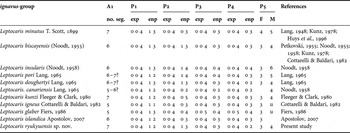
Leptocaris ryukyuensis belongs to the ignavus-group of species which is characterized by a 2-segmented P1 endopod, and P2 to P4 exp-3 with 4 setae respectively (Table 2).
Comparison of morphological characteristics in ignavus-group species (female only).

no. seg., number of segments; exp, exopod; enp, endopod.
Leptocaris ryukyuensis has some characters which may be considered as derived, chiefly the subcircular anal operculum and the spinule rows on the first article of the antennules, and, in the male, rudimentarily sculptured hyaline protuberances on some prosomites. Partly because of the lack of male descriptions in several species, proposed arrangements of species-groups within the genus Leptocaris are at present problematic (Fleeger & Clark, Reference Fleeger and Clark1980).
Biogeography
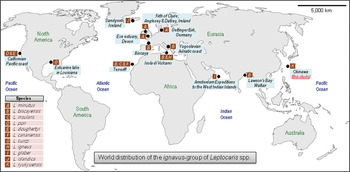
Among the Darcythompsoniidae, the genera Leptocaris and Darcythompsonia have a worldwide distribution while Kristensenia and Pabellonia are more restricted. Representatives of Leptocaris are known from China, Korea, Japan, the Americas (Brazil, El Salvador and USA), Africa (Egypt and Algeria), Iran, Israel and Europe (Mediterranean Sea, Black Sea, Atlantic coasts of Britain and France, the North Sea). The ignavus-group of Leptocaris is distributed worldwide but restricted to the northern hemisphere (Figure 6). In the ignavus-group only L. minutus and L. biscayensis were recorded at more than one locality—namely from 3 localities in Ireland, England and Germany and 4 localities in the Mediterranean and from the Canary Island of Tenerife in the Atlantic. All other species were found only for one time, primarily in marine European waters and one species, L. kunzi from an estuarine lake in Louisiana, USA. The present record of Leptocaris ryukyuensis sp. nov. provides the first record from the Pacific Ocean.
World distribution of the ignavus-group (sensu Kunz, Reference Kunz1994) of Leptocaris spp. References for: (A) Lang, Reference Lang1948; Noodt, Reference Noodt1953; Huys et al., Reference Huys, Gee, Moore and Hamond1996; (B) Noodt, Reference Noodt1955; Petkovski, Reference Petkovski1955; Kunz, Reference Kunz1978; Cottarelli & Baldari, Reference Cottarelli and Baldari1982; (C) Noodt, Reference Noodt1958; (D) Lang, Reference Lang1965; (E) Lang, Reference Lang1965; (F) Noodt, Reference Noodt1958; Lang, Reference Lang1965; (G) Fleeger & Clark, Reference Fleeger and Clark1980; (H) Cottarelli & Baldari, Reference Cottarelli and Baldari1982; (I) Fiers, Reference Fiers1986; (J) Apostolov, Reference Apostolov2007; (K) present study.

Ecology
Although new species and new records of species of this family were frequently published, the ecology of these groups of animal remains poorly understood. Representatives inhabit bottom sediments with high organic matter content at coastal marshes or lagoons. Most representatives are known from brackish coastal habitats (Fleeger & Clark, Reference Fleeger and Clark1980). Kunz (Reference Kunz1978) claimed that isolated brackish pools or sand beaches are the most common habitats of Leptocaris. Indeed, most collections are from sandy habitats, but some are from phytal decomposing habitats and from mud. A stromatolite and a marsh habitat for L. stromatolicolus is suggested to provide an appropriate interstitial situation by Valdez & Reid (Reference Valdez and Reid1990). Por (Reference Por1983) supported the idea that Leptocaris are distributed in the material of decomposing mangrove tree leaves. Fiers (Reference Fiers1986) noted that these apparently highly specialized animals are adapted to live in particular ‘marginal’ habitats (euryhaline, eurythermal and temporary) where colonization by most other harpacticoid groups is failing. The species newly described here and most other species are found in contrasting habitats. Among the 27 species belonging to the genus Leptocaris T. Scott, 1899 (see Boxshall & Halsey, Reference Boxshall and Halsey2004) there are 3 species that are reported from continental waters (Dussart & Defaye, Reference Dussart and Defaye1990; Lee & Chang, Reference Lee and Chang2008): L. sibiricus Borutzky, 1952, L. trisetosus trisetosus (Kunz, 1935) and L. brevicornis (van Douwe, Reference Douwe1905).
Most members of the genus occur in euryhaline and eurythermal habitats, sometimes as members of a typically estuarine species assemblage (Fleeger & Clark, Reference Fleeger and Clark1980), but most often in isolated brackish pools or beach sands (Kunz, Reference Kunz1978). Two congeners, L. brevicornis (van Douwe, Reference Douwe1905) and L. sibirica (Borutsky, Reference Borutsky1952), have been found in Eurasian continental fresh as well as brackish waters (van Douwe, Reference Douwe1905; Borutsky, Reference Borutsky1952). Most records are from sandy substrates, but some are from mud and phytal substrates, including decomposing mangrove leaves, a niche to which members of the genus seem pre-adapted (Por, Reference Por1983).
ACKNOWLEDGEMENTS
We thank Dr Jinsoon Park (Korea University) and Dr Huyn Soo Rho (KORDI, Korea) for technical assistance for drawings and collecting samples from Okinawa, Japan. We are particularly indebted to Dr Frank D. Ferrari (Smithsonian Institution, Washington, DC) for critical amendments to a previous MS version. Mr Minkyu Kim and Mr Jae Hyuk Kim of Korea University provided a developed world map. This research was supported by Basic Science Research Program through the National Research Foundation of Korea (NRF) funded by the Ministry of Education, Science and Technology to H.-U. Dahms (2010-A001-0057). This work was also supported by the NRF of Korea Grant funded by the Korean Government (MEST) (NRF- 2011-0004261).