Introduction
Past societies have bequeathed us a large number of figurative and schematic graphic remains that speak of them and that we describe, analyse and contextualize in order to gain information on human groups, their practices, myths and cultural interactions. However, access to these disappeared societies seems easier through figurative iconographies which seem to offer us fragments of past daily lives that we only have to ‘read’ to gain understanding. A honey-harvest scene, for example, seems more explicit than a grid figure, a circle, a simple anthropomorphic or even the association of these different figures. But, if figurative iconographies convey a priori more direct information, we must not forget that they are not always necessarily narrative and that the interpretations proposed must remain cautious and rely as much on a convergent body of data as on a chrono-cultural context documented elsewhere. In addition to this apparent ease of reading, figurative iconographies provide an aesthetic emotion which, given the antiquity of rock art, is all the greater. The virtuosity that is revealed through the Palaeolithic animal figures painted on the walls of caves renders these distant and disappeared societies more familiar and brings them closer to us. Schematic graphic expressions, which cannot therefore be qualified as images, elude aesthetic criteria, and do not invite interpretation as readily. Therefore, they are still too often excluded from studies on prehistoric societies but, at the same time, are preserved from hasty readings and interpretations that sometimes tend to hamper long-term research. Such schematic expressions require particular conceptual and methodological tools that enable the recovery of anthropological information from these often-unrecognizable assemblages of shapes. This paper proposes the use of cognitive and pragmatic semiotics of visual culture to study Neolithic schematic rock art. The author posits that the conclusions resulting from such studies can shed new light on this graphic ensemble and its associated social practices, propose new research hypotheses and renew some of the current debates and, more generally, the conceptual tools at our disposal to approach archaeological graphic corpuses.
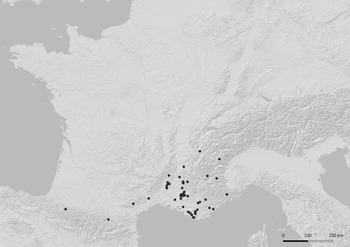
The reflections presented in this article stem from the author's research on the schematic rock paintings of southern France initiated in 2014. However, this graphic corpus is part of a large-scale phenomenon which ranges from the Iberian peninsula to Italy and cannot therefore be understood independently of it. Thus, references to Spanish and Italian sites are used to help understand the schematic expression (Fig. 1). In return, we hypothesize that the reflections presented in this article may in turn contribute to the debate on the coexistence of Levantine and schematic rock art in Spain.
Distribution of painted caves in southern France and the western Alps (sites cited in the text). (1) Faravel; (2) Bergerie des Maigres (Signes, Var); (3) Pin de Simon 2 (Gémenos, Bouches-du-Rhône); (4) Trou de la Féclaz (Saint-Jean-d'Arvey, Savoie); (5) Pierre Rousse (Beauregard-Baret, Drôme); (6) Perret 1 (Blauvac, Vaucluse); (7) Alain cave (Tourves, Var); (8) Baume Peinte (Saint-Saturnin-les-Apt, Vaucluse); (9) Otello (Saint-Rémy-de-Provence, Bouches-du-Rhône). (CAD: C. Defrasne.)

Neolithic schematic rock art: description and chronological allocation
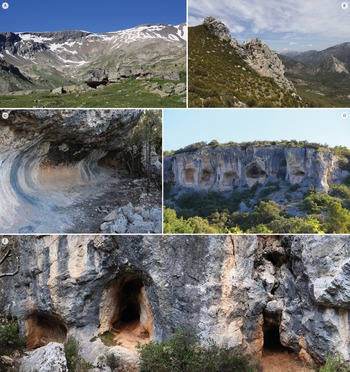
Holocene schematic rock art, documented from the Iberian peninsula to Italy, was first identified at the end of the eighteenth century in Spain and studied from 1910 onwards by Henri Breuil and Juan Cabré (Breuil Reference Breuil1933). In southern France, schematic rock art is mainly painted at open-air sites or in caves and can sometimes be engraved. It can be found in a variety of environments, from plains to high-altitude areas, up to 2400 masl (Defrasne et al. Reference Defrasne, Chalmin, Bellot-Gurlet, Thirault and André2019a,b; Defrasne & Bailly Reference Defrasne, Bailly and Besse2014; Hameau Reference Hameau2002; Walsh et al. Reference Walsh, Mocci, Defrasne, Dumas and Masinton2016) (Fig. 2).
Images of rock-shelters with schematic rock art in a variety of environments, from plains to high-altitude areas. (A) Faravel, Freissinières (Hautes-Alpes, France); (B) Pierre Escrite, Castellane (Alpes-de-Haute-Provence, France); (C) La Gayette, Murs (Vaucluse, France); (D) Baume Brune, Gordes and Joucas (Vaucluse, France); (E) Trou des deux Amis and Trou Nicole, Tourves (Var, France).

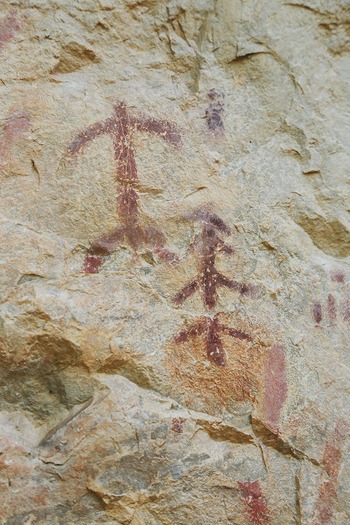
The imagery consists of more than 40 themes (anthropomorphic figures, U-shaped figures, ramiforms, grids, broken lines, lattices, ladder-shaped figures, groups of dots organized or not, meander-like figures, sun-like figures …). The human figures constitute a third of the ensemble and consequently appear as the pillars of the ‘schematic discourse’ (Fig. 3). In addition to these figures, the rock-shelters are also marked with a considerable number of simple marks, which can be linked or not to certain details of the rock surface (concretions, depressions …) (Hameau Reference Hameau2015a). The number and diversity of paintings vary greatly from one site to another, sometimes resulting from probable successive visits, sometimes probably from the same paint pot (Hameau Reference Hameau1997). Similarly, archaeological contexts, in the rare instances where they are found in schematic rock-art sites, are very varied: sepulchral caves, flint or clay mines, temporary occupations and flint-cutting sites (Chopin & Hameau Reference Chopin and Hameau1996; Hameau Reference Hameau2002). However, schematic rock paintings seem to share common location criteria, mainly rock-shelters with a southern exposure, particular topographies or impressive views of the surroundings, common themes and associations of themes, and the presence of intermittent water flows and a coloured rock surface (Hameau Reference Hameau2002). Most of these characteristics have also been observed in the Iberian Peninsula (Alves & Rey Reference Alves and Rey2017; Jones et al. Reference Jones, Cochrane, Diaz-Guardamino, Bickle, Cummings, Hofmann and Pollard2017).
Schematic parietal paintings are quickly and summarily executed. (Photograph: C. Defrasne.)

The paintings are rarely datable because of the use of mineral colouring matter or the limited quantities of organic material still available. Their chronological attribution remains imprecise, which probably explains why they are often excluded from research on prehistoric societies. However, it is now possible to bring together chronological milestones that converge around the fifth, fourth and third millennia bc and support a possible Neolithic affiliation for at least part of the corpus (Defrasne et al. Reference Defrasne, Chalmin, Bellot-Gurlet, Thirault and André2019a,b; Hameau Reference Hameau2002). These milestones come initially from the general context of some painted shelters around Mont Ventoux (Binder Reference Binder, Buisson-Catil, Guilcher, Hussy, Olive, Pagni and Pontet2004; Borrell et al. Reference Borrell, Bosch, Gibaja, Schmidt and Terradas2019; Léa Reference Léa2004), particularly the Bedoulian flint-mining area or the sepulchral cavities characteristic of the Late Neolithic of southern France. Others come from archaeological contexts preserved in the sites, with colouring matter from dated archaeological levels or diagnostic lithic and ceramic material (Defrasne et al. Reference Defrasne, Chalmin, Bellot-Gurlet, Thirault and André2019a,b; Hameau Reference Hameau2002; Reference Hameau2010). There is, of course, no evidence for the relationship between iconography and archaeological material. However, the recurrence of these Neolithic discoveries makes them relevant chronological clues. The link between at least three alpine painted rock-shelters and visits from Square Mouth Pottery culture groups during the second half of the fifth millennium bc is also noteworthy (Defrasne et al. Reference Defrasne, Chalmin, Bellot-Gurlet, Thirault and André2019a,b; Pétrequin et al. Reference Pétrequin, Pétrequin and Errera2007; Thirault Reference Thirault2008). The excavation of the Faravel shelter (Freissinières, Hautes-Alpes) provided a terminus post quem for the execution of the paintings on the negative of a slab that detached itself from the vault of the shelter and fell on archaeological levels belonging to the Early Neolithic (5295–5045 cal. bc) (Defrasne et al. Reference Defrasne, Chalmin, Bellot-Gurlet, Thirault and André2019a,b; Walsh et al. Reference Walsh, Mocci, Defrasne, Dumas and Masinton2016). Finally, the iconography itself provides some elements of chronology through the depiction of dated objects, superimpositions with precisely datable figurations (Defrasne & Bailly Reference Defrasne, Bailly and Besse2014), comparisons with decorated objects from dated archaeological contexts and with final Neolithic menhir statues and engraved schist plaques widely present in Neolithic contexts of the Iberian peninsula (Gonçalves Reference Gonçalves1999; Reference Gonçalves2005; Gonçalves et al. Reference Gonçalves, Andrade and Pereira2014; Hameau Reference Hameau, Rodriguez and Marchesi2015b). This chronology of schematic expression is not fixed and corresponds to a period of three millennia within which very different Neolithic worlds followed one another. To render this chrono-cultural context more precise, integrated studies of painted or engraved sites with high archaeological potential, associating archaeo-geomorphological and physico-chemical analyses, are essential, as is the systematic study of graphic expression in these territories at different scales. Such integrated studies have initiated at four French rock-art sites (Defrasne Reference Defrasne2021; Defrasne et al. Reference Defrasne, Mocci, Tzortzis, Walsh, Dumas, Deschamps, Costamagno, Milcent, Renard and Valdeyron2019b; Defrasne et al. Reference Defrasne, Bellot-Gurlet and Chalmin2021a; Defrasne et al. Reference Defrasne, Chalmin and Schmitt2021b). It is now necessary to identify the link between schematic expression and its cultural environment and to relate it to settlement sites and material culture data for a better chrono-cultural definition of the European Neolithic.
The chronological clues obtained for the schematic expression of southern France echo Iberian research, which faces the same difficulties. Its dating relies largely upon formal parallels with dated decorated pottery (that should be treated with caution: see below) and portable art. Iberian schematic rock art is attributed to a period from the early Neolithic until the early/middle Bronze Age and maybe Iron Age (Domingo Sanz et al. Reference Domingo Sanz, Roman Monroig and Macarulla Uriarte2020; Hernandez Perez Reference Hernández Pérez2006; Jones et al. Reference Jones, Cochrane, Diaz-Guardamino, Bickle, Cummings, Hofmann and Pollard2017; Ochoa et al. Reference Ochoa, Garcia-Diez, Domingo and Martins2021).
However, the characterization of Iberian schematic rock art remains problematic, as it seems more heterogeneous than that observed in southern France. In other words, all figures that do not belong to the other identified eastern rock-art groups, macroschematic or Levantine, are attributed to schematic rock art (Domingo Sanz et al. Reference Domingo Sanz, Roman Monroig and Macarulla Uriarte2020; Fairén-Jiménez Reference Fairén-Jiménez, Fowler, Harding and Hofmann2015). It is therefore probable that the graphic manifestations grouped under the term schematic rock art, which are variable and multiple (Gómez-Barrera Reference Gómez-Barrera2005), as evidenced by the use of a wide variety of qualifiers, cover different archaeological realities. The characterization and circumscription of the cultural and social phenomenon to which the schematic expression of southern France bears witness, therefore, requires that we focus on understanding its cognitive nature. To what extent can we speak of schematic rock art, and consequently of schematism, and what does this imply from an archaeological and anthropological point of view?
From cognitive and pragmatic semiotics to archaeology
Why should archaeologists of rock art use semiotics?
Visual graphic productions communicate and thus act as signs, as representations of something else (representamen) (Peirce Reference Peirce1978). Graphic systems are both systems of signification and systems of representation (Duval & Peraya Reference Duval and Peraya2005). This gives them a semiotic dimension and invites us to consider ancient graphic productions through the lens of the eponymous discipline in order to shed fundamental light on prehistoric graphic productions. Semiotics studies the processes of signification, that is, the production, codification and communication of signs. These material graphic productions are also cognitive productions in the sense that they result from the authors’ interpretation of reality. Rather than stopping at the relationship between the content presented by the representation and the represented object, it is necessary to consider the representation in its entirety including the production of the representation or, more precisely, the system producing the representation.
When archaeologists take an interest in rock art, they study visual material productions resulting from interactions between the perceived world and the cognitive universes of their authors. Unduly gathered under the term ‘images’ (Esquenazi Reference Esquenazi1997), to which we should prefer that of ‘visual icons’, the graphic productions of any human society, past or contemporary, are multiple, heterogeneous. If we are now aware of the existence of such diversity in our societies, it has not always been the same for prehistoric societies. The formal and structural variability of ancient graphic expressions is in fact most often attributed to chronological and/or cultural diversity, where other anthropological realities may have intervened. Here, the author proposes that other paradigms are now conceivable and deserve to be investigated in order to revitalize the archaeology of graphic systems and more generally our understanding of prehistoric societies and their social practices.
Semiotics has been and is characterized by different currents of thought. The communication sciences have indeed successively offered us a structuralist model, widely used in studies of rock art, centred on the language code and the utterance, and then a pragmatic model, centred on the relation and the context, and therefore on the enunciation. The former has been generalized into a general semiology, the object of which is the study of sign systems relating to different languages and different codes (Peraya & Meunier Reference Peraya and Meunier1999). In rock-art archaeology, this resulted in the study of the structures of rock art and their ‘formal grammar’ (Sauvet & Wlodarczyk Reference Sauvet and Wlodarczyk1995). The second has produced a semio-pragmatics focusing on the enunciative aspects detectable through different kinds of signs and discourses. We are now witnessing in the communication sciences the emergence of a new theoretical point of view on communication, a cognitive point of view that draws attention to the mental representations and cognitive operations that accompany communication (Peraya & Meunier Reference Peraya and Meunier1999). It is from this movement that our work is inspired, as we wish to go beyond the study of the structure of signs to question their morphogenesis and its consequences on the variability of rock art. The mobilization of a conceptual framework stemming from cognitive and pragmatic semiotics for a better understanding of prehistoric rock arts is new and constitutes, with the new research hypotheses that it allows to formulate and the renewal of our conceptual tools, the main contribution of this article.
Variability in visual graphic productions, variability of purposes
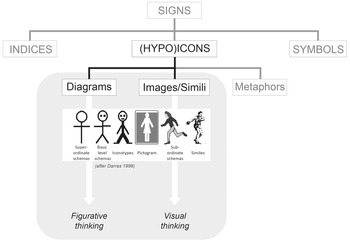
C.S. Peirce, a pioneer of pragmatic semiotics, distinguished three types of signs (Darras Reference Darras2020; Fisette Reference Fisette2003; Peirce Reference Peirce1978) (Fig 4):
Illustration of Peirce's semiotics and the difference between diagrams and similes as described in the work of Bernard Darras. (CAD: C. Defrasne.)

- Symbols, conventional and arbitrary signs possibly presenting a degree of similarity with the object;
- Icons defined by an analogical relationship to the object and which are characterized by different degrees of iconicity;
- Indices characterized by a causal relationship to the object and which, in other words, constitute a trace of it.
In these signs signifying processes, Peirce saw uses, ‘signs in act’ rather than fixed entities. Semiotic studies now go further by distinguishing different types of icons: images, diagrams and metaphors (Fig 4). Images are based on resemblance to something real or imaginary. Diagrams represent relationships between things through signs and metaphors represent a semiotic relationship through another, similar, semiotic relationship (Verhaegen Reference Verhaegen1994). This diversity of analogical representations is the mark of the multiplicity of semiotic processes at work in their production. This approach characterizes in particular the work of Bernard Darras who, advantageously for archaeologists, is interested in the consequences on the graphic act itself, on the gesture, as well as on the relationships between the figures and the medium's spatial area (Darras Reference Darras1998).
According to Darras, it is no longer the degree of resemblance with the referent that distinguishes analogical representations, but the semiotic processes at work in the production of the representations. Using children's drawings, the author demonstrates the use of what he calls polygraphy (Darras Reference Darras2020). The children use different graphic systems and universes of references according to their circumstances, their needs and their desires, exploiting the whole iconic range of diagrams, also called schemas, up to images simulating the optical experience and called similes. What interests us here is the perpetuation, in adulthood, of this polygraphy (Darras Reference Darras1996; Reference Darras1998; Reference Darras2003; 2020). Diagrams and similes, which coexist in all human societies, result from different cognitive operations and are thus mobilized in different ways according to the context.
Similes are the result of so-called visual thinking (Arnheim Reference Arnheim1976), which aims, as mentioned earlier, to reproduce the optical experience graphically. The modalities of the resemblance to the perceived image are, however, culturally constructed and consequently subject to stylistic variability. As for the diagrams, they come from so-called figurative thinking and reconstruct material derived from visual perception. They are derived from cognitive categories that result from the subject's evolution in his or her social and cultural environment and ‘are built from a social consensus that validates them’. Only the generic, salient and distinctive characteristics of what is represented are retained. For the sake of figurative economy and efficiency, the diagrams are often symmetrical and systematically look for the most informative axis of the object or subject (e.g, front representation for the human figure, profile representation for the animal). The figures thus produced are simple, effective and intended for communication and repetition. From this perspective, schematism is considered as a normal communicative process, present in all human societies, produced in special contexts for particular purposes, clearly different from those of figurative representations, and not as an impoverished artistic behaviour (Darras Reference Darras1998).
Polysemy, a difficulty to consider
Archaeology of rock art and more generally of graphic expression faces many difficulties. The greatest of them consists in the polysemy of images. Representation is not only representation of something. It is always representation for someone, who is not only a psychological subject, but also a biological, historical and social subject (Darras et al. Reference Darras, Fisette, Verhaegen and Julien-Casanova2006; Fisette Reference Fisette2003; Linard Reference Linard1990). In other words, there is no single meaning associated with a visual production and the meaning of an image can only be constructed through the interaction with the narrative, the text. Moreover, the same image can be index, icon or symbol depending on the effects induced by the context (Esquenazi Reference Esquenazi1997; Fisette Reference Fisette2003). However, that of prehistoric graphic expressions is lost forever. The system in which the image makes sense is lacking. In the absence of this significant context, it cannot be interpreted.
In spite of the difficulties specific to archaeology, semiotics can help in understanding archaeological graphic productions. Ancient graphic corpuses can now be studied bearing in mind the diversity of the visual graphic productions of any and all human societies and its origin, and researchers can now thus search for material clues that will resonate with the observations stemming from semiotics.
Can we really talk about schematic rock art? A determination key for schematism based on cognitive semiotics
On the use of the word ‘schematic’
The rock art discussed in this article is described as ‘schematic rock art’ and thus characterized. Cognitive and pragmatic semiotics have attempted to demonstrate that the production of diagrams attests to the use of a particular cognitive register for different purposes than realistic images. The use of the term and its mobilization in the naming and study of archaeological remains must therefore be questioned and justified. Can we then really speak of schematic art? Certain works of cognitive semiotics have been interested in the form and behaviour of diagrams on media, thus providing us with a real key for determining schematic expressions.
First, in the case of the study of archaeological graphic productions, when imagery is considered schematic, this means that a resemblance has been identified. A known shape has been recognized despite its simplification and it can therefore be perceived. This is the case in schematic rock art of anthropomorphic and animal figurations, which are reduced to their structure and constitute almost half of the graphic corpus. However, some figures, in Neolithic schematic rock art or elsewhere, appear unfamiliar and their structure evokes nothing known. This is the case with circular or rectangular grids, shield-shaped figures or comb-like figures. Other figures are simple and ubiquitous, like circles, crosses, groups of dots. It is therefore difficult to rule on their schematic or abstract (which avoids direct reference to an identifiable being from the real or imaginary world) nature. Geometrical figures that may appear abstract can turn out to be representations of objects once they are contextualized and questioned against material culture and archaeological or ethnographical contexts (Defrasne & Fedele Reference Defrasne and Fedele2015; Hollmann Reference Hollmann2014). In archaeological contexts, such reference objects may not be preserved, and the nature of the resulting graphic shapes can no longer be determined. Besides human and animal figures, schematic rock art is also composed of undetermined shapes that are difficult to qualify and for which it is difficult to judge a possible schematization. Thus, the use of simple forms is insufficient for the use of such a qualification. In this case, the qualification of schematic art must be supported by arguments other than the mere simplification of a few identifiable figures. Cognitive and pragmatic semiotics provide other elements for recognizing schematic expressions.
Multimedia communication and collective exchanges: a quick and summary execution?
An essential difference between diagrams and similes lies in their communicative environment and its consequences on the execution of signs (Darras Reference Darras1996; Reference Darras1998). The diagrams aim at a dynamic, multimedia communication and immediate mediation in collective exchanges. Their meaning and their interpretation thus depend on such communicative interactions that surround their consensual production. As a consequence, the diagrams are generally the result of a quick and summary execution. ‘It is not therefore through negligence, incapacity or clumsiness that the initial productions (diagrams) are quickly and summarily processed, but rather through the fluid, lively, concentrated and lapidary nature of the communicative act that demands it’ (Darras Reference Darras1996). Moreover, diagrams are generally not intended to survive the communicative act from which they originate. The production of similes is, on the contrary, individual and much slower. Their realism makes them easily understandable beyond their production. They aim at description, imitation, uniqueness and universality of understanding. These characteristics allow and aim at the repeated use of the same images (Darras Reference Darras1996; Reference Darras1998).
It is difficult to estimate the time taken to produce rock art. However, the formal characteristics that we observe in the rock-shelters of Mediterranean France, namely wide lines made with a brush or finger, dots made with the fingertip, coarse contours and the irregularity of deposit of pictorial matter, are compatible with quick execution. Only in rare cases, a precision tool may have been used and finely executed, and solid figures are exceptional.
No scenes but topological, reticular or linear compositions
Schematic expressions also have an essential structural characteristic. As explained by Darras, diagrams support neither fragmentation nor segmentation (Darras Reference Darras1996; Reference Darras1998). The figures must be complete. They are thus never superimposed and flatness is preferred to perspective. The space in which they are presented is therefore a two-dimensional space. As a consequence, and contrary to similes, diagrams are never, or very rarely, associated in scenes. Their spatial organization is therefore topologic, based on relationships of proximity, inclusion and juxtaposition. Their organization on the support is linear (of additive type), reticular (multidirectional: a sign can have several links with other signs) or topologic (local neighbourhood relations by juxtaposition and inclusion). As explained by the author, the spaces between the diagrams are signs of separation, just like the spaces between written words. The graphic space is often vectorized, structured by verticality and horizontality. ‘The vertical, and the horizontal associated with it, constitute the two main references of the lived space’, and consequently of the graphic space. On the contrary, the spaces between figurative images are a distance in a trimensional space rendered by the use of perspective (Darras Reference Darras1996; Reference Darras1998).
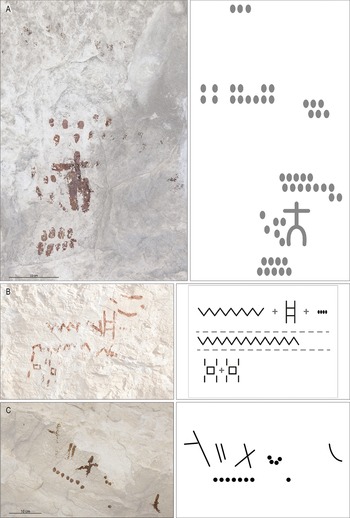
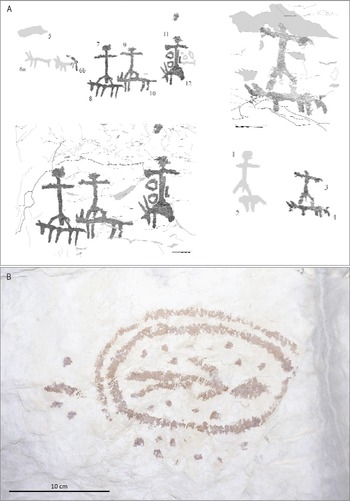
All these structural characteristics of diagrammatic imagery can be identified on the walls of painted shelters in southern France. The absence of a scene, as defined for the study of rock art (Lenssen-Erz Reference Lenssen-Erz1992; May & Domingo Sanz Reference May and Domingo Sanz2010), is prevalent in the Neolithic rock art of southern France. It is interesting to note that the two sites that delivered scenes (Bergerie des Maigres, Signes, Var; Pin de Simon 2, Gémenos, Bouches-du-Rhône) display both a very similar imagery, much less schematic than other sites from southern France and the western Alps, and a focus on human/animal interactions (Defrasne Reference Defrasne2019; Hameau Reference Hameau2010). Interestingly, as a result of this absence of scenes, and as identified by cognitive semiotics studies, the figures’ proportions are variable and independent of each other. Topological relationships of proximity, inclusion, juxtaposition and stratification are recurrent, as already mentioned by Philippe Hameau (Reference Hameau2016). Alignments of figures, simple or arranged in tiered registers, are, for example, present at the sites of Trou de la Féclaz (Saint-Jean-d'Arvey, Savoie, France), Pierre Rousse (Beauregard-Baret, Drôme) and Perret 1 (Blauvac, Vaucluse) (Hameau & Paccard Reference Hameau and Paccard1989; Hameau & Vaillant Reference Hameau and Vaillant1997) (Fig. 5). There is an example of inclusions at the Alain cave (Tourves, Var) (Fig. 6B) (Hameau Reference Hameau2000). The impossible fragmentation or segmentation of figures is well illustrated by the representation of mounted animals from the Iberian peninsula in which the human figure is placed above the animal figure, a well-identified graphic solution considered emblematic by semioticians (Fig. 6A) (Bea et al. Reference Bea, Domingo Martinez, Agudo, Reklaityte and Fatás Fernández2009; Collado Giraldo Reference Collado Giraldo and de Balbín Behrmann2008; Lanau & Bea Reference Lanau, Bea, Lorenzo Lizalde and Rodanés Vicente2016).
Juxtaposed relationships and organization in superimposed registers at (A) Perret 1 rock-shelter (Blauvac, Vaucluse, France); (B) Pierre Rousse (Bauregard-Baret, Drôme, France); (C) Trou de la Féclaz (Saint-Jean-d'Arvey, Savoie, France). (DAO: C. Defrasne.)

Examples of topological relationships. (A) Juxtapositions at La Fenellosa, Beceite, Matarraña, Teruel, Spain (from Bea et al. Reference Bea, Domingo Martinez, Agudo, Reklaityte and Fatás Fernández2009); (B) Inclusions at the Alain cave (Tourves; Var, France). (DAO: C. Defrasne.)

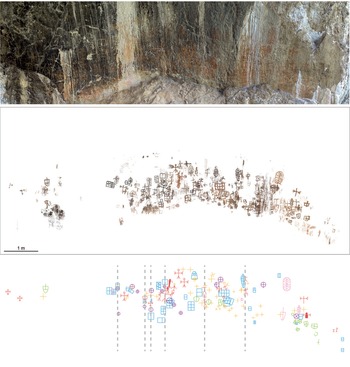
The organization of paintings at the wall level is topological or linear and the vertical and horizontal axes that govern the distribution of figures are sometimes traced. The relationships between the figures are generally perceptible at the scale of a few better-preserved portions of the walls. However, a few shelters have revealed true linear or topological compositions. This is the case for three painted rock-shelters: Otello (Saint-Rémy-de-Provence, Bouches-du-Rhône), les Eissartènes (Le Val, Var) and Baume Peinte (Saint-Saturnin-les-Apt, Vaucluse), three of the major sites of southern France in terms of number of figures (Hameau Reference Hameau1996; Reference Hameau1997; Reference Hameau, Sénépart, Perrin and Bonnardin2011). With 308 painted figures and marks recorded, the Otello shelter is the richest of the set of painted sites in southern France and the western Alps and one of the most remarkable displays of schematic rock art (Fig. 7).
Photo, tracing and analytical tracing with vertical alignments and spatial distribution of the different colors in the Otello rock shelter (Saint-Rémy-de-Provence, Bouches-du-Rhône, France). (Photograph: CAD: C. Defrasne).

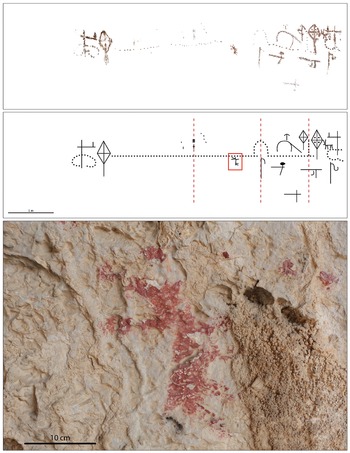
The polychrome imagery is mainly composed of cross-like figures (59, 19 per cent), circular reticulates (17, 6 per cent) or quadrangular reticulates (30, 10 per cent), anthropomorphic figures (27, 9 per cent) and scutiforms (12, 4 per cent) (author's unpublished observations). Some figures, of different types and colours, seem aligned along their vertical axis, staggered or superimposed. At the Eissartènes rock-shelter, which has a similar polychromy to that of the Otello shelter, and in spite of the rockface's worse state of preservation, most of the figures seem to be horizontally distributed. A double line of dots helped materialize the organization during one of the last phases of execution of the paintings. On the Baume Peinte site, where analysis of the colouring matter (Hameau Reference Hameau1997) indicates a true composition with synchronous figures, the composition is structured in two superimposed registers separated by a horizontal line of dots that runs along the entire wall and within which the direction of the signs differs. The line of dots sometimes defines outgrowths in relation to certain signs (Fig. 8).
Baume Peinte rock-shelter (Saint-Saturnin-les-Apt, Vaucluse). Complete tracing, schematization of the painted composition with location of the reverse animal figure and detail of the latter. (CAD: C. Defrasne.)

Vertically aligned figures, orthogonal to the horizontal line of punctuation, are visible at the back of the shelter, facing the entrance, and suggest the existence of a vertical structuring axis. If this is the case, the composition of Baume Peinte would be vectorized. Topological structuring of the graphic space by means of lines of dots can also be assumed at Balma dei Cervi (Crodo, Italian Piedmont) and for some Iberian sites (abrigo della Serradassa) (Domingo Sanz et al. Reference Domingo Sanz, Roman Monroig and Macarulla Uriarte2020). It appears that mental and communicative diagrams allow the expression and communication of a thought. These expressive forms use the topologies by which we think. They transcribe ‘architectures of thought’ (Brandt Reference Brandt2018). Do such compositions represent lived, mythical spaces, cosmograms?
Translation and time of the figures
Contrary to figurative imageries, in which the search for realism dictates the positioning of the figures, the figures composing schematic graphisms can be painted in different directions. This is particularly evident in human and animal figures, which can be presented vertically, horizontally or inverted (Darras Reference Darras1996; Hameau Reference Hameau2016). According to Hameau (Reference Hameau2002), the direction of representation in schematic rock art indicates variability in the status of the entities, as is the case in other schematic imageries (Darras Reference Darras1996). This is explicit at the Baume Peinte site (Saint-Saturnin-les-Apt, Vaucluse). Figures located above the line of dots seem to be presented in the ‘normal/natural’ position while figures below this line (an animal figure, two gallows-shaped figures) seem reversed. In schematic rock art, shape is not the only vehicle of meaning and the form can be manipulated according to the narrative it communicates. Other examples of inverted figures come from the sites of the Alain cave (Tourves, Var) (Fig. 6) as well as shelter I of the Vallon de Combrès (Oppède-le-Vieux, Vaucluse).
In addition, and contrary to simili which is completed as soon as the image is finished, diagrams are dynamic. Various moments can coexist within the sign and the sign itself can be modified during the communicative action (Darras Reference Darras1996; Reference Darras1998). Could the identification of repeats of figures or repaints be evidence of such behaviours?
The parietal graphic expression of southern France and the western Alps seems to present the structural and structuring characteristics that define diagrammatic graphic expressions and distinguish them from realistic representations, from images. The use of the term ‘schematic’ seems therefore to be justified and invites us to question the archaeological implications of these cognitive foundations. However, it is clear that the hypothesis developed here, based on the above-mentioned empirical observations, now needs to be demonstrated by means of systematic analyses using statistical and spatial analysis tools in order to confirm the relationship of the schematic rock art to the wall space. This is the subject of an ongoing research programme.
Archaeological implications and research perspectives From diagrams to social practices
Group social practices? Transmission and memorization of narratives
Semiotic studies also help in understanding the modalities of diagram production and thus allow us to glimpse some of the characteristics of the associated social practices. As previously mentioned, diagrams are generally produced in the context of a dynamic communication between different persons. Can we imagine a similar context for the production of schematic rock paintings? Were they produced as part of practices that brought people together in particular places in the environment? For what purpose?
The communicational aim of schematic rock art orientates research towards its articulation with orality and social memory and towards the modalities of transmission of collective representations in Neolithic societies. Indeed, studying schematic expression disseminated throughout the western Mediterranean and the cultural geographies it has recorded is equivalent to studying the communication and transmission of collective practices and representations across cultural borders and their regional reappropriation. These systems of representation, like any myth or know-how, are the result of individual learning. Any cultural process in fact articulates public collective representations with a cultural realization in the individual mind (Sperber Reference Sperber1996). A human population is inhabited by mental representations, just as the environment in which it evolves is populated by stated public representations. Only a small part of mental representations is communicated and becomes public. When they are transmitted in this way, the content of these representations remains stable. Representations that remain stable are easily produced, remembered and communicated (Atran Reference Atran2003). Ideas and behaviours become ‘cultural’ to the extent that they spread and survive within a given population. In so-called ‘oral tradition’ societies, it is the memorability of narratives that is a factor of stability in time and space (Sperber Reference Sperber1996). What people share in common is a strict reduction in the number of social representations associated with memorization techniques and major constraints on enunciation (Severi Reference Severi2005). The processes of memorization and transmission are therefore at the heart of large-scale cultural phenomena such as schematic expression. It is these concrete interactions at the level of the individual that contribute to the stabilization of narratives (Sperber Reference Sperber1996). These processes of transmission and memorization directly question the practices which surrounded the graphic act.
These objectives are also those of selective writing, also known as picture-writing, used in many small-scale societies with oral traditions. As pragmatic anthropological research has shown, the ‘false symmetry’ between writing and non-writing does not allow us to account for the variety of coherent and effective mnemonic devices that link image, speech and memory (Severi Reference Severi2007) and it obscures the ways in which ‘obviously graphic or seemingly non-graphic forms, architectural or spatial, work in tandem with oral traditions’ (Hugh-Jones Reference Hugh-Jones, Fausto and Severi2016). The role of graphics is central to the production of social memory and the dissemination of socially shared knowledge. Thus, oral traditions are also (icono)graphic and elaborate picture-writing to transcribe specific discourses from a limited corpus to accompany the memorization of narratives in a ritual context and the construction of social memory. They participate in the creation of a common base of cultural references and representations (Severi Reference Severi2007). These picture-writings present recurrent characteristics (schematism, rotation of the figures, structure …) which evoke Neolithic schematic rock art. Indeed, the production of diagrams, combined with the use of a conventional and finite repertoire of themes and a sequential organization, constitute the main characteristics of pictographic iconography (Severi Reference Severi, Berthoz and Scheid2009). Schematic rock art, which sometimes displays a typical linear organization, could therefore appear as a mnemonic device linking graphic productions, speech and memory. The question now is not the meaning, but the nature of the content thus transmitted between individuals of the same culture and of distinct cultures and on the modalities and significance of its transmission at different scales.
A trans-contextual communication register?
Finding archaeological contexts in such painted sites is rare, and excavations are old or have yielded little archaeological material. However, previous studies indicate that painted rock-shelters testify to a diversity of activities and functions related to graphic expression (Hameau Reference Hameau2002). Some are temporary camps, others sepulchral cavities or raw-material extraction sites (flint or clay). This diversity is also evident in their location: at the fringes of populated areas, in the piedmont, in valleys or canyons that are possible axes of communication, or in high-altitude areas. The nature of the themes represented can also point to these diverse practices: some shelters focus, for example, on the human figure, others on animal figurations. It is therefore necessary to question this diversity. Was schematic rock art a communication and semio-cognitive register (Darras Reference Darras1998; Peraya & Meunier Reference Peraya and Meunier1999) used in a wide range of social practices? In that case, what is the common denominator that justifies the use of such painted diagrams? Are they from the same ideational universe? It is difficult to answer these questions given the current state of research. It is thus important to keep in mind that these diagrams may have been used in significantly diverse social contexts, possibly having as a common denominator the transmission of a message to a group of people. Schematic expression probably holds an essential, but not pre-eminent, place compared to other actions of multimedia communication. This hypothesis is in line with that submitted by Hameau, for whom rock paintings constitute ‘the most persistent trace of a set of social practices that have contributed to their development’ (Hameau Reference Hameau2016).
The need for structure-based comparisons
A simple glance at the graphic productions from different cultural and chronological contexts reveals the use of similar forms by very different human societies. Indeed, the development of what Darras calls the initial imagery, graphic representation in young children, is almost the same whatever the culture (Darras Reference Darras1996). It thus constitutes in different contexts a repertory of effective forms, similar because they result from the same cognitive processes mobilized during childhood and correspond to the same way of solving a problem. Different cultures thus mobilize similar patterns to serve a variety of discourses. Schematism is transcultural and transchronological, used in all places and at all times to communicate (Hameau Reference Hameau2016). As a consequence, the second implication of semiotic studies is a warning. Schematism is not a style. In all human societies, diagrams are used in dynamic communication, to communicate quickly, with the aid of other media, often to a group of persons, and the simplicity of the figures makes them suitable for repetition.
Consequently, diagrams cannot be used a priori as a marker for a specific prehistoric cultural group or phenomenon. As regards schematic rock art, the homogeneity of the phenomenon and the existence of shared ideas or stories at the scale of the western Mediterranean must be questioned and demonstrated by characteristics other than the sole presence of diagrams in rock-shelters or caves. Evidence for the coherence of such a phenomenon in the absence of absolute dates is to be found in the criteria for selecting rock-shelters in particular environments, the inter-site correspondence of themes and structures, the archaeological context when present, the composition of the colouring matter … Some of them have already been proposed (Hameau Reference Hameau2002). New elements will come from the chrono-cultural attribution of the paintings established from geomorphological studies coupled with absolute dating when no archaeological context is preserved.Footnote 1
In line with this first warning, the comparisons between rock paintings and engraved and painted pottery used to solve the problem of dating the different types of Iberian rock art (macroschematic, schematic and Levantine) (Alday et al. Reference Alday, Perez-Romero, Iriarte, Frances-Negro, Arsuaga and Carretero2019; Domingo Sanz et al. Reference Domingo Sanz, Roldán-García, Ferrero Calabuig and Borja2007; Martí Oliver & Hernández Pérez Reference Martí Oliver and Hernández Pérez1988; Torregrosa Giménez & Galiana Reference Torregrosa Giménez and Galiana2001) should not be based on isolated schematic animal or human figures that are likely to have been simplified in the same way at all times, or on simple shapes like sun-like figures or broken lines which are used in a great variety of chrono-cultural contexts for a large range of meanings. In other words, only structural correspondences (Cassen Reference Cassen, Pétrequin, Gauthier and Pétrequin2017) can be significant in terms of contemporaneity and/or the homogeneity of the studied graphic expressions and the narratives sometimes shared over long distances.
When style is not necessarily the answer: a working hypothesis for coexistence between Levantine imagery and schematic paintings
As demonstrated by semiotics, diagrams and figurative productions coexist in all human societies. To what extent can observations from semiotic studies help explain some archaeological situations? Indeed, the simple observation of archaeological graphic productions reveals great variability between the different chronological periods, of course, but also within the same periods. For example, for the Neolithic period in question here, the differences are notable between schematic and Levantine rock art. The first testifies to the absence of any mimetic aim of the painted figures. This may also be the same for the Palaeolithic period, in which spectacularly realistic figures are found alongside geometric figures or simple forms known as ‘signs’. These observations lead to the following questions: are all these representations similar in nature? Does the way we understand or view them reveal the same cognitive processes? (Duval & Peraya Reference Duval and Peraya2005).
Strikingly heterogeneous rock arts
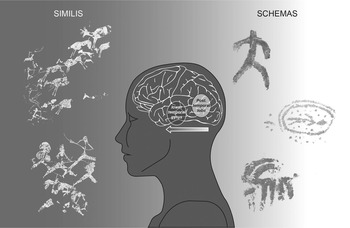
Schematic rock art, as defined earlier, is documented from the Iberian peninsula to Italy but coexists, in eastern Spain, with other graphic expressions present in open-air rock-shelters: macro-schematic rock art and Levantine imagery. The former is characterized by large undulating anthropomorphic figures with raised arms, Y-shaped anthropomorphic figures, meander-form figures composed of parallel lines and with finger and zig-zag endings (Cruz Berrocal & Vicent Garcia Reference Cruz Berrocal and Vicent Garcia2007; Fernández López de Pablo Reference de Pablo, Manen, Perrin and Guilaine2014; Hernández Pérez et al. Reference Hernández Pérez, Ferrer i Marset and Catalá Ferrer1988, among others) and is located in the provinces of Alicante, Murcia, Valencia and Albacete. However, the focus in this paper is on the Levantine imagery located in the eastern limits of the Iberian peninsula. This figurative imagery is composed of figures finely and carefully executed, probably painted with a precision tool. Levantine imagery is characterized by many realistic animal figurations as well as different characters, the style of which varies according to periods and regions. Figures are sometimes isolated but, more often, included in scenes of a varied nature: hunting activities, gatherings, pastoralism, dance or even human confrontations (Bea Reference Bea2020; Domingo Sanz Reference Domingo Sanz, Domingo Sanz, Fiore and May2009; Reference Domingo Sanz, McDonald and Veth2012; Lopez Montalvo Reference Lopez Montalvo2018; Lopez Montalvo & Uckelmann Reference Lopez Montalvo, Uckelmann, Dolfini, Crellin and Horn2018; Mateu Reference Mateu2002; Villaverde et al. Reference Villaverde, Martinez, Guillem, Lopez, Domingo, Garcia, Collado and Nash2012). If the stylization of the characters is sometimes important and distracts from a faithful representation of reality, they are occasionally individualized and all the anatomical parts are represented and include different attributes (body ornaments, weapons, etc.) (Domingo Sanz Reference Domingo Sanz2015). These characters are sometimes associated with contextual elements (plants, trees) and material culture. Furthermore, the organization of the figures integrates perspective. These formal and structural characteristics are diametrically opposed to those of the schematic expression previously described. Levantine imagery has all the characteristics of the similes and visual thinking described by semiotics, whereas, as explained above, schematic imagery has the characteristics of diagrams and figurative thinking (Fig. 9).
Illustration of the hypothesis that Levantine and schematic art correspond to visual and figurative thought, respectively, as defined by cognitive and pragmatic semiotics. (DAO: C. Defrasne.)

Coexistence between Levantine and schematic rock arts
Despite their differences, Levantine figurative imagery and schematic rock art share the same environments and sometimes the same rock-shelters. In such situations, superimposition works both ways: Levantine on schematic rock art and vice versa (Alonso & Grimal Reference Alonso and Grimal1994; Beltrán Reference Beltrán1968; J. Fortea Reference Fortea1974; Reference Fortea1975; Hernández Pérez et al. Reference Hernández Pérez, Ferrer i Marset and Catalá Ferrer1988). Sometimes, both directions of superimposition can even be found within the same site, resulting in intermingled compositions indicating that both styles can be considered archaeologically contemporary (Cruz Berrocal & Vicent Garcia Reference Cruz Berrocal and Vicent Garcia2007). Schematic rock art and Levantine iconography, as a result of the above-mentioned differences, are considered as different styles or traditions, often attributed to distinct cultural groups and chronologies, in keeping with the still too-often used concept in archaeology equating style to period and ethnicity. Attempts to provide absolute dates for these different types of rock art have so far proved uninformative (Ochoa et al. Reference Ochoa, Garcia-Diez, Domingo and Martins2021). Relative dates are based on superimpositions or on comparisons between paintings and material culture (mainly pottery and bone idols). Macro-schematic figures are attributed to the Early Neolithic (Fairén-Jiménez Reference Fairén-Jiménez2004; Hernández Pérez Reference Hernández Pérez, Garcia, Collado and Nash2012; Hernández Pérez et al. Reference Hernández Pérez, Ferrer i Marset and Catalá Ferrer1988; Martí & Juan Cabanilles Reference Marti, Juan Cabanilles, Hernández Pérez and Segura Martí2002; Martí Oliver & Hernández Pérez Reference Martí Oliver and Hernández Pérez1988). As for schematic rock art, it is attributed to a wide chronological period, from the sixth to the second millennia bc (Defrasne et al. Reference Defrasne, Chalmin, Bellot-Gurlet, Thirault and André2019a,Reference Defrasne, Mocci, Tzortzis, Walsh, Dumas, Deschamps, Costamagno, Milcent, Renard and Valdeyronb; Hameau Reference Hameau2002; Ruiz et al. Reference Ruiz, Hernanz, Armitage, Rowe, Vinas, Gavira-Vallejo and Rubio2012, among others). Consequently, the debates concern the chrono-cultural attribution of Levantine imagery and its interactions with other types of rock art. Various interpretations have been proposed over time to explain such a coexistence in socio-cultural and economic terms (Cruz Berrocal & Vicent Garcia Reference Cruz Berrocal and Vicent Garcia2007; Domingo Sanz Reference Domingo Sanz and Smith2014; Lopez Montalvo Reference Lopez Montalvo2018; Marti Reference Marti, Tortosa and Santos2003; Marti & Juan Cabanilles Reference Marti, Juan Cabanilles, Hernández Pérez and Segura Martí2002; Utrilla & Martinez Reference Utrilla and Martinez2007; Villaverde et al. Reference Villaverde, Martinez, Guillem, Lopez, Domingo, Garcia, Collado and Nash2012, among others). These graphic expressions are mainly attributed to cultural groups and distinct chronologies. Macro schematism and schematism are consensually attributed to the Neolithic period. As for the Levantine imagery, three theories have been proposed: it is (i) Palaeolithic or has its origins in Palaeolithic art; (ii) a reaction on the part of the last hunter-gatherers to the arrival of Neolithic groups (the dual model) (F.J. Fortea & Aura Reference Fortea and Aura1987; Llavori de Micheo Reference Llavori de Micheo1988; Martinez & Guillem Reference Martinez, Guillem, Hernández Pérez and Santos2005; Utrilla et al. Reference Utrilla, Baldellou, Bea, Garcia, Collado and Nash2012; Villaverde et al. Reference Villaverde, Guillem and Martinez2006, among others); and (iii) produced by Neolithic groups. In the dual model, Levantine iconography would testify to an economic and territorial conflict between two opposing socio-economic systems. The hunting scenes are used to justify the attribution of Levantine iconography to groups of the Mesolithic tradition and obscures the social significance of hunting, widely documented among Neolithic agro-pastoral populations (Lopez Montalvo Reference Lopez Montalvo2018). In the last hypothesis, Levantine figurations are clearly separated from Mesolithic groups and linked to the social, economic and ideological transformations that took place during the Neolithic period, but in these works, the interaction with schematic rock art is little questioned (Fairén-Jiménez Reference Fairén-Jiménez2006; Garcia et al. Reference Garcia, Molina and García-Robles2004; Hernández Pérez Reference Hernández Pérez, Hernández Pérez and Soler2005; Reference Hernández Pérez, Garcia, Collado and Nash2012; Marti Reference Marti, Tortosa and Santos2003; Marti & Hernández Pérez Reference Martí Oliver and Hernández Pérez1988; Marti & Juan-Cabanilles Reference Marti, Juan Cabanilles, Hernández Pérez and Segura Martí2002; Martinez & Villaverde Reference Martinez and Villaverde2002; Utrilla et al. Reference Utrilla, Baldellou, Bea, Garcia, Collado and Nash2012).
Levantine and schematic rock art as different cognitive registers for distinct purposes?
The question that now needs to be addressed is the following: could the difference between these different types of rock art be located upstream, at the cognitive level, and not at the social or cultural one? Could the Levantine imagery and schematic rock art have derived from distinct cognitive operations and reference universes? In such a semiotic perspective, and as Darras writes about diagrams and similes, ‘their purposes and functions constitute relatively autonomous systems that must be distinguished and understood to avoid confusion that hinders their exploitation’ (Darras Reference Darras1998, 99). Once such a hypothesis is considered, one can envisage that the same cultural groups produced these different graphic systems, as already evoked by some authors on the basis of other arguments.
The terms style, tradition and horizon often used to describe and study them appear inappropriate for defining the coexistence of these types of rock art and may mislead research. The differences between the Levantine and schematic rock art may not only be due to the way in which the shapes are traced but may also result from distinct modalities of communication. These would suggest diverse social practices and different interactions with the environment. Attributing the diversity of rock art to stylistic variability constrains interpretations to cultural and/or chronological readings. As soon as these differences are interpreted as the imprint of distinct cognitive registers, the interpretation moves towards the nature and purpose of the communicative act. This may allow a more accurate understanding of the phenomena.
The hypothesis of a production of Levantine and schematic rock arts by the same cultural groups has been previously proposed (Cruz Berrocal & Vicent Garcia Reference Cruz Berrocal and Vicent Garcia2007; Hernández Pérez Reference Hernández Pérez2006; Hernández Pérez & Marti Reference Pérez, & and Marti2000) but is not currently the dominant hypothesis. With this assumption, the same groups would thus have mobilized different cognitive registers according to a desired purpose.
A few elements may support this hypothesis. The first is the wider spatial and probably chronological distribution of schematic rock art which is painted or engraved in cists, megaliths, rock-shelters or outcrops (Bueno Ramirez & de Balbín Behrmann Reference Bueno Ramirez, de Balbín Behrmann, Rodríguez Casal and Coruña1997; Reference Ramirez, & R and Behrmann2001; Cruz Berrocal & Vicent Garcia Reference Cruz Berrocal and Vicent Garcia2007). This pleads in favour of a communication system used within a wide range of social practices by diverse social and cultural groups. A second argument in favour of the current proposal is the complementarity of location of both types of rock art within the same environment. They are present in the same regions, often the same rock-shelters (Torregrosa Reference Torregrosa2000; Torregrosa Giménez & Galiana Reference Torregrosa Giménez and Galiana2001), and figures of each type seem to indicate a continuity and complementariness (Cruz Berrocal & Vicent Garcia Reference Cruz Berrocal and Vicent Garcia2007). When they are not sharing rock-shelters, both rock-art types occupy different places within the territories of human groups. Levantine imagery appears in more accessible rock-shelters, perhaps to be seen, while schematic expression seems to occupy places that are more difficult to access, have less visibility and can only accommodate a limited number of people (Bea et al. Reference Bea, Utrilla, Lanau, Collado and Garcia Arranz2015).
Moreover, some specific themes are common to both rock-art types, like tethered deer (in Barfaluy or Mallata) (Hameau Reference Hameau2002).
Methodological proposals for testing the semiotic research hypothesis
This paper does not seek to demonstrate this proposal but rather invites us to reflect on these rock-art sets differently in order to research and identify the archaeological arguments and clues, differences but also commonalities, that will allow us to understand them. This paper proposes a research hypothesis that must be supplemented through other arguments. The transcultural character of schematism is attested for the European Neolithic since, even if its chronological attribution is too imprecise to attribute it to precise cultural groups, its geographical distribution from the Iberian peninsula to Italy, and even in some Mediterranean islands, suggests that its production is common to different cultural groups. However, the fact that the schematism is transcultural and transchronological does not mean that it was not mobilized in the east of the Iberian peninsula by human groups of a different culture or chronology from those of the authors of Levantine art. However, such an assertion cannot be based solely on the morphological differences of these two sets of graphic productions. The research hypothesis derived from cognitive semiotics and previously described must therefore be put to the test.
Only an interdisciplinary and joint study of the two graphic corpuses in selected sectors of the east of the Iberian Peninsula will allow us to rule on this hypothesis. The first elements of an answer could be found in the pictorial matter. Are Levantine and schematic art made of the same matter, from the same sources of supply? Is the chaîne opératoire of colouring matter comparable for the two rock-art sets? Other elements of response could be sought in the relationship of each of the graphic expressions to space at different scales: to the space of the wall, the shelter, the group of shelters, the mountainous massif or the geomorphological entity and the region. How do the figures interact with each other and with the architecture of the shelter? How do the two graphic ensembles participate in the social construction of territories? In the absence of a possible absolute dating of the paintings, and in the recurrent absence of an associated archaeological context, integrated studies of sites with schematic paintings, of Levantine art sites or of shelters presenting both graphic sets should be carried out. Chronological data could indeed be derived from geomorphological studies whose objective would be to situate the graphic act in the relative chronology of the evolution of the site but also to identify possible supports for absolute dating. Only studies that jointly mobilise these different lines of research will make it possible to rule on the contemporaneity and/or complementarity of schematic and Levantine expressions and consequently on the joint mobilization of different cognitive registers by the same Neolithic groups.
Conclusion
This paper seeks to rethink the way we approach schematic rock art and the heuristic categories used for its study. The use of cognitive and pragmatic semiotics reinvigorates the approach to the study of certain prehistoric graphic ensembles by providing new conceptual tools that can help:
1 apprehend the diversity of prehistoric graphic productions and their purposes and exploit them for social restitution;
2 get a glimpse of the social practices at the origin of schematic rock art, practices probably involving several people and associating the graphic act with the explanation and memorization of narratives;
3 direct towards research on the material characteristics of schematic expression (linear or topological organization, etc.) on the rock surfaces and shelters;
4 go beyond the stylistic paradigm of Neolithic graphic expressions and propose new categories for analysis. While style can be a relevant tool in the analysis of certain graphic sets (Duquesnoy Reference Duquesnoy2015), its use does not seem relevant for schematic expressions. Style is not the answer to all the formal variabilities that can be observed in rock art.
Finally, cognitive studies underline the fact that schematic and realistic figures lie on either side of a gamut graphic productions that are mobilized in different ways according to their purposes and contexts and that, consequently, they should not be put into an evolutionary and chronological continuum.
Semiotic research approaches Neolithic schematic graphic expression in a new way and perhaps also its coexistence with more figurative imageries. It sheds light on the diversity of the graphic productions that have survived the passage of time. It seems essential to consider the difference in cognitive origin and purposes of such graphisms when interpretating them and, more broadly, in attempting to understand prehistoric societies.
This paper does not intend to provide a truth about the coexistence of different types of rock art from the Spanish Levant, but proposes an alternative to the chrono-cultural interpretations of this variability that are commonly envisaged for these contexts. It also proposes new conceptual tools for addressing prehistoric graphic expressions and invites us to consider the diversity in the cognitive origin and purposes of these graphics in order to shed light on the multiplicity of social and cultural practices that underlie them. Could the hypotheses previously formulated also be put to the test of Palaeolithic art? The hypotheses considered here on the basis of published work in cognitive semiotics must now be tested, and cognitive semiotics and pragmatics must be part of the integrated study of a few sites.
Acknowledgements
The author thanks the Fyssen Foundation and LabexMed for financing her research, as well as the LaMPEA and SERP laboratories for hosting her from 2014 to 2016 and from 2016 to 2018, respectively. Thanks are also due to Bernard Darras and Philippe Hameau for the conversations which undeniably enriched this article. Jean-Loïc Le Quellec's attentive and constructive re-reading was also invaluable. Finally, the author would like to thank Esther Lopez Montalvo for sharing and authorizing the publication of her tracings of the Levantine rock paintings.
This research project started as part of a post-doctoral contract at SERP (Seminari d'Estudis I Recerques Prehistòriques), University of Barcelona (Spain) from 2014 to 2016, funded by the Fyssen Foundation, and continued as part of a second post-doctoral contract (LabexMed) at LaMPEA (Laboratoire Méditerranéen de Préhistoire Europe Afrique, Aix-en-Provence, France) from 2016 to 2018. This research is now carried out within the framework of a CNRS research post at the EDYTEM laboratory (Bourget-du-Lac, France).