INTRODUCTION
The family Ochlesidae Stebbing, 1910 comprises very small and cryptic benthic amphipods that are mainly widespread in tropical and subtropical ecosystems (Coleman & Lowry, Reference Coleman and Lowry2006; Fidelis de Souza & Serejo, Reference Fidelis de Souza and Serejo2008; Coleman & Heinz, Reference Coleman and Maturana Heinz2011). Ochlesids are morphologically characterized by the missing accessory flagellum, the palp of maxilliped one or two-articulate, sometimes absent, the mouthparts projecting subconically, the mandibular molar reduced or lacking, the coxae 1–4 subacuminate and the telson entire (Thomas, Reference Thomas1983).
This family includes the genera Curidia Thomas, Reference Thomas1983, Meraldia Barnard & Karaman 1987; Ochlesis Stebbing, 1910 and Ochlesodius Ledoyer, 1983 (Barnard & Karaman, Reference Barnard and Karaman1991). Previously to this work, seven nominal Curidia spp. had been described worldwide, all distributed in the continental shelf from 12 to 150 m depth and associated with macroalgae, bryozoans, sponges and coral rubble. Of these species, only C. debrogania and C. monicae have been documented from the Gulf of Mexico and the Caribbean Sea (Thomas, Reference Thomas1983, Reference Thomas1993; Ortiz et al., Reference Ortiz, Lalana and Varela2007; LeCroy et al., Reference LeCroy, Gasca, Winfield, Ortiz, Escobar-Briones, Felder and Camp2009; Miloslavich et al., Reference Miloslavich, Diaz, Klein, Alvarado, Diaz, Gobin, Escobar-Briones, Cruz-Motta, Weil, Cortes, Bastidas, Robertson, Zapata, Martín, Castillo, Kazandjian and Ortiz2010).
During an oceanographic campaign carried out in the Sisal Coral Reef System (SAS), south-east Gulf of Mexico, Mexico, several lots of peracarids were collected from different biological substrates by SCUBA divers in 2012. Among this material, a series of 29 amphipods of the family Ochlesidae was recognized and an undescribed species in the genus Curidia found. This new species is described herein and morphologically compared to two other very similar species, C. wakabarae and C. andreae.
MATERIALS AND METHODS
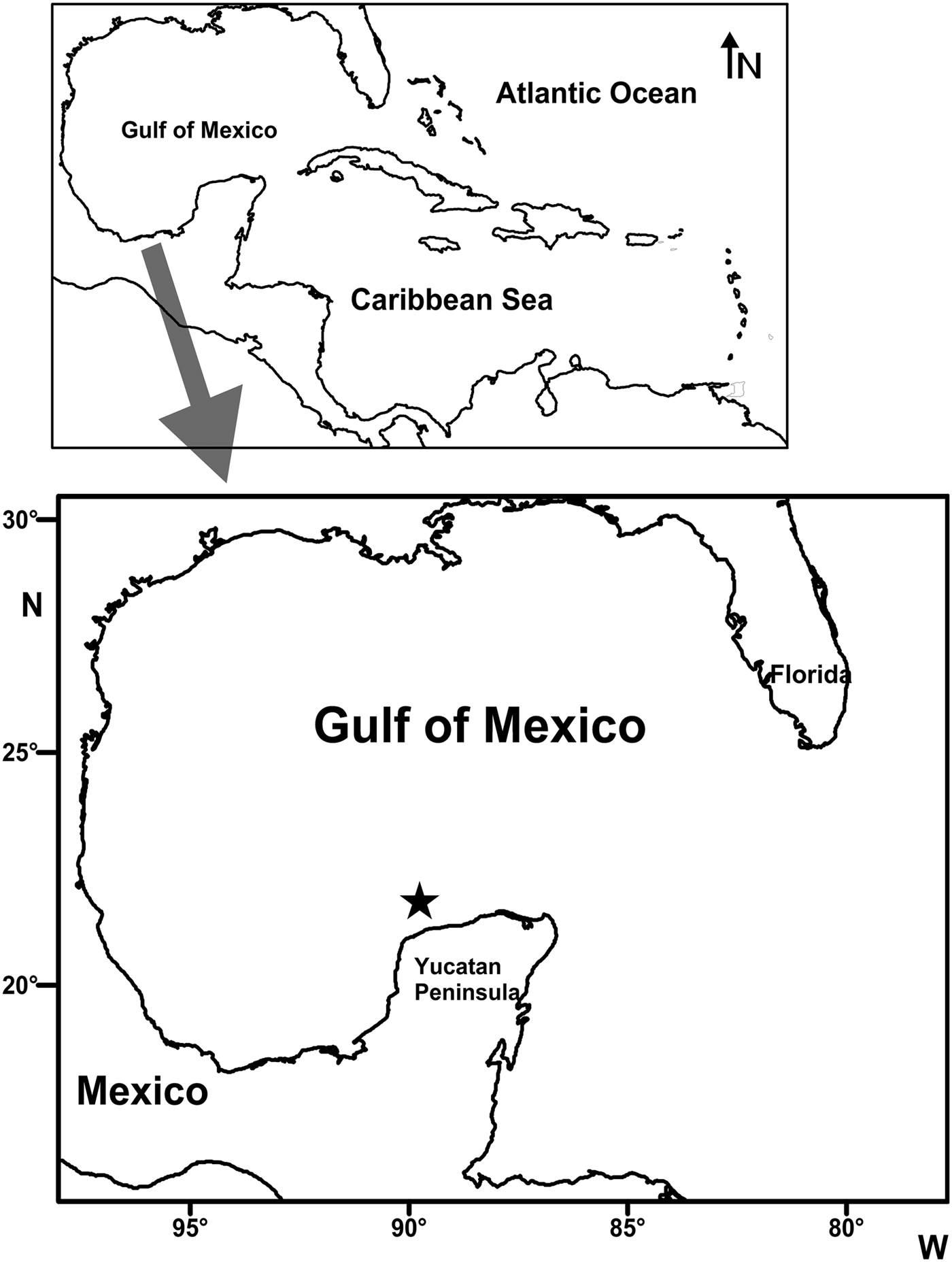
Amphipods were collected in the SAS, which is located west to Puerto Progreso, Yucatan, Gulf of Mexico. This is formed by three reefs (Sisal, Madagascar and Serpientes) that extend from the shoreline out ~30 km. The SAS is demarcated by a polygon with the following coordinates: 21°20′N 90°14′W and 21°14′N 89°53′W (Figure 1).
Map of the Gulf of Mexico showing the sampling locality.

Ochlesid amphipods were collected from two sampling stations: Sisal reef (Sisal Bocana station 21°13′56.5′′N 89°53′20.1′′W) associated with macroalgae beds (Chnoospora minima and Wrangelia biscuspidata) at 5 m depth, on 6 July 2012, and Bajo de diez station (21°20′50.8′′N 90°08′53.0′′W) associated with macroalgae Dictyopteris delicatula at 12 m depth, on 4 July 2012. The macroalgae beds were collected manually by SCUBA divers, and placed underwater in sealed plastic bags. Onshore, 1:1 formalin–ethanol was added to the plastic bags for transportation to the laboratory, where samples were preserved in 70% ethanol. Ochlesids were transferred to glycerin for dissection, illustration and microstructure analysis under a Motic dissecting microscope (SMZ–175) at the Crustacean Laboratory, Facultad de Estudios Superiores Iztacala, Universidad Nacional Autónoma de México (FESI; UNAM).
The species was drawn using a camera lucida and CorelDRAW V.12. The type material is deposited in the Colección Nacional de Crustáceos (CNCR), IB–UNAM, Mexico. We followed taxonomic concepts and terminology for setae and mouthparts proposed by Thomas (Reference Thomas1983), Lowry & Myers (Reference Lowry and Myer2003), Coleman & Lowry (Reference Coleman and Lowry2006), Fidelis de Souza & Serejo (Reference Fidelis de Souza and Serejo2008), and Coleman & Heinz (Reference Coleman and Maturana Heinz2011).
SYSTEMATICS
Order AMPHIPODA Latreille, 1816
Suborder GAMMARIDEA Latreille, 1802
Family OCHLESIDAE Stebbing, 1910
Genus Curidia Thomas, Reference Thomas1983
Curidia nunoi sp. nov.
(Figures 2–5)
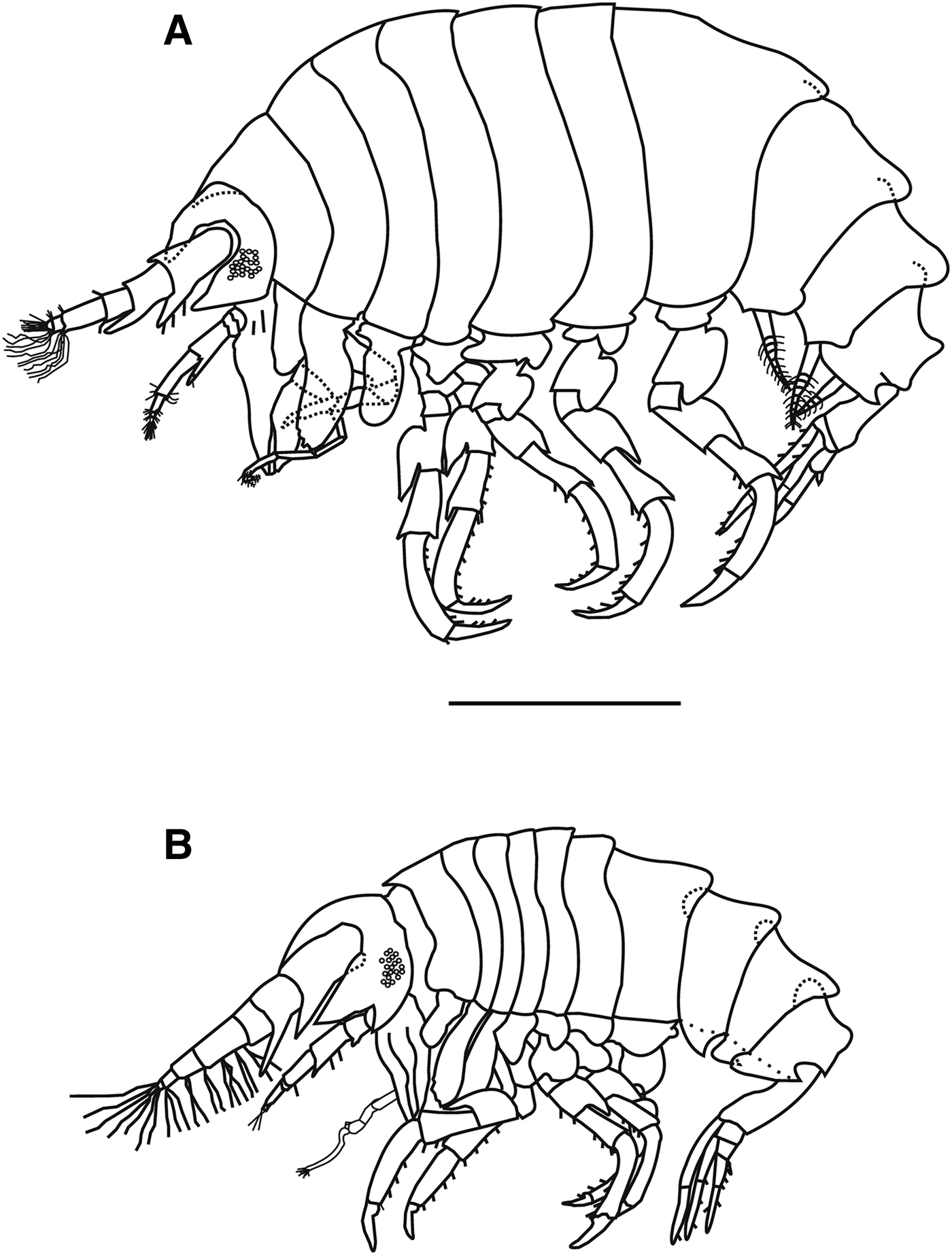
Curidia nunoi sp. nov., holotype female (1.9 mm length): (A) habitus; paratype male (1.5 mm length): (B) habitus. Scale bar: A, B, 0.6 mm.
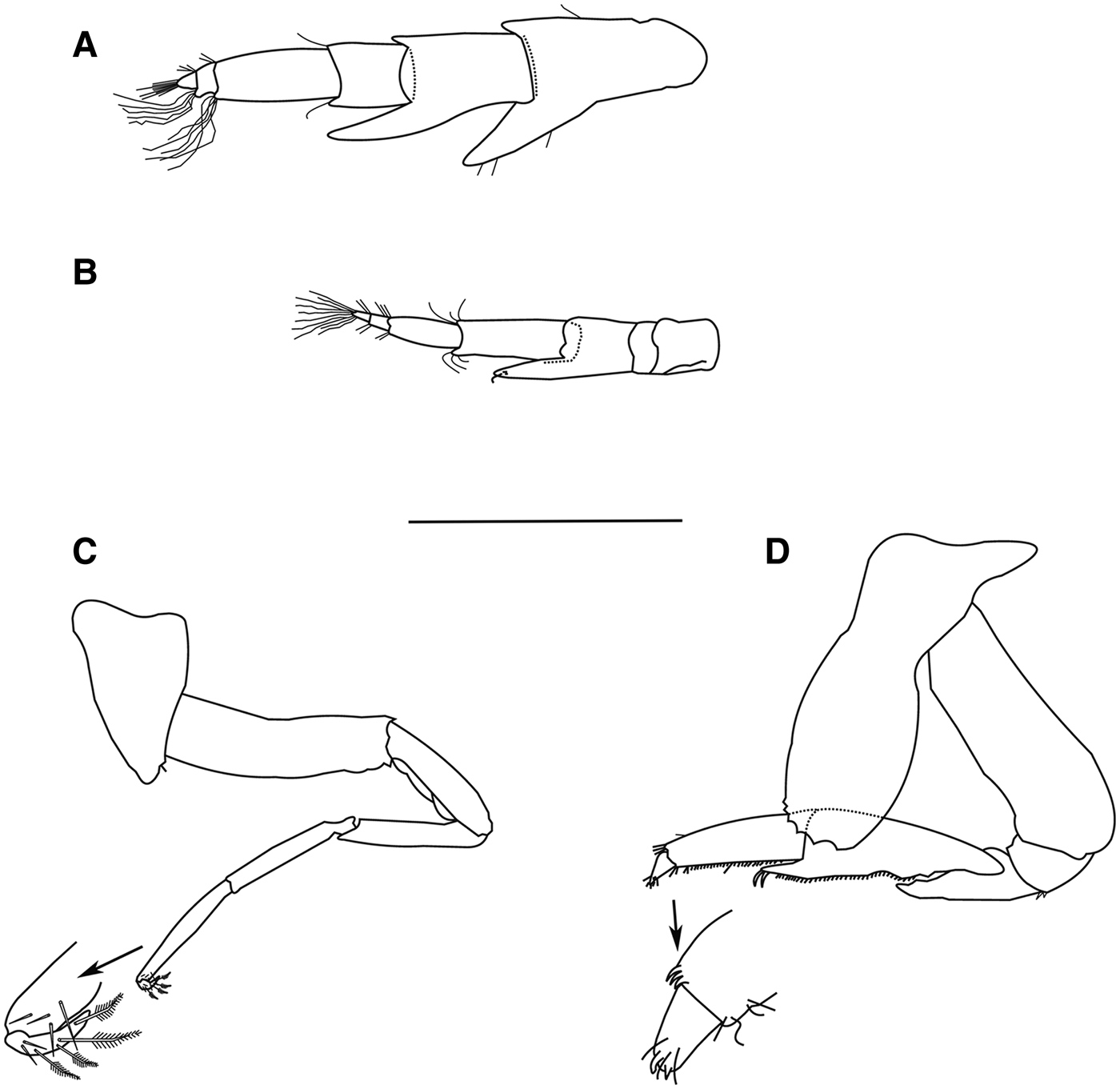
Curidia nunoi sp nov., holotype female (1.9 mm length): (A) antennae 1; (B) antennae 2, (C) gnathopod 1; (D) gnathopod 2. Scale bar: A–D, 0.5 mm.
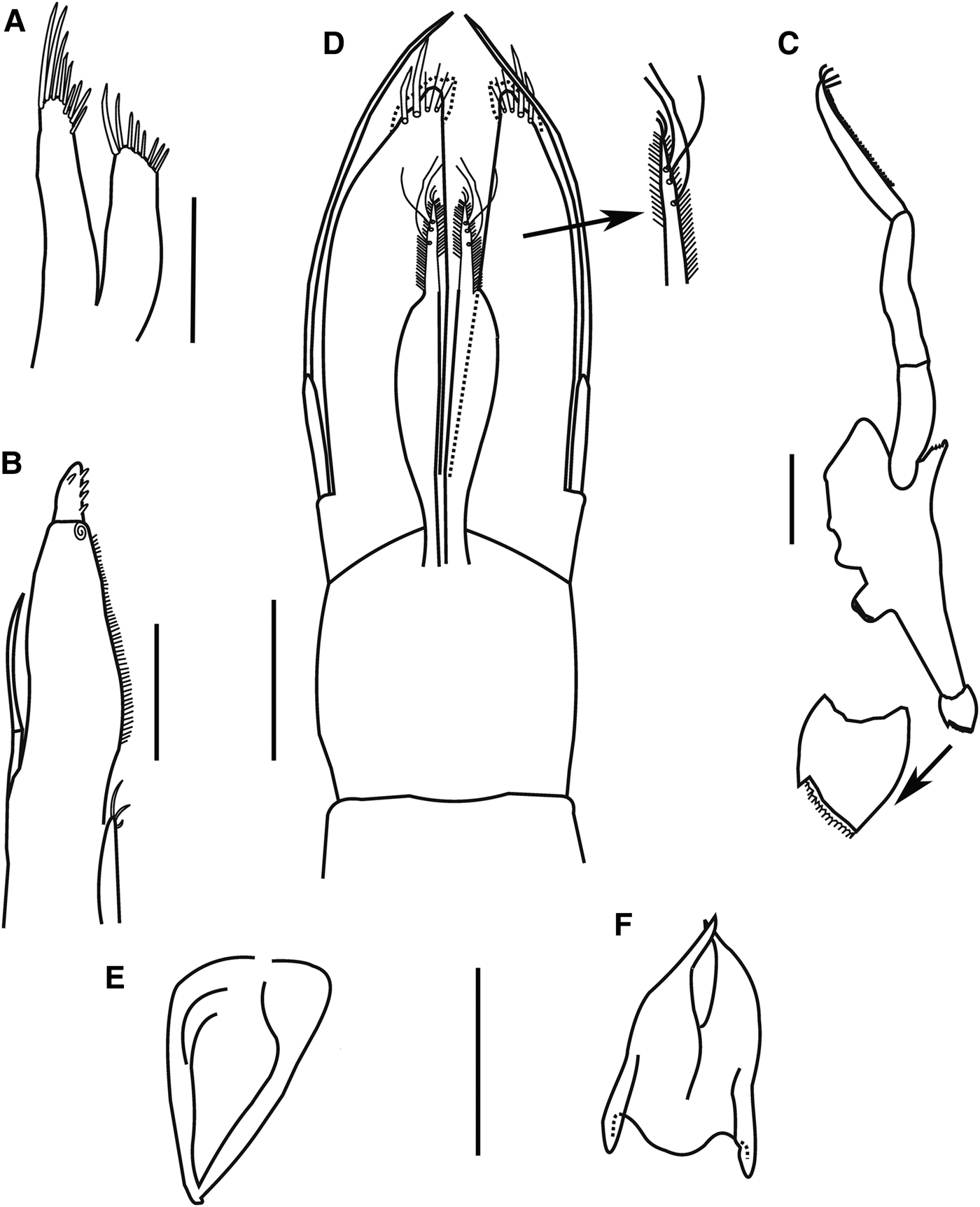
Curidia nunoi sp. nov., holotype female (1.9 mm length): (A) maxilla 1; (B) maxilla 2; (C) mandible; (D) maxilliped; (E) upper lip; (F) lower lip. Scale bar: A–F, 0.1 mm.
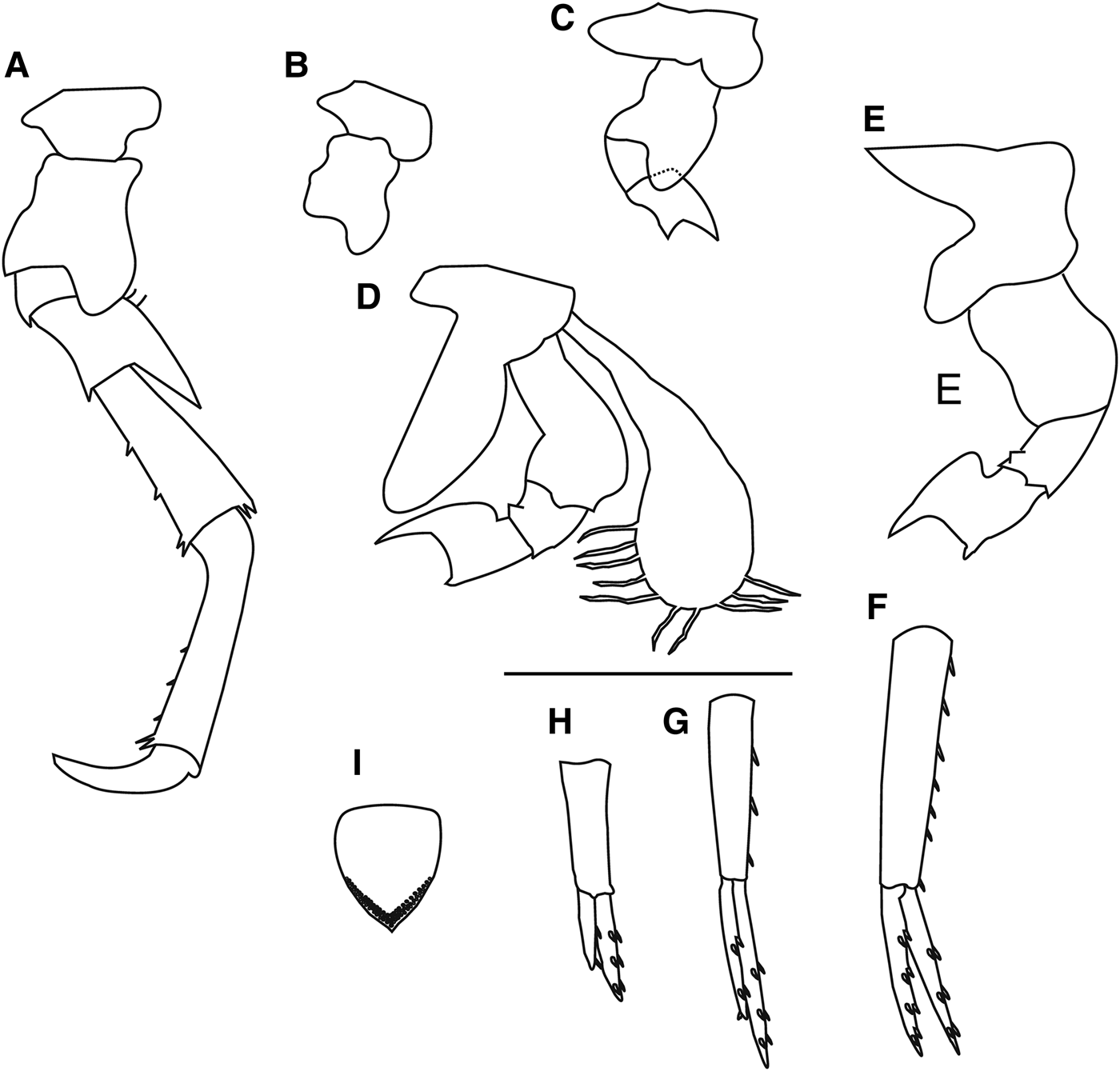
Curidia nunoi sp. nov., holotype female (1.9 mm length): (A) pereopod 7; (B) pereopod 6; (C) pereopod 5; (D) pereopod 3; (E) pereopod 4; (F) uropod 1; (G) uropod 2; (H) uropod 3; (I) telson. Scale bars: A–E, 0.9 mm; F–H, 0.3 mm; I, 0.04 mm.
TYPE MATERIAL
Holotype: adult female, 1.9 mm length; CNCR #27871; Sisal Bocana Station (21°13′56.5′′N 89°53′20.1′′W), Sisal Coral Reef System, south-east Gulf of Mexico; associated with macroalgae Chnoospora minima and Wrangelia biscuspidata at a depth of 5 m; Ignacio Winfield coll., 6 July 2012.
Paratypes: adult male, 1.5 mm length; CNCR #27872; same station data as holotype.
OTHER MATERIAL EXAMINED
Seven females: 2.1 mm, 2.0 mm, 2.0 mm, 2.0 mm, 1.9 mm, 1.9 mm and 1.8 mm; nine males: 1.5 mm, 1.5 mm, 1.5 mm, 1.3 mm, 1.3 mm, 1.2 mm, 1.1 mm, 1.1 mm and 1.1 mm length; CNCR #27873; Sisal Bocana Station (21°13′56.5′′N 89°53′20.1′′W), Sisal Coral Reef System, south-east Gulf of Mexico; associated with macroalgae Chnoospora minima and Wrangelia biscuspidata at a depth of 5 m; Ignacio Winfield coll., 6 July 2012. Five females: 1.9 mm, 1.9 mm, 1.8 mm, 1.8 mm and 1.8 mm length; three males: 1.2 mm, 1.1 mm and 1.1 mm length; three juveniles: 1.0 mm, 1.0 mm and 0.9 mm length; Bajo de diez Station (21°20′50.8′′N and 90°08′53.0′′W) associated with macroalgae Dictyopteris delicatula at a depth of 12 m, Ignacio Winfield coll., 4 July 2012.
TYPE LOCALITY
Sisal Coral Reef System, south-east Gulf of Mexico (Mexico).
ETYMOLOGY
This new species is named to honour Dr Nuno Simoes, a great friend and a renowned carcinologist of the Unidad Multidisciplinaria de Docencia e Investigación; Facultad de Ciencias, Universidad Nacional Autónoma de México. It is derived from the noun ‘nuno’ in the genitive case.
DIAGNOSIS
Body strongly compressed laterally. Head small with laterocephalic lobe acute and lateroventral lobe subrectangular. Antenna 1 peduncle article 1 with posteroventral spine subequal in length to middle article 2, peduncle article 2 with posteroventral spine subequal in length to spine on article 1. Antenna 2 longer than peduncle of antenna 1. Gnathopod 1 simple. Gnathopod 2 coxa deeper than coxa 1, ventrally rounded with distal margin dentate. Upper lip triangular and large. Lower lip slender with apices extended. Mandible with incisor simple, cutting edge present; molar cup-like and weakly triturative. Maxilla 1 outer plate with four robust setae distomarginally, and another distomedially, a rounded process subdistally. Telson entire with some rows of minute granules submarginally.
DESCRIPTION
Holotype: adult female, 1.9 mm length; CNCR #27871. Body strongly compressed laterally (Figure 2A). Head: small, not partially hidden by pereonite 1, rostrum normal; laterocephalic lobe acute, lateroventral lobe subrectangular. Pereon: pereonite 1 slightly wider than pereonite 2, forming a small rostrum-like anterior process. Pereonites 2–6 subequal in width. Pereonite 7 widest, with a dorsodistal blunt protuberance. Pleon: pleonite 1 and 2 each with a medium apically rounded dorsodistal protrusion, pleonite 3 with a slender slightly upright hump, smaller than protrusion on pleonite 2. Epimeral plates 1 and 2 each with a small protrusion on posteroventral corner, epimeron 3 posteromedial margin excavate, with a posteroventral pointed hump.
Antenna 1 (Figure 3A) peduncle article 1 with posteroventral protuberance, subequal in length to middle article 2; peduncle article 2 with posteroventral protuberance, subequal in length to protuberance on article 1, reaching distal margin peduncle article 3; article 3 shortest; flagellum 3-articulate, article 1 and 2 with distoventral setae; accessory flagellum absent.
Antenna 2 (Figure 3B) longer than peduncle of antenna 1, peduncle article 4 with distoventral protuberance, protuberance as long as 0.75× length of article 5, elongate with subdistal simple setae.
Mouthpart bundle styliform (Figures 1A, 4A–F); upper lip triangular, large; lower lip slender, apices extended, mandibular process produced downwards; mandibles massive, right mandible with incisor simple, small, with cutting edge; small lacinia mobilis (lacinia mobilis of left mandible smaller); molar cup-like, small and weakly triturative; palp 3-articulate, article 1 slightly shorter than article 2, article 2 curved medially, article 3 long with a row of tiny setae marginally, and four setae distally. Maxilla 1 inner plate small, with three distal setae; outer plate elongate, with four robust setae distomarginally and another distomedially, a rounded process subdistally, and a row of lateral setules; palp 1-articulate, short with a long apical seta reaching 2/3 of row of lateral setules. Maxilla 2 inner plate smaller and wider than outer plate, nine distal setae on outer plate and eight on inner plate. Maxilliped palp 1-articulate, slender, with a long apical seta, longer than distal margin of outer plate; outer plate elongate and longer than inner plate, apical margin with two robust setae and four simple setae subdistally; inner plate narrow and elongate with three setae distally and two rows of setae medially.
Gnathopod 1 (Figure 3C) simple, coxa anterior margin straight and apically rounded; basis elongate, shorter than merus and carpus combined; ischium, merus, carpus and propodus subequal in length; dactylus with some plumose setae.
Gnathopod 2 (Figure 3D) coxa deeper than coxa 1, ventrally rounded, distal margin dentate; basis elongate; merus posterodistal angle with truncate process; carpus with distal process with two robust setae, ventral margin with minute and equidistant setae; propodus slightly shorter than carpus, three short robust setae on distodorsal margin; dactylus stout with three simple and two robust setae.
Pereopods (Figure 5A–E): pereopod 3 coxa shorter than coxa 2, ventrally subacute, anteroproximal part with a sub-rectangular process, anterodistal margin slightly produced; basis slightly increasing in width distally, ischium short and broad; merus with anterodistal acute process; carpus shorter than propodus, and increasing in width distally; propodus elongate and curved, proximally with several posterior setae; dactylus elongate. Pereopod 4 coxa broad, anteriorly excavate; basis broad; ischium to dactylus similar to pereopod 3. Pereopod 5 coxa longer than broad, slightly excavate ventrally, anterior margin produced; basis wide, posteroventral angle rounded; ischium to dactylus similar to pereopods 3. Pereopods 6 and 7 similar; coxae longer than broad; basis to dactylus similar to pereopod 3.
Uropods (Figure 5F–H): uropod 1 peduncle longer than rami, with several small robust setae marginally; rami elongate, subequal in length; outer ramus with three pairs of submarginal robust setae, inner ramus with four pairs. Uropod 2 peduncle subequal in length to outer ramus, with three small robust setae marginally; rami elongate, outer longer than inner ramus; outer ramus with three pairs of submarginal robust setae; inner ramus with two pairs. Uropod 3 peduncle longer than rami; outer ramus longer than inner ramus, with three pairs of submarginal robust setae; inner ramus with two small robust setae marginally.
Telson (Figure 5I) entire with some rows of minute granules submarginally, distal margin acute.
DESCRIPTION OF MALE
Male (sexual dimorphism) based on adult paratype (Figure 1B), 1.5 mm length. Male habitus smaller and narrower than female. The pereonites 2–6 are shortened; epimera 1–2 are shortened with a pointed hump ventrally. The shapes of coxae 3–5 are very different compared to female. Antenna 1 is much longer than antenna 2 and bears long aesthetascs on ventral side of the flagellum. The ventral margin of the head is bifurcated compared to female.
HABITAT
Curidia nunoi sp. nov. was associated with a mixture of algae Chnoospora minima, Wrangelia biscuspidata and Dictyopteris delicatula ranging from 5 to 12 m depth.
TAXONOMIC REMARKS
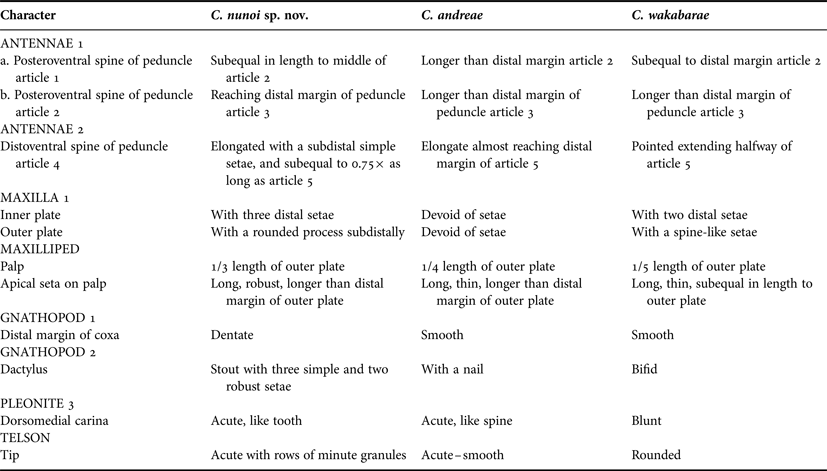
A comparison of females of Curidia species indicated that C. nunoi sp. nov. is morphologically more similar to C. wakabarae from Brazil and C. andreae from Australia. All three species share a developed rostrum, an acute laterocephalic lobe, they all have processes or protrusions on pereonite 7 and pleonites 1–3, and the shape and length of coxa 1 and articles of gnathopod 1. Curidia nunoi sp. nov., however, is easily distinguished from these two species by the following combined characteristics: the shape and length of posteroventral protuberance of peduncle article 1 and article 2 of antenna 1; the length and shape of distoventral protuberance of peduncle article 4 of antenna 2; the distal margin dentate of coxa of gnathopod 2; the setae on dactylus of gnathopod 2; the inner and outer plates of maxilla 1, and the distal margin of the telson. Major differences are summarized in Table 1.
The more significant morphological characters used to compare females of Curidianunoi sp. nov. to the two closely related species C. wakabarae and C. andreae.
BIOGEOGRAPHICAL REMARKS
Including the new species described in this paper, there are eight nominal species belonging to the genus Curidia: C. andreae Coleman & Maturana Heinz, Reference Coleman and Maturana Heinz2011; C. debrogania Thomas, Reference Thomas1983; C. knoxi Lowry & Myers, Reference Lowry and Myer2003; C. magellanica Coleman & Barnard, Reference Coleman and Barnard1991; C. monicae Ortiz et al., Reference Ortiz, Lalana and Varela2007; C. ramonae Lowry & Myers, Reference Lowry and Myer2003, C. wakabarae De Souza-Filho & Serejo, 2008 and C. nunoi sp. nov.
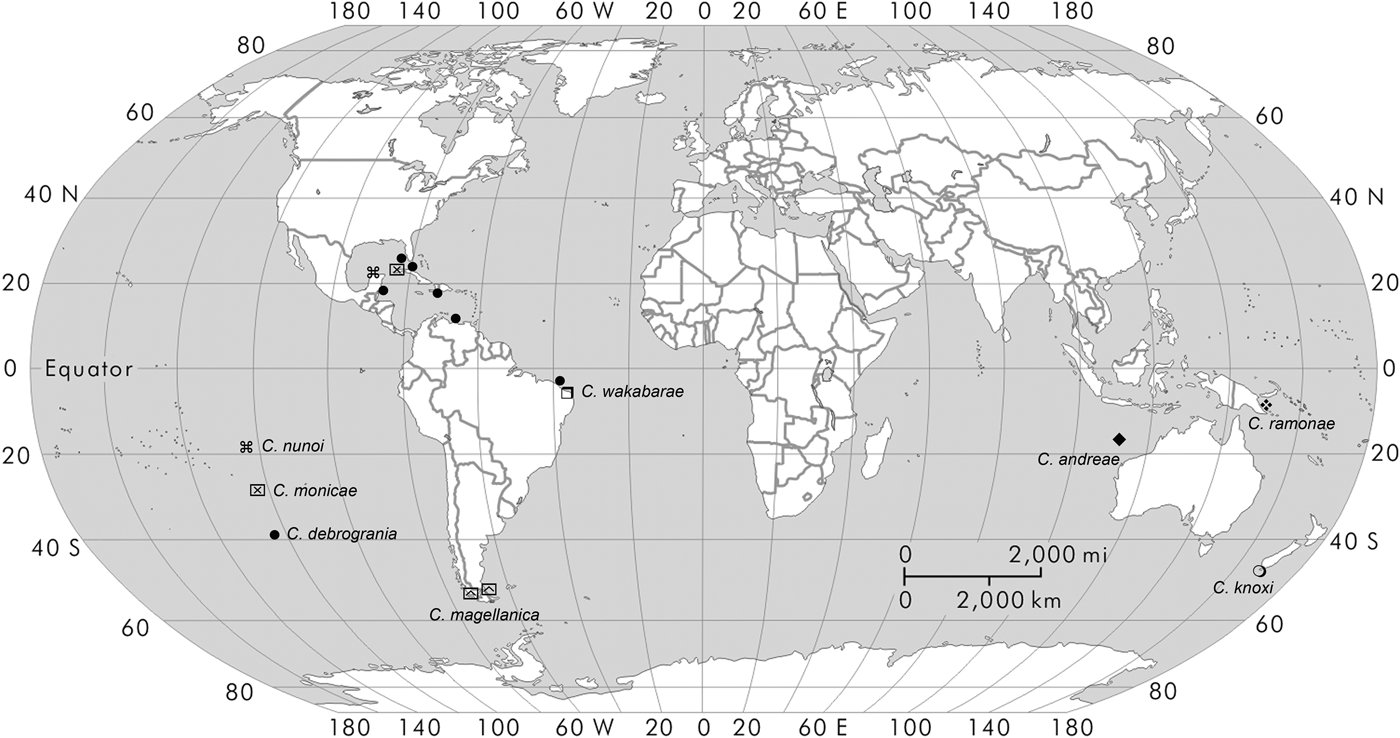
Until now, the global geographical distribution of the genus Curidia has been mostly from 40°N to 10°S, corresponding to tropical and subtropical seas; five species have been documented in the southern hemisphere and three in the northern hemisphere (Figure 6). Based on this geographical pattern, five species (C. debrogania, C. monicae, C. wakabarae, C. magellanica and C. nunoi sp. nov.) are known from the western Atlantic coasts, in contrast with the shallow waters of Oceania and the eastern Pacific, with four species (C. ramonae, C. andreae, C. magellanica and C. knoxi) (Figure 6). Only, C. debrogania, C. monicae and C. nunoi sp. nov. are restricted to the Gulf of Mexico and the Caribbean Sea.
Current global distribution of all species of genus Curidia. Marks indicate the records where the eight species have been found.
ACKNOWLEDGEMENTS
The authorities of the Agriculture and Fisheries Secretariat (SAGARPA;CONAPESCA–DGOPA02921.290411.1172), and the Administración Portuaria Integral Progreso (API, Puerto Progreso), Yucatán, are thanked for granting the necessary permits to sample within the coral reef. Reviews by Dr Oliver Coleman and Dr Traudl Krapp-Schickel significantly improved the manuscript. We thank in particular M.A. Lozano Aburto and C.M. Bedia Sánchez for their help in subaquatic activities.
FINANCIAL SUPPORT
We gratefully acknowledge the funds obtained through grants from the Universidad Nacional Autónoma de México (PAPIME–PE207311 and PAPCA–FESIztacala–2013 (Numeral 2) projects).