Political economy and fiscal administration have been fundamental to Chinese conceptions of governance since even before the founding of the first empires in the late first millennium BCE. Philosophers of the Warring States era (fifth–third centuries BCE) shared a common belief in the ability of—and the necessity for—the ruler to provide for the economic welfare of his subjects through wise and just fiscal policies and practices. Although the chapters on “food and money” (shihuo 食貨) appear after the chapters on cosmic order and ritual propriety in official dynastic histories since the creation of the genre by the court historian Ban Gu in the first century CE, the renowned historians Du You 杜佑 (735–812) and Ma Duanlin 馬端臨 (1245–1322) gave them pride of place at the beginning of their monumental encyclopedias of Chinese institutions, the Tongdian 通典 and Wenxian tongkao 文獻通考 respectively. Implicit in Chinese conceptions of political economy since antiquity is faith in the capacity of the state and its agents to serve as positive forces for the creation and equitable distribution of wealth. By contrast, the very conception of the state as a crucial arena of economic action was largely absent from the Western philosophical tradition before the turn of the sixteenth century, and mainstream economics today takes a dim view of the state's role in the economic realm. Economic historians, however, have begun to reassess the importance of the fiscal capacity and actions of the state in economic development.
Standard narratives of economics and economic history depict the state as an impediment to the market forces that drive economic progress and propelled the breakthrough to modern economic growth that occurred in Britain in the seventeenth–eighteenth centuries. According to the orthodoxy of neo-classical economics, it is the autonomy and impersonality of markets that enable efficient allocation of productive factors (land, labor, capital, and technology) in ways that generate the highest returns, both in private profit and social benefits. But the rise of the “new institutional economics” during the past several decades has given a particular inflection to this narrative by underscoring the importance of political as well as economic institutions. In Douglass North's now-classic formulation, “institutions are a set of rules, compliance procedures, and moral and ethical behavioral norms designed to constrain the behavior of individuals in the interest of maximizing the wealth or utility of principals.”Footnote 1 In his study of the origins of modern economic growth in early modern Europe, North singled out Britain's creation of sovereign property rights as the essential catalyst for the development of competitive markets and the expansion of commerce, which in turn fostered the innovations in agriculture, industry, and finance that culminated in the Industrial Revolution. In North's analysis, and in new institutional economics narratives generally, the English “Glorious Revolution” of 1688 is upheld as an epochal watershed in human history: by acquiring the power to restrain the executive powers of the monarchy, the English Parliament protected property rights from royal predation, prevented arbitrary taxation and confiscation, and promoted entrepreneurship and market competition.
In contrast to standard neo-classical economics, new institutional economics theorists assert that a strong central state plays an essential role in creating “inclusive” institutions. It is vitally important for the state to use its powers to promote the economic welfare of its subjects by establishing domestic law and order and securing national defense. But states and rulers are seen as having an inherent tendency toward extraction of wealth for their exclusive benefit. In the influential thesis of Daron Acemoglu and James A. Robinson, sustained economic growth requires “inclusive” economic institutions, which in turn are secured by pluralistic political institutions, that is to say, some form of representative government that precludes the monopolization of wealth by a narrow elite. What distinguishes the Acemoglu–Robinson analysis from conventional economics is their emphasis on the necessity of strongly centralized government as well as broadly inclusive political institutions. Like North, Acemoglu and Robinson herald the Glorious Revolution as the pivotal moment for the creation of a strong but politically inclusive state (albeit more oligarchic than democratic) that instituted domestic law and order, steadfastly enforced property rights (especially patents, which others might view as a special form of monopoly), and aggressively promoted mercantile interests at home and abroad. The set of inclusive economic institutions fostered by the English state stimulated investment and entrepreneurship, which in turn promoted the ultimate “engines of prosperity”—education and technological innovation.Footnote 2
The new institutional economics model of Acemoglu and Robinson seeks to square economic theory with the historical reality—uncomfortable to neo-classical economics—that the commercial expansion of the early modern era and the breakthrough to modern economic growth was accompanied not by a diminution but rather an expansion of the visible hand of the state in economic life. In John Brewer's characterization, eighteenth-century Britain was a “fiscal-military state” that amassed vast fiscal and military resources in service of a war-based strategy of commercial growth and colonial conquest by instituting a level of taxation that dwarfed rivals such as France. The success of Britain's fiscal-military state was owed to a much bigger but also more efficient state administration.Footnote 3 According to Michael Mann, Britain achieved a surpassing “infrastructural power” (in ideological, economic, military, and fiscal dimensions) generated by the uniquely organic unity of constitutional monarchy and capitalist landed and commercial elites.Footnote 4 Mann, too, emphasized the development of the “permanent war-making state” as a signal feature of European politics generally in the eighteenth century. What made “constitutional states” such as Britain and Netherlands distinctive was not the limited degree of state extraction—on the contrary, they had the highest per capita taxation in the world—but rather the degree to which taxation was enacted with the cooperation and consent of the ruling classes, rather than using the coercive means of “absolutist states” such as France and Spain.Footnote 5
In contrast to the once-prevalent portrayal of the state as inherently predatory, recent scholarship in European economic history has underscored the ways in which the weakness of the state inhibited effective fiscal policymaking as well as the development of institutions favorable to economic growth (such as well-defined and legally enforced property rights). Drawing on the negative example of the late medieval Italian city-states, S.R. Epstein concluded that the national state's jurisdictional sovereignty over territory and revenues enhanced market integration, reduced transaction costs, strengthened domestic industries, and enabled more equitable taxation.Footnote 6 David Ormrod has traced the “great divergence” in British and Dutch economic growth during the eighteenth century to the weak federal government of the Dutch Republic, which frustrated the development of coherent and consistent economic policies. Britain's adoption of markedly mercantilist policies, beginning with the Navigation Acts of 1651 and 1660, presaged both political and commercial success, especially in its rivalry with the Dutch. Ironically, at the same time that mercantilist policies enabled the British to wrest control of seaborne trade in the Baltic and North Seas and achieve dominance over the Atlantic economy, Dutch capital fled Amsterdam for the richer opportunities to be found in London.Footnote 7 The crucial importance of militarism and mercantilism to Britain's economic development in the eighteenth century and eventually to its rise as the first industrial nation is now widely acknowledged.Footnote 8
The renewed attention devoted to the positive role of the state in economic development has stimulated reconsideration of the impact of fiscal systems on state formation and economic growth. The plethora of “new fiscal history” scholarship that has been produced during the past several decades originated with Schumpeter's idea of the “tax state” as the backbone of the modern state. Conceived strictly within the context of European history, Schumpeter's “tax state” was a product of the transition from medieval polities in which revenues largely derived from the personal domain of the prince to the early modern state (i.e., nascent nation-states) in which taxation was levied and legitimated within a well-defined system of property rights and state protection.Footnote 9 Warfare, colonization, and mercantilist policies drove efforts to rationalize tax systems in order to meet the rising costs of military defense and aggression. The rise of the fiscal state in Europe also occurred in tandem with a fundamental shift away from direct taxation of people and property and toward indirect taxation of commerce and consumption.Footnote 10 In contrast to Weber's classic definition of the state as an institution that exercises a monopoly over the use of violence within a defined territory, economic historians increasingly emphasize the power of the state to levy permanent taxation.Footnote 11 As Schumpeter himself put it, “‘tax’ has so much to do with ‘state’ that the expression ‘tax state’ might almost be considered a pleonasm.”Footnote 12 Still, the impetus behind the emergence of the tax state can be traced to the rise of large-scale, capital-intensive warfare triggered by the pursuit of power both within Europe and around the globe.
The “tax state” in early modern Europe established a new institutional and legal constitution for raising and expending resources. The monarch's seigneurial rights over his personal domain were separated from public revenues designated for the maintenance of the government and the provision of public goods including internal and external security, popular welfare, and economic infrastructure. Regular taxation—both directly on land, people, and resources and indirectly on commerce and consumption—replaced arbitrary exactions, confiscations, and a hodge-podge of royal prerogatives as means of raising revenues. Permanent taxation also required the creation of a professional bureaucracy under the control of the central government. There was a general trend toward collecting taxes in money rather than in kind, and increasingly frequent resort to borrowing funds in credit markets, using future tax payments as collateral. The enhanced fiscal role of the state also encouraged increasing state intervention in the economy through supervision of markets, control of the food supply, the creation of monopolies, and especially mercantilist trade policies.
State taxation was by no means novel in the early modern period. During the medieval period, fiscal crises—typically, as in the early modern era, the result of warfare and military emergencies—propelled fiscal changes that expanded the revenue-gathering powers of the monarch. A notable example was England in the twelfth and thirteenth centuries.Footnote 13 But these provisional enhancements abated. In the early modern period, by contrast, the medieval domain states were supplanted by tax states throughout Western Europe. Competition for colonial treasure and mercantile profit initially developed within the framework of domain states. Spain's American empire was founded on the principles of a domain state, and the Portuguese crown arrogated to itself a royal monopoly on Asian trade. The conventional image of imperial Spain as a highly centralized and predatory tributary state gradually has been revised by the recognition that the fiscal structure of its “composite monarchy” was starkly asymmetrical: in contrast to the royal fisc's deep penetration into and extraction from the Castilian countryside, revenues from the other Habsburg domains and the American colonies were mostly retained locally (or, in the case of colonies, redistributed among them).Footnote 14 Still, the repatriation of American treasure also enabled Spain to pioneer the development of a consolidated system of public debt through the issue of long-term, low-interest bonds (juros), which became the mainstay of its fiscal system.Footnote 15
The degree of progress toward the creation of a modern fiscal state varied even among the richest European economies. In the Dutch Republic, the formation of a fiscal state evolved gradually, rather than as the consequence of a fiscal crisis, and still remained incomplete at the time of the republic's demise in 1795. In the early sixteenth century the Habsburg monarchy granted the towns and provinces of Spanish Netherlands domainal privileges and tax-levying powers in exchange for repartition of fixed revenue quotas. This pattern of political autonomy and fiscal decentralization persisted under the Dutch Republic. Forged in the crucible of wars of independence against the Habsburg monarchy, the republic consisted of a congeries of provinces and municipalities united in common defense but lacking centralized government or fiscal planning. Even the vaunted Dutch navy was divided into five independently financed admiralties. The sole centrally administered fiscal institution was the maritime customs, but the Dutch Republic taxed trade very lightly and collected only a fraction of the customs revenues amassed by the British, French, Spanish, or Portuguese. In the early years of the republic, the Dutch provinces relied heavily on excises levied on consumption and the possession of land, cattle, and servants. Up to the onset of the wars with France beginning in 1672, the prosperity of the Dutch Golden Age kept pace with rapidly escalating costs of military expenditures; although the Dutch had by far the highest per capita taxation in Europe, the real tax burden remained essentially unchanged. The substantial rise in the real tax burden after 1672 was accompanied by a shift from regressive excises to direct taxation levied on property and wealth, with the affluent shouldering a greater share of taxation.Footnote 16 But the diffusion of fiscal sovereignty among numerous jurisdictions compounded the economic torpor of the Dutch Republic in the eighteenth century and impeded mobilization of resources and coordination of economic policy amid the intense mercantilist competition that engulfed the European states.Footnote 17
In Britain, the Civil War and its aftermath acted as the catalyst for the emergence of a new fiscal constitution based on an elite consensus that favored a stronger central state to maintain domestic peace and to advance Britain's growing commercial interests overseas.Footnote 18 Foreign wars and aggressive mercantilist policies led to massive spending increases, especially to support Britain's formidable navy, and soaring national debt. Parliament, which by 1697 had acquired full control over taxation, sharply increased revenues through excise taxes on consumption and customs duties on imports, while sparing the landed property of the aristocracy. In the first quarter of the seventeenth century per capita tax revenues in Britain were more than two times greater than in France.Footnote 19 What truly distinguished Britain was not the magnitude of state revenues, however, but rather its remarkable success in gaining the compliance of the ruling elites to accept the enhancement of the state's fiscal powers and in developing—by the standards of the time—an efficient bureaucracy for tax assessment and collection.
Despite the uneven development of tax states and the diverse forms they took, there is general agreement that a “fiscal revolution” occurred in Western Europe in the early modern era that redefined the relationship between the state and its subjects.Footnote 20 The vastly greater scale of the costs of war rendered the limited fiscal capacity of the domain state obsolete, leading to permanent forms of taxation and public debt (which in turn required permanent tax revenues as collateral). Actual tax systems—which had to be negotiated with corporate bodies, estates, and representative institutions—varied significantly in the types of taxation they imposed, the equitability of the tax burden, their capacity to raise revenues, and their impact on the private economy. Even the new forms of taxation often were too limited to meet the extraordinary costs of military expenditure, necessitating persistent recourse to borrowing. Debt repayments constituted roughly two-thirds of total Dutch public expenditure during the eighteenth century.Footnote 21 Government debt has been estimated at 182 percent of GNP in Britain and 56 percent of GNP in France in 1788, and as much as 250 percent of GNP in the Netherlands in 1807.Footnote 22 More important than the course or pace of change in fiscal systems, however, was the broad trend toward centralization of state power abetted by mercantilist strategies of political and economic competition.Footnote 23
Within the context of global history, the new fiscal history scholarship has inspired comparative study of the contrasts in state formation and economic development between the nascent Western Europe nation-states and Eurasian empires in the early modern period. Echoing Charles Tilly, Patrick O'Brien has emphasized the role of competition among European states in promoting emulation of and convergence in fiscal strategies and mercantilist trade policies intended to strengthen state power and national economies. By contrast, contemporary Eurasian empires such as the Ottomans, the Mughals, and Manchu/Qing China were unable or unwilling to mobilize revenues on a scale sufficient to make transformational investments in public goods and services. Although the Eurasian empires commanded substantial fiscal resources by the standards of European states at the dawn of the sixteenth century, the size and composition of their revenues remained static or declined (especially in per capita terms) during the following centuries. Fiscal powers and resources became increasingly decentralized, and fiscal efficiency steadily eroded.Footnote 24 Emphasizing the differences in ideological commitments and claims on state resources in China compared to Europe, R. Bin Wong has proposed that the ideals of good governance in Qing China (1644–1911) were based on light taxation, laissez-faire economic policies, and the provision of social goods such as flood control, irrigation systems, and famine relief. The Qing state's ethic of “agrarian paternalism” and minimal state extraction encouraged Smithian dynamics of economic growth in the private sphere: the formation of national markets, regional economic development based on comparative advantages in resources, and the free mobility of labor and capital.Footnote 25 More problematic, however, is the assertion by Wong and his collaborator Jean-Laurent Rosenthal that the “early modern Chinese political economy was more explicitly intended to foster economic growth than European political economies.”Footnote 26 Peer Vries has rebutted this thesis in his comparative analysis of fiscal governance in Britain and China in the eighteenth-nineteenth centuries. Vries contends that Qing China—which faced no serious challenge to its rule between 1683 and 1850—did not develop the macroeconomic institutions and policies to penetrate local society and extract revenues on a scale comparable to Europe's mercantilist governments. Vries agrees that the Qing state—in contrast to the stereotyped image that continues to recur in works such as Acemoglu and Robinson—was frugal rather than predatory: he calculates that per capita revenues in Qing China amounted to only one-eighth of the level of Britain ca. 1750. But in Vries's view Qing China's “weak infrastructural state” contributed little to economic growth.Footnote 27 Although Wong and Rosenthal may well be correct in concluding that the Qing state's agrarian paternalism was more conducive to a Smithian dynamic of market expansion and division of labor than European mercantilism, the argument that it was not Smithian dynamics but rather a Schumpeterian logic of asymmetric markets, infrastructural development, investment in strategic industries, promotion of new knowledge and technologies, and demand-driven development that promoted economic growth in the early modern world appears increasingly compelling.Footnote 28
Fiscal Regimes in Imperial China
The Europe-centered new fiscal history scholarship has largely adopted the taxonomy developed by Richard Bonney and W.M. Ormrod, which charts an evolution from tribute state (Roman Empire as archetype) to domain state (medieval European polities), tax state (early modern centralizing European nation-states), and the modern fiscal state (first appearing in Britain at the advent of the nineteenth century). To be sure, Bonney and Ormrod emphasize that this progression was by no means necessarily linear, and that specific polities might combine features of more than one of these ideal types. In their view, the fiscal state was characterized by an explicit commitment to self-sustaining growth and the development of institutions—especially sophisticated credit structures such as efficient use of public debt—to facilitate economic growth.Footnote 29 By this definition, the fiscal state is a product of the Industrial Revolution—which made self-sustaining growth possible—rather than its cause. At the same time Bonney and Ormrod trace the origin of the “rise of the fiscal state” in Europe to ca. 1200, with the temporary emergence of a “tax state” in Britain that subsequently reverted to a domain state. In contrast, Bartolomé Yun-Casalilla has proposed a more encompassing conception of the fiscal state in the context of early modern globalization, which eschews typology for “middle-range comparisons” focused on centralization of state power, war, negotiations with dominant elites, and the accumulation of information, while also emphasizing the multiple paths toward the fiscal state.Footnote 30 In general, however, scholars of European history have been cautious in applying the concept of “fiscal state” to premodern regimes, preferring instead the more neutral term “fiscal regime.”Footnote 31
Historians of China have been bolder in defining the premodern Chinese imperial state as a fiscal state. William Guanglin Liu describes Song China as “the first sustainable tax state in global history,” and goes even further in asserting that the Southern Song, by developing a system of credit-based public finance, completed the transition to a fiscal state as defined by the standard criteria of the new fiscal history scholarship. Liu rightly draws attention to the dynamic relationship between state finance and the market economy in the Song, although I have deep reservations regarding his claims for credit-based public finance. Missing from his analysis, however, is any discussion of the fiscal constitution(s) in imperial China, or the reasons for the retreat from the institutional innovations of the Song fiscal state in late imperial China.Footnote 32 For Kent Deng, “fiscal state” essentially designates one whose ruler seeks to maximize income. In his view, such a pattern was exceptional in Chinese history, exemplified only by the Northern Song and late (post-1850) Qing periods. In both of these cases, fiscal crises—the urgent need for massive increases in defense spending in response to dire external (and in the Qing case, also internal) threats—prompted “deviation” from the normative practices of Confucian good governance. Before 1850 the Qing state remained wedded to benevolent but fiscally passive practices of “Confucian state finance” that Deng traces back to the founding of the Han dynasty.Footnote 33
Certainly, the contrast between the benign passivity of Qing “agrarian paternalism” and the aggressive military-fiscalist states of early modern Europe is stark. But over the long arc of imperial history China's fiscal system assumed diverse forms, and it is wrong to assume that the fiscal regime of the Qing era should be taken as representative of a singular Chinese model of fiscal governance. In China, many basic features of the tax state as defined by the early modern European experience—such as the separation of revenues dedicated to the maintenance of the monarch (the “Privy Purse”) from general state income—already had been established under the first empires. I propose to broaden the concept of “fiscal state” to designate precise, centralized planning of taxation and expenditure to satisfy the state's commitments to good governance, including defense of the realm and the economic welfare of its subjects. The institutional apparatus of the fiscal state already was a defining feature of governance in the first Chinese empires. But the empire's fiscal constitution underwent repeated metamorphosis throughout the long imperial era. Moreover, rather than conforming to an evolutionary model of historical development, the principles of fiscal governance in imperial China constituted a repertoire of ideological commitments, institutional capacities, and strategic choices that were adopted (or rejected) on the basis of contingent historical, geo-political, and economic conditions.
This essay will explore the different modalities of fiscal governance across the imperial era in order to assess the changing capacity of the Chinese state to influence economic growth. I propose four basic ideal types of fiscal constitution in Chinese history:
(1) Militarist-Physiocratic: integral to the founding of the first unified empires of Qin and Han, based on a military model of society
(2) Mercantilist: two key but short-lived episodes, marked by extreme centralization of fiscal powers: the reign of Emperor Wu of Han and Wang Anshi's “New Laws” in Song
(3) Synergistic: took form during the Tang–Song transition and held the greatest potential for abetting economic growth
(4) Providential: the Ming-Qing consensus; primacy of Neo-Confucian ideological commitments (a favorable setting for Smithian, but not Schumpeterian, growth)
As these are ideal types, they are by no means mutually exclusive. The instantiation of the fiscal system at any given historical moment was a product of geopolitical context as well as institutional and ideological competition, negotiation, and compromise.
The Militarist-Physiocratic State
The militarist-physiocratic state emerged during the initial rise of the autocratic state amid the fierce interstate warfare and economic competition of the Warring States era. Beginning in the sixth century BCE a series of sweeping military, political, and economic changes transformed the Chinese socio-political order. The patrimonial order of the early Zhou, in which political authority was broadly shared among noble lineages, was eclipsed by autocratic states in which power and economic resources were concentrated in the hands of an exalted ruler.
Stratification within the ruling class intensified, resulting in a vast disparity in wealth and power between the rulers and the rest of the nobility. The next several centuries witnessed the destruction of the old noble lineages and the largely autarkic estate economies under their dominion. Rulers asserted direct control over the land, which they awarded to farming families in return for tax payments, labor service, and military service. The nobility's hereditary rights to office were abrogated, and rulers instead established bureaucratic forms of government in which officials served at the ruler's pleasure. A group of seven or eight states emerged as the dominant contenders for power.
Although most commonly associated with the state of Qin, the militarist-physiocratic regime also was characteristic of the other leading macro-states of the Warring States era such as Qi, Yan, and Chu. In contrast, a more federal form of governance prevailed in the core states of the Central Plain such as Wei, Hann, and Zhao, which would be better understood as leagues of mercantile cities. The Central Plain was blanketed with a dense network of commercial cities that were centers of trade and mass production of industrial goods, especially iron weapons, bronze artifacts, pottery, and lacquer wares. Numismatic and archaeological evidence shows that from the inception of coinage ca. 500 BCE long-distance trade was concentrated in the Central Plain but thinned out steeply in the periphery. Thus two models of state-building emerged in the Warring States period: the autocratic monarchs of the peripheral macro-states established strong bureaucratic rule and exercised a high degree of central control over the internal economy, while in the core states of the Central Plain local cities and an independent merchant class enjoyed considerable political and economic autonomy.Footnote 34 Ultimately, the autocratic state triumphed.
The founding of the unified empire of Qin in 221 BCE led to the repudiation of the flourishing commercial world of the Central Plain and the imposition of tight state control over production and exchange. The militarist-physiocratic model instituted by Qin reflected the vision of political economy enunciated in the Legalist treatise The Book of Lord Shang 商君書, which identified warfare and agriculture as the two pillars of state power.Footnote 35 Since the fourth century BCE, the Qin government had fostered this farmer-soldier ideal by instituting a system of social rank based on military accomplishment that served as the basis for allocating lands and slaves to its subjects. Qin society was organized into paramilitary units for the purposes of military and labor service conscription as well as joint legal liability. Although the merit rank system fostered new forms of economic inequality based on service to the state instead of noble ancestry, in principle all subjects were equal before the ruler.
These principles of equality and uniformity were embedded in the fiscal system. Although we remain uninformed about many aspects of the fiscal system of the Qin Empire, the laws issued by the succeeding Han Empire in 186 BCE—preserved in the corpus of documents excavated at Zhangjiashan—are believed to retain many features of the Qin system. The Han state from its founding instituted uniform capitation taxes (suanfu 算賦)—in coin and labor service—on all adults, male and female (children age 6–14 were also liable for a reduced head tax in coin). Adult men were also liable for military service (two year-long tours of duty). The tax obligations imposed on women were a notable feature of the Han fiscal system (to encourage procreation, tax penalties were imposed on unmarried adult women, while labor service duties were reduced for pregnant and nursing women). Land taxes (collected in grain) were light, only one-thirtieth of yields for most of the Han dynasty. The real burden imposed on the populace was conscript labor service. In the early Han adults were summoned to labor service for one month out of every five, although this arduous regimen was reduced later on. Village headmen recorded in meticulous detail monthly collection of poll and land taxes and fulfillment (or not) of labor service requirements. In one locality adult individuals from three to five households were combined into groups of ten on labor service rosters and assigned duties—one man and one woman at a time—in rotation; but in an adjacent community, households were grouped into pairs for assessing labor services.Footnote 36
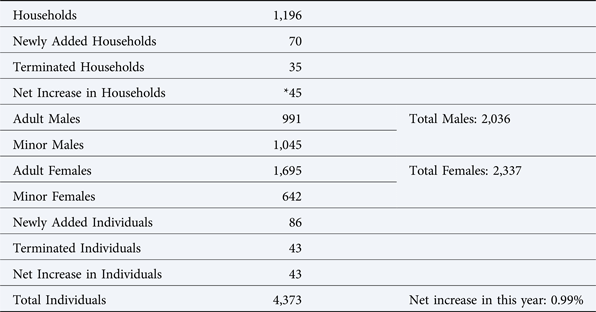
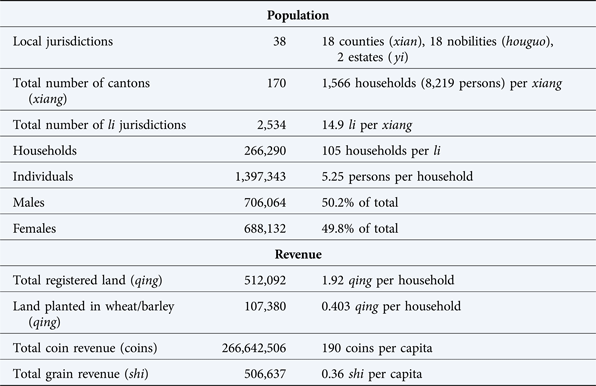
Civil registration became the crux of state power. The Qin–Han tax system was premised on the capacity of the state to exercise command over the most basic economic unit of Chinese society, namely the household (ordinarily understood as a conjugal family, which might include elderly parents and slaves in addition to the married couple and their children). As we can now see from a wide range of administrative documents, census reports, and household registers excavated from tombs during the past several decades, the Qin and Han states did indeed possess this capacity. The “Household Statutes” from Zhangjiashan specify five types of registers compiled by local officials that listed household members, landed property, dwellings and gardens, and tax and service obligations. Local officials were obliged to record inheritances and transfers of property on these registers. Annual household surveys, conducted in the eighth lunar month, recorded births, deaths, and the creation or extinction of households based on household registers compiled by village officers (Table 1). Data on individuals included gender, age, labor and military service liabilities, privileged exemptions, and infirmities that entailed exemption from military service. The household registers also specified landholdings, dwellings, and other productive assets (livestock, vehicles, slaves) and tax obligations. Local officials relayed aggregate information to the central government through a procedure referred to as “submitted accounts” (shangji 上計) in the third lunar month of the following year. The types of statistical information recorded in “submitted accounts” can be seen in the surviving specimen for Donghai commandery (in the lower Huai River valley of eastern China) for 13 BCE shown in Table 2.Footnote 37
Register of Households and Persons, West Canton, Nan Commandery, ca. 139 BCE

* Clearly a calculation error has occurred; probably should read “35”
Source: “Ernian xixiang hukou bu” 二年西鄉戶口簿, cited in Yang Zhenhong 杨振红, “Songbai Xi Han mu buji du kaoshi” 松柏西汉墓簿籍牍考释,” Nandu xuebao (renwen shehui kexue xuebao) 南都学报 (人文社会科学学报) 30.5 (2010), 1.
Census Report for Donghai Commandery, 13 BCE

Units: 1 qing = roughly 5 hectares; 1 shi = 194 liters
Source: Lianyungang shi bowuguan 连云港市博物馆, “Yinwan Hanmu jiandu shiwen xuan” 尹湾汉墓简牍释文选, Wenwu 文物 1996.8, 26.
Despite their enormous territorial and demographic scale (with a population estimated at 44–50 million persons in the late second century BCE), the militarist-physiocratic empires of the Qin–early Han era were deeply embedded in local society. Intensive governance that penetrated society down to the household level was made possible by building a vast apparatus of civil registration, record-keeping, and bureaucratic communication. The “legibility” of society that James Scott sees as strictly the product of the modern state—knowledge of population and resources through the invention of surnames, standardization of weights and measures, freehold land tenure, cadastral surveys and population registration, the standardization of language and laws, and urban spatial design—already was a hallmark of the early Chinese empire.Footnote 38 This legibility was necessary to the institution of universal conscription for military and statutory labor service that was the foundation of imperial rule.Footnote 39 The state also exercised a firm hand in most spheres of economic life. Much industrial production was concentrated in state-run workshops whose labor force was chiefly composed of convicts and government-owned slaves (in addition to skilled artisans performing statutory labor service). Commerce was tightly regulated, and merchants were subject to legal discrimination and at times singled out for special tax and military service obligations.
The cardinal features of the militarist-physiocratic state in Qin–Han China, then, were (1) light taxation of the agrarian base of society; (2) strong regulation of commerce and industry with punitive sanctions for profit-taking and deficiencies in workmanship; and (3) heavy reliance on conscripted labor and military service as the primary obligations of the subjects to the imperial state. Under the fourth Han emperor, Wu, the Han state diverged from this model in significant ways, as we shall see below. But the model was revived at later moments in Chinese history. The basic features of the militarist-physiocratic model can be seen in the fiscal reforms adopted by the Northern Wei state in the late fifth century CE in its effort to reestablish a stable agrarian order after two centuries of anarchic warfare and devastation in North China. The centerpiece of the Northern Wei reforms was the equal-field (juntian 均田) system, in which the state allocated arable lands for food and textile production to individual households based on their productive capacities (measured in able-bodied adults, oxen, and slaves). The enactment of the equal-field system was accompanied by a new tax code in which the amounts of grain, cloth, and labor service owed to the state were directly proportional to the land allocation the household received. Thus tax rates were relatively uniform; in principle, every adult male had the same tax and labor service obligations to the state. The new fiscal regime also was coupled to efforts to compile accurate population registers and to integrate village society into the state administration through what became known as the “three elders” (sanzhang 三長) system along with a new form of military conscription.Footnote 40
The Northern Wei fiscal system endured into the Sui and Tang dynasties, but disintegrated in the wake of the An Lushan Rebellion in the mid-eighth century. The essential features of the militarist-physiocratic model were revived, however, by Emperor Hongwu (r. 1368–98), founder of the Ming dynasty (1368–1644), in the late fourteenth century. Hongwu was determined to restore the autarkic village order idealized in the Confucian canon, minimize the market and the socio-economic inequalities it was believed to foster, and seize the property of great landowners as an expedient means of obtaining a revenue base for the state. To achieve these objectives Hongwu introduced a fiat paper currency system in lieu of metallic money, established a tax system based on in-kind payments and labor services, and shifted the major share of the administrative burden of local government directly onto the shoulders of landowners. Hongwu did make certain concessions to the changed socio-economic realities of his day. Apart from confiscating the estates of the Yangzi Delta (Jiangnan) region's great seigneurial families, he did not attempt an empire-wide nationalization of landholdings. Still, the Jiangnan land confiscations were intended to level the most extreme cases of economic inequality in order to reestablish a uniform smallholder society of family farms. In addition, rather than imposing universal military conscription Hongwu continued the precedent of the Mongol Yuan dynasty by designating a separate caste of self-supporting military households (junhu 軍戶) to lessen the burden of state military expenditures. Many of Hongwu's fiscal policies—notably his disastrous attempt to create a pure fiat paper currency—failed abysmally, and his successors abandoned his attempt to recreate a command economy directly subordinate to the ruler's will.Footnote 41
The Mercantilist Fiscal State
The mercantilist state, like the militarist-physiocratic type, was conceived amid the intense interstate rivalry of the Warring States period. The key difference between the two is that the former concentrated on the mobilization of economic resources rather than military manpower. Initially, the mercantilist type—whose best expression is found in the “Ratios of Exchange” chapters (qingzhongpian 輕重篇) of the Guanzi 管子 treatise, composed in the early Han period—was premised on a world of multiple competing states, long-distance trade, and the asymmetries of comparative advantage. The Guanzi urged the ruler to manipulate the terms of trade and especially the money supply to induce an inflow of goods and wealth and prevent a dissipation of his own resources. Control of the money supply enabled the ruler to adjust prices, ensure a favorable balance of trade, and maintain an equilibrium between domestic producers and consumers.Footnote 42 In many respects, the principles of political economy expressed in the Guanzi—centered on maximizing exploitation of agricultural, mining, and manufacturing resources; maintaining a favorable balance of trade; and amassing reserves of gold and bronze coin that enabled the state to control prices and consumption—parallel the economic strategies encapsulated in the mercantilist doctrines of early modern Europe. In contrast to European mercantilism, however, the Chinese mercantilist state sought not to strengthen the domestic merchant class but rather to displace it.
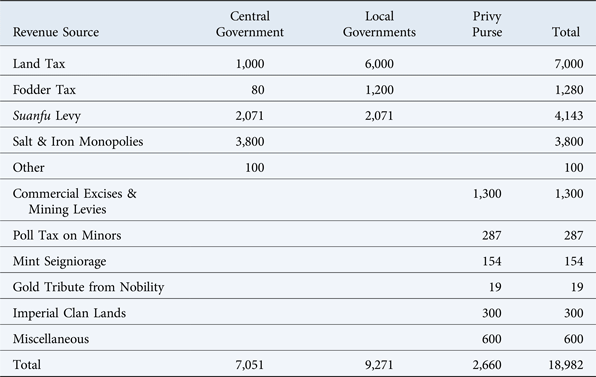
The fourth Han ruler, Emperor Wu (r. 141–87 BCE), broke with the militarist-physiocratic policies of his predecessors and sought to implement these principles in order to raise the massive revenues required to pay for his aggressive but costly campaigns of conquest and colonization in Central Asia, Korea, and Vietnam. Apart from raising revenues, Emperor Wu's policies also were aimed at curbing the growing wealth and power of the seigneurial and mercantile classes. Towards these ends Wu and his advisors placed the lucrative salt and iron industries under state monopoly, imposed new and onerous taxes on merchant income and capital assets, introduced the so-called “balanced standard” (pingzhun 平準) system whereby government agents stockpiled commodities and aggressively intervened in markets to smooth out price fluctuations, and created a new monetary system (one which initially included several fiat currencies, but largely rested on a new and remarkably stable bronze coin). The fiscal system constructed by Emperor Wu's advisors came to rely heavily on indirect taxation (Table 3). Roughly half of total revenues—especially in-kind receipts of grain and fodder—were retained at the local level. Most of the central government's income—and nearly half of total revenue—was collected in the form of coin. Total monetary revenues (9.26 billion coins) averaged 154 coins per capita, consistent with the recently excavated revenue account for Donghai commandery, which recorded cash revenues of 190 coins per capita in 13 BCE (Table 2). The salt and iron monopolies—which generated more than half of the central government's revenue and 20 percent of total revenues—clearly had become vitally important to the Han state. Indirect levies paid in coin also provided the vast majority of the revenues of the Privy Purse. But under the Eastern Han dynasty (24–220 CE) the court retreated from these mercantilist policies and instead opted for a minimalist fiscal regime that relied almost entirely on in-kind taxation (both direct and indirect taxes) while abolishing universal military conscription.
Estimated Government Revenues of the Han Empire in the First Century BCE
(all figures in millions of coins)

Source: Yamada Katsuyoshi 山田勝芳, Shin Kan zaisei shūnyū no kenkyū 秦漢財政収入の研究 (Tokyo: Kyūko Shoin, 1993), 653–58.
The second notable attempt to create a mercantilist fiscal state occurred in the Song dynasty (960–1276), during the tenure of the prime minister Wang Anshi 王安石 (1021–86) and his successors. The Tang–Song transition witnessed a profound metamorphosis of Chinese society and economy. The Jiangnan region supplanted the traditional heartland of the Central Plain as the dynamic core of China's economy. The rise of the rice economy and exploitation of the rich resources of South China improved agricultural productivity, fostered rapid population growth, and stimulated the emergence of new technologies and industries. Tea, porcelain, silk, iron goods, paper, books, and sugar as well as staple foods such as rice, soybeans, and wheat became the major commodities traded in regional, national, and even international markets. Innovations in finance (including negotiable bills of exchange, assignment transfers on bank deposits, credit-based consignment contracts, and the world's first viable system of paper money) promoted urban commerce and long-distance trade. With the overland Silk Road routes occupied by hostile adversaries, both the Song state and private merchants turned toward maritime commerce as a source of bulk commodities as well as prestige goods. To an unprecedented degree the fiscal base of the Song government relied on indirect taxation of trade and consumption, and commercial taxes and maritime customs became important sources of state revenues. Sustained economic growth also fueled unprecedented demographic expansion. By 1100 the empire's population reached 100 million, far surpassing the peak levels (roughly 60 million) of the Han and Tang.Footnote 43
Upon his appointment as privy councilor in 1069, Wang Anshi embarked on a sweeping program of institutional and fiscal reforms that quickly became known as the “New Policies” (xinfa 新法). Although also encompassing education and civil service recruitment, the New Policies had their greatest impact in fiscal governance, seeking to capture the productive energies unleashed by the rapid growth of the market economy. The New Policies inaugurated by Wang aimed to strengthen frontier defense while reducing the burden of military expenditures; increase the state's income from monopoly commodities and foreign trade; streamline the tax system by reducing or eliminating in-kind payments and labor services; and revitalize the agrarian base of society through state investments in agriculture (e.g., in irrigation and flood control projects), providing low-cost credit to farmers, and expanding the reach of public relief. As much as Wang sought to capitalize on the growth of the market economy, he also was deeply concerned about the inequities in the distribution of wealth fostered by commercial development. In the name of protecting family farms and small businessmen from rentier landowners and merchant cartels, Wang espoused state intervention in private commerce and moneylending. His administration created new state agencies to manage wholesale trade at the capital and lend credit to retail businesses, turned private brokers into government agents, tightened the state's control of foreign trade, and extended the existing monopoly on salt production to include much tea cultivation as well.Footnote 44 Wang also sought to circumvent a sclerotic bureaucracy by creating a host of new, task-oriented state agencies headed by upstart officials liberated from many of the constraints of civil service protocols—a political style (Schumpeterian in philosophy) that the historian Paul Jakov Smith has dubbed “bureaucratic entrepreneurship.”Footnote 45
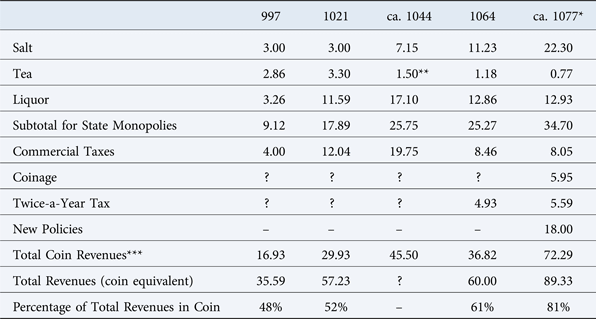
The fiscal reforms adopted by the Tang government in the wake of the devastating An Lushan Rebellion already had shifted state finance from in-kind direct taxation to excises on commerce and consumption collected in money. In the early Song the state collected nearly half of its revenue in the form of coin. But the New Policies accelerated the monetization of taxes, and by 1077 coin revenues constituted over 80 percent of total revenues (Table 4). By this time, payments in cloth, a major form of revenue from the late Han to the early Tang, had fallen to negligible levels. In addition, the New Policies reforms replaced most forms of statutory labor service with money payments, although village officers continued to be conscripted from the affluent landowning class.
Coin Revenues in the Northern Song
(in millions of guan)

* Figures variously from 1076, 1077, and 1078; does not include revenues from Green Sprouts loans and maritime customs (because revenue data for these categories is not divided into coin and non-coin portions)
** Figure from 1034; 1054 figure was 1.28 million
*** Total figures also included additional revenues apart from the above categories
Source: von Glahn, Economic History, 231, table 6.6
The New Policies provoked virulent political and ideological opposition, but the reigning emperor, Shenzong (r. 1067–85), remained steadfast in his support. After Shenzong's death in 1085 Wang Anshi's political enemies came to power and began to dismantle the reforms. Another reversal of regimes, in 1093, restored Wang's acolytes to power and resurrected the New Policies agenda. By the early twelfth century, however, many of the New Policies measures had deteriorated into confiscatory taxation, provoking popular unrest as well as opposition among the Confucian political elite. After the debacle of 1127, when North China was conquered by the Jurchen invaders and the Song court was forced to take refuge in the south, the mercantilist policies of Wang Anshi's regime became discredited and most of the New Policies were repudiated.
The Synergistic Fiscal State
It was during the Song dynasty—before and after Wang Anshi's more radical mercantilist experiment—that China's fiscal regime most closely approximated the form of the fiscal state as defined by the new fiscal history scholarship.Footnote 46 This type, which I designate the synergistic state, emerged over the course of the Tang–Song transition, which as outlined above was a period of unprecedented commercial and industrial growth. Amid the fiscal crisis engendered by the An Lushan Rebellion the Tang leadership abandoned the virtually defunct equal-field system of land allocations and the principle of uniform taxation that underlay it. The twice-a-year tax system inaugurated in 780 instituted progressive taxation assessed on land and property. In addition, the Tang increasingly resorted to the expediency of indirect taxation. The salt monopoly and commercial taxes once again became major sources of revenue, as they had been in the Han. Military conscription was replaced with taxes collected in money to support professional standing armies. These trends continued and intensified in the Song, liberating productive energies and enabling households to allocate land, labor, and other resources more efficiently. State income rose substantially because the government was able to capture more elastic sources of revenue through taxation of commerce and consumption. The rise in revenue was driven by massive outlays of state expenditure to support frontier armies (numbering as many as a million soldiers in the mid-eleventh century). But the Song state also invested in public goods—including water control projects, transport networks, schools, and famine relief—to a much greater degree than previous dynasties.
The shift of the Song fiscal system toward more progressive taxation was premised on a new system of civil registration. The twice-a-year tax was not levied directly on land or wealth. Instead, the Song dynasty devised a household ranking system that graded property-owning households into a set of ranks—five ranks in the countryside and ten in the cities—which became the basis for direct taxation.Footnote 47 Ranks were determined by the number of able-bodied adult males (ding 丁) and “material assets” (wuli 物利) of each household. The choice of criteria for ranking households varied among different regions. The amount of arable land seems to have been the most prevalent criterion, but tax quotas, the amount of seed sown, and total economic assets also were used. Urban residents were ranked according to the amount of rent collected on urban real estate, the volume of business, or their economic assets. After the New Policies reforms of the 1070s the ding unit ceased to be factored into the determination of household rankings. This change marked a key shift in the basis of the imperial system of social control from individual adult males (who bore equal responsibilities) to households graded according to wealth. In effect the state accommodated the reality of a social hierarchy determined by wealth.
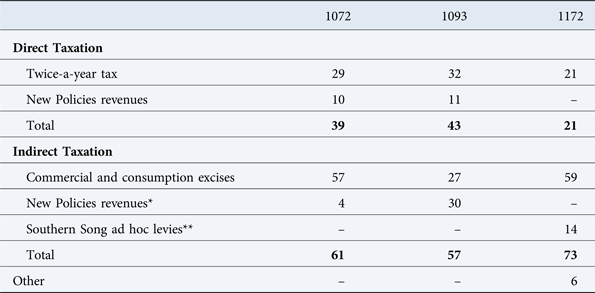
At the same time, direct taxation and tax collection in kind occupied much more diminished places in the Song fiscal system. As Table 4 shows, indirect taxation of commerce and consumption already generated more than half of central government revenues before the New Policies era. The percentage of revenues received via the twice-a-year tax (the principal form of land taxation) declined steadily over the course of the dynasty, and despite the marked population growth revenues paid in grain remained essentially flat. The trend toward indirect taxes paid in money strengthened in the Southern Song period, after the repeal of Wang Anshi's mercantilist New Policies agenda (Table 5). Nonetheless, according to Robert Hartwell the share of economic production garnered by the state as revenue remained essentially unchanged at roughly ten percent of GNP.Footnote 48
Composition of State Revenues in Song China
(all figures in percentages)

* The New Policies agencies absorbed a substantial portion of commercial and consumption excises
** Includes various supplementary wartime levies (mostly consumption taxes and commercial fees) enacted in the 1130s and later routinized
Source: Hartwell, “The Imperial Treasuries”: 66, table 6; 71, table 8; 74, table 10.
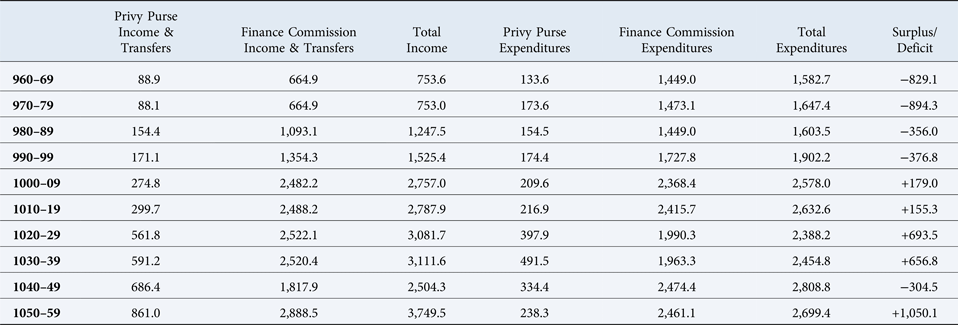
Since the Warring States period, Chinese governments had separated revenues designated for the personal maintenance of the imperial house (which derived primarily from commercial sources, including proprietary ownership of mines, as can be see for the Han in Table 1) from general revenues at the disposal of the fiscal administration. Over the course of the first century of Song rule, the emperors enlarged their share of total revenues—from 11 percent of total central government income to a quarter or more—by claiming a specified share of regular taxes and periodic transfers from treasuries under the jurisdiction of the Finance Commission (Table 6). But the imperial treasury acted as a reserve fund for the Finance Commission. More often than not, transfers of revenues involved Privy Purse subsidies to cover Finance Commission deficits due to emergencies such as war (especially in the 1040s) and famine. During the New Policies era imperial finances, including the Privy Purse, became highly centralized under the direct control of the chief minister. But in the Southern Song period fiscal authority devolved to regional and local administrators, especially a group of regional fiscal commissariats placed in charge of military logistics.Footnote 49
Decennial Averages of Annual Income and Expenditures of the Song Central Government, 960–1060
(all figures in thousands of kgs of silver)

Source: Hartwell, “Imperial Treasuries”: 62, table 5.
The synergistic fiscal state that prevailed for most of the Song era (excepting Wang Anshi's radical mercantilist experiment) was still premised on a fundamentally agrarian economic and social order. But it also acquiesced to the autonomy of the market and sought to harness, rather than arrest or subvert, market forces to meet the state's fiscal and economic goals. This new emphasis on a cooperative rather than antagonistic relationship with the merchant class was illustrated in the operation of the salt monopoly, which was a crucial institution for financing the frontier armies. Merchants who delivered provisions to the frontier camps were compensated in salt certificates, which guaranteed monopsony rights to the sale of salt in designated regions. Lucrative as these rights were, the salt certificates also functioned as negotiable financial instruments and were traded through a secondary market, with exchanges located in major commercial centers. The salt certificates thus functioned as bills of exchange and speculative investments in addition to their primary purpose of financing military procurement and provisions.Footnote 50 Another notable Song innovation was the creation of viable paper currencies that compensated for the drawbacks of the cumbersome bronze coin that had been the staple of the Chinese monetary system. Both the jiaozi 交子 currency (established as an official state-issued paper money in Sichuan in 1023) and huizi 會子 currency (issued in the southeastern provinces of the Southern Song from 1161 to the end of the dynasty) achieved considerable success thanks to the prudent management by treasury officials. State-issued paper money had two- or three-year terms of expiry (after which old bills had to be replaced with new bills, each issue with new designs), and in effect the government created a hard-currency reserve by redeeming bills with silver when their market value began to falter. To be sure, at times of grave emergency such as war the Song government resorted to wanton printing of paper money that led to a sharp depreciation of its value. But by the second quarter of the thirteenth century paper currencies had effectively displaced bronze coin as the standard means of payment for larger transactions in both private exchange and state payments.Footnote 51
The synergistic fiscal state generated a positive environment for economic growth. Fiscal institutions and practices such as salt certificates (and a whole panoply of similar financial instruments) and sound paper currency lowered transaction costs and facilitated long-distance exchange. The Song leadership encouraged the growth of both domestic and foreign commerce, which became major sources of state revenue. A more progressive tax structure, the monetization of tax obligations, and the abolition of most forms of labor service had beneficial effects on the household economy in what was still largely a world of smallholder family farms. State revenues rose substantially. Although most of the state's income was expended on the military, the Song state also invested in public goods that abetted economic development in both the private and public sectors.
The Mongol conquest disrupted the functioning of the synergistic fiscal state and subjected China to a predatory form of tribute exaction. The epochal reversal of the Song fiscal trends and the repudiation of the synergistic fiscal state occurred after the founding of the Ming dynasty in the late fourteenth century. As noted earlier, the Hongwu Emperor rejected what he regarded as the scourge of the market economy and sought to restore a modified version of the militarist-physiocratic model. Hongwu's policies ultimately failed in the face of intractable economic forces that rekindled private enterprise and the growth of the market. But the early Ming marked a crucial historical disjuncture that paved the way toward a new alternative conception of the fiscal role of the state.
The Providential State
What I designate as the providential state constitutes what scholars typically regard as the traditional fiscal regime in imperial China, the form that prevailed during the Ming and Qing dynasties.Footnote 52 This paradigm has been ably described by R. Bin Wong in terms of a paternalist agrarian state in which Neo-Confucian ideological commitments to popular welfare guided fiscal policies. Above all the providential state was devoted to the well-being of the family farm, a goal that was achieved with a certain measure of success. The providential state was premised on a low level of taxation levied on land, with minimal taxation of commerce, industry, or consumption (the signal exception being the salt monopoly). Departing from the militarist-physiocratic principles of the Ming founder, the late Ming leadership gradually shifted from in-kind to money taxes and generally favored a laissez-faire policy of non-interference in the commercial economy. One of the major sources of cash income in the Ming, as in the past, was the salt monopoly. But the Ming salt administration suffered from chronic mismanagement, and in the early seventeenth century adopted a franchise system—essentially a form of tax-farming—that created an immensely rich cartel of salt merchants but further isolated the state from the market.Footnote 53
The inflow of foreign silver in the late Ming period often is seen as a crucial force in inducing the transition from in-kind to money taxes. By the end of the Ming most labor service obligations had been converted to payments in silver, although these payments continued to be assessed on individual adult males (ding). The monetization of taxes accelerated during the early Qing period. In 1712 the Qing established permanent quotas for the ding labor service levy, and in the following year the Kangxi Emperor declared that the land tax quotas would be permanently frozen at their current levels. In 1729 the ding levy was formally merged into the land tax on an empire-wide scale. Henceforth landowners paid a single lump-sum tax in silver. This step completed the process of shifting taxation (and by extension the state's control over local society) from households to land. At that time the Qing state enjoyed substantial budget surpluses. By the end of the eighteenth century, however, the inability of the state to capture new revenues greatly weakened its ability to respond to political and economic crises.
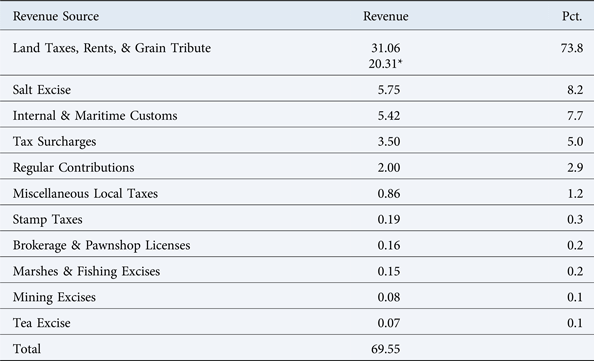
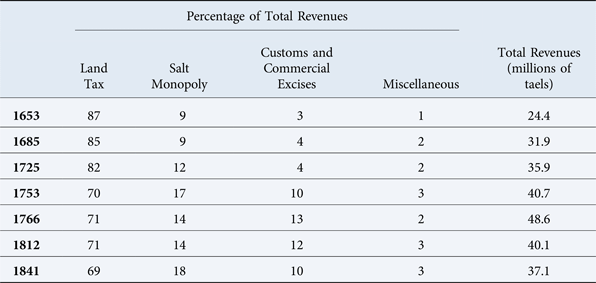
The Qing state thus was left with an immobile fiscal system that limited its capacity to capture or generate new revenues. The land tax—now converted to a fixed quota regardless of the actual productivity of the land—supplied nearly three-quarters of the central government's budget (Tables 7 and 8). Despite the shift from in-kind taxation to payments in silver, the real per capita tax burden (measured in grain) was only thirty percent of the level of the fifteenth century (Table 9). The state's presence in the national economy diminished as well. Government spending in the Qing probably dipped below 3 percent of total GDP, less than a third of the level of the Song synergistic fiscal state.Footnote 54
Ministry of Revenue Income, 1766
(all revenue figures in millions of silver taels)

* portion of land tax collected in grain, converted to silver equivalent
Source: Chen Feng 陈锋, Qingdai caizheng zhengce yu huobi zhengce yanjiu 清代财政政策与货币政策研究 (Wuhan: Wuhan daxue chubanshe, 2008), 369, table 6–3.
Ministry of Revenue Income in Qing China, 1652–1841

N.B. Figures do not include grain tribute revenues
Source: Ni Yuping 倪玉平, Cong guojia caizheng dao caizheng guojia: Qingchao Xian-Tong nianjiande caizheng yu shehui 从国家财政到财政国家:清朝咸同年间的财政与社会 (Beijing: Kexue chubanshe, 2017), 37, table 1–3
Grain and Money Revenues in Ming and Qing China

Source: Wu Hui 吴慧, “Ming Qing (qianqi) caizheng jiegouxing bianhuade jiliang fenxi” 明清 (前期) 财政结构性变化的计量分析. Zhongguo shehui jingji shi yanjiu 中国社会经济史研究 1990.3, 45.
The Qing state exercised a far lighter hand in managing the domestic commercial economy compared to the fiscal regimes of Western Europe. Apart from the salt monopoly—operated under the franchise system inherited from the Ming—and copper mining, the government interfered little in the production and distribution of goods. Merchant organizations assumed a greater degree of self-governance. Guilds, generally organized on the basis of native place association rather than trade before the nineteenth century, proliferated in commercial cities throughout the empire. While guilds had broad authority to regulate membership fees and duties, wages and prices, and the terms of apprenticeship, they were forbidden to restrict access to their trade. The Qing approach to economic management was exemplified by the brokerage system. Since the Song dynasty the government licensed brokers (yahang 牙行) who served as intermediaries between local merchants and long-distance traders, assisting the latter in finding customers, negotiating deals, arranging transportation, lodging, credit, and warehousing services, and acting as guarantors. In the Qing period, brokers increasingly acted in lieu of magistrates in recording transactions, policing trade, adjudicating disputes, and collecting various commercial taxes. In return the government restricted the number of licenses within a locality, guaranteeing brokers a comfortable income. The state charged only nominal fees for brokerage licenses; its chief interest was to ensure the smooth operation of commerce, not to raise revenue. As a form of tax-farming, the brokerage system insulated local commerce from the reach of the state.Footnote 55 The common practice whereby taxpayers used intermediaries to deliver their taxes to the authorities, known as “proxy remittance” (baolan 包攬), also constituted a form of tax-farming.
Private commerce flourished in this environment, which encouraged the free play of Smithian market dynamics. Commercial profit was, with a few exceptions, wholly privatized. Given its meager revenue base, however, the Qing state generated minimal public investment. Since the final decades of the Ming dynasty, non-official local elites had steadily expanded their responsibilities for local governance and social welfare, including management of public works, local security, famine and poor relief, schools, and temples. This trend accelerated under Qing rule, when a wide range of intermediate social institutions—including corporate lineages, merchant and artisan guilds, native-place societies, communal water control leagues, and an array of religious, fraternal, and philanthropic associations—proliferated. (One arena of public welfare in which the Qing government did actively intervene was food supply and famine relief.) Although local leaders operated independently of magistrates and the state bureaucracy, they often held civil service examination degrees and many were retired officials. State officials and the local elites shared common interests in maintaining social control, popular welfare, and moral leadership. Thus R. Bin Wong has argued that the expanded role of local elites in civil governance during the Qing constituted a delegation, not a devolution, of public power that may have attenuated the imperial state's range of action but did not erode its authority.Footnote 56
Still, the fiscal capacity of the state had been sharply curtailed compared to earlier periods. Moreover, the Qing tax reforms, by making land rather than people the object of taxation, had rendered civil registration meaningless. The freezing of the land tax in 1713 eliminated the necessity of maintaining accurate records of landholdings, and the Qing state never conducted a universal cadastral survey (relying instead on the Ming survey of 1580). The quinquennial surveys of households known as bianshen 編審 ceased altogether in 1772. Consequently, the Qing state no longer had the capacity to identify, let alone mobilize, its population. The legibility of society vital to the operation of the fiscal state vanished.
Despite these fiscal constraints, the Qing empire achieved geopolitical supremacy within East Asia in the eighteenth century. The incorporation of Manchuria and military conquest and annexation of Taiwan, Tibet, and the “New Frontier” (Xinjiang) between 1683 and 1759 doubled the size of the empire. Subsequently the Qing faced no external threats before the Opium War instigated by the British in 1839. Although the White Lotus Rebellion (1796–1805) escalated into an urgent military and fiscal crisis, the Qing managed to weather the turbulence without resort to drastic fiscal expediencies. The palpable sense of military competition that suffused early modern European political consciousness was absent, at least before the outbreak of the Taiping Rebellion (1850–64).
Despite the progressive monetization of taxation in the late imperial era, the Ming-Qing providential state retreated from the high levels of revenue generated—especially from indirect taxes—under the Song in favor of minimal taxation derived overwhelmingly from landowners. The dire predicament of the Qing court following the eruptions of the Opium War and the Taiping Rebellion forced it to abandon its original economic principles and adopt expedient measures such as commercial taxes, sale of venal offices, deficit spending, and public debt financed by bonds and foreign loans—a mixture of old and new fiscal devices, but with limited institutional coherence or central government control. Although the structure of state finance was irrevocably transformed—and its leadership explicitly acknowledged a mercantilist agenda of utilizing fiscal policy to enhance national wealth—the Qing regime ultimately failed to mobilize the fiscal resources necessary to undertake a successful program of economic development.Footnote 57
Conclusion
Recent scholarship has portrayed the late imperial Chinese state—particularly at its apogee during the reign of the Qianlong Emperor (r. 1735–95)—as a positive force in creating an economic environment highly favorable to Smithian growth.Footnote 58 Qianlong's regime has been characterized as “non-interventionist,” or even as a turning point toward the emergence of “economic liberalism” in Chinese fiscal ideology.Footnote 59 Certainly some Qing statesmen touted the benefits of market forces in enabling a more optimal distribution of goods and resources, and by extension in protecting popular welfare. But continuous real (i.e., per capita) economic growth was scarcely imaginable in the intellectual milieu of Qing political economy, and indeed by the mid-eighteenth century some officials and scholars began to sound quasi-Malthusian alarms about the intensifying stress of population growth on the food supply. Qing policymakers remained resolutely focused on the efficient use of land and labor resources, the elimination of waste (especially in the form of luxury consumption), and largely rhetorical efforts to promote the diffusion of best practices in agriculture. The non-interventionist stance that prevailed at Qianlong's court left little scope for the state to invest in economic development.Footnote 60
Neo-institutionalist scholarship has expressed far more dour assessments of the influence of the state and its institutional infrastructure on economic development in the late imperial era. A recent survey by a group of leading economists characterizes the Qing as dominated by a “patronage economy” in which the foundation of property rights rested on politics rather than law, the prevalence of patron–client ties impeded both public initiative and private innovation, and tax collection was handicapped by peculation and high agency costs that undermined the state's fiscal capacity.Footnote 61 Taisu Zhang has argued that the peculiar form of multi-tiered landownership (which vested both landlords and tenants with separate and negotiable rights) that prevailed in late imperial China impeded the securitization of property rights necessary for the emergence of capitalist agriculture.Footnote 62 In the view of these scholars, it was the ideology and institutions of Qing China—and not, as Kenneth Pomeranz has suggested, resource constraints—that inhibited economic growth. In contrast, Wenkai He recently has challenged this depiction of institutional rigidity and contends that the key functional components for building a modern fiscal state in fact existed in late Qing China. In He's view, in the absence of a sufficiently dire fiscal crisis—even in the wake of the Sino-Japanese War and Boxer Rebellion fiascos!—the Qing government (in contrast to Meiji Japan) was not compelled to undertake a fiscal revolution.Footnote 63
The deeper perspective afforded by examination of the different modalities of the fiscal constitution across the entire imperial history provides a more rounded assessment of the relationship between the Chinese state and the economy. The militarist-physiocratic state of the early empires penetrated more deeply into local society, in large part because of the crucial importance of conscript labor and military service in state extraction. Recent comparative study suggests that the Han state devoted considerably more resources to civil administration and local public infrastructure than did the Roman Empire.Footnote 64 The militarist-physiocratic state was capable of extracting private resources for public investment on a scale rarely achieved in any premodern society. This kind of direct expropriation of income and labor diminished under the mercantilist and synergistic models of the fiscal state, which shifted toward indirect taxation of commerce and consumption and mobilization of resources through market-based mechanisms. The mercantilist model was predicated on a system of fiscal circulation wherein the state directly or indirectly organized the circulation of goods on a national scale through its procurement policies, especially for military expenditures. Fiscal circulation remained an important component of the synergistic fiscal state engendered by the Tang–Song transition, but the synergistic state also contributed to economic growth by establishing institutions conducive to commercial expansion, supplying public investment (e.g., in transportation, land reclamation, water control, and education), and intervening in income distribution (e.g., through progressive taxation of wealth and famine relief policies) to mitigate some of the inequalities generated by the market economy. The synergistic state thus fostered not only Smithian growth but also a Schumpeterian dynamic in which the state promotes industries, technologies, and institutions that have potential for economic growth through dissemination of knowledge, economies of scale, and increasing returns over the long run.
In the providential state that prevailed in late imperial China, by contrast, the state exercised only superficial control of fiscal resources. The Ming and Qing regimes reverted to direct taxation (focused on land, not people) and an ideological commitment to low and equitable taxation (probably the lowest and most equitable of any major Eurasian state) that generated positive inducements for private utilization of land, labor, and capital, but at the same time greatly diminished the state's extractive capacity (both formal and informal). The merging of labor service and land taxation into a single money payment in 1729, for example, had negligible impact on the fiscal capacity of the state. The weak administrative and infrastructural capacity of the Qing state abetted private economic growth as long as the empire enjoyed domestic peace and external security, but it deprived the state of the resources needed to cope with the military crises of the nineteenth century. When confronted by the dire need to maximize revenues, the late Qing state lacked the infrastructural capacity to mobilize and control fiscal resources. The fiscal difficulties of the Qing state in the nineteenth century led—in a pattern similar to Bakumatsu, not Meiji, Japan—to fiscal decentralization and transfer of public responsibilities to local governments. Although the Qing central government was compelled to shift to commercial and consumption taxes in the latter half of the nineteenth century, the fiscal system remained hobbled by the decentralized structure of tax collection, the failure of half-hearted efforts to introduce deficit financing, and mismanagement of state-owned industrial enterprises and banks. Despite the reforms undertaken by the late Qing state, many elements of Schumpeterian growth—particularly the role of the state in creating demand for national production—remained unfulfilled, and the potential for systemic synergies between the state and the private economy remained unrealized.