Introduction
The recent economic and financial crisis triggered new and controversial discussions of old questions in the field of political economy – particularly how governments address structural problems and fiscal deficits. Despite the fact that tackling structural economic problems is usually unpopular with large parts of society, there is an emerging consensus in the wider academic literature that fiscal consolidation measures are not necessarily politically costly. Empirical research shows that such unpopular reforms do not have negative implications for incumbents and future electoral outcomes (Armingeon and Giger Reference Armingeon and Giger2008; Alesina et al. Reference Alesina, Carloni and Lecce2011; Giger and Nelson Reference Giger and Nelson2011), and it has been hypothesised that such events may even positively affect future economic prospects (Alesina and Ardagna Reference Alesina and Ardagna2013). Based on these insights, fiscal consolidation should not pose a major political problem for governments.
This is, however, inconsistent with our experience from the Euro-crisis and previous research on reform. Most governments find it very difficult to commit themselves to fiscal discipline and hesitate to implement harsh budgetary cuts. Anecdotal evidence from Greece, Spain and Ireland suggests that governments face a serious risk of breaking apart over the implementation of budgetary cuts or at least are punished in future elections after implementing severe cuts. Adding to this, public discourse and empirical evidence show some skepticism related to the claim that austerity and fiscal discipline serve as triggers for short- and long-term economic and employment growth (Cottarelli and Jaramillo Reference Cottarelli and Jaramillo2013). Another indication of how difficult and politically risky the implementation of highly unpopular reforms can be is the increasing number of countries that implement fiscal rules whose violation should automatically initiate the necessary processes to curb deficits and balance budgets. The development of tighter regulatory frameworks (both domestically and on the supranational level) implies that politicians deliberately limit their room to manoeuvre, possibly in order to shift and dismiss blame for unpopular actions.
In accordance with these inconsistencies, the literature yields a variety of findings about the ability of governments to consolidate and the economic and political determinants of consolidation and reforms in general. Whereas party politics was considered to be an important determinant of state policy output during the “golden age” of the welfare state (Korpi Reference Korpi1989; Hicks and Swank Reference Hicks and Swank1992; Huber et al. Reference Huber, Ragin and Stephens1993), more recent research yields unstable or even contradictory results regarding the impact of political preferences on public policies (Huber and Stephens Reference Huber and Stephens2001; Kittel and Obinger Reference Kittel and Obinger2003). One of the reasons for the theoretical and empirical disagreements may be a mismatch between theoretical concepts and empirical measures. Theoretical contributions to the literature on the political economy of reforms mostly focus on reform episodes and policy events (Pierson Reference Pierson1996; Green-Pedersen and Haverland Reference Green-Pedersen and Haverland2002; Wenzelburger Reference Wenzelburger2011). They identify mechanisms, both political and socioeconomic, that trigger discrete policy changes and their characteristics. The empirical literature, in contrast, often focuses on continuous economic and social outcomes, such as general public and social spending, which are only partially influenced by the underlying politics of reform.
This paper therefore examines the political and socioeconomic determinants of fiscal consolidation by distinguishing between consolidation events and consolidation size. This events-based approach is advantageous not only from an empirical point of view but also conceptually. It allows me to examine how the explanatory factors affect the timing of a policy event and which ones affect the content of a policy, in this case the size of fiscal consolidation. This is important because governments that face economic pressure to address fiscal problems may not be able to avoid these measures, but they can still exploit their room to manoeuvre and time these measures strategically. A proper analysis that examines how political preferences, political constraints and strategic considerations affect consolidation thus needs to rely on discrete-events data. By examining the determinants of consolidation events, this paper complements recent contributions to the literature that have studied the effect of these events on economic outcomes (Guajardo et al. Reference Guajardo, Leigh and Pescatori2011).
The empirical analysis is based on an action-based data set, which captures incidents of fiscal consolidation packages in 16 industrialised democracies since 1978. The consolidation events reflect the discretionary and deliberate political decisions by governments about whether or not to cut the fiscal deficit in a particular year. This study differs from previous research that has used continuous outcome variables, such as the fiscal balance or government spending, to measure fiscal consolidation (Alesina et al. Reference Alesina, Perotti and Tavares1998, Reference Alesina, Ardagna and Trebbi2006). The problem with aggregated fiscal indicators is that they are not only affected by political decisions, but to a large extent also depend on other macroeconomic factors, such as the level of unemployment and demographic change. These factors obfuscate the actual impact of politics on policy change. The more recent approach of inferring consolidation episodes from improvements in the cyclically adjusted fiscal balance do not solve this problem (Ahrend et al. Reference Ahrend, Catte and Price2006; Guichard et al. Reference Guichard, Kennedy, Wurzel and André2007; Alesina et al. Reference Alesina, Carloni and Lecce2011). Reductions in the structural fiscal deficit are often caused by developments in the macroeconomic environment and not by immediate fiscal decisions by the government.
The results show that the occurrence of a fiscal consolidation event is primarily driven by strategic considerations, especially the point in the electoral cycle, and not by government ideology or constraints. Governments implement consolidation measures significantly more often at the beginning of the electoral cycle than towards the end of the term of office. This is in line with recent contributions, which find that governments make use of strategic considerations when planning consolidation events (Wenzelburger Reference Wenzelburger2011), particularly in times of crisis (Armingeon Reference Armingeon2012). These results, however, raise the question of why governments systematically try to avoid fiscal cuts before elections, although the literature mentioned at the outset of this paper finds that these cuts do not have electoral consequences. Future research should examine why the implications of these two research agendas differ. The results are also consistent with findings that both left- and right-wing party governments are forced to implement reforms in times of fiscal pressure (Green-Pedersen Reference Green-Pedersen2002; Vis Reference Vis2009a). Partisanship, however, still affects the size of cuts, with leftist party governments preparing smaller fiscal consolidation packages than conservative governments, which is in line with how party scholars traditionally have theorised about the impact of left and right parties on economic policy.
The remainder of the paper is structured as follows. The next section presents the theoretical framework and the hypotheses. The section after that discusses the data and the empirical strategy used to assess the hypotheses. Finally, I present the results and conclude.
Theory
The slow death of politics
Broadly defined, political economy research takes two different views on the role of politics for economic reform and therefore also fiscal consolidation. An important part of the literature suggests that governments have lost their ability to design and implement policies according to their ideological preferences. One reason is that their room to manoeuvre has been shrinking, owing to the increasing international interdependence of domestic economies (Cusack Reference Cusack1999; Swank Reference Swank2001; Kittel and Obinger Reference Kittel and Obinger2003; Castles and Obinger Reference Castles and Obinger2007). This led to a “functionalist” view on the politics of reforms, policy change and party competition (Cameron Reference Cameron1978; Rodrik Reference Rodrik1998; Huber and Stephens Reference Huber and Stephens2001; Schwartz Reference Schwartz2001; Castles Reference Castles2005), which is also reflected in unusual government arrangements that have become more common in recent years. Examples are grand coalitions (in Germany) and technocratic governments (Italy, Greece), which often arise from developments in the political system that, again, can be partially traced to the societal changes triggered by globalisation.
With regard to reform politics, this view is represented by the New Politics literature (Pierson Reference Pierson1994, Reference Pierson1996, Reference Pierson2001) that sees countervailing pressures as a main source of declining political competition. On the one hand, welfare state institutions and social policies enjoy large popular support (Boeri et al. Reference Boeri, Börsch-Supan, Tabellini, Moene and Lockwood2001; Larsen Reference Larsen2006), which makes welfare states resilient to the challenges of globalisation (Pierson Reference Pierson1996; Vis Reference Vis2009a). At the same time, economic and structural problems raise the pressure to cut spending even if it is politically costly. Retrenchment events then occur out of sheer economic necessity and fiscal pressure. In addition, the extent of the retrenchment events is mostly influenced by macroeconomic factors and is not necessarily related to the preferences of the parties in government or other potential factors like elections. This leads to the following hypotheses:
H0: Political considerations have no influence on the probability of fiscal consolidation in times of increasing economic interdependence.
H1a: If the economic pressure increases, the probability of a consolidation event increases.
H1b: Given that a consolidation event occurs, the size of consolidation increases with economic pressure.
Revival of politics and strategic fiscal consolidations
The empirical evidence for the “functionalist” perspective on policy change and reform, however, is mixed, and the results on the influence of partisanship contradictory. Some scholars have confirmed that conservative governments indeed implement harsher cuts (Korpi and Palme Reference Korpi and Palme2003; Allan and Scruggs Reference Allan and Scruggs2004). This is in line with the traditional view that right-wing governments promote spending less than left-wing governments. These inconclusive and contradictory findings raise doubts that political motivations indeed have become irrelevant for policy even under austerity, and suggest that the impact of politics on fiscal consolidation is more complex. I focus particularly on three factors that influence the likelihood of consolidation events, notably the ideology of the incumbent, various forms of constraints and strategic considerations related to the electoral cycle.
In the standard logic, left governments should be less supportive of fiscal consolidation than right governments, but this can manifest in different forms. Public support for redistributive policies and welfare states is particularly large during economic downturns and in times of fiscal constraints (Blekesaune Reference Blekesaune2007; Jensen Reference Jensen2007). As left governments generally represent constituencies that rely more heavily on redistributive policies, these governments are particularly vulnerable to losing political support in response to fiscal retrenchment. Left-wing governments therefore may not want to be associated with consolidation measures and hence try to avoid them. This argument implies that left-wing governments are less likely to initiate consolidation measures in the first place.
Alternatively, left-wing parties can choose a different, more strategic approach by proactively opting for consolidation, but, at the same time, design them in their interest. As the literature has shown, left governments often successfully implement consolidation measures, which means that the likelihood of a reform is not necessarily smaller than for right-wing governments (Green-Pedersen Reference Green-Pedersen2002).Footnote 1 Left-wing governments therefore may not be less likely to pass a consolidation package. However, given that a reform occurs, the left-wing government can use the remaining room to curb spending less radically than a right-wing government would. In this way, the government can avoid being blamed for not solving an existing problem and still minimise the impact of the reform. This means we should primarily see the effect of government partisanship on the size of consolidation.
H2a: The probability of a consolidation event is smaller when the incumbent is a left-wing government and bigger with a conservative incumbent.
H2b: Given that a consolidation event occurs, the size of retrenchment is lower under left-wing governments than under conservative governments.
Apart from political preferences, governments face varying degrees of constraints that affect fiscal consolidation. Constraints generally reduce the ability of governments to implement their most preferred policies and are tied to specific political situations in combination with the institutional framework of a country. With respect to fiscal consolidation, a major political constraint arises from resistance among affected citizens against fiscal cuts. Citizens who suffer from these measures will oppose them and increase the pressure on governments to abandon the intended cuts or reverse previously implemented reforms. An important way in which this resistance manifests itself is through street-level politics. Although examples from the Euro-crisis are evident, there also is evidence that fiscal retrenchment is systematically and historically related to anti-government demonstrations and popular unrest (Ponticelli and Voth Reference Ponticelli and Voth2011). Such mass protests can have an important impact on reform activities in that they affect the political calculus of the government.
To what extent public opposition directly affects the policy-making process, however, depends on the institutional setting of the country. Different institutional features mediate the access of political groups to the political process (Immergut Reference Immergut1992). The electoral system, for instance, has a decisive effect on the number of political parties in government. Majoritarian electoral systems tend to produce single-party governments that are less constrained than coalition governments, which usually are associated with proportional systems. The parliamentary system is also important, because a second chamber provides the opportunity for the opposition to block government proposals. Similarly, central governments in federal systems have less autonomy over particular policy areas, such as fiscal policy, than in unitary systems. The literature agrees that the more actors involved in decision-making processes, the more difficult it is to implement highly contentious policies, such as fiscal retrenchment. The presence of political and institutional constraints therefore primarily influences the probability of consolidation. This argument is consistent with empirical evidence from other areas of fiscal policy making, such as tax policy (Hallerberg and Basinger Reference Hallerberg and Basinger1998; Basinger and Hallerberg Reference Basinger and Hallerberg2004; Hallerberg Reference Hallerberg2004).Footnote 2
H3: High levels of popular, political and institutional constraints lower the probability that a consolidation event occurs and potentially also affect the size of reform packages.
Finally, there are important strategic considerations influencing governments’ reform plans. In principle, major consolidation events are considered a risky enterprise for governments. Despite the electoral riskiness of reforms, research shows that governments regularly implement unpopular reforms, taking into account potential punishment by the electorate (Vis and van Kersbergen Reference Vis and van Kersbergen2007). They do this when a deteriorating economic situation and weakening government strength manifest themselves in low public opinion polls. The combination of these factors leads governments to resort to risky reforms, with the hope that these reforms will reinstate a more favourable position (Vis Reference Vis2009b, Reference Vis2009c).
Given the political risk associated with fiscal reforms, I would expect that governments strategically time these events to maximise political gains or minimise potential losses. Following a large literature on the electoral effects on economic policy (Downs Reference Downs1957; Nordhaus Reference Nordhaus1975; Alesina Reference Alesina1987; Stimson Reference Stimson1999; Erikson et al. Reference Erikson, MacKuen and Stimson2002), it is plausible that fiscal consolidation tends to occur early in the electoral cycle for a number of reasons. First, the electoral cycle structures governments’ legislative activity, with governments’ activity being highest at the beginning of the term and declining in the second half of a legislative term (Heller Reference Heller2001; Becker and Saalfeld Reference Becker and Saalfeld2004; Martin and Vanberg Reference Martin and Vanberg2004). A second reason is the time horizon of voters, which previous research finds to be relatively short (Bartels Reference Bartels2005). If this is right, governments can hope that the negative effects of fiscal consolidation packages will be remembered less by the time of the next election. In addition, if governments cut spending at the beginning of the legislative term, the positive impact of these measures may become noticeable right before the next election, which can be used as a political asset by the incumbent and may convince the voters to support the present government in the next election. According to this logic, the probability that governments implement a substantial reform decreases the closer the next election is. I expect that elections mostly affect the timing of the reform event. If an incumbent decided that it is strategically wise to cut spending before an election, its size and content should not be affected by the fact that an election occurs in the near future.
H4: The probability of a consolidation event is highest right after the election and decreases over the legislative term.
Empirical analysis
Data
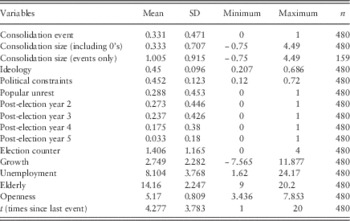
The data cover discrete consolidation events in 16 Western democracies and include a total of 159 instances of fiscal adjustments between 1978 and 2009 (Devries et al. Reference Devries, Guajardo, Leigh and Pescatori2011).Footnote 3 The selection of the consolidation events included in the data set is based on official announcements by public authorities to cut fiscal deficits in nominal terms measured as the percentage of GDP. It represents how these actions reflect on the budgetary balance of the general government and therefore avoids missing deficits, which are shifted to lower levels. Consolidation events are identified qualitatively based on the most important policy documents in each country, including Budget Reports, Budget Speeches, OECD Economic Surveys and IMF Staff Reports. These documents ‘explicitly provide evidence of what policymakers believed at the time that the decisions were taken’ (Devries et al. Reference Devries, Guajardo, Leigh and Pescatori2011, 4). For the events that are identified, the size of the respective measures is then specified by assessing the impact that the cuts have on the overall fiscal balance. The data set therefore captures the governmental decisions that can be publicly identified and were debated as consolidation events.Footnote 4 The consolidation events cover both consolidation through spending cuts and consolidation through changes in taxation. In additional analyses, I will distinguish between consolidation via spending and via taxes.Footnote 5
The raw data indicates the size of fiscal consolidation in the year when it happened. Using this information, I first construct a time-series cross-section data set with a discrete dependent variable that takes the value 1 for the year in which the data set reports that a consolidation event occurred, and the value 0 for years in which no event is reported.Footnote 6 This yields a balanced data set from 1978 to 2009, which can be used to estimate the probability of a consolidation event. To examine the size of consolidation, I construct another variable, which takes the value 0 when no fiscal cut took place and the amount of consolidation as listed in the original data for the year when the government implemented the reform.
The data used in this paper differ in important ways from previous studies of the determinants of fiscal consolidation. Although early work operationalised fiscal consolidation simply as the change in the budgetary deficit (Alesina et al. Reference Alesina, Perotti and Tavares1998, Reference Alesina, Ardagna and Trebbi2006), research has increasingly used the cyclically adjusted fiscal balance to identify discrete consolidation periods (Ahrend et al. Reference Ahrend, Catte and Price2006; Guichard et al. Reference Guichard, Kennedy, Wurzel and André2007; Alesina et al. Reference Alesina, Carloni and Lecce2011).Footnote 7 Although it is useful to isolate the structural deficit by removing the cyclical component that is due to regular business cycles, this strategy does not solve the problems mentioned above. A reduction in the structural deficit can be, but often is not necessarily, the result of a government’s policy choice. Instead, the structural deficit can fall owing to a reduction in structural unemployment, which, in turn, can be unrelated to fiscal consolidation measures.Footnote 8 The consolidation episodes, which are calculated based on improvements of the CAPB, hence, often do not reflect government decisions, but rather to considerable extent reflect the overall macroeconomic environment net of the cyclical component.Footnote 9
Assessing the impact of political and socioeconomic factors on consolidation events rather than incremental changes in public spending has the advantage that consolidation events represent pure political acts. Consolidation events therefore are based on conscious decisions of the cabinet and represent the political considerations of policy makers more properly than gradual outcome variables like spending. In addition, the effect of the key explanatory factors on reform data is straightforward and less ambiguous than for macroeconomic aggregates like spending. For instance, high levels of unemployment may be associated both positively and negatively with public spending. On the one hand, high levels of unemployment boost public expenditure because more benefits need to be paid. On the other, high levels of unemployment, in the long run, may lead to increasing pressure on governments to consolidate and cut public spending. By focusing on consolidation events, we can avoid having the ambiguous relationship between incremental changes in public spending and macroeconomic factors confound the empirical results (see also Hicks and Zorn Reference Hicks and Zorn2005). As a consequence, the correlation between the two different measures is not very high. Further analyses show that this is because consolidation episodes, as defined by the events-based measure, mostly occur in times when structural problems in the macro economy deteriorate. Consolidation episodes, as defined by the CAPB measure, often occur when structural economic problems improve. I will revisit these results in greater detail in the next section.
The key political explanatory variables are government ideology (Klingemann et al. Reference Klingemann, Volkens, Bara and Budge2006; Andersson et al. Reference Andersson, Bergmann and Ersson2012; Volkens et al. Reference Volkens, Lehmann, Merz, Regel and Werner2013), political constraints (Henisz Reference Henisz2006) and different electoral variables. Government ideology is measured using an index suggested by the study of Kim and Fording (Reference Kim and Fording1998, Reference Kim and Fording2002). The measure is based on the left-right index from the Comparative Manifesto Project and takes into account the weighted seat share in parliament of each party in the cabinet. The original index varies between −100 (most leftist position) and 100 (most rightist position). This index has been rescaled for this analysis to range between 0 and 1 (see also Table A1 included in the online appendix). Lower values still indicate more leftist party governments. To measure political constraints, I use the general constraints index by Henisz (Reference Henisz2006). Unlike other measures of political constraints, which are often time invariant, it takes into account that political constraints can vary owing to changing majorities in national decision-making arenas.Footnote 10 In addition to general constraints, I assess the impact of public discontent as another form of political constraint using a variable that captures whether anti-government protests occurred in a given year (Banks and Wilson Reference Banks and Wilson2014). The distribution of demonstrations is seriously skewed, which is why I use a binary variable distinguishing between no and at least one demonstration. The results do not change when variables with more categories are used. To assess the strategic dimensions of the politics of fiscal consolidation, I use two electoral variables, which capture various parts of the effect the electoral cycle has on government reform activity. The first is an electoral counter counting the years between two elections. The second comprises different electoral dummies for every year after the election. The main macro- and socioeconomic measures are unemployment, economic growth, demographic change and financial openness, which come from the study by Armingeon et al. (Reference Armingeon, Careja, Weisstanner, Engler, Potolidis and Gerber2013).Footnote 11 In the empirical models, the socioeconomic variables are lagged by one year, as I expect the impact of these variables to take effect only during the next budgetary year (Table 1).
Summary statistics

Source: Author’s elaborations.
Estimation strategy
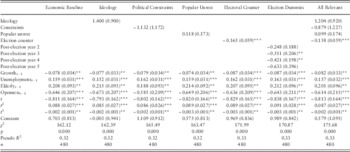
Given the structure of my data, the empirical part proceeds in two steps. The first step assesses the probability that a consolidation event happens. The second step examines the size of consolidation, given that a reform occurs. Because of the binary nature of the dependent variable for the first step, I use a probit model to estimate the likelihood that a consolidation event occurs in a particular year. To account for time in a time-series cross-section setting with a binary dependent variable, I use the procedure proposed by Carter and Signorino (Reference Carter and Signorino2010), which has become a standard approach to dealing with this problem in political economy research. The variable t captures the time that has passed since the last consolidation event, i.e. it takes the value 0 after a fiscal consolidation episode and increases linearly until the next consolidation event in that country occurs. I also add t 2 and t 3 to the model to capture the nonlinear effects of time on the probability of an event. These variables together capture the probability of a reform, given the number of years that have passed since the last reform. This procedure therefore is a variant of a classic duration model accounting for the hazard that an event takes place over time (see Box-Steffensmeier and Jones Reference Box-Steffensmeier and Jones2004). The models based on equation (1) assess the probability of a reform as specified by H0, H1a, H2a, H3 and H4. The results from this equation are presented in Table 2.
 $$\eqalignno{ Pr({\rm Consolidation}\,{\rm event}_{{i,t}} )= \ & \Phi (\alpha _{0} {\plus}\alpha _{1} {\times}{\rm Ideology}_{{i,t}} \cr & {\plus}\alpha _{2} {\times}{\rm Constraint}_{{i,t}} {\plus}\alpha _{3} {\times}{\rm Election}_{{i,t}} \cr & {\plus}\alpha _{4} {\times}{\rm Growth}_{{i,t{\minus}1}} {\plus}\alpha _{5} {\times}{\rm Unemployment}_{{i,t{\minus}1}} \cr & {\plus}\alpha _{6} {\times}{\rm Elderly}_{{i,t{\minus}{\rm 1}}} {\plus}\alpha _{7} {\times}{\rm Openness}_{{i,t{\minus}1}} \cr & {\plus}\alpha _{8} {\times}t_{{i,t}} {\plus}\alpha _{9} {\times}t_{{i,t}}^{2} {\plus}\alpha _{{10}} {\times}t_{{i,t}}^{3} {\plus}d_{i} {\plus}\epsilon ) $$
where d i is a country dummy.
Determinants of consolidation events
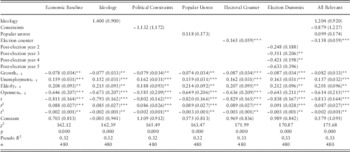
Source: Author’s elaborations.
Notes: All models include fixed effects. Robust errors are in parentheses.
*=p<0.1; **=p<0.05; ***=p<0.01.
Examining the size of consolidation raises some tricky econometric issues. First, if we examine consolidation size by looking at consolidation episodes only, we get biased estimates because of selection problems. Specifically, the set of governments that consolidates is systematically different from those that do not consolidate because they face different macroeconomic and political situations. Second, if we examine all country-years (also those when consolidation is 0), we still have the problem that governments that do not consolidate (those for which the dependent variable is 0) are all treated in the same way in a standard regression model. This is problematic because some of those governments only marginally decided against reform, whereas others were far away from implementing a reform (Bortolotti and Siniscalco Reference Bortolotti and Siniscalco2004; Hicks Reference Hicks2014). Theoretically, the problem arises because, as the previous literature has argued, the political processes that lead to consolidation differ from the political processes that lead to expansions (Pierson Reference Pierson1996, Reference Pierson1998). We therefore cannot simply expand the distribution to include both consolidations and expansions because the variables and their expected impacts differ for the two processes.
I address these problems using Tobit and Heckman models. Tobit models take into account the possibility that governments that did not reform can have different characteristics. Technically, it assumes that the underlying (latent) consolidation process is only observable when consolidation is positive, which means that the observable distribution of consolidations is truncated. I use the same basic model as before, but exclude the time variables because we do not have a binary dependent variable at this stage.
 $$\eqalignno{ {\rm Consolidation}\,{\rm size}_{{i,t}} =\,\,\beta _{0} {\plus}\beta _{1} {\times}{\rm Ideology}_{{i,t}} {\plus}\beta _{2} {\times}{\rm Constraint}_{{i,t}} {\plus}\beta _{3} {\times}{\rm Election}_{{i,t}} \cr & {\plus}\beta _{4} {\times}{\rm Growth}_{{i,t{\minus}1}} {\plus}\beta _{5} {\times}{\rm Unemployment}_{{i,t{\minus}1}} \cr & {\plus}\beta _{6} {\times}{\rm Elderly}_{{i,t{\minus}1}} {\plus}\beta _{7} {\times}{\rm Openness}_{{i,t{\minus}1}} {\plus}d_{i} {\plus}\epsilon _{{i,t}} $$
The Heckman model captures the truncation and nonrandom selection of fiscal consolidation events in a different way. It is more complex than the Tobit model because it requires the specification of two equations. One equation accounts for sample selection, and the other for the outcome of the reform. The estimation of the model is also based on the assumption that at least one variable affects the selection process, but does not affect the outcome process. The selection equation is equivalent to the probit model described in equation (1). This equation estimates the probability of observing a consolidation event, i.e. whether or not an observation is selected into the consolidation subsample. For the outcome equation, I can rely on a version of equation (2), because the dependent variable of the outcome equation is the consolidation size. To satisfy the exclusion restriction, variables that only affect the timing, but not the size of consolidation, need to be excluded in the outcome equation. An argument can be made that the time counters represent such variables. As Alesina and Drazen (Reference Alesina and Drazen1991) argue, the mere “passage of time” often increases the likelihood that a consolidation package is passed, independent of the development of the underlying structural problems (which are captured by different variables in my model). By this argument, the time variables represent the gradually increasing cost of not solving a problem, holding the size of the problem constant. In addition, according to the theoretical logic in this paper, I assume that the election cycle primarily influences the timing, but not the size of the consolidation measures. This implies that the election variable can be excluded from equation (2) for the Heckman model.Footnote 12 Given the difficulty of establishing that a variable should truly be excluded from the selection equation, the Heckman results should be interpreted in combination with the results from the Tobit models, which rely on less restrictive assumptions.
Discussion of the results
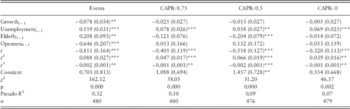
Table 2 presents the results from the probit model assessing how the probability of fiscal consolidation depends on political and macroeconomic circumstances. All models were estimated with country fixed effects. The first column presents the baseline model, including only the socio- and macroeconomic determinants of fiscal consolidation and the three variables controlling for time since the last consolidation events. The economic variables assessing the impact of growth, unemployment and financial openness on the likelihood of a fiscal consolidation event are statistically significant. Greater economic growth during the past year significantly decreases the probability that the government will consolidate. The same is true for financial openness. This negative effect is contrary to conventional wisdom, as financial openness is associated with increasing pressure on fiscal policies. This result is driven by countries that have been benefiting from capital flows and open financial markets for a long time, such as the United Kingdom, Ireland and Switzerland. Higher levels of unemployment unambiguously increase the probability of fiscal consolidation. The same applies to demographic change, although this effect is less pronounced. These results are robust, are not sensitive to different specifications of the model and are supportive of H1a.
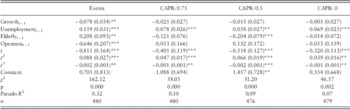
In further analyses, I reestimated the socioeconomic baseline model with the main alternative measure of fiscal consolidation, i.e. one based on the CAPB as discussed in the previous section. The results, which are presented in Table A1 in the appendix, differ from those in Table 2 and raise important questions. First and foremost, the effect of growth is not statistically significant at conventional levels. This means that a growing economy does not reduce the probability of fiscal consolidation, as defined by this alternative measure. From an actions-based perspective, this is puzzling because more growth clearly diminishes the pressure on governments to consolidate. The effect of unemployment is considerably smaller in the models using alternative measures of fiscal consolidation, but is still statistically significant. The effect of demographic change is not robust and yields contradicting results. These inconsistent results confirm the concerns about the alternative measure that I voiced in the previous section. An improvement in the cyclically adjusted fiscal balance (which, in the alternative definition, is equivalent to a consolidation event) to a large extent reflects improvements in the overall macroeconomic environment and is only partially indicative of fiscal policy choices by the government. This conflation between pure macroeconomic reactions and policy decisions leads to unstable and unclear results in the models estimated with the alternative measures of fiscal consolidation.
The coefficient on government ideology is not statistically significant at conventional levels but points in the expected direction, which implies that conservative party governments are more likely to implement consolidation measures. This finding is consistent with the studies of Vis (Reference Vis2009a, Reference Vis2009b) and Green-Pedersen (Reference Green-Pedersen2002), who find that both left- and right-wing governments implement fiscal reforms. The results on the government ideology measure support the hypothesis that ideological preferences do not influence the likelihood of fiscal reforms. The impact of political constraints and popular unrest on the likelihood of consolidation again is not statistically significant. Whereas the impact of political constraints is negative as expected, the coefficient on popular constraints is positive, which runs against the expectation that anti-government demonstrations also limit governments’ reform activity. These results imply that, contrary to H3, higher political constraints and popular constraints do not significantly reduce the likelihood of budgetary cuts. Overall, economic pressure dominates the ideology and constraints when it comes to fiscal consolidation. Unlike in other areas of social or economic policy making, like taxes or regulatory policy, greater constraints do not prevent fiscal retrenchment.
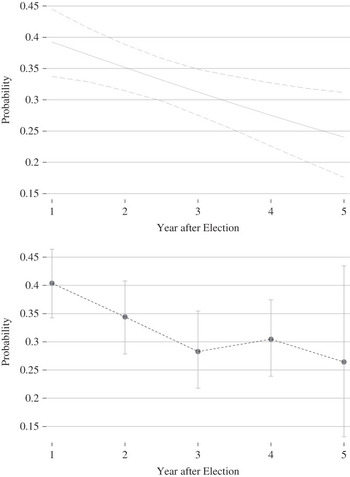
Among the political variables, elections have the strongest and a robust effect on consolidation. If we include dummies for each year, except the post-election year, we see that the probability of fiscal consolidation decreases over the term. The effect is even more pronounced for the electoral counter, which linearly increases during the term. This is in line with our expectations and also confirms qualitative and quantitative findings about the strategic manoeuvres of governments (Wagschal and Wenzelburger Reference Wagschal and Wenzelburger2012). If governments take the decision to consolidate the household, they are likely to implement the cuts at the beginning of the electoral cycle, as discussed in the theoretical section.Footnote 13
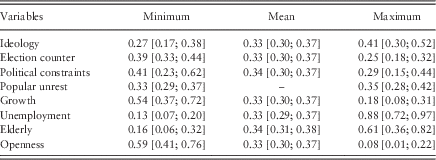
To facilitate the substantive interpretation of these results, Table 3 presents the predicted probabilities of a consolidation event for the minimum, mean and maximum values of the explanatory variables. The predictions are computed based on the model in the last column of Table 2. Predictions for the whole range of values for each variable are in the online appendix. To compute the predicted probabilities, I use the “observed values approach” as proposed by Hanmer and Kalkan (Reference Hanmer and Kalkan2013, 269–271).This means that I compute the predicted probabilities of fiscal consolidation when the variable listed on the left increases while holding all other variables at their observed values.Footnote 14 The substantive effect of the socioeconomic variables is large: the increase in the probability of a consolidation event changes between 39 percentage points for growth and 76 percentage points for unemployment. The effect for ideology and political constraints is consistent with our expectations, but the confidence intervals at the two extremes are very large and the effects are not statistically significant.
Predicted probabilities
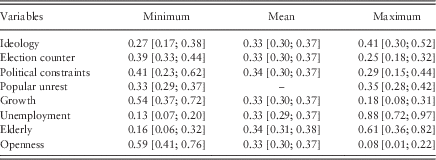
Source: Author’s elaborations.
Note: The table presents predicted probabilities of a consolidation event for different values of the variable on the left; 95% confidence intervals for each prediction are listed in brackets below the point estimate. The predicted values presented in the table were obtained by holding all other variables at their observed values (as suggested by Hanmer and Kalkan Reference Hanmer and Kalkan2013, 269–271). No value for the mean of popular unrest is reported because this is a binary variable.
Given the strong and important effect of elections, Figure 1 explores the role of the electoral cycle in greater detail. The graph on the top is based on the fifth model in Table 2 with the electoral counter. The graph on the bottom is based on the sixth model in Table 2 with several dummies for each post-election year. Both graphs show that governments are significantly more likely to implement reforms at the beginning of their terms in office than towards the end of their terms in office. The probability for a consolidation event decreases from ca. 39% at the beginning of the electoral cycle to ca. 24% at the end. Overall, this implies that H4 can be confirmed.
Probability of consolidation event over electoral cycle. Source: Author’s elaborations.

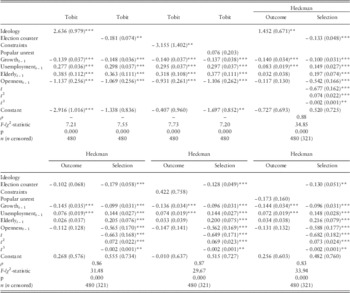
Table 4 presents the results for the size of consolidation of the Tobit and the Heckman models. Both models assess which factors determine the size of consolidation events. The dependent variable of the Tobit model and the outcome equation of the Heckman model is the size of the consolidation package. The influence of the socioeconomic variables is as expected. Economic growth negatively affects the size of budget consolidation, which means that consolidation will be smaller when the economy performs well. High levels of unemployment have a positive effect on the size of fiscal consolidation measures. These two variables have a similar effect in both models (Tobit and Heckman). The share of elderly people and financial openness are statistically significant in the Tobit model and in the selection equation of the Heckman model, but show no statistically significant effect in the outcome equation of the Heckman model examining the size of fiscal consolidation events. Overall, this implies that they mostly influence the probability that governments consolidate and less the extent to which governments consolidate. The differences between the Tobit and the Heckman model arise, because the Tobit model picks up some of the effects that are captured by the selection equation in the Heckman model.
Determinants of consolidation size

Source: Author’s elaborations.
Notes: All models include fixed effects. Robust standard errors are in parentheses.
**p<0.05; ***p<0.01.
Among the political variables, ideology has the strongest and most robust effect on consolidation size. The variable is statistically significant and has the sign in the expected direction in both the Tobit and the Heckman models. This implies that, although government partisanship does not significantly affect the likelihood of a reform as shown before, it has a significant impact on the size of government cuts. The results show that right-wing incumbents cut spending much more than left-wing governments. The first finding for the probability of reforms means that skeptics are right – economic pressure pushes both left and right governments towards reforms. However, the result for consolidation size suggests that party governments still have room to implement different consolidation measures. Right governments grab the opportunity to cut spending as much as possible. Left governments will do as much as they have to. This result confirms H2b.
As expected, constraints and elections do not have a robust effect on consolidation size. Both variables have a statistically significant impact in the Tobit model, but this effect disappears in the Heckman model. For constraints, the coefficient in the Heckman outcome equation is even in the wrong direction. As for the socioeconomic variables, the Tobit model picks up the effects from the selection equation in the Heckman model. However, if we disentangle the two processes, the effect disappears.Footnote 15
I conducted a series of additional analyses to assess the robustness of the models presented in the paper and to examine alternative hypotheses, such as the impact of (domestic and international) fiscal rules on fiscal consolidation events. First, I examine whether government ideology has a nonlinear effect on the probability of consolidation, which would require a different functional form. In one specification, I divide the government ideology variable into a set of dummy variables differentiating between left, right and centre governments. In the other, I add the squared term of the ideology variable. The results (in Table A5 in the online appendix) show that the (non-)effect of government ideology on the probability of consolidation does not change for these alternative specifications. The impact of government ideology on the size of the consolidation event is as expected and confirms that the effect is largely linear: the difference between left governments and right governments (the excluded category) is large and statistically significant; the difference between centre governments and right governments is small and not statistically significant.
As mentioned in the introduction, the implementation of fiscal rules on the domestic and/or supranational level can affect whether countries implement consolidation packages or not. The presence of domestic or supranational fiscal rules can be seen as an additional constraint on governments, which – unlike the constraints discussed above – should increase the likelihood of fiscal consolidation. I assessed the impact of various types of fiscal rules (domestic, supranational and both) on the likelihood of fiscal consolidation (Table A6 in the online appendix). The results on various types of fiscal rules show no statistically significant association with fiscal consolidation. However, the underlying political mechanisms of fiscal rules and their usage should be explored in a more in-depth way using a different research design.
Conclusion
This paper examines the determinants of fiscal consolidation by focusing on consolidation events instead of continuous fiscal policy. The distinction between consolidation events and consolidation size is useful, because it produces novel insights about the politics of fiscal reforms.
Overall, economic factors are strong determinants of consolidation events, and government ideology and political constraints do not have a robust impact on the probability of a reform. These results imply that globalisation skeptics are right in their view that all governments, both left and right, are forced to implement fiscal cuts. The empirical strategy of the paper, however, allows me to show that the content of the reforms differs across governments. Given that a consolidation event occurs, right governments use the opportunity to significantly cut spending. A case that illustrates this finding is the conservative Dutch government that implemented several fiscal consolidation packages between 1982 and 1986 that included large amounts of spending cuts. For example, in 1982 and 1983, spending cuts amounted to an improvement of the cyclically adjusted fiscal balance by 2.75 and 1.76%, respectively. Left governments, however, try to consolidate only as much as necessary. Governments therefore still have room to implement different policies even in times when economic pressure is large.
Despite the importance of the economy, strategic political considerations play a major role in the timing of fiscal consolidation. This result is in line with and extends previous qualitative contributions to the literature, which show how governments resort to strategic manoeuvres to implement reforms and make use of strategic communication and framing of reforms (Wenzelburger Reference Wenzelburger2011). It also yields interesting implications in combination with recent findings that governments are not necessarily punished when implementing unpopular reforms (Armingeon and Giger Reference Armingeon and Giger2008; Giger and Nelson Reference Giger and Nelson2011). Possibly, electoral punishment is small because governments implement unpopular reforms at the beginning of the electoral cycle deliberately to minimise this punishment. In fact, 13 out of 18 consolidation events that improved the cyclically adjusted fiscal balance by 2 percentage points or more took place in the first or second year after the inauguration of the new government.Footnote 16 This pattern is also characteristic of smaller consolidation events. Germany, for example, implemented 11 out of 16 consolidation events covered by the data set in the first two years after the elections. After the elections in 1990 and 1994, the fiscal balance was adjusted by roughly 1 percentage point.
The results of this paper suggest that the importance of strategic political considerations in planning and implementing costly reforms may have even grown in the aftermath of the collapse of the financial system in 2008 and the ongoing debt crisis in a number of countries such as Italy, Portugal and Greece. In particular, fiscal consolidation did not lead to the expected economic growth and speedier recovery suggested by research based on the expansionary fiscal consolidation thesis (Alesina et al. 1998; Alesina and Ardagna 2013). Since economic recovery has been slow or non-existent, governments cannot claim credit or harvest the positive outcomes of these painful reforms. This implies that governments are walking on a tight rope, both in terms of the timing and the size of fiscal consolidation measures. On the one hand, consolidation measures in the Eurozone countries, particularly cuts in spending, are needed to comply with the deficit rules imposed by the monetary union. On the other hand, cuts that are too harsh may not only alienate the electorate, but also negatively affect economic recovery and the confidence of investors. The current context in which governments find themselves calls for carefully designed reforms that intelligently combine the available policy measures (Price 2010).
The insights from this paper and the current crises imply that governments are likely to time costly reforms, such as fiscal consolidation events, even more carefully and implement these reforms as early as possible in the legislative term. In a best case scenario, the costly effects of the reform will have vanished and the economy will have picked up by the time the next election approaches. Only if this is the case can the government claim credit for its austerity policies. If this is not the case, the government can at least hope that the electorate will weigh the painful reforms that happened at the beginning of the legislative term less and still support the incumbent in the next elections. Future work will assess the relationship between electoral vulnerability and fiscal consolidation events in more detail.
To conclude, the findings partially support the early view that economic factors dominate certain political factors, but also show that governments still have significant room to implement distinct types of fiscal reform. Moreover, they strategically plan unpopular reforms and implement the measures at the beginning of the electoral cycle, likely in order to avoid electoral punishment in the future. Overall, the picture painted by the results is less disenchanting for the way representative democracy and party government work in times of fiscal austerity and interdependent economies than suggested by globalisation skeptics during the past decades.
Acknowledgements
The author would like to thank Oliver Treib and the participants of the panel on “Politische Parteien im Zeitalter von Globalisierung und Europäisierung” at the 3-Länder-Tagung in Innsbruck in 2013; Zbigniew Truchlewski, the two anonymous referees and the Journal editor for their helpful comments and advice.
Supplementary material
To view supplementary material for this article, please visit http://dx.doi.org/10.1017/S0143814X15000057
Appendix
Baseline Model for Different Definitions of Consolidation Events