Historically, research on family influences on youths' emotional adjustment has focused almost exclusively on parents' influences on children (McHale, Updegraff, & Whiteman, Reference McHale, Updegraff and Whiteman2012). Shortcomings of this approach include that the interconnections among all family members are ignored and that important relationships are overlooked. A critical family relationship that has received increasing attention is the sibling relationship. Relationships with siblings have direct effects on youths' development and can impact the magnitude of the effect of parents' influences (Brody, Reference Brody2004). In the current study, interactions with siblings are considered as a mediator of the relation between the parent–child relationship and adolescents' emotional adjustment. In particular, past research indicates that mothers' psychological control of their children is linked with youths' emotional adjustment problems (Barber, Reference Barber1996; Barber, Olsen, & Shagle, Reference Barber, Olsen and Shagle1994). In the current study, adolescents' perceptions of mothers' psychological control are expected to be related to adolescents' anxiety and depressive symptoms. In addition, these relations are expected to be at least partially mediated by siblings' relational aggression and psychological control. That is, mothers' psychological control is expected to be related to siblings' relational aggression and psychological control toward one another, which are expected to be related to adolescents' emotional adjustment problems.
Relational Aggression and Psychological Control in the Sibling Relationship
As stated, the present study considers relational aggression and psychological control in the sibling relationship. Relational aggression typically is defined as threatening or damaging social relationships (Crick & Grotpeter, Reference Crick and Grotpeter1995). Crick and colleagues first assessed relational aggression in the context of peer relationships, and most relational aggression research has focused on peers. Relational aggression is conceptualized and operationalized as involving (a) threats or damage to the relationship between the aggressor and the victim (e.g., the aggressor threatening not to be friends with the victim anymore unless s/he does what the aggressor says) and (b) damage to the victim's relationships with others (e.g., spreading rumors about the victim or getting others to not like or to exclude the victim).
Psychological control is a related construct that also involves relationship manipulation (Barber, Reference Barber1996). This construct was developed in the context of the parent–child relationship, and most research has focused on parents' psychological control of their children. Psychological control is defined as the manipulation of another person's psychological and emotional expression and experiences, and involves behaviors such as invalidating the other person's feelings, trying to influence how the other person thinks and feels, interfering with the other person's expression or himself or herself, and love withdrawal (e.g., limiting positive interaction when unhappy with the other person; Barber, Reference Barber1996).
There are important similarities between the constructs of relational aggression and psychological control. Nelson and Crick (Reference Nelson, Crick and Barber2002) stated that “elements of psychological control (e.g., love withdrawal, erratic emotional behavior) parallel the essence of relational aggression, in which relationships are manipulated or threatened.” However, the literature on relational aggression and psychological control remains largely unconnected. Research on relational aggression has focused primarily on egalitarian peer relationships, whereas research on psychological control has focused on hierarchical parent–child relationships. Extensions of the constructs to other relationships have maintained this distinction, with relational aggression studied in egalitarian relationships (e.g., romantic relationships; Linder, Crick, & Collins, Reference Linder, Crick and Collins2002) and psychological control studied in hierarchical relationships (e.g., the teacher–student relationship; Soenens, Sierens, Vansteenkiste, Dochy, & Goossens, Reference Soenens, Sierens, Vansteenkiste, Dochy and Goossens2012).
Siblings provide a unique context for simultaneously considering relational aggression and psychological control given that the sibling relationship consists of both an egalitarian, playmate structure similar to peer relationships and a hierarchical (older vs. younger) and caretaking structure similar to parent–child relationships (Dunn, Reference Dunn, Smith and Hart2002). A few studies have considered relational aggression (Ostrov, Crick, & Stauffacher, Reference Ostrov, Crick and Stauffacher2006; Stauffacher & DeHart, Reference Stauffacher and DeHart2005; Updegraff, Thayer, Whiteman, Denning, & McHale, Reference Updegraff, Thayer, Whiteman, Denning and McHale2005; Yu & Gamble, Reference Yu and Gamble2008) or psychological control (Conger, Conger, & Scaramella, Reference Conger, Conger and Scaramella1997) in sibling relationships. However, no previous work has considered relational aggression and psychological control in sibling relationships within a single study.
Because the present study considers relational aggression and psychological control in the context of one relationship type within a single study, the factor structure of the items can be examined to determine whether they are better represented by one factor or two. Analyses might suggest a single factor representing relationship manipulation. However, there are differences between the constructs as well. Whereas psychological control involves manipulation only within the relationship dyad, relational aggression involves manipulation within the dyad as well as manipulation of the victims' relationships with others. Moreover, some assessments of relational aggression (including the one used in the present study) focus primarily on the manipulation of the victim's relationships with others, further reducing the overlap between the constructs. As such, relational aggression and psychological control are expected to be best represented by two factors in the current study.
In addition, because both constructs are considered, whether the same pattern of gender and birth order differences emerge for sibling relational aggression and for sibling psychological control can be examined with a single sample of siblings. Although some studies suggest that girls may be more relationally aggressive than boys with peers (e.g., Smith, Rose, & Schwartz-Mette, Reference Smith, Rose and Schwartz-Mette2010), gender differences in sibling relational aggression have not been found during early and middle childhood (Ostrov et al., Reference Ostrov, Crick and Stauffacher2006; Stauffacher & DeHart, Reference Stauffacher and DeHart2005, Reference Stauffacher and DeHart2006) or adolescence (Updegraff, Thayer, et al., Reference Updegraff, Thayer, Whiteman, Denning and McHale2005; Yu & Gamble, Reference Yu and Gamble2008). Girls and boys also did not differ in how much psychological control they reported receiving from siblings (Conger et al., Reference Conger, Conger and Scaramella1997). In regard to birth order, one study did not find mean-level birth order differences in sibling relational aggression (Updegraff, Thayer, et al., Reference Updegraff, Thayer, Whiteman, Denning and McHale2005). However, birth order differences in sibling relational aggression and psychological control generally have not been tested. The previous studies do not provide a basis to expect gender or birth order differences, thus strong hypotheses are not put forth given that relatively few previous studies have examined mean-level gender or birth order differences in relational aggression or psychological control.
Mothers' Psychological Control and Adolescents' Emotional Adjustment Problems: Considering Sibling Relational Aggression and Psychological Control as Mediators
Considering relational aggression and psychological control in the sibling relationship is important conceptually because these processes may help to explain the association between mothers' psychological control and their children's emotional adjustment problems. Because parents' psychological control involves constraining and manipulating their children's emotional experiences, it has been conceptualized as a negative parenting strategy that should undermine youths' emotional well-being (Barber, Reference Barber1996). Parents' psychological control is consistently associated with their children's internalizing symptoms (e.g., Barber, Reference Barber1996; Barber et al., Reference Barber, Olsen and Shagle1994; Conger et al., Reference Conger, Conger and Scaramella1997; Yu & Gamble, Reference Yu and Gamble2008).
Although the relation between parents' psychological control and their children's emotional adjustment problems is well documented, less is known about processes that may help to account for the relation. In the present study, being relationally victimized and psychologically controlled by a sibling is expected to mediate the relations between mothers' psychological control and adolescents' anxiety and depressive symptoms. Mothers' psychological control has been found to be related to relational aggression (Yu & Gamble, Reference Yu and Gamble2008) and psychological control (Conger et al., Reference Conger, Conger and Scaramella1997) between siblings, and being relationally victimized (Yu & Gamble, Reference Yu and Gamble2008) and psychologically controlled (Conger et al., Reference Conger, Conger and Scaramella1997) by a sibling is related to internalizing problems. However, whether these associations help to account for the relation between maternal psychological control and youths' internalizing symptoms is not known.
Moreover, because both sibling relational aggression and psychological control are considered, whether both (or only one) of the constructs mediate the relations between maternal psychological control and adolescents' emotional adjustment problems can be examined. Sibling psychological control may be a stronger mediator because the construct is most similar to maternal psychological control. That is, mothers' psychological control may translate most directly into psychological control between siblings, which is linked with emotional problems. Alternatively, relational aggression may be a particularly strong mediator. As noted, psychological control involves manipulation only within the sibling dyad, whereas relational aggression includes manipulation of the siblings' relationships with others. Youth may consider some negativity within the sibling dyad to be normative or even expected. However, carrying aggression beyond the dyad by undermining relationships with others may be less expected and particularly hurtful.
Finally, gender and birth order differences in associations among maternal psychological control, sibling relational aggression and psychological control, and adolescents' emotional adjustment problems are examined. From previous studies, it is not entirely clear whether the associations vary across gender and birth order (Conger et al., Reference Conger, Conger and Scaramella1997; Yu & Gamble, Reference Yu and Gamble2008); however, one study suggests that maternal psychological control and sibling relational aggression may be related to internalizing problems especially strongly for younger siblings (Yu & Gamble, Reference Yu and Gamble2008). Thus, in the present study, mean-level gender and birth order differences in perceptions of receiving relational aggression and psychological control from siblings are investigated, as well as the potential differential associations between these relational processes and emotional adjustment for older and younger siblings, as well as for different sibling gender compositions.
Method
Participants
Participants included 101 sibling dyads. One adolescent was recruited from Grades 10, 11, or 12 and participated with his/her sibling who was closest in age. The siblings were less than 5 years apart and both lived in the same home. Participants' ages ranged from 11 to 21 years (older siblings in the dyads ranged in age from 14 to 21, M = 16.46, SD = 1.35; younger siblings in the dyads ranged in age from 11 to 17, M = 13.67, SD = 1.56). Participants ranged in grade from 6th grade to post-high school (5.4% were post high school), with the modal response being 10th grade. The mean age difference between siblings was 2.79 years. Males made up 45.6% of the sample, with a relatively equal distribution of sibling sex composition (older brother–younger brother: 26%; older sister–younger sister: 33%; older brother–younger sister: 20%; older sister–younger brother: 22%). The birth order of siblings varied with 38% of the sample consisting of first- and second-born siblings, 45% second- and third-born siblings, 13% third- and fourth-born siblings, and 4% individuals reporting later than third-born status in the family. Siblings are referred to as older or younger siblings within the dyad (as opposed to referring to their specific birth order within the larger family context).
According to parent reports, participants came from a relatively homogeneous and affluent population. The majority of the sample consisted of European Americans (85%) with the rest of the sample consisting of African Americans (5%), Asian Americans (2%), or other ethnicities (4%; the final 4% of the sample did not report on ethnicity). Most families were intact (72.3%), with 12.9% of parents married in a blended family, 10.9% of parents divorced, and 3.9% of the parents reporting being single (either never married or widowed). Over 80% of the parents of participants had a college or graduate degree (81.2%). The median annual income was over $100,000. There were no significant associations between the study variables and ethnicity (tested as White and non-White), marital status (tested as intact and not intact), family income, or parental education.
Although there was a small amount of missing data (7.87%) owing to some participants not completing all questionnaire items, it was likely missing completely at random, χ2 (4,048) = 4,151.21, p > .05. The expectation maximization procedure (Schafer, Reference Schafer1997) in Statistical Package for the Social Sciences software was therefore utilized in order to retain all of the data for analyses.
Procedures
Participants were recruited from three local high schools within a Midwestern suburban district. Letters describing the nature of the study were sent to families with adolescents in 10th–12th grades. School officials provided address information for 3,332 adolescents, with some from overlapping families. Letters were sent to approximately 1,500 of these households (randomly drawn from roster). All interested families contacted the investigators regarding participation. Inclusion criteria were that at least one sibling had to be in 10th–12th grade, with a sibling (closest in age) less than 5 years apart, and with both siblings living at home. Specific participation rates could not be calculated given that it was unknown how many families who received recruitment information were eligible for participation and chose not to participate versus those not eligible to participate. A small honorarium was paid to each sibling. There also was a raffle for four $100 gift certificates ($50/sibling) for siblings who returned their questionnaires within 3 weeks of receiving them. Once families agreed to participate, they were sent individual e-mails with links to an online survey (or mailed paper questionnaires if requested). Two weeks after receiving the questionnaire, participants who had not returned their questionnaire received a follow-up telephone reminder to complete the study by the 3-week deadline.
Measures
Maternal psychological control
The Psychological Control Scale—Youth Self-Report (Barber, Reference Barber1996) is an eight-item measure designed to assess youths' reports of parental psychological control and was used in this study to assess maternal control, specifically. The eight items assess the extent to which individuals perceive the following four categories of behavior from their mothers from 1 (not like mother) to 3 (a lot like mother): invalidating feelings (1 item; “is always trying to change how I feel or think about things”), constraining verbal expression (2 items; e.g., “often interrupts me”), personal attacks (2 items; e.g., “tells me I am not loyal or a good member of the family”), and love withdrawal (3 items; e.g., “if I have hurt her feelings, stops talking to me until I please her again”).
Sibling psychological control
The Psychological Control Scale—Youth Self-Report (Barber, Reference Barber1996) also was used to assess youths' reports of psychological control received from their sibling. The same eight items that were used for mothers were used for siblings, and participants rated each behavior from 1 (not like sibling) to 3 (a lot like sibling).
Sibling relational victimization
The relational victimization subscale of the Revised Social Experience Questionnaire (Crick & Grotpeter, Reference Crick and Grotpeter1996) is a five-item measure and was originally used to measure peer victimization. For the present study, each item was reworded to reflect adolescents' perceptions of their sibling's relational aggression toward them. Four of the five items involved the sibling manipulating the adolescents' relationships with people outside of the sibling dyad (e.g., “My brother/sister tries to keep others from liking me by saying mean things about me”; “My brother/sister has told lies about me to make others not like me”). The fifth relational aggression item assessed negative behavior within the sibling dyad (e.g., “My brother/sister tells me he/she won't like me unless I do what he/she says”).
Anxiety
The Revised Children's Manifest Anxiety Scale (Reynolds & Richmond, Reference Reynolds and Richmond1978) is a 28-item scale used to assess different dimensions of anxiety. Sample items include “I worry a lot of the time” and “My hands feel sweaty” and were rated on a scale from 1 (not at all true of yourself) to 5 (really true of yourself). Mean scores of the items were used in the final analyses (Cronbach α = 0.93), and higher scores indicated greater anxiety.
Depressed mood
The Center for Epidemiologic Studies Depression Scale (Radloff, Reference Radloff1977) is a 20-item measure designed to assess depression. Items were rated on a scale from 1 (rarely) to 4 (most or all). Sample items include “I felt that everything I did was an effort” and “I felt lonely.” Mean scores were used in the final analyses (Cronbach α = 0.76), and higher scores indicated greater depressed mood.
Results
Factor structure of the maternal psychological control measure and the sibling relational aggression and psychological control measures
We conducted a series of confirmatory factor analyses (CFA) using Amos 21.0 to examine our measures of maternal and sibling psychological control and sibling relational aggression. Because the individual adolescents were nested within sibling dyads, each adolescent could not be treated as an independent observation in these analyses. Moreover, it was important to test whether the same factor structure held for older and younger siblings. Therefore, for each CFA described below, preliminary analyses were conducted. Unconstrained models were tested in which all loadings and covariances were computed separately for older and younger siblings, with covariances included across older and younger siblings for each variable to account for the nested nature of the data (Kenny, Kashy, & Cook, Reference Kenny, Kashy and Cook2006). Constrained models were tested in which the factor loadings were constrained to be equal for older and younger siblings. Then, for each CFA, a chi-square difference test was computed that compared the unconstrained model to the constrained model. For each CFA tested, the unconstrained model did not fit significantly better than the constrained model, as evidenced by nonsignificant chi-square difference tests (all ps > .05). Thus, because the measurement models indicated that the factor loadings did not significantly differ for older versus younger siblings, the following results reflect those for the constrained models.
We first conducted a one-factor CFA on the eight-item measure of youths' perceptions of maternal psychological control. The CFA (including one covariance between item error terms as recommended by modification indices) indicated adequate model fit, χ2 (99) = 127.41, p = .03, comparative fit index (CFI) = 0.90, root mean square error of approximation (RMSEA) = 0.05, based on Hu and Bentler's (Reference Hu and Bentler1999) criteria. The standardized factor loadings were reviewed to assess each item's strength within the model. Seven of the eight factor loadings were significant (p < .05), and six were particularly strong (0.34–0.70, standardized). However, two items (“Finishes my sentences whenever I talk” and “Acts like he/she knows that I'm thinking or feeling”) were relatively weak (0.12 and 0.18). Although the other six items in Barber's (Reference Barber1996) measure clearly imply manipulative, antisocial relational tactics, these two items could be interpreted as supportive and involving positive relational tactics rather than psychologically controlling behaviors. Given this possible interpretation, along with the lower factor loadings, we dropped these two items and recomputed the model. The new model had good fit, χ2 (49) = 60.13, p = .13, CFI = 0.96, RMSEA = 0.05, Akaike information criterion (AIC) = 118.13, and showed significant improvement over the previous model (AIC = 201.41) based on a nonnested comparison. Therefore, the analyses for maternal psychological control utilized the mean of these remaining six items (Cronbach α = 0.75).
We next conducted a one-factor CFA on the eight items assessing sibling psychological control. The CFA (including two covariances between item error terms as recommended by modification indices) indicated adequate fit, χ2 (99) = 121.75, p = .06, CFI = 0.90, RMSEA = 0.05. The six items retained in the maternal psychological control model showed strong, significant factor loadings (0.35–0.65), but the two items that were dropped from the maternal psychological control measure also had the lowest loadings in the sibling model (0.29 and 0.30). In order to utilize parallel measures for maternal and sibling psychological control, these two items were removed from the sibling model and it was recomputed. The new model indicated good fit, χ2 (49) = 44.69, p = .65, CFI = 1.00, RMSEA = 0.00, AIC = 102.69, and significantly improved upon the previous model (AIC = 195.75) based on a nonnested comparison. The mean of the six items that were retained were used in analyses examining sibling psychological control (Cronbach α = 0.68).
For relational aggression, we examined the fit of the model with all five items, and we compared the fit of this model to the fit of a four-item model in which we dropped the single item assessing relational aggression within the sibling dyad (the remaining four items assessed manipulation of the sibling's relationships with others). The one-factor CFA conducted with all five items (including one covariance between two item error terms as recommended by modification indices) indicated good model fit, χ2 (32) = 35.52, p = .31, CFI = 0.99, RMSEA = 0.03. However, the fit of the one-factor CFA conducted with only the four items (including one covariance between two item error terms) also was good, χ2 (17) = 16.60, p = .48, CFI = 1.00, RMSEA = 0.00. Moreover, a nonnested comparison of the models indicated that the four-item model (AIC = 54.60) fit the data better than the five-item model (AIC = 81.52). Therefore, the four-item model was retained. The standardized factor loadings of the items in the four-item model all were significant, ranging from 0.43 to 0.96. The mean of these four items were used for analyses (Cronbach α = 0.81).
Finally, we examined whether sibling psychological control and sibling relational aggression are best conceptualized as one construct or as two separate constructs. We first conducted a one-factor CFA with the six psychological control items (along with two covariances) and the four relational aggression items (along with one covariance) loading onto a single factor. Model fit was fair, χ2 (163) = 247.59, p < .01, CFI = 0.86, RMSEA = 0.07, and the standardized factor loadings for the items were significant, ranging from 0.18 to 0.91. We next conducted a two-factor CFA with the six psychological control items loading onto one factor, and the four relational aggression items loading onto a second factor, with the two higher order factors allowed to covary. Model fit for the two-factor model was adequate, χ2 (160) = 223.38, p = .001, CFI = 0.90, RMSEA = 0.06, and the standardized factor loadings for the items were significant, ranging from 0.28 to 0.98. A chi-square difference test indicated that the two-factor model was a significant improvement upon the one-factor model, Δχ2 (3) = 24.21, p < .01. These results justified conceptualizing sibling psychological control and relational aggression as two separate constructs.
Descriptive statistics and gender and birth order differences
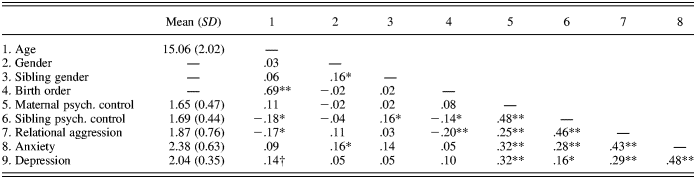
Bivariate correlations among all study variables are presented in Table 1. In addition, we performed two 2 (adolescent gender) × 2 (sibling gender) × 2 (birth order) between-subjects analyses of variance, for sibling psychological control and sibling relational aggression. For sibling psychological control, only a significant main effect of sibling gender was evident, F (1, 194) = 7.04, p < .01. Adolescents perceived more psychological control from sisters (M = 1.72, SD = 0.39) than from brothers (M = 1.59, SD = 0.33). For sibling relational aggression, only a significant main effect of birth order was found, F (1, 194) = 6.52, p < .05. Younger siblings reported more relational victimization from older siblings (M = 1.96, SD = 0.75) than older siblings reported from younger siblings (M = 1.68, SD = 0.77).
Means (standard deviations) and correlations between study variables

Note: Sex and sibling sex were coded as 1 = male, 2 = female. Birth order was coded as 1 = younger sibling, 2 = older sibling. Psych. control, psychological control.
†p < .10. *p < .05. **p < .01.
Analytical plan for structural equation models
Separate path analyses (using AMOS 21.0) tested: (a) associations between maternal psychological control and the emotional adjustment indices (anxiety and depression), (b) associations between sibling psychological control and the emotional adjustment indices, and (c) associations between sibling relational aggression and the emotional adjustment indices. A meditational model then tested whether sibling psychological control and relational aggression mediated any associations between maternal psychological control and the indices of adolescents' emotional adjustment.
For each of the four models of interest, we accounted for the nested nature of the data, as described above for the CFAs (Kenny et al., Reference Kenny, Kashy and Cook2006). Specifically, in preliminary analyses, unconstrained models in which the parameters were allowed to vary were compared to constrained models in which the factor loadings were constrained to be equal for older and younger siblings. For each model, a chi-square difference test was computed that compared the unconstrained model to the constrained model. For each of the four models, the unconstrained models did not fit significantly better than the constrained models (all ps > .05). Therefore, all results are presented from the constrained models.
Next, additional analyses of the nested models (with paths constrained to equality across both siblings in each dyad) were conducted to determine whether the models fit equally well for brother–brother, sister–sister, older brother–younger sister, and older sister–younger brother dyads. For each of the four models, unconstrained models in which the parameter estimates were computed separately for each of the gender composition groups did not fit significantly better than constrained models with paths constrained to equality across the four gender composition groups (all ps > .05). Thus, subsequent results were conducted with all dyads combined, rather than separately by gender composition.
Associations of maternal psychological control, sibling relational aggression, and sibling psychological control with emotional adjustment
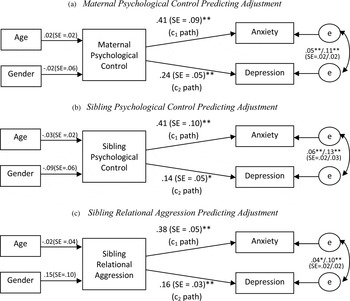
Figure 1a depicts the model examining the effect of maternal psychological control on adolescent anxiety and depressive symptoms. Adolescent age and gender were controlled for in the model. Adolescents who reported greater psychological control from mothers reported greater anxiety and greater depression.
The associations between relational tactics and adjustment (unstandardized parameter estimates). (a) Maternal psychological control predicting adjustment, (b) sibling psychological control predicting adjustment, and (c) sibling relational aggression predicting adjustment. Models presented were run concurrently for older and younger siblings to account for the nested nature of the data, with paths constrained to equality across both groups. Values presented in the figures are therefore representative of both older and younger siblings. Covariances between error terms were estimated separately for younger/older siblings (younger sibling values presented first, older sibling values second). Model fit for (a) χ2 (35) = 34.33, p = .50; comparative fit index (CFI) = 1.00, root mean square error of approximation (RMSEA) = 0.00; (b) χ2 (35) = 49.55, p = .05; CFI = 0.91, RMSEA = 0.06; and (c) χ2 (35) = 34.35, p = .50; CFI = 1.00, RMSEA = 0.00. *p < .05, **p < .01.

Figure 1b depicts a model of associations between sibling psychological control and adolescent anxiety and depressive symptoms. Again, adolescent age and gender were controlled for in the model. Greater sibling psychological control was associated with greater adolescent anxiety and more depressive symptoms.
Figure 1c depicts a model of associations between sibling relational aggression and adolescent anxiety and depressive symptoms (with adolescent age and gender as controls). Greater sibling relational aggression was associated with greater adolescent anxiety and more depressive symptoms.
Mediational analyses
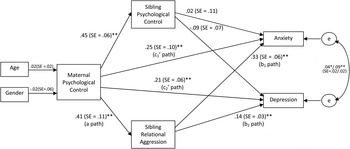
Next, we tested a meditational model to examine whether associations between maternal psychological control and the two emotional adjustment indexes were mediated by sibling psychological control and relational aggression (see Figure 2). Paths were included from maternal psychological control to sibling psychological control and relational aggression. Paths from sibling psychological control and relational aggression to anxiety and depression also were included. The direct paths from maternal psychological control to anxiety and depression were estimated as well. As in the previous models, age and adolescent gender were controlled.
The associations between maternal psychological control and adjustment as mediated by sibling psychological control and relational aggression (unstandardized parameter estimates). Model presented was run concurrently for older and younger siblings to account for the nested nature of the data, with paths constrained to equality across both groups. Values presented in the figures are therefore representative of both older and younger siblings. Covariances between error terms were estimated separately for younger/older siblings (younger sibling values presented first, older sibling values second). An additional covariance (not shown in figure) between the error terms of sibling psychological control and sibling relational aggression was also estimated (estimates = 0.10**/0.07*, SE = 0.03/0.03). Model fit: χ2 (71) = 96.18, p = .03; comparative fit index = 0.92, root mean square error of approximation = 0.06. *p < .05, **p < .01.

Maternal psychological control was a significant predictor of sibling psychological control and sibling relational aggression. Similar to the previous models, sibling relational aggression predicted greater anxiety and greater depression. However, sibling psychological control was no longer associated with anxiety or depression. The direct effect of maternal psychological control significantly predicted greater anxiety and greater depressed mood even with sibling psychological control and relational aggression in the model.
Procedures outlined by Preacher and Hayes (Reference Preacher and Hayes2004) were used to determine whether sibling relational aggression and/or sibling psychological control mediated the effect of maternal psychological control on anxiety and/or depression. Specifically, the asymmetric confidence interval (CI) method (see MacKinnon, Lockwood, Hoffman, West, & Sheets, Reference MacKinnon, Lockwood, Hoffman, West and Sheets2002) was used to determine if significant mediation was present (95% asymmetric CIs were calculated for the indirect effect [IE], using PRODCLIN; MacKinnon, Fritz, Williams, & Lockwood, Reference MacKinnon, Fritz, Williams and Lockwood2007). Sibling relational aggression significantly mediated the relation of maternal psychological control with anxiety, IE = 0.14, 95% CI (0.06, 0.23), and depressive symptoms, IE = 0.02, 95% CI (0.02, 0.10). As would be expected, given that sibling psychological control was not a significant predictor of the emotional adjustment indexes, sibling psychological control did not mediate the relation of maternal psychological control with anxiety, IE = 0.14, 95% CI (–0.09, 0.11), or depression, IE = 0.02, 95% CI (–0.10, 0.02).
Discussion
The present study provided new information about the interplay among mothers' psychological control, siblings' relational aggression and psychological control, and adolescents' emotional adjustment. One goal of the study was to test whether, when examined within the same relational context, relational aggression and psychological control were best represented by one factor (reflecting social manipulation in the sibling relationship) or two factors. Although the two processes share some features, they are not redundant in the context of the sibling relationship. In regard to the current assessment, the key distinction may involve whether the social manipulation occurs within the sibling dyad as it does for psychological control or through manipulation of relationships outside of the dyad as it does for relational aggression. Considering these constructs separately proved to be important because they functioned differently in terms of the degree to which they helped to account for the relation between maternal psychological control and adolescents' emotional adjustment.
Specifically, we examined whether sibling relational aggression and psychological control at least partially mediated the associations of maternal psychological control with adolescent anxiety and depressive symptoms. In order to test for mediation, it was important to confirm (a) that greater maternal psychological control was associated with greater sibling relational aggression and psychological control and (b) that greater relational aggression and sibling psychological control were associated with poorer emotional adjustment. Consistent with previous research (Conger et al., Reference Conger, Conger and Scaramella1997; Yu & Gamble, Reference Yu and Gamble2008), these associations were significant.
Despite similar associations of sibling relational aggression and psychological control with the emotional adjustment variables when considered independently, notable differences emerged between the constructs when they were considered as simultaneous mediators of the associations between maternal psychological control and adolescent adjustment. Only sibling relational aggression was a significant mediator of the associations of maternal psychological control with depression and anxiety. As hypothesized, sibling relational aggression may be an especially effective mediator because it involves manipulating relationships beyond the sibling dyad. The sibling relationship has been considered the quintessential “love–hate relationship” (McHale, Kim, & Whiteman, Reference McHale, Kim, Whiteman, Noller and Feeney2006), and control by siblings in general is a relatively common feature within sibling dyads (Tucker & Updegraff, Reference Tucker and Updegraff2010). Perhaps sibling psychological control, or attempts to control and manipulate within the relationship, is not considered by siblings to be especially aberrant or surprising. In contrast, manipulating and threatening relationships outside of the sibling relationship, such as with peers or parents, may be seen as particularly hurtful and out of bounds because it takes the issues between the siblings to the broader social context. If adolescents fear that their siblings may turn others against them if they do not adhere to their siblings' desires, this could be particularly problematic.
Although mediation was significant, the direct effects of maternal psychological control on adolescents' anxiety and depressive symptoms also remained significant even with siblings' relational aggression and psychological control included in the model. These findings are consistent with the idea that there are additional processes that help to account for the influence of mothers' psychological control on adolescents' emotional adjustment problems. For example, future work could test whether mothers' psychological control influences their children's social cognitions, such as their attributions about difficulties (e.g., tending to make internal and stable attributions) or their self schemas (e.g., feeling unworthy or unlovable), in ways that undermine their emotional adjustment.
Utilizing a prospective design in future research on mediators of the link between maternal psychological control and youth's emotional adjustment will be critical for understanding the temporal ordering of the relations. At least three data points are needed to test the influence of maternal psychological control on the mediator and the mediator's influence on youths' emotional adjustment. Moreover, the relations between maternal psychological control and sibling psychological control and relational victimization, and between sibling psychological control and relational victimization and youths' emotional adjustment may each be bidirectional. If that is the case, then the associations may be further strengthened over time through reciprocal influence processes.
In addition, future work should consider how maternal psychological control might contribute to psychological control and relational victimization in the sibling relationship. One possibility is that modeling may play an important role. From psychologically controlling parents, children may learn that family relationships can be manipulated as a means to meet one's own needs and goals. Biological factors also may play a role. Twin research on relational aggression toward peers indicates that genetics play a stronger role in determining children's relational aggression than does shared environment (Brendgen et al., Reference Brendgen, Boivin, Vitaro, Bukowski, Dionne and Tremblay2008). The twin paradigm also could be used to consider the degree to which relational aggression and psychological control within the sibling relationship is due to genetic influences, shared environmental influences (e.g., modeling), and nonshared environmental influences.
Turning to gender and birth order, a few differences emerged in regard to the degree of maltreatment adolescents receive from siblings. Adolescents reported more psychological control from sisters than from brothers and more relational aggression from older siblings than from younger siblings. While some previous research with peers suggests that girls are more relationally aggressive than boys (e.g., Smith et al., Reference Smith, Rose and Schwartz-Mette2010), the previous research regarding gender differences in sibling relational aggression and psychological control has either not been investigated or has shown no mean-level differences (Ostrov et al., Reference Ostrov, Crick and Stauffacher2006; Updegraff, Thayer, et al., Reference Updegraff, Thayer, Whiteman, Denning and McHale2005; Yu & Gamble, Reference Yu and Gamble2008). However, previous research regarding siblings' controlling behaviors toward one another in general has found that older siblings are more likely to control younger siblings than the reverse (Tucker & Updegraff, Reference Tucker and Updegraff2010). Thus, girls and younger siblings may be especially at risk for sibling psychological control and sibling relational aggression. Even though there were some mean-level differences in the degree of relational aggression and psychological control adolescents reported receiving from siblings, there were not gender or birth order differences in associations with adjustment. These findings suggest that sibling relational victimization and psychological control may similarly influence emotional adjustment for girls and boys as well as for earlier-born and later-born siblings.
Although the present study advances our understanding of the relational processes of relational aggression and psychological control in the sibling relationship, some limitations remain. First, as noted, the relational data and outcome data were collected at one point in time, and longitudinal research is needed to examine the temporal ordering of the relations. Second, all reports of relational processes and adjustment were from the perspectives of the adolescents in our study. Future studies would benefit from other reporters (e.g., parents' reports) or observations of actual relationship processes. Third, the present study is limited in its generalizability because the sample utilized was overwhelmingly White and middle class. Given that racial/ethnic differences have been found in sibling relationship processes (e.g., Updegraff, McHale, Whiteman, Thayer, & Delgado, Reference Updegraff, McHale, Whiteman, Thayer and Delgado2005), future research should investigate sibling psychological control and relational aggression in more diverse samples.
Despite these limitations, the present study is the first to examine both relational aggression and psychological control within the same relationship context. By doing so, and by examining these processes within the context of the sibling relationship, we were able to provide a unique comparison between the two processes. Although sibling psychological control and sibling relational aggression likely both stem from earlier experiences with parental psychological control and both have negative consequences for youth adjustment, they appear to function differently. In particular, sibling relational aggression (when operationalized as manipulating relationships outside of the sibling dyad) is a stronger mediator of the association between maternal psychological control and emotional adjustment than psychological control (manipulative behaviors within the sibling dyad). Additional work is necessary to determine if this distinction is evident in other relational contexts as well to better understand how these similar mechanisms operate within and across close relationships.