1. Introduction and geologic background
The ~180 km diameter Chicxulub peak-ring basin (Hildebrand et al. Reference Hildebrand, Penfield, Kring, Pilkington, Camargo-Zanoguera, Jacobsen and Boynton1991) is the largest Phanerozoic impact structure on Earth, has been linked to the K–T boundary events (e.g. Izett, Reference Izett1991; Kring & Boynton, Reference Kring and Boynton1991, Reference Kring and Boynton1992; Sigurdsson et al. Reference Sigurdsson, Bonté, Turpin, Chaussidon, Metrich, Steinberg, Pradel and d'Hondt1991; Sharpton et al. Reference Sharpton, Dalrymple, Marín, Ryder, Schuraytz and Urrutia-Fucugauchi1992; Krogh et al. Reference Krogh, Kamo, Sharpton, Marín and Hildebrand1993b; Kamo & Krogh, Reference Kamo and Krogh1995; Kring, Reference Kring1995) and is the apparent source of the iridium anomaly that sparked the impact – mass-extinction hypothesis (Alvarez et al. Reference Alvarez, Alvarez, Asaro and Michel1980; Ganapathy, Reference Ganapathy1980; Kyte, Zhou & Wasson, Reference Kyte, Zhou and Wasson1980; Smit & Hertogen, Reference Smit and Hertogen1980). In this context, we refer readers to an extensive literature that includes the early reports of the iridium anomaly in K–T transition sediments worldwide; the discovery of the Chicxulub crater as the K–T impact site; petrologic studies of Chicxulub-produced impactites and target rocks; the characterisation of the impact-induced hydrothermal system; systematic studies of proximal, medial and distal K–T ejecta and associated tsunami deposits; constraints on the meteoritic signature in Chicxulub-produced impactites; the geophysical study of the crater; the isotopic dating of the impact; and the effects of the Chicxulub impact on the Earth's biosphere and climate (e.g. reviews by Smit, Reference Smit1999; Kring, Reference Kring2005, Reference Kring2007; Schulte et al. Reference Schulte, Alegret, Arenillas, Arz, Barton, Bown, Bralower, Christeson, Claeys, Cockell, Collins, Deutsch, Goldin, Goto, Grajales-Nishimura, Grieve, Gulick, Johnson, Kiessling, Koeberl, Kring, MacLeod, Matsui, Melosh, Montanari, Morgan, Neal, Nichols, Norris, Pierazzo, Ravizza, Rebolledo-Vieyra, Reimold, Robin, Salge, Speijer, Sweet, Urrutia-Fucugauchi, Vajda, Whalen and Willumsen2010; and references therein).
The Chicxulub impact structure lies in a layered sedimentary and crystalline target rock sequence, composed of a ~3 km thick suite of Jurassic–Cretaceous carbonate platform sediments (mainly limestone, dolomite, marl and anhydrite) that overlies a structurally complex basement of granitoids, amphibolite, dolerite, gneiss and cordierite gneiss of the Maya block (e.g. Kring, Reference Kring2005; Keppie et al. Reference Keppie, Dostal, Norman, Urrutia-Fucugauchi and Grajales-Nishimura2011; Morgan et al. Reference Morgan, Gulick, Bralower, Chenot, Christeson, Claeys, Cockell, Collins, Coolen, Ferrière, Gebhardt, Goto, Jones, Kring, Le Ber, Lofi, Long, Lowery, Mellett, Ocampo-Torres, Osinski, Perez-Cruz, Pickersgill, Poelchau, Rae, Rasmussen, Rebolledo-Vieyra, Riller, Sato, Schmitt, Smit, Tikoo, Tomioka, Urrutia-Fucugauchi, Whalen, Wittmann, Yamaguchi and Zylberman2016; Schmieder et al. Reference Schmieder, Kring, Chenot, Christeson, Claeys, Cockell, Coolen, Ferrière, Gebhardt, Goto, Gulick, Jones, Lofi, Lowery, Mellett, Morgan, Ocampo-Torres, Perez-Cruz, Pickersgill, Poelchau, Rae, Rasmussen, Rebolledo-Vieyra, Riller, Sato, Smit, Tikoo-Schantz, Tomioka, Urrutia-Fucugauchi, Whalen, Wittmann, Xiao, Xiao, Yamaguchi, Zhao and Zylberman2017). Impactites have been recovered from several boreholes, among which are a petroleum exploration well, Yucatán-6 (~50 km radial distance from the crater centre, depth 1645 m), and a scientific well, Yaxcopoil-1 (~65 km radial distance, depth 1511 m; see fig. 3 of Sharpton et al. Reference Sharpton, Marín, Carney, Lee, Ryder, Schuraytz, Sikora, Spudis, Ryder, Fastovsky and Gartner1996, and fig. 5 of Kring, Reference Kring2005, for stratigraphic correlations of boreholes into the Chicxulub impact structure). Zircon, apatite and other U-carrier phases initially present in the rocks of the Maya block and the overlying sedimentary sequence were, during the Chicxulub impact, shock-metamorphosed and subsequently exposed to impact-induced hydrothermal conditions, including the local precipitation of secondary U–Th–Pb-bearing phosphate (e.g. Zürcher & Kring, Reference Zürcher and Kring2004) and Pb-rich sulphide (e.g. galena; Ames et al. Reference Ames, Kjarsgaard, Pope, Dressler and Pilkington2004). Affected by a long-lived impact-induced hydrothermal system thought to have lasted up to ~2 Myr (Abramov & Kring, Reference Abramov and Kring2007), rocks inside the Chicxulub crater are to variable degrees altered (Ames et al. Reference Ames, Kjarsgaard, Pope, Dressler and Pilkington2004; Hecht et al. Reference Hecht, Wittmann, Schmitt and Stöffler2004; Zürcher & Kring, Reference Zürcher and Kring2004; Newsom et al. Reference Newsom, Nelson, Shearer and Dressler2006; Nelson et al. Reference Nelson, Newsom, Spilde and Salge2012). The hydrothermal alteration pattern seems to show outward radial zoning from higher temperatures in the central crater domain towards intermediate temperatures at Yucatán-6 and lower temperatures at Yaxcopoil-1 (Zürcher, Lounejeva-Baturina & Kring, Reference Zurcher, Lounejeva-Baturina and Kring2005).
Zircon was previously isolated from bulk rock samples from the Yucatán-6 core (Krogh et al. Reference Krogh, Kamo, Sharpton, Marín and Hildebrand1993b) and a granodiorite fragment from the Yaxcopoil-1 core (Keppie et al. Reference Keppie, Dostal, Norman, Urrutia-Fucugauchi and Grajales-Nishimura2011) to determine the ages of the crater and impact target rocks. However, due to the technique applied (see Section 2), in which zircon grains from a whole-rock sample are isolated and dissolved, the petrologic context of each individual zircon grain analysed by Krogh et al. (Reference Krogh, Kamo, Sharpton, Marín and Hildebrand1993b) could not be assessed in detail, although shock-metamorphic textures of the zircon grains were described. Likewise, no detailed shock-petrographic description of zircon grains in the analysed granodiorite clast of Keppie et al. (Reference Keppie, Dostal, Norman, Urrutia-Fucugauchi and Grajales-Nishimura2011) was provided.
Here we expand that work by examining additional samples from different depths in both those cores to better understand the U–Th–Pb systematics within impact melt breccias and suevitic breccias that were deposited in the annular trough between the peak ring and the rim of the Chicxulub crater. These lithologies contain impact melt and fragments of target lithologies. Because the petrologic context of the zircon and apatite may be important to the interpretation of any ages, we used in situ laser ablation – inductively coupled plasma – mass spectrometry (LA–ICP–MS) to analyse the the U–Th–Pb carrier phases in thin-section, which allows for optically controlled spot analysis.
Previous zircon analyses produced U–Pb ages of target rocks from ~550 to ~465 Ma (Krogh, Kamo & Bohor, Reference Krogh, Kamo and Bohor1993a; Krogh et al. Reference Krogh, Kamo, Sharpton, Marín and Hildebrand1993b; Kamo & Krogh, Reference Kamo and Krogh1995; Kamo, Lana & Morgan, Reference Kamo, Lana and Morgan2011; Keppie et al. Reference Keppie, Dostal, Norman, Urrutia-Fucugauchi and Grajales-Nishimura2011); a recently obtained age cluster for zircon in the uplifted granite from the peak ring of the impact structure (Morgan et al. Reference Morgan, Gulick, Bralower, Chenot, Christeson, Claeys, Cockell, Collins, Coolen, Ferrière, Gebhardt, Goto, Jones, Kring, Le Ber, Lofi, Long, Lowery, Mellett, Ocampo-Torres, Osinski, Perez-Cruz, Pickersgill, Poelchau, Rae, Rasmussen, Rebolledo-Vieyra, Riller, Sato, Schmitt, Smit, Tikoo, Tomioka, Urrutia-Fucugauchi, Whalen, Wittmann, Yamaguchi and Zylberman2016) yielded U–Pb ages between 304±10 Ma and 326±8 Ma (Xiao et al. Reference Xiao, Zhao, Liu, Xiao, Morgan, Gulick, Kring, Claeys, Riller, Chenot, Christeson, Cockell, Coolen, Ferrière, Gebhardt, Goto, Jones, Lofi, Lowery, Mellett, Ocampo-Torres, Perez-Cruz, Pickersgill, Poelchau, Rae, Rasmussen, Rebolledo-Vieyra, Sato, Smit, Tikoo-Schantz, Tomioka, Urrutia-Fucugauchi, Whalen, Wittmann, Yamaguchi and Zylberman2017). Lower intercept solutions along the U–Pb concordia produced ages between 57.3±4 Ma and 69±0.6 Ma for the Chicxulub impact (Krogh, Kamo & Bohor, Reference Krogh, Kamo and Bohor1993a; Krogh et al. Reference Krogh, Kamo, Sharpton, Marín and Hildebrand1993b; Kamo & Krogh, Reference Kamo and Krogh1995; Kamo, Lana & Morgan, Reference Kamo, Lana and Morgan2011). Based on that work, we anticipated U–Th–Pb ages that reflect the ages of the target rocks and the impact event as a function of the degree of shock metamorphism experienced by analysed grains. However, zircon and apatite within the crater may also have experienced a prolonged period of high temperatures due to impact-induced shock heating, nearby impact melt and a circulating post-impact hydrothermal system. Potentially, prolonged heating of the lithologies may have caused additional Pb diffusion and generated younger and/or disturbed ages.
In particular, radiation-damaged (metamict) zircon (e.g. Geisler et al. Reference Geisler, Pidgeon, Van Bronswijk and Kurtz2002, Reference Geisler, Rashwan, Rahn, Poller, Zwingmann, Pidgeon, Schleicher and Tomaschek2003) and apatite (e.g. Hausrath et al. Reference Hausrath, Golden, Morris, Agresti and Ming2013) may be susceptible to alteration under hydrothermal conditions. Shocked zircon with significant internal damage and neocrystallised (microcrystalline–granular) zircon in melt-bearing impactites, both with a high surface-to-volume ratio and µm-scale diffusion domains, may represent a ‘transitional type’ between (mono)crystalline and metamict (i.e. partially or entirely amorphous) end members, as discussed by Abramov, Kring & Mojzsis (Reference Abramov, Kring and Mojzsis2013), and may thus show intermediate diffusional characteristics. Geochemical results and U–Th–Pb systematics in zircon and apatite from the Yaxcopoil-1 and Yucatán-6 cores, acquired in this study, help test for effects potentially related to shock-metamorphic and post-impact hydrothermal overprint inside the impact breccia-filled annular trough of one of the largest terrestrial impact structures, the Chicxulub crater.
Previous studies of U–Th–Pb systematics of shocked zircon found at the K–T boundary produced ages that range from 57.3±4 Ma to 69±0.6 Ma (Krogh, Kamo & Bohor, Reference Krogh, Kamo and Bohor1993a; Krogh et al. Reference Krogh, Kamo, Sharpton, Marín and Hildebrand1993b; Kamo & Krogh, Reference Kamo and Krogh1995; Kamo, Lana & Morgan, Reference Kamo, Lana and Morgan2011). For that reason, we take as a benchmark the more precise age of 66.04±0.05 Ma for the impact event that was determined from 40Ar/39Ar studies of glass (i.e. tektites and microtektites) ejected from the crater and currently found in Haiti (Renne et al. Reference Renne, Deino, Hilgen, Kuiper, Mark, Mitchell, Morgan, Mundil and Smit2013); this 40Ar/39Ar age is, within uncertainties, equivalent to a more recent U–Pb age of 66.02±0.08 Ma for the K–T boundary exposed in the Denver Basin, Colorado, USA (Clyde et al. Reference Clyde, Ramezani, Johnson, Bowring and Jones2016).
2. Techniques for the U–Th–Pb isotopic analysis of ‘impact zircon’ and other minerals
Isotopic analysis and U–Pb geochronology of shock-metamorphosed zircon, including zircon from distal Chicxulub ejecta sites at the K–T boundary (Krogh, Kamo & Bohor, Reference Krogh, Kamo and Bohor1993a; Krogh et al. Reference Krogh, Kamo, Sharpton, Marín and Hildebrand1993b; Kamo & Krogh, Reference Kamo and Krogh1995; Kamo, Lana & Morgan, Reference Kamo, Lana and Morgan2011), and other U-bearing minerals, have been achieved using a variety of techniques. These are chemical abrasion thermal ionisation mass spectrometry (CA-TIMS; also involving mechanical abrasion in earlier times; e.g. Krogh, Reference Krogh, McNutt and Davis1982; Åberg & Bollmark, Reference Åberg and Bollmark1985; Hodych & Dunning, Reference Hodych and Dunning1992; Hart et al. Reference Hart, Andreoli, Tredoux, Moser, Ashwal, Eide, Webb and Brandt1997; Ames, Watkinson & Parrish, Reference Ames, Watkinson and Parrish1998; Kalleson, Corfu & Dypvik, Reference Kalleson, Corfu and Dypvik2009; Kamo, Lana & Morgan, Reference Kamo, Lana and Morgan2011; Moser et al. Reference Moser, Cupelli, Barker, Flowers, Bowman, Wooden and Hart2011; Wielicki, Harrison & Schmitt, Reference Wielicki, Harrison and Schmitt2012; Sylvester, Crowley & Schmitz, Reference Sylvester, Crowley and Schmitz2013); sensitive high-resolution ion microprobe (SHRIMP) analysis (e.g. Koeberl, Armstrong & Reimold, Reference Koeberl, Armstrong and Reimold1997; Tohver et al. Reference Tohver, Lana, Cawood, Fletcher, Jourdan, Sherlock, Rasmussen, Trindade, Yokoyama, Souza Filho and Marangoni2012; Schmieder et al. Reference Schmieder, Tohver, Jourdan, Denyszyn and Haines2015; see Stern, Reference Stern1997, for an outline of the method); secondary ion mass spectrometry (SIMS and NanoSIMS; e.g. Mänttäri & Koivisto, Reference Mänttäri and Koivisto2001; Moser et al. Reference Moser, Cupelli, Barker, Flowers, Bowman, Wooden and Hart2011; Wielicki, Harrison & Stockli, Reference Wielicki, Harrison and Stockli2014); and, more rarely applied to the geochronology of impact events, LA-ICP-MS (e.g. Keppie et al. Reference Keppie, Dostal, Norman, Urrutia-Fucugauchi and Grajales-Nishimura2011; Nédélec et al. Reference Nédélec, Paquette, Yokoyama, Trindade, Aigouy and Baratoux2013; and this study). Each of these techniques has unique features. Chemical abrasion TIMS analysis generally yields the highest precision and accuracy on U–Pb ages (≤0.1%; Schaltegger, Schmitt & Horstwood, Reference Schaltegger, Schmitt and Horstwood2015), but is a destructive method, whereas LA-ICP-MS preserves the petrologic context of zircon within the host rock and smaller-scale mineral zoning. SHRIMP (at a spot size of ~5–30 µm; e.g. Stern, Reference Stern1997) and SIMS/NanoSIMS analyses (at spot sizes of 10–30 µm and ~2–3 µm, respectively; Ireland & Williams, Reference Ireland and Williams2003; Crow et al. Reference Crow, Jacobsen, Moser, McKeegan and Weber2016) are usually applied to zircon mineral mounts that need to be thoroughly rinsed (to reduce contamination by common Pb) and coated with pure gold before analysis, but can also be employed in situ on thin-sections.
The LA-ICP-MS method (e.g. Jackson et al. Reference Jackson, Pearson, Griffin and Belousova2004; Chang et al. Reference Chang, Vervoort, McClelland and Knaack2006), applied in this study, is routinely used in situ on zircon grains in thin-section samples. Any potential common Pb contamination is removed during the laser ablation process (laser pits in LA-ICP-MS analysis are typically >15 µm deep, as opposed to very shallow beam analysis pits of <1 µm depth produced in SIMS and SHRIMP analysis). LA-ICP-MS analysis of zircon provides useful U–Pb resolution (~2%), good spatial resolution (≥15 µm), low useful yields for U and Pb (typically ~0.01% for quadrupole mass spectrometers) and allows for fast sample analysis (>100 data spots per day) without complex sample treatment beforehand. Importantly, this technique provides an opportunity to analyse a mineral or rock sample in its petrologic context. That is, for the zircon and apatite grains in the Yaxcopoil-1 and Yucatán-6 core samples examined in this study, it can be determined whether the analysed mineral grain occurs, for example, in a lithic clast or within a particulate groundmass or impact melt domain of the impact breccias. Moreover, the level of shock metamorphism and the degree of hydrothermal alteration of the host rock can be directly assessed. This makes the LA-ICP-MS technique a powerful tool applicable to the dating and U-Th-Pb isotopic characterisation of zircon and other U-bearing minerals in terrestrial (and extraterrestrial) impact lithologies.
The U–Pb ages for zircon in impactites, obtained using the above methods, usually tend to correlate with the level of shock that affected the zircon crystals: weakly to moderately shocked zircon typically produces older, incompletely impact-reset to non-reset apparent ages that, in ideal case, provide a magmatic or metamorphic age for the target rock, in terms of an upper intercept and/or a concordia age (e.g. Åberg & Bollmark, Reference Åberg and Bollmark1985; Krogh, Kamo & Bohor, Reference Krogh, Kamo and Bohor1993a; Krogh et al. Reference Krogh, Kamo, Sharpton, Marín and Hildebrand1993b; Mänttäri & Koivisto, Reference Mänttäri and Koivisto2001; Schmieder et al. Reference Schmieder, Tohver, Jourdan, Denyszyn and Haines2015). In contrast, strongly shocked zircon grains with planar microstructures, zircon partially and entirely transformed into granular aggregates of microscopic zircon neoblasts (e.g. Cavosie et al. Reference Cavosie, Timms, Erickson, Hagerty and Hörz2016; Timms et al. Reference Timms, Erickson, Pearce, Cavosie, Schmieder, Tohver, Reddy, Zanetti, Nemchin and Wittmann2017), as well as larger euhedral zircon crystallised from the impact melt (e.g. Hodych & Dunning, Reference Hodych and Dunning1992), tend to produce partially to completely impact-reset U–Pb ages, defining a lower intercept (i.e. the impact as a Pb loss event), and/or impact ages clustering on concordia (e.g. Krogh et al. Reference Krogh, Kamo, Sharpton, Marín and Hildebrand1993b; Ames, Watkinson & Parrish, Reference Ames, Watkinson and Parrish1998; Tohver et al. Reference Tohver, Lana, Cawood, Fletcher, Jourdan, Sherlock, Rasmussen, Trindade, Yokoyama, Souza Filho and Marangoni2012). In some cases, Pb loss in post-impact time can produce anomalously young error ages (e.g. Schmieder et al. Reference Schmieder, Tohver, Jourdan, Denyszyn and Haines2015).
3. Samples and analytical techniques
3.1. Impactite samples
This study presents new results for impactites from the Yaxcopoil-1 and the Yucatán-6 drill cores that were deposited ~10 to ~25 km beyond the summit of the peak ring, in the trough between the peak ring and final crater rim. The Yaxcopoil-1 core sampled a thick sequence of Tertiary post-impact sediments (from a depth of 404–794.4 m), underlain by a c. 100 m thick impactite unit (794.4–894.9 m), and one or more blocks of Cretaceous limestone, dolomite and calcarenite, before it bottomed at a depth of 1511 m. The impactite sequence itself is subdivided into, from top to bottom, 13.39 m of reworked suevite (unit 1), 14.86 m of suevite (unit 2), 22.94 m of a brown impact melt breccia (unit 2), 15.26 m of a suevitic impact breccia (unit 4), 23.86 m of a green impact melt breccia (unit 5) and 10.02 m of a polymict impact melt breccia (unit 6; e.g. Dressler et al. Reference Dressler, Sharpton, Schwandt and Ames2004; Kring et al. Reference Kring, Hörz, Zürcher and Urrutia-Fucugauchi2004; Wohlgemuth et al. Reference Wohlgemuth, Bintakies, Kück, Conze and Harms2004; Zürcher & Kring, Reference Zürcher and Kring2004). The Yucatán-6 core penetrated, from top to bottom, ~1100 m of marl, limestone and dolomite, followed by ~180 m of a suevitic breccia, and ~380 m of coherent impact melt rock underlain by ~6–8 m of massive anhydrite (e.g. Hildebrand et al. Reference Hildebrand, Penfield, Kring, Pilkington, Camargo-Zanoguera, Jacobsen and Boynton1991; Kring & Boynton, Reference Kring and Boynton1992; Claeys et al. Reference Claeys, Heuschkel, Lounejeva-Baturina, Sanchez-Rubio and Stöffler2003; Kring, Reference Kring2005; see also Lopez Ramos, Reference Lopez Ramos, Nairn and Stehli1975).
Three polished thin-sections were scanned for zircon and apatite grains, which were then petrographically and geochemically characterised (see Section 2.2). First, we chose thin-section Yax-1_832.83, from brown impact melt of unit 3 at a depth of ~833 m in the Yaxcopoil-1 core (i.e. at a depth of ~39 m within the ~100 m thick impactite sequence; Kring et al. Reference Kring, Hörz, Zürcher and Urrutia-Fucugauchi2004; Zürcher & Kring, Reference Zürcher and Kring2004). This thin-section contains a cm-sized, dark mafic rock clast. All zircon grains analysed are embedded in crystalline, and locally fluidal, domains of impact melt. Thus, they have been separated from their target lithology, which may have been shock-melted to produce the melt that currently entrains the zircon. Zircon grain #4 occurs within a fluidal silicate melt domain in the breccia groundmass between larger melt clasts; #5 lies in a fluidal silicate domain within a clay-altered and carbonate-replaced silicate melt clast, adjacent to some blocky calcite; #6 and #10 occur within larger, angular, microcrystalline silicate melt fragments; #7 lies in the silicate groundmass of the melt breccia, partially replaced by calcite, adjacent to an elongated, clay-altered silicate melt fragment that also contains ballen quartz; and #21 occurs in a coarser-crystalline silicate melt fragment near the rim of the thin-section. An exception is zircon #17, which is an aggregate of multiple subgrains within the aforementioned mafic rock clast.
Second, we selected thin-section Yax-1_872.32 from the green impact melt unit 5, recovered from a depth of ~872 m in the Yaxcopoil-1 core (i.e. at ~78 m depth within the impactite sequence), for analyses of fluor-chlorapatite. All of these apatite grains are relict grains that occur within a larger, impact-deformed and clay-altered mafic target rock clast within the green impact melt unit (Kring et al. Reference Kring, Hörz, Zürcher and Urrutia-Fucugauchi2004; Zürcher & Kring, Reference Zürcher and Kring2004).
Finally, from the Yucatán-6 core, we examined thin-section Y6-N14-4, a melt-bearing and partly chloritized polymictic breccia from the ‘middle suevite’ unit at a depth of 1208–1211 m (i.e. >100 m below the top of the suevitic impactite sequence, and ~60 m above the underlying, coherent impact melt unit; Kring, Hildebrand & Boynton, Reference Kring, Hildebrand and Boynton1991; Claeys et al. Reference Claeys, Heuschkel, Lounejeva-Baturina, Sanchez-Rubio and Stöffler2003), for analyses of fluorapatite within a ~1 cm-long, dark impact melt particle.
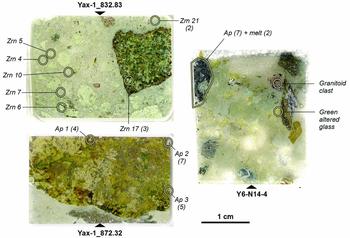
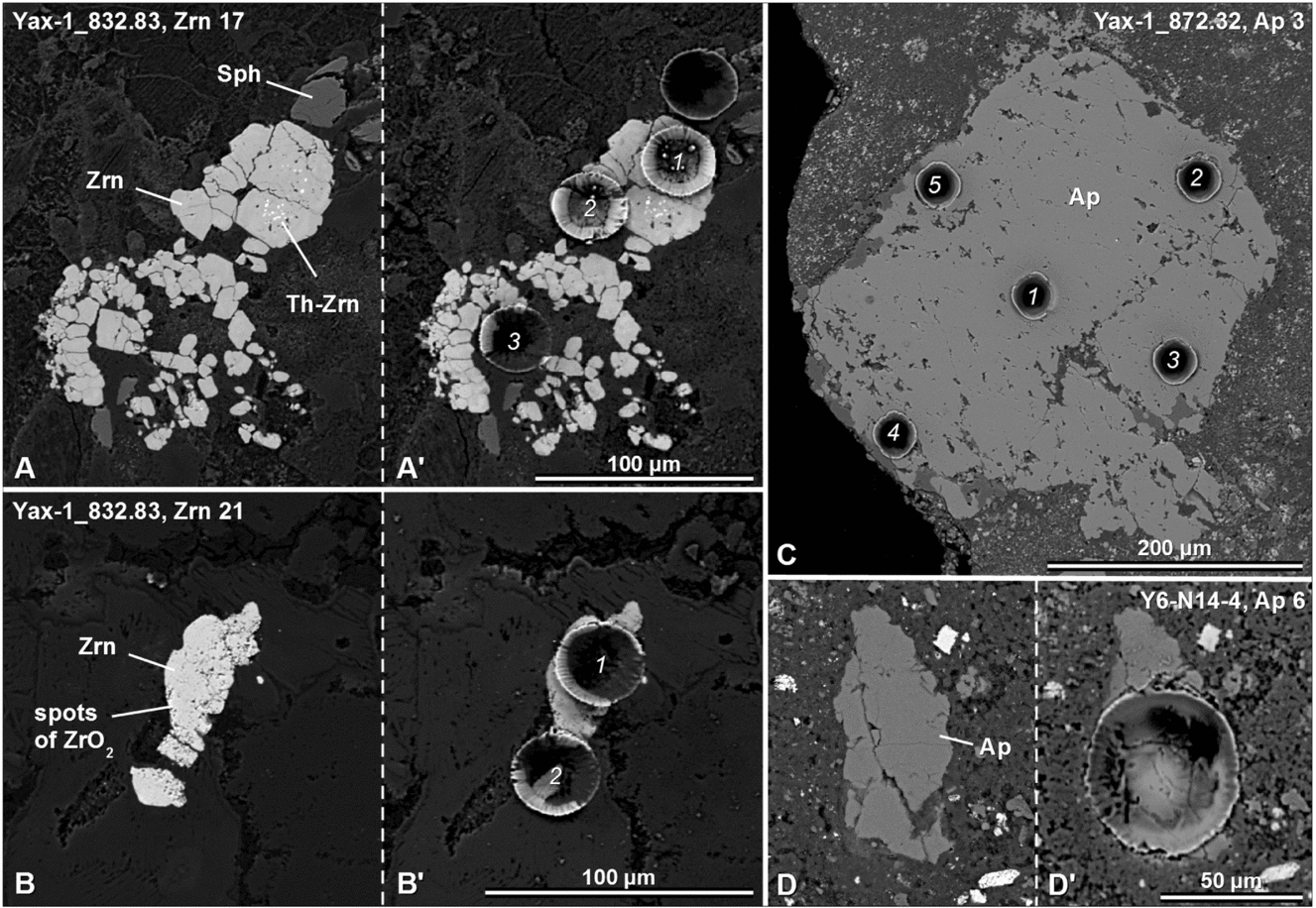
Thin-sections Yax-1_832.83, Yax-1_872.32 and Y6-N14-4 are shown in Figure 1. Backscattered electron images of some individual zircon and apatite grains and aggregates analysed in this study are presented in Figure 2, before and after LA-ICP-MS analysis; additional image material is provided in supplementary file S1. All of the grains analysed are apparently unshocked and shocked relicts of the target. Although we encountered polycrystalline aggregates of secondary apatite that crystallised from hydrothermal fluids (see also Zürcher & Kring, Reference Zürcher and Kring2004, who found hydrothermal apatite at depths of ~813, ~841 and 858 m in the Yaxcopoil-1 core), individual crystals in those aggregates were too small for LA-ICP-MS analysis. Nonetheless, even the relict grains were exposed to post-impact hydrothermal conditions. The presence of a high-temperature, secondary mineral assemblage including andradite garnet (Newsom et al. Reference Newsom, Salge, Nelson and Spilde2010; Nelson et al. Reference Nelson, Newsom, Spilde and Salge2012) and diopside–hedenbergite (Zürcher and Kring, Reference Zürcher and Kring2004) in core Yax-1 suggests hydrothermal peak temperatures of ≥300°C inside the Chicxulub crater moat soon after the impact.
Chicxulub impactite thin-sections from the Yaxcopoil-1 and Yucatán-6 drill cores, and position and number of laser spots (in parentheses, if more than one) in in situ LA-ICP-MS analysis. Thin-section Yax-1_832.83 is from a depth of ~833 m in Yaxcopoil-1 (central unit 3 of Kring et al. Reference Kring, Hörz, Zürcher and Urrutia-Fucugauchi2004; Zürcher & Kring, Reference Zürcher and Kring2004); Yax-1_872.32 is from a depth of ~872 m in Yaxcopoil-1 (central unit 5 of Kring et al. Reference Kring, Hörz, Zürcher and Urrutia-Fucugauchi2004; Zürcher & Kring, Reference Zürcher and Kring2004); and Y6-N14-4 is from a depth of 1208–1211 m in Yucatán-6 (middle suevite unit of Claeys et al. Reference Claeys, Heuschkel, Lounejeva-Baturina, Sanchez-Rubio and Stöffler2003; see also Kring, Hildebrand & Boynton, Reference Kring, Hildebrand and Boynton1991). ‘Ap’ denominates apatite, ‘Zrn’ denominates zircon. Yax-1_832.83 contains a larger mafic rock clast similar to the one shown in a breccia sample (Yax-1_836.34) from a depth of ~836 m (cf. Kring, Reference Kring2005). Apatite crystals in Yax-1_872.32 occur in a larger, impact-deformed rock clast (dark) that occupies most of the thin-section, and reach ~1 mm in size. All apatite analyses for Y6-N14-4 were done on mineral grains within the ~1 cm long, dark, fluidal impact melt particle marked; additional laser spots in a granitoid clast and altered impact glass are indicated.

Backscattered electron images of zircon and apatite in Chicxulub impact lithologies analysed by LA–ICP–MS. A: Aggregate of zircon (Zrn) locally containing spots of thorite–zircon (Th-Zrn, white spots) and sphene (Sph) before laser ablation; Aʹ: the same aggregate after laser ablation. B: Granular zircon in sample Yax-1_832.83, with sub-µm-sized spots of ZrO2 (most likely baddeleyite) along the rim and fractures of the zircon aggregate, before laser ablation; Bʹ: the same aggregate after laser ablation analyses. C: Larger apatite (Ap) grain in sample Yax-1_872.32, with one laser pit at the core and four pits near the crystal rim. D: Smaller apatite grain in sample Y6-N14-4 before laser ablation; Dʹ: the same grain with a 50 µm diameter laser pit. Numbers in the pits correspond to laser spot numbers in LA–ICP–MS analysis.

3.2. Electron microscopy
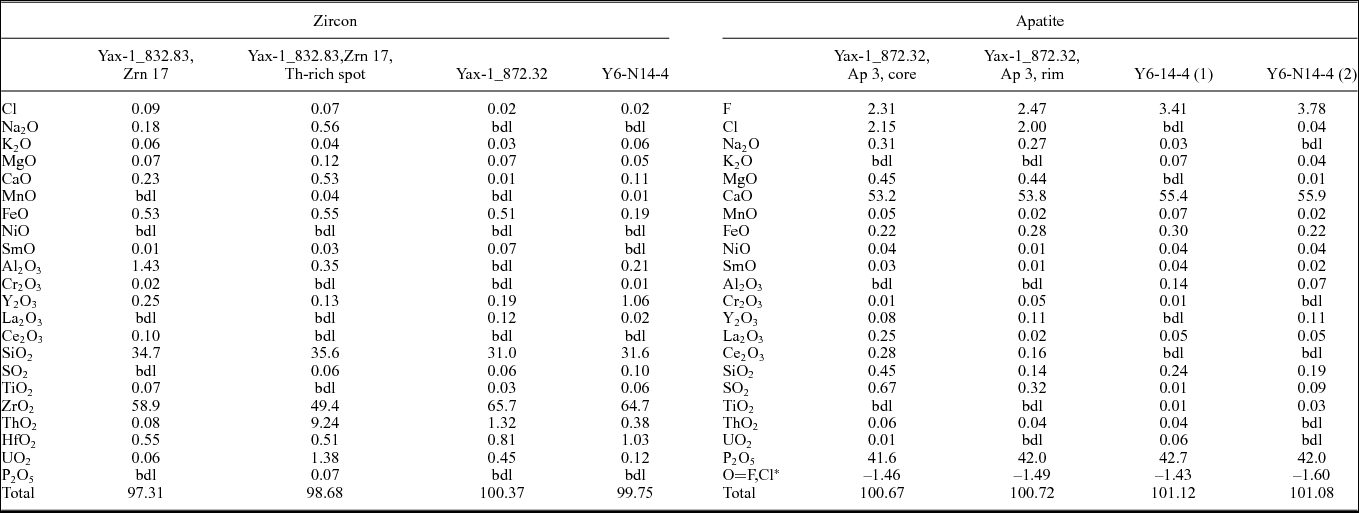
Zircon and apatite grains in the impactite samples were imaged using an optical Leica DMLP polarisation microscope at the LPI, and a JEOL JSM–5910LV SEM with an energy-dispersive X-ray detector (EDS) and a CAMECA SX 100 electron microprobe equipped with an EDS unit in addition to the wavelength-dispersive X-ray spectrometer (WDS) system at the NASA–Johnson Space Center. Optical microscopic and back-scattered electron imaging allowed for a tentative shock classification of zircon crystals and granular zircon aggregates (see Schmieder et al. Reference Schmieder, Tohver, Jourdan, Denyszyn and Haines2015; cf. Wittmann et al. Reference Wittmann, Kenkmann, Schmitt and Stöffler2006; Moser et al. Reference Moser, Cupelli, Barker, Flowers, Bowman, Wooden and Hart2011; Timms et al. Reference Timms, Reddy, Healy, Nemchin, Grange, Pidgeon and Hart2012, Reference Timms, Erickson, Pearce, Cavosie, Schmieder, Tohver, Reddy, Zanetti, Nemchin and Wittmann2017; Singleton, Osinski & Shieh, Reference Singleton, Osinski, Shieh, Osinski and Kring2015). Major and minor element geochemical analyses of zircon and apatite were done by WDS using the CAMECA SX 100 microprobe. Zircon and apatite were analysed with an accelerating voltage of 15 kV, a beam current of 10 nA, and a beam diameter of 5 µm for apatite and 1 µm for zircon. Standards used were: oligoclase for Na and Al; orthoclase for K and Si; kaersutite for Mg and Fe; Minot and Durango apatite for Ca and P; rhodonite for Mn; rutile for Ti; chromite for Cr; NiO for Ni; Y-, La-, Ce- and Sm-phosphate for Y, La, Ce and Sm, respectively; Canyon Diablo troilite for S; thorianite for Th; uraninite for U; hafnon for Hf; strontiofluorite and Durango apatite for F; and tugtupite for Cl. Volatile elements, such as F, Cl, Na, K and P, were analysed first to reduce electron beam-induced loss. Dwell times were 20–30 s on element peaks and half that on background locations adjacent to peaks; F was analysed in time-intercept mode, with six peak measurements over 40 and 20 s for backgrounds, to account for possible F migration during electron beam interaction. All element concentrations accurately reproduced standard compositions within ~2%, most elements within ~1% of relative error. The reported geochemical data for apatite are corrected for Cl and F replacing O in the calculated atomic formula (Table 1).
Representative electron microprobe analyses of zircon and apatite in the Chicxulub impactite samples Yax-1_832.83, Yax-1_872.32 and Y6-N14-4. Data acquired using a CAMECA SX 100 instrument (15 kV, 10 nA). All values are in wt%; ‘bdl’ = below detection limit

*O=F,Cl correction: Totalreported=Totalmeasured – [(Clwt% ∙ (16a/70.9b)) + (Fwt% ∙ (16a/38c))]; a atomic mass of O; b atomic mass of Cl2; c atomic mass of F2.
3.3. Laser ablation ICP-MS
Laser ablation ICP-MS analyses were done using a Varian 810 quadrupole instrument coupled to a Photon Machines Analyte 193 nm wavelength excimer laser ablation system powered by a TL Ex300si ultrashort pulse (~4 ns length) ArF laser head. The mass spectrometer has a digital scaling pulse detector manufactured by ETP Electron Multipliers. The system was operated in high-sensitivity laser mode to maximise signal intensity of masses of minor abundance (e.g. 204Pb and 207Pb). Intensities were measured in peak hopping scan mode. Dwell times were 10 ms for 202Hg, 206Pb, 208Pb, 232Th and 238U; 20 ms for 207Pb; and 30 ms for 204Pb. We refer readers to Shaulis, Lapen & Toms (Reference Shaulis, Lapen and Toms2010) and Shaulis et al. (Reference Shaulis, Lapen, Casey and Reid2012) for additional details on the technical set-up and analytical procedure. Isotopic abundances and ratios in the Chicxulub samples were calculated against the Plešovice (337.13±0.37 Ma; Sláma et al. Reference Sláma, Košler, Condon, Crowley, Gerdes, Hanchar, Horstwood, Morris, Nasdala, Norberg, Schaltegger, Schoene, Tubrett and Whitehouse2008) and FC5Z (1099.0±0.6 Ma; Paces & Miller, Reference Paces and Miller1993) zircon standards; the Madagascar (MAD1; 473.5±0.7 Ma; Chew, Petrus & Kamber, Reference Chew, Petrus and Kamber2014) and Bear Lake (921.3±8.7 Ma) apatite standards (e.g. Thomson et al. Reference Thomson, Gehrels, Ruiz and Buchwaldt2012); and NIST-612 glass (National Institute of Standards and Technology; Kent, Reference Kent2008) for Pb isotopic calibrations. Measured 206Pb/204Pb, 207Pb/204Pb and 208Pb/204Pb ratios of NIST-612 glass (n= 3) yielded weighted averages of 17.1±0.7, 15.7±0.6, 37.4±1.6, respectively, which are identical to values reported in Kent (Reference Kent2008).
Minerals were analysed in situ on polished thin-sections. A laser spot size of 25 µm was chosen for zircon (n = 10 spots in seven grains/aggregates ~17–170 µm in size; Table 2). Fluor-chlorapatite was analysed using a spot size of 25 µm (Yax-1_872.32; n = 16 spots in three crystals ~400–1000 µm in size); fluorapatite was analysed with a spot size of 50 µm (Y6-N14-4; n = 7 spots in seven grains ~44–86 µm in size; Table 3). Additional laser spots were placed in the breccia groundmass of sample Yax-1_872.32, and in a granitoid clast and a green particle of altered impact glass in sample Y6-N14-4. During the 1 min long spot analysis, the first 14 s was dedicated to acquiring a robust blank baseline, followed by a 30 s long ablation phase with ~180 laser pulses, and another ~15 s allocated to washing out gas in the line. Due to the laser spot diameter of 25 µm, it was inevitable to sample a minor contribution from the interstitial and/or surrounding impact melt in mineral grains that have pervasive fractures or a granular texture (zircon), or in grains that were fully penetrated by the laser ablation procedure (zircon and apatite); the same holds true for locally ‘microporous’ zircon and apatite crystals. IGOR Pro 6.12a with the Iolite 2.11 add-in (Hellstrom et al. Reference Hellstrom, Paton, Woodhead, Hergt and Sylvester2008) and Isoplot 4.15 (Ludwig, Reference Ludwig2008) were used for data reduction. U–Pb ages are calculated according to the U-series decay constants of Jaffey et al. (Reference Jaffey, Flynn, Glendenin, Bentley and Essling1971). Unless otherwise stated, errors are given at the 2σ level.
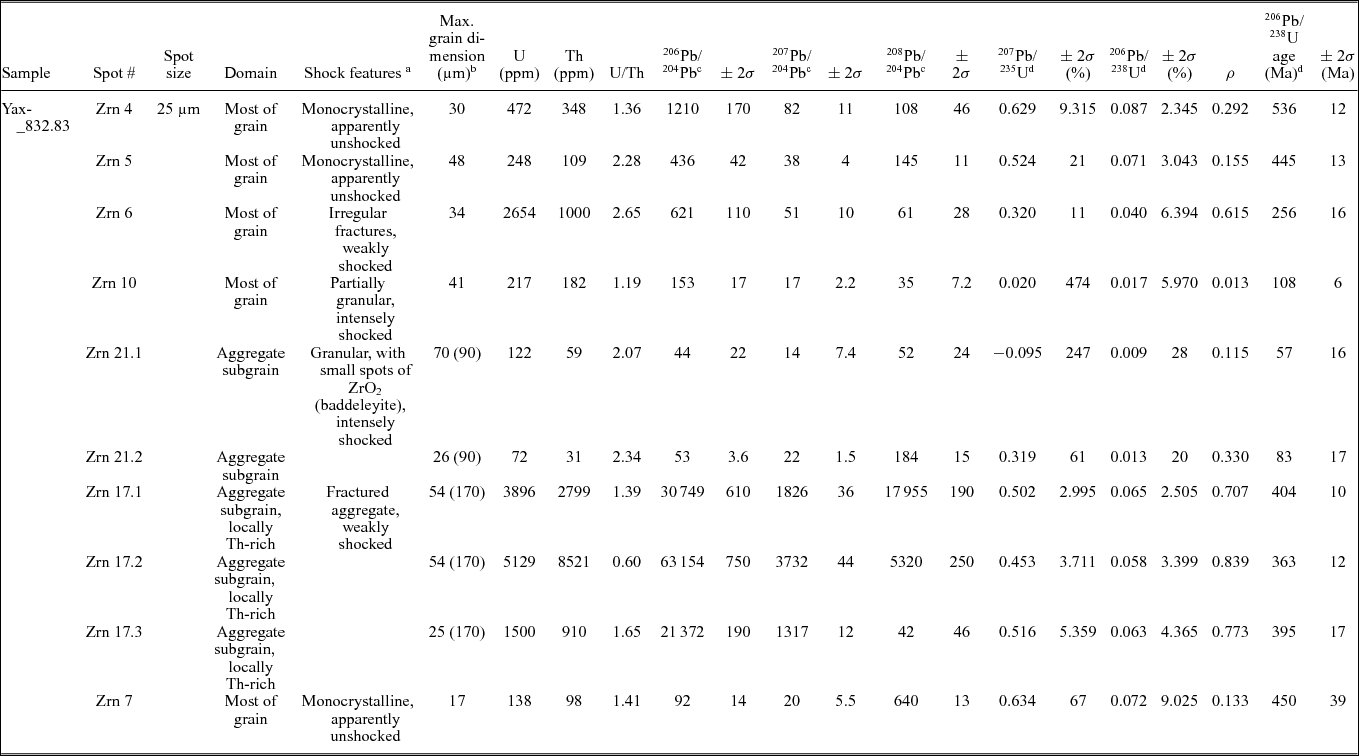
Laser ablation ICP–MS analysis of zircon in Yax-1_832.83

a Following the scheme of Schmieder et al. (Reference Schmieder, Tohver, Jourdan, Denyszyn and Haines2015).
b Values give size of individual subgrains; values in parentheses denominate maximum diameter of the entire aggregate.
c Baseline-corrected.
d 204 Pb-corrected.
Laser ablation ICP–MS analysis of apatite in Yax-1_872.32 and Y6-N14-4

a Baseline-corrected.
b Calculated as weighted mean.
4. Results
4.1. Petrology and geochemistry
Zircon in thin-section Yax-1_832.83 (see Section 2.1 for the position of zircon grains either within the groundmass of the impact melt breccia, or in melt clasts) shows a wide range of shock-metamorphic microtextural features (Fig. 2); for systematic reviews and examples of shock-metamorphosed zircon and shock-produced decomposition products of zircon we refer readers to Bohor, Betterton & Krogh (Reference Bohor, Betterton and Krogh1993), Wittmann et al. (Reference Wittmann, Kenkmann, Schmitt and Stöffler2006), Timms et al. (Reference Timms, Reddy, Healy, Nemchin, Grange, Pidgeon and Hart2012, Reference Timms, Erickson, Pearce, Cavosie, Schmieder, Tohver, Reddy, Zanetti, Nemchin and Wittmann2017), Cavosie, Erickson & Timms (Reference Cavosie, Erickson and Timms2015), Schmieder et al. (Reference Schmieder, Tohver, Jourdan, Denyszyn and Haines2015), and references therein. The shock-metamorphic characteristics of the Chicxulub zircon crystals are described here following the scheme of Schmieder et al. (Reference Schmieder, Tohver, Jourdan, Denyszyn and Haines2015), which distinguishes between (1) weakly impact-deformed, largely monocrystalline zircon crystals; (2) weakly shocked (<20 GPa) zircon with irregular fractures; (3) moderately shocked (≥20 GPa) zircon with planar microstructures; (4) more severely shocked, partially granularised, zircon with relict irregular fractures and planar microstructures; and (5) heavily shocked (≥65 GPa) zircon that has been thermally transformed into entirely granular aggregates of neocrystalline zircon crystallites, commonly disintegrated within the surrounding impact melt matrix, and locally associated with µm-sized domains of ZrO2 (presumably baddeleyite).
Some monocrystalline zircon grains in Yax-1_832.83 are seemingly undeformed by the impact (e.g. grains #4, #5 and #7), whereas others are internally fractured (zircon aggregate #17, which also contains µm-sized spots of thorite–zircon; Fig. 2A). No zircon grains with planar fractures or planar deformation features were encountered in thin-section Yax-1_832.83. Some zircon grains have been partially (grain #10) to (almost) completely transformed into granular aggregates of neocrystallised zircon crystallites (e.g. grain #21; Fig. 2B); grain #21 contains sub-µm-sized spots of ZrO2 (most likely baddeleyite) along its rim and fractures, where in relatively close contact with the surrounding impact melt matrix (Fig. 2B). Most of the zircon grains (or more coherent subgrains in zircon aggregates) in Yax-1_832.83 are small, typically between ~10 and ~70 µm, which made LA-ICP-MS analyses, with a minimum crystal size requirement of ~25 µm, challenging (e.g. Fig. 2A, B). Electron microprobe analyses (Table 1) indicate zircon grains contain resolvable amounts of Y, U, Th and Hf. Zircon aggregate #17, located within a larger mafic clast in Yax-1_832.83 (Fig. 1), locally has a microporous texture and also contains spots of thorite–zircon. This is reflected in low totals in electron microprobe data and locally high concentrations of Th (>9 wt% ThO2). A summary of electron microprobe analyses of zircon in the Chicxulub impactites is presented in Table 1; for comparison, two partly granular zircon grains in Yax-1_872.32 and Y6-N14-4, respectively, were also analysed.
Only recently has apatite been studied systematically in terms of its characteristic response to shock metamorphism. The petrographic analysis of shocked apatite grains from the eroded, ~6–13 km diameter Santa Fe impact structure, New Mexico, by Cavosie & Lugo Centeno (Reference Cavosie and Lugo Centeno2014) suggested that, similar to zircon, apatite develops planar microstructures at shock pressures of at least 20 GPa. Apatite in thin-sections Yax-1_872.32 and Y6-N14-4 does not display any distinctive shock-metamorphic features. The anomalously large apatite crystals in Yax-1_872.32 (see also Zürcher & Kring, Reference Zürcher and Kring2004, p. 5), commonly ≥1 mm in size (e.g. grain apatite #1), contain abundant micropores (Fig. 2C). Apatite in Y6-N14-4 is typically ≤100 µm in size. Crystals in Yax-1_872.32 and Y6-N14-4 are commonly fractured, with some of the fractures filled with crypto- to microcrystalline impact melt (Fig. 3C, D). Electron microprobe analyses show that the coarse-grained Yax-1_872.32 apatite (e.g. grain #3) is enriched in F (up to ~2.5 wt%), Cl (up to ~2.2 wt%) and S (up to ~0.7 wt% SO2), whereas the smaller apatite grains in the impact melt clast of suevite sample Y6-N14-4 are rich in F (up to ~3.8 wt%), but poor in S (<0.1 wt% SO2), and essentially free of Cl (concentrations near or below the detection limit). This is consistent with previous results of Zürcher & Kring (Reference Zürcher and Kring2004), who also found different varieties of apatite, with igneous crystals relatively rich in sulphur, pointing towards different provenance lithologies within the target rock sequence. Some apatite (F-, Cl- and S-rich crystals) may be from an igneous–metamorphic source (represented by the mafic rock clast in Yax-1_872.32), while other, Cl-poor, crystals within the dark suevite melt particle in Y6-N14-4 are sourced from an unknown zone within the target rock, and may have been affected by stronger metasomatism (such as the loss of Cl by partitioning into fluids during higher-temperature hydrothermal overprint; e.g. Zürcher & Kring, Reference Zürcher and Kring2004). The rare earth elements La and Ce seem to be more abundant in sample Yax-1_872.32 compared with Y6-N14-4. The composition of apatite in the Chicxulub impactite samples are summarised in Table 1.
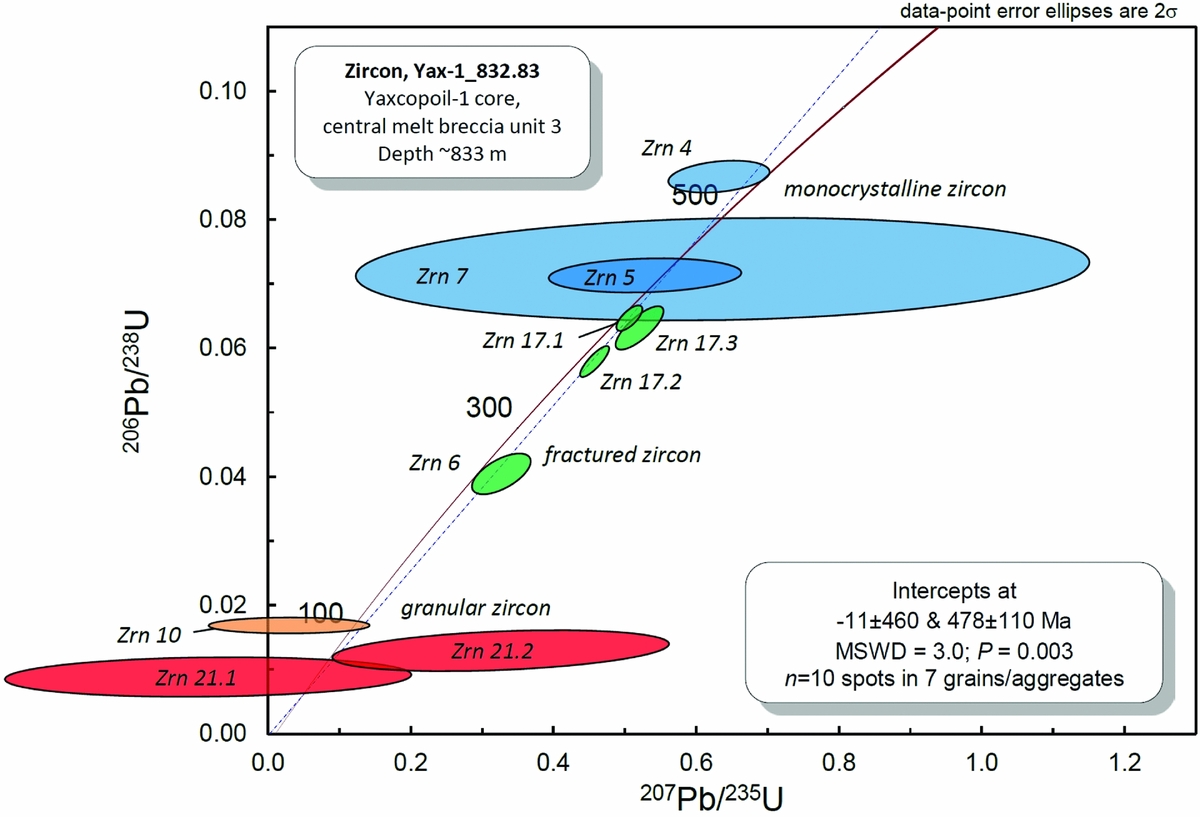
Concordia plot for zircon in Yax-1_832.83. The U–Pb results form a discordant array between the Early Palaeozoic age of the Maya block basement and the geologically younger impact. Blue ellipses denote ages for largely monocrystalline, i.e. weakly shocked, zircon grains; green ellipses represent ages for zircon grains and aggregates with irregular (non-planar) fractures; orange indicates partially granular zircon; and red marks entirely granular and locally ZrO2-bearing, i.e. intensely shocked, zircon following the scheme of Schmieder et al. (Reference Schmieder, Tohver, Jourdan, Denyszyn and Haines2015).
4.2. Geochronology
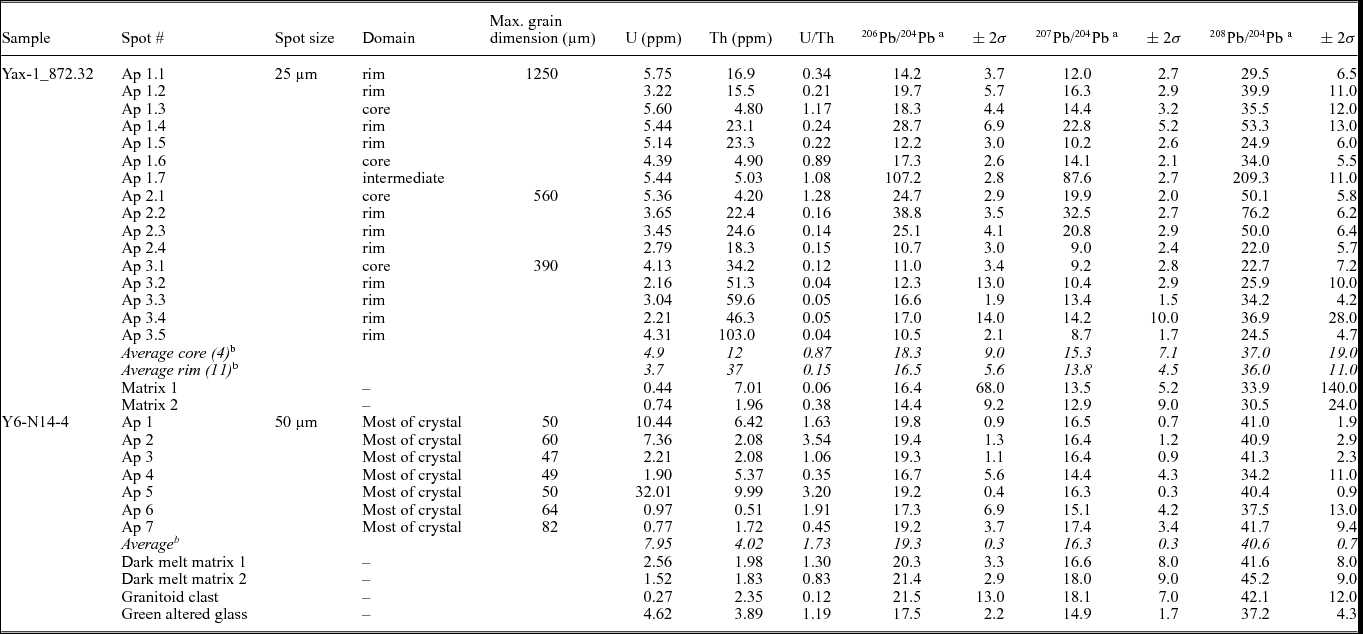
Laser ablation ICP-MS analysis of zircon grains #4, #5, #6, #7, #10; #17 (three spots) and #21 (two spots) in Yax-1_832.83 (73–5189 ppm U; 31–8521 ppm Th; U/Th=0.60–2.65; mean U/Th=1.71±0.63), characterised by variable levels of shock metamorphism ranging from apparently undeformed crystals to granular aggregates (see Table 2), yielded a discordant array (MSWD=3.0; P=0.003) of apparent ages, with an upper intercept age of 478±110 Ma and a poorly defined lower intercept (Fig. 3). The calculated upper intercept age is, within the large error, in line with the Early Palaeozoic ages for the Maya block (e.g. Krogh, Kamo & Bohor, Reference Krogh, Kamo and Bohor1993a; Krogh et al. Reference Krogh, Kamo, Sharpton, Marín and Hildebrand1993b; Gleason et al. Reference Gleason, Gehrels, Dickinson, Patchett and Kring2007; Keppie et al. Reference Keppie, Dostal, Norman, Urrutia-Fucugauchi and Grajales-Nishimura2011). 206Pb/238U apparent ages ranging between 536±12 Ma and 57±16 Ma appear to span the timeline between Early Palaeozoic magmatism and metamorphism, and the Chicxulub impact, respectively (Table 2). Noticeable common Pb and/or low concentrations of radiogenic Pb are indicated by a low 206Pb/204Pb ratio of ~44–1200 for most of the Yax-1_832.83 zircon grains; however, zircon aggregate #17 yielded 206Pb/204Pb of ≤63,000; but this aggregate is remarkably rich in U (>5000 ppm; see Table 1). A summary of U–Th–Pb systematics of the Yax-1_832.83 zircon, along with a shock-metamorphic classification of the grains analysed (see Schmieder et al. Reference Schmieder, Tohver, Jourdan, Denyszyn and Haines2015), is presented in Table 2.
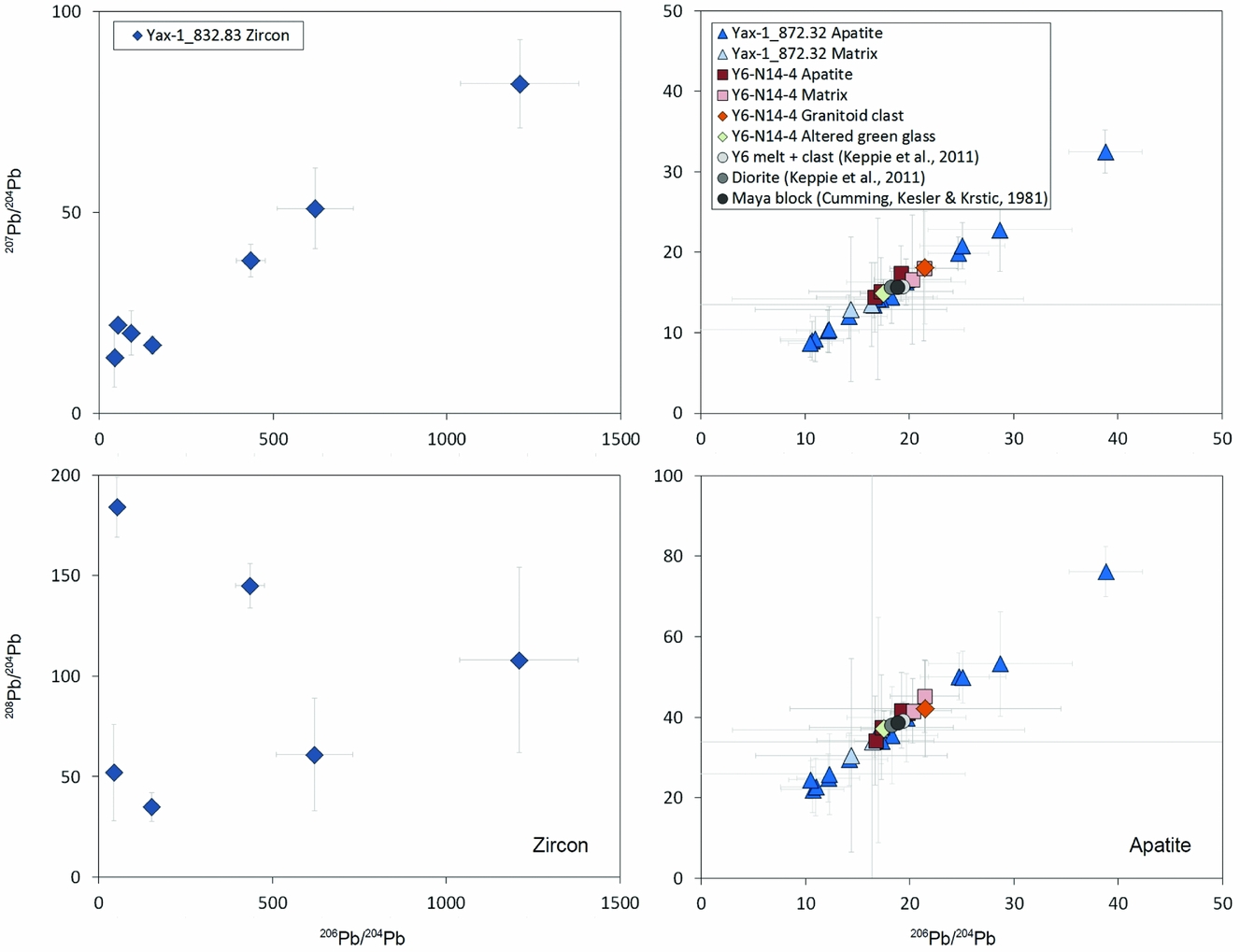
No geologically meaningful U–Pb ages were obtained for either apatite sample. As indicated by an indistinct gradient in Th concentrations across different laser spots within the crystals (i.e. in central position; approximately midway between the centre and rim; and near the rim of apatite grains), the coarse-grained Yax-1_872.32 apatite exhibits some Th zoning, which may be of igneous origin. Crystal cores (n=4) of three apatite grains (Ap 1–3) contain 4.2–34 ppm Th, 4.1–5.6 ppm U, with U/Th=0.9±0.5. The cores have 206Pb/204Pb of 11.0–24.7 (average 18.3), 207Pb/204Pb of 9.2–19.9 (average 15.3) and 208Pb/204Pb ratios that range from 22.7 to 50.1 (average 37.0). Crystal rims (i.e. the outer ~25 µm sampled by the laser spot; n=11) have 15.5–103 ppm Th, 2.2–5.7 ppm U, with U/Th ≤0.2. As with the grain cores, for measured Pb isotope compositions the rims have 206Pb/204Pb of 10.5–38.8 (average 16.5), 207Pb/204Pb of 8.7–32.5 (average 13.8) and 208Pb/204Pb ratios that range from 24.5 to 76.2 (average 36.0). One spot halfway between the core and rim of apatite grain #1 has 206Pb/204Pb of 107.2, 207Pb/204Pb of 87.6 and 208Pb/204Pb of 209.3.
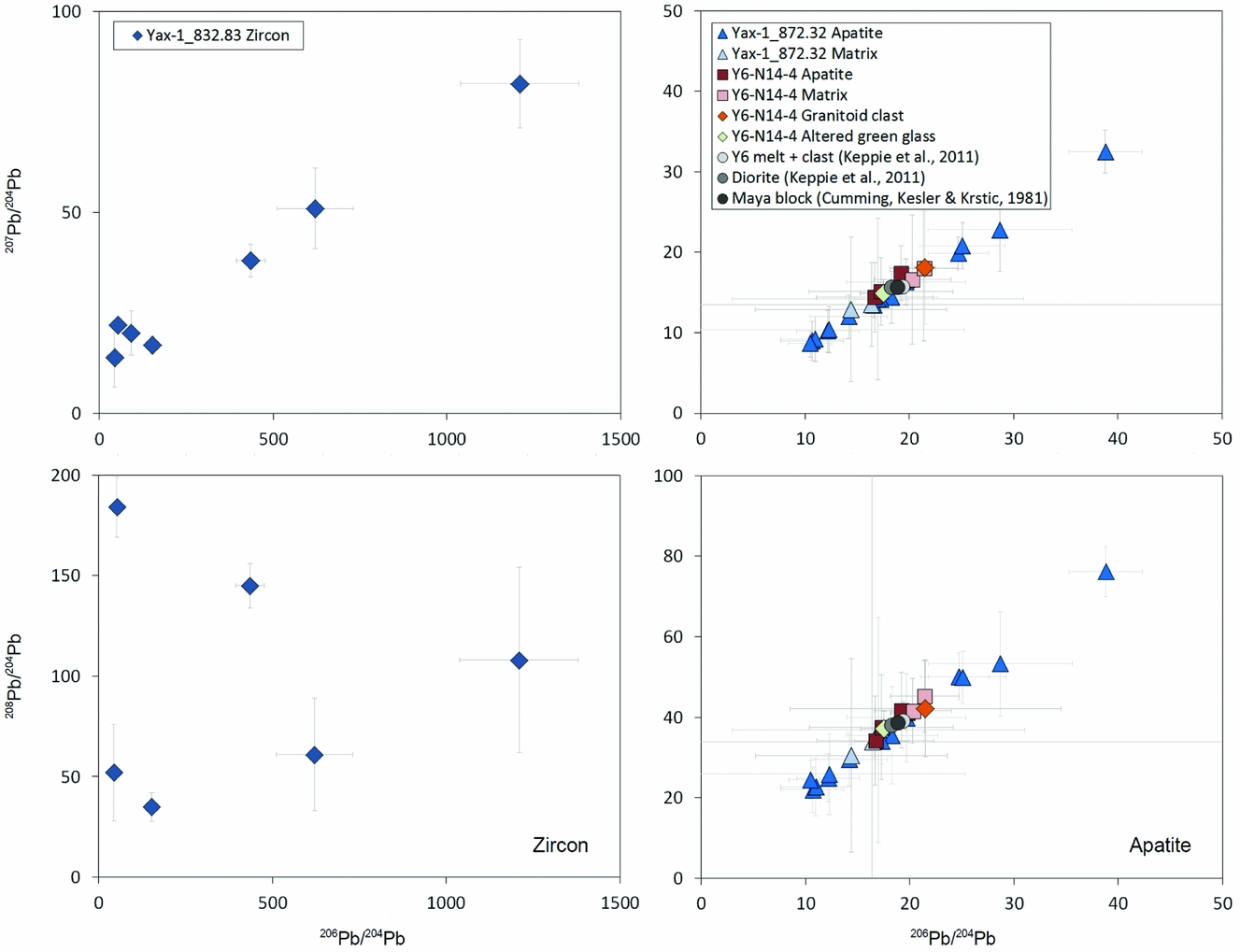
The Y6-N14-4 apatite contains ~0.5–10 ppm Th, ~0.8–32 ppm U, with U/Th of 1.7±1.8, and has a 206Pb/204Pb of ~16.7–19.8 (average 19.3), 207Pb/204Pb of 15.1–17.4 (average 16.3) and 208Pb/204Pb of 34.2–41.7 (average 40.6). Two spots in the groundmass of the dark impact melt particle that hosts the apatite grains yielded ~1.5–2.6 ppm U, ~1.8–2.0 ppm Th, at U/Th=1.1±0.3, and similar ratios of 206Pb/204Pb of ~20.8, 207Pb/204Pb of ~17.5 and 208Pb/204Pb of ~43.4. A granitoid clast yielded ~0.3 ppm U, ~2.4 ppm Th, with U/Th=0.1; 206Pb/204Pb of ~21.5, 207Pb/204Pb of ~18.1 and 208Pb/204Pb of ~42.1. Finally, a particle of green, altered impact glass has ~4.6 ppm U, ~3.9 ppm Th, with U/Th=1.2; and 206Pb/204Pb of ~17.5, 207Pb/204Pb of ~14.9 and 208Pb/204Pb of ~37.2. These values are similar to those reported for impactite whole-rock samples from the Yucatán-6 core by Keppie et al. (Reference Keppie, Dostal, Norman, Urrutia-Fucugauchi and Grajales-Nishimura2011) and rocks from the Maya block (Cumming, Kesler & Krstic, Reference Cumming, Kesler and Krstic1981). The U–Th–Pb systematics of the Yax-1_872.32 and Y6-N14-4 apatite grains are summarised in Table 3. A plot showing the Pb-istopic composition (e.g. Stacey & Kramers, Reference Stacey and Kramers1975) of the Chicxulub zircon and apatite in comparison with other published data is presented in Figure 4.
Lead isotopic composition of zircon (n=10 spots in seven grains/aggregates; left) and apatite (n=16 spots in three grains in Yax-1_872.32; and n=7 spots in seven grains in Y6-N14-4; right) plotted together with some melt domain and whole-rock analyses (n=6 spots; right) in the Yaxcopoil-1 and Yucatán-6 impactite samples, shown with additional data taken from the literature (Keppie et al. Reference Keppie, Dostal, Norman, Urrutia-Fucugauchi and Grajales-Nishimura2011). Error bars (not indicated for data from the literature) are at the 2σ level.
5. Discussion
Laser ablation spot analysis not only acquires quantitative data for U, Th and Pb abundances and isotopic ratios, but also generates an isotopic depth profile as the laser pit grows downward. Consistently low 206Pb/204Pb ratios for most zircon and apatite grains with increasing laser pit depth suggest common Pb is not a sample surface contamination, but reflects the inherent isotopic composition of the analysed mineral grains. Low 206Pb/204Pb may reflect the composition of the (local) impact melt produced by Chicxulub impact (i.e. a reservoir characterised by high concentrations of common Pb), or may potentially be attributed to Pb-rich fluids in the relatively long-lived, impact-triggered hydrothermal system inside the Chicxulub crater (Abramov & Kring, Reference Abramov and Kring2007). The presence of secondary hydrothermal galena in the basal portion of the Chicxulub impact breccia sampled by the Yaxcopoil-1 core (Ames et al. Reference Ames, Kjarsgaard, Pope, Dressler and Pilkington2004), as well as abundant chalcopyrite and barite at various levels across the core (Zürcher & Kring, Reference Zürcher and Kring2004; both of these minerals are known as potential Pb carriers; e.g. Takano & Watanuki, Reference Takano and Watanuki1974; Griffith & Paytan, Reference Griffith and Paytan2012), demonstrates that Pb-rich fluids circulated in the initially hot and permeable (e.g. Mayr et al. Reference Mayr, Burkhardt, Popov and Wittmann2008a,Reference Mayr, Wittmann, Burkhardt, Popov, Romushkevich, Bayuk, Heidinger and Wilhelmb; see also Popov et al. Reference Popov, Romushkevich, Bayuk, Korobkov, Mayr, Burkhardt and Wilhelm2004) impact breccia lens. That impact breccia lens became increasingly brittle and permeable to circulating hot fluids as it cooled (Abramov & Kring, Reference Abramov and Kring2007). This poses the question whether impact-induced circulation of hot fluids inside the fresh Chicxulub crater may have been capable of hydrothermally altering U–Th–Pb carrier minerals in the crater-hosted impactites in the presence of free common Pb in the system. Our study focused on relict (i.e. target-inherited, but not hydrothermally grown) zircon and apatite as two of the classical U–Th–Pb-bearing minerals commonly analysed in U–Pb geochronology. As noted earlier, all of the grains analysed in this study are unshocked and shock-metamorphosed relict grains from the target.
5.1. Zircon in the Yaxcopoil-1 core
The zircon grains from the Yaxcopoil-1 drill core represent parts of the basement lithologies excavated from a depth down to ~13 km, within a transient cavity ~30 km deep that included a central zone of melting down to ~28 km depth during the large Chicxulub impact (Kring, Reference Kring2005, fig. 4 and table 2). Following excavation, the shocked zircon grains were deposited and incorporated into impact breccias inside the annular trough (at a radial distance of ~65 km from the centre of the impact structure, probed by the Yaxcopoil-1 core) that lies between the peak ring (radial distance of ~40±5 km; e.g. Kring et al. Reference Kring, Hörz, Zürcher and Urrutia-Fucugauchi2004) and the final rim of the ~180 km diameter impact basin (radial distance ~90 km).
The new LA-ICP-MS results for the Yax-1_832.83 zircon represent the first U–Th–Pb isotopic dataset for impactite samples recovered from the Yaxcopoil-1 core that carry a petrologic (i.e. granular and locally ZrO2-bearing zircon) and U–Pb geochronologic (i.e. young zircon ages that encompass the age of the impact within uncertainty) signal of the Chicxulub impact (Fig. 3). Several years before the recovery of the Yaxcopoil-1 drill core in 2001/02, Krogh et al. (Reference Krogh, Kamo, Sharpton, Marín and Hildebrand1993b) had analysed shocked, monocrystalline and granular, zircon (n=16 dissolved grains) from the upper suevite unit from a depth of ~1100–1103 m in the Yucatán-6 core (a ~30g sample of a carbonate-rich, suevitic, polymict breccia, Y6-N13; see also Sharpton et al. Reference Sharpton, Marín, Carney, Lee, Ryder, Schuraytz, Sikora, Spudis, Ryder, Fastovsky and Gartner1996 and Claeys et al. Reference Claeys, Heuschkel, Lounejeva-Baturina, Sanchez-Rubio and Stöffler2003 for logs and petrologic context). Those Y6-N13 zircon grains yielded a range of U–Pb ages between a common age of 544.5±5.0 Ma (upper intercept age value; calculated from a combination of zircon results for the Yucatán-6 impactite and the ejecta deposits at Beloc, Haiti; Krogh et al. Reference Krogh, Kamo, Sharpton, Marín and Hildebrand1993b) of the Maya black and the age of the impact event (lower intercept age value of 57.3±4 Ma, and 206Pb/238U ages between ~63 and ~73 Ma for four granular zircon grains; Krogh et al. Reference Krogh, Kamo, Sharpton, Marín and Hildebrand1993b, table 1). More recently, using LA-ICP-MS, Keppie et al. (Reference Keppie, Dostal, Norman, Urrutia-Fucugauchi and Grajales-Nishimura2011) analysed zircon grains (n=33 laser spots in 33 grains) from a granodiorite clast within the Yaxcopoil-1 core (from a core depth of ~890 m, i.e. within the central polymict impact melt breccia unit 6 of Dressler et al. Reference Dressler, Sharpton, Schwandt and Ames2004 and Zürcher & Kring, Reference Zürcher and Kring2004). U–Pb dating of the clast-hosted zircon crystals by Keppie et al. (Reference Keppie, Dostal, Norman, Urrutia-Fucugauchi and Grajales-Nishimura2011) resulted in an Early Palaeozoic age that reflects the age of the granitoid intrusion into the Maya block basement at ~546 Ma; one younger ‘outlier’ zircon age (206Pb/238U age of ~130 Ma) in that dataset may have been partially reset by the Chicxulub event.
The Yax-1_832.83 zircon grains analysed in this study (n=10 spots in seven grains/aggregates) experienced variable degrees of shock metamorphism, from weakly shocked to strongly shocked conditions. The varying degrees of shock have affected the U–Pb system of the zircon, as evidenced by the discordia line between the age of the Maya block basement and the timing of the impact (Fig. 3). As typically seen in U–Pb results for zircon from a number of other large terrestrial impact structures (e.g. Åberg & Bollmark, Reference Åberg and Bollmark1985; Schärer & Deutsch, Reference Schärer and Deutsch1990; Krogh et al. Reference Krogh, Kamo, Sharpton, Marín and Hildebrand1993b; Deutsch & Schärer, Reference Deutsch and Schärer1994; Tohver et al. Reference Tohver, Lana, Cawood, Fletcher, Jourdan, Sherlock, Rasmussen, Trindade, Yokoyama, Souza Filho and Marangoni2012; Schmieder et al. Reference Schmieder, Tohver, Jourdan, Denyszyn and Haines2015), zircon crystals in Yax-1_832.83 affected by weak to moderate shock (grains #4, #5, #6, #7 and #17) were not notably altered isotopically by the impact, and mostly yielded Palaeozoic U–Pb ages. Weak to moderate shock conditions are evidenced by the formation of irregular fractures in zircon below shock pressures of ~20 GPa and post-shock temperatures of ≤150°C, and planar microstructures at pressures ≥20 GPa and temperatures of ~150–1100°C (e.g. Wittmann et al. Reference Wittmann, Kenkmann, Schmitt and Stöffler2006; Timms et al. Reference Timms, Reddy, Healy, Nemchin, Grange, Pidgeon and Hart2012, Reference Timms, Erickson, Pearce, Cavosie, Schmieder, Tohver, Reddy, Zanetti, Nemchin and Wittmann2017), corresponding to shock stages I–III of Stöffler (Reference Stöffler1971) (shock levels 2–4 of Singleton, Osinski & Shieh, Reference Singleton, Osinski, Shieh, Osinski and Kring2015). In contrast, zircon grains that display evidence of partial (grain #10) to complete granularisation (neo-crystallisation) and local decomposition into ZrO2 (baddeleyite) and silica (grain #21), i.e. high levels of shock at pressures of ≥50 GPa to ≥70 GPa and post-shock temperatures exceeding ~1100°C and ≥1775°C, respectively (e.g. El Goresy, Reference El Goresy1965; Wittmann et al. Reference Wittmann, Kenkmann, Schmitt and Stöffler2006; Timms et al. Reference Timms, Reddy, Healy, Nemchin, Grange, Pidgeon and Hart2012, Reference Timms, Erickson, Pearce, Cavosie, Schmieder, Tohver, Reddy, Zanetti, Nemchin and Wittmann2017; Cavosie et al. Reference Cavosie, Timms, Erickson, Hagerty and Hörz2016), corresponding to shock stages III–IV of Stöffler (Reference Stöffler1971) (shock levels 4–7 of Singleton, Osinski & Shieh, Reference Singleton, Osinski, Shieh, Osinski and Kring2015), yielded 206Pb/238U apparent ages as young as 57±16 Ma. The isotopic system of these zircon grains and aggregates appears to have been (completely) reset by the 66.04 Ma (Renne et al. Reference Renne, Deino, Hilgen, Kuiper, Mark, Mitchell, Morgan, Mundil and Smit2013) Chicxulub impact. Owing to the relatively large errors associated with the discordant zircon ages, U–Pb geochronologic evidence for hydrothermal alteration in the Yax-1_832.83 zircon is not resolved.
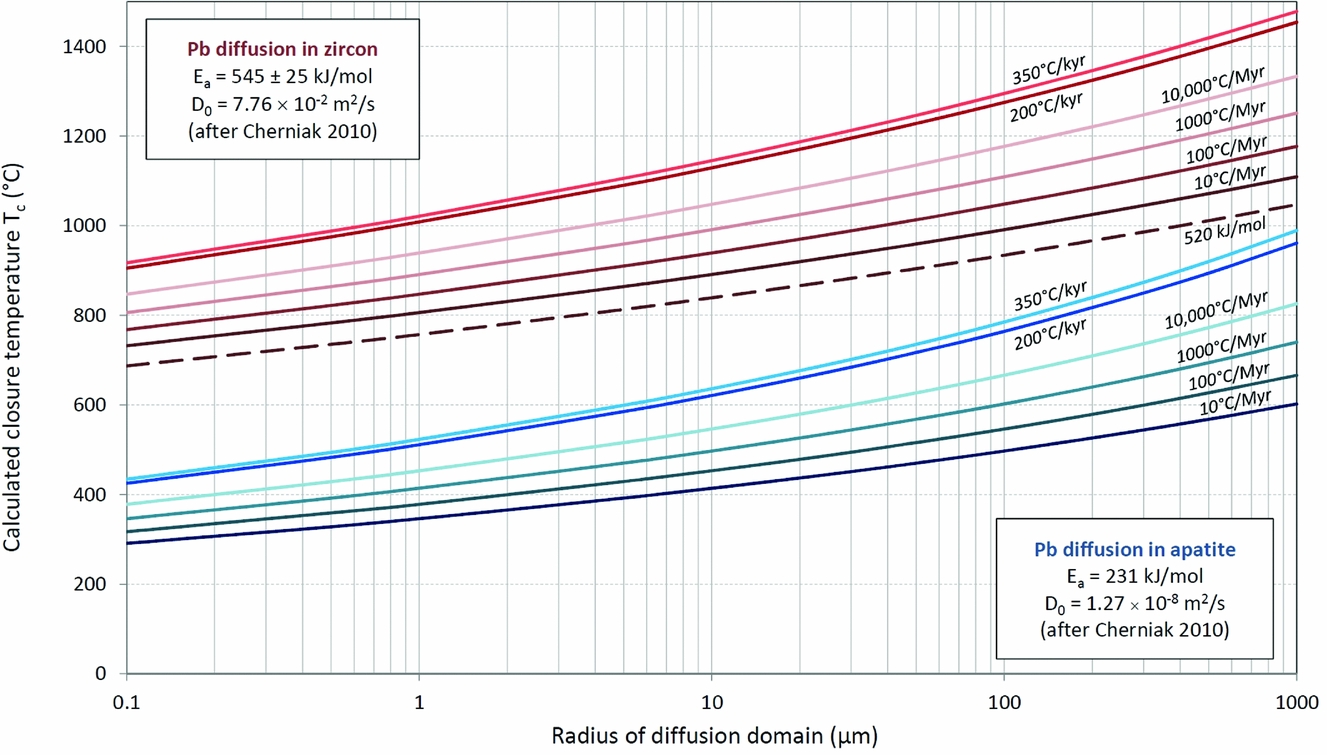
Previous studies demonstrated that zircon incorporates only very minor amounts of initial Pb (e.g. Compston et al. Reference Compston, Williams, Kirschvink, Zichao and Guogan1992; Black et al. Reference Black, Kamo, Allen, Aleinikoff, Davis, Korsch and Foudoulis2003). However, initial Pb may be associated with the outer rims of zircon crystals, as well as mineral inclusions (Mattinson, Reference Mattinson2005), and it has been shown that fluid-grown, ‘hydrothermal’ low-temperature zircon can incorporate significant amounts of Pb (Watson et al. Reference Watson, Cherniak, Hanchar, Harrison and Wark1997). Lead diffusion in non-metamict zircon is usually sluggish (e.g. Cherniak & Watson, Reference Cherniak and Watson2001; Cherniak, Reference Cherniak, Zhang and Cherniak2010). Zircon crystals ≥20 µm in size require temperatures of at least ~700°C over ~1 Myr at typical cooling rates (here arbitrarily given as ~10–10,000°C/Myr) for significant Pb diffusion to occur (Cherniak & Watson, Reference Cherniak and Watson2001; Cherniak, Reference Cherniak, Zhang and Cherniak2010). At fast cooling rates of order ~200–350°C kyr−1, such as those calculated for the impact breccia lens ~30 m above the hot Chicxulub impact melt sheet (i.e. the central melt unit 3 including Yax-1_832.83 in the Yaxcopoil-1 core; Abramov & Kring, Reference Abramov and Kring2007), closure temperatures for Pb diffusion are even higher, exceeding ~900°C for the smallest sizes of diffusion domains (e.g. in granular zircon, with individual neoblasts typically ~0.5–5 µm in size; e.g. Schmieder et al. Reference Schmieder, Tohver, Jourdan, Denyszyn and Haines2015) and ≥1100°C for typical crystal sizes (≥20 µm diameter) observed in Yax-1_832.83 (Fig. 5). As fresh impact craters cool fast initially (e.g. Onorato, Uhlmann & Simonds, Reference Onorato, Uhlmann and Simonds1978; Abramov & Kring, Reference Abramov and Kring2007), and as these theoretical cooling rates are based on the conservatively calculated, late-stage conductive cooling of the impact breccia (i.e. from ~135°C to ~35°C in 500 years in a ‘most likely’ scenario, and from ~220°C to ~45°C in an ‘extreme’ scenario, next to a thick impact melt body; Abramov & Kring, Reference Abramov and Kring2007), the resultant closure temperatures are minimum values. The calculated ‘Pb closure temperatures’ clearly exceed those of the post-impact hydrothermal system inside the Chicxulub crater, although the post-impact assemblage of hydrothermal minerals in the Yaxcopoil-1 impactite sequence (e.g. diopside–hedenbergite, scapolite and sphene; Zürcher & Kring, Reference Zürcher and Kring2004), as well as andradite (Newsom et al. Reference Newsom, Salge, Nelson and Spilde2010; Salge & Newsom, Reference Salge and Newsom2010; Nelson et al. Reference Nelson, Newsom, Spilde and Salge2012; see also McCarville & Crossey, Reference McCarville, Crossey, Koeberl and Anderson1996) indicates fluid flow at relatively high temperatures well above 300°C, and possibly as high as initially ~450–500°C (Taylor & Liou, Reference Taylor and Liou1978). Figure 5 shows the calculated range of closure temperatures for Pb diffusion in zircon (red lines, top) at different grain sizes (i.e. maximum diffusion domain sizes) and variable cooling rates, including anomalously fast ones, based on the diffusion parameters experimentally determined by Cherniak & Watson (Reference Cherniak and Watson2001) and Cherniak (Reference Cherniak, Zhang and Cherniak2010), and assuming a simplified, spherical diffusion domain geometry according to Dodson (Reference Dodson1973).
Calculated closure temperatures for Pb diffusion in zircon (red lines, top) and apatite (blue lines, bottom) for a range of diffusion domain sizes and cooling rates. Calculations were done using the diffusion parameters of Cherniak (Reference Cherniak, Zhang and Cherniak2010), and assuming spherical geometry of diffusion domains according to Dodson (Reference Dodson1973). The curves for anomalous fast cooling rates of 200°Ckyr−1 and 350°Ckyr−1 were calculated from the numerical models of Abramov & Kring (Reference Abramov and Kring2007), for late-stage conductive hydrothermal cooling of the impact breccia lens 30 m above the melt sheet (i.e. central unit 3 in the Yaxcopoil-1 core, which applies to zircon sample Yax-1_832.83), from ~135°C to ~35°C (‘most likely scenario’) and ~220°C to ~45°C (‘extreme scenario’, close to a thick impact melt body) in c. 500 years, respectively; as cooling is faster at initially higher temperatures, these ‘impact crater cooling rates’ represent minimum values, but are considerably higher than typical endogenic cooling rates (here given between 10°CMyr−1 and 10000°CMyr−1).

Despite the rather small number of analysed zircon grains, the lower 206Pb/204Pb of ~44 to ~153 in the partially to fully granular grains #10 and #21, compared with higher 206Pb/204Pb of ~92 to ~1200 in the apparently unshocked and irregularly fractured zircon grains, indicate a resolvable concentration of common Pb. This effect could be primarily related to the Pb-isotopic composition of the shocked and/or neocrystallised-granular zircon crystals, but may also be an effect of the relatively large (25 µm diameter) laser spot size that, particularly in granular zircon, probably sampled minor amounts of interstitial impact melt, or parts of the host rock rich in common Pb, as the laser beam penetrated the zircon grain. A similar compositional trend can be seen in shock-metamorphosed zircon from an impact melt rock of the large, eroded Acraman impact structure in South Australia, where weakly shocked, monocrystalline and irregularly fractured zircon usually shows negligible common Pb contamination (typically <1%, with 206Pb/204Pb of ~323 to ~127000; n=48), whereas moderately to strongly shocked zircon, including crystals with planar microstructures and partially to fully granular grains, tends to contain a traceable common Pb component (up to ~7%, with 206Pb/204Pb of ~900 to ~34000; n=35; Schmieder et al. Reference Schmieder, Tohver, Jourdan, Denyszyn and Haines2015).
In summary, the U–Pb systematics of the Yax-1_832.83 zircon grains, in accordance with closure temperature modelling for Pb diffusion in zircon, suggest that post-impact hydrothermal temperatures in the annular trough, at a radial distance of ~65 km from the centre and ~20–25 km outside the peak ring of the Chicxulub crater, were not high enough, or did not last long enough, to resolvably alter the pre-impact U–Pb signature in these zircon crystals, including ‘syn-impact’ granular zircon.
5.2. Apatite in the Yaxcopoil-1 and Yucatán-6 cores
In contrast to apatite in meteorites and lunar rock samples, known to be very useful in the geochronology of thermal events in space (e.g. Terada et al. Reference Terada, Anand, Sokol, Bischoff and Sano2007; Joy et al. Reference Joy, Nemchin, Grange, Lapen, Peslier, Ross, Zolensky and Kring2014; Lapen et al. Reference Lapen, Kring, Zolensky, Andreasen, Righter, Swindle and Beard2014), shock-metamorphosed apatite in terrestrial impactites (Cavosie & Lugo Centeno, Reference Cavosie and Lugo Centeno2014) has so far been rarely used for radiometric U–Pb analyses of terrestrial impact events (e.g. Nicholson Lake, Canada; McGregor, McFarlane & Spray, Reference McGregor, McFarlane and Spray2017); monazite, another phosphate, was for example used by Tohver et al. (Reference Tohver, Lana, Cawood, Fletcher, Jourdan, Sherlock, Rasmussen, Trindade, Yokoyama, Souza Filho and Marangoni2012) to date the Permotriassic Araguainha impact structure in Brazil. In contrast to a number of zircon analyses for Chicxulub in the literature (Krogh, Kamo & Bohor, Reference Krogh, Kamo and Bohor1993a; Krogh et al. Reference Krogh, Kamo, Sharpton, Marín and Hildebrand1993b; Kamo & Krogh, Reference Kamo and Krogh1995; Kamo, Lana & Morgan, Reference Kamo, Lana and Morgan2011; Keppie et al. Reference Keppie, Dostal, Norman, Urrutia-Fucugauchi and Grajales-Nishimura2011; see also Section 5.1), this appears to be the first U–Th–Pb isotopic study of apatite in Chicxulub impactites. Unlike magmatic or metamorphic zircon (e.g. Black et al. Reference Black, Kamo, Allen, Aleinikoff, Davis, Korsch and Foudoulis2003; Mattinson, Reference Mattinson2005), apatite has inherently low U concentrations and can incorporate significant amounts of initial Pb during crystallisation (e.g. Nemchin et al. Reference Nemchin, Pidgeon, Healy, Grange, Whitehouse and Vaughan2009; Chew, Sylvester & Tubrett, Reference Chew, Sylvester and Tubrett2011). For that reason, any radiometric signature was overwhelmed by common Pb.
Closure temperatures for Pb diffusion in apatite are generally lower than those for zircon, and are typically on the order of ~400–700°C for apatite crystals ~20–1000 µm in size, at typical endogenic cooling rates (again calculated for an arbitrary range between 10°C Myr−1 and 10000°C Myr−1; Cherniak, Lanford & Ryerson, Reference Cherniak, Lanford and Ryerson1991; Lee, Williams & Ellis, Reference Lee, Williams and Ellis1997; Chamberlain & Bowring, Reference Chamberlain and Bowring2001; Harrison, Catlos & Montel, Reference Harrison, Catlos, Montel, Kohn, Rakovan and Hughes2002; Cherniak, Reference Cherniak, Zhang and Cherniak2010). As for zircon, closure temperatures for Pb diffusion in apatite increase with an increasing rate of cooling. At fast cooling rates of ~200°C kyr−1 and ~350°C kyr−1, as extrapolated from the late-stage conductive cooling model of Abramov & Kring (Reference Abramov and Kring2007), the smallest diffusion domain sizes have blocking temperatures of ~420°C, and approach ~1000°C for larger, mm-sized, apatite crystals; one should note this model does not take into account changes in diffusion and domain size properties due to shock damage and/or annealing in the initially hot impact breccia lens. Figure 5 shows the calculated range of closure temperatures for Pb diffusion in apatite (blue lines, bottom), again in dependence on grain size and cooling rate, and based on the diffusion parameters of Cherniak (Reference Cherniak, Zhang and Cherniak2010) and spherical geometry (Dodson, Reference Dodson1973). For the ICP-MS-analysed crystal size range of ≥20 µm in Y6-N14-4, Pb closure temperatures are on the order of ~620–920°C, i.e. presumably higher than the petrologically constrained (Zürcher & Kring, Reference Zürcher and Kring2004; Nelson et al. Reference Nelson, Newsom, Spilde and Salge2012) and modelled (Abramov & Kring, Reference Abramov and Kring2007) temperatures of the hydrothermal system. In terms of prolonged exposure to elevated temperatures, calculations by Cherniak, Lanford & Ryerson (Reference Cherniak, Lanford and Ryerson1991) suggest that an apatite crystal 1 mm in diameter only changes its original isotopic composition, down to the crystal core, when exposed to temperatures of ≥500°C over at least 50 Myr; temperatures of ≥900°C are required if the crystal is exposed to constant heating for only 100 years. Hence, long-lived hydrothermal activity inside the Chicxulub crater (Abramov & Kring, Reference Abramov and Kring2007), temporarily crystallising andradite and other high-temperature minerals at >300°C (Zürcher & Kring, Reference Zürcher and Kring2004; Salge & Newsom, Reference Salge and Newsom2010; Nelson et al. Reference Nelson, Newsom, Spilde and Salge2012), was unlikely to isotopically overprint larger relict apatite crystals in the impact breccia lens.
Lead isotopic compositions of the Yax-1_872.32 and Y6-N14-4 apatite are similar to those of whole-rock samples (e.g. as in several laser spots in impact melt domains and a granitoid fragment; or as in rocks reported by Cumming, Kesler & Krstic, Reference Cumming, Kesler and Krstic1981; and Keppie et al. Reference Keppie, Dostal, Norman, Urrutia-Fucugauchi and Grajales-Nishimura2011; Fig. 4), and suggest the U–Th–Pb isotopic signature in apatite is not much different from that of the surrounding host rock. The Th zoning seen in the larger apatite crystals in Yax-1_872.32, with Th being approximately three times more abundant in the outer ~25 µm compared with crystal cores (Table 3), is probably a primary, igneous or metamorphic effect, as seen for different elements in magmatic and metamorphic apatite (e.g. Tepper & Kuehner, Reference Tepper and Kuehner1999; Spear & Pyle, Reference Spear, Pyle, Kohn, Rakovan and Hughes2002; Dempster et al. Reference Dempster, Jolivet, Tubrett and Braithwaite2003; Boyce & Hodges, Reference Boyce and Hodges2005); however, it cannot be ruled out that this zoning pattern may be related to, or may have been altered by, impact metamorphic (thermal) overprint of the apatite-hosting rock clast.
5.3. Implications for Chicxulub and other impact craters
Although the residual heat from the large Chicxulub impact drove an initially hot and long-lived hydrothermal system that locally precipitated Pb carrier phases (e.g. galena and chalcopyrite; Ames et al. Reference Ames, Kjarsgaard, Pope, Dressler and Pilkington2004; Zürcher & Kring, Reference Zürcher and Kring2004), this study found no evidence of post-impact ‘hydrothermal’ alteration of the U–Th–Pb systematics in shocked relict zircon and apatite grains in the Yaxcopoil-1 and Yucatán-6 cores, which sampled impactites deposited in the annular moat of the impact crater. According to the thermal model of Abramov & Kring (Reference Abramov and Kring2007), the initially hottest zones within the impact melt-bearing crater moat (outside the peak ring, at radial distances of ~45–60 km) reached high temperatures of ≥900°C immediately after the impact, with impact melt crystallising in ~600 years, which dropped below 600°C after ~4000 years; the annular moat domain cooled to temperatures of <300°C within 200000 years (Abramov & Kring, Reference Abramov and Kring2007, figs 2 and 3). The annular crater moat was, moreover, characterised by a steep vertical thermal gradient, i.e. impact breccias and/or sediments almost immediately below and above (e.g. suevite, as probed in Y6-N14-4) the impact melt deposits sampled by the Yaxcopoil-1 and Yucatán-6 drill cores only saw temporary peak temperatures of ≤220°C. Thus, the thermal resetting of apatite, and particularly zircon, inside the annular moat of the Chicxulub crater seems to have coincided with the occurrence and distribution of impact melt.
The present results provide a baseline for comparison with analyses of U–Pb-bearing phases recovered from the IODP–ICDP Expedition 364 core (depth 1335m below sea floor; Morgan et al. Reference Morgan, Gulick, Bralower, Chenot, Christeson, Claeys, Cockell, Collins, Coolen, Ferrière, Gebhardt, Goto, Jones, Kring, Le Ber, Lofi, Long, Lowery, Mellett, Ocampo-Torres, Osinski, Perez-Cruz, Pickersgill, Poelchau, Rae, Rasmussen, Rebolledo-Vieyra, Riller, Sato, Schmitt, Smit, Tikoo, Tomioka, Urrutia-Fucugauchi, Whalen, Wittmann, Yamaguchi and Zylberman2016). That core was obtained from the Chicxulub peak-ring and overlying breccias, only ~45 km from the basin centre. That borehole location was selected, in part, because impact-generated hydrothermal activity may have been more vigorous in the uplifted basement lithologies that build up the peak ring of the crater, with both higher temperatures and heat flow maintained for a longer period of time (e.g. Naumov, Reference Naumov2005; Abramov & Kring, Reference Abramov and Kring2007; Schmieder & Jourdan, Reference Schmieder and Jourdan2013). As an outlook, and in addition to the isotopic analysis of impactites from the Chicxulub crater, it would be desirable to study zircon and apatite from various settings within other terrestrial impact sites and their possible U–Th–Pb isotopic response to post-impact Pb remobilisation at elevated temperatures. A number of impact structures on Earth are known to host progenetic (i.e. pre-impact), syngenetic or epigenetic (post-impact) Pb-rich economic deposits (e.g. Pb–Zn mineralisations); among these are the Crooked Creek, Kentland and Serpent Mound impact structures in the USA (e.g. Grieve & Masaitis, Reference Grieve and Masaitis1994; Grieve, Reference Grieve, McDonald, Butler, Hetherington and Polya2005; Reimold et al. Reference Reimold, Koeberl, Gibson, Dressler, Koeberl and Henkel2005), Sudbury in Canada (e.g. Naldrett, Reference Naldrett2003), Siljan in Sweden (Johansson, Reference Johansson1984), and the Shoemaker (Pirajno et al. Reference Pirajno, Hawke, Glikson, Haines and Uysal2003) and Lawn Hill (Salisbury, Tomkins & Schaefer, Reference Salisbury, Tomkins and Schaefer2008) impact structures in Australia. Out of these, to our knowledge, only zircon from Siljan (Åberg & Bollmark, Reference Åberg and Bollmark1985) and Sudbury (Krogh, McNutt & Davis, Reference Krogh, McNutt and Davis1982; Krogh, Davis & Corfu, Reference Krogh, Davis, Corfu, Pye, Naldrett and Giblin1984; Krogh, Kamo & Bohor, Reference Krogh, Kamo, Bohor, Basu and Hart1996; Ames, Watkinson & Parrish, Reference Ames, Watkinson and Parrish1998) has been studied in more detail. Finally, determining if there is a gradient in post-impact Pb diffusion and, thus, an increasing degree of resetting of zircon ages with increasing radial proximity to the centre of a large impact structure, and vertical distance from the melt sheet, will be important when evaluating the age spectra of Hadean zircon (e.g. Abramov, Kring & Mojzsis, Reference Abramov, Kring and Mojzsis2013; Marchi et al. Reference Marchi, Bottke, Elkins-Tanton, Bierhaus, Wünnemann, Morbidelli and Kring2014) during a putative period of intense bombardment of the Earth.
6. Conclusions
Laser ablation ICP-MS analyses of zircon in an impact melt breccia from the Yaxcopoil-1 core that penetrated the annular trough between the peak ring and the rim of the large Chicxulub impact crater, at a radial distance of ~65 km from the centre of the impact structure, provides the first U–Pb isotopic study of the Chicxulub impact in impactites recovered from the Yaxcopoil-1 core. Weakly shocked, largely monocrystalline, relict zircon grains (affected by shock pressures of ≤20 GPa, and post-shock temperatures of ≤150°C) remained largely unchanged isotopically by the impact, whereas the U–Th–Pb system of intensely shocked, granular and ZrO2-bearing, zircon (experiencing shock pressures of ≥50 GPa, and post-shock temperatures of ≥1100°C) appears to be reset to the age of the impact. These results are consistent with earlier U–Pb dating results (yet with larger error envelopes) for zircon in the upper suevite unit of the Yucatán-6 core (Krogh et al. Reference Krogh, Kamo, Sharpton, Marín and Hildebrand1993b), zircon in a granodiorite clast within the Yaxcopoil-1 core (Keppie et al. Reference Keppie, Dostal, Norman, Urrutia-Fucugauchi and Grajales-Nishimura2011), and zircon grains from the Chicxulub ejecta layer (e.g. Krogh, Kamo & Bohor, Reference Krogh, Kamo and Bohor1993a; Krogh et al. Reference Krogh, Kamo, Sharpton, Marín and Hildebrand1993b; Kamo, Lana & Morgan, Reference Kamo, Lana and Morgan2011) which, in combination, identified the ages of the Early Palaeozoic Maya block and the ~66 Ma Chicxulub impact. Apatite from the Yaxcopoil-1 and Yucatán-6 cores (radial distance ~50 km) yielded Pb-isotopic compositions similar to that of the surrounding whole-rock samples. Modelling of closure temperatures for Pb diffusion in zircon and apatite (e.g. Cherniak, Reference Cherniak, Zhang and Cherniak2010) at slower (endogenic) and fast (impact crater-related) cooling rates indicates the temperatures in the impact-induced hydrothermal system were too low for significant alteration to occur in either mineral. Although secondary galena and other potential Pb-carrier phases were identified in the Chicxulub impact breccia, the longevity of a Pb-rich hydrothermal system remains, isotopically, elusive. Investigating the potential effects of shock metamorphism and the role of possible hydrothermal alteration of the U–Th–Pb isotopic signature of zircon and apatite, this study provides a foundation for the isotopic analysis and interpretation of results from new core material recovered from the Chicxulub crater and other impact structures in current (e.g. Morgan et al. Reference Morgan, Gulick, Bralower, Chenot, Christeson, Claeys, Cockell, Collins, Coolen, Ferrière, Gebhardt, Goto, Jones, Kring, Le Ber, Lofi, Long, Lowery, Mellett, Ocampo-Torres, Osinski, Perez-Cruz, Pickersgill, Poelchau, Rae, Rasmussen, Rebolledo-Vieyra, Riller, Sato, Schmitt, Smit, Tikoo, Tomioka, Urrutia-Fucugauchi, Whalen, Wittmann, Yamaguchi and Zylberman2016) and future drilling campaigns.
Acknowledgements
The authors thank Minako Righter (University of Houston) for her technical support during ICP-MS set-up and analysis. We acknowledge the thorough review by Aaron Cavosie, additional remarks by an anonymous reviewer, and the editorial handling by Mark Allen. This work was supported by NASA Solar System Exploration Research Virtual Institute contract NNA14AB07A (David A. Kring PI). This is LPI Contribution no. 2017.
Supplementary material
To view supplementary material for this article, please visit https://doi.org/10.1017/S0016756817000255