Introduction
Recent population-based studies have shown that isolated ‘delusional-like experiences’ (DLEs) are common among the general population and may exist in a continuum with clinical psychotic disorder (Stip & Letourneau, Reference Stip and Letourneau2009; Van Os et al. Reference Van Os, Linscott, Myin-Germeys, Delespaul and Krabbendam2009; Kelleher & Cannon, Reference Kelleher and Cannon2010; Linscott & Van Os, Reference Linscott and Van Os2010). In addition to the association with clinical psychosis, DLEs are associated with common mental illnesses such as depression, anxiety and drug/alcohol abuse and dependence (Degenhardt & Hall, Reference Degenhardt and Hall2001; Yung et al. Reference Yung, Buckby, Cosgrave, Killackey, Baker, Cotton and Mcgorry2007; Varghese et al. Reference Varghese, Scott, Welham, Bor, Najman, O'callaghan, Williams and McGrath2009; Armando et al. Reference Armando, Nelson, Yung, Ross, Birchwood, Girardi and Fiori Nastro2010).
There is evidence to suggest that social support can ‘buffer’ an individual against adverse life events and thus reduce the risk of subsequently developing mental illness (Henderson, Reference Henderson1977, Reference Henderson1984; Cohen & Wills, Reference Cohen and Wills1985). Individuals who have little contact with friends and family and/or who feel that they can not rely on friends and family (i.e. ‘perceived’ social support) may be more vulnerable to general psychological distress, and to a range of adverse mental health outcomes (Kawachi & Berkman, Reference Kawachi and Berkman2001). However, the direction of causality between mental illness and social support can be difficult to fractionate. It is feasible that those with DLEs and/or mental disorders have impoverished social support networks as a consequence of their disorder (Henderson, Reference Henderson1980; Brugha et al. Reference Brugha, Wing, Brewin, MacCarthy and Lesage1993). With respect to schizophrenia, poor social support has been associated with worse clinical outcomes in those with established schizophrenia (Erickson et al. Reference Erickson, Beiser and Iacono1998). However, the evidence linking social support and risk of psychosis is less robust compared to research based on other social factors (e.g. social inequality and neighbourhood organization; Allardyce & Boydell, Reference Allardyce and Boydell2006; Cantor-Graae, Reference Cantor-Graae2007). An English population-based case-control study reported that, compared to well controls, those with first episode psychosis were more likely to report fewer social support (Reininghaus et al. Reference Reininghaus, Morgan, Simpson, Dazzan, Morgan, Doody, Bhugra, Leff, Jones, Murray, Fearon and Craig2008).
Exploring the links between DLEs and social support is further complicated by the association between social anhedonia and psychosis (Meehl, Reference Meehl1990; Cohen et al. Reference Cohen, Najolia, Brown and Minor2011). Meehl (Reference Meehl1990) has drawn attention to the role of social anhedonia as a key construct in understanding the continuum of psychosis. Furthermore, studies based on undergraduate student (Kwapil, Reference Kwapil1998) and general population samples (Blanchard et al. Reference Blanchard, Collins, Aghevli, Leung and Cohen2011) have confirmed that high scores on scales designed to assess social anhedonia are associated with psychosis proneness and/or schizotypy. It is feasible that both social anhedonia and DLEs may be part of an underlying vulnerability to psychosis. Furthermore, environmental influences associated with ‘urbanicity’ may have a complex role towards increasing the risk of psychotic disorders among vulnerable individuals (Van Os & McGuffin, Reference Van Os and McGuffin2003; Krabbendam & van Os, Reference Krabbendam and Van Os2005; Van Os et al. Reference Van Os, Krabbendam, Myin-Germeys and Delespaul2005). Thus, studies that assess the cross-sectional association between social support and DLEs need to have a sober appreciation of the complex transactional nature of the variables of interest.
Mindful of the above issues, the research community needs to explore the pattern of relationships between DLEs and social support. A recent study based on Japanese high school students found that social isolation (i.e. ‘having no people to confide in’) was associated with an increased risk of endorsing psychotic-like experiences (Oshima et al. Reference Oshima, Nishida, Fukushima, Shimodera, Kasai, Okazaki and Sasaki2010). We had the opportunity to explore the relationship between social support and DLEs using data from a large adult population-based study in Australia. Although our study does not allow us to dissect out the nuances linking social anhedonia, social support, DLEs and schizotypy, but had the modest goal of describing the cross-sectional association between social support and DLEs. We hypothesised that impoverished social support would be associated with an increased risk of endorsing DLEs. Specifically (a) those with less communication with family and friends, and (b) those with few friends or family members to confide in or rely on would be more likely to endorse DLEs. We also hypothesised that this relationship would persist in the absence of common psychiatric disorders (e.g. any depression and anxiety) or other known factors associated with DLEs (e.g. drug or alcohol abuse/dependence or physical disorders, sex and age).
Methods
Participants
Subjects were drawn from the Australian National Survey of Mental Health and Wellbeing 2007 (NSMHWB). Details of the methodology have been published elsewhere (Slade et al. Reference Slade, Johnston, Oakley Browne, Andrews and Whiteford2009). In brief, the NSMHWB was a national face-to-face household survey of community residents aged between 16 and 85 years. Sampling was based on random selection from a stratified, multistage area probability sample of private dwellings. Interviews were carried out by trained interviewers from the Australian Bureau of Statistics from August to December 2007. In total, 8841 individuals participated in the survey.
Assessment of Diagnostic and Statistical Manual of Mental Disorders (DSM-IV) diagnoses, DLEs and physical disorders
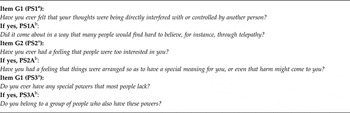
A modified version of the World Mental Health Survey Initiative of the Composite International Diagnostic Interview (WMH-CIDI 3.0) was used to generate lifetime presence of DLEs, and DSM-IV-based diagnoses of a wide range of common mental health disorders including anxiety disorders, depressive disorders and alcohol or drug abuse or dependence (Degenhardt et al. Reference Degenhardt, Hall, Korten and Jablensky2005). We used the same methodology for the assessment of DLEs in keeping with our previous analyses (for the survey data in 1997 and 2007) (Degenhardt & Hall, Reference Degenhardt and Hall2001; Scott et al. Reference Scott, Chant, Andrews, Martin and McGrath2007; Varghese et al. Reference Varghese, Saha, Scott, Chan and McGrath2011; Saha et al. Reference Saha, Scott, Varghese and McGrath2011a, Reference Saha, Scott, Johnston, Slade, Varghese, Carter and McGrathb, Reference Saha, Scott, Varghese and McGrathc, Reference Saha, Varghese, Slade, Degenhardt, Mills, McGrath and Scottd). Details of the DLEs and the counts for this analysis are given in Appendices 1 and 2. Briefly, we used the items in Section G designed to screen for possible psychosis, which was composed of three ‘screen’ items followed by three ‘probe’ items. Subjects who responded positively to any of the screen items were administered the ‘probe’ items. The items covered the following features of psychotic disorders: delusions of control, thought interference and passivity (Question 1 and 1a); delusions of reference and persecution (Question 2 and 2a) and grandiose delusions (Question 3 and 3a).
In keeping with our previous studies for 2007 survey data (Degenhardt et al. Reference Degenhardt, Hall, Korten and Jablensky2005; Scott et al. Reference Scott, Chant, Andrews, Martin and McGrath2007; Varghese et al. Reference Varghese, Saha, Scott, Chan and McGrath2011; Saha et al. Reference Saha, Scott, Varghese and McGrath2011a, Reference Saha, Scott, Johnston, Slade, Varghese, Carter and McGrathb, Reference Saha, Scott, Varghese and McGrathc, Reference Saha, Varghese, Slade, Degenhardt, Mills, McGrath and Scottd), individuals who screened positively for self-reported schizophrenia (i.e. respondents who reported ‘Yes’ to the item ‘Had been told at any time by a psychiatrist that they had schizophrenia’) were excluded from the analyses (n = 68) leaving a total of 8773 subjects for this study.
The WMH-CIDI instrument also includes checklists related to the presence of physical disorders (Australian Bureau of Statistics, 2008; Saha et al. Reference Saha, Scott, Varghese and McGrath2011a). In brief, respondents were asked if they ever had one of six broadly defined classes of disorders: (a) asthma, (b) gout, rheumatism or arthritis, (c) cancers, (d) diabetes or high blood sugar levels, (e) any heart attack, angina or high blood pressure and (f) stroke or effects of stroke.
Assessment of social support
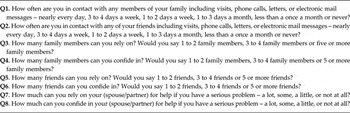
In the survey, social support was assessed with eight questions (full details are given in Appendix 3). The questions include the frequency of contact with family members or friends (e.g. ‘How often are you in contact with any members of your family including visits, phone calls, letters, or electronic mail messages?’) or questions related to the number of family members or friends they can rely on or confide in (e.g. ‘How many family members or friends can you rely on or confide in?’). Each question uses a three- to six-value response option for describing frequency depending on the questions. In order to simplify the analysis, we divided the six-value items into four categories.
Statistical analyses
For the main analyses, we examined the association between social support as the predictor variable and ‘any’ DLEs endorsement as the outcome variable using logistic regression. As the screen items were administered first, the models were run with screen items first followed by probe items that were a subset of screen items.
We also included a range of covariates to explore the impact of known and/or potential confounding variables. As sex and age influence endorsement rates of DLEs (Varghese et al. Reference Varghese, Scott, Welham, Bor, Najman, O'callaghan, Williams and McGrath2009), we included these as covariates in the main analyses (Model 1). As previous studies have reported DLEs to be also associated with alcohol and drug abuse/dependence (Degenhardt & Hall, Reference Degenhardt and Hall2001), anxiety and depressive disorders (Yung et al. Reference Yung, Buckby, Cosgrave, Killackey, Baker, Cotton and Mcgorry2007; Armando et al. Reference Armando, Nelson, Yung, Ross, Birchwood, Girardi and Fiori Nastro2010), physical disorders (Saha et al. Reference Saha, Scott, Varghese and McGrath2011a), and marital status and migrant status (Scott et al. Reference Scott, Chant, Andrews and McGrath2006), we examined a second model adjusting for these potential confounding factors.
The sample was weighted to adjust for differential probabilities of selection within households, over-sampling of population subgroups and non-response to match census population distribution on a number of geographic and socio-demographic variables (Slade et al. Reference Slade, Johnston, Oakley Browne, Andrews and Whiteford2009). The initial weights were calibrated against known population estimates. Replicate weight variables were developed using the Jack-knife procedure of replication (i.e. the analysis was repeated after one subject was dropped and then the standard error was derived from the distribution of results from all ‘minus one’ resamples) (Rust & Rao, Reference Rust and Rao1996). Analyses were performed using SURVEYLOGISTIC procedure (An, Reference An2004), which is designed to analyse complex survey sample using SAS (version 9.2, SAS Institute, Cary, NC).
Results
Of the 8773 subjects included in the study, 776 (8.4%) positively endorsed one or more DLEs screen items, and 295 (3.0%) endorsed one or more probe items (Appendix 2).
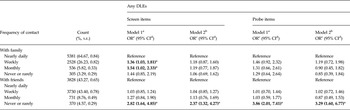
Overall, individuals who had (a) little or no contact with friends, or (b) few friends or family members to confide in or rely on, were significantly more likely to endorse DLEs. Table 1 shows the association between the frequency of contact (with family or friends) and DLEs. Compared to those who had ‘every day contact with friends’, individuals with no or rare contact with friends were two to three times more likely to endorse DLEs in screen and probe items.
Relationship between frequency of contact with friend, and family and DLEs (n = 8773)

aModel 1, adjusted for age and sex.
bModel 2, adjusted for age, sex, marital status, migrant status, any alcohol abuse/dependence, any illicit drug abuse/dependence, any anxiety disorders, any depressive disorders and physical disorder.
cOR, odds ratio.
dCI, 95% confidence interval.
*Significance: p < 0.001 (shown in bold).
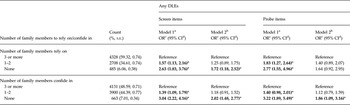
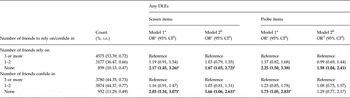
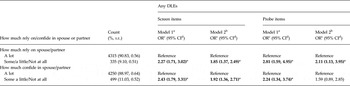
Similarly, increased risk of DLEs endorsement was found in those with poor social support as assessed by (a) fewer family members to rely on or confide in (Table 2), (b) number of friends to rely on or confide in (Table 3), or (c) being able to rely on or confide in spouse or partner (Table 4).
Relationship between number of family members available to rely on or confide in, and DLEs (n = 8773)

aModel 1, adjusted for age and sex.
bModel 2, adjusted for age, sex, marital status, migrant status, any alcohol abuse/dependence, any illicit drug abuse/dependence, any anxiety disorders, any depressive disorders and physical disorders.
cOR, odds ratio.
dCI, 95% confidence interval.
*Significance: p < 0.001 (shown in bold).
Relationship between number of friends available to rely on or confide in, and DLEs (n = 8773)

aModel 1, adjusted for age and sex.
bModel 2, adjusted for age, sex, marital status, migrant status, any alcohol abuse/dependence, any illicit drug abuse/dependence, any anxiety disorders and any depressive disorders and physical disorders.
cOR, odds ratio.
dCI, 95% confidence interval.
*Significance: p < 0.001 (shown in bold).
Relationship between the ability to rely on and confide in spouse/partner, and DLEs (n = 8773)

aModel 1, adjusted for age and sex.
bModel 2, adjusted for age, sex, marital status, migrant status, any alcohol abuse/dependence, any illicit drug abuse/dependence, any anxiety disorders, any depressive disorders and physical disorders.
cOR, odds ratio.
dCI, 95% confidence interval.
*Significance: p < 0.001 (shown in bold).
Discussion
In this large nationally representative sample, we found that poor social support with family and friends was associated with increased likelihood of endorsement of DLEs. The pattern of association persisted after adjusting for a range of potentially confounding factors. This suggests that those with a poor social support are more likely to experience DLEs regardless of co-occurring mental illnesses and socio-demographic variables. The results are consistent with a Japanese study that found ‘having no people to confide in’ was associated with psychotic-like experiences in a school-based sample of adolescents (Oshima et al. Reference Oshima, Nishida, Fukushima, Shimodera, Kasai, Okazaki and Sasaki2010). To the best of our knowledge, this is the first population-based study, and the first study based on an adult population, to show an association between poor social support and DLEs.
As this study was cross-sectional, it is not possible to establish the direction of causality between DLEs and measures of social support (we do not have information on the age-of-onset of the DLEs). However, we hope that our findings will stimulate future research designed to explore potential causal pathways between the variables of interest. For example, it is feasible that DLEs and social anhedonia are both features of an underlying vulnerability to psychosis proneness (Kwapil, Reference Kwapil1998), and any association between social support and DLEs is the reflection of this underlying association (i.e. social support is not causally related to DLEs). It is also feasible that (a) the presence of DLEs could result in the atrophy of social support networks (i.e. poor social support is a downstream consequence of DLEs) or (b) poor social support contributes to impaired mental health, and DLEs that arise in those with general psychological distress (Saha et al. Reference Saha, Scott, Varghese and McGrath2011c) (i.e. DLEs are a downstream consequence of poor social support). The links between social anhedonia and psychosis (Meehl, Reference Meehl1990; Kwapil, Reference Kwapil1998; Cohen et al. Reference Cohen, Najolia, Brown and Minor2011), and common mental disorders such as anxiety and depression v. DLEs (Yung et al. Reference Yung, Buckby, Cosgrave, Killackey, Baker, Cotton and Mcgorry2007; Varghese et al. Reference Varghese, Scott, Welham, Bor, Najman, O'callaghan, Williams and McGrath2009; Armando et al. Reference Armando, Nelson, Yung, Ross, Birchwood, Girardi and Fiori Nastro2010) also need consideration.
The study has other limitations. We used only short screen items administered by lay interviewers designed to assess DLEs. The prevalence of DLEs varies widely according to the instrument used as we found lower prevalence of DLEs (8.4%) compared to other studies with the prevalence as high as 20% than those who used longer version of the instrument (Wittchen et al. Reference Wittchen, Burke, Semler, Pfister, Von Cranach and Zaudig1989; Dominguez et al. Reference Dominguez, Saka, Lieb, Wittchen and Van Os2010; Linscott & Van Os Reference Linscott and Van Os2010), thus making comparisons difficult. In addition, the survey also did not use any items for hallucinations. However, previous studies have shown a strong association between DLEs and hallucinations in general population samples (Hanssen et al. Reference Hanssen, Bak, Bijl, Vollebergh and Van Os2005; Lincoln, Reference Lincoln2007; Van Os et al. Reference Van Os, Linscott, Myin-Germeys, Delespaul and Krabbendam2009). While we were able to adjust for depressive and anxiety disorders (including social phobia) in our models, the study did not assess sub-syndromal anxiety or depressive symptoms. Furthermore, there was no assessment of schizotypal personality disorder. Thus, the potential contribution of this disorder to our findings cannot be examined. In addition, because the data were obtained from a household survey some population groups such as the homeless, people living in nursing home, hostels, etc. were not surveyed. The study results may not also be generalised to other countries because of potential differences in cultures and socio-economic structures.
In spite of these limitations, our study provides evidence that poor social support from family and friends is associated with an increased risk of endorsing DLEs. Future studies should explore the influence of social support and DLEs in longitudinal studies, in order to examine the timing of onset of DLEs with respect to social support. Most individuals with DLEs do not develop a full psychotic disorder; however, there is evidence that these individuals also have an increased risk of common mental health conditions such as anxiety disorders and depression (Varghese et al. Reference Varghese, Scott, Welham, Bor, Najman, O'callaghan, Williams and McGrath2009). Thus, future studies related to the interaction between social support, DLEs and subsequent mental health should consider a wide range of clinical outcomes. Regardless of these speculations, our findings contribute further clues to understanding the shared and non-shared risk factors between DLEs and psychotic disorders (Van Os et al. Reference Van Os, Hanssen, Bijl and Ravelli2000; Kelleher & Cannon, Reference Kelleher and Cannon2010) providing a platform for evidence base treatment considerations (Barbui & Cipriani, Reference Barbui and Cipriani2011).
Declaration of Interest
No current external funding sources for this study
Conflict of Interest
None of the authors have conflict of interests.
CIDI screen and probes items for psychosis (DLEs)

Item PS4@: Has a doctor ever told you that you may have schizophrenia?
aScreen items (lifetime) with answer (Yes/No): ‘Any screen’ items required ‘Yes’ answers to all three questions.
bProbe items (lifetime) with answer (Yes/No): ‘Any probe’ items required ‘Yes’ answers to PS1A and PS2A, and ‘No’ answer to PS3A.
@Sample excluded from the analyses (n = 68).
Frequencies of sample responses and percent of population endorsement of DLE items (screen and probe items) (n = 8773a)

aThe sample excludes the item related to past history of schizophrenia ‘doctor ever told you that you have schizophrenia’.
Social support questions