Introduction
The rapid growth of large-scale ‘industrial’ farms in the US dairy sector in recent decades has been well documentedReference Blayney1–Reference Jackson-Smith, Barham, Schwarzweller and Davidson6. However, this ‘industrialization’ trend is neither universal in the present nor inevitable in the futureReference Albrecht7–Reference Cross9. Although large dairies (those with herd sizes over 200 cows) produce over half of the nation's milk; 90% of the nation's 75,140 dairy farms have herds with fewer than 200 cows10 and most of these small- to moderate-scale dairy farms are concentrated in the traditional dairy states: Wisconsin, Minnesota, Ohio, Pennsylvania, Michigan and New YorkReference Blayney1. With 12,000 operations of less than 100 cows, Wisconsin—‘America's Dairyland'—had about a quarter of the nation's operations of this size categoryReference Cross4, 10. These smaller-sized farms are more predisposed to adopt alternative production and marketing strategies which have become much more common since the mid-1990sReference Guthey, Gwin and Fairfax11, Reference Welsh and Lyson12. We examine the divergence in structure and strategy that occurrs in the United States dairy sector by looking closely at the rapid growth of alternative dairy farms in Wisconsin.
Our examination compares the structure, behavior and performance of five distinct dairy farm management systems in Wisconsin. These systems include large-scale confinement (over 200 cows) and traditional semi-confinement (under 200 cows) as well as three pasture-based management systems which have become important in recent decades. The largest (in terms of farm numbers) of these three systems is broadly identified as management intensive rotational grazing (MIRG), a strategy that is often characterized as ‘low-cost’ or ‘low-input’, because it relies substantively on intensive animal grazing rather than solely on forage and grain produced, mechanically harvested and physically delivered by the farmer or from other farms. This strategy has become quite widespread in a number of traditional dairy-producing statesReference Nott13–Reference Parsons, Luloff and Hanson16 and accounts for almost 25% of producers in Wisconsin. The second type of alternative dairy farm strategy is certified organic. These farms produce and market milk as free of agrichemicals and synthetic hormones, and their numbers have grown more than tenfold over the past decadeReference Dalton, Bragga, Kersbergen, Parsons, Rogers, Kauppilad and Wange17, Reference Barham, Brock and Foltz18. They account for roughly 3% of the dairy farms in Wisconsin19. Organic dairy producers generally, but not always, overlap with the MIRG farms in their intensive use of rotationally grazed pasture as a feeding system. Amish dairy farms are the third farm type, which are also pasture-based though they often use extensive rather than intensive methods. They continue to have a strong presence on the agricultural landscape in well-established Amish communities like Pennsylvania, Ohio and IndianaReference Parsons, Luloff and Hanson16, Reference Luthy20. But, in the past couple of decades, Amish dairy farmers have migrated to states with newer settlements often where non-Amish farmers are exiting farming, such as in Wisconsin, New York, Michigan and MissouriReference Cross5, Reference Cross9, Reference Hostetler21, Reference Cross22. It is estimated that Amish farmers will be around 10% of Wisconsin's dairy sector by 2010Reference Cross5. Because of the very recent take-off in organic dairy farming, as well as the difficulty in identifying Amish farms from standard surveys, no systematic and representative comparisons exist of the structure, behavior and performance of these multiple alternative dairy farm strategies.
This paper provides that kind of analysis for Wisconsin, and in the process explores the basis for the continued persistence of small- to moderate-sized operators during an era of significant expansion in the number and scale of large confinement operationsReference Cross4, Reference Jackson-Smith, Barham, Schwarzweller and Davidson6, Reference Foltz and Lang23. The first empirical section documents the recent divergence in the structure and management strategies on Wisconsin dairy farms. Next, the behavior of these farm strategies is explored by comparing and contrasting the management practices and technologies utilized. Finally, several social and economic performance indicators, including productivity, income and quality of life measures are compared.
Methods
The analysis primarily exploits data from two surveys done by the Program on Agricultural Technology Studies (PATS) at the University of Wisconsin, Madison. (Data used from outside sources will be cited as such.) Both surveys were conducted using a modified Dillman methodReference Dillman24. In order to mitigate response bias, each non-respondent was contacted three times over a three-month period. Survey respondents included both confinement and pasture-based farmers. The three types of pasture-based farmers are MIRG, organic and the Amish. Confinement operations are also included mainly for comparison purposes. Both surveys are supplemented with results from selected on-farm interviews, which were conducted by the lead author.
(1) The first survey includes a random sample of the entire state dairy sector conducted in the winter of 2003. The statewide dairy survey generated over 700 usable surveys and had a 45% response rate. One hundred and sixty-four (MIRG) farmers and 491 confinement farmers responded to this 2003 Wisconsin Dairy Farm Poll. Please note that a random sample component of a survey from the winter of 2005 is also utilized to a limited extent in the analysis below. The 2005 survey was done with some assistance from PATS by an affiliated institution, the Center for Integrated Agricultural Systems, with the explicit purpose of examining various measures of quality of life on different types of dairy farms. Many questions on this 2005 survey are identical or overlap closely with those on the 2003 Dairy Farm Poll which made robust comparisons possible. Because organic and Amish dairy farmers were not separately identified or significantly represented in the random sample component of the 2005 data, information is only available on the MIRG and confinement groups.
(2) The second survey undertaken in the spring of 2004 focused on two alternative dairy farm groups: a sample of Amish farmers from Old Country Cheese, an Amish cheese cooperative based in Cashton, WI, and a statewide sample of organic dairy farmers (members of Organic Valley and Midwest Organic Services Association organic certified operators). This survey also had a 45% response rate, with 100 Amish and 85 organic producers responding to the survey.
To test the statistical significance of differences in behavior and performance across the different farming systems, we use standard t-tests with a 95% confidence interval cut-off. These are denoted in the tables by letters (i.e. Amish=a, organic=b, MIRG=c and confinement=d). Some of the tables also include a comparison with medium-sized confinement (under 200 cows=e) and large-scale confinement (over 200 cows=f). For example, the ‘b’ for a given number or percent in the first column of a table denotes that there is a statistically significant difference between that outcome and the outcome in column b.
Divergence in Dairy Farm Structure and Management Strategies
Twenty years ago, the structure of dairy farming in America's dairyland was relatively homogeneous. Almost all farms utilized semi-confinement methods, where the vast majority of the feed was provided to cows in the form of forage and feed harvested mechanically and delivered to them in the barns. Pastures were used non-intensively, mostly for animal health purposes25. Stanchion and tie-stall barns were the predominant structures used as combined housing and milking facilities. Milking parlors were rare, there were only occasional organic dairy farms with no major market presence, and the Amish were just beginning to make serious inroads into Wisconsin agriculture. Increasing diversity in the past several decades can be seen first in terms of the changing size structure of the industry and second in the emergence from moderate-scale semi-confinement dairy farms to five distinctive dairy farming systems: large confinement (over 200 cows), moderate-scale confinement (under 200 cows), MIRG, organic and Amish. Please note that, according to our data, farms with herd sizes that are between 100 and 199 cows also have somewhat distinctive characteristics in terms of adoption of technologies and performance. Because the focus of the report is on the alternative farm strategies, we do not split confinement farms with herd sizes under 200 cows and thus treat these confinement farms as one category for the rest of this paper.
Although dairy processing and market structure are not the focus of this paper, it should be noted that there is more potential for product diversification in dairy than in other livestock sectors like poultry, where production is becoming extremely interconnected along with processing. Thus, there may be more possibilities of dairy farm-level adoption of alternative production practices than in other livestock sectors as these decisions have a lower likelihood of being constrained by concentrated marketing arrangements. For example, adopting alternative practices such as MIRG does not require alternative processingReference Hinrichs and Welsh26. Diverse and unconstrained dairy product markets provide a promising economic environment for diverse types of farm operationsReference Lyson and Gillespie27.
Overall structural change
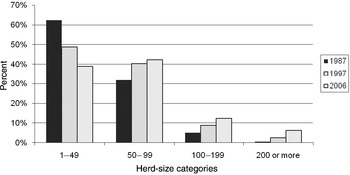
Divergence in the Wisconsin dairy sector in the past 20 years can be seen through the 1.6-fold decrease in the percent of farms with herds under 100 cows and the almost 10-fold increase in the percent of farms with herds over 200 cows. Nonetheless, in 2006, 81% of Wisconsin dairy farms were still under 100 cows and 94% were under 200 cows, in contrast to western states like California where 89% of herds were larger than 500 cows; herd sizes smaller than 200 cows are moderate sized indeed. These Wisconsin moderate-sized farms produced 64% of the state's milk supply10. Divergence in the size and management structure in Wisconsin's dairy sector can be explained by changes amongst existing farmers as well as the characteristics of entering and exiting farmers. Many of the moderate-sized semi-confinement farms from the 1980s and 1990s have exited, which explains the decrease in dairy farm numbers from 36,500 in 1987 to 14,900 in 2006 (Fig. 1)10, 25. About 500 of those confinement operations converted to large-scale confinement in the past couple of decades. The majority of expansions that led to this increase in large confinement dairy were due to incremental size changes, often followed by major expansionsReference Jackson-Smith, Barham, Schwarzweller and Davidson6, and as a result it is likely, too, that many of the operations currently in the 100–199 size category could move in that direction. It is fair to say that an even larger number of the moderate-sized semi-confinement farms were converted to MIRG operations by existing operators or replaced by entering farmers utilizing MIRG or other alternative dairy farm systems, including around 700 farms that have been bought by Amish farmers in the past several decades.
Percent of Wisconsin dairy farms by herd-size category 1987, 1997 and 2006. (Sources: 1987 (Total 36,459 farms) and 1997 (Total 21,997 farms), Census of Agriculture; 2006 (Total 14,900 farms), NASS-USDA.)

Management structural divergence: MIRG farmers
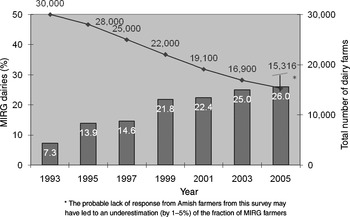
The emergence of MIRG as a farm management strategy was a major trend in the 1990s in traditional dairy products producing statesReference Nott13–Reference Parsons, Luloff and Hanson16 that has seemed to plateau in recent years in Wisconsin. As seen in Figure 2, the percentage of MIRG farmers doubled from 7 to 14% in the four-year period from 1993 to 1997. It took another eight years for the percent of MIRG dairy farms to almost double again to 26% in 2005. It is important to note that the overall number of MIRG farms has not doubled twice since 1993 (when the total number would have been close to 2200, compared to just under 4000 in 2005), but that the MIRG strategy has become far more prevalent proportional to the conventional dairy farm strategy.
Use of management-intensive rotational grazing (MIRG).

Historical accounts of the emergence of the MIRG farm strategy highlight the critical role that farmer to farmer information exchange played regarding how to manage pastures most efficiently in a localized areaReference Hassanein28. This localized information exchange was especially needed given that land-grant university pasture research and support declined significantly after 1950Reference Fales, McMurry, McSweeny and Sims29. The clustering patterns of MIRG adoption in Wisconsin may be related to this information exchange and/or the nature of the unglaciated landscape where there are high rates of adoption.
The MIRG farm strategy is a combination of a very old technique involving heavy reliance on pastureReference Voisin30 with more recent pasture management knowledgeReference Hassanein28 aimed at making intensive use of the pastures. Technically, we define farmers as MIRG based on their reliance on pastures as a source of feed during the grazing season and by their movement of cows to a new paddock about once a week. In that sense, we use a relatively liberal definition compared to other worksReference Taylor and Foltz14, Reference Lloyd, Bell and Stevenson31, but we consider variations on the definition from less to more intensive MIRG operations.
Management structural divergence: organic and Amish farmers
In recent years, it has become clear that significant structural divergence is also occurring within the pasture-based dairy farm strategies in the US, with Wisconsin being a prime site example of this structural change. The growth of MIRG farms overall may have reached a plateau at about 25% of the farms in Wisconsin, but the diversity within the MIRG farm strategy has increased. At present, Wisconsin provides an ideal context for exploring diversity in dairy farming and may be reflective of the rest of the Upper Midwest as both organic (i.e., third-party certified) and Amish farm numbers are increasing in Wisconsin, which impacts the dynamics of the MIRG farm strategy. Organic dairy farmers are a growing fraction of the MIRG farm numbers, constituting 1% of the graziers in 1997, 8% of the graziers in 2005 (calculations supplemented with data from ERS–USDA), and could account for 10–12% of graziers by the end of 200719. The Amish were roughly 14% of Wisconsin MIRG graziers in 2002 (calculations supplemented with data from CrossReference Cross9)Reference Cross22. The Amish and organic farm types when combined constitute about one-fifth to one-fourth of MIRG farm numbers in the early 2000s, and this percentage will probably expand as these two farm types seem likely to grow at rapid rates in the near future. Both organic and Amish farmers are geographically clustered in similar areas where MIRG farmers overall are clusteredReference Cross9, Reference Cross22.
Organic milk production began to take off in the 1990s, and has the fastest growing dairy product sales, with demand far exceeding the supply most of the time in the late 1990s and early 2000s. Some trade journals link the approval in 1993, and subsequent use, of the controversial hormone, rBST, as a primary reason why consumers, demand for organic milk grew rapidly in the 1990sReference DuPuis32. Organic-dairy cow numbers in the US have grown from about 2000 in 1992 to 86,000 in 200519 to well over 100,000 by the end of 2007. Organic farming is also seen as a promising alternative towards the goal of keeping smaller scale farms operating, particularly in the Midwest and in the Northeast (i.e. traditional dairy producing states)Reference Barham, Brock and Foltz18, Reference Guptill33. Wisconsin is the leading producer of organic dairy products in US markets and home base to the largest organic milk cooperative, Organic Valley (CROPP), which now has members in 29 states. Organic dairy farm numbers in Wisconsin have grown from approximately 54 farms in 1997 to over 350 farms in 2005 (calculated from USDA–ERS data)19 and probably well over 400 by the end of 2007.
Amish dairy farms comprise roughly one-eigth of all dairy farms in the US, as estimated by US Farm Service Agency officials in 2005Reference Cross5. The Old Order Amish dairy operations are an independent phenomenon from the other alternative groups (organic and MIRG overall) as this farm type is defined by their Anabaptist Christian religious and cultural identity. For the Amish, ‘living in a redemptive community, separated from the world, is essential to salvation’Reference Hostetler21; as exemplified by one Wisconsin Amish farmer interviewee who stated ‘confess[ing] Christ with our farm’ was the primary motive for farming. The geographic areas that have the highest concentration of farms with the smallest dairy herds correspond well to maps where there are dense concentrations of Amish dairy farms in states like Wisconsin, Iowa, Indiana, Ohio and Pennsylvania, and Missouri and Kentucky. Some of the states with really high percentages of Amish dairy farms include Indiana, with three-fifths of dairy farms being Amish owned, and Pennsylvania and Ohio where over one-fourth of the farms are Amish ownedReference Cross5.
Many Amish who have a desire to farm as a way to maintain religious and family values have migrated from eastern urbanizing states to other states like Wisconsin with more available farm land. Amish-owned dairy farms constituted roughly 5% of the dairy sector in 2004Reference Hinrichs and Welsh26 and were estimated to be around 10% of the state's dairy numbers in 2007Reference Cross5. Wisconsin has the second largest concentration of Amish church settlements in the USReference Luthy20. Whereas only 22% of Wisconsin farms overall have dairy herds, the majority of Amish farmers in Wisconsin (80%) have dairy herdsReference Cross9. Amish dairy farms are occupying barns which would otherwise be abandoned or torn down as the number and proportion of non-Amish dairy farms decline rapidlyReference Cross22.
Across the state, 18 settlements were founded between 1920 and 1990 that still exist today, and at least 21 more have been founded since that timeReference Luthy20. Many of these settlements have been growing rapidly given the large family sizes and high retention rates to the Amish faith. The Kickapoo Valley settlements in this survey chose to start their own cheese co-op which would be committed to buying milk in cans. In contrast, some other districts in Wisconsin and from where the Amish emigrated chose to adopt bulk tanks and electrical means to cool milk several decades ago, partly out of the necessity of marketing their milk under increased regulatory structureReference Kraybill34. The Amish dairy farmers surveyed for this paper also have some distinctive demographic characteristics, such as lack of schooling beyond the 8th grade. These dairy farmers have fewer years of farm operating experience than other dairy farmers, which may reflect their younger age (average age of an Amish is 41 years compared to an average of 48 years in the other types of farmers). A relatively small proportion of the Amish obtained their farm from their parents as many emigrated from other states. Amish farm-acquisition stands in contrast to the majority of dairy farmers in the other farming strategies examined here, where farm transfers from parents are common. Because the elevated price of agricultural land (reflecting residential and recreational demand) serves as a significant constraint to other new entrants in farming, the number of ‘new’ Amish farms is notable.
Alternative dairy farm herd sizes
The Amish farmers as well as the other pasture-based dairy farm types have average herd sizes which are much smaller than the Wisconsin dairy sector overall. The average herd size on the PATS sample of Amish-owned farms is 15 cows (median around 14) whereas the overall state Amish herd average is 19 cowsReference Cross22. MIRG farmers in this study have a mean average herd size of 48 (median 42), and organic dairy farms have an average herd size of 65 cows (median 47). At the other end of the spectrum, confinement operators have a mean herd size of 97 cows (median 62 cows). In contrast to the rapid growth in average herd size seen in the Wisconsin dairy sector overall in recent years, the alternative farms did not change dramatically in herd size from 1997 to 2002/2003.
Sector Divergence in Patterns of Modernization
The divergence in farm structure and strategy laid out thus far has implications for patterns of technology use and management practices on Wisconsin dairy farms. With some technologies such as housing and milking facilities, a significant fraction of Wisconsin dairy farms still milk in stanchion or tie-stall barns that were built prior to or during the 1980s. Yet, the recent changes in size structure and farm strategies have also given rise to divergence in the adoption trends of a host of technologies and management practicesReference Jackson-Smith, Barham, Schwarzweller and Davidson6.
Modernization is frequently used in the US agricultural circles for describing the adoption of new and often more sophisticated technologies. These technologies are assumed to keep farmers cost competitive and ideally increase farm profitability. This paper utilizes the modernization concept but also broadens it to include improvements in product quality dimensions and management of environmental impactsReference Holmes, Kammel and Palmer35. The development of alternative practices are examples of ‘reflexive modernization’Reference DuPuis32, Reference Kaltoft36, Reference Stock37, which as BellReference Bell38 states is a ‘modernism that reflects on where it's going, a modernism that is self-conscious and self-critical’ of the benefits associated with technological advances in the predominant (or conventional) agricultural system. Reflexive consumers and producers become more concerned about issues like the environment, genetic modification and healthReference DuPuis32, Reference Kaltoft36, Reference Stock37, Reference Beck39, Reference Lockie, Lyons, Lawrence and Mummery40.
These concerns may be a reflection of the environmental and social problems with conventional agricultural systems. Pesticides, in particular, can have detrimental effects on ecological and human healthReference Spiewak41–Reference Schreinemachers44. The degradation of soil quality caused by destructive agricultural practices may lead to increasing needs for inputs like fertilizers and irrigationReference Cassman45, Reference Fox, Gulledge, Engelhaupt, Burow and McLachlan46. The common practice of prophylactic treatment of antibiotics in confined livestock production is causing antibiotic resistance problems in both animals and humansReference Smith, Besser, Hedberg, Leano, Bender, Wicklund, Johnson, Moore and Osterholm47, Reference Gorback48. There is a need for new approaches that capitalize on human knowledge and skills so that harm to the environment can be minimizedReference Pretty49.
In the context of the dairy industry, the adoption of management-intensive rotational grazing, organic farming practices and more intensive nutrient management are examples of this broader concept of modernization. Intensive rotational grazing may have sustainability benefits, such as reductions in soil erosion, fossil-fuel expenditureReference Rayburn and Liebhardt50, and nitrogen volatizationReference Soder and Rotz51 as well as providing enhanced dimensions of soil ecological healthReference Johnson, Pfleger, Bethlenfalvay and Linderman52, Reference Rabatin and Stinner53 and better habitats for fauna. Intensive rotational grazing, especially on improved pastures, may also offer additional agronomic benefits in terms of productivity and forage and soil qualityReference Martz54–Reference Kuusela and Khalili57. Organic farming may also offer social and environmental benefits such as increased biodiversity, erosion control, increased soil health and reduced usage of chemicals and antibioticsReference Haas, Wetterich and Köpke58–Reference de Boer63.
In contrast, the unique and more traditional technology adoption patterns amongst the Amish would more accurately be attributed to religious and cultural community norms that are less likely to be examples of reflexive modernization. However, Amish farms may offer some environmental benefits. For example, the main consistent difference between Amish and the other farmer types is using horses for tillage, which may be associated with better soil quality as less soil may be lost as it is thrown up at lower levels than by using the mechanic tiller. In a comparative study with an Amish farm and a no-till farm, the Amish farm was found to have more organic matterReference Jackson64. So in summary, this paper demonstrates a more subtle account that goes beyond the common argument that links a common conception of ‘modernization’ in dairy to larger farmersReference Barham65, Reference Brannstorm66.
Technology adoption
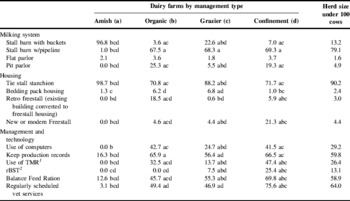
In Wisconsin, the adoption of parlors, freestall housing and several technologies aimed at enhancing the milk production of cows have been strongly associated with herd expansions. Those associations are evident in Table 1, but a careful examination also demonstrates strong modernization outcomes on certain types of alternative, smaller scale dairy farms. The adoption patterns on organic dairy farms are particularly striking. They utilize modern milking facilities and housing structures and have much higher adoption rates of some technologies than their herd-size distribution alone would predict in a sample of conventional farms.
Infrastructure, management and technology on Wisconsin dairy farms (% of farms).

1 TMR=total mixed ration (grains, minerals, vitamins and protein supplements are mixed for creating nutrient-rich animal feed).
2 rBST=recombinant bovine growth hormone (it is used to increase milk production).
The adoption of different types of milking parlors and freestall housing by farming strategy is perhaps the most powerful example where adoption of technology does not necessarily imply large and/or expanding herd sizes. About a quarter of organic operations have a pit parlor and some type of freestall housing. These adoption rates are, respectively, five times and three times the adoption rates amongst a random sample of farms that were under 100 cows (Table 1). The high adoption rate of these technologies is especially surprising given that the trend statewide has been one where parlor use has usually been very closely correlated to dairy farms undergoing major expansions in herd sizes usually to 150–200 cowsReference Jackson-Smith, Barham, Schwarzweller and Davidson6. In contrast, organic farmers have not increased their herd sizes dramatically, and do not express the intention of expanding significantly in the future.
Organic farmers also have adoption rates of other technologies that are higher than all but the largest confinement herds. Computer usage amongst organic farms is 13% more likely than would be predicted by a random sample of farms in the under 100 cow herd size category. The probability that organic farmers keep individual cow production records is similar to farmers managing larger confinement herds. The use of total mixed rationing equipment amongst organic farmers is also relatively high compared to a random sample of herds under 100 cows.
At the other end of the technology adoption spectrum, the Amish utilize more traditional milking facilities than even their small size distribution would suggest. The vast majority of Amish producers have a stall barn with a bucket system and milk by hand. Thus, the Amish are utilizing older milking facilities and housing structures or setting up lower technology operations. As one might expect, the Amish adopt ‘modern’ technologies at rates that are roughly 25% or less than the other farming types.
MIRG farmers have adoption levels of milking structures and housing that are more typical of other moderately sized farms (with the exception of higher usage levels of bucket milking systems perhaps due to the presence of some Amish in the grazier sample). They also have a lower probability of utilizing computers than organic farmers (25% against 43%). It is possible that MIRG farmers have more basic milking structures and housing and technology use because of their lower expectations to stay in farming. As one organic dairy farmer in an on-farm interview states about graziers ‘the graziers may think that I am going to retire this way, and in a few years I am going to sell the place … graziers would put less money into it … [They work] closer to the backbone … .’
Some technology adoption decisions are affected by the core strategy of the farm, as we see the pasture-based farmers utilizing milk productivity enhancing technologies such as rBST at much lower levels. Not surprisingly, organic dairy producers report no use of rBST, as it is a stipulation of organic certification. Growth hormones are also not allowed by the Amish in this region, partly due to the belief that they are ‘not natural’ as stated by an Amish elder in the Kickapoo Valley. Only one in 15 MIRG farmers report the use of the synthetic hormone, as compared to one in four confinement operations. The lower rBST adoption rates amongst the MIRG farmers are similar to what one would predict of farms under 100 cows following the common modernization argument. Similarly, balanced feed rations and total mixed rationing equipment (TMR) are used less on pasture-based farms than on confinement herds, with the Amish at the bottom end of the adoption spectrum.
Surprisingly, given the similar pasture-based focus, organic farmers use TMR at about two and a half times the rate of MIRG farmers. Organic dairy farm operations and MIRG operations look similar in their lower frequency of use of veterinarian services as compared to confinement dairy farms. While this gap may originate in the constraints organic farmers face on the use of certain types of veterinary medicine, it may also be that lower veterinary use rates are a function of better herd health due to potential benefits of pasture-based managementReference Goldberg, Wildman, Pankey, Kunkel, Howard and Murphy67, Reference McCue68 and longer term organic systems on herd healthReference Bennedsgaard, Thamsborgb, Vaarstc and Enevoldsend69. The small proportion of Amish that utilize scheduled veterinary services (3%) is an especially stark contrast to the vet use amongst the other management types. According to on-farm interviews, some of the Amish use a significant amount of home remedies and rely on veterinarians only as a last resort.
Manure and pasture management practice adoption
Dairy studies that focus on manure management suggest that larger farms are more likely to follow recommended practices than are smaller farms, as they are able to spread the substantial fixed costs of storage systems out over a larger operation as well as having more specialized laborReference Burton, Rigby and Young70, Reference Fulhage71. The recommended strategy is to store in a lined structure and haul mostly in the spring and fall when tillage incorporates manure into the soil after spreadingReference Turnquist, Foltz and Roth72. Manure is neither collected nor stored on many Wisconsin dairy farms, which could be explained, at least in part, by financial and labor constraints on small- to medium-sized operators in WisconsinReference Turnquist, Foltz and Roth72, Reference Powell, McCrory, Jackson-Smith and Saam73.
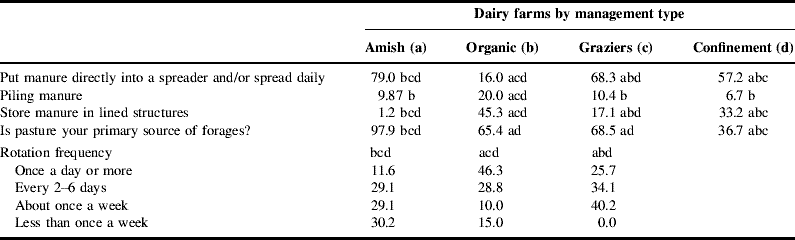
However, as shown in Table 2, organic dairy farmers are far less likely (16%, compared to 68% for MIRG, 79% for Amish and 57% of confinement operators) to put manure directly into a spreader than are the other types of dairy farmers. Rather, organic farmers are much more likely to either store the manure in a lined structure (45%) or in a pile (20%), practices that are generally considered to be more environmentally beneficial. This stark difference in manure management practices between organic dairy farmers and all other management types may be due to the higher incentives organic farmers face for efficiently utilizing manure as a source of nitrogen, given certification restrictions on their use of chemical fertilizers. In contrast, the less intensive manure management practices in the other pasture-based groups are more similar to the typical farms in that herd size category.
Manure and pasture-management choices (% of farms).
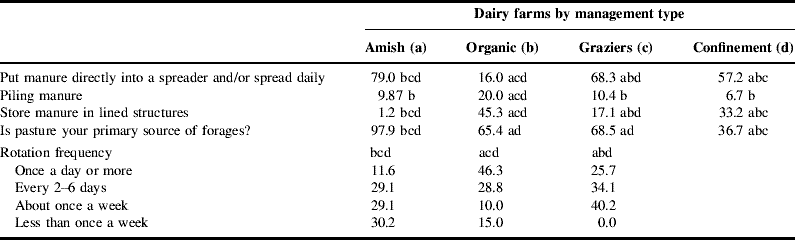
Organic farmers are also the most likely to rotate their cows in an intensive manner and the Amish are the least likely of the pasture-based groups to rotate intensively (see Table 2). The average rotation frequency of MIRG farms overall is in between these two extremes. About one-half (46%) of organic dairy farmers rotate pasture once a day or more, as compared to only one in four (26%) of the MIRG farmers and 11% of the Amish farmers. On a national scale, the extent of pasture exposure and intensity of management may vary across organic farms as national pasture standards are not totally explicit. However, these data indicate that the majority of organic farms in Wisconsin rely on pasture to a significant extent and manage it in an intensive fashion. Almost all (98%) organic producers rely on pastures for at least part of the forage ration and about two-thirds (65%) rely on pastures for the primary source of forages. These rates are similar to the extent of pasture reliance for MIRG farms. According to the survey results, almost all Amish producers rely on pastures extensively rather than intensively, yet they indicate that pasture was their primary source of forage during the grazing months. It appears then that the Amish rely heavily on pastures that are likely to be only moderately productive.
Overall, the diversity of farm structure shapes technology adoption outcomes in the Wisconsin dairy industry, with larger confinement farms being more likely to adopt some of the modern technologies and management practices. Yet, there are also very important and distinctive dimensions of the modernization story that are evident on the smaller scale alternative dairy farms, especially on organic dairy farms. Organic farmers use a hybrid of modern milking and housing structures which are combined with a range of practices that are ‘reflexive’, but also clearly intensive and innovative in their management demands. Organic farm-adoption patterns seem to follow the trend in some research which finds a positive relationship between smaller farm sizes and sustainable agricultural practicesReference Tavernier and Tolomeo74 given their progressive adoption patterns towards management practices like manure and pasture management.
Amish farms, for the most part, stand in contrast to this modernization story as many of the technology and management practices are far less modern and intensive than on any other farm system. These extremes highlight the diversity in technology and management practices that has emerged over the past two decades in America's dairyland.
Productivity, Performance and Satisfaction
The impact and viability of these diverse types of dairy farms will depend on a multitude of factors. In this section, we compare a few critical performance indicators: herd productivity levels; farmers' self-reported satisfaction with income and quality of life; and their expectations for how long they envision themselves farming. These comparisons suggest some distinctive reasons why organic and Amish farms will continue to play an increasing role in the Wisconsin dairy industry well into the future.
Organic and MIRG farms have similar levels of milk productivity (52 versus 55 lbs per cow per day), but productivity is significantly lower on these pasture-based farms than on confinement farms. It is worth noting that large-scale confinement farms are also significantly more productive than the smaller scale confinement producers. Among the pasture-based systems, productivity levels did not vary much by grazing intensity level. Average productivity on Amish farms is around 48 lbs per cow per day which is 8% less than average production levels on organic (at 53 lbs per cow day) and 12% less than grazing farms (at 55 lbs per cow per day) and 25% less than conventional producers (at 64 lbs per day). Given that Amish producers milk by hand, these nearly comparable production levels suggest that intense labor efforts on Amish farms may explain why they manage smaller herds. The combination of fewer cows and low productivity levels mean that Amish milk production and acres operated comprise only about 1% of the total Wisconsin dairy sector even though they comprise 5–7% of the farms. Organic farms account for no more than 2% of milk production in Wisconsin currently, with MIRG farms accounting overall for less than 20% of total milk production.
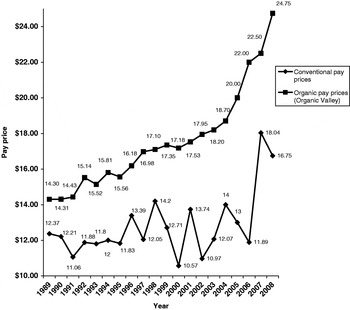
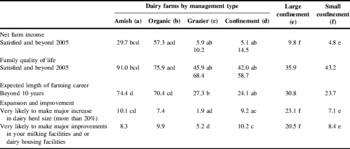
Organic and Amish dairy farmers report relatively high levels of satisfaction with net farm income and overall quality of life compared to other types of dairy farms (see Table 3). Well over half of the organic farmers (57%) are satisfied or very satisfied with net farm income and 76% are satisfied or very satisfied with overall quality of life. By contrast, only 5–10% of the other non-Amish dairy farmers reported being satisfied or very satisfied with net farm income in a comparable survey. The high levels of satisfaction with income that organic farmers express likely reflect significant improvements in income over the previous 5 years that other farmers have not experienced (Fig. 3).
Organic price versus conventional dairy pay price comparisons, 1989–2008. (Sources: from Organic Valley (CROPP) which indicates Organic Valley Midwest base price without butterfat or quality premiums. Conventional pay price data are from DPW Markets, Ken Bailey, Penn State Forecast.)

Satisfaction and future of farm life (% of farms).

It should be noted that the average organic milk price received by organic dairy farms in 2003 was $19.50 per cwt ($18.20 base price), or roughly $7.00 greater (or 60% higher) than non-organic operations. Hence, the striking difference in satisfaction levels with net farm income and quality of life in the 2003–04 data may be muted in other years, such as 2005, when there was not as stark a contrast between conventional and organic prices (Fig. 3). MIRG and confinement farmers did report a more positive view on their overall quality of life with 68% of the former reporting satisfaction levels that were satisfied or very satisfied in 2005 compared to only 46% having satisfaction levels at those levels in 2002. Over half (59%) of the confinement farmers reported being highly satisfied in 2005 compared to only 42% in 2002. When asked what price they would need to remain profitable, organic farmers, on average, reported needing $16.80 per cwt, which was well below the price they were earning at the time and at any time during the past decade. Since 2004, the mean organic milk price has been well above $18.00, buffering organic farmers from the down-side price pressures that have been so challenging for other types of dairy farms.
Large confinement operations (greater than or equal to 200 cows) report somewhat higher satisfaction levels with respect to income than other dairy farm types, but they do not have levels of satisfaction comparable to those reported by organic or Amish dairy farmers. Relatively high levels of satisfaction in larger confinement farms are also evident in other studies on dairy farm modernizationReference Bewley, Palmer and Jackson-Smith75 and quality of lifeReference Lloyd, Bell and Stevenson31, and appear to be explained both by higher incomes and more freedom to take time away from the farm. Because over 80% of household income comes from farming across all types of dairy farms in our sample, the strong performance of farm income on organic dairy farms indicates that they are also more likely to experience satisfactory overall family income levels compared to other farm types. From 2002 and 2005 data, we analyzed that satisfaction with income and overall quality of life did not vary consistently with grazing intensity level. Note, though, that again both organic and Amish farmers reported higher quality of life outcomes than other types of dairy farmers. If we combine the results of the two satisfaction measures in Table 3—Satisfaction with net farm income and Satisfaction with family's quality of life—we see that the majority of Amish dairy farmers have high satisfaction levels with respect to overall quality of life (91%), but the majority do not have high satisfaction levels with respect to net farm income (30%). In 2003, Amish farmers were only receiving $10.03 per cwt for their Grade B milk. The Amish farmers' high satisfaction with life and thus their survival on the farm may be a reflection of their dedication to simple living and contentment with life (1 Timothy 6:6–9)Reference Hostetler21. When asked what is the biggest obstacle for the Amish people, an Amish elder in the Kickapoo Valley responded by stating, ‘The devil. He is very busy. In prosperity, the devil gets a lot of people. When prosperity goes too far, it is dangerous. We should make a living but not more.'
The Amish are also more likely to use non-farm self-enterprise activities (21%) against off-farm employment income (6%) to support household income. For the other types of dairy farms, off-farm rather than on-farm employment does not play as significant a role. This contrast reflects the Amish commitment to a rural lifestyle, self-reliance, insulation from the surrounding culture, and the limited employment opportunities given transportation and technology restrictions. As is well known, Amish operate a variety of farm cottage industries on their farms which include saw mills, woodwork, bakery, quilts and processing food products, all of which are used for securing additional income for the household. In addition, more than one-third (38%) of the Amish dairy farmers in our study also grow and market vegetables. Many Amish market their produce through a local produce auction and to the same organic co-operative, CROPP, which buys much of the fluid organic milk in Wisconsin.
Organic and Amish farmers are more likely than other dairy farm types to report plans to stay in farming for the indefinite future, which is consistent with their high overall satisfaction levels with quality of life. Seventy percent of organic farmers and 74% of Amish farmers expect to stay in farming for the indefinite future (i.e., beyond 10 years), compared to 27 and 24% of MIRG and confinement farmers, respectively. The intentions of expanding and improving are modest amongst all the farm strategies especially amongst the pasture-based farmers, with MIRG farmers being even less likely to consider those changes given their lower reported levels of intention to remain in farming for many years. Confinement operations are the most likely to expect future expansion with one out of four considering either expanding their herd size significantly or improving their milking or housing facilities. Grazing intensity also did not affect the farmer's intention to stay in farming nor the farmer's intentions to expand or improve farm infrastructure. One distinguishing aspect of the MIRG strategy is that it may provide an easier transition to other farming or career endeavors given the lower levels of sunk investments involved compared to the infrastructure necessary for implementing confinement systemsReference Barham, Chavas and Klemme76. It is also important to emphasize that MIRG farmers are in a better position to switch to organic, given their pasture- based focus, though some may decide that the knowledge and investment costs associated with transitioning to organic are too high. According to the performance data analyzed here, especially the organic and Amish dairy farms should persist and grow in the years to come.
Conclusions
Structural change and increasing diversity of management strategies in the Wisconsin dairy farm sector are strongly intertwined. In the past two decades alternative pasture-based farms have emerged which are typically smaller in scale and less capital-intensive, in contrast to the more commonly documented theme of industrialization with the proliferation and growth of large-scale confinement farms. This paper demonstrates that the divergence in management strategies has implications for structure, technology and management adoption patterns as well as farmer satisfaction levels. The emergence of different farm types suggests that there are multiple ways by which farmers choose to live out economic, social/spiritual and ecological values.
The organic farm strategy seems to be especially vibrant, based on farmer satisfaction levels with overall quality of life and income, which is also reflected in their high expectations for their future in farming. Organic farmers are also progressive in their adoption of modern technologies, especially considering their moderate size. Amish dairy producers have a solid and growing presence on the farm landscape despite their low production levels, small herd sizes and modest adoption of moderate technologies, which perhaps is made possible by their relatively low expectations for income and consumption and their strong preference for a rural, culturally insulated lifestyle. The MIRG farm strategy overall continues to be a low input and perhaps also a low-cost strategy in the conventionally priced market. Further research is needed for comparing rigorous farm-based economic performance indicators, especially various measures of profitability, and to explore factors (farming strategy, technology use, number of rotations, acreage/per cow) that may contribute to higher levels of economic performance amongst these alternative and confinement farm strategies in Wisconsin, as well as other states.
At the environmental level, we see that organic dairy farmers appear to be quite proactive in terms of adoption of management practices that may have positive impacts, such as progressive manure management practices and intensive rotational grazing practices. The Amish and MIRG farmers offer some of these same benefits, given their pasture-management focus, but their management intensity with respect to these practices is considerably lower than that in the organic farms. However, more research is needed to make comprehensive environmental sustainability comparisons between these groups of dairy farmers.
These farm systems are worth considering at a societal level as well, as the role of personal values, environmental stewardship and other non-pecuniary dimensions may be central to the decisions made by dairy farm families. This is especially evident with the proliferation of Amish farms. For the Amish, their motivations and purpose in farming are not strongly tied to income levels or other standard economic measures. As an entry in an Amish newsletter states, ‘Farming is not a top paying job … . Isn't farming still the most important and best for the family?’ 77. Many of these Amish individuals are quite committed to continue farming despite low levels of satisfaction with farm income. The niche of dairy farming at a small scale with a low cost/minimal technology approach helps preserve the Amish way of life as it involves the family on a daily basis throughout the year.
Also, clearly, organic farming is often viewed as a way to live out values on health and the environment, especially amongst some of the originators of the movement. The MIRG system is more flexible for farmers who want the option to use non-organic practices. This system also does not entail the administrative work involved with organic marketing. In this way, diversity in dairy farm systems provides multiple avenues for farmers to match the management system to varying landscape and biophysical conditions and meet their own personal goals.
This paper indicates that alternative dairy farming systems will likely become more prevalent on the agricultural landscape of Wisconsin. Both organic and Amish farm numbers are growing rapidly, and the proportion of MIRG farms seems to be holding steady. It also provides one of the first statistically representative comparisons of the diverse structure, behavior and performance of alternative dairy farm strategies which are growing in prevalence in traditional dairy states like Wisconsin. Much remains to be learned about farmers' choices with respect to size and farm strategy, their viability in terms of profitability, as well as their satisfaction with quality of life given their choices. With the Amish, we might see a different picture of farm structure and performance, if we were to study more liberal Amish settlements in Wisconsin and other states. The extent of overlap between the Amish and the adoption of organic and management-intensive grazing practices is also an important research topic. In sum, future systematic comparisons on economic, environmental and social dimensions will likely be useful for informing farmers regarding their choice of farming systems and for guiding other public and private decision makers as they work with farmers and communities to achieve desired outcomes and for mitigating undesirable ones.
Acknowledgements
We are grateful to the producers who provided invaluable information on the state's agricultural sector and the student assistants who spent many hours assisting in data entry and cleaning.