Introduction
Physical and verbal/psychological aggression between family members is internationally recognized as a public health problem (World Health Organization, 2002, 2014). While most persons with serious mental illness (SMI), such as schizophrenia and bipolar disorder, do not act aggressively toward family members, available evidence suggests that many family members have feared being harmed by relatives with SMI (Katz, Medoff, Fang, & Dixon, Reference Katz, Medoff, Fang and Dixon2015; Labrum & Solomon, Reference Labrum and Solomon2018) and approximately20% (Labrum & Solomon, Reference Labrum and Solomon2017) and 40% (Kageyama, Solomon, & Yokoyama, Reference Kageyama, Solomon and Yokoyama2016b; Labrum, Reference Labrum2017) have experienced physical and verbal/psychological aggression by their relatives with SMI in the past year, respectively. A limited number of quantitative studies have examined family aggression by persons with SMI, focusing on risk factors and consequences of aggression. Findings suggest that many risk factors for family aggression by this population are shared with members of the general population, including offender co-residence and frequency of contact with victims, younger age, unemployment, engaging in drug and alcohol use, and history of violence and arrest (for a review see Labrum, Zingman, Nossel, & Dixon, Reference Labrum, Zingman, Nossel and Dixonin press). Other factors known to increase the likelihood of family aggression by this population have not been empirically examined among persons without SMI and are likely more common in families of persons with SMI. Such factors include those related to the treatment of persons with SMI – number of inpatient admissions, attendance of mental health treatment, and use of psychiatric medications (Labrum et al., Reference Labrum, Zingman, Nossel and Dixonin press) – and the interactions of persons with SMI and their family members. Interaction factors positively associated with family aggression include various facets of caregiving provided by family members (i.e. assistance with activities of daily living, financial assistance, and officially and unofficially managing the income of persons with SMI), family members setting limits with persons with SMI, and expressed emotion (Labrum et al., Reference Labrum, Zingman, Nossel and Dixonin press). Reflecting the uniqueness of family aggression by persons with SMI, violence toward parents – especially mothers – composes a considerably larger portion of family violence by persons with SMI (Estroff, Zimmer, Lachicotte, & Benoit, Reference Estroff, Zimmer, Lachicotte and Benoit1994; Estroff, Swanson, Lachicotte, Swartz, & Bolduc, Reference Estroff, Swanson, Lachicotte, Swartz and Bolduc1998) than by members of the general population (Truman & Morgan, Reference Truman and Morgan2014), likely related to caregiving, limit-setting, and expressed emotion.
While research conducted in this area has meaningfully expanded the understanding of family aggression by persons with SMI, there are substantial limitations regarding quantity, design, and scope of existing studies. First, only a handful of quantitative studies with independent (non-overlapping) samples have been conducted in the past decade focusing on nonfatal aggression by persons with SMI toward family members who are not exclusively intimate partners (e.g. Kageyama et al., Reference Kageyama, Solomon, Kita, Nagata, Yokoyama, Nakamura and Fujii2016a; Onwumere et al., Reference Onwumere, Grice, Garety, Bebbington, Dunn, Freeman and Kuipers2014) – only two of which were conducted in the USA (Labrum & Solomon, Reference Labrum and Solomon2016; Labrum, Solomon, & Marcus., Reference Labrum, Solomon and Marcus2020). Second, studies have employed convenience sampling, often producing grossly non-representative samples of the target population regarding race/ethnicity (Labrum & Solomon, Reference Labrum and Solomon2016; Labrum et al., Reference Labrum, Solomon and Marcus2020) and treatment involvement (Onwumere et al., Reference Onwumere, Grice, Garety, Bebbington, Dunn, Freeman and Kuipers2014; Smith, Onwumere, Craig, & Kuipers, Reference Smith, Onwumere, Craig and Kuipers2018). Third, we are unaware of any study conducted to date comparing family aggression by persons with and without SMI, precluding knowledge of how family aggression may be different when offenders have SMI. Lastly, adequate research has not been performed on this topic utilizing a situational/event perspective, which focuses on the immediate context of specific events of aggression (Babcock, Costa, Green, & Eckhardt, Reference Babcock, Costa, Green and Eckhardt2004; Finneran & Stephenson, Reference Finneran and Stephenson2014). Utilizing an event perspective can elucidate specific circumstances – that are often malleable – in which persons are particularly vulnerable to aggression and may complement risk factor research by providing evidence as to how established risk factors contribute to aggression.
The present analyses were designed to address the limitations described above. Using a population-based design of all incidents of aggression (physical or verbal) between adult children and their parents to which police were summoned in a single year in one of the largest cities in the USA, the primary aim of this study was to examine the association of offenders' SMI status with offender behaviors during the incident and victim outcomes. Examining all incidents of aggression in which the offender was indicated to have SMI and a matched sample of incidents in which the offender was not indicated to have SMI, the secondary aim was to compare the contextual characteristics of incidents with offenders with v. without SMI.
Methods
The authors assert that all procedures contributing to this work comply with the ethical standards of the relevant national and institutional committees on human experimentation and with the Helsinki Declaration of 1975, as revised in 2008. This research was approved as exempt by the university Institutional Review Board of the second author. We first analyzed all incidents of domestic violence between adult children and their parents to which police were summoned, in Philadelphia, PA, in 2013 (related to the study's primary aim). We then analyzed a subset of all incidents: all incidents in which offenders were indicated to have SMI and a matched sample of incidents in which offenders were not indicated to have SMI (related to the study's secondary aim). We focused on incidents between adult children and parents due to parents often being the family member identified as victims of aggression by persons with SMI (Estroff et al., Reference Estroff, Zimmer, Lachicotte and Benoit1994, Reference Estroff, Swanson, Lachicotte, Swartz and Bolduc1998). The data utilized contains incidents in which offenders were the adult child or parent of the victim. As persons with SMI may commit aggression toward their adult children, we examined incidents of aggression by offenders who were the adult child or parent of the victim, with the relationship type being accounted for in analyses. Data were drawn from forms required to be completed by officers when responding to domestic violence calls for assistance, regardless of whether an arrest was made. Philadelphia Police Department defines domestic violence as violence/aggression between any family members or housemates. The Police Department provided 54 476 domestic violence forms to the research team, 6248 of which pertained to incidents between adult children and their parents.
Data management
The domestic violence forms were collected in paper copy and converted to electronic data through an emerging digitization technology. The digitizing firm reports a 99% accuracy rate (Sorenson, Reference Sorenson2017). The forms include checkboxes pertaining to demographic characteristics of the offender and victim as well as actions by the offender, victim, and officer; an outline of the human body on which officers could note injuries; and an open-ended field for officers to describe the incident. With the exceptions of whether the offender was indicated to have SMI, mental health diagnoses/symptoms of offenders with SMI, and the immediate contextual characteristics of the incidents, variables derived from officers' descriptions of the incident were coded by research assistants. As described by Sorenson (Reference Sorenson2017), research assistants were trained on a subset of the data. Once the coding of research assistants had a 95% agreement rate with that of the senior coder, they were allowed to work on the data set. Throughout coding, the senior coder checked a random 10% sample of all research assistants' coding. Corrective feedback was provided when necessary and adjustments were made to their coding to ensure consistency. Four categories of offender weapon use toward victims were created: no weapon (overwhelmingly labelled ‘verbal only’ by officers); bodily weapon only (fists, feet, etc.); non-gun external weapon, such as knives and household items (alone or in addition to a bodily weapon); and gun (alone or in addition to a bodily weapon, non-gun external weapon, or both).
Whether the offender was indicated to have SMI and the contextual characteristics of the incidents were coded from officers' descriptions of the incident, by the first author with input from the second author. Offenders were classified as having an indicator of SMI if the officer's description reported any of the following in regards to the offender: having a general or specific mental health condition (e.g. ‘psych problems’, ‘schizophrenic’) or mental health symptoms (e.g. ‘paranoid’, ‘hearing voices’), mental health treatment or medications (e.g. ‘released from psych hosp’, ‘off psych meds’), or involuntary commitment [e.g. ‘comp (complainant) wants off (offender) committed’]. If none of the above was reported regarding the offender, the offender was classified as not indicated to have SMI. In 57 incidents, it was unclear if the offender was indicated to have SMI. To prevent contamination of offenders indicated v. not indicated to have SMI (hereafter referred to as offenders with v. without SMI), these cases were removed, leaving 6191 incidents. Each incident with an offender with SMI was matched with an incident with an offender without SMI with identical values for victim sex, offender relationship type, offender sex, and type of weapon use (randomly selected if more than one matched incident was available). Contextual characteristics of incidents were coded by preforming content analysis (Vaismoradi, Turunen, & Bondas, Reference Vaismoradi, Turunen and Bondas2013) of officers' descriptions for incidents with offenders with SMI (n = 327) and matched offenders without SMI (n = 327). After reading the officers' descriptions twice, initial coding was performed (producing first-level codes) by deriving coding categories directly from the text (Graneheim & Lundman, Reference Graneheim and Lundman2004). Through consensus between the first and second authors, first-level codes were moderately condensed into a more manageable number of codes (referred to as second-level codes) believed to parsimoniously, yet accurately represent the data (Graneheim & Lundman, Reference Graneheim and Lundman2004). The 654 officers' descriptions were then recoded by the first author using the list of second-level codes.
Statistical analyses
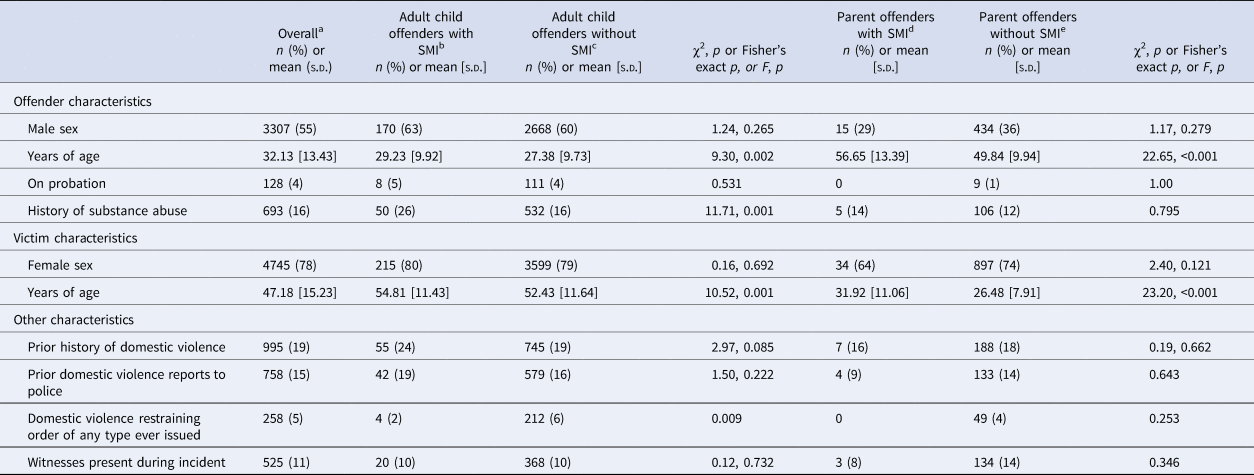
For illustrative purposes, we computed descriptive statistics of offender, victim and other characteristics, overall and by offender serious mental illness status and relationship type, with chi-squared, Fisher's exact, and one-way ANOVA tests (Table 1). Regarding the study's primary aim, variables were conceptualized as follows: predictor variable = offender SMI status; control variables = prior history of domestic violence, victim sex, and offender race/ethnicity, sex, age, history of substance abuse, probation status, and relationship type; outcome variables = offender behaviors during the incident (type of weapon use, threatened, damaged property, and violated protection from abuse order) and victim outcomes (distraught, frightened, complaint of pain, visible injuries, and medical treatment not needed). Bivariate associations between the predictor variable (offender SMI status) and outcome variables were computed with chi-squared, Fisher's exact, and one-way ANOVA tests; multivariate associations were estimated with dichotomous and multinomial logistic regression (Tables 2 and 3). Regarding the study's secondary aim, we used McNemar's χ2 and Exact McNemar's tests for paired nominal data (Table 4). As commonly occurs with administrative data, information was missing for a substantial minority of incidents. In bivariate analyses, when data were missing for a variable of interest, the cases were removed from the analysis. In multivariate analyses, when data were missing for a control variable, a ‘not ascertained’ category was included in analyses (omitted from tables), allowing cases with missing data to be retained. The variance inflation factors (VIF) for all variables included in multivariate analyses were less than 4 and thus considered acceptable (Menard, Reference Menard1995).
Characteristics of adult child-parent incidents, overall and by offender serious mental illness (SMI) status and relationship type

Maximum n (may be fewer due to missing data).
a 6191.
b 274.
c 4624.
d 53.
e 1240.
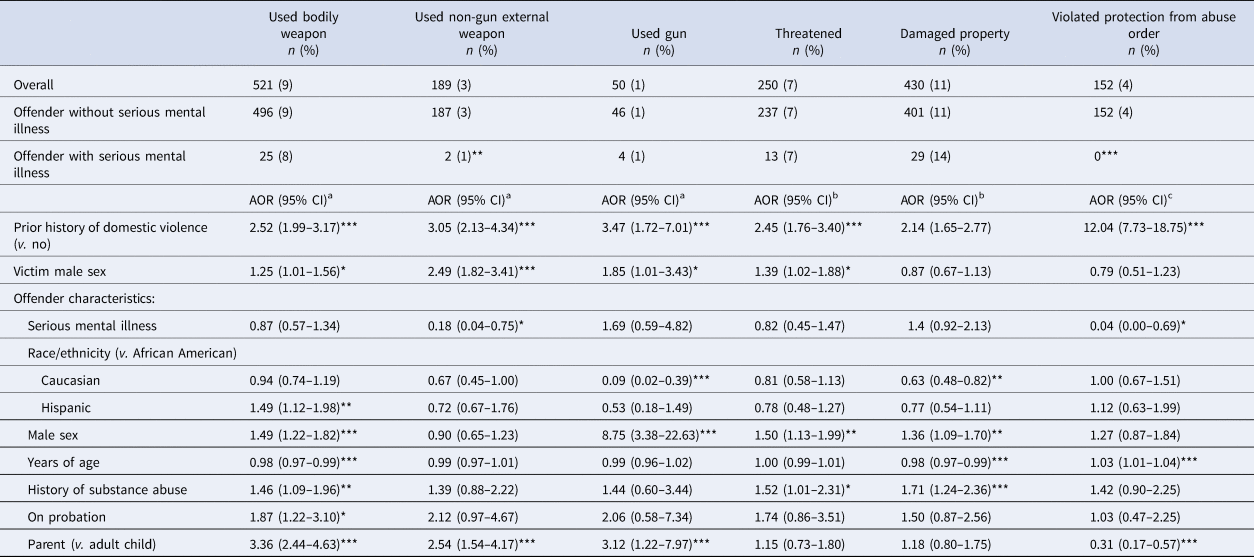
Offender behaviors during the incident: bivariate associations and logistic regression models

AOR, adjusted odds ratio; CI, confidence interval.
Maximum n = 6191, however, may be fewer due to missing data. Bivariate analyses results: Used bodily weapon, χ2 = 0.40, p = 0.529; Used non-gun external weapon, Fisher's exact p = 0.004; Used gun, Fisher's exact p = 0.351; Threatened, χ2 = 0.15, p = 0.702; Damaged property, χ2 = 2.50, p = 0.114; Violated protection from abuse order, Fisher's exact p = 0.001. Multivariate regression models performed:
a Multinomial logistic regression with four categorical groups for the dependent variable – no weapon (reference category), bodily weapon, non-gun external weapon, and gun.
b Separate dichotomous logistic regression models utilizing maximum likelihood estimation.
c Dichotomous logistic regression with Firth logistic regression, utilizing a penalized likelihood estimation method, due to serious mental illness perfectly predicting violated protection from abuse order. To account for missing data, a ‘missing’ category was included for many independent variables in multivariate models.
*p ⩽ 0.05. **p ⩽ 0.01. ***p ⩽ 0.001.
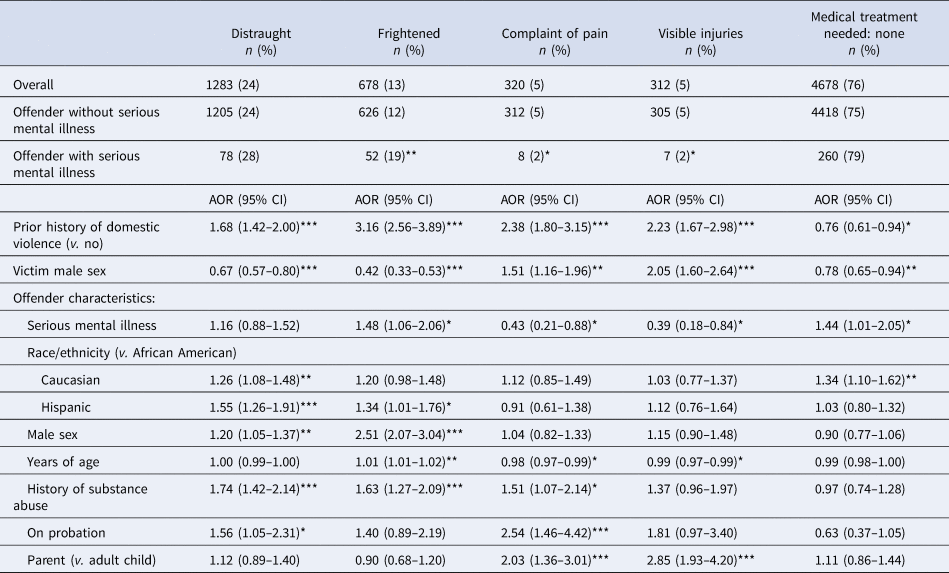
Police observations of victims and need for medical treatment: bivariate associations and logistic regression models

AOR, adjusted odds ratio; CI, confidence interval.
Maximum n = 6191, however, may be fewer due to missing data. Bivariate analyses results: Distraught, χ2 = 2.36, p = 0.125; Frightened, χ2 = 9.54, p = 0.002; Complaint of pain, Fisher's exact p = 0.020; Visible injuries, Fisher's exact p = 0.013; Medical treatment needed: none, χ2 = 2.92, p = 0.088. AOR was computed by conducting separate multivariate dichotomous logistic regression utilizing maximum likelihood estimation, for each dependent variable. To account for missing data, a ‘missing’ category was included for many independent variables in multivariate models.
*p ⩽ 0.05. **p ⩽ 0.01. ***p ⩽ 0.001.
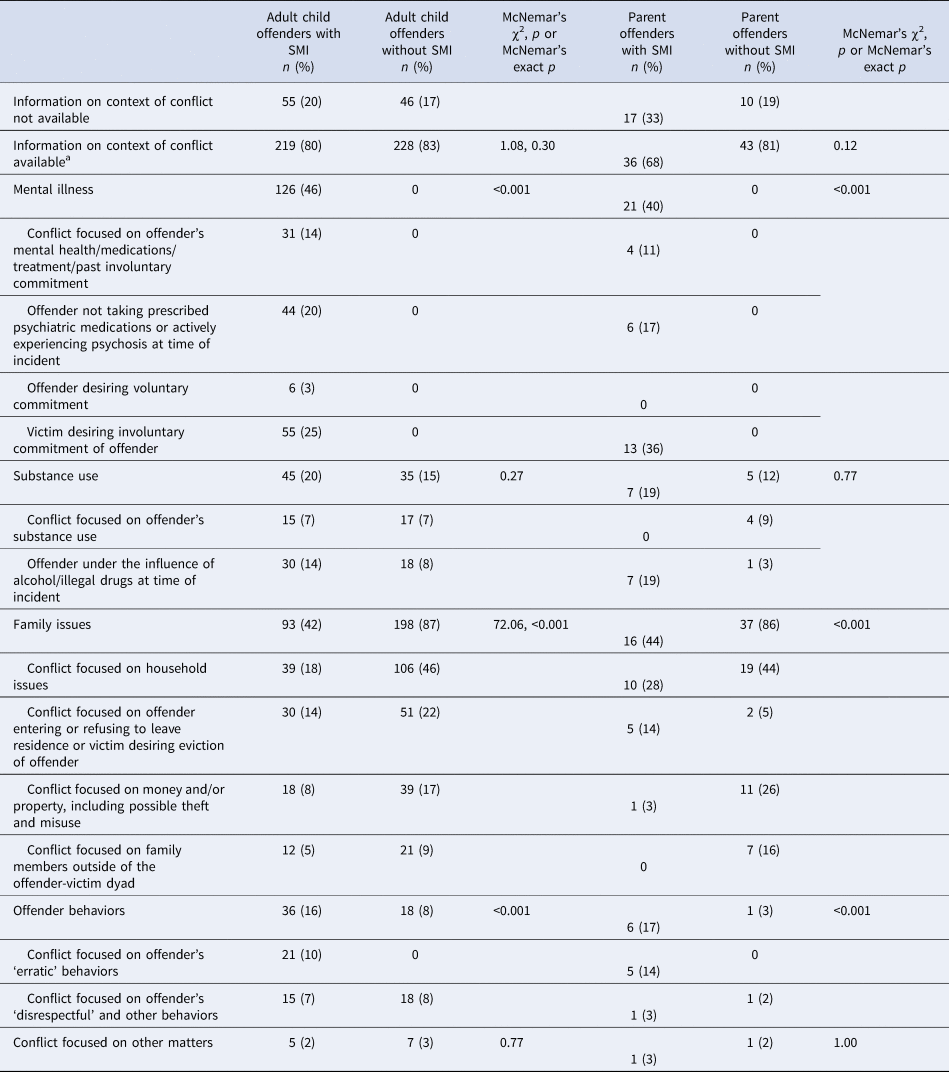
Contextual characteristics of incidents, by offender serious mental illness (SMI) status and relationship type

Incidents with offenders without SMI were matched to incidents with SMI on victim sex, offender relationship type (adult child or parent), offender sex, and type of weapon use (none, bodily weapon, non-gun external weapon, and gun). n: adult child offenders = 274 pairs; parent offenders = 53 pairs.
a Categories pertaining to the context of conflict when information on said context is available are not mutually exclusive.
Results
Two-thirds of offenders were Non-Hispanic African American (n = 3955, 64%), followed by Non-Hispanic Caucasian (n = 1425, 23%), Hispanic of any race (n = 573, 9%), unknown (n = 201, 4%), and Non-Hispanic Asian (n = 37, 0.6%). The race/ethnicity of victims resembled that of offenders being 64% (n = 3986) Non-Hispanic African American, 24% (n = 1470) Non-Hispanic Caucasian, 9% (n = 556) Hispanic of any race, 2% (n = 139) unknown, and 0.6% (n = 40) Non-Hispanic Asian. In 79% (n = 4898) of incidents, the offender was the adult child of the victim. In the remaining incidents (n = 1293, 21%), the offender was the parent of the victim. Of the total, 88% (n = 5431) of incidents involved no weapon (nearly all labelled ‘verbal only’ by officers), 8% (n = 521) involved a bodily weapon, 3% (n = 189) involved a non-gun external weapon, and 0.8% (n = 50) involved a gun. Most offenders were male (55%) and most victims were female (78%). In all, 5% (n = 327) of offenders had SMI, 95% (n = 4624) did not haveSMI, and 16% (n = 693) were reported to have a history of substance abuse. Table 1 presents additional characteristics of incidents. Information regarding specific mental health diagnoses/symptoms was provided in officers' descriptions for 14% (n = 46) of incidents with offenders with SMI. Diagnoses/symptoms of said offenders included bipolar (n = 18, 39%), schizophrenia (n = 14, 30%), psychosis (n = 7, 15%), depression (n = 6, 13%), and post-traumatic stress disorder (n = 1, 2%).
Characteristics of incidents by SMI Status
Table 1 presents characteristics of incidents by offenders' SMI status and relationship type along with results of chi-squared, Fisher's exact, and one-way ANOVA tests. Both adult child and parent offenders with SMI were younger than their counterparts without SMI. Similarly, victims were younger when the adult child and parent offenders had SMI v. did not have SMI. More adult child offenders with SMI had histories of substance abuse than those without SMI. Among adult child offenders, a domestic violence restraining order of any type was less often reported among offenders with v. without SMI. Offenders with SMI were more likely to be adult children (84%, n = 274) than offenders without SMI (79%, n = 4624; χ2 = 4.60, p = 0.033).
SMI Status and offender behaviors
Table 2 reports bivariate and multivariate associations between offenders' SMI status and offender behaviors during the incident. In bivariate and multivariate analyses, when offenders had SMI, they were significantly less likely to have used a non-gun external weapon toward the victim and to have violated a protection from abuse order. Bivariate and multivariate analyses indicate that offenders' SMI status is not associated with remaining offender behaviors (using a bodily weapon or gun toward the victim, threatening, or damaging property).
SMI Status and victim outcomes
Bivariate and multivariate associations between offenders' SMI status and observations of victims and the need for medical treatment made by police officers are presented in Table 3. In bivariate and multivariate analyses, when offenders had SMI, victims were more likely to be observed as frightened. When offenders had SMI, officers were less likely to observe victims as having a complaint of pain or visible injuries and were more likely to indicate that medical treatment was not needed. Offenders' SMI status was not significantly associated with victims being observed as distraught.
Contextual characteristics of incidents
Using the 327 incidents with offenders with SMI and a matched sample of 327 incidents with offenders without SMI, Table 4 presents the contextual characteristics of incidents, by offenders' SMI status and relationship type as well as results of McNemar's and Exact McNemar's tests. Among both adult child and parent offenders, when offenders had SMI, conflict was less likely to focus on family issues and more likely to focus on offenders' behaviors and to involve contextual characteristics related to mental illness. There were no significant differences between offenders with v. without SMI regarding the rates of conflict focusing on other matters or involving contextual characteristics related to offenders' substance use.
Discussion
This is the first population-based study we are aware of examining family aggression by offender SMI status. In 5% of all incidents between adult children and their parents, offenders had SMI. Further, 85% of offenders identified as having SMI in the present analyses appear to have bipolar, schizophrenia, or psychosis-related disorders, resulting in a 4.5% rate among all offenders. In contrast, the lifetime – not current – prevalence rate of such disorders is estimated to be 3.5% (Perälä et al., Reference Perälä, Suvisaari, Saarni, Kuoppasalmi, Isometsä, Pirkola and Härkänen2007). This moderate discrepancy combined with the likelihood that many offenders with SMI were not identified suggests that persons with SMI are modestly more likely to be offenders in adult child-parent incidents to which police are summoned. Such a possibility is supported by studies conducted in Australia indicating that 12% (Short, Thomas, Mullen, & Ogloff, Reference Short, Thomas, Mullen and Ogloff2013) to 25% (Hachtel, Harries, Luebbers, & Ogloff, Reference Hachtel, Harries, Luebbers and Ogloff2018; H. Hachtel, personal communication, 19 June 2019) of persons with schizophrenia spectrum disorders had been the primary perpetrator of family disputes responded to by police.
Prevention of gun and other family violence
In contrast to the above argument that persons with SMI disproportionately present as offenders in adult child-parent incidents, during such incidents offenders with SMI were not more likely to use a bodily weapon or gun, to threaten victims, or to damage property. Notably, offenders with SMI were less likely to use a non-gun external weapon. Likely as a consequence, when offenders had SMI, victims were less likely to have a complaint of pain or visible injuries, with medical treatment more likely to not be needed. Inversely, offender behaviors (use of weapons, threats, and property destruction) were often positively associated with offenders' male gender, younger age, and having a history of substance abuse ordomestic violence. These findings resemble population-based evidence that substance use and criminogenic risk factors predict violence more strongly than schizophrenia or bipolar disorder (Fazel, Gulati, Linsell, Geddes, & Grann, Reference Fazel, Gulati, Linsell, Geddes and Grann2009; Fazel, Lichtenstein, Grann, Goodwin, & Långström, Reference Fazel, Lichtenstein, Grann, Goodwin and Långström2010; Yu, Geddes, & Fazel, Reference Yu, Geddes and Fazel2012). It has been argued that efforts to prevent violence generally (Elbogen, Dennis, & Johnson, Reference Elbogen, Dennis and Johnson2016) and gun violence specifically (Swanson, McGinty, Fazel, & Mays, Reference Swanson, McGinty, Fazel and Mays2015) should target risk factors more strongly associated with violence than SMI. This is the first study we knowof that examined the risk of SMI in relation to gun and other violence against a family member. We believe the results similarly support the importance of violence risk assessments and preventative interventions focusing on offender characteristics beyond SMI.
As an example, only 8% of gun use was by offenders with SMI. Consequently, even under the best of circumstances, it is very unlikely that preventative efforts focusing solely on persons with SMI (e.g. federal and state laws prohibiting persons with SMI from possessing firearms) will effectively reduce gun violence between adult children and their parents – and likely other family members – by even 10%. Alternatively, gun use was 3.5 times more likely to occur when a history of domestic violence was noted, with such history being reported in 39% of incidents involving a gun. These results suggest that preventative efforts focusing on persons with prior histories of violence have the possibility of being more effective in decreasing gun use against parents or adult children than those focusing on persons with SMI. Providing support that such preventative efforts could be effective, there is evidence that laws prohibiting the possession of firearms by persons with restraining orders (Bridges, Tatum, & Kunselman, Reference Bridges, Tatum and Kunselman2008) or convictions of misdemeanor charges of domestic violence (Raissian, Reference Raissian2016) decrease homicide of non-intimate partner family members.
Prevention of family aggression by persons with SMI
The majority of incidents with offenders with and without SMI were verbal disputes with offenders not using a bodily or external weapon toward the victim. This finding is consistent with previous research that verbal/psychological abuse is considerably more common than physical violence, both among persons with SMI (Kageyama et al., Reference Kageyama, Solomon, Kita, Nagata, Yokoyama, Nakamura and Fujii2016a; Labrum, Reference Labrum2017) and the general population (Breiding et al., Reference Breiding, Smith, Basile, Walters, Chen and Merrick2014; Simmons, McEwan, Purcell, & Ogloff, Reference Simmons, McEwan, Purcell and Ogloff2018). It is imperative that practitioners prevent and intervene in cases of verbal, as well as physical aggression by persons with SMI toward family members. While physical aggression may pose unique risks to victims such as physical injuries and death, verbal as well as physical aggression has deleterious impacts on victims' psychological wellbeing and quality of life (for a review see Onwumere, Zhou, and Kuipers, Reference Onwumere, Zhou and Kuipers2018). Additionally, intervening in verbal aggression may prevent violence, as verbal family aggression by persons with SMI is associated with and temporally precedes acts of violence (Hachtel et al., Reference Hachtel, Harries, Luebbers and Ogloff2018).
Based on previous research (described in Introduction) and results of the present study, aggressive behaviors toward family members are positively associated with younger age, substance use, and prior history of violence and criminal justice involvement. Practitioners should thoroughly assess the risk of aggressive behaviors when such attributes are present among persons with SMI. Prior history of domestic violence and offenders being on probation were reported at similar rates between offenders with and without SMI. Among adult child offenders, those indicated to have SMI were more likely to have a history of substance abuse. These findings support that in attempting to accurately assess the risk of family aggression and prevent aggressive acts, criminogenic factors and substance use should be addressed, at least as much regarding persons with SMI as those without SMI.
This is one of the first studies to utilize an event perspective, describing and comparing the immediate contextual characteristics of incidents with offenders with and without SMI. Offenders' substance use was involved in the context of 12–20% of incidents, with rates not differing significantly between offenders with and without SMI. The presence of substance use conditions/histories is known to increase the risk of violence by persons with SMI and the general population (Elbogen et al., Reference Elbogen, Dennis and Johnson2016; Fazel et al., Reference Fazel, Gulati, Linsell, Geddes and Grann2009). Findings of the present study indicate that many persons are under the influence of drugs and alcohol when engaging in aggressive behaviors toward family members. The connection between substance use conditions/histories and aggressive behaviors may be partly explained by increased hostile attributions and disinhibition of aggressive behaviors resulting from substance use (Clements & Schumacher, Reference Clements and Schumacher2010; Eckhardt, Parrott, & Sprunger, Reference Eckhardt, Parrott and Sprunger2015). Additionally, persons with substance use conditions/histories may be more likely to act aggressively toward family members as a result of family discord regarding their use of substances. These results underscore the importance of interventions supporting sobriety among persons at risk of aggressive behaviors and assisting persons who use substances and their family members in navigating conversations regarding substance use without escalating conflict.
Rates of other contextual characteristics were substantially different between offenders with and without SMI. While the vast majority of incidents with offenders without SMI focused on household issues, entering/refusing to leave the residence, money/property, or family members outside of the victim-offender dyad, less than half of incidents with offenders with SMI focused on such matters. Instead, among incidents with offenders with SMI, the context of conflict was more likely to include factors related to mental illness and offender behaviors. In approximately 20% of incidents with offenders with SMI, the offender was noted to either not be taking psychiatric medications or to actively be experiencing psychosis with at least 25% of victims desiring involuntary commitment of the offender and a few offenders wanting voluntary commitment. It is likely that offenders were experiencing considerable psychiatric symptoms at the time of the incident, which may have contributed to aggressive behaviors by offenders. The risk of violence by persons with schizophrenia is moderately associated with the level of psychotic symptoms (Witt, Van Dorn, & Fazel, Reference Witt, Van Dorn and Fazel2013), with such symptoms playing a larger role in violence against family members than non-family members (Joyal, Côté, Meloche, & Hodgins, Reference Joyal, Côté, Meloche and Hodgins2011). Additionally, the risk of family violence is two-fold when persons with SMI are not taking prescribed psychiatric medications nor attending mental health treatment (Labrum & Solomon, Reference Labrum and Solomon2016). These findings and those of the present study support the potential impact of adherence to psychiatric medications and treatment in specifically decreasing family conflict and aggression by persons with SMI.
Lastly, family members often supervise persons with SMI and attempt to modify treatment-related and a range of other behaviors (Labrum, Walk, & Solomon, Reference Labrum, Walk and Solomon2016; Tessler & Gamache, Reference Tessler and Gamache2000). In more than 10% of incidents with offenders with SMI, conflict was reported to be focused on the mental health and treatment of offenders, including medication use, treatment involvement, and concerns regarding psychiatric symptoms. Similarly, conflict in incidents with offenders with SMI was significantly more likely to be focused on the offender's behaviors, with 11% of incidents being focused on ‘erratic’ behaviors. The use of limit-setting practices by family members has been identified as a risk factor for aggression (Ahn et al., Reference Ahn, Kim, Oh, Choi, Ahn and Kim2012; Labrum & Solomon, Reference Labrum and Solomon2016). The results of the present study provide more immediate evidence that attempting to modify behaviors of persons with SMI is indeed involved in aggressive acts. Efforts to decrease family aggression by persons with SMI requires educating family members that aggression often occurs in the context of attempting to modify treatment-related, erratic, and other behaviors of persons with SMI. Additionally, interventions should assist family members in prioritizing circumstances in which to set limits (e.g. those jeopardizing safety) and in strengthening communication and problem-solving skills to decrease the likelihood that setting limits will escalate conflict.
Strengths and limitations
The present study examined all incidents of aggression between adult children and their parents, to which the police were summoned, in the fifth most populous city in the USA in 2013. Strengths of the study are that it utilizes a population-based design with the data having considerable diversity regarding race/ethnicity and likely treatment involvement of offenders with SMI. Additionally, this is one of the first studies to utilize an event perspective of acts of family aggression by persons with SMI or to directly compare family aggression by persons with v.without SMI. Limitations of the study are that all information was recorded by officers and the accuracy of their reporting was not able to be verified. The only US-based study we know of directly examining the accuracy of officers' assessments of SMI found their assessments to be in agreement with those of clinicians in 97% of cases, with no cases of false positives being made by officers (Teplin, Reference Teplin1984). When available, officers consider information provided by relatives on the scene to be particularly helpful in assessing for mental illness (Bohrman, Blank Wilson, Watson, & Draine, Reference Bohrman, Blank Wilson, Watson and Draine2018). In the present analyses, family members (most commonly victims) were on the scene in nearly all cases and likely provided information regarding offenders' SMI status, strengthening the accuracy of officers' reporting. Despite officers using broad terms when describing offenders whom they consider to have a mental illness, their assessments of mental illness overwhelmingly pertain to severe symptoms – i.e. psychosis or mania (Bohrman et al., Reference Bohrman, Blank Wilson, Watson and Draine2018). Providing support that the vast majority of offenders classified in the present analyses as having SMI do have SMI (as opposed to more moderate mental illnesses), among offenders with SMI in which a diagnosis was included in the officer's description, 85% were reported to have bipolar or a psychotic disorder. Providing general support for the accuracy of the data used, the findings of the present study are in agreement with previous studies on this and proximal topics (described above). Despite employing a large number of incidents, some of the outcome variables occurred in small numbers among incidents with offenders with SMI (e.g. 0 and 4 offenders with SMI were reported to have violated a protection from abuse order or to have used a non-gun external weapon, respectively). As such, the findings should be interpreted with caution. Persons with SMI are often victims of violence by family members and others (Dean et al., Reference Dean, Laursen, Pedersen, Webb, Mortensen and Agerbo2018; Labrum et al., Reference Labrum, Solomon and Marcus2020). An additional limitation of the present study is its inability to examine victims of family aggression with SMI. Unfortunately, officers' descriptions rarely provided information about victims, precluding the identification of victims with SMI.
Acknowledgements
The authors are grateful to the Philadelphia Police Department for providing access to the data, to Susan B. Sorenson, PhD, Professor of Social Policy, University of Pennsylvania, for her guidance of this project, and to Rebecca Schut, University of Pennsylvania, for her time spent coding related data.
Conflict of interest
None.